
Sendlane vs Klaviyo vs Maestra: 12 Features Compared [2026]

If you’re choosing an email platform for a Shopify store, Sendlane and Klaviyo are likely both on your list. They’re hard to compare because they charge for different things. Klaviyo charges for the contacts you can email, while Sendlane charges for the emails you send.
Beyond price, they differ in what comes included. Sendlane gives you product reviews and deliverability monitoring at no extra cost, while Klaviyo has the bigger library of templates and integrations.
The comparison below covers both, plus Maestra, across 12 categories, from email and SMS to support and pricing.
Quick Verdict – Choosing Between Sendlane, Klaviyo, and Maestra
Choose Sendlane if your contact list is far bigger than your monthly send volume. Choose Klaviyo if you want email and SMS with mobile push, WhatsApp, and the largest integration catalog on top. Choose Maestra if you want email, SMS, loyalty and on-site personalization to work as one program instead of four tools you wire together yourself.
Sendlane starts at $100/mo for 50,000 sends with unlimited contacts. Klaviyo starts at $20/mo and climbs with every contact you could email. Maestra starts at $2,000/mo with the first 100,000 active profiles included.
Comparison Summary
| Feature | Sendlane | Klaviyo | Maestra |
|---|---|---|---|
| ⭐⭐⭐⭐ Unlimited contacts, send-metered; builder covers the basics well | 🏆 ⭐⭐⭐⭐⭐ Prebuilt flows and templates that get a program live the same day | 🏆 ⭐⭐⭐⭐⭐ Unlimited sends, advanced builder, personalized templates built for you | |
| SMS | ⭐⭐⭐ US, Canada, and Puerto Rico only; two-way Reply Center | 🏆 ⭐⭐⭐⭐⭐ US, Canada, UK, Australia, New Zealand, EU; RCS and WhatsApp alongside | 🏆 ⭐⭐⭐⭐⭐ SMS, MMS, and RCS worldwide, WhatsApp alongside; one daily cap across channels |
| Omnichannel Flows | ⭐⭐⭐ Email and SMS steps, 50+ prebuilt funnels | ⭐⭐⭐⭐ Email, SMS, push, and WhatsApp in one builder with conditional splits | 🏆 ⭐⭐⭐⭐⭐ One flow also changes site content, syncs ad audiences, and awards loyalty points |
| Customer Data & Segmentation | ⭐⭐⭐ 100+ real-time data points; reliability is the recurring complaint | ⭐⭐⭐⭐ Strong marketing profile; the advanced data platform is a $500/mo add-on | 🏆 ⭐⭐⭐⭐⭐ Real-time CDP in every plan, with granular segmentation: nested segments, RFM, computed fields |
| Popups & List Growth | ⭐⭐⭐⭐ Multi-step forms with targeting rules, no extra charge | 🏆 ⭐⭐⭐⭐⭐ Web forms from the free plan, AI-optimized display timing | ⭐⭐⭐⭐ Lead-capture popups, quizzes, and gamified forms |
| Deliverability | 🏆 ⭐⭐⭐⭐⭐ Proactive monitoring on every plan, in-house team, optional dedicated IP | ⭐⭐⭐ Shared pool by default; the deliverability strategist sits in paid support tiers | 🏆 ⭐⭐⭐⭐⭐ Email Health monitoring, dedicated IPs, a marketer who owns deliverability |
| Product Recommendations | ⭐⭐⭐ In email and SMS, driven by the product catalog | ⭐⭐⭐⭐ In messages and on site; real-time models cost extra | 🏆 ⭐⭐⭐⭐⭐ Site, app, every message channel, and in-store POS; 14 engines in every plan |
| Loyalty | ⭐⭐ Partner apps only – Smile.io and Rivo | ⭐⭐ Partner apps only | 🏆 ⭐⭐⭐⭐⭐ Built-in loyalty: points, cashback, referrals, and tiers that show up in emails, texts, and on the site |
| Reporting & Attribution | ⭐⭐ Email and SMS dashboards; reviewers question the numbers | ⭐⭐⭐⭐ Strong dashboards and benchmarks; predictive layers are add-ons | 🏆 ⭐⭐⭐⭐⭐ Dedicated reports from campaigns and segments to subscribers and loyalty; control groups, raw export, every plan |
| Support & Onboarding | ⭐⭐⭐⭐ Round-the-clock chat, dedicated CSM from 10,000 contacts – on an annual contract | ⭐⭐ Standard support included; faster response costs $500 or $1,800/mo | 🏆 ⭐⭐⭐⭐⭐ A marketer on your account who builds the flows: weekly calls, shared Slack, every plan |
| Shopify, BigCommerce & Integrations | ⭐⭐⭐ Around 25 native connectors, plus Zapier; Shopify and WooCommerce in practice | 🏆 ⭐⭐⭐⭐⭐ 350+ ready-made integrations, any e-commerce platform | 🏆 ⭐⭐⭐⭐⭐ 150+ native integrations, the rest built for you at no extra cost |
| Pricing | $ Cheapest bill for large lists; annual contract to unlock the service | $$ Cheapest entry; the meter tracks list size, and sends are capped at 10× profiles | $$ From $2,000/mo; replaces several subscriptions and includes a dedicated marketer |
Sendlane vs Klaviyo vs Maestra: Email
Email winner: Klaviyo for its template library and self-serve speed, Maestra for emails that pull in loyalty points, regional promos, and recommendations from every channel.
| Sendlane | Klaviyo | Maestra |
|---|---|---|
| ⭐⭐⭐⭐ Unlimited contacts, metered by sends | 🏆 ⭐⭐⭐⭐⭐ Prebuilt flows, templates, AI agents | 🏆 ⭐⭐⭐⭐⭐ Advanced builder, unlimited sends, personalized templates |
Sendlane: Unlimited Contacts, Metered by Sends
Sendlane’s email product is built around one promise: the size of your list never changes the bill. Contacts are unlimited on every plan, and you pay for the volume you send. For a brand sitting on years of accumulated subscribers, that is the whole pitch, and it holds up.
The builder itself is competent rather than remarkable. Drag-and-drop layout blocks, a Shopify product element, plain-text and HTML modes, and a library of prebuilt templates cover normal campaign work. Reviewers who like Sendlane consistently say it is quick to learn, and for a small team that is the point.
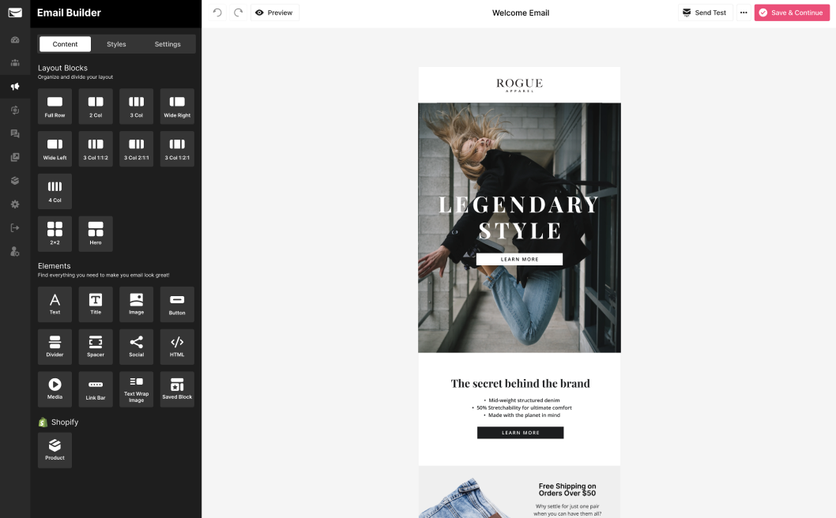
Sendlane’s email builder with layout blocks and a Shopify product element
The ceiling shows up when a brand wants the email to sell rather than announce. Blue Q, a gift-goods brand with 300,000 email contacts, spent two years on Sendlane before moving. Head of Marketing Noah Cook-Dubin described the result as “basically treading water, struggling to evolve our very basic email marketing program in meaningful ways.”
Klaviyo: Prebuilt Flows and the Largest Template Library
Klaviyo is where most DTC email programs live, and the product shows it. Automated flows, a large template library, predictive analytics, and the K:AI suite all sit on the email side first. Composer, the AI marketing agent, audits your flows, segments, and forms and drafts a full campaign from one prompt. It is sold separately from $20/month, with extra usage bought in $10 increments.
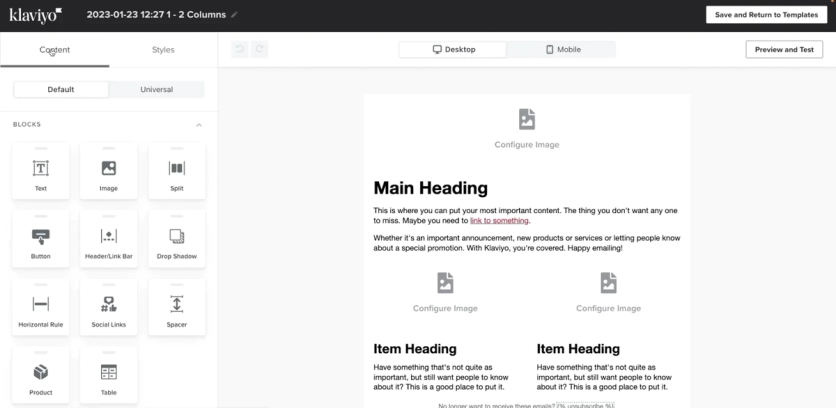
Klaviyo’s drag-and-drop email editor: ready blocks for text, images, buttons, and products, with a desktop and mobile preview
The mechanic buyers miss is the send cap. Every Klaviyo email tier allows exactly ten emails per active profile per month – 500 profiles buys 5,000 sends, 50,000 profiles buys 500,000. A brand that emails its list three times a week will cross that ceiling and have to buy a larger profile tier, even though the list hasn’t grown by a single subscriber.
Email goes out over shared sending infrastructure unless you buy your way off it, and that infrastructure can strain under load. One merchant documented two Black Friday campaigns in which “a shared IP ban caused 22.5 and 60% of my emails to bounce.”
Maestra: Unlimited Sends and Personalized Templates
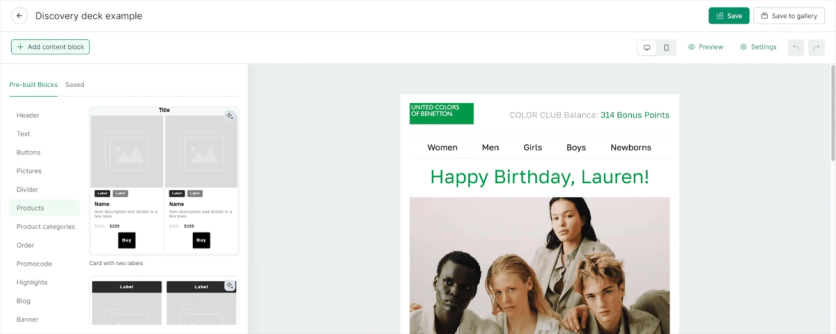
Maestra’s email composer: pre-built blocks for products, promo codes, highlights, and orders on the left, the re
Maestra prices email as a monthly module with unlimited sends, so neither list growth nor send frequency changes the email line on the invoice. The builder handles drag-and-drop, custom HTML blocks, dynamic content, and AMP for Email, and sending speed is adjustable up to high-throughput mode.
Maestra’s MCP connector also lets an AI assistant like Claude or ChatGPT build an email in the visual editor from a prompt, a Figma mockup, or a screenshot. It saves as a draft, and nothing sends until someone on your team approves it.
What Blue Q credits isn’t the editor, though. It’s what got built in it. Maestra’s marketer worked with the brand to turn its artwork-led emails into personalized templates: free-shipping and returns bars, category navigation, countdown timers, and product recommendations that show live prices and an add-to-cart button.
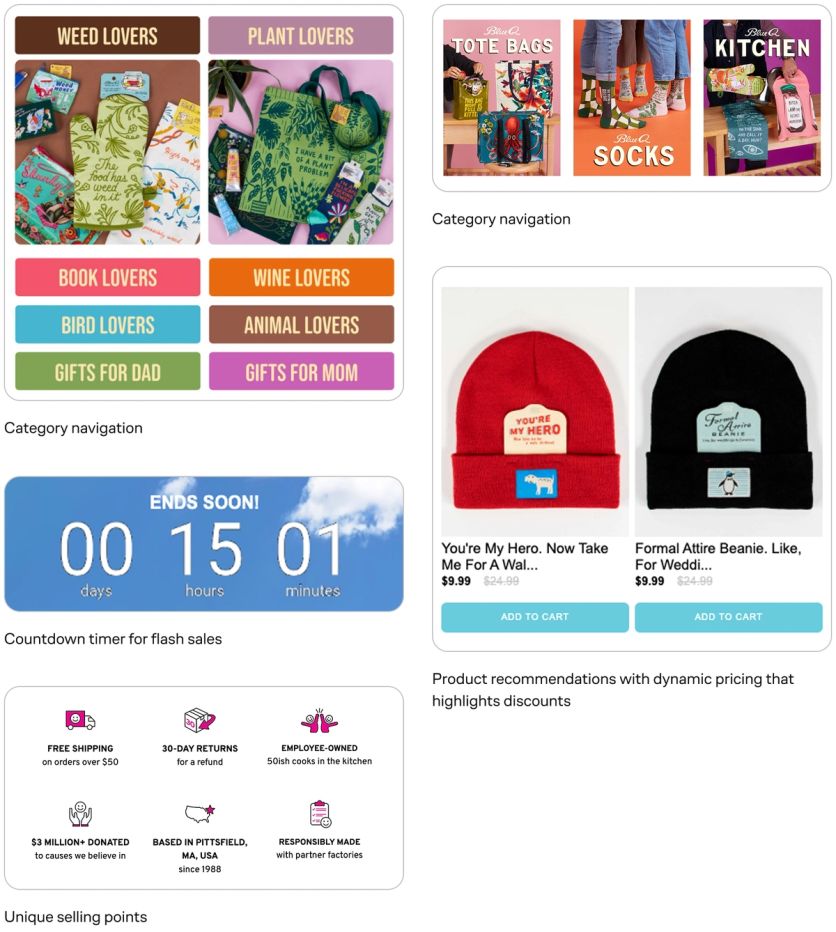
The selling blocks Blue Q now drops into every campaign: category navigation, countdown timers, trust bars, and recommendations with live sale prices
Because email, SMS, the site, and loyalty all feed one customer profile, an email can pull in almost anything from any channel: the reader’s points balance, the promotion running in their region, or a last-chance reminder with recommendations in their size. The same data picks the offer. A loyal repeat buyer gets a referral code to bring a friend, while a customer who’s drifting away gets a discount to come back. The message also carries from one channel to the next. At German Kabirski, a shopper who clicks through an email with a promo code finds the same code in a banner on the site, ready to copy at checkout. Sendlane and Klaviyo need a separate loyalty app for the points, and another tool to show that code on the site.
Two Klaviyo switchers show the same thing from a different angle. Coolibar grew revenue from email and SMS campaigns 33.6% year over year within two months of moving to Maestra, with flow revenue up 62%, and Sena consolidated two Klaviyo accounts into one workspace and grew total revenue 2.2x.
Takeaway: If your email program is campaigns and templates, Klaviyo’s head start is real and Sendlane’s send-metered version of it costs less. The gap opens when the emails have to sell, with product recommendations, live prices and countdown timers, and when somebody has to build them. Maestra is built for that second case: emails that pull data from every channel, and a marketer who builds them. That is what the higher price pays for.
Sendlane vs Klaviyo vs Maestra: SMS
SMS winner: Klaviyo and Maestra – both text customers in the US, Canada, and abroad, with RCS and WhatsApp next to SMS, while Sendlane stops at the US, Canada, and Puerto Rico.
| Sendlane | Klaviyo | Maestra |
|---|---|---|
| ⭐⭐⭐ US, Canada, Puerto Rico; two-way Reply Center | 🏆 ⭐⭐⭐⭐⭐ Six regions, RCS, WhatsApp, Compliance Hub | 🏆 ⭐⭐⭐⭐⭐ Worldwide SMS, MMS, RCS; WhatsApp alongside |
Sendlane: Two-Way Texting, US and Canada Only
Sendlane sells SMS as the second half of a pair rather than a product of its own. Texts and emails share the same contact record, the same segments, and the same automations, which is the cleanest thing about it. Two-Way Reply gives agents a conversational inbox, and the Reply Center shows the contact’s lifetime value, order history, and campaign conversions next to the thread.
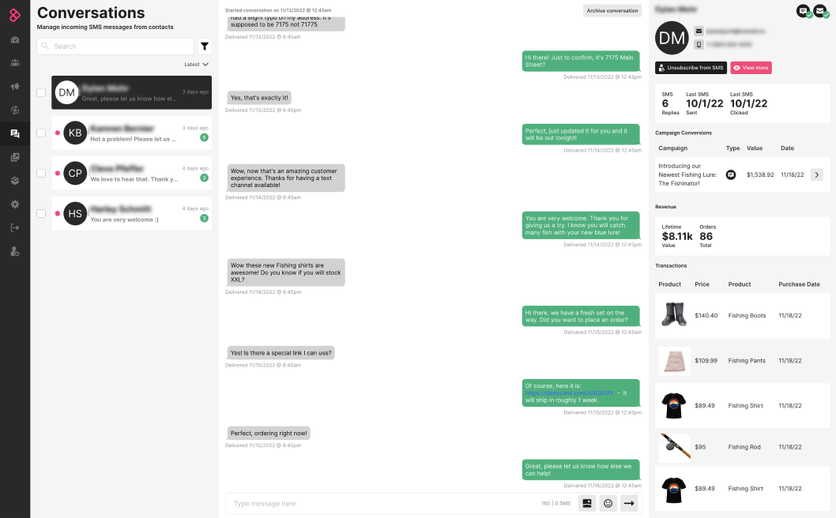
Sendlane’s Conversations inbox with the contact’s revenue and order history alongside the thread
Geography is the hard limit. Sendlane’s own documentation puts short codes in the United States and Canada, and toll-free numbers in the United States, Canada, and Puerto Rico. Sell to the UK or the EU and SMS simply isn’t available to you. The same documentation warns that number registration “currently takes up to 4 weeks,” so an SMS launch needs to start a month before the campaign it is meant to support.
Pricing is refreshingly plain: from $0.009 per credit with carrier fees already included, one credit per message, a $10 monthly activation, and à-la-carte packs from 250 credits at $6.25. Annual customers are currently offered Direct Rate SMS, described as cost-plus pricing with savings of up to 70% when moving both email and SMS across.
Klaviyo: Six Regions, Plus RCS and WhatsApp
Klaviyo supports SMS in the United States, Canada, the United Kingdom, Australia, New Zealand, and the European Union, with Mexico at international rates. Number types, MMS availability, and compliance rules vary by country, and the help center is specific about it: MMS is unavailable across Europe and New Zealand, and New Zealand is short-code only.
Next to SMS, Klaviyo runs RCS for Business and WhatsApp as separate channels in the same builder. Automated SMS Conversations handle FAQs and preference-gathering without an agent. The K:AI Customer Agent runs conversational selling and resolves 65% of questions autonomously. Compliance Hub monitors consent health and flags issues before carriers do.
Mobile messages are billed by volume – US toll-free SMS runs at $0.01 per send with carrier fees bundled in, and the pricing page quotes $15 for 1,000 messages.
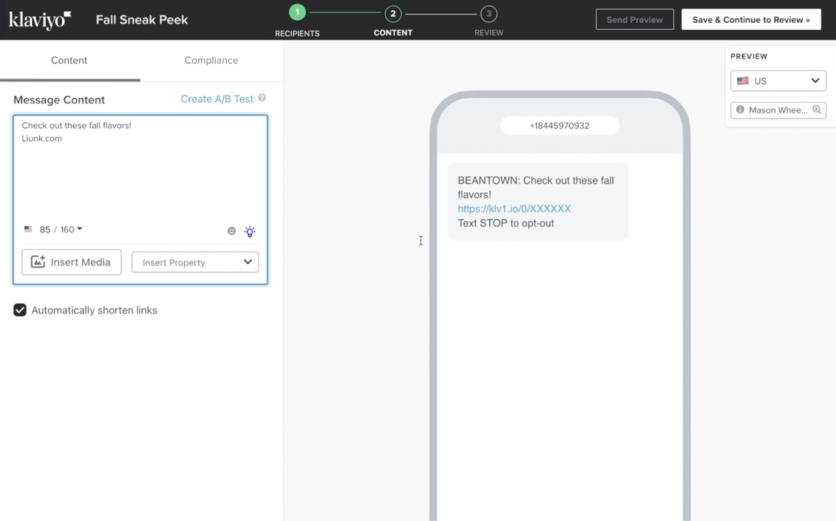
Klaviyo’s SMS composer with the compliance tab, character counter, and a live US phone preview
Maestra: Texts as a Step in the Same Flow
In Maestra, a text is one more step in the same flow as the email, the push, and the site banner. A daily cap covers every channel at once, so you can hold a shopper to, say, two emails and five texts a day. Short codes, 10DLC, and toll-free numbers are supported, and texts go to the US, Canada, and other countries. RCS runs in the same module, and WhatsApp is its own module. US texts start at $0.0035 per SMS plus carrier fees.
Opt-in takes one tap on mobile with Tap-to-Text, with no keyword to type. Maestra also recognizes the same shopper across devices. A cart filled on a laptop comes back in the abandoned-cart text on their phone, still full.
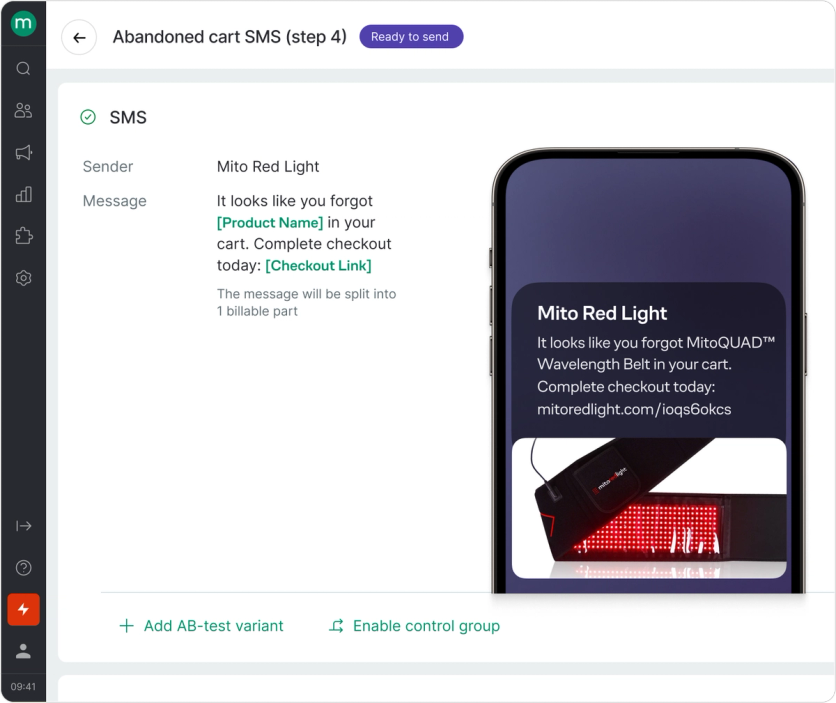
An abandoned-cart SMS step in Maestra: product variables, a live phone preview, and controls to add an A/B varia
Selkirk Sport grew SMS-attributed revenue 149% year over year after moving off Bloomreach, with buyers and partner audiences finally sitting in one platform instead of separate tools.
Takeaway: If you sell outside the US and Canada, Sendlane is out, because it can’t text those customers at all. Klaviyo and Maestra both can, with RCS and WhatsApp alongside. Klaviyo adds an AI agent that answers shoppers’ replies. Maestra puts the text in the same flow as the site banner and the loyalty balance.
Sendlane vs Klaviyo vs Maestra: Omnichannel Flows
Flows winner: Maestra – the only builder here where one flow can also change what the customer sees on the website and award them loyalty points.
| Sendlane | Klaviyo | Maestra |
|---|---|---|
| ⭐⭐⭐ Email and SMS steps, 50+ prebuilt funnels | ⭐⭐⭐⭐ Email, SMS, push, WhatsApp, conditional splits | 🏆 ⭐⭐⭐⭐⭐ Messaging, on-site, ads, and loyalty in one flow |
Sendlane: 50+ Prebuilt Funnels, Email and SMS Steps
Sendlane ships more than 50 prebuilt funnels – welcome, cart recovery, back-in-stock, review requests – and the builder lets you add, remove, or split-test nodes without duplicating the whole automation. Each step displays its own sends, open rate, click rate, and attributed revenue on the canvas, which makes performance obvious at a glance.
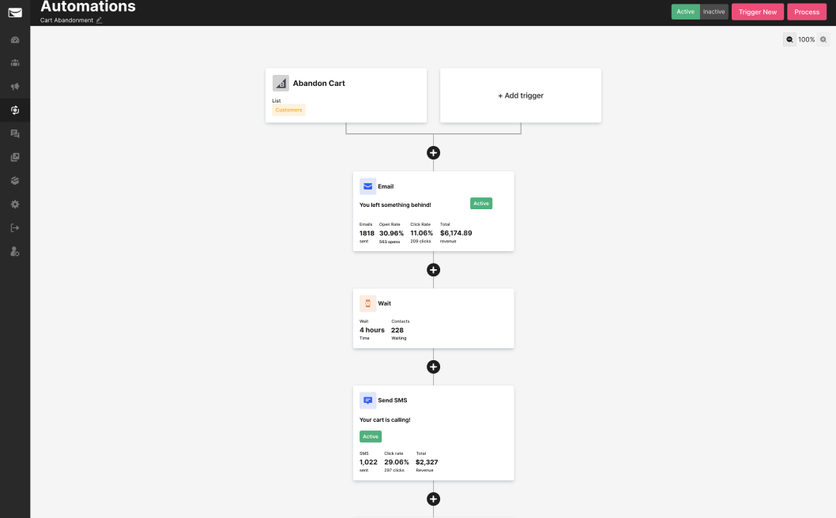
Sendlane’s cart-abandonment automation showing sends, click rate, and revenue on each step
Every step is an email or a text. Sendlane’s product list runs to four items – email, SMS, reviews, and forms – so a journey that needs a push notification, a WhatsApp message, or a change to the website has to leave the platform.
The limit brands hit first is usually strategic rather than technical. Blue Q ran exactly two flows on Sendlane, welcome and abandoned checkout, for two years. Nothing in the product stopped them building more. Nobody on the vendor side pushed them to.
Klaviyo: Four Channels in One Canvas
Klaviyo’s flows mix email, SMS, mobile push, and WhatsApp steps in one canvas with conditional splits and trigger splits. An abandoned-checkout flow can branch on cart value and send a different sequence to each branch, all reported in one place. For a brand that wants several channels without several logins, this is the strongest argument against a specialist tool.
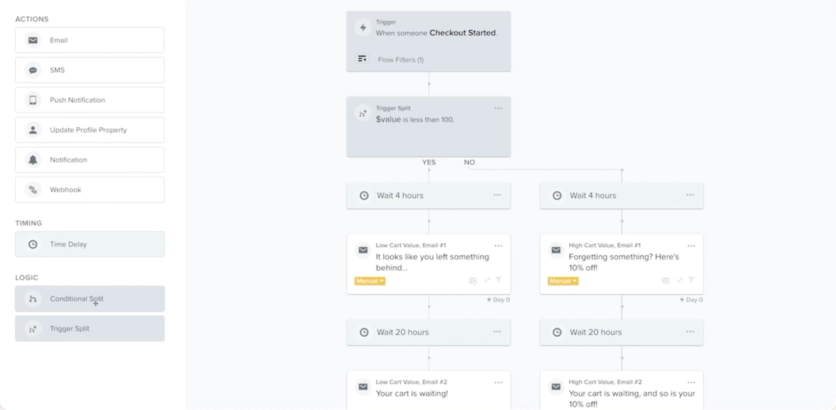
Klaviyo’s flow builder splits one abandoned-checkout flow by cart value, so only high-value carts get the 10% offer
Klaviyo’s answer to that curve is the prebuilt library. Flow templates for welcome, browse abandonment, back-in-stock, and post-purchase can be switched on and edited the same day, which is a large part of why a small team can have a working program by the end of the week. Smart Send Time picks the hour per subscriber, and channel affinity decides which channel each person hears from.
Composer sits above all of it. Given a prompt, the agent audits your existing flows, segments, and forms, then drafts a campaign against whichever gap it found. It is a genuinely different way to work, and it is also a separate line on the invoice.
Reviewers consistently describe a learning curve underneath the templates. Advanced flows and large segment libraries are where new users say the platform gets hard to hold in your head, and where Klaviyo agencies start earning their retainers.
Maestra: Flows That Also Change the Website
Everything the other two do is here too: email and SMS steps, conditional splits, A/B tests, mobile push and WhatsApp. On top of that, Maestra’s flow builder reaches surfaces the other two treat as separate products. One abandoned-cart flow can send an email, branch on cart value, follow with a push and a text, change the banner the shopper sees when they return, add them to a paid-media audience, and award loyalty points on purchase.
A dedicated marketer on your account builds these flows for you and keeps tuning them after launch.
Flows work with AI assistants too. Through Maestra’s MCP connector, Claude or ChatGPT can audit your flows against last month and last year, or build a new one from a plain-language brief.
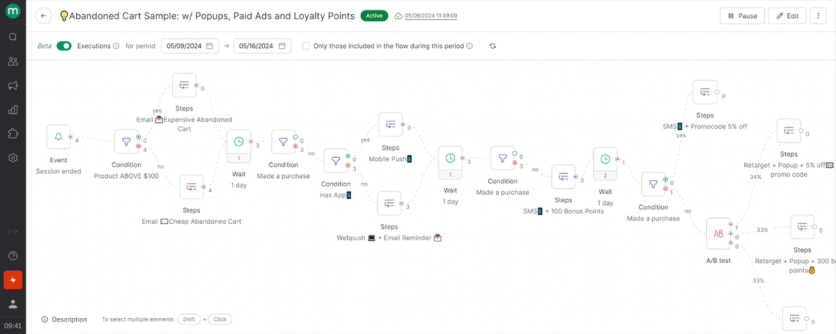
A Maestra abandoned-cart flow combining email, mobile push, web push, SMS, loyalty points, retargeting, and an A
Magnum Bikes moved from Klaviyo to Maestra and ran its anniversary sale as one coordinated push across email, SMS, and the site, growing online order volume 111.7% and online revenue 56.6% year over year. JOLYN launched Price Drop Alert and Low Stock flows that weren’t possible on Klaviyo, and campaign-driven revenue grew 26% year over year with SMS revenue up 52%.
Takeaway: Count the surfaces your best-performing flow needs to touch. Two of them, email and SMS, and Sendlane covers it. Four messaging channels, and Klaviyo does. A flow that also changes the website, feeds an ad audience, and awards points is the one none of them reach except Maestra.
Sendlane vs Klaviyo vs Maestra: Customer Data & Segmentation
Customer data winner: Maestra – the real-time customer data platform is the base of every plan rather than an upgrade or a synced copy.
| Sendlane | Klaviyo | Maestra |
|---|---|---|
| ⭐⭐⭐ 100+ data points, real-time; reliability complaints | ⭐⭐⭐⭐ Strong profile; advanced data platform is $500/mo extra | 🏆 ⭐⭐⭐⭐⭐ Real-time CDP in the base; nested segments, RFM, computed fields |
Sendlane: 100+ Data Points, Stacked Exclusions
Sendlane’s Multivariable Segmentation offers more than 100 real-time data points – purchase behavior, browse activity, predicted lifetime value – combined with and/or conditions in a visual builder. Sendlane Beacon supplies the browsing side, tracking page views, sign-ups, purchases, and cart abandonment, and feeding those events straight into segments and automations.
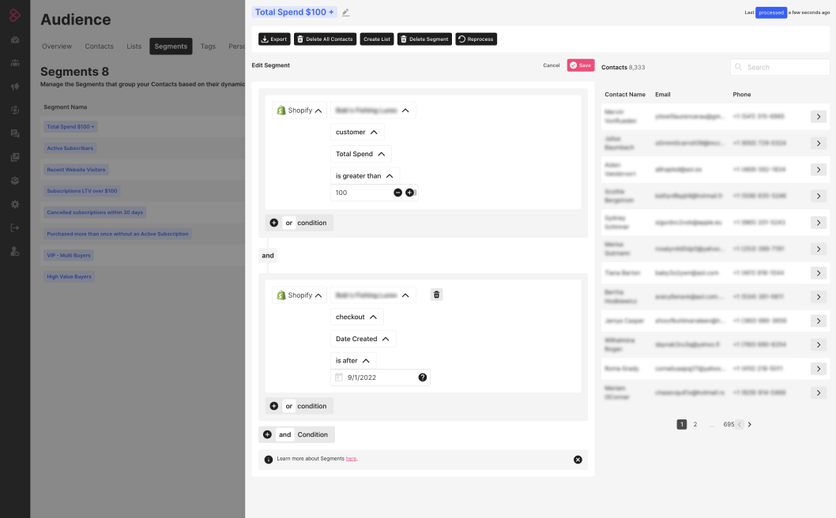
Segment builder in Sendlane combining Shopify conditions with and/or logic
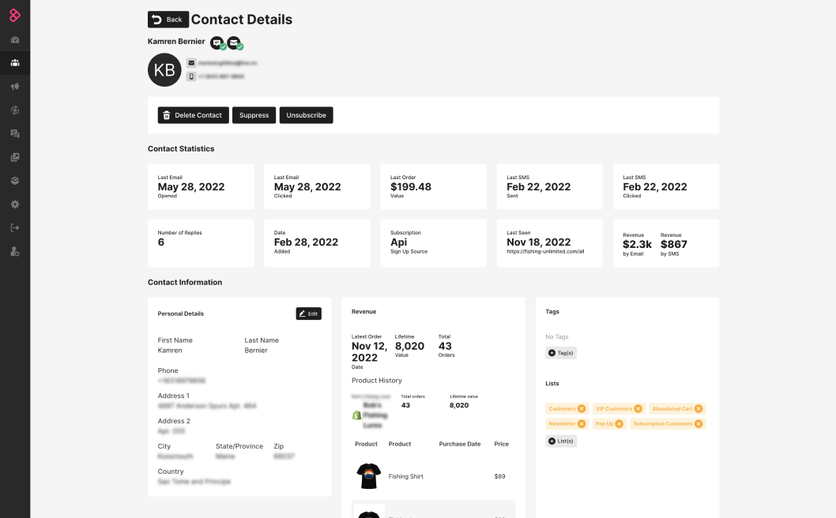
A contact record in Sendlane: email and SMS activity dates, lifetime value, order history, tags, and list member
The complaint that recurs most often is not about what the segmentation can express, but whether it holds. Blue Q’s marketing lead put it bluntly: “We often ran into issues with segmentation, and found ourselves stacking exclusions as a failsafe for the unreliable segmentation.” In practice that meant six segments and six exclusions on a single send. A November 2024 Shopify App Store reviewer reported a related problem with the tracking layer: “The beacon fails regularly... I can see on my pixel orders from Sendlane email referrers, but dashboard in Sendlane says $0 in revenue.”
Klaviyo: Strong Profile, Paid Data Platform
The Klaviyo Data Platform holds unified lifetime profiles with real-time segmentation and predictive analytics, and every paid plan gets it. The segment builder is the one most e-commerce marketers already know, and it reaches any event the connected apps deliver.
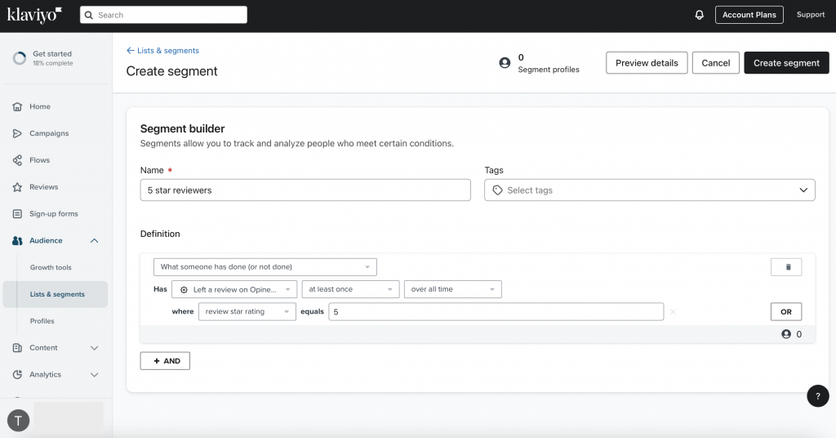
Creating a segment in Klaviyo from review and behavioral conditions
What the base gives you is the profile itself: purchase history, browsing, engagement, and predictive scores, updated in real time and queryable in the segment builder without a data team. For most Shopify brands that is enough to run a good program.
The depth costs money. Advanced Klaviyo Data Platform – which adds no-code data transformations, data export to third-party destinations, RFM segments, custom CLV prediction, catalog insights for cross-sell, and unlimited data retention – starts at $500/month at 100,000 total profiles. The Personalization add-on, which brings customizable RFM analysis, custom lifetime-value prediction, and real-time personalization models, runs from $100/month at 500 active profiles to $398/month at 95,000. Data Warehouse Sync is a separate add-on again at enterprise level.
So the honest reading is two products with one name. The customer data platform you compare on the pricing page and the one that does the heavy data work are different purchases.
Maestra: The CDP Is the Base of Every Plan
Maestra starts from the customer data platform and builds the channels on top, which is why there is no CDP upgrade to buy. Identity resolution, real-time profiles, and first-party data are the $1,300/month base that every subscription begins with, and product recommendations, full-funnel reporting, and ad audience sync come inside it.
Segments nest inside each other and combine AND/OR conditions. They can also use computed fields, which Maestra fills from each customer’s history: the category they buy most, the delivery option they usually pick, the store they shop at. Lifecycle and RFM segments come ready-made and refresh every night, so a win-back flow can start from a maintained audience instead of a stack of exclusions.
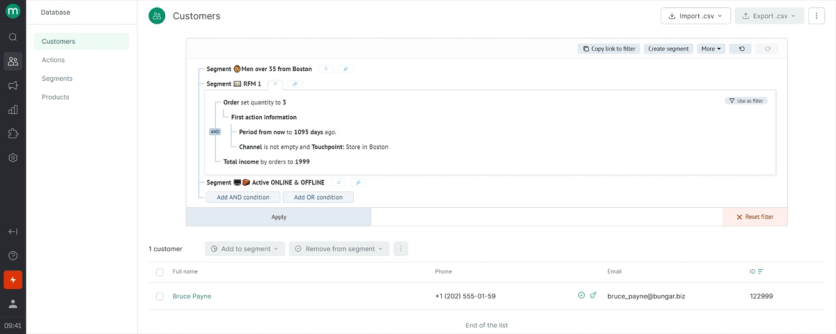
Three saved segments stacked in one filter, with conditions nested inside the RFM one and no export needed to combine them
That is exactly what changed for Blue Q when the brand moved to Maestra. Six segments and six exclusions per send collapsed into three clean ones – active subscribers, all subscribers, and wholesale. Audiogon keeps three separate audiences on Maestra and grew its core subscriber base 75%.
Takeaway: All three builders handle plenty of conditions. What separates them is whether the segment is still right on send day and what the deeper data work costs. On Sendlane, reliability is the documented weak point. On Klaviyo, segments hold, but RFM, custom lifetime-value prediction, and data export are a second purchase on top of the email bill. In Maestra, the real-time CDP is the base of every plan, so nested segments, RFM, and computed fields come without an upgrade.
Sendlane vs Klaviyo vs Maestra: Popups & List Growth
List growth winner: Klaviyo – web forms come with every plan, the free one included.
| Sendlane | Klaviyo | Maestra |
|---|---|---|
| ⭐⭐⭐⭐ Multi-step forms, targeting rules, no extra charge | 🏆 ⭐⭐⭐⭐⭐ Free from day one, AI-optimized display timing | ⭐⭐⭐⭐ Lead-capture popups, quizzes, and gamified forms |
Sendlane: Multi-Step Forms at No Extra Cost
Sendlane includes Forms at no additional cost, which is not a given in this category. The builder handles email, SMS, and multi-step forms with drag-and-drop layouts, targeting rules for when and where each form appears, and compliance language built into the templates. Questionnaire fields collect the attributes that make later segmentation useful – birthdays, skin type, size, preferences.
Running several forms at once across different stages of the journey is supported, and the same contact record receives whatever the form collects. For a brand whose acquisition strategy is “a welcome offer and a quiz-ish second step,” this is enough.
Klaviyo: Free From Day One, AI-Timed Display
Klaviyo’s web forms are available on the free plan, which means a brand can grow a list before paying anything. The form library is the largest in e-commerce, covering popups, flyouts, embedded forms, and teasers, with both email and SMS consent capture in one unit.
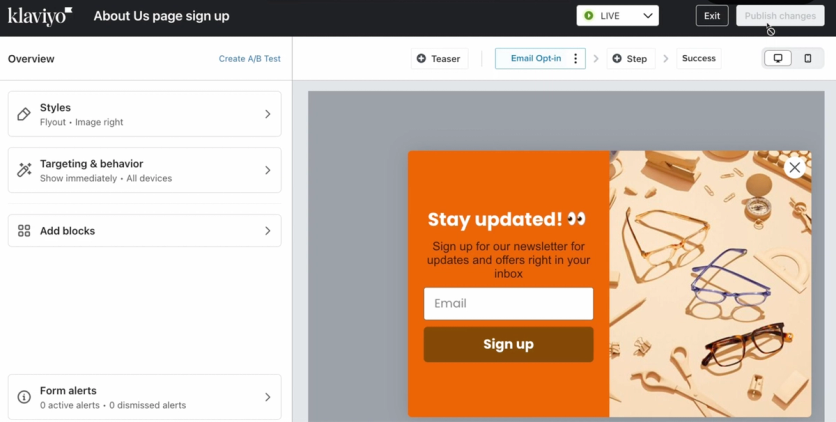
Editing a pop-up in Klaviyo
The AI layer optimizes when a form appears for each individual visitor rather than applying one delay to everyone, which Klaviyo positions as a way to grow the list faster with higher-value subscribers. Sign-up forms sit in the same navigation as flows and segments, so the consent a form collects is immediately addressable.
Forms are also where Klaviyo collects SMS consent. Adding a phone field captures promotional SMS consent by default, with the disclosure language required by carriers built into the template, and multi-step forms are Klaviyo’s own recommendation when you want both the email and the number. Device targeting runs desktop-only, mobile-only, or both, so one form can behave differently on a phone without maintaining a duplicate.
Maestra: Popups With Email, Quizzes in the Onsite Module
Lead-capture popups come with Maestra’s email and SMS modules. The wider onsite toolkit – quizzes, embedded forms, product recommendation widgets, badges – sits in the Onsite Experience Personalization module at $1,515/month, so a brand that wants the full set pays for it deliberately.
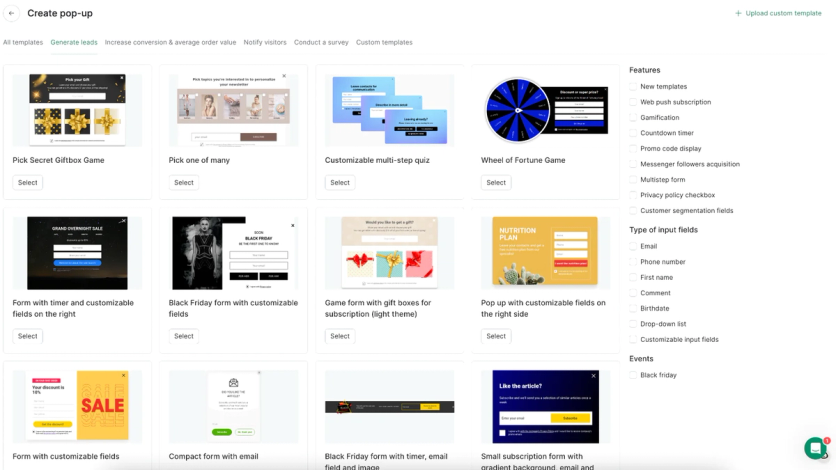
Maestra’s pop-up template gallery filtered by goal, with gamification, countdown timers, multistep forms, and th
The Forward Deployed Marketer on your account decides what each form should test and rolls out the winner. JOLYN increased email capture 21% with AI-optimized popups. Nat’v Basics lifted popup conversion 24% by redesigning the offer rather than deepening the discount. Blossom Flower Delivery doubled lead generation with a gamified form.
Takeaway: Any of the three will collect an email address, and Klaviyo will do it before you pay anything. What separates them is who keeps improving the form after launch. If someone on your team will test offers, timing, and formats, Klaviyo’s free forms are enough to start. If nobody will, Maestra is the one where a marketer does that work for you.
Sendlane vs Klaviyo vs Maestra: Deliverability
Deliverability winner: Sendlane and Maestra – both watch your sending health as part of the plan, while Klaviyo sells that help as a support package.
| Sendlane | Klaviyo | Maestra |
|---|---|---|
| 🏆 ⭐⭐⭐⭐⭐ Monitoring on every plan, in-house team, optional dedicated IP | ⭐⭐⭐ Shared pool by default; strategist in the $500 and $1,800 tiers | 🏆 ⭐⭐⭐⭐⭐ Email Health monitoring, dedicated IPs, a marketer who owns deliverability |
Sendlane: Monitoring on the Entry Plan
Deliverability is the thing Sendlane builds its product identity around. Every plan advertises sending from a Tier 1 ESP and proactive deliverability monitoring, both listed on the entry package rather than an upgrade. Enterprise Plus adds a direct line to in-house deliverability resources and an optional dedicated IP.
The knowledge base carries 22 articles on compliance and deliverability, and the compliance team reviews sending patterns actively. That cuts both ways. One September 2024 Trustpilot reviewer complained that compliance review held a week of scheduled campaigns and rejected one outright: “we paid in advance for the month and we are not getting the service we paid for.”
Still, the customer evidence points the right way. Lifeboost Coffee’s CEO says deliverability rose 39% after switching, and Grey Ghost Gear reports a 99.9% deliverability rate.
Klaviyo: Shared Pool, Strategist Behind a Paywall
Klaviyo sends from a shared pool by default, and reviewers report that the pool is the weak point at peak season. The Black Friday bounce incident above is the sharpest example, and it is not isolated – shared-IP reputation problems surface repeatedly in recent reviews.
Structurally, the deliverability expertise sits behind the support packages rather than the platform. Standard support, included with paid plans, does not include a deliverability strategist. Professional at $500/month adds one “on request.” Enterprise at $1,800/month covers up to one domain twice a year, with remediation strategies for up to five domains and quarterly performance reviews for monitored domains.
For a brand with a healthy list and moderate volume, none of this matters. For a brand recovering from a reputation problem, it means the help you need is a line item.
Maestra: Health Monitoring and a Marketer Who Owns It
Maestra monitors sending health as part of the platform. The Email Health report scores open, click, bounce, unsubscribe and spam rates against your industry and points to what to fix, and the email module adds dedicated IPs, a DMARC analyzer and send-time optimization. During migration, the team handles the sender warm-up rather than handing you a checklist.
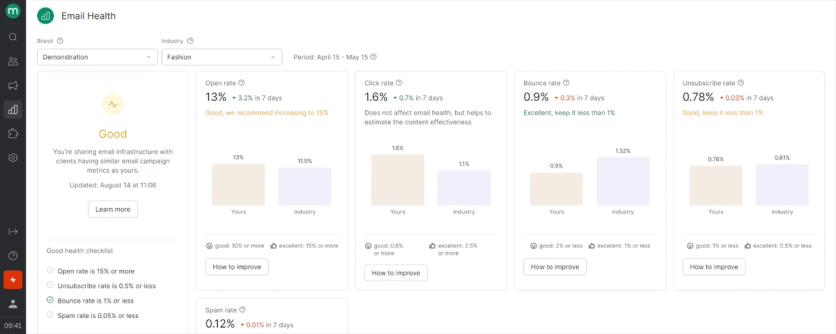
Maestra’s Email Health screen scoring open, click, bounce, unsubscribe, and spam rates against the industry benc
The published result to point at is AD Mortgage, which reached 99.7% email deliverability through list hygiene and sender-reputation work done with Maestra’s team. 4ocean solved Gmail clipping by cutting email file size 30% compared with Klaviyo, using Maestra’s editor.
The difference from Sendlane is who does the work and when. Sendlane’s in-house deliverability team and dedicated IP come with Enterprise Plus, from 500,000 contacts on an annual contract. At Maestra, the marketer on your account owns deliverability from the first warm-up, on every plan.
Takeaway: This category matters most to brands with a sending problem right now. Sendlane puts monitoring on every plan and a deliverability team on Enterprise Plus. Maestra puts both on every plan, through the marketer on your account. On Klaviyo, that help is a paid support package on top of a bill that already tracks your list.
Sendlane vs Klaviyo vs Maestra: Product Recommendations
Recommendations winner: Maestra – recommendations reach the website, the app, every message channel, and the in-store terminal, and they are in the base plan.
| Sendlane | Klaviyo | Maestra |
|---|---|---|
| ⭐⭐⭐ In email and SMS, catalog-driven | ⭐⭐⭐⭐ In messages and on site; real-time models cost extra | 🏆 ⭐⭐⭐⭐⭐ Site, app, messages, and POS; 14 engines in every plan |
Sendlane: Recommendations in Messages Only
Sendlane supports product recommendations inside email and SMS campaigns, pulling from the connected store catalog, and dynamic review content can be inserted into cart-recovery emails so the social proof travels with the product. Both are listed among the app’s campaign capabilities.
Reviews feed the same blocks, which is the part Sendlane does that neither of the others matches for free. Ratings and UGC can be dropped into a cart-recovery email so the social proof travels with the product, and audiences can be built on who left which rating.
There is no on-site surface for any of it. Sendlane’s recommendation logic serves messages, so a shopper who clicks through lands on whatever the storefront shows everyone else. Bundles on the product page, cross-sells in the minicart, and personalized homepage content are somebody else’s app.
Klaviyo: In Messages and On Site, Models Cost Extra
Personalized product recommendations are included with Klaviyo’s paid plans, and they run in both messages and on-site content. The catalog feeds the recommendation blocks, and the same profile data that drives segmentation drives what each person sees.
Customer Hub extends the same logic to a logged-in destination on your own site, where a shopper can look up orders, find offers, and see products chosen for them. It is priced from $30/month at 1,500 active profiles, currently under introductory pricing.
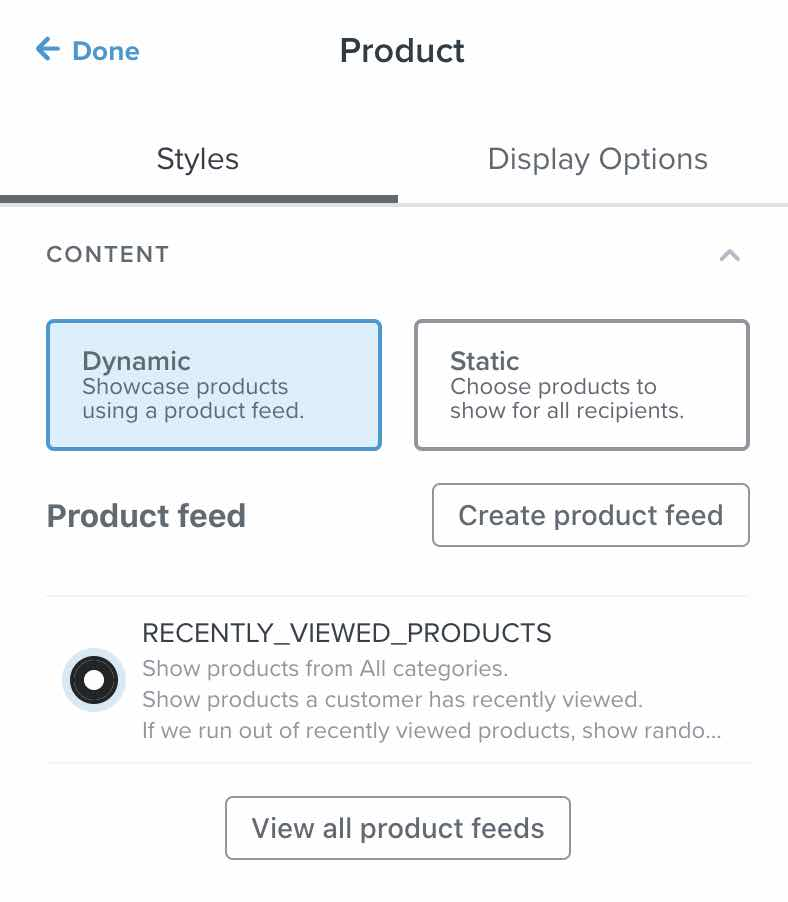
A product block in Klaviyo’s email editor switching between a dynamic product feed and a static hand-picked set
Real-time personalization models and customizable RFM analysis belong to the Personalization add-on rather than the base product, which is the line to check when comparing quotes. At 35,000 active profiles that add-on is $165/month; at 95,000 it is $398/month. The distinction matters because the phrase “personalized recommendations” appears in both tiers and means something different in each.
Maestra: 14 Engines, Site to POS, In the Base
Recommendations are part of Maestra’s CDP base, not a module, which is the single clearest pricing difference in this category. Fourteen prebuilt engines range from Recently Viewed and Personal Recommendations to Category Bestsellers and Custom Recommendations, and custom business rules can match products by color, style, or price range. Bundle offers pair a product with the items shoppers most often buy alongside it. The same picks show up wherever the shopper is: on product pages and in the cart, inside the app, in every message channel from email to WhatsApp, and on in-store self-checkout and POS screens.
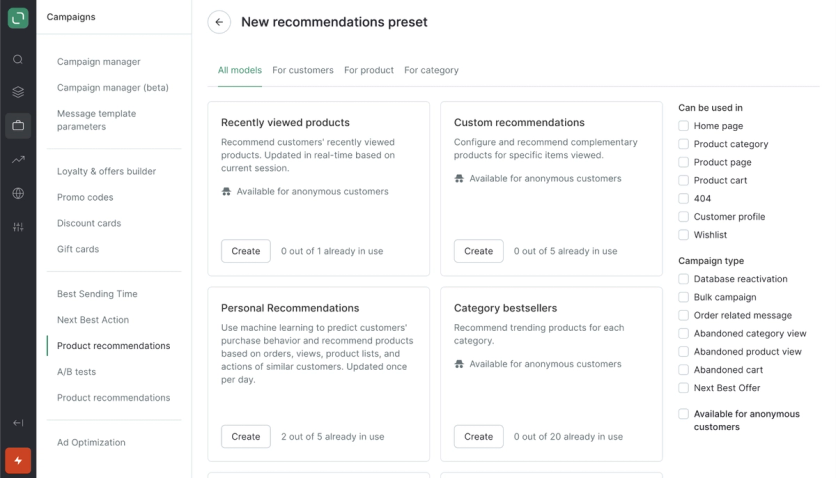
Maestra’s recommendation presets: 14 engines that can be placed on the home page, category, product page, cart,
Blue Q is the useful example again, because the brand ran the comparison itself. After adding bundles to product pages, impulse items in the minicart, and personalized homepage content, shoppers who engaged with recommendations showed a 28.7% higher average order value and 45.3% more items per order than shoppers who didn’t. Cook-Dubin’s reason for consolidating is one most Shopify brands will recognize: “On Shopify, if you don’t have a dev team to do a custom build, each of those is a separate app, and your site gets janky fast as you stack them.”
Takeaway: Decide where recommendations have to appear, then read the row. In messages only, all three work. On the product page, in the cart, and in the app, Sendlane has no surface for them and Klaviyo charges for the real-time models. Maestra puts all of it in the base plan, which is why this is the category where the price gap narrows fastest.
Sendlane vs Klaviyo vs Maestra: Loyalty
Loyalty winner: Maestra – the only platform of the three that runs a loyalty program rather than integrating with one.
| Sendlane | Klaviyo | Maestra |
|---|---|---|
| ⭐⭐ Smile.io and Rivo integrations | ⭐⭐ Partner apps; Customer Agent can look up points | 🏆 ⭐⭐⭐⭐⭐ Built-in loyalty, points, cashback, referrals, tiers |
Sendlane: Smile.io and Rivo, Plus Coupons
Sendlane connects to Smile.io and Rivo, and the documentation covers sending targeted emails to Smile.io customer groups. The loyalty data lands in Sendlane where it can be segmented on, which is genuinely useful.
What it isn’t is a loyalty engine. Points, tiers, redemption rules, and referral mechanics live in the partner app, on a separate bill, with a separate dashboard and a separate script on the storefront.
Sendlane does ship one adjacent piece: coupons. You can upload your own codes or have Sendlane auto-generate unique ones, then drop them into emails and texts with templating syntax, which covers single-use promo codes and birthday rewards without a loyalty vendor. It stops well short of a points economy, but for a brand whose “loyalty program” is really a VIP segment and a discount, it may be all that’s needed.
Klaviyo: Partner Apps and a Points Lookup
The picture is the same, one step more polished. Klaviyo’s partner catalog includes every major Shopify loyalty app, and the K:AI Customer Agent gained retail skills in 2026 that include loyalty lookup, so a shopper can ask about their points balance over chat.
Looking points up is not running a program. Klaviyo has no loyalty product of its own, so the economics, the liability, and the storefront widget stay with the partner app, and so does the second subscription.
In practice the integration is good enough that plenty of brands never feel the seam. Points balances and tier status sync into Klaviyo profiles, which means they can be segmented on and merged into emails. What you cannot do is have the loyalty program itself react – change a tier threshold for one segment, or run a points promotion as a campaign – without going back to the other tool.
Maestra: A Loyalty Program, Not an Integration
Maestra’s Loyalty Program for Shopify is a module at $1,010/month on top of the CDP base, so a loyalty-focused setup starts at $2,310/month. It covers points, cashback, personal discounts, referrals, gift cards, and promo codes, with a dashboard that reports program reach, redemption rate, and the share of revenue the program generates.
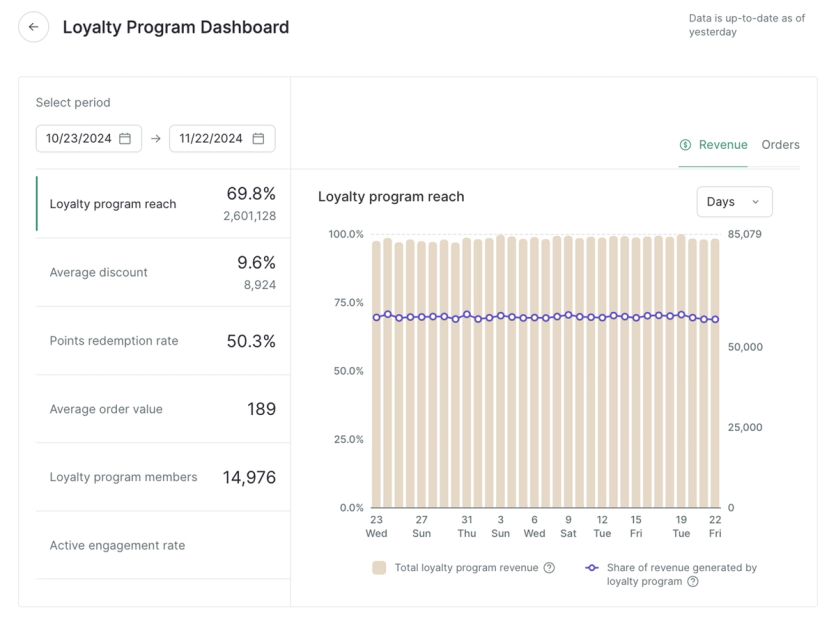
Maestra’s Loyalty Program dashboard reporting reach, redemption rate, and revenue share
Because loyalty sits on the same profile as email and SMS, promotions can be run as marketing rather than as a standing mechanic. I Love Linen layered a one-day Double Points Day onto an existing sale period and saw sales rise 31% and orders 19% against the sale-period baseline. JOLYN rebuilt its program in Maestra around its own refund and promo logic rather than a template. Members who redeem points now generate 28% more profit than members who don’t – $96 per customer against $75.
Takeaway: If you’re happy for loyalty to live in a separate app with its own bill and its own script, this category won’t move your decision, since Sendlane and Klaviyo both integrate with the good ones. It matters the moment you want points to trigger a flow, show up in an email, and change what the shopper sees on the site. Maestra runs that as one program, while the other two need a third vendor stitched in.
Sendlane vs Klaviyo vs Maestra: Reporting & Attribution
Reporting winner: Maestra – dedicated reports from campaigns and segments to subscribers and loyalty, with control groups and raw data export, in every plan.
| Sendlane | Klaviyo | Maestra |
|---|---|---|
| ⭐⭐ Email and SMS dashboards; accuracy questioned by reviewers | ⭐⭐⭐⭐ Strong dashboards and benchmarks; predictive layers are add-ons | 🏆 ⭐⭐⭐⭐⭐ Dedicated reports from campaigns to subscribers and loyalty; control groups, raw export |
Sendlane: Good Dashboard, Questioned Numbers
Sendlane’s dashboard puts contacts, email, SMS, and revenue in one view – sends, attributed revenue split between campaigns and automations, deliverability health, and a weekly digest. Every automation step carries its own performance numbers on the canvas, which is a genuinely good design decision.
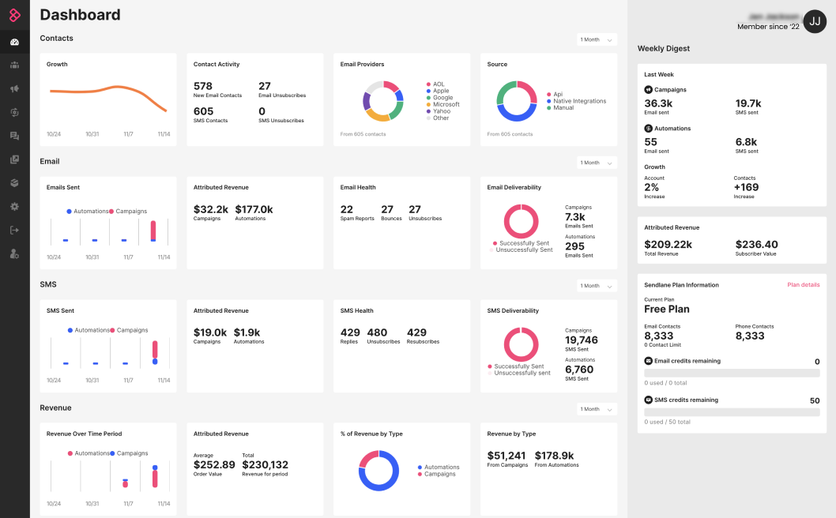
Sendlane’s dashboard: contact growth, email and SMS deliverability, and attributed revenue in one view
Reporting is also the most frequently criticized part of the platform. “Poor reporting” sits among the cons G2 pulls from its own Sendlane review corpus. The Shopify reviewer quoted earlier is more concrete: their dashboard showed $0 in revenue against orders their own pixel attributed to Sendlane email.
Attribution you can’t trust is worse than attribution you don’t have, because it quietly reshapes the calendar. That is the gap Blue Q describes on the strategy side too – the numbers were there, but nobody was reading them back to the brand with a recommendation attached.
Klaviyo: Solid Reports, Predictive Layers Extra
Klaviyo’s built-in reporting covers audience and conversion dashboards, campaign and segment performance, behavior funnels and cohort reports, customizable attribution, and peer-group benchmarks. Multi-channel attribution credits the last engaged channel so email and SMS don’t double-count the same sale.
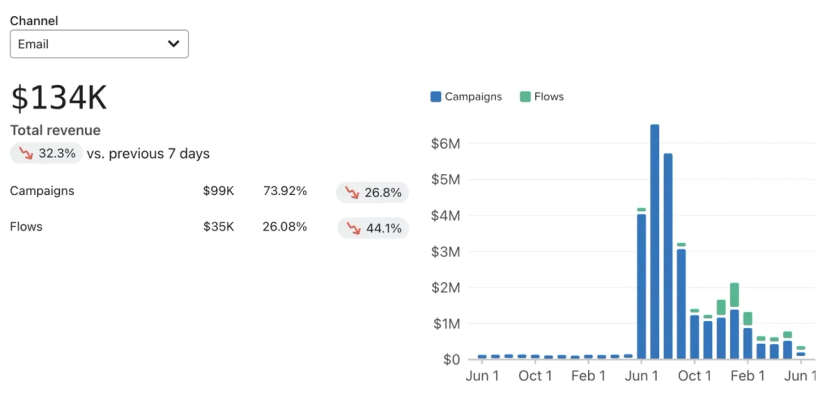
A fragment of Klaviyo’s business review dashboard splitting email revenue between campaigns and flows
The analytics that predict rather than describe are priced separately. Predictive analytics and customer lifetime value, custom CLV prediction, purchase-pattern insights, and real-time personalization models unlock with the Personalization add-on. Data export to third-party destinations and unlimited data retention unlock with Advanced Klaviyo Data Platform. Data Warehouse Sync is an add-on again at enterprise level.
Maestra: Every Channel and Control Groups, Every Plan
Maestra’s reporting sits inside the CDP base, which means every subscription tier gets all of it – there is no analytics upgrade to buy at any point. There’s a separate report for each job: campaigns by channel and type, segments side by side, subscriber growth and list health, the loyalty program, promotions, and email health. Campaign results drill down to an individual campaign, flow or segment. Control groups can be held out on whole channels rather than single sends, and raw data exports or streams to a BI tool.
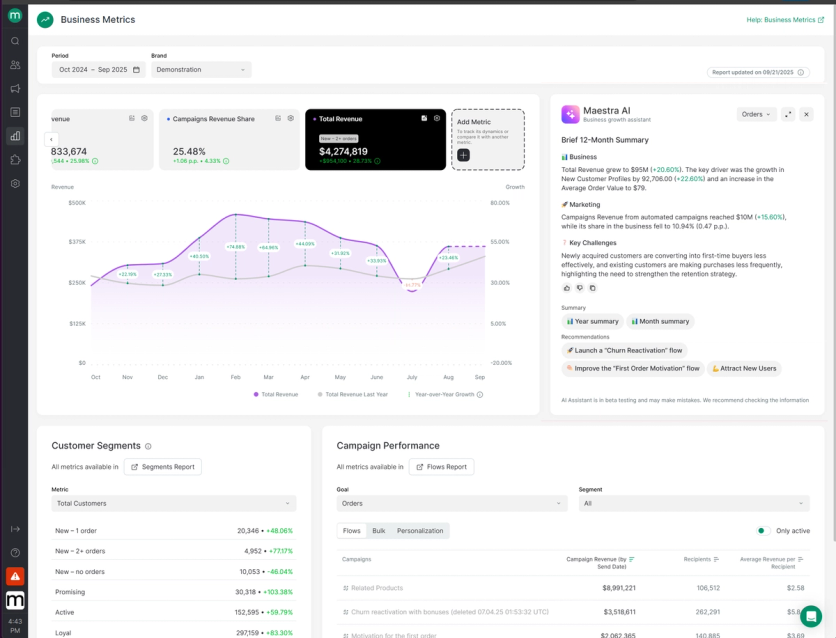
Maestra’s Business Metrics dashboard with the AI assistant summarizing twelve months and proposing next actions
Control groups are the part worth dwelling on, because they answer the question attribution models argue about. Holding out a slice of the audience from an entire channel shows what that channel actually added.
Takeaway: Ask what it costs to answer one question: did this channel actually add revenue, or would those people have bought anyway. On Sendlane the honest answer is that you may not trust the dashboard. On Klaviyo you can get there, after buying Personalization and the advanced data platform. On Maestra the control groups that answer it come with the base plan.
Sendlane vs Klaviyo vs Maestra: Support & Onboarding
Support winner: Maestra – every plan includes a marketer who builds the campaigns with you, with no tier to reach and no contract length to commit to.
| Sendlane | Klaviyo | Maestra |
|---|---|---|
| ⭐⭐⭐⭐ Chat around the clock, CSM from 10,000 contacts, annual contract required | ⭐⭐ Standard support included; faster response is $500 or $1,800/mo | 🏆 ⭐⭐⭐⭐⭐ A marketer on your account, weekly calls, shared Slack, every plan |
Sendlane: Fast Chat, White Glove on an Annual Contract
Support is Sendlane’s headline argument against Klaviyo, and at the entry level it lands. Live chat and email support are available to everyone including trial accounts, with a stated average response of about 30 seconds. Sendlane is explicit that it does not restrict who gets help.
The ladder above that is keyed to contact count, which is the quiet irony of a platform that bills by sends. Professional covers 0–9,999 contacts with assisted onboarding. Professional Plus starts at 10,000 contacts and adds a dedicated customer success manager, monthly program reviews, and proactive deliverability monitoring. Enterprise starts at 200,000 and adds a personal Slack channel and twice-monthly reviews. Enterprise Plus starts at 500,000 and adds weekly review calls, quarterly business reviews, and direct access to the deliverability team.
Two caveats matter. First, Sendlane states that the dedicated support services are held exclusively for customers on an annual contract – the white-glove pitch requires the commitment. Second, the round-the-clock coverage is not all human: Sendlane’s own site says live specialists work Monday to Friday during set business hours and AI-powered chat covers the rest.
The gap between the promise and the experience is what shows up in reviews. An August 2024 Shopify App Store reviewer who spent a year on the platform wrote: “Their sales team will over-promise and the rest will under-deliver... they don’t have a white-glove service that they say they have.” Blue Q’s account is gentler and more specific – the CSMs were responsive, but “there was very little proactive work to help us grow, other than pointing out some features of the platform.”
Klaviyo: Standard Included, Speed Costs $500 or $1,800
Klaviyo’s Standard support is included with paid plans: 24/7 email with response times from 4 to 48 hours depending on priority, live chat on weekdays, and unlimited access to Klaviyo Academy. The free plan gets email support for 60 days.
Everything faster is a separate purchase. Professional starts at $500/month for 2-to-24-hour responses, weekend chat coverage, one training session a year, and a deliverability strategist on request. Enterprise starts at $1,800/month for 1-to-12-hour responses, round-the-clock chat, two training sessions, and a dedicated solutions architect.
This is the most reliable complaint in Klaviyo’s recent reviews. An August 2026 Trustpilot reviewer wrote that “putting the customer support behind a paywall is appalling,” adding that the problems needing support appeared exactly when the plan ran out. An April 2026 reviewer framed it as a value problem: “Their pricing keeps climbing, yet the customer service remains abysmal. For the price they charge, you’d expect a much higher level of support and care.”
Maestra: A Marketer Who Builds, on Every Plan
Each Maestra plan includes a marketer on your account whose job is to build things, not to advise. That person moves you off the old platform, sets up the flows, segments, emails, and on-site experiences, launches the campaigns, and keeps improving them once they’re live. The cadence is a weekly call and a shared Slack channel. Maestra publishes the ratios it holds itself to: fewer than 15 customers per marketer, four meetings a month, and response times measured in minutes rather than days.
The role has a name at Maestra: Forward Deployed Marketer. Commercially, the point is that there is no services price list and no tier that unlocks it – the work is not sold separately, and there is no annual contract to sign for it. The contract is month to month, migration and implementation are included, and there are no setup or onboarding fees.
Atlanta Cutlery’s marketer finished the integration in two weeks and connected both of the company’s brands under one customer view. She rebuilt every flow along the way, adding product recommendations and smarter logic. At Urban Armor Gear, weekly strategy calls produced specific recommendations on loyalty, new flows, and A/B tests after the brand replaced Klaviyo, Yotpo Loyalty, and Frosmo with one platform.
Takeaway: Decide whether you need someone to answer questions or someone to do the work. Klaviyo sells answers by tier and leaves the work to you or an agency. Sendlane answers freely, and puts the person who builds things behind an annual contract. Maestra includes the builder in every plan, so the work gets done without hiring a separate agency.
Sendlane vs Klaviyo vs Maestra: Shopify, BigCommerce & Integrations
Integrations winner: Klaviyo for the size of the catalog, Maestra for the connector that isn’t in anyone’s catalog.
| Sendlane | Klaviyo | Maestra |
|---|---|---|
| ⭐⭐⭐ Around 25 native connectors plus Zapier | 🏆 ⭐⭐⭐⭐⭐ 350+ integrations, platform-agnostic | 🏆 ⭐⭐⭐⭐⭐ 150+ native integrations, the rest built for you |
Sendlane: Around 25 Connectors, Shopify and WooCommerce
Sendlane’s native integration list runs to roughly 25 entries. On the storefront side that means Shopify and Shopify Plus, WooCommerce, Miva, ClickBank, ClickFunnels, Sticky.io, and Konnektive. Around them sit Recharge, Loop Subscriptions, Gorgias, Justuno, Wonderment, PostPilot for direct mail, Smile.io and Rivo for loyalty, Google Ads, and Facebook Custom Audiences. Zapier covers the rest, and Sendlane quotes 2,000+ apps through it.
The Shopify connection is one-click and deep, and unlimited storefronts can be connected under one account, which matters for multi-brand operators. What’s missing from the list is as telling as what’s on it: BigCommerce, Magento, and Salesforce Commerce Cloud have no native connector. If your store isn’t on Shopify or WooCommerce, Sendlane is a short conversation.
Klaviyo: 350+ Integrations, Any Platform
Klaviyo’s 350+ prebuilt integrations and platform-agnostic design mean it works on Shopify, BigCommerce, WooCommerce, Magento, Salesforce Commerce Cloud, and custom stacks alike. For a brand running more than one storefront platform, or planning a replatform, this alone can decide the comparison.
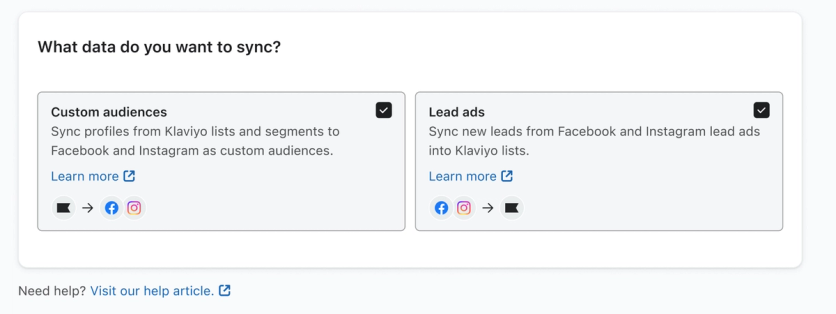
Data syncing settings in Klaviyo
The catalog is also why Klaviyo’s product stays narrower than Maestra’s. Loyalty, reviews, subscriptions, and on-site personalization have healthy partner ecosystems, so Klaviyo can leave those categories to partners and connect to whichever one a brand picks. That is a real strategy, not a gap: it means you keep the loyalty app you already like.
The cost of it is the seam count. Every partner is another subscription, another script on the storefront, and another place where a sync can lag. Klaviyo also publishes APIs and an MCP server for anything the catalog misses, though building against them is developer work rather than a connector you switch on.
Maestra: 150+ Integrations, the Rest Built for You
Maestra offers 150+ native integrations, including Shopify, BigCommerce, Magento, and WooCommerce. Anything outside that list gets built rather than looked up. The team writes the integration during onboarding through the API and SDK and doesn’t charge for it, so a missing connector becomes a scheduling question instead of a dealbreaker.
Takeaway: Start from your storefront. On Shopify or WooCommerce, all three are live options. On BigCommerce, Magento, or Salesforce Commerce Cloud, Sendlane is out. If the connector you need is an in-house system or something niche, Klaviyo’s catalog probably doesn’t have it either. Maestra covers the major storefronts and builds anything missing during implementation at no extra cost.
Sendlane vs Klaviyo vs Maestra: Pricing
Pricing verdict: Sendlane once the list outgrows the send calendar, Klaviyo under roughly 5,000 active profiles, Maestra when one bill is replacing three or four.
| Sendlane | Klaviyo | Maestra |
|---|---|---|
| From $100/mo for 50,000 sends, unlimited contacts | From $20/mo; rises with active profiles, sends capped at 10× | From $2,000/mo; pay only for active profiles, month to month |
Per-message SMS rates don’t line up across the three. Sendlane bundles carrier fees into its credit price, Klaviyo bundles them into its per-send rate, and Maestra quotes the message and the carrier fee separately. Compare total monthly spend on your own volume rather than the headline per-send figure.
Sendlane: From $100/mo for 50,000 Sends
Sendlane pricing: from $100/mo for 50,000 email sends per month, with unlimited contacts on every plan. The ladder is public and linear – $200 for 100,000 sends, $300 for 200,000, $600 for 500,000, $1,100 for 1,000,000, custom above that. Overage is charged at $2.00 per thousand on monthly billing. Annual billing saves 14%, drops overage to about $0.92 per thousand, and unlocks the dedicated CSM, white-glove migration, and Direct Rate SMS.
SMS starts at $0.009 per credit with carrier fees included, plus a $10 monthly activation. The free trial is 60 days, capped at 100 contacts and 500 sends.
The thing to read twice is the annual-contract condition on service. The monthly price is the flexible option; the support that Sendlane sells against Klaviyo is the annual one.
Klaviyo: From $20/mo, Rising With the List
Klaviyo pricing: Free plan available (up to 250 profiles, 500 emails/month), with paid email from $20/mo at 500 active profiles. From there it tracks the list: $80 at 3,500 profiles, $175 at 10,500, $400 at 25,000, $720 at 50,000, $1,265 at 90,000, $1,785 at 135,000, and custom pricing above 150,000. Every tier includes ten emails per active profile per month.
Billable profiles are the ones you can still email. Suppressing a contact removes them from the count, but it also removes your ability to market to them, so the choice is to pay for a dormant subscriber or give them up. That trade is the single most common complaint in recent reviews. An August 2026 Trustpilot reviewer wrote that Klaviyo bills “based on outdated subscriber list sizes, so even after you clean house, you’re stuck overpaying for profiles that don’t exist anymore.”
Add-ons sit on top of the email line: Composer at $20/month, Reviews at $25/month for 250 orders, Customer Hub from $30/month, Social marketing from $50/month, Personalization from $100/month, Advanced Klaviyo Data Platform from $500/month, Customer Agent from $200/month, and Helpdesk from $264/month. Mobile messages are billed by volume at around $15 per 1,000 US messages.
Maestra: From $2,000/mo, Active Profiles Only
Maestra starts from $2,000/mo: $1,300 for the CDP every plan is built on, plus $700 for unlimited email. That covers up to 100,000 active profiles. Past that, each extra active profile costs $0.013, with no tier jumps. A profile counts as active in a month when it gets a message, visits the site or app, or buys something. Dormant profiles cost nothing to store, and you can still reach them. The billable count is a rolling twelve-month average, so a Black Friday spike doesn’t reprice the following year.
Channel modules are added monthly as you need them: SMS, MMS and RCS at $250/mo plus per-message fees, onsite personalization at $1,515/mo, Shopify loyalty at $1,010/mo, WhatsApp and messengers at $420/mo, mobile push at $1,305/mo, surveys at $150/mo. Several things other platforms sell separately are already in the base: product recommendations, full-funnel reporting, ad audience sync, the MCP connector for AI assistants, and the dedicated marketer. You pay month to month, with no setup fees, and migration costs nothing extra.
Takeaway: Divide your monthly sends by your contact count. Under ten, Klaviyo’s meter fits how you actually work. Well over ten, Sendlane is the cheaper model and stays cheaper as the list grows. Maestra starts higher, so set it against the total of every tool and agency hour it would replace.
Final Verdict: Sendlane vs Klaviyo vs Maestra
Choose Sendlane if your contact list is far larger than your monthly send volume, you sell mainly in the US and Canada, and your store runs on Shopify or WooCommerce. Nobody else in this comparison will price a 300,000-contact list at four figures a month. Sign the annual contract if the service is what you’re buying, and budget a month for SMS number registration.
Choose Klaviyo if you want the biggest template library, self-serve setup, and a connector that already exists for your stack. It has the deepest product and the largest ecosystem in e-commerce marketing. Model the active-profile meter against your real list before committing, and check the ten-sends-per-profile ceiling against your calendar. Then price the add-ons you assume are included: reviews, personalization, the advanced data platform, and faster support are all separate.
Choose Maestra if you’re a mid-size, enterprise, or rapidly scaling e-commerce brand assembling engagement from parts. Maestra replaces three to five point tools – email, SMS, loyalty, popups, site personalization – with one platform on one real-time profile, and a dedicated marketer runs it with you rather than advising from a ticket queue. That’s the model behind Blue Q’s 39% growth in email-driven sales after leaving Sendlane and Urban Armor Gear’s 64% stack-cost reduction. The next step is a proposal with your own numbers in it – Maestra’s pricing page builds one from your active-profile count.
If you’d rather run email, SMS, loyalty, and the site as one program, book a Maestra demo and bring your current Sendlane or Klaviyo invoice. Setting it against the whole stack Maestra would replace takes about half an hour.
FAQ
- Maestra, Sendlane, Attentive, Omnisend, and Braze are the platforms e-commerce brands most often weigh against Klaviyo. Maestra covers the full stack: email, SMS, built-in loyalty, and site personalization on one customer data platform, with a marketer included in every plan. Sendlane uses the opposite billing model, with unlimited contacts metered by sends. Attentive focuses on SMS at enterprise scale, Omnisend is the cheaper entry point for smaller stores, and Braze runs enterprise orchestration for app-first brands.
Brands that leave Klaviyo usually leave for cost predictability or for service. G-Plans doubled customer lifetime value in the year after switching to Maestra, running real-time personalization across email, SMS, and mobile push on a seven-million-customer base. - Three come up repeatedly in reviews from the past year. Billing tracks the list, not results: you pay for every profile you could email, so the invoice grows even when performance doesn’t. Faster support is a separate purchase at $500 or $1,800 a month. And email sends are capped at ten per active profile, so a heavy calendar forces a bigger plan even when the list hasn’t grown.
Klaviyo also has no loyalty program of its own, so that arrives as a partner app on a second bill. Furniture Fair replaced five separate tools with Maestra and cut its marketing stack costs 27%. - For most brands with an established list, yes, and often by a wide margin. A brand with 50,000 contacts pays Sendlane $300/month for 200,000 sends. The same brand pays Klaviyo $720/month, because Klaviyo prices the 50,000 profiles rather than the sends.
Klaviyo is cheaper in one shape: a small list. Below roughly 5,000 active profiles its tier costs less than Sendlane’s $100 entry plan, and it includes ten sends per profile. Above that, Sendlane’s send-metered pricing pulls ahead and keeps pulling.
Compare your contact count against your monthly send volume – that ratio decides it. And if you’re weighing several subscriptions rather than one, compare the whole stack: PuffCuff cut marketing automation software costs 73.6% by folding two Klaviyo accounts and an Attentive account into Maestra. - Yes. Sendlane has a one-click Shopify and Shopify Plus integration, supports unlimited storefronts under one account, and is listed on the Shopify App Store. WooCommerce, Miva, ClickFunnels, ClickBank, and Sticky.io are also supported natively.
BigCommerce, Magento, and Salesforce Commerce Cloud are not. Maestra has 150+ native integrations, including Shopify, BigCommerce, Magento, and WooCommerce, and Klaviyo covers all of them through its integration catalog. Unidragon connected two Shopify storefronts, one US and one EU, to Maestra and reached 195% ROI within 92 days. - Maestra is the strongest choice for a Shopify store that wants email, SMS, loyalty, and the site to work as one program. Every email can pull in the shopper’s points balance, recommendations in their size, or the promotion running in their region, and a Forward Deployed Marketer builds and runs the program for you. Pricing starts from $2,000/month. Among self-serve tools, Klaviyo has the largest Shopify app ecosystem, Omnisend is the budget pick for smaller stores, and Sendlane suits large lists because it bills by sends rather than contacts.
Svaha USA grew total sales 26% after replacing its Shopify marketing stack with a single platform.