
Klaviyo Agency Guide [2026]: What It Costs, How to Vet One, and the Option Most Brands Miss

You’re on Klaviyo and the platform is fine. The flows that carried year one have flattened. The person who was meant to own email is also running paid social and the store.
Most of what decides which Klaviyo agency you hire is not on anyone’s website. Agencies quote only after a call, the strategist who pitches you is rarely the one who runs the account, and nobody tells you what month three is supposed to look like.
This guide fills those gaps: what retainers actually run at your revenue, the questions that get straight answers on a sales call, what each agency’s own case studies say about where they are strong, and how to judge the work at 90 days. It also prices the option the agency-written guides leave out, where the marketer comes with the platform instead of sitting on top of it.
Quick Verdict on Hiring a Klaviyo Agency
A Klaviyo agency costs $2,500–$10,000 per month for ongoing email and SMS management in 2026, with most mid-market retainers landing between $4,000 and $8,000 on top of the Klaviyo license. Hire one if you have the budget but nobody to run the account. If the retainer alone exceeds the price of a platform with a built-in marketer, compare both first.
Agency plus Klaviyo: from roughly $5,400/month at 100,000 profiles ($1,380 license plus a $4,000 retainer at the low end of mid-market).
In-house: $8,600–$13,200/month for one experienced email marketing manager, salary plus benefits, before tools.
Maestra – one platform for all ecommerce marketing. Plus a Forward Deployed Marketer. From $2,000/month, with the first 100,000 active profiles included.
What a Klaviyo Agency Actually Does
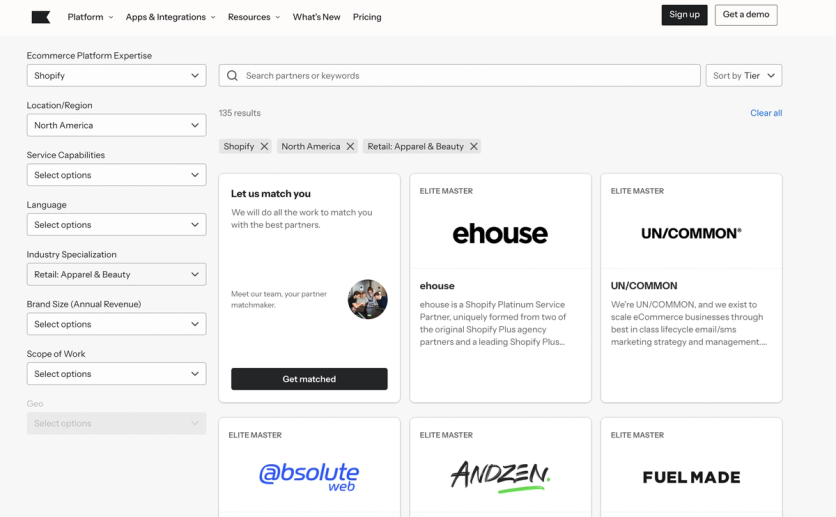
A Klaviyo agency is a service company that plans, builds, and runs your email and SMS program inside Klaviyo. Most are certified through Klaviyo’s K:Partners program, listed in the partner directory, and paid by you, not by Klaviyo.
Agency websites lead with their partner tier, so it helps to know what the badge means. Klaviyo counts more than 5,000 partners. The top badge, Elite Master, requires an agency to manage a large book of Klaviyo accounts and to be nominated by a Klaviyo committee that meets twice a year, so only a few dozen firms hold it. Platinum, Gold, and Silver sit below. The tier tells you how much Klaviyo revenue an agency influences, not how good it will be for your brand.
There are two kinds of engagement, and mixing them up is how brands overpay. A setup project is a one-time build that ends with a handover. Ongoing management is a monthly retainer.
A one-time build normally covers:
- migration from another platform.
- a library of core flows.
- a template system.
- an audit of the account you already have.
A full retainer covers the month-to-month work:
- a campaign calendar with copy and design.
- core flows rebuilt and tested: welcome, browse and cart abandonment, post-purchase, win-back.
- segmentation.
- deliverability monitoring.
- a monthly revenue report.
Some agencies add SMS, list growth, and Shopify conversion work.
What changed in the last two years is what you should be paying an agency for. Klaviyo now ships an AI agent that drafts and schedules campaigns on its own, so the manual production work agencies used to bill by the hour is shrinking. The agencies worth paying now do profile and event modeling, predictive segments, flow architecture with documented suppression logic, and governance over what the AI is allowed to send unsupervised. The old retainer produced campaigns. The modern one designs the system that decides who gets which message.
Klaviyo itself also sells services: onboarding, deliverability and compliance work, and ongoing customer success management on paid plans. None of it carries a public price. Treat that as a light layer of platform guidance rather than a replacement for someone who owns your calendar.
What a Klaviyo Agency Costs in 2026
Price points below come from agency pricing pages and pricing guides published between April and September 2026. Only three agencies in the current top results publish their own rate cards. Everyone else quotes after a call, so treat the ranges as the market, not as any one agency’s price.
| Pricing model | Typical range in 2026 | What it usually covers | Watch out for |
|---|---|---|---|
| Monthly retainer | $2,500–$10,000/mo; mid-market brands mostly pay $4,000–$8,000 | Strategy, flows, campaigns, design, segmentation, reporting | The scope changes with the price: lower retainers often cover campaign production, higher ones a full team |
| Project or setup fee | Migration $2,000–$6,000; full flow build $5,000–$25,000; audit $500–$4,000 | A one-time build with handover | Who maintains the flows afterward; ask for documentation in the deliverables |
| Revenue share | 5–25% of Klaviyo-attributed email revenue, often on top of a smaller base | “Pay for results” | The attribution window is a setting the agency can widen. See below |
| Hourly | $100–$300 per hour for senior strategists; blocks of 10–60 hours | Audits, fixes, second opinions | Hours are not outcomes. Fine for a one-off, poor for ongoing management |
Magnet Monster puts end-to-end management at $4,000–$8,000 with a practical ceiling near $10,000. Senior strategy time, when an agency sells it by the hour rather than by the month, runs $100 to $300.
What you should expect to pay tracks your revenue, not your list size. MarketerHire breaks the market down like this.
| Your annual revenue | Typical monthly retainer | What the money buys |
|---|---|---|
| Under $3M | $3,000–$6,000 | A shared strategist, core flows, and a campaign calendar |
| $3M–$20M | $6,000–$12,000 | A named strategist, design and copy, SMS, monthly reporting |
| Over $20M | $12,000–$25,000 | A pod with strategy, design, copy, and analytics |
One-time work is quoted separately: a full flow build runs $5,000–$25,000, and a migration onto Klaviyo from another platform runs $2,000–$6,000.
Budget the license on top of the retainer. Klaviyo bills on active profiles, meaning every profile that can be emailed, and moves you up a tier once you cross it. The retainer stays flat while the software line climbs with your list, so a quote that looked comfortable in January costs more by peak season. Pull your own current bill before you sign anything, and if the software line is the one that hurts, compare the best Klaviyo alternatives before you compare agencies.
Revenue share is the model to avoid. The mechanism is simple. Klaviyo’s default attribution is last-touch with a five-day window for email opens and clicks, and that window is a setting anyone with account access can widen. An agency paid on attributed revenue has every reason to widen it, and the number on your invoice grows without a single extra order.
The Option Most Guides Don’t Price In: a Platform That Comes With Your Marketer
An agency and an in-house hire both assume you buy software first and then pay a person to run it. There is a third arrangement where those are one line.
Maestra is a marketing platform for e-commerce brands, and every account includes a Forward Deployed Marketer – a Maestra marketer who both sets the strategy and does the hands-on work. They run the migration, rebuild flows and segments, design templates, watch deliverability, and bring test ideas to a weekly call.
The difference from an agency account manager is load and accountability. Your marketer carries 15 brands, works in one platform only, and answers for your numbers on a weekly call.
Here is the like-for-like math at 100,000 active profiles.
| Klaviyo plus a mid-market agency | Maestra with a Forward Deployed Marketer | |
|---|---|---|
| Platform | Klaviyo email plan, $1,380/mo at 100,000 profiles, billed on every emailable profile | Customer data platform plus unlimited email, $2,000/mo at 100,000 active profiles; dormant profiles stored free |
| The person running it | Retainer $4,000–$8,000/mo | Included in the platform base |
| Monthly total | $5,380–$9,380 | $2,000 |
What you give up is real. You’re switching platforms, and even with the marketer doing the work, a migration takes two to seven weeks with the old stack running in parallel. You leave Klaviyo’s app ecosystem. And a store with a few thousand profiles will pay less on Klaviyo alone and should; Maestra is built for mid-size and enterprise brands.
JOLYN, a swimwear brand with about one million subscribers, left Klaviyo because the flows it needed weren’t possible there. Maestra’s marketer rebuilt the key flows with real-time product recommendations, then launched Low Stock Alerts and Price Drop Notifications. Campaign-driven revenue grew 26% in March 2025 against March 2024; email revenue rose 17% and SMS revenue 52%.
Blue Q, a gift brand with 300,000 contacts, arrived from Sendlane with two automated flows live and, in its own words, a platform rather than a partner. Their marketer built modular selling blocks under the brand’s artwork and rebuilt the lifecycle flows. Email-driven sales grew 39% in August–December 2025 against the same months of 2024.

Furniture Fair, a home furniture retailer with 250,000 subscribers, came in with open rates at 17.3% and deliverability problems. Its marketers fixed the technical faults, rebuilt the templates, and launched Price Drop and Abandoned Checkout flows. Open rates reached 45.86%, email sessions grew 95% year over year, and email and SMS now account for 11% of total revenue, online and offline.

If you still end up hiring an agency, that’s the bar to hold it to: weekly, proactive, and accountable.
How to Choose a Klaviyo Agency: a 10-Question Vetting Checklist
If an agency is still the right answer for you, the next job is separating the ones who will do the work from the ones who will manage it. Ask these ten questions on the first call. The answer you want follows each one.
- Who will actually run my account, and can I meet them before I sign? The strategist joins the sales call, and the pitch team is the delivery team. Do not sign until you have spoken to the person who will open your account on Monday. At Maestra the Forward Deployed Marketer joins before any contract is signed, because the first piece of work is reading your business and writing the plan, and the person who writes that plan is the one who then owns it.
- How many brands does that strategist carry, and what else are they responsible for? A number they will say out loud, and an answer where your account is the work rather than one of several things they also sell. For reference, a Maestra Forward Deployed Marketer carries around 15 brands.
- What will you look at before you touch Klaviyo? Repeat rate, AOV, margins, and acquisition health. An agency that pitches a 12-flow package before asking about your margins is selling a template.
- When is the first flow live, and how long does one flow take to build? The first flow inside three weeks of signing. On a modern platform the build itself is a couple of hours, so when an agency quotes days or a week for a single flow, ask what the rest of that time buys. Strategy, copy, and design are fair answers. A queue is not.
- How do you price, and can I see the full rate card? A fixed monthly retainer. If they insist on revenue share, ask for a base fee and a kicker that only starts above a revenue floor.
- Which attribution will you report on? Klaviyo-attributed revenue shown next to Shopify or Google Analytics revenue, with the default five-day window left alone.
- Who owns the Klaviyo account, templates, and data? You do. The agency is a user on your account, and offboarding means removing their access, not requesting an export.
- What are the exit terms? Month-to-month, or a notice period of 30–60 days. Anything longer than a quarter should come with a discount you asked for, not one they volunteered.
- How will we work together week to week? A standing call and a channel where you can reach them between calls, not a monthly report that arrives after the month is spent. Ask for revenue by flow and campaign, list growth, deliverability, and the tests they ran, with raw Klaviyo access so you can check any of it yourself. A Maestra marketer holds a weekly call and sits in a shared Slack channel, which is the part clients mention most often.
- What happens when something breaks, and who answers? A named person, a channel that is not a ticket form, and a response time they will put in writing. Deliverability problems and broken sends do not wait for the next scheduled call, so ask what their answer looked like the last time a client’s sending domain got flagged.
Red Flags
Each of these shows up before you sign, in a sales call or a proposal. One on its own can have an innocent explanation. Two or three together say the account will be maintained rather than grown.
| What you see | What it means |
|---|---|
| 🚩 Revenue share with no base fee | The agency can under-invest and still get paid. |
| 🚩 One strategist on ten or more accounts | You will get the junior. |
| 🚩 A single flow quoted at several days or a week | The build itself takes hours. You are paying for a place in a queue. |
| 🚩 Nothing live three weeks after signing | The account is being staffed, not run. |
| 🚩 ROI claims with no brand name and no method | Marketing copy, not a result you can check. |
| 🚩 Klaviyo access requested before any question about margins, AOV, or repeat rate | A template is coming, not a plan. |
| 🚩 Reporting that lives in the agency’s deck instead of your Klaviyo account | You cannot verify the numbers you are paying for. |
Klaviyo Agencies Worth Shortlisting
Seven partners with US teams. Klaviyo’s directory lists thousands, so this is a place to start calls rather than a ranking of the market. Instead of repeating taglines, this guide counts what their own published cases are about: which industries the clients come from, which parts of lifecycle marketing the work covers, and which results carry a stated time period. What a firm publishes is not the limit of what it does. Tiers and figures verified on their own sites and in Klaviyo’s directory in September 2026.
| Agency | Where the cases cluster | What the work actually is | What sets them apart |
|---|---|---|---|
| Un/Common | Beauty, then food and drink | Flow builds, though most of the portfolio is replatforming and site design | Seven vertical landing pages, and a claim of 250+ Klaviyo migrations |
| ECD Digital Strategy | Home and garden, then food and apparel | Flows, SMS, and list growth, with sign-up rate as a headline number | The only one here making sign-up rate a headline number |
| Flowium | Wellness, sporting goods, automotive | Flow builds and campaign calendars, a third of them Black Friday | The most consistent at stating the period a result covers |
| InboxArmy | Spread wide, much of it outside retail | Flows, campaigns, template production, and the only published deliverability rescues | The only published deliverability rescues, across 40+ email platforms |
| Fuel Made | Apparel, home goods, food | Email on about a third of the portfolio; the rest is conversion and store design | Publishes its floor price, and has been Shopify-only since 2010 |
| Zettler Digital | Apparel, food, golf | An even split between retention work and site work, one migration | Names its client-size band out loud, $1M to $30M |
| Domaine | Apparel, beauty, home | Replatforming onto Shopify; no lifecycle case carries a published number | Klaviyo’s Global Partner of the Year two years running |
Un/Common
🏅 Klaviyo Elite Master · Americas Partner of the Year 2026
📍 Philadelphia
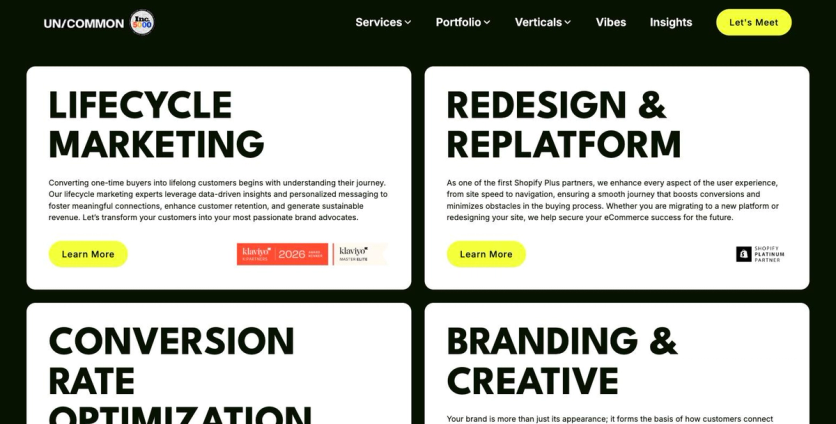
Un/Common has worked on Shopify since 2015, under the name Noticed until 2024, and was one of the first Shopify Plus partners. Today it is a team of 60-plus that has moved more than 250 brands onto Klaviyo, with Rare Beauty, Dermalogica, and Liquid Death among its clients.
Pricing: custom, plus a fixed onboarding fee covering the first two weeks.
Strong on: beauty and skincare, where about twenty of their client pages sit, and migrations, of which they claim more than 250. Rare Beauty reports +58% owned revenue and +16% automated flow conversion in a stated one-month window.
Weaker on: published email results. Only four of their roughly 68 client pages quantify lifecycle work; the rest are site redesigns and replatforms, so ask for Klaviyo references specifically.
ECD Digital Strategy
🏅 Klaviyo Elite Master · Americas Partner of the Year 2026
📍 Schenectady, New York
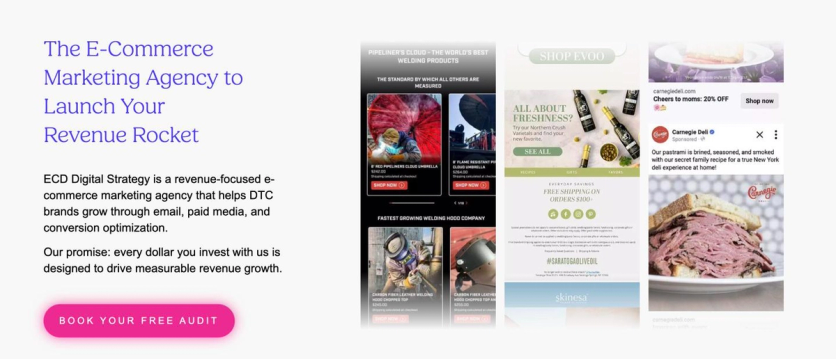
ECD has run email and paid media for ecommerce brands since 2016 and made the Inc. 5000 with 106% revenue growth. Today its team spans three continents, and its clients include Garden Answer, Saratoga Olive Oil, and Soccer Wearhouse.
Pricing: custom.
Strong on: list growth, which they treat as a headline number rather than a footnote. Garden Answer attributes 49% of total revenue to Klaviyo email and SMS, with a 7% form sign-up rate and a 44% SMS subscription rate.
Weaker on: breadth. Nine published cases is the smallest body of work here, and four of them sit in home and garden.
Client reviews: rated 5.0 on Clutch, a directory where clients rate agencies, with reviews from 2024 to 2026. No reviewer names anything to improve, and Clutch’s own summary of them asks for clearer project time estimates.
Flowium
🏅 Klaviyo Elite Master since 2022
📍 New York
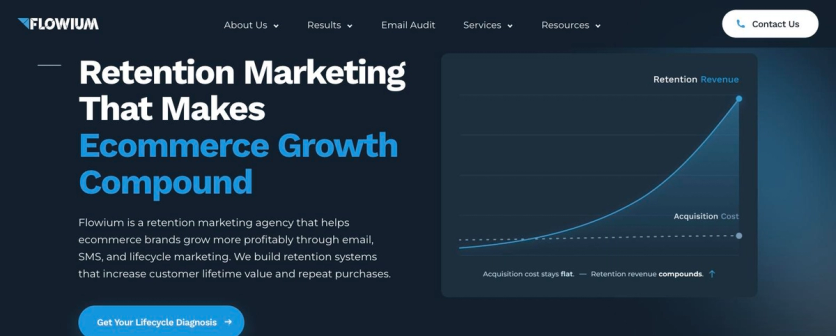
Flowium started in 2017, reached Klaviyo’s Platinum tier the following year, and has worked only with ecommerce brands since late 2018. Today it has worked with more than 1,000 of them, including Dr. Squatch, True Classic, and Balsam Hill.
Pricing: not published.
Strong on: flow rebuilds and peak-season calendars, and on stating the period behind each result. Chaparral Motorsports grew flow revenue from $150,539 to $252,452 over two months, and SMS revenue from $1,648 to $54,289.
Weaker on: migrations, loyalty, and deliverability, none of which appear in their published work.
Client reviews: rated 4.9 on Clutch, with reviews from 2021 to 2026. The recurring note is account-manager handovers, and a brand leaving in March 2025 warned the next client to watch how many unused lists, segments, and flow variations pile up.
InboxArmy
🏅 Klaviyo Master Silver, one tier below the rest of this list
📍 Grapevine, Texas
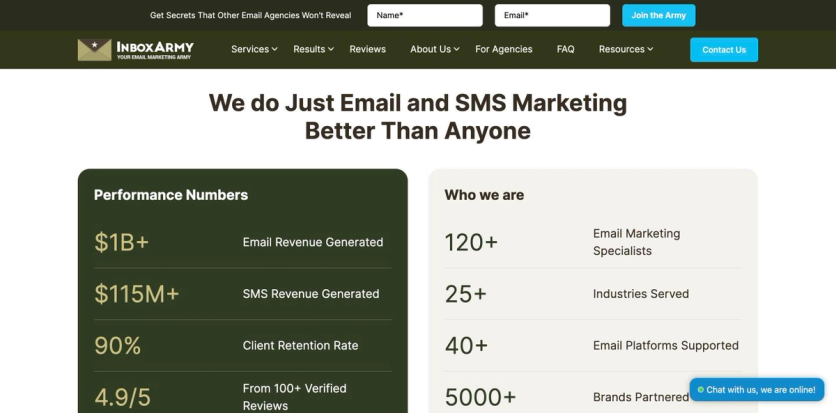
InboxArmy launched in 2016 as an email production team that works on any platform, and merged with its sister company, Inbox Group, in 2018. Today it has 120-plus email specialists and has worked with more than 5,000 brands, from Hilton to Purple.
Pricing: managed services from $1,500 a month, the lowest published floor here.
Strong on: deliverability rescue, with the only published examples on this list, and on stacks that are not only Klaviyo, since they work across more than 40 platforms. Maven Lane reports $700,000 in six months, broken down flow by flow.
Weaker on: strategy. Reviewers describe a team that executes well and waits to be told what to do next.
Client reviews: rated 4.9 on Clutch, with reviews from 2018 to 2026. A marketing director wrote in November 2025 that the team “doesn’t always slow down to look at performance trends.”
Fuel Made
🏅 Klaviyo Elite Master · Shopify-only since 2010
📍 Washington state
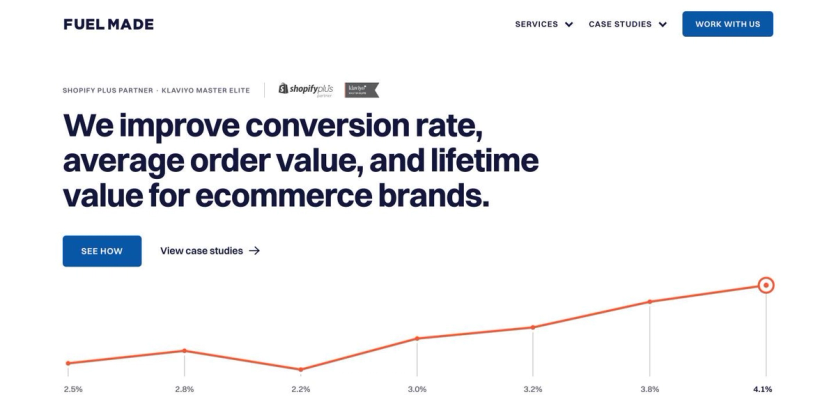
Fuel Made has built on Shopify since 2007 and in 2016 became one of the first eight agencies Shopify named Plus Experts. Today it is still about twenty people, with Beardbrand, Briogeo, and Umbra among its clients.
Pricing: retainers from $7,500 a month, with lighter packages from about $3,000.
Strong on: running the storefront and the email program with one team; several clients appear in both their design and their email work. SASnola reports 135x return on email and 40% of online revenue through Klaviyo.
Weaker on: timeframes and scope. Almost none of their cases state a period, and there is no data or business-intelligence work and no dedicated copywriting unless you bring it.
Client reviews: rated 5.0 on Clutch, with reviews from 2022 to 2026. The improvement notes ask for a clearer sequence of next steps at the end of a project.
Zettler Digital
🏅 Klaviyo Elite Master · Shopify Platinum
📍 New York metro
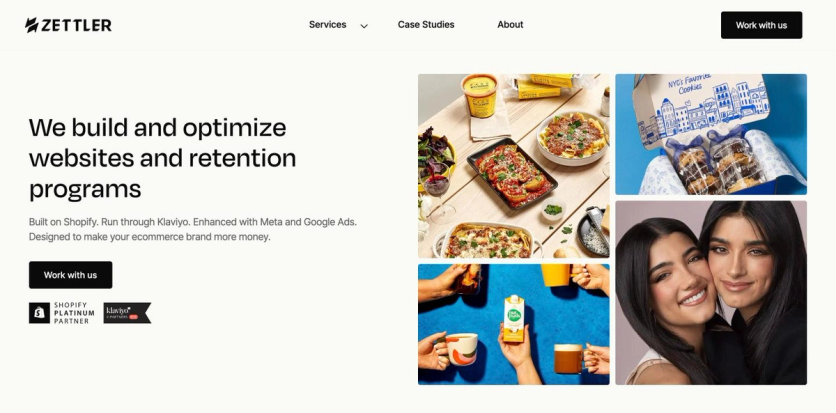
Zettler Digital has been a Shopify partner since 2014. Today it has worked with more than 400 brands, from Levain Bakery and Shinola to Bleacher Report and Mariano Rivera.
Pricing: a published band of mid four figures to low five figures a month.
Strong on: buying site, email, and paid from one shop, and on naming the client size they serve, $1M to $30M. Promix Nutrition reports $6.5M attributed revenue, 26% higher 90-day retention, and 34% higher 60-day lifetime value across a stated first two years.
Weaker on: evidence volume. Ten of their fifteen cases carry no figure at all.
Client reviews: no Clutch profile. They hold a 5.0 rating in Shopify’s partner directory, where the only low score concerns Facebook ads in 2019 and says nothing about their email work.
Domaine
🏅 Klaviyo Elite Master · Global Partner of the Year 2025 and 2026
📍 Los Angeles, New York, Charleston
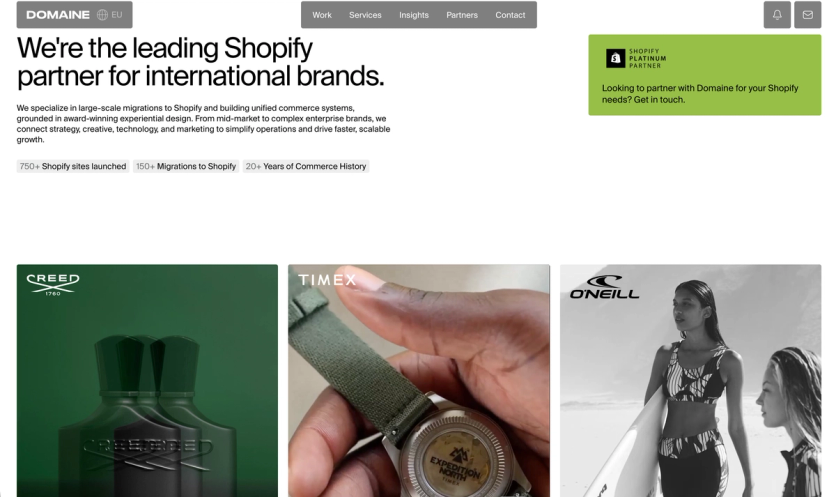
Domaine formed in 2023 when two Shopify agencies, Tomorrow and Half Helix, merged, and has bought two more since. Today it has 300-plus people, has launched more than 750 Shopify sites, and works with brands such as Peloton, Timex, and Arhaus.
Pricing: custom.
Strong on: enterprise replatforming. Sixty-six published projects for brands including Peloton, FIGS, and Arhaus, most of them moves onto Shopify from Salesforce Commerce Cloud and Magento.
Weaker on: lifecycle proof. The three cases on their own Klaviyo partner page carry no metrics, so ask for an email reference before you sign.
Client reviews: rated 5.0 on Clutch, but only from late 2025, and both reviewers answered “N/A” when asked what could be improved.
How to Tell If a Klaviyo Agency Is Working
After you sign, agree on the checkpoints below with the agency and review the work against them every month.
Set the Goal First and Measure Against It
Which numbers matter depends on why you hired the agency. A brand that needs bigger baskets watches average order value and the revenue from upsell and cross-sell placements. A brand losing customers after the first order watches repeat purchase rate and the time it takes to reach a second order. A brand trying to win back lapsed customers or grow its VIPs watches that segment’s revenue and activity month over month.
Put the goal and a target number in the agreement before month one. Each monthly report then answers whether that number moved, and each call starts from the answer.
Two checks apply whatever the goal. Klaviyo-attributed revenue should move in the same direction as your store revenue, and when only the attributed line grows, check the attribution window first. Keep raw access to the Klaviyo account as well, so you can verify any figure in the report yourself.
The First 90 Days
In the first month the agency should audit the account and rebuild the flows that earn the most: welcome, cart and browse abandonment, and post-purchase. The first of them should go live by week three.
Flows show results first because they run on every new subscriber and every abandoned cart without anyone pressing send. By day 60 you should see flow revenue move. Campaign testing, segmentation, and a steady calendar take longer, and a full program usually settles in by the end of the second quarter.
If nothing has shipped by day 90, ask what the retainer has paid for so far.
Check Deliverability in Your Own Klaviyo Account
Klaviyo’s Deliverability tab, under Analytics, shows the account’s bounce, unsubscribe, and spam complaint rates and marks each one as Healthy, Room for improvement, or Needs attention. Spam complaints above 0.05% count as Needs attention, and Gmail may block senders above 0.3%. An agency should be able to explain any rate in that band and what it is changing to bring it down (see how to fix deliverability problems).
Open rates need care. Since iOS 15, Apple Mail Privacy Protection loads messages in the background, which registers as an open, so Klaviyo’s own guidance points to clicks instead. A report built around rising opens, with these three rates left out, is worth a question on the next call.
What Clients Complain About After They Sign
On Clutch, every reviewer is asked what could have gone better. Across reviews of the agencies above from 2023 to 2026, five notes repeat.
- Execution without strategy. The most common complaint by a distance. Clients get the emails they asked for and nothing more, then find themselves setting the direction they thought they were buying.
- Reporting you cannot open yourself. Clients ask for live dashboards instead of a monthly deck, and for numbers they can check without booking a call.
- Chasing the agency for updates. One reviewer put it plainly in November 2023: agencies are supposed to be more self-directed than that.
- Turnover on your account. Reviews describe quality wobbling when the assigned strategist changes, which is why the question about who carries your account matters more than the logo on the deck.
- Clutter left behind in Klaviyo. Unused lists, segments, and duplicate flow variations accumulate quietly, and you inherit them the day the contract ends.
If any of the five shows up, the monthly review against the agreed goal is the place to raise it.
Agency vs In-House vs Maestra: the Decision Table
| Klaviyo agency | In-house hire on Klaviyo | Maestra with a Forward Deployed Marketer | |
|---|---|---|---|
| Monthly cost at 100,000 profiles | ≈ $5,400–$9,400 (license plus retainer) | ≈ $10,000–$14,600 (one manager, salary plus benefits, plus license) | $2,000 |
| Who is accountable for results | An account manager; the strategist is shared across brands | One person, accountable to you | Your marketer, with weekly calls and a shared Slack channel |
| Platform expertise | Deep in Klaviyo | Depends on who you hire | The only platform they work in |
| Cross-industry input | Yes, if the strategist’s load is low | Whatever the hire brings from past roles | Yes, by design |
| Ramp time | Three to eight weeks to first flows live | A hiring cycle, then onboarding | Two to seven weeks to migrate, old stack live in parallel |
| Adding a channel or loyalty | Depends on the agency; not all of them run loyalty or onsite work | Training or another hire for each new channel | Add a module and the same marketer runs it |
| Getting a platform issue fixed | Elite partners work closely with Klaviyo; lower tiers less so | Through Klaviyo’s standard support queue | Your marketer takes it straight to Maestra’s product team |
| What you keep when you leave | Your Klaviyo account and data, if the contract says so | Everything | Your data exports; the marketer leaves with the platform |
The in-house figure uses Salary.com’s September 2026 average of $121,468 for an email marketing manager and Glassdoor’s $103,000 median, plus roughly 30% for benefits. Add a designer and a copywriter and the team runs past $20,000 a month, which is the point most brands stop and call an agency.
Final Verdict: Agency, In-House, or Maestra
Hire a Klaviyo agency if you’re committed to Klaviyo, you have $4,000–$8,000 a month for execution, and you can hold the agency to the checklist above: a named strategist you have met, first flow live in three weeks, a fixed fee, and your own attribution settings left alone.
Go in-house if email and SMS are already a top-three revenue channel and you can afford a full-time manager plus design support. You’ll pay more than an agency but keep every decision, every template, and every learning in the building.
Choose Maestra if you’d rather pay one bill than two. From $2,000 a month you get the platform and a Forward Deployed Marketer who migrates you, rebuilds the flows, and shows up weekly with the next test. It’s the right call for mid-size and enterprise brands that want an owner for the channel without a retainer on top of a license. Start with the pricing page or book a demo.
Frequently Asked Questions About Klaviyo Agencies
- Senior Klaviyo strategists charge $100 to $300 an hour for audits and one-off fixes. Ongoing management from an agency costs $2,500 to $10,000 a month, and most mid-market brands pay $4,000 to $8,000. The Klaviyo license is billed on top, about $1,380 a month at 100,000 profiles. Maestra charges $2,000 a month at the same profile count for the platform and email, with a Forward Deployed Marketer included.
- The tier reflects how much Klaviyo revenue an agency influences, and Elite partners have the closest working ties with Klaviyo, which helps when a platform issue needs escalating. It says little about the work on a single account. The strategist assigned to the brand, the number of brands they carry, and dated results in published cases say more. At Maestra the marketer works for the company that builds the platform, so product issues go straight to its product team.
- An in-house specialist pays off once email and SMS are already a top revenue channel and the budget covers a manager plus design support. The manager alone costs about $8,600 to $13,200 a month with benefits. An agency fits brands that need flows live within weeks and have nobody to own the channel. In both cases the Klaviyo account and templates are best kept in the brand’s name. Maestra is a third option, where a Forward Deployed Marketer comes with the platform and there is no hiring cycle or separate retainer.
- It depends on what the brand needs fixed. Among Elite Master partners with US teams, Un/Common claims more than 250 migrations onto Klaviyo, Flowium publishes flow rebuilds with the period each result covers, ECD Digital Strategy makes list growth a headline number, and Zettler Digital works with brands making $1 million to $30 million a year. InboxArmy, a tier lower, is the one with published deliverability rescues. For brands that want the platform and the person running it on one bill, Maestra includes a Forward Deployed Marketer with every account.
- A useful case study names the brand, states the period the result covers, and says which number moved: flow revenue, Klaviyo-attributed revenue, or total store revenue. A one-month window or a single Black Friday tells less than a full quarter compared with the same quarter a year earlier. Attributed revenue also depends on the attribution window, so a case that leaves it out is hard to compare with another. Maestra’s cases state the period and the metric, for example Blue Q’s 39% growth in email-driven sales in August–December 2025 against the same months of 2024.