
Best DTC Marketing Agencies [2026]: What They Cost, Who to Shortlist

Your DTC brand has outgrown the founder running ads at night and a part-timer sending the newsletter. The question is who takes over, and the answer is rarely one firm.
Most DTC agencies sell acquisition: paid social, performance creative, and the measurement around them. All eleven agencies in this guide buy media, and fewer than half of them run email and SMS. The part that pays for the next year is the owned channels, from email and SMS to loyalty and on-site personalization, and it usually needs a different partner.
Agency websites rarely say what either half costs or who will run the account. This guide prices both halves for 2026, sorts eleven US agencies by what they are built for, and adds the option most lists leave out: a platform that comes with its own retention marketer.
Quick Verdict on DTC Marketing Agencies
The best DTC marketing agencies in 2026 are Darkroom, Hawke Media, Blue Wheel, WITHIN, ATTN Agency, Common Thread Collective, New Engen, and DTCo for full-service growth, and Flighted, Kynship, and Y’all for paid social and creative. Retainers run $6,000–$25,000 a month before ad spend. For the retention half, a less obvious option costs less: Maestra comes with a Forward Deployed Marketer and starts at $2,000 a month.
- Darkroom – best for paid, creative, and retention from one team · 50–249 people · no Clutch reviews yet.
- Hawke Media – best for an outsourced marketing department · 250–999 people · rated 3.0 on Clutch.
- Blue Wheel – best for brands that also sell on Amazon and Walmart · 50–249 people · no Clutch reviews yet.
- WITHIN – best for performance branding · 50–249 people · no Clutch reviews yet.
- ATTN Agency – best for paid media plus email and SMS · 10–49 people · rated 4.8 on Clutch.
- Common Thread Collective – best for ad spend tied to a profit forecast · about 70 people · rated 4.1 on Clutch.
- New Engen – best for larger brands that also sell through retail · 400+ people · no Clutch reviews yet.
- DTCo – best for brands spending $150K+ a month on paid media · 11–50 people · no Clutch reviews yet.
- Flighted – best for Meta and Google ads with landing pages · about 25 people · rated 4.9 on Clutch.
- Kynship – best for brands at $2M–$100M managing to profit · about 20 people · no Clutch reviews yet.
- Y’all – best for health, wellness, and beauty creative · 10–49 people · rated 5.0 on Clutch.
DTC growth agency: $10,000–$18,000 a month at mid-stage, plus about $6,100 in retention software at 100,000 profiles. In-house lifecycle manager: $11,200–$13,200 a month before tools.
Maestra – one platform for all ecommerce marketing. Plus a Forward Deployed Marketer who runs the retention half. From $2,000/month, with the first 100,000 active profiles included.
Content:
What a DTC Marketing Agency Does, and the Two Halves of It
A DTC marketing agency grows sales in a brand’s own store: it buys the traffic, makes the ads, and brings customers back for the next order. In practice that work splits into two halves that are priced and judged differently, and most firms are strong in only one.
The acquisition half brings in first orders: paid social on Meta and TikTok, performance creative, launches, conversion rate optimization, and search. Creative volume drives much of the price, because a paid-social program needs a steady supply of new ads.
The retention half turns a first order into a second: email and SMS flows, loyalty, subscriptions, and on-site personalization. It runs inside a platform such as Klaviyo or Attentive, so the license is a second line on the bill. The data behind it comes from the customer segmentation tools built into those platforms, and the on-site layer from e-commerce personalization tools.
Who does which: paid-social and creative shops sell the first half and stop at the order. Retention specialists sell the second and rarely touch ads. Full-service growth agencies sell both, with retention usually the smaller practice, which is why their retention results are worth reading separately.
Agency websites lead with badges, and each badge belongs to one half. Meta Business Partner and Google Partner badges speak for the acquisition half, Klaviyo’s partner tiers for the retention half, and a Shopify Plus partner badge for the storefront work. Klaviyo gives its top tier, Elite Master, to agencies with a large book of Klaviyo accounts that its partner committee has put forward (K:Partners). The badge measures how much platform business a firm influences, not how it will run your account.
Two engagement shapes exist in both halves. A project is a one-time build with a handover: a creative sprint, a flow library, a migration, an audit. A retainer is the monthly work, and nearly every price below is a retainer.
What DTC Agencies Cost in 2026
DTC growth agencies charge $6,000–$25,000 a month in 2026, and most mid-stage brands pay $10,000–$18,000 before ad spend. The ranges below come from agencies’ own price lists, such as Darkroom’s, and from pricing guides published between February and October 2026.
| Pricing model | Typical range in 2026 | Where it applies | Watch out for |
|---|---|---|---|
| Percentage of ad spend | 10–20% of monthly spend; about 20% under $50K, 15% at $50K–$150K, 10–12% above $150K | Paid social and search | The fee rises with spend, not with profit; creative, landing pages, and tooling often sit outside it |
| Fixed paid-media retainer | $1,500–$5,000/mo for one channel; $6,000–$15,000+ for a multi-channel program | Brands spending $20,000+/mo on ads | Ask how many ad concepts a month the fee includes |
| Growth-agency retainer | $6,000–$25,000+/mo; most mid-stage brands pay $10,000–$18,000 | Paid, creative, and lifecycle under one roof | “Full-funnel” with no named owner per discipline |
| Hybrid | A base fee plus 5–15% of managed spend, or a bonus tied to CAC or ROAS | Brands past $50,000/mo in spend | Define the target and the window before you sign |
| Retention retainer | $4,000–$18,000/mo for a genuine retention mandate; email-only $2,500–$10,000 | Email, SMS, loyalty, subscription | The platform license and any loyalty app are billed separately |
| Project or setup | Onboarding $500–$7,000; a creative pilot $3,000–$5,000; a flow build $3,000–$25,000 | One-time builds and audits | Who maintains the work after handover |
Cap a percentage-of-spend fee. The fee grows with the budget rather than with the result, and extras often sit outside it. In Eightx’s worked example, a brand spending $200,000 a month on a quoted 15% fee, or $30,000, pays $41,750–$57,000 a month once creative, landing pages, reporting, and test budgets are billed on top.
Budget the retention half as software plus a retainer. At 100,000 profiles, a typical stack of Klaviyo Email, a loyalty app, Rebuy for upsells, and Nosto for on-site personalization runs about $6,100 a month before SMS, as the retention agency guide breaks down. A retention retainer of $4,500–$8,000 brings that half to $10,600–$14,100.
Keep the Paid-Social Partner, Replace the Retention Retainer
Most brands fill the retention half the way they fill the acquisition half: software from one vendor, a team from another. Maestra works differently. The platform comes with its own marketer, the total costs less than an agency on top of a software stack, and the paid-social partner keeps the ads.
Every Maestra account gets a Forward Deployed Marketer, who sets the retention strategy and does the hands-on work. Your marketer runs the migration and builds the flows and segments, then designs the templates, watches deliverability, and brings a new test to each weekly call.
Your marketer works only in Maestra and handles around 15 brands, so a tactic that works for one brand reaches the others within the quarter. The incentive is built in: Maestra bills month to month, and a brand that stops seeing results can leave. The marketer’s job is to make sure it doesn’t, by setting goals with the team and reaching them.
The acquisition half stays where it is. Maestra’s customer data platform syncs segments to Meta and Google ad accounts, so the paid-social agency targets the audiences your retention data produces. A $925-a-month module turns the product feed into dynamic ad creative that updates itself.
Here is the like-for-like math for the retention half at 100,000 active profiles.
| Retention agency plus a typical stack | Maestra with a Forward Deployed Marketer | |
|---|---|---|
| Monthly total | $10,600–$14,100, plus SMS messages | $4,775, plus SMS messages |
| Klaviyo Email plan, $1,380 a month | Customer data platform plus unlimited email, $2,000 a month, first 100,000 active profiles included | |
| SMS | Klaviyo or Attentive, billed per message | SMS module, $250 a month plus $0.0035 per US message |
| Loyalty | Yotpo Loyalty, from $199 a month | Shopify loyalty module, $1,010 a month |
| Recommendations and upsells | Rebuy, $534 a month | Included in the base |
| On-site personalization | Nosto, about $4,000 a month | On-site personalization module, $1,515 a month |
| The person running retention | Retainer, $4,500–$8,000 a month | Included in the platform |
| Your paid-social agency | Unchanged | Unchanged, with audience sync to its ad accounts included |
The trade is a platform switch: two to seven weeks of migration, with the old stack running until the new flows are live. Klaviyo’s app ecosystem stays behind. Maestra is built for mid-size and enterprise brands, so a store with a few thousand profiles should keep a basic license.
Magnum Bikes, a premium e-bike brand that sells online, in stores, and through dealers, runs retention on Maestra with a lean team. Online revenue grew 56.6% year over year.

Selkirk Sport, a pickleball brand, runs email and SMS on Maestra, and Maestra’s dynamic product cards feed its Meta ads. Email-attributed revenue grew 55% year over year.

The paid-social partner still has to be chosen, and that is what the agencies below are for.
DTC Marketing Agencies Worth Shortlisting
Eleven US agencies, sorted by what they are built for rather than ranked: eight run full-service growth, and three sell paid social and creative. Each was checked in October 2026 on its own site, its case pages, and Clutch where a profile exists. Agencies that only do retention are compared in a separate guide.
| Agency | Type | Strongest at | Best for | Pricing band |
|---|---|---|---|---|
| Darkroom | Full-service growth | Paid media, creative, retention, and CRO from one team, plus Amazon and TikTok Shop | Consumer brands at $10M–$500M in revenue | Published: from $5,000/mo per service |
| Hawke Media | Full-service growth | Paid search and social, Amazon, TikTok Shop, affiliate, and email and SMS | Brands that want an outsourced marketing department | Custom; $5,000 minimum on Clutch |
| Blue Wheel | Full-service growth | Amazon and Walmart retail media plus DTC paid social and email | Brands that sell on their own store and on marketplaces | Custom; $10,000 minimum on Clutch |
| WITHIN | Full-service growth | Performance branding across paid and owned media | DTC and larger brands that want brand and performance together | Custom |
| ATTN Agency | Full-service growth | Paid media plus email, SMS, and direct mail | DTC and retail brands | Custom; $1,000 minimum on Clutch |
| Common Thread Collective | Full-service growth | Paid media run from a profit forecast | Brands that want ad spend tied to contribution margin | Custom; a lite plan at $500/mo for brands under seven figures |
| New Engen | Full-service growth | Media, creative, creators, affiliate, and marketing mix modeling | Larger brands that also sell through retail | Custom; $75,000 minimum on Clutch |
| DTCo | Full-service growth | Strategy, media, content, funnels, and measurement as one system | Brands spending $150K–$15M a month on paid media | Custom |
| Flighted | Paid social and creative | Meta, TikTok, and Google ads with creative and landing pages | DTC brands with a steady paid-social budget | Custom; retainer plus performance bonus |
| Kynship | Paid social and creative | Meta, TikTok, and Google ads run from a 12-month P&L forecast | DTC brands at $2M–$100M in revenue | Custom |
| Y’all | Paid social and creative | High-volume performance creative, with media buying as an option | Health, wellness, and beauty brands | Published: from $10,000/mo |
Darkroom
🏅 Klaviyo Platinum Master · Inc. 5000, 2023
📍 New York, with hubs in Lisbon, São Paulo, and Barcelona
Darkroom was founded in 2017 and works with consumer brands at $10 million to $500 million in revenue. Today one team covers paid media, performance creative, retention, and CRO, with separate Amazon and TikTok Shop practices, for clients such as Olipop, Everlane, Laundry Sauce, and Morphe.
Pricing: published starting prices of $5,000 a month for retention marketing or paid media management, $8,000 for performance creative, and $10,000 for growth strategy. Brands under about $2 million are pointed to a freelancer instead.
Real cases:
- Morphe – Shopify revenue up 75% year over year over Black Friday and Cyber Monday 2025.
- Public Goods – retention revenue up 18% year over year over Black Friday and Cyber Monday 2025.
- Everlane – Amazon revenue up 123% between January and March 2026.
Hawke Media
🏅 Klaviyo Platinum Master · Google Premier Partner · Meta Business Partner
📍 Los Angeles, with offices in New York and Chicago
Hawke Media was founded in 2014 as an outsourced marketing team for growing brands. Today 250 to 999 people run paid search and social, Amazon, TikTok Shop, affiliate, and email and SMS, for clients such as Crocs, Funko, K-Swiss, Taylor Stitch, and The Sill.
Pricing: not published; Clutch lists a $5,000 minimum project and $150–$199 an hour.
Real cases:
- TileMart – revenue up 677% year over year in Q4 2024.
- LAFAZA Foods – Amazon advertised sales up 104% in December 2024.
- Rockstar Original – monthly revenue up 50% from a TikTok Shop affiliate program in 2024.
Client reviews: rated 3.0 on Clutch, a directory where clients rate agencies, from two reviews dated July 2021 and January 2022, both for website builds rather than marketing. The recurring note is about scoping.
Blue Wheel
📍 Birmingham, Michigan
Blue Wheel was founded in 2011 and merged with Retail Bloom in 2023. Today 50 to 249 people run Amazon and Walmart retail media, marketplace management, DTC paid social and search, TikTok Shop, and email and SMS, for brands such as Sol de Janeiro, Ariat, Oribe, and Jack Black.
Pricing: not published; Clutch lists a $10,000 minimum project and $150–$199 an hour.
Real cases:
- PowerBlock – Meta revenue 57% above goal in Q4.
- Oribe – email-attributed revenue up 37% year over year.
- Serious Steel Fitness – acquisition MER up 20.7% in one month.
WITHIN
🏅 Klaviyo Platinum Master
📍 New York, with offices in Mexico City and Bogotá
WITHIN was founded in 2015 as a performance branding agency. Today 50 to 249 people run paid and owned media, email and SMS included, along with creative and Shopify builds, for DTC brands such as Touchland, Parachute, and Casper and for larger names such as Timberland.
Pricing: not published.
Real cases:
- Anthony’s Goods – revenue up 13% in the first month after launch.
- Timberland – more than $1 million in TikTok Shop sales and a top-25 footwear store ranking in under four months.
- Touchland – a 34% conversion rate on a sweepstakes for its body mist launch.
ATTN Agency
🏅 Klaviyo Platinum Master · Google Premier Partner · Meta Business Partner · TikTok Marketing Partner
📍 San Diego, California
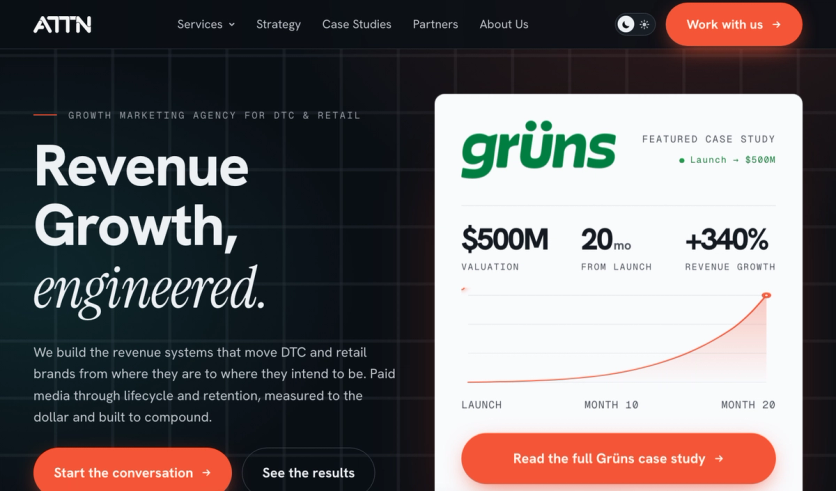
ATTN was founded in 2016 to grow DTC and retail brands. Today a remote team of 10 to 49 people runs Meta, TikTok, Google, YouTube, CTV, and retail media alongside email, SMS, and direct mail, for brands such as Bones Coffee, Grüns, Laundry Sauce, and Tubby Todd.
Pricing: not published; Clutch lists a $1,000 minimum project.
Real cases:
- Midnight Hour – revenue up 95.4% from an app-only Friday promotion in October 2025.
- EMUAID – 47.5x ROI and 54.5% more new email and SMS subscribers.
Client reviews: rated 4.8 on Clutch, with reviews from March 2020 to January 2024. The notes that come up are reports that didn’t match the client’s own numbers, limited bandwidth, and slipped timelines.
Common Thread Collective
📍 Costa Mesa, California
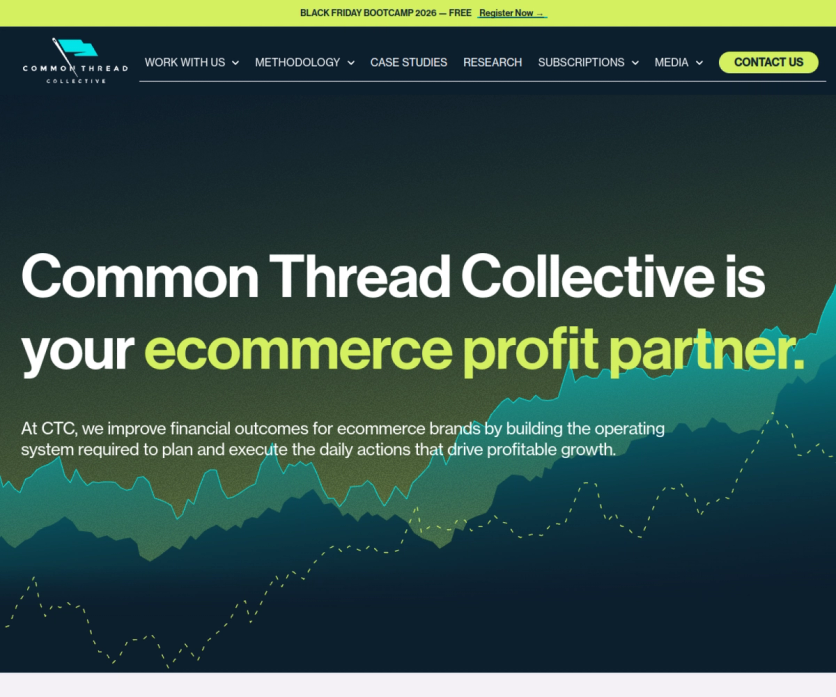
Common Thread Collective has run paid media for e-commerce brands since 2012 and says it has engineered more than $3 billion in profitable growth, for clients such as Liquid Death, ColourPop, Native, and Olukai. Today its offer, the Prophit Engine, pairs one named strategist with a forecasting model built on the brand’s revenue, marketing, and cost data.
Pricing: not published for the full program; a lite version for brands under seven figures costs $1,500 to onboard and $500 a month. Clutch lists a $5,000 minimum project.
Real cases:
- Urban Armor Gear – revenue up 40% and contribution margin up 43% year over year, January to September 2025.
- Quay – ROAS on Snapchat catalog ads 40% above other Snapchat campaigns, November to December 2025.
Client reviews: rated 4.1 on Clutch, with reviews from July 2021 to January 2022. The recurring notes are about team changes and missed deadlines.
New Engen
📍 Seattle, with offices in Rogers, Arkansas, Manhattan Beach, California, and New York
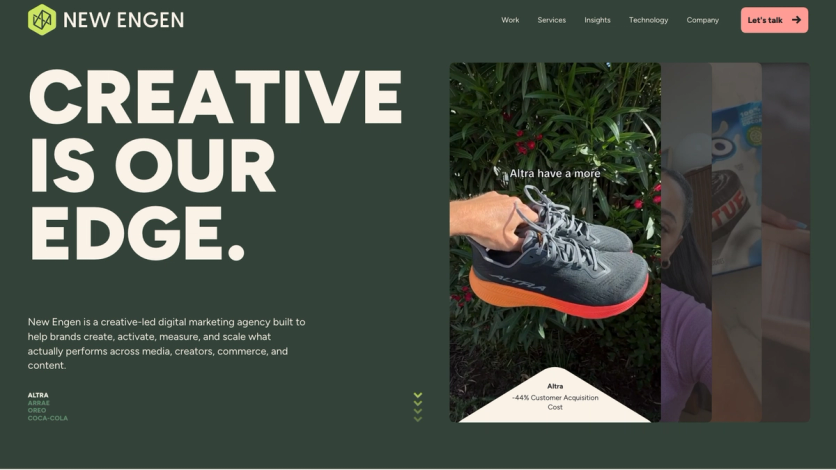
New Engen was founded in 2016 as a performance media agency. Today more than 400 people run media, creative, creator and influencer programs, affiliate, and marketing mix modeling, for DTC brands such as MeUndies and Cotopaxi as well as CPG names.
Pricing: not published; Clutch lists a $75,000 minimum project.
Real cases:
- Altra – customer acquisition cost down 44% year over year, fiscal 2025 to fiscal 2026.
- arrae – ROAS 11% above internal benchmarks for a product launch in Q1 2025.
DTCo
📍 New York
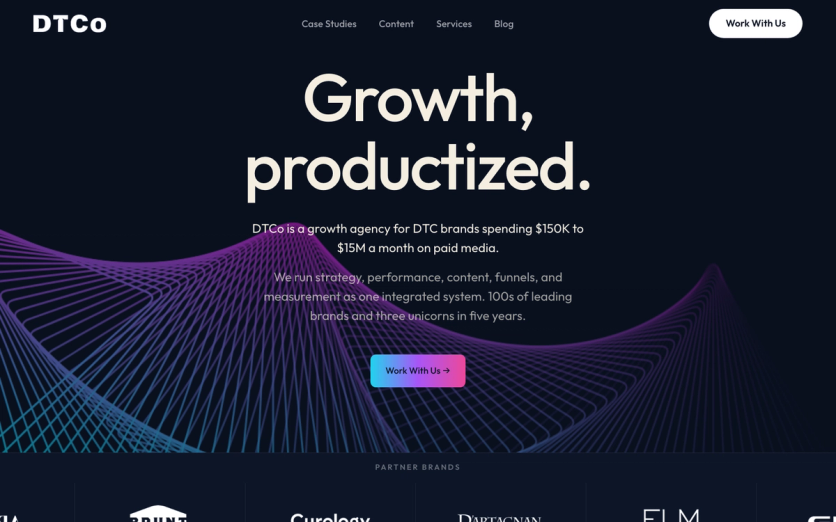
DTCo was founded in New York in 2020 for brands spending $150,000 to $15 million a month on paid media. Today it runs strategy, media, content, funnels, and measurement as one system, for brands such as ARMRA, BRUNT, Pvolve, and The Inkey List.
Pricing: not published.
Real cases:
- Pvolve – revenue up 51% half over half, with blended ROAS up 11%.
- The Inkey List – revenue up 35% in six months, with MER unchanged.
Flighted
🏅 Meta Business Partner
📍 New York
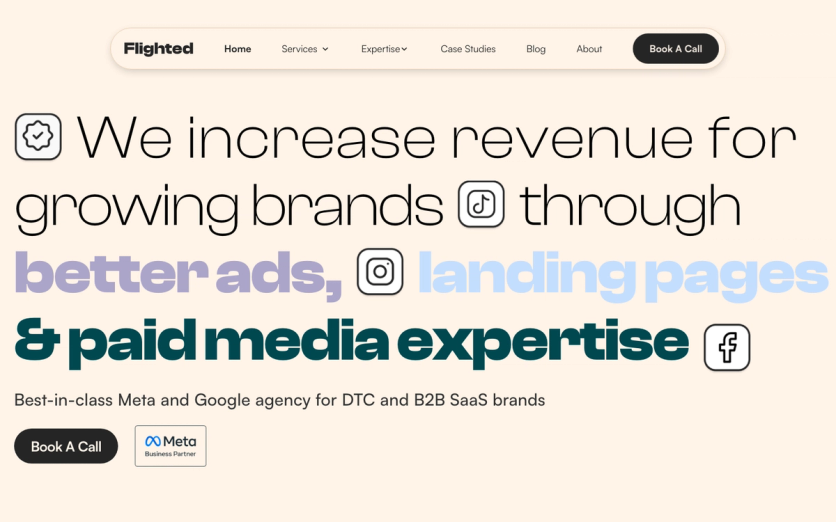
Flighted was founded in 2021 as a paid-social agency. Today a team of about 25 runs Meta, TikTok, and Google ads, produces the creative, and builds landing pages for DTC brands such as Cat Person, Apple Bottom Jeans, and Bespoke Post, and lately for B2B SaaS too.
Pricing: not published; the fee is a flat retainer plus performance bonuses, and Clutch lists a $5,000 minimum project.
Real cases:
- Apple Bottom Jeans – CPA down 43% on 44% more Meta spend, October to December 2024.
- Magic Story – revenue up more than 800% over Black Friday and the 2025 holidays.
- Outerseas – a 3.3 Meta ROAS in month one as spend grew past $150,000 a month in 2025.
Client reviews: rated 4.9 on Clutch, with reviews from February 2023 to July 2026. The few critical notes ask for firmer expectations before launch and more push to test new ideas.
Kynship
📍 Newport Beach, California
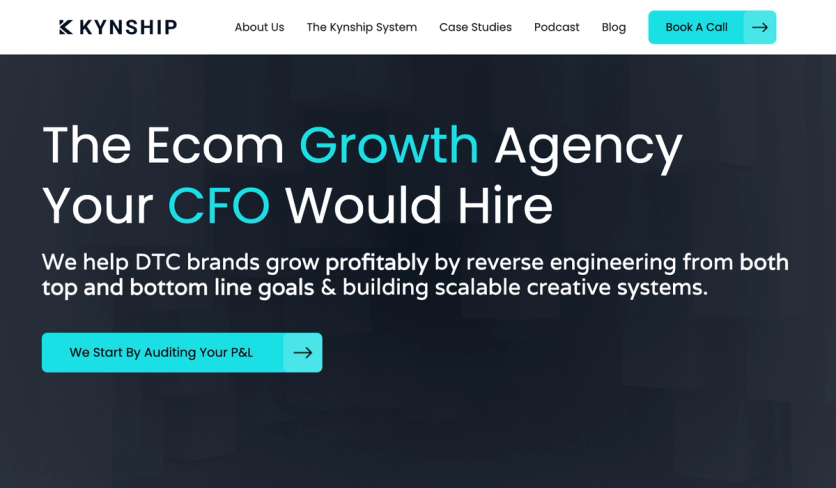
Kynship started in 2019 with seed funding from Common Thread Collective and works with DTC brands at $2 million to $100 million in revenue. Today it builds a 12-month, cohort-based P&L forecast from a brand’s last two years of data and runs Meta, TikTok, and Google ads against it, with influencer seeding and UGC feeding the creative.
Pricing: not published.
Real cases:
- WildBird – revenue up 14x since starting with Kynship, at 22% average monthly net profit by mid-2026.
- OMI Wellbeauty – monthly new-customer revenue up 2.4x in four months in 2026.
Y’all
🏅 Meta Business Partner · Google Partner · Shopify Partner
📍 San Antonio, Texas
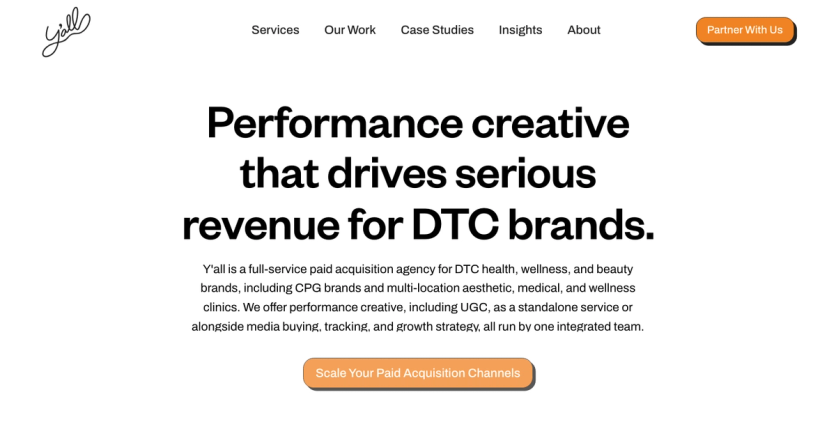
Y’all was founded in 2018 as a performance creative studio. Today it makes high-volume ad creative for health, wellness, and beauty brands, clinics included, and buys media on Meta, TikTok, Google, and YouTube for those who want it.
Pricing: creative-only engagements start at $10,000 a month and full-service ones at $17,500. Past $175,000 a month in ad spend, the fee becomes a share of spend starting at 10%.
Real cases:
- Save Trees – ad spend up 800% in a year, with CAC held 5% below baseline.
- Allie+Bess – new customers up 70% in 2025 at a profitable cost per new customer.
- Pamos – cost per acquisition down 49% in three months as monthly ad spend grew from $10,000 to $90,000.
Client reviews: rated 5.0 on Clutch, with reviews from November 2025 to March 2026. One client asked for clearer reporting on strategy and test results.
How to Choose a DTC Agency: 10 Questions for the First Call
If you still want an agency, the first call settles most of it. Ask these ten questions; the answer to look for follows each one.
- Which half are you selling me, and who owns the other half? A clear answer: acquisition, retention, or both with a named lead for each. “Full-funnel” with no owner per discipline is a red flag.
- Who will run my account, and can I meet them before I sign? The person who will run your ad account or your email platform joins a call before any contract. At Maestra you meet the Forward Deployed Marketer first, and the plan they write with you is the plan they then execute.
- How many brands does that person carry? A specific number, with your account as the work rather than one line in a portfolio. A Maestra marketer handles around 15 brands.
- How is the fee built, and what sits outside it? A fixed figure or a capped percentage, with creative volume, landing pages, tooling, and the platform license named as separate lines.
- Which numbers will you answer for? For acquisition: new-customer revenue, CAC, and contribution margin from your store data, not platform ROAS alone. For retention: repeat purchase rate and revenue from returning customers in Shopify or GA4, not email-attributed revenue.
- What ships in the first 30 days? On the paid side, the first creative batch live and a measurement baseline. On the retention side, an audit, a lifecycle map, and the first rebuilt flows. A single flow takes a couple of hours on a modern platform, so a quote of days per flow is worth questioning.
- How will we work week to week? A standing call and a shared channel between calls, not a monthly deck. A Maestra marketer holds a weekly call and sits in a shared Slack channel.
- What do we keep if we part ways? Everything, with a written handover: the ad accounts and the email platform, and inside them the templates, segments, creative files, and dashboards.
- What are the exit terms? A 90-day initial term, then month-to-month with 30–60 days’ notice, and an exit clause that leaves every account in your name. A 12-month minimum demanded before any work starts is a sign the agency is selling the contract rather than the work.
- Who do we call when something breaks? A named person on a direct channel, with a response time in writing, rather than a ticket form. A disapproved ad account or a flagged sending domain costs revenue by the hour, so ask when a client last had one and how long the fix took.
Red Flags
Each of these shows up before you sign. One alone can have a reasonable explanation; two or three together say the account will be maintained rather than grown.
| What you see | What it means |
|---|---|
| 🚩 A percentage of ad spend charged on retention work or branded search | The fee grows with the budget, not with the result |
| 🚩 “Full-funnel” with no named owner for creative, media, or lifecycle | Nobody is accountable for the half you are buying |
| 🚩 Pricing tied to “scope” with no monthly number | The number arrives after you are committed |
| 🚩 An account manager who is not a marketer | The work happens somewhere you cannot see |
| 🚩 “We can’t share specific client results” | Marketing copy, not a result you can check |
| 🚩 An upsell into adjacent services within the first 60 days | The retainer was priced to grow, not to deliver |
| 🚩 Nothing live a month after signing: no flow, no creative batch, no baseline | Onboarding is being billed as work |
| 🚩 Monthly numbers that arrive only in the agency’s slides, with no owner access to the ad accounts or store analytics | Nothing can be checked against your own data |
How to Tell If a DTC Agency Is Working
Three checks show whether a DTC agency is growing the business, and each uses data the brand owns.
New customers grow with the spend. Platform ROAS also counts returning customers and people who would have bought anyway. Shopify’s new vs returning customers report shows how many first-time buyers arrive each month. Divide ad spend by that number for the cost of a new customer, and watch whether it holds as the budget rises.
The ads beat a holdout group. In a lift test, Meta keeps a random share of the audience from seeing the ads, and the gap in purchases between the two groups is what the ads add. Meta reports it as cost per incremental conversion, and an agency sure of its work will agree to run one.
Contribution margin holds as revenue grows. Revenue bought with deeper discounts and rising ad costs can grow while profit per order shrinks. Ask the agency to report contribution margin from the brand’s finance data next to revenue, every month.
Agency vs In-House vs Maestra: the Decision Table
A DTC growth agency costs $10,000–$18,000 a month at mid-stage, plus about $6,100 in retention software at 100,000 profiles. Three in-house hires cost $30,000–$45,000 a month loaded. Maestra covers the retention half for $4,775 at the same scale, with the marketer and the SMS, loyalty, and on-site modules included, while the paid-social partner keeps its fee.
| What to compare | DTC growth agency | In-house team | Maestra with a Forward Deployed Marketer, plus your paid partner |
|---|---|---|---|
| Monthly cost at 100,000 profiles | $10,000–$18,000 for a mid-stage brand, plus about $6,100 in retention software | $30,000–$45,000 loaded for three hires (paid, creative, lifecycle), plus the same software | $4,775 for the retention half with SMS, loyalty, and on-site modules; the paid-social fee stays as it is |
| Who answers for repeat purchases | The agency, on the numbers you write into the contract | One person, accountable to you | Your marketer, on a month-to-month plan you can leave at any point |
| Platform expertise | Depends on the pod | Depends on who you hire | The only platform they work in |
| Cross-industry input | Yes, if the strategist’s load is low | Whatever the hires bring from past roles | Yes, by design, across around 15 brands |
| Ramp time | Flows live by week three, a first creative batch inside the first month | A hiring cycle, then onboarding | 2–7 weeks to migrate, old stack running alongside |
| Adding loyalty or on-site personalization | A new scope, or a second agency | Another tool and someone to learn it | A module on the same customer profile, run by the same marketer |
| Getting a platform issue fixed | Through the agency’s ties with the platform vendor, which depend on its tier | Through the vendor’s support queue | Your marketer raises it with Maestra’s product team directly |
| Feeding paid media with first-party audiences | Through exports and connectors the agency maintains | Through whichever CDP you license | Audience sync from the customer data platform, included |
| What you keep at exit | Accounts and data, if the contract says so | Everything | Your data exports; the marketer stays with the platform |
The in-house figures are MarketerHire’s loaded cost for three hires and, for the lifecycle manager alone, Salary.com’s September 2026 average of $121,468 and Glassdoor’s $103,000 median plus roughly 30% for benefits.
Final Verdict on DTC Marketing Agencies
Hire a paid-social or full-service growth agency if acquisition is the gap, you can fund $6,000–$18,000 a month plus ad spend, and you will cap any percentage fee and name the owner of each discipline before you sign. Common Thread Collective and Kynship fit brands that want a profit forecast running the spend. Darkroom, Hawke Media, and ATTN Agency cover paid media and lifecycle from one team, Blue Wheel fits brands that also sell on Amazon and Walmart, and WITHIN and New Engen suit brands that want brand and performance together. DTCo suits large media budgets, and Flighted and Y’all fit brands that mostly need more ads and creative.
Hire a retention specialist if the second order has no owner and you can add $4,500–$8,000 a month on top of the software. A separate guide compares seven of them by their own cases.
Build in-house if both halves are already top revenue lines and you can fund $30,000 a month or more for a three-person team that keeps every learning in the building.
Consider Maestra for the retention half if you are about to hire an agency for it: the option is less obvious and costs less. Maestra starts at $2,000 a month with the first 100,000 active profiles included, and a mid-size or enterprise brand gets the customer data platform, unlimited email, audience sync to its ad accounts, and a Forward Deployed Marketer who builds the lifecycle program and answers for it. The paid-social partner keeps the acquisition half. Start with the pricing page or book a demo.
Frequently Asked Questions
- $6,000–$25,000 a month for a DTC growth agency in 2026, with most mid-stage brands paying $10,000–$18,000 before ad spend. Paid-social-only agencies charge 10–20% of ad spend or a fixed $1,500–$15,000 a month, and retention specialists charge $4,000–$18,000 on top of the email platform license. For the retention half, a less obvious and cheaper option is Maestra: it starts at $2,000 a month with a Forward Deployed Marketer included.
- Two specialists, when acquisition and retention are both real gaps. The retention practice inside a full-service agency is usually its smallest, so its retention results deserve a separate read. One full-service agency fits a brand that sells through Amazon or retail as well as its own store and needs one measurement model across channels. A third setup costs less than either: a paid-social agency for acquisition and Maestra for retention, with the marketer included in the platform. “Your team feels like an extension of ours,” says Lauren Roe, founder of I Love Linen.
- Only with a hard cap and a CAC or ROAS target attached. Without a cap, the agency earns more by spending more, and extras billed outside the base push the real rate higher: in Eightx’s example, a quoted 15% fee ends up at about 25% of spend. A percentage fee makes no sense for retention work, where there is no ad spend to measure. Maestra charges a fixed monthly price for the retention platform and the marketer.
- Darkroom, for a brand at $10 million to $500 million that wants paid media, creative, and retention from one team at published prices. For ad spend run from a profit forecast, look at Common Thread Collective or Kynship; for brands that also sell on Amazon and Walmart, Blue Wheel; for paid media plus email and SMS, ATTN Agency or Hawke Media; for creative volume, Flighted or Y’all. For the retention half, a less obvious and cheaper option is Maestra: the platform comes with a Forward Deployed Marketer. “With Maestra, our dedicated marketer proactively suggests and builds new flows with me,” says Nikita Zabrodin, CRM Lead at Coolibar.
- The brand’s name, the period, and the number that moved. For the acquisition half, that number is new-customer revenue or CAC at a stated spend; for the retention half, repeat purchase rate or revenue from returning customers. A ROAS figure with no spend level and no dates cannot be checked. Selkirk Sport’s case on Maestra shows the format: email-attributed revenue up 55% in 2025 against 2024.