
Best Retention Marketing Agencies [2026]: What They Do, What They Cost, Who to Shortlist

You have the tools for retention: flows, SMS, maybe a loyalty program. They run, and repeat purchases stay where they were.
Retention marketing agencies promise to change that, but their proof is hard to check from the outside. Most case studies report email-attributed revenue, and only three of the seven agencies here publish a price.
This guide does the checking: 2026 prices, the numbers to put in the contract, and seven US agencies matched to the gap each one fits, plus one platform that includes the marketer.
Quick Verdict on Retention Marketing Agencies
The best retention marketing agencies for US e-commerce brands in 2026 are Stimulate, Sticky Digital, The Email Marketers, BMO Media, AMB Interactive, eHouse Studio, and Mattered. Their published retainers start at $4,000–$4,500 a month on top of the platform license. The alternative is a platform with the service built in: Maestra includes a Forward Deployed Marketer for $2,000 a month at 100,000 active profiles.
- Stimulate – best for repeat purchases · 100+ brands served · rated 4.9 on Clutch.
- Sticky Digital – best for subscription programs · 40+ brands on retainer · no Clutch reviews yet.
- The Email Marketers – best for price transparency · 100+ brands served · rated 5.0 on Clutch.
- BMO Media – best for running every owned channel as one program · 40+ named clients · rated 5.0 on Clutch.
- AMB Interactive – best for fashion and footwear email and SMS · 20+ current brands · no Clutch reviews yet.
- eHouse Studio – best for subscription brands that need the customer portal built · 145 retained clients · rated 4.8 on Clutch.
- Mattered – best for apparel and beauty brands that also want Shopify development · 20+ named clients · rated 5.0 on Clutch.
What a Retention Marketing Agency Actually Does
A retention marketing agency runs everything that happens after a customer’s first order, from email and SMS to loyalty and subscriptions, and answers for whether that customer buys again. When an agency starts from scratch, the work usually goes in four steps:
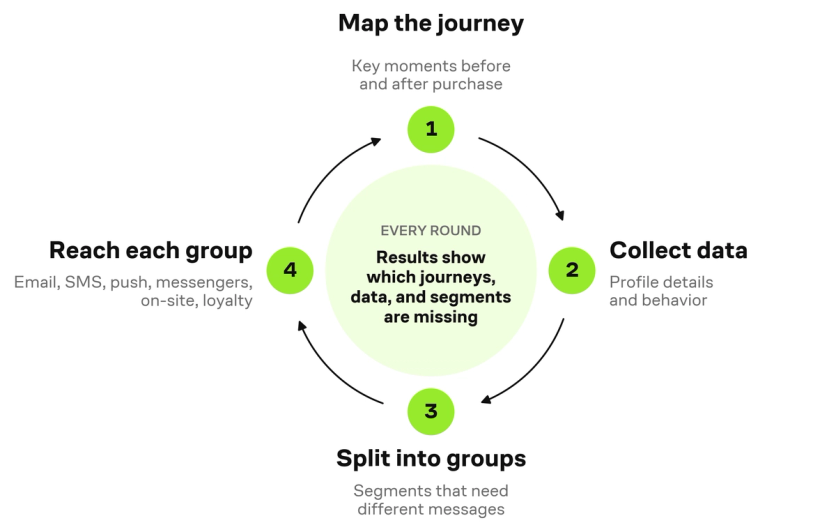
Step 1. Map the customer journey. Each agency draws the journey differently, but most mark the same key moments, from the welcome and the abandoned cart to the replenishment window and the win-back. Those moments get a message, an offer, and a number to move.
Step 2. Collect customer data. To make those messages personal, the agency sets up forms and pop-ups that gather email addresses and phone numbers. They can also ask about preferences, age, gender, or anything else that matters to the business, such as the type of pet and its diet for a pet store.
Behavioral tracking comes next: browsing, abandoned carts, orders, and subscription changes. With both in place, the agency sees each customer in full.
Step 3. Split customers into groups. Segments let the agency send each group the message, offer, and timing that fits it, instead of one campaign for everyone. Some segments work for almost any store: first-time buyers, VIPs, customers about to lapse. The most useful ones are usually specific to the business, such as owners whose dog food runs out next week or cat owners who have never tried the treats.
Step 4. Reach each segment in its channels. The messages go out wherever the customer pays attention:
- Email and SMS, which carry most of the program, from welcome and post-purchase messages to replenishment, win-back, and skip-or-pause flows for subscribers.
- Mobile push and in-app messages, for brands with an app.
- Messengers such as WhatsApp, for customers who ignore the inbox.
- On-site banners and product recommendations, for returning visitors.
- Loyalty points and tiers, which give customers a reason to come back.
How a Retention Agency Differs From an Email Agency
Retention agencies often get mixed up with other kinds of agency, for example:
- An email agency runs one channel. It plans campaigns and flows and is judged on email revenue, while loyalty, subscription, and on-site work sit with someone else.
- A paid-media agency buys new customers. It is judged on acquisition cost and first-order revenue, and what happens after that order is outside its brief.
- A Shopify or CRO agency builds and tunes the storefront. It overlaps with retention on on-site prompts, quizzes, and cart offers, so it is worth settling early who owns them.
A retention agency is judged on whether customers keep coming back, which is why the contract should say so.
What a Retention Agency Is Accountable For
A retention agency is accountable for customer retention: the share of customers who come back and buy again within a set period. Repeat purchase rate, time to the second order, and lifetime value are supporting numbers that show why retention moves.
Which supporting numbers go into the contract next to retention depends on why you are hiring the agency:
- Customers who never come back: first-to-second order conversion and the time it takes to reach the second order.
- Baskets that stay small: average order value and revenue from cross-sell and upsell placements.
- A loyalty program nobody uses: the share of buyers who redeem points and the revenue they bring.
- A subscription that leaks: monthly churn, skips, and recovered failed payments.
- Lapsed customers or VIPs: that segment’s revenue and activity.
Email-attributed revenue is the number most agencies report first, but it can grow without a single extra order once someone widens the attribution window. Measure the goal in Shopify or GA4 instead, because the store records every order and the email platform records only the ones it can claim.
What a Retention Agency Costs in 2026
Retention retainers sit above email-only ones because the mandate covers more channels and is judged on repeat purchases rather than send volume. Three of the seven agencies in this guide publish a price, and the ranges below come from their rate cards and Clutch profiles, checked in October 2026.
| Model | 2026 range | What it usually covers | Watch out for |
|---|---|---|---|
| Monthly retainer | $4,000–$4,500 at entry; the largest published package is about $13,000 | Strategy, flows, campaigns, SMS, segmentation; loyalty and subscription work on higher tiers | Entry tiers can cap the number of emails a month, so check what the cap leaves out |
| Setup or audit | Flow setup from about $13,000 on one public rate card; audits are often free | A build with a handover, or a roadmap for the first 90 days | Who maintains the flows after handover; ask for documentation in the deliverables |
| Hourly | $100–$200 an hour on the Clutch profiles of agencies in this guide | Audits, fixes, second opinions | Hours buy opinions, not outcomes |
| Performance or revenue share | Offered case by case by some agencies | The same scope, with part of the fee tied to results | The fee rides on attributed revenue, and the attribution window is a setting |
Everything in the table comes on top of what you already pay for your own marketing tools, and a retention program rarely runs on email alone. A typical mid-market DTC stack at 100,000 profiles looks like this:
- Email: the Klaviyo Email plan, about $1,380 a month.
- SMS: Klaviyo or Attentive, billed per message on top.
- Loyalty: Yotpo Loyalty, with paid plans from $199 a month.
- Cart upsells and recommendations: Rebuy, $534 a month for the full suite at the entry order tier, more as orders grow.
- On-site personalization: Nosto, with an average contract near $47,600 a year, about $4,000 a month.
That is roughly $6,100 a month in software before SMS. Add a retainer of $4,500–$8,000 and the retention budget lands around $10,600–$14,100 a month. For an email-only mandate, here is what a Klaviyo agency costs.
There is also a way to get most of these tools and the person running them on one bill. The next section covers it.
A Marketer Measured on Your Repeat Rate, Included in the Platform
The usual choice is between an agency and an in-house team. There is a third model few brands price in: a marketing platform that comes with its own marketer, who does the retention work for you.
Maestra works this way. Every account gets a Forward Deployed Marketer, who joins your team and clears the work that keeps waiting for bandwidth: the journey map, flows and segments, loyalty, on-site prompts, and the tests nobody had time to run. The brand grants access, sets the priorities, and signs off; the marketer builds and launches everything else.
The marketer also has better incentives than an agency. There are no hours or setups to sell, so the job is to make you happy with the results. Maestra bills month to month on purpose, and you can leave at any point. That puts the marketer in charge of making sure you get enough value: setting goals together and reaching them. Brands that see the value stay on the platform.

The platform matters as much as the person here. Loyalty, on-site personalization, and product recommendations are built into Maestra, so a points balance can sit in every email, a win-back flow can end in an on-site banner, and recommendations run in both without a connector between vendors.
Here is the like-for-like math at 100,000 active profiles.
| Retention agency plus a typical stack | Maestra with a Forward Deployed Marketer | |
|---|---|---|
| Monthly total | $10,600–$14,100, plus SMS messages | $4,775, plus SMS messages |
| Klaviyo Email plan, $1,380 a month | Customer data platform plus unlimited email, $2,000 a month, first 100,000 active profiles included | |
| SMS | Klaviyo or Attentive, billed per message | SMS module, $250 a month plus $0.0035 per US message |
| Loyalty | Yotpo Loyalty, from $199 a month | Shopify loyalty module, $1,010 a month |
| Recommendations and upsells | Rebuy, $534 a month | Included in the base |
| On-site personalization | Nosto, about $4,000 a month | On-site personalization module, $1,515 a month |
| The person running retention | Retainer, $4,500–$8,000 a month | Included in the platform |
The trade-off is a platform switch. Migration takes two to seven weeks, with the old tools running until the new flows are live. Maestra is built for mid-size and enterprise brands, and a store with a few thousand profiles will pay less on a basic license.
Svaha USA, a themed-apparel brand, moved its loyalty, recommendations, email, and SMS onto Maestra right before peak season. Its marketer rebuilt the flows, helped design the win-back, post-purchase, and re-engagement flows the brand had never had, and set up loyalty points that redeem inside checkout. Total sales grew 26% year over year.

Jewellerybox, a UK jeweller, moved its loyalty program from Yotpo with one goal: get more customers to spend their points. Together with its marketer, the team put the reward in front of every point holder, with a corner tab on every page, a product-page message, an exit-intent popup, and a points banner in key flows. The share of buyers who redeem points rose from 1.7% to 3.3%.

If you still hire an agency, carry two questions into the pitch: who is paid on my repeat rate, and how many brands does that person carry.
How to Choose a Retention Agency: 8 Questions for the First Call
If an agency is still the right call, the first conversation tells you most of what you need. Ask these eight questions; the answer you want follows each one.
- Who will run my account, and can I meet them before I sign? The person who will open your account joins a call before the contract does. At Maestra the Forward Deployed Marketer is on the calls before anything is signed, because the plan they write is the plan they will run.
- How many brands does that person carry? A number said out loud, with your account as the work rather than one of several things they also sell. A Maestra marketer carries around 15 brands.
- Which numbers will you answer for, and what are they today? Two or three numbers tied to your goal, with a baseline from Shopify or GA4 rather than email-attributed revenue.
- Do you run loyalty and subscription programs, or only the emails around them? Yes, with a named client for each.
- What ships in the first 30 days? An audit, a lifecycle map, and the first rebuilt flows. A single flow takes a couple of hours to build on a modern platform, so a quote of days or a week per flow is worth questioning.
- Which attribution will the report use? Store revenue next to attributed revenue, with the platform’s default window left alone.
- How will we work week to week? A standing call and a shared channel between calls, not only a monthly deck. A Maestra marketer holds a weekly call and sits in a shared Slack channel.
- What do we keep if we part ways? Everything: the account, templates, segments, and dashboards, with a written handover.
Red Flags
All of these are visible in a proposal or on a first call. Any one of them can have a reasonable explanation. Several together point to a program that will be kept running rather than grown.
| What you see | What it means |
|---|---|
| 🚩 A pitch built on email-attributed revenue, with no Shopify or GA4 numbers | The agency is reporting the number it can move with a setting. |
| 🚩 Revenue share with no base fee | The fee grows when the attribution window does, not only when orders do. |
| 🚩 A twelve-month contract with no exit before the first cohort has aged | You pay for a year before you can judge a single cohort. |
| 🚩 Flows or dashboards that stay with the agency when you leave | The program you paid for leaves with them. |
| 🚩 No loyalty or subscription case when that is the work you are buying | You would be their first. |
Retention Marketing Agencies Worth Shortlisting
Seven agencies with US headquarters whose main business is retention for e-commerce brands. Each was checked in October 2026 on its own site, its case-study pages, Klaviyo’s partner directory, and Clutch where a profile exists. The table sums up what their published cases are about; the cards add pricing, strengths, weak spots, and client reviews. This is a list to start calls from, not a ranking.
| Agency | Where the cases cluster | What the work actually is | What sets them apart |
|---|---|---|---|
| Sticky Digital | Beauty, home fragrance, wellness | Segmentation, loyalty revamps, subscription programs on Recharge | Retention only; Yotpo’s Best Retention Marketing Agency in North America in 2023 and 2024 |
| The Email Marketers | Food and beverage, wellness, home care | Flow rebuilds, campaigns, list growth, cancel flows for subscribers | The most detailed public rate card, priced by monthly email volume |
| Stimulate | Beauty, wellness | Klaviyo flows and campaigns, replenishment timing, subscription growth | The most published repeat-purchase results on this list |
| BMO Media | Apparel, food and beverage, jewelry | Email and SMS first, with loyalty launches and subscription work | Runs email, SMS, loyalty, reviews, push, and direct mail as one program |
| AMB Interactive | Fashion, footwear, grooming | Segmentation, personalized email, post-purchase and win-back flows | Shared Klaviyo’s Agency Partner of the Year award for the Americas in 2025 |
| eHouse Studio | Health and wellness, food, apparel | Subscription portals on Recharge, alongside store builds and integrations | A Recharge Elite partner that builds the subscription experience itself |
| Mattered | Apparel, beauty | Email and SMS on Klaviyo and Attentive, plus Shopify development | The most recent client reviews on Clutch among these seven |
Sticky Digital
🏅 Yotpo Best Retention Marketing Agency, North America, 2023 and 2024 · Klaviyo Platinum Master
📍 San Diego, California
Sticky Digital opened in 2019 and works only on retention, with no paid media and no SEO. Today it runs more than 40 retainers for Shopify brands, mostly in beauty, wellness, food, and apparel, with clients such as MUD\WTR, PrettyLitter, Tubby Todd, and American Optical.
Pricing: new engagements start at $4,500 a month, and migrations onto Klaviyo are free.
Real cases:
- NEST New York – subscription revenue up 223% in a year.
- KISS USA – $175,000 more revenue in under six months from a revamped loyalty program.
- Deborah Lippmann – revenue up 110% year over year.
The Email Marketers
🏅 Klaviyo Platinum Master
📍 Santa Monica, California
The Email Marketers started in 2020 and took its current name in 2021. Today a remote, US-led team serves more than 100 e-commerce brands, including Koala Eco, Grüns, KiwiCo, and BodyBio, and every account gets the same five people: a strategist, a project manager, a copywriter, a designer, and an implementation specialist.
Pricing: $4,400 to $12,999 a month in four packages set by monthly email volume, with the average client at about $6,500; a one-time flow setup costs $12,999.
Real cases:
- Koala Eco – US repeat customer revenue up 234.6% between September 2025 and April 2026.
- The Freeze Pipe – email-attributed revenue up 113% year over year.
- Gimme Seaweed – email revenue up 65% month over month.
Client reviews: rated 5.0 on Clutch, with every review from late 2021. The one improvement note mentions Klaviyo bugs that the team fixed quickly.
Stimulate
🏅 Klaviyo Gold Master
📍 St. Petersburg, Florida
Stimulate launched in 2021 as a retention-only shop with no paid ads. Today it has worked with more than 100 brands, most of them selling $200,000 to $2 million a month, among them Begin Health, TEMPTU, ezpz, and Nursing Queen.
Pricing: from about $4,000 a month, month-to-month or on six-month terms; a free retention audit for brands past $1 million in revenue.
Real cases:
- Editor’s Pick – 30-day repeat customers up 104%.
- Begin Health – repurchase rates up 42%.
- Unicorn Snot – repurchase rates up 91%.
Client reviews: rated 4.9 on Clutch, with reviews from December 2024 to October 2026. A January 2025 reviewer did not want their team to work inside the agency’s own tools.
BMO Media
🏅 Klaviyo Elite Master
📍 Irvine, California
BMO Media focuses on what happens after the first order and sells no paid media or web builds. It runs email, SMS, loyalty, reviews, push, subscriptions, and direct mail for brands such as Our Place, CALPAK, Birdy Grey, and Liquid Death.
Pricing: custom; Clutch lists a $1,000 minimum project.
Real cases:
- Spoonful of Comfort – email and SMS-attributed revenue up 196.9% year over year over Black Friday and Cyber Monday 2025.
- Liquid Death – email revenue up fourfold in 12 months.
- James Michelle – email revenue up 159% year over year.
Client reviews: rated 5.0 on Clutch, with every review posted in one week of May 2026 and almost no improvement notes.
AMB Interactive
🏅 Klaviyo Agency Partner of the Year, Americas 2025, shared with Homestead Studio · Klaviyo Elite Master
📍 New York
AMB Interactive opened in 2018 as an email and SMS shop, and Klaviyo named it an Elite Master partner in 2022. Today a team of about 15 people runs programs for more than 20 brands, including Lake, Outdoor Voices, Ekster, and Arctic Cool.
Pricing: custom, on month-to-month contracts; a free Klaviyo audit comes with a 30-, 60-, and 90-day roadmap.
Real cases:
- Italist – email-driven revenue up 53% in six months.
- Black Wolf Nation – customer retention up 53% in a year.
- Birdies – email-driven revenue up 31% in three months.
eHouse Studio
🏅 Recharge Elite partner · Klaviyo Elite Master · Shopify Platinum
📍 Charleston, South Carolina
eHouse has built online stores for more than two decades. Today it has about 135 people and 145 retained clients, among them ButcherBox, Briogeo, Love Wellness, and MegaFood, and it joined Recharge’s invite-only Elite tier in its first group in 2025.
Pricing: custom; Clutch lists a $25,000 minimum project and $150–$199 an hour.
Real cases:
- Kenneth Jay Lane – returning-customer rate up 6%, to 36% in 2024.
- DanceSupplies – Klaviyo-attributed revenue up 77% year over year within 90 days.
- Sweet Bee – year-to-date Klaviyo revenue up 33.31% on the previous year.
Client reviews: rated 4.8 on Clutch, with reviews from 2017 to May 2022, most of them about store builds rather than retention work.
Mattered
🏅 Yotpo Best Digital Marketing Agency, North America, 2025 · Klaviyo Gold Master
📍 Irvine, California
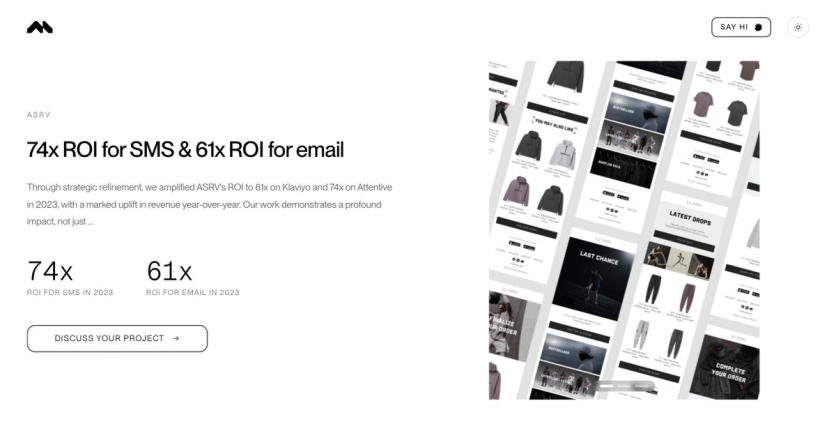
Mattered was founded in 2021 and sells lifecycle marketing alongside Shopify development. Today email and SMS make up about 70% of its work, for brands such as ASRV, Cos Bar, Three Nails, and Milani, and Yotpo’s 2025 award cites its email, SMS, and loyalty work for Milani Cosmetics and Bioray.
Pricing: custom; Clutch lists a $5,000 minimum project and $100–$149 an hour.
Real cases:
- Three Nails – Black Friday and Cyber Monday sales up 265% over 2022.
- Cos Bar – attributed email revenue up 219%.
- ASRV – 61x return on email and 74x on SMS.
Client reviews: rated 5.0 on Clutch, with reviews from July 2024 to March 2026. The recurring note is slow first responses when a project starts.
How to Tell If a Retention Agency Is Working
Three checks show whether the retention program works, and all three use data the brand owns.
Newer cohorts come back more often. Shopify’s customer cohort analysis groups buyers by the month of their first order and shows how many return. Put the cohorts from before the agency started next to the ones after. Once a full reorder cycle has passed, the newer rows should show a higher retention rate.
The lift holds against a holdout group. Attributed revenue also counts orders that would have come anyway. A holdout group is a random share of customers who get no marketing messages, so the gap in purchases between them and everyone else is what the program adds. Give the test about three months before reading the result.
Repeat orders don’t lean on discounts. A repeat rate bought with coupons costs margin and teaches customers to wait for the next deal. At Editor’s Pick, Stimulate found that discounts over 10% made customers expect the same next time, and scaled them back. Watch the share of repeat orders placed with a discount code: it should not climb along with the repeat rate.
Retention Agency vs In-House vs Maestra: the Decision Table
| What to compare | Retention agency | In-house retention manager | Maestra with a Forward Deployed Marketer |
|---|---|---|---|
| Monthly cost at 100,000 profiles | ≈ $10,600–$14,100, software stack plus retainer, before SMS messages | ≈ $17,200–$19,200, one manager with benefits plus the same software, before SMS messages | $4,775 with the SMS, loyalty, and on-site personalization modules, before SMS messages |
| Who answers for repeat purchases | The agency, on the numbers you write into the contract | One person, accountable to you | Your marketer, on a month-to-month plan you can leave at any point |
| Loyalty, personalization, recommendations | Separate apps the agency configures, if it runs them | Separate apps you license and someone has to learn | Built in, on one customer profile |
| Adding a channel | Depends on the agency; several advise on loyalty rather than run it | Training or another hire | Add a module and the same marketer runs it |
| Getting a platform issue fixed | Through the agency’s partner contact at the vendor | Through the vendor’s support queue | Your marketer takes it to Maestra’s product team |
| Ramp time | Three weeks to the first rebuilt flows | A hiring cycle, then onboarding | Two to seven weeks to migrate, old stack running alongside |
| What you keep at exit | Account, templates, and data, if the contract says so | Everything | Your data exports |
The in-house line takes Salary.com’s $121,468 average (September 2026) and Glassdoor’s $103,000 median for an email marketing manager, adds about 30% for benefits, and adds the same software stack, about $6,100 a month. Someone who also runs loyalty and subscription programs usually costs more, so read it as a floor.
Final Verdict on Retention Marketing Agencies
Hire a retention agency when nobody owns the second order, you can fund $4,500–$8,000 a month on top of the software stack, and the contract names the number the agency answers for, measured in Shopify. Stimulate and Sticky Digital have the most published retention work; eHouse Studio fits brands whose subscription experience needs building as well as marketing.
Build in-house when retention is already a top-three revenue line and you want the cohort knowledge to stay in the building; budget about $17,000 a month or more for one manager and the software.
Choose Maestra when you want the platform and the person on one bill, paid on the same number. For $2,000 a month at 100,000 active profiles, a mid-size or enterprise brand gets the customer data platform, unlimited email, and a Forward Deployed Marketer who builds the lifecycle. Recommendations are already in the base, and loyalty and on-site personalization add as modules on the same profile. Start with the pricing page.
Frequently Asked Questions
- Stimulate, if the goal is more repeat purchases: it has published more repeat-purchase results than the other six agencies in this guide. For subscription programs, look at Sticky Digital or eHouse Studio. BMO Media runs every owned channel as one program, The Email Marketers publishes a full rate card, and AMB Interactive and Mattered fit apparel, footwear, and beauty brands that mainly need email and SMS. A less obvious and cheaper option is Maestra: the platform comes with a Forward Deployed Marketer who runs retention, at less than half the cost of an agency plus its software.
- A retention agency, unless retention is already a top revenue line and the budget covers a full salary. A comparable email marketing manager earns $103,000–$121,000 a year before benefits, while published agency retainers start around $4,000–$4,500 a month and there is no hiring cycle. Few brands consider a third option that costs less than either: Maestra comes with a Forward Deployed Marketer, so there is nobody to hire. “Maestra lets our lean team run sophisticated retention marketing without adding headcount,” says Etan Efrati of Magnum Bikes.
- For most mid-size e-commerce brands, a retention agency. A loyalty agency designs the program: the tiers, the rewards, and what they cost. A retention agency also runs it week to week alongside email, SMS, and subscriptions, and is judged on repeat purchases. Maestra is a cheaper route: loyalty is built into the platform, and the Forward Deployed Marketer runs it. At Jewellerybox, the share of buyers who redeem points rose from 1.7% to 3.3%.
- Lifecycle flows, campaigns, segmentation, SMS, and loyalty operations. This work runs on a schedule and can be judged on a number. Keep the platform account, the customer data, the brand voice, and the goal with its baseline in-house. The same work can also go to Maestra instead of an agency: the Forward Deployed Marketer runs it inside the brand’s own account, for less than an agency plus its software costs. “With Maestra, our dedicated marketer proactively suggests and builds new flows with me,” says Nikita Zabrodin, CRM Lead at Coolibar.
- A rate above the brand’s own baseline for the same period, rather than an industry average. Repeat purchase rate is the share of customers who placed more than one order in a period. Fix the window, such as 90 days or 12 months, and measure it by cohort in Shopify. Reorder cycles differ by category, so a store’s own cohorts say more than any benchmark.