Svaha USA Grows Total Sales by 26% After Consolidating Their Entire Marketing Stack


Integrated with:
Switched from:
Results
- +26%
total sales
- +14%
average order value

What Consolidating to Maestra Changed
| Before Maestra | With Maestra |
|---|---|
| Loyalty program | |
| ❌ Loyalty required a separate opt-in – support kept getting “can I get points for my old orders?” tickets | ✅ No separate opt-in – shoppers earn points on every purchase automatically |
| ❌ Loyalty points often didn’t land – customers left reviews and got no credit | ✅ Points land reliably on every review, purchase, and trigger |
| ❌ Points lived on a separate page – copy a code, paste at checkout. Shoppers gave up and wrote to support | ✅ Checkout shows all rewards – tap to apply, instant refund if you change your mind |
| Product recommendations | |
| ❌ Rebuy recommendations filled every slot with the same dress in different colors – no real product discovery | ✅ Color variants grouped with swatches, each rec slot shows a genuinely different product |
| ❌ Recommendations cost a percentage of attributed revenue | ✅ Recommendations are included in Maestra – no per-revenue fee |
| ❌ Product recommendations in emails crashed often, so customers saw empty links | ✅ Email recommendations render correctly and use real customer data to personalize |
| Site personalization | |
| ❌ A one-size-fits-all storefront – no way to tailor the experience by geo, traffic source, or shopper behavior | ✅ A store that adapts to each visitor – geo, traffic source, and lifecycle stage all shape what they see |
| Email & SMS flows | |
| ❌ Emails looked like they came from different brands – flows from various redesign eras stacked side by side | ✅ Every flow rebuilt on-brand, with reusable blocks for fast new builds |
| ❌ No hands-on help from Yotpo – flows went stale, logic broke, some never got built | ✅ Maestra marketer rebuilt the flow program end to end – fixed logic, refreshed content, filled the gaps |
Loyalty That Customers Can Actually Use
Under Yotpo, Svaha’s loyalty program had problems on both ends:
Rewards often didn’t land. Customers left reviews through Yotpo Reviews and didn’t get credit for them – ironic given both products live under the same roof.
Redeeming points meant finding a dedicated loyalty page, picking a reward, copying a code, and pasting it at checkout. Customers who forgot to apply their codes had to reach out to support for retroactive adjustments – a recurring ticket category.
Customer service fielded a new round of loyalty complaints every week.
With Maestra, points land reliably on every review, purchase, and trigger. Redemption happens directly in checkout. All available rewards sit in a single section – eligible ones ready to apply with one tap, ineligible ones grayed out so there’s no guesswork.
If a customer applies a reward and then removes it from the order, the points get refunded automatically – no support ticket needed.
Loyalty points are now visible across the whole customer journey. In emails, a single adaptive block shows members their tier and points balance and invites non-members to join.
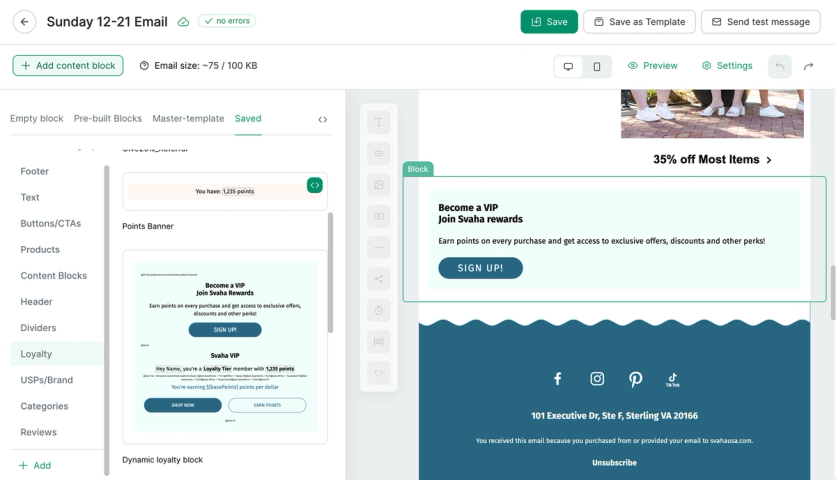
The pre-built loyalty block sits in the email builder, ready to drop into any campaign – members see their tier and points balance, non-members get an invite to join
The result: loyalty tickets no longer show up on the customer service queue.
The same loyalty experience now works on Svaha’s mobile app.
Recommendations That Surface Something New
Under Rebuy, product discovery was broken. Svaha stores each color as its own Shopify product, and Rebuy treated all 16 as distinct items – so browsing a dragon dress surfaced the same dress in 16 shades instead of anything new.
Maestra groups color variants with swatches, so each recommendation slot is a genuinely different product. Shoppers browse colors within one card instead of seeing the same item repeated.
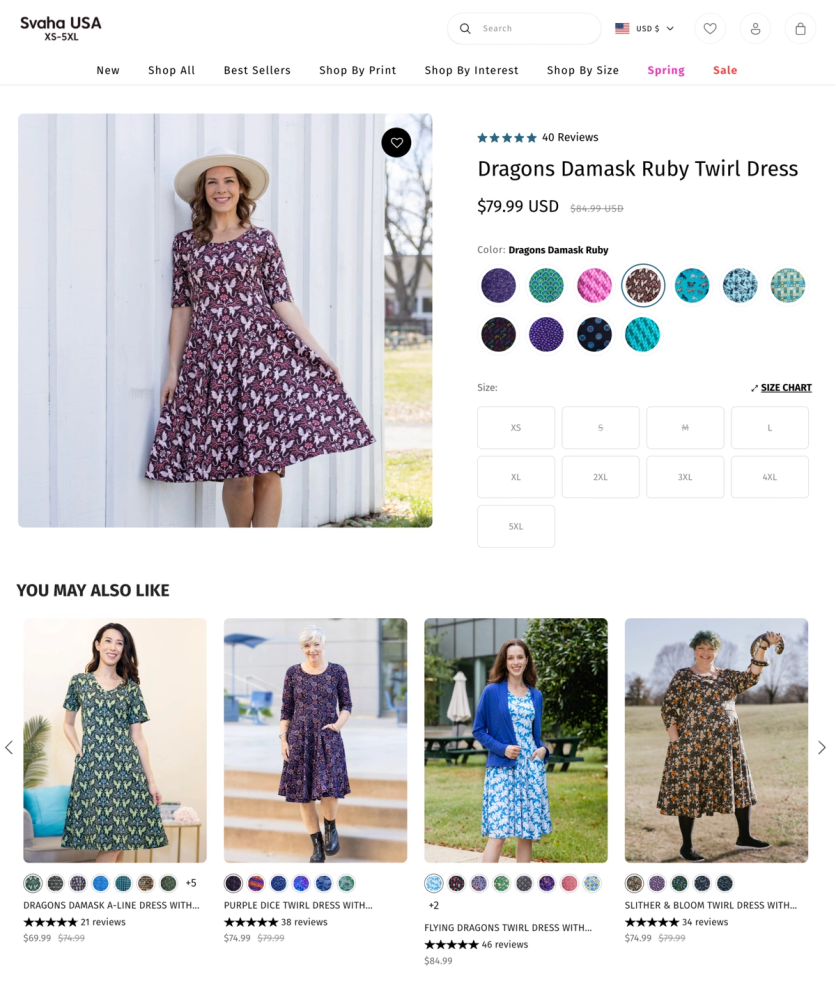
Color variants grouped with swatches – each recommendation slot shows a genuinely different product
That’s just one slice of the setup. For the full breakdown – Pair With, You May Also Like, FBT, bundles, minicart upsells, and the revenue they bring – see the dedicated recommendations case study.
A Website That Adapts to Every Visitor
Svaha’s shoppers come from different places, different ad campaigns, and different points in the lifecycle – and they expect the storefront to meet them where they are. Maestra’s on-site tools let the same product page show different things to different people.
Geo and ad-targeted promo reminders. AUS back-to-school doesn’t line up with the US calendar, so AUS shoppers see the 25% off reminder on PDPs and the announcement bar while US visitors keep seeing the US offer.
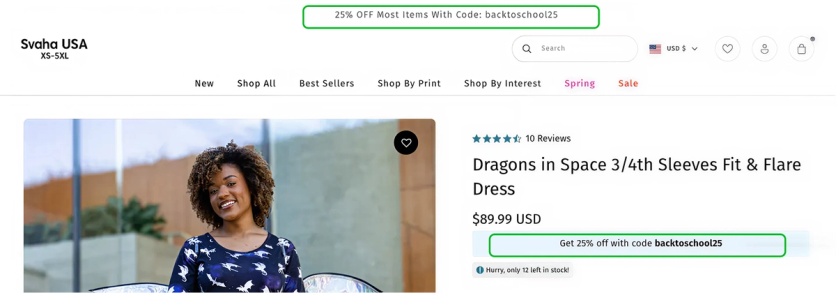
AUS shoppers see the back-to-school reminder on PDPs and the announcement bar; US visitors keep seeing the US offer
BOGO for ad campaign traffic. Svaha runs a “Buy One, Get One 50%” deal on a curated set of dresses – one of the highest-performing plays for specific audience segments. Before Maestra, there was no way to target by traffic source, so the team ran the offer on a single dress, visible to everyone. Now the badge shows on every qualifying dress, only to ad traffic, with a link to the full collection.
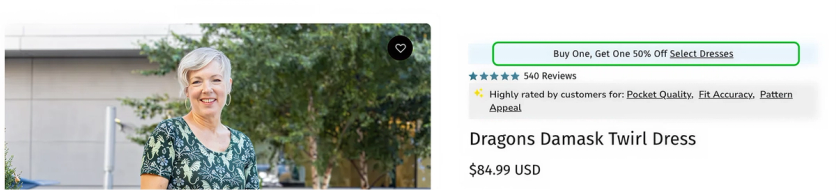
The BOGO badge shows on every qualifying dress, only to ad traffic, with a link to the full collection
These are just two of the website personalization tactics Svaha runs. More examples – announcement bars, sticky banners, PDP overlays, shortcut filters, promo reminder badges, country-aware minicart messages, and more – are in our 16 website personalization tactics article.
Every Email Redesigned, Every Flow Rebuilt
Under Yotpo, Svaha’s email program was a time capsule. The brand had been through multiple redesigns, but with a lean team and no strategic help from Yotpo, only some emails got updated each time. Flows from different eras sat side by side – some in the old green branding, some in an even older blue, reading like messages from different brands.
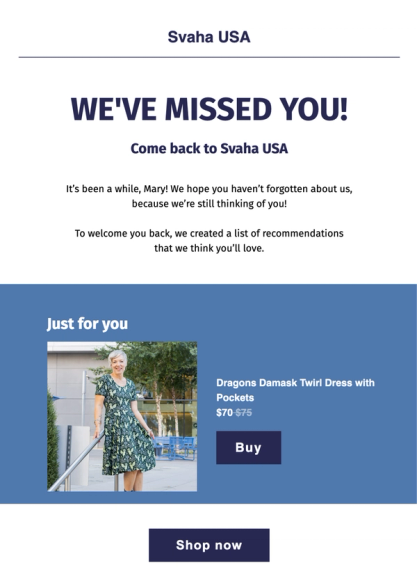
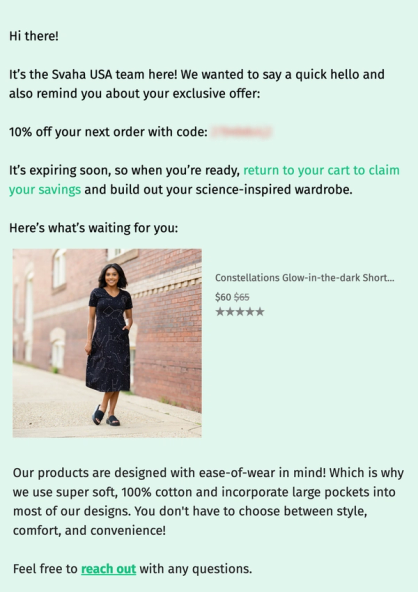
Winback and Abandoned Cart emails in the old design – they looked like messages from different brands
On top of that, Svaha redesigned their website a week before going live with Maestra – new color palette, new vibe. Every email had to be restyled from scratch.
Maestra’s Forward Deployed Marketer didn’t just rebuild the existing flows to match. She put together a set of branded content blocks – headers, product cards, promo banners – so Svaha’s team can now assemble new emails in minutes, always on-brand.
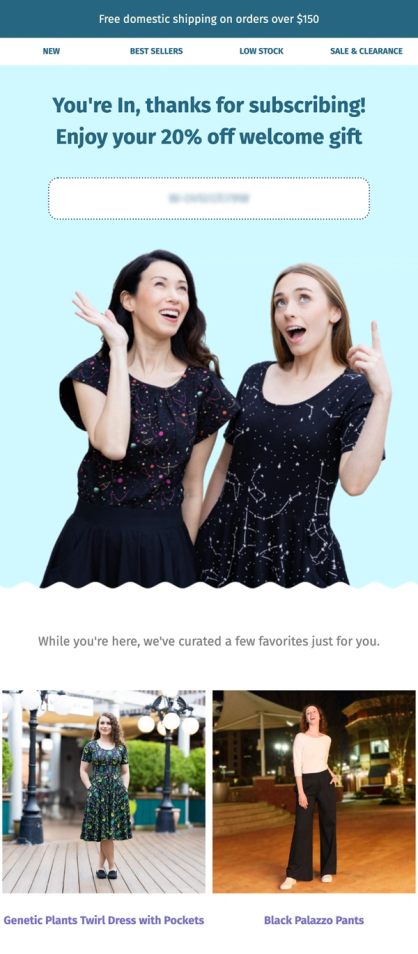
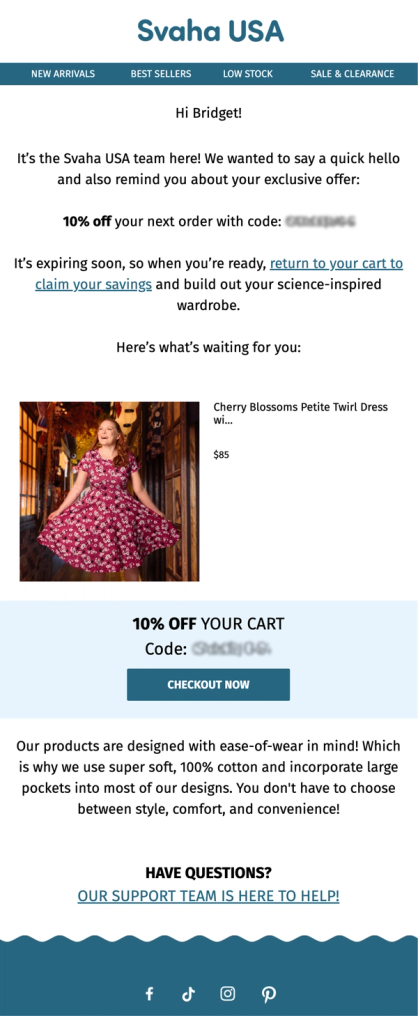
Welcome and Abandoned Cart emails in the new design – consistent and up to date
Fixing the logic. Without proper support from Yotpo, some flows had gaps that were quietly leaking money. The Back in Stock SMS, for example, offered a 20% discount to customers who had signed up to be notified – the highest-intent audience possible. These are people who literally asked to be told when the item was available. Removing that unnecessary discount was one of many tweaks made during the rebuild.
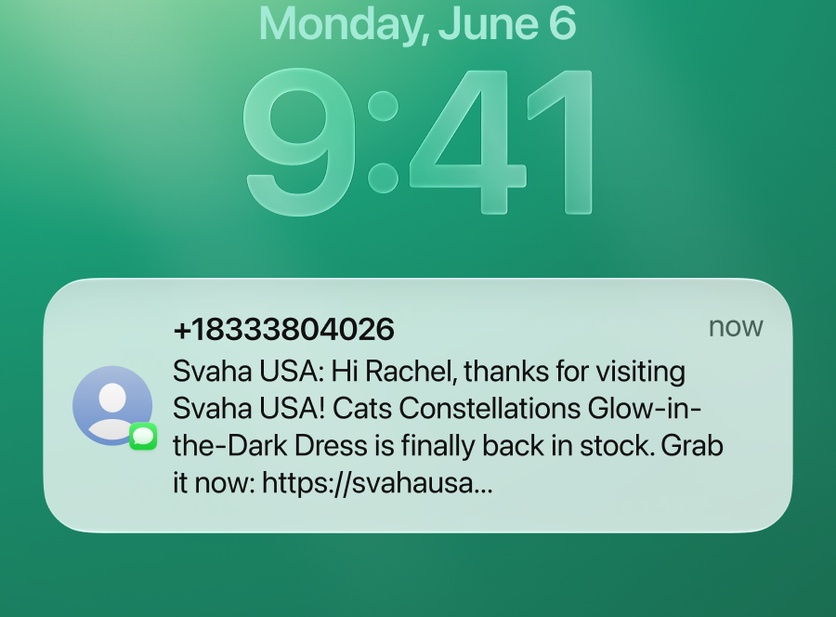
Another quiet problem: the browse abandonment flow was set up to exclude all existing purchasers – not just those who’d bought since entering the flow. Customers who’d made a single purchase months ago stopped receiving browse abandonment messages entirely. Fixing the segmentation logic reopened a channel to the brand’s most engaged audience.
Building what was missing. Svaha had no Win-back, Post-Purchase, or Re-engagement flow. Maestra’s Forward Deployed Marketer helped design each from scratch – the strategy, triggers, and segmentation.
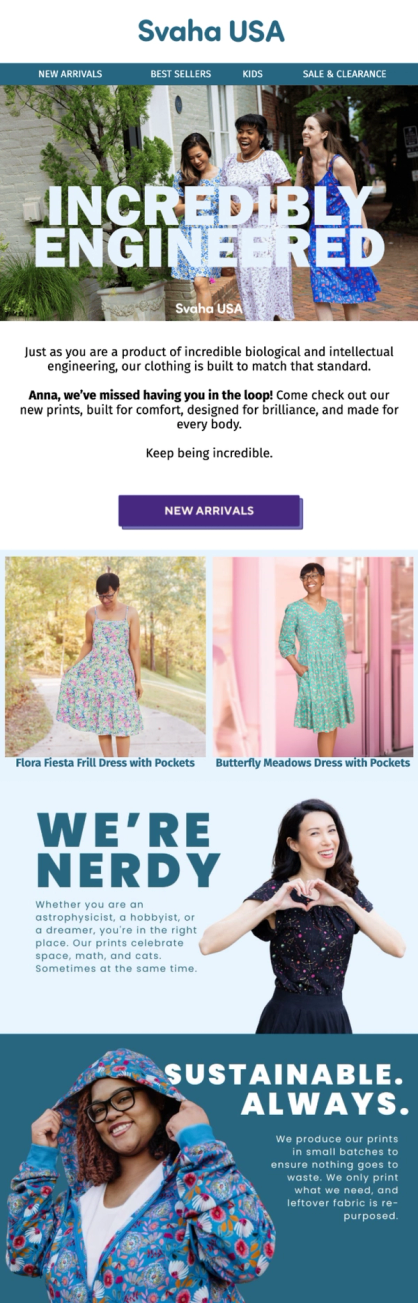
The new Win-back email, built from scratch
The Bottom Line
Svaha was forced to migrate mid-peak season – not the plan any brand would choose. But with Maestra’s white-glove service, the crisis turned into a cleanup. Emails rebuilt from scratch. Missing flows launched. A loyalty program that had been quietly broken, fixed. Product discovery working for the first time, with recommendations that understand how Svaha’s catalog is built.
A forced migration that left the business in a stronger place than where it started.