
9 Best Sendlane Alternatives for E-Commerce Brands

In February 2026 Sendlane was acquired by Privy, and brands are asking what the roadmap looks like under new ownership. The platform won its following on a simple promise: email, SMS, reviews, and forms under one login, one bill, and support that answers in seconds. For many DTC brands that promise still holds.
The trade-offs show up as you scale. Pay-for-sends pricing climbs quickly for high-frequency senders, and SMS stops at the US border.
This guide compares 9 Sendlane alternatives on pricing, features, G2 ratings, and user reviews from the past 12 months. Here’s how they stack up:
Quick Verdict on the Best Sendlane Alternatives
The nine Sendlane alternatives that hold up in 2026 are Maestra, Klaviyo, Omnisend, Attentive, Postscript, Drip, Listrak, ActiveCampaign, and Mailchimp. Maestra is the pick for brands that liked Sendlane’s one-bill, high-touch model and now need a CDP, loyalty, and site personalization underneath it; the rest split by channel focus and budget.
Best for scaling past email and SMS: Maestra – real-time CDP, built-in loyalty, and site personalization on one profile
Best for e-commerce data depth: Klaviyo – B2C CRM with the widest channel list and the deepest store integrations
Best for keeping costs low: Omnisend – free 5-day migration and web push on every plan
Best for enterprise SMS: Attentive – AI trained on 90B+ messages, with identity resolution
Best for SMS-first Shopify brands: Postscript – Infinity Testing and Shopify-native monetization tools
Best for small teams doing email well: Drip – unlimited sends, with live chat from the $99/mo tier
Best for managed retail programs: Listrak – identity resolution plus in-store and RCS reach
Best for mixed B2B and B2C: ActiveCampaign – Active Intelligence and 950+ automation recipes
Best for a small starting budget: Mailchimp – Intuit Assist AI and 300+ integrations
Content:
Pain Points with Sendlane
Sendlane’s public review base has stayed thin over the past 12 months, so we combined verified reviews from the past two years with what’s verifiable on Sendlane’s own site and current news. The recurring themes:
| Pain Point | Description | Possible Solutions |
|---|---|---|
| Send-based pricing climbs fast | $100/mo covers 50,000 email sends. A brand emailing a 100K list daily lands near the $1,100/mo tier, and overages bill at roughly $2 CPM | Audit your real send volume; consider per-contact or flat-rate platforms |
| SMS is US-only | Sendlane doesn’t sell international SMS sending | Pick a platform with international SMS, WhatsApp, or RCS |
| Compliance holds freeze campaigns | Reviewers describe scheduled sends stuck in compliance review without warning | Ask support about review triggers before big sends; keep list hygiene tight |
| Reporting stays surface-level | Dashboards cover the basics; Beacon tracking has drawn accuracy complaints | Export data to a BI tool, or choose a platform with deeper analytics |
| No version history in flows | Editing a complex automation can’t be rolled back | Document flow logic outside the platform before every change |
| New ownership, unsettled roadmap | Privy acquired Sendlane in February 2026, after buying SMS platform Emotive | Ask for written roadmap commitments before renewing an annual contract |
Pricing is the loudest theme. “The new plans are far too expensive and I may need to look at cheaper alternatives,” wrote one Capterra reviewer after Sendlane moved to pure usage-based billing. Another reported being “billed for the entirety of my list contacts and 8.5M emails delivered,” despite sending a fraction of that volume.
Compliance holds sting because they hit mid-campaign. “They held all of them in compliance review and denied todays email for no reason. It is becoming a nightmare!” reads one verified Trustpilot review from a wholesale retailer.
Analytics complaints are quieter but consistent. “The reporting and analytics feel somewhat basic; more customizable dashboards and deeper segmentation on campaign performance would help,” noted one G2 reviewer – and a Shopify App Store review adds that “the beacon fails regularly.”
The ownership question is newer. The acquisition announcement praises Sendlane’s support model (Privy), but two retention platforms merging always means consolidation decisions ahead – Yotpo shut its Email & SMS product on December 31, 2025, and Attentive absorbed those customers.
To be fair: plenty of brands should stay. Sendlane’s support earns consistent praise – recent Shopify App Store reviews call the team “always quick with responses” – and deliverability monitoring is a genuine strength. Before switching, ask your CSM about annual pricing, direct-rate SMS, and volume-tier discounts. If the math still doesn’t work, or you need channels and personalization Sendlane doesn’t have, keep reading.
Sendlane Alternatives at a Glance
| Platform | Best For | Key Differentiator | Starting Price |
|---|---|---|---|
| Maestra | Scaling brands that need more than email and SMS | Real-time CDP, built-in loyalty, and site personalization run by a dedicated Forward Deployed Marketer | From $2,000/mo (100,000 active profiles) |
| Klaviyo | Deep e-commerce data and integrations | B2C CRM with the widest channel list – email, SMS, RCS, WhatsApp, push | Free plan available; from $20/mo (500 profiles) |
| Omnisend | Keeping costs low without losing e-commerce focus | Free 5-day migration and web push on every plan | Free plan available; from $16/mo (500 contacts) |
| Attentive | Enterprise SMS programs built on AI | Attentive AI trained on 90B+ messages, identity resolution | Custom pricing (contact sales) |
| Postscript | SMS-first Shopify brands | Infinity Testing and SMS monetization tools like Shopper and CashBack | From $0/mo + $49 minimum spend |
| Drip | Small teams that want email done well | Unlimited sends; live chat from the $99/mo tier | From $39/mo (2,500 people) |
| Listrak | Managed cross-channel retail programs | Identity resolution plus in-store, RCS, and guaranteed-performance GXP | Custom pricing (contact sales) |
| ActiveCampaign | Mixed B2B and B2C automation | Active Intelligence AI layer and 950+ automation recipes | From $15/mo (1,000 contacts) |
| Mailchimp | Getting started on a small budget | Intuit Assist AI and 300+ integrations | Free plan available; from $13/mo (500 contacts) |
1. Maestra – Best for Scaling Brands That Need More Than Email and SMS
Starting price: From $2,000/mo (100,000 active profiles) · G2 rating: 4.8
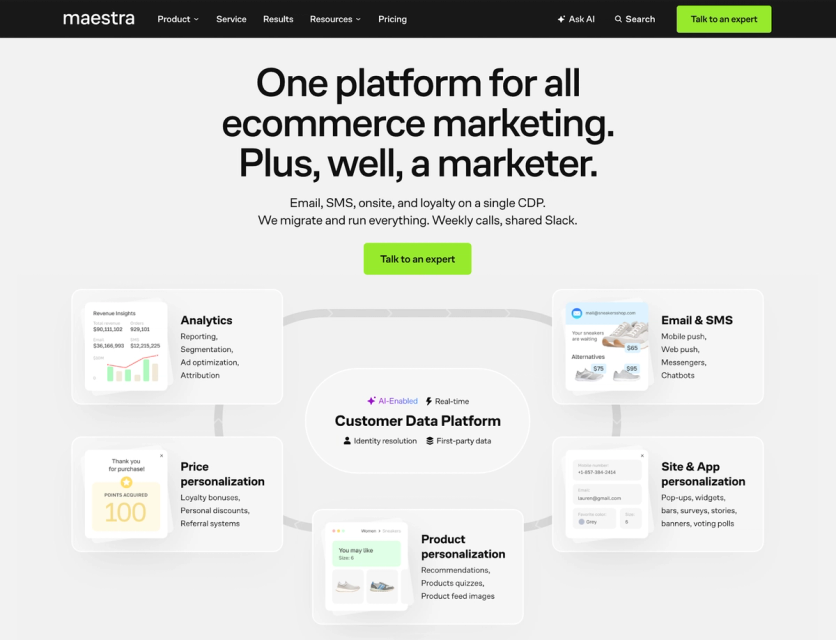
Maestra is built for mid-size, enterprise, and fast-growing e-commerce brands whose site, messaging, and rewards program all need to read from a single customer record. Where Sendlane unifies email, SMS, reviews, and forms, Maestra goes several layers deeper: a real-time CDP, an omnichannel journey builder, built-in loyalty, and on-site personalization – all of it operated with a named Forward Deployed Marketer who sits alongside your team and builds the flows and segments.
That last part matters for Sendlane users. The reason most brands picked Sendlane was hands-on support. Maestra keeps that model and extends it: your Forward Deployed Marketer isn’t a ticket router – a marketer inside your team who proposes flows, builds them, and reports on results.
Key Features
Omnichannel Journey Builder
One canvas for email, SMS, MMS, RCS, mobile and web push, WhatsApp, and Telegram. Flows adapt in real time to what customers do on-site and in every channel – no duplicate logic per channel.

Price Drop Alerts notify customers when prices are reduced on items in their cart or products they’ve viewed
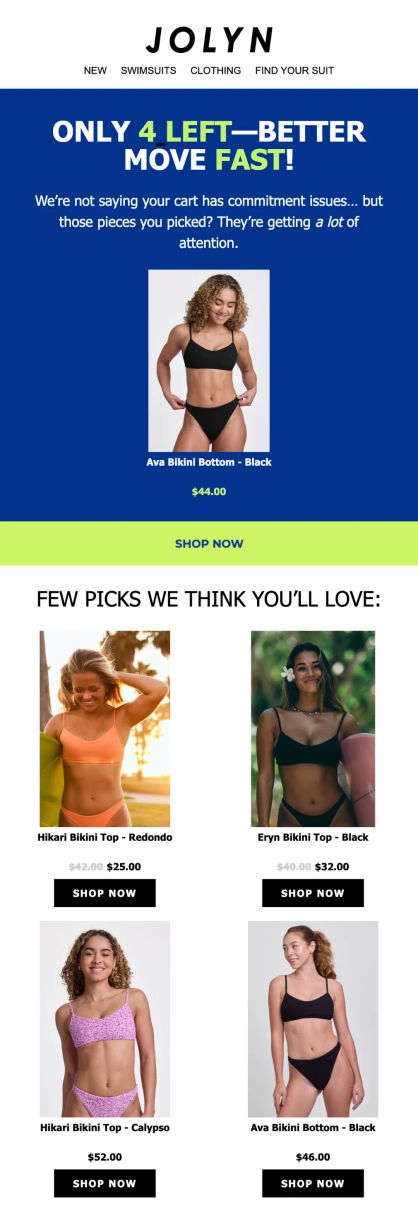
Low Stock Notifications alert customers when inventory is running low on products they’ve added to their cart
Real-Time CDP
Every click, order, and site visit lands in one customer profile as it happens. Segments update instantly, so a price-drop alert or back-in-stock message goes out while the shopper still cares.
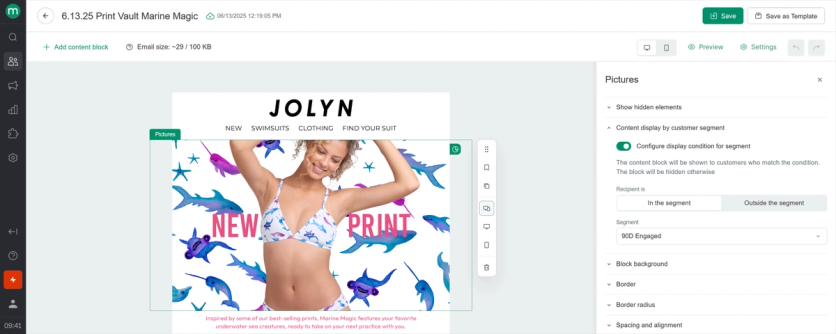
Built-In Loyalty, Promos, and Referrals
Points, tiers, referrals, and promo codes live in the same platform as your messaging – no third-party loyalty app, no sync delays. UAG retired three vendors this way – Klaviyo, Yotpo Loyalty, and Frosmo – and watched the stack bill fall 64%, about $100,000 a year.
Site and App Personalization
Pop-ups, quizzes, surveys, and AI product recommendations personalize the on-site experience from the same segments that drive your emails. Enlightened Equipment used recommendations and a smart up-sell bar to grow revenue 22% in two months, with a 15% higher site conversion rate and 8.7% higher AOV – on zero extra ad budget.
Maestra AI
Next best action suggestions, optimal send time prediction, auto-generated email and SMS content, and AI-proposed segment hypotheses that your marketer reviews and approves – the AI assists, the human decides.
Dedicated Forward Deployed Marketer on Every Plan
Migration, campaign and journey setup, and ongoing optimization are included at no extra cost. Coolibar’s Forward Deployed Marketer proactively rebuilt their flows after a Klaviyo migration – flow revenue rose 62% year over year.
Pricing
From $2,000/mo, which covers the real-time CDP, unlimited email, and the first 100,000 active profiles – you pay only for active profiles, so a dormant list costs nothing. Product recommendations, full-funnel reporting, and your Forward Deployed Marketer are already in that base; site personalization and loyalty are monthly modules on top, while SMS and WhatsApp add a module fee plus per-message costs. Migration is included, with no setup fees. For brands paying separately for an ESP, an SMS tool, a loyalty app, and a personalization widget, the consolidated bill usually comes out lower than the sum. See Maestra’s pricing.
Where Maestra Wins
Consolidation is the clearest win. One platform replaces three to five point tools, one support team owns the whole stack, and segments built once work everywhere – email, SMS, on-site, and loyalty.
Depth of personalization is the second. Real-time CDP data powers flows Sendlane can’t run, like price-drop alerts on a viewed product or loyalty-tier-specific recommendations. JOLYN grew campaign-driven revenue 26% after switching from Klaviyo, with SMS revenue up 52%.
And the support model scales with you. Sendlane’s dedicated CSM starts at 10,000+ contacts; Maestra assigns a Forward Deployed Marketer to every client, and the role runs migration, flows, segments, and campaign templates rather than check-ins alone.
Where Maestra Falls Short
Maestra has no free plan and no self-serve tier, so early-stage and smaller stores will find the entry price hard to justify – the base covers the first 100,000 active profiles whether you use them or not. Sendlane’s $100/mo starting point serves that segment better.
The G2 review base is also smaller – dozens of reviews against the thousands Klaviyo and Omnisend have collected. The rating is high (4.8), but buyers who want a huge public review archive will notice the difference.
Compared to Sendlane
Both platforms lead with human support and transparent, published pricing. The difference is scope: Sendlane covers email, SMS, reviews, and forms; Maestra adds the CDP, loyalty, site personalization, and five more channels, including WhatsApp and Telegram – useful the moment your audience extends beyond US phone numbers, since Sendlane’s SMS is US-only.
When to Switch from Sendlane to Maestra
You want Sendlane-style support with more platform underneath. Blue Q made exactly this move – after switching from Sendlane, email-driven sales grew 39% on the strength of a Forward Deployed Marketer partnership and conversion-focused modular email design.
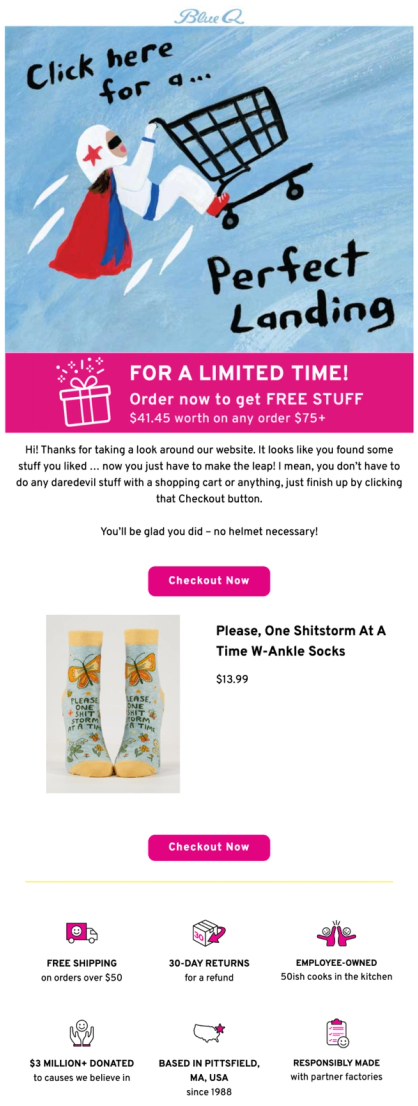
Blue Q’s abandoned cart email rebuilt in Maestra after the switch from Sendlane
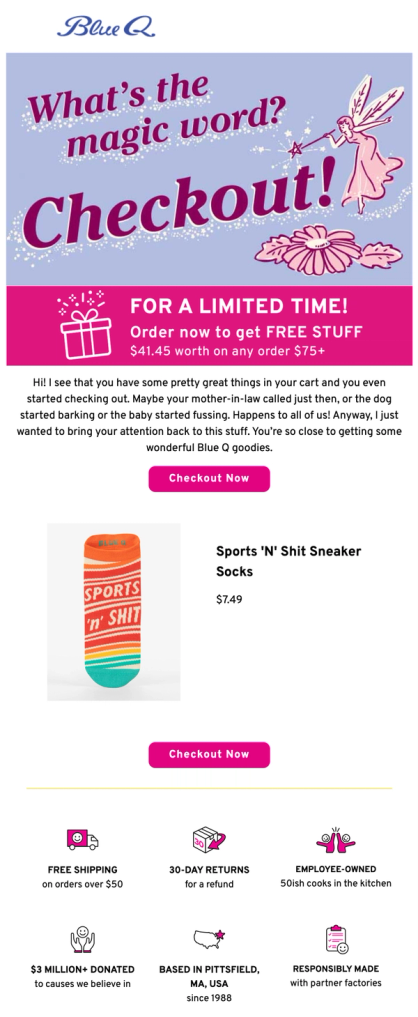
The matching abandoned checkout email with conversion-focused modular design
You’re paying for loyalty, reviews, or personalization tools on top of Sendlane. UAG cut that stack down to one platform and saved about $100,000 a year.
Your campaign revenue has plateaued. JOLYN’s dynamic recommendations plus price-drop and low-stock flows lifted campaign-driven revenue 26% year over year.
Your site converts worse than your emails. Enlightened Equipment added on-site recommendations and lead forms from the same platform and grew revenue 22% in two months.
2. Klaviyo – Best for Deep E-Commerce Data and Integrations
Starting price: Free plan available (up to 250 profiles); from $20/mo (500 profiles) · G2 rating: 4.6
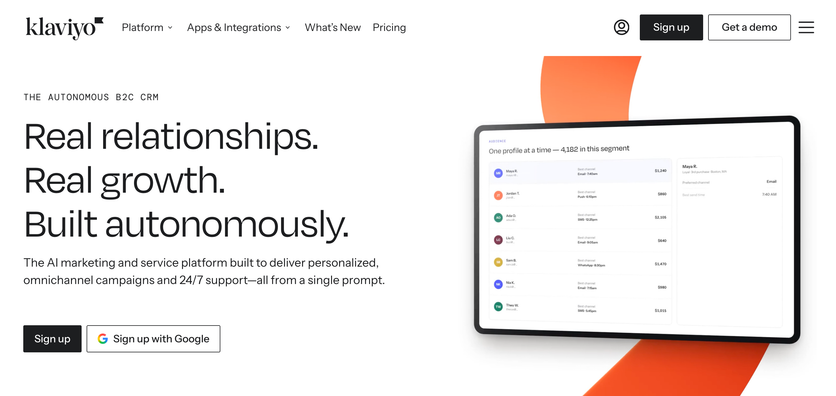
Klaviyo now calls itself “the autonomous B2C CRM” – an AI marketing and service platform for consumer brands. It’s the category default for Shopify email, used by 196,000+ brands, and its channel list is the widest here: email, SMS, RCS, mobile push, WhatsApp, plus built-in reviews and a customer service product.
Key Features
Flows
Flows trigger off a subscriber action, event, or milestone, then branch. Conditional splits send each group down its own path on what you already know – location, gender, purchase history – and trigger splits branch on the event itself. Pre-built templates in the flow library arrive with recommended delays already set, and A/B tests inside a branch can auto-select the winner at significance.
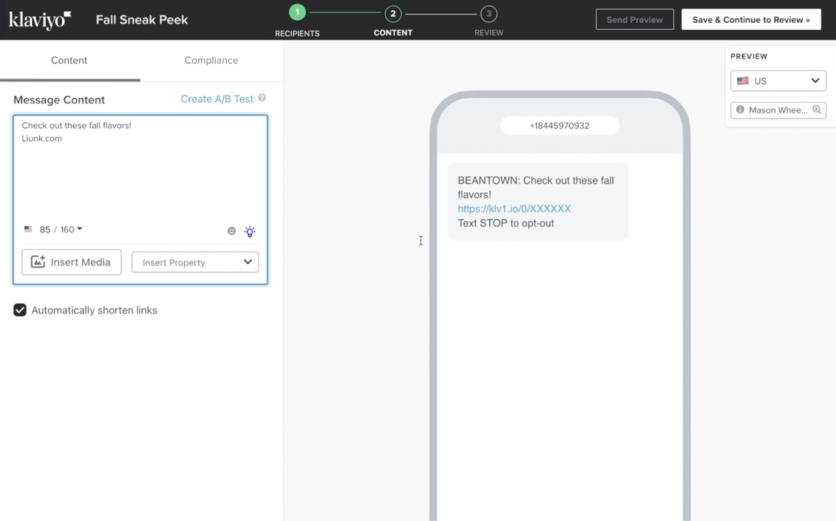
Klaviyo AI
Describe the flow you want in plain language and Klaviyo AI builds it out. The same layer handles predictive analytics – expected date of next order, churn risk, predicted lifetime value – and feeds the segments those predictions define, so the AI output lands in targeting rather than in a report.
Klaviyo Data Platform
Klaviyo’s own CDP, embedded in the B2C CRM rather than sold as a separate product. It unifies customer data and pushes it straight back into activation – segments, flows, and service – instead of syncing to a downstream tool first.
Customer Hub
A signed-in area on your storefront where shoppers track orders, start returns, and update their account without leaving the site. Embedded FAQs answer the common questions, and anything left escalates to Klaviyo Helpdesk with the context attached. It runs on Shopify, WooCommerce, and headless storefronts.
Multi-Channel Coverage
Email, SMS, RCS Marketing, mobile push, and WhatsApp – the only platform in this roundup with both RCS and WhatsApp live today.
Pricing
Free plan available (up to 250 profiles, 500 email sends/mo). Paid email plans from $20/mo (500 profiles); email plus SMS from $35/mo. Klaviyo bills on active profiles – since early 2025, cleaning your list doesn’t cut the bill until the next billing snapshot, a change that drew sustained criticism in reviews.
Where Klaviyo Wins
Nothing matches Klaviyo’s ecosystem. Hundreds of integrations, an enormous agency network, and benchmark data from 196,000+ brands mean answers to almost any question already exist.
The platform also keeps expanding – RCS, WhatsApp, a service helpdesk, and AI campaign generation shipped while most rivals were catching up to Flows.
Where Klaviyo Falls Short
The pattern in verified reviews from the past 12 months is price and support, not features. Klaviyo’s Trustpilot rating sits at 1.8, and the complaints are specific: “Klaviyo kept increasing their prices multiple times in a 12 month period and customer service was not there,” wrote one reviewer in July 2026. Another, spending $4K a month, reported having “only access to AI chatbots who take you around in circles.”
The active-profile billing model draws the sharpest words: “They bill based on outdated list sizes so even after you clean your list, you’re forced to overpay until their system finally decides to 'catch up.'”
Compared to Sendlane
Klaviyo is the self-serve inverse of Sendlane. You get a far bigger platform and ecosystem, but support is tiered and increasingly AI-first, while Sendlane answers chat around the clock. Pricing philosophies also invert: Klaviyo charges per profile, Sendlane per send – high-frequency senders with small lists do better on Klaviyo, big lists with careful cadence do better on Sendlane.
Compared to Maestra
Klaviyo gives you the tools; Maestra gives you the tools plus the team. Brands that switched tell the sharper story: Magnum Bikes doubled online orders after leaving Klaviyo, and Sena consolidated two Klaviyo accounts into one Maestra workspace and grew campaign-driven revenue 8.6x. Klaviyo counters with a free tier, RCS and WhatsApp, and an unmatched integration catalog – advantages that matter most below Maestra’s mid-market entry point.
3. Omnisend – Best for Keeping Costs Low Without Losing E-Commerce Focus
Starting price: Free plan available (up to 250 contacts); from $16/mo (500 contacts) · G2 rating: 4.6
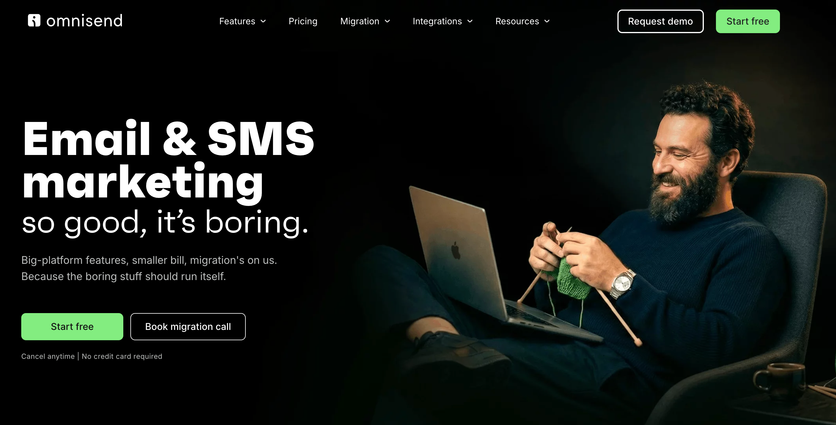
Omnisend’s own tagline is “Email & SMS marketing so good, it’s boring” – big-platform features, smaller bill, migration’s on us. It’s the value pick of this list: 150K+ e-commerce brands, a genuinely useful free plan, and a free 5-day migration service aimed squarely at brands fleeing pricier tools.
Key Features
Email Campaigns and Email Builder
A drag-and-drop builder for mobile-ready email with no code, plus dynamic tags and conditional blocks that swap content per recipient. Commerce blocks are the e-commerce part: a product picker that drops items exactly where you want them, discount codes, scratch cards, and gift boxes.
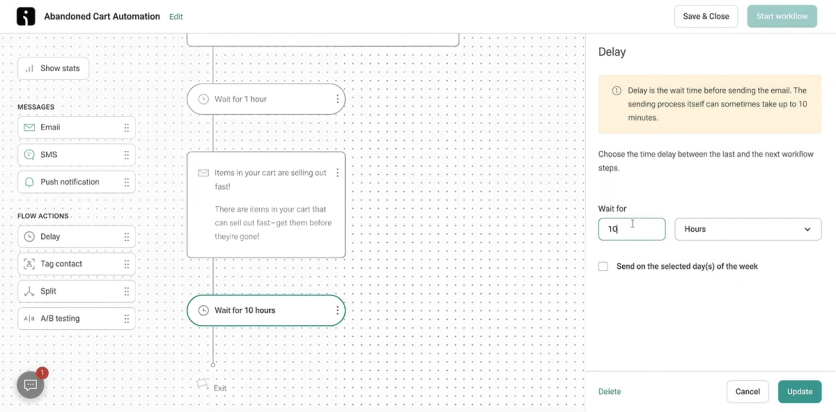
Automations
Pre-built e-commerce workflows – welcome, cart abandonment, browse abandonment – that run across email, SMS, and push from one canvas.
Web Push Notifications
Push reaches subscribers instantly for abandoned carts, flash sales, and restocks, and it drops into any workflow next to email and SMS rather than living in its own tool. It is on every plan, including the free one, which is unusual at this price.
Forms and Popups
Popups, teasers, and landing forms with targeting rules, and all of it sits on every tier rather than behind an upgrade. For a store that would otherwise buy a separate list-growth app, that is one fewer subscription in the stack.
Omnisend AI
Content generation for campaign copy plus audience insights that feed segmentation. The assistant will also build a segment from a plain-language description of who you want to reach, so the AI output arrives as targeting rather than as a suggestion to act on later.
Pricing
Free plan available (250 contacts, 500 emails/mo, 500 web pushes). Standard from $16/mo (500 contacts). Pro from $59/mo (2,500 contacts) with unlimited email. Two gotchas from recent changes: subscriptions started after May 2026 get SMS only on Pro as a volume-based add-on (from $0.007/SMS), and billable contacts include non-subscribers like cart abandoners – so the effective tier is bigger than your subscriber list.
Where Omnisend Wins
Price-to-feature ratio, full stop. At $16–59/mo you get automation, segmentation, push, and forms that cover what most sub-50K-contact stores actually use.
Support holds up under load, too. Omnisend’s Trustpilot rating sits at 4.5, and reviewers from the past 12 months consistently praise the service team – rare for a budget platform.
Where Omnisend Falls Short
Workflow depth has ceilings. “You can’t edit the steps a contact will receive in a live workflow, can’t move contacts from one workflow to another after they’ve finished, can’t save the entire campaigns as a template,” wrote one detailed reviewer in July 2026, who also flagged “flawed segmentation logic.”
SMS economics disappoint some buyers: one reviewer expecting thousands of texts on Pro found “my sms credit was already almost used up” after a single campaign – credits are dollar-denominated and burn fast outside the US. Several 2026 reviews also describe abrupt compliance suspensions during onboarding.
Compared to Sendlane
Omnisend wins on entry price and channel breadth for small stores – free plan, $16/mo start, web push included. Sendlane wins on unified economics at scale: email and SMS under one bill with unlimited contacts, while Omnisend now gates SMS behind Pro and bills you for non-subscribed contacts. Sendlane’s dedicated support tiers also go deeper than Omnisend’s chat-first model.
Compared to Maestra
These two play in different weight classes. Omnisend is the budget choice for stores under 50K contacts; Maestra is the consolidation play for brands past 100K that also need loyalty, a CDP, and on-site personalization. A brand that outgrows Omnisend’s workflow ceilings – live-flow editing, cross-flow contact moves, deeper segmentation – is describing exactly the gaps Maestra’s journey builder and real-time CDP close.
4. Attentive – Best for Enterprise SMS Programs Built on AI
Starting price: Custom pricing (contact sales) · G2 rating: 4.5
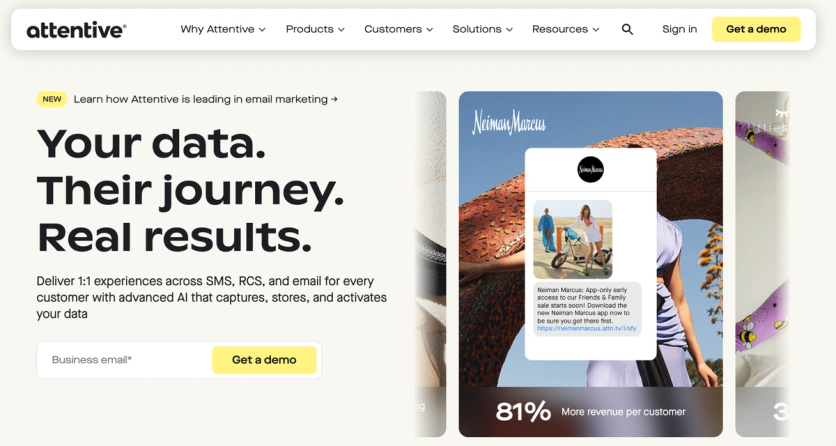
Attentive’s pitch is “Marketing made personal” – an AI-led SMS and email platform built around a single customer ID. It’s the enterprise gravity well of US SMS marketing: when Yotpo shut down its SMS product in late 2025, Attentive is where those customers were sent.
Key Features
Attentive AI
The umbrella layer, trained on what Attentive says is 2+ trillion datapoints and 90B+ messages. It feeds the rest of the suite rather than running as a standalone assistant, which is why the AI pieces below share the same signals instead of each learning separately.
AI Pro
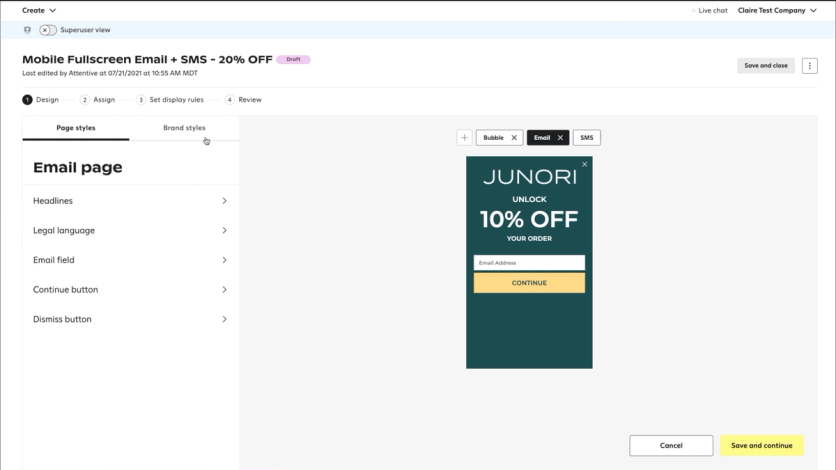
Optimizes send timing, audience, and content across SMS and email; Attentive claims 25% more email campaign revenue with it.
AI Journeys
Triggered journeys personalized per subscriber, with two-way messaging inside them. Attentive reports an average 200% revenue lift and 5x-plus incremental ROI from the product, and a 13% SMS conversion lift over Cyber Week 2025 – vendor figures, not independently verified.
AI Grow
Sign-up units that replace the one-size-fits-all popup with timing chosen per visitor, firing at the moment someone looks most likely to subscribe. List growth is where SMS programs live or die, so this is the piece that feeds everything else.
Attentive Signal and Audience Manager
Signal is the identity layer: phone numbers, emails, and device data resolved into one subscriber profile even without cookies, using an enhanced tag and smart resolution. Audience Manager sits on top of it for precise targeting and dynamic segmentation.
Pricing
Custom pricing (contact sales). Attentive quotes each contract on message volume, list size, channels, and which AI products you add; the AI modules carry flat monthly fees. No public rate card exists, so budget for a sales process – and read the contract terms closely.
Where Attentive Wins
At high SMS volume, nothing here matches Attentive’s AI stack and identity graph. Enterprise brands running eight-figure SMS programs get optimization tooling and deliverability infrastructure that smaller platforms can’t replicate.
The channel set is also modern: SMS, MMS, email, push, and RCS for Business – Attentive moved on RCS earlier than most.
Where Attentive Falls Short
Contracts are the recurring complaint in reviews from the past 12 months. “The agreement includes strict SMS exclusivity with long-term lock-in, limited flexibility, and significant financial penalties if you need to adapt your tech stack,” warned one Shopify App Store reviewer in January 2026. Another described being billed $11K for the remainder of a contract after trying to leave, with the bill sent to collections.
Email, while genuinely first-class now, is still the second channel – Attentive’s DNA is SMS.
Compared to Sendlane
Attentive operates a different economic universe: custom-quoted enterprise contracts against Sendlane’s published $100/mo entry. You’d move for AI optimization at scale, RCS, push, and identity resolution. You’d stay away if transparent pricing and month-to-month flexibility are why you chose Sendlane in the first place – the lock-in stories in Attentive’s reviews are the exact opposite of that.
Compared to Maestra
Both target brands past the SMB stage, but the shapes differ. Attentive is SMS-first with AI depth; Maestra is channel-neutral with a CDP, loyalty, and site personalization in the same bill, plus a Forward Deployed Marketer who builds alongside your team. Attentive’s RCS support is ahead; Maestra’s WhatsApp and Telegram channels reach audiences Attentive doesn’t cover, and pricing is published rather than negotiated.
5. Postscript – Best for SMS-First Shopify Brands

Starting price: From $0/mo + $49 minimum spend · G2 rating: 4.8
Postscript calls itself “SMS Marketing and Sales for Shopify Brands” – and means the “Shopify” part literally. It was SMS-only until September 2026, when it launched its own email; access opens first come, first served, starting with existing customers, so most brands still pair it with an ESP for now. For brands that treat SMS as the primary revenue channel, that focus is the appeal.
Key Features
Postscript AI
The AI layer the company credits with a 20% average revenue lift in beta. Rather than a copy assistant bolted on, it drives the testing engine underneath: hundreds of on-brand message variants generated and evaluated instead of a two-arm A/B split.
Infinity Testing
Testing at the individual-subscriber level instead of A/B cohorts. Many on-brand variants run at once and the winner is decided per person, which reaches significance faster than a classic split test on a list this size.
Shopper and CashBack
Shopper is an always-on AI shopping assistant that answers questions and closes sales inside the text thread. CashBack is positioned as a smart coupon alternative – an incentive that grows the list and protects margin instead of discounting the order outright.
Conversational SMS
Two-way texting handled by humans with AI underneath, aimed at keeping replies on-brand at a volume a support team could not answer manually. It is the piece that turns an SMS list into a channel people actually answer.
Postscript Plus
The managed tier: Postscript’s in-house SMS strategists create, run, and optimize the program for you. It is the closest thing on this list to Sendlane’s hands-on model, and it is priced as a service tier rather than included.
Pricing
From $0/mo + $49 monthly minimum spend ($0.009/SMS). Growth at $100/mo ($0.008/SMS) and Professional at $500/mo ($0.007/SMS), plus carrier fees; Enterprise is custom. US and Canada only. The published per-message rates are refreshingly transparent – but note the minimum: several reviewers learned the “free” plan still bills $49.
Where Postscript Wins
For Shopify SMS specifically, Postscript is the deepest tool available – checkout integration, compliance tooling, and testing infrastructure built around one platform with SMS at the center. The 4.8 G2 rating – the highest in this comparison – reflects that focus, and its support scores lead the category.
Where Postscript Falls Short
Billing surprises dominate recent complaints. “This app just stole $500 from my account as a service fee which means whether you use the platform or not you are charged,” wrote one Shopify reviewer in May 2026; another in April 2026: “They offer a 'free plan' but charge you $49 even if you didnt send any text messages.” Reviews from late 2025 also describe support slowing down as AI assistance replaced humans.
And structurally: email is brand new and not yet open to every account, no push, US/Canada only, Shopify only.
Compared to Sendlane
This is a half-replacement. Postscript beats Sendlane’s SMS on Shopify depth, testing, and monetization – but until its new email is open to your account, you’d still need an email platform, which puts you back into the two-tool, two-bill world Sendlane exists to eliminate.
Compared to Maestra
Postscript is SMS done exceptionally well, with email only just added; Maestra is every channel plus the data layer underneath. A Shopify brand whose SMS program has outgrown everything else might run Postscript standalone – but once email, loyalty, and on-site experience need the same customer data, a unified platform stops being optional. Maestra runs SMS alongside seven other channels from one segment engine, with published pricing.
6. Drip – Best for Small Teams That Want Email Done Well
Starting price: From $39/mo (2,500 people) · G2 rating: 4.4
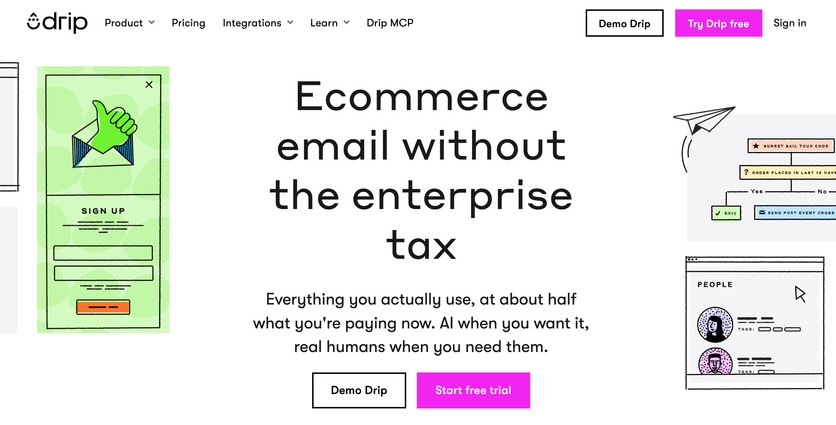
Drip’s homepage promises “all the ecommerce email power you need, none of the bloat you don’t” – serious e-commerce email a small team can run. It’s the minimalist of this list: email plus on-site popups, unlimited sends, and support the company treats as the product (chat answers in about two minutes, by its own published stats).
Key Features
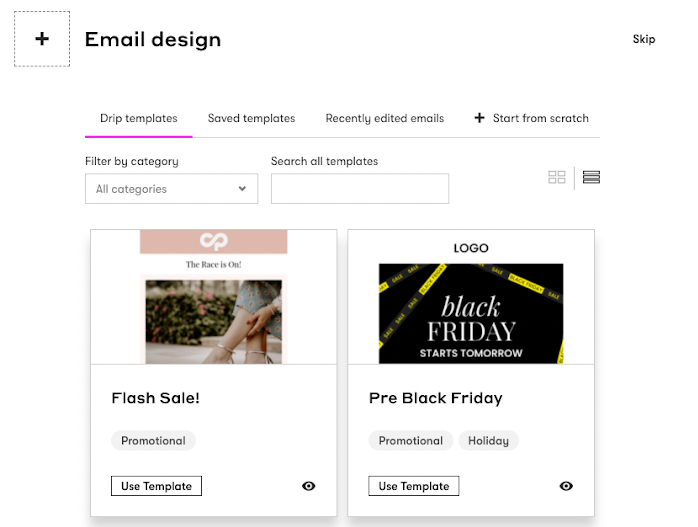
A polished drag-and-drop builder with e-commerce blocks and templates, plus pre-built playbooks for abandoned cart, browse abandonment, welcome, and win-back. Twenty-plus workflow templates ship ready to run, which is the point for a team without an email specialist.
Automation
A visual workflow builder with branching, Goals, and split tests. The entry plan caps you at 50 workflows per account – Drip’s own limit, set to keep the app fast – which is plenty for a lean team and a ceiling for a complex program.
Segmentation
Dynamic segments built on what people actually did – purchases, opens, clicks, location – with membership updating on its own as behavior changes. An AI assistant will generate a segment from a plain-language description of the audience you want.
Onsite Pop-ups and Embedded Forms
Popups, slide-ins, sticky bars, Spin-to-Win, and quizzes, built on the Sleeknote technology Drip acquired. All of it is on every plan with no session limits, so list growth does not arrive as a second invoice.
Insights and Guidance
Reporting built around Revenue Per Person rather than opens, with recommendations attached to the numbers. It is aimed at teams that have no analyst to interpret a dashboard and need the report to say what to do next.
Pricing
From $39/mo (2,500 people) with unlimited email sends and free migration. No free plan; 14-day trial. Two catches: live chat support requires a $99/mo+ plan, and white-glove migration with 90-day onboarding only kicks in for lists over 17,500.
Where Drip Wins
Simplicity with real support behind it. For a one-person marketing team sending email and nothing else, Drip’s unlimited sends deliver Sendlane’s core feel at a third of the entry price – though the fast human chat everyone praises starts on the $99/mo tier, not at $39.
Where Drip Falls Short
Fresh reviews are scarce – Drip’s Trustpilot profile has no reviews in years, so the picture comes from a handful of recent Shopify and Capterra entries. What’s there points at conversion and cost transparency: “it probably converted less than any other email app I’ve used,” wrote one Shopify reviewer in August 2025, adding “they raise the price on you. I pay $89/mo and had no clue it increased.” A Capterra reviewer in April 2026 found “the user interface was kind of confusing.”
SMS exists but isn’t self-serve: Drip switches it on per account through its support team.
Compared to Sendlane
Drip is what Sendlane looks like with email at the center and the price cut accordingly. SMS is there on request, but if it drives real revenue for you, test Drip’s texting before you move; if SMS never earned its keep, Drip covers the email half for $39/mo instead of $100/mo.
Compared to Maestra
They bracket opposite ends of the same axis. Drip strips the stack down to email for small teams; Maestra unifies eight channels, loyalty, and a CDP for brands that outgrew single-channel tools. A store doing under $1M in revenue belongs on Drip’s end; past 100K contacts and multiple channels, consolidation math points the other way.
7. Listrak – Best for Managed Cross-Channel Retail Programs

Starting price: Custom pricing (contact sales) · G2 rating: 4.5
Listrak positions itself as “the cross-channel personalization platform” for leading retailers – email, SMS, push, web, in-store, and RCS from a single platform. It’s the closest thing here to an agency-platform hybrid: strategic account teams run programs with you, and its GXP list-growth product even ships with performance guarantees.
Key Features
Listrak Data Platform
A real-time data engine built to drive action rather than reports: zero- and first-party data unified through identity resolution into one customer view. It is what lets the retail-specific pieces above it target the same person online and in store.
Journey Orchestration
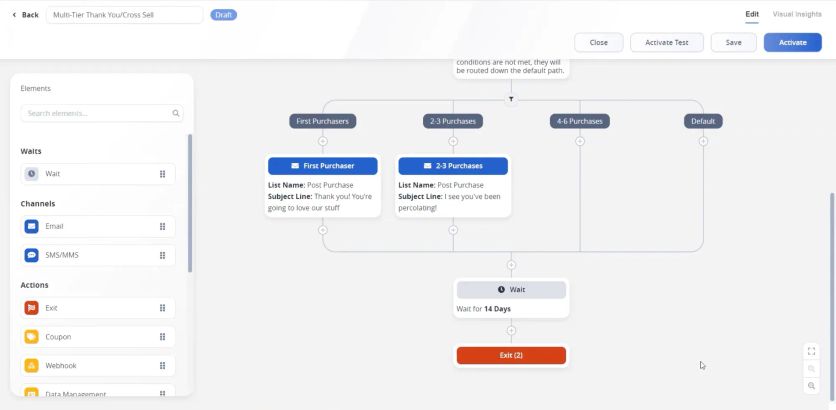
One builder spanning email, SMS, MMS, RCS, push, web, and social audiences, all reading the same unified profile. RCS in the same canvas as email is rare outside enterprise platforms and is part of why Listrak sells to retail chains.
Listrak Intelligence
Predictive segmentation, AI channel affinity, and AI-powered product and content recommendations, plus an AI SMS assistant for campaign copy. The predictions feed segments directly, so the model output ends up in targeting rather than in a report.
Experience Builder
Personalized popups, landing pages, and real-time behavior-based website personalization, built to convert and retain rather than just capture an address. It closes the loop between the on-site visit and the messaging that follows it.
GXP (Growth Xcelerator Platform)
A managed list-growth and onsite-conversion service that runs on top of whatever ESP you already have – Klaviyo, Salesforce Marketing Cloud, and Sailthru are named integrations. Listrak’s strategists handle setup, design, implementation, optimization, and reporting, and the offer carries performance guarantees. Swipe-to-Join and Tap-to-Join grow SMS opt-ins from social and mobile traffic.
Pricing
Custom pricing (contact sales). No public rate card, free plan, or trial. Third-party contract data suggests real budgets: negotiated deals average near $83,000 a year, in a range of $37,000–146,000 from a small sample (Vendr) – treat those as estimates, not vendor-confirmed pricing.
Where Listrak Wins
Retail depth. Identity resolution that includes in-store transactions, RCS ahead of most rivals, and a managed-services model where Listrak’s team carries execution – attractive for retail organizations that want a partner more than a tool.
Where Listrak Falls Short
Public review detail is thin – Listrak has no Trustpilot presence, and recent G2 feedback surfaces mostly through aggregated summaries. Those summaries repeat three themes: a dated, rigid interface (“still requires a lot of manual effort”), slow performance around product recommendations, and a steep learning curve that keeps teams dependent on their account managers. Older reviews also describe per-feature fees stacking up over multi-year contracts.
Compared to Sendlane
Listrak is several weight classes up: five-figure annual contracts, enterprise sales cycles, and in-store data against Sendlane’s published $100/mo entry and self-serve speed. Brands leave Sendlane for Listrak when they need identity resolution and managed execution; they regret it when the dated UI and contract structure land on a team used to moving fast.
Compared to Maestra
Both sell the managed, high-touch model to mid-market retail – the differences are surface and structure. Maestra’s interface and flow builder are modern where Listrak’s draw “dated and rigid” comments, pricing is published rather than negotiated, and loyalty is built in. Listrak counters with in-store channel depth and RCS. For pure e-commerce brands without physical stores, Listrak’s biggest differentiator goes unused.
8. ActiveCampaign – Best for Mixed B2B and B2C Automation
Starting price: From $15/mo (1,000 contacts, billed annually) · G2 rating: 4.5
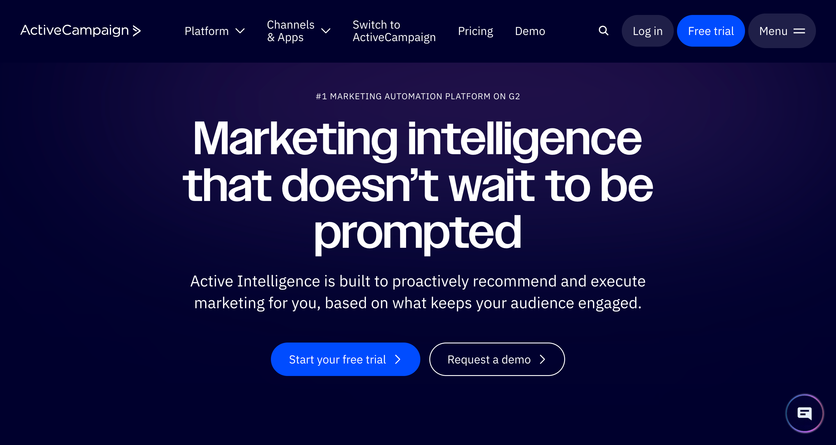
ActiveCampaign now leads with “autonomous marketing” – its pitch is cutting 13 hours of marketing busywork a week. It’s the generalist of this list: marketing automation, CRM, and sales pipelines serving agencies, B2B companies, and stores alike, with 1,000+ integrations.
Key Features
Active Intelligence
The AI engine under the platform, currently version 2.8, with Memory, Custom Instructions, and a Brand Kit. It analyzes interaction data to recommend what to send and to whom, and it is what powers predictive sending and the AI campaign builder.
Automations Map
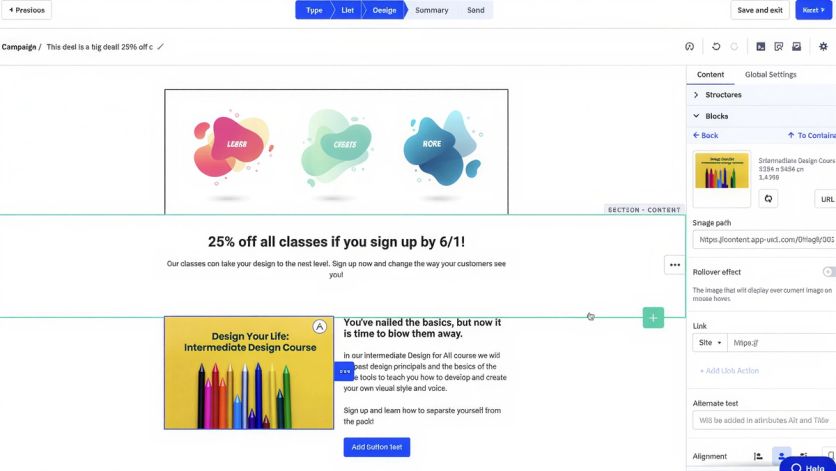
A visual overview of how 950+ recipe-based automations connect to each other. On an account that has been running for years, this is the difference between knowing what your automation estate does and guessing at it.
Predictive Sending and Conditional Content
Send timing chosen per contact from engagement patterns – ActiveCampaign reports an average 17% click-through lift – plus conditional content that picks between up to five variations of the same email per recipient. Both sit on Pro plans and up.
Enhanced CRM
Pipelines and sales engagement sold as an add-on: deal records, lead scoring, win probability. It is the reason ActiveCampaign shows up on B2B shortlists, and the reason a pure e-commerce brand ends up paying for a module it will not open.
WhatsApp Messaging
Sold as an add-on channel alongside SMS and transactional email rather than included in the plan. For a brand whose audience messages instead of texting, that is a third line item on top of the base subscription.
Pricing
From $15/mo (1,000 contacts, billed annually, 1 user); Plus $49/mo, Pro $79/mo, Enterprise from $145/mo. SMS and WhatsApp are paid add-ons – SMS broadcast covers the US, UK, and Australia only. One change worth knowing: accounts created after November 2025 pay for all contacts, including unsubscribed and bounced ones.
Where ActiveCampaign Wins
Breadth per dollar. No other $15–79/mo tool combines automation this deep with a CRM, sales engagement, and a WhatsApp channel – for a business that’s part-store, part-services, it covers ground Sendlane never will.
Where ActiveCampaign Falls Short
Reviews from the past 12 months read like a support crisis. “I haven’t been able to get in touch with someone for weeks, everything is AI,” wrote one Trustpilot reviewer in July 2026; another reported the entire US support team being laid off in May 2026. Long-time customers describe regressions – “each time they add another AI anything, they take away past functionality” – and unannounced price increases. The Trustpilot rating sits at 2.8 against the G2 4.5.
Compared to Sendlane
ActiveCampaign trades Sendlane’s e-commerce focus for breadth. SMS demonstrates the difference: a first-class unified channel at Sendlane, a bolt-on add-on with three-country coverage at ActiveCampaign. And where Sendlane’s reviewers praise support, ActiveCampaign’s are fleeing it – brands that picked Sendlane for the humans should read those reviews before moving.
Compared to Maestra
ActiveCampaign serves the widest audience at the lowest price; Maestra serves one audience – scaling e-commerce brands – with the CDP, email, and the channels you switch on in one platform. The per-contact model (now counting unsubscribed contacts for new accounts) punishes exactly the list growth Maestra’s active-profile billing absorbs. And Active Intelligence automates busywork, while Maestra pairs its AI with a human Forward Deployed Marketer who owns outcomes.
9. Mailchimp – Best for Getting Started on a Small Budget
Starting price: Free plan available (up to 250 contacts); from $13/mo (500 contacts) · G2 rating: 4.3
Intuit Mailchimp sells “email & SMS marketing minus the learning curve,” backed by Intuit’s AI stack. It remains the easiest on-ramp in email marketing – and for e-commerce brands specifically, the most likely platform to be outgrown within a year.
Key Features
Customer Journey Builder
A drag-and-drop canvas with branching and pre-built e-commerce journeys. Mailchimp claims up to 4x more orders for accounts that automate here rather than send campaigns only – a vendor figure, but the direction matches what every platform on this list reports.
Intuit Assist
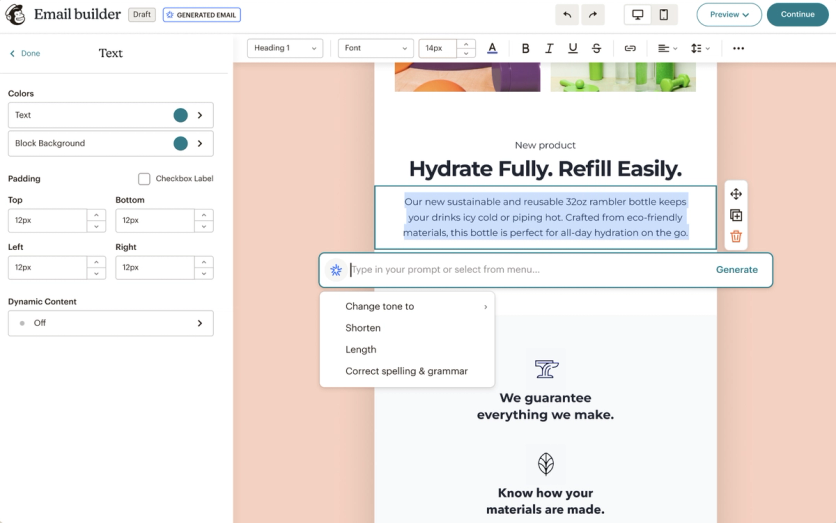
A generative assistant, still in beta, that drafts copy and builds one-click automations such as abandoned cart. It reads your brand kit to keep the styling consistent, which is the part that saves time on a small team.
Marketing CRM
Tags, customer profiles, behavioral targeting, and predicted demographics – estimated age and gender inferred for your list. It is a light CRM rather than a customer data platform, and it stops well short of the identity resolution the enterprise tools here run.
Send Time Optimization
Send time and send day optimization analyze when your specific audience engages and recommend the slot, backed by Intuit’s data scale. It is the one place where being part of a company this large is a genuine advantage.
300+ Integrations
Shopify, WooCommerce, and the QuickBooks ecosystem no rival can match, since Intuit owns both sides. For a store that already runs its books in QuickBooks, that connection is the reason Mailchimp stays on the shortlist.
Pricing
Free plan available (up to 250 contacts, 500 sends/mo – trimmed from 500 contacts in January 2026). Essentials from $13/mo (500 contacts), Standard from $20/mo, Premium from $350/mo (10,000 contacts). SMS is a paid add-on requiring an application, sold as monthly credit blocks that expire without rollover. Unsubscribed and non-subscribed contacts count toward your tier until you archive them manually.
Where Mailchimp Wins
Accessibility. The editor, templates, and AI assistance genuinely require no specialist, and the free-to-$13 entry lets a new store start email marketing the same afternoon.
Where Mailchimp Falls Short
Cost predictability tops recent complaints: “The pricing structure can be difficult to understand and predict, especially as your audience grows,” wrote one Capterra reviewer in June 2026. Others cite paywalled basics (“the need to upgrade whenever you need to do anything beyond basic”) and, after the January 2026 free-plan cut, Shopify reviewers calling the free tier “misleading advertising.” Automation reliability also drew complaints through spring 2026.
Compared to Sendlane
Mailchimp is where brands start; Sendlane is where e-commerce brands often land once generic journeys stop converting. Sendlane’s revenue-focused flows, deliverability monitoring, and send-based billing serve stores better than Mailchimp’s contact-tier model, which charges for unsubscribed contacts and locks SMS behind an application process.
Compared to Maestra
Two different eras of a brand’s life. Mailchimp handles the first 10,000 contacts fine; Maestra exists for the moment personalization, loyalty, and multi-channel orchestration start driving real revenue – with a Forward Deployed Marketer instead of a help center. There’s no meaningful overlap: a brand ready for one has definitionally outgrown or not yet reached the other.
How to Choose the Right Sendlane Alternative
Maestra is the strongest pick for brands that liked Sendlane’s high-touch, one-bill model but need more platform underneath it – one system replacing three to five point tools across email, SMS, loyalty, on-site personalization, and customer data, with a named Forward Deployed Marketer doing the construction work. The proof points are switching stories: Blue Q left Sendlane and grew email-driven sales 39%; UAG consolidated its stack and saved about $100,000 a year.
The rest of the field maps to different situations. Under 50K contacts, Omnisend or Mailchimp keep costs sane. Email-only teams fit Drip. SMS-obsessed Shopify brands fit Postscript, enterprise SMS budgets fit Attentive, mixed B2B/B2C businesses fit ActiveCampaign, and store-plus-retail chains fit Listrak.
If you’re in the first group, get a Maestra demo – bring your Sendlane send volumes and your current tool bills, and the consolidation math takes about half an hour to check.
Frequently Asked Questions About Sendlane Alternatives
- Maestra is the closest thing to a one-for-one Sendlane replacement at mid-size and enterprise scale. Email, SMS, loyalty, a real-time CDP, and site personalization come on one subscription, with a dedicated Forward Deployed Marketer running the migration. Blue Q made exactly that switch off Sendlane and grew email-driven sales 39%. Scale changes the answer, though: smaller stores get better value from Omnisend or email-first simplicity from Drip, and enterprise SMS programs point to Attentive.
- No, Sendlane continues to operate after Privy acquired it in February 2026. The platform is still sold and supported. That said, Privy now owns three messaging products (Privy, Emotive, and Sendlane), so it’s fair to ask your account manager how the roadmaps will merge before signing an annual contract. If the roadmap answer is vague, that is the moment to compare: Maestra publishes its price, bills month-to-month, and migrates you itself – Sena consolidated two Klaviyo accounts into one Maestra workspace in two weeks and multiplied campaign-driven revenue 8.6x against the prior year. See Maestra’s pricing.
- Yotpo closed its Email & SMS business at the end of 2025 and refocused on reviews and loyalty. Migration was split by account type rather than by channel: managed and annual customers were pointed to Attentive, self-serve accounts to Omnisend, and both partners cover email and SMS. The lesson carries over to picking a Sendlane alternative – favor a vendor whose core business is the channel you depend on. At Maestra, messaging and the customer database are the product itself. Svaha USA, which ran email, SMS, and loyalty on Yotpo, consolidated onto Maestra and lifted average order value 14%.
- Maestra includes email, SMS, MMS, RCS, push, WhatsApp, and Telegram in one platform and one bill. Klaviyo sells a combined email-and-SMS plan from $35/mo, and Omnisend offers SMS as an add-on on its Pro plan. Drip adds SMS on request and Postscript only just launched email, so in practice both still lead with a single channel. Running both from one profile is where the lift shows up: with Selkirk Sport’s two channels on Maestra, attributed revenue climbed 55% on email and 149% on SMS against the prior year.
- Maestra, Klaviyo, Omnisend, and Postscript all integrate deeply with Shopify. Maestra migrations are handled by its team – Coolibar moved off Klaviyo and grew campaign revenue 33.6% year over year within two months. Postscript is Shopify-exclusive, and its email only just launched with first-come access, so most brands still run an email platform beside it.
- Sendlane’s SMS is US-only, so international texting is a real reason to switch. Maestra pairs SMS with WhatsApp and Telegram for audiences that message instead of text, and Klaviyo and Omnisend both sell international SMS. Postscript covers the US and Canada; ActiveCampaign’s SMS broadcast covers the US, UK, and Australia. Sena runs its US and EU stores from one Maestra workspace in five EU languages plus a US version, with total revenue up 2.2x year over year.