
What is a Loyalty Program: Types and Different Strategies
What a Loyalty Program Is and How It Works

A loyalty program has two sides: for the customer, it’s about how to earn points and get rewards; for the business, it’s about using what we learn about customers to send them better, more targeted marketing to lift conversions and retention.
Loyalty programs come in many forms, from simple punch cards to sophisticated tiered memberships, each aimed at encouraging repeat business. However, crafting an effective loyalty program goes beyond just selecting a model – it’s about choosing a strategy that resonates with both the business’s goals and its customers' desires.
We’ll unpack the essentials of loyalty programs, covering different types of programs, benefits, drawbacks, common pitfalls, and strategies for assessing program effectiveness. Let’s get started.
What is a Loyalty Program?
A basic way to define a loyalty program is as a strategic marketing tool that enables businesses to collect customer data, analyze it, and build a comprehensive approach to customer engagement. Customers enjoy discounts, bonuses, and useful newsletters, while companies gain insights into their behavior, identify preferences, and send personalized offers that help maintain a positive experience and aid retention.
Structure of a Loyalty Program
At its core, a loyalty program consists of two main elements: the external and the internal components.
External Component
The external aspect details the explicit benefits to the customer, outlining the basic rules for earning and redeeming rewards. For example, a customer might receive a 15% discount on merchandise once they have spent a specified amount. Retailers offer benefits like cashback, bonus points, and discounts on selected products as incentives for customers to share their personal information by filling out a form or registering in an app. From a business perspective, this aspect is considered an investment to motivate customers to share their personal data.
Internal Component
The internal component is centered on the business's strategic use of the collected data for targeted marketing. Once a customer's identity and purchase history are established, the company can monitor their shopping behavior. Marketers use this data to predict which offers are most likely to appeal to the customer, identify optimal timings for campaigns, and select the most appropriate products to recommend. This approach enables the delivery of personalized offers at the most opportune moments, aiming to secure repeat business, build a loyal customer base, and enhance profitability. For example, brands can email loyalty members who haven't made a purchase in a month with a targeted offer to re-engage them:
Key Benefits of a Loyalty Program
The benefits of loyalty programs are extensive for both businesses and customers, but five standout advantages are particularly notable:
1. Attracts New Customers
Loyalty programs act as a magnet for new customers. They tap into the power of word-of-mouth marketing as satisfied customers naturally share their experiences, effectively drawing in a new, interested audience.
For instance, some brands employ a referral strategy where existing loyalty program members earn points for bringing in new members, rewarding both the referrer and the new customer upon a first purchase. This approach not only attracts new clients but also strengthens the bond with existing ones.
2. Enhances Customer Retention and Loyalty
Being part of a loyalty program means customers regularly receive benefits such as increased cashback, personalized offers, welcome bonuses, points, and discounts. These perks enrich the customer’s experience with the brand, fostering a stronger relationship and boosting repeat sales.
3. De-anonymizes the Customer
By agreeing to participate in a loyalty program, customers provide access to their personal information. This allows companies to learn about their preferences, purchase history, average spending, and contact details. This valuable data can be used for targeted newsletters, special offers, calculating Lifetime Value (LTV), and making predictions.
4. Increases the Average Spend
Loyalty programs encourage customers to spend more. By setting thresholds for discounts or offering points on purchases, customers are often persuaded to add just one more item to their cart. This strategy effectively raises the average purchase value. Loyalty program members also earn points with each purchase, which can be redeemed on future orders, further incentivizing higher spending.
5. Facilitates Data-Driven Decision Making
Loyalty programs provide businesses with a rich dataset about their customers' buying habits and preferences – this information is crucial for tailoring marketing strategies, optimizing product offerings, and improving overall service. With detailed insights into consumer behavior, companies can make informed decisions that align with their customers' needs and expectations, leading to better outcomes for both the business and its clientele.
Drawbacks of Having a Loyalty Program
While loyalty programs come with a lot of benefits and are effective for nurturing customer relationships and driving repeat business, they also come with their own set of challenges. Below are five notable drawbacks that businesses often face:
Costly Customer Retention
Offering widespread discounts to all customers can be a costly component of loyalty programs. Businesses generate revenue from the repeat purchases of customers who are motivated by personalized offers. However, when businesses give away promotions and bonuses at the cost of their profit margins, there’s a risk of financial loss without a well-executed targeted marketing strategy in the background.
Primarily a Long-term Commitment
Building a successful loyalty program is a process that doesn't happen overnight. It involves testing hypotheses and may require several iterations to get right. The journey from pilot to full launch can easily span several months – making it essential for businesses to view loyalty programs as a long-term investment, demanding both time and patience to yield results.
Requires Substantial Investment in Technology and Expertise
Before even launching, a loyalty program demands robust infrastructure and a skilled specialist to manage the mechanics of the process. An employee tasked with launching a loyalty program must be capable of implementing it across different customer segments and communication channels, choosing the right platform for the job, such as Smile.io, Yotpo, or Maestra, taking responsibility for the program’s key performance metrics. This necessitates an investment not only in technology but also in hiring or training staff with the necessary expertise to manage the program effectively.
The right infrastructure also depends on where most of the customer interaction happens. For brick-and-mortar retailers, loyalty often runs through the point of sale itself – POS-integrated systems like FTx POS handle in-store rewards capture, barcode scanning, and age-verification at checkout, then sync the data with online channels and marketing tools.
Six Types of Loyalty Programs
There are many different types of loyalty programs – here are six of the most prevalent ones across various industries:
1. Points-Based Loyalty Programs
Perhaps the most common type, points-based programs allow customers to accumulate points with each purchase, which can then be redeemed for rewards, discounts, or exclusive offers. This system encourages repeat purchases by directly linking spending to rewards, making it particularly effective for businesses with frequent, short-term purchases.
2. Tiered Rewards Programs
Tiered rewards create a hierarchy of loyalty levels, with each tier offering progressively better rewards. Customers advance through tiers based on their spending or activity level, motivating them to engage more to unlock exclusive benefits. This model is great for businesses looking to differentiate rewards and create a sense of achievement among customers.
3. Subscription-Based Loyalty Programs
Under a subscription model, customers pay a recurring fee to access special benefits, such as free shipping, members-only sales, or premium content. This approach guarantees a consistent customer base and revenue stream, suitable for companies offering regular services or products.
4. Cashback Loyalty Programs
Cashback programs offer customers a percentage of their purchase back in the form of cash rewards, which can either be used towards future purchases or withdrawn. This straightforward value proposition is easy for customers to understand and appreciate, making it a popular choice for both businesses and consumers.
5. Partnership Programs
Partnership (or coalition) loyalty programs unite several businesses under one loyalty scheme, allowing customers to earn and spend rewards across different brands. This expands the program’s attractiveness by offering a wider range of redemption options and encourages cross-brand exploration. This is a common loyalty program strategy for airlines, where partners can include banks, hotels and car rental services.
6. Hybrid Loyalty Programs
Hybrid programs combine elements from different types of loyalty schemes to create a more flexible and engaging customer experience. For example, a hybrid program might offer tiered rewards for different levels of spending while also providing points for each purchase that can be redeemed for discounts or gifts. This type of program is tailored to meet diverse customer preferences and can adapt to various business models, making it highly effective for engaging a wide customer base.
How to Evaluate a Loyalty Program’s Effectiveness
Understanding the success and efficiency of a loyalty program is essential for optimizing customer engagement and maximizing return on investment – here are some critical metrics that you can use to evaluate your loyalty program:
Engagement Level
This measures how actively customers participate in the loyalty program. To gauge engagement, consider:
- The growth rate in the number of loyalty program members.
- Retention trends, seen through repeat purchases and overall customer activity.
- Traffic in physical stores and online.
Turnover vs. Bonus Points Balance
This metric evaluates how the balance of points affects a member’s purchasing engagement. A high balance of unredeemed points could signal a problem, indicating that the program may not be as engaging or rewarding as intended. To calculate this, you need to collect data on the following:
- The average discount provided to loyalty program members.
- Trends in earning and redeeming points.
- The total points balance across all members.
By analyzing these figures, businesses can understand how effectively the points system encourages purchases and engagement within the loyalty program.
Creating reports based on this data can be quite complex, but using software like Maestra can simplify the data collection and analysis process.
Average Purchase Value or Average Order Value (AOV)
The impact of the loyalty program on the average purchase value directly reflects its effectiveness. This involves tracking the average purchase amount, revenue per item, and the number of items per transaction over time. Tracking these variables can reveal if the loyalty program successfully encourages higher spending, thereby increasing the company’s revenue.
Though these metrics provide a comprehensive overview of a loyalty program’s effectiveness, deeper analysis might be necessary for your specific marketing objectives. A detailed report can be tailored to the marketer’s needs, focusing on particular areas of interest or concern within the loyalty program’s performance.
Loyalty Programs in Maestra
Implementing a loyalty program in Maestra is designed to be a straightforward and customizable process, akin to using a building block system. Initially, users select the kind of promotion they wish to run – either discount-based or points-based. These promotions can be further categorized into groups, each with its specific set of conditions.
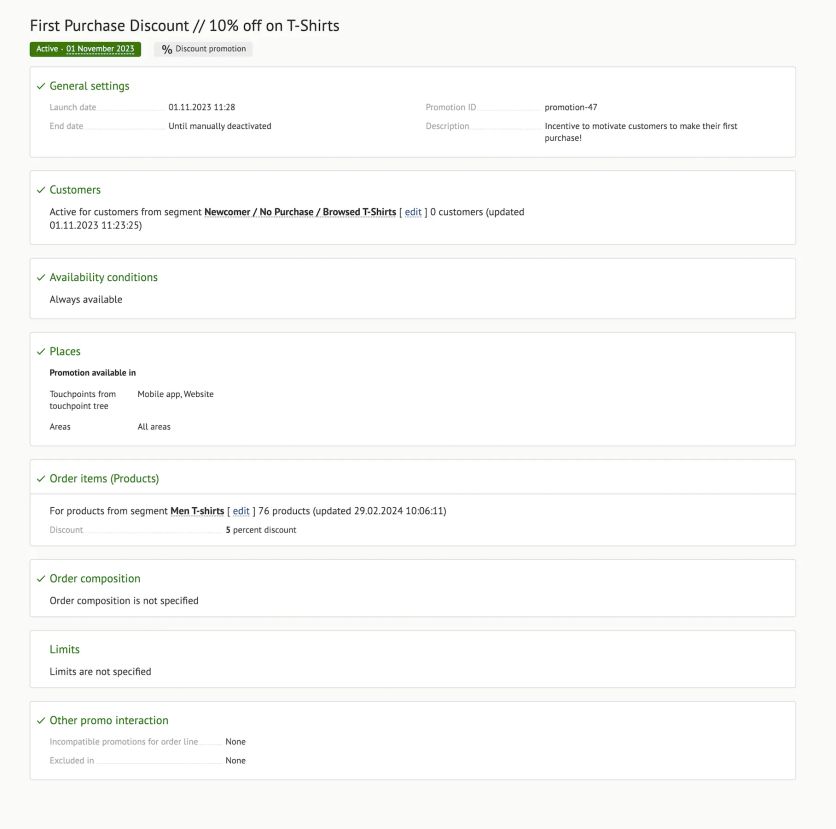
Promotion setup page in Maestra’s interface
The promotion settings are divided into several key sections:
- Start and end date, identifier, and description: These basic details outline the timeframe and specifics of the promotion.
- Customer segment: This specifies the group of customers eligible for the promotion.
- Availability conditions: This includes the dates and times the promotion is active. For example, a promotion might run for a month but only be available every Wednesday until 1:00 PM.
- Eligible locations: This defines the touchpoints where the promotion is valid, such as offline only, through the mobile app, or in specific stores.
- Order composition or specific products: This details the items or order values the promotion applies to, like orders exceeding a certain amount.
- Interaction with other promotions: This setting allows you to choose how the offer combines with or excludes other promotions.
In points-based promotions, the setup mirrors that of discount promotions but includes additional parameters for the accrual and spending of points. Additional conditions are specified, such as the percentage of the purchase amount that will be converted into points on the customer’s account.
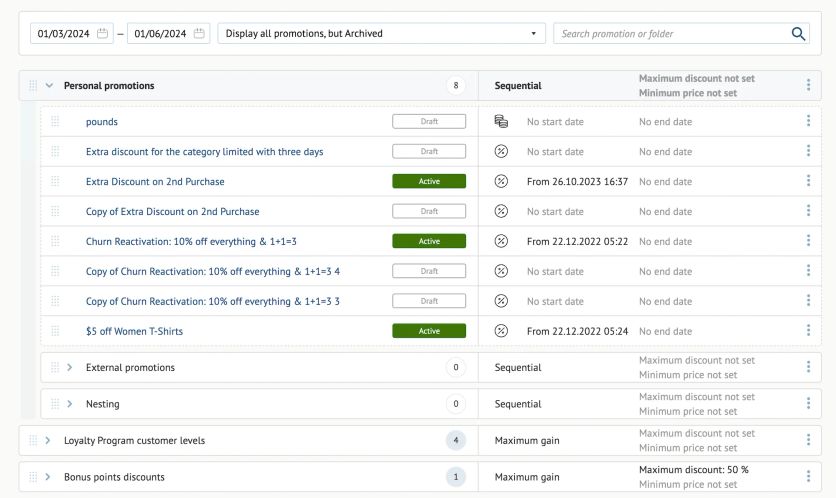
Configured promotions can be combined, applied sequentially, or a promotion can be excluded in favor of ones that are more advantageous to the customer or the store:
Mistakes to Avoid When Launching a Loyalty Program
When launching a loyalty program, it’s crucial to navigate around common pitfalls that can hinder its success. These mistakes often fall into organizational, technical, and operational categories. Here’s how to identify and avoid them:
Organizational Challenges
These tend to stem from a lack of understanding of the loyalty program’s processes and structure:
- Focusing too heavily on the customer facing aspects such as how much discount to offer, without considering the internal aspects such as how to track average order value (AOV).
- Lacking an employee skilled in targeted marketing, which may result in the program failing to hit its mark.
- Lack of clear objectives and goals for the program makes it difficult to gauge its success or ROI.
- Not having precise tools and metrics for evaluating program outcomes can leave its impact ambiguous.
One significant benefit of Maestra’s loyalty program is its omnichannel capability. However, in certain companies, online and offline channels are handled by separate teams, potentially hindering seamless integration. To address this challenge, a dedicated specialist is necessary to analyze data and manage the loyalty program comprehensively, ensuring its effectiveness across all channels.
Technical Challenges
Opting for overly complex software can drain resources in establishing communication and IT infrastructure. Companies may encounter "integration chaos" if loyalty programs, email campaigns, website product recommendations, and mobile apps operate on separate, unlinked systems. A more efficient approach centers around a single marketing system (such as Maestra), consolidating all information into a single, deduplicated repository.
Operational Challenges
These can include:
- Lack of a campaign plan: Jumping into a loyalty program without a clear, iterative campaign strategy and without regularly comparing actual outcomes against projected outcomes can lead to misaligned efforts.
- Prioritizing intuition over insights: Basing marketing decisions on gut feelings rather than data-driven insights can result in overlooking what truly engages and retains customers.
- Being slow to adapt: A loyalty program that doesn’t quickly respond to feedback and adjust strategies accordingly risks becoming outdated and ineffective.
Key Takeaways
A loyalty program is a marketing tool that provides you with a deeper understanding of your audience, their behaviors, and, based on accumulated data, enables you to craft personalized offers for customers.
The anatomy of a successful loyalty program includes both cost-related aspects (such as providing discounts and bonuses to gather insights about customers) and revenue-generating components (like utilizing those insights for targeted marketing to encourage further purchases). In an effective loyalty program, the revenue generated from personalized promotions exceeds the costs associated with gathering customer data.
Evaluating the success of a loyalty program requires ongoing monitoring. It’s essential to analyze the level of engagement with the program, how the balance of points influences shopping behavior, and changes in the average transaction value.
Frequently Asked Questions
- Results vary by implementation depth. Benetton grew its loyalty program to 600K members and increased LTV by 10.3% using Maestra’s loyalty module with gamification that returned $5.60 for every $1 spent. Decathlon rolled out a loyalty program across 62 physical stores in just 2 months and increased identified customer rates from 11% to 44%. The best loyalty program software for ecommerce connects loyalty data to email, SMS, and on-site personalization so that tier status and point balances influence every customer interaction.
- Essential features include tiered rewards, points management, referral program integration, gamification mechanics, and multi-channel redemption. Benetton’s gamification mechanics returned $5.60 per $1 spent, and their Wallet app drove 3% conversion rates. Look for software that integrates loyalty data with your marketing automation – platforms like Maestra embed loyalty directly into the CDP so tier status, point balances, and reward history are available for segmentation across all 150 integrations. The ability to launch quickly matters too: Decathlon deployed across 62 stores in 2 months.
- Retail loyalty program software needs to identify customers at the point of sale and sync data between online and in-store channels. Decathlon used Maestra to launch loyalty across 62 stores in 2 months, increasing identified customer rates from 11% to 44%. This means 4x more in-store shoppers were linked to known profiles, enabling personalized follow-up via email, SMS, and push notifications. The best retail loyalty platforms support barcode/QR scanning, POS integration, and Wallet passes – Benetton’s Wallet app alone drove a 3% conversion rate.
- Yes, and consolidation can significantly reduce costs. Urban Armor Gear replaced Klaviyo, Yotpo, and Frosmo with Maestra’s all-in-one platform and achieved a 64% cost reduction – approximately $100K per year in savings. The advantage of an integrated loyalty module over a standalone tool is that loyalty data (tiers, points, rewards) is natively available for email personalization, on-site experiences, and ad targeting without API syncs or data delays. The tradeoff is that standalone loyalty tools may offer more niche features like UGC collection (Yotpo).
- Implementation timelines range from 2-8 weeks depending on complexity. Decathlon rolled out loyalty across 62 physical stores in 2 months with Maestra, which is notably fast for an omnichannel retail deployment. Maestra offers free migration with billing starting only after go-live, and each account receives a dedicated Forward Deployed Marketer – a marketer from our team who works as part of yours – managing just 10-15 accounts (the industry standard is 60-125). For Shopify stores without physical retail, implementation takes typically a few days due to pre-built integrations and Maestra’s Shopify App.
- The best loyalty program software for Shopify depends on your scale and integration needs. For brands that want loyalty as part of a unified marketing stack, Maestra offers a native Shopify integration within its +150 connector library, combining loyalty with email, SMS, on-site personalization, and ads. Urban Armor Gear moved to Maestra from a Klaviyo + Yotpo stack and saved approximately $100K per year. For smaller stores needing only basic points and rewards, standalone Shopify apps may suffice, but brands with $1M+ revenue typically outgrow them quickly due to limited segmentation and cross-channel capabilities.
- Gamification has a measurable impact on both engagement and revenue. Benetton’s gamification mechanics within Maestra’s loyalty program returned $5.60 for every $1 spent on gamification campaigns, and the program grew to 600K members with a 10.3% increase in LTV.