
Klaviyo vs Postscript vs Maestra: 12 Features and Real Pricing [2026]

Most brands comparing Klaviyo and Postscript already run Klaviyo for email. The real decision is narrower: turn on Klaviyo SMS and keep one bill, or add Postscript as a dedicated texting tool and sync the two.
Both paths have a cost that doesn’t show on the pricing page. The bundle means Klaviyo’s two meters run together – active profiles for email and a monthly mobile-messaging plan for texts. The best-of-breed route means two segment builders, two attribution reports, and a six-hour list sync between them.
We compared Klaviyo, Postscript, and Maestra across 12 categories using current pricing pages, product docs, and verified reviews from the last 12 months. Short version: Postscript is the deeper SMS tool, Klaviyo is the easier bundle, and Maestra is the option for brands that want email, SMS, loyalty, and site personalization on one customer profile with a marketer included.
Quick Verdict – Klaviyo SMS vs Postscript vs Maestra by Use Case
Klaviyo, Postscript, and Maestra solve the same problem at three different depths. Klaviyo bundles SMS into the email platform Shopify brands already use. Postscript is a Shopify-only SMS specialist with human sales associates and AI message testing. Maestra runs email, SMS, built-in loyalty, and site personalization on one real-time customer data platform, bills only for active profiles, and includes a marketer who migrates your stack and runs the program with you.
Klaviyo – best for brands under roughly 50,000 profiles that want SMS as a toggle inside their email platform. Email from $20/mo; email + SMS from $35/mo.
Postscript – best for Shopify stores treating SMS as a staffed revenue channel worth its own tool. $0/mo platform fee with a $49 monthly minimum; Growth $100/mo; Professional $500/mo.
Maestra – best for mid-size, enterprise, and rapidly scaling e-commerce brands replacing an email tool, an SMS tool, a loyalty app, and a personalization vendor with one system. From $2,000/mo (CDP + unlimited email); SMS module $250/mo on top.
Comparison Summary
| Feature | Klaviyo | Postscript | Maestra |
|---|---|---|---|
| SMS Marketing | ⭐⭐⭐⭐ Same flows and segments as email; 20+ countries | ⭐⭐⭐⭐⭐ Infinity Testing, human SMS Sales, RCS | ⭐⭐⭐⭐ SMS, MMS, RCS on the shared profile, with transparent, published rates |
| ⭐⭐⭐⭐⭐ Pre-built flow library and the friendliest ramp in e-commerce email | ⭐ No email product | ⭐⭐⭐⭐⭐ Unlimited sends, a deeper builder, and AI assistants wired in through MCP | |
| Omnichannel Flows | ⭐⭐⭐⭐ Email, SMS, push in one builder | ⭐⭐⭐ SMS-only journeys; email steps live in Klaviyo | ⭐⭐⭐⭐⭐ One flow also changes site content and awards loyalty points |
| Customer Data & Segmentation | ⭐⭐⭐⭐ Klaviyo Data Platform, data kept indefinitely; warehouse sync and custom objects need Advanced KDP | ⭐⭐⭐ 45+ filters on the SMS list; Klaviyo lists sync every 6 hours | ⭐⭐⭐⭐⭐ Real-time CDP is the base of every plan |
| Popups & List Growth | ⭐⭐⭐⭐ Five form types and the richest targeting rules; both channels in one multi-step form | ⭐⭐⭐⭐⭐ The smoothest SMS opt-in in the category, on every plan | ⭐⭐⭐⭐⭐ One form feeds email and SMS, and what it captures becomes segmentable profile data |
| SMS Compliance | ⭐⭐⭐⭐ Quiet hours, frequency caps, litigator screening on consent | ⭐⭐⭐⭐⭐ Quiet hours per state law, in-house legal team | ⭐⭐⭐⭐ Quiet hours by recipient time zone, plain-language opt-outs |
| Loyalty | ⭐⭐ Partner apps only | ⭐⭐ Partner apps only; CashBack via Fondue | ⭐⭐⭐⭐⭐ Built-in loyalty with case-verified profit per member |
| Product Recommendations | ⭐⭐⭐ In email and SMS only; catalog-driven blocks | ⭐⭐⭐ In SMS and RCS conversations; custom recs at Enterprise | ⭐⭐⭐⭐⭐ Site, app, every message channel, and in-store POS; 14 prebuilt engines in every plan |
| Reporting & Attribution | ⭐⭐⭐ Email and SMS dashboards; deeper analytics cost extra | ⭐⭐⭐ SMS only; deeper analytics from the $500 tier | ⭐⭐⭐⭐⭐ Every channel on one profile; raw-data export; full reporting in every plan |
| Support | ⭐⭐⭐ Chat on paid plans; premium support at $5,000/mo | ⭐⭐⭐ Live chat from Growth; reviewers report decline since late 2024 | ⭐⭐⭐⭐⭐ A marketer who builds and runs campaigns with you: weekly Zoom calls, shared Slack, every plan |
| Shopify & Integrations | ⭐⭐⭐⭐⭐ 350+ ready-made integrations, any e-commerce platform | ⭐⭐⭐⭐ Deep Shopify integration; Shopify only | ⭐⭐⭐⭐⭐ Shopify, BigCommerce, Magento, WooCommerce, and anything else built for you at no extra cost |
| Pricing | ⭐⭐⭐⭐ Cheapest entry; two meters grow with list size | ⭐⭐⭐ Transparent rates; $49 minimum and $500 platform fee draw complaints | ⭐⭐⭐⭐ From $2,000/mo, pay only for active profiles, month-to-month |
Klaviyo vs Postscript vs Maestra: SMS Marketing
SMS marketing winner: Postscript – the only one of the three that bets the whole product on texting, and it shows in the tooling.
| Klaviyo | Postscript | Maestra |
|---|---|---|
| ⭐⭐⭐⭐ Shared flows and segments; 20+ countries | ⭐⭐⭐⭐⭐ Infinity Testing, SMS Sales, RCS | ⭐⭐⭐⭐ SMS, MMS, RCS with transparent, published rates |
Klaviyo
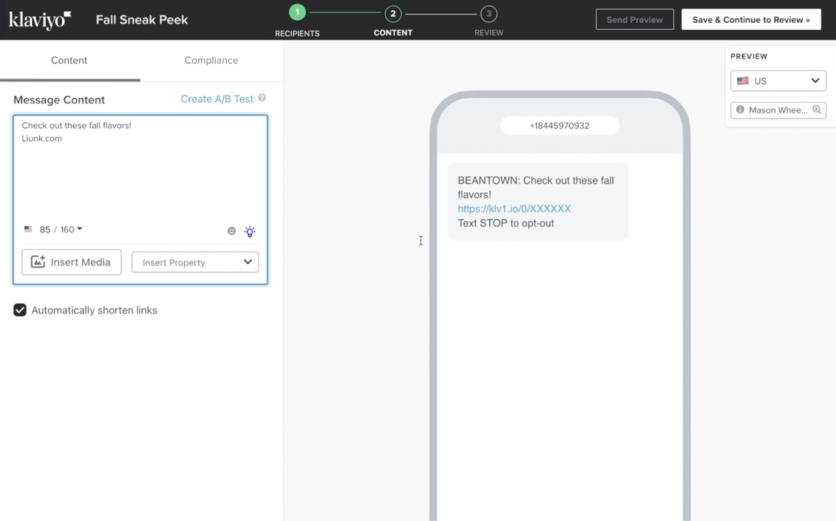
Klaviyo’s argument for SMS is that nothing is separate. The same flows, segments, and profiles that run your email send your texts, and a cart-abandonment flow can hold an email step and an SMS step side by side.
The channel covers SMS, MMS, and RCS in over 20 countries, with two-way conversations answered by the K:AI Customer Agent. The pricing model changed on July 13, 2026: Klaviyo moved mobile messaging from credit tiers to dollar-based monthly plans, with carrier fees bundled into the rate and no rollover of unused spend.
Postscript
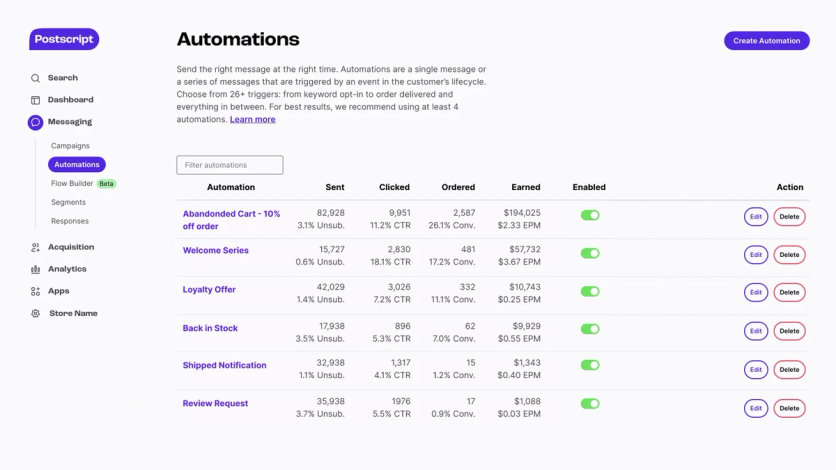
Postscript stacks features Klaviyo doesn’t try to match. Infinity Testing generates and tests message variants inside automations. SMS Sales puts US-based associates on your list seven days a week to convert hesitant subscribers, with a stated average response under five minutes. Shopper, the AI layer, runs one-to-one conversations and recommendations over SMS and RCS.
The platform is Shopify-only and prices sending for the US and Canada. Segmentation runs on more than 45 filters and over 65 automation triggers, all scoped to the SMS list rather than a full customer profile.
Maestra
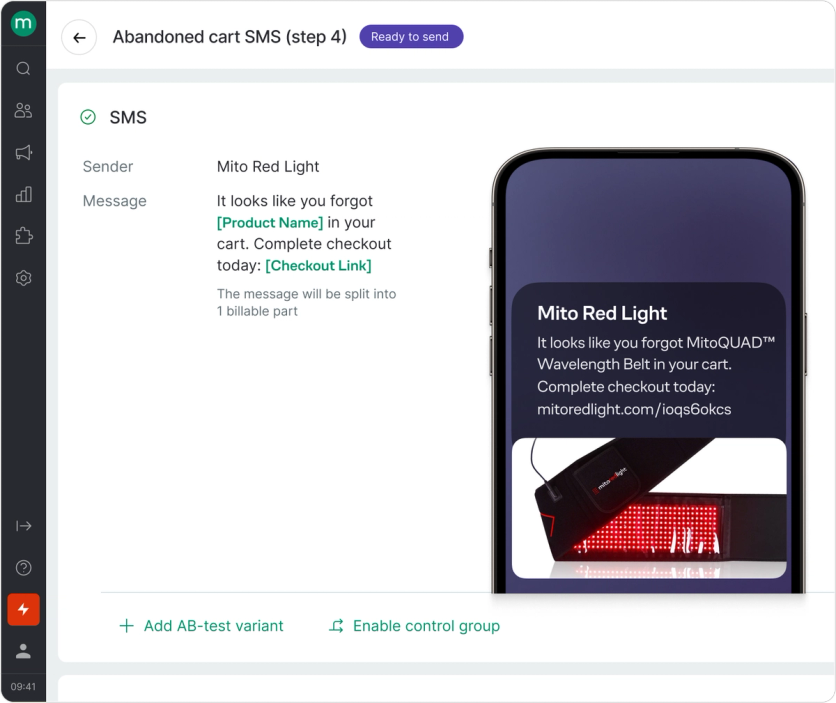
In Maestra, SMS isn’t a separate product with its own audience. A text is a step in the same flow as the email, the push and the on-site banner, reading one profile, so frequency caps and suppressions apply across every channel at once. Messages carry variables and product data, and the composer can generate the copy.
Two pieces sit either side of that. Tap-to-Text subscriptions turn a tap on mobile into an opt-in without a typed keyword. Cross-device recognition carries the cart between screens: a shopper fills a cart on desktop, gets the abandoned-cart text on their phone, and the link opens that same cart already filled. Short codes, 10DLC and toll-free numbers are all supported.
Message pricing is transparent rather than quoted: the rates sit on the pricing page instead of arriving after a sales call. In the US that means from $0.0035 per SMS and $0.0125 per MMS, with carrier fees on top.
Selkirk Sport grew SMS-attributed revenue 149% year over year after switching from Bloomreach. Buyers and partners finally sat in one platform instead of separate tools, which is what made the segmentation work, on delivery that held at volume.
The gap, to be fair about it, is staffed human selling over text. Postscript puts trained associates into the thread to talk a hesitant subscriber into buying, and Maestra has no equivalent.
Klaviyo vs Postscript vs Maestra: Email
Email winner: Klaviyo for how fast a small team gets a program running, Maestra for what the builder handles once that program gets complicated.
| Klaviyo | Postscript | Maestra |
|---|---|---|
| ⭐⭐⭐⭐⭐ Pre-built flows, templates, easiest ramp | ⭐ No email product | ⭐⭐⭐⭐⭐ Unlimited sends, deeper builder, MCP for AI assistants |
Klaviyo
Klaviyo is where most DTC email programs live, and the product is built for getting started fast. The flow library ships ready-made welcome, abandoned-cart, browse-abandonment and winback sequences that a marketer can switch on and edit the same afternoon, on templates that need no code. Predictive analytics and the K:AI suite – Marketing Agent, Customer Agent and Composer – sit on the email side first.
Email deliverability runs on shared infrastructure by default, and the shared pool can fail under load. One merchant documented two Black Friday campaigns where “a shared IP ban caused 22.5 and 60% of my emails to bounce.”
The cost story is the recurring complaint. Email bills by active profiles, so every stored contact counts whether you message them or not. One Trustpilot reviewer in April 2026 wrote that Klaviyo bills “based on outdated list sizes so even after you clean your list, you’re forced to overpay.”
Postscript
Postscript has no email product, which is why the Klaviyo integration exists. Subscribers, segments, coupons, and click events sync between the two, and the Klaviyo list sync runs every six hours.
Maestra
The email module is priced per month with unlimited sends, so the number of emails you send never moves the bill. List size isn’t free of charge, though. Email sits on top of the customer data platform, which covers the first 100,000 active profiles and then charges per active profile. Dormant contacts are stored at no cost, so what raises the bill is how many people you actually engage, not how many rows you keep.
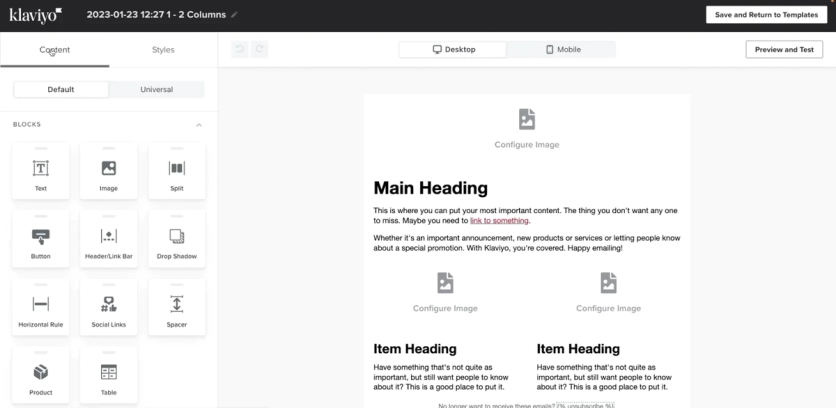
Maestra’s email builder goes deeper than a template picker: a proprietary WYSIWYG editor, custom blocks you upload and then edit visually, and imported HTML you can keep tweaking. Ready-made blocks cover product grids, countdowns, promo-code banners and surveys, and copy can be generated inside the editor.
What surrounds the email matters as much. Sends run at high throughput or throttle down, and time-zone scheduling lands the message at 10 a.m. local coast to coast. A/B tests report incremental revenue rather than opens, and AMP for Email is supported for the interactive formats that suit it. And an MCP connector points an AI assistant at your own data and tools, so building and checking a campaign isn’t only a manual job.
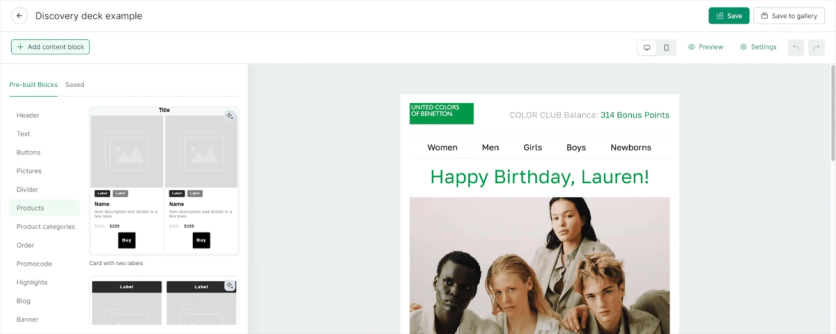
Maestra’s email builder keeps pre-built blocks for products, promo codes and loyalty, so an email can show a live points balance without a sync
Coolibar grew revenue from email and SMS campaigns 33.6% year over year within two months of switching from Klaviyo, and flow revenue grew 62% in the same period. On deliverability, AD Mortgage reached 99.7% email deliverability through list hygiene and sender-reputation work with the Maestra team.
Klaviyo vs Postscript vs Maestra: Omnichannel Flows
Omnichannel flows winner: Maestra – the only builder here where a flow can change what a customer sees on the website and award loyalty points.
| Klaviyo | Postscript | Maestra |
|---|---|---|
| ⭐⭐⭐⭐ Email, SMS, and push in one flow | ⭐⭐⭐ SMS-only automations; email steps in Klaviyo | ⭐⭐⭐⭐⭐ Messaging, on-site, and loyalty in one flow |
Klaviyo
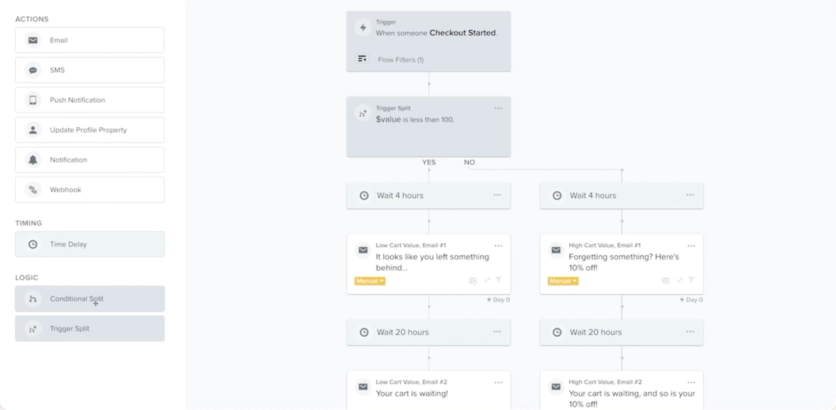
Klaviyo’s flows mix email, SMS, and mobile push steps in one builder with conditional splits. For a brand on the bundle, that’s the strongest argument against a second SMS tool: one abandoned-cart flow, one set of branches, one report.
The library is the real head start. Welcome, abandoned cart, browse abandonment and winback ship ready to switch on, which is why a small team can have a credible programme running in an afternoon rather than a sprint.
Reviewers describe a ramp: advanced flows and large segment libraries are where new users say the platform gets hard to hold in your head.
Postscript
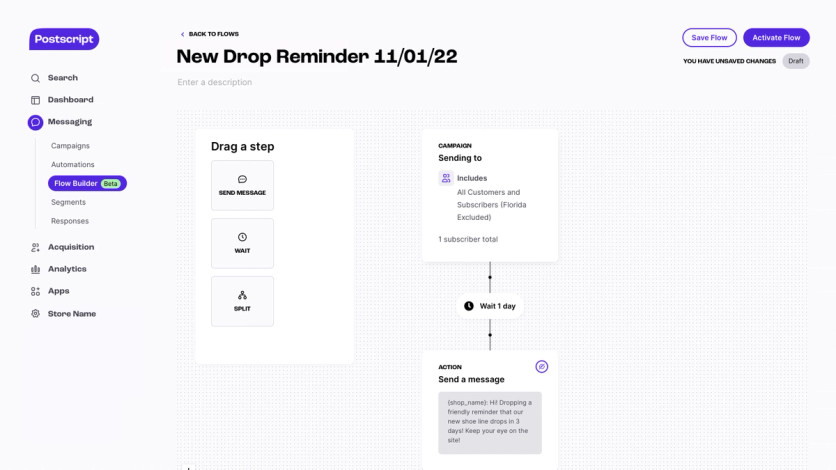
Postscript’s flow builder is drag-and-drop with over 65 automation trigger events and 85 trigger filters. Every step is a text. If the journey needs an email, that step lives in Klaviyo, triggered off a synced segment or event.
The depth is in the targeting rather than the steps. Postscript exposes more than 65 automation triggers, over 85 trigger filters and 45-plus user filters, so who enters a journey is finely controlled even though what they receive is always a text.
Postscript’s help center notes that real-time event triggers from Klaviyo are an upcoming feature limited to accounts on the OAuth connection, so today’s cross-tool journeys run on scheduled syncs, not live events.
Maestra
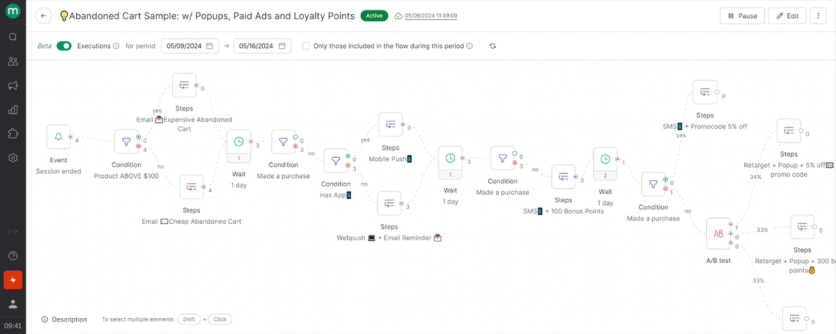
Maestra’s flow builder connects channels the other two treat as separate products. One abandoned-cart flow can send an email, follow with an SMS, change the banner the customer sees on return, and award loyalty points on purchase, all reading one profile.
Magnum Bikes used coordinated email, SMS, and on-site activation for its anniversary sale after leaving Klaviyo, and grew online order volume 111.7% and online revenue 56.6% year over year. JOLYN launched Price Drop Alert and Low Stock flows that weren’t possible on Klaviyo, and campaign-driven revenue grew 26% year over year, with SMS revenue up 52%.

Klaviyo vs Postscript vs Maestra: Customer Data & Segmentation
Customer data winner: Maestra – the real-time customer data platform is the base of every plan, not an add-on or a synced list.
| Klaviyo | Postscript | Maestra |
|---|---|---|
| ⭐⭐⭐⭐ Rich marketing profile; CDP add-on at $500/mo | ⭐⭐⭐ SMS-list segmentation; Klaviyo sync every 6 hours | ⭐⭐⭐⭐⭐ Real-time CDP included |
Klaviyo
Klaviyo’s data layer has a name now – the Klaviyo Data Platform – and the pitch is time to value: no code, pre-built integrations, running in hours rather than the months an enterprise CDP implementation usually takes. The profile holds purchase history, browse events and predictive scores, segments apply to SMS exactly as they apply to email, and Klaviyo stores customer data indefinitely at no extra charge.
The parts that make it a CDP in the harder sense sit in Advanced KDP, a paid tier on top. That is where warehouse syncing lives – exporting to Snowflake, BigQuery, Databricks, Redshift, S3 and Azure, and pulling enriched attributes and models back the other way through reverse ETL. It also carries custom objects for relationships a flat profile can’t hold, such as subscriptions, reservations or households, plus deduplication that catches typo’d addresses and aliases, no-code data transformation, and serverless functions that fire on an event to reshape a property or forward it to a webhook. Klaviyo doesn’t publish what the tier costs.
The consequence is worth saying out loud: the CDP you compare on the pricing page is not the CDP that does warehouse work. A team that picked Klaviyo because it includes a customer data platform can still find the identity resolution and the data modelling they had in mind sitting behind another purchase.
Reviewers also flag what the profile count does to the bill. An August 2026 Trustpilot review describes being charged “almost three times my normal monthly bill because of profiles that were obviously generated during development/testing.”
Postscript
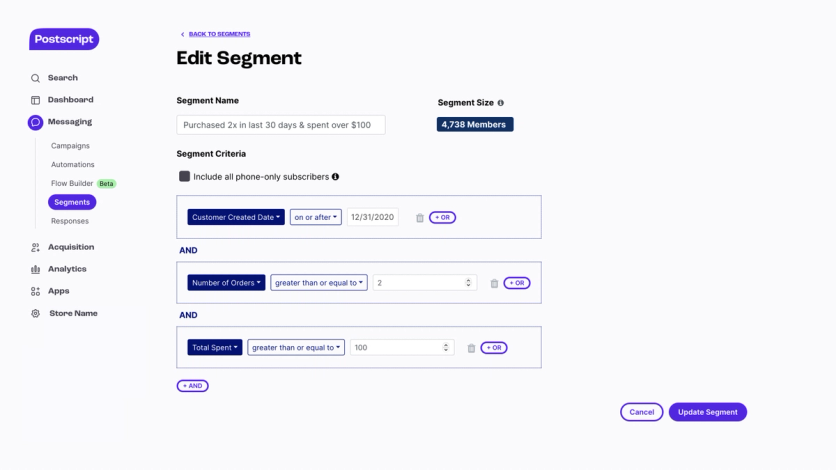
Postscript segments its own subscriber list with more than 45 filters, plus Shopify order data. Klaviyo lists and segments sync in every six hours, and only lists used in a campaign within the last 30 days sync automatically.
Six hours is fine for a weekend promotion and useless for anything that moves. A price-drop alert or a low-stock notification earns its money in the minutes after the price or the stock level changes, not on the next sync. That is the practical ceiling of running email in one tool and texts in another: the two lists agree eventually, and eventually is the wrong unit for urgency.
Targeting rules can be saved and reused across popups rather than rebuilt each time, and segments combine subscriber behaviour with Shopify order history. The ceiling is the data model: everything is anchored to a phone number on the SMS list, so anyone who hasn’t opted in to texts is invisible to it.
Maestra
Maestra’s profile is assembled rather than stored. It merges identities across email, phone, loyalty ID and device, deduplicates and error-checks the data as it arrives, and updates the moment something happens. What sits on it is the whole relationship: purchase history and order status, product interactions, lifecycle events, and engagement signals from every channel. Nothing meters the profile count on the data side.
Segmentation is where that pays off. Conditions nest and combine with AND/OR, and they can run on calculated fields rather than raw attributes alone. Say you need to clear rare sneaker sizes out of the warehouse. You can send only to people who have never bought sneakers, who historically buy only on discount, and who wear that size. Those are three different kinds of condition – a gap in purchase history, a behavioural pattern, a product attribute – and they resolve into one audience without an export.
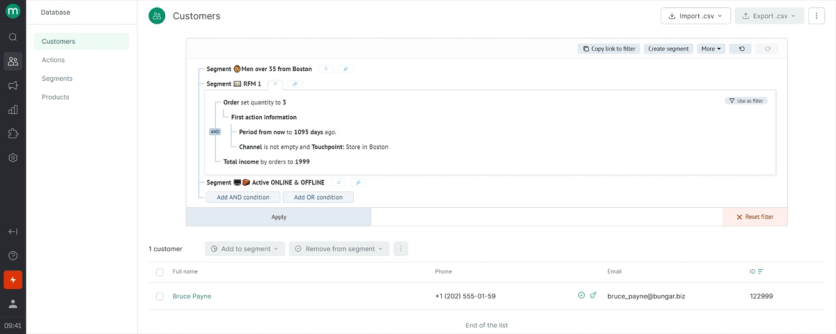
Coolibar names exactly that as the change from Klaviyo: flexible segmentation with AND/OR logic and nested segments, which the brand didn’t have before. G-Plans doubled customer lifetime value in a year after switching from Klaviyo, crediting real-time profiles and personalized flows across email, SMS, and mobile push.
Klaviyo vs Postscript vs Maestra: Popups & List Growth
List growth winner: Postscript for the opt-in moment itself, Maestra for what the capture turns into afterwards.
| Klaviyo | Postscript | Maestra |
|---|---|---|
| ⭐⭐⭐⭐ Five form types and the richest targeting rules; both channels in one multi-step form | ⭐⭐⭐⭐⭐ The smoothest SMS opt-in in the category, on every plan | ⭐⭐⭐⭐⭐ One form feeds email and SMS, and what it captures becomes segmentable profile data |
Klaviyo
Klaviyo calls them sign-up forms and ships five shapes: popup, flyout, full page, embedded and banner. Any of them can run as multiple steps, which is Klaviyo’s own advice when you want an email address and a phone number without scaring the visitor off at the first field. Add a phone input and it collects promotional SMS consent by default.
Display control is the strong part. Forms fire immediately, on exit intent, after a delay, at a scroll depth or after a page count, with frequency caps and priority levels so two forms don’t collide. Audiences narrow to email subscribers, SMS subscribers, a named segment or people with no profile at all, and targeting reads URL, UTM parameters and location – on Shopify it can even read what is in the cart. A/B testing is documented as an offer test: two incentives, a hidden property recording which one a subscriber saw, and a split in the welcome flow that honours it.
Postscript’s own help centre, meanwhile, documents how to grow a Postscript list using Klaviyo forms. That tells you where most Shopify brands actually collect.
Postscript
Postscript’s capture toolkit is the deepest for SMS, and Onsite Opt-in is why. It uses the one-time-password autofill built into iOS and Android to take a compliant opt-in without sending the shopper out to their messaging app: tap, autofill, done. On desktop the passcode is typed into the popup instead, and if someone starts and stops, a reminder text follows four hours later.
It is on every plan and it is the default for new popups, with one catch – it only works with Postscript’s own popups, so a third-party form can’t use it. The editor triggers on time, exit intent, scroll depth or a custom event, targets by country, state and city, and lets you save a targeting profile and reuse it. A/B tests pick the winner by cumulative opt-ins per variant.
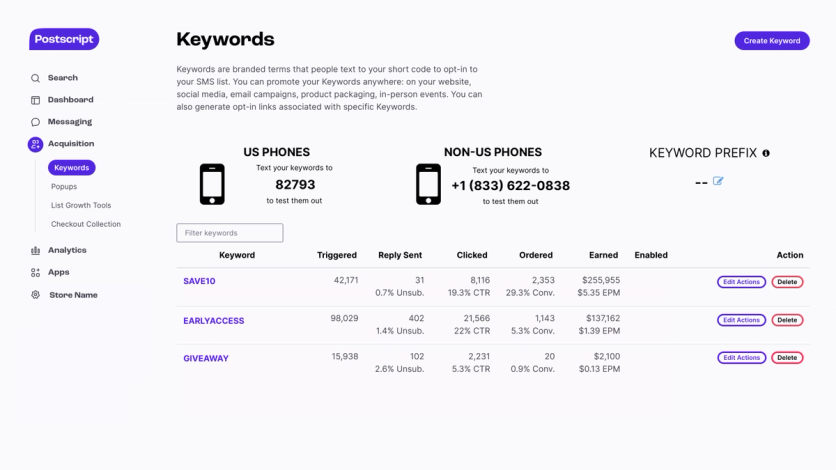
Around it sits the rest of the kit: Checkout Collection for Shopify, Shopify Plus, Recharge and CartHook, trackable text-to-join keywords, QR codes for packaging and events, Back in Stock capture on sold-out items, and standalone landing pages. Two keywords come with Starter; unlimited keywords start on Growth.
The ceiling is what happens next. Postscript’s popups collect email addresses as well as phone numbers, but with no email product of its own it has nowhere to send them – the addresses go on to Klaviyo or another provider. One moment of capture, two systems to follow it up in.
Maestra
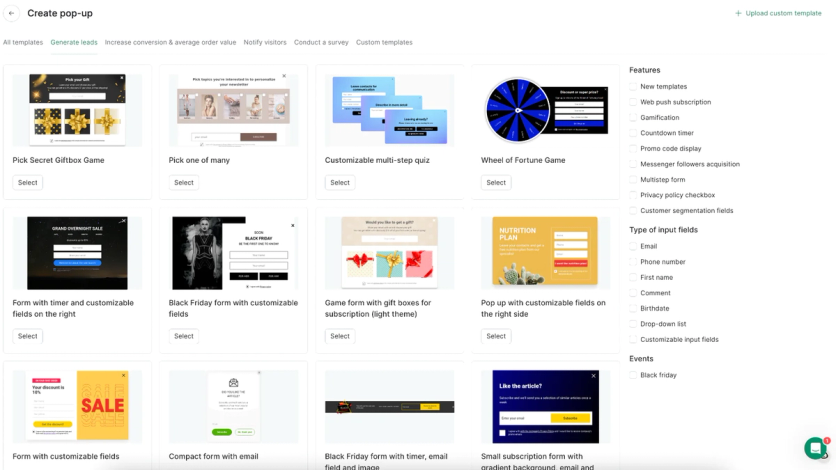
Maestra’s capture library runs to hundreds of templates – gamified popups, countdowns, one-click SMS opt-ins – and one form can feed email and SMS at once. What it collects goes beyond an address: phone numbers, birthdays and stated preferences land on the customer profile as attributes you can segment on months later.
Targeting is what keeps the setup from annoying people. A popup can be shown only to visitors who haven’t shared anything yet, capped with frequency limits, and narrowed by location or by what someone is doing in the current session. A/B testing is built in. Product-picking quizzes do double duty: they guide a hesitant shopper and record the preferences that make later campaigns sharper.
The difference isn’t the form, it’s what the form becomes. One unit collects the email address and the phone number together, and what a visitor volunteers along the way – a size, a preference, a birthday – lands on the profile as an attribute the next campaign can segment on instead of asking again. Which popup someone sees can differ too, so a first-time browser and a returning customer aren’t handed the same offer.
None of it is set-and-forget, either. The marketer on your account keeps testing the units after launch – the offer, the format, the moment it fires – and that testing is part of the subscription rather than a service line on top. Often enough the thing that needs changing is the offer itself.
Nat’v Basics increased popup conversion 24% by testing a fixed-dollar offer against a percentage discount, a test its marketer proposed.
Klaviyo vs Postscript vs Maestra: SMS Compliance
SMS compliance winner: Postscript – the only one of the three that publishes state-by-state rules and staffs an in-house legal team.
| Klaviyo | Postscript | Maestra |
|---|---|---|
| ⭐⭐⭐⭐ Quiet hours and frequency caps; litigator screening on consent | ⭐⭐⭐⭐⭐ Quiet hours per state law; in-house legal team | ⭐⭐⭐⭐ Quiet hours by recipient time zone; plain-language opt-outs |
Klaviyo
Klaviyo enforces quiet hours by default, holding sends between 8 p.m. and 11 a.m. in the recipient’s region, and it warns you when a campaign would break them. Smart Sending caps how many messages one person receives in a rolling window, 24 hours by default.
Two safeguards go past timing. Klaviyo excludes known litigators from SMS consent collection by default, and age-gating covers regulated products such as alcohol in the markets where it’s allowed. Numbers are toll-free or short code, with carrier fees bundled into the per-message rate.
Postscript
Postscript applies quiet hours in the recipient’s local time zone. Campaigns can’t send inside the window at all, and an automation triggered during quiet hours waits for the next one. Opt-in and opt-out confirmations still go out immediately, as federal law requires.
The deeper work is state by state. Postscript publishes compliance guidance for the stricter 8 a.m. to 8 p.m. windows in Florida, Texas, Connecticut, Maryland, Oklahoma, and Washington, backed by an in-house legal team. Every plan includes a dedicated toll-free number; a short code runs $750/mo through the carriers.
Maestra
Maestra applies quiet hours to campaigns and flows, scheduled in each recipient’s local time zone, so a 9 a.m. send in New York doesn’t land at 8 a.m. in Texas.
Opt-outs don’t depend on the exact keyword. Maestra reads plain replies such as “no thanks” or “revoke” and unsubscribes automatically, and it can auto-append the opt-out line to outbound messages. Short codes, 10DLC, and toll-free numbers are all supported.
The honest gap is legal depth. Maestra doesn’t publish state-by-state compliance guidance or staff an in-house legal team the way Postscript does.
Klaviyo vs Postscript vs Maestra: Loyalty
Loyalty winner: Maestra – built-in loyalty on the same profile as messaging, against two partner lists.
| Klaviyo | Postscript | Maestra |
|---|---|---|
| ⭐⭐ Loyalty via partner apps | ⭐⭐ Partner apps; CashBack via Fondue | ⭐⭐⭐⭐⭐ Points, tiers, referrals, promo codes built in |
Klaviyo
Klaviyo runs no loyalty programme of its own, and 2026 didn’t change that. What it added was data plumbing: integrations with Thanx, Punchh and Yotpo that sync reward balances, coupons and referral status onto the customer profile, so points can drive targeting and expiry-date flows.
Postscript
Postscript’s answer is CashBack, delivered through a Fondue integration, and it is a different animal from a points programme. Instead of a discount code in the welcome popup, the shopper buys at full price and afterwards gets an email to claim the reward as cash or a store gift card, with six months to redeem.
The appeal is margin: you only pay out when the incentive actually converted someone. What it isn’t is loyalty in the usual sense – no balance, no tiers, no member portal. Actual programmes come from the Reviews and Loyalty category of Postscript’s app directory, where LoyaltyLion, Smile, Yotpo and Rivo sit.
Maestra
Maestra ships built-in loyalty: points, tiers, referrals, promo codes, and gift cards. It runs on the same profile as email and SMS, so a flow can award points and a text can show the balance without a sync.
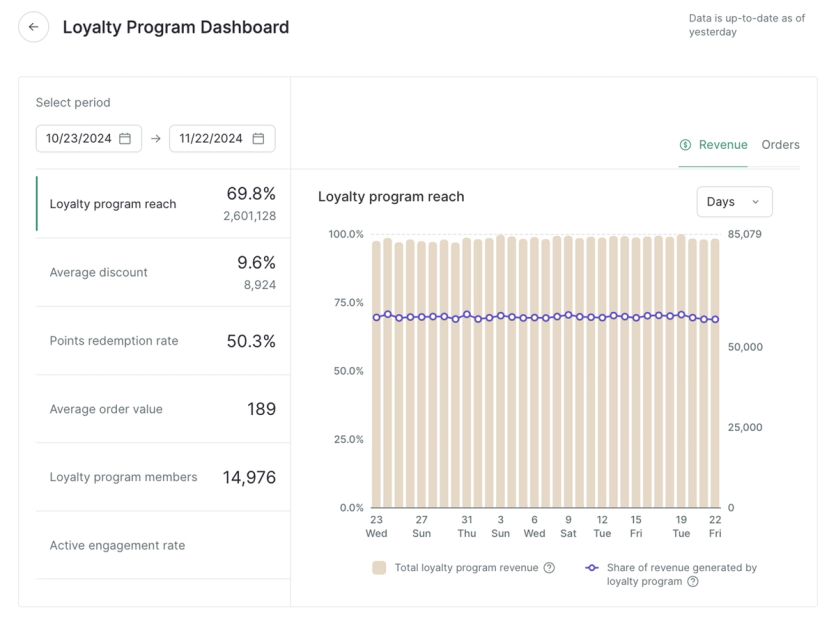
JOLYN moved loyalty from Yotpo and Klaviyo to Maestra; members who redeem points bring 28% more profit, $96 per customer versus $75 for non-redeemers. Svaha USA replaced Yotpo’s email, SMS, and loyalty with Maestra and grew total sales 26% year over year, with points now landing reliably on every review and purchase.
Klaviyo vs Postscript vs Maestra: Product Recommendations
Recommendations winner: Maestra – the same engines run on every surface the brand owns, from the website to the checkout terminal.
| Klaviyo | Postscript | Maestra |
|---|---|---|
| ⭐⭐⭐ Email and SMS only; catalog-driven blocks | ⭐⭐⭐ SMS and RCS conversations; custom recs at Enterprise | ⭐⭐⭐⭐⭐ Site, app, messages, and in-store POS; 14 prebuilt engines in every plan |
Klaviyo
Klaviyo builds recommendations as product feeds: sets of products chosen by rules you define, dropped into an email through a product block. The rules run from plain catalog logic, best sellers or newest arrivals, to behavioural picks like recently viewed items and products a customer may also like. Already-purchased and out-of-stock items drop out automatically, and the catalog tops out at 250,000 items.
There is now an on-site surface too, which there wasn’t a year ago. Customer Hub is a personalised drawer on the storefront, and its For You tab carries a Recommended Products carousel built from the shopper’s browsing and purchase history. The limits matter, though: signed-in shoppers only, one drawer rather than the product page or the cart, up to five items, and models retrained roughly weekly.
So the honest reading is that Klaviyo has entered on-site recommendations rather than solved them. One drawer for logged-in shoppers is a useful place to put five products; it is not merchandising the product page, the category page or the cart, which is where most of the revenue from recommendations actually moves.
Postscript
Shopper is Postscript’s AI layer, and its Responses agent is what actually recommends: it reads browse history, cart contents and the conversation itself, then suggests products and tries to close the sale in the thread. Brand Center trains it on your products and voice, and it can pull from FAQ pages and loose text as well.
The Enterprise plan adds custom product recommendations on top. Everything stays inside SMS and RCS, though – Postscript says it is expanding across the customer journey, but today there is no on-site surface for any of it.
Maestra
Maestra ships 14 prebuilt recommendation engines plus custom rules, and they aren’t tied to one surface. The same recommendations run on the website, in the mobile app, across email, SMS, MMS, RCS, push and messengers, and in offline stores on self-checkout and POS terminals.
They’re part of the customer data platform every subscription starts with, so they aren’t a paid module.
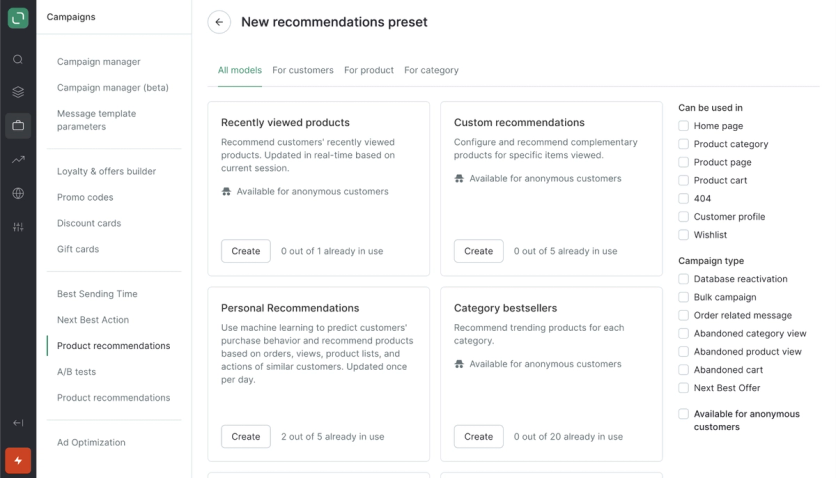
At Blue Q, shoppers who engage with recommendations show 28.7% higher average order value and 45.3% more items per order, with “Often Bought With” bundles alone driving 40% of recommendation-influenced revenue.
Svaha USA replaced Rebuy, which filled every slot with the same dress in different colors, with Maestra recommendations that group color variants and show a different product in each slot.
Klaviyo vs Postscript vs Maestra: Reporting & Attribution
Reporting winner: Maestra – every channel on one profile, down to raw data, on every subscription tier.
| Klaviyo | Postscript | Maestra |
|---|---|---|
| ⭐⭐⭐ Email and SMS dashboards; deeper analytics $100/mo extra | ⭐⭐⭐ SMS only; deeper analytics from the $500 tier | ⭐⭐⭐⭐⭐ Every channel, raw-data export, included on every tier |
Klaviyo
Three things come included: Dashboards for a per-channel overview, Custom Reports for single-metric and multi-metric digs, and Benchmarks that set your numbers against similar companies. Attribution is last touch, and each Klaviyo channel gets its own configurable window – email credits clicks for five days, SMS five days for clicks and one for opens, push twenty-four hours – with 31 days as the ceiling.
Last touch with a 31-day ceiling suits e-commerce with short consideration cycles and starts creaking on considered purchases, where the email that began the journey falls outside the window and the text that finished it takes all the credit.
The analysis most teams actually want sits behind a second subscription. Marketing Analytics adds funnels, RFM, cohorts, a customer-lifetime-value report and product analysis showing what people buy together or in sequence, and it lifts custom metrics from one to fifty. It runs $100/mo at 13,500 active profiles and requires both an email plan and a profile plan underneath it.
Postscript
Postscript reports on the programme it runs. Subscriber lists, a ninety-day revenue report tying orders to a specific message, message and subscriber analytics refreshed every fifteen minutes, popup analytics down to impressions and conversion, and a subscriber lifetime-value view. Enhanced analytics is listed as a Professional feature; data-warehouse push arrives at Enterprise.
Attribution is worth reading closely. The default is a seven-day click window plus a twenty-four-hour view window, so a purchase counts if it lands within a day of delivery even when nobody clicked. Both windows are adjustable on every plan, but changes don’t recalculate history. Cross-channel questions – did the text or the email drive the sale – still mean stitching two tools together by hand.
Practically, that means the attribution decision is a one-way door. Widen the window after a quarter of reporting and the old numbers stay as they were, so the before-and-after comparison a CFO asks for is the one thing the change makes impossible.
Maestra
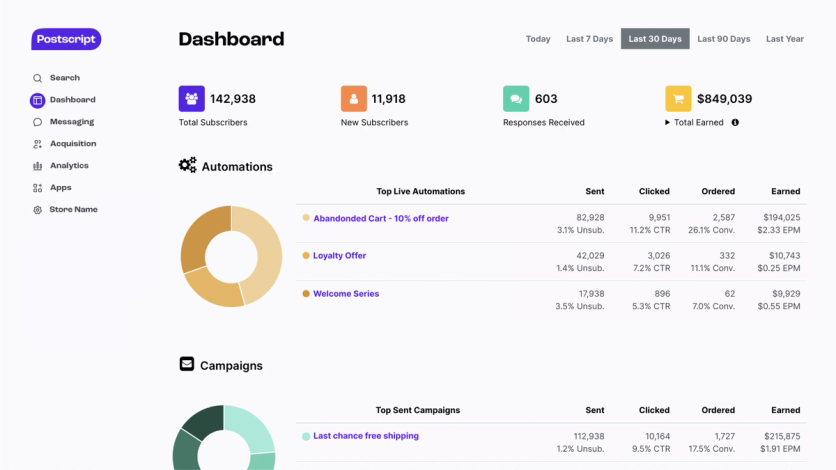
Maestra reports on every channel it runs – email, SMS, push, in-app, on-site personalization and recommendations – against the same profile that sends the messages, so attribution never means matching IDs across tools. Attribution defaults to last non-direct touch, and you can change the window or exclude transactional messages.
Depth is the other half. You can drill from a channel down to a single campaign, flow, or segment, run control groups against entire channels as well as individual promotions, and export raw data or stream it live to your own BI.
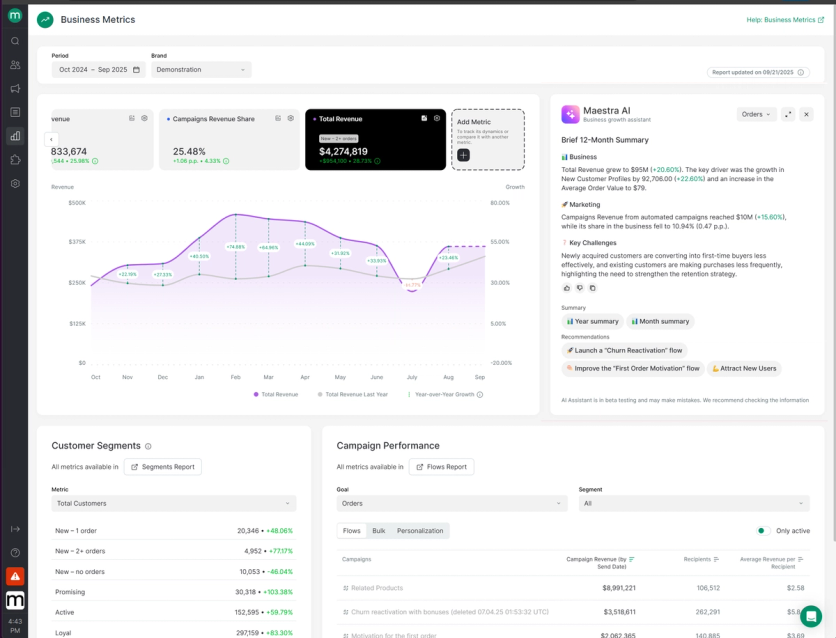
None of this sits behind a tier. Reporting is part of the customer data platform that every Maestra subscription starts with, so the smallest plan sees the same numbers as the largest.

Klaviyo vs Postscript vs Maestra: Support
Support winner: Maestra – every plan comes with a marketer who does the work with you, not a queue you file tickets into.
| Klaviyo | Postscript | Maestra |
|---|---|---|
| ⭐⭐⭐ Chat on paid plans; premium support at $5,000/mo spend | ⭐⭐⭐ Live chat from Growth; decline reported since late 2024 | ⭐⭐⭐⭐⭐ A marketer on your account: weekly Zoom calls, shared Slack, hands-on builds |
Klaviyo
Paid plans get email support around the clock and live chat on weekdays, following regional business hours. The free plan gets email for sixty days, then a virtual assistant and the help centre. No phone support is documented at any tier.
Anything more hands-on is gated by spend. Klaviyo sells Standard, Professional and Enterprise success packages, and eligibility runs on monthly spend: under $5,000 you get Standard only, Professional opens at $5,000, and the full set at $10,000. What each package actually includes isn’t published.
Which sets up the trade the whole comparison turns on: on Klaviyo, help scales with what you spend, and the brands that need the most help are usually the ones spending the least.
Postscript
Support was Postscript’s calling card, which makes the recent reviews conspicuous. The ladder is steep: Starter names no live chat at all, Growth adds live chat and email, Professional adds an onboarding launch specialist, priority chat, tier-one engineering support and – notably – API access, and Enterprise promises priority chat with a two-minute response in business hours.
Two services sit above the plans and neither is priced publicly. Postscript Plus is managed SMS in three tiers, from a four-month Launch programme for migrations up to Signature, where strategists work as an extension of the team. SMS Sales is the unusual one: US-based associates trained on your products, covering seven days a week at an average response under five minutes, with four to six weeks to onboard them.
Maestra
Every Maestra plan comes with a marketer assigned to your account who does the work rather than advises on it. They run the migration off your old platform, build the flows and segments, launch the campaigns, and keep optimizing after go-live. You get a weekly Zoom call and a shared Slack channel instead of a ticket queue.
Maestra calls the role a Forward Deployed Marketer. The part that matters commercially is that there is no services price list and no tier to reach: the work isn’t sold separately.
I Love Linen has run its email programme on plenty of platforms over the years. What the brand rates highest about Maestra isn’t a feature.

Klaviyo vs Postscript vs Maestra: Shopify & Integrations
Integrations winner: Klaviyo for breadth of ready-made connections, Maestra for anything that isn’t ready-made.
| Klaviyo | Postscript | Maestra |
|---|---|---|
| ⭐⭐⭐⭐⭐ 350+ ready-made integrations, platform-agnostic | ⭐⭐⭐⭐ Deep Shopify integration; Shopify only | ⭐⭐⭐⭐⭐ Four e-commerce platforms natively, anything else built for you at no extra cost |
Klaviyo
Klaviyo advertises integrations with 350+ apps, and the model is platform-agnostic: it runs on Shopify, BigCommerce, WooCommerce, Magento and custom stacks alike. Product catalogs sync natively from Shopify, WooCommerce, BigCommerce, Magento, PrestaShop, Salesforce Commerce Cloud, Square and Wix, with an API for anything else. For a brand running more than one storefront platform, this alone can decide the comparison.
The directory itself is the App Marketplace, and Klaviyo’s own plan lineup has gone modular alongside it: Marketing, Data and Analytics, Service, Composer and Customer Agent are separate products you assemble, which is worth knowing before comparing a headline price with anyone else’s.
Postscript
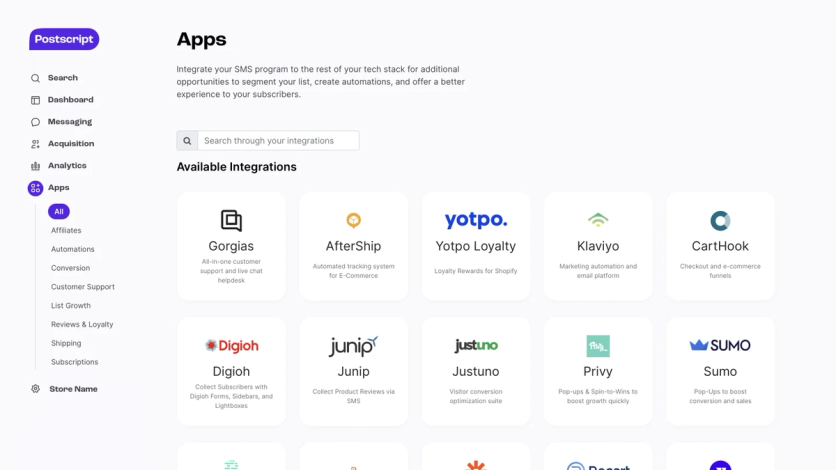
Postscript is built for Shopify and says so plainly – a platform “deeply integrated in the Shopify ecosystem”. Subscriber collection covers Shopify and Shopify Plus plus Recharge, CartHook and custom checkouts wired into Postscript. No other e-commerce platform is listed anywhere.
The app directory runs to roughly 78 integrations across ten categories, and the categories tell you what Postscript expects you to buy elsewhere: an Email Service Providers shelf holding Klaviyo, Iterable, Listrak, Mailchimp and Omnisend, and a Reviews and Loyalty shelf holding LoyaltyLion, Smile, Yotpo and Rivo. One catch for custom work: API access starts on the $500 Professional plan, so Starter and Growth customers can’t build their own integration at all.
That gate matters more than it looks. A brand on Starter or Growth can only connect what is already in the directory, so the moment your stack has something unusual in it, the integration question becomes a pricing question.
Maestra
Maestra connects natively to Shopify, BigCommerce, Magento, and WooCommerce. Anything outside that list gets built rather than looked up: the team writes the integration during onboarding and doesn’t charge for it, so a missing connector is a scheduling question instead of a dealbreaker.
That’s the opposite trade to Klaviyo’s. Klaviyo’s strength is the size of the library you can pick from; Maestra’s is that the library doesn’t have to contain your system. The catalog is also shorter by design, because loyalty, recommendations, and site personalization are built in and whole categories of partner apps have nothing left to connect.
Klaviyo vs Postscript vs Maestra: Pricing
Pricing winner: Klaviyo for lists under roughly 50,000 profiles; Maestra above that, where unlimited sends and per-active-profile billing keep the dormant half of a database off the invoice.
| Klaviyo | Postscript | Maestra |
|---|---|---|
| ⭐⭐⭐⭐ Email from $20/mo; email + SMS from $35/mo | ⭐⭐⭐ $0/mo with $49 minimum; $100 and $500 platform tiers | ⭐⭐⭐⭐ From $2,000/mo; SMS module $250/mo |
Per-message SMS rates don’t line up across the three. Klaviyo bundles carrier fees into its rate, while Postscript and Maestra quote the message and the carrier fee separately. Compare total monthly spend on your own send volume rather than the per-send figure.
Klaviyo
Klaviyo pricing: Free plan available (up to 250 profiles, 500 emails/mo). Email starts at $20/mo for 251–500 active profiles, and Email + SMS starts at $35/mo. Since July 13, 2026, mobile messaging is sold as dollar-based monthly plans that scale by volume, with carrier fees bundled into the rate and unused spend expiring each month. Third-party guides put US SMS at roughly a cent per send, with MMS costing about three times as much – treat those as estimates; exact rates appear in your account.
The real cost driver is the active-profile meter on email. Reviews from the past year return to it constantly: bills that triple when test profiles are counted, and list cleaning that doesn’t lower the invoice until the next tier change.
Postscript
Postscript pricing: $0/mo platform fee with a $49 monthly minimum spend on Starter (SMS $0.015, MMS $0.045 plus carrier fees); Growth is $100/mo (SMS $0.01, MMS $0.03) and Professional $500/mo (SMS $0.007, MMS $0.024), all plus pass-through carrier fees that Postscript averages at $0.00418 per SMS. A toll-free number is free on every plan; a short code is $750/mo. Enterprise is custom.
The transparency is real, and the platform fees are what merchants push back on. The $500 Professional fee lands before a single text is sent, and a May 2026 Shopify App Store review reads: “This app just stole $500 from my account as a service fee which means whether you use the platform or not you are charged $500 upfront.” Older one-star reviews make the same complaint about the entry tier’s monthly minimum. Postscript Plus and SMS Sales are priced separately on request.
Maestra
Maestra pricing: From $2,000/mo – the CDP base ($1,300/mo) plus the unlimited-email module ($700/mo). The SMS module adds $250/mo plus per-message fees (US SMS from $0.0035), so an email-and-SMS setup starts at $2,250/mo. The first 100,000 active profiles are included, then $0.013 per active profile; dormant profiles are stored free. The CDP base already includes product recommendations, full-funnel reporting, ad audience sync, and the dedicated marketer.
Billing is month-to-month with no setup fees, and migration is included. Against Klaviyo’s two meters and Postscript’s tier ladder, the number a Maestra buyer sees on the pricing page is the number on the invoice. Urban Armor Gear cut marketing stack costs 64%, about $100,000 a year, by replacing Klaviyo, Yotpo Loyalty, and Frosmo with one subscription.
Final Verdict: Klaviyo vs Postscript vs Maestra
Choose Klaviyo if you’re under roughly 50,000 profiles, already run Klaviyo email, and want SMS as a toggle rather than a project. One builder, one report, the largest integration catalog in e-commerce. Watch the active-profile meter as the list grows.
Choose Postscript if you’re a Shopify brand treating SMS as a staffed revenue channel and the tooling matters more than the extra login. Infinity Testing, SMS Sales, and the compliance posture are the best in this comparison. Budget for the platform tier, the Klaviyo sync, and two attribution reports.
Choose Maestra if you’re a mid-size, enterprise, or rapidly scaling e-commerce brand assembling engagement from parts. Maestra replaces three to five point tools – email, SMS, loyalty, popups, site personalization – with one platform on one real-time profile, and a dedicated marketer runs it with you. That’s the model behind Svaha USA’s 26% sales growth after replacing Yotpo and Rebuy, and Urban Armor Gear’s 64% stack-cost reduction. The next step is a proposal with your numbers in it – Maestra’s pricing page builds one from your active-profile count.
FAQ
- Postscript if SMS is a revenue channel you staff on its own, Klaviyo if you want SMS as a toggle inside email you already run, Maestra if you want both channels on one profile. Postscript has the strongest SMS tooling in this comparison – Infinity Testing, Onsite Opt-in, US-based SMS Sales associates – and no email product, so an ESP is a separate bill. Klaviyo makes sense on a list under roughly 50,000 profiles, where the active-profile meter is still cheap. Maestra runs email, SMS, popups, loyalty and site personalization off one real-time profile, with a marketer who builds and runs them included in the plan.
- Email starts at $20/mo for 251–500 active profiles and Email + SMS at $35/mo. Since July 13, 2026, mobile messaging is sold as dollar-based monthly plans that scale by volume, with carrier fees bundled into the rate and unused spend expiring each month. The number that moves the bill is the active-profile meter on email, not the per-message rate. Past roughly 50,000 profiles it’s worth pricing a third option: Maestra runs email and SMS from $2,250/mo with the first 100,000 active profiles included, unlimited sends and dormant profiles stored free, and its pricing page builds a quote from your own profile count.
- $0 platform fee with a $49 monthly minimum on Starter (SMS $0.015), $100/mo on Growth (SMS $0.01) and $500/mo on Professional (SMS $0.007), all plus pass-through carrier fees that Postscript averages at $0.00418 per SMS. A toll-free number is free on every plan; a short code is $750/mo. Email isn’t included, so budget an ESP on top. Once you’re paying a platform fee and an ESP invoice, compare the total against one bill: Maestra covers email and SMS from $2,250/mo with migration and a dedicated marketer included, and publishes the numbers rather than quoting on request.
- Yes – Klaviyo sits on Postscript’s Email Service Providers shelf, and Postscript’s own help centre documents how to grow a Postscript list using Klaviyo forms. What the integration doesn’t remove is the second subscription, the second attribution report, and the six-hour sync between the two lists – so a price drop or a low-stock alert reaches the SMS list on the next sync rather than the minute it happens.
On Maestra there is no integration to manage and nothing to wait for: email and SMS read the same real-time profile, so one flow can open with an email and follow up with a text on the same trigger, and one report says which of them earned the order.
The same profile also carries loyalty points, on-site behaviour and product recommendations, which is what a two-tool setup can’t do – a text can quote a customer’s points balance, and the products someone browsed on site can show up in the next email without anyone exporting a segment. - It depends on what SMS has to do. Postscript has the deepest SMS-only toolkit for Shopify, down to compliance guidance state by state, but leaves email to another vendor. Klaviyo switches SMS on inside the email platform you already run, which is the simplest option until the profile count grows. Maestra runs email, SMS, MMS and RCS from one real-time CDP at US SMS rates from $0.0035, with a dedicated marketer on every plan – Selkirk Sport grew SMS revenue 149% year over year on it.
- Recent reviews concentrate on three things: active-profile billing that raises the invoice as the list grows, support that moves behind higher plans, and attribution numbers reviewers find inflated against GA4 and Shopify. Klaviyo also has no built-in loyalty program or on-site personalization, so those come from partner apps – more invoices, and a customer profile split across them.
Maestra answers each of those directly. Pricing is one published number with unlimited sends, 100,000 active profiles included and dormant profiles stored free, so cleaning the list isn’t a billing event. Loyalty, popups, recommendations and site personalization are part of the platform, running on the same profile as email and SMS.
And every plan – not just the largest – comes with a Forward Deployed Marketer: a marketer on Maestra’s side who runs the migration, builds your flows and segments, launches the campaigns and keeps optimizing them, on a weekly call and a shared Slack channel instead of a ticket queue. There is no services price list and no spend threshold to reach. Coolibar grew email and SMS campaign revenue 33.6% within two months of moving from Klaviyo.