
7 Best SMS Marketing Platforms for E-Commerce (2026)

Shopping for SMS marketing platforms used to mean comparing feature lists. In 2026, it first means checking which vendors are still standing: Yotpo terminated its entire SMS and email product on December 31, 2025, and sold the customer base to Attentive, while Emotive went through two ownership changes in eight months.
The survivors aren’t always easy to price, either. Between platform fees, per-message rates, pass-through carrier charges, and auto-renewing annual contracts, the number on the pricing page is rarely the number on the invoice.
This guide ranks seven platforms that are actively developed, publicly reviewed, and proven with e-commerce brands – from all-in-one personalization suites to lean texting tools. Every pricing figure comes from the vendor’s live pricing page, and every complaint comes from verified reviews published within the last 12 months. Here’s how they stack up.
TL;DR – Best SMS Marketing Platforms
The best SMS marketing platforms for e-commerce in 2026 are Maestra (SMS unified with email, loyalty, and site personalization on one customer profile), Attentive (managed enterprise SMS), Postscript (Shopify-exclusive texting), Klaviyo (self-serve email + SMS), Omnisend (budget-friendly omnichannel), Braze (app-centric enterprise messaging), and SlickText (simple mass texting).
SMS Marketing Platforms Compared
| Platform | Best For | Key Differentiator | Starting Price | G2 Rating |
|---|---|---|---|---|
| Maestra | Mid-size, enterprise, and rapidly scaling e-commerce brands | Omnichannel journeys, built-in loyalty, and a dedicated Forward Deployed Marketer on every plan | From $1,550/mo (CDP base + SMS module); SMS from $0.0035/msg | 4.8 / 5 |
| Attentive | Enterprise DTC brands that need compliance-heavy SMS at scale | Litigator Defender and a patented two-tap sign-up | Custom pricing (contact sales) | 4.5 / 5 |
| Postscript | Shopify brands running SMS as a dedicated revenue channel | SMS Sales – real human agents closing sales over text | $0/mo platform fee ($49 monthly minimum spend) | 4.7 / 5 |
| Klaviyo | Self-serve brands that want email and SMS on shared profiles | Email, SMS, RCS, and WhatsApp on shared profiles, plus 350+ integrations | Free plan available (up to 250 profiles); SMS credits from $0.009 per US send | 4.6 / 5 |
| Omnisend | Smaller stores adding SMS to email on a budget | Global SMS reach with per-country rates | Free plan available (up to 250 contacts); paid from $16/mo | 4.6 / 5 |
| Braze | Enterprises with mobile apps and engineering support | Canvas journeys spanning SMS/RCS, WhatsApp, push, and in-app | Custom pricing (median ~$91k/yr per Vendr estimates) | 4.5 / 5 |
| SlickText | Teams that want simple, transparently priced texting | Rollover credits and every feature on every plan | From $29/mo (500 texts) | 4.8 / 5 |
How to Choose an SMS Marketing Platform
Before the individual reviews, five factors separate the platforms below more than any feature list.
Total Cost, Not Sticker Price
An SMS bill has up to four layers: platform fee, per-message rate, carrier fees, and overage or minimum-spend rules. Reviewers get burned by the layers they didn’t see – one verified Attentive customer wrote this spring that “carrier fees, which Attentive does not advertise upfront, nearly double the real monthly cost.”
Bottom line: model your real monthly volume across all four layers before signing anything.
Contract Terms
Month-to-month platforms (Maestra, Omnisend, SlickText) let you leave when performance drops. Custom-quoted enterprise contracts often don’t – an Attentive customer reported in April: “they buried a 12 month auto renewal into our contract. We believed we were month to month after the initial 12 month term. We were not.”
Channel Strategy
Buying SMS as a standalone channel sounds simple – until you have to wire it up. If email lives in one tool and SMS in another, someone has to keep segments, suppression lists, and attribution in sync across both, usually by hand and usually right before a big send.
So ask two honest questions before you split the stack: do you actually need both channels yet, and do you have the people to run them? If it’s one channel for now, a focused SMS tool is the right call. But if you’re running email and SMS together, a platform where both share one customer profile deletes the integration work – no duplicate audiences, no split reporting, no discount code firing at a customer who already bought from the email. The effort you save is real; just don’t pay for extra channels before you have the demand and the hands to run them.
Compliance Tooling
TCPA lawsuits target senders, not platforms. Look for named safeguards: quiet hours, consent records, opt-out detection, and litigator screening. The platforms below differ widely, from Attentive’s Litigator Defender to bare-bones keyword opt-outs. Data-security posture counts just as much – Maestra, for instance, holds SOC 2 Type II, GDPR, HIPAA, and CCPA compliance, the certifications enterprise procurement checks before signing.
Vendor Stability
The Yotpo shutdown stranded thousands of merchants mid-quarter, and its reviewers are still angry – “the rug pull destroyed our trust and confidence,” one wrote after being forced off both Yotpo Subscriptions and Yotpo SMS within a year. Check that a platform’s reviews are recent, its roadmap is active, and its SMS product is core business rather than a bundled side bet.
1. Maestra – Best for All-in-One SMS, Email, Loyalty, and On-Site Personalization
Starting price: From $1,550/mo – the CDP base plus the SMS module ($250/mo); SMS from $0.0035 per message. First 100,000 active profiles included.
G2 rating: 4.8
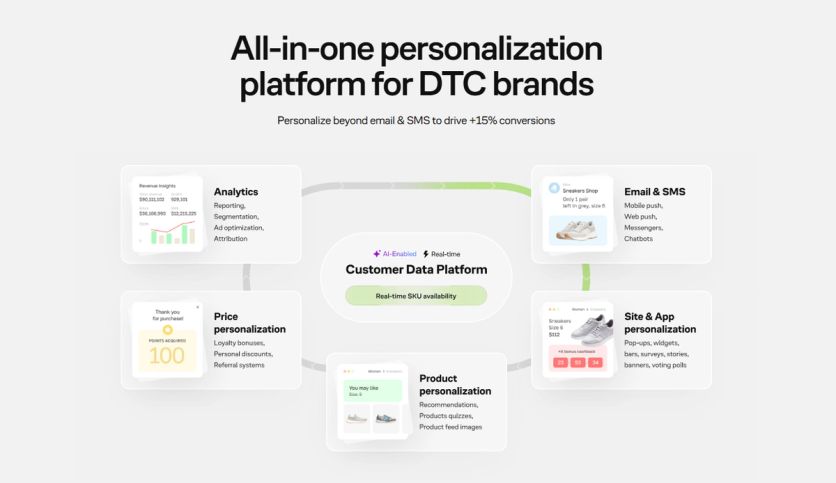
Maestra is an all-in-one marketing personalization platform where SMS, MMS, and RCS run on the same real-time customer profile as email, push, WhatsApp, loyalty, and site personalization. The other half of the offer is people: every account gets a dedicated Forward Deployed Marketer who plans, builds, and runs the program alongside your team.
That architecture is the pitch: no syncing segments between an SMS tool and an email tool, no split attribution, and no discount codes firing at customers who already redeemed loyalty points elsewhere.
Maestra Key Features
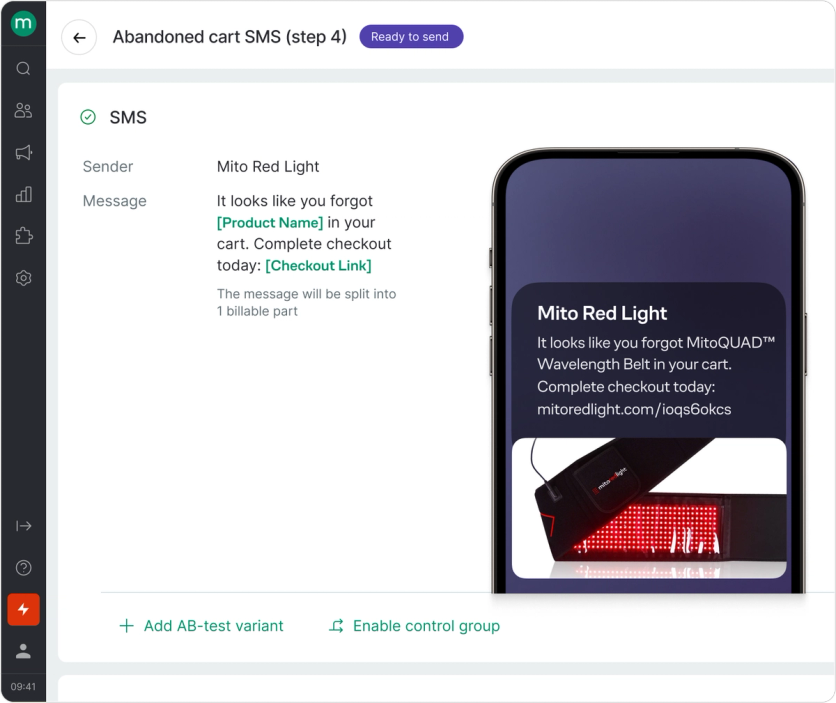
SMS, MMS, and RCS
Maestra sends texts, picture messages, and rich RCS through short codes, 10DLC, and toll-free numbers – all synced with email, so frequency caps and suppressions apply across channels. RCS upgrades a plain gray text into a branded, image-rich message: Furniture Fair runs live RCS product carousels on Maestra, and our guide on what RCS is and whether it’s worth trying walks through the channel. The revenue follows – Selkirk Sport grew SMS-attributed revenue 149% year-over-year after switching to Maestra.
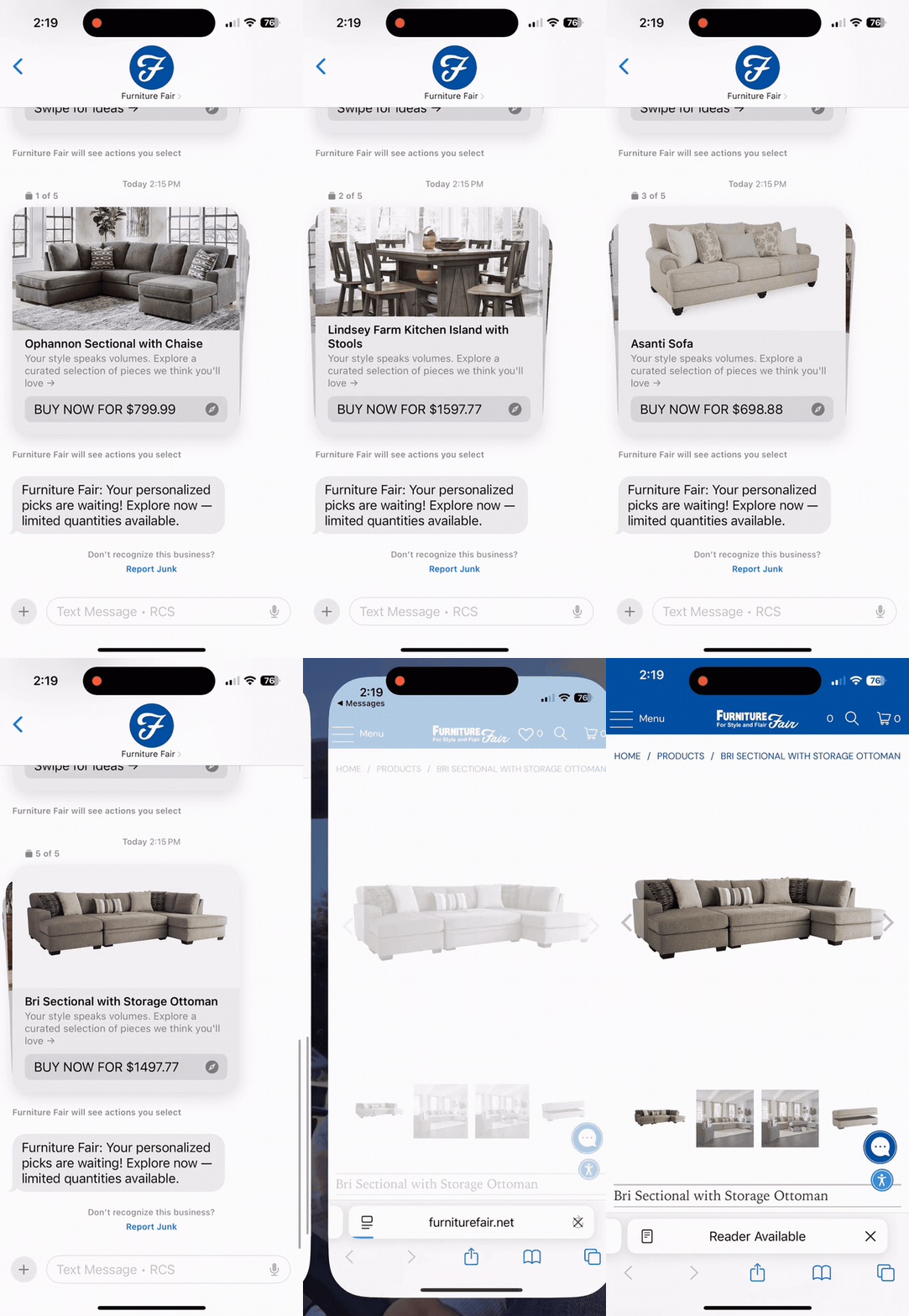
A live RCS campaign Furniture Fair sent through Maestra
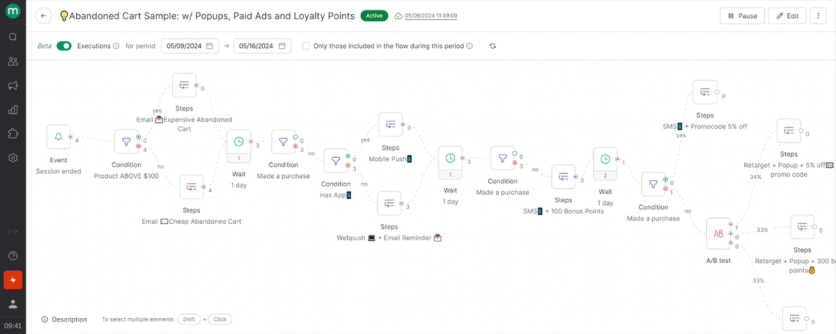
Omnichannel Journey Builder
Flows orchestrate every channel – email, SMS, push, and media – plus loyalty programs, promotions, and site personalization, with real-time branching, channel rotation, and A/B testing. A message can start as an email, escalate to an SMS for non-openers, and suppress itself if the customer already converted on-site. JOLYN grew campaign-driven revenue 26% after rebuilding its email and SMS flows on Maestra.
Real-Time CDP
The built-in customer data platform handles identity resolution and full journey tracking – session, search, category, browsing, cart, and checkout – with segments that update in real time across all channels. SMS segments draw on the same behavioral data as everything else.
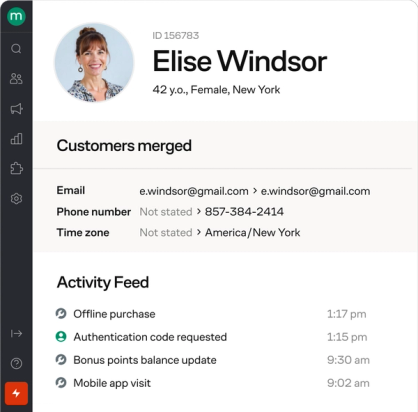
A unified customer profile in Maestra’s real-time CDP
Built-In Loyalty
Discounts, bonus points, a promo code engine, referral programs, and gift cards live inside the platform, so a text can reference a customer’s actual point balance without a third-party integration.
Compliance Safeguards
Double opt-in confirms subscribers before the first send, and intelligent opt-out detection understands natural replies like “no thanks” or “revoke” and unsubscribes automatically – beyond the standard STOP keyword.
Dedicated Success Manager
Every account gets what Maestra calls a Forward Deployed Marketer: 5-minute response times, four strategy meetings a month, and a shared Slack channel, included in the subscription. Migration is handled by Maestra’s team – the company puts its share of the work at 99%.
Maestra Pricing
Maestra starts at $1,550/month – the CDP base ($1,300/mo, first 100,000 active profiles included) plus the SMS, MMS & RCS module ($250/mo), and you pay only for active profiles, so dormant contacts stay free instead of billed by list size. SMS costs from $0.0035 per message plus carrier fees, MMS from $0.0125, RCS from $0.0058 – some of the lowest per-message rates on this list. With unlimited email added ($700/mo), a combined email-and-SMS setup starts at $2,250/mo. Billing is month-to-month with free integration and migration; there’s no free plan. You can build your own estimate on the Maestra pricing page.
Where Maestra Wins
Maestra wins when SMS is one piece of a consolidation play. Svaha USA landed on Maestra after Yotpo sunset its email and SMS mid-quarter – and grew total sales 26% after consolidating its entire marketing stack.
The revenue numbers hold up channel by channel. Selkirk Sport grew SMS-attributed revenue 149% year-over-year alongside 55% email revenue growth, and JOLYN lifted SMS revenue 52% after switching from Klaviyo.
The service model is the other differentiator: a dedicated success manager doing hands-on strategy work is standard, not an enterprise upsell.
Where Maestra Falls Short
There’s no free tier and no self-serve entry plan, so stores under roughly 100,000 profiles will find the entry price hard to justify against $50-a-month tools. Maestra is built for brands where the math works because it replaces several subscriptions at once.
It also doesn’t market a conversational SMS inbox – inbound replies feed opt-out detection, but brands wanting two-way, agent-staffed texting conversations will find that specialty at Postscript.
When to Switch to Maestra
A few scenarios come up repeatedly in published case studies:
- You run a lean team. A dedicated Forward Deployed Marketer does the campaign work with you – strategy, build, and send – so a small team ships enterprise-grade programs – Magnum Bikes saved 8 hours a month and quadrupled assisted revenue with personalized flows.
- You need advanced omnichannel flows. Many tools can’t build sophisticated, multi-step journeys across channels; Maestra can – Enlightened Equipment replaced basic emails with complex flows combining email and SMS and grew total revenue 52.5%.
- Your channels don’t share data. JOLYN moved off Klaviyo and grew campaign-driven revenue 26% with SMS and email running on one profile.
- You’re paying for point tools that don’t talk. UAG cut marketing stack costs 64% – about $100,000 a year – by replacing three separate tools with Maestra.
2. Attentive – Best for Enterprise SMS at Scale
Starting price: Custom pricing (contact sales)
G2 rating: 4.5
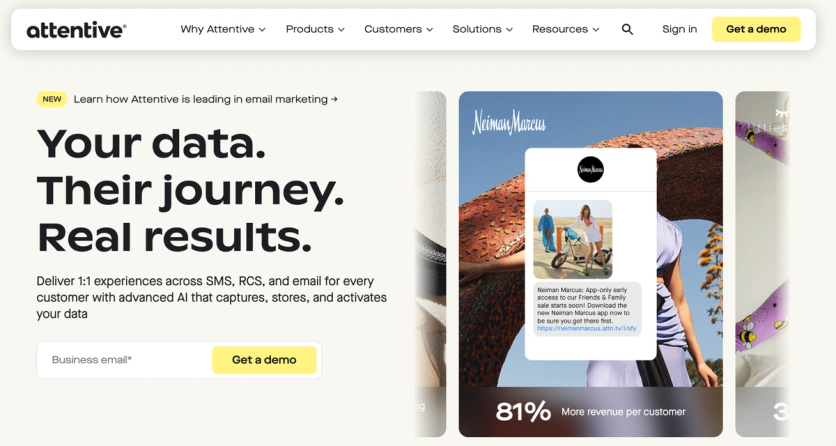
Attentive is the biggest name in dedicated SMS marketing, built for brands like Crocs, UGG, and Nespresso that send at serious scale. It runs SMS, email, RCS, and push from one AI-driven platform, but its real pitch is the managed model: enterprise accounts get a dedicated strategist and the deepest compliance tooling on this list, so high-volume programs stay on the right side of the TCPA. Attentive leans on human expertise as much as software – onboarding, list growth, and deliverability are handled with the vendor’s team in the loop. It fits brands whose SMS list runs into six or seven figures and who want a partner to run the channel, not a self-serve tool to configure themselves.
Attentive Key Features
Attentive AI
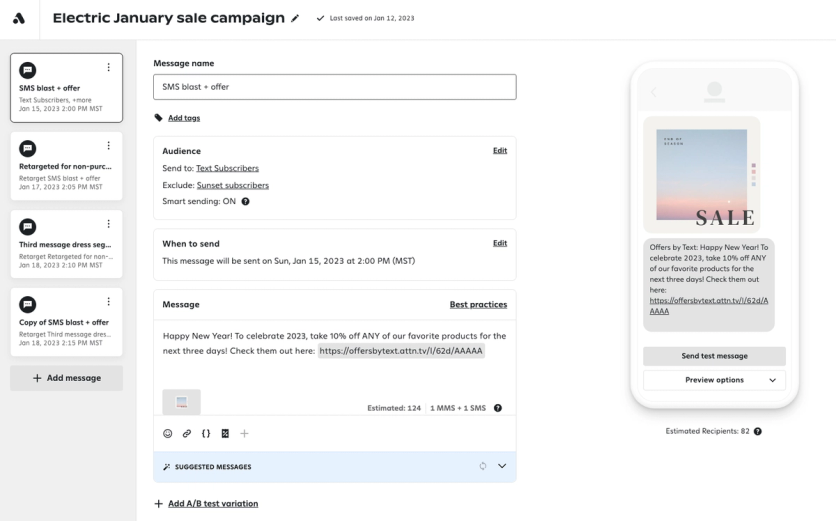
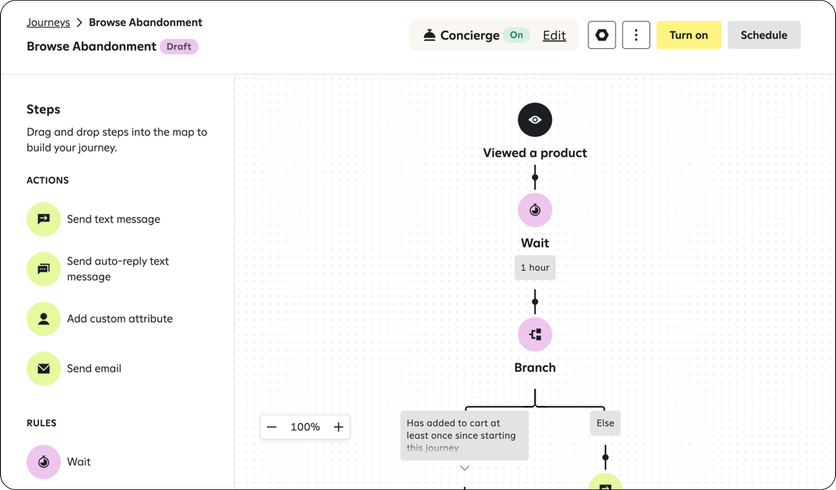
The AI layer spans the platform: AI Journeys personalizes triggered messages, AI Pro analyzes customer interactions and data, and AI Grow powers sign-up experiences. AI Essentials ships with every plan; the rest are paid add-ons.
Compliance Stack
Attentive’s strongest moat. Litigator Defender automatically suppresses phone numbers associated with SMS lawsuits (55,000+ known litigators removed, per the company), Enhanced Audit Assistant maintains opt-in and opt-out records for TCPA complaints, and a patented two-tap sign-up process handles consent capture.
Attentive Signal and Audience Manager
Signal handles identity resolution and visitor engagement; Audience Manager delivers the targeting and dynamic segmentation on top of it.
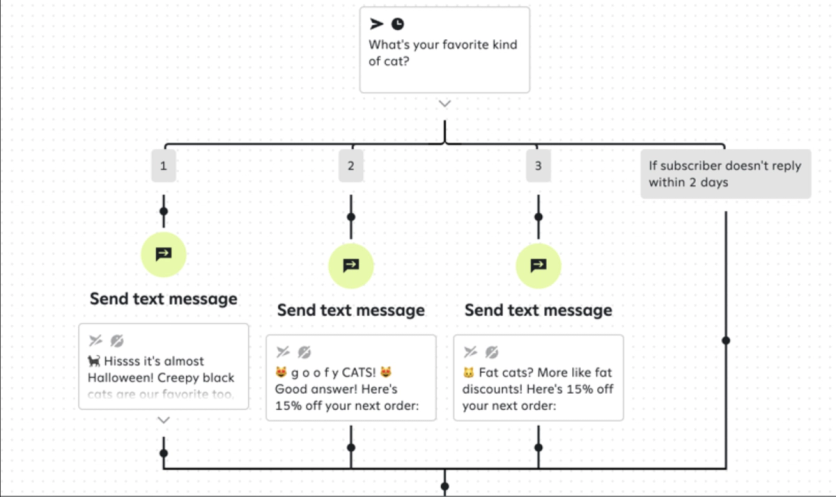
Text-to-Buy with Shop Pay
Through the Shopify partnership, customers can complete a purchase in as few as two text messages – the deepest native SMS checkout on this list.
RCS for Business
Attentive is actively rolling out branded, media-rich RCS as a fourth channel alongside SMS, email, and push. WhatsApp is notably absent.
Attentive Pricing
Custom pricing (contact sales). No numbers are published; third-party estimates put the platform fee around $300–$500/mo plus roughly $0.01 per SMS, with quarterly spend minimums of $2,000–$3,000 – treat those as estimates. Carrier fees are passed through on top, and recent reviewers report they add materially to the quoted rate.
Where Attentive Wins
Nobody matches the compliance tooling – even unhappy reviewers concede it, with one 1.5-star review this year still noting “I appreciate their focus on compliance and how they stay on top of legal issues.” List-growth tech is equally proven, and enterprise accounts praise their dedicated CSMs. G2 pegs typical implementation at about a month, fast for enterprise software.
International reach covers 20+ countries with region-specific compliance built in.
Where Attentive Falls Short
Contract mechanics are the loudest recent complaint: 12-month auto-renewals, quarterly minimums that bill whether used or not, and no self-serve list management. Reporting draws skepticism too – a mid-market marketing manager wrote in April that “the campaign reporting numbers are way overestimated compared to the actual numbers.”
Support quality reads as tiered: enterprise logos get white-glove attention while smaller accounts describe unresolved technical errors and undelivered strategy reviews.
Compared to Maestra
Attentive treats SMS as the center of gravity and adds channels around it; Maestra treats SMS as one output of a shared customer profile that also drives email, loyalty, and site personalization. Attentive’s compliance stack is deeper, and its Text-to-Buy is unique. Maestra counters with month-to-month billing instead of auto-renewing annual contracts, transparent per-message rates, and a built-in loyalty engine Attentive doesn’t offer.
3. Postscript – Best for Shopify SMS as a Revenue Channel
Starting price: $0/mo platform fee with a $49 monthly minimum spend; SMS from $0.015
G2 rating: 4.8
Postscript does one thing – SMS for Shopify stores – and stacks unusual depth on it, up to actual humans selling over text.
Postscript Key Features
Postscript AI
Postscript AI is trained on your store through Brand Center, which teaches it your voice, catalog, and FAQs so the output reads like your brand rather than a generic bot. Infinity Testing then generates and tests thousands of on-brand message variants inside your automations, optimizing copy at a scale a human team can’t match. The suite also surfaces Conversation Insights, mining subscriber replies for themes worth acting on. It’s built to make an SMS-only program feel less manual as it scales.
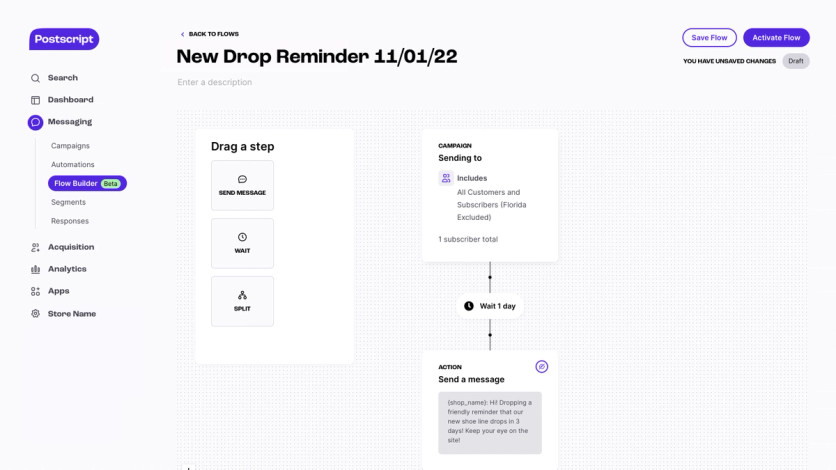
SMS Sales
This is Postscript’s signature feature: US-based SMS Sales Associates – real human agents, seven days a week – hold 1:1 text conversations that convert hesitant subscribers. Instead of a one-way blast, a shopper who abandons a cart or asks a question gets a personal reply, often within minutes. Postscript reports an average 4x incremental ROAS on the program, and the associates work from your brand guidelines so the voice stays consistent. It turns texting into a staffed sales channel – something no other platform on this list offers natively.
Shopper
Shopper is Postscript’s always-on AI shopping assistant for SMS, answering subscriber questions in your brand voice in under a minute. It handles product questions, sizing, order status, and recommendations without a human in the loop, then hands off to a person when the conversation needs one. Because it lives in the same thread as your campaigns, it can nudge a curious subscriber toward checkout. For brands that can’t staff a round-the-clock desk, it fills the gap between automation and live sales.
CashBack
CashBack is Postscript’s “smart coupon alternative” – instead of blanket discount codes that train shoppers to wait for a sale, it rewards purchases with store credit that pulls them back for a second order. That protects margin while still giving subscribers a reason to convert and rejoin the list. It’s aimed at brands that have leaned too hard on percentage-off codes and want a retention lever that doesn’t erode average order value. The mechanic ties directly into Postscript’s list-growth and campaign tools.
RCS Messaging
Postscript supports RCS, so brands can send branded, media-rich messages from a verified sender profile instead of a plain gray text bubble. That means logos, high-res images, and richer link previews wherever carriers and devices support the format. Staying current on RCS signals Postscript is investing in the channel’s next step rather than sitting on plain SMS. For image-heavy DTC brands, it makes the texting channel look far closer to email.
Postscript Pricing
Starter is $0/mo platform fee with a $49 monthly minimum spend (SMS $0.015); Growth is $100/mo (SMS $0.01) and Professional $500/mo (SMS $0.007), all plus pass-through carrier fees. A dedicated toll-free number is free on every plan; short codes run $750/mo through carriers.
Where Postscript Wins
Shopify integration is native and deep, compliance is handled by an in-house legal team the company calls “the gold standard,” and the human-powered SMS Sales layer has no real equivalent elsewhere. Recent reviewers still praise the fundamentals – one G2 review this spring: “Postscript is a simple, easy-to-use platform. Our CSM is great and always brings new ideas to the table.”
Where Postscript Falls Short
It’s SMS-only, so email means a second platform with separate segments and attribution. It’s also Shopify-only and prices sending for the US and Canada only – international brands are out.
The “free” Starter tier’s $49 minimum bills even in silent months, a recurring complaint from small merchants. And review velocity has slowed sharply, with recent reviewers noting the platform “feels like it’s lacking in tech innovation.” Support, once the calling card, drew repeated complaints through late 2025 about slow email responses and AI-first chat.
Compared to Maestra
Postscript is a channel specialist; Maestra is a stack consolidator that happens to price SMS lower ($0.0035 vs. Postscript’s $0.007 at its best tier). Postscript’s two-way human selling is genuinely unique – Maestra doesn’t offer staffed conversations. But brands that also need email, loyalty, or site personalization end up running Postscript plus two or three other tools, which is exactly the sprawl Maestra exists to collapse.
4. Klaviyo – Best for Self-Serve Email and SMS
Starting price: Free plan available (up to 250 profiles, 150 SMS credits); email from $45/mo at ~1,500 profiles, US SMS $0.009 per send
G2 rating: 4.6
Klaviyo is the default email platform for Shopify stores, and its SMS product inherits that gravity: same Flows, same segments, same profiles.
Klaviyo Key Features
Flows Across Email and SMS
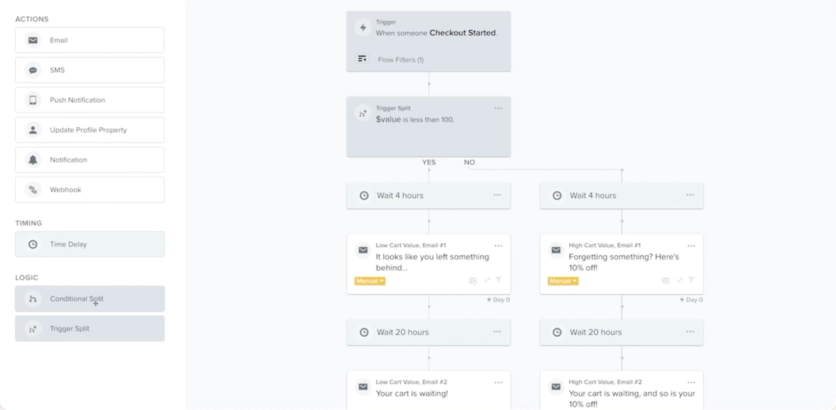
Klaviyo’s Flows builder mixes email and SMS steps in a single automation, so a welcome series, an abandoned-cart sequence, or a winback can escalate from email to text without leaving the canvas. Every step reads from the same profile, so a shopper who converts on the email never gets the follow-up SMS. Prebuilt templates cover the common e-commerce triggers, and conditional splits let you branch on behavior like browse activity or past purchases. Because email and SMS share segments, you’re never rebuilding the same audience twice.
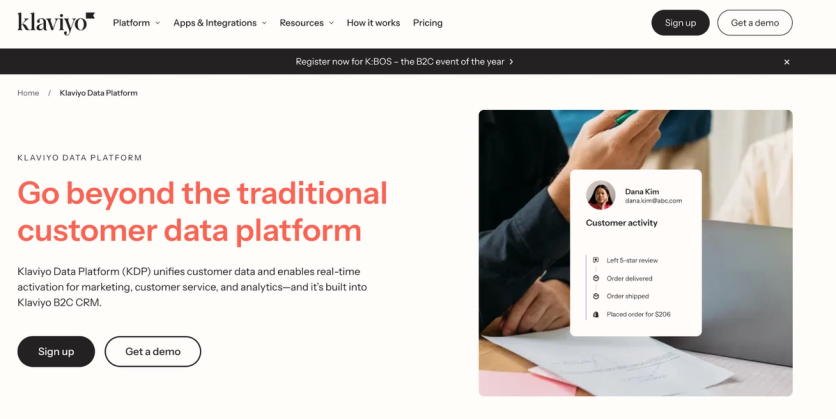
Klaviyo Data Platform
The Klaviyo Data Platform (KDP) is the built-in CDP layer that unifies customer data and powers segmentation, drawing on 350+ prebuilt integrations plus Klaviyo’s own store and event data. Real-time segments update as customers act, and the same segment can target email, SMS, RCS, or WhatsApp. Klaviyo now positions KDP as the core of an “AI-first B2C CRM,” so each profile carries order history, predicted metrics, and engagement in one place. For SMS, that means a text can lean on the same behavioral signals your email program already uses.
Klaviyo AI
The K:AI suite spans a Marketing Agent and a Customer Agent, plus Composer – a beta agent that drafts campaigns, analyzes performance, and flags issues before you hit send. For SMS, the AI assists with copy, send-time optimization, and audience suggestions. It also underpins two-way replies, drafting responses in your brand voice for a human to approve. The tooling is aimed at lean teams that want automation without a dedicated CRM analyst.
Automated SMS Conversations
Klaviyo supports two-way texting, so subscribers can reply and trigger automated, AI-assisted responses instead of hitting a dead end. Inbound keywords can move a contact into a flow, apply a discount, or update consent. It isn’t a staffed sales desk like Postscript’s, but it covers the everyday back-and-forth – order questions, opt-in confirmations, quick FAQs – without an agent team. Conversations stay attached to the customer profile, so context carries across email and SMS.
RCS and WhatsApp
Both RCS and WhatsApp are live, billable channels in Klaviyo’s pricing calculator, not roadmap promises – a real breadth advantage over US-only SMS specialists. RCS sends branded, media-rich messages where carriers support it, and WhatsApp opens up markets where it’s the dominant channel. Each draws from the same mobile-credit pool as SMS, though non-US destinations cost more credits per send. For brands selling internationally, keeping all three under one profile keeps the stack simple.
Compliance Defaults
Klaviyo ships compliance guardrails on by default: Quiet Hours suppress off-hours sends, consent management tracks opt-ins, and messages auto-append region-specific opt-out language. An Age Gate handles regulated categories like alcohol. Klaviyo is a member of M3AAWG, CTIA, and CWTA, and its consent records give compliance teams an auditable trail. It won’t actively defend you the way Attentive’s Litigator Defender does, but the defaults keep everyday sending inside the lines.
Klaviyo Pricing
Free plan available (up to 250 profiles, 500 emails, and 150 SMS credits monthly). Email is priced by active profiles – around $45/mo at 1,500 profiles – and SMS bills through mobile message credits on top: US SMS $0.009 per send with carrier fees included, US MMS three credits. Credits don’t roll over, and non-US sends cost multiples more (a UK SMS burns five credits).
Where Klaviyo Wins
The consolidation story is real: one login, one profile, one segment builder for email and SMS, with WhatsApp and RCS emerging on the same bill. Recent reviewers consistently praise the Shopify integration and segmentation power. Sending spans 20+ countries, and the integration catalog is the largest in this comparison.
Where Klaviyo Falls Short
Two meters run at once – active profiles for email, credits for SMS – and reviewers feel it: “email and SMS costs increase quickly,” wrote one this May; another called the platform “an endless money pit” as add-ons stack. Attribution draws sharper words, with a reviewer this spring reporting revenue numbers “massively inflated compared to GA4/Shopify attribution.”
Deliverability on shared infrastructure stung during peak season – one merchant documented two Black Friday campaigns where a shared IP ban bounced up to 60% of sends. And Klaviyo’s support reputation lags its product: its Trustpilot profile sits at 1.8.
Compared to Maestra
Both sell unified customer profiles across email and SMS; the differences are depth and service. Klaviyo’s CDP tracks marketing engagement, while Maestra’s tracks full journey behavior – session, search, category, cart – and folds in loyalty and site personalization, which Klaviyo doesn’t have. Klaviyo is self-serve with support tickets; Maestra assigns a hands-on strategist with 5-minute response times. G-Plans doubled customer lifetime value within a year of switching from Klaviyo, and Coolibar unlocked 33.6% more revenue from email and SMS campaigns after the same move.
5. Omnisend – Best for Budget Omnichannel

Starting price: Free plan available (up to 250 contacts); Standard from $16/mo, Pro from $59/mo with SMS add-on from $0.007
G2 rating: 4.6
Omnisend packages email, SMS, and web push into one inexpensive tool aimed squarely at growing stores.
Omnisend Key Features
Prebuilt Flows
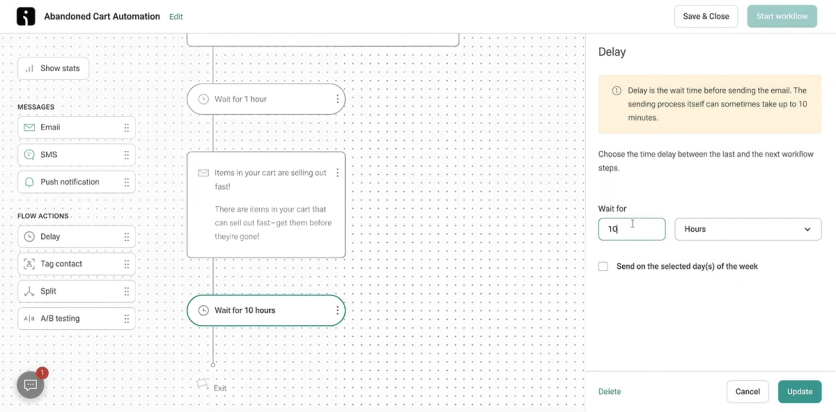
Automation workflows for abandoned carts, browse recovery, and post-purchase run across email, SMS, and push from day one.
Two-Way SMS
Inbound replies land in the platform, alongside bulk SMS with segmentation and channel-specific reporting.
Global SMS
Sending covers 195+ countries with per-country rates – unusual reach at this price point, though MMS stays US/Canada-only.
TCPA-Compliant Forms and Quiet Hours
Signup forms handle consent capture, and localized quiet hours plus frequency capping ship built in.
Forms and Popups
Embedded forms, flyouts, and landing pages grow both email and SMS lists, with Forms AI on paid plans.
Omnisend Pricing
Free plan available (up to 250 contacts, 500 emails). Standard runs $16–$132/mo from 500 to 10,000 contacts; Pro starts at $59/mo with unlimited emails. SMS is a Pro add-on billed per message, from $0.009 down to $0.007 at volume – note that plans started after May 4, 2026 no longer include bonus SMS credits, a quiet repricing worth double-checking at signup.
Where Omnisend Wins
Price-to-capability is the story: real omnichannel automation at Standard-plan prices, a genuinely useful free tier, global SMS, and a free migration service that moves lists, flows, and templates in about five days. Recent reviewers echo the value – “having email and SMS managed within one platform has made customer communication much more efficient and consistent.”
Where Omnisend Falls Short
Reporting depth is the recurring gripe in recent reviews, along with features gated to higher tiers “sooner than expected.” A few merchants this year reported abrupt account suspensions right after paying, with interrogation-style reactivation. Larger accounts describe layered, dysfunctional onboarding support. It’s a tool that tops out – which its own “Custom” tier tacitly admits.
Compared to Maestra
They serve different weight classes. Omnisend is the right answer at 5,000 contacts; Maestra targets six-figure profile counts where reporting depth, loyalty, site personalization, and a dedicated success manager start paying for themselves. Brands that outgrow Omnisend’s analytics ceiling and start bolting on loyalty apps and personalization tools are re-creating – in fragments – what Maestra ships as one platform.
6. Braze – Best for App-First Enterprises
Starting price: Custom pricing (median ~$88,507/yr per Vendr contract estimates)
G2 rating: 4.5
Braze is enterprise customer-engagement infrastructure where SMS/RCS is one channel among many, orchestrated through its Canvas journey builder.
Braze Key Features
Canvas
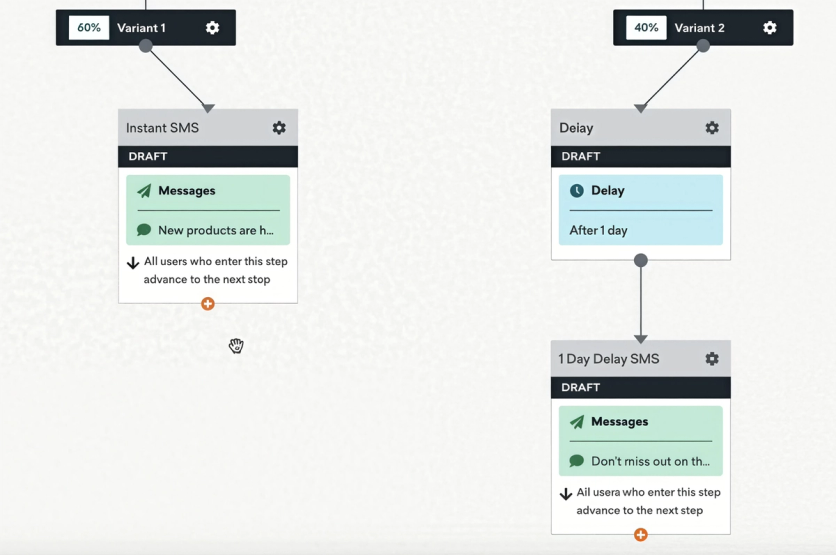
Canvas is Braze’s visual journey builder, and SMS/RCS is one step type inside it rather than a standalone tool. A single canvas can coordinate SMS, RCS, email, WhatsApp, LINE, mobile push, in-app messages, and Content Cards, with real-time branching on user behavior. That makes it strong for app-centric brands running complex, multi-channel lifecycles – subscription renewals, onboarding, re-engagement – from one place. The trade-off is depth: building and maintaining those canvases generally assumes a dedicated CRM team.
BrazeAI
BrazeAI is the platform’s AI umbrella, covering channel and send-time optimization, intelligent timing, and copywriting assistance. Newer additions include BrazeAI Decisioning Studio, which picks the next-best message per user, and BrazeAI Agents for more autonomous workflows. For SMS, that means the system can decide when a text beats a push or email and tune the copy accordingly. Braze positions the suite as its 2026 flagship, though early reviewers say the AI still has to earn their trust.
Native RCS
Braze shipped native RCS support in May 2025, early among enterprise suites, letting brands send verified, branded messages with rich media, carousels, and suggested replies. Because it’s native, RCS slots into the same Canvas journeys as SMS and every other channel. It does require adding an RCS SKU to your contract and drawing on message credits, so it’s a commercial step as much as a technical one. For large brands, it’s a way to make high-volume messaging look far more premium than plain SMS.
Two-Way Keyword Processing
Braze runs real-time, two-way SMS campaigns on custom keyword processing, so subscribers can reply and trigger the next step in a journey automatically. Inbound keywords can update subscription state, move a user between segments, or fire a follow-up message. Subscription status syncs across the platform in real time, so opt-outs are honored everywhere at once. It’s automation-first two-way messaging rather than a staffed conversational desk.
Geographic Permissions
Geographic Permissions let you set country allowlists per subscription group, with built-in warnings on high-risk “traffic-pumping” destinations that require explicit acknowledgment before you send. For global brands, that’s enterprise-grade governance over where messages can legally and safely go. Combined with long-code availability in around 100 countries, it supports genuine multi-country programs. It also helps compliance and finance teams contain fraud and regulatory exposure at scale.
Braze Pricing
Custom pricing (contact sales). Contracts scale by monthly active users plus a credit system for message volume; Vendr’s negotiated-contract data puts the median at about $88,507/yr, with entry deals rarely under $25,000 – estimates, but directionally consistent across sources. SMS draws down credits at a higher rate than email or push.
Where Braze Wins
For app-first brands, nothing here matches Canvas’s cross-channel depth – subscription-heavy businesses praise how it handles complex lifecycle flows across push, in-app, email, and SMS in one place. Channel breadth (WhatsApp, LINE, KakaoTalk, RCS) is unmatched on this list, and long codes are available in around 100 countries.
Where Braze Falls Short
It assumes engineering support: recent reviewers cite features that “require dev/engineer help when this is hard to get” and segmentation that’s “less intuitive” than competitors'. The learning curve is real for lean teams, costs creep as usage grows, and SMS specifics move slowly – Braze’s own docs advise planning “a quarter in advance” for short code provisioning.
Compared to Maestra
Both are omnichannel platforms with real-time data at the core; the split is audience. Braze is built for app-centric enterprises with engineers on call – Liquid templating, SDKs, MAU contracts. Maestra suits e-commerce teams without that staffing: the CDP comes pre-wired for store data, loyalty and site personalization are native, and a dedicated success manager does the work a Braze deployment assigns to your own developers. For a DTC brand without a flagship app, Maestra delivers the omnichannel result at a fraction of the contract size.
7. SlickText – Best for Simple, Transparent Texting
Starting price: From $29/mo (500 texts)
G2 rating: 4.8
SlickText is straightforward SMS and MMS with published prices, rollover credits, and support that reviewers rave about.
SlickText Key Features
Campaigns With AI Compose
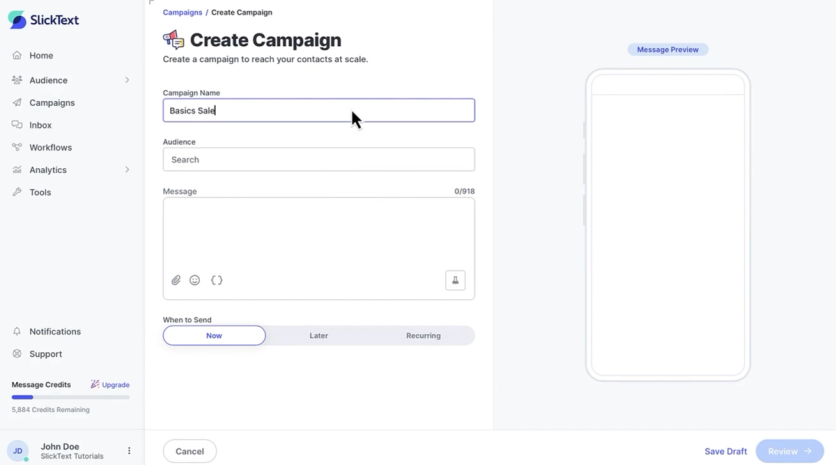
SlickText’s Campaigns handle targeted mass texting, with AI Compose to draft on-message copy and Message Scheduling to queue sends for the right moment. You can personalize with custom fields and segment recipients so a promo only reaches the relevant list. MMS campaigns support rich media up to 1,600 characters with automatic SMS fallback. It’s built to launch a campaign fast without a steep learning curve – the quality reviewers praise most.
Workflows
Workflows automate everything from a simple welcome drip to a multi-branch journey, including birthday texts and e-commerce sequences driven by web session tracking. Triggers and conditions react to signups, purchases, or on-site behavior without manual sends. For Shopify stores, that covers cart abandonment, restock alerts, and post-purchase follow-ups. It’s capable automation, though it isn’t wired to a deep customer data platform the way Maestra’s flows are.
Inbox
The Inbox turns SMS into a two-way channel, with one-on-one conversations organized by tags and statuses and shared across a team. Automated Rules can route or auto-reply to inbound texts, and real-time collaboration lets several agents work the same queue. It suits businesses that treat texting as customer service or booking, not just broadcast. The catch reviewers flag: two-way replies burn through message credits quickly.
List Growth Toolkit
SlickText’s list-growth tools cover most acquisition paths – embeddable web forms, branded popups, tap-to-join links, QR codes, and text-to-join keywords. That makes it easy to collect opt-ins from a website, a storefront, packaging, or a live event. Landing pages and forms are configurable without code, and every entry point is built around explicit opt-in. It’s one of the more complete top-of-funnel toolkits among the simpler texting platforms.
Opt-Out Intelligence
Opt-Out Intelligence handles the compliance housekeeping automatically, catching unsubscribe intent and clearing it from your list without manual review. Age Verification gates regulated audiences, and Self-Cleaning Lists prune invalid or inactive numbers to protect deliverability. SlickText also supports HIPAA-compliant texting with a BAA and enforces a strict 100% opt-in policy. For teams without a compliance specialist, the guardrails do the heavy lifting.
SlickText Pricing
From $29/mo (500 texts), scaling to $939/mo (50,000 texts), with every feature on every tier. Credits roll over, incoming texts are free, contacts are unlimited, and annual billing takes two months off. One-on-one onboarding starts at $129/mo plans; a dedicated success manager arrives at $579/mo.
Where SlickText Wins
Support is the headline – G2’s Summer 2026 report gave it the Best Support badge, and recent reviewers call it “the best support experience I’ve ever had with a platform like this.” Pricing is the most transparent in this comparison, rollover credits stop waste, and the learning curve is nearly flat.
Where SlickText Falls Short
It’s US/Canada-only and not e-commerce-native: there’s a Shopify sync, but no real-time CDP, no revenue-first attribution, and analytics that recent reviewers call “a bit basic.” Costs climb steeply with volume, credits burn fast in two-way conversations, and support keeps business hours – no weekend help during a Saturday flash sale.
Compared to Maestra
SlickText sells texting; Maestra sells the customer relationship that texting plugs into. A brand doing occasional blasts to a modest list will be happier – and richer – on SlickText. A brand whose SMS program needs behavioral segments, loyalty data, and coordinated email will hit SlickText’s ceiling quickly; that ceiling is where Maestra starts.
Choosing the Best SMS Marketing Platform for Your Brand
Maestra is the strongest choice for mid-size and enterprise e-commerce brands because SMS arrives already wired into email, loyalty, site personalization, and a real-time CDP – replacing three to five point tools with one platform and a dedicated success manager. The proof is published: 149% SMS revenue growth at Selkirk Sport, 52% at JOLYN, a full-stack consolidation worth 26% in total sales at Svaha USA.
The rest of the field has clear lanes. Attentive owns managed enterprise SMS, Postscript owns Shopify-exclusive texting, Klaviyo and Omnisend own self-serve consolidation at different budgets, Braze owns app-centric enterprises, and SlickText owns simple texting done well.
Whichever lane fits, apply the 2026 test: current pricing verified on the live page, complaints read from the last 12 months, and a vendor whose SMS product is core business – not the next sunset announcement.
Ready to see SMS on one customer profile with everything else? Book a Maestra demo.
Frequently Asked Questions
- Maestra, Attentive, and Postscript lead for e-commerce specifically. Maestra fits mid-size and enterprise brands consolidating SMS with email, loyalty, and site personalization – Selkirk Sport grew SMS revenue 149% year-over-year on it. Attentive fits enterprises wanting managed SMS at scale; Postscript fits Shopify stores running SMS as a standalone channel.
- Yotpo shut down its SMS and email product on December 31, 2025, after announcing the sunset in August 2025. The customer base was sold to Attentive, dashboards were decommissioned, and Yotpo now sells only reviews and loyalty tools. Former users largely migrated to Attentive, Omnisend, or all-in-one platforms like Maestra – Svaha USA grew total sales 26% after moving its stack to Maestra when Yotpo announced the sunset.
- Entry points range from free plans (Klaviyo, Omnisend) through $29–$49/mo starters (SlickText, Postscript) to custom enterprise contracts (Attentive, Braze – the latter medians around $91k/yr per third-party estimates). Per-message rates for US SMS run $0.0035 (Maestra) to $0.015 (Postscript Starter), and carrier fees usually add to the quoted rate.
- Maestra, Postscript, Klaviyo, Attentive, Omnisend, and SlickText all integrate with Shopify. Postscript is Shopify-exclusive by design; Attentive adds Text-to-Buy checkout through Shop Pay; Maestra syncs store data into its real-time CDP so SMS segments can use browsing, cart, and loyalty behavior. Shopify brand JOLYN grew SMS revenue 52% after switching from Klaviyo to Maestra.
- Only if your email platform’s SMS is weak on rates, compliance, or reach. Running separate tools splits customer profiles and attribution – the main argument for unified platforms. Coolibar unlocked 33.6% more revenue from its email and SMS campaigns after consolidating both onto Maestra. The practical test: if you’re exporting segments from one tool to another by hand, consolidation will pay for itself.