12 Proven Braze Alternatives for 2026 [Real Review Data]
Most users choose Braze because they need to orchestrate marketing campaigns across push, email, SMS, and in-app channels.
Often with real-time segmentation and often at enterprise-grade volume scale.
This is exactly what Braze users rave about and what the tool does best.
But if you’re here reading this article, you’ve already hit some limitations. In this guide, we’ll evaluate most known issues and suggest alternative solutions to resolve them.
Let’s dive in!
Here’s what Braze users usually complain about:
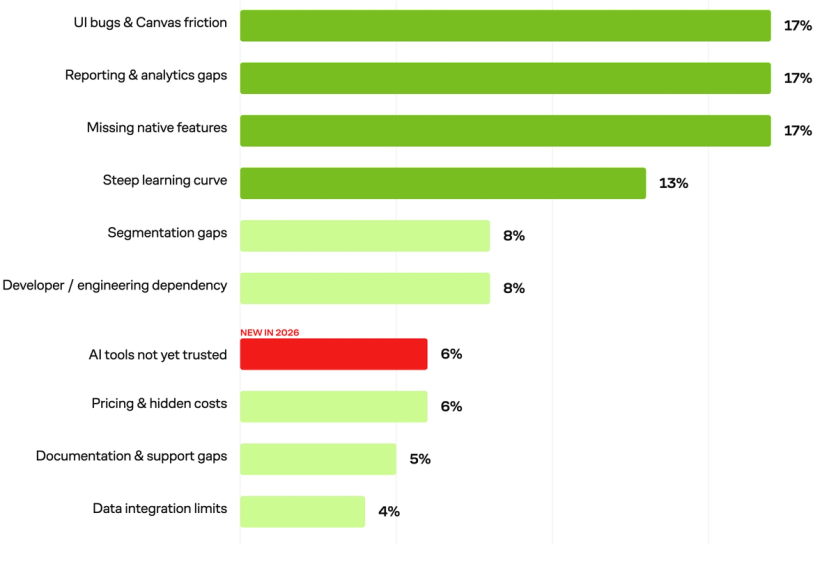
Braze offers powerful customer engagement capabilities, but it also presents some notable issues, such as:
- Canvas friction that consumes real time, like missing multi-select for filter groups and HTML editors with no live preview
- Reporting that feels basic for the price, pushing teams to rebuild their analytics in Tableau or Looker.
- “Obvious-but-missing” features (no native loyalty, no countdown timers in emails, no campaign calendar view) that keep most customers paying for 3–5 side tools
- A complexity ramp that never quite ends, with segments, add-ons, and Liquid templating keeping lean teams dependent on developers
You’re not the only one dealing with these problems. We categorized every verified Braze review posted on G2, TrustRadius, and Capterra between January 2025 and April 2026, and the complaints above sit at the very top of the frequency map, with the most common issue not being pricing but the Canvas UI itself.
Below, we break down the 12 best Braze alternatives, from full-stack platforms with built-in loyalty and CDP to lightweight tools that launch in weeks.
But first, let’s look at what Braze is and exactly what hundreds of reviewers had to say about Braze.
TL;DR: Best Braze Competitors and Alternatives at a Glance
The strongest Braze alternatives are Maestra for all-in-one omnichannel e-commerce, Iterable for custom workflow builders, CleverTap and MoEngage for mobile-first engagement, Klaviyo for budget-friendly e-commerce email and SMS, and Insider One for AI-powered personalization at enterprise scale. Here’s the quick rundown before the full breakdown.
Best for e-commerce marketing on one platform: Maestra – omnichannel, loyalty, CDP & real-time personalization in one platform
Best for custom workflow builders: Iterable – flexible API-first automation for marketing engineers
Best for mobile-first teams: CleverTap / OneSignal – deep push & in-app analytics
Best budget option: Customer.io – powerful messaging, lean pricing
Closest Braze parity at lower cost: MoEngage – insights-led engagement without enterprise overhead
Content:
What is Braze
Braze is an enterprise customer engagement platform. It lets marketing teams orchestrate campaigns across push, email, SMS, in-app messages, and web, using real-time behavioral data.
Its journey-building tool, Canvas, connects those channels into one automated flow. Braze is best known for serving large, mobile-first consumer brands that message millions of users at once.
The Biggest Braze Pain Points in 2026 (From 500+ Verified Reviews)
To build this list, we pulled every verified Braze review posted to G2, TrustRadius, and Capterra between January 2025 and April 2026, then categorized each complaint by theme. The result is a clear picture of what current customers push back on, with verbatim quotes and feedback from named reviewers, all from the past 16 months.
Most-mentioned Braze pain points
1. Canvas friction and UI bugs (17%)
The single most common complaint about Braze isn’t strategic, but rather the platform’s daily UX friction inside Canvas, its journey orchestration tool. Marketers cite missing multi-select, cleanup that scrambles the layout, and HTML editors without a live preview.
As a verified Retail user wrote on G2 in April 2026: “When selecting filter groups under target audience, I can only select one at a time and then need to repeat the process for every segment or custom event I want to select. This costs me a lot of time every day.”
Even fans of Braze can admit that some of the basics need work. “The Braze Canvas UI feels a bit old-school,” noted another G2 reviewer the same week.
The takeaway: small friction compounds. The #1 complaint about an enterprise platform is lost hours, one click at a time.
2. Reporting that feels basic for the price (17%)
The criticism here comes from people who otherwise love Braze. Dashboards feel rigid, exports are clunky, and custom reporting requires workarounds, so many teams end up piping data into Tableau or Looker.
Approaching reporting this way only adds cost and engineering overhead, which, in turn, defeats the all-in-one promise Braze tries to provide.
A verified Media Production user at the Enterprise tier summed it up on G2 in April 2026: “There really isn’t much to dislike about Braze. If I had to pick one thing, it would be the reporting. With all the data it collects, you’re better off doing your analytics outside of Braze.”
The bottom line is that even satisfied Braze customers have to budget for a second analytics tool because reporting just isn’t good enough.
3. Specific feature gaps that force workarounds (17%)
The third major complaint is harder to define because it covers many individual requests. Reviewers mention missing or limited features such as:
- Countdown timers in emails
- Movable email elements
- Campaign calendar views
- Better deliverability monitoring
- Native Salesforce integration
- Native loyalty functionality
- Better organization for tags and assets
One G2 reviewer specifically asked for countdowns and movable elements in emails. Each feature sounds small, but together they create a bigger issue.
Erin J., Sports CRM Manager, wrote on G2 in April 2026: “There needs to be countdowns and movable ink-like features available for us to use in emails.” Individually, each gap looks minor. Stacked together, they explain why so many Braze customers still pay for three to five adjacent tools to fill the holes.
That’s a recurring theme throughout this list: teams don’t leave Braze because a single feature is missing. They leave because the cumulative cost of patching five small gaps, each with its own vendor, its own contract, and its own login, eventually exceeds the cost of switching to a platform where those features already exist.
The takeaway: Look beyond the feature checklist. Count the tools you’ll need around the platform to complete your actual marketing stack.
4. A steep learning curve and ongoing complexity for lean teams (13%)
Braze gives you a lot of control, but you need the right people to use that control.
Recent reviewers describe a learning curve that can stretch from weeks into months, especially when teams start working with advanced segmentation, Liquid, integrations, and complex journeys.
Bethany M., a Customer Engagement Manager at a mid-market company, wrote on G2 in April 2026: “Because all the technical features are so upfront, it can be complex to understand segments and how to set up certain journeys. They also have loads of add-ons which can be hard to keep track of.”
That’s a useful distinction.
Braze’s complexity isn’t simply about the number of buttons in the interface. It comes from the number of concepts your team needs to understand before it can use the platform well. You may need to understand events, attributes, segments, connected data sources, Liquid, Canvas logic, message variants, testing, reporting, and integrations.
For a large lifecycle marketing organization, that can be a reasonable investment. For a small CRM team with two or three marketers, it can become a bottleneck.
The takeaway: The right Braze alternative isn’t necessarily the platform with fewer features. It’s the one that gives your team the features it needs without creating unnecessary operational work.
5. Segmentation gaps that force you to buy a CDP anyway (8%)
Braze segmentation can become harder to manage when your customer data lives across multiple systems.
A verified Financial Services reviewer at a mid-market company wrote on G2 in September 2025:
“Braze segmentation needs quite a bit of work. Using CDP tools like Segment or Hightouch is almost a necessity because some basic segmentation features that should exist in Braze simply do not.”
This is an important consideration if your marketing strategy depends on behavioral data.
Your customer profile may include purchases, product usage, website events, app activity, loyalty status, customer service interactions, and data from your warehouse.
The more fragmented that data becomes, the more important your customer data architecture becomes.
Some teams solve that problem by connecting Braze to a separate CDP or data infrastructure.
That can work.
But it also means paying for another platform and maintaining another integration layer.
The takeaway: If you want your customer data and campaign execution in one place, prioritize companies like Braze that offer a native CDP or a unified customer profile.
6. Developer dependency that never goes away (8%)
Braze can be marketer-friendly for basic campaigns, but advanced use cases often need engineering help.
That becomes important when your team starts building custom integrations, complex segmentation logic, personalized API-driven experiences, or advanced Liquid templates.
Albert H., an engineering manager at a mid-market company, wrote on G2 in April 2026: “Custom integrations – such as sending personalized content via their API – are expensive and don’t handle high volumes well when you need to operate at scale.”
This doesn’t mean Braze requires developers for every campaign.
It means your organization needs to plan for technical ownership if you want to get the most from the platform.
That can be fine for an enterprise with dedicated marketing engineers.
It’s less attractive when your CRM team shares one developer with five other departments.
The takeaway: When comparing Braze alternatives, ask a practical question: “Who will build and maintain our campaigns six months after implementation?”
7. BrazeAI tools are promising, but not yet trusted (6%)
AI is now part of the Braze story, but early user feedback shows that trust remains a concern. Braze launched its agentic AI suite, including BrazeAI Operator, Agent Console, and Decisioning Studio, in April 2026. Recent reviews included concerns about the accuracy and performance of some AI features.
Lauren C., an Enterprise reviewer on G2, wrote: “The AI tools are great, but it’s hard to ‘trust' they are accurate.”
A Financial Services user also commented: “The Liquid AI tool hasn’t worked too well for us yet.”
That doesn’t mean BrazeAI lacks value.
It means AI-driven marketing decisions need to be judged differently from ordinary productivity features.
If an AI assistant writes a subject line you don’t like, you can edit it. If an AI system makes the wrong audience or content decision, the impact can be much larger.
The takeaway: If AI is a major reason you’re considering Braze, evaluate the quality of the AI output in your own campaigns instead of relying on feature lists.
8. High pricing and hidden costs (6%)
Braze is an enterprise platform, and the total cost can extend well beyond the base contract.
Pricing complaints appear less often than usability complaints because many current Braze customers already accepted the enterprise price before signing.
But when reviewers discuss cost, the same themes appear: data consumption, expensive plans, limited flexibility, and additional costs around the broader stack.
A Director of Marketing at a small company wrote on TrustRadius in March 2026:
“Cost models based on data consumption disincentivized their core use cases, which rely heavily on data, high cost, and payment flexibility.”
Estimated Braze pricing by tier
| Tier | Estimated annual cost | Typical buyer | What’s included |
|---|---|---|---|
| Entry | $30,000 – $60,000 | Mid-market with a single primary channel | Email or push, basic MAU bucket, standard support |
| Mid-tier | $60,000 – $100,000 | Established mid-market brands | Multi-channel messaging, expanded MAU, journey orchestration |
| Enterprise | $150,000+ | Large consumer brands and global retailers | Full suite, premium add-ons, dedicated CSM, custom contract terms |
There’s no published Braze price list and no free plan. TrustRadius and encharge.io put typical contracts at $60,000–$100,000 per year, and procurement platform Vendr reports a median Braze contract value of $88,507 across its own client deals. Those are benchmarks rather than quotes: the number you get depends on usage, channels, contract structure, and how hard you negotiate.
Here’s the practical issue.
You shouldn’t compare the Braze subscription to the price of an alternative subscription. You should compare the total cost of your marketing stack.
That includes:
- Platform fees
- Additional channels
- CDP or data infrastructure
- Loyalty software
- Personalization software
- Analytics tools
- Implementation
- Developer time
- Agency or consultant support
- Ongoing maintenance
A cheaper platform can become expensive if you need five additional tools. A more expensive platform can be cheaper overall if it replaces several point solutions.
The takeaway: Calculate total stack cost, not just software license cost.
9. Documentation that’s deep but hard to search when it counts (5%)
Braze has extensive documentation, but some reviewers say finding the right answer can still take time when something goes wrong.
A verified Luxury Goods user wrote on G2 in April 2026: “Any issues sometimes take longer to get resolved or have to do our own research as to what was causing the problem rather than Braze being forthcoming.”
For a platform that plays a central role in your customer engagement stack, slow troubleshooting can become a real problem. Teams need to know not only whether documentation exists, but also how quickly they can get help when a campaign or integration breaks.
The takeaway: When comparing Braze alternatives, look at both the documentation and the support experience. A platform is easier to manage when your team can get a clear answer without spending hours searching for it.
10. Data integration limits that hold some teams back (4%)
Non-standard data requirements can make implementation harder than expected.
Braze works with event-based customer data, but companies with proprietary identifiers, complex data warehouses, real-time streams, or custom data science models may need additional architecture to make everything work smoothly.
Jonathan B., Head of CRM Solutions at an Enterprise company, wrote on G2 in April 2026: “I think maybe a better integration with external data would help. The cloud data ingestion is good, but if it could be extended to allow selections to be made within Canvas.”
This is where your data architecture matters.
A platform can have strong native integrations and still require engineering work if your business data doesn’t fit the standard path.
Before switching platforms, map the events and attributes you actually use.
Then ask each vendor how those data points are ingested into the platform, how quickly they become available, and how marketers can use them in campaigns.
The takeaway: Test your real data model during evaluation rather than relying on a generic integration checklist.
11. Performance that lags at very large volumes (2%)
Performance complaints are less common, but they still appear in high-volume environments.
The recent review analysis found a small but persistent group of complaints around large data sets and complex Canvas configurations. These comments primarily come from enterprise users operating at high volumes.
This is one area where your own workload matters more than a generic benchmark.
A company sending a few hundred thousand messages a month has different requirements from a global consumer brand handling millions of profiles and events.
Test the workflows you expect to run. Build complex journeys, load large audiences, run segmentation, check reporting, and then see how the platform works.
The takeaway: Don’t evaluate scale based solely on a vendor’s maximum capacity. Evaluate how your real workflows perform.
The 12 Best Braze Alternatives Compared (Pricing, Ease of Use, Support, and More)
Here’s a quick side-by-side of Braze and the 12 platforms we cover below, so you can shortlist before reading the full breakdowns.
| Platform | Notable strengths | Pricing | Ease of use | Support |
|---|---|---|---|---|
| Braze | Multi-channel messaging, real-time segmentation, journey orchestration | Custom, typically $60K+/year | Steep learning curve | Standard; dedicated CSM for largest clients only |
| Maestra | Omnichannel automation, native loyalty, real-time CDP, on-site personalization | From $2,000/month | Built for marketers, minimal coding | Dedicated Forward Deployed Marketer on every plan |
| Iterable | Flexible APIs, strong personalization, collaborative workflow builder | Custom, enterprise-level | Moderate; still requires ramp time | Dedicated enterprise support, well-regarded |
| CleverTap | Mobile-first engagement, AI segmentation, TesseractDB behavioral store | From $85/month | Moderate; no-code tools plus a learning curve for full depth | Account manager on higher tiers |
| Netcore | Insights-led omnichannel retention, interactive AMP email, predictive AI | Custom enterprise pricing | Intermediate; advanced multi-channel setups need developer support | Chat support on all plans; dedicated growth engineer, onboarding and QBRs on Enterprise |
| MoEngage | Insights-led engagement, 360° analytics, App Marketplace integrations | Custom (contact sales) | Friendlier than Braze for lean teams | Responsive onboarding, cited often in reviews |
| Insider One | AI-native CDP, individualized cross-channel experiences | Custom, enterprise premium | Modern UI, geared to enterprise complexity | High-touch, consulting-led |
| Klaviyo | E-commerce email/SMS automation, deep Shopify integration | Free up to 250 profiles; from $20/month | Very easy, built for non-technical marketers | Email and chat on paid tiers |
| Agentforce Marketing | Deep Salesforce CRM integration, full marketing suite | ~$1,500–$3,250/month for mid-tier | Difficult; often needs certified specialists | 24/7 on enterprise plans, large partner network |
| Customer.io | Event-driven messaging, flexible workflow builder, fast time-to-value | From $100/month | Marketer-friendly UI, dev support helps at scale | Email/chat, dedicated CSM on Premium |
| Bloomreach Engagement | Native CDP, Loomi AI, deep e-commerce analytics | Custom, mid-five to six figures/year | Powerful but complex, comparable to Braze | Dedicated CSM, structured onboarding |
| OneSignal | Strongest push delivery, generous free tier, developer-first APIs | Free tier; from $19/month | Easy for push, less full-funnel overall | Self-service on free plans, paid support above |
| WebEngage | Built-in CDP, retention playbooks, strong APAC presence | Custom pricing | Marketer-friendly, some setup support helps | 24/7, dedicated CSM at higher tiers |
Braze is not the only option here, and depending on your team size, budget, and channel mix, another platform on this list might be a better fit.
A few patterns stand out from the table above worth calling out before we go deeper: the platforms that beat Braze on ease of use, Klaviyo, OneSignal, and WebEngage, tend to trade away some channel breadth or orchestration depth to get there.
The platforms that match or exceed Braze’s depth, Iterable, Insider One, Bloomreach, Netcore, and Agentforce Marketing, carry enterprise pricing and a comparable learning curve.
Maestra is the one platform on this list that adds functionality Braze doesn’t have – native loyalty and on-site personalization – while still pricing and onboarding closer to the mid-market end of the spectrum.
Below, we break down each alternative in detail, starting with why Maestra tops this list for e-commerce teams. If you are also comparing the broader market, you can read Best Customer Engagement Platforms for 2026 for a closer look at how these tools differ.
1. Maestra: Best Braze Alternative for E-commerce Brands
Best for: All ecommerce marketing on one platform
Starting price: From $2,000/month
G2 rating: 4.8/5
If you want one platform to handle customer data, messaging, loyalty, promotions, and personalization, Maestra is the strongest Braze alternative for e-commerce brands. Braze is good at orchestrating customer communications across channels.
The problem starts when your marketing strategy extends beyond messaging. Teams often need additional tools for loyalty, referrals, promotions, and on-site personalization, which means more vendors, integrations, data synchronization, and operational overhead.
Maestra takes a different approach.
Maestra combines those capabilities in a single platform, including a real-time CDP, omnichannel messaging, native loyalty and referral programs, a promotions engine, and on-site personalization.
That unified data layer is important. When a customer qualifies for a new segment, the same profile can immediately drive an email, SMS message, push notification, or personalized website experience. Your marketing team doesn’t have to wait for separate systems to synchronize customer data.
What makes Maestra different from Braze
Braze focuses primarily on customer engagement, while Maestra combines it with built-in e-commerce tools. Along with email, SMS, push, and in-app messaging, Maestra includes loyalty, product recommendations, and website personalization, which many e-commerce brands would otherwise need to manage through separate platforms.
With Maestra, you can:
- Build omnichannel journeys that combine email, SMS, push, and personalized website experiences around real-time customer behavior.
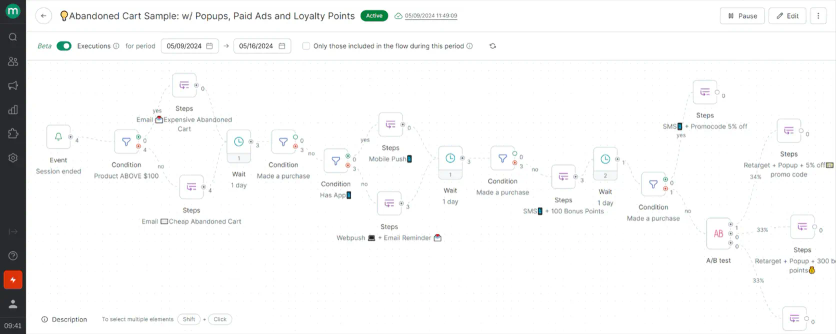
Maestra’s flow example includes emails, mobile and web pushes, pop-ups, paid ads and loyalty points
- Create real-time customer segments using online and offline behavioral data, including pageviews and purchase history.
- Run loyalty and referral programs with points, VIP tiers, and referral tracking inside the same platform.
- Personalize your storefront with recommendations, tailored content, and behavior-based experiences.
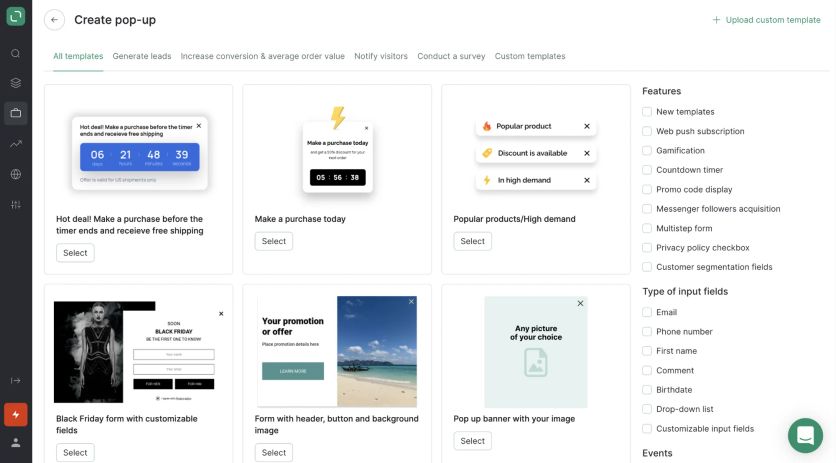
Maestra’s pop-up form templates
- Automate promotions by creating and distributing targeted promo codes without manually exporting customer lists.
- Work from an AI assistant through Maestra’s MCP server. Pull campaign, flow, and personalization reporting into Claude or ChatGPT, rewrite a campaign, define a segment, or have the assistant lay out an automation in the flow builder.
- Get dedicated implementation support through a Forward Deployed Marketer who works with your team on campaigns, strategy, and technical setup.
The result is a shorter path from customer data to customer action. You aren’t stitching together a CDP, engagement platform, loyalty solution, and personalization tool just to execute one retention strategy.
Maestra vs. Braze: Which is better
Maestra matches Braze on core cross-channel messaging and automation, but adds e-commerce features that Braze does not offer natively. That includes loyalty, promo management, and onsite personalization.
Here’s where it gets interesting.
If your current stack is Braze + a loyalty platform + a personalization tool, Maestra can consolidate those capabilities into one platform. That means fewer integrations to manage and less complexity for your marketing team.
Cost is another major difference.
Maestra starts at $2,000 per month for its CDP and unlimited email, or about $24,000 per year. You can then add channel modules as needed and pay based on active profiles.
But there’s another difference worth considering: support. Maestra assigns each client a Forward Deployed Marketer who manages around 15 accounts, compared with 60 or more at most vendors. For teams replacing a complex platform, that hands-on guidance can make implementation much easier.
So, which is better?
Braze remains a strong choice for enterprise customer engagement, but Maestra makes more sense for e-commerce teams that want messaging, customer data, loyalty, and personalization in one platform without the same level of complexity and cost.
When to Switch from Braze to Maestra
Braze is a strong cross-channel messaging platform. But if you’re an e-commerce brand, you may be paying enterprise prices for a tool that still needs third-party add-ons to cover loyalty, product recommendations, and on-site personalization.
Here are the most common scenarios where brands switch from Braze to Maestra, with documented results.
You’re paying for Braze plus 3–5 other tools
Braze handles messaging well. But most e-commerce teams still need separate platforms for loyalty, product recommendations, site personalization, and sometimes even a standalone CDP.
Maestra replaces the entire stack with a single platform. It’s the best Braze alternative for marketing stack consolidation.
A Maestra client, Urban Armor Gear replaced Klaviyo, Yotpo, and Frosmo with Maestra, cutting stack costs by 64%, roughly $100K in annual savings. “Each tool we replaced now works better than before,” said Nick Salisbury, E-commerce Director at Urban Armor Gear.
You need a loyalty program but don’t want another vendor
Braze has no native loyalty engine. If you’re running or planning one, that means another integration, another vendor, another data sync to maintain.
Maestra includes loyalty points, tiers, gamification, and referral tracking built into the same platform as your email, SMS, and CDP. Loyalty data flows directly into campaigns, with no custom development required.
You want real-time personalization without a dev team
Braze requires significant developer resources for implementation, Liquid templating, and API integrations.
Maestra is built for marketers instead: a no-code flow builder, a drag-and-drop email composer, a visual segment builder, and 14 AI recommendation algorithms that work across site, email, and push, all configurable without writing code. Maestra offers the strongest product recommendation engine built into a marketing platform.
A Maestra client Enlightened Equipment uses Maestra’s dynamic upsell bar to increase average order value by 38.7% and grew total revenue by 52.5% year over year. “Small tweaks keep adding up, better conversion here, higher AOV there, and it all compounds into real revenue growth,” said Parker Wisniewski, Enlightened Equipment.
You’re overpaying for support you don’t get
Braze reserves dedicated support and strategic guidance for its largest enterprise clients. Mid-market brands often get generic onboarding and ticket-based support instead.
With Maestra, every client gets a dedicated Forward Deployed Marketer, regardless of size, managing around 15 accounts against 60 or more at most vendors. Your Forward Deployed Marketer handles migration, builds campaigns, and acts as a strategic partner. Maestra gives the best white-glove support among all Braze alternatives.
A Maestra client Blossom Flower launched 38 automated campaigns in its first month with its Forward Deployed Marketer, reaching a 426% ROI. “Maestra isn’t just a vendor, they’re part of my team,” said Kyle Cannon, Digital Marketing Manager at Furniture Fair.
You’ve outgrown your current stack and need to scale fast
You’re either on Braze plus several point solutions, or still using Klaviyo or Mailchimp and looking to level up. In both cases, Maestra’s migration is fully managed in 2 to 7 weeks at no additional cost.
The results speak for themselves: a Maestra client, Sena, achieved 8.6x campaign-driven revenue growth year over year. Another client JOLYN grew campaign-driven revenue by 26% after switching. Another Maestra client Coolibar grew email and SMS revenue by 33.6% year over year. Another client named Magnum Bikes increased online orders by 111.7%.
Bottom line: Maestra makes the most sense when you’re an e-commerce or DTC brand that wants Braze-level campaign orchestration without maintaining several additional systems for loyalty, promotions, and personalization.
It’s especially compelling for teams that have outgrown tools such as Klaviyo or Mailchimp but aren’t interested in taking on the operational complexity of a full enterprise stack.
2. Iterable: Best for Custom Workflows With an In-House Data Team
Best for: Custom workflow builders and teams with in-house data expertise
Starting price: On request
G2 rating: 4.4/5 (824 reviews)
If your team has strong internal data infrastructure and wants control over how customer data flows into marketing campaigns, Iterable is one of the closest Braze alternatives to consider.
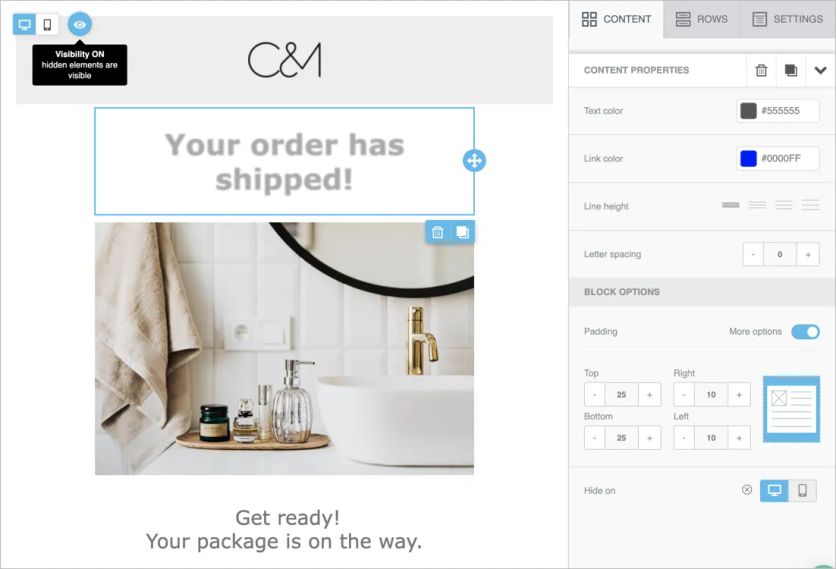
Iterable’s visual email composer
Both platforms are designed for sophisticated cross-channel engagement. You can coordinate email, mobile push, SMS, and in-app messaging to build branching customer journeys based on real-time behavior.
The difference becomes clearer when you look at the data layer.
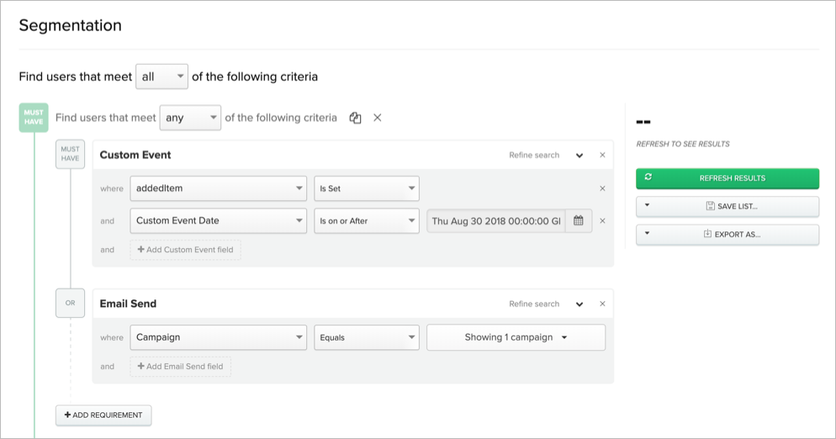
Iterable: user segmentation
Iterable gives technical teams more flexibility to define their own customer and event structures. Instead of forcing your existing data into a rigid model, its APIs and data model are designed to work with the infrastructure you’ve already built.
That makes Iterable particularly attractive if your company already has a data warehouse, event pipeline, or engineering team capable of supporting the marketing platform.
Where Iterable stands out
Iterable’s strongest capabilities include:
- Flexible data model: Define customer and event schemas around your existing data infrastructure.
- Visual campaign builder: Build branching journeys without requiring marketers to write the underlying logic.
- Catalog-driven personalization: Bring live product data and recommendations dynamically into campaigns.
- Cross-channel orchestration: Coordinate email, push, SMS, and in-app messaging within the same journey.
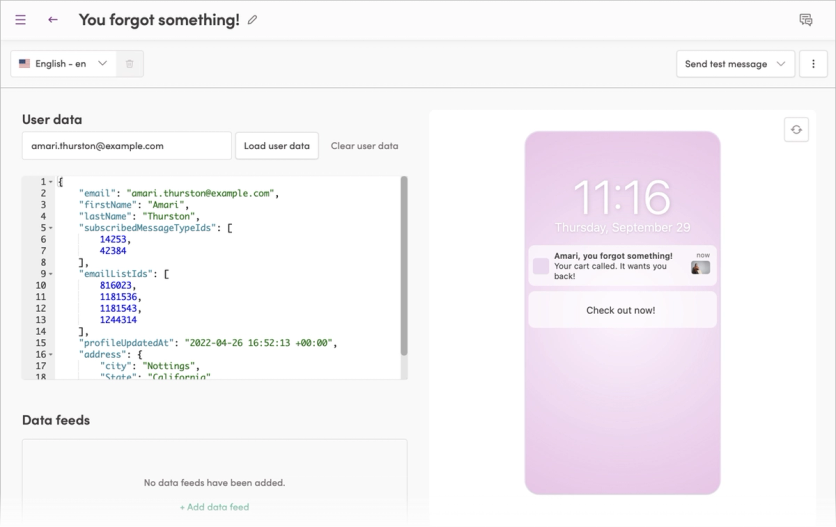
Iterable: сreating push notification
The combination gives Iterable a useful middle ground. Marketers get a visual campaign environment, while developers retain considerable control over the underlying data.
Iterable vs. Braze
Iterable and Braze overlap heavily, which is why enterprise teams frequently evaluate them side by side.
Both Iterable and Braze support real-time triggers, granular segmentation, and multi-step customer journeys. Iterable tends to receive stronger feedback on onboarding and support responsiveness, while Braze retains an advantage in areas such as depth of native in-app messaging and certain analytics capabilities.
Pricing is less of a differentiator than you might expect. Neither platform publishes a straightforward public enterprise price, and Iterable can reach the same general cost range as Braze once you’re negotiating at scale.
The more important question is how much control your team wants over its data architecture.
Iterable vs. Maestra
Iterable and Maestra both cover core messaging channels, but their priorities are different. Iterable is a strong choice when your internal data team wants to build custom workflows on top of a flexible platform. Maestra is broader for e-commerce teams because it includes loyalty, promotions, and on-site personalization, rather than requiring additional tooling.
That distinction matters when you calculate total stack complexity.
Iterable may give your developers the flexibility they want, but you’ll still need separate solutions for capabilities beyond its core messaging and personalization.
Bottom line: Choose Iterable when you want Braze-level orchestration, a highly flexible data model, and already have the technical resources to support it. If your priority is to consolidate more e-commerce functionality into a single platform with less solution engineering, Maestra is the more complete alternative.
3. CleverTap: Best for Mobile-First Teams That Live in Analytics
Best for: Mobile-first engagement and behavioral analytics
Starting price: From $85/month
G2 rating: 4.6/5 (682 reviews)
If your product is used primarily within a mobile app, CleverTap is one of the strongest alternatives to Braze for behavioral analytics and app engagement.
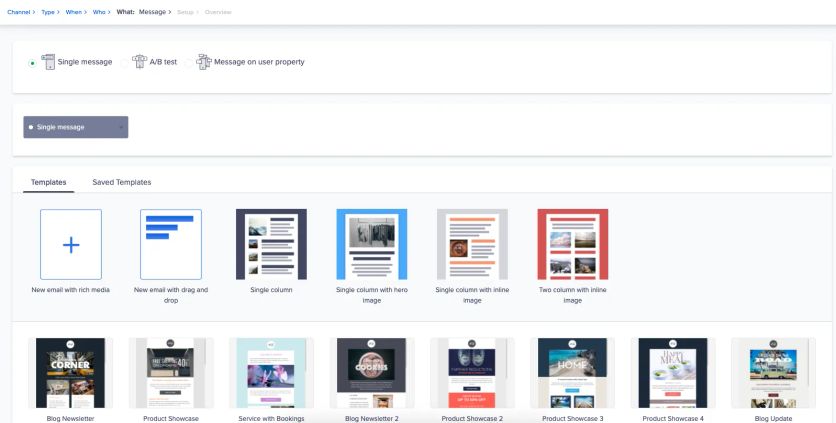
Creating an email with Clever.AI’s recommendations
CleverTap is built around the idea that understanding user behavior is just as important as sending the next message. Its platform combines behavioral data, predictive analytics, segmentation, and omnichannel engagement, enabling product and growth teams to act on what users are doing within the app.
Its Clever.AI engine can predict the likelihood of churn and conversion, while TesseractDB is designed to store large volumes of behavioral events for analysis. On the engagement side, CleverTap supports push, in-app, email, SMS, web notifications, and WhatsApp through a visual journey builder.
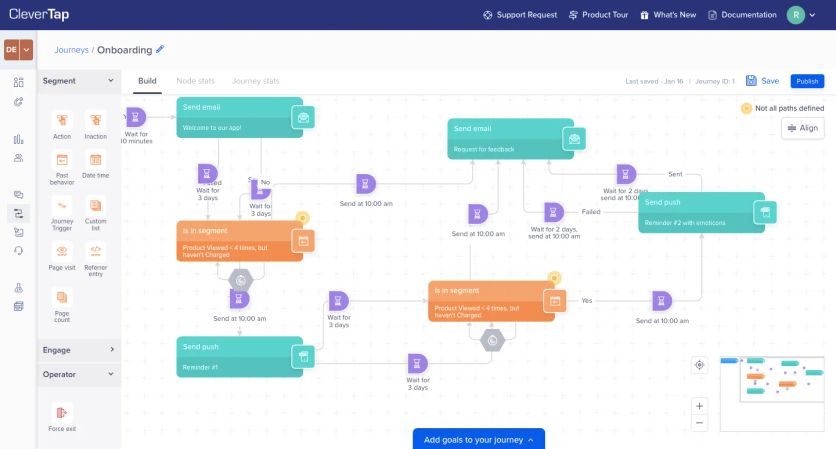
CleverTap’s flow builder
Why mobile teams choose CleverTap
The platform’s standout capabilities include:
- Clever.AI: Predictive churn and conversion scoring that can inform segmentation and campaign targeting.
- TesseractDB: A behavioral data store designed to handle millions of events per user.
- Omnichannel messaging: Coordinate push, in-app, email, SMS, web, and WhatsApp campaigns.
- No-code campaign management: Build campaigns, experiments, and A/B tests without writing queries.
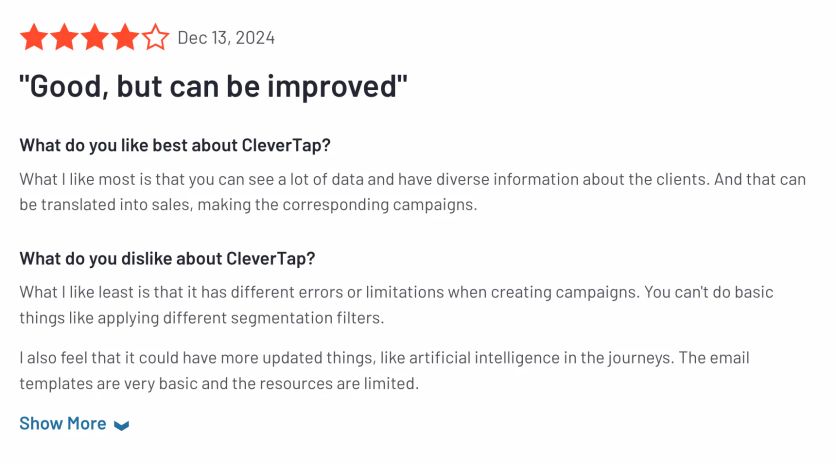
This makes CleverTap particularly useful for teams that want analytics and campaign execution closely connected.
CleverTap vs. Braze
CleverTap is often considered a Braze alternative for app-first businesses because the two platforms cover much of the same engagement territory.
The main distinction is analytics. CleverTap puts cohorts, funnels, behavioral analysis, and predictive scoring closer to the center of the marketing workflow. Braze is more heavily associated with campaign orchestration and real-time customer engagement.
CleverTap is also more accessible for startups, with the Core plan starting at $85 per month for up to 5,000 monthly active users. The price scales with usage, so this entry-level rate should not be taken as an estimate of what larger or enterprise deployments will cost.
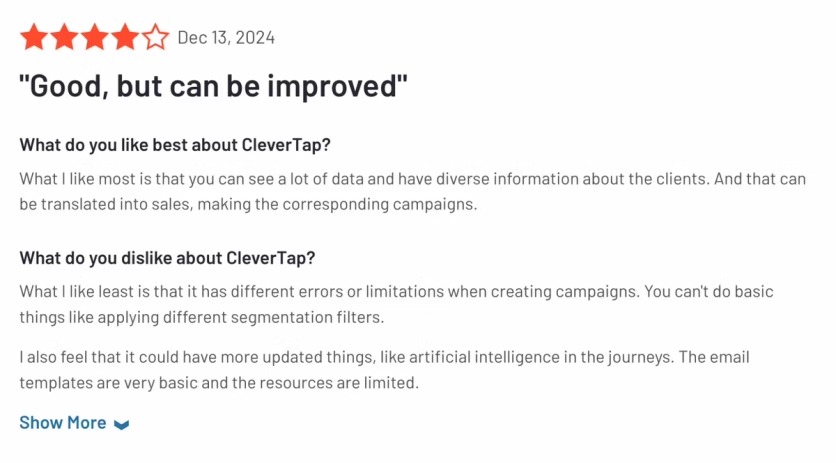
Reviewers value CleverTap’s data depth but hit errors and limits when they apply segmentation filters
CleverTap vs. Maestra
CleverTap and Maestra are both aimed at different centers of gravity.
CleverTap is the better fit when your business is fundamentally a mobile app and behavioral analytics drives your growth strategy. Maestra is designed more broadly around omnichannel e-commerce, where email, SMS, web personalization, loyalty, and customer retention all need to work together.
Think gaming, fintech, and subscription apps for CleverTap. Think retail and DTC brands with substantial web and email activity for Maestra.
Bottom line: CleverTap is the better Braze alternative when mobile engagement and behavioral analytics are your highest priorities. Brands that need web, email, loyalty, and personalization to carry equal weight should look at a broader platform.
4. Netcore – Insights-Led Omnichannel Retention and AMP Email
Best for: Mid-market to enterprise B2C retention with interactive AMP email
Starting price: Custom enterprise pricing (scales with usage and send volume)
G2 rating: 4.5/5 (578 reviews)
Netcore (formerly Netcore Cloud) is an enterprise-grade agentic customer engagement platform built specifically for retention, growth, and marketing teams managing complex, high-volume customer lifecycles. Powered by a predictive AI engine and autonomous marketing agents, Netcore helps mid-market and large enterprise brands maximize customer lifetime value by bridging disparate messaging channels into a single, real-time workspace.
Where Netcore stands out
- Omnichannel Orchestration: Connects email, SMS, WhatsApp, RCS, web push, and in-app messaging within a single visual journey builder.
- Interactive AMP Emails: Enables full shopping, product browsing, and search workflows directly inside the email body – reducing friction and boosting conversions without sending users to a website.

Netcore’s interactive AMP email engine
- Predictive AI Engine: Evaluates real-time behavioral signals to forecast churn risk, determine optimal send times, and deliver 1:1 contextual recommendations.
- Deep Retention Analytics: Offers advanced funnel tracking, cohort retention analysis, and multi-touch revenue attribution modeling.

Netcore’s retention curve report
Netcore vs. Braze
Both platforms orchestrate high-volume messaging across email, SMS, WhatsApp, push, and in-app, and both are built for enterprise scale. The clearest difference sits in the inbox: Netcore ships native AMP email, so product browsing, search, and checkout can happen inside the message, which Braze does not offer natively. AMP renders only in Gmail, Yahoo and Mail.ru, so an interactive campaign still ships a full HTML fallback for Outlook and Apple Mail. Braze remains the stronger pick for mobile-first teams that live in in-app messaging and Content Cards, and its integration and agency ecosystem is broader. Pricing is custom on both sides, so the real cost depends on your channel mix and volumes.
Netcore vs. Maestra
The difference is where each platform goes deep. Netcore’s center of gravity is messaging – email, SMS, WhatsApp, RCS, and push at volume – and its advanced multi-channel setups need technical onboarding and developer coordination. Maestra covers those channels and goes further where retention is actually won: the site and app personalize in real time from the same profile behind the messages, loyalty and promotions run natively on the same data layer, and product recommendations come with the CDP base. The build-out doesn’t land on your team either – every plan includes a forward-deployed marketer who sets up integrations, segments, flows, and A/B tests. And on cost there is nothing to reverse-engineer: Netcore quotes privately, while every Maestra module price is published, so you can size the whole stack before a sales call. You can build your own estimate on the Maestra pricing page.
Bottom line: Pick Netcore if you are a mid-market to large enterprise e-commerce, B2C, or app-first brand looking to eliminate messaging silos, reduce churn via predictive AI, and drive inbox-level conversions with interactive AMP emails – and Maestra if you want that same channel coverage with site and app personalization, loyalty, and a hands-on team included.
5. MoEngage: Best Braze Parity Without the Enterprise Overhead
Best for: Insights-led engagement at a friendlier price
Starting price: Custom (contact sales)
G2 rating: 4.5/5 (523 reviews)
MoEngage is a strong choice for teams that want Braze-style omnichannel engagement without taking on as much enterprise complexity.
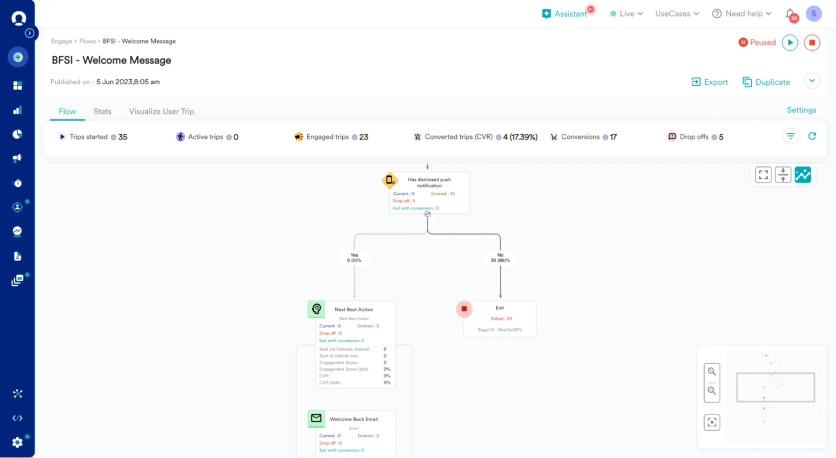
MoEngage’s flow builder
It combines customer analytics, behavioral segmentation, journey orchestration, and personalized messaging across push, in-app, email, SMS, and web. MoEngage is designed around a 360-degree view of customer behavior, so campaigns can respond to what users actually do rather than relying only on static audience lists.
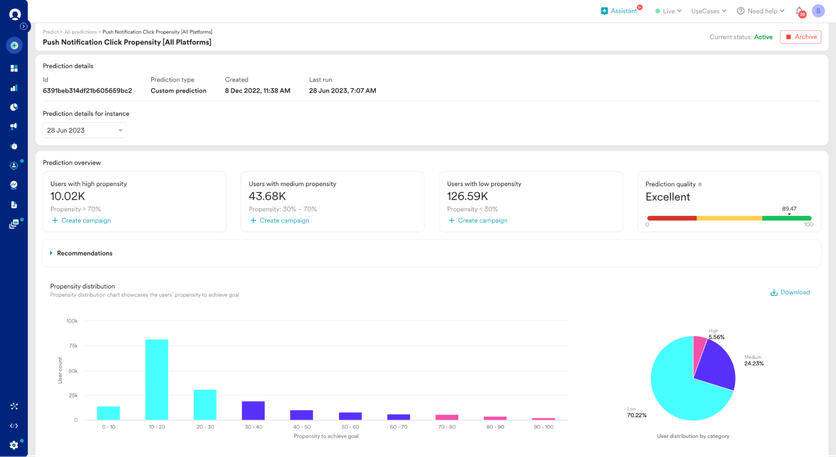
MoEngage’s push notification click propensity
That positioning puts MoEngage in close proximity to CleverTap and Braze, but its emphasis on accessibility makes it particularly relevant to mid-market teams.
Key MoEngage Features
- 360° customer analytics: Bring behavioral profiles across messaging channels into a unified view.
- Predictive AI: Use churn prediction and recommended send times without purchasing a separate AI product.
- App Marketplace: Connect your existing marketing stack through pre-built integrations.
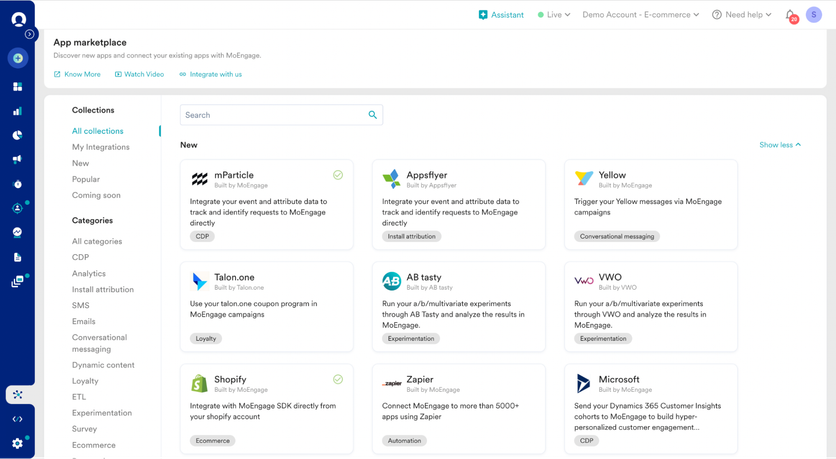
MoEngage’s App Marketplace
- Journey orchestration: Build cross-channel workflows with functionality comparable to Braze’s Canvas.
The practical advantage is speed. Teams can get sophisticated campaigns running without turning every implementation decision into an engineering project.
MoEngage vs. Braze
MoEngage is particularly relevant if Braze feels too expensive or too complicated relative to the campaigns you need to run.
Braze remains a strong choice for the largest enterprises with demanding engineering requirements and high-volume use cases, while MoEngage can be a more practical option for mid-market teams looking for a simpler and more accessible platform.
That’s an important distinction.
You’re not necessarily choosing between a capable platform and an incapable one. You’re deciding how much enterprise infrastructure your marketing organization genuinely needs.
MoEngage vs. Maestra
MoEngage and Maestra overlap on messaging and automation, but Maestra extends further into e-commerce.
Maestra offers native loyalty and on-site personalization, while MoEngage focuses more on engagement, analytics, and automation. If loyalty is a core part of your retention strategy, you’ll need to account for additional tooling with MoEngage.
Bottom line: MoEngage is a compelling Braze alternative for mobile-focused and mid-market teams that want sophisticated engagement without the full enterprise overhead. For e-commerce teams seeking loyalty and personalization in a single system, Maestra offers broader coverage.
6. Insider One: Best for AI Personalization at Enterprise Scale
Best for: AI-powered personalization for large B2C brands
Starting price: Custom, enterprise premium
G2 rating: 4.7/5 (1,419 reviews)
If your main reason for replacing Braze is to move from marketer-defined targeting toward AI-led personalization, Insider One deserves a close look.
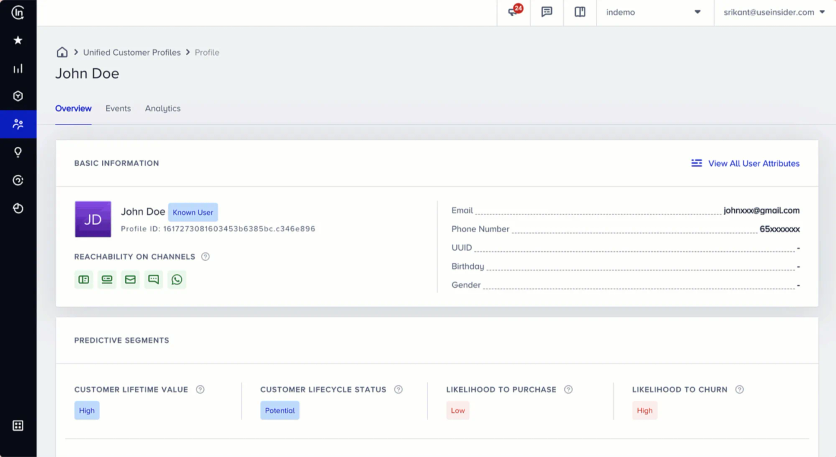
Insider’s customer profile
Insider One, formerly Insider, takes a different approach from traditional engagement platforms. Instead of positioning messaging as the center of the product, it focuses on using customer data and machine learning to determine who should receive the experience, what it should include, and when it should occur.
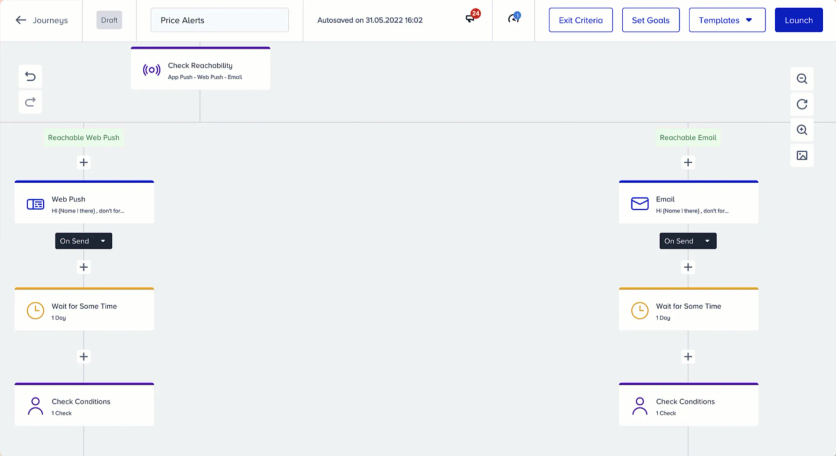
Insider’s flow builder
Its integrated CDP connects customer data across systems, while its AI intent engine can predict purchase behavior and churn risk. Those predictions can then feed individualized journeys across web, app, email, SMS, push, and WhatsApp.
What Insider One does particularly well
- AI intent engine: Predict likely purchases and churn risk to create more targeted audiences.
- Integrated CDP: Unify customer data across systems to support individualized experiences.
- On-site personalization: Tailor website content and overlays to individual visitors.
- Pre-built playbooks: Launch common use cases such as cart abandonment, churn recovery, and product recommendations faster.
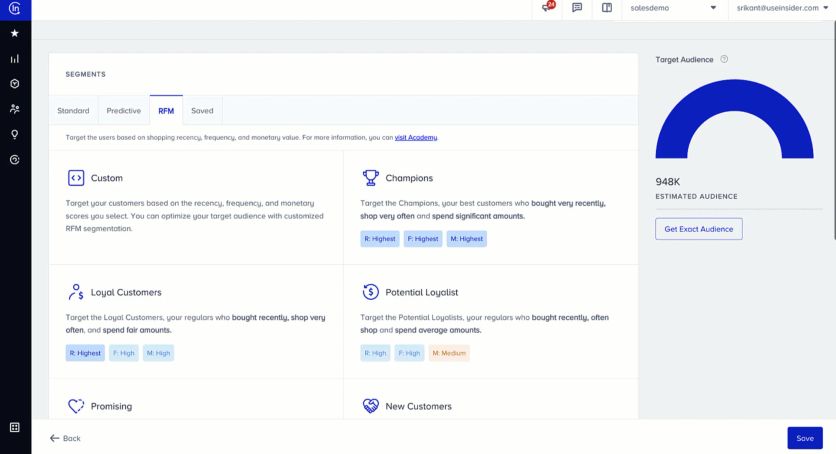
Insider’s segmentation
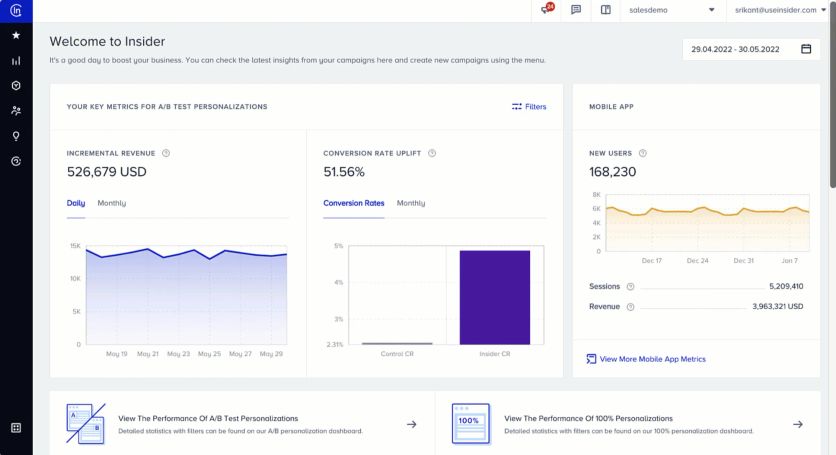
Insider’s reporting
The important difference is strategic rather than purely technical.
Braze generally gives marketers the tools to define the audience and journey. Insider One tries to use machine learning to determine more of those decisions automatically.
Insider One vs. Braze
Braze is fundamentally a messaging workhorse. You define the trigger, audience, content, and journey logic, then the platform executes it.
Insider One puts more emphasis on predictive decision-making. The question becomes less “Which segment should I build?” and more “What does the system predict this customer will do next?”
That makes Insider One especially interesting for large consumer brands where personalization is a strategic priority rather than a supporting feature.
The trade-off is cost. Insider One is positioned at a premium enterprise price point comparable to Braze, so it’s unlikely to make financial sense for a small team simply looking for a cheaper engagement platform.
Insider One vs. Maestra
Both platforms combine customer data with omnichannel messaging and personalization, but they prioritize different outcomes.
Insider One is the stronger choice when predictive analytics and AI-led personalization are the primary objectives. Maestra is broader as a marketing operating system, combining campaign execution with loyalty, promotions, and personalization.
That distinction becomes especially important for e-commerce brands. A business may want AI-powered recommendations, but it may also need a loyalty program and promotion management running from the same customer data layer.
Bottom line: Choose Insider One when your organization is ready to make AI-led personalization a central part of its customer experience strategy. Choose Maestra when you want personalization alongside a broader set of native e-commerce marketing capabilities.
7. Klaviyo: Best Budget Option for E-commerce Email and SMS
Best for: E-commerce email and SMS for small to mid-sized brands
Starting price: Free up to 250 profiles; paid plans from $20/month
G2 rating: 4.6/5 (1,361 reviews)
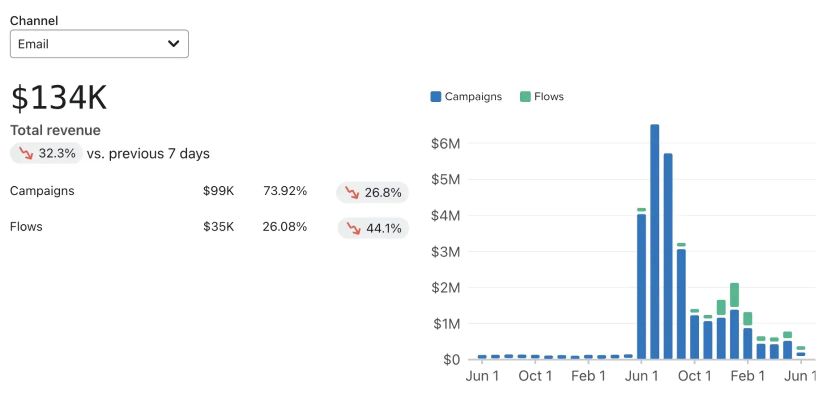
Fragment of Klaviyo’s business review dashboard
For a smaller e-commerce brand, Klaviyo can be a much more practical alternative to Braze because it delivers strong email and SMS automation without requiring an enterprise budget or a technical team.
Klaviyo doesn’t try to replicate every channel Braze supports. Instead, it focuses heavily on the channels e-commerce marketers use most, particularly email and SMS, while connecting closely with store data such as products, orders, and customer segments.
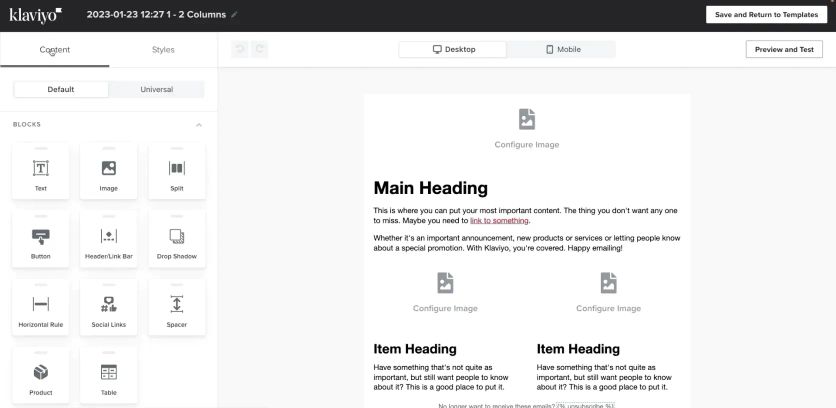
Klaviyo’s email composer
That narrower scope is a part of its appeal.
You can launch common lifecycle campaigns quickly, including welcome sequences, abandoned-cart flows, and post-purchase follow-ups, without building the infrastructure required by a platform such as Braze.
Why Klaviyo is so popular with e-commerce teams
Klaviyo’s biggest advantage is speed to value.
Its pre-built flows give marketers a starting point for common revenue and retention use cases, while its segmentation and predictive lifetime value capabilities allow teams to become more sophisticated as their customer base grows.
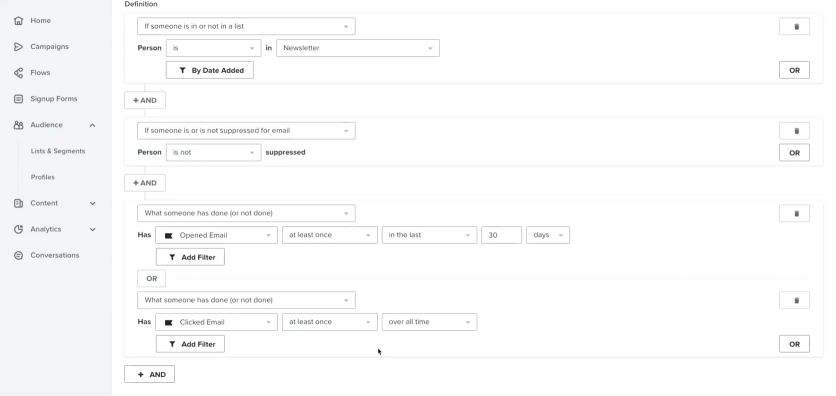
Klaviyo’s segment builder
You also don’t need a dedicated developer for everyday campaign management.
That matters for smaller brands, where the person responsible for lifecycle marketing may also handle promotions, email strategy, analytics, and merchandising.
Klaviyo vs. Braze
Klaviyo wins when simplicity and cost matter more than channel breadth.
Its free entry point and plans starting at $20 per month make it accessible to brands that would never consider an enterprise platform. Braze, by comparison, is designed for organizations with significantly more complex engagement requirements.
The trade-off is clear: Klaviyo doesn’t provide the same breadth of native channels and journey orchestration as Braze. It also lacks built-in loyalty and referral capabilities, which means growing brands may eventually need additional tools.
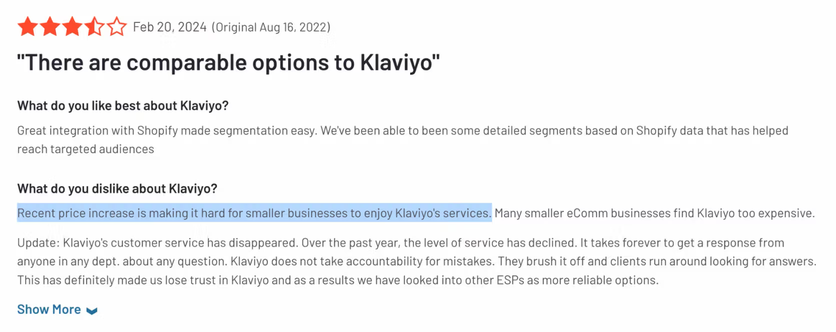
Price increases and slower support are what push smaller e-commerce teams to look past Klaviyo
That can recreate the fragmented-stack problem you’re trying to solve by moving away from Braze, just at a different stage of growth.
Klaviyo vs. Maestra
Klaviyo and Maestra often represent different stages of an e-commerce brand’s growth.
Klaviyo is excellent when the immediate goal is to quickly build a strong email and SMS program. Maestra becomes more compelling when the brand needs those channels alongside push, loyalty, promotions, and on-site personalization.
There’s a real-world example behind that progression. JOLYN grew campaign-driven revenue by 26% after moving from a Klaviyo-centric stack to Maestra, with email, SMS, and on-site personalization operating from a unified segment definition.
Bottom line: If you’re running a smaller online store and primarily need excellent email and SMS automation, Klaviyo is difficult to beat for the price. If you’re already dealing with multiple point solutions and need a broader retention stack, moving to a platform like Maestra makes more sense.
8. Agentforce Marketing (Salesforce): Best for Teams Already on Salesforce
Best for: Enterprises deep in the Salesforce ecosystem
Starting price: Roughly $1,500–$3,250/month for mid-tier packages
G2 rating: 4.0/5 (4,627 reviews)
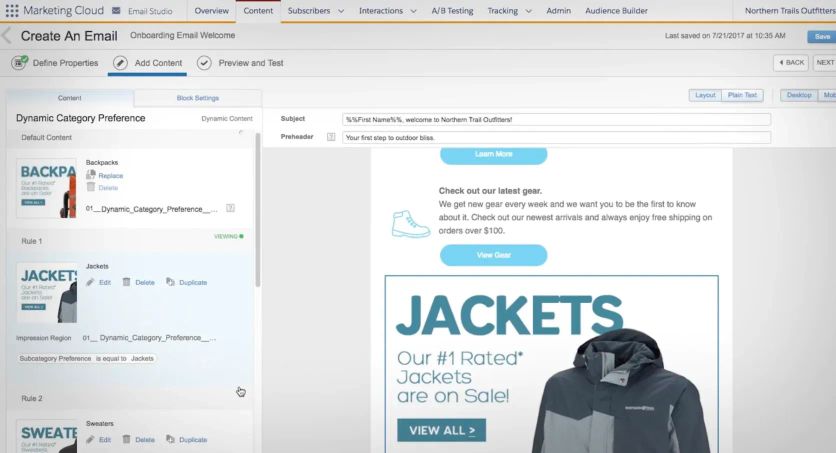
Salesforce Marketing Cloud’s email builder
If your company already runs its CRM on Salesforce, Agentforce Marketing can be a credible alternative to Braze because customer data, sales activity, service interactions, and marketing can all live within the same ecosystem (see the feature-by-feature Braze vs Salesforce Marketing Cloud comparison).
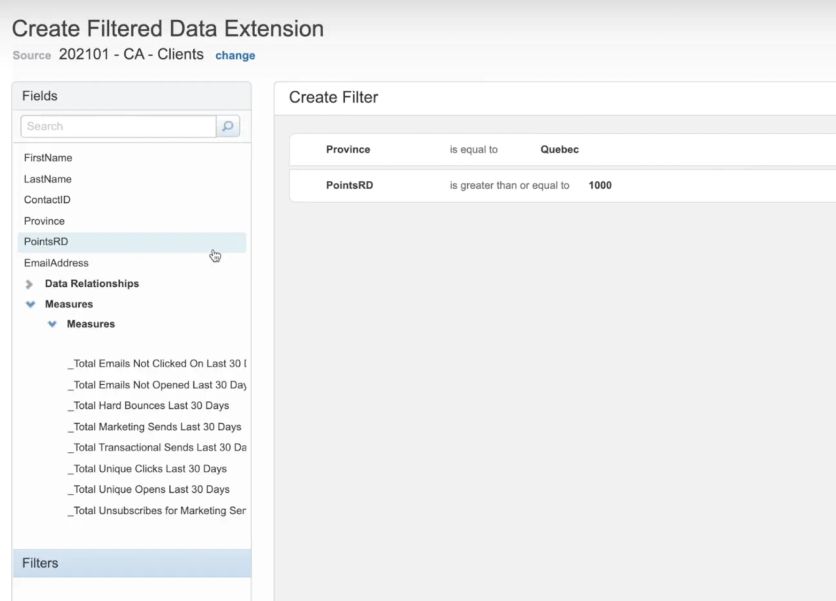
Salesforce Marketing Cloud: user segmentation
Agentforce Marketing, formerly Salesforce Marketing Cloud, is built as a collection of marketing products rather than a single narrow engagement tool. Its ecosystem includes Email Studio, Mobile Studio, Journey Builder, and Advertising Studio, covering email, SMS, push, social, and advertising audiences.
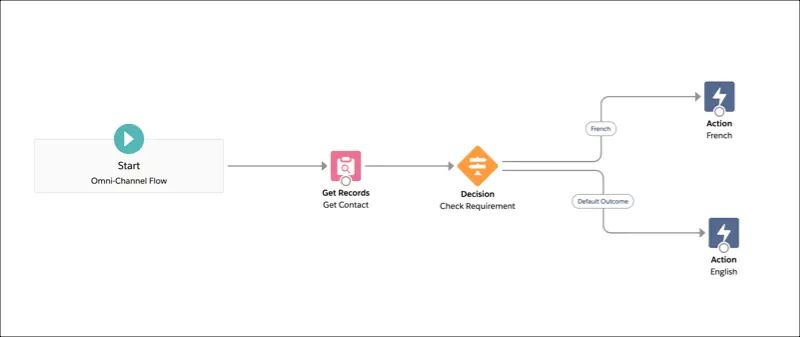
Salesforce Marketing Cloud’s Journey Builder
That breadth is useful for large organizations with complex marketing operations.
Agentforce Marketing vs. Braze
Agentforce Marketing and Braze have evolved from different starting points.
Braze grew around mobile and event-driven customer engagement. Agentforce Marketing grew from email marketing and CRM-based customer journeys. As a result, Agentforce Marketing is particularly strong when marketing needs to operate closely with CRM data and scheduled campaigns while still supporting real-time triggers.
Functionally, there is substantial overlap. Journey Builder can handle complex multi-channel workflows in much the same way Braze’s Canvas does.
The bigger difference is operational complexity.
Agentforce Marketing often requires specialized expertise, and larger companies may rely on certified consultants or dedicated marketing operations teams. Braze generally feels more streamlined for day-to-day campaign work.
Agentforce Marketing vs. Maestra
The choice becomes simpler when you look at your existing technology stack.
If Salesforce already runs your CRM, sales, and service operations, keeping marketing within the same ecosystem can reduce the need to move customer data between systems. Agentforce Marketing is therefore a legitimate Braze alternative for enterprises that already have the Salesforce infrastructure and internal expertise to support it.
For an e-commerce company starting from scratch, the calculation is different. A purpose-built platform such as Maestra can cover much of the same marketing ground without requiring the same level of Salesforce-specific expertise, while also offering native loyalty management.
Bottom line: Agentforce Marketing makes the most sense when Salesforce is already deeply embedded in your business. If it isn’t, you’re likely paying for an ecosystem whose biggest advantage you don’t actually need.
9. Customer.io: Best for Lean, Technical Teams on a Budget
Best for: Data-driven messaging for lean, technical teams
Starting price: From $100/month
G2 rating: 4.4/5 (900 reviews)
Customer.io is one of the better Braze alternatives for startups and technical growth teams that want event-driven messaging without paying for enterprise capabilities they don’t need yet.
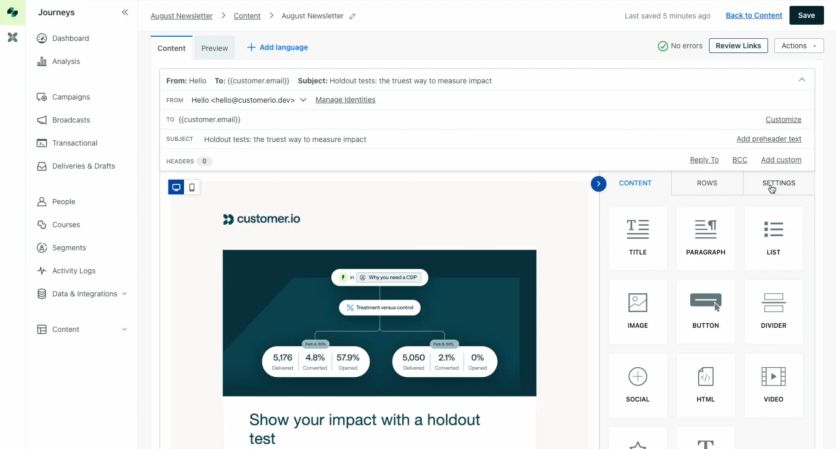
Customer.io: visual email composer
The platform focuses on behavior-triggered communication. You can send personalized email, push, and SMS messages based on what users do in your app or on your website, while developers retain control over the underlying customer data.
Its flexible data model is a major advantage for technical teams. Instead of forcing your business into a predefined customer schema, you can send behavioral data via APIs or tools like Segment and build campaigns around the attributes that matter to your product.
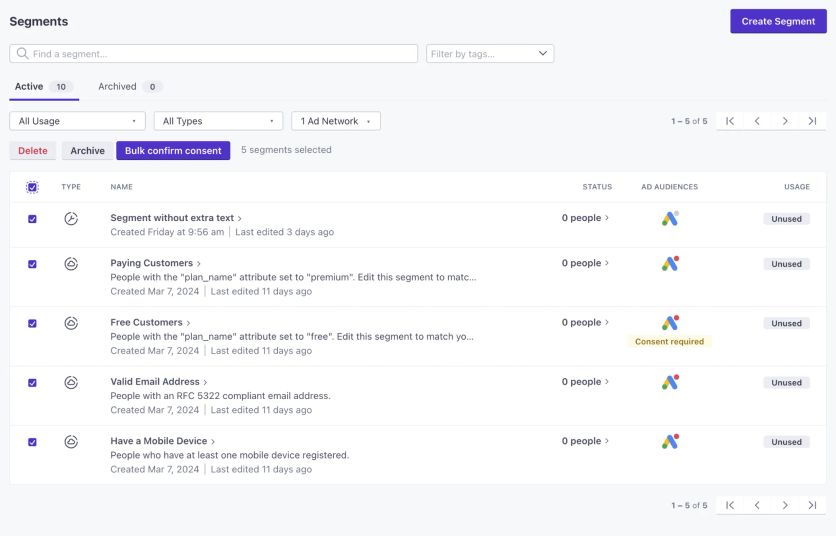
Customer.io’s ad audience management
Where Customer.io fits best
Customer.io is particularly strong when your marketing team and engineering team are comfortable working together.
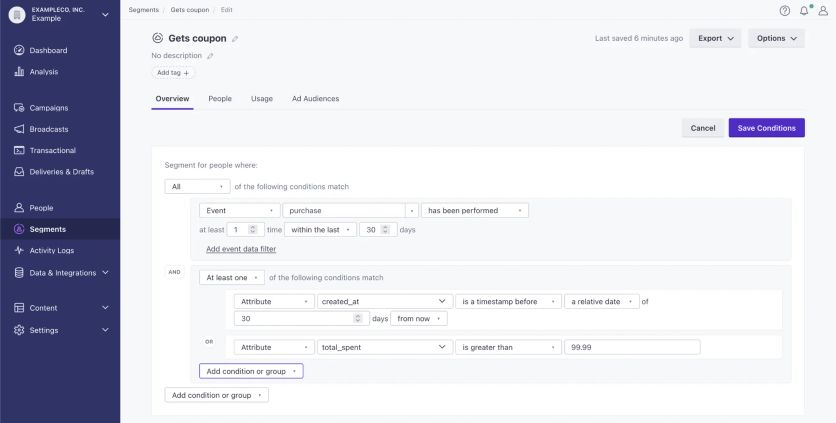
Customer.io: user segmentation
You can:
- Build real-time segments from behavioral data.
- Trigger campaigns from product and website events.
- Create workflows with conditional logic.
- Run A/B tests directly within messages.
- Start with a contact-based pricing model that is accessible to early-stage companies.
Customer.io doesn’t try to hide the technical layer. Instead, it gives technical teams the flexibility to use it.
Customer.io vs. Braze
Think of Customer.io as a lighter, more focused version of the Braze model.
For a simple use case such as sending a welcome email after signup or a re-engagement push after seven days of inactivity, Customer.io can provide what you need without the cost and infrastructure associated with a large enterprise platform.
The trade-off appears as your program becomes more complex.
Customer.io has fewer native channel types, lighter analytics, and less built-in AI than Braze. Those limitations may barely matter to a lean growth team, but they become more relevant when you’re orchestrating complex journeys across millions of users.
Customer.io vs. Maestra
The two products are designed for different buyers.
Customer.io is built for technical teams that want a flexible messaging core they can connect to their own data infrastructure. Maestra is designed for marketing teams seeking a more comprehensive platform with ready-made capabilities and dedicated support.
Customer.io also doesn’t provide the same native e-commerce functionality around loyalty and broader marketing operations.
Bottom line: Customer.io is a strong choice when your team has engineering bandwidth and wants inexpensive, flexible event-driven messaging. If marketers need to own more of the campaign experience without depending on developers, a broader platform is likely a better fit.
10. Bloomreach Engagement: Best for Data-Heavy Retail Teams
Best for: Data-powered omnichannel marketing for retail and e-commerce
Starting price: Custom enterprise pricing
G2 rating: 4.6/5 (794 reviews)
Bloomreach Engagement is a strong Braze alternative for retail and e-commerce teams that want deep customer analytics, a native CDP, and personalization in the same platform they use to run campaigns.
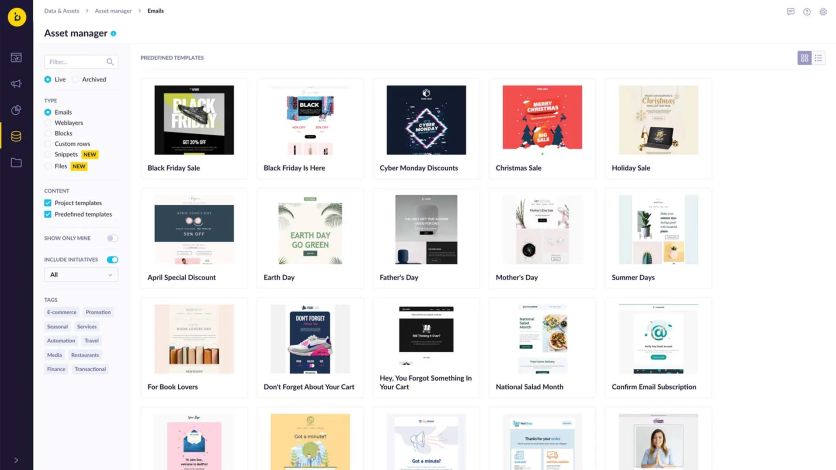
Bloomreach’s asset manager
Built on the platform formerly known as Exponea, Bloomreach combines customer data, campaign orchestration, analytics, and AI-powered personalization. Its strength is the connection between analysis and activation: the same customer data used to understand behavior can also be used to trigger campaigns.
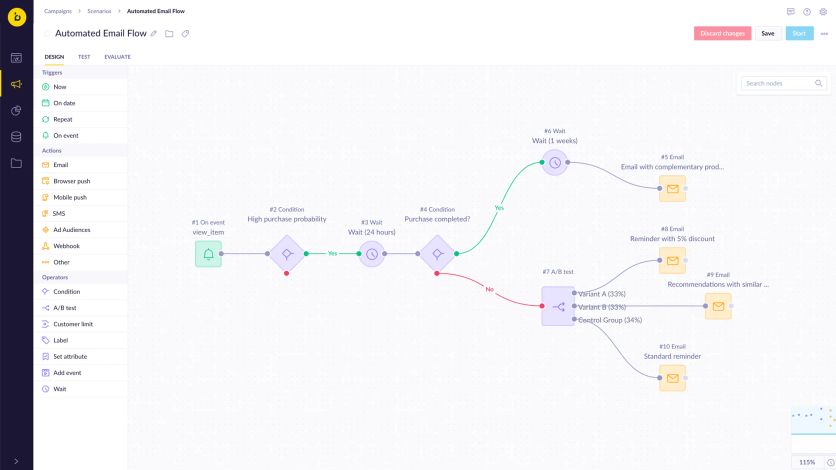
Bloomreach’s flow builder
That makes Bloomreach particularly useful for data-heavy organizations where marketing decisions depend on detailed behavioral analysis.
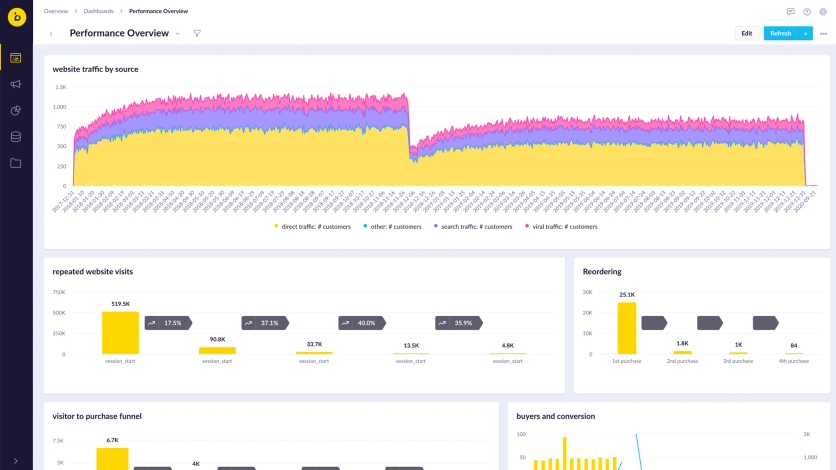
Bloomreach’s Performance Overview dashboard
What Bloomreach does differently
Bloomreach’s analytics layer goes deeper than basic campaign reporting. Teams can work with funnel tracking, retention analysis, and segment data while keeping those insights connected to campaign execution.
Bloomreach has also been expanding its AI capabilities. In April 2026, it launched the dedicated Loomi AI app for Shopify, bringing AI-powered personalization and product recommendations directly to Shopify merchants. That puts Bloomreach in closer competition with Maestra for the e-commerce brands both platforms target.
Bloomreach vs. Braze
Bloomreach has historically positioned itself as a way to consolidate capabilities that might otherwise require Braze, a CDP, and a personalization platform.
The two have comparable cross-channel campaign capabilities, but their strengths differ. Braze tends to be simpler for immediate, real-time campaign triggering, while Bloomreach places greater emphasis on analytics and e-commerce data depth. That depth comes with a trade-off: teams generally need to invest more upfront in event tracking and data configuration.
For a data-heavy retail organization, that extra setup can be worthwhile because more of the analysis happens inside the same environment.
Bloomreach vs. Maestra
Both Bloomreach and Maestra are strong fits for digital commerce, but they appeal to somewhat different operating models.
Bloomreach extends beyond marketing to include site search and content management, making it useful for companies seeking a broader commerce technology ecosystem. Maestra stays more focused on marketing and retention while aiming for a shorter path to value.
Bloomreach’s depth is an advantage when you have analysts or CRM specialists who can make full use of it. Maestra is more approachable for teams that want the same general outcome but require less specialist involvement.
Bottom line: Pick Bloomreach when advanced analytics and data science are central to your marketing strategy. If you want a shorter implementation path and a marketing-first platform with native loyalty capabilities, Maestra is the simpler alternative.
11. OneSignal: Best for Push Notifications on a Startup Budget
Best for: Developer-friendly push notifications
Starting price: Free tier; paid plans from $19/month
G2 rating: 4.7/5 (1,235 reviews)
If push notifications are the main thing you need, OneSignal can replace much of the Braze functionality you use at a fraction of the cost.
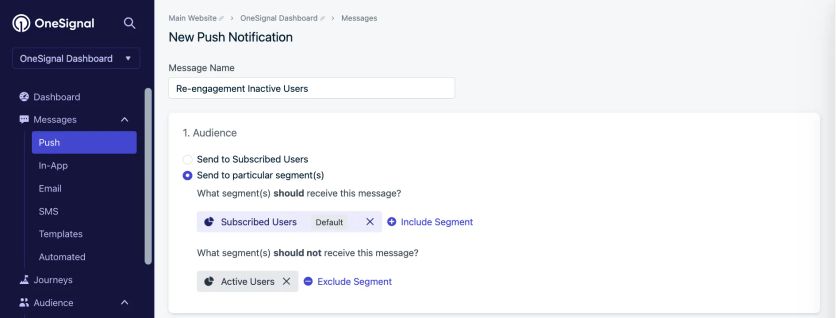
Creating a push notification in OneSignal
OneSignal built its reputation around push notifications for mobile apps and websites. It has since expanded into email, SMS, and in-app messaging while maintaining its developer-first approach.
Getting started is also relatively fast. An SDK for your mobile app and a website script can quickly get basic notification delivery running, while segmentation, A/B testing, and visual automation give you room to build beyond one-off broadcasts.
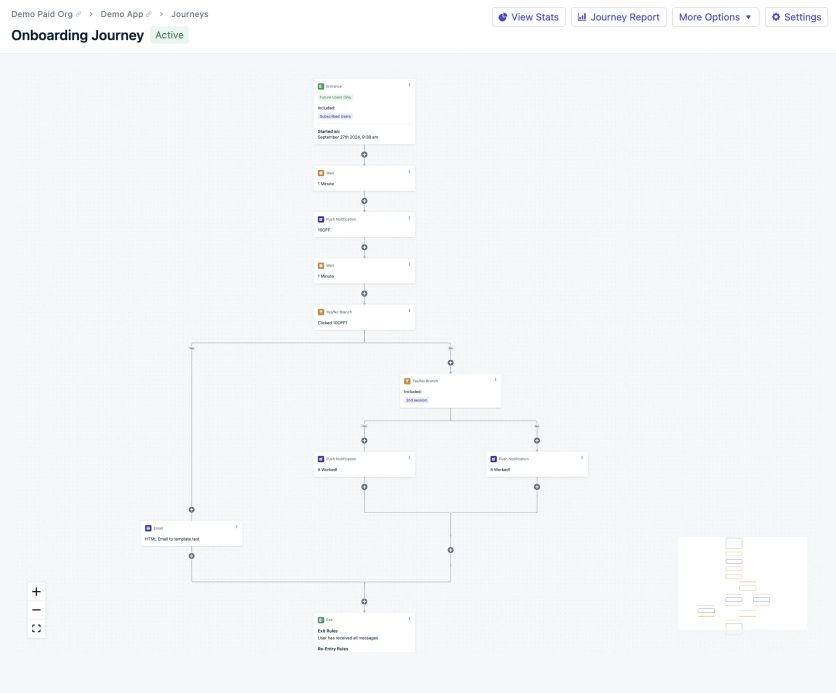
OneSignal’s visual flow builder
OneSignal vs. Braze
This is one of the clearest cases in which a Braze alternative makes sense, as the use cases differ.
Braze is designed for complex, multi-channel customer engagement. OneSignal is much more focused. If your primary requirement is reliable push notifications with some lightweight automation, paying for Braze’s broader platform can be difficult to justify.
The trade-off is functionality.
OneSignal’s automation capabilities don’t approach the depth of Braze’s Canvas. It also doesn’t provide its own CDP, and its email and SMS capabilities are newer than Braze’s. Support is similarly more self-service unless you’re on a custom plan.
OneSignal vs. Maestra
OneSignal and Maestra solve very different problems.
OneSignal is ideal for a developer or small team that needs reliable notifications without building a larger marketing stack. Maestra is designed for marketing teams that want messaging, customer data, personalization, loyalty, and other e-commerce capabilities integrated into a single platform.
That means OneSignal can actually be the smarter choice when push is genuinely all you need. The problem comes later if your team starts adding separate tools for email, loyalty, personalization, and customer data.
Bottom line: OneSignal is an excellent starting point for startups, developers, and app teams that mainly need push notifications. Once your customer engagement strategy becomes genuinely omnichannel, you’ll likely need a broader platform.
12. WebEngage: Best for Retention-First Teams, Strongest in APAC
Best for: Unified customer data and engagement, especially in APAC markets
Starting price: Custom pricing
G2 rating: 4.5/5 (769 reviews)
If retention is at the center of your marketing strategy and your business operates primarily in India or the wider APAC region, WebEngage is one of the most relevant alternatives to Braze to evaluate.
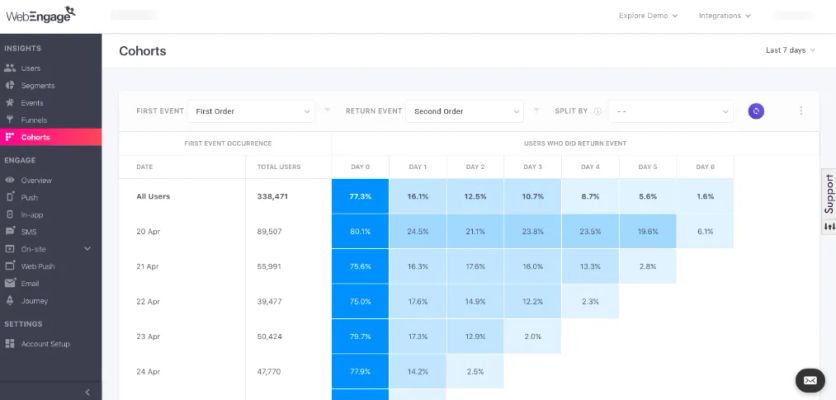
WebEngage’s cohort analysis
WebEngage combines customer data and campaign execution on a single platform. Its CDP creates a unified customer view that marketers can use to build segments and orchestrate campaigns across email, SMS, push notifications, in-app messaging, and web experiences.
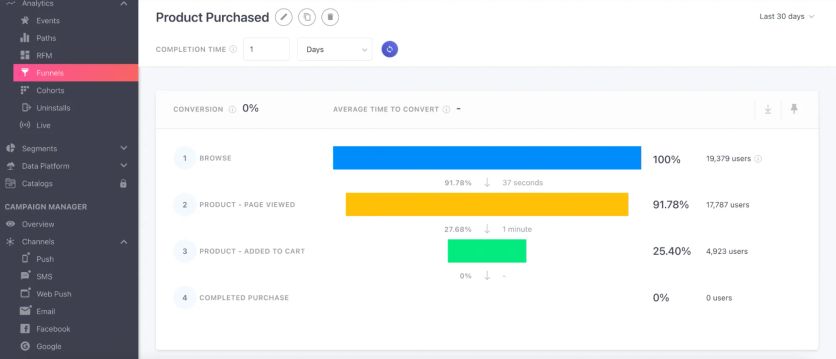
WebEngage’s funnels analysis
WebEngage’s strongest differentiator is its retention-first approach. Rather than starting with a blank campaign canvas, teams can use pre-built journeys for common lifecycle scenarios such as onboarding and win-back campaigns.
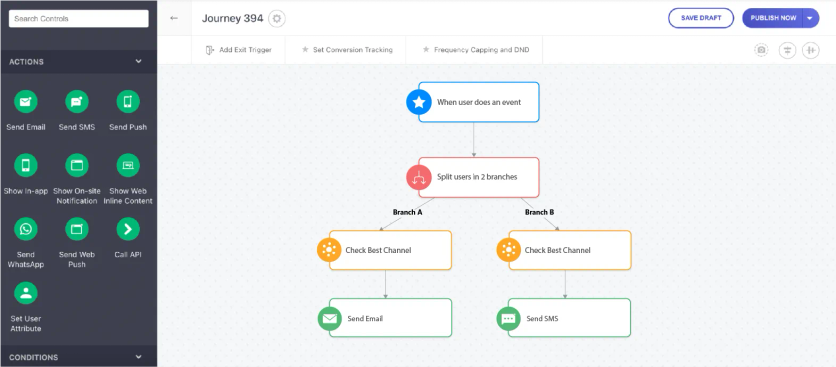
WebEngage’s Journey Designer
What WebEngage does well
- Built-in CDP: Consolidate customer data into a unified profile without purchasing a separate CDP.
- Retention playbooks: Start with pre-built lifecycle journeys rather than creating every workflow from scratch.
- Journey Designer: Build cross-channel campaigns through a visual workflow builder.
- Web and app personalization: Extend customer targeting beyond messages into personalized digital experiences.
That combination makes WebEngage particularly attractive to teams that want to move quickly from customer insight to retention campaigns.
WebEngage vs. Braze
WebEngage gives businesses many of the capabilities they expect from Braze, but in a more accessible and budget-friendly package. Its pricing is generally more transparent and lower for comparable usage, which makes it an appealing option for companies that want to control their customer engagement costs.
Here’s where the difference becomes more noticeable.
WebEngage offers a simpler interface that can help new users get started faster, while Braze can feel overwhelming because of its extensive technical options and configuration depth.
WebEngage also combines a CDP and messaging tools in one platform, so businesses do not need to pay separately for a customer data platform. This all-in-one approach can reduce both software costs and the complexity of managing multiple systems.
But Braze still has an advantage in some markets.
It has a stronger presence in North America and may offer more integrations and partner support in the region.
When it comes to scale, Braze may have the edge for extremely large deployments, but WebEngage can handle the needs of most mid-sized and large consumer businesses.
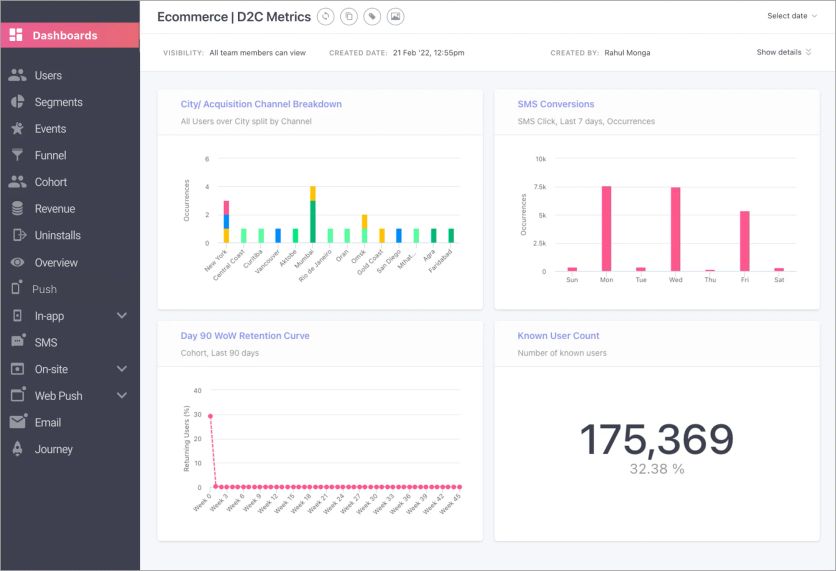
WebEngage’s dashboards
WebEngage vs. Maestra
WebEngage and Maestra both overlap considerably. Both combine customer data with campaign execution and are designed for brands that want coordinated, cross-channel retention rather than isolated email or push campaigns.
The clearest difference is the depth of native e-commerce tooling. Maestra includes a dedicated loyalty engine, whereas WebEngage can represent loyalty tiers via custom user attributes rather than offering a purpose-built loyalty module.
WebEngage leans more heavily into ease of adoption and regional support, particularly across India and APAC. Maestra takes a broader approach to e-commerce marketing, combining engagement with loyalty, promotions, and personalization.
Bottom line: WebEngage is a strong Braze alternative for retention-focused teams, particularly in APAC markets where local support and regional presence can influence the buying decision. If loyalty, promotions, and broader e-commerce capabilities need to live natively alongside engagement, Maestra offers a more comprehensive stack.
How to Choose the Right Braze Alternative
The best Braze alternative depends on what you need to fix.
If Braze feels too complex, you may want a simpler platform. If you need stronger loyalty or e-commerce personalization, look for a broader marketing stack. And if your team is heavily focused on mobile apps, mobile analytics may matter more than anything else.
Use this quick breakdown to narrow the list:
| If your priority is | Start with | Why |
|---|---|---|
| All ecommerce marketing on one platform | Maestra | Combines customer engagement, real-time CDP, loyalty, promotions, and website personalization |
| Mobile analytics and app retention | CleverTap or MoEngage | Built around behavioral analytics, mobile engagement, and retention |
| Email and SMS for e-commerce | Klaviyo | A simpler option when you mainly need lifecycle email and SMS |
| AI-driven personalization | Insider One | Focuses heavily on AI-powered targeting and personalization |
| Data-heavy retail personalization | Bloomreach Engagement | Combines customer data, personalization, orchestration, and analytics |
| Interactive AMP email at volume | Netcore | Shopping and browsing inside the email body, plus predictive retention analytics |
| Salesforce ecosystem | Agentforce Marketing | Makes the most sense when Salesforce is already at the center of your stack. |
| Flexible event-driven messaging | Customer.io | Suits technical teams that want control over data and workflows |
| Push notifications | OneSignal | A focused, lower-cost option for push-first engagement |
| Retention in APAC | WebEngage | Strong regional presence and a retention-focused platform |
| Highly customizable workflows | Iterable | Works well for teams with in-house data and technical resources |
Start with your biggest Braze problem
Your current pain point should eliminate most of the options.
If the problem is complexity: Look at Maestra, MoEngage, or WebEngage. These can cover cross-channel engagement without requiring the same level of operational overhead.
If you need more than messaging: Maestra is worth a closer look because its platform combines engagement with loyalty, promotions, CDP capabilities, and website personalization.
If mobile is your center of gravity: CleverTap and MoEngage are stronger starting points. Both put behavioral data, app engagement, and retention closer to the center of the platform.
If email and SMS are enough: Klaviyo may be the better fit. It keeps the lifecycle marketing stack relatively focused, rather than paying for capabilities you may never use.
If personalization is the priority: Compare Insider One and Bloomreach Engagement. Both go deeper into data-driven personalization, although they take different approaches.
If your team already lives in Salesforce: Agentforce Marketing has an obvious ecosystem advantage. The trade-off is that you may also inherit more enterprise complexity.
If you have a small technical team: Customer.io and OneSignal are worth considering when you need a focused set of behavioral messaging or push capabilities without adopting a large marketing suite.
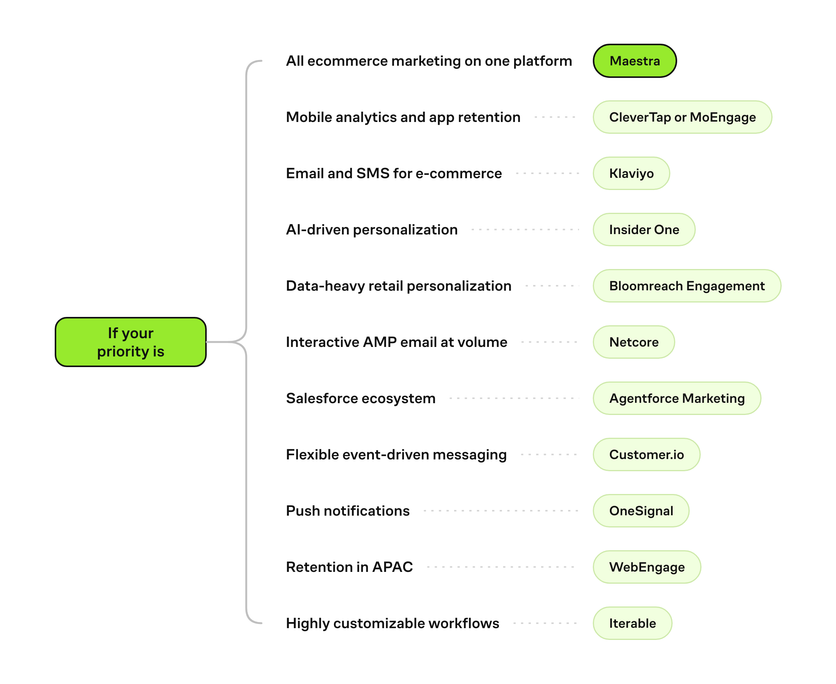
Your biggest reason for leaving Braze narrows the shortlist to one or two platforms
Then look beyond the subscription price
The cheapest platform on paper isn’t always the cheapest to operate.
Before switching, calculate the total cost of ownership, including:
- Platform and channel fees
- Implementation and migration
- Developer time
- Data integrations
- Additional tools for missing features
- Analytics and reporting tools
- Support or consulting costs
This matters because one platform may cost more per month but replace three other tools. Another may have a lower subscription price but require developers, third-party integrations, or separate loyalty and personalization software.
Test the workflows you actually run
A demo can make almost any customer engagement platform look good. Your existing campaigns are a better test.
Recreate a few real workflows in each finalist:
- Welcome journey
- Abandoned-cart campaign
- Win-back campaign
- Behavioral segment
- Personalized promotion
Then compare how much work it takes to get each one live.
Pay attention to how easily marketers can build and modify journeys, how much developers need to step in, how segmentation works, and how quickly you can troubleshoot a campaign when something goes wrong.
That last part is easy to overlook.
A platform can match Braze feature-for-feature and still be a poor replacement if your team spends just as much time maintaining it.
Ready to Move Beyond Braze
If Braze no longer fits your budget, workflows, or e-commerce requirements, compare your current setup with the alternatives above to see which platform can replace the tools you actually use.
For e-commerce teams considering Maestra, check the pricing page to see what the platform could cost for your business.
And if the Maestra column is the one that fits, talk to an expert. Bring your Braze contract and the bills for the tools around it, and you will get a migration plan, a flow map, and the consolidation arithmetic before you commit to anything.
FAQ: Braze Alternatives
- For e-commerce brands, Maestra is the strongest Braze alternative because it combines customer data, messaging, loyalty, product recommendations, and website personalization on a single platform. Braze is a capable messaging solution, but it doesn’t offer native loyalty, product recommendations, or site personalization. Furniture Fair replaced five separate tools with Maestra and reported a 7,543% ROI, while Urban Armor Gear cut its marketing stack costs by 64%, saving roughly $100,000 a year by consolidating Klaviyo, Yotpo, and Frosmo.
- Starting at $2,000 per month, Maestra is generally more affordable than Braze, especially when you compare total cost of ownership rather than the platform price alone. That price includes the CDP, unlimited email, and the first 100,000 active profiles. Braze typically starts at $60,000 or more per year, roughly $5,000 a month, with additional fees depending on usage. Since Maestra can replace five to seven separate marketing tools, the overall cost can be significantly lower.
- Both Maestra and Braze support email, SMS, push, and in-app messaging, but Maestra combines those channels with native website personalization, product recommendations, and loyalty. Its product recommendations use 14 AI algorithms, while the built-in loyalty engine connects directly with the CDP and marketing channels. German Kabirski launched 31 automated omnichannel workflows in four months and achieved a 2,349% ROI using Maestra’s real-time CDP.
- Maestra includes a built-in loyalty program with points, tiers, gamification, and referral tracking. These features connect with its CDP, email, SMS, and website personalization capabilities, so brands don’t need another platform to manage loyalty.
- Maestra. Every client gets a Forward Deployed Marketer, a marketer who works inside your team instead of a ticket queue. They run the migration, connect your data sources, build the segments, flows, and campaigns, run the A/B tests, and stay on weekly calls and a shared Slack channel to decide what to launch next. Each one carries around 15 accounts, against 60 or more at most vendors, and the role is included for every client regardless of size. Blue Q meets its Forward Deployed Marketer weekly, who builds the automations and site personalizations alongside the team – email-driven sales grew 39% after the switch.
- No, not for a team that was running Braze. Klaviyo and OneSignal have free tiers, but they cap out at 250 profiles and 500 email sends a month, or push notifications only. If you were paying Braze enterprise prices, you have more contacts than that in a single segment.
The real question is not free versus paid, it is how many tools the price covers. A free tier means email or push alone, and you add a CDP, loyalty, recommendations, and site personalization on top, each with its own contract. That stack costs more than one platform that includes them. - Braze doesn’t publish a standard rate card, so pricing is negotiated based on factors such as data consumption and usage. Braze typically costs $60,000 or more per year, and procurement platform Vendr puts the median Braze contract at $88,507, with additional fees depending on the setup. By comparison, Klaviyo and OneSignal publish tiered pricing based on factors such as contact or subscriber volume, while Customer.io lists monthly plans starting at $100. Maestra publishes pricing for its modules on its pricing page, allowing businesses to estimate costs before speaking with sales.
- A Braze migration can take anywhere from days to several months, depending on the complexity of your existing setup and integrations. Lightweight alternatives such as OneSignal or Klaviyo can potentially go live within days, while full-stack platforms with managed migration, including Maestra, typically take two to seven weeks. Platforms that require your team to rebuild integrations independently, such as Iterable, Bloomreach, and Agentforce Marketing, can take closer to Braze’s original three-to-six-month migration window.
- For most teams, a dedicated developer isn’t required for the Maestra migration. Its migration process is supported by a Forward Deployed Marketer who handles the technical setup and helps manage the transition. At Selkirk Sport, pop-ups had needed custom JavaScript and a developer on the previous platform; on Maestra the same forms went live with no custom code.
- A parallel setup can make the transition from Braze to Maestra safer. Most teams can use a two- to four-week parallel period, sending a subset of campaigns through both platforms to identify differences in deliverability, segmentation, and campaign behavior. This approach allows teams to validate the new setup before fully moving away from Braze.
- Yes, Maestra meets several major data privacy and security standards, including SOC 2 Type 2, GDPR, CCPA, and HIPAA, with 2FA authentication, data masking and SIEM integration. These certifications and compliance frameworks make it suitable for businesses that need enterprise-grade controls around customer data. Its compliance capabilities are comparable to those of Braze and other large customer engagement platforms.