
7 Best Attentive Alternatives for SMS and Email (2026)

Attentive typically charges $2,000 to $3,000 in quarterly minimums, reportedly locks brands into SMS exclusivity clauses, and reports ROI through a 30-day click attribution window that flatters every campaign.
Those terms are easier for brands to accept when SMS is their only priority. But they get harder to justify once you need SMS to coordinate with email, push, and on-site messaging, because Attentive’s SMS-first focus forces you to run parallel platforms that don’t share data.
We analyzed hundreds of Attentive reviews across G2, Capterra, Trustpilot, Software Advice, and the Shopify App Store to find where the platform falls short and which tools fill those gaps. Below are 7 alternatives, ranging from full omnichannel platforms to budget SMS tools, along with the trade-offs of each.
Quick Verdict: Best Attentive Alternatives by Category
The best Attentive alternatives are Maestra for omnichannel e-commerce, Klaviyo for email and SMS with deep segmentation, Postscript for Shopify-native SMS, and Omnisend for budget-friendly multichannel. Maestra is the strongest all-in-one pick, unifying SMS, email, push, loyalty, and on-site personalization on a single real-time platform.
Best for omnichannel e-commerce: Maestra. SMS plus email, push, loyalty, and on-site personalization in one platform.
Best for email and SMS with deep segmentation: Klaviyo. Data-driven automation and pre-built e-commerce flows.
Best for Shopify-native SMS: Postscript. Deep Shopify integration with compliance tools and two-way messaging.
Best for app-driven brands: Braze. Real-time mobile, push, and in-app messaging beyond SMS.
Best for budget-friendly multichannel: Omnisend. Email, SMS, and push at lower cost than Attentive.
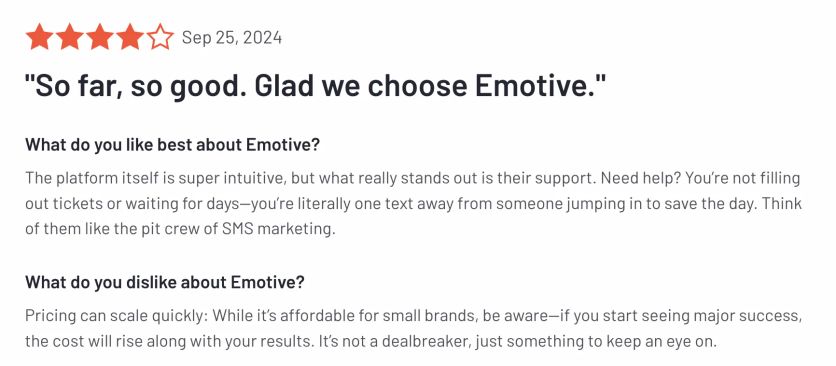
Best for conversational SMS: Emotive. Human-like text conversations that drive replies and revenue.
Best for simple, affordable SMS: SimpleTexting. Straightforward mass texting without the enterprise price tag.
Content:
Attentive Pain Points (and Quick Fixes)
We analyzed reviews across G2, Capterra, Trustpilot, Software Advice, and the Shopify App Store to surface the most common frustrations with Attentive:
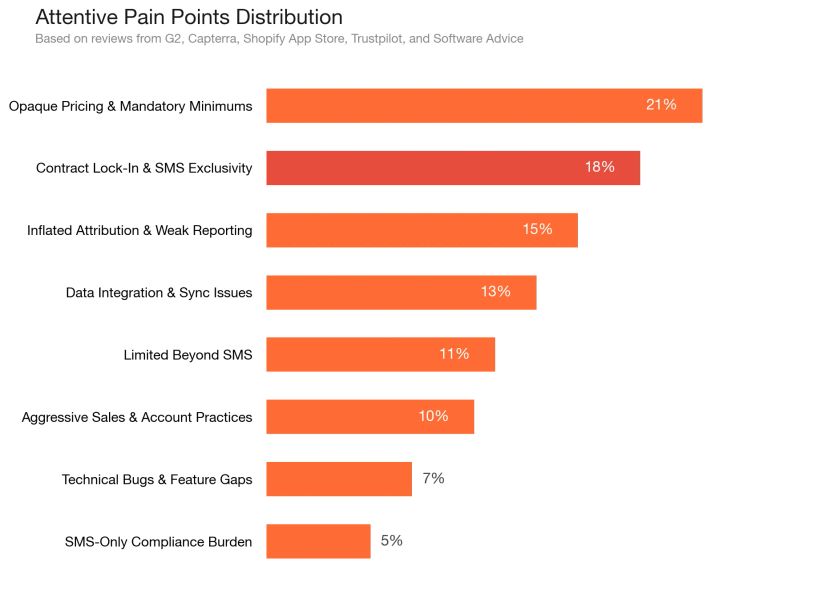
According to user feedback, the most common pain points include:
Cost
Attentive’s pricing can hit like a sucker punch. There’s no public price sheet with simple tiers, so you often need a demo or quote, which is a hint that it’s not the cheapest option.
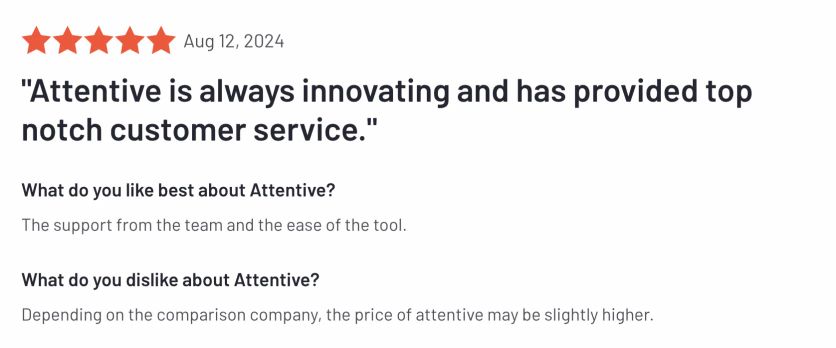
Attentive typically charges a base platform fee plus per-message fees, so success (i.e. more texts sent) ironically makes it more expensive. Imagine paying a few hundred dollars a month, plus cents on every SMS and MMS.
As you unlock features like two-way messaging or more advanced segmentation, you might be pushed into higher pricing tiers or enterprise plans. For small and mid-sized businesses, it’s hard to justify sticking with Attentive if the ROI isn’t keeping pace with the rising bill.
The lack of transparent pricing also means you could end up overpaying if you’re not actively negotiating or monitoring usage. In short, Attentive can deliver results, but you’ll pay a premium for the ride, and budgeting for it can feel like aiming at a moving target.
Limited channels and functionality
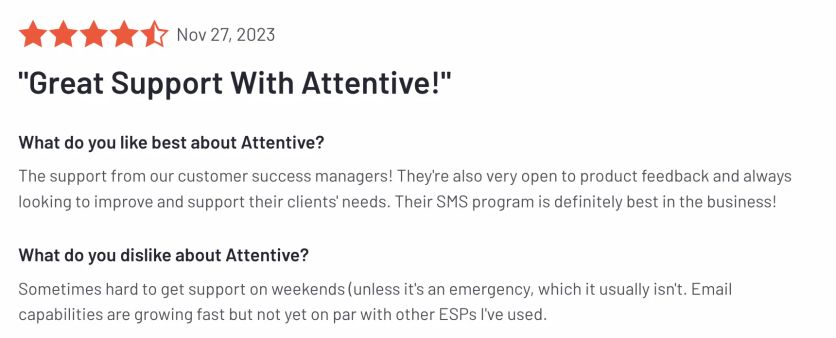
Attentive is laser-focused on texting (with a side of email), and that narrow focus can become a limitation. Modern brands want to engage customers on multiple channels, including SMS, email, push notifications, in-app messages, WhatsApp, web pop-ups, and more. This is why most brands turn to alternatives to fill the gaps.
This means your marketing stack can become a patchwork: Attentive for SMS, something else for push, another for on-site personalization, etc., with data siloed in each.
Attentive’s email capability helps a bit, but it still leaves out big pieces of the customer journey (e.g. no built-in web personalization or loyalty program features). Even within its comfort zone of SMS, some users crave more sophistication.
For example, Attentive’s segmentation is solid for messaging (filtering by purchase history or behavior), but creating highly dynamic, cross-channel customer journeys can be challenging. There’s no built-in customer data platform to unify all your touchpoints in real-time.
If you want to trigger an SMS based on a complex event (say, customer viewed product X three times this week AND hasn’t purchased in 30 days AND didn’t open last email), you might struggle or need an external system.
How to Fix Common Attentive Pain Points
If you’d still like to stay with Attentive despite these limitations, here are some workarounds for common issues:
| Pain Point | Description | Possible Solutions |
|---|---|---|
| Opaque Pricing & Mandatory Minimums | No published pricing; $2,000–$3,000 quarterly minimums regardless of usage; small stores pay inflated per-message rates; setup costs $2,000–$5,000 | • Negotiate quarterly minimums down during renewal • Compare CPM rates against Postscript, Maestra and Klaviyo for leverage • Request a usage-based pricing tier |
| Contract Lock-In & SMS Exclusivity | 6–12 month minimum commitments with auto-renewal; reported SMS exclusivity clauses; 60–90 day cancellation notice required; financial penalties for early termination | • Review contract carefully before renewal – push back on exclusivity
• Negotiate shorter commitment terms |
| Inflated Attribution & Weak Reporting | 30-day click attribution window inflates reported ROI; cannot slice-and-dice data granularly; weak reporting compared to email platforms | • Shorten attribution window to 7-day click in settings
• Build parallel UTM tracking through Google Analytics • Cross-reference Attentive reports with Shopify attribution |
| Data Integration & Sync Issues | Subscriber data doesn’t always sync correctly to email platforms; only one-way integration with most ESPs; data handoff failures prevent email flows from triggering | • Set up automated reconciliation checks between Attentive and ESP
• Use Zapier or custom webhooks for two-way sync • Audit subscriber lists monthly for sync discrepancies |
| Limited Beyond SMS | Email and push are newer and less mature than dedicated platforms; no native loyalty, CDP, or site personalization | • Use Attentive for SMS + a dedicated ESP for email
• This is a platform limitation for loyalty and personalization – consider alternatives below |
| Aggressive Sales & Account Practices | Unsolicited sales calls; billing disputes for messages not sent; SMS sending blocked without accountability | • Document all billing discrepancies immediately
• Escalate account issues to your account executive directly • Request billing audit during renewal conversations |
| Technical Bugs & Feature Gaps | Sign-up forms fail from Facebook landing pages; notification bugs; no individual user profiles; new features lag behind competitors | • Test sign-up forms across all traffic sources regularly
• Report bugs through support tickets for documentation • This is a platform limitation – consider alternatives below |
| SMS-Only Compliance Burden | TCPA compliance complexity; opt-in management requires careful setup; regulatory changes create ongoing overhead | • Work with your legal team to establish SMS compliance playbooks
• Use Attentive’s built-in compliance tools to maximum extent • Subscribe to TCPA update newsletters for proactive compliance |
The Alternatives at a Glance
With that in mind, let’s take a look at some of the popular alternatives.
| Best For | Key Features | Price Range |
|---|---|---|
| Maestra Full-funnel marketing for ambitious e-commerce brands | • Real-time CDP for behavior-driven segmentation • Hyper-personalized omnichannel flows • Built-in loyalty program and promotions engine • Real-time site personalization • Dedicated Forward Deployed Marketer | From $2,250/mo (CDP + unlimited email + SMS) + per-message SMS fees; pay only for active profiles |
| Klaviyo Integrated email & SMS automation for data-driven marketers | • Powerful segmentation with e-commerce data • Pre-built email and SMS flow templates • 350+ integrations (Shopify, Magento, etc.) • Dynamic personalization and A/B testing | Free tier; Paid plans from ~$20/month (plus usage) |
| Postscript Shopify-centric SMS campaigns for online stores | • Seamless Shopify integration for SMS • Easy opt-in tools (pop-ups, keywords) for list growth • Automated cart abandonment and product back-in-stock texts • Simple, usage-based pricing model | No free plan (30-day trial); from ~$49/mo minimum spend (Starter, no platform fee), then Growth $100/mo, Pro $500/mo – usage-based |
| Braze Enterprise-grade omnichannel customer engagement | • Multi-channel campaigns (SMS, push, email, in-app) at scale • Real-time data streaming & segmentation • Advanced personalization with dynamic content • Robust analytics and journey orchestration tools | Custom pricing (enterprise) |
| Omnisend All-in-one email, SMS, & push for SMB e-commerce | • Pre-built automation workflows (welcome series, cart recovery) • Drag-and-drop campaign builder • Email, SMS, and web push from one platform • Deep Shopify and WooCommerce integration | Free plan; paid plans from ~$11/month |
| Emotive Two-way conversational SMS marketing with a human touch | • 1:1 text conversations at scale (real human agents + AI) • AI assistance to triage and respond to customer texts • Interactive campaigns (quizzes, two-way promos) • Revenue-focused analytics and ROI dashboard | Custom pricing (offers to beat competitors; ~$100+/month based on usage) |
| SimpleTexting Straightforward text message marketing for any business | • Easy mass texting with no coding • MMS support for images and multimedia texts • Keywords and auto-replies for customer interaction • Contact management and scheduling tools | From ~$39/mo (500 credits, annual) plus a ~$10/mo number; ~$239/mo for 7,500 credits |
Now let’s dive into detailed reviews of each alternative, how they stack up, and how they compare to both Attentive and Maestra.
Tool #1: Maestra – Best for Omnichannel E-commerce
Maestra is an all-in-one omnichannel marketing platform built for e-commerce brands ready to leave the patchwork approach behind. With integrated email, SMS, push notifications, loyalty programs, and on-site personalization, Maestra makes it easy for brands to manage everything in one place.
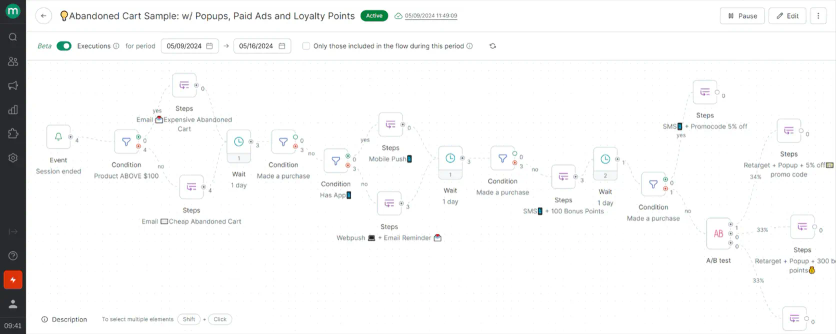
Maestra’s flow example: abandoned cart flow with emails, mobile and web pushes, pop-ups, paid ads and loyalty points
The platform centers on a real-time customer data platform (CDP), which means every customer action (a click, a browse, a purchase) can instantly trigger tailored marketing across any channel. Out of the box, Maestra provides advanced segmentation and a drag-and-drop journey builder so you can design flows that reach customers at the perfect moment on the perfect channel.
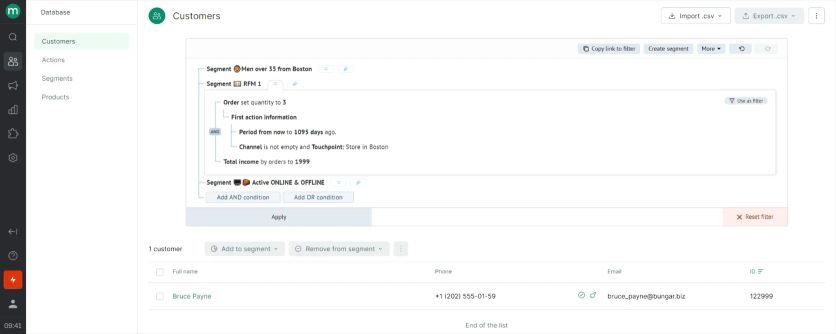
Maestra’s segment builder
Think email and SMS combos, follow-up texts that react to on-site behavior, and personalized product blocks on your homepage. All of it coordinated in one place instead of six.
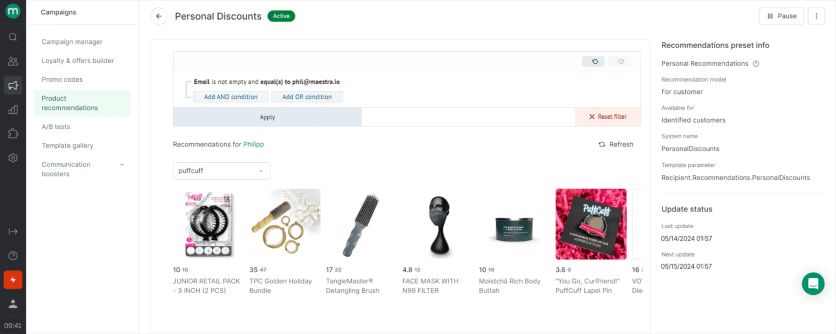
Maestra: creating a personalized recommendations block
Instead of juggling separate apps for loyalty, email, SMS, etc., you get one platform where all these capabilities work in sync. It’s like having a marketing command center that gives you a 360° view of the customer and the controls to engage them with precision.
Key Features:
- Unified Omnichannel Automation streamlines campaign management across email, SMS, web, and mobile from one central dashboard. Design intricate customer journeys that adapt to real-time actions, ensuring the right message reaches the best channel at the ideal time.
- Advanced Customer Data Platform integrates online and offline data, allowing detailed segmentation down to specific interactions. This drives highly personalized experiences rooted in a comprehensive view of each customer.
- Integrated Loyalty & Referral Programs remove the need for standalone tools. Offer rewards like points, VIP levels, and referral bonuses are all seamlessly handled within the same platform as your messaging.
- Dynamic Website Personalization tailors unique experiences for every visitor. Welcome back returning customers by name, highlight products based on their browsing habits, and deliver AI-powered, targeted offers.
- Intelligent Promotions Engine simplifies discount handling with automated delivery, redemption monitoring, and expiration controls, precisely aligned with your chosen segments.
- Chat-Based Platform Work brings Maestra into Claude or ChatGPT through its MCP server. Ask for last month’s SMS and email numbers, rework a campaign’s copy and send settings, define a new segment, or have an automation laid out in the flow builder without opening the platform.
- White-Glove Support provides each client with a dedicated Forward Deployed Marketer (a marketer who works as part of your team) to assist with onboarding, strategy, and technical setup – delivering top-tier service uncommon at this price level.
Strengths and weaknesses
Maestra’s biggest strength is making every interaction feel personal at scale. The flow builder plus unified data lets you run one campaign across email, SMS, your site, and ad platforms at once.
For example, you could set up a flow where a customer who browses a product gets an in-app pop-up offering a discount, then an hour later an SMS if they didn’t purchase, and a day later an email with a related product recommendation – all without manual intervention. This kind of orchestration is where Maestra shines.
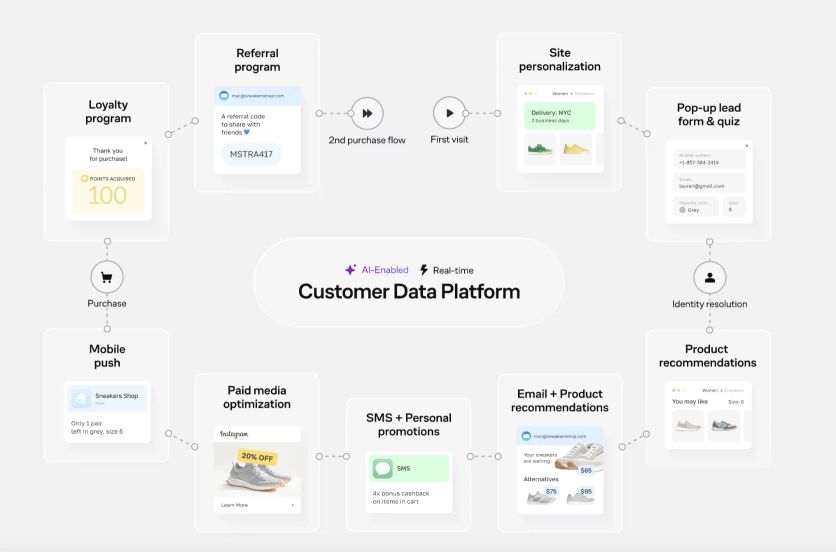
You can also trigger on micro-events like “customer viewed X but didn’t add to cart” or “VIP customer just hit 100 loyalty points” to capitalize on moments that generic tools would miss.
Pro tip: Start with one high-intent trigger like cart abandonment before you build bigger journeys. You’ll see revenue faster and learn the builder on a flow that already converts.
Maestra can handle the execution, too. Emails are optimized to avoid the dreaded Gmail clipping (so your long, image-heavy newsletters still land perfectly).
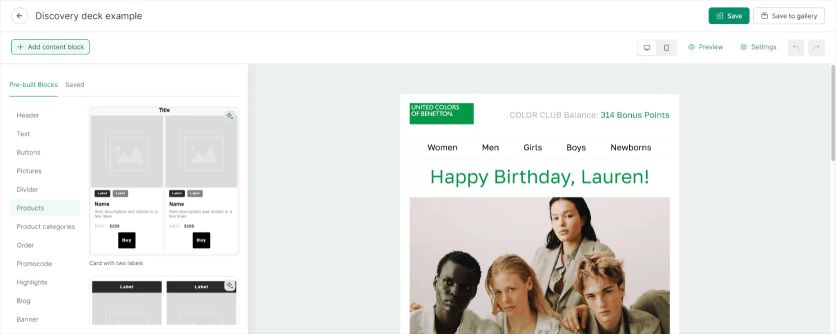
Maestra’s visual email composer
When it comes to drawbacks, Maestra doesn’t give you much to gripe about on features – it’s a very comprehensive platform – but there are two considerations. First, the pricing starts at about $2,250/month for the CDP plus unlimited email, with the SMS module adding per-message fees. There’s no free plan, and that price could be a hurdle for smaller businesses. You pay only for active profiles, and the cost reflects the value and breadth; it’s effectively software + service, given the included support and setup help. You can build your own estimate on the Maestra pricing page.
Second, Maestra currently doesn’t include a built-in user-generated content (UGC) management tool (for curating and displaying customer photos/reviews). It excels at incentivizing reviews and leveraging social proof in campaigns (like emailing a discount when someone submits a review), but if you need a gallery of shoppable Instagram photos on your site, you’d integrate a UGC tool for that.
Bottom line: Maestra’s weak spots aren’t things the tool necessarily does badly. We simply leave them out, while pricing our platform for brands ready to invest in a top-tier solution.
Compared to Attentive
Attentive is a specialist – it’s great at SMS marketing and has added email – but it remains relatively siloed and limited in scope. Where Attentive covers one channel well, Maestra covers far more in a single platform. Compared to Attentive, Maestra offers a far broader range of channels and capabilities under one roof.
Attentive users like the texting focus, but they bolt on other tools for email, push, or loyalty. Meanwhile, Maestra can handle all of it natively, so there’s nothing to bolt on.
Also, Attentive’s reliance on batch data updates and third-party integrations can leave marketers juggling spreadsheets or waiting for systems to sync. In contrast, Maestra’s real-time CDP means your campaigns can react instantly to customer behavior (Attentive, for example, can’t easily pause an email send if a customer makes a purchase on another channel in real time – Maestra can).
Attentive does offer two-way SMS and good segmentation for texts, but Maestra matches those SMS capabilities and raises the stakes with its cross-channel intelligence. In summary, Attentive works within SMS, whereas Maestra coordinates messaging across every touchpoint.
Bottom line: If you’ve outgrown SMS-first, Maestra is the strongest fit on this list.
When to Switch to Maestra from Attentive
You’re running Attentive + Klaviyo + a loyalty tool and the fragmentation is hurting you
Urban Armor Gear consolidated Klaviyo (email), Yotpo Loyalty, and Frosmo (personalization) into Maestra – achieving a 64% cost reduction while gaining capabilities none of those tools offered individually. When SMS, email, loyalty, and personalization share the same data and flow builder, messages become more relevant and customer experience becomes seamless.
You need loyalty alongside SMS, not as separate tools
I Love Linen, an Australian linen bedding brand, switched to Maestra and saves 5 hours every week. On Maestra, the team enters promotion details and dates once, and the system updates everything automatically across every flow – email banners, subject lines, SMS text – while loyalty-specific content like member-only points displays adapts in real time based on each customer’s profile. When the promotion ends, everything reverts on its own. No manual updates, no risk of stale messaging across channels.
Your SMS and email campaigns can’t coordinate because the data doesn’t sync
Magnum Bikes, a premium e-bike brand, switched to Maestra and saw +56.6% online revenue and +111.7% in order volume. For every major promotion, Maestra coordinates email, SMS, and on-site activation simultaneously – email goes out first, SMS follows, and the website updates with matching announcement bars, banners, and popups. The sale is visible at every touchpoint, launched from one place, without the team touching each channel separately.
Note: If you only need texting, a lighter tool may fit. But when you need to replace your stack with something more extensive, Maestra is the best pick.
Tool #2: Klaviyo – Best for Email and SMS With Deep Segmentation
Klaviyo is a well-known marketing automation platform tailored for e-commerce, and it has made a name for itself by combining email and SMS in one powerful package.
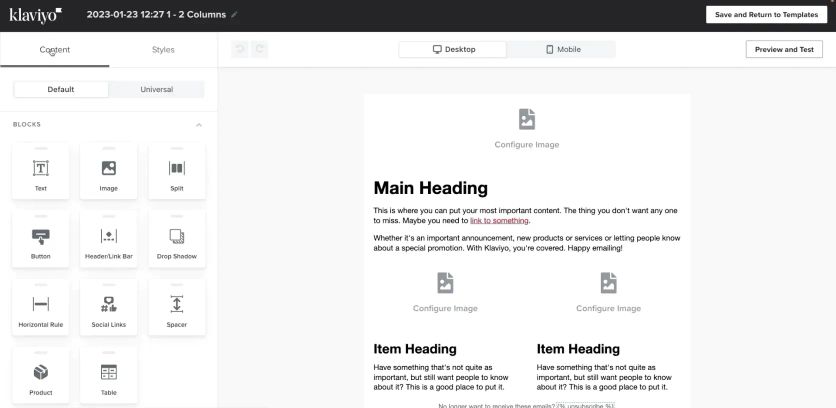
Klaviyo’s email composer
With Klaviyo, you can build detailed customer segments using e-commerce data (like shopping behavior, purchase history, website activity) and then target those segments with both email campaigns and text messages.
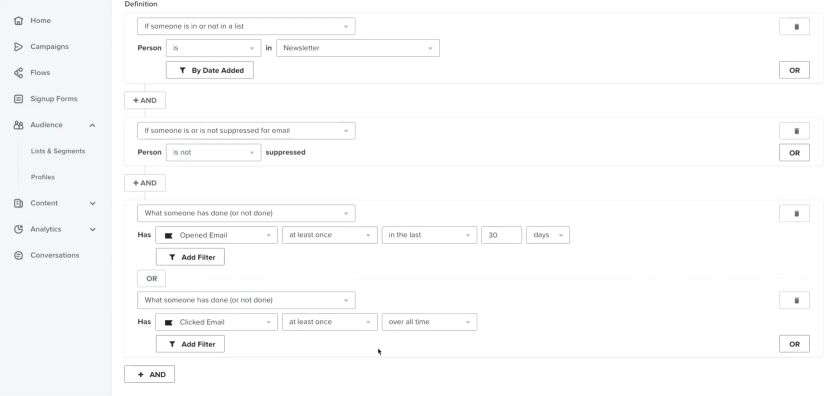
Klaviyo’s segment builder
This means a newcomer can quickly get sophisticated multi-step campaigns up and running without heavy lifting. Klaviyo’s deep integration with e-commerce platforms (Shopify, Magento, BigCommerce, etc.) allows it to pull in product data, purchase events, and even predictive analytics (like expected customer lifetime value or churn risk), which you can use to tailor your messaging.
Essentially, Klaviyo acts as a brain that centralizes customer insights and orchestrates personalized communication, rather than having email and SMS operate in separate silos.
Key Features:
- Unified customer profiles: Combines email & SMS engagement data with purchase history for each contact.
- Powerful segmentation: Create segments on virtually any behavior (e.g., “Bought at least $500 AND clicked last campaign AND hasn’t purchased in 90 days”).
- Email & SMS flows: Drag-and-drop visual flow builder to mix email and text steps in one automation (great for things like abandoned cart or birthday campaigns).
- Templates and content blocks: Extensive library of email templates and an SMS content editor with link tracking, personalization, and compliance tools (easy opt-out management, etc.).
- Integrations: +350 integrations including e-commerce, helpdesks, review apps, and ad platforms – Klaviyo plays nicely with the rest of your stack.
- Reporting & attribution: Dashboard to see revenue attributed to email vs SMS, engagement over time, and even predictive metrics for customer lifetime value.
- APIs and customization: For developers, Klaviyo offers APIs to push custom events or pull data out, allowing more complex use-cases if needed.
Strengths and weaknesses
One of Klaviyo’s biggest strengths is its deep roots in e-commerce data. It was built for online stores, so it naturally speaks the language of catalogs, orders, and customer lifecycle.
The platform’s ease of use is frequently praised. Marketers, even those without coding skills, can navigate the interface, create segments, and design emails with a straightforward drag-and-drop editor.
Klaviyo also has a strong community and knowledge base. Because it’s widely used, there are plenty of guides, best practices, and even pre-built recipes for campaigns.
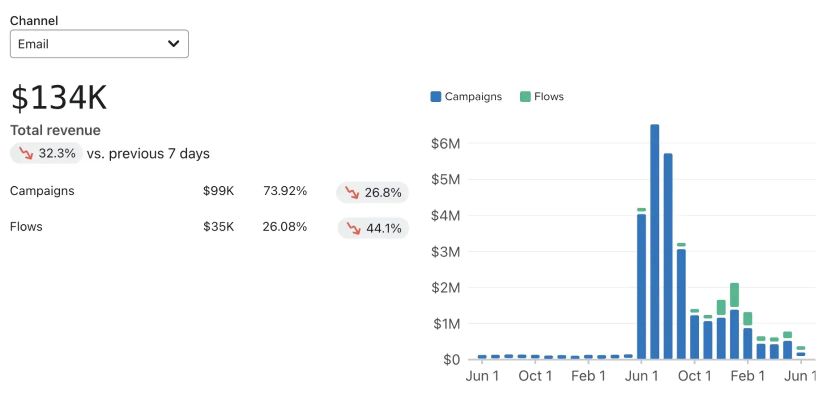
Fragment of Klaviyo’s business review dashboard
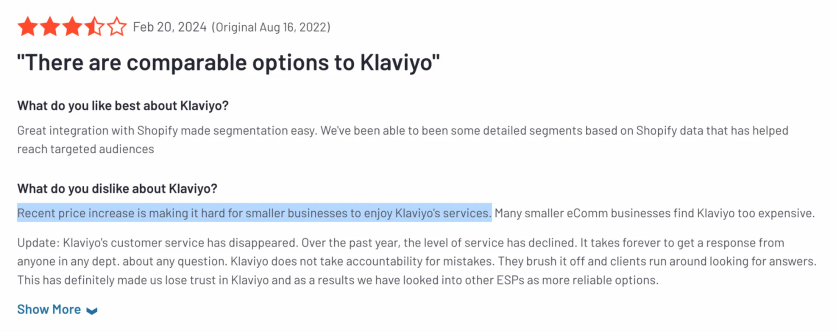
On the downside, Klaviyo can become expensive as your contact list grows, especially since you’re often paying for email contacts and SMS messages in one platform. A rapidly scaling brand might see their Klaviyo bill climb quickly into the hundreds or thousands per month (though Attentive isn’t cheap either, Klaviyo’s pricing is very contact-count dependent).
Klaviyo has added mobile push and in-app messages for brands with their own app, but it still leaves out web push, on-site personalization, and loyalty. So it’s more multi-channel than Attentive, but not fully omnichannel the way a platform like Maestra is.
There’s also a steeper learning curve for advanced features. Basic stuff is easy, but Klaviyo is very robust, and truly mastering its segmentation logic or fully exploiting its personalization takes some time and skill.
Lastly, some users report that Klaviyo’s email builder, while good, isn’t the most modern or slick compared to newer email tools. It’s functional but can feel a bit dated in UI.
Compared to Attentive
Klaviyo and Attentive have been on a bit of a collision course, each encroaching on the other’s territory. Attentive added email to complement its SMS, and Klaviyo added SMS to complement its email.
Attentive might let you segment by whether someone clicked a text or not. Klaviyo can create a segment like “VIP customers in California who purchased in the last 30 days and clicked any message about 'Shoes'.”
Klaviyo’s email features are also far more mature than Attentive’s nascent email tool. Advanced email A/B testing, automated resending to unopens, and intricate template designs are Klaviyo’s bread and butter, whereas Attentive’s email is pretty bare-bones.
But here’s the kicker. In terms of SMS capabilities, Attentive might have a slight edge on some SMS-specific innovations. They’ve been focused on SMS longer, so features like their two-way Concierge or certain compliance guardrails are very polished.
Attentive tends to position itself as more high-touch (they might manage more of the campaign creation for you via their team, acting almost as an extension of your team), whereas Klaviyo is very self-serve.
If you value control and depth of data, Klaviyo is likely more appealing than Attentive. On the other hand, if you wanted a hands-off approach with a vendor curating a lot of your SMS strategy, Attentive might pitch that (though at a cost).
Ultimately, many brands choose Klaviyo over Attentive because they want one platform for both email and SMS, and they trust Klaviyo’s robustness for email.
Compared to Maestra
Klaviyo vs. Maestra is a point solution versus a platform. Klaviyo is excellent at email and SMS automation. Maestra covers those channels and adds the ones Klaviyo doesn’t.
Here’s how they stack up:
| Capability | Klaviyo | Maestra |
|---|---|---|
| Channels | Email, SMS, mobile push and in-app (needs your own app) | Email, SMS, web and mobile push, on-site, WhatsApp |
| Loyalty | Third-party apps | Built-in |
| On-site personalization | Not native | Built-in, real-time |
| Customer data | E-commerce events | Real-time CDP, incl. live web behavior |
| Support | Self-serve | Dedicated Forward Deployed Marketer |
For instance, Maestra has built-in loyalty and rewards, on-site personalization, and web push woven into cross-channel journeys. Klaviyo has added mobile push and in-app for app-owning brands, but it has no native loyalty or on-site personalization. So with Klaviyo, you might still need additional tools for loyalty programs or website personalization (and then try to integrate them), whereas Maestra includes those in one system.
Also, Maestra’s real-time CDP means it’s aggregating data from every touchpoint instantly. Klaviyo has a strong data foundation with e-com events, but it might not capture, say, real-time web behavior for on-site personalization on the fly – Maestra does.
Another difference is the level of strategic service: Klaviyo is mostly a do-it-yourself platform (with support available, and agency partners if you need), while Maestra bundles in strategy and support via a dedicated Forward Deployed Marketer as mentioned. That means Maestra often feels like a more white-glove, enterprise solution, whereas Klaviyo is more DIY.
If email plus SMS covers your needs and you have the team to run it, Klaviyo is enough. Brands usually move to Maestra when they start needing what Klaviyo doesn’t do.
In many cases, brands outgrow Klaviyo when they start needing capabilities it doesn’t have – that’s where Maestra often comes into play, as an upgrade that consolidates what Klaviyo does and adds more on top.
Tool #3: Postscript – Best for Shopify-Native SMS
If Attentive is a generalist across many industries, Postscript is a specialist. It zeroes in on e-commerce merchants, especially those on Shopify, who want to drive sales through text messaging.
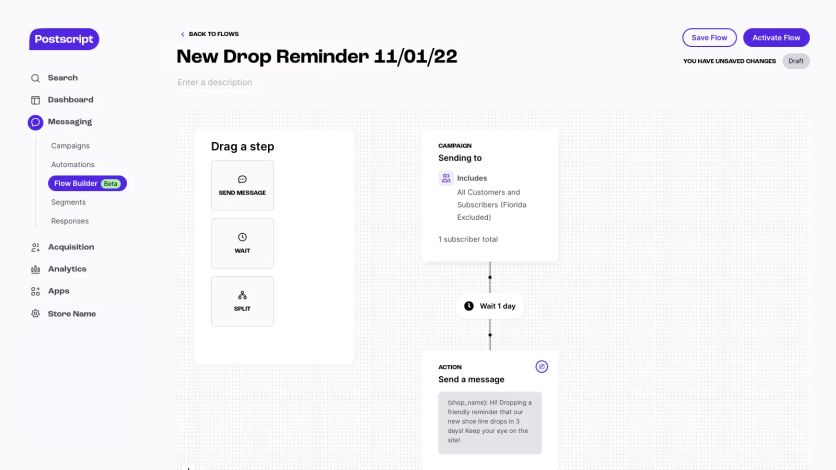
Postscript’s flow builder
The platform integrates deeply with Shopify, which means it can pull product data, customer tags, and order history directly into your SMS campaigns.
One standout aspect is Postscript’s focus on compliance and opt-in collection in the Shopify environment. It provides plug-and-play opt-in widgets, pop-ups, and keywords that let customers subscribe during checkout or via landing pages, so your list grows in a compliant way.
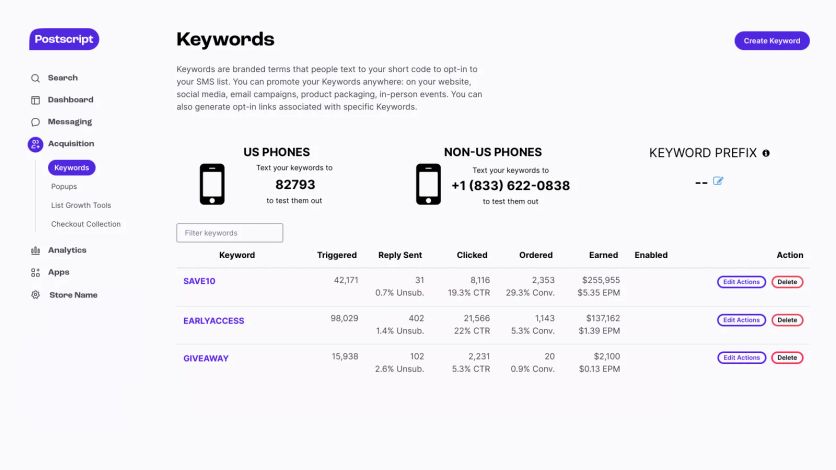
Postscript’s keyword opt-in
In terms of user experience, Postscript’s dashboard is straightforward. You can craft one-off campaigns or multi-step automated flows, use segmentation filters like purchase behavior or Shopify customer tags, and see revenue attribution for your texts.
Key Features:
- Seamless Shopify integration: Syncs customer data, order history, and product info in real time. You can insert product recommendations or dynamic discount codes into texts easily.
- Automated SMS flows: Built-in flows for abandoned cart, welcome series, and win-back campaigns.
- List growth tools: Native mobile number capture via pop-ups, checkout, and keyword campaigns.
- Two-way messaging: Customers can reply, and you can manage replies in a conversational inbox.
- Segmentation: Filter by total spend, items purchased, last purchase date, and more.
- MMS support and GIF library: Send engaging images or GIFs with built-in creative assets.
- Analytics and attribution: Track SMS-driven revenue, CTRs, and subscriber growth.
- Flexible pricing: Usage-based message credits that scale as you grow.
Strengths and weaknesses
Postscript’s strength lies in its simplicity and focus. For a Shopify merchant, it covers all the SMS essentials without much of an issue.
The templates and pre-built flows mean you don’t have to brainstorm every message from scratch. Postscript gives you a starting point, like a series of 3 abandoned cart texts spaced out over a day or two, which you can tweak to your brand voice.
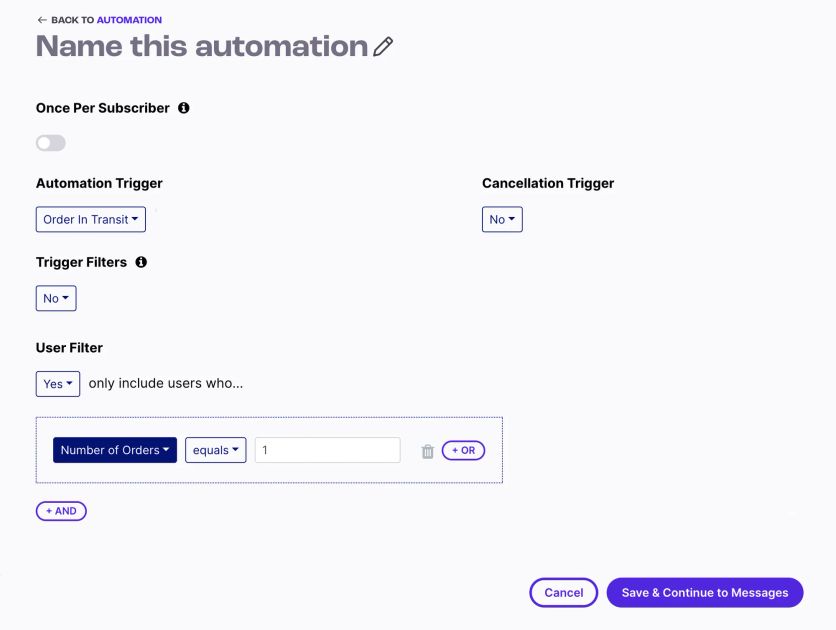
Creating an automation in Postscript
Another strong point is Postscript’s compliance safeguards. SMS marketing has strict legal requirements under TCPA, and Postscript handles things like unsubscribing keywords automatically while providing compliant language for opt-ins.
Because it’s focused on e-commerce, all the features are geared toward driving sales. The platform also tends to be more affordable for SMBs compared to enterprise tools. You pay for the messages you send, starting at a reasonable base, so you can scale up without huge contracts.
On the flip side, Postscript is SMS-only (no email, no push, etc.), so it’s not a one-stop shop if you need multi-channel. Many Postscript users pair it with an email platform like Klaviyo (in fact, Postscript integrates with Klaviyo to sync data between the two). This means you could end up using multiple tools, whereas an Attentive or others might handle both channels together.
Another weakness is that Postscript’s feature set is narrower than a big platform’s. Postscript has added AI tools like message-variant testing and an AI shopping assistant, though its segmentation, while solid, stays tied to the data Shopify provides.
For most smaller brands that’s fine. Larger ones might want to combine data from other sources like in-store purchases or a loyalty program, which would be harder to do directly in Postscript.
So, you rely on concise, punchy text copy for impact. Lastly, because Postscript is very focused on Shopify, if you ever migrate off Shopify to another platform, you might have to switch SMS providers (though they’ve since added an SDK for non-Shopify sites, Shopify is still their home turf).
Compared to Attentive
Attentive aims to be an upscale, full-service solution. They pair you with their own team for strategy and tout enterprise clients. Postscript is self-service and SMB-friendly.
If you’re a smaller operation or just starting with SMS, Postscript’s simplicity is a plus. Attentive might wow you with AI features or promises of big lifts, but it also comes with higher cost and potentially a longer onboarding. Postscript can often get you similar core results (recovering abandoned carts via text, sending promo blasts, etc.) at a fraction of the cost.
Attentive has capabilities Postscript lacks. Its Concierge handles automated customer replies with AI, and it offers an email component plus broader regional compliance support.
However, Postscript’s tight Shopify integration is arguably smoother than Attentive’s integration. Because Postscript is literally an app in the Shopify ecosystem, it feels very native – data flows in real time, and you can even manage some settings from within Shopify.
Attentive integrates with Shopify too, but as an external platform via API – it works, but you might experience slight sync delays (for example, Attentive might sync your nightly inventory or something, whereas Postscript can check inventory in real time if needed).
Another factor is flexibility vs guidance: Attentive might prescribe best practices and do a lot for you (good if you lack bandwidth), whereas Postscript gives you the tools to run SMS your way (better if you have a clear vision or strategy).
Bottom line: Attentive is overkill and over-budget for a lot of Shopify stores, especially those with a solid email setup already. Postscript nails the SMS basics at a fraction of the cost.
Compared to Maestra
Comparing Postscript to Maestra is really comparing a single-channel tool to a multi-channel powerhouse. Postscript does one thing very well: Shopify SMS marketing. Maestra, on the other hand, does many things – SMS included – at a very high level.
Below is a more detailed look at how they compare:
| Capability | Postscript | Maestra |
|---|---|---|
| Channels | SMS and MMS only | SMS, email, push, on-site, loyalty |
| Coordination | SMS in isolation | One event triggers every channel |
| Customer data | Shopify data | Real-time CDP across all sources |
| Recommendations | Manual | Automated from browsing and inventory |
| Support | SMB support | Dedicated Forward Deployed Marketer |
If a brand is only looking to improve their SMS game on Shopify, Postscript is a fine choice. But brands that are thinking bigger – like connecting SMS with other channels and building unified customer journeys – will find Maestra much more capable.
For instance, Maestra can take an event like an abandoned cart and not only send an SMS, but also an email, show a personalized website banner, and adjust a Facebook ad audience, all orchestrated together. Postscript would handle the SMS part in isolation and you’d rely on other tools for the rest, without real-time coordination between them.
Maestra also has built-in loyalty triggers and personalized product recommendations via SMS or email. Postscript can’t automate a recommendation based on browsing history combined with live inventory.
In terms of support, Postscript support is well-regarded for SMB, but Maestra’s dedicated Forward Deployed Marketer model is a different tier – it’s like comparing general support to having a consultant on call.
Worth noting: A brand considering Postscript is likely at an earlier stage than a typical Maestra client. Those brands might not yet feel the pain of siloed systems because they’re still building out each channel.
In essence, Postscript is part of a possible toolkit with other apps, whereas Maestra could replace the toolkit. If you anticipate needing more than just SMS (like adding sophisticated email, loyalty, on-site personalization), you might start with Postscript for SMS now but eventually outgrow it and turn to something like Maestra to avoid juggling separate solutions.
Maestra is the next step when an e-commerce brand says: “SMS is great – what if we could have it work in tandem with everything else we do?” and doesn’t want the headache of manually making that happen.
Tool #4: Braze – Best for App-Driven Brands
Braze is a customer engagement platform aimed at enterprise brands, particularly those with mobile apps or complex multi-channel needs. Braze is a heavy-hitter for orchestrating messaging across mobile push, in-app messages, email, SMS, and more. If Attentive sometimes feels limited to just texts (and a bit of email), Braze is the polar opposite: it’s all about coordinated, cross-channel campaigns powered by real-time data.
The platform excels at event streaming and segmentation at scale. It ingests streams of customer events like app opens, purchases, and content views, then lets you build sophisticated trigger conditions.
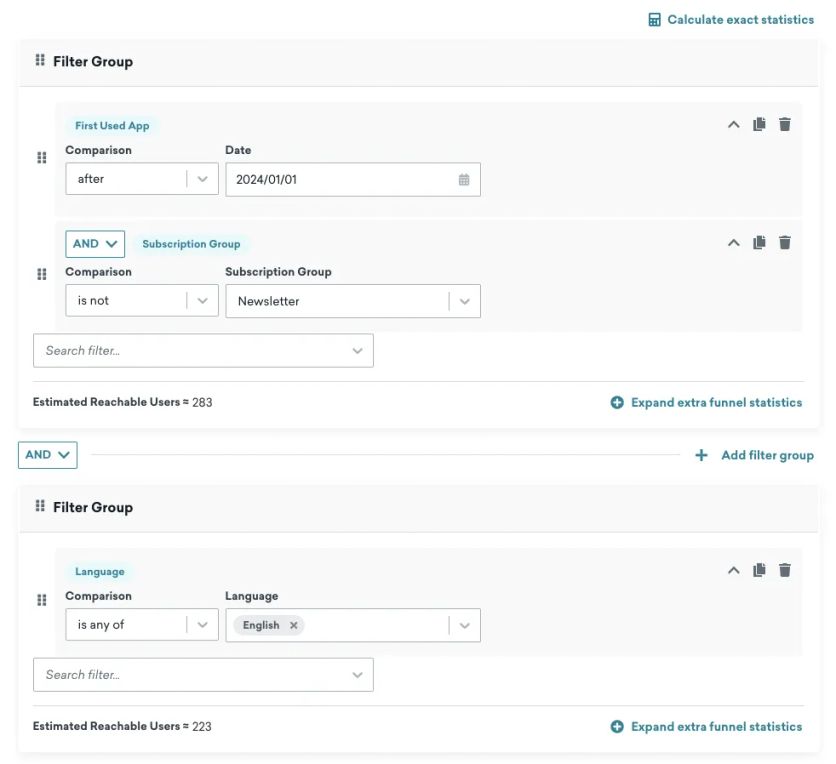
Creating a segment in Braze
Braze’s Canvas tool (their journey builder) allows branching logic, testing, and all sorts of complex journey mapping that sophisticated marketing teams crave. In essence, Braze provides the infrastructure and tools to ensure the right users get the right message on the right channel, all in real time, even at massive volumes.
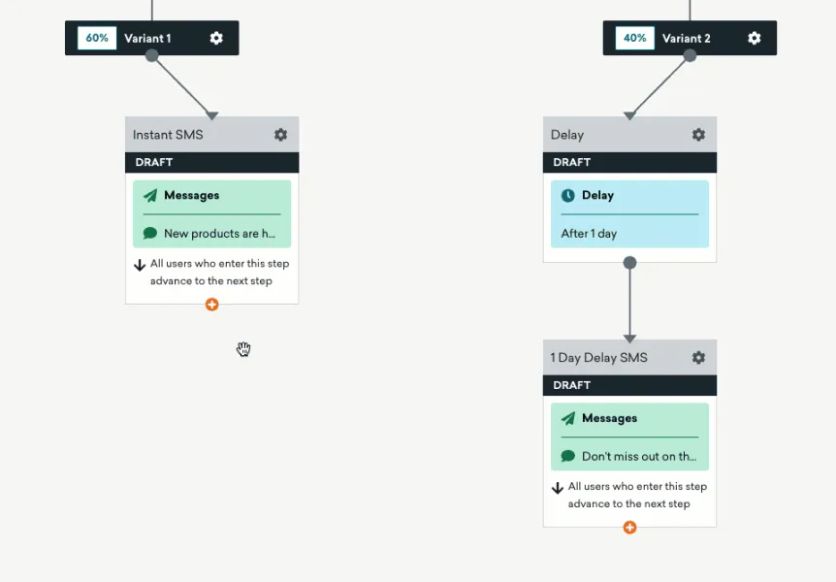
Braze’s Canvas tool
Key Features:
- Multiple channels: Native support for mobile push, web push, email, SMS, in-app messages, and content cards. One campaign can combine any of these.
- Braze Canvas: A visual builder for multi-step, multi-channel journeys with branching logic. You can A/B test entire paths or timing delays.
- Real-time data streaming: SDKs and APIs pull user events in real time, so behavior can trigger messages seconds later. Braze can also ingest data from external sources like a CRM.
- Intelligence Suite: Predictive tools like Intelligent Timing (send when each user is most likely to engage) and Intelligent Channel (pick the best channel per user based on past behavior).
- Personalization: Advanced personalization using Liquid templating. Reference user attributes, event data, product recommendations, or live inventory and pricing via API.
- Analytics and Currents: Detailed campaign analytics, plus Braze Currents to stream data out to warehouses like Snowflake or Looker.
- Scale and throughput: Built to send huge volumes reliably, even during high-traffic events like Black Friday.
- Developer Friendly & Integration: They have robust SDKs for iOS, Android, web, and a library of integrations (to import/export data). It often sits in a larger stack, connecting with CDPs like Segment or analytics tools, and it’s quite flexible in that regard.
Strengths and weaknesses
Braze’s strength is in its firepower and flexibility. It’s the kind of platform that can be as sophisticated as your strategy requires. Have a crazy idea for a campaign that involves three channels, conditional logic based on user attributes, and multivariate tests? Braze can probably do it. Marketing teams at large enterprises love that they can dream up complex customer journeys and Braze will let them build and automate those scenarios, rather than resorting to one-off manual campaigns.
Another strength is Braze’s focus on the user experience – by supporting so many channels and real-time triggers, it enables a very customer-centric approach. Instead of blasting everyone with the same message, Braze pushes you toward targeted, behavior-driven messaging. Where Attentive focuses on SMS, Braze spans the full range of customer-engagement channels. On top of that, Braze has a strong community and documentation, plus customer success teams used to working with big clients – so enterprises feel supported. The reporting is also quite granular, allowing teams to prove out the impact of campaigns or refine them with data.
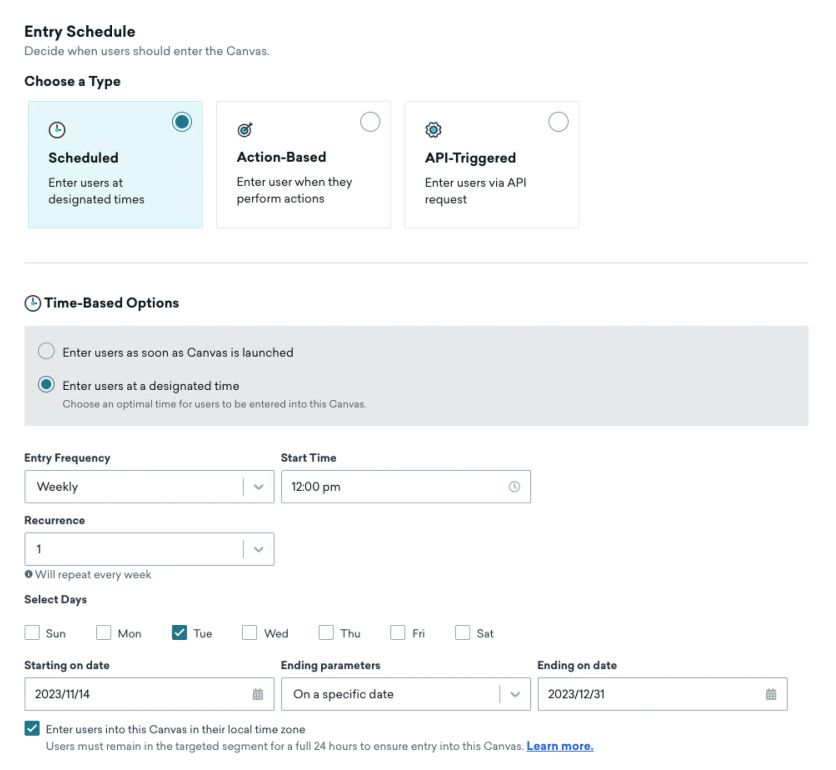
Scheduling delivery in Braze
However, with great power comes… some trade-offs. Braze is not trivial to implement or operate. It often requires developer involvement to get the most out of it (especially to instrument your app or website to send the right events and data into Braze). Smaller teams without a dedicated tech resource might struggle to fully utilize it. In contrast, Attentive or others might be more turnkey.
The interface has a learning curve, too. Marketers often need training, whereas simpler tools can be picked up in a day.
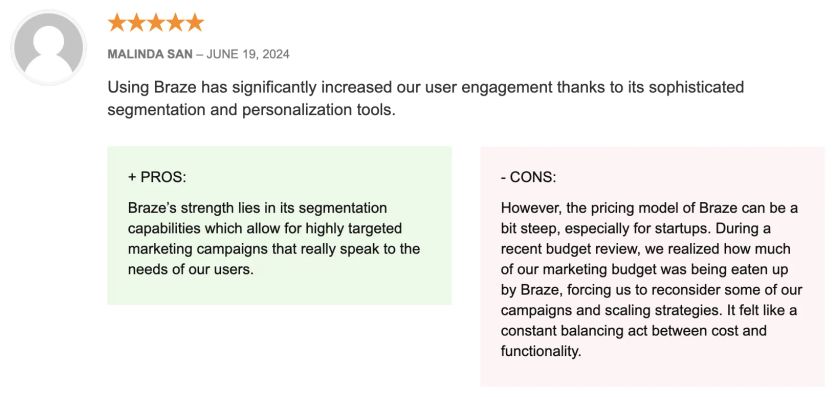
Then there’s cost. Braze is priced for enterprise and charges based on monthly active users or subscriber counts across channels, plus message volumes. For an SMS-only program, it’s overkill and too pricey.
Also, for all its channels, Braze does not include some higher-level marketing features like a loyalty program or out-of-the-box review generation like Yotpo would, for example. It’s channel-agnostic engagement, so something like a loyalty tier management would be custom or external. Essentially, Braze gives you the pipes and the sending engine, but not those niche marketing programs.
And while Braze does SMS, it isn’t an SMS specialist. It may not match Attentive’s SMS-specific innovations like the two-way Concierge or managed compliance services, because it’s spread across channels.
Compared to Attentive
Attentive and Braze target almost different planets. Attentive is for marketing teams that want a turnkey SMS and email solution to drive revenue, usually e-commerce.
Here’s a quick look at their key differences and how they match up:
| Capability | Attentive | Braze |
|---|---|---|
| Channel focus | SMS-first, plus email and basic push | Push, in-app, email, SMS, webhooks |
| Best fit | E-commerce SMS revenue | App-centric, enterprise orchestration |
| SMS depth | Deep (Concierge, compliance) | One channel among many |
| Setup | Turnkey | Needs engineering resources |
| Pricing | Quarterly minimums | Enterprise, usage-based |
If you compare feature to feature, Braze covers SMS (as one channel among many), but it doesn’t offer the kind of specialized SMS services Attentive does like helping with carrier provisioning or dedicated short codes as proactively, because enterprises usually handle that or Braze assumes you know what you need. Braze’s SMS is typically used alongside push and email for companies with apps (e.g., a ride-share service sending you an SMS if you haven’t opened their push).
For a pure e-commerce retailer, Braze can be somewhat complex if you don’t utilize the mobile/app capabilities. Meanwhile, Attentive is quite specifically optimized for retail use-cases like cart abandonment texts or product drop alerts via SMS.
In terms of channel breadth, Braze far outstrips Attentive. Attentive centers on SMS with email and basic push, while Braze adds in-app, content cards, and webhooks that trigger external actions. So if a brand’s looking at expanding beyond SMS/email, Braze is a logical step up.
On ease-of-use, Attentive probably wins for a marketing person; Braze might require more technical know-how. Attentive often acts as a “strategic partner” for you (with their customer success suggesting campaigns, etc.), whereas Braze expects more technical ownership – they’ll support you, but you’re expected to have engineering resources, either in-house or via solutions partners.
Cost-wise, if Attentive felt expensive, Braze could be even more so, unless you’re cutting other tools and consolidating into Braze.
Another notable difference: Attentive’s strength is two-way conversational SMS for commerce (they highlight how you can chat with customers via text). Braze supports two-way (you can get replies and respond or trigger flows based on keywords), but it doesn’t emphasize a managed conversational service. Braze is more about automation at scale; Attentive is also about one-to-one engagement via text with the help of their Concierge.
In summary, if a company is currently only doing SMS with Attentive and contemplating Braze, it’s likely because they need to integrate more channels (maybe they launched an app, or they want to unify messaging). Attentive could start to feel limiting in that case. Braze offers a world of multi-channel possibilities Attentive can’t match, but it also demands more investment in setup and talent to harness it.
Bottom line: If you’re expanding beyond SMS and email, Braze is a logical step up. If you just want better SMS results, it’s overkill next to Attentive.
Compared to Maestra
Braze and Maestra both offer omnichannel capabilities, but from different angles. Braze’s heritage is product and app messaging, strong for tech companies and large brands.
Below, we compare key features and strengths of each:
| Capability | Braze | Maestra |
|---|---|---|
| Heritage | Product and app messaging | Commerce marketing |
| Loyalty | Via partners | Built-in |
| On-site personalization | Not out of the box | Built-in |
| Segmentation | Often needs external data prep | Marketer-friendly CDP |
| Support | Needs engineers | Dedicated Forward Deployed Marketer |
In a way, Maestra attempts to bundle the best of several worlds: the cross-channel messaging of a Braze, the loyalty of a Smile.io, the personalization of an Optimove, etc., into one. Braze, on the other hand, sticks to being a communications platform and relies on you to integrate any loyalty or advanced marketing logic from elsewhere.
A key difference is accessibility and support. Maestra provides a lot of white-glove service and is designed so that a marketing team can use it without needing a squad of engineers. Braze, while marketer-friendly in interface, typically still needs engineers to pipe data in correctly and possibly to manage templates for in-app messages, etc. If a brand doesn’t have that engineering support, Maestra would be a gentler experience because Maestra’s team helps with those heavy lifts and the platform is tailored to not need as much custom dev work to get common use-cases going.
For example, implementing a loyalty program trigger in Braze means your app or backend has to send Braze an event when someone’s loyalty points change, and then you craft a campaign around that. In Maestra, the loyalty program is built-in, so those triggers are native and easier to configure by a marketer.
In terms of capabilities, Maestra matches Braze on channels like SMS, email, push, and also adds the on-site and loyalty angles.
Maestra has a real-time CDP that’s arguably more marketing-friendly – it’s built to house purchase history, product catalog, etc., and make that usable quickly for segmentation. Braze often relies on integrating with an external CDP or data warehouse for the richest segmentation (Braze can store a lot of data per user, but complex segment logic sometimes needs data pre-processed). So Maestra might let a marketer create a complex segment more easily through its interface, whereas Braze might expect some computed custom attributes fed in to simplify segmentation.
When it comes to choosing between them, a brand that is very app-centric or has a wide non-commerce user base (like a media app or a fintech service) might lean Braze, because that’s Braze’s sweet spot. A brand that is commerce-centric and wants a more turnkey growth platform might lean Maestra, as it covers more of those needs out-of-the-box.
Also, Maestra includes the strategic guidance in the package, whereas with Braze you might hire consultants or have an internal CRM team to strategize.
In essence, Maestra provides an all-in-one growth engine with handholding, whereas Braze provides a powerful multi-channel engine and expects you to drive it. They can achieve similar outcomes – highly personalized, timely messages across channels – but Maestra bundles more marketing-specific functionality on the platform and service side, while Braze offers a bit more raw configurability.
Tool #5: Omnisend – Best for Budget-Friendly Multichannel
Omnisend is an email and SMS marketing platform designed for small to mid-sized e-commerce businesses. It positions itself as an affordable, easy-to-use alternative to tools like Klaviyo, with the bonus of also handling web push notifications.
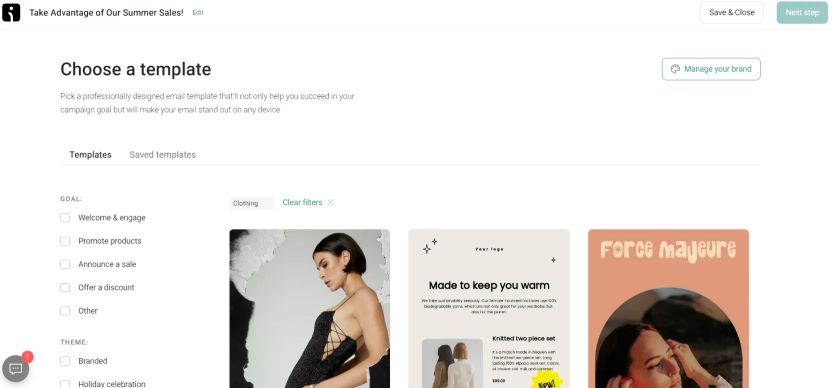
Omnisend’s email templates
It integrates nicely with e-commerce platforms like Shopify, BigCommerce, and WooCommerce, pulling in product and customer data to fuel your marketing.
One of Omnisend’s calling cards is its library of pre-built automation workflows tailored to e-commerce – things like welcome series, cart recovery, browse abandonment, order confirmations, and reactivation campaigns are available as templates that you can activate with a few clicks. This is great for smaller teams who may not have the time to build complex automations from scratch.
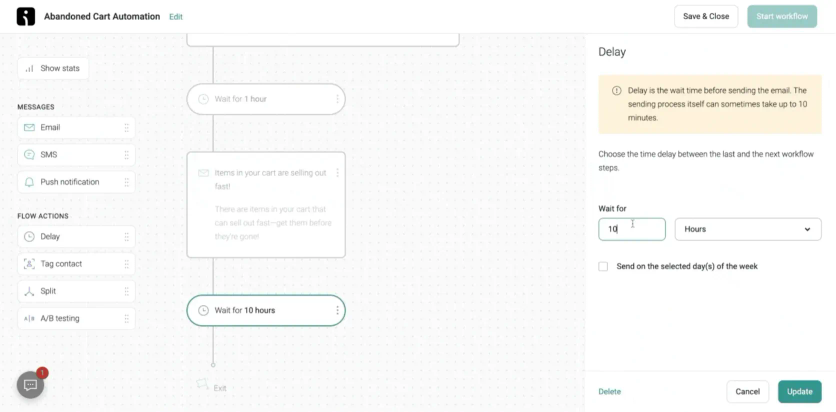
Omnisend’s pre-built abandoned cart automation
Omnisend also includes a modest SMS capability (you can send text campaigns or add SMS steps in your automation workflows) and supports basic web push notifications, giving it a broader channel mix than Attentive’s SMS-led offering. In summary, Omnisend aims to cover the marketing needs of an online store in one place: capturing subscribers, emailing them, texting them, and even nudging via push – all with a friendly interface and at a budget that smaller businesses can handle.
Key Features:
- Email and SMS campaigns: Build branded emails using a drag-and-drop editor and send SMS messages. Combine both into a single workflow, such as an email followed by an SMS to non-openers.
- Pre-built automations: Ready-to-use workflows for cart abandonment, welcome series, order and shipping updates, and reactivation, with recommended timing you can customize.
- Segmentation: Segment by shopping behavior, email engagement, or profile data. Not as granular as enterprise tools, but enough for targeted campaigns like “VIP customers” or “Category X browsers.”
- Sign-up forms and pop-ups: Build email pop-ups, landing pages, or a wheel-of-fortune sign-up game to capture email addresses and phone numbers on your site.
- Web push notifications: Capture browser push subscribers and send back-in-stock or flash sale alerts that appear even when a user isn’t on your site.
- Campaign booster: Resend emails to non-openers with a different subject line for a second shot at engagement.
- Reporting: A dashboard showing sales, clicks, and engagement, with revenue attributed to each automation.
- Integrations: Connects with review apps, loyalty apps, Google Ads, and Facebook Ads for syncing lists to ad audiences.
- Pricing model: A free tier for email up to a set contact count, with paid upgrades for more contacts and SMS credits. More affordable at entry level than many competitors.
Strengths and weaknesses
Omnisend’s strength is definitely in its accessibility and value for money. For an SMB, being able to set up relatively advanced automations with a few clicks is a huge win – you can start recovering abandoned carts or sending post-purchase review requests without deep technical skills.
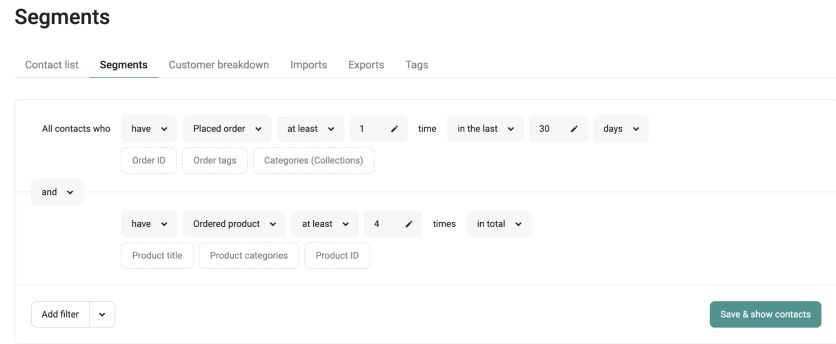
Omnisend’s segment builder
The interface is built for marketers who aren’t experts. It’s clean and simpler than Braze or even Klaviyo. Email, SMS, and push in one place means you don’t learn or pay for multiple systems.
Another plus is support and onboarding, which users often praise. That matters for smaller businesses that need extra help getting set up.
The platform continuously rolls out new e-commerce-centric features (they recently beefed up things like product recommender blocks in emails, etc.), showing they are focusing on what store owners need. Also, the inclusion of web push is a nice touch – it’s a free channel (doesn’t cost per send like SMS or email) and can add a few percentage points of extra reach/ sales if used well, and not all competitors include push in the mix.
On the downside, because Omnisend aims to be easy and affordable, it may lack some of the advanced sophistication of pricier or more specialized tools. For example, its segmentation, while useful, isn’t as deep as what you’d get in a dedicated CDP – you might not be able to create ultra-nuanced segments combining dozens of criteria.
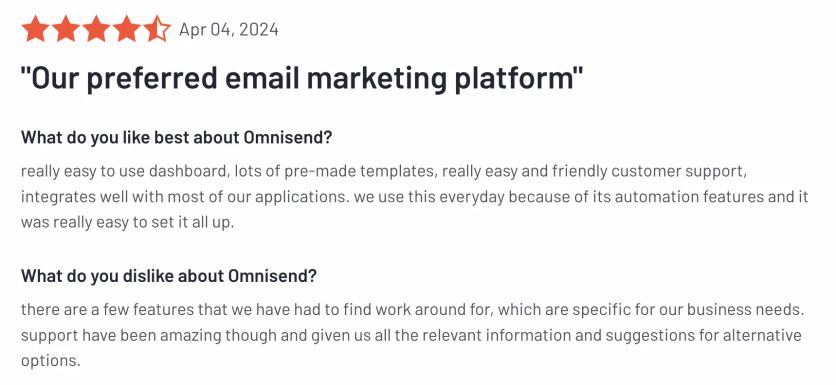
The email builder, while user-friendly, could be limiting if you want highly custom designs or complex dynamic content (it’s improving, but agencies sometimes prefer more flexibility). Also, while Omnisend does offer SMS, it’s somewhat region-limited – it’s strong in certain areas (like U.S., Europe) but might not support all countries as robustly as a dedicated SMS platform, and its SMS feature set is more basic (Attentive’s two-way chat or advanced compliance handling outstrips Omnisend’s simple send-and-receive capability).
In terms of deliverability, Omnisend is generally good but doesn’t give as much granular control as advanced email platforms (e.g., managing dedicated IPs, fine-tuned domain warmups – though for most small businesses that’s overkill anyway).
A potential weakness is scalability: an SMB might love Omnisend, but as they grow to enterprise level, they might start to feel limitations – be it in reporting depth, speed, or integration flexibility.
Bottom line: Omnisend covers about 80% of what most small and mid-sized e-commerce brands need. The other 20%, like complex analytics or deeper personalization, may eventually require a move upmarket.
Compared to Attentive
For a small or mid-sized brand, Attentive and Omnisend solve different problems. Attentive specializes in one thing (SMS, with some email now) and does it flashily (AI, promise of huge ROI via text). Omnisend is offering a broader, more balanced package (email + SMS + push) at a cost that SMBs can stomach.
Below, we look closer at how Attentive and Omnisend compare:
| Capability | Attentive | Omnisend |
|---|---|---|
| Channels | SMS-first, plus email and basic push | Email, SMS and web push |
| Basic add-on | Full-featured | |
| Pricing | Opaque, quarterly minimums | Transparent, free plan, from $16/mo |
| Cross-channel | Can’t see email run elsewhere | Email then SMS follow-ups in one tool |
| Best fit | SMS-heavy brands | Budget SMBs wanting all-in-one |
If you’re already using Attentive for SMS and another tool for email, Omnisend could replace both in one go, which is appealing from a cost and simplicity perspective. Attentive’s SMS capabilities might be a bit more advanced – for example, Attentive has that two-way concierge and very refined SMS templates for things like compliance messaging. Omnisend’s SMS is more straightforward: you schedule or automate texts, you can receive replies but it’s not positioned as a conversational channel with AI handling it. Attentive might yield more SMS-driven revenue if you fully leverage their bells and whistles, but then you’d still need to handle email separately.
Omnisend’s email capabilities far exceed Attentive’s basic email add-on. So, if email marketing is an equal priority to SMS for you (and it usually is for e-com), Omnisend offers a more robust solution there (better email design tools, more email automation, etc.).
Another aspect is pricing transparency and control. Attentive’s pricing can be opaque and often expensive for small folks, whereas Omnisend’s pricing is transparent on their site, with free plans and predictable tiers – no surprise overages except if you send a ton of SMS (but you buy those as needed). Many small brands simply won’t qualify for Attentive’s higher-touch service or large minimums; they can get started on Omnisend for free or cheap and see results.
However, Attentive’s focus means they might have higher SMS click-through or conversion rates, potentially, since they fine-tune text strategies with you. But if Attentive’s email is lacking, overall performance may suffer in the multi-channel sense. Omnisend encourages using a combo: maybe you send an email first, then a text to those who didn’t open or purchase – you can orchestrate that easily in Omnisend, something Attentive alone can’t do (Attentive can’t know who ignored your email from Mailchimp, for example, whereas Omnisend knows because it was running the email).
So, compared to Attentive, Omnisend is more of an all-in-one marketing solution albeit a bit less flashy. A brand that needs to maximize every dollar and prefers a simpler tech stack might choose Omnisend over juggling Attentive + another email platform. On the other hand, a brand that has a large SMS list and wants to push SMS performance to the max, and maybe has budget for separate best-in-class tools, might lean Attentive (and then pair it with something else for email).
One more thing: Attentive’s support is more high-touch for big clients (like they provide strategic guidance), whereas Omnisend, while supportive, is more self-serve/tech support oriented.
Overall, Omnisend offers a compelling “good enough” alternative to Attentive that also solves additional problems at a lower cost, which for many is a winning proposition.
Compared to Maestra
Omnisend and Maestra target different ends of the market. Omnisend is aimed at smaller brands; Maestra is geared toward rapidly scaling brands and mid-to-large enterprises that want the full toolkit.
If you’re choosing between the tools, the notable differences include:
| Capability | Omnisend | Maestra |
|---|---|---|
| Target | Smaller brands | Scaling brands, mid-to-large |
| Loyalty | Via apps | Built-in |
| On-site personalization | None | Built-in |
| Push | Basic, one-off | Coordinated inside journeys |
| Customer data | Basic segmentation | Real-time CDP |
Maestra covers what Omnisend does and adds more on each channel, plus a real-time CDP, loyalty, and on-site personalization.
So, a brand using Omnisend might eventually hit a ceiling: maybe they want to do real-time personalized content on their homepage based on a user’s email behavior, or they want a tightly integrated loyalty program driving their emails and texts – Omnisend can integrate with loyalty apps but doesn’t have its own; Maestra has it built-in.
Omnisend’s push is also basic, one-off, or automated. Maestra’s push can run inside a larger journey coordinated with web personalization, which Omnisend doesn’t do.
From a support perspective, Omnisend is more DIY, whereas Maestra is that full-service partner model. A company might start on Omnisend and do well, but as they grow, they might value more guidance or bespoke solutions – Maestra provides a dedicated Forward Deployed Marketer who actively works on your account strategy, which Omnisend (at its price point) can’t offer.
Also, scale and optimization: Maestra’s infrastructure is built to handle enterprise volumes and real-time decisions at scale. Omnisend works great for moderate lists, but if you become a huge retailer with millions of contacts and complex data, you’d likely consider upgrading to a platform like Maestra (or others in that tier) for reliability and sophistication.
In summary, Omnisend is sort of an entry-level tool and Maestra is high-end. They’re alternatives to Attentive in different segments. Omnisend is cost-effective but limited to simpler tactics. It’s a trade-off between “keep it simple and cheap” versus “invest to unlock big growth levers.”
If a brand aspires to do what the big players do (real-time personalization, unified multi-channel, etc.) and has the growth to warrant it, Maestra would be the choice. If they are more constrained or simply don’t require those extras yet, Omnisend might serve them perfectly well for a long time. In a way, Maestra could be seen as what you graduate to if you outgrow Omnisend.
Tool #6: Emotive – Best for Conversational SMS
Emotive’s campaign flow interface for two-way conversations. Emotive is a unique player in the SMS marketing arena, billing itself as a platform for “conversational commerce” via text message. (Note: Emotive was acquired by Privy in 2025 and now operates as part of Privy’s email and SMS platform.)
While Attentive and many others allow two-way messaging, Emotive puts that front and center by combining automated texts with real human interaction. The idea is that when a customer replies to one of your campaign texts – say, asking a question about a product – Emotive’s system can hand the conversation off to a live agent (an e-commerce sales rep or support agent on your team, or in some cases an agent provided by Emotive’s service) who continues the conversation, driving toward a sale or resolution. This hybrid approach aims to give consumers a feeling of personalized, real conversation over SMS, rather than just receiving blasts or bot-like replies.
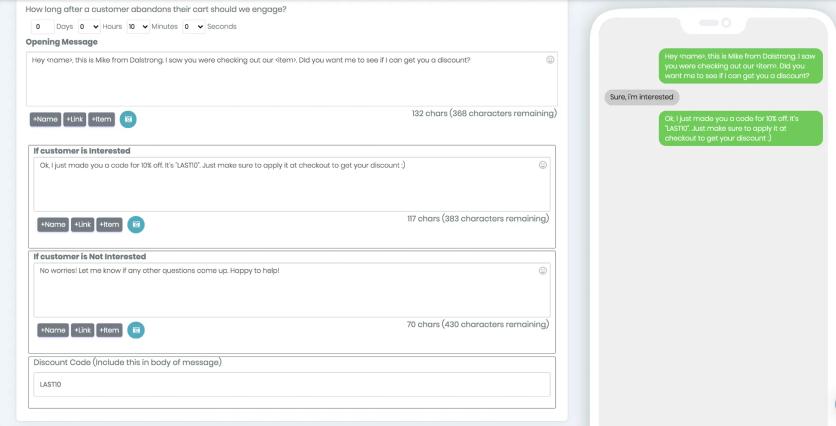
Setting up conversational texting abandoned cart in Emotive
Emotive integrates with Shopify and other e-com platforms to pull in customer and order data, so agents (and the system) have context on who they’re texting (past purchases, browsing history if tracked, etc.).
Emotive also provides an AI assistant that helps manage the flow: it can handle simple responses or FAQs initially – for example, if someone texts “How do I track my order?”, the AI can recognize that and send the tracking info – and route more complex queries to a human.
For a brand, using Emotive means when you send out an SMS campaign, you’re not just sending a message, you’re implicitly opening a chat channel with customers. The platform includes a dashboard for viewing and responding to ongoing text conversations, tools to trigger campaigns or one-on-one outreach, and analytics on the outcomes (like how many conversations led to a purchase).
Key Features:
- Conversational SMS campaigns: Build campaigns that invite a reply, like a question, a quiz, or a simple “Have questions? Just reply.” The AI and agents handle responses at scale.
- Human plus AI agents: The AI greets and handles common questions, then pings a human for higher-value interactions. Fast response times without losing the human touch.
- Segmentation and targeting: Segment by browsing history, purchase history, and other attributes to keep conversations relevant.
- E-commerce data integration: Agents can view order history, modify orders, and issue discount codes mid-chat, making conversations truly commerce-enabled.
- Campaign types: Two-way structures like product quizzes, feedback collection, and VIP concierge outreach (“We noticed you left something in your cart, any questions?”).
- Compliance and opt-in tools: Consent capture via keywords, short codes, and forms, with automatic opt-out handling and compliant messaging.
- Analytics and ROI tracking: Revenue tied back to conversations. If an agent shares a code and the customer buys, that sale is attributed to the chat.
- Managed service option: Emotive offers a team of their trained “concierge” agents who can represent your brand in these text conversations, if you don’t have staff to dedicate. This is a big differentiator; they essentially offer outsourcing of the conversational texting to experts (for an added fee), which can be appealing to brands that love the idea of one-to-one texting but can’t staff it 24/7.
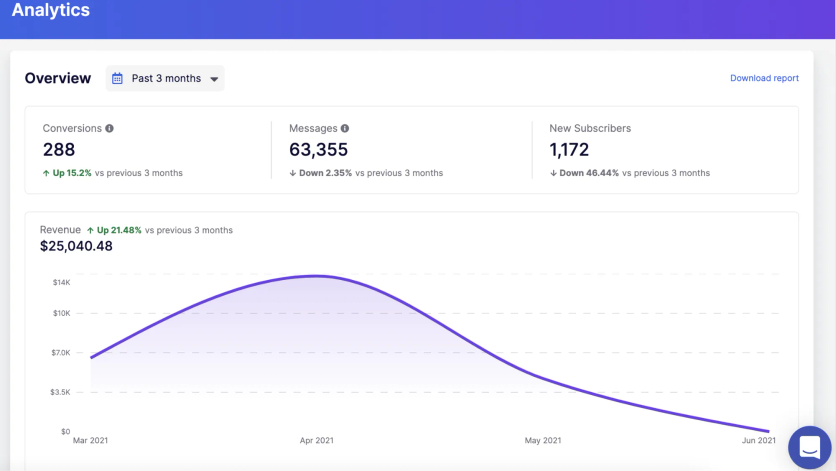
Emotive’s Reporting
Strengths and weaknesses
Emotive’s strength lies in the personalized customer experience it facilitates. In an era where consumers are bombarded with impersonal marketing, actually having a conversation with a brand via text can really stand out. Many shoppers have questions or hesitations that, if resolved in the moment, lead directly to a sale – Emotive capitalizes on that by making SMS interactive. This often translates to higher conversion rates from SMS campaigns. Instead of just sending a coupon and hoping they use it, you’re effectively replicating the in-store sales associate experience: “Can I help you find something or answer any questions?” That can boost confidence and push customers over the line.
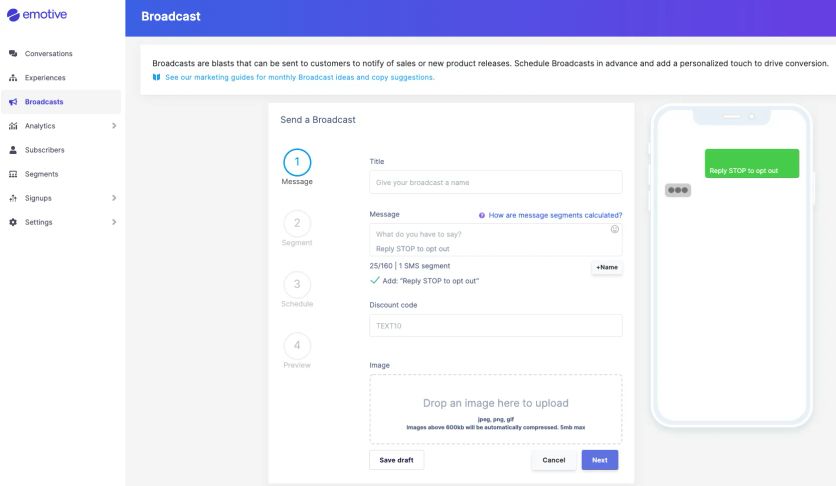
Emotive’s Broadcast Lab
Emotive clients often see strong ROI because those conversations can recover potentially lost sales (like abandoned cart recovery through a personal nudge). Another strength is the blend of AI and human. Pure AI chatbots can be frustrating when they hit their limits, but Emotive’s use of humans for the nuance ensures the customer feels heard and assisted, not stuck in an endless loop of “Sorry, I didn’t get that.” For brands with smaller catalogs or higher-touch products (like luxury goods or electronics that people might have questions about), this approach is golden. Also, Emotive makes it relatively easy – they train their agents to know your FAQs and tone, so even the outsourced approach can feel consistent with your brand voice.
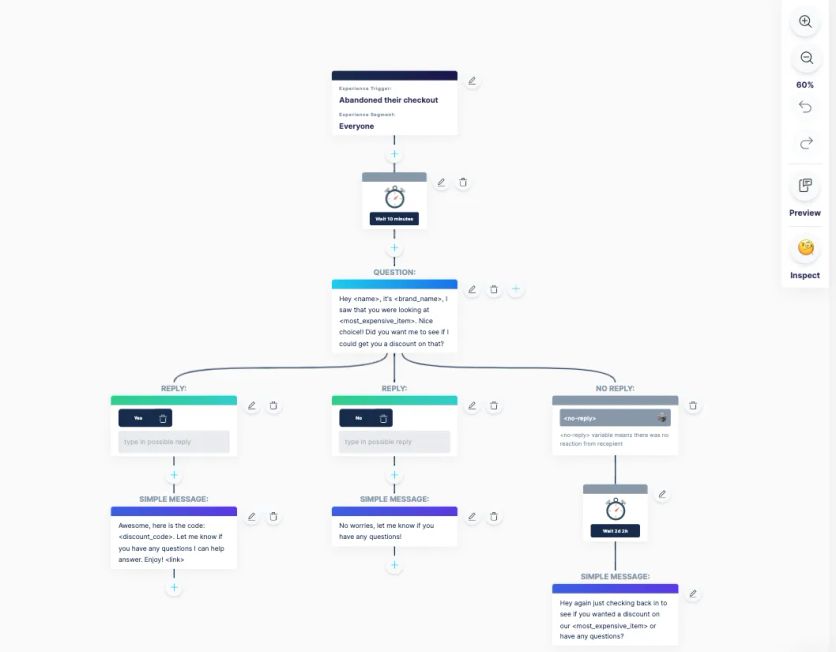
Abandoned Checkout flow in Emotive
Weaknesses of Emotive include scalability and cost. While they do their best to automate, the model inherently involves human labor. If you suddenly need to engage thousands of customers in text conversations, you either need a big team on your side or to pay Emotive’s team to handle it. This can get expensive – likely more expensive than a typical SMS platform where you just pay per message. Staffing live conversations costs far more than sending automated blasts. So, brands must ensure the increased sales justify that cost.
Another potential downside is not every consumer wants to chat. Some might find it intrusive if a brand starts texting them and trying to chat when they only expected a one-way promo. Emotive campaigns need to be crafted carefully to ensure you’re engaging those who are interested and not annoying those who aren’t – otherwise you risk higher opt-out rates. Compared to Attentive’s approach of mostly automated personalized messaging, Emotive’s reliance on human interaction could be seen as less efficient from a pure tech standpoint. Also, if a business already has live chat on their site or robust customer support, they may find overlapping efforts (e.g., an agent answering the same question on live chat and via Emotive). It requires coordination.
Emotive’s platform as a software may also not be as feature-rich in non-conversational aspects – for example, it doesn’t focus on email, push, etc., so it’s not a one-stop shop; it’s an add-on specifically to supercharge SMS with conversation. And as a relatively newer concept, measuring its success can be tricky – one needs to look at conversation-to-sale conversion metrics, which is a bit different from standard campaign metrics. Overall, Emotive’s approach can be highly effective, but it’s best suited for brands that benefit from customer dialog and are prepared to invest in making the most of that dialog.
Compared to Attentive
Attentive and Emotive share the SMS channel, but their philosophies diverge. Attentive emphasizes scale and automation with personalization, whereas Emotive emphasizes conversation and human touch. If you’re currently using Attentive, you might be sending out more “campaign” style texts – even if segmented and targeted, they’re largely one-way, aside from maybe automated responses to certain replies. With Emotive, you’re embracing a strategy where every customer reply is an opportunity for a back-and-forth interaction.
The contrast is notable, and here’s a look at how each tool compares:
| Capability | Attentive | Emotive |
|---|---|---|
| Approach | Scale and automation | Conversation and human touch |
| Two-way | Concierge (AI + human) | Human agents + AI, managed option |
| Best fit | High-volume SMS | Consultative, higher-touch products |
| Trade-off | High reach | Higher conversion per chat, fewer replies |
If customers often have questions, or your product benefits from consultation like cosmetics or electronics, Emotive offers something Attentive doesn’t: real-time, personal help over SMS.
Attentive’s scale vs Emotive’s intimacy: Attentive can blast out huge volumes and rely on its AI for some personalization (like insert first name, maybe product recommendations to segments, etc.), and it might trigger follow-ups based on behavior (like a reminder text if no purchase, etc.). Emotive will treat each send as the start of a possible chat session. So for example, Attentive might send a “We saw you left items in your cart” text with a link. Emotive might send “You left something in your cart – do you have any questions about it? I’m here to help!” The latter invites engagement.
It could recover more carts through direct assistance, but maybe fewer people will respond at all (some might prefer just the link and not want to chat). It’s a different style, possibly appealing to different customer segments.
From a resource standpoint, Attentive might require less of your team’s time day-to-day (since it’s automated campaigns), whereas Emotive may require you to have staff or pay their staff to be on those text conversations. Attentive’s pricing is about platform + usage; Emotive’s pricing will include charges for those managed conversations or agent time. If you have the support budget, Emotive can double as a sales channel and a support channel. If you don’t, Attentive’s mostly automated approach might be safer.
Customer preference is another factor: Younger consumers might love texting a brand and getting answers quickly; others might find it odd. But given the prevalence of messaging, more and more consumers are open to it. Attentive’s approach is more like “we send you info and deals, ” Emotive’s is “we text like a friend who works at the store.”
Worth noting: Attentive is moving this direction too, having acquired a conversational SMS company called Tone. But Emotive was built around conversation from the ground up, so its agent hand-off workflows tend to be more refined.
If comparing outcomes: an Attentive campaign might boast high click rates, Emotive might boast higher conversion per conversation. Emotive could lead to bigger basket sizes too because an agent could upsell (“that shirt would go great with these pants, want me to add? we can give you 10% off as a bundle”). That’s stuff an automated text won’t do elegantly.
In summary, if Attentive feels too impersonal or you see missed opportunities to truly engage customers via text, Emotive is a compelling alternative. Conversely, if your SMS program is running fine with mostly one-directional pushes and you don’t see a need for live interaction (or can’t support it), Attentive’s model may suffice. Emotive essentially differentiates itself by focusing on turning SMS into a conversation channel, whereas Attentive treats SMS as a broadcast/marketing channel (with minor exceptions). Depending on your strategy, one will fit better. Some brands even use both: Attentive style for certain blasts, Emotive style for high-value segments or specific touchpoints where conversation matters. But for an “alternatives” discussion, Emotive stands out as the choice if you prioritize engagement quality over sheer quantity in SMS.
Compared to Maestra
Maestra and Emotive are almost complementary. One is an omnichannel platform, the other a specialized conversational SMS service.
Maestra does include SMS capabilities, but its focus is not on live human conversation via SMS. Maestra could send automated SMS and do two-way messaging, but it’s not providing a team of agents to chat with customers. Emotive could technically integrate as a service into a Maestra-driven stack: for example, Maestra could segment and trigger an Emotive conversation to start for a certain customer event.
But in terms of either-or:
If a brand is evaluating Maestra versus Emotive, they’re looking at two very different scopes. Maestra offers SMS as part of a coordinated cross-channel strategy using a unified data platform, plus loyalty, email, push, etc. Emotive offers a way to potentially supercharge SMS (one channel) by adding conversational conversion. Emotive doesn’t send emails, doesn’t personalize your website, doesn’t manage loyalty points – it’s not an all-in-one marketing hub.
So, if a brand’s main pain point is “we’re not converting as many SMS subscribers as we could” or “our customers need more handholding via text, ” Emotive is a direct solution. If the pain point is broader – “we have siloed channels, limited personalization, lacking a loyalty program, etc.” – Maestra is the solution to that.
Maestra compared to Emotive in SMS: Maestra can automate SMS, include SMS in multi-channel flows, and segment based on cross-channel data, but interactions remain automated except where you might manually intervene. Emotive gives that deep engagement on SMS but has zero involvement in email or other channels.
If a brand’s strategy heavily revolves around high-touch customer interaction, they might deploy Emotive in addition to something like Maestra or instead of a more automated SMS approach. If a brand wants to automate and scale, Maestra’s automation (and maybe its predictive personalization) might argue that you don’t need a human in every SMS. It might depend on product type and customer base. For example, a high-end furniture retailer might love Emotive (customers often have questions before buying a $3,000 sofa). A fast-fashion retailer might prefer Maestra’s automated approach (customers likely just click the 20% off text and buy quickly, no need to chat).
So they serve different purposes. Emotive is the pick if Attentive’s conversation features fell short. Maestra is the pick if Attentive’s limited channels and data integration were the problem.
Tool #7: SimpleTexting – Best for Simple, Affordable SMS
SimpleTexting is one of the OGs in the SMS marketing space, known for providing a straightforward platform to send mass text messages and manage two-way SMS conversations without a lot of complexity.
With SimpleTexting, you can easily set up keywords for opt-ins (e.g., text “JOIN” to a number to subscribe), compose SMS or MMS messages to send to your contacts, and handle replies in an inbox-like interface.
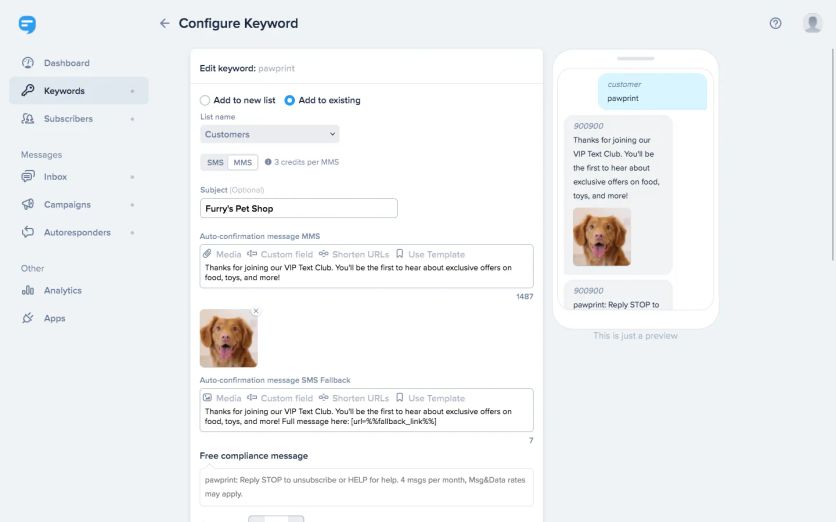
Setting up keywords in SimpleTexting
The focus is doing core SMS functions reliably, like bulk sends, inbox replies, and link tracking, with usability and affordability up front.
Key Features:
- Mass texting campaigns: Send bulk SMS or MMS to your lists. MMS supports images and short videos, which can lift engagement when used smartly.
- 2-way messaging & Inbox: Every account gets phone numbers (or short codes) that you use to send texts. Any replies from contacts come into a dashboard where you can read and respond, like checking text messages on a phone but for all subscribers. This is good for customer service or engaging folks who respond to campaigns.
- Keywords for opt-in and out: Set up multiple keywords (“SALE” for promos, “NEWS” for updates). Texting a keyword triggers an auto-confirmation and adds the person to the right list.
- Autoresponders and triggers: Simple automated messages, like an instant coupon on signup or a follow-up a day later. No big branching sequences, but the basics are covered.
- Contact management: Upload contacts with consent, store basic info, and use merge tags for personalization like “Hi [Name].” Build segments manually or with simple criteria.
- Link tracking and analytics: Automatic link shortening with click tracking, plus delivery rates and unsubscribes for a read on performance.
- Apps and integrations: Web and mobile apps to manage texts anywhere, plus direct integrations with Mailchimp, HubSpot, and others to sync contacts.
- Compliance tools: Recommended opt-in language and an automatic “Text STOP to unsubscribe” footer, with the platform keeping up with carrier rules like throughput limits and toll-free verification.
- Pricing simplicity: SimpleTexting typically has plans that allot you a certain number of credits per month (1 SMS = 1 credit, 1 MMS = 3 credits, roughly) and you pay based on that allotment. Plans start at a low number of credits with low cost, making it accessible. There are no onboarding fees or minimum contract commitments at the low end – you can pay monthly and cancel anytime. This is appealing to those who can’t commit to high monthly spends just for texting.
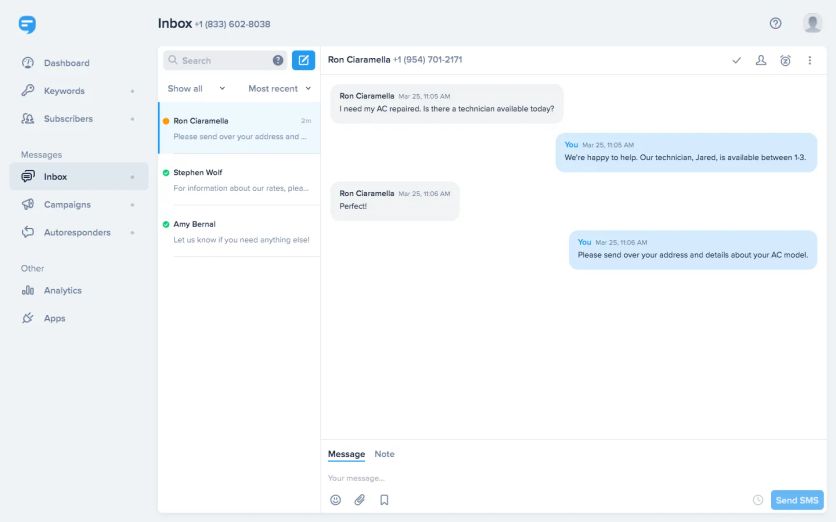
SimpleTexting’s Inbox
Strengths and weaknesses
The major strength of SimpleTexting is right in the name: simplicity. It’s extremely easy to use, even for someone totally new to SMS marketing. Within minutes you can upload a list or get people joining via a keyword, and blast out a text. This makes it great for organizations that might not have dedicated marketing ops teams – think restaurants sending weekly specials, churches sending congregation alerts, or indie ecommerce brands doing occasional promos.
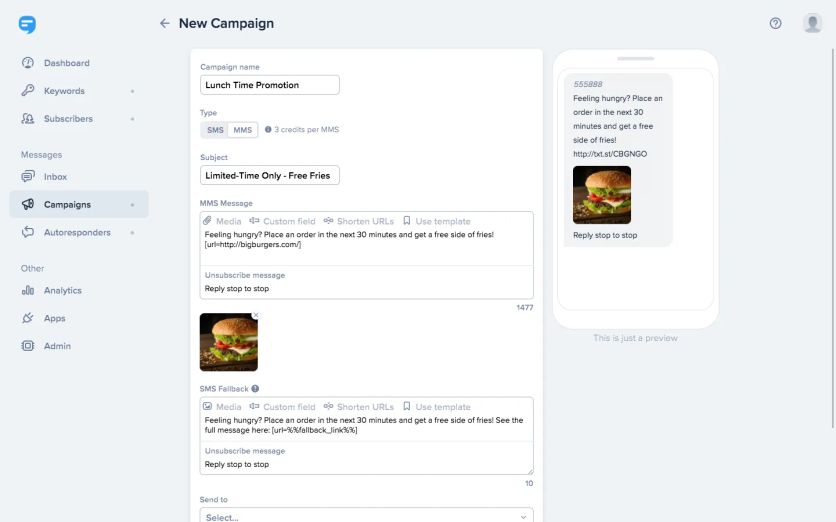
MMS creation in SimpleTexting
The cost is another strength. It’s one of the more affordable solutions, especially when you compare it to enterprise platforms.
Also, SimpleTexting has a reputation for good customer support (despite being low cost, they have live chat and responsive support to help customers with any issues or questions).
However, the weaknesses become apparent as your needs grow. There’s limited automation – you can’t design complex customer journeys or condition-based triggers beyond the basics. For example, you can’t automatically target someone who clicked a link but didn’t purchase with a follow-up text two days later unless you rig up something externally and push the data in. There’s no built-in integration with ecommerce to do advanced stuff like Attentive can. The segmentation is rudimentary, so running highly targeted campaigns might be a manual effort.
Another weakness: no email or multi-channel integration in the platform. It’s SMS-only (with a sprinkle of email capture maybe via a web form, but not for email campaigns). So you’ll likely pair it with an email service, and those two won’t talk to each other unless you integrate via Zapier or such. In contrast, Attentive or others have at least both channels or more built-in.
Also, analytics depth is low – you get clicks and replies, but you won’t easily get revenue attribution unless you manually track coupon usage or use Google Analytics/UTMs to see how SMS traffic converts. A bigger platform might directly tie into sales data and show ROI per text send. With SimpleTexting, you might have to do a bit more legwork to connect those dots.
For some, another limitation is brand perception; using a very basic SMS might mean relying on long phone numbers or shared short codes (though nowadays shared short codes are phased out so you’d have a dedicated number but likely a toll-free or local number, which is fine but less fancy than maybe having a short code – though short codes are pricey anyway). Attentive might provision vanity short codes or multiple numbers to optimize throughput – SimpleTexting by default might throttle large sends on one number, making huge blasts slower (though they do offer high-volume solutions if you ask).
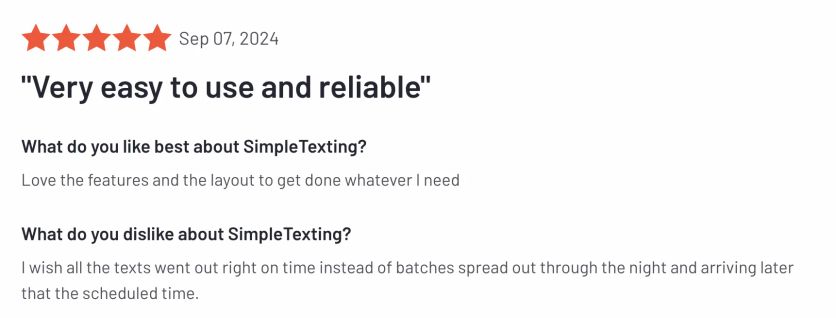
SimpleTexting is great for simple use-cases but you trade off the advanced marketing capabilities that tools like Attentive offer.
Compared to Attentive
If Attentive is the high-end solution full of features, SimpleTexting is the pared-down alternative that might actually be better suited for a small outfit.
We’ve broken down how they compare in more detail:
| Capability | Attentive | SimpleTexting |
|---|---|---|
| Scale and budget | Enterprise minimums | Affordable, from ~$39/mo |
| Features | Advanced segmentation, e-commerce triggers, AI, email | Core mass texting, keywords, autoresponders |
| Personalization | Real-time behavioral | Name and static fields |
| E-commerce triggers | Native | Not native |
| Best fit | Sophisticated teams | Small orgs, simple sends |
If you are a small business or organization and Attentive’s salespeople don’t even give you the time of day (Attentive usually targets bigger fish with bigger budgets), SimpleTexting is clearly the more viable choice. Attentive might have minimum monthly spends that are more than a small biz’s entire marketing budget. SimpleTexting has plans that even a local shop can afford. So one big factor is scale and budget.
In terms of features, Attentive offers advanced segmentation using customer data, automated workflows triggered by e-commerce events, AI-driven optimization, and an integrated email channel. SimpleTexting offers none of that out of the box. So if you used Attentive and got used to those features, moving to SimpleTexting would feel like a downgrade in capability. However, maybe you never fully used them, or you found them too complicated or not worth the cost.
One thing Attentive touts is its managed approach – they often provide strategic guidance, and of course, they have those concierge services for two-way if needed. With SimpleTexting, strategy is on you. The platform won’t tell you “here’s the best time to send” or “here’s a suggested campaign based on your data” – Attentive might have some of those insights from experience with large retail clients (and their reps might guide you).
Deliverability & compliance: Attentive likely has strong relationships and processes to maximize throughput and deliverability (given their scale, they can get short codes, etc., and navigate carrier rules quickly). SimpleTexting, while reliable, might not send as fast if you have tens of thousands of messages (they often use toll-free numbers which have throughput limits, though there are workarounds like using multiple numbers).
For an SMB, that’s rarely an issue (sending 5,000 texts might take a few minutes, which is fine). Attentive will make sure 5,000 texts go out almost instantly by using high-speed routes. That matters if you’re doing time-sensitive blasts (e.g., a flash sale that ends in one hour, you want all messages out quickly). But again, scale.
Another difference is analytics and integration. Attentive might integrate with your e-commerce platform to directly show how much each text campaign made in sales. With SimpleTexting, you’d have to do more manual tracking.
Finally, customer experience: Attentive’s texts can be quite personalized if you feed data in – “Hey John, that pair of sneakers you looked at is almost sold out!” That’s powerful but requires data and setup. SimpleTexting can personalize by name or a static field but not much beyond what you import (no real-time behavioral triggers without manual input). So the texts might be more generic.
If your marketing strategy doesn’t require that level of personalization (maybe you only do store-wide sales or announcements), then you’re not missing much. But if you want those event-triggered messages (like browse abandon, cart abandon, etc.), SimpleTexting alone won’t do it – you’d need to hook it up with some other system via API or switch to a more advanced platform like Attentive or others.
In summary, SimpleTexting is an alternative to Attentive for those who find Attentive’s complexity or cost unnecessary for their needs. It’s essentially “SMS marketing light.” You lose the fancy features but keep the core ability to text your customers, which for many is the main point.
Compared to Maestra
SimpleTexting and Maestra sit at opposite ends of the scope spectrum. One sends texts; the other runs an integrated marketing ecosystem.
Maestra offers an integrated marketing ecosystem – SMS, email, push, loyalty, site personalization, unified by a real-time data platform and guided by their team. SimpleTexting offers… SMS. Just SMS, and not even with advanced automation or data unification (outside of what you upload).
The only scenario to compare is perhaps a resource-strapped one: say a mid-sized brand is thinking “we can’t afford Maestra or fully commit to that yet, what if we just handle SMS and some basic email ourselves with cheaper tools?” Then SimpleTexting (for SMS) plus maybe Mailchimp for email might be their DIY approach instead of Maestra. That sacrifices a lot of integration and finesse, but saves money.
From Attentive’s perspective (since these are alternatives to Attentive, which is more similar in channel scope to SimpleTexting albeit with more features): If you didn’t want to invest in a platform like Maestra, you’d not drop to SimpleTexting unless you were drastically cutting down strategy. They solve different problems. Maestra solves “how do I maximize LTV with cross-channel data-driven marketing” whereas SimpleTexting solves “how do I send texts to customers.”
So basically, Maestra vs SimpleTexting isn’t a typical either/or for the same requirement. It’s a matter of scale and needs.
So, compared directly:
- These rarely compete for the same job. Maestra can do everything SimpleTexting does with SMS, blasts, two-way, segmentation, in a more integrated and automated way, then add far more across other channels.
- Ease of use: Interestingly, SimpleTexting might actually be easier for a very small scope because it’s minimal. Maestra will have a learning curve to use all features. For someone who just wants to quickly send a manual text to 100 customers, SimpleTexting is simpler. Maestra’s value is in setting up automated flows which take some thought and config.
- Cost: SimpleTexting runs from about $39/month (500 credits) up to roughly $239/month for higher volume. Maestra is in the thousands per month. The magnitude difference is huge – but so is the value proposition.
- Integration: Maestra integrates all your data and channels, so SMS can be part of a bigger picture. SimpleTexting on its own is siloed: you might have to manually integrate it with your other systems to keep data consistent. That’s a known limitation; some use cases might not mind (like a local business might not even have other systems to integrate with). But any serious e-com or organization likely wants at least some integration.
In conclusion, if Attentive was too limited and you want much more, you go to Maestra (or Braze, etc.). If Attentive was too much and you want to simplify, you might go to SimpleTexting. They represent two opposite alternative directions one could take from Attentive. We include both because readers of an “Attentive alternatives” piece could be either type: some looking to scale up and integrate (Maestra, Braze, etc.), others looking to cut costs or simplify (SimpleTexting, SlickText, etc.).
What Each Tool Brings to the Table
Here’s how our Attentive alternatives stack up at a glance:
- Omnichannel powerhouses: Maestra and Braze. Both deliver SMS alongside email, push, and more, giving larger brands a unified platform to reach customers on every channel. Maestra adds loyalty and personalization on top. Pick these if you want to go beyond SMS and consolidate your stack.
- Email + SMS All-in-One: Klaviyo and Omnisend combine robust email marketing with SMS under one roof. These are perfect for e-commerce teams that want tight integration between their email and text campaigns (with Klaviyo skewing towards advanced data capabilities and Omnisend towards ease and affordability for SMBs).
- Conversational Focus: Emotive stands out by turning SMS into a two-way sales conversation. If your brand benefits from real-time Q&A and personal engagement via text (and you have the resources to manage it), Emotive can drive higher conversion through humanized interactions that Attentive’s automated texts might miss.
- SMS Specialists for E-commerce: Postscript shines for Shopify-based businesses that need a specialized SMS solution deeply embedded in their store’s operations. It’s great for leveraging Shopify data and quick to launch with pre-built flows for cart abandonment and more – an Attentive alternative that feels tailor-made for online store integration.
- No-Frills Texting Solutions: SimpleTexting (and similar platforms like SlickText) offer straightforward mass texting without the complexity. If you’re a small business or organization that found Attentive’s feature set overkill, these tools let you send promotions, alerts, and engage in 1:1 texting without breaking the bank or needing a dedicated tech team.
Each alternative excels in its niche. If we group them relative to Attentive: Maestra and Braze cover the gaps in channels and data integration, Klaviyo and Omnisend address Attentive’s shortcomings in email and cost for SMBs, Emotive targets the need for human touch and conversation, Postscript focuses on Shopify-centric capabilities, and SimpleTexting offers a solution for those who just want simple, budget-friendly texting.
Why Start with Maestra?
With Maestra, you’re not just getting a tool – you’re gaining a full-service partner in growth. Its real-time CDP powers the kind of hyper-personalized marketing flows and loyalty programs that simply aren’t possible with single-purpose platforms. While other alternatives excel in one area or another, Maestra combines the best of these capabilities into one seamless solution. It adapts in real time to each customer’s behavior, integrating every touchpoint – email, SMS, web, push, ads – and evolves alongside your business.
Attentive showed the impact of SMS, but Maestra shows what’s possible when all your channels work in harmony. Whether you’re scaling up or looking to refine a mature strategy, Maestra is built to grow with your brand and eliminate the fragmentation in your tech stack.
The dedicated support (a Forward Deployed Marketer for every client) means you have an expert by your side, ensuring you get maximum value from the platform – from day one, they help design your flows, migrate data, and even craft strategy, acting as an extension of your team.
Choosing the right platform can truly transform your customer experience and drive long-term loyalty and revenue. Don’t settle for “good enough” when you can have the best. If you’re ready to move beyond Attentive’s limits and unlock your full marketing potential, start with Maestra – book a demo today and see how it can revolutionize your business.
FAQ
- Klaviyo’s free plan is the most accessible way to test SMS: it includes up to 250 contacts, 500 monthly email sends, and a small monthly SMS credit. Omnisend’s free plan covers email and web push but not SMS, which is a paid add-on. For brands that want SMS integrated into a comprehensive marketing strategy, Maestra starts at about $2,250/month (the CDP plus unlimited email, with the SMS module adding per-message fees), with modules like loyalty, WhatsApp, and site personalization added as you grow – JOLYN saw +52% SMS revenue growth after consolidating into Maestra’s unified platform, making the investment pay for itself.
- For SMS-only on Shopify, Postscript offers the closest feature parity with simpler pricing. For email + SMS combined, Klaviyo’s native Shopify integration is the market leader. For brands ready to go beyond email and SMS, Maestra’s all-in-one approach includes loyalty, site personalization, and product recommendations alongside messaging – Coolibar saw +33.6% campaign revenue growth within 2 months by consolidating into Maestra from a multi-tool setup.
- Phone number portability depends on the type of number. Long codes and toll-free numbers can generally be ported to a new provider. Short codes, however, are typically leased through Attentive and may not transfer – you’d need to apply for a new short code with your new provider. Maestra’s onboarding team handles the entire migration process, including number provisioning and subscriber list transfer, as part of their white-glove implementation.
- Attentive uses a 30-day click attribution window by default – one of the most aggressive in the industry, which can significantly inflate reported SMS ROI. Klaviyo and Postscript offer configurable attribution windows. Maestra provides configurable attribution and can show not only a channel’s impact but also the impact of a flow that combines SMS, email, and push – giving you a more accurate picture of each channel’s true contribution.
- For most e-commerce brands, yes. Running Attentive + a separate ESP creates data sync issues, fragmented reporting, and duplicate costs. Consolidating into a platform that handles both (like Maestra) eliminates these problems. Maestra takes consolidation furthest by also including loyalty, personalization, and CDP – Urban Armor Gear achieved a 64% cost reduction by replacing their fragmented stack (including separate email, loyalty, and personalization tools) with Maestra.
- TCPA compliance obligations follow your brand, not your SMS provider. Subscriber consent transfers with your list – the key is ensuring clean opt-in documentation during migration. All major SMS platforms provide compliance tools and consent management. Maestra’s dedicated Forward Deployed Marketer team handles compliance documentation as part of migration, ensuring no gaps in your consent records.
- SimpleTexting and Omnisend are praised for responsive, accessible support at low price points. Braze’s support quality varies by account size. Maestra takes a fundamentally different approach: every client gets a dedicated Forward Deployed Marketer with weekly strategy calls, a shared Slack channel, and 5-minute response times – a level of hands-on partnership that contrasts sharply with Attentive’s account management model.