8 Smile.io Alternatives
Running a customer loyalty program should feel rewarding – not like pulling teeth. This comparison of 5 Smile.io alternatives helps you identify platforms that enhance your capabilities rather than constrain them. Find the solution that empowers your team to create seamless customer experiences across all touchpoints.
Quick Verdict: Best Smile.io Alternatives by Category
Best for omnichannel e-commerce with loyalty: Maestra – loyalty unified with email, SMS, push, and on-site personalization
Best for Shopify-native loyalty: Yuko – lightweight points, tiers, and referrals built for Shopify
Best for gamified loyalty and referrals: Loyoly – missions, challenges, and UGC-driven engagement
Best for reviews + loyalty + wishlists: Growave – multiple engagement features consolidated in one Shopify app
Best for UGC + loyalty at scale: Yotpo – reviews, visual marketing, and loyalty for large catalogs
Best for data-driven loyalty: LoyaltyLion – advanced loyalty analytics and segmentation for mid-market
Best for affordable reviews + loyalty: Stamped.io – review collection and loyalty at a lower price point
Best for simple Shopify referrals: Rivo – entry-level loyalty and referral app for growing stores
Content:
Smile.io Overview
Smile.io has become one of the go-to loyalty and rewards apps for ecommerce, known for its simplicity and quick setup.
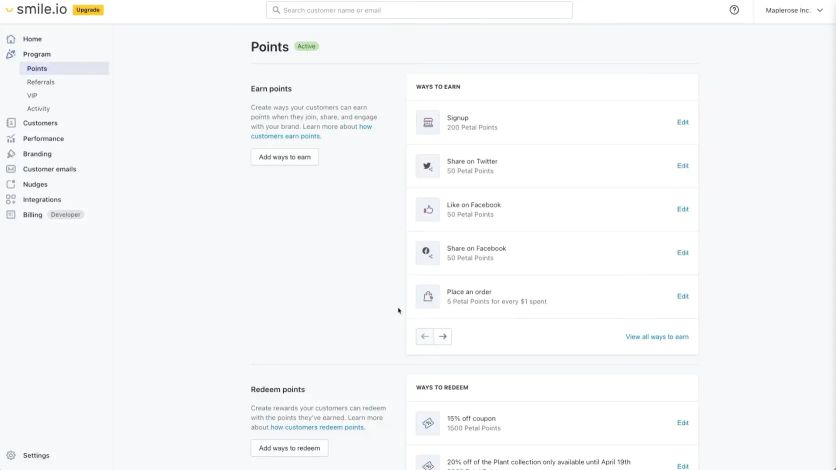
Smile.io’s point program settings
It enables brands to launch point-based rewards, referral bonuses, even VIP tiers with minimal fuss. Over 100,000 businesses have used Smile.io to turn first-time shoppers into repeat customers, rewarding purchases, referrals, social shares, and more.
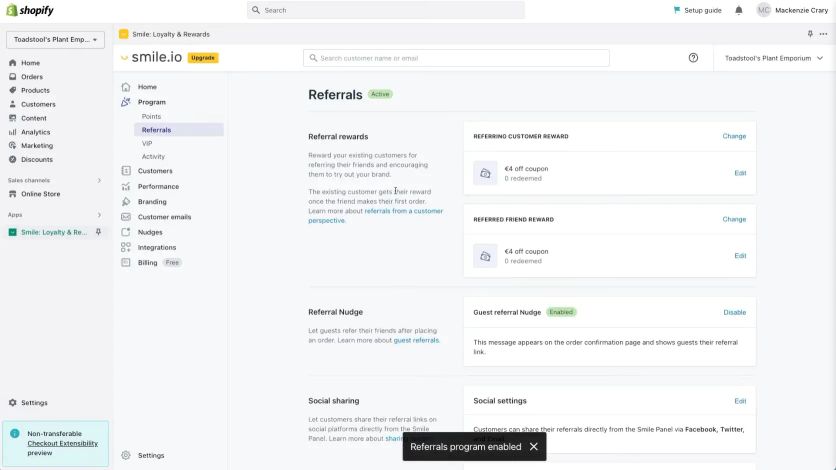
Smile.io’s referral program settings
It shines for small to mid-sized brands that want a plug-and-play loyalty program: you can get a basic points-and-referrals system running in an afternoon, and the interface – both the admin dashboard and the customer-facing widget – is clean and easy to use.
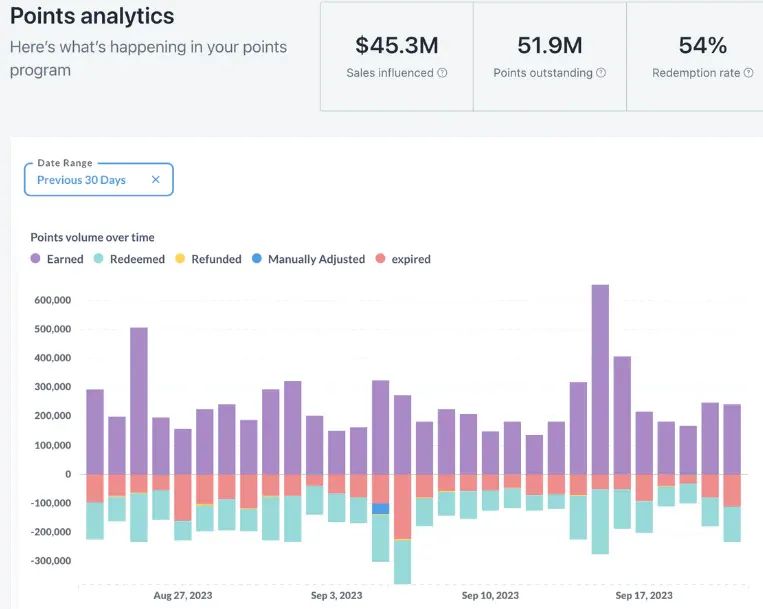
Smile.io’s Points analytics page
There’s even a free plan (up to ~200 orders/month) and affordable paid tiers starting around $49/month, so you don’t pay a cent until your store gains some traction.
But as your loyalty strategy matures, you might start bumping into Smile.io’s limits. Advanced features – highly customized rewards, complex earning rules, deeper analytics – are reserved for the higher-priced plans. For example, if you want to reward very specific actions or tailor perks to different customer segments, Smile’s built-in options may feel basic.
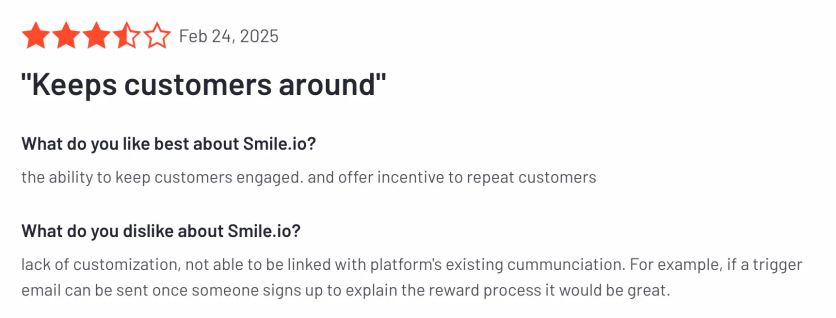
The widget-centric design, while easy to install, doesn’t always blend perfectly into your site’s UX without custom tweaks; larger brands sometimes wish for a more fully white-labeled experience for their VIP customers.
In short, Smile.io is ideal for straightforward loyalty needs, but it’s not a full-blown retention marketing suite. As your brand grows, you may crave more flexibility, integration, or sophistication than Smile can offer out-of-the-box.
That’s why we’ve compiled this list of top Smile.io alternatives.
The Alternatives at a Glance
| Tool | Best For | Key Features | Price Range |
|---|---|---|---|
| Maestra All-in-One CDP + Marketing | Full-funnel marketing for ambitious e-commerce brands | • Real-time CDP for behavior-driven segmentation • Hyper-personalized omnichannel flows (email, SMS, push) • Built-in loyalty program and promotions engine • Real-time site personalization and product recommendations • Dedicated Forward Deployed Marketer for onboarding and strategy | From $2,310/month (CDP base + Shopify loyalty module) |
| Yuko All-in-One Retention Suite | Shopify brands replacing multiple retention apps with one unified platform | • All-in-one platform – loyalty, referrals, reviews, and memberships from a single dashboard (no app-switching) • Points-and-rewards with 12+ earning actions – purchases, reviews, referrals, and social activity included • VIP tiers with escalating perks and member-only pricing to reward your best customers • Automated review requests via email and SMS with photo/video UGC and Google Shopping rich snippets • Fraud-protected referral program with unique per-customer links and automatic dual-sided rewards | Free plan + $12–$199/month |
| Loyoly 3-in-1 Post-Purchase Platform | Ecommerce & retail brands wanting to combine loyalty, referral, and a digital wallet into one post-purchase engine | • 3-in-1 platform: Loyalty, Referral & Wallet with smartphone loyalty card + geo-located push notifications • 40+ engagement missions (UGC, reviews, social, referrals, surveys) auto-verified • Dynamic VIP tiers that adapt in real time to each customer’s behavior • Built-in UGC library to collect, store, and reuse customer content • Native integrations with your full stack (Klaviyo, Shopify POS, Cegid, Trustpilot, Gorgias…) | From $99/month |
| Growave Retention Bundle with Instagram UGC | Shopify brands wanting loyalty, wishlists, reviews, referrals, and Instagram UGC in one retention app | • Loyalty & Rewards program with points and tiered VIP • Referral program with dual-sided incentives • Product reviews & ratings with UGC • Wishlist with price-drop and back-in-stock reminders • Instagram Shop Gallery (shoppable feed) | Free plan; from $49/mo |
| Yotpo Loyalty & Referrals Loyalty + Reviews Suite | Brands seeking an all-in-one loyalty + reviews + UGC solution | • Customizable loyalty programs (points for purchases, reviews, referrals, social) + VIP tiers • Built-in refer-a-friend tracking with dual-sided rewards • UGC integration – reward points for reviews/Q&A and showcase that content on site • Omnichannel touchpoints (web, mobile app, POS) for earning and redemption • Analytics dashboard for loyalty performance (ROI, redemption rates, etc.) | From Free (basic) to Enterprise custom pricing |
| LoyaltyLion Loyalty Program Specialist | Scaling loyalty programs on Shopify (with robust features) | • Tiered loyalty levels and points rewards with gamification (badges, challenges) • Built-in referrals and incentivized social actions • Deep integration with Shopify (plus support for BigCommerce, Magento, etc.) • Customizable branding and UI to match your storefront • Detailed analytics and segmentation of loyalty data for insights | From $0 (limited free) to $159–$+699/month |
| Stamped.io Loyalty + Reviews Combo | Combining loyalty rewards with customer reviews/UGC | • Two-in-one platform for loyalty program and product reviews • Points, VIP tiers, and referrals comparable to dedicated loyalty tools • Automated review requests and UGC display widgets built in (e.g. photo reviews galleries) • “Reward for review” feature to drive UGC (e.g. points for a product review) • Competitive bundle pricing vs. separate loyalty + reviews apps (loyalty add-on from ~$59/month) | From $19/month (basic reviews) to $249/month |
| Rivo Loyalty & Referrals Lean & Affordable | Shopify brands seeking a cost-effective, fast-evolving loyalty solution | • Transparent, flat pricing – all loyalty & referral features included (no costly add-ons) • Fast-paced feature development (updates and new features released weekly) • Deep Shopify integration (Shopify-exclusive app) for easy setup and use • Focused solely on loyalty and referrals – a specialist approach with no distractions • Highly responsive support and willingness to implement feedback quickly (startup mentality) | Free plan + $29–$49/month |
Tool #1: Maestra – The Data-Driven Marketing Suite
Best Smile.io alternative for comprehensive e-commerce marketing.
Maestra is an all-in-one omnichannel marketing platform built for e-commerce brands ready to leave the patchwork of single-purpose apps behind. It combines everything into one roof: email and SMS campaigns, real-time customer data platform (CDP) with AI-driven segmentation, on-site personalization, product recommendations, loyalty programs and promotions, and more.
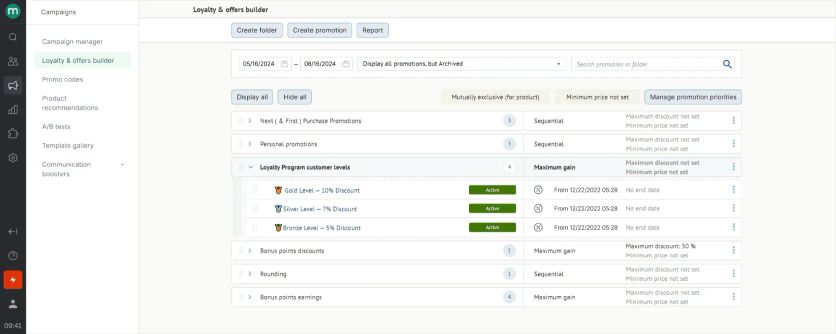
Maestra’s promotions rule engine
In other words, Maestra doesn’t just help you run a loyalty program – it helps you turn loyalty data into fuel for personalized marketing across every channel. Instead of juggling separate tools for emails, SMS, pop-ups, and rewards, Maestra’s drag-and-drop journey builder lets you create connected campaigns that span them all.
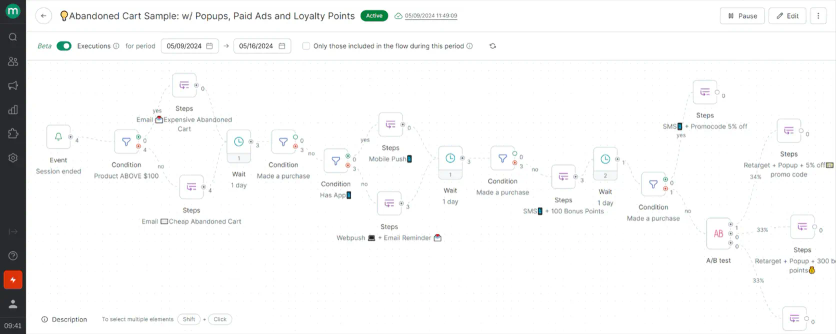
Maestra’s flow example: abandoned card flow with emails, mobile and web pushes, pop-ups, paid ads and loyalty points
It’s a full-funnel solution designed to boost customer engagement and LTV (life‑time value) by making every interaction timely and relevant.
Key Features:
- Real-time CDP & Segmentation: Track every customer action (browse, cart, purchase, etc.) and update profiles in real time. Use this data for laser-focused segments and AI predictions.
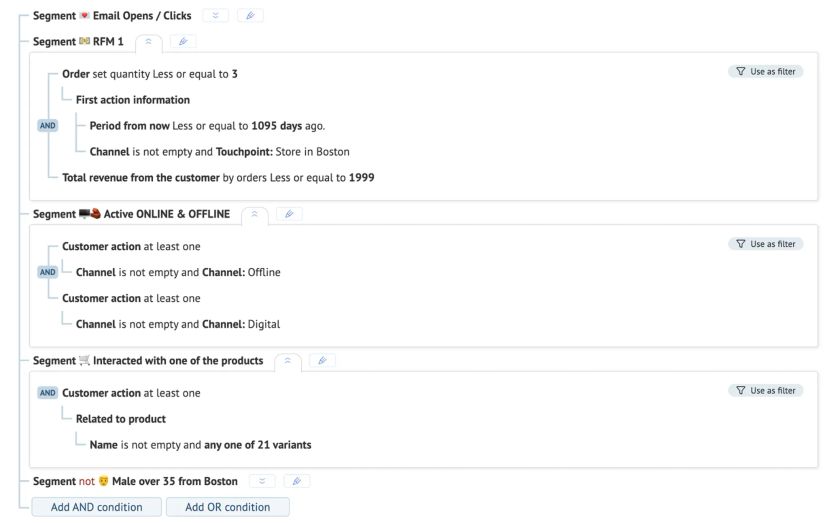
Maestra: user segmentation
- Omnichannel Campaigns: Build workflows that blend email, SMS, push notifications, on-site popups, and loyalty rewards seamlessly – all in one visual flow builder. For example, trigger an email + SMS + ad sequence when a VIP’s points are about to expire.
- Loyalty & Promotions Engine: Flexible point rules, tiers (e.g. Silver, Gold), and dynamic promotions that can trigger on the fly (like limited-time bonus points for larger carts). Loyalty is not an add-on here; it’s baked into the core.
- Real-time Personalization: Personalize the onsite experience and messages based on in-session behavior. Maestra can, say, show a special offer banner to a customer who just joined your loyalty program, or recommend products based on their reward history – all instantly.
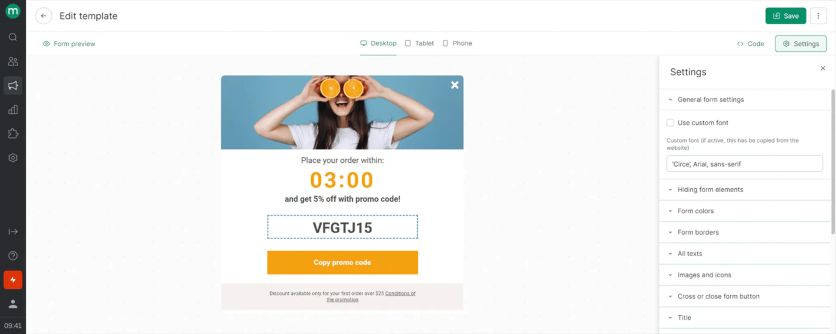
Maestra’s pop-up template editing
- White-Glove Support: Mid-market and enterprise plans come with a dedicated Forward Deployed Marketer to assist with migration, onboarding, and ongoing strategy (it feels like having an extra team member).
Strengths and weaknesses
Maestra’s biggest strength is making every customer interaction feel personal. It’s not about blasting generic points notifications – it’s about hitting the mark with the right message at the right time. The platform enables hyper-focused campaigns that truly resonate.
For example, you can set up real-time triggers like “low stock in your size” or “price drop on an item you browsed” to automatically ping customers with a perfectly timed incentive.
The loyalty component isn’t just a standalone program; it ties into these triggers. So if a shopper’s favorite item comes back in stock, Maestra might not only send an email but also offer double points if they purchase within 48 hours. This kind of dynamic, behavior-based reward is a game-changer for conversion rates.
The built-in email composer also ensures your communications stay on-brand and out of spam folders (no more clunky, one-size-fits-all emails).
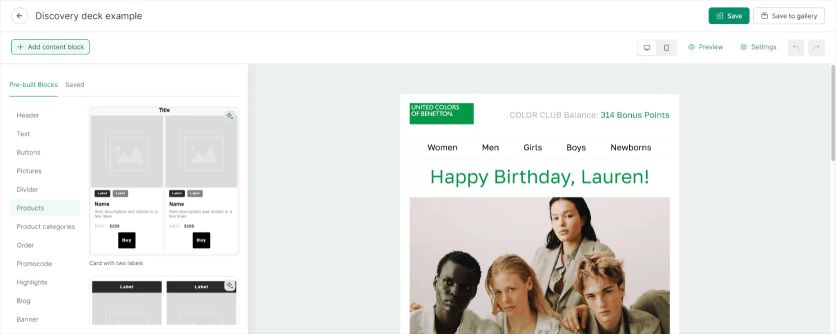
Maestra’s visual email composer
When it comes to drawbacks, Maestra doesn’t give you much to gripe about in terms of capabilities – but it is a bigger investment. Pricing is modular: a loyalty-focused setup starts at $2,310/month – the $1,300 CDP base plus the $1,010 Shopify loyalty module (a separate loyalty and promotions module for custom POS is $1,980) – which makes sense for rapidly scaling or mid-market/enterprise brands. You can build your own estimate on the Maestra pricing page.
Maestra is designed for brands that are ready to invest in a comprehensive solution. That said, the cost reflects the value – it can replace multiple tools and includes high-touch support, so you’re paying for more than just software.
Another consideration: Maestra doesn’t include its own user-generated content module. It incentivizes reviews and can capture that data, but it doesn’t have a built-in reviews display widget. Brands that rely heavily on showcasing UGC would integrate a dedicated reviews app alongside Maestra.
It’s a minor gap that’s easily filled via integration, given Maestra’s focus on being the central “brain” that orchestrates everything.
Compared to Smile.io
Smile.io vs Maestra comes down to scope. Smile sticks to traditional loyalty mechanics – customers earn points for purchases and get reward emails – while Maestra takes a holistic approach to customer engagement.
Where Smile might help you run a points‑for‑purchase program with monthly point‑balance emails, Maestra can tie loyalty into every channel in real time.
For example, with Smile you might email a customer saying “You earned 100 points for your order.” With Maestra, that same event could trigger an on‑site pop‑up right after checkout, a personalized SMS with a reward link, and add that customer to a “loyal VIP” segment for an upcoming ad campaign – all automatically.
Maestra’s real‑time CDP means loyalty isn’t an isolated program; it’s part of your broader marketing strategy.
Also, personalization is a huge differentiator. Smile will happily give every shopper the same 10 points per dollar and send a generic birthday coupon. Maestra, on the other hand, can tailor incentives to individual behavior – for instance, detecting that a customer has browsed skincare products and offering double points on the exact item they showed interest in.
In short, Smile.io keeps loyalty simple and separate, whereas Maestra makes it sophisticated and integrated into everything else. Of course, Maestra’s power comes with higher cost.
If you just need a no‑frills loyalty tool, Smile is great. But if you’re ready to turn loyalty data into a strategic weapon across email, SMS, ads, and more, Maestra is on another level.
Try it out: book a demo, and see how it could elevate your loyalty game from basic to cutting‑edge.
Tool #2: Yuko – The All-in-One Retention Suite for Shopify
Best Smile.io alternative for Shopify brands that want loyalty, reviews, referrals, and memberships without juggling multiple apps.
Yuko is a Shopify-exclusive retention platform built around one simple premise: you shouldn’t need five separate apps to run a single retention strategy. Where most merchants end up patching together a loyalty app, a reviews tool, a referral program, and a membership solution – each with its own dashboard, billing, and support queue – Yuko consolidates all of it into one unified platform that goes live in under 15 minutes.
It covers the full retention stack: points-and-rewards loyalty programs, VIP tiers, referral campaigns with fraud protection, product reviews with photo and video UGC, paid and free memberships, and a visual workflow builder for automated customer journeys. For Shopify brands tired of “plugin chaos,” Yuko makes a strong case that the whole can be greater than the sum of its parts.
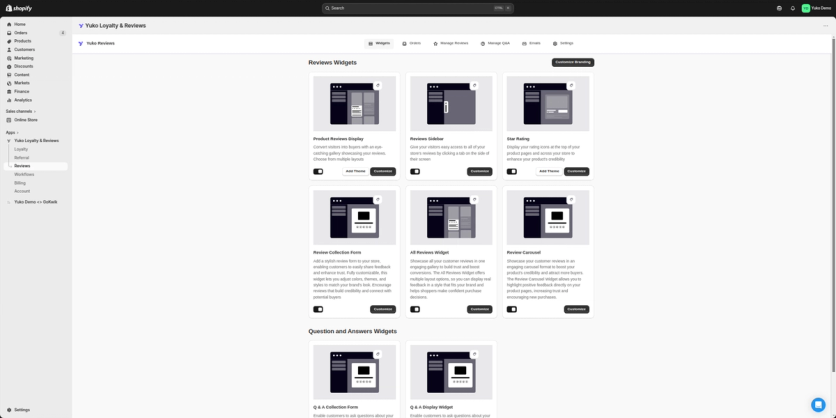
Key Features:
- Loyalty & VIP Tiers: Customers earn points through 12+ earning actions – purchases, reviews, referrals, birthdays, social shares, and more. Tiered VIP levels (Bronze, Gold, Platinum) unlock escalating perks, and a dedicated customer hub (account page) gives shoppers full visibility into their status and rewards. Shopify Plus merchants also get checkout extensions for in-checkout loyalty engagement.
- Reviews & UGC: Automate review request emails and SMS after every order, collect photo and video submissions, display reviews in customizable widgets, and improve Google Shopping visibility with rich snippets. The review system ties directly into loyalty – customers can earn points for leaving a review, creating a flywheel between trust-building and repeat purchases.
- Referral Program: Each customer gets a unique referral link. When a friend buys, both sides are rewarded automatically – no coupon codes, no manual tracking. Real-time referral analytics and built-in fraud protection make the program low-maintenance and high-impact.
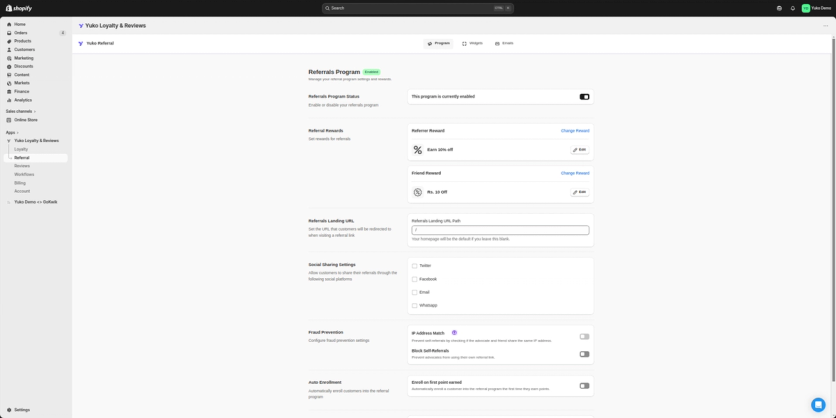
- Memberships: Go beyond transactional loyalty with paid or free membership tiers that offer exclusive access, early drops, and member-only pricing. Memberships integrate seamlessly with the loyalty program, enabling a recurring revenue stream alongside your points economy.
- Workflow Automation: A visual, trigger-based workflow builder lets you automate entire customer journeys – post-purchase review requests, loyalty reminders, referral nudges, VIP unlock sequences – all with A/B testing and per-workflow analytics. It integrates natively with Klaviyo and Omnisend for email and SMS delivery.
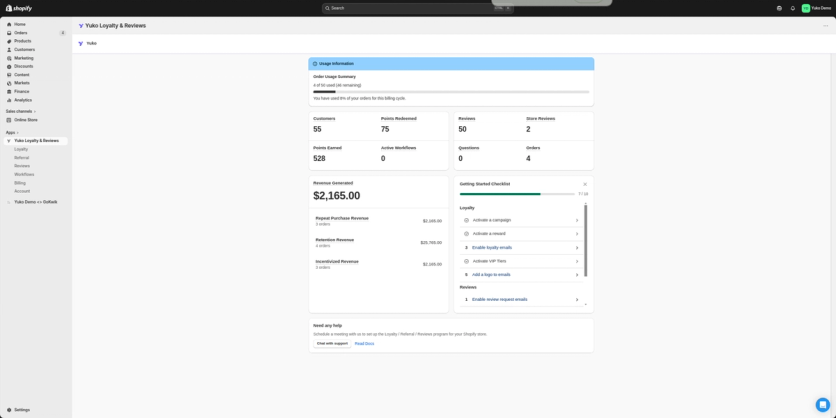
Strengths and weaknesses
Yuko’s standout strength is consolidation without compromise. Most all-in-one platforms sacrifice depth in individual features to cover breadth. Yuko avoids this by treating loyalty, reviews, and referrals as genuinely interconnected – not three tools bolted together. The result is a coherent retention engine where a customer action (say, leaving a review) immediately feeds into their loyalty balance, which in turn triggers a VIP tier unlock, which fires an automated workflow. That level of native integration is hard to replicate with separate apps talking to each other via webhooks.
Pricing is another notable strength. Yuko’s flat-rate model starts from a free plan and scales affordably – for what merchants typically spend across three separate apps (a loyalty app, a reviews app, a referral tool), Yuko often comes in at a fraction of the combined cost, with no per-feature surcharges.
The tradeoff is platform exclusivity: Yuko is built solely for Shopify. If you’re on BigCommerce, Magento, or a headless stack, it’s not an option. And while Yuko covers a wide surface area, brands with highly sophisticated loyalty analytics needs or enterprise-scale personalization may find the reporting less granular than dedicated specialist tools.
Compared to Smile.io
Smile.io and Yuko share the same starting point – points, referrals, a widget, easy Shopify setup – but they diverge quickly on scope. Smile keeps loyalty deliberately narrow and simple. Yuko treats loyalty as one component of a broader retention system.
The practical difference shows up in a few key areas. First, reviews: Smile has no built-in reviews capability, meaning you’d need a separate app (and a separate cost) to collect and display customer feedback. Yuko handles this natively, and crucially, rewards customers with points for submitting reviews – creating a direct feedback loop between social proof and loyalty participation.
Second, memberships: Smile doesn’t offer paid membership tiers. Yuko does, giving brands a recurring revenue lever that goes beyond traditional point redemption.
Third, automation: Smile’s automation is limited to basic reward notifications. Yuko’s workflow builder enables multi-step, trigger-based sequences across email and SMS – closer to what you’d expect from a dedicated marketing automation tool, but built specifically around retention events.
For a small Shopify store with straightforward loyalty needs, Smile.io remains a solid, proven choice. But if you’re finding that you’re paying for Smile plus a reviews app plus a referral tool – and none of them talk to each other – Yuko makes a compelling case for consolidation. You get a tighter retention loop, a simpler vendor relationship, and often a lower combined cost.
Compared to Maestra
Yuko and Maestra both aim to replace a patchwork of disconnected apps with a single platform – but the surface area they cover is fundamentally different. Yuko consolidates the retention stack: loyalty, reviews, referrals, and memberships. Maestra consolidates the entire marketing stack: loyalty sits alongside email, SMS, push notifications, popups, AI product recommendations, on-site personalization, and a real-time CDP – all reading from the same unified customer profile.
The biggest practical difference is messaging. Yuko’s workflow builder orchestrates retention-specific sequences (review requests, VIP unlock notifications, referral nudges), but the actual email and SMS delivery flows through Klaviyo or Omnisend. That means your loyalty data lives in Yuko while your messaging data lives in a separate tool – and keeping the two in sync requires integration maintenance. Maestra owns the full loop: a customer earns loyalty points, hits a new VIP tier, and the congratulatory email with a personalized product recommendation fires from the same platform, using the same real-time profile, with no sync delay.
Where Yuko pulls ahead is reviews and memberships. Maestra can reward points for submitting reviews, but it doesn’t collect or display UGC the way Yuko does – with photo and video widgets, Google Shopping rich snippets, and automated post-purchase review requests built in. Memberships are another differentiator: Maestra’s loyalty module is built around earned tiers – customers unlock perks through purchases and engagement. Yuko adds paid membership tiers with native billing, so customers can subscribe to a VIP level directly in the storefront. Maestra can power the same tier-based personalization if the membership status is passed in from a subscription tool.
For Shopify brands whose primary challenge is retention – building a loyalty program, collecting reviews, and running referrals – Yuko delivers strong value at a fraction of the cost. But if retention is just one piece of the puzzle and you also need to orchestrate abandoned cart flows, trigger cross-channel campaigns based on browsing behavior, personalize the entire storefront in real time, and run it all from a single customer data layer, Maestra eliminates the need for Yuko, Klaviyo, and your popup tool in one move.
Tool #3: Loyoly – The 3-in-1 Post-Purchase Engagement Platform
Best Smile.io alternative for brands that want to unify loyalty, referral, and a digital wallet into a single post-purchase experience.
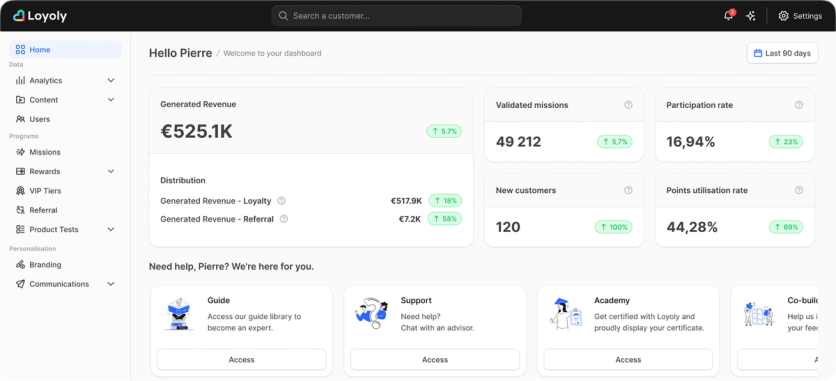
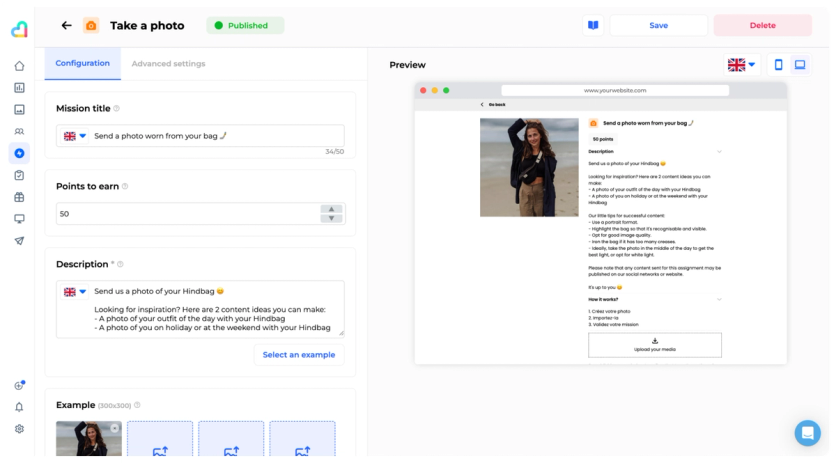
Loyoly is a post-purchase engagement platform that brings together Loyalty, Referral, and Wallet under one roof – orchestrating personalized customer journeys across every touchpoint, online and in-store. Rather than simply rewarding purchases, it gives customers a library of 40+ missions to complete: writing a product review, posting an unboxing video on TikTok, sharing a photo on Instagram, answering a brand quiz, or referring a friend. Each completed mission earns points – automatically verified – turning passive shoppers into genuine brand advocates.
Built for ecommerce and retail brands alike – from fast-growing DTC brands to established retail chains – Loyoly natively integrates with your entire stack: CRM, marketing automation, POS, review tools, and customer support. The result is a cohesive post-purchase experience that’s fully aligned with your brand identity, whether customers are shopping online or walking into a store. With 600+ ecommerce and retail brands already on board, it has earned a clear positioning as a growth loop builder, not just a loyalty widget.
Key Features:
- Loyalty Programs & VIP Tiers: Create fully customizable, behavior-driven programs that go well beyond a basic points system. Earn triggers include purchases, opt-ins, reviews, UGC, surveys, and social actions on Instagram and TikTok. Dynamic journeys adapt in real time to each customer’s engagement level – from first purchase to long-term loyalty.
- Referral Program: Turn satisfied customers into high-quality acquisition channels with a built-in refer-a-friend program that rewards both sides – reducing your CAC while growing a qualified customer base.
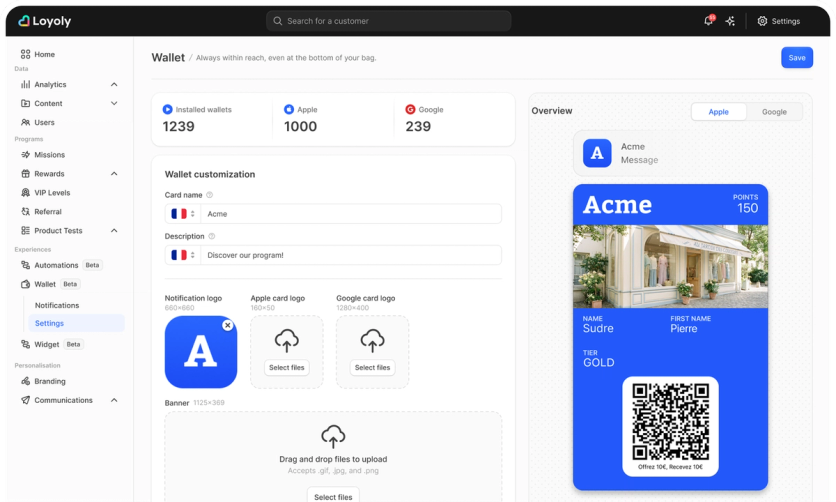
- Wallet & Push Notifications: This is where Loyoly stands apart from most loyalty tools. Loyoly embeds a personalized loyalty card directly into customers’ smartphones and sends targeted, geo-located push notifications to drive reward usage, repeat purchases, and in-store visits – without relying on email open rates.
- 40+ Engagement Mechanics: UGC collection, customer reviews, social sharing, data collection, surveys, and more – all auto-verified and configurable to your brand strategy.
- Native Integrations: Deep connectivity with Klaviyo, Brevo, Braze, Splio (CRM/automation), Shopify POS, Cegid, Fastmag (retail/POS), Trustpilot, Judge.me, Avis Vérifiés (reviews), Gorgias, Recharge, Typeform (support/subscriptions), and more.
Strengths and weaknesses
Loyoly’s biggest differentiator is its 3-in-1 architecture. Most loyalty tools handle points and maybe referrals. Loyoly adds a native Wallet layer that puts your loyalty card on a customer’s phone and enables geo-located push notifications – a capability that’s particularly powerful for brands with physical retail presence. If a customer is near one of your stores, Loyoly can push a targeted notification to encourage a visit. That kind of omnichannel activation is rare at this price point.
The mission-based model is equally compelling. A customer who earns points for an Instagram post, a verified review, and a friend referral is far more invested in your brand than one who only accumulates checkout points. Those missions also produce a steady stream of royalty-free UGC stored in Loyoly’s built-in library – content your team can reuse across ads, emails, and product pages without lifting a finger.
The platform earns consistent praise for its ease of setup, responsive 24/7 support, and fast product iteration. Brands that need to move quickly and customize their loyalty experience without heavy developer involvement will find it well-suited.
The main limitation: Loyoly currently supports Shopify and PrestaShop as native ecommerce platforms. Merchants on WooCommerce, BigCommerce, or Magento are not yet covered. And while the free tier is genuinely capable, the jump to higher plans is significant – advanced automation flows, enhanced analytics, and a dedicated account manager kick in at the Premium level.
Compared to Smile.io
Smile.io vs. Loyoly comes down to the depth and reach of the post-purchase experience. Smile runs the classic playbook well: customers buy, earn points, and redeem discounts – familiar, frictionless, and effective for straightforward needs. But the engagement ceiling is relatively low, and the program lives almost entirely in a browser widget.
Loyoly expands that surface area dramatically. Where Smile sends a “You earned 150 points!” email after a purchase, Loyoly can follow that same purchase with a push notification to the customer’s phone wallet, an invitation to post their unboxing on TikTok for bonus points, a geo-targeted ping if they’re near one of your stores, and a referral nudge when their engagement score peaks – all from a single platform.
Pricing entry points are comparable: Smile’s paid plans start around $49/month, Loyoly’s paid plans start from $99/month – with a 7-day free trial to get started. For brands running on Smile and finding that customers earn points but don’t really connect with the program, Loyoly’s combination of missions, wallet, and push notifications offers a meaningfully different – and more active – loyalty experience.
In short, if Smile.io is your loyalty workhorse, Loyoly is the upgrade for brands ready to build a full post-purchase growth engine: more interactive, more omnichannel, and designed to make every customer interaction count – on Shopify or PrestaShop.
Compared to Maestra
While both Maestra and Loyoly operate in the post-purchase space, they serve fundamentally different scopes and budgets.
Maestra is a full-blown omnichannel marketing suite where loyalty is one powerful component inside a much larger engine – real-time CDP, email, SMS, on-site personalization, paid ads, and product recommendations all working in concert. Loyalty in Maestra is a fuel source: it feeds behavioral data into campaigns across every channel. If a customer’s points are about to expire, Maestra can trigger an SMS, an on-site banner, and a retargeting ad – simultaneously. That level of cross-channel orchestration is genuinely impressive, but it comes at a price that reflects it: the Shopify loyalty module plus the CDP base starts at $2,310/month, a fit for mid-market and enterprise brands with the volume to justify it.
Loyoly, by contrast, is a post-purchase specialist. It doesn’t try to own your email campaigns or your CDP – it owns the loyalty layer, and does so with more depth than most tools at its price point. The 40+ mission mechanics, the native Wallet with geo-located push notifications, and the built-in UGC library are capabilities Maestra doesn’t replicate natively. Loyoly also integrates with tools like Klaviyo and Brevo rather than replacing them, slotting cleanly into an existing stack.
The practical question is one of stage and strategy. If you’re a scaling brand that wants one platform to orchestrate loyalty and email and SMS and on-site personalization under a single CDP, Maestra is built for that. If you already have your marketing automation covered (say, Klaviyo + an ESP) and what you’re missing is a loyalty program with real engagement depth – missions, referrals, a smartphone wallet, UGC collection – Loyoly fills that gap at a fraction of the cost.
In short, Maestra is the all-in-one command center for brands ready to consolidate their entire marketing stack. Loyoly is the best-in-class post-purchase layer for brands that want to plug a powerful, specialized loyalty engine into their existing tools – without rebuilding everything around it.
Tool #4: Growave – Retention Bundle with Wishlists & Instagram UGC
Best Smile.io alternative for Loyalty, Wishlists, Reviews, and Instagram UGC
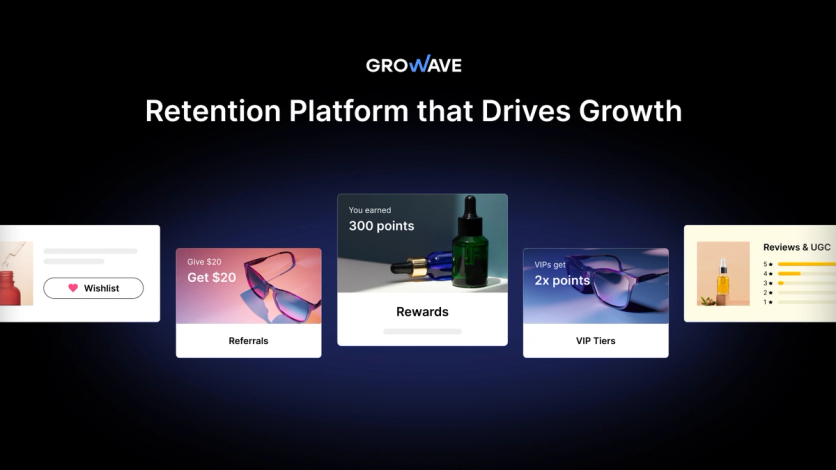
Growave is the all-in-one retention platform designed to help Shopify stores boost conversions, deepen customer relationships, and drive sustainable growth. By unifying reviews, wishlists, loyalty programs, and referrals into a single seamless experience, Growave empowers brands to engage their audience effortlessly while saving time on managing multiple tools.
With flexible customization and smooth Shopify integration, Growave scales with your business, from emerging stores to advanced Shopify Plus brands, giving teams the freedom to craft loyalty experiences that truly reflect their brand. It is perfect for merchants who want a cohesive, integrated solution without sacrificing flexibility.
Key Features & Benefits:
Loyalty & Rewards, incentivize repeat purchases with points, rewards, and personalized perks.
VIP Program, reward top customers with tiered experiences that increase loyalty and average order value.
Points Program, offer fully customizable rewards with robust analytics and multi-currency support.
Referral Program, turn your customers into brand advocates with incentivized sharing.
Product Reviews & Ratings, build trust by collecting and showcasing authentic user-generated content.
Wishlist, keep shoppers engaged by letting them save favorites and sending timely reminders.
Instagram Shop Gallery, transform your Instagram feed into a shoppable, revenue-driving experience using the latest API.
Growave makes customer retention simple, impactful, and scalable, so your brand can grow while keeping your customers coming back.
Strengths and Weaknesses
Growave’s strength lies in its versatility. By combining loyalty, referrals, reviews, and wishlists in one platform, it provides a complete retention solution for e-commerce brands. Its intuitive interface allows stores to launch quickly while offering advanced customization options.
For brands seeking only enterprise-level analytics or ultra-specific features, higher-tier plans may be needed. However, Growave delivers a more holistic retention solution than Smile.io’s loyalty-focused approach.
Compared to Smile.io
Smile.io is purpose-built for loyalty programs – points, VIP tiers, and referrals – and does that job cleanly, but reviews, wishlists, and UGC require separate apps on top. Growave bundles all of them into a single Shopify app: loyalty, reviews, referrals, wishlists, and a shoppable Instagram gallery in one dashboard. For brands that want to run retention through a single tool rather than stack Smile.io + a reviews app + a wishlist app, Growave offers narrower loyalty depth than Smile but covers more of the retention surface for the same budget.
Compared to Maestra
Growave bundles loyalty, reviews, and wishlists into one app – but messaging still lives elsewhere. To send a points-expiry email or a wishlist price-drop alert, you’re routing data through Klaviyo or Omnisend, which means another integration to maintain and another place where customer data can fall out of sync. Maestra’s real-time CDP keeps loyalty activity, browsing behavior, and messaging on the same data layer – so a VIP tier upgrade can instantly change the on-site experience, trigger a personalized SMS, and adjust product recommendations without a single webhook in between. If you want retention mechanics and you’re happy pairing them with a separate messaging tool, Growave covers the basics well. If you want those mechanics to power your entire customer journey from one platform, Maestra closes the gap.
Tool #5: Yotpo Loyalty & Referrals – Loyalty + UGC Powerhouse
Best Smile.io alternative for brands wanting an all-in-one loyalty + reviews + UGC solution.
Yotpo Loyalty & Referrals offers loyalty and referral programs under the umbrella of Yotpo’s larger marketing platform. Yotpo is well-known in ecommerce for its reviews, ratings, and user-generated content tools – and its loyalty module ties right into those.
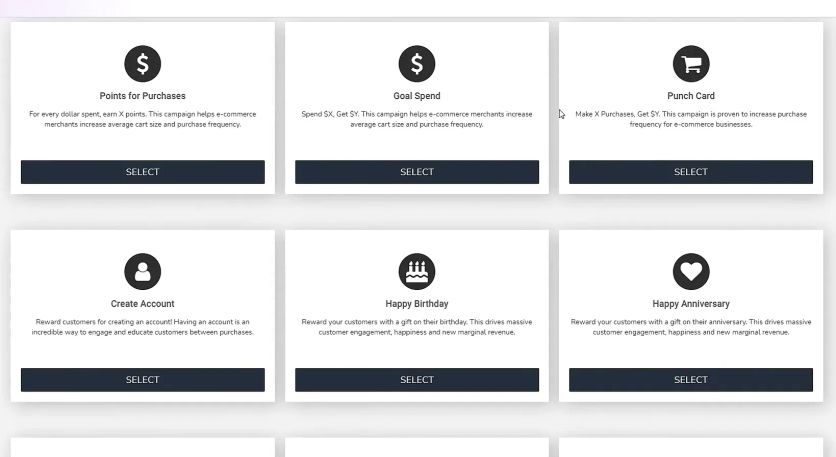
Yotpo’s preset loyalty program reward options
Many brands consider Yotpo when they want to consolidate vendors, since with one ecosystem you can handle product reviews, Q&A, customer photos, SMS marketing, and loyalty rewards together.
The Loyalty & Referrals component specifically gives you a flexible points & VIP program that integrates tightly with Yotpo’s other products. In essence, Yotpo can turn your customers into advocates: not only rewarding purchases, but incentivizing them to leave reviews, refer friends, post on social, and more – then amplifying that content to build trust in your brand.
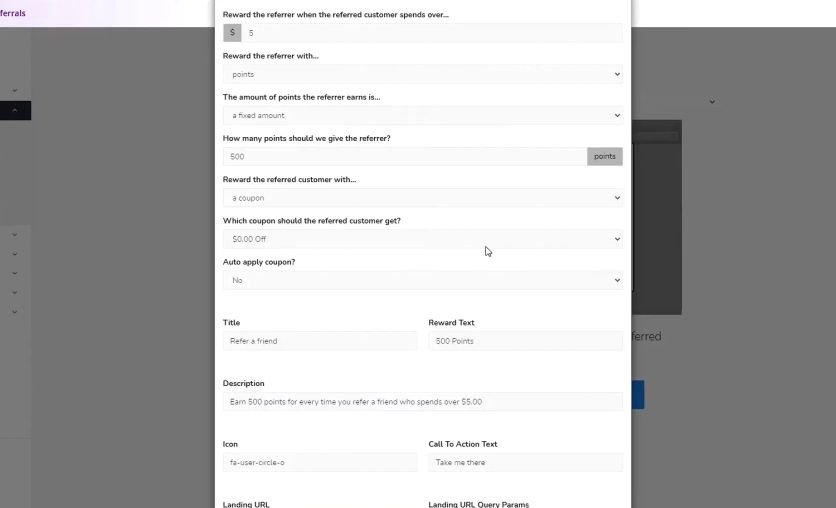
Yotpo’s referral program settings
Key Features:
- Customizable Loyalty Programs: Define point rewards for various actions (purchases, writing a review, referrals, social follows, birthdays, etc.) and configure VIP tier perks – all with a drag-and-drop rules editor. You have fine control over earning and spending rules (e.g. different point values for different product categories, exclusive rewards for VIP tiers).
- Referral Program: Built-in refer-a-friend tracking that rewards both the referrer and the friend (e.g. “Give $10, Get $10” style incentives). It’s fully integrated with the points system, so referral rewards can tie into your overall loyalty currency.
- UGC Integration: This is Yotpo’s signature strength. You can reward customers with points for leaving a product review, answering a question, or uploading a photo. Those reviews and photos then flow into Yotpo’s UGC widgets on your site to boost conversions. This synergy between loyalty and social proof is something standalone loyalty tools like Smile don’t natively offer.
- Omnichannel Touchpoints: Engage customers on every channel – website, mobile app, and even in-store. Yotpo supports POS integrations (on higher plans) so customers can earn and redeem points in a physical store, for example. This makes it attractive for retail brands with both online and brick-and-mortar presence.
- Analytics and Management: A robust dashboard to track loyalty performance – things like ROI, redemption rates, average order value lift, repeat purchase rate, etc. Yotpo leverages its data across thousands of brands to provide benchmarks and insights. Also, because it’s part of a larger suite, all your data (reviews, loyalty, etc.) can be viewed holistically.
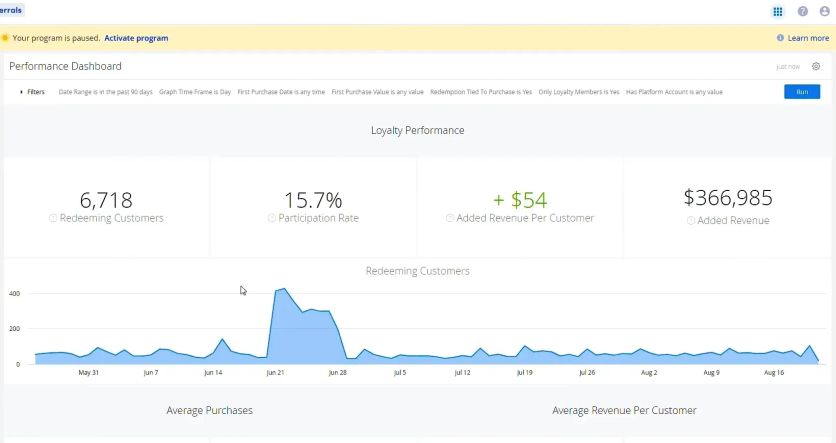
Yotpo’s loyalty program performance dashboard
Strengths and weaknesses
The strength of Yotpo’s loyalty offering lies in its breadth and integration. It’s part of a larger suite aimed at the whole customer journey, from first purchase to advocacy. That means your loyalty program isn’t in a silo – it connects with your review requests, your Instagram galleries, your SMS campaigns.
For instance, Yotpo can automatically give a customer points when they upload a photo review, and then display that photo in a shoppable gallery on your site. This kind of one-two punch (rewarding UGC and showcasing it) is a unique advantage Yotpo has over pure loyalty platforms.
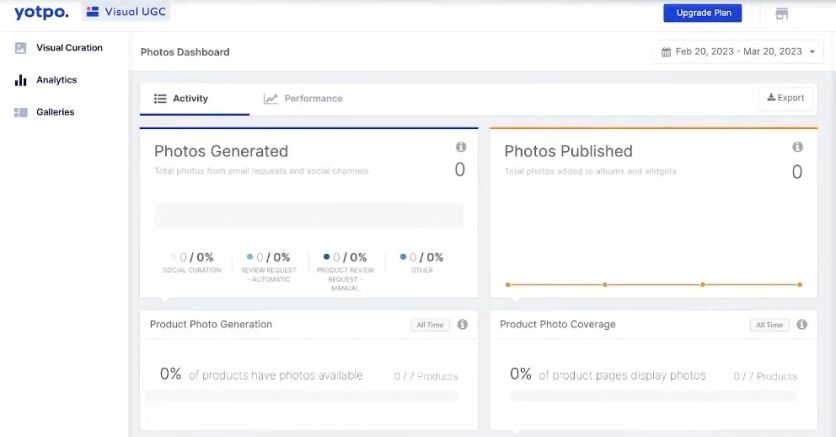
Yotpo’s Photos dashboard
Another plus: Yotpo Loyalty is highly customizable in look and feel. You can fully white-label the loyalty widgets/pages to match your branding, and on enterprise plans you get extremely fine control (like different earning rates for different customer segments, exclusive VIP rewards, etc.).
As a mature platform, it also integrates with major ecommerce platforms (Shopify, BigCommerce, Magento, etc.) and a variety of other apps, so it’s not hard to fit into your stack.
However, all that capability comes with added complexity and cost. Yotpo’s suite has a bit of a notorious reputation for confusing pricing tiers. The loyalty module itself is typically tiered into plans (Free, Silver, Gold, Platinum, etc.), with some crucial features only unlocking at higher levels.
If you want to use multiple Yotpo products (say Loyalty + Reviews + SMS), the costs can add up quickly, as each has its own pricing. In many cases, a full Yotpo stack turns out to be one of the pricier options on the market.
Also, because Yotpo is so feature-rich, the interface can feel overwhelming until you learn the ropes. There are a lot of settings to configure, and smaller teams might struggle with the learning curve.
Yotpo does offer good support and even dedicated success managers for its big clients, but if you’re on a lower-tier plan, you might not get the same level of hand-holding (some users on the free or basic plans report slower support responses).
Compared to Smile.io
Compared to Smile.io, Yotpo Loyalty offers a far more comprehensive solution – it’s not just loyalty, but a whole customer content and engagement suite. This means Yotpo can do things Smile can’t, like reward customers for writing reviews and then instantly showcase those reviews to boost your credibility.
If Smile.io feels like a simple rewards plug-in, Yotpo feels like an expansive toolkit for customer advocacy. The flip side is complexity and expense. Smile is purpose-built to be straightforward and budget-friendly; Yotpo is built to be powerful, which inherently makes it more complicated and often more costly.
For a small brand that only needs a basic points and referrals program, Smile is easier to set up and costs a lot less (Smile’s paid plans start around $49, whereas Yotpo Loyalty’s fully featured plans can run much higher). In fact, Yotpo does have a free tier for loyalty (up to 100 orders per month) to get you in the door, but to get the kind of features that truly compare to Smile’s paid tiers (like VIP levels or points-for-referrals), you’ll likely be on a paid Yotpo tier anyway.
So the decision here comes down to what you need: If you’re finding Smile.io too limited – maybe you really want to integrate loyalty with product reviews, visual UGC, and even SMS campaigns – Yotpo is an attractive alternative. It gives you that all-in-one ecosystem which can simplify your vendor list (one login, one support team, etc. for multiple capabilities).
On the other hand, if you love Smile’s simplicity and price point, be aware that moving to Yotpo means a more complex setup and a bigger budget. Many growing brands actually graduate to Yotpo when they reach a stage where leveraging customer content (reviews, photos) in tandem with loyalty becomes a priority.
If that’s where you’re headed, Yotpo can deliver those combined benefits, whereas Smile would require adding separate apps. It’s wise to try out Yotpo’s demo/free tier alongside your current Smile setup to see if the extra features are worth it for your team.
Compared to Maestra
While both Maestra and Yotpo aim to be “all-in-one” in their own ways, they cover different ground. Yotpo’s strength is in ratings, reviews, and social proof combined with loyalty – it’s about turning customers into advocates and showcasing that advocacy.
Maestra’s strength is in unifying all your marketing channels (email, SMS, on-site, ads) and making them smarter with loyalty and behavioral data. In simpler terms, Yotpo can tell you what your customers are saying about you (and reward them for saying it), whereas Maestra focuses on using what customers do (browse, click, purchase) to decide how to engage them next.
For example, Yotpo can automatically give points for a product review and then feature that review on your site – something Maestra doesn’t do natively because Maestra doesn’t include a reviews platform. On the other hand, Maestra can trigger a perfectly-timed sequence of messages across multiple channels in response to a single customer action, which is outside Yotpo’s scope.
A brand evaluating both should consider their priorities: customer content & community vs. customer data & personalization. If your goal is to amplify reviews, UGC, and referrals as part of loyalty, Yotpo is tailor-made for that. It’s basically loyalty + content/advocacy in one.
Maestra, however, is loyalty + omnichannel marketing brain. For instance, Yotpo might excel at prompting a happy customer to refer a friend or post a photo for points, whereas Maestra would excel at reacting to that customer’s behavior (say they browsed certain items but didn’t buy) with a targeted incentive.
Maestra doesn’t have its own review widgets, but it does excel at real-time triggers, advanced segmentation, and AI-driven recommendations beyond Yotpo’s purview. Cost-wise, both can be significant investments. Maestra consolidates a lot of marketing functions (thus replacing other tools’ costs), while Yotpo can start smaller if you only use the loyalty piece.
However, a full Yotpo deployment (loyalty + reviews + extras) often becomes comparable in expense to Maestra. Ultimately, Maestra is chosen when a brand wants to centralize data and personalization across channels, whereas Yotpo Loyalty is chosen when a brand wants to enrich a loyalty program with robust UGC capabilities (and perhaps is already in Yotpo’s ecosystem of products).
Some larger brands even use both – for example, Yotpo for reviews/UGC and Maestra as the CDP and omnichannel engine – but for most, it will be a choice between the two approaches.
If you’re leaning toward data-driven multi-channel marketing, Maestra has the edge; if you lean toward a loyalty program that doubles as a customer advocacy platform, Yotpo shines.
Tool #6: LoyaltyLion – Loyalty Program Specialist
Best Smile.io alternative for scaling loyalty programs on Shopify.
LoyaltyLion is a loyalty program platform designed to help online stores (especially Shopify brands) turn one‑time buyers into loyal, repeat customers. It’s one of the most established players in loyalty software, and unlike Yotpo it focuses 100% on loyalty and rewards (no built‑in reviews or SMS here).
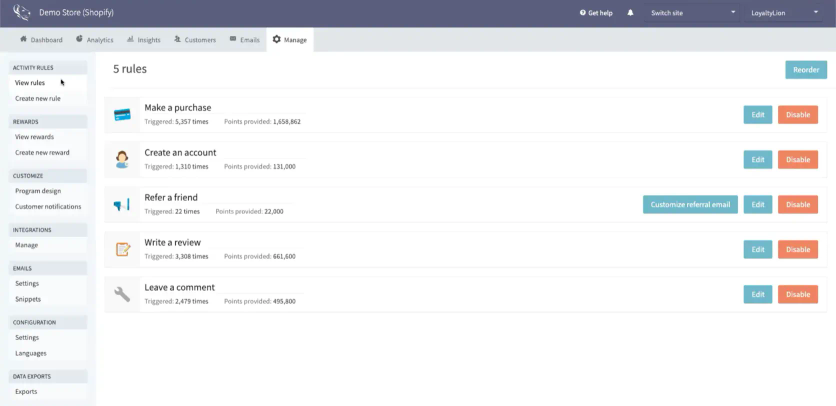
Managing rules in LoyaltyLion
With LoyaltyLion, you can launch a fully featured points‑and‑referrals program with a lot of flexibility in how you reward customers. It offers things like tiers (e.g. Bronze, Silver, Gold VIP levels), reward vouchers, and even some gamification elements to keep shoppers engaged.
The platform integrates deeply with Shopify (and also supports BigCommerce, Magento, and others), so it feels like a natural extension of your store.
For brands that outgrow the basic loyalty apps, LoyaltyLion is often the next step up – it brings more sophistication and analytics to the table while still being relatively user‑friendly.
Key Features:
- Tiered Programs & Referrals: Set up point rewards for purchases and customer actions, and create VIP tiers that unlock extra perks. LoyaltyLion natively supports referral programs too, so shoppers can earn rewards for referring friends – all tracked within the same dashboard.
- Gamification & Engagement: Introduce elements like badges, challenges, or milestone rewards. For example, you might give a badge and bonus points when a customer makes 10 purchases in a year. These features keep the program fun and motivating (and keep customers checking their progress). LoyaltyLion excels in offering these nuanced reward conditions that go beyond basic “earn 1 point per $1”.
- Omnichannel Support: While primarily used online, LoyaltyLion can unify offline and online loyalty if needed. It offers an API and some POS integrations so you can reward in‑store purchases and then let customers redeem online, or vice versa. (This is especially useful for Shopify brands that also have a physical boutique.)
- Custom Branding & Widgets: You can tailor the look of your loyalty widget, emails, and pages to match your brand. LoyaltyLion’s widget can appear on your site for customers to see their point balance, rewards available, etc., and it’s quite customizable in style and placement. The goal is to make the loyalty program feel like a natural part of your store, not a clunky add‑on.
- Analytics & Insights: LoyaltyLion provides detailed analytics on engagement, points issuance vs redemption, repeat purchase rates, and more. It also offers customer segmentation based on loyalty data (like identifying who your top 10% customers are, who is at risk of lapsing, etc.). These insights help you refine your program over time.
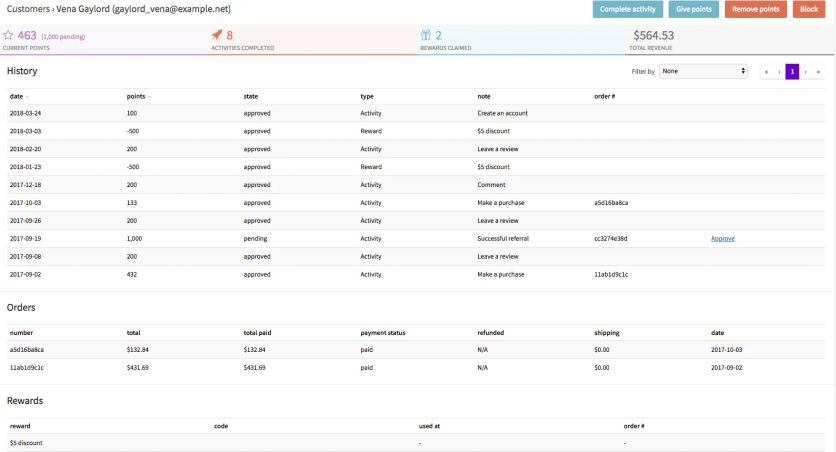
Customer’s actions in LoyaltyLion
Strengths and weaknesses
LoyaltyLion packs a punch with its loyalty features. It’s loaded with options – gamification, tiered rewards, referrals – and wraps it all in a user‑friendly interface that feels native to your store.
For marketers who love digging into data, LoyaltyLion offers more depth than simpler tools. You can, for example, set very granular rules (reward points for specific products or social media actions) and get reports on how those actions drive sales.
This level of customization and insight is a big strength; brands often praise that LoyaltyLion “thinks like a loyalty marketer, ” giving you levers and metrics that go beyond the basics. It also has a strong integration with Shopify (it was one of the first official Shopify loyalty partners), so setup is straightforward – just install, configure your program, and go.
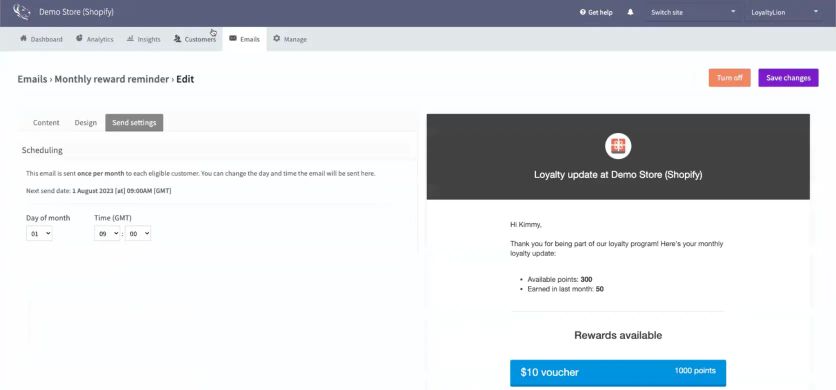
Creating reward reminder in LoyaltyLion
Another highlight is the community & support around LoyaltyLion: being a specialist, they have a lot of resources (blogs, benchmarks, success stories) and a customer success team that understands loyalty deeply.
On the flip side, LoyaltyLion is not the cheapest option. In fact, cost is one reason some users eventually move on to other solutions. LoyaltyLion’s paid plans start around $159/month and can increase based on your number of orders or features needed.
It does have a free plan, but that free plan is very limited (suitable only for very small stores as a trial). As your business grows, you might find LoyaltyLion’s pricing ramps up quickly – especially if you cross an order threshold or want add‑ons like advanced analytics.
In comparison, Smile.io remains cheaper at equivalent scales. Another consideration is that while LoyaltyLion is more flexible than Smile, it’s still a standalone loyalty tool – meaning if you need capabilities outside of loyalty (like email marketing or reviews), you’ll be integrating it with other apps.
That’s perfectly fine for many, but it doesn’t magically solve problems in those adjacent areas. Some users also mention that the UI, while powerful, has a slight learning curve: there are a lot of options and settings to navigate, which can be a bit daunting if you expected a plug‑and‑play solution.
In essence, LoyaltyLion trades a bit of simplicity for greater power. Finally, if you’re not on Shopify – say you’re on a different platform – LoyaltyLion works, but it shines most in the Shopify environment where it has the tightest integration. Non‑Shopify merchants might not get as seamless an experience.
Compared to Smile.io
LoyaltyLion and Smile.io target a similar audience (small to mid‑sized ecommerce brands adding a loyalty program), but their philosophies differ.
LoyaltyLion provides a wider array of built‑in loyalty actions and deeper analytics, appealing to data‑minded marketers and those who want to fine‑tune their program. Smile, in contrast, focuses on making points‑and‑referrals dead simple and accessible, even at the cost of some advanced features.
If Smile.io feels a bit too basic or “cookie‑cutter” as your brand grows, LoyaltyLion can be that step up – offering more sophisticated rewards (points for reviews, VIP tiers with exclusive perks, etc.) and richer insight into performance.
However, this comes with increased complexity and cost: as noted, LoyaltyLion’s pricing can climb as you exceed free limits or require more features, whereas Smile remains one of the more affordable options.
In practical terms, small brands often start on Smile.io because it’s quick and cheap, and then upgrade to LoyaltyLion when they need more. For example, if you start wanting to reward things like social media follows, birthday purchases, or need more advanced email integrations, you might find LoyaltyLion has those options ready to go, whereas Smile would require workarounds or simply can’t do it.
On the other hand, if your needs are modest and budget is tight, Smile might actually be the friendlier alternative to LoyaltyLion (indeed, LoyaltyLion themselves acknowledge that – they position themselves as the richer tool and Smile as the easier, cheaper one).
One notable difference: LoyaltyLion’s analytics and dashboard are much more detailed than Smile’s. If measuring the ROI of your program is important, LoyaltyLion gives more out‑of‑the‑box than Smile does.
Bottom line: Choose LoyaltyLion over Smile when you need a more feature‑rich, customizable loyalty program and are willing to invest more for it. But if Smile.io is still covering your needs and you prefer simplicity, you might hold off on jumping to LoyaltyLion until you truly need those extra bells and whistles.
Compared to Maestra
LoyaltyLion is a loyalty specialist, whereas Maestra is a broader marketing platform that includes loyalty. This means LoyaltyLion’s focus is on excelling at loyalty program mechanics, while Maestra’s focus is on connecting those mechanics to everything else.
For instance, LoyaltyLion might give you excellent tools to reward points, run VIP tiers, and analyze loyalty program performance – but it relies on integrating with your email service or ad platforms to actually act on that data. Maestra, by contrast, has those communication channels built‑in, so loyalty events (like “customer reached Gold tier” or “customer’s points are expiring”) can immediately trigger multi‑channel campaigns without external apps.
If you compare purely on loyalty features, LoyaltyLion and Maestra both offer points, referrals, tiers, etc. – Maestra isn’t lacking there. But Maestra outshines when it comes to using the loyalty data in real time across channels.
With LoyaltyLion, you might set up an email in Klaviyo to go out when a customer has enough points for a reward, pulling data via an integration. With Maestra, that trigger is native – as soon as the customer has enough points, Maestra could automatically send an email (or SMS, or even show a web pop‑up) because it’s all one system.
Essentially, Maestra treats loyalty as one piece of a bigger customer engagement puzzle, whereas LoyaltyLion is the whole puzzle but only about loyalty.
Another difference is in segmentation and personalization. LoyaltyLion provides segmentation based on loyalty (like who’s in what tier, who earned X points), which is useful. Maestra, having a full CDP, can create much more nuanced segments that combine loyalty data with behavioral and demographic data (e.g. “loyal customers who haven’t purchased in 90 days and browsed high‑value items”) and then target those with campaigns automatically, whereas with LoyaltyLion you’d export that list to another tool.
On the flip side, simplicity and focus are in LoyaltyLion’s favor. If all you need is a loyalty program, LoyaltyLion might be simpler to implement and operate day‑to‑day. Maestra’s all‑in‑one nature means it’s more complex and best suited if you actually use its many capabilities.
Also, from a cost perspective, LoyaltyLion (at least at the mid‑tier) will generally cost less than Maestra’s platform.
To sum up, LoyaltyLion vs Maestra is a choice between a best‑in‑class loyalty‑only platform versus an integrated marketing suite. If your brand’s strategy is to have a standalone loyalty program plugged into an existing marketing stack (and you’re primarily on Shopify), LoyaltyLion is a strong choice – it’s dedicated to that purpose.
If instead you want loyalty data to be the beating heart of a broader personalized marketing strategy, Maestra offers a unified solution to do so, likely delivering more value but requiring a larger investment and a willingness to consolidate systems.
Tool #7: Stamped.io (Loyalty & Rewards) – UGC Meets Loyalty
Best Smile.io alternative for combining loyalty with customer reviews.
Stamped.io is known primarily as a customer reviews and ratings platform – a popular alternative to Yotpo for collecting product reviews – but it also offers a Loyalty & Rewards module. For brands interested in both customer feedback and loyalty, Stamped provides a compelling two‑in‑one solution. Instead of using one app for reviews (e.g., Yotpo or Judge.me) and another for loyalty (e.g., Smile.io), Stamped lets you handle both under one roof.
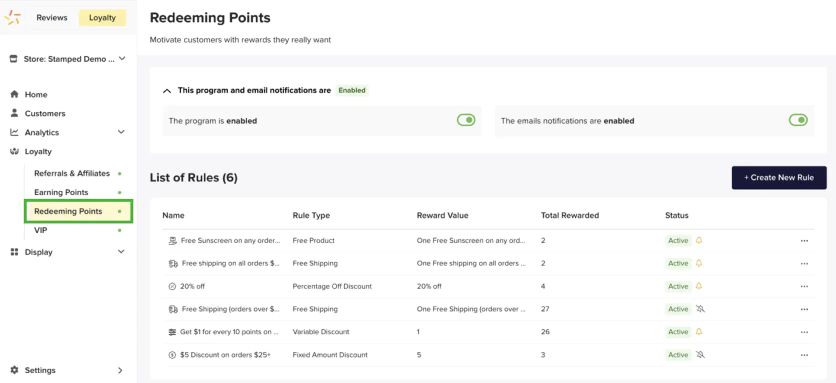
Loyalty program rules in Stamped.io
This means you can reward customers for purchases and referrals and also encourage them to leave reviews or UGC, all with a single integration. It’s a popular choice for merchants who believe a great loyalty program and great reviews program go hand‑in‑hand – Stamped is built to “kill two birds with one stone.”
With Stamped’s Loyalty & Rewards, you can run a classic points‑based program (earn points for purchases, reviews, referrals, etc.) and a referral program, much like Smile.io or LoyaltyLion. At the same time, because it ties into Stamped’s reviews system, you can incentivize product reviews with points (“Write a review, get 50 points”) and then showcase those reviews on your site to boost trust.
This creates a virtuous cycle: loyalty incentives drive more reviews, and more reviews drive more conversions (and thus more loyal customers). For small to mid‑sized brands especially, Stamped’s combined approach can be more cost‑effective than paying for two separate apps.
Key Features:
- Points, VIP Tiers, and Referrals: Stamped’s loyalty feature set covers all the basics you’d expect – customers earn points on purchases, referrals, and other actions, and can redeem for discounts or perks. You can set up tiered VIP levels (e.g. earn 1000 points to become Gold and get better rewards) with comparable capabilities to dedicated loyalty tools.
- Integrated Reviews & UGC: Unique to Stamped is the seamless integration with its reviews/UGC platform. You can automatically send review request emails after purchase (using Stamped’s review system) and reward customers with loyalty points for submitting reviews or photos. Those reviews can then be displayed using Stamped’s widgets, creating a synergy between loyalty and social proof.
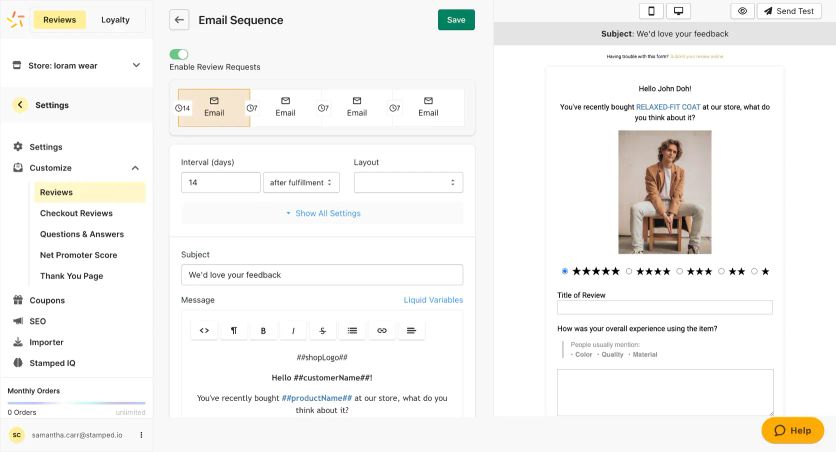
Stamped.io allows to send review request email
- Cost-Effective Bundle: Stamped’s pricing for the combined reviews + loyalty offering tends to be attractive. Many brands find that using Stamped for both functions is cheaper than, say, using Yotpo for reviews and Smile for loyalty separately.
- User-Friendly Admin: If you’ve used Stamped for reviews, adding Loyalty feels familiar. All management happens in one dashboard, making onboarding straightforward.
- Support & Community: Stamped often gets high marks for customer support. They have chat and email support that’s responsive, and since they cater to a lot of Shopify merchants, you’ll find community forums and guides for best practices.
Strengths and weaknesses
The biggest strength of Stamped’s loyalty solution is synergy. If you believe loyalty and reviews are two sides of the same coin for customer engagement, Stamped is built for you.
Customers participating in your loyalty program can be funneled to leave reviews (“Earn 50 points for reviewing your purchase!”) and those reviews in turn boost conversion for new shoppers – it’s a virtuous cycle that Stamped facilitates smoothly.
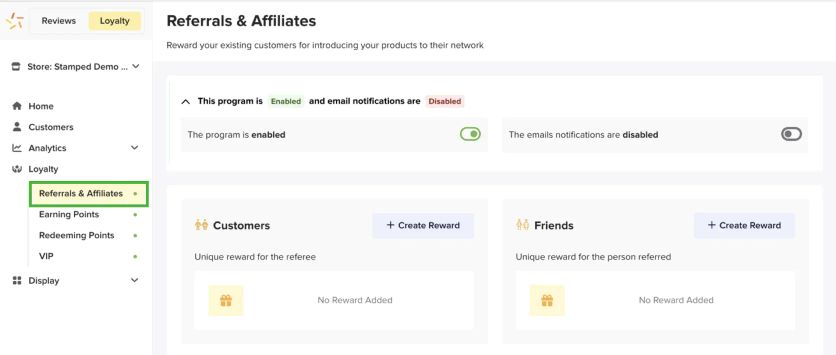
Stamped’s referral program settings
Another strength is that Stamped covers a lot of ground despite not being a dedicated loyalty‑only company. You still get point campaigns, VIP tiers, referrals – the works – so you’re not sacrificing loyalty features for the sake of integration.
Value for money is a notable advantage too: as mentioned, the combined package can be more affordable than piecing together separate apps. For a mid‑market brand that needs robust reviews and decent loyalty features, Stamped often hits a sweet spot of functionality vs. cost.
Additionally, Stamped’s interface tends to be friendly. If you’re already using their reviews app, adding loyalty doesn’t drastically increase complexity. Many users report that Stamped’s dashboard is clean and the learning curve is gentle – especially compared to feature‑dense suites like Yotpo.
Stamped also has a reputation for strong support and listening to merchant feedback.
On the downside, since Stamped isn’t exclusively focused on loyalty, a few of the loyalty‑specific features are a bit more basic than what you might get in a specialist platform.
For instance, the analytics for the loyalty program within Stamped, while present, may not be as deep as LoyaltyLion’s. You might get high‑level metrics, but not the kind of cohort analysis or predictive analytics that an enterprise loyalty platform would provide.
Similarly, customization of loyalty campaigns – while decent – might not reach the same granular level as a dedicated tool.
Another consideration: if you’re not interested in the reviews aspect, Stamped’s loyalty on its own doesn’t necessarily outshine alternatives like Smile.io or even newer apps like Rivo.
Compared to Smile.io
Stamped and Smile.io actually have a lot in common on the loyalty front: both offer points, referrals, VIP tiers, and an easy‑to‑use interface for setting up rewards.
If you used just the loyalty portion of Stamped and compared it to Smile, you’d find they cover similar ground in terms of features for the core loyalty program.
The key difference is Stamped’s integration of reviews/UGC. Smile.io doesn’t handle reviews at all – it would need to integrate with a separate reviews app to accomplish anything similar. Stamped gives you that out of the box.
So, Stamped vs Smile comes down to whether you want your loyalty program to also drive your reviews.
If you’re currently using Smile.io and a separate reviews solution, Stamped could simplify your stack by combining them. For example, with Smile you might use Smile for points and something like Judge.me or Trustpilot for reviews, and there’s no direct connection between them.
With Stamped, your loyalty program can directly incentivize reviews and then showcase them, potentially yielding more reviews and more engagement.
On the other hand, if you have no need or desire for the built‑in reviews (say you’re already deeply invested in another reviews platform or you’re in an industry where reviews aren’t as crucial), then switching from Smile to Stamped just for loyalty might not be worthwhile. Smile is a bit more “plug‑and‑play” purely for loyalty.
Stamped’s loyalty features, while robust, are not dramatically more advanced than Smile’s – it’s not as if Stamped will suddenly give you a crazy new loyalty mechanic that Smile cannot do. In fact, Smile is arguably easier for a pure loyalty scenario, since it’s laser‑focused on that use case.
One more angle: pricing. Smile.io (beyond the free plan) starts at $49 and ranges up to a few hundred dollars for enterprise, whereas Stamped’s combined plans (reviews + loyalty) might start around $119 and go up from there.
If you were already paying for a reviews app and Smile, Stamped could save money; but if you only care about the loyalty budget, Smile might be cheaper at the low end. In terms of support and updates, both are good: Smile has been around longer solely in loyalty, while Stamped is very actively developed especially on the UGC side.
In summary, choose Stamped ifyou want to get a dual benefit – a solid loyalty program and an integrated product reviews system – and possibly streamline costs by bundling. You’ll gain the ability to reward reviews without extra effort, potentially boosting your social proof. Stick with Smile (or another single‑purpose loyalty app) if reviews/UGC aren’t a priority or if you prefer the absolute simplicity of Smile’s interface and pricing.
Compared to Maestra
Stamped and Maestra are quite different: Stamped focuses on loyalty plus reviews/UGC, whereas Maestra focuses on loyalty integrated with multi‑channel marketing and personalization.
If you compare them purely as loyalty solutions, Stamped is narrower in scope but offers that reviews component which Maestra doesn’t have internally. So a brand deliberating between these two should first consider what their priority is. If it’s engaging customers to leave reviews and building community trust, Stamped offers a neat way to incentivize that through loyalty points.
Maestra, on the other hand, could still incentivize reviews (it can send an email offering points for a review, integrating with a reviews tool), but Maestra’s real advantage is using loyalty data as part of a broader automated marketing strategy.
For example, with Stamped you might simply email a customer that they earned 100 points for a purchase. With Maestra, that same scenario could trigger an on‑site pop‑up immediately after checkout, a personalized SMS with a reward link, and segmentation of that customer into a “loyal fan” audience for your next campaign – all automatically.
Maestra’s real‑time CDP means loyalty isn’t an isolated program; it’s part of your broader marketing “brain” connecting email, SMS, ads, and more.
Stamped can’t do all of that because it’s not built to run multi‑channel campaigns – it would rely on you to use another email marketing app or similar for those functions.
Also, personalization is a big differentiator. Stamped will happily give everyone, say, 10 points per dollar and send out a generic birthday reward email. Maestra could, for instance, detect a customer’s browsing history and offer a tailored incentive (“Hey Jane, complete your 2nd purchase this month and earn double points on that skincare item you viewed”). That level of individualized offer is beyond Stamped’s scope (you would have to manually craft such campaigns with data exports if at all).
So the question is, do you need a straightforward loyalty+reviews combo (Stamped) or an integrated, AI-enhanced loyalty+marketing platform (Maestra)? If you just need a no-frills loyalty tool and value the reviews integration, Stamped is great – it keeps things relatively simple and gives you that dual functionality. If you’re ready to turn loyalty data into a strategic weapon across all marketing channels, Maestra is on another level.
In essence, Stamped vs Maestra boils down to content-focused loyalty vs data-focused loyalty. Stamped’s value shines in generating user content through loyalty incentives. Maestra’s value shines in generating personalized outreach through loyalty data.
Tool #8: Rivo Loyalty & Referrals – Affordable & Fast-Improving
Best Smile.io alternative for Shopify brands seeking a cost-effective, fast-evolving loyalty solution.
Rivo is a newer player in the loyalty space that has been gaining traction, particularly among Shopify merchants. It positions itself as a modern, cost-effective alternative to the likes of Smile.io or LoyaltyLion, bringing a lean startup mentality to loyalty software. Rivo focuses solely on loyalty and referrals (no reviews, no email marketing add‑ons) and emphasizes transparency in pricing – you get all features for one price, instead of having to pay extra for each module or usage tier.
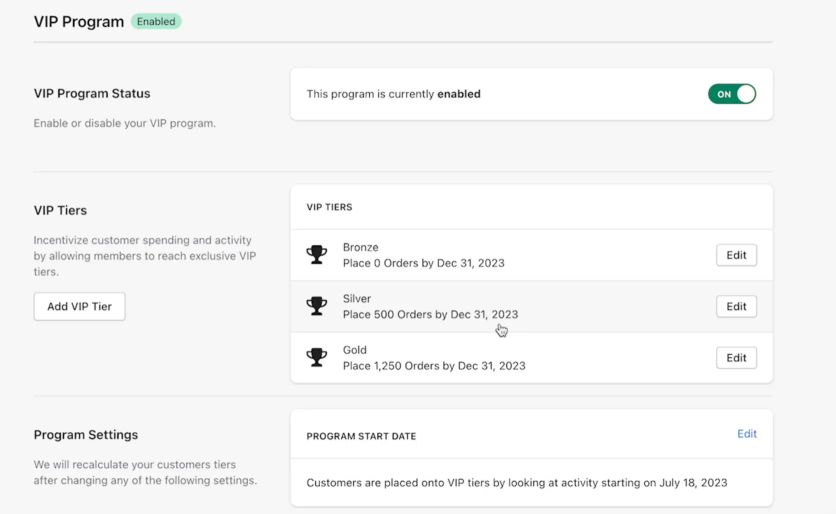
Setting up VIP program in Rivo
One thing that sets Rivo apart is their pace of innovation: they tout a nimble development cycle, often rolling out new features or improvements weekly or monthly rather than quarterly. This means the product is evolving fast, often driven by user feedback.
Important to note, Rivo is Shopify‑exclusive. It integrates deeply with Shopify (and only Shopify) to the point that if you’re not on Shopify, Rivo isn’t an option.
Key Features:
- Points & Referral Program: Rivo covers the core loyalty mechanics: customers earn points for purchases and other actions, and can redeem for rewards (discounts, freebies). It also has a built‑in referral program where customers can get rewards for referring friends (with referral links or codes). These features are equivalent to what Smile’s free or standard tier offers – points per dollar, referral incentives, and more, but Rivo often adds tweaks based on merchant requests.
- VIP Tiers and Customization: Rivo has introduced VIP tier functionality, allowing you to create tiered loyalty levels (like Bronze, Silver, Gold) with escalating benefits. You can customize the branding of your loyalty widget and emails to match your store. While not as elaborate in customization as an enterprise tool, it covers the needs of most small businesses; for instance, you can set your colors, logos, and some text.
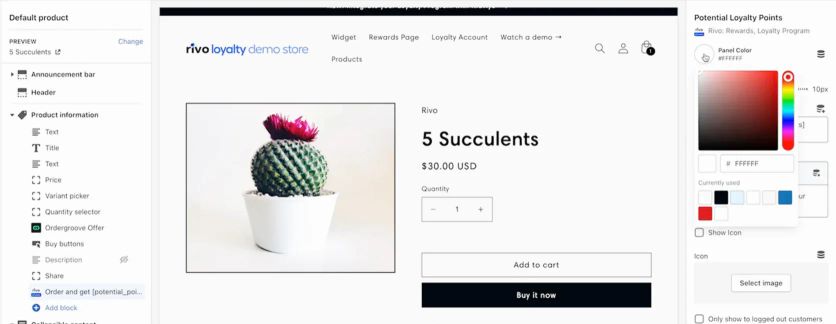
Displaying potential loyalty points in a Shopify store with Rivo
- No “Addon” Fees: All features are included in the plan – for example, if Rivo adds a new way to earn points such as birthdays or social follows, it becomes available to all users without requiring a higher plan. This contrasts with competitors where things like birthday rewards may only appear on a premium tier. Rivo’s philosophy is to keep pricing simple and flat
- Shopify‑Centric Integrations: Rivo integrates with Shopify seamlessly, and it also hooks into popular Shopify apps. For instance, it can sync loyalty data to Klaviyo for emails or connect with other marketing apps. It uses Shopify’s theme app extension, meaning adding the loyalty widget to your store is as easy as a few clicks. Because they focus on Shopify, they ensure compatibility with Shopify’s ecosystem.
Strengths and weaknesses
Rivo’s strengths start with affordability and ROI‑focus. The team explicitly states that the cost of loyalty software should not outweigh the rewards you give to customers – and they price accordingly. Many brands find Rivo’s pricing significantly lower than established competitors for a similar feature set. The pricing is straightforward – month‑to‑month plans, no long contracts, and no charges for each extra integration or feature.
Another strength is the focus on Shopify. By not trying to serve every platform, Rivo’s engineering can concentrate on doing one ecosystem really well. This means if you’re a Shopify user, Rivo might feel more tailored to you: better performance, better integration points such as showing loyalty info in Shopify’s admin, and quicker support since they don’t have to juggle multiple platform quirks.
Rivo also prides itself on not being an “all‑in‑one” but rather best‑in‑class for loyalty. In practice, this means their development and support are fully dedicated to loyalty and referrals, hopefully resulting in a deeper feature set in that domain over time. Many merchants comment that Rivo’s support is very responsive – being a newer entrant, they are hungry for success, so they often work closely with clients, listen to feedback, and even build requested features quickly.
On the weaknesses side, the same focus that gives Rivo strengths also imposes limits. The big one: platform limitation – Rivo is Shopify‑only. If you are not on Shopify, or if you ever plan to migrate off Shopify, Rivo is a no‑go.
Another weakness is that because Rivo doesn’t bundle things like reviews or email, you’ll still be using other apps for those functions.
Also, the fact that Rivo is not an all‑in‑one means you have to ensure it plays nicely with your other tools. In many cases it does, but it is an extra step to connect the dots – whereas with an all‑in‑one like Maestra or Yotpo, those dots are connected internally.
As a newer product, Rivo might not yet have every niche feature that older competitors have accumulated. If your program needs very specific advanced capabilities right now, you’ll want to confirm Rivo supports them out of the box.
Compared to Smile.io
Rivo directly competes with Smile.io in the Shopify loyalty app arena. Both are dedicated loyalty platforms, and both offer the usual suspects of points, referrals, VIP tiers, and integrations with marketing tools. The big differences come down to pricing, support, and ecosystem.
Smile.io has a free plan and then paid plans that increase with features and order count, topping out at enterprise levels. Rivo similarly offers a free tier or at least a low‑cost tier and then a flat paid plan with all features. Brands can often save money versus Smile – especially at scale – because Rivo doesn’t charge for each feature or for advanced analytics; everything is included.
Feature‑wise, Smile is more mature simply from being around longer – it has a polished interface and a huge user base. Rivo is catching up fast and even surpassing in some areas thanks to rapid development, but being newer, you might encounter a few more edges or need to request a feature that’s not there yet.
Support is a differentiator: Smile has solid support and documentation, but Rivo is often praised for very hands‑on help – sometimes even the founders jump in to assist.
One consideration: Smile.io works on multiple platforms, whereas Rivo is Shopify only. If you ever change platforms or run additional stores on a platform that’s not Shopify, Smile would have the edge.
In terms of philosophy, Smile aims for ease of use and approachability, while Rivo aims for merchant‑driven innovation and cost efficiency. For a typical Shopify store starting a loyalty program, both will do the job well. If Smile’s free plan suits you and you don’t need more, you might stick with it; if you find Smile’s pricing or progress frustrating, Rivo is worth exploring.
In short: Rivo vs Smile.io for a Shopify store comes down to whether you prefer the established simplicity of Smile or the fast‑moving, potentially more cost‑effective nature of Rivo. Since both have free plans or trials, the best approach is to test them side by side and see which interface and approach you prefer.
Compared to Maestra
Rivo and Maestra differ in scope significantly. Rivo is a specialist for loyalty (on Shopify) and referrals; Maestra is a broad marketing and loyalty platform. If you compare purely their loyalty program capabilities, Rivo offers much of what Maestra does – but Maestra integrates loyalty data with multi‑channel marketing.
Rivo would integrate with your email service to send loyalty emails, whereas Maestra is the email/SMS service, so it uses loyalty events in real time to trigger communications. For example, with Rivo you might manually set up a flow that emails a customer when they have enough points for a reward. With Maestra, that trigger is native and could also instantly show a pop‑up on your site, send a push notification, or even adjust an ad audience – all based on that single event.
Maestra’s CDP can create nuanced segments combining loyalty data with browsing behavior and purchase history, then target them across channels. Rivo provides the basics, but not that multi‑dimensional segmentation. Rivo’s advantage is simplicity.
If you don’t need Maestra’s all‑in‑one approach – perhaps you’re happy plugging a focused app into your existing stack. If you want a single platform to orchestrate every customer journey touch‑point with loyalty embedded, Maestra is built for that.
Choosing the Right Alternative
Ultimately, the best Smile.io alternative for you depends on your business size, tech stack, and loyalty ambitions. Each of these platforms – from the all-in-one powerhouse (Maestra) to the specialized upstart (Rivo) – offers a unique mix of strengths. Take advantage of demos and free trials – try them out, see how they feel in action, and pay attention to how they align with your growth plans.
The good news is that now loyalty technology is richer than ever: whether you prioritize cost savings, advanced features, or integration breadth, there’s an option above that can elevate your loyalty program and, with it, your customer lifetime value.
Explore the platforms, ask questions, and you’ll find a solution that keeps both your customers and your finance team happy. Start with a free Maestra demo right now!