
12 Best Rebuy Alternatives in 2026 (Compared & Ranked)

Rebuy advertises entry at $25 a month; reviewers report real quotes near $1,000. The gap is the model – pricing scales with your total order count and bills on prorated 30-day cycles. The app itself earned its place in the Shopify ecosystem: Smart Cart, AI recommendations, and post-purchase offers in one place, trusted by tens of thousands of stores.
There's a structural question too. Rebuy optimizes what happens around the cart, on Shopify only – while the same behavioral data could be powering your email, SMS, and loyalty, and your brand may not stay single-platform forever.
This guide compares twelve Rebuy alternatives – from $4.99 point apps to full personalization platforms – on pricing mechanics, recommendation quality, placements, and platform coverage. The quick verdict first:
Quick Verdict on the Best Rebuy Alternatives
The best Rebuy alternatives are Maestra, Nosto, Insider One, Bloomreach, LimeSpot, Glood AI, Wiser, Upsell.com (formerly ReConvert), Kaching CartDrawer, Aftersell, Zipify OneClickUpsell, and Bold Upsell. All twelve work Rebuy’s territory – recommendations, cart upsells, post-purchase offers – at very different depths:
- Best for replacing the whole app stack: Maestra – recommendations, on-site offers, email, SMS, and built-in loyalty on one real-time customer profile
- Best storefront discovery suite: Nosto – recommendations, search, and category merchandising for mid-market retail
- Best cheapest entry: Upsell.com (formerly ReConvert) – full post-purchase feature set from $4.99/mo
- Best pricing honesty: Zipify OneClickUpsell – you pay on upsell revenue generated, never on order volume
- Best for enterprise scale: Insider One – cross-channel personalization far beyond the cart
Content:
Common Rebuy Pain Points (and Quick Fixes)
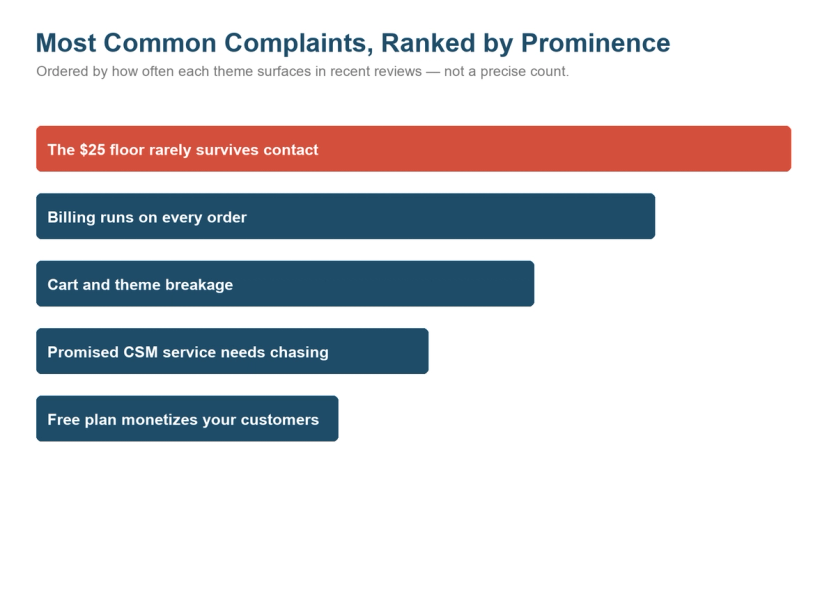
These themes come from recent verified reviews on the Shopify App Store, G2, and Trustpilot – worth checking against your own bill before renewal.
| Pain Point | Description | Possible Solutions |
|---|---|---|
| The $25 floor rarely survives contact | Pricing scales with total monthly orders, and reviewers report real quotes many times the advertised entry price | Get the quote at your actual order volume – and at 2x it – before installing |
| Billing runs on every order | Bills are prorated 30-day cycles based on the previous period's metrics, and the pricing FAQ doesn't define what counts as an "order" | Audit line items monthly; consider tools that charge on upsell revenue or active profiles instead |
| Cart and theme breakage | Reviewers describe carts breaking after vendor deployments and themes needing paid fixes | Test on a staging theme; prefer vendors who implement and own the integration |
| Promised service that needs chasing | The dedicated CSM tier draws reviews saying proactive strategy "will not happen unless you continually beg for it" | Weigh platforms where hands-on service is included, not a $499/mo add-on |
| The free plan monetizes your customers | Rebuy Monetize places third-party ads from an ad network on your post-purchase pages | Know what "free" trades away; keep owned offers in owned placements |
The pricing theme is the loudest: "From a $25/month subscription as it's advertised here on the marketplace, after installed I was asked for nearly $1k/month," one merchant wrote. The free tier surprises people too: "You can't actually put your OWN offers in the post-purchase journey... they're 3rd party adverts."
In fairness, Rebuy's product earns real praise. Smart Cart is the category's reference implementation, recent reviewers name support people who solved their problems, and one merchant measured a 10% units-per-transaction increase with a 12% sales lift. If the bill matches the value for you, the fixes above may be enough – negotiate the tier, define "order" in writing, and skip Monetize unless the ad economics genuinely work.
Why (or When) to Consider Rebuy Alternatives
The clearest trigger is billing math: when fees track total store orders, your costs rise with growth whether or not the widgets contributed. Tools priced on upsell revenue, active customers, or flat tiers keep the incentive aligned.
The second is catalog complexity. Recommendation engines differ sharply in how they handle variants, sizes, and materials – brands with deep catalogs often find generic "similar products" logic recycling the same item in different colors.
The third is scope. If the data behind your cart offers should also drive email, SMS, and loyalty – or your roadmap includes BigCommerce, WooCommerce, or headless – a Shopify-only cart specialist becomes the ceiling.
The Best Rebuy Alternatives at a Glance
| Platform | Best For | Key Differentiator | Starting Price | Rating |
|---|---|---|---|---|
| Maestra | Personalization and retention on one platform | Recommendations, offers, email, SMS, and loyalty on one real-time profile | From $2,815/mo (100K active profiles included) | 4.8/5 (G2) |
| Nosto | Storefront-wide product discovery | Recommendations, search, and category merchandising in one suite | Custom (GMV- and traffic-based) | 4.6/5 (G2) |
| Insider One | Enterprise cross-channel engagement | Personalization across web, app, and messaging with agentic AI | Custom (~$48K/yr average per Vendr estimates) | 4.8/5 (G2) |
| Bloomreach | Enterprise AI search with marketing built in | Loomi AI across search, merchandising, and campaigns | Custom (module + usage fees) | 4.6/5 (G2) |
| LimeSpot | Budget AI recommendations on two platforms | Shopify and BigCommerce coverage with segmentation on Max | Free to 10 orders/mo; Turbo from $9.99/mo | 4.6/5 (Shopify App Store) |
| Glood AI | Low-cost recommendation widgets | Free basic widgets; paid tiers priced on widget serves | Free plan; Basic $19.99/mo | 4.7/5 (Shopify App Store) |
| Wiser | Simple upsells with a generous free tier | Broad placements from $9/mo, free to 50 orders | Free to 50 orders/mo; from $9/mo | 4.9/5 (Shopify App Store) |
| Upsell.com (formerly ReConvert) | Thank-you page and post-purchase funnels | Full feature set on every tier from $4.99/mo | From $4.99/mo (50 orders) | 4.8/5 (Shopify App Store) |
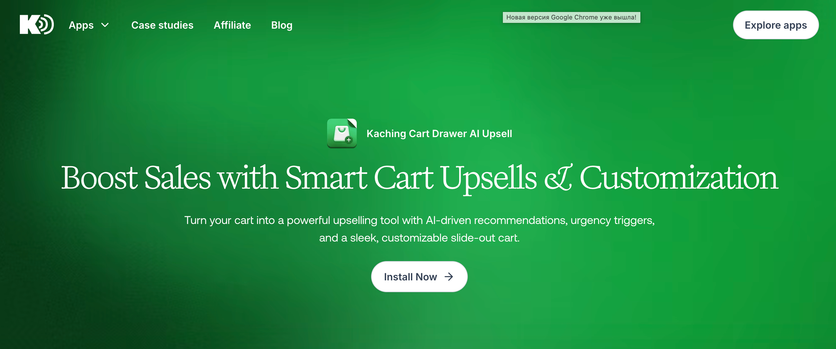
| Kaching CartDrawer | Drop-in Smart Cart replacement | Built for Shopify slide cart with an FBT slider, add-on toggles, and reward bars at flat $9.99–$24.99 tiers | Free for dev stores; from $9.99/mo (99 orders) | 5.0/5 (Shopify App Store) |
| Aftersell | Post-purchase offers with network payouts | Rokt Thanks pays $0.30–$0.80 per transaction on confirmations | From $34.99/mo (500 orders) | 4.9/5 (Shopify App Store) |
| Zipify OneClickUpsell | Upsell funnels priced on results | Fees tier on upsell revenue generated, never order volume | From $8/mo (revenue-tiered) | 4.5/5 (Shopify App Store) |
| Bold Upsell | True upsells with product swap | Accepting an upsell replaces the cart item with the upgrade | Free + 3.5% commission on upsell revenue | 4.4/5 (Shopify App Store) |
1. Maestra – Best for Retention Marketing Beyond the Cart
Starting price: From $2,815/mo (CDP + onsite personalization; first 100K active profiles included)
G2 rating: 4.8/5
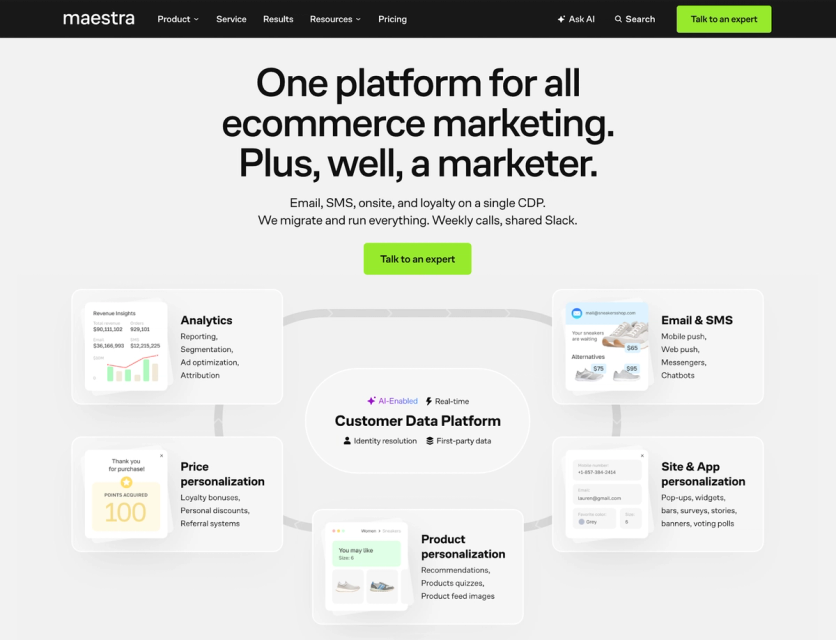
Maestra is a retention platform for mid-size, enterprise, and rapidly scaling ecommerce brands, with personalization built into the same system. It covers the ground Rebuy covers – product recommendations, cart prompts, bundles, on-site offers – and keeps going: email, SMS, push, built-in loyalty, and a real-time CDP all working from the same customer profile.
Key Features
Product Recommendations Built on Variant-Level Data
Fourteen ready-to-use recommendation engines handle the details that break generic "similar products" logic: matching by size, color, and material, filtering to in-stock and region-appropriate items, and following business rules per category or collection. JOLYN, a swimwear brand with 4,000 SKUs, runs recommendations that pair tops and bottoms by color, material, and size – "if you browse a red bikini top, you see the matching bottom – in your size, with the same material and cut," says Jennifer Fenton, Sr. Director of Marketing. Recommendations influence 7% of JOLYN's sales.
Cart, Bundle, and Upsell Mechanics On-Site
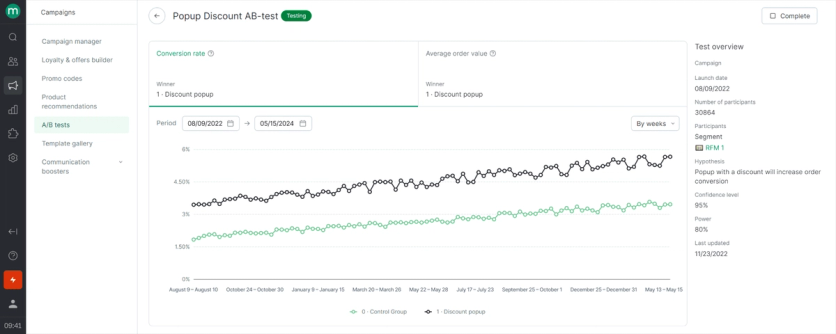
Upsell progress bars, minicart sliders, dynamic bundles, and threshold offers run as configurable on-site campaigns. At Blue Q, "Often Bought With" bundles on product pages account for 40% of all recommendation-influenced revenue, and a minicart slider surfaces under-$10 impulse items at checkout – shoppers who interact with recommendations show 28.7% higher AOV. Enlightened Equipment's Smart Upsell Bar – a real-time free-shipping and gift threshold bar – grew AOV 38.7% in an A/B test against a control group.
Recommendations That Travel Into Email and SMS
The same engines render inside flows: abandoned-cart emails show the exact browsed item plus size-matched companions, and post-purchase messages cross-sell from live inventory. Svaha runs Pair With placements on product pages, Frequently Bought Together bundles at a discount, and minicart upsells – recommendations now assist 11.2% of total revenue, with 31.7% higher AOV on orders where shoppers click them.
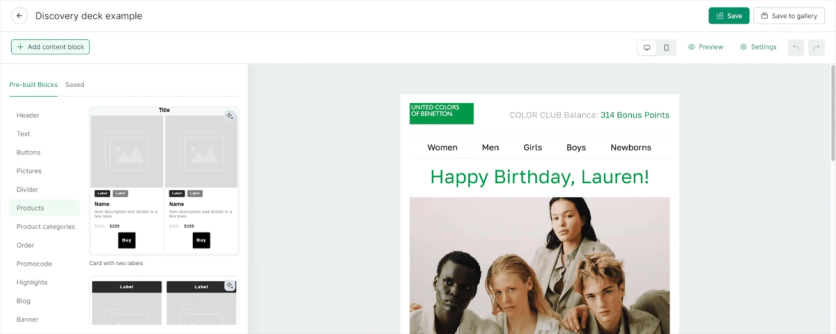
Maestra's visual email composer
Built-In Loyalty and Promotions
Points, tiers, and rewards live in the same platform as the offers – redeemable in checkout, visible across the site, and usable as targeting conditions. Svaha shows members their tier and balance while non-members get an enrollment prompt, alongside geo-targeted promos and lifecycle-stage flows; total sales grew 26% with AOV up 14% year over year on Shopify data.
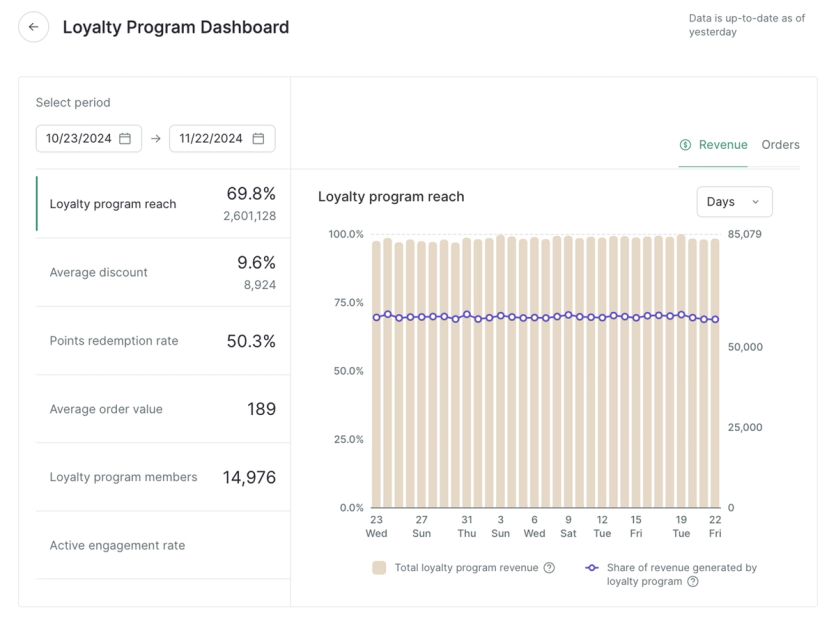
A Real-Time Profile Behind Every Offer
Every widget, email, and loyalty rule reads one profile updated in real time – geography, traffic source, lifecycle stage, purchase history. That's what lets an ad-traffic visitor see one offer while a loyal local customer sees another, without duct-taping apps together.
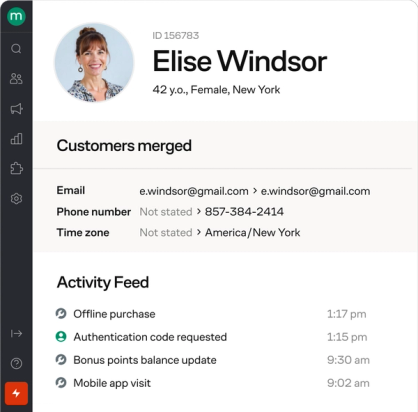
Customer profile in Maestra
A Forward Deployed Marketer Runs the Setup
Migration, integration, flow builds, and ongoing optimization come with every plan, handled by a named Forward Deployed Marketer rather than a support queue. "If you take a chance on Maestra, they will go the extra mile, and you will basically gain a whole other team member," says Nikki Brown, Marketing & Operations Director at Svaha.
Pricing
From $2,815/mo for the real-time CDP plus onsite personalization, first 100,000 active profiles included. The billing unit is the active profile – someone you messaged or who visited or bought that month – so anonymous traffic and dormant list weight are free, and the bill doesn't move with your order count. Messaging volume is separate: SMS, MMS, and WhatsApp are metered on usage. Month-to-month terms, no setup fees, migration and campaign builds included; the module math is public on Maestra's pricing page.
Where Maestra Wins
The consolidation math. Rebuy handles the cart; a typical stack adds an ESP, an SMS app, a loyalty app, and a popup tool on top. Maestra replaces that row of subscriptions – "one platform instead of a fragmented stack... we're getting more for less than we ever paid Rebuy and Yotpo combined," as Svaha's Nikki Brown puts it.
Platform breadth is the second win: Maestra runs on Shopify, BigCommerce (Enlightened Equipment), and WooCommerce (Blossom Flower), so replatforming doesn't mean re-buying your personalization.
And the pricing direction differs: active profiles instead of order counts, with the published number on the pricing page rather than a quote after install.
Where Maestra Falls Short
If you want one cart widget, Maestra is oversized: the $2,815/mo floor buys a retention platform, not an app. Stores under roughly 100K profiles that only need post-purchase offers will get faster payback from a point app in this list.
There's no free plan or self-serve trial. And in-checkout placements on Shopify Plus – offers rendered inside the checkout page itself – are the home turf of checkout-extension specialists like Aftersell or Zipify OCU.
Compared to Rebuy
Rebuy is Shopify-native and cart-centered: Smart Cart, checkout extensions, and post-purchase flows, priced on your total order volume with Premium Support at $499/mo. Maestra is lifecycle-centered: the recommendation and offer layer plus the channels it should feed, priced on active profiles with the service included.
The recommendation engines also read catalogs differently. Rebuy's AI trains on behavioral and transactional signals; Maestra adds variant-level control – size, color, material, stock, and region – which is exactly where large-catalog brands hit Rebuy's ceiling. "With Rebuy, it was on us to update the recommendations and guide their AI," Svaha's Nikki Brown says of the before state.
When to Switch from Rebuy to Maestra
Your recommendations keep showing the same product in different colors. Variant-aware engines fix that: Svaha's recommendations now assist 11.2% of total revenue with 34.9% more items per order on rec-click orders, and JOLYN pairs 4,000 SKUs by size and material with recommendations influencing 7% of sales.
Your bill grows with orders the app didn't touch. Maestra bills active profiles – anonymous and dormant profiles are free – and publishes the number.
The cart is optimized but retention still runs on three more tools. Blue Q wanted "one platform instead of five": recommendations, bundles, email, and promotions now share one profile, with email-driven sales up 39%.
You're going multi-platform. Rebuy is Shopify-only; Maestra carries the same personalization to BigCommerce and WooCommerce storefronts.
2. Nosto – Best for Storefront-Wide Product Discovery
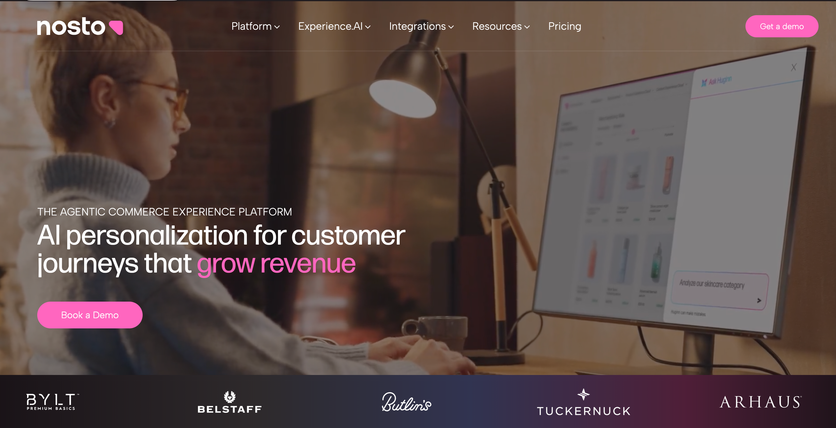
Starting price: Custom (GMV- and traffic-based; ~$47.6K average contract per Vendr estimates)
G2 rating: 4.6/5
Nosto's Commerce Experience Platform treats the whole storefront as the personalization surface – recommendations, search, category merchandising, and content – where Rebuy concentrates on the cart and checkout. For mid-market brands whose discovery experience is the growth lever, that's the relevant difference.
Key Features
Predictive Product Recommendations
Recommendations draw on real-time behavioral and transactional data, with Nosto's Predictive AI surfacing what each shopper is most likely to purchase next across home, product, and cart pages.

Dynamic Bundles and Post-Purchase Upsell
Dynamic Bundles builds "shop-the-look" and complementary-product sets through manual curation or AI. Post-Purchase Upsell adds one-click offers after checkout with no payment re-entry – on Shopify and Shopify Plus only.
Personalized Search and Category Merchandising
Search interprets intent in real time with Semantic AI handling long-tail queries, while Category Merchandising blends product attributes, performance metrics, and business goals – margin, inventory clearance – into drag-and-drop sorting rules with built-in A/B testing.
Behavioral Pop-Ups and Content Personalization
The Content Experience Cloud swaps hero banners, menus, copy, and layouts per segment in real time, plus behavioral pop-ups – all point-and-click.
Pricing
Custom pricing (contact sales), based on "GMV turnover and traffic," selected modules, and support tier. No dollar figures are published and there's no self-serve trial (qualified merchants get a proof of concept). Buyer-side contract data puts the average near $47,591 a year (Vendr).
Where Nosto Wins
Scope with speed: the Shopify integration is one-click, and the platform covers search, merchandising, recommendations, and content in one contract. Reviewers praise the automation – "the virtual merch is automated thanks to some rules you configurate on Nosto" – and name their customer success managers review after review. Delivery is fast, too: "Nosto content also loads fast and does not slow down our pages."
Where Nosto Falls Short
The bill reads enterprise even when the brand isn't: "The cost of the solution also represents a significant investment, which can be a barrier for some companies." Getting full value takes staffing – "there are many options and levels of details… but this requires a lot of time" – and reviewers want deeper analytics and faster merchandising sync to the storefront.
Compared to Rebuy
Both are Shopify-strong, but they tax growth differently – Nosto on GMV and traffic, Rebuy on order count – and they specialize at opposite ends of the journey: Nosto owns discovery (search, categories, content), Rebuy owns the cart moment. Nosto also runs on BigCommerce, Adobe Commerce, Shopware, and Salesforce Commerce Cloud, where Rebuy is Shopify-only. What Nosto doesn't chase is Rebuy's Smart Cart depth – the drawer itself stays your theme's job.
Compared to Maestra
Nosto personalizes the storefront; Maestra personalizes the storefront and the channels around it, with built-in loyalty and a published starting price. Platform coverage tilts the same way: Nosto doesn't list WooCommerce, where Maestra's personalization generated 9% incremental revenue against a control group for Blossom Flower. The full matchup lives in our Nosto alternatives guide.
3. Insider One – Best for Enterprise-Grade Cross-Channel Engagement
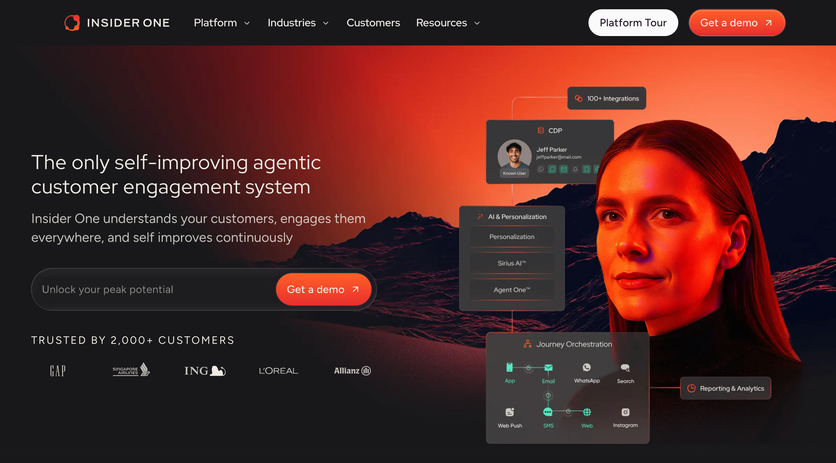
Starting price: Custom (~$48K/yr average contract per Vendr estimates; ~$950–$1,300/mo starter per Spendbase estimates)
G2 rating: 4.8/5
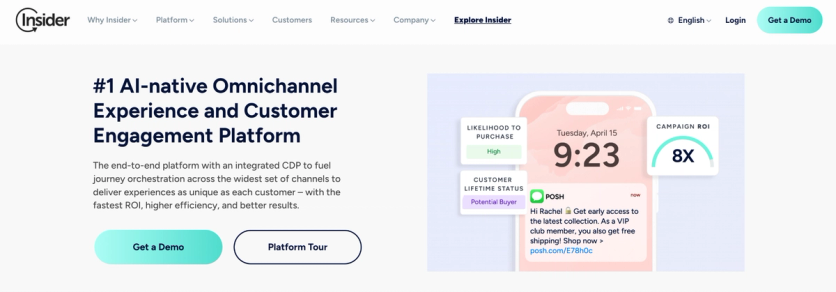
If your Rebuy replacement question is really "should this be a platform?", Insider One is the enterprise answer. Rebranded from Insider in 2026, it calls itself "the leading Agentic Customer Engagement Platform" – personalization, recommendations, search, and messaging journeys across a dozen channels, increasingly operated by AI agents.
Key Features
Smart Recommender
Recommendations run across web, app, email, SMS, WhatsApp, and push – "20+ proven algorithms" on the web channel alone, spanning generic, contextual, personalized, and image-based Visually Similar strategies. The Recommendation Strategist converts a plain-language goal into a working, catalog-validated recommendation setup.
Web Personalization With 140+ Templates
Banners, gamified pop-ups, and InStory – a story-format discovery layer – launch from a large template library, with Onsite Experiment A/B and multivariate testing and AI-picked winners.
Eureka Search
NLP-driven site search reorders results around each shopper's brands, sizes, and colors, with typo tolerance and intelligent autocomplete.
Architect Journeys and Agent One
Architect orchestrates journeys across email, SMS, WhatsApp, push, web, app, and TikTok from one canvas, with AI choosing the next best channel and send time. Agent One layers autonomous Insights, Design, Shopping, and Support agents on top.
Pricing
Custom pricing (contact sales), based on Monthly Active Users; Insider states the fee includes professional services, onboarding, and support, with one-year terms and a "$0 Migration Movement" that covers switching costs. Spendbase pegs starter packages at $950–$1,300/mo; Vendr's logged deals average $48,210/yr.
Where Insider One Wins
Breadth with genuine review strength – a 4.8/5 G2 rating across 1,400+ reviews leads this list. The customer success model is embedded ("not as an external consultant, but as a member of the team"), and global brands consolidate multiple regional tools onto it.
Where Insider One Falls Short
Onboarding runs long – "the initial onboarding and technical integration took a bit more time than we anticipated" – and the breadth "can be a bit overwhelming for beginners," with a steep Architect learning curve. Licensing product by product grates too: a reviewer wanted one package instead, "so we dont have to make order form for each product that we start using."
Compared to Rebuy
They're different purchases. Rebuy is a Shopify app you install this afternoon; Insider One is an enterprise platform you contract for a year, priced on MAUs. The jump makes sense when cart optimization stops being the bottleneck and coordinating web, app, and messaging across markets becomes it.
Compared to Maestra
Both consolidate personalization with marketing channels on unified profiles. Insider One is tuned for global enterprise: MAU pricing, annual contracts, agentic AI across 12+ channels. Maestra is tuned for scaling DTC: a published $2,815/mo start, month-to-month terms, and a Forward Deployed Marketer who builds the flows – with segmentation kept marketer-controlled (RFM plus AI-suggested hypotheses) rather than black-box predictive scoring.
4. Bloomreach – Best for Enterprise AI Search With Marketing Built In
Starting price: Custom (module + usage fees; Bloomreach's Shopify listing cites $22,500/yr for Email Marketing and $45,000/yr for Ecommerce Search)
G2 rating: 4.6/5
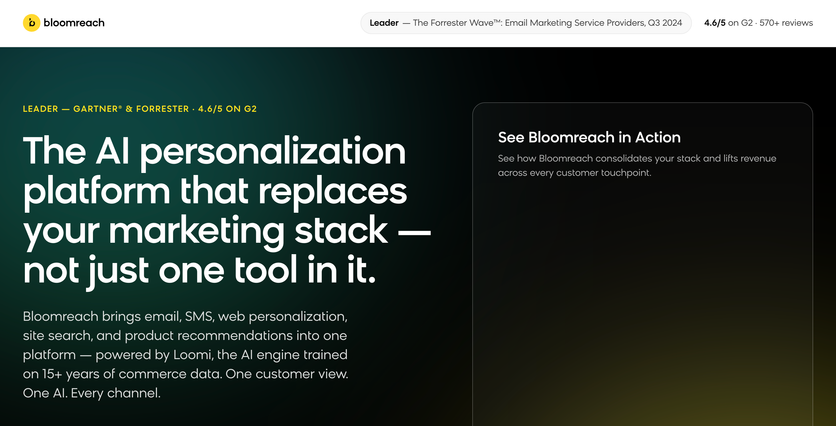
Bloomreach – "The AI Platform for Personalization," 1,400+ brands – pairs the strongest search and merchandising stack in this list with a full marketing automation suite, all under its Loomi AI branding. In 2026 the familiar names changed: Engagement became Marketing Automation, Discovery became Ecommerce Search.
Key Features
Ecommerce Search and Product Recommendations
AI-native search built to maximize revenue per visitor, with recommendations fed by search history, customer insights, and product data – bestselling, frequently bought together, trending, and rule-based strategies. The vendor's own benchmark for it is a 20% lift in revenue per visitor.
Ecommerce Categories
Merchandisers boost, bury, lock, and block products on category pages, build dynamic categories from attributes, and control individual grid slots without developer time.
Marketing Automation Across 13+ Channels
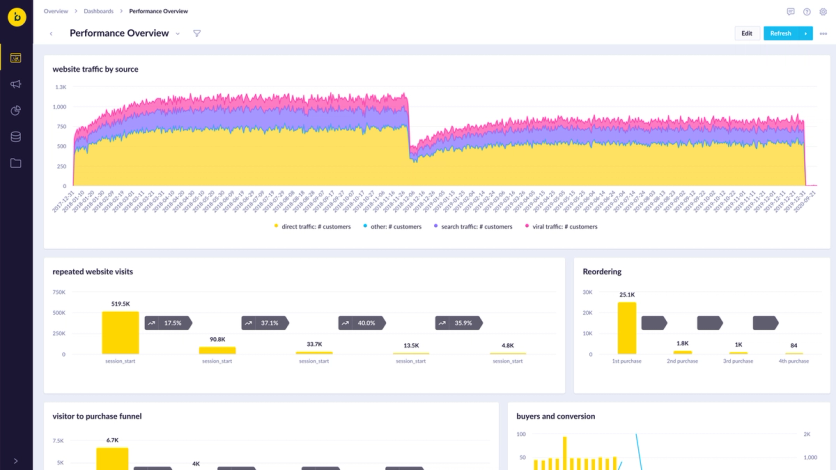
Email, SMS, RCS, WhatsApp, web personalization, and ads run on unified customer data, with Loomi generating copy, inserting recommendations, and timing sends per customer.
Loomi AI and Agents
Loomi Marketing Agent turns a prompt into a fully built workflow; Loomi Shopping Agent 2.0 handles conversational shopping; Loomi Connect builds custom agents on the same intelligence.
Pricing
Custom pricing – a module fee per licensed product plus a usage fee scaling with customers served, catalog size, and event volume, billed annually only. Its Shopify App Store listing puts Email Marketing at $22,500/yr and Ecommerce Search at $45,000/yr, while Vendr's logged deals average about $180,000/yr.
Where Bloomreach Wins
Search-led commerce at enterprise scale: for brands where product discovery drives revenue, Ecommerce Search plus Categories is the strongest single-vendor stack here. Support scores back it up – a 9.3 Quality of Support on G2 – and reviewers note real-time speed on heavy data volumes.
Where Bloomreach Falls Short
The usage-fee mechanics draw pointed reviews: "During negotiations, they will underestimate the number of processed events you actually need to lure you in with a lower investment." It's also a technical platform – reviewers report hiring "a technical consultant from Bloomreach to develop scenarios, which is an extra cost." And on Shopify storefronts, Bloomreach's own docs note the platform can't use a service worker – so no web push and no flicker-free experiments there.
Compared to Rebuy
An enterprise search-and-marketing suite against a cart-focused Shopify app: the comparison only becomes real when you're on Shopify Plus with enterprise budget and search is strategic. At that point Bloomreach replaces several categories at once – but on annual contracts with usage fees, versus Rebuy's monthly app billing.
Compared to Maestra
Both combine personalization with owned email and SMS. Bloomreach's pricing compounds – module fees plus processed-event usage on annual terms – where Maestra bills active profiles month-to-month with dormant profiles free. Selkirk Sport consolidated its Bloomreach-era email stack into Maestra and saw email-attributed revenue climb 55% over its final Bloomreach year, with SMS up 149%. Bloomreach keeps the edge on enterprise site search; Maestra adds built-in loyalty and includes its Forward Deployed Marketer in every plan.
5. LimeSpot – Best for Budget AI Recommendations on Two Platforms
Starting price: Free to 10 orders/mo; LimeSpot Turbo from $9.99/mo
Shopify App Store rating: 4.6/5 (391 reviews)
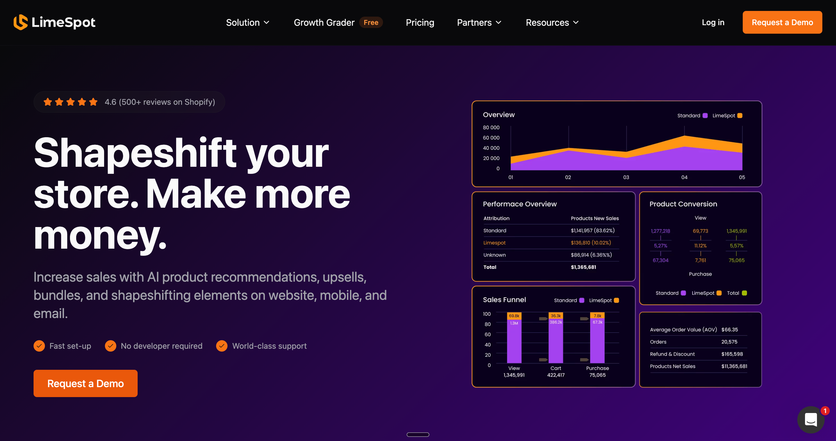
LimeSpot – the app now named LimeSpot AI Bundles & Upsells, acquired by Pantastic in 2022 – sells "AI-Powered E-commerce Personalization for Shopify & BigCommerce." It's one of the few Rebuy alternatives at app-store prices that isn't Shopify-exclusive.
Key Features
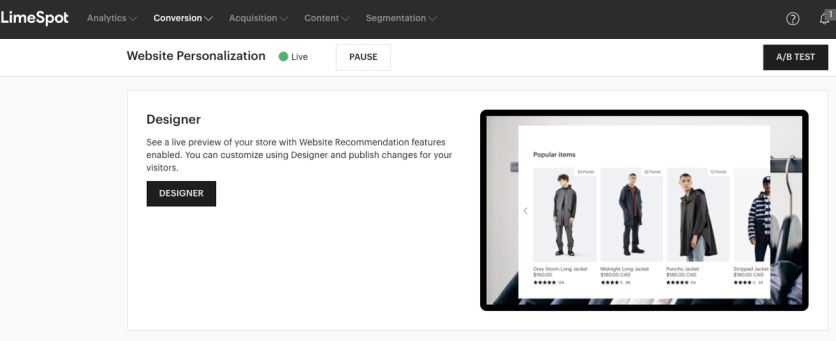
Smart Recommendations
"Adjustable AI-driven Merchandizing" powers cross-sells, upsells, complementary items, and dynamic bundles with optional personalized discounts, placed "from the homepage to checkout, and beyond" – including checkout-extension and post-purchase offers on Shopify.
Customer Segmentation
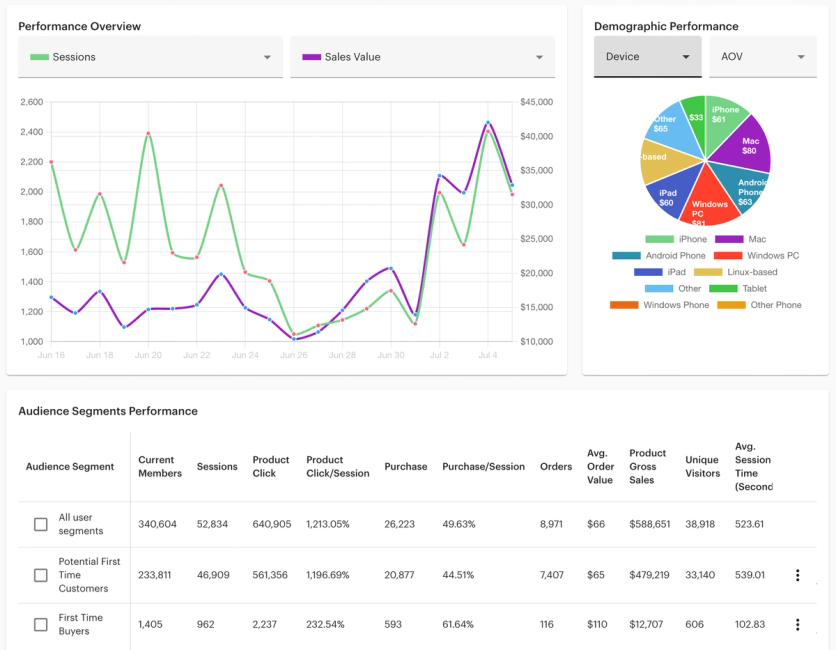
The Max plan groups customers automatically by journey stage – first visit through VIP – using "150+ signals," refreshed with every interaction while the customer browses.
Email and SMS Personalization
Recommendation widgets render inside emails across 13 integrations (Klaviyo with auto-sync, Omnisend, Mailchimp, and others), with SMS covered via personalization links.
A/B/n Testing and Content Personalization
"Sophisticated multi-variate tests" run alongside Smart Images, Smart Text & HTML, and Smart Collections – content that reshapes itself per segment.
Pricing
Free for up to 10 orders/mo; LimeSpot Turbo from $9.99/mo with the fee rising on order volume (up to 250 orders = $19.99); LimeSpot Max from $50/mo rising on store revenue (up to $50K revenue = $150/mo). Both paid tiers carry 15-day trials. Two catches: Free and Turbo are marked not compatible with Shopify Plus, and legacy accounts may still sit on the old "Pay as You Grow" model of roughly 2.5% of LimeSpot-attributed revenue.
Where LimeSpot Wins
Entry cost and reach: a real free tier, sub-$10 starting price, and BigCommerce coverage alongside Shopify. Recent reviews praise the support by name – "Rodolfo is simply the best customer / technical support agent I have ever had" – and describe quick setups with visible conversion lift.
Where LimeSpot Falls Short
Billing transparency is the sore spot on legacy plans: "They charge us more then $500 a month without explanation," one three-year user wrote – the developer's reply confirmed a ~2.5% revenue-share plan. Attribution draws related complaints: "they seem to take credit for selling things which have nothing to do with them." One enterprise-size store also reported long load times, which LimeSpot disputes.
Compared to Rebuy
LimeSpot covers Rebuy's core recommendation-and-bundle territory at a fraction of the entry price, and adds BigCommerce. Rebuy answers with depth LimeSpot doesn't have – Smart Cart, Smart Search, no-code Flows, and a bigger integration ecosystem. Both bills climb with success: Rebuy's on orders, LimeSpot's on orders (Turbo) or store revenue (Max).
Compared to Maestra
LimeSpot Max – segmentation plus email personalization – is a step toward platform behavior; Maestra completes the move with its own email, SMS, loyalty, and variant-level recommendation engines on one profile. The BigCommerce overlap is real, and so is the gap: at Defense Mechanisms, a BigCommerce brand, Maestra recommendations influence 8.9% of sales with merchandiser-controllable AI.
6. Glood AI – Best for Low-Cost Recommendation Widgets
Starting price: Free plan; Basic $19.99/mo (10,000 widget serves)
Shopify App Store rating: 4.7/5 (107 reviews)
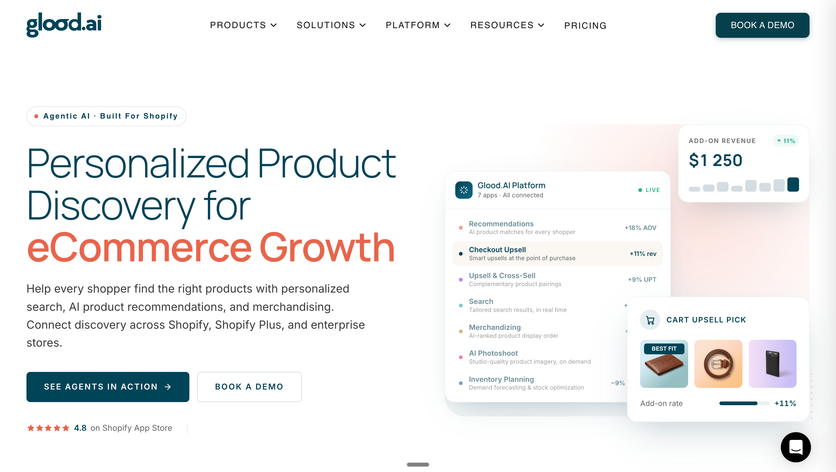
Glood AI brands itself a "commerce experience platform"; in practice it's a Shopify recommendation-app family – a rated flagship (Glood Product Recommendations) plus newer AI search and creative apps that launched recently. For stores that want recommendation widgets cheaply, the flagship does the job.
Key Features
Personalized Recommendations
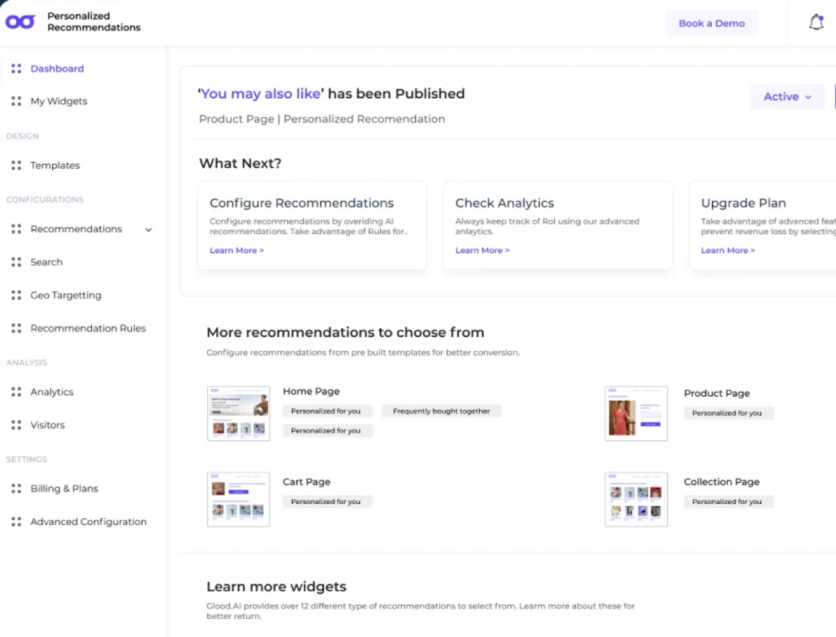
AI-driven widgets – Recently Launched, Recently Viewed, Trending, Bestseller, Personalized Recommendations, Similar Products, Bought Together – place across home, product, cart, and checkout pages, with a Mini Cart from the Basic plan.
Product Bundles
Fixed bundles, upsell bundles, frequently bought together, and related products are the four bundle types, priced with fixed pricing, a discount, or custom pricing. Bundles unlock on the Pro plan at $69.99/mo, while product-page and cart upsells start on Basic and checkout upsell stays Plus-only at $299.99/mo.
Checkout Upsells and One-Click Post-Purchase
"Automated, intelligent one click, post checkout product upsells" without payment re-entry, plus a Visual Promotion Builder – on the Plus plan.
A/B Testing and AI Search
Concurrent A/B tests with real-time analytics arrive on Plus; a separate Glood AI Search with Image app (launched March 2026) adds image search and typo-tolerant instant search.
Pricing
Free plan with unlimited basic widgets; Basic $19.99/mo for 10,000 widget serves; Pro $69.99/mo for 100,000; Plus $299.99/mo for 500,000 (A/B testing, checkout upsell, API); Enterprise custom above 1M. The unit is the widget serve, and overages bill on usage – worth watching. 14-day trials on paid tiers.
Where Glood AI Wins
Support is the dominant praise theme in recent reviews – "great responsive customer support willing to make customizations" – and the free plan plus $19.99 entry make it one of the cheapest credible recommendation setups on Shopify.
Where Glood AI Falls Short
Usage billing has surprised merchants: "I bought a $19.99 monthly package and they charged me an extra $107 at the end of the month… I paid $137 for an app that didn't make me a single sale," one wrote. A 2025 product overhaul broke a long-time user's setup. And there's a trust-signal gap: Glood has no G2, Capterra, or Trustpilot presence at all – its review base is 96 Shopify App Store reviews.
Compared to Rebuy
Both are Shopify-native and price on volume, but different volume: Rebuy meters your orders, Glood meters widget serves. Glood is far cheaper at entry; Rebuy is far deeper – cart, search, flows, landing pages, and a much larger merchant base and integration list.
Compared to Maestra
Glood serves widgets; Maestra runs the customer relationship those widgets feed. Nothing in Maestra is metered per impression – billing follows active profiles – and the same recommendation engines render on-site, in email, and in SMS with variant-level business rules.
7. Wiser – Best for Simple Upsells With a Generous Free Tier
Starting price: Free to 50 orders/mo; from $9/mo
Shopify App Store rating: 4.9/5 (512 reviews)
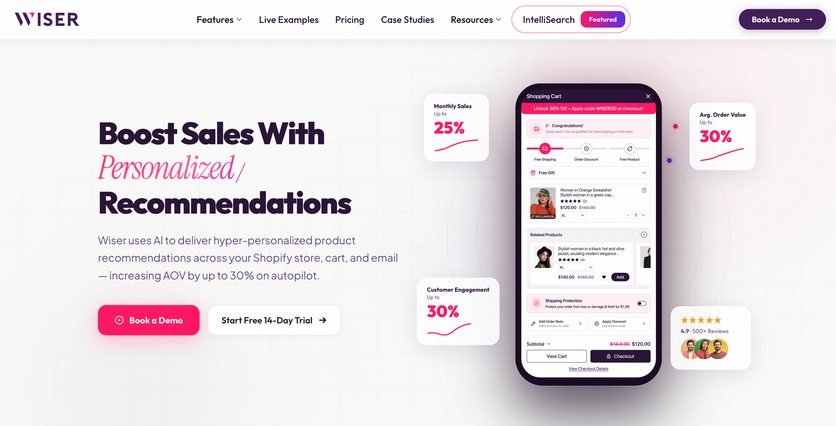
Wiser AI ‑ Upsell & Cross Sell, by Expert Village Media, is "a powerful Shopify upsell app that helps ecommerce brands increase AOV with AI-powered product recommendations, bundles, and post-purchase upsells." Its 4.9 rating is the highest among the point apps in this list.
Key Features
AI Powered Recommendations
The engine "dynamically adapts to real-time customer data including their on-site behavior and changes in… assortment, product pricing, and offers," across homepage, product, cart, and collection pages plus pop-ups.
Frequently Bought Together
Item-by-item collaborative filtering builds FBT blocks for product, cart, and checkout pages – though FBT with bundle discounts sits on the Enterprise plan.
Post Purchase Upsell
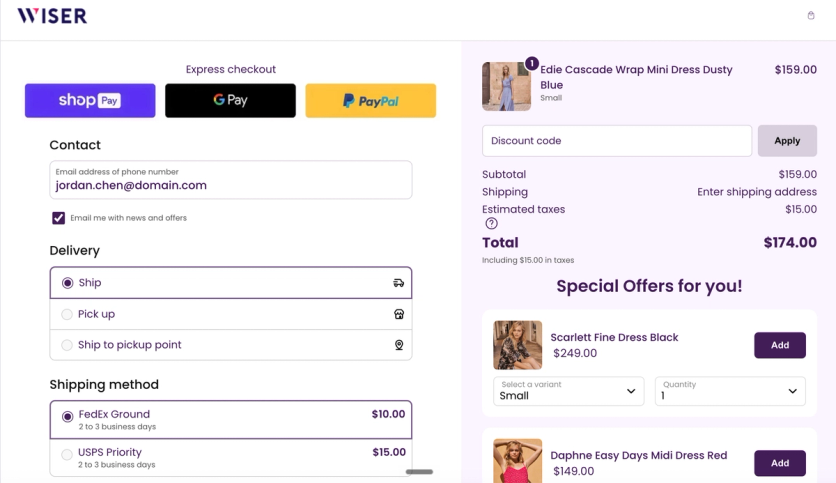
Offers land right after checkout completes, and the post-purchase funnel is included on every tier, the free one included. The same recommendation logic also runs on the thank-you page, the order status page, and the cart drawer, so the window after payment is covered at more than one point.
Email Recommendations and Cart Drawer
Both exist – and both are Enterprise-gated, along with checkout-page recommendations, API access, and a dedicated success manager.
Pricing
Free up to 50 orders/mo, then Basic $9/mo (51–100 orders), Growth $19/mo (101–300), Premium $49/mo (301–500), scaling to $399/mo at 3,000–5,000 orders and custom Enterprise above that. The meter is total store orders, auto-switching tiers. 14-day trial on paid plans.
Where Wiser Wins
The ratings and the entry point: 4.9/5 across 482 reviews, a free tier to 50 orders, and recurring praise for fast hands-on support – "he fixed everything in seconds." Reviewers call the placement options "many options and opportunities for Upsells" with "a very generous free tier."
Where Wiser Falls Short
The billing meter frustrates: "their billing is based off of total monthly orders on your store. Including orders that their app may not have had any part in generating… what a scam," one reviewer wrote. Others flag that listed features live behind expensive tiers – "not included without paying hundreds of dollars a month" – and one store traced an order-flow delay to upsell triggers.
Compared to Rebuy
Wiser shares Rebuy's billing philosophy – total store orders – at much lower price points, and covers the recommendation and post-purchase basics. It doesn't attempt Rebuy's cart drawer, search, or flow automation; it's a recommendations-and-upsell specialist.
Compared to Maestra
The complaint that dogs Wiser – paying on every store order regardless of contribution – is the exact question Maestra's model answers: billing follows active customer profiles, not order counts, and dormant profiles are free. The recommendation depth differs in kind, too: fourteen engines with size, color, material, and stock rules, running on-site and inside email and SMS flows from one profile.
8. Upsell.com (formerly ReConvert) – Best for Thank-You Page and Post-Purchase Funnels
Starting price: From $4.99/mo (50 orders or $50 upsell revenue)
Shopify App Store rating: 4.8/5 (3,098 reviews)
ReConvert rebranded to Upsell.com in 2026 – same product, new name: "The Best Shopify Upsell App for Bigger, Better Orders." With 3,098 reviews it has the largest review base of any point app in this list, and the lowest entry price.
Key Features
One-Click Post-Purchase Upsells
A custom offer page appears between checkout and the thank-you page, accepting payment in one click – with multi-offer funnels chaining "bundles, cross-sells & downsells" based on what the shopper accepts or declines.
Thank You Page Editor
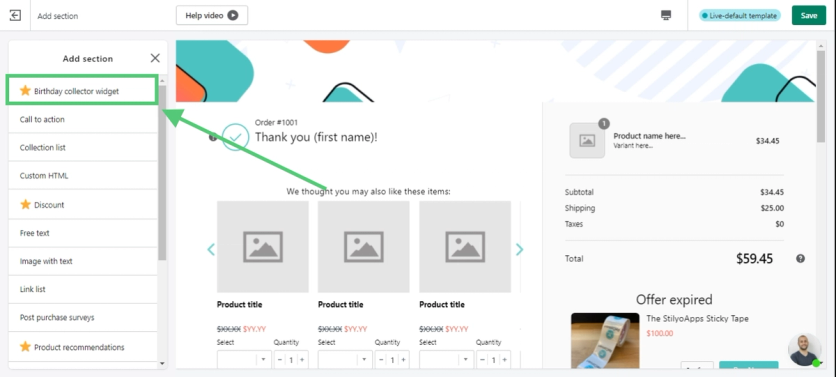
A drag-and-drop builder turns the order confirmation page into an offer surface with conditional logic on order contents, totals, and collections. Upsell.com cites an average of 2.2 thank-you-page views per order.
Checkout Upsells on Shopify Plus
A checkout editor puts offers inside Shopify Plus checkout itself. Everyone else works the window after it: single-click offers that need no re-entered payment details, a thank-you page you can fill with cross-sells, pop-ups, videos and surveys, and offers on the order status page for shoppers returning to check shipping.
Segmentation, Triggers, and A/B Testing
Offer targeting runs on "conditions like order value, product type, or customer history," and split testing plus full analytics ship on every plan – including the $4.99 tier.
Pricing
From $4.99/mo (Upsell Basic: up to 50 orders or $50 upsell revenue), $9.99/mo Growth, $19.99/mo Business (200 orders or $200 upsell revenue) – tiers auto-bump when either the order count or the upsell-revenue threshold hits first. Above roughly $2,000 in monthly upsell revenue, it's talk-to-sales. 14-day trial; a Wix version starts at the same $4.99.
Where Upsell.com Wins
Price-to-feature ratio: the entire feature set – A/B testing, analytics, all placements – ships on every tier, so a small store pays $4.99 for tooling others gate behind $299 plans. The 24/7 live chat earns name-checks in reviews, and "5 Minute Setup" holds up for non-technical merchants.
Where Upsell.com Falls Short
The dual billing trigger can invert the economics: "The app generated €340.86 in upsell revenue, while €424.70 was charged in usage fees," one January 2026 reviewer calculated – because the meter counts all store orders "no matter what sales channel or if the upsell is displayed at all." Several 2026 reviewers also report third-party affiliate ads appearing on their post-purchase pages – presented here as merchant claims, since no official feature documentation describes it – and a minority report post-trial and post-uninstall charges.
Compared to Rebuy
Upsell.com is the post-purchase specialist: thank-you pages and after-checkout funnels, done cheaply and well. Rebuy is the surrounding suite – cart, recommendations, search, flows. The billing gotcha rhymes across both (fees tied to store-wide order counts), but the absolute numbers differ by an order of magnitude at entry.
Compared to Maestra
A thank-you page upsell is one post-purchase touch; Maestra runs the whole post-purchase journey on customer data – cross-sell emails, replenishment flows, loyalty enrollment – plus the on-site offers. Where Upsell.com's fees track orders, Maestra's track active profiles with the number published. For a store that just needs the thank-you page working this quarter, though, $4.99 is hard to argue with – Maestra is the move when that page is one touch among many you want coordinated.
9. Kaching CartDrawer – Best for a Drop-In Smart Cart Replacement
Starting price: From $9.99/mo (up to 99 orders); free for development stores
Shopify App Store rating: 5.0/5 (1,467 reviews)
Kaching CartDrawer Cart Upsell, by Kaching Bundles & Upsells, promises to "boost AOV with a custom slide cart featuring cart discount, urgency timer, free shipping bar" and more. Its 5.0 rating holds across 1,467 reviews, and the app carries the Built for Shopify badge, Shopify's audit of performance, design, and integration.
Key Features
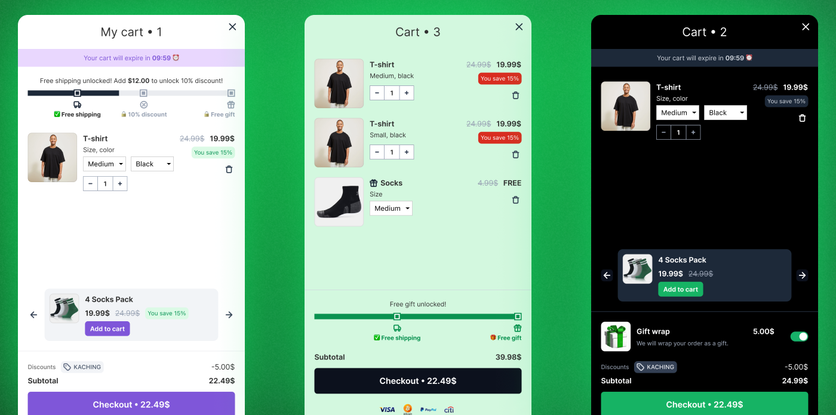
Upsell Slider With Frequently Bought Together
The drawer's slider surfaces frequently-bought-together products as one-tap adds, so the cross-sell happens where the buying decision already is: no separate page, no popup, no re-render of the theme cart.
One-Toggle Add-Ons
Gift wrapping and shipping protection sell through simple toggles inside the drawer, about the lowest-friction attach rate a cart can offer.
Free Shipping and Free Gift Bars
A progress bar counts up to free shipping or a free gift, with tiered rewards to keep pulling carts past the next threshold; countdown timers and payment icons add urgency and trust in the same surface.
Design Control Without Code
Custom rules, custom CSS and HTML, sticky cart, announcements, and discount fields, with the listing promising it is "easy to create, customize your cart drawer and translate it to any language, no coding required" (seven languages ship by default). It works with Shopify Checkout, GemPages, PageFly, Releasit COD Form, and the rest of the Kaching app family.
Pricing
Free for development stores, then $9.99/mo up to 99 monthly store orders, $14.99/mo to 199, and $24.99/mo to 499, each paid tier with a 14-day trial. The meter is total store orders, the same philosophy as Rebuy and Wiser, but the absolute numbers stay pocket-sized: the highest published tier costs less than Rebuy's advertised $25 floor.
Where Kaching CartDrawer Wins
The scoreboard: a 5.0/5 average across 1,467 reviews on a Built for Shopify app, which means the drawer passed Shopify's own speed and integration bar rather than just its review filter. Setup is genuinely no-code, and because every selling mechanic (slider, toggles, reward bar, timers) lives inside one drawer, there is exactly one surface to configure and one to test.
Where Kaching CartDrawer Falls Short
It lives entirely in the cart drawer: no post-purchase offers, no checkout-page placements, no recommendation widgets on product or collection pages. The developer ships those jobs as separate Kaching apps, so a store wanting the whole journey stacks subscriptions. And like most of this list, the billing meter counts total store orders, not upsell contribution.
Compared to Rebuy
CartDrawer competes with exactly one piece of Rebuy, Smart Cart, and prices it like an accessory instead of a platform: flat $9.99–$24.99 tiers against a $25 floor that reviewers report ballooning at quote time. There is no search, no flows, no recommendations engine. If the drawer is the only Rebuy surface you actually use, this is the cheapest credible way to keep it.
Compared to Maestra
CartDrawer optimizes one surface with one tool; Maestra runs recommendations, offers, email, SMS, and loyalty from one real-time profile, billed on active profiles rather than order counts. A store that lives and dies by its cart drawer gets what it needs for $24.99; a brand coordinating that drawer with every other customer touch is shopping in Maestra's category.
10. Aftersell – Best for Post-Purchase Offers With Network Payouts
Starting price: From $34.99/mo (0–500 orders)
Shopify App Store rating: 4.9/5 (1,097 reviews)
Aftersell – owned by Rokt since 2024 – pitches "upselling without the sacrifice": one-click post-purchase offers, checkout upsells for Plus stores, and a twist the others don't have, Rokt Thanks, which pays you for showing partner-brand offers on your order confirmations.
Key Features
One-Click Post-Purchase Upsells and Downsells
Offers appear right after order completion and accept in one click with no payment re-entry, triggered by products purchased, collections, cart value, order count, customer tags, UTM source, shipping method, or discount codes – including one-click conversion of one-time buyers to subscriptions.
Smart Funnels
"Aftersell's AI-powered offer optimization engine" generates, tests, and rotates "up to 6,000+ offer variations" across products, pricing, discounts, and layouts – you set the parameters once.
Checkout Upsells on Shopify Plus
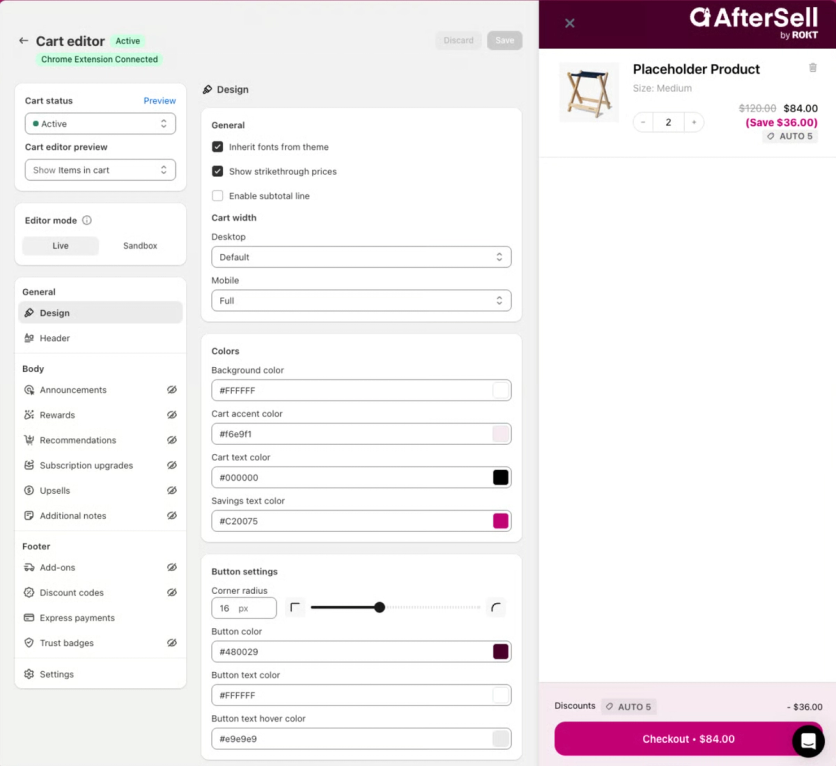
Instant Upsells (single-product, multi-product, or pre-checked order bumps), Smart Nudges showing progress toward free shipping, and trust content render inside the checkout itself – Plus stores only.
Rokt Thanks
The order-confirmation page shows offers from "1000+ premium brands" via Rokt's advertiser marketplace, earning merchants "$0.30–$0.80 in additional profit per transaction." It's free to run (Rokt takes an equal revenue share), can offset your subscription fees dollar-for-dollar, and lets you block categories or competitor brands. Eligibility: 1,000+ monthly orders, US/CA/AU/UK stores.
Pricing
$34.99/mo up to 500 monthly store orders, $54.99/mo to 1,000, $99.99/mo to 2,000 (where Rokt Thanks fee offsets unlock), scaling per module on the site – Post Purchase reaches $329.99/mo at 10,000 orders and $799.99/mo at 100,000. Checkout upsells price separately at $99/mo (Plus only). 30-day free trial.
Where Aftersell Wins
Support dominates the praise – one merchant got a personalized walkthrough video "at almost 11 PM at night" – and the 4.9 rating across 1,097 reviews runs 94% five-star. Rokt Thanks is genuinely differentiated: for high-volume stores in eligible countries, the app can pay for itself.
Where Aftersell Falls Short
The meter is your total store orders: "I'm paying more for worse performance... charging more because my store grew, not because they delivered more value," one 2026 reviewer wrote; another was billed "$54.99... i do not get any sales from it." And post-purchase offers can't fire on Apple Pay or Google Pay orders – a Shopify API limitation Aftersell's own docs say applies to all post-purchase apps – while those orders still count toward your bill.
Compared to Rebuy
The Monetize story repeats here with better economics: Rebuy Monetize and Rokt Thanks both place third-party network ads on confirmation pages, but Aftersell's version can offset your whole subscription. Rebuy remains the broader suite – cart, search, recommendations, flows – where Aftersell stays a post-purchase and checkout specialist at half the noise.
Compared to Maestra
Network ads monetize your customers' attention for someone else's brand; Maestra's post-purchase works your own catalog instead. At Unidragon, a single personalized cross-sell flow – triggered three weeks after delivery, excluding categories the customer already bought – generates 7.4% of total revenue. That's the difference in kind: offers as a page moment versus post-purchase as a customer-data program.
11. Zipify OneClickUpsell – Best for Upsell Funnels Priced on Results
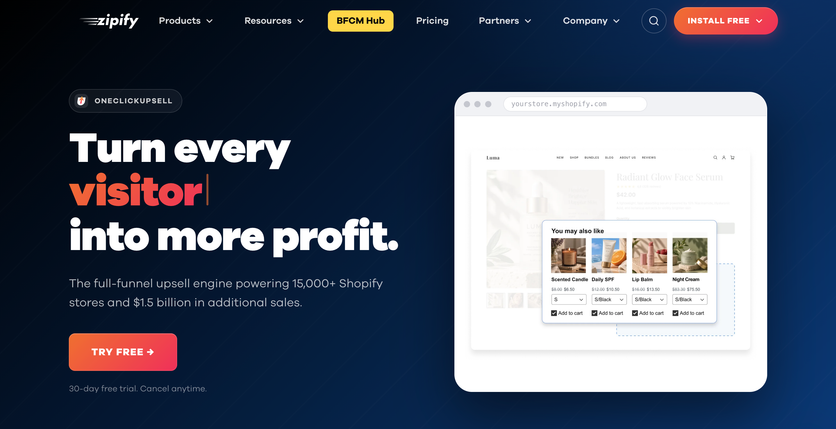
Starting price: From $8/mo (revenue-tiered)
Shopify App Store rating: 4.5/5 (500 reviews)
Zipify calls OneClickUpsell "the original upsell app for Shopify" – built by Ezra Firestone's team in 2016 – and it carries the cleanest pricing logic in this list: fees tier on the upsell revenue the app generates, never on your order volume.
Key Features
Post-Purchase Offers With Downsells
One-click offers appear between checkout and the thank-you page; if a shopper declines, a Downsell Offer fires with a softer pitch before the window closes.
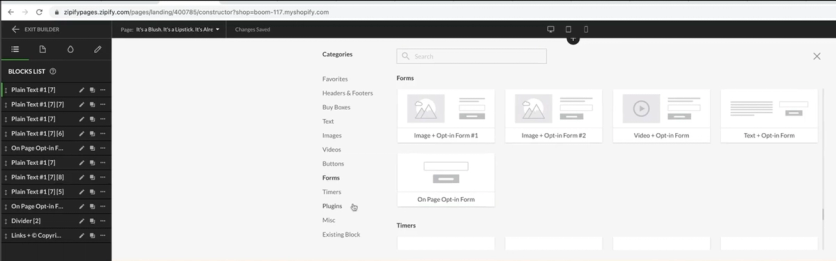
Pre-Purchase Upsells and Slide Cart Drawer
Product Page Widgets hold up to 8 upsells, Pre-Purchase Popups up to 5, and the Slide Cart Drawer adds a customizable cart with a free-shipping progress bar.
In-Checkout and Enhanced Thank You Page Offers
Shopify Plus stores get native in-checkout offers and order bumps; all stores get thank-you page offers rebuilt on Shopify's Checkout Extensibility.
Split Testing and AI Pre-Built Funnels
Unlimited split tests include Multi-Variant ABCD (four variations in one test), and Pre-built Funnels "launch an AI-powered upsell funnel for every product in your store with a single click."
Pricing
One "Unlimited" plan, tiered on upsell revenue: $8/mo up to $200 in upsell revenue, $35/mo to $1,000, $99/mo to $5,000 – with no percentage commission, and tiers above $5,000 unpublished (contact Zipify). "You only pay for what you earn – never for order volume." 30-day free trial; a Zipify Plus agency tier adds done-for-you setup for Plus merchants.
Where Zipify OCU Wins
The pricing alignment: if offers don't sell, you're at $8. Merchants measure the difference – "we've already pushed over $238,000 through it... $53 with our upsells, $45 without," one wrote – and reviewers call the split testing "the best features," with support that "walked me through every step."
Where Zipify OCU Falls Short
The tiers keep climbing with success – "far too expensive for larger stores," per a July 2026 review – and configuration frustrates some ("doesnt trigger at all no matter what i do"). One January 2026 report describes duplicate orders. Payment coverage matters too: post-purchase offers don't fire on Apple Pay, Google Pay, Klarna, Afterpay, or multi-currency orders.
Compared to Rebuy
OCU is the focused funnel machine: pre-purchase, post-purchase, thank-you, tested and chained – priced on results, where Rebuy meters your whole order flow. Rebuy answers with scope OCU doesn't chase: AI recommendations everywhere, Smart Search, no-code flows, and a heavier integration ecosystem. The Slide Cart Drawer gives OCU a light Smart Cart rival, not a replacement.
Compared to Maestra
Both align price to value – OCU on upsell revenue, Maestra on active customer profiles. The scope differs by an order of magnitude: OCU optimizes offer moments; Maestra coordinates those moments with recommendation engines, email and SMS flows, and built-in loyalty reading one profile. Stores that outgrow funnel-only economics usually do it because the data behind the funnel wants to work more surfaces.
12. Bold Upsell – Best for True Upsells With Product Swap
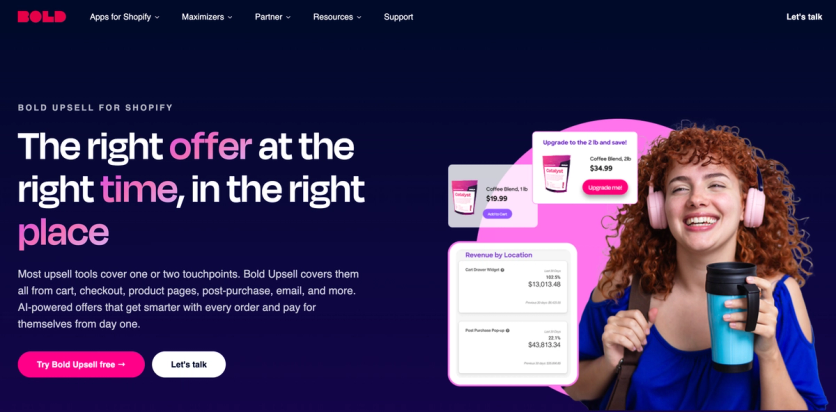
Starting price: Free to install + 3.5% commission on upsell revenue
Shopify App Store rating: 4.4/5 (528 reviews)
Bold AI Upsell & Cross-Sell – Bold Commerce's first app, live since 2012 – covers "product pages, cart, checkout, post-purchase, and email" with one mechanic the others don't lead with: the true upsell, where accepting the offer replaces the cart item with the upgrade.
Key Features
True Upsells With Product Swap
"When the shopper accepts, the original item in their cart is replaced with the upsold product" – the clean way to move shoppers from the standard version to the premium one without double-carting.
Smart Offers
Bold's AI generates and manages cross-sell offers from your catalog and order history, automatically rotating in new batches and disabling underperformers. It needs about 30 days of order data to start.
Funnels and Chained Offers
"Chain offers so every accept triggers the next opportunity" – accept-dependent sequences across product, cart, and post-purchase, with Buy X Get Y and subscribe-and-save formats.
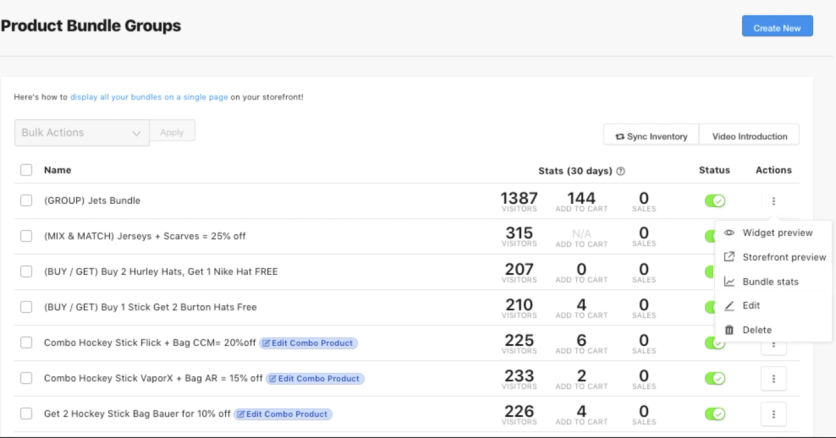
Post-Purchase, Checkout, and Free Gift
One-click thank-you page offers plus a follow-up email variant on all plans; in-checkout offers and automatic Free Gift additions arrive on the Advanced plan (checkout requires Shopify Plus).
Pricing
Standard: free to install plus a 3.5% conversion fee on upsell revenue. Advanced: $10/mo plus 2.5%. "The conversion fee applies only to revenue that Bold Upsell directly generates… If no Bold Upsell offers convert in a billing period, no conversion fee is charged." Custom pricing exists for high-volume brands.
Where Bold Upsell Wins
Zero fixed risk: commission-only pricing means the app costs nothing until it sells something. Longevity shows in the reviews – merchants at 8–10+ years on the app, a Built for Shopify badge, and support that reaches founder level: "I very much appreciated having direct support from Jay, co-founder of Bold."
Where Bold Upsell Falls Short
Reliability draws the sharpest recent reviews: "This app just stopped working for no reason and I didn't get notified," wrote a decade-long user; another long-timer calls it "more buggy than ever." One merchant reports a support-installed code change that dropped add-to-cart and checkout rates 70% until removed. Reporting can't be exported yet – Bold says it's "on our roadmap."
Compared to Rebuy
Bold leads with swap-style true upsells and commission pricing – you pay 3.5% of what it wins, versus Rebuy's order-volume tiers whether or not widgets convert. Rebuy's suite is far wider (cart, search, flows, landing pages); Bold's AI covers cross-sell offers specifically, with the rest built manually.
Compared to Maestra
A commission on won upsells is fair – and still leaves the rest of the customer relationship untouched. Maestra treats the upsell as one output of the profile: the same data feeds on-site offers, recommendation emails, SMS, and loyalty, with billing published per active profile. Bold is the low-risk single-mechanic pick; Maestra is the system those mechanics eventually plug into.
How to Choose the Right Rebuy Alternative
Maestra is the strongest Rebuy alternative for brands that want the cart offers and the marketing they should feed in one platform – it replaces the upsell app, the ESP, the SMS tool, and the loyalty app with one real-time profile. The point apps in this list win narrower briefs: Upsell.com for cheap post-purchase funnels, Kaching CartDrawer for a standalone cart drawer, Zipify OCU and Bold for results-priced offers, Wiser and Glood for recommendation widgets, LimeSpot for two-platform budgets – and Nosto, Insider One, and Bloomreach when the brief is really a platform upgrade.
Five checks settle it:
- Match the meter to the value. Total orders (Rebuy, Aftersell, Wiser, Upsell.com, Kaching CartDrawer), widget serves (Glood), upsell revenue (Zipify OCU, Bold), GMV (Nosto), or active profiles (Maestra) – each taxes growth differently. Model your bill at twice your current volume.
- Map the placements you actually need. Cart drawer, in-checkout (Shopify Plus only, everywhere), post-purchase, thank-you page, site-wide recommendations, email – no two tools cover the same set.
- Stress-test recommendations on your real catalog. Variants, sizes, materials, and stock filtering separate engines that discover products from engines that repeat them.
- Count the subscriptions around the cart. If recommendations, email, SMS, and loyalty are four more line items, consolidation math beats widget math.
- Check your platform roadmap. Most of this list is Shopify-only; Maestra, Nosto, and LimeSpot travel to other platforms.
If more than one check points to consolidation, see Maestra in action and price your current stack against one platform running all of it.
Frequently Asked Questions About Rebuy Alternatives
- For Shopify brands, Maestra reaches furthest of the Rebuy alternatives. It covers recommendations, bundles, cart and post-purchase offers, and adds the email, SMS, loyalty, and customer data platform behind them, with pricing published from $2,815/mo. JOLYN moved its product recommendations to Maestra and pairs 4,000 SKUs by size, color, and material – recommendations now influence 7% of sales. For narrower briefs: Upsell.com (formerly ReConvert) is the budget post-purchase pick, Zipify OneClickUpsell prices on results, and Nosto leads on storefront discovery.
- Rebuy's à-la-carte packages start "as low as $25/month," per Rebuy's pricing page. The Platform One bundle starts around $534/mo at entry volumes. Fees scale with your total monthly orders on prorated 30-day cycles, and reviewers report real quotes near $1,000/mo. Premium Support runs $499/mo separately. For comparison, Maestra – which replaces the upsell app plus the ESP, SMS, and loyalty tools around it – publishes its pricing at $2,815/mo for the CDP plus onsite personalization, first 100,000 active profiles included, month-to-month. Svaha made that trade – it dropped Rebuy and Yotpo for one platform, and against the same months a year earlier total sales came in 26% higher and average order value 14% higher.
- Maestra renders the same recommendation engines on-site and inside email and SMS flows. Recommendations assist 11.2% of Svaha's total revenue, and "recommendations work in our emails now, too," per its marketing director. Nosto offers Personalized Emails, Bloomreach inserts Loomi-picked products into campaigns, and LimeSpot (Max plan) and Wiser (Enterprise plan) add email recommendation widgets to third-party ESPs.
- Rebuy itself is Shopify-only, but several of its alternatives are not. Maestra is the broadest option here – it runs on Shopify, BigCommerce, and WooCommerce alike, and on BigCommerce Enlightened Equipment's A/B-tested Smart Upsell Bar lifted AOV 38.7%. Nosto covers BigCommerce, Adobe Commerce, Shopware, and Salesforce Commerce Cloud (not WooCommerce); LimeSpot covers BigCommerce; Upsell.com adds Wix. Aftersell, Zipify OCU, Wiser, Glood AI, Kaching CartDrawer, and Bold Upsell are Shopify-only.
- Upsell.com (formerly ReConvert) starts at $4.99/mo with its full feature set. Wiser is free to 50 orders/mo, Glood AI and LimeSpot have free plans, and Bold Upsell is free to install with a 3.5% commission on upsell revenue. Maestra isn't the budget pick – it's the consolidation pick: Svaha replaced Rebuy and Yotpo with one platform, reports "we're getting more for less than we ever paid Rebuy and Yotpo combined," and grew total sales 26% year over year.
- Yes, Maestra runs recommendations, on-site offers, email, SMS, and built-in loyalty off a single real-time profile. Blue Q consolidated onto "one platform instead of five," and buyers who engaged with recommendations showed 28.7% higher AOV; its email-driven sales rose 39% after the move. Insider One and Bloomreach cover both sides too, at enterprise contract sizes.