
Klaviyo vs Salesforce Marketing Cloud vs Maestra: 13 Features and Real Pricing [2026]

If Klaviyo and Salesforce Marketing Cloud are both on your shortlist, whether you’re outgrowing one or tired of paying for the other, they’re hard to compare because they’re sold to different buyers. Klaviyo is a self-serve tool priced per active profile. Salesforce Marketing Cloud is an enterprise suite priced per org and billed annually, with personalization, loyalty, and analytics sold as separate products.
Beyond price, they differ in who does the work. Klaviyo expects the marketer to set everything up alone, while Salesforce expects an implementation partner and developers who know SQL and AMPscript.
The comparison below covers both, plus Maestra, across 13 categories, from journey orchestration and customer data to AI, support, and total cost.
Quick Verdict – Choosing Between Klaviyo, Salesforce Marketing Cloud, and Maestra
Choose Klaviyo if you run a Shopify or DTC store and want to set up email, SMS, and push yourself, this week. Choose Salesforce Marketing Cloud if your company already runs on Salesforce CRM and buys software with implementation partners and annual contracts. Choose Maestra if you want email, SMS, loyalty, and on-site personalization to work as one program, with public prices, month-to-month billing, and a marketer who runs it.
Klaviyo starts at $20/mo and climbs with every active profile. Salesforce Marketing Cloud starts at $1,500/org/mo billed annually, before SMS, data, personalization, or loyalty add-ons. Maestra starts at $2,000/mo for the customer data platform plus unlimited email, with the first 100,000 active profiles and a Forward Deployed Marketer who migrates and runs the program included.
Comparison Summary
Feature | Klaviyo | Salesforce Marketing Cloud | Maestra |
|---|---|---|---|
Journey Orchestration | ⭐⭐⭐⭐ | ⭐⭐⭐⭐ | 🏆 |
Customer Data & Segmentation | ⭐⭐⭐⭐ | ⭐⭐⭐ | 🏆 |
⭐⭐⭐⭐ | ⭐⭐⭐⭐ | 🏆 | |
SMS & Messaging | 🏆 | ⭐⭐⭐ | 🏆 |
Mobile & Web Push | ⭐⭐⭐ | 🏆 | ⭐⭐⭐⭐ |
AI Capabilities | ⭐⭐⭐⭐ | ⭐⭐⭐⭐ | 🏆 |
Site Personalization | ⭐⭐ | ⭐⭐⭐⭐ | 🏆 |
Product Recommendations | ⭐⭐⭐ | ⭐⭐⭐⭐ | 🏆 |
Loyalty | ⭐⭐ | ⭐⭐⭐ | 🏆 |
Reporting & Attribution | ⭐⭐⭐ | ⭐⭐⭐⭐ | 🏆 |
Implementation & Support | ⭐⭐⭐ | ⭐⭐ | 🏆 |
Integrations & CRM | 🏆 | ⭐⭐⭐ | 🏆 |
Pricing | $$ | $$$ | $$ |
Klaviyo vs Salesforce Marketing Cloud vs Maestra: Journey Orchestration
Journey orchestration winner: Maestra – the only builder here where one flow can send a text, change the website, and credit loyalty points.
Klaviyo | Salesforce Marketing Cloud | Maestra |
|---|---|---|
⭐⭐⭐⭐ | ⭐⭐⭐⭐ | 🏆 |
Klaviyo: Fast Flows That Stop at the Message
Klaviyo’s flows are why most DTC teams never look further. A marketer picks a trigger such as an abandoned checkout, a price drop, a birthday, or a predicted next order date, branches the audience by what people bought or how much is in the cart, and sends email, SMS, or push at each step. More than 60 prebuilt flows cover welcome, cart, browse, post-purchase, and back-in-stock, so a new store has automations running the same afternoon.
Testing is part of the builder. You can split a branch to compare send times, channels, copy, or discounts and read the results without leaving the flow, and Composer will draft a whole flow from a sentence.
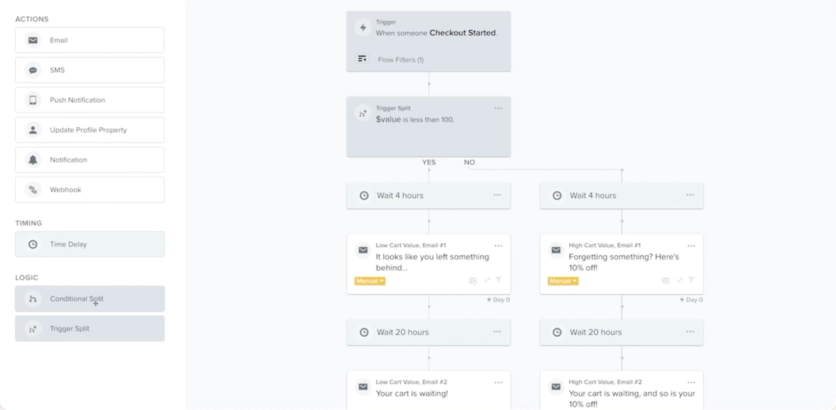
Klaviyo’s flow builder with a trigger split on cart value, wait steps, and separate email branches for low- and high-value carts
The limit is what a step can do. A Klaviyo flow sends messages, updates a profile field, or calls a webhook. It can’t change what a customer sees on the website, create a promo code with its own rules, or move a loyalty balance without a partner app on the other end. JOLYN’s senior director of marketing put it plainly after leaving: “With Klaviyo, we couldn’t build the flows we actually needed.”
Salesforce Marketing Cloud: Journeys Tied to the CRM
Journey Builder is the deepest orchestration tool of the three. A journey can start from a data table, an API event, a form, or a change on a Salesforce record, and it can branch on almost anything: profile attributes, opens and clicks, predicted engagement, or the send time Einstein picks per person. Whole branches can be tested against each other with the winner rolled out automatically, and a journey step can create a task for a sales rep or update a lead in the CRM, which no e-commerce tool does.
Marketing Cloud Next builds journeys differently, on the same automation engine the CRM uses, and Agentforce drafts the audience and the journey from a brief. Salesforce sells both generations side by side, so a new buyer chooses an orchestration model along with an edition.
The cost of that depth is operational. Every edit to a live journey means a new version, and the entry audience usually has to be built as a data table first. Reviewers describe both sides. A marketing operations manager in cosmetics, reviewing on Capterra in July 2026, called Journey Builder “really helpful for creating multi-step campaigns.” An enrollment systems administrator in April 2026 added: “There is a significant learning curve with Marketing Cloud. The Marketing Cloud user interface seems disjointed.”
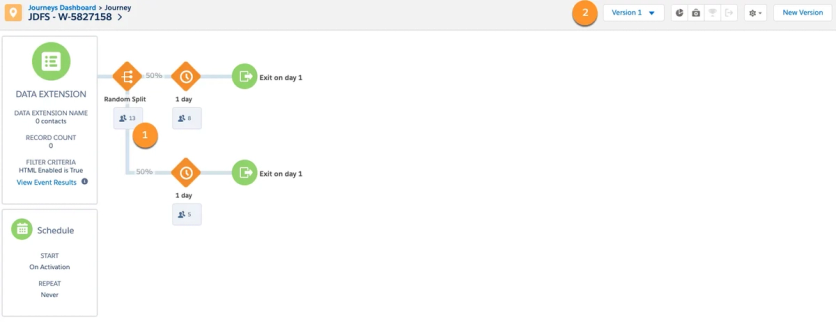
Salesforce Marketing Cloud’s Journey Builder with a data extension as the entry source, a random split, and wait-and-exit branches
Maestra: One Flow for Messages, Site, and Loyalty
In Maestra, a flow is the whole program, not the messaging part of it. An abandoned-cart flow can email the customer, follow with a push if they have the app, show them a banner with the cart on their next visit, put them in a retargeting audience on Meta or Google, and award bonus points when they buy. Every step reads the same live profile, so nothing waits for a sync.
Steps go beyond sending. A flow can issue a personal promo code with its own limits, add or remove loyalty points, edit customer data, or move someone into a segment that other flows react to. Waits can hold until a date on the profile, such as the day points expire, and a limit on a branch caps how many people pass through it, which is how you cap spend on a paid retargeting step or hand out a fixed number of rewards.
Testing measures money, not only clicks. A flow can split into up to five branches, with a control group that gets nothing, and report order conversion, average order value, and revenue per contact for each. Next Best Action predicts when each customer is likely to buy again and triggers a personal offer in that window.
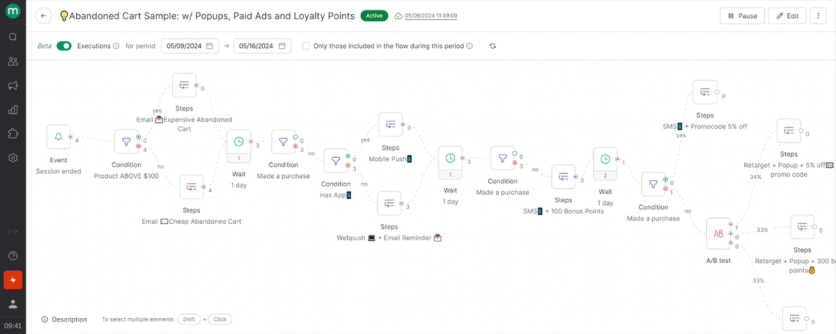
One Maestra abandoned-cart flow branches on cart value and app ownership, then mixes email, mobile push, web push, SMS with bonus points, retargeting, popups, and an A/B test
The reporting follows the flow down to each message. JOLYN launched Price Drop Alert and Low Stock flows it couldn’t build on Klaviyo and grew campaign-driven revenue 26% year over year. Coolibar rebuilt its flows after the move and grew flow revenue 62% year over year, with revenue from abandoned-item flows tripling.
Takeaway: Klaviyo fits a team that needs message flows live fast and nothing else from them. Salesforce fits a company whose journeys should read and write CRM records. Maestra fits a brand that wants one flow to run the site, the promo, and the loyalty program along with the messages.
Klaviyo vs Salesforce Marketing Cloud vs Maestra: Customer Data & Segmentation
Customer data winner: Maestra – profiles update in real time, mid-session, and a marketer segments them without SQL.
Klaviyo | Salesforce Marketing Cloud | Maestra |
|---|---|---|
⭐⭐⭐⭐ | ⭐⭐⭐ | 🏆 |
Klaviyo: Strong Profile, Paid Data Platform
Klaviyo’s profile is deep for a marketing tool. Every customer carries their orders and browsing from the store integration plus four predictions the models recalculate weekly: lifetime value, churn risk, expected date of next order, and time between orders. A marketer can build a segment such as “high churn risk, hasn’t opened in 60 days, bought twice” without help and use it for email, SMS, and push alike.
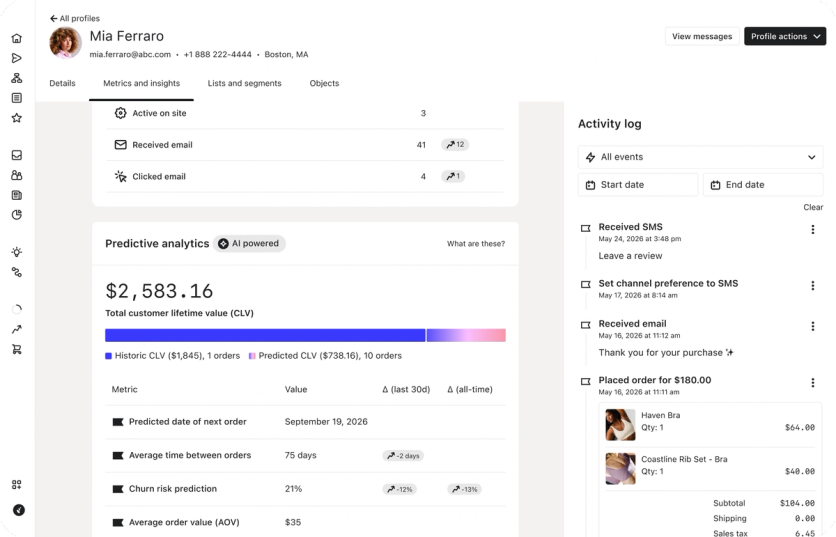
A Klaviyo profile shows predicted lifetime value, next order date, and churn risk, ready to use in a segment once the store has enough order history
The Klaviyo Data Platform, launched as a separate product, adds what a data team wants: imports from Snowflake, BigQuery, Redshift, and Databricks, and stronger identity matching. Those sit in a paid tier. Third-party pricing reviews put the data platform at a $500/mo minimum for 100,000 profiles, an estimate to confirm on your own quote.
The profile count is also the bill. A Trustpilot reviewer in August 2026 objected to Klaviyo “charging for dormant profiles that are not even subscribed to receive marketing,” and another the same month saw the invoice almost triple after test profiles from a development sync were counted as active.
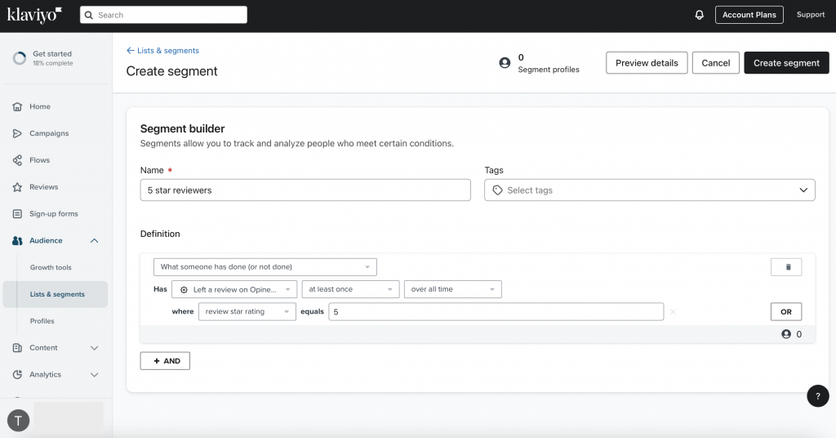
Klaviyo’s segment builder defines a segment on a single behavioral condition with AND and OR operators
Salesforce Marketing Cloud: SQL or a Separate CDP
On the Engagement stack, customer data lives in tables the team designs and joins. A simple filter is drag-and-drop; anything that combines two tables, such as “bought in category X but never opened a category X email,” is a SQL query that writes its result into another table before a journey can use it. Marketers who know SQL find it limitless. Marketers who don’t hire someone who does. A Software Advice reviewer in IT services, writing in February 2025, summed it up: “segmentation can be tricky (need to use Salesforce Data Cloud for it).”
That product is now Data 360, and Marketing Cloud Next is built on it. It is a real CDP: it pulls from 200+ sources, reads Snowflake and Databricks without copying data, merges identities into one profile, and builds segments that trigger flows in real time. It is also its own line item, $240 per 1,000 profiles a year plus credits for actions, and it has to be provisioned before the first journey runs or Salesforce Personalization is switched on.
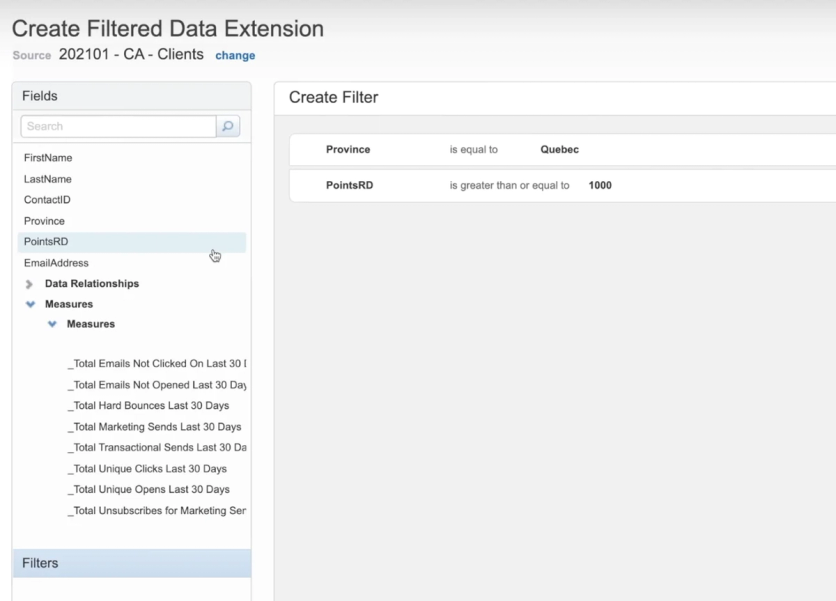
Creating a filtered data extension in Salesforce Marketing Cloud: fields on the left, rule-based filters on the right, and 30-day engagement measures for anything more complex
Maestra: Profiles That Update Mid-Session
Maestra’s customer data platform is the product’s core rather than an add-on. Orders, site sessions, app visits, store purchases, and message clicks update the profile as they happen, and when the same person shows up under a new email or device, Maestra merges the records and keeps the full history, with an audit trail of why.
Segments are built in plain filters and can be as sharp as the business needs: nested inside each other, combined with AND, OR, and exclusions, based on computed fields such as lifetime spend or days since the last store visit, and reaching into product data, so “bought from the running collection but never a shoe” is a filter, not a project. RFM segmentation runs automatically once a year of orders exists, splitting the base into champions, loyal, promising, at-risk, and about-to-sleep groups the marketer can use straight away.
Segments can also be built in plain words. With Claude or ChatGPT connected to Maestra through MCP, a marketer describes the audience, for example “customers who bought twice in the last year, opened an email this month, and haven’t spent their points,” and the assistant builds that filter in Maestra for the team to check before any campaign uses it.
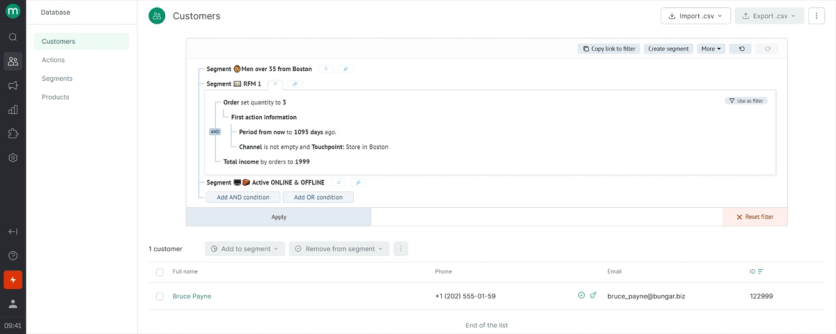
Maestra nests segments inside segments and mixes AND and OR conditions across orders, offline touchpoints, and revenue, with no SQL
Billing counts active profiles only, so a large dormant list costs nothing to keep. Sena ran two Klaviyo accounts for its US and EU stores, merged them into one Maestra profile base with cross-site tracking, and grew campaign-driven revenue 8.6x year over year, from 1.8% to 6.8% of total revenue. G-Plans doubled customer lifetime value within a year of leaving Klaviyo: “Every customer action is reflected in their profile in real-time, and we can use that data to personalize every campaign.”
Takeaway: Klaviyo is enough when the store integration is your only data source and predictions matter more than joins. Salesforce is the choice when the CRM already holds the customer and you have the budget for Data 360. Maestra is the choice when store, site, app, and offline data should sit in one profile a marketer can segment alone.
Klaviyo vs Salesforce Marketing Cloud vs Maestra: Email
Email winner: Maestra – unlimited emails, templates a marketer builds for you, and loyalty, store, and recommendation data inside every message.
Klaviyo | Salesforce Marketing Cloud | Maestra |
|---|---|---|
⭐⭐⭐⭐ | ⭐⭐⭐⭐ | 🏆 |
Klaviyo: The Shopify Default, Priced by the Profile
Klaviyo’s email is a decade of DTC habits made default. The editor comes with more than 160 templates and product blocks fed by the store catalog, A/B tests on subject lines and content, a send-time model per recipient, and benchmarks against brands of similar size. Composer drafts copy and subject lines from a prompt, and Image Remix edits product photos inside the tool.
For a Shopify store this works within a day of connecting, and campaign revenue is attributed automatically, split between campaigns and flows.
The complaints are about the bill and the pace of the product, not the editor. Email bills by active profiles, so every stored contact counts; a Trustpilot reviewer in April 2026 put the mechanism plainly: “reducing your list on Klaviyo does not reduce your costs when it should.” Sending runs on shared IPs by default, and one Black Friday sender documented bounce spikes from a shared IP ban. An agency reviewer in July 2026 who runs Klaviyo for many clients wrote that the platform “has not improved for many years” and that the “template editor did not improve.”
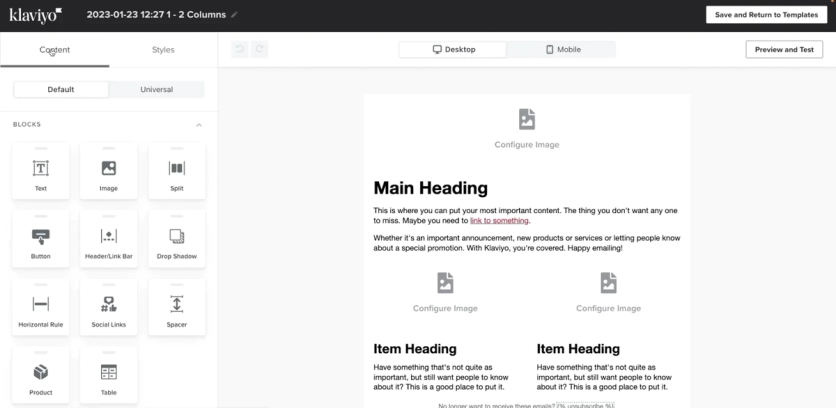
Klaviyo’s email composer with prebuilt blocks for text, images, buttons, products, and tables on the left and a live preview on the right
Salesforce Marketing Cloud: Built for the Biggest Senders
Email is where the Engagement stack’s age is an asset. Its email engine descends from ExactTarget, the platform that defined enterprise email, and the top edition bundles 150 million messages a month with dedicated sending infrastructure. Einstein picks the send hour per person from 90 days of behavior, finds how many emails each contact tolerates before fatigue, swaps in the content block each subscriber is most likely to click, and scores who will open at all. A digital marketing manager on Capterra, reviewing in April 2026: “Its send speed is unmatched, even on multi-step automations across different channels.”
Personalization beyond a first name is code. A dynamic product grid or a regional offer is written in AMPscript, Salesforce’s scripting language, so email work stays close to developers. Marketing Cloud Next has its own email builder, and templates don’t move between the two generations automatically, so a company that later switches rebuilds its library.
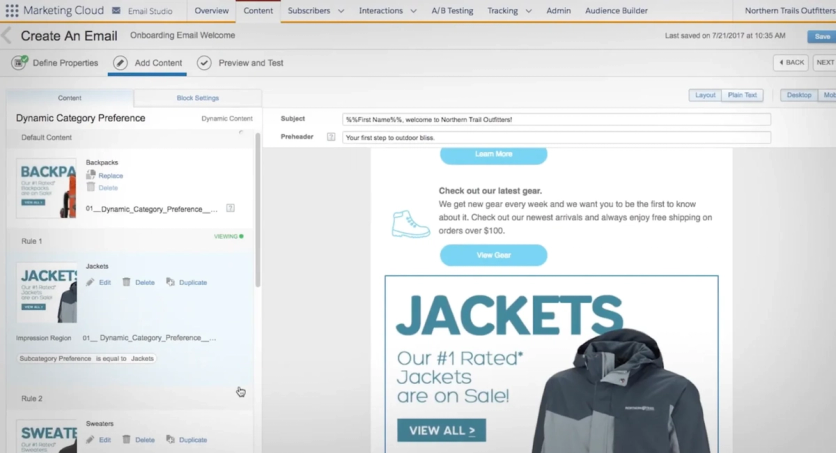
Salesforce Marketing Cloud’s Email Studio builds dynamic content by rule, swapping a category block per subscriber preference
Maestra: Unlimited Emails and Templates Built for You
Maestra’s email module comes with unlimited emails, so a bigger list or a busier calendar never raises the email bill. A Forward Deployed Marketer builds branded templates for each type of email the brand sends, from new arrivals and sales to newsletters and abandoned carts, and the templates break into ready blocks for products, categories, promo codes, countdowns, and the customer’s loyalty balance. The team then assembles new emails from those blocks in the drag-and-drop editor, or codes from scratch when it wants to.
An AI assistant can do the assembling. Claude or ChatGPT connect to Maestra through MCP: you describe the campaign in a sentence, and a draft built from your brand’s blocks appears in Maestra, waiting for the team to check it. Emails render at send time, so prices, stock, and recommendations are current when the message goes out, and an interactive AMP version is available for Gmail.
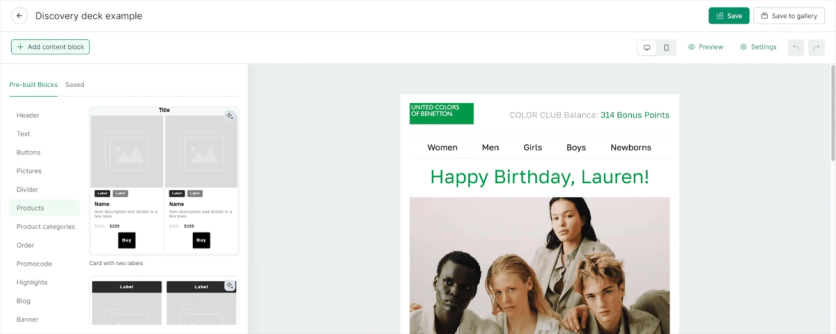
Maestra’s email builder drops product cards, category menus, and a live loyalty balance into the template from prebuilt blocks
Deliverability is watched, not hoped for. A dashboard tracks reputation by mailbox provider against industry benchmarks, bot clicks are filtered out of the data, sending can be throttled or timed to each recipient’s time zone, and a daily cap per customer works across email, SMS, and push at once. Dedicated IPs are available as an add-on for brands that need them.
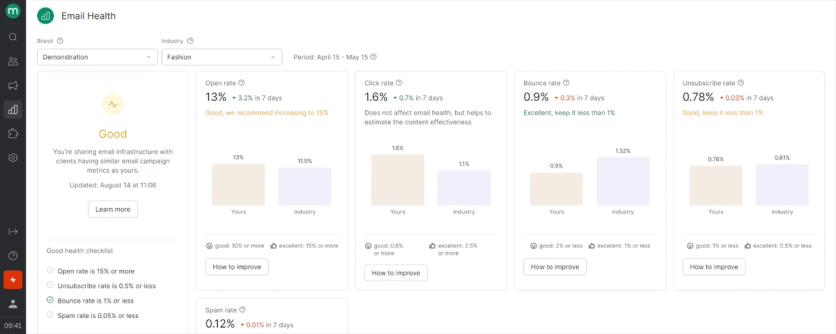
Maestra’s email health report compares open, click, bounce, unsubscribe, and spam rates with the brand’s industry and says what to fix first
Coolibar grew revenue from email and SMS campaigns 33.6% year over year within two months of leaving Klaviyo and called it “the smoothest migration I’ve ever seen.” 4ocean moved off Klaviyo to send impact reports that calculate each contributor’s pounds of trash removed at send time; 49.3% of active contributors read them, twice the engagement of a regular email. AD Mortgage reached 99.7% deliverability through list hygiene and sender-reputation work with the Maestra team.
Takeaway: Klaviyo is the pick when you want the biggest template library and will build every email yourself. Salesforce is the pick for nine-figure send volumes with developers on the team. Maestra is the pick when emails should be unlimited, personalized with loyalty and store data, and built with you rather than by you.
Klaviyo vs Salesforce Marketing Cloud vs Maestra: SMS & Messaging
SMS and messaging winner: Klaviyo and Maestra – both run texts in the same flows as email; Klaviyo covers more countries, Maestra adds WhatsApp and regional messengers to the same flow.
Klaviyo | Salesforce Marketing Cloud | Maestra |
|---|---|---|
🏆 | ⭐⭐⭐ | 🏆 |
Klaviyo: Texting as a Toggle in 20+ Countries
Klaviyo sends SMS, MMS, and RCS in more than 20 countries, from the US and Canada across Western Europe to Australia and Mexico, and nothing about it is a separate product. The same flows, segments, and profile run texts and email, so a cart flow holds an email step and a text step side by side, and the K:AI Customer Agent answers replies and sells over text around the clock.
The guardrails are mature. Quiet hours hold sends overnight in the recipient’s region, a cap limits how many messages one person gets in a day, marketing consent is collected separately from order updates, and age gating covers regulated products. A send-time model decides when to text, and channel affinity decides whether a text or an email is more likely to land.
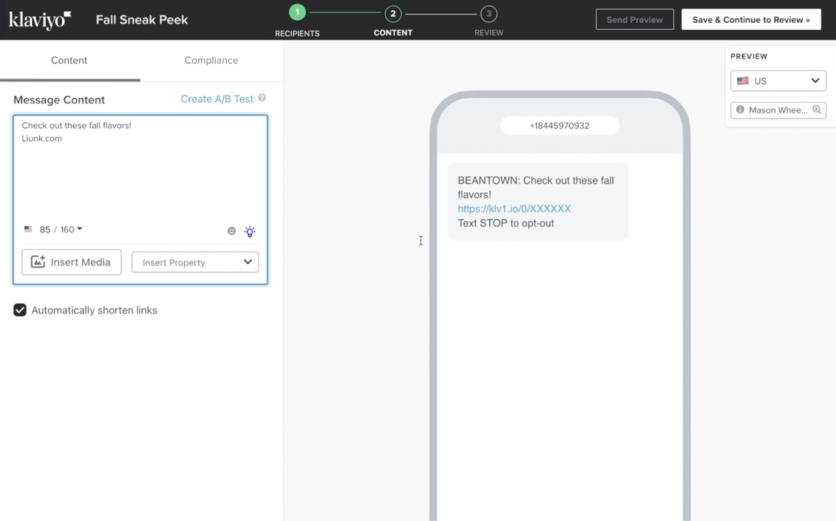
Klaviyo’s SMS editor previews the message on a US number with the brand prefix, shortened link, and opt-out line added automatically
Salesforce Marketing Cloud: RCS and Two-Way Texts, Split Across Two Stacks
Salesforce covers the channels an enterprise asks for. Texts can be two-way, with keyword opt-ins and replies routed to a service agent; RCS sends branded, rich messages where the phone supports it; WhatsApp runs through Meta’s business platform inside the suite; and links in texts are tracked back to the journey that sent them. A journey can send the email first and text only the people who didn’t open it, because the same Journey Builder holds both steps.
The catch is how the pieces fit. On the legacy stack, texting lives in its own studio with personalization written in AMPscript, so pulling a promo code from a data table into a text is a developer task. On Marketing Cloud Next, two-way conversations need the Advanced edition, and a team running both generations manages texting in two places.
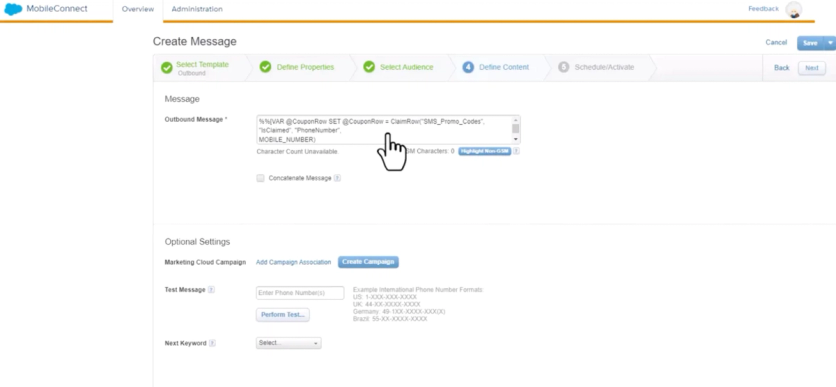
Salesforce Marketing Cloud’s MobileConnect builds an SMS with AMPscript pulling a promo code from a data extension
Maestra: Texts and Regional Messengers in the Same Flows
Maestra sends SMS, MMS, RCS, WhatsApp, Viber, Telegram, and other messengers popular in a region from the same flows as email, so a text can follow an unopened email, and a WhatsApp message can follow an unanswered text, without a second tool. Short codes, 10DLC, and toll-free numbers are supported, and short links track clicks and orders back to each text so SMS revenue lands in the same report as email.
The compliance work is built in. Customers can subscribe with one tap from a mobile popup, sends follow each recipient’s time zone so a 9 a.m. campaign doesn’t wake anyone up, opt-outs are recognized even when someone writes “no thanks” instead of STOP, and the same daily cap that governs email counts texts too. RCS messages fall back to plain SMS on phones that don’t support them, and every text step can carry a test variant and a control group, so the channel’s incremental revenue is measured rather than assumed.
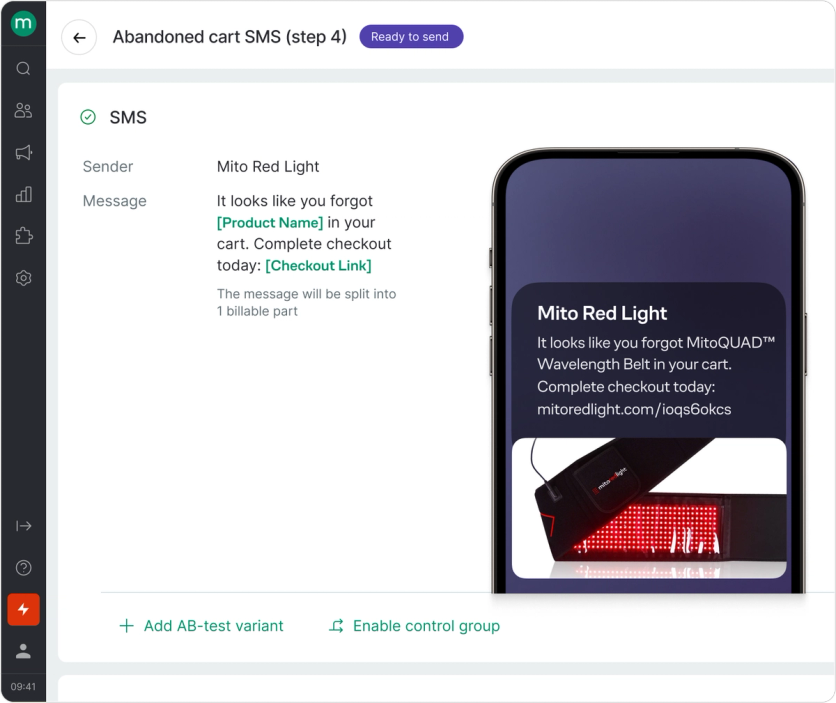
Maestra composes the SMS step inside the flow, with product and checkout variables, a billable-parts counter, an A/B variant, and a control group toggle
Selkirk Sport grew SMS-attributed revenue 149% year over year on Maestra, crediting segmentation across buyers and partners in one platform and delivery diagnostics after years of not knowing why messages bounced. MPD raised WhatsApp deliverability from 53% to above 80% and cut send costs 10% along the way.
Takeaway: Klaviyo is the pick when you text customers in many countries and want an AI agent answering them. Salesforce works for a team already on Marketing Cloud that can manage texting across two product generations. Maestra is the pick when texts, WhatsApp, and regional messengers should run in the same flows as email, the site, and loyalty.
Klaviyo vs Salesforce Marketing Cloud vs Maestra: Mobile & Web Push
Push winner: Salesforce Marketing Cloud – the only one here with messages that fire when a customer walks past the store or a beacon.
Klaviyo | Salesforce Marketing Cloud | Maestra |
|---|---|---|
⭐⭐⭐ | 🏆 | ⭐⭐⭐⭐ |
Klaviyo: Unlimited Mobile Push, No Browser Push
Klaviyo includes unlimited push notifications on every plan, with SDKs for iOS, Android, React Native, Expo, and Flutter. App behavior lands in the same profile as email, so a push segment can be “viewed a product in the app but didn’t buy,” deep links open the right screen, and in-app messages and location-triggered pushes are available for brands that want them.
The gap is the browser. Klaviyo sends mobile push only; a brand without an app has no push channel, and the request for browser push has sat in Klaviyo’s community forum for years.
Salesforce Marketing Cloud: Core App Channels and Location Triggers
Salesforce’s mobile toolkit covers push notifications, in-app messages, and an app inbox that keeps a message available after the notification is dismissed, plus triggers that fire when a customer enters a store’s radius or passes a beacon, which neither of the other two offers. Einstein’s send-time and frequency models apply to push as they do to email.
Marketing Cloud Next is adding mobile channels release by release, so a Next buyer should confirm which push and in-app features their edition and region include before signing. On the Engagement stack the depth is real, and the buyer is still on an annual contract with mobile add-ons priced through Salesforce.
Maestra: Push and In-App on the Same Segments
Mobile and web push are steps in Maestra flows, under the same segments, daily caps, and quiet hours as email and SMS. The mobile module ships SDKs for iOS, Android, Flutter, and React Native and includes in-app messages: pop-ups, promotions, and contact forms inside the app, targeted from CDP segments and testable with a control group like everything else. An app inbox keeps messages available after the notification is dismissed.
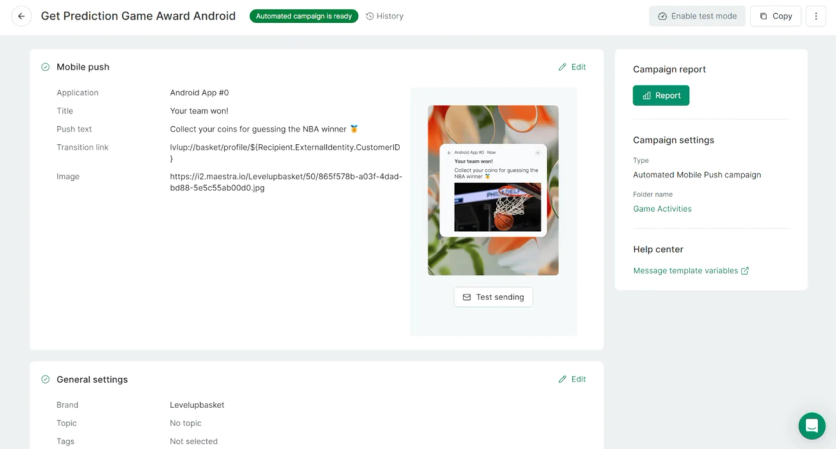
An automated Maestra mobile push with a personal deep link and an image, built as a step that fires from the same data as email and SMS
Web push covers the brand without an app. A small popup asks for browser permission, the subscription attaches to the profile, and Maestra merges a push subscriber with the same browser’s later email sign-up automatically, so the customer is one person from the first visit.
D-Steimatzky runs push segmented by literary preference alongside email and popups on a WooCommerce site and native apps, and direct communications reached 29.4% of revenue within three months of launch. What Maestra doesn’t offer is location-triggered messaging.
Takeaway: Klaviyo covers mobile push for a store with an app. Salesforce is the pick when the app is the business and location triggers matter. Maestra is the pick when push, web push, and in-app should run on the same segments and caps as every other channel.
Klaviyo vs Salesforce Marketing Cloud vs Maestra: AI Capabilities
AI winner: Maestra – AI you direct in plain language through MCP, AI that reads your reports, and models you tune to your own merchandising, all in the base plan.
Klaviyo | Salesforce Marketing Cloud | Maestra |
|---|---|---|
⭐⭐⭐⭐ | ⭐⭐⭐⭐ | 🏆 |
Klaviyo: K:AI Drafts the Campaign and Answers the Customer
Klaviyo’s AI shows up in three places a marketer touches daily. Composer drafts emails, subject lines, flows, and audiences from a prompt. Customer Agent answers customers over chat, SMS, email, and WhatsApp, and can sell, not only support. The profile carries predicted lifetime value, churn risk, and next order date, and Form Display Optimization tests when a popup should appear, though Klaviyo’s help center sets a minimum of 400,000 profiles for that test.
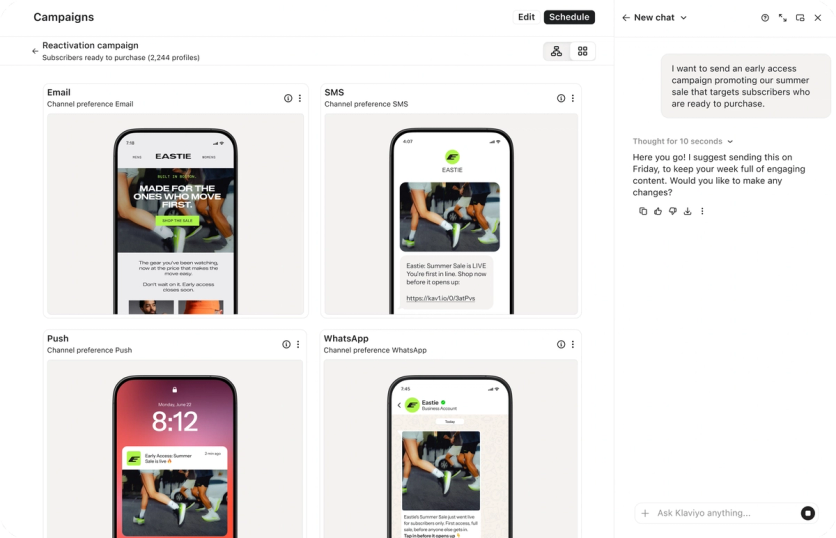
Klaviyo’s Composer turns one chat request into an early-access campaign with email, SMS, push, and WhatsApp versions to review
The models are Klaviyo’s; the marketer edits the output. Deeper analysis, such as cohorts, funnels, and RFM, sits in the paid Marketing Analytics add-on rather than in the AI.
Salesforce Marketing Cloud: Agentforce Everywhere, Paid per Request
Salesforce has bet the company on Agentforce, and marketing got a full slate. An agent drafts the brief, audience, content, and journey from a prompt; Personalization Decisioning picks the offer and content per visitor; Paid Media Optimization monitors and pauses underperforming ads; conversational analytics answers questions about performance in plain language. The Einstein models for send time, frequency, content selection, and engagement scoring carry on in the Engagement stack.
Every agent interaction consumes Flex Credits at $500 per 100,000 requests, and the personalization and paid-media agents live in products that are sold separately. The AI is broad; the invoice grows with how often you use it.
Maestra: AI in Your Chat, Your Reports, and Your Models
AI is built into Maestra at every level. The first is the assistant you already use: Claude or ChatGPT connect to Maestra through MCP, and a marketer describes the task in plain words. The assistant builds the segment, assembles the email from the brand’s blocks, sets up or audits a flow, or pulls a report on any campaign. Nothing goes out until someone on the team approves it.
The second is inside the platform. Maestra AI sits beside the business metrics and explains what changed: which numbers dropped, which flow to rework, what to test next. It’s flagged as a starting point rather than a decision, and it’s the fastest way to brainstorm the next quarter’s program.
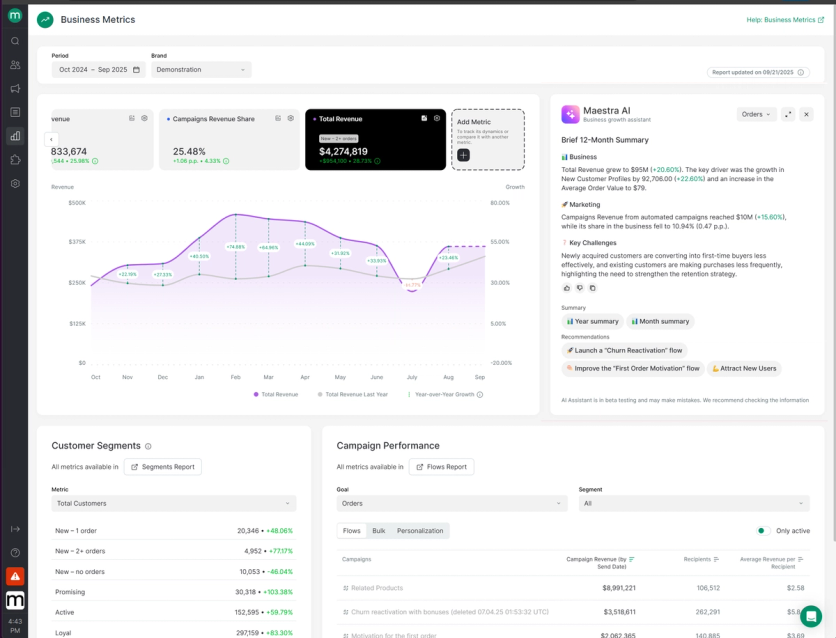
Maestra’s Business Metrics dashboard tracks revenue and year-over-year growth, segment sizes, and campaign performance, with the AI assistant summarizing the year and proposing flows
The third is a set of models for specific jobs. Next Best Action predicts when each customer is ready to buy again and sends the offer at that moment. Fourteen recommendation models pick products for the site, emails, texts, and store terminals. A send-time model picks the hour per recipient, and generated copy drafts email and SMS text. What sets them apart is how far you can bend them: a recommendation block can be limited to one collection or price band, a manual mapping decides which categories get recommended together, and custom sets follow the brand’s own merchandising logic. All of it is in the base plan.
Takeaway: Klaviyo is the pick for AI that drafts and replies inside a self-serve tool. Salesforce is the pick for AI agents across a Salesforce stack you already own and can meter. Maestra is the pick for AI you direct in plain language, AI that reads your numbers, and models you tune by hand, without a per-request bill.
Klaviyo vs Salesforce Marketing Cloud vs Maestra: Site Personalization
Site personalization winner: Maestra – the storefront changes for each visitor as part of the platform, and tests show which version brings more sales.
Klaviyo | Salesforce Marketing Cloud | Maestra |
|---|---|---|
⭐⭐ | ⭐⭐⭐⭐ | 🏆 |
Klaviyo: Forms and an Account Page, Not the Storefront
Klaviyo’s on-site surface is its sign-up forms, and they are good at their job: popups, flyouts, embeds, and full-page units with teasers, multi-step designs that ask for a phone number after the email, targeting by page, device, and visit count, and A/B tests on offer and design. They collect email and SMS consent in one unit, which is why so many Shopify stores collect subscribers in Klaviyo whichever tool sends the texts.
Customer Hub extends the surface for Shopify stores. It replaces the account page with a drawer where customers track orders, manage subscriptions, start returns, keep a wishlist, and see recommendations, all fed by the Klaviyo profile.
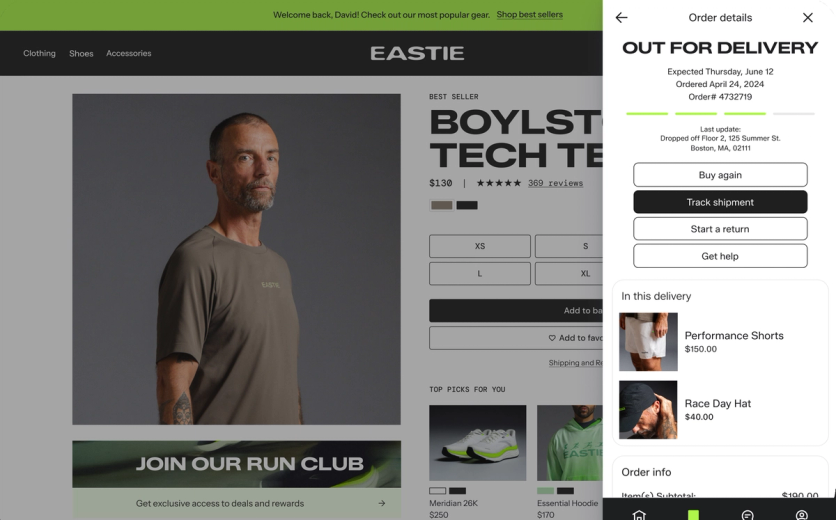
Klaviyo’s Customer Hub lets a shopper track a delivery, buy again, or start a return from the account drawer, while the store page itself stays the same
What Klaviyo doesn’t do is change the store. Banners, catalog order, and product-page content are the same for every visitor, and personalizing them means a partner app and another sync.
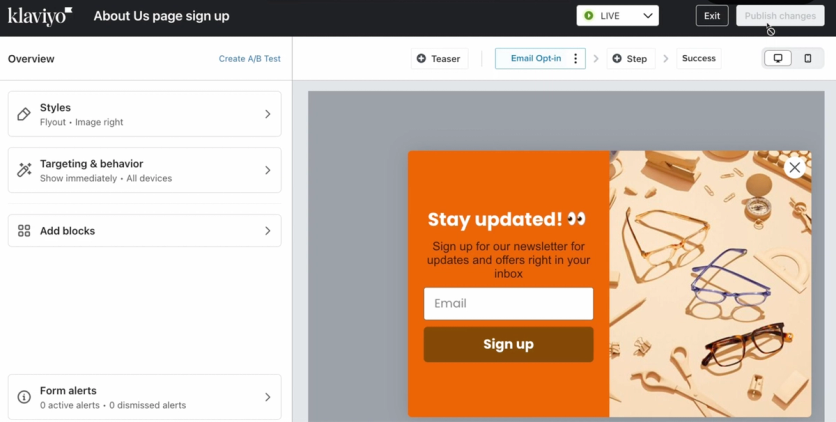
Klaviyo’s form editor sets a flyout sign-up unit’s style, targeting, and behavior, with an A/B test option at the top
Salesforce Marketing Cloud: Deep Site Personalization, Sold Separately
Salesforce Personalization is a serious product. It tracks behavior in session, infers what the visitor is after, and adjusts layout, content, recommendations, offers, and calls to action in real time across the website, the mobile app, and email, with multivariate tests and automatic cohorts to prove the lift. Agentforce turns conversational intent into signals the decisioning engine uses, and a higher tier adds next-best-offer and objective-based recommendations.
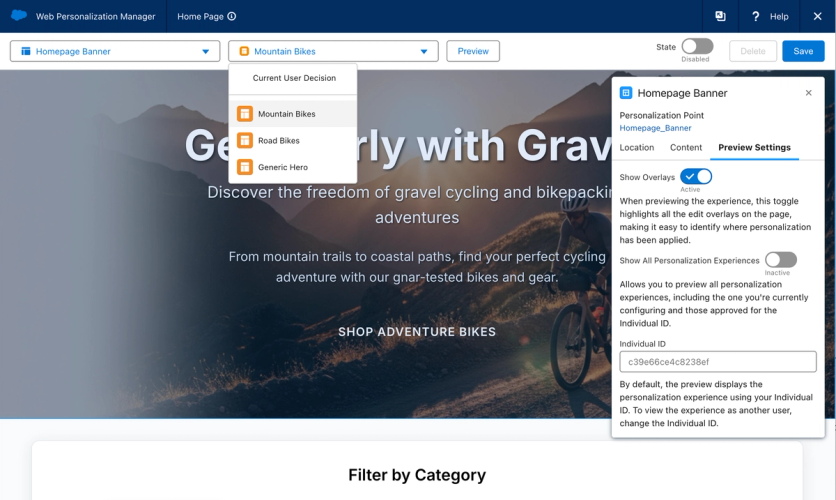
Salesforce’s Web Personalization Manager picks which homepage banner each visitor sees, such as mountain bikes or road bikes, based on the decision for that person
It costs $8,000/org/mo on top of the marketing platform, $15,000 for the tier with next-best-offer, and it requires Data 360 to be provisioned first. A reviewer on Software Advice in June 2025 found Salesforce “expensive and pricing is opaque, especially when scaling or adding features.”
Maestra: The Storefront Itself Changes
Maestra changes what each visitor sees, using the same segments as email and SMS. A first-time visitor from a paid ad, a returning loyalty member, and a shopper with $180 in the cart get different banners, bars, popups, and offers on the same page, decided in session. The toolkit runs from popups, embedded blocks, and quizzes to games, polls, stories, countdown timers, cashback banners, exit-intent offers, loyalty reminders, upsell bars, and cart add-ons, with hundreds of templates and a no-code composer. A submitted form can enrich the profile or start a flow.
Control keeps it from becoming noise. Frequency limits cap how often anyone sees a form, prioritization decides which widget wins when several qualify, and location targeting handles regional offers. Quizzes guide shoppers to the right product and record their preferences for later targeting; surveys catch unhappy customers before they churn and ask happy ones for a review.
Testing works two ways. Forms and offers are tested against each other to find the design and incentive that convert best. Site-wide personalization and recommendation widgets can be tested against a control group that sees nothing, which is the only clean way to know whether the mechanic itself moved conversion or average order value.
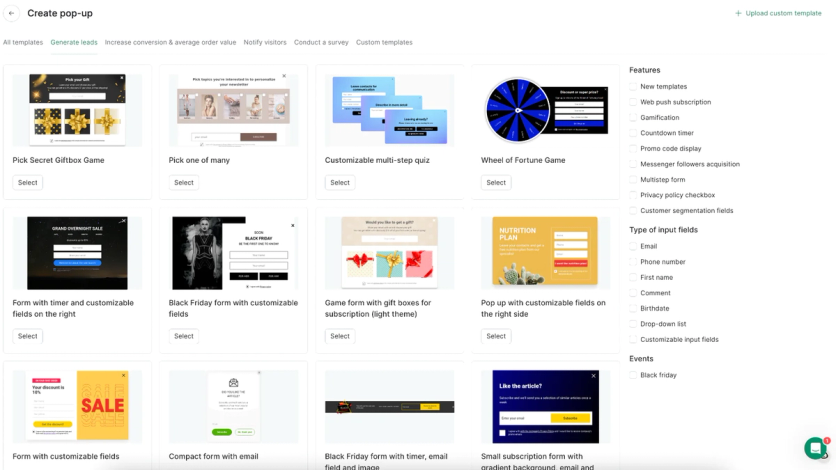
Maestra’s popup gallery covers gift-box games, multi-step quizzes, a wheel of fortune, and countdown forms, each filtered by feature and input field
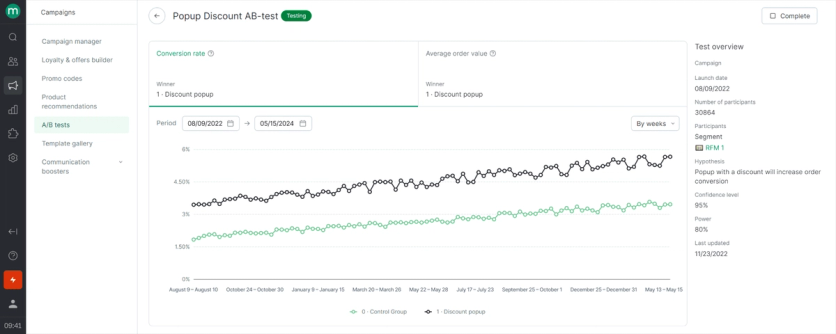
A Maestra popup A/B test tracks conversion rate and average order value for the discount variant against a control group, with confidence level and power shown
Blossom Flower Delivery gained 9% incremental revenue from website personalization measured against a control group; social-proof blocks alone lifted conversion 34%. Nat’v Basics raised popup conversion 24% without deeper discounts by testing a dollar-off offer against a percentage, a test the Maestra team proposed. Magnum Bikes coordinated announcement bars, popups, and corner banners with email and SMS for its anniversary sale after leaving Klaviyo.
Takeaway: Klaviyo covers sign-up forms and an account page. Salesforce delivers enterprise personalization if you have Data 360 and the budget. Maestra is the pick when the storefront itself should change for each shopper without a second product.
Klaviyo vs Salesforce Marketing Cloud vs Maestra: Product Recommendations
Recommendations winner: Maestra – the same recommendations on the site, in every message, and at the store terminal, tuned by hand and included in the base plan.
Klaviyo | Salesforce Marketing Cloud | Maestra |
|---|---|---|
⭐⭐⭐ | ⭐⭐⭐⭐ | 🏆 |
Klaviyo: Recommendations Inside Messages
Klaviyo’s recommendations are product feeds. A marketer drags a product block into an email, picks a feed such as recently viewed, bestsellers, predicted next purchase, or a category the customer likes, and filters out low-stock or off-budget items. The same feeds fill texts and RCS messages, and the account page for Shopify stores shows picks too.
It is a messaging feature. Recommendations appear where the message appears, not on the homepage, the product page, or in the cart, and the feed types are fixed rather than rules you compose.
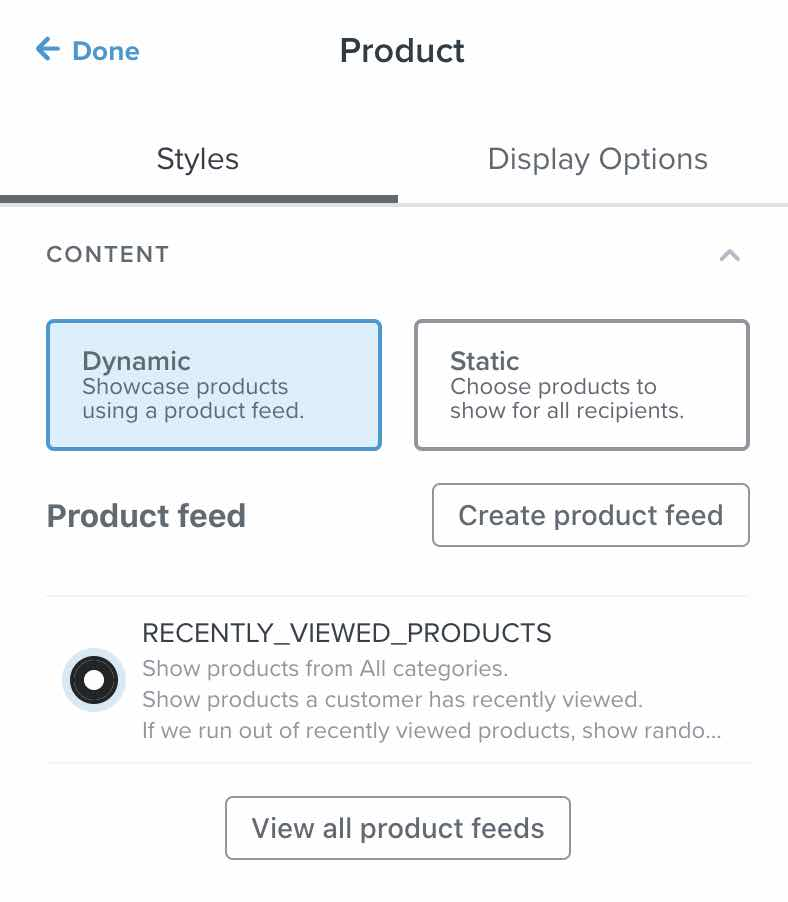
Klaviyo fills a product block from a dynamic feed such as recently viewed products, with a static fallback
Salesforce Marketing Cloud: Email Picks Included, Site Picks Sold Separately
On the Engagement stack, Einstein chooses the content block each subscriber is most likely to click, and product recommendations render inside emails through templates a developer edits. Recommendations on the website and in the app live in Salesforce Personalization, where recipes combine browsing, purchases, and intent signals and the engine picks products, content, and offers in real time.
The pieces are strong, and they span two or three products. Site recommendations need Data 360 and the $8,000/mo Personalization product, and the email ones need a developer for anything past the template.
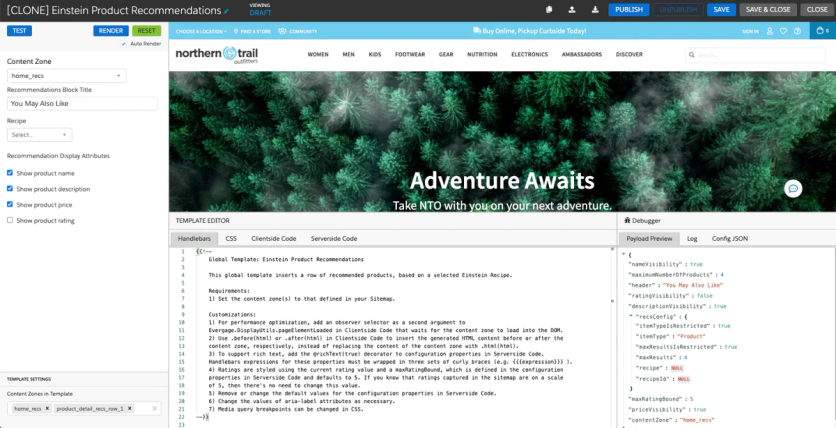
Salesforce configures an Einstein product recommendations block through a Handlebars template editor with client-side and server-side code tabs
Maestra: 14 Models Across Site, Messages, and the POS
Maestra ships 14 ready models, from bestsellers, similar items, and recently viewed to frequently bought together, post-purchase cross-sell, and personal picks for each customer. Picks update during the session as the shopper browses, anonymous visitors get recommendations before they sign in, and bundle offers such as “often bought with” sit next to the product.
The models are rule-based and yours to tune. A block can be limited to one brand, a new collection, or items on sale; a manual mapping decides which categories get recommended together; business rules match by color, price, size, or region so shoppers see in-stock, size-matched, local items; and custom sets follow the brand’s own merchandising logic, built with the Forward Deployed Marketer when the standard models don’t fit.
The same picks run everywhere the brand sells: homepage, category and product pages, cart, 404 and empty-search pages, in-app blocks, email, SMS, MMS, RCS, push, messengers, and self-checkout or POS terminals in stores. Reports show recommendation revenue, items per order, and average order value against shoppers who didn’t engage, and none of it is a paid module.
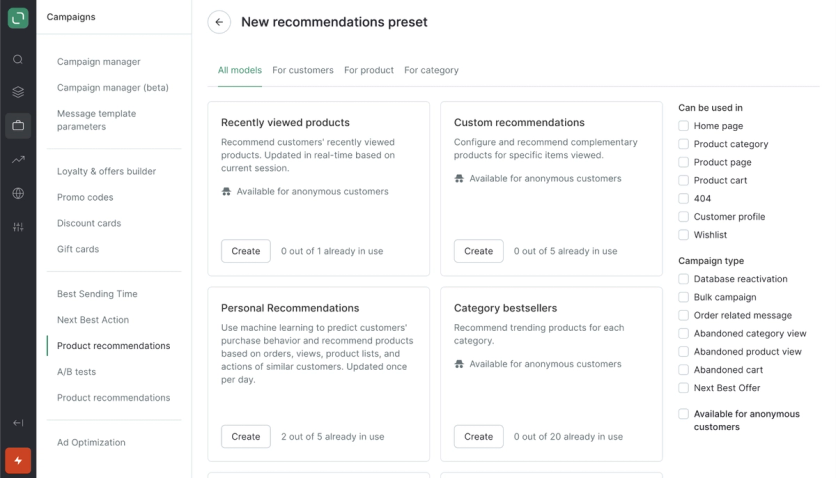
Maestra ships recommendation models as presets, and each one declares where it can run: home page, category, product page, cart, or a flow step such as abandoned cart
Enlightened Equipment, an outdoor gear brand on BigCommerce with about 2 million website visitors a year, had run Klaviyo with no website personalization and tried several recommendation apps that didn’t fit its catalog. On Maestra, the homepage shows personal picks to returning visitors and bestsellers to new ones, product pages show related gear filtered by business rules such as gender and past purchases, the cart offers handpicked accessories, and the 404 and empty-search pages fall back to bestsellers. Measured against a control group over two months, website conversion grew 15% and average order value 8.7%. Its director of marketing: “Their ML algorithms understand our product relationships perfectly.”
At Blue Q, shoppers who engage with recommendations show 28.7% higher average order value and 45.3% more items per order, with “often bought with” bundles alone driving 40% of recommendation-influenced revenue.
Takeaway: Klaviyo and Salesforce put recommendations inside messages first, and Salesforce sells the site version separately. Maestra is the pick when the same recommendations, tuned to your merchandising, should appear on the site, in messages, and in stores.
Klaviyo vs Salesforce Marketing Cloud vs Maestra: Loyalty
Loyalty winner: Maestra – a built-in loyalty program on the same profile as messaging, against a partner directory and a five-figure add-on.
Klaviyo | Salesforce Marketing Cloud | Maestra |
|---|---|---|
⭐⭐ | ⭐⭐⭐ | 🏆 |
Klaviyo: Loyalty Through Partners
Klaviyo has no loyalty program of its own. Points, tiers, and referrals come from a partner app such as Yotpo, Smile.io, or LoyaltyLion, and reach Klaviyo as synced fields a flow can branch on and an email can display.
The seam is the sync. A points balance in an email is a partner update away from being wrong, redemption happens in the partner’s checkout widget rather than in the flow, and the brand pays and administers two platforms whose customer records don’t always agree.
Salesforce Marketing Cloud: Loyalty Management From $20,000/mo
Salesforce sells a real loyalty product. Loyalty Management runs points, tiers, cashback, vouchers, gamified rewards such as a spin-the-wheel game, partner programs, and referral campaigns with point-and-click configuration; Agentforce drafts promotions and next-best offers; prebuilt dashboards track program ROI; and a tier change can trigger a journey.
It starts at $20,000/org/mo, with $35,000 and $45,000 editions above it, all billed annually. For a global retailer running several programs across brands, it’s an option. For a DTC brand, it’s a second marketing budget spent on loyalty alone.
Maestra: Built-In Points, Tiers, and Referrals
Maestra’s loyalty program runs on the profile that sends the email, so a flow can award points, an email can show the balance, and a text can announce a tier change with nothing to reconcile. Points can be earned per order, per dollar, or as a percentage back, activate immediately or after delivery, and expire on a schedule the brand sets; tiers are based on spend or points and carry benefits such as discounts, early access, or free shipping; referral links reward both sides; and gift cards and cashback are part of the same engine.
Promotions don’t collide. When several offers could apply to one order, Maestra’s arbitration rules decide which run, whether they stack, and how much discount is allowed in total, so a stackable welcome code can’t be combined into a free order. The whole program works at checkout online and at the store terminal, so an in-store purchase earns points on the same balance the email shows, and a flow can fire when points are about to expire.
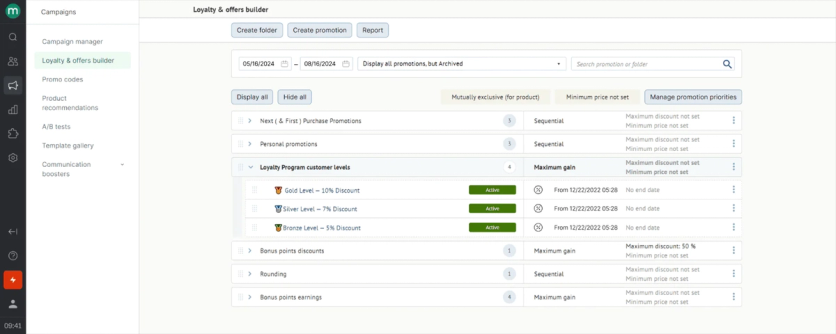
Maestra’s loyalty and offers builder groups tier discounts, personal promotions, and bonus-point rules, and decides which apply when several fit one order
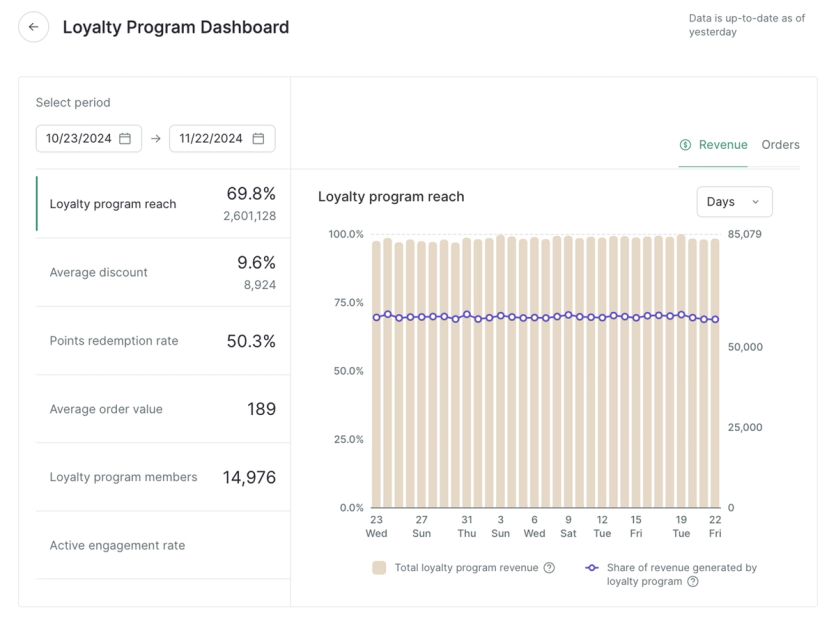
The loyalty dashboard reports reach, redemption rate, average discount, revenue share, and the average order value uplift for members over non-members. JOLYN moved loyalty off Yotpo and Klaviyo; members who redeem points bring 28% more profit, $96 per customer against $75 for non-redeemers, and customer service no longer works inside a separate loyalty tool. Svaha USA left Yotpo’s loyalty for Maestra’s, where points now credit reliably on every review and purchase and redeem in checkout, and grew total sales 26% year over year. The Shopify loyalty module is $1,010/mo on top of the CDP base.
Takeaway: Klaviyo means a partner app and a sync. Salesforce means a full loyalty product at an enterprise price. Maestra is the pick when loyalty should be one part of the same program as email, SMS, and the site, at a module price.
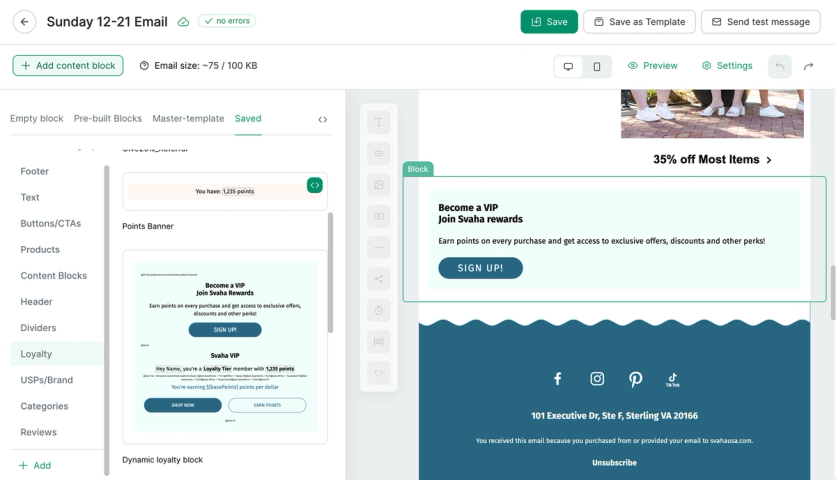
Svaha USA’s loyalty blocks in a Maestra email: members see their tier and points balance, and non-members get an invitation to join
Klaviyo vs Salesforce Marketing Cloud vs Maestra: Reporting & Attribution
Reporting winner: Maestra – revenue traced to a channel, a flow, or a single email, with control groups and raw export, on every plan.
Klaviyo | Salesforce Marketing Cloud | Maestra |
|---|---|---|
⭐⭐⭐ | ⭐⭐⭐⭐ | 🏆 |
Klaviyo: Solid Reports, Deeper Analysis Extra
Klaviyo answers the question DTC teams ask most, fast: how much did email and SMS make this week, and which flows made it. Revenue is attributed by default with a window the marketer can set, and benchmarks compare open, click, and revenue metrics against peer brands.
The deeper questions live in Marketing Analytics, a paid add-on with RFM, funnel, and cohort analyses, a report builder, and custom lifetime value; third-party pricing reviews list it from $100/mo for 13,500 profiles. Attribution across a loyalty app or a personalization vendor stays a spreadsheet exercise.
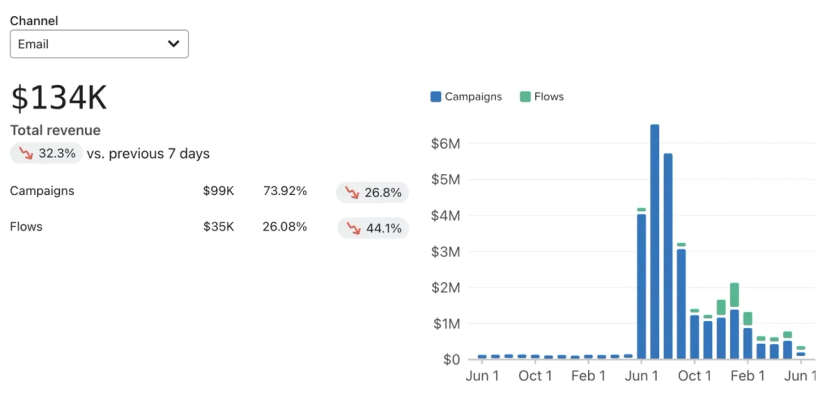
Klaviyo’s revenue dashboard splits email revenue between campaigns and flows and compares it with the previous period
Salesforce Marketing Cloud: Paid-Media Attribution, at a Price
At the top end, nothing here matches Marketing Intelligence at $10,000/org/mo. It pulls owned and paid data through 170+ connectors, harmonizes it, runs multi-touch attribution with path exploration, renders it in Tableau dashboards, and lets Agentforce pause underperforming ads. For a company whose marketing spans owned and paid channels at scale, this is the analytics ceiling of the category.
Standard reporting is thinner. On Engagement it runs on tracking reports and queries; on Next it needs Data 360 to be provisioned before the reports exist. Without the add-on, teams notice the gap between what the suite can measure and what their edition shows them.
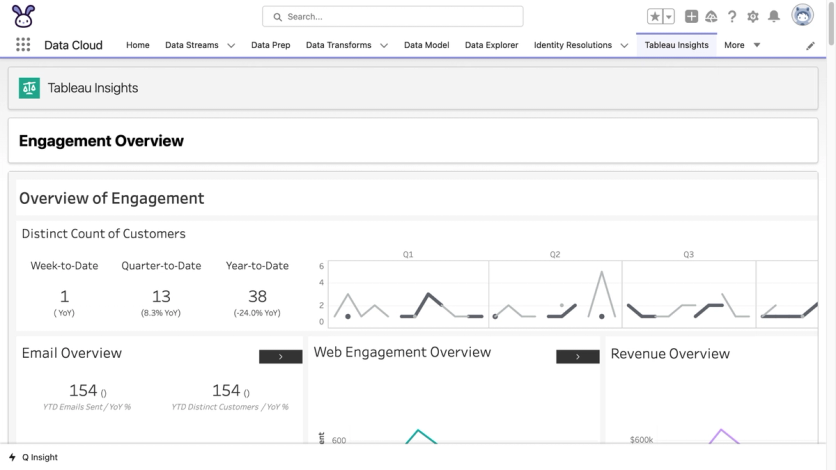
Standard reporting on Marketing Cloud Next runs through Data 360 and Tableau, so the data platform has to be set up before the engagement dashboard has anything to show
Maestra: Revenue by Channel, Flow, and Email
Maestra reports on every channel it runs, including on-site personalization, recommendations, and the loyalty program, against the profile that sent the message, so attribution never means matching IDs across tools. You can start from a channel and drill down to a single flow, a single email in that flow, or a segment, and verify every attributed order. Attribution defaults to last non-direct touch; the window can be changed and transactional messages excluded.
Control groups turn attribution into proof. A holdout can be set on an entire channel, on one campaign or flow, on a promotion, or on a popup, so the number on the dashboard is incremental revenue rather than credited revenue. The business metrics report tracks revenue, year-over-year growth, first-order and repeat-order conversion, and campaign share, with up to 30 segments side by side, and dedicated dashboards cover loyalty, list growth, in-app, recommendations, lead forms, and email health by mailbox provider.
Raw data leaves whenever you want it: orders and line items, message engagement, points and promotions, test participants, segment history, and merges export or stream live to Power BI, Tableau, or Amplitude. It’s all in the base plan, so the smallest account sees the same numbers as the largest. Selkirk Sport after years of not knowing why emails bounced: “We finally have a clear view of the customer journey thanks to reporting we can trust.” D-Steimatzky watches direct communications contribute 29.4% of revenue on the dashboard with no BI project behind it.
Takeaway: Klaviyo is enough for weekly channel revenue; deeper analysis is an add-on. Salesforce is the pick for paid-media attribution at enterprise scale, if you buy Intelligence. Maestra is the pick when every channel, flow, and email should report incremental revenue on one dashboard without an extra product.
Klaviyo vs Salesforce Marketing Cloud vs Maestra: Implementation & Support
Implementation winner: Maestra – a marketer migrates the account, builds the flows, and keeps optimizing, so the marketing team never waits on engineers, and none of it is sold separately.
Klaviyo | Salesforce Marketing Cloud | Maestra |
|---|---|---|
⭐⭐⭐ | ⭐⭐ | 🏆 |
Klaviyo: Self-Serve, With Help Behind a Paywall
Klaviyo is built to be set up without help, and for a standard Shopify store that works: the integration connects in minutes, history backfills, the flow library supplies the first automations, and Klaviyo Academy answers most questions. Migration out is the customer’s problem.
Support scales with the plan. The free plan gets email support for 60 days, paid plans add chat, and packages with a named contact are priced on request; third-party guides put dedicated account management in the thousands per month. Reviews concentrate on what happens below that line. A Trustpilot reviewer in March 2026 wrote that the “chat support is an AI bot which is poorly trained,” another that month described support that “responds roughly every 8 hours” during a multi-day lockout, and a reviewer in July 2026 said Klaviyo “kept increasing their prices multiple times in a 12 month period and customer service was not there.”
Salesforce Marketing Cloud: Studios, SQL, and Partners
Salesforce points buyers to certified partners for implementation, and reviewers describe the result. An apparel and fashion marketer on Software Advice, writing in April 2025: “automating and integrating it with our e-commerce system needed more help from IT and consultants, generating additional setup costs.” A June 2025 reviewer added that “many features like Journey Builder or Automation Studio require significant training or technical skill.” Multi-month, consultant-led projects are the norm, and a company that later moves from Engagement to Next runs a second one.
Ongoing help is priced too. The standard plan is included; the Premier Success Plan costs 30% of license fees and adds 24/7 support and coaching; the Signature plan, priced on request, adds a dedicated success manager and 15-minute response times for outages. With partner implementation on top, the services budget rivals the license budget.
Maestra: A Marketer Runs the Ramp and Stays
Every Maestra plan comes with a marketer assigned to the account who does the work rather than advises on it. They migrate data, templates, flows, and consent off Klaviyo or Salesforce, connect the integrations, build the segments, flows, popups, and loyalty rules, and launch the campaigns. Standard migrations take two to four weeks, the old platform stays live until everything is ready, and after go-live the same person keeps proposing tests and new mechanics on a weekly call and in a shared Slack channel. Maestra calls the role a Forward Deployed Marketer, and there is no services price list behind it.
German Kabirski connected Shopify in about two hours, migrated its data in two days and ten workflows in three, and reached 2,349% ROI with 31 workflows live within four months of leaving Klaviyo; its executive director credited “a dedicated success manager who has been instrumental in launching our workflows both in email and pop-ups.” Sena went live in two weeks and describes its Maestra marketer as “incredibly proactive.”
The ongoing part is where the model differs most from a support plan. At Nat’v Basics, the Maestra team proposed the popup offer test behind the 24% conversion lift; the founder’s summary was “someone whose job is helping us optimize.” Furniture Fair works with two Maestra marketers over Slack daily and retired five tools along the way.
Takeaway: Klaviyo fits a marketer who will set everything up alone and pay for faster help later. Salesforce fits a company with a partner and a services budget. Maestra fits a marketing team that wants to run the program itself, with a Forward Deployed Marketer doing the build and the migration.
Klaviyo vs Salesforce Marketing Cloud vs Maestra: Integrations & CRM
Integrations winner: Klaviyo and Maestra – both connect natively to Shopify; Klaviyo has the biggest app library, and Maestra builds any connector you’re missing at no charge.
Klaviyo | Salesforce Marketing Cloud | Maestra |
|---|---|---|
🏆 | ⭐⭐⭐ | 🏆 |
Klaviyo: 350+ Apps, One-Way From the CRM
Klaviyo lists 350+ integrations, and the e-commerce ones are the point: Shopify, BigCommerce, WooCommerce, Magento, and Salesforce Commerce Cloud through a cartridge that syncs orders, catalog, and on-site events. Reviews, helpdesk, subscription, shipping, and loyalty partners connect the same way, and Meta audiences sync both directions.
The Salesforce CRM integration installs from AppExchange and pulls up to three objects, such as leads, contacts, and opportunities, into Klaviyo profiles every hour. It’s one-way: enough to segment and personalize on CRM data, not enough for a sales team expecting marketing engagement back in the CRM.
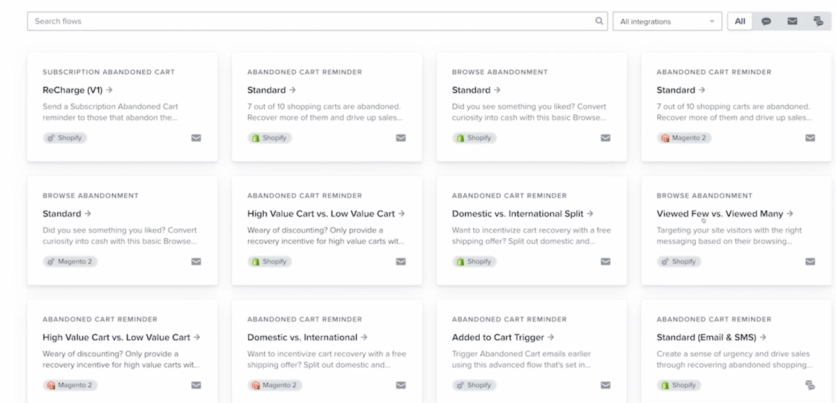
Klaviyo’s flow library ships prebuilt abandoned-cart and browse-abandonment flows per store platform, Shopify and Magento 2 among them
Salesforce Marketing Cloud: The Largest Ecosystem, Next to the CRM
This is Salesforce’s home field. A lead status change in the CRM is a journey trigger without middleware, Data 360 unifies the profile across sales, service, and marketing, the marketplace now called AgentExchange carries thousands of apps, and zero-copy connectors read Snowflake and Databricks in place. For a company whose sales, service, and finance teams already work in Salesforce, that adjacency is the argument, and it’s a strong one.
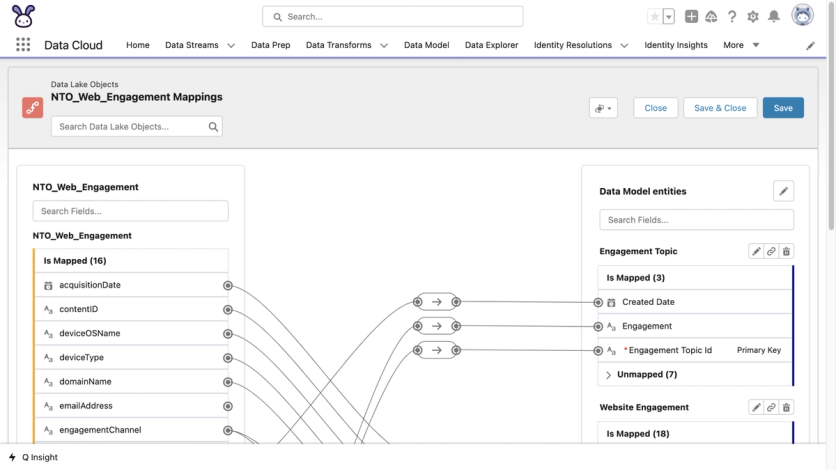
Connecting a new source in Data 360 means mapping each incoming field to Salesforce’s data model before journeys or segments can use it
E-commerce is the footnote. Salesforce’s own Shopify connector for Data 360 is still labelled beta, so Shopify brands mostly connect through third-party apps, and even Salesforce customers report seams: a digital marketing manager on Capterra in April 2026 noted that syncing with Sales Cloud “leaves a lot to be desired.”
Maestra: 150+ Integrations, the Rest Built for You
Maestra connects natively to Shopify, BigCommerce, Magento, and WooCommerce and lists 150+ integrations including Salesforce, HubSpot, Pipedrive, SAP, Dynamics 365, Gorgias, Zendesk, Intercom, Twilio, and the major BI tools. A webhook builder inside the platform lets a flow step open a helpdesk ticket or update a CRM record without a middleware subscription, and an API and SDKs cover the rest.
Anything missing gets built rather than looked up. The Maestra team writes the integration during onboarding at no charge, so a missing connector is a scheduling question instead of a dealbreaker. Magnum Bikes unified online stores, retail locations, and its dealer network into one profile after leaving Klaviyo and grew online revenue 56.6% year over year. Furniture Fair connected Shopify and replaced Optimizely, Outgrow, UNBXD, Wisepops, and the Zapier glue between them with one platform.
The catalog is shorter than Klaviyo’s by design: loyalty, recommendations, surveys, and site personalization are built in, so whole categories of partner apps have nothing left to connect.
Takeaway: Klaviyo is the pick when the connector you need is probably already in a 350-app library. Salesforce is the pick when marketing must live next to Salesforce CRM. Maestra is the pick when the integration you need may not exist yet and you’d rather have it built than search for it.
Klaviyo vs Salesforce Marketing Cloud vs Maestra: Pricing
Pricing verdict: Klaviyo on entry price; Maestra once the shortlist includes the data platform, analytics, and support that Klaviyo sells as add-ons, because Maestra’s base plan already contains them at a public, month-to-month price.
Klaviyo | Salesforce Marketing Cloud | Maestra |
|---|---|---|
$$ | $$$ | $$ |
Klaviyo and Maestra both bill on active profiles, but they don’t count them the same way, and Salesforce bills per org plus consumption credits. Text prices don’t line up either: Klaviyo’s mobile plans include carrier fees, Maestra quotes the message and the carrier fee separately, and Salesforce sells credits per message with US and Canadian carrier fees passed through on top. Compare total monthly spend on your own list and channel mix rather than any single line.
Klaviyo: From $20/mo, Rising With the List
Klaviyo pricing: Free plan available (up to 250 profiles, 500 emails/mo). Email starts at $20/mo for 251–500 active profiles and Email + SMS at $35/mo. Third-party trackers put the Email plan at roughly $720/mo for 50,000 profiles and $1,380/mo for 100,000, with the data platform from $500/mo, Marketing Analytics from $100/mo, and a 20% surcharge on the top tier above $10,000/mo in spend; treat those as estimates. Mobile messaging is sold as monthly dollar plans with carrier fees included and unused spend expiring monthly.
The structure is easy to enter and hard to forecast: three meters move independently, and the one reviewers return to is the profile count. An August 2026 Trustpilot reviewer described billing “based on outdated subscriber list sizes, so even after you clean house, you’re stuck overpaying for profiles that don’t exist anymore.”
Salesforce Marketing Cloud: From $1,500/org/mo, Then Add-Ons
Salesforce Marketing Cloud pricing: From $1,500/org/mo (billed annually) for Marketing Cloud Next Growth, with Advanced at $3,250. That is where the list starts. SMS and WhatsApp credits start at $2 per 1,000, Data 360 runs $240 per 1,000 profiles a year, Agentforce consumes credits at $500 per 100,000 requests, and the legacy Engagement+ editions run $2,000 to $30,000/org/mo. Personalization ($8,000), Marketing Intelligence ($10,000), and Loyalty Management ($20,000 and up) each bill separately, and Premier Success adds 30% of license fees.
Salesforce publishes all of it, which is more than most enterprise vendors do. Budgeting still needs a spreadsheet, and a nonprofit digital marketing manager on Capterra in April 2026 didn’t renew because the platform “was just too expensive to justify renewing our contract when we only used a quarter of its functionality.”
Maestra: From $2,000/mo With Unlimited Email
Maestra pricing: From $2,000/mo for the customer data platform plus unlimited email, with the first 100,000 active profiles included and $0.013 per active profile above that. Only profiles that got a message, visited, or bought this month count, so a dormant list costs nothing to store. The $1,300/mo base already covers product recommendations, reporting, ad audience sync, the AI assistant connector, and the Forward Deployed Marketer.
Channels come as monthly modules: SMS, MMS, and RCS at $250/mo + $0.0035 per US SMS; WhatsApp and other messengers at $420/mo; onsite personalization at $1,515/mo; mobile push at $1,305/mo; loyalty for Shopify at $1,010/mo. Billing is month-to-month with no setup fees, any module can be switched off at any time, and the prices are the ones on the public page, so the number on the proposal is the number on the invoice.
Urban Armor Gear cut marketing stack costs 64%, about $100,000 a year, by replacing Klaviyo, Yotpo Loyalty, and Frosmo with one subscription, and G-Plans reports lower marketing costs than on Klaviyo alongside the doubled lifetime value.
Takeaway: Choose Klaviyo if your list is small and you’re fine with add-ons appearing as you grow. Choose Salesforce if you can price every product you’ll need before you sign an annual contract. Choose Maestra if you want public prices, month-to-month billing, and a base plan that already includes the data platform, reporting, recommendations, and a marketer.
Final Verdict: Klaviyo vs Salesforce Marketing Cloud vs Maestra
Choose Klaviyo if you run a Shopify or DTC store, want email, SMS, and push live this week without a project, and your list is small enough that the active-profile meter isn’t yet the biggest line on the invoice. The ecosystem is unmatched in e-commerce. Price the data platform and analytics add-ons before you assume they’re included.
Choose Salesforce Marketing Cloud if your company already runs Salesforce CRM and buys platforms the way enterprises do, with partners, annual contracts, and a services budget. Nothing here matches the ecosystem or the analytics ceiling, and nothing here needs as many specialists to run. Before you sign, check which generation you’re buying, Engagement+ or Marketing Cloud Next, and budget for Data 360 if it’s Next.
Choose Maestra if you’re a mid-size or scaling e-commerce brand that has outgrown Klaviyo, or is paying Salesforce prices for a marketing team that can’t ship without developers. Maestra replaces the email tool, the SMS tool, the loyalty app, the personalization vendor, and the analytics add-on with one platform on one live profile, at public month-to-month prices, plus a Forward Deployed Marketer who runs it, so the marketing team doesn’t wait on engineers. Urban Armor Gear made exactly that trade and cut its stack costs 64%. To see what Maestra would replace in your stack, start with the module prices and your current Klaviyo invoice.
FAQ
- Yes, in two ways. The Salesforce CRM integration installs from AppExchange, syncs up to three objects (Leads, Contacts, Accounts, or Opportunities) into Klaviyo profiles every hour, and tracks the Became Lead metric. Salesforce Commerce Cloud stores connect through Klaviyo’s cartridge, which syncs orders, catalog data, and on-site events.
Both syncs flow into Klaviyo, not back to Salesforce. If the sales team needs marketing engagement inside the CRM, check what the connector returns before committing. Maestra also connects to Salesforce and HubSpot, and its marketer builds any connector that’s missing during onboarding. Maestra, Salesforce Marketing Cloud, Braze, and Attentive are the platforms e-commerce brands most often weigh against Klaviyo.
- Maestra competes on the full program: email, SMS, built-in loyalty, and site personalization working together, with a marketer included.
- Salesforce Marketing Cloud and Braze compete for enterprise accounts with large engineering and services budgets.
- Attentive competes on SMS alone.
- Reviews from the past year return to three: active-profile billing that keeps rising after you clean the list, support that moves behind higher plans, and a product reviewers say hasn’t changed much in years. Klaviyo also has no built-in loyalty, no web push, and no storefront personalization, so those come from partner apps.
Brands that outgrow it usually cite cost predictability and service. G-Plans doubled customer lifetime value within a year of moving to Maestra; German Kabirski had 31 workflows live within four months. For a wider shortlist, see the 12 best Klaviyo alternatives. - In enterprise marketing suites, Adobe and Oracle sell against Salesforce Marketing Cloud most often, with Braze and HubSpot taking the app-first and mid-market deals. For e-commerce brands the shortlist is different: Klaviyo for self-serve DTC, and Maestra for brands that want enterprise-grade orchestration and a real-time CDP without an implementation partner or an annual contract.
The way to choose is to price the full stack you’d need, not the entry edition, and ask who does the implementation. - Only if the rest of the company already runs Salesforce and the marketing team has developer support. Salesforce’s own Shopify connector for Data 360 is still in beta, Engagement segmentation relies on data tables and SQL, and personalization, loyalty, and analytics are separate products.
A Shopify brand comparing the two usually gets more from a platform built for e-commerce data: Klaviyo if the list is small, Maestra if it needs a CDP, built-in loyalty, and site personalization with a marketer running them.