
Braze vs MoEngage vs Maestra: 14 Features and Real Pricing [2026]

If your brand lives in a mobile app, Braze and MoEngage are probably both on your shortlist. Both grew up on push notifications, and neither publishes a price. The main difference is what each does best: Braze runs real-time journeys and app messaging, MoEngage digs into app analytics.
They also bill for different things. Braze charges for monthly active users plus credits for each message, while MoEngage counts every tracked user, anonymous visitors included, and sells most of its analytics as add-ons.
The comparison below covers both, plus Maestra, across 14 categories, from journeys and app messaging to support and pricing.
Content:
Quick Verdict – Choosing Between Braze, MoEngage, and Maestra
Choose Braze if the app is your main sales channel and engineers can own the setup. Choose MoEngage if you want app analytics and campaigns in one tool, plus an extra delivery layer for Android push. Choose Maestra if you sell online and want email, SMS, loyalty, and the storefront to work as one program, with public prices and a marketer who runs it.
Braze doesn’t publish prices; Vendr’s contract data puts the median at about $88,507 a year, or roughly $7,400 a month. MoEngage doesn’t either, and Vendr estimates its average contract at about $186,725 a year. Maestra starts at $2,000/mo for the CDP plus unlimited email, with the first 100,000 active profiles included and a Forward Deployed Marketer on the account to run the migration and the program.
Comparison Summary
Feature | Braze | MoEngage | Maestra |
|---|---|---|---|
Omnichannel Flows | 🏆 | ⭐⭐⭐⭐ | 🏆 |
Customer Data & Segmentation | ⭐⭐⭐⭐ | ⭐⭐⭐⭐ | 🏆 |
Analytics & Reporting | ⭐⭐⭐ | 🏆 | ⭐⭐⭐⭐ |
⭐⭐⭐⭐ | ⭐⭐⭐⭐ | 🏆 | |
Mobile Push & In-App | 🏆 | ⭐⭐⭐⭐ | ⭐⭐⭐⭐ |
SMS & Messaging | 🏆 | ⭐⭐⭐⭐ | 🏆 |
AI Capabilities | 🏆 | ⭐⭐⭐⭐ | ⭐⭐⭐⭐ |
Site Personalization | ⭐⭐⭐ | 🏆 | 🏆 |
Product Recommendations | ⭐⭐⭐ | ⭐⭐⭐⭐ | 🏆 |
Loyalty & Promotions | ⭐⭐ | ⭐⭐ | 🏆 |
Integrations & Ecosystem | 🏆 | 🏆 | 🏆 |
Ease of Use & Implementation | ⭐⭐⭐⭐ | ⭐⭐⭐⭐ | 🏆 |
Customer Support & Services | ⭐⭐⭐ | ⭐⭐⭐⭐ | 🏆 |
Pricing | $$$ | $$$ | $$ |
Braze vs MoEngage vs Maestra: Omnichannel Flows
Omnichannel flows winner: Braze and Maestra – Braze for app journeys that pick their own winning path, Maestra for flows that also run promo codes, site popups, and loyalty points.
Braze | MoEngage | Maestra |
|---|---|---|
🏆 | ⭐⭐⭐⭐ | 🏆 |
Braze: App Journeys That Pick Their Own Winner
Canvas, Braze’s journey builder, reacts to what a customer does in the app or on the site the moment they do it. Each branch can switch channel, so a user who ignores a push can get an email or an in-app message next.
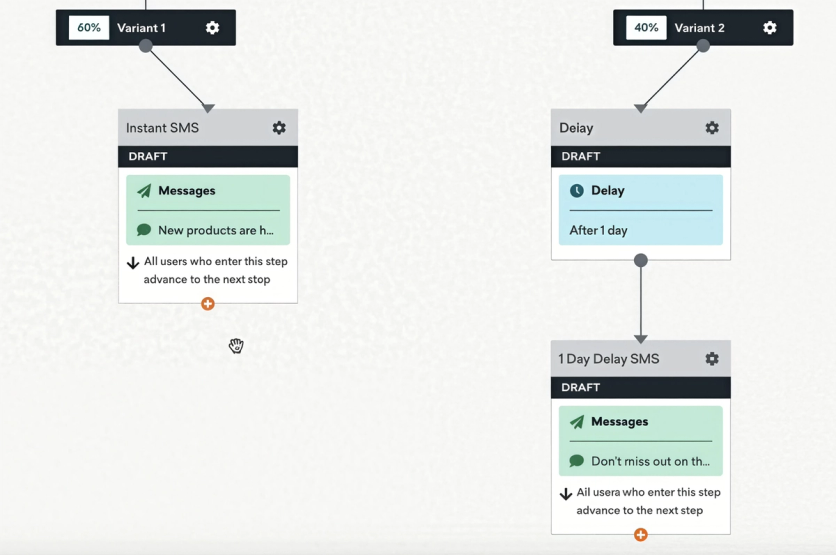
Braze Canvas tests an instant SMS against one sent a day later, with traffic split 60/40 between the two paths
Testing is built in. A journey can run up to four versions against a control group, and once one wins, Braze sends the rest of the audience down it on its own. An AI step can also choose the branch for each customer.
The catch is upkeep. A reviewer at a small software company in September 2026 found that a journey with several branches “takes more effort to review, and it can be hard to see why a user followed a particular path.” An enterprise reviewer who builds journeys for patients added that “you can not copy a canvas or campaign from Dev to Prod.”
MoEngage: Prompt-Built Flows, Auto-Routing on Enterprise
MoEngage builds flows in a drag-and-drop editor, and its Flow Assist agent drafts a cross-channel flow from a few lines of text. A marketer can describe a welcome series and get the steps, channels, and waits laid out, ready to edit.
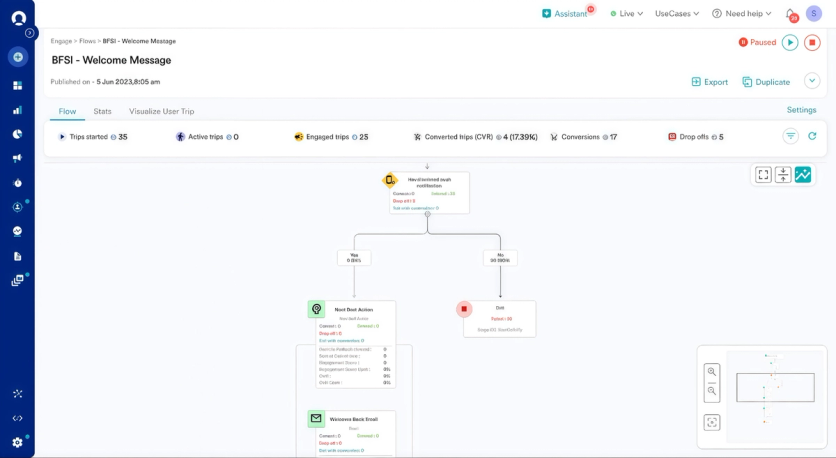
A MoEngage flow reports trips started, conversions, and drop-offs at the top of the canvas
The smarter routing sits on the top plan. Sending each user down the best-performing path, picking the best time to send, and choosing each user’s preferred channel all come with Enterprise. On Growth, the team runs tests and moves traffic by hand.
Maestra: One Flow for Messages, Promo Codes, and Points
Maestra flows start from the store’s own events: a cart left behind, a price drop on a viewed item, a customer who hasn’t ordered in months. Every step reads the same profile, so a text that follows an email already knows what the shopper clicked.
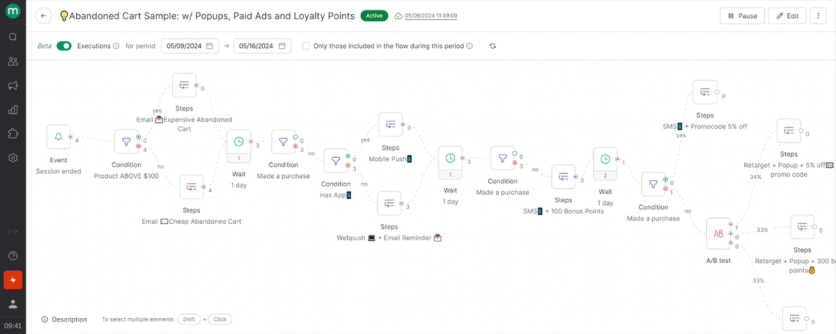
One Maestra abandoned-cart flow sends email, SMS, and push, retargets through ads, shows a popup, and awards loyalty points
Steps go beyond messages. Next to email, SMS, WhatsApp, and push, a flow can show a popup on the site, issue a unique promo code, credit loyalty points, or add the shopper to an ad audience on Meta or Google.
Each flow can carry an A/B test against a control group measured on orders, and reports show the revenue of every step, so the team sees which email or text sells.
Level Up Basketball, a training app, rebuilt its install-to-trial and trial-to-subscription journeys across email and mobile push in Maestra. Conversion from install to trial rose from 4.2% to 10.3%, and revenue grew 4.5x year over year.
Takeaway: If your journeys run on app events and you want the platform to find the winning path, Braze is the stronger builder. MoEngage suits a team that likes drafting flows from a prompt and can test by hand below Enterprise. Maestra fits a store that wants one flow to handle the message, the promo code, and the loyalty points.
Braze vs MoEngage vs Maestra: Customer Data & Segmentation
Customer data winner: Maestra – profiles update while the shopper is still on the site, and marketers segment them without SQL or a warehouse project.
Braze | MoEngage | Maestra |
|---|---|---|
⭐⭐⭐⭐ | ⭐⭐⭐⭐ | 🏆 |
Braze: Quick Segments, Long History in Your Warehouse
Marketers build Braze segments by stacking filters, and the builder shows how many users each condition reaches as they go. A small-business reviewer in September 2026 named “the advanced segmentation builder” as a favorite feature.
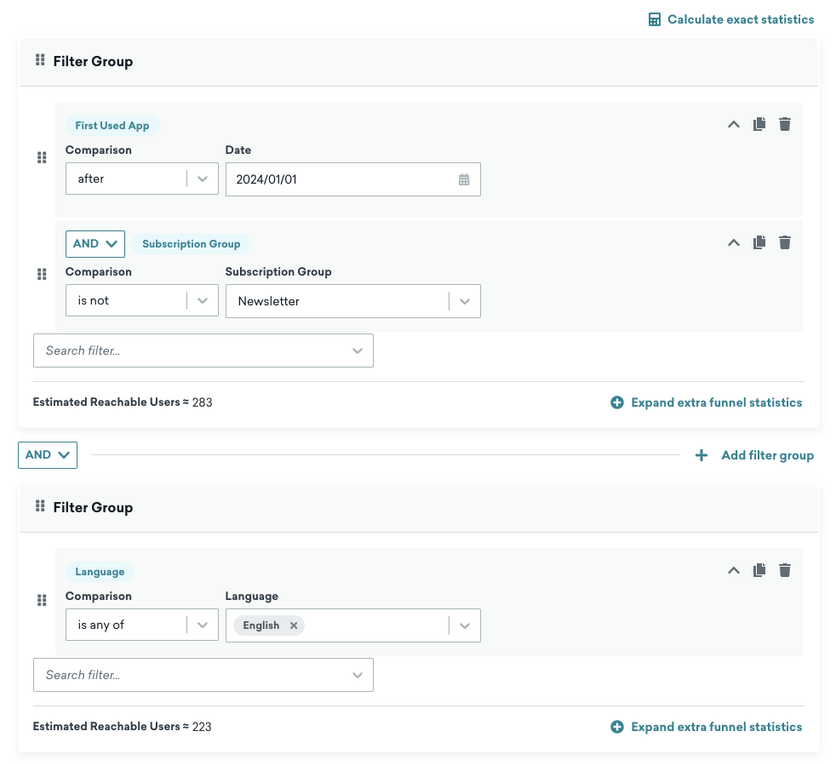
Braze’s segment builder stacks filter groups and shows estimated reachable users as each condition is added
Everyday segments look back 30 days. Audiences built on longer purchase history need a separate segment type or SQL, and Braze expects that data to sit in a warehouse such as Snowflake, BigQuery, or Databricks, where it can query it in place. A company with a data team gets a lot from that setup; without one, much of the depth stays out of reach.
MoEngage: Identity Merge Included, Warehouse Segments Extra
MoEngage merges anonymous and logged-in activity into one profile and can match online and offline records on up to five identifiers. RFM, affinity, and behavior segments come with both plans, so a marketer can target people who bought twice and browsed shoes this week without another tool.
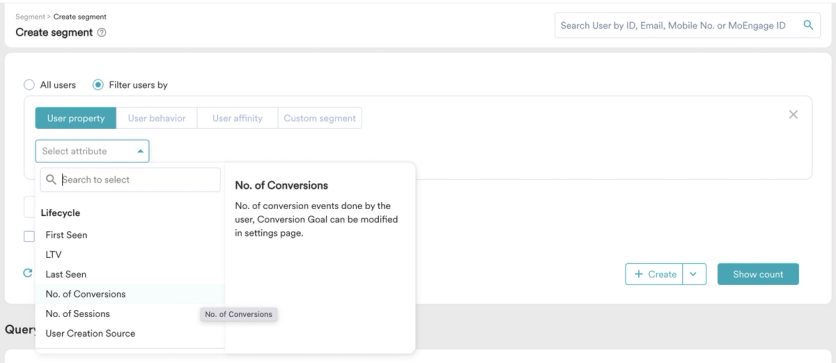
MoEngage’s segment builder filters users by property, behavior, or affinity, with lifecycle attributes like LTV and number of conversions
The deeper pieces are add-ons: segments that query your data warehouse directly, and predictive segments for churn or conversion. Event setup also takes discipline. An IT services reviewer in March 2026 warned that “debugging incorrect event data can take effort without proper tracking standards.”
Maestra: Profiles That Update During the Visit
Maestra’s CDP updates each profile in real time, while the shopper is still browsing. Purchases, site and app behavior, and in-store sales land in one profile, duplicates merge automatically, and a visitor’s browsing is kept until they leave an email or phone number.
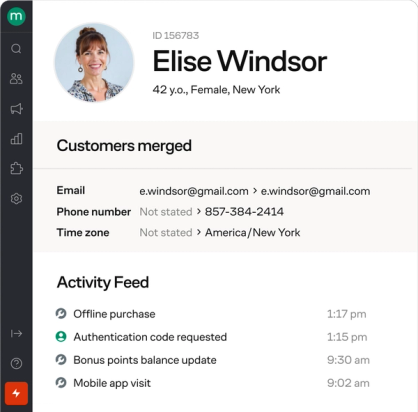
One Maestra profile merges a shopper’s email, phone, and time zone and logs offline purchases, logins, and points updates in a single feed
Segments can be as fine as the business needs, with no SQL. Marketers nest segments inside each other, group customers by how recently, how often, and how much they buy, and add computed fields such as each customer’s most-viewed product. Segments refresh on their own and can start a flow the moment someone enters one.
A segment can also start as a sentence. With Claude or ChatGPT connected to Maestra through MCP, a marketer types the audience they want, say, customers who ordered twice this year, opened an email this week, and still have unspent points, and the assistant builds that filter in Maestra for the team to check.
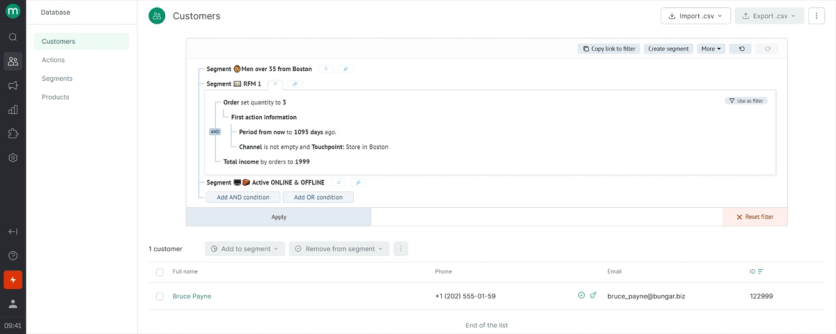
Nested segments in Maestra combine an RFM group, a store audience, and online-plus-offline activity in one filter, no query language
Crezu, a fintech broker working in 15 countries, used to see one customer as five or even twelve separate leads in its in-house CRM. In Maestra each person is one profile with the traffic source attached in real time, and quality leads grew 11% year over year.
Takeaway: Braze fits a company whose customer data already lives in a warehouse, with engineers to run it. MoEngage fits a team that wants identity merge and standard segments out of the box and will pay for the warehouse and predictive extras. Maestra fits a brand that wants live profiles and fine-grained segments without starting a data project.
Braze vs MoEngage vs Maestra: Analytics & Reporting
Analytics winner: MoEngage – the deepest app analytics here, from funnels to uninstalls, though most of it is sold as add-ons.
Braze | MoEngage | Maestra |
|---|---|---|
⭐⭐⭐ | 🏆 | ⭐⭐⭐⭐ |
Braze: Campaign Reports In-House, Deep Analysis in Your BI
Braze reports well on single campaigns and journeys: revenue per step, conversions, and uplift against a control group, with a confidence score that flags the winning variant.
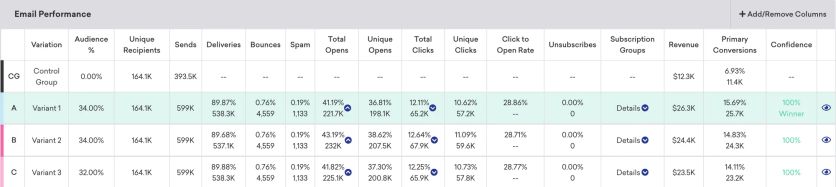
Braze’s email performance table compares variants against a control group and flags the winner by confidence
Questions that cut across campaigns take more work. Custom queries reach back 60 days, and full event data goes out to a warehouse or BI tool through a connector included in many Pro and Enterprise packages. An e-learning reviewer in September 2026 asked for better tracking “mainly in regards to revenue and overall engagement metrics.”
MoEngage: Funnels, Retention, and Uninstalls, Mostly as Add-Ons
Analytics is MoEngage’s strongest area. Product teams can see where users drop out of onboarding or checkout, how each cohort retains week by week, which paths people take through the app, and who uninstalls, then turn any of those groups into a campaign audience.
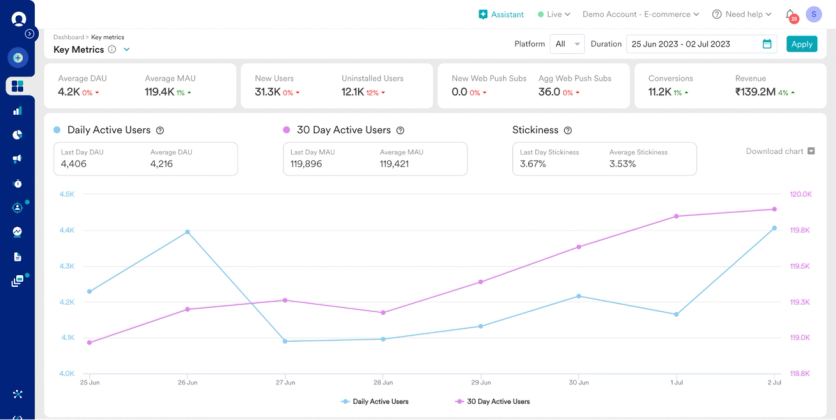
MoEngage’s Key Metrics view tracks daily and monthly active users, stickiness, uninstalls, and revenue on one dashboard
Most of that toolkit costs extra. Key metrics, acquisition, and uninstall reports are included, while funnels, retention, user paths, and behavior analysis are add-ons on both plans. Even with them, an associate marketing manager in August 2026 found that detailed funnel or cohort data “often means exporting to Excel and building the analysis myself.”
Maestra: Revenue Traced to a Single Flow or Email
Maestra reports revenue by channel, campaign, flow, and segment, and drills down to a single email or text inside a flow. Reporting sits in the CDP base, so every plan gets it, and any report exports as raw data.
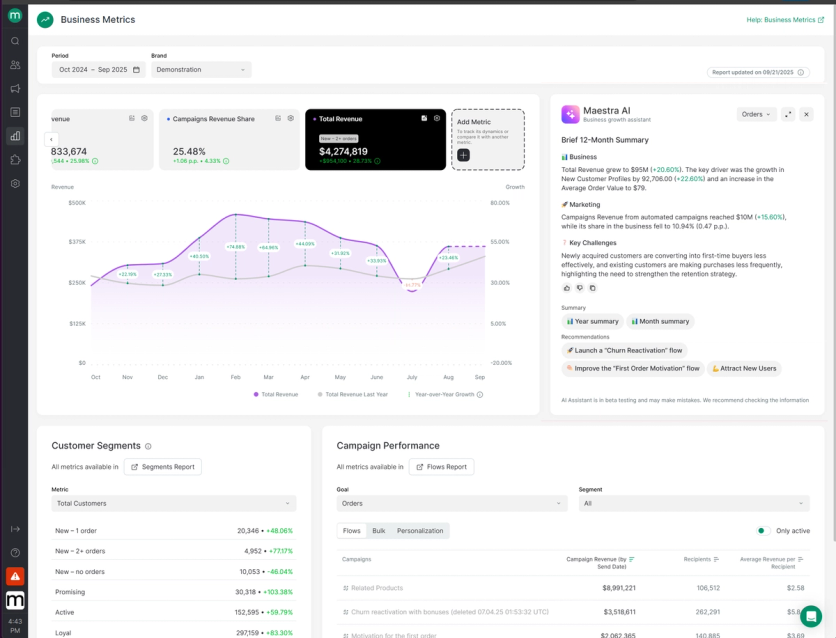
Maestra’s Business Metrics dashboard puts revenue, segment movement, and campaign performance on one screen, with an AI summary
Control groups show what marketing added on top of sales that would have happened anyway. A brand can hold back part of its audience from a whole channel, one flow, or a promotion and compare the revenue.
Kiwitaxi, a transfer-booking service with iOS and Android apps, now tracks revenue from attribution down to each flow. After it rebuilt its flows in Maestra, email’s share of total revenue grew from 6% to 10%.
Takeaway: If your team needs app analytics such as funnels, retention, and uninstalls, MoEngage has the deepest toolset, as long as you budget for the add-ons. Braze suits teams that already run a BI tool for the big picture. Maestra suits marketers who want channel and flow revenue answered inside the platform.
Braze vs MoEngage vs Maestra: Email
Email winner: Maestra – unlimited emails, templates built for your brand, and drafts an AI assistant can assemble from them.
Braze | MoEngage | Maestra |
|---|---|---|
⭐⭐⭐⭐ | ⭐⭐⭐⭐ | 🏆 |
Braze: A Flexible Editor, With Every Send on the Meter
Braze gives marketers a drag-and-drop editor and a code editor, pulls live customer data into the email at send time, and goes deeper with Liquid, its templating language. Liquid lets a team personalize almost anything, but whoever writes it has to be comfortable with code.
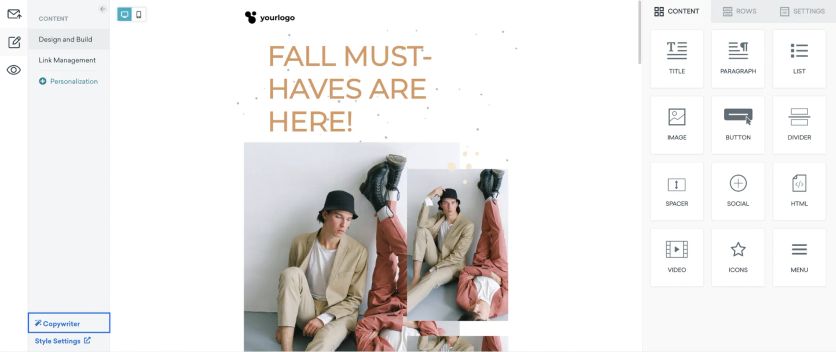
Braze’s drag-and-drop email editor, with an AI copywriter and a personalization panel
On deliverability, a Braze specialist plans the IP warm-up, and mailbox-provider reputation data sits in the dashboard. Email sends spend Action Credits, so a busier calendar shows up on the invoice.
MoEngage: Solid Email, Sent Through a Provider You Connect
MoEngage email covers the standard toolkit: a drag-and-drop editor, dynamic content blocks, AI-written subject lines and copy, and send-time optimization on Enterprise. Gartner Peer Insights users rate it well, and MoEngage was the only vendor named Customers’ Choice in the 2026 email marketing report.
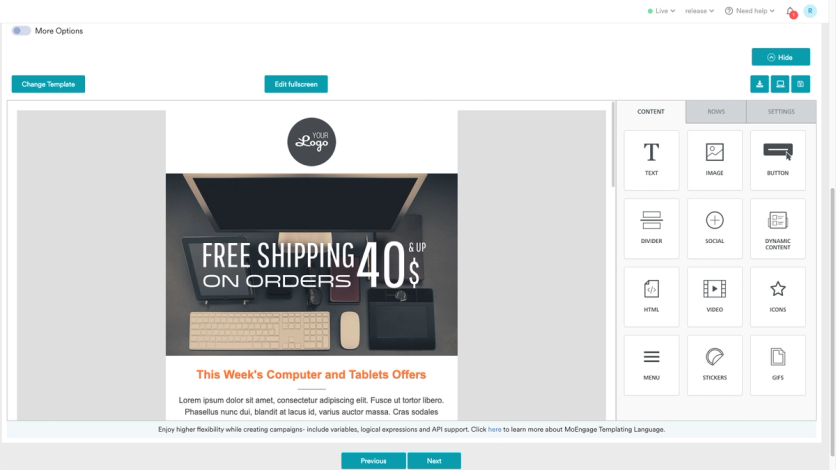
MoEngage’s drag-and-drop email editor, with text, image, dynamic-content, and HTML blocks
The sending runs through an email provider, one the brand connects or a SendGrid account MoEngage manages, so deliverability depends on how that provider is set up. Email is billed by the number of sends.
Maestra: Unlimited Sends, Brand Templates, and AI Drafts
Maestra’s email module comes with unlimited emails, so neither a bigger list nor a busier calendar changes the email bill.
The marketer Maestra assigns to each brand, called a Forward Deployed Marketer, builds templates for every type of email the brand sends, from new arrivals to abandoned carts, and breaks them into blocks for products, promo codes, and countdowns. The team then assembles new emails from those blocks in the drag-and-drop editor, with an AMP version when it wants one.
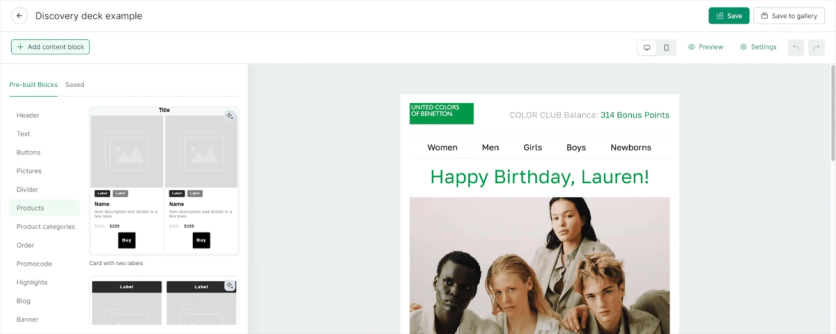
Maestra’s email composer pulls the reader’s loyalty balance into the header, next to pre-built product and promo-code blocks
Claude or ChatGPT can draft an email too. Connected to Maestra through MCP, the assistant builds the draft from the brand’s own blocks, and nothing goes out until someone on the team approves it.
Every email can pull in data from other channels, such as the reader’s points balance or the promotion running in their region. The Email Health screen checks deliverability against industry benchmarks, fake clicks from security bots are filtered out of reports, and dedicated sending IPs are available as an add-on.
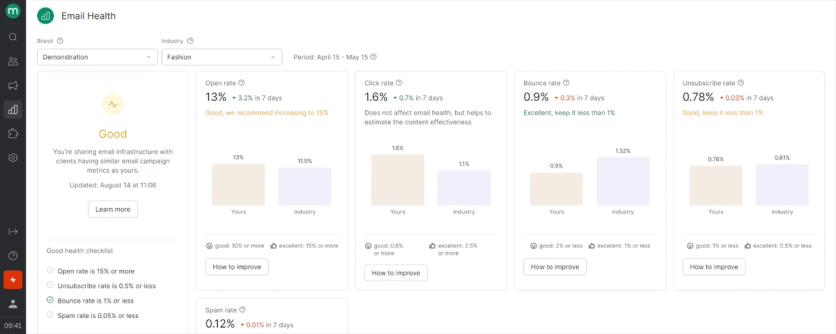
Maestra’s Email Health screen benchmarks open, click, bounce, and unsubscribe rates against the industry and links to fixes
Movavi, a video-editing software company with users in 190 countries, runs 60 email flows localized into five to nine languages, and email’s share of its net revenue grew from 3.7% to 4.7%.
Takeaway: Braze suits an app-led program where email is one channel among several and someone on the team writes Liquid. MoEngage suits teams that are happy to bring their own email provider and pay per send. Maestra suits brands that send a lot of email and want the templates and campaigns built with them.
Braze vs MoEngage vs Maestra: Mobile Push & In-App
Push and in-app winner: Braze – the widest set of app formats here, from lock-screen live updates to in-app feeds and feature flags for product launches.
Braze | MoEngage | Maestra |
|---|---|---|
🏆 | ⭐⭐⭐⭐ | ⭐⭐⭐⭐ |
Braze: Lock-Screen Updates, In-App Feeds, and Feature Flags
Braze can keep a delivery status or a live score on the iPhone lock screen and update it as things change. Inside the app it runs pop-ups, banners built into a screen, and a feed of cards that stays until the user acts on it.
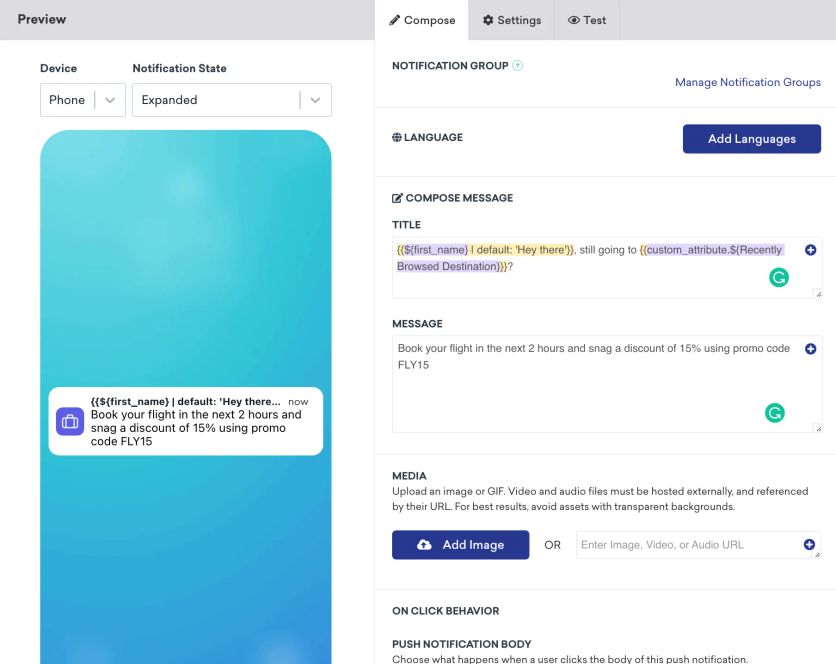
Braze’s push composer previews the notification on a phone and personalizes it with customer data
Product teams use the same tool to switch a new feature on for a chosen audience and widen the rollout step by step. All of it runs on the Braze SDK, so an engineer sets it up.
MoEngage: An Extra Delivery Layer for Android Push
Android phone makers often stop apps from running in the background, and notifications get lost on the way. MoEngage’s Push Amplification adds a second delivery route for those cases and lifts push delivery by up to 25%.
Web push and in-app messages run alongside, and content cards, the persistent in-app inbox, are a paid add-on. A senior software engineer in January 2026 found that “basic push notifications were working quickly with minimal effort.”
Maestra: Push and In-App on the Same Segments as Email
Maestra runs mobile push, web push, and in-app messages as steps in the same flows as email and SMS, under the same segments, daily caps, and quiet hours. A shopper who already got two messages today doesn’t get a third from another channel.
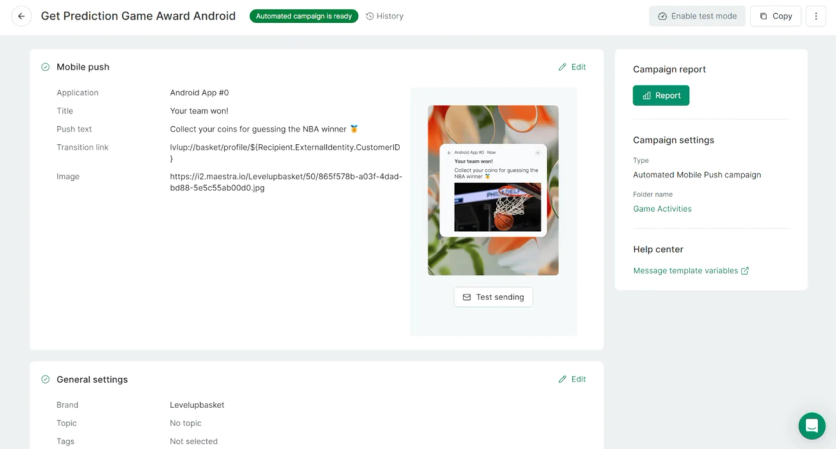
An automated Maestra push for Level Up Basketball deep-links app users straight to the coins they won
In-app messages can open as a pop-up or sit as a banner inside a screen, aimed by segment, screen, product, or city. An app inbox keeps messages available after the notification is dismissed. A/B tests show which messages bring orders, and an in-app can ask for push permission at a moment when the user is likely to agree.
Web push covers brands without an app. A small popup asks for browser permission, and the subscriber joins the same profile as their later email sign-up.
Pinemelon, a grocery delivery app in Denver, used to send only bulk and transactional pushes through Firebase. With Maestra, push runs inside most of its automated flows, which bring in 55.8% of its direct-channel revenue.
What Maestra doesn’t offer is lock-screen live updates or feature rollouts.
Takeaway: If the app is the product and you need lock-screen updates and feature rollouts, choose Braze. If lost Android notifications are your biggest problem, MoEngage has a dedicated fix. If push and in-app should follow the same segments and caps as the rest of your marketing, choose Maestra.
Braze vs MoEngage vs Maestra: SMS & Messaging
SMS and messaging winner: Braze and Maestra – both send texts and messenger campaigns from the same journeys as email. MoEngage sends texts through a provider you bring.
Braze | MoEngage | Maestra |
|---|---|---|
🏆 | ⭐⭐⭐⭐ | 🏆 |
Braze: Texts and East Asian Messengers in Every Edition
Every Braze edition includes SMS, MMS, RCS, and WhatsApp, plus LINE and KakaoTalk for audiences in East Asia. A customer’s reply can start a journey, and RCS messages carry the brand’s logo, buttons, and carousels.
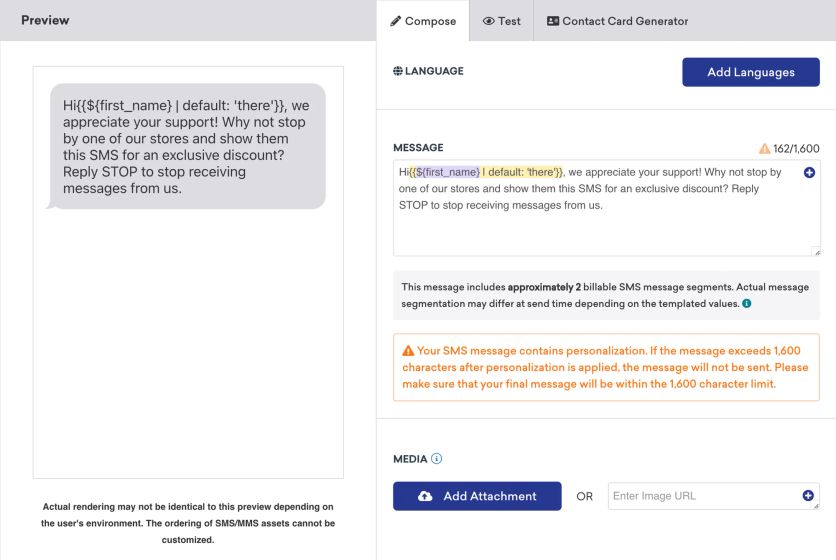
Braze’s SMS composer shows how many billable message parts a personalized text will use before it sends
Conversational AI agents that answer texts are still in beta, and two-way texting has gaps. A small-business reviewer in October 2026 said “two-way messaging, the native text scheduler, and bulk WhatsApp dispatches do not work well for our needs.”
MoEngage: Your Own SMS Provider, Messengers as Connected Channels
MoEngage doesn’t send texts itself. A brand connects its own SMS provider, such as Twilio, Infobip, or Sinch, and MoEngage handles the targeting, flows, and reporting on top.
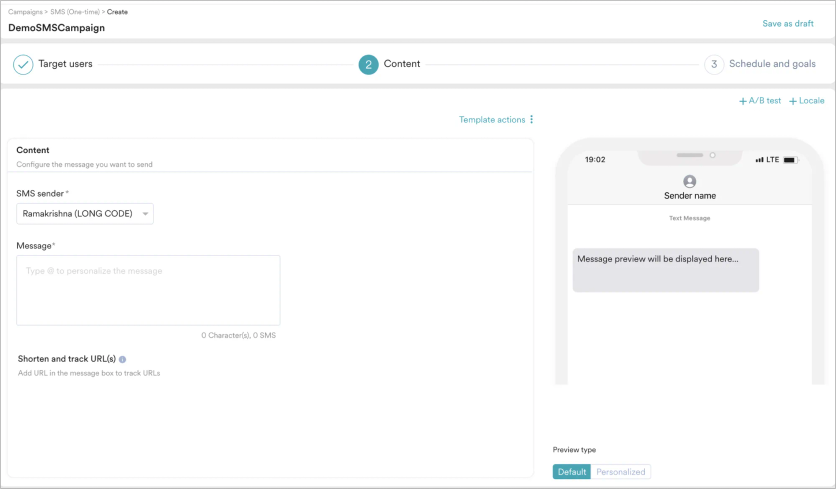
MoEngage’s SMS composer sets the sender and message with a live phone preview, plus A/B tests and locales
WhatsApp, LINE, Viber, and Telegram run as connected channels next to SMS and RCS. An e-commerce manager at an enterprise brand in January 2026 liked the order-journey campaigns but wrote that MoEngage “is not able to conversationally interact with customers.”
Maestra: Texts, WhatsApp, and Regional Messengers in One Flow
Maestra sends SMS, MMS, RCS, WhatsApp, Viber, Telegram, and other messengers popular in a region from the same flows as email, so a WhatsApp message can follow an unread text without a second tool.
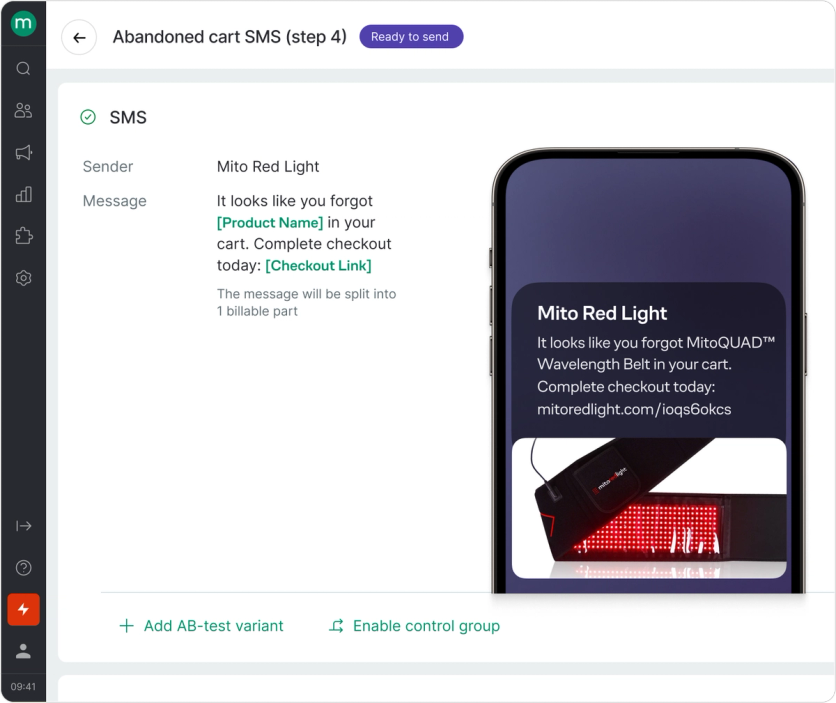
Maestra’s SMS editor fills in the product and checkout link, with an A/B variant and a control group one click away
Compliance runs inside the platform. Plain-language opt-outs such as “no thanks” count, consent history is stored for audits, and RCS falls back to plain SMS on phones that don’t support it.
MPD, a real estate agency, rebuilt its WhatsApp program with double opt-out handling, quarantine for bouncing numbers, and smaller segments. Delivery rose from 53% to above 80% within four months.
Takeaway: Braze and Maestra both put texts and messengers into the same journeys as email: Braze adds LINE and KakaoTalk, Maestra adds Viber and Telegram. MoEngage fits a team that already has an SMS provider contract and wants to keep it.
Braze vs MoEngage vs Maestra: AI Capabilities
AI winner: Braze – its decisioning engine already picks the offer, channel, and timing for each customer in production.
Braze | MoEngage | Maestra |
|---|---|---|
🏆 | ⭐⭐⭐⭐ | ⭐⭐⭐⭐ |
Braze: Decisioning That Learns per Customer
Braze’s decisioning engine, built from its OfferFit acquisition, chooses the offer, channel, send time, and content for each customer and keeps learning from the results.
BrazeAI Operator, an assistant inside the platform, drafts campaigns, journeys, and segments and asks before it changes anything, and teams can drop AI agents into journeys. An IT services reviewer in September 2026 liked that Braze can build “a full journey just from a marketing brief,” but added that the new AI features “will take some time to become stronger, reliable, and efficient.”
The predictive models need scale. Churn prediction typically wants around 300,000 monthly active users in one workspace, and AI agents spend credits.
MoEngage: Merlin Agents and Per-User Decisioning
MoEngage’s AI suite, Merlin, is a set of agents for everyday tasks: one writes copy, another builds segments, another drafts flows, and a campaign-insights agent explains results. An MCP connector lets Claude, ChatGPT, or Copilot work with MoEngage data on both plans.
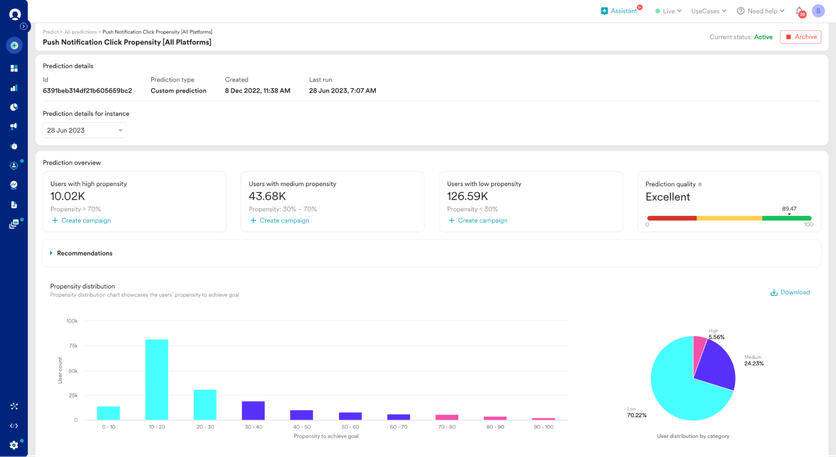
MoEngage’s Predictions add-on splits users into high, medium, and low propensity to click a push notification
The bigger bet is decisioning. MoEngage bought Aampe, which gives every user an AI agent that learns which message, time, and channel work for that one person.
Much of it is gated. Predictions are an add-on, and path optimization, best time to send, and next best action in flows need the Enterprise plan.
Maestra: An AI Assistant, AI in Reports, and Models You Tune
AI is built into Maestra at every level. Claude or ChatGPT connect to Maestra through MCP, and a marketer describes the task in plain words: build a segment, assemble an email from the brand’s blocks, audit or set up a flow, or pull a report. Nothing goes out until someone on the team approves it.
In the reports, Maestra AI reads the business metrics and points to what changed, which flow to rework, and what to test next.
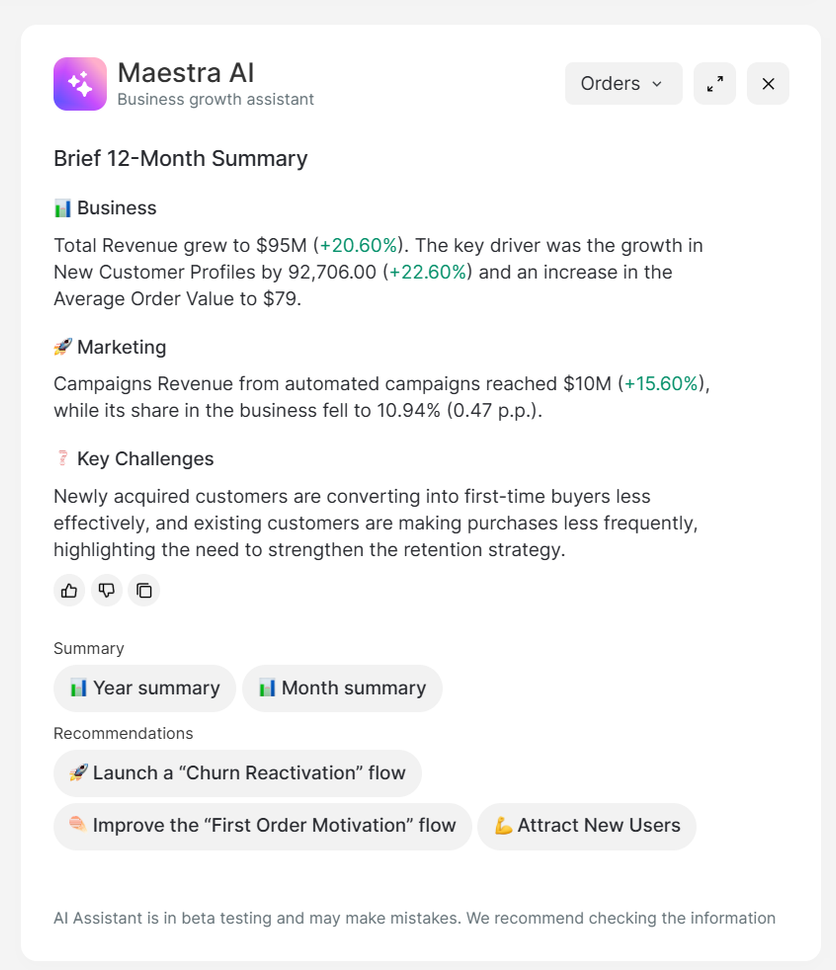
Maestra AI sums up the year in the reports and names which flows to launch or rework next
For specific jobs Maestra runs its own models. Next Best Action predicts when each customer is ready to buy again, a send-time model picks the hour for each recipient, and 14 recommendation models choose products. They run on rules the team can read and change by hand, such as limiting picks to one collection or price band.
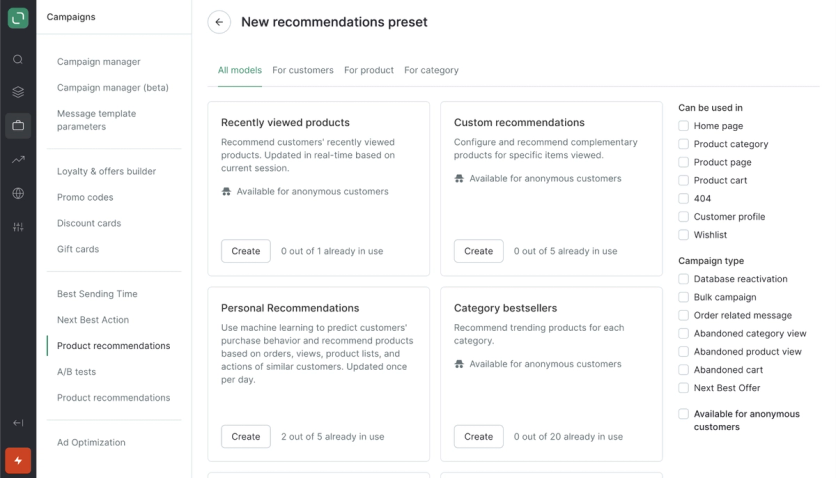
Maestra’s recommendation presets cover recently viewed, custom, personal, and category-bestseller picks, with Next Best Action and Best Sending Time in the same menu
That control is what Defense Mechanisms values most: “We can let the AI engine run on autopilot and pick products from our inventory. Or we can adjust it ourselves to match what we know works well together.”
Takeaway: For decisioning that already runs per customer at scale, choose Braze. For an agent suite and per-user decisioning on an Enterprise contract, choose MoEngage. For AI you direct from your own assistant and models you can tune by hand, choose Maestra.
Braze vs MoEngage vs Maestra: Site Personalization
Site personalization winner: MoEngage and Maestra – MoEngage for a standalone personalization engine with server-side tests, Maestra for a storefront that changes per visitor, with popups, quizzes, and tests built in.
Braze | MoEngage | Maestra |
|---|---|---|
⭐⭐⭐ | 🏆 | 🏆 |
Braze: Campaign Messages Placed on the Page
Braze can put campaign content on a website: pop-ups, slide-ins, banners inside the page, and simple landing pages, each aimed at a segment.
It doesn’t change the store itself. Catalog order and product-page content look the same for every visitor unless a developer builds the logic, and free landing pages stop at five.
MoEngage: Personalize, a Separate Engine With a Visual Editor
MoEngage sells website personalization as its own product, Personalize. Marketers change banners, product grids, and copy in a visual editor, developers can run personalization on the server for dynamic sites, and every change can be split-tested.
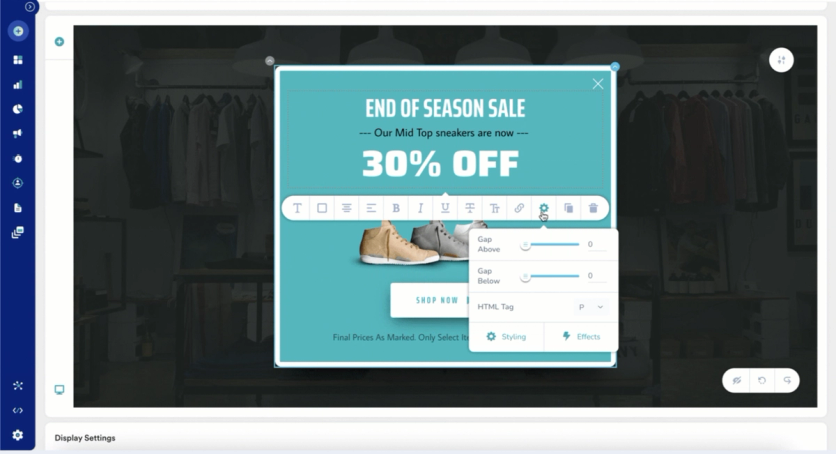
MoEngage’s on-site editor styles a sale pop-up directly over the storefront page
Gartner named MoEngage a Visionary in its 2026 Magic Quadrant for Personalization Engines. It’s priced as a separate product, and the visual editor, custom code, and on-site recommendations are add-ons.
Maestra: Catalog, Product Pages, and Minicart per Visitor
Maestra’s onsite module changes the storefront during the visit. Catalog pages, product pages, the minicart, and promo overlays adjust to the visitor and keep updating as they browse.
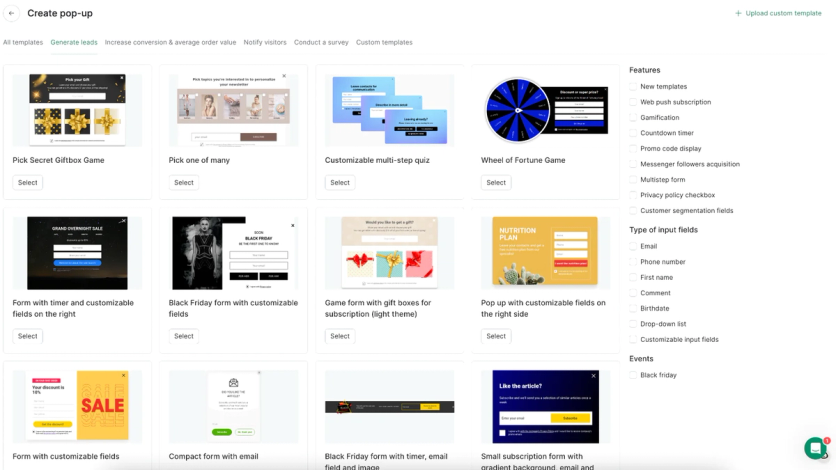
Maestra’s onsite module adds gamified forms, quizzes, and lead popups to the storefront personalization
Marketers also run popups, quizzes, games, sticky bars, and embedded forms, aimed by segment, cart contents, traffic source, device, or location. Forms are A/B-tested by offer and by design, and site-wide changes run against a control group, so the team sees the real lift.
The module costs $1,515/mo on top of the CDP base, and the brand’s Forward Deployed Marketer sets it up.
Sena, a motorcycle and cycling gear brand selling in the US and Europe, added sticky promo banners on every page, sale overlays on product pages, and countdown timers in its reminder emails. Revenue from its Memorial Day sale grew 5.6x. Of a summer-sale banner, the team said: “We actually had more conversions from that single banner than from two separate email campaigns combined.”
Takeaway: Braze covers messages placed on a page. MoEngage fits a team that wants a dedicated personalization engine with server-side testing and has the budget for its add-ons. Maestra fits a store that wants the catalog, product pages, and popups personalized and tested without buying a separate product.
Braze vs MoEngage vs Maestra: Product Recommendations
Recommendations winner: Maestra – 14 models across the site, messages, and stores, tuned by hand and included in the base plan.
Braze | MoEngage | Maestra |
|---|---|---|
⭐⭐⭐ | ⭐⭐⭐⭐ | 🏆 |
Braze: Product Picks Inside Messages
Braze adds product picks to messages from a catalog the brand uploads: bestsellers, trending items, recently viewed products, or AI picks based on behavior. Back-in-stock and price-drop alerts are where it does best.
AI picks come with the Pro edition and typically need around 30,000 users to work well. Braze shows them in messages only.
MoEngage: Six Models, Sold as an Add-On
MoEngage offers six recommendation models, including similar items, frequently bought together, and trending products, plus an API for developers. The picks go into email and push, and onto the site with Personalize.
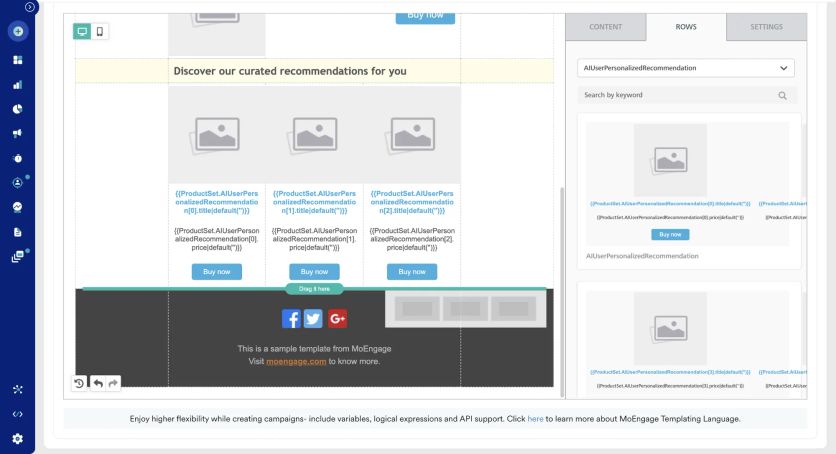
MoEngage inserts an AI-personalized recommendation row into an email as a set of product variables
AI recommendations are a paid add-on, and syncing the full product catalog for them takes the Enterprise plan.
Maestra: The Same Picks on the Site, in Messages, and in Stores
Maestra shows recommendations on the website and in the mobile app, in email, texts, and push, and on store terminals, and the picks stay consistent from one channel to the next. Recommendations are part of the CDP base, so they need no separate module.
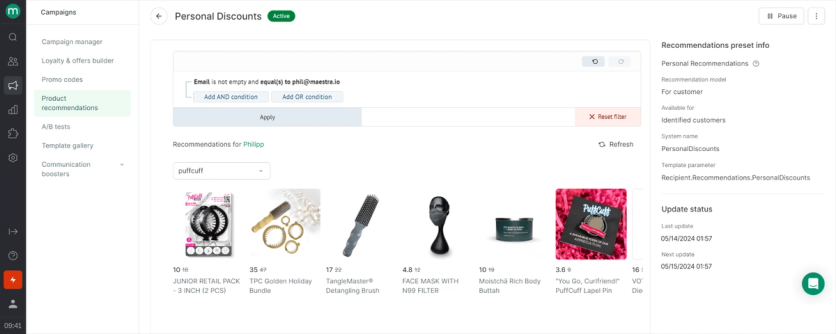
A Maestra personal-recommendations preset previews the picks for an individual shopper before it goes live
There are 14 ready models, from bestsellers and similar items to frequently bought together and personal picks. Picks update during the visit as the shopper browses, anonymous visitors get recommendations before they sign up, and bundle offers group matching items into one deal.
The models run on rules the team can read and adjust by hand. A block can match by color, price, size, or region, so shoppers see in-stock items in their size, and a manual mapping can pair categories the brand knows sell together.
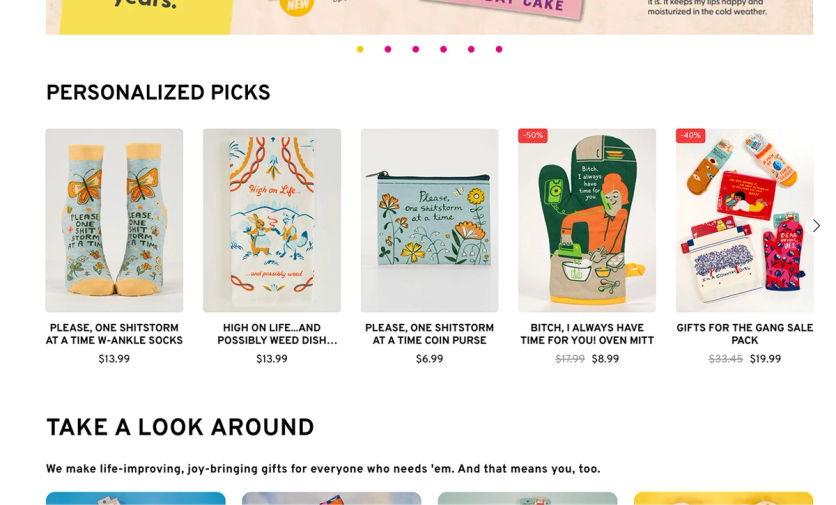
Blue Q, a gift brand with artist-designed socks, bags, and kitchenware, uses recommendations at every step of the visit. New visitors see bestsellers on the homepage, returning ones see personal picks that start with full-priced items, product pages offer “Often Bought With” bundles, and the minicart adds small impulse buys before checkout. Shoppers who engage with recommendations place orders with 28.7% higher AOV and 45.3% more items, and the bundles alone drive 40% of recommendation-influenced revenue.
Takeaway: Braze puts recommendations inside messages. MoEngage adds the site and more placements if you buy the add-on. Maestra fits brands that want the same tunable picks on the site, in every message, and in stores without paying extra for them.
Braze vs MoEngage vs Maestra: Loyalty & Promotions
Loyalty winner: Maestra – the only built-in loyalty program of the three; Braze and MoEngage connect to partner apps.
Braze | MoEngage | Maestra |
|---|---|---|
⭐⭐ | ⭐⭐ | 🏆 |
Braze: Loyalty Through Partner Apps
Braze has no loyalty program of its own. It connects to partners such as Talon.One, Voucherify, and Antavo, so points and tiers live in a separate product with its own contract.
Promo codes come in as uploaded lists, and a message that needs a code won’t send once the list runs out.
MoEngage: Loyalty Through Marketplace Partners
MoEngage doesn’t have a loyalty product either. Its marketplace lists loyalty partners such as LoyaltyLion, Smile, Voucherify, and Capillary, whose data can feed MoEngage campaigns.
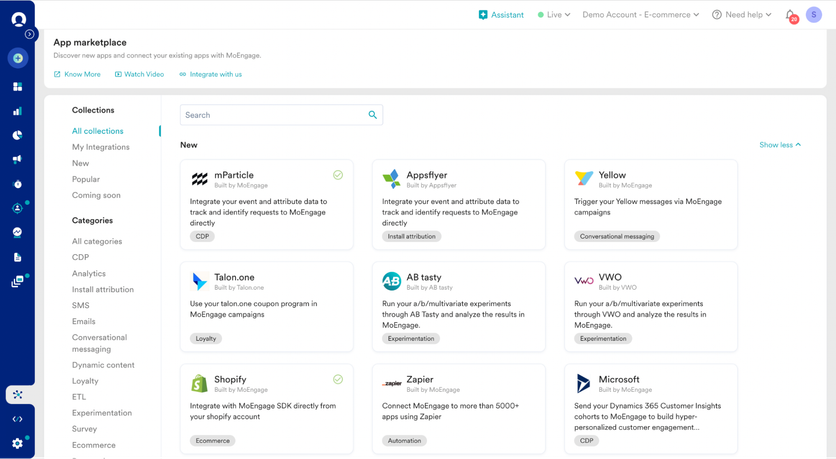
MoEngage’s App Marketplace lists loyalty as a partner category, with apps such as Talon.One feeding coupon programs into campaigns
The trade-off is the same as with Braze: a second vendor, and a points balance stored outside the platform that sends the messages.
Maestra: Points Shoppers See in Every Email and at Checkout
Maestra’s loyalty is built in: points, cashback, tiers, referrals, promo codes, and gift cards. Because it runs inside the platform, every email and text can show the shopper’s live points balance, and a flow can award points the moment an order lands.
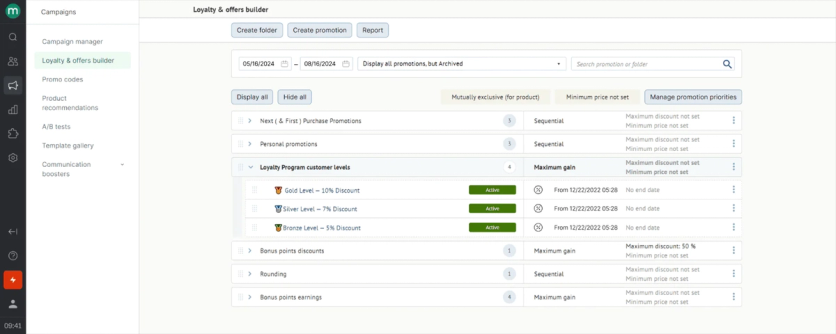
Maestra’s loyalty builder runs Gold, Silver, and Bronze tiers next to bonus-point rules and personal promotions
Marketers set the rules themselves, from points per dollar and double-points days to limits on how much can be paid with points and how discounts stack. The loyalty report compares members’ order value with everyone else’s.
Shoppers earn and spend points online and, with the POS version of the module, at store checkouts. The Shopify loyalty module costs $1,010/mo.
Svaha USA moved its loyalty program off Yotpo. Rewards now show at checkout, where shoppers tap to apply them, and loyalty questions no longer fill the customer service queue.
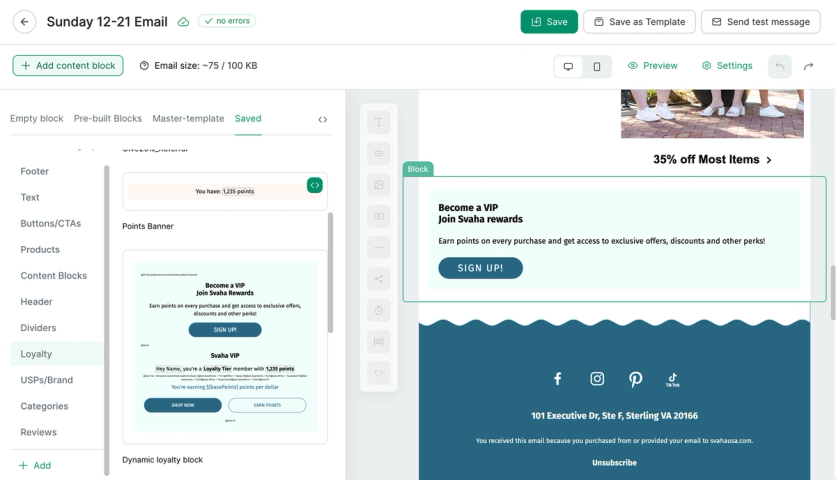
Maestra’s loyalty block in the email builder shows members their tier and points balance and invites everyone else to join
Takeaway: With Braze or MoEngage, loyalty means a partner app and a sync to maintain. Maestra fits brands that want points and tiers to show up inside their emails, texts, and checkout.
Braze vs MoEngage vs Maestra: Integrations & Ecosystem
Integrations winner: all three – Braze for warehouse-native data stacks, MoEngage for the largest app marketplace, Maestra for connectors built to order.
Braze | MoEngage | Maestra |
|---|---|---|
🏆 | 🏆 | 🏆 |
Braze: 180+ Partners and Zero-Copy Warehouse Access
Braze works with more than 180 technology partners and reads data from Snowflake, BigQuery, Databricks, and Redshift without copying it. Event data flows back out to analytics and BI tools.
Shopify stores get a ready integration that syncs browsing, carts, checkouts, orders, and refunds, plus 90 days of past orders.
MoEngage: 300+ Integrations and a Free Shopify App
MoEngage’s marketplace lists more than 300 integrations across CDPs, analytics, attribution, ads, and messaging, and it connects to the same warehouses Braze does. A free Shopify app brings web push, popups, and on-site personalization to a store.
Some of the data plumbing costs extra. Segments that query your warehouse directly and syncing audiences out to other tools are both add-ons.
Maestra: 150+ Integrations, Missing Ones Built Free
Maestra has 150+ ready integrations, including Shopify, BigCommerce, Magento, WooCommerce, and Salesforce Commerce Cloud, plus help desks and analytics tools. When a connector is missing, the team builds it during onboarding at no extra charge.
A real-time API exchanges customer and order data with CRMs, ERPs, and store systems, and SDKs cover iOS, Android, Flutter, and React Native. Audiences sync to Meta and Google ads from the CDP base.
Kiwitaxi runs a custom Django website plus iOS and Android apps. Its team credits the Maestra marketer with keeping that integration stable after it had grown fragile on the previous platform.
Takeaway: Pick Braze when your data team works from a warehouse. Pick MoEngage when the app you need is probably already in its marketplace. Pick Maestra when part of your stack is custom and you want the integration built as part of onboarding.
Braze vs MoEngage vs Maestra: Ease of Use & Implementation
Ease of use winner: Maestra – a Forward Deployed Marketer runs the migration and setup, so the marketing team doesn’t wait on engineers.
Braze | MoEngage | Maestra |
|---|---|---|
⭐⭐⭐⭐ | ⭐⭐⭐⭐ | 🏆 |
Braze: Easy Once Live, Heavy to Set Up
Marketers find Braze easy to work in once it’s connected. An enterprise reviewer in September 2026 praised the “easy interface and navigation,” where you “can go to the different parts quickly.”
The setup itself needs engineers. G2 reviewers put the average implementation at about three months, and another enterprise reviewer noted that the first setup “requires significant interaction between the technology and data teams.” Personalization written in Liquid keeps developers involved afterward.
MoEngage: Quicker Setup, Steeper Learning Curve
MoEngage tends to go live faster. G2 reviewers put the average implementation at about two months, and its MoUpgrade program offers managed migration from another platform.
The first weeks inside the product are harder. A marketing manager at an enterprise company in February 2026 found that the platform “can feel overwhelming at first,” with “a learning curve before you fully unlock its potential.”
Maestra: A Marketer Does the Setup
Maestra staffs the setup. A Forward Deployed Marketer builds the integrations, segments, and flows with the brand’s team from the first week.
The brand’s part is granting access and approving the timeline. Moving flows and templates and warming up the sending domain sit with Maestra, and the old platform keeps running until the switch. Typical migrations take two to seven weeks, depending on the size of the brand.
Daily work needs no code: segments, flows, emails, and popups are built in visual editors.
Blossom Flower Delivery connected its WooCommerce site through Google Tag Manager in two days and sent its first campaign a week after signing.
Takeaway: Braze works for teams with engineers for the integration and for the personalization code after it. MoEngage gets live sooner but asks more of the marketer in the first months. Maestra fits marketing teams that want to run the program themselves and leave the setup to their Maestra marketer.
Braze vs MoEngage vs Maestra: Customer Support & Services
Support winner: Maestra – hands-on help is part of every plan, from migration to ongoing optimization.
Braze | MoEngage | Maestra |
|---|---|---|
⭐⭐⭐ | ⭐⭐⭐⭐ | 🏆 |
Braze: Round-the-Clock Support, Services Priced Separately
Braze runs technical support around the clock and sells hands-on help separately: onboarding, migration, account management, training, creative, and deliverability, each priced on request. Many brands run Braze through partner agencies.
Reviewers with a good team say so. A mid-market reviewer in September 2026 wrote that “our customer support team is excellent, especially our CSMs and account managers.”
MoEngage: In-House Experts, Consulting as an Extra
MoEngage’s Growth plan includes access to its in-house engagement experts, and Enterprise adds quarterly business reviews with the MoEngage team. Implementation services and consulting are add-ons on both plans.
Support itself earns praise: a CRM lead for India and the UAE in March 2026 summed up the platform as “excellent support, great analytics and 10/10 UI.”
Maestra: A Forward Deployed Marketer on Every Plan
Every Maestra plan includes a Forward Deployed Marketer, who handles migration, setup, and ongoing optimization. There’s no services price list, and migration is free.
Each marketer works with fewer than 15 brands, meets the team every week, and answers in a shared Slack channel in about five minutes. The work covers strategy, deliverability, flows, segments, the website, and A/B tests.
Selkirk Sport moved to Maestra after its previous platform, where the team “spent six months fixing onboarding errors that should have been caught from the start.” On Maestra, its email marketing manager says that “that level of partnership is included, not an upsell.”
Takeaway: Braze suits teams with an agency partner or in-house experts who mainly need technical support. MoEngage suits teams that want responsive support and will buy consulting when they need it. Maestra suits teams that want a marketer on the account who builds and optimizes with them every week.
Braze vs MoEngage vs Maestra: Pricing
Pricing verdict: Maestra – every price is public and billed month to month; Braze and MoEngage quote each deal and bill on usage meters.
Braze | MoEngage | Maestra |
|---|---|---|
$$$ | $$$ | $$ |
The three count customers differently. Braze bills monthly active users plus credits for each message, MoEngage bills monthly tracked users with anonymous visitors included, and Maestra bills active profiles only. Price a full year on your own audience before comparing quotes.
Texts are priced differently too. Braze bills them in credits at each country’s rate, and Vendr notes that carrier fees come on top. MoEngage sends through the SMS provider a brand contracts, so that provider bills the messages and the carrier fees. Maestra lists its per-text rate and the carrier fees separately. Compare monthly totals on your own volumes.
Braze: Custom Quotes on Users and Credits
Braze pricing: Custom pricing (contact sales). Braze sells four editions, Go, Select, Pro, and Enterprise, priced by monthly active users plus Action Credits spent on email, texts, messengers, and some AI features. A contract bundles the edition, the user and profile counts, a credit allotment, and services.
Vendr’s contract data, a third-party estimate, puts the median Braze deal at about $88,507 a year, roughly $7,400 a month, with most contracts running one to three years.
MoEngage: Custom Quotes on Tracked Users, Plus Add-Ons
MoEngage pricing: Custom pricing (contact sales). The main product comes in Growth and Enterprise plans, with Personalize and Inform sold separately. Billing counts monthly tracked users, anonymous ones included, and a fair-use limit on events per user can raise the billable count for busy apps.
Add-ons stack on top: WhatsApp, predictions, content cards, open analytics, real-time exports, and segment sync, plus most of the analytics suite. Vendr, also an estimate, puts the average contract at about $186,725 a year.
Maestra: From $2,000/mo, With Every Price Public
Maestra pricing: From $2,000/mo for the customer data platform plus unlimited email, with the first 100,000 active profiles included and $0.013 per active profile above that. Only profiles that got a message, visited, or bought in a given month count, so a dormant list costs nothing to store.
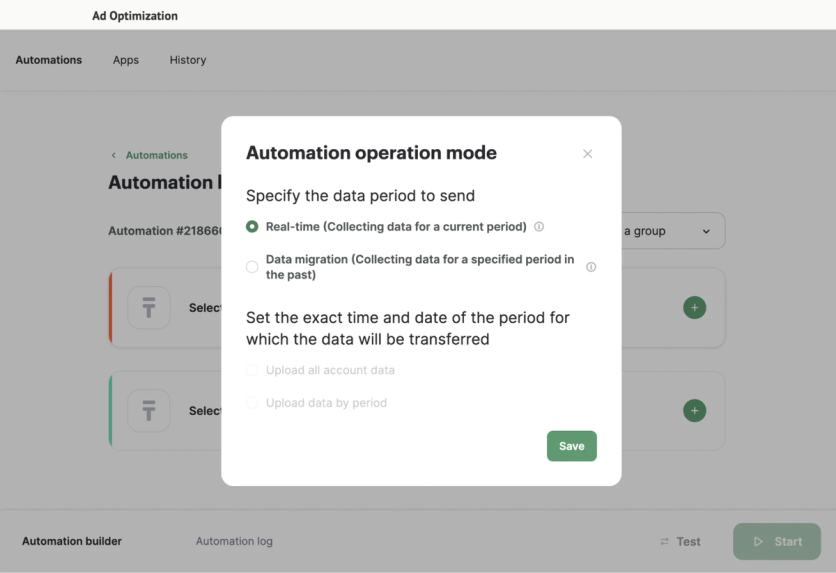
Ad audience sync, part of the CDP base, can send audiences to ad platforms in real time
The $1,300/mo base already covers product recommendations, reporting, ad audience sync, the MCP connector for AI assistants, and the Forward Deployed Marketer. Channels come as monthly modules: SMS, MMS, and RCS at $250/mo + $0.0035 per US SMS, WhatsApp and other messengers at $420/mo, mobile push and in-app at $1,305/mo, onsite personalization at $1,515/mo, and loyalty for Shopify at $1,010/mo.
Billing is month-to-month with no setup fees, and any module can be switched off at any time. Extras are listed too: dedicated sending IPs cost $3,000/mo, and each additional brand costs $1,000/mo.
Crezu needed fair pricing for a database of more than 6 million customers. One of the six enterprise platforms it evaluated “quoted us 8–12× what we were paying for our entire stack at the time.”
Takeaway: Choose Braze if a negotiated multi-year contract is how you buy and you can watch a credit meter. Choose MoEngage if you want its analytics suite and can price the add-ons before you sign. Choose Maestra if you want to see the full price before the first call and add channels as you need them.
Final Verdict: Braze vs MoEngage vs Maestra
Choose Braze if your product is an app and your engineers can own a serious integration. Its journeys, app formats, and AI decisioning are the strongest here, and it’s easy to work in once it’s live. Watch the credit meter as message volume grows.
Choose MoEngage if your team lives in app analytics and wants funnels, retention, and campaigns in one tool. Its Android delivery layer and Personalize engine are real strengths. Price the add-ons before you sign, because much of the analytics you came for is on that list.
Choose Maestra if you’re a mid-size or scaling e-commerce brand that runs marketing across several separate tools. Maestra replaces the email platform, the CDP, the loyalty app, the personalization tool, and the recommendations engine with one platform, plus a Forward Deployed Marketer who runs it. Furniture Fair replaced five tools that way and cut its marketing stack costs 27%.
To price your own setup, open the module calculator with your current Braze or MoEngage quote next to it.
FAQ
- Braze is better for app-first brands that want real-time journeys and AI that decides for each customer. It also has the widest set of app formats. MoEngage is better for teams that want app analytics, such as funnels, retention, and uninstalls, next to their campaigns, plus a delivery layer for Android push.
E-commerce brands that want email, SMS, loyalty, and the storefront in one program often shortlist Maestra. Level Up Basketball, a training app, grew revenue 4.5x after rebuilding its email and push journeys in Maestra. - A September 2026 G2 review says the first Braze setup takes the technology and data teams. A February 2026 review calls MoEngage overwhelming at first. Once they’re live, users describe both as manageable.
Maestra takes the setup off the team: a Forward Deployed Marketer runs the migration and builds the first flows. Blossom Flower Delivery sent its first campaign a week after signing. Braze and MoEngage both sell on custom quotes and publish no prices.
- Braze quotes custom contracts priced on monthly active users plus Action Credits. Vendr’s contract data puts the median at about $88,507 a year.
- MoEngage quotes Growth and Enterprise plans priced on monthly tracked users, with many features as add-ons. Vendr estimates the average contract at about $186,725 a year.
- Maestra starts at $2,000/mo for the CDP plus unlimited email, with the first 100,000 active profiles included, month-to-month billing, and public module prices.
Urban Armor Gear cut its marketing stack costs 64% after consolidating on Maestra.
Recent reviews point to different pain points.
- Braze: setup needs engineering and data teams, journeys with many branches get hard to review, and email and texts are billed in credits.
- MoEngage: most of the analytics suite is sold as add-ons, and detailed funnel work can still mean exporting to Excel.
Maestra covers both gaps for e-commerce brands: a Forward Deployed Marketer does the setup, and reporting comes with every plan. Selkirk Sport grew email-attributed revenue 55% year over year after moving to Maestra.