Crezu Grows Email Revenue 23% YoY – and Hits Its All-Time Channel Record


Integrated with:
Switched to Maestra from:
Results
- Highest ever
email channel revenue
- +23%
email revenue YoY
- +7 p.p.
growth in email channel share
- +11%
quality leads YoY
A key driver of this growth is promotional send automation. With manual launches gone, the team went from 65–80 hours a month on promo execution to under 10 – while the sends themselves became more efficient and more profitable.
The Impact of Automated Promotional Sends
- −32%
fewer promotional sends YoY
- +43%
revenue from promotional sends YoY
- +62%
in revenue per send (RPS)
Testimonial

Why Crezu Chose Maestra
For years, Crezu built and maintained their own CRM platform. Over time, it became the bottleneck: no complex flows, no real-time segmentation, customer records fragmented across brands, and every improvement taking 2–3 months of development. The choice was stark – invest heavily in building a proprietary solution, or find a platform that could do it out of the box.
When the CRM team started evaluating vendors, their requirements were demanding:
- a single account managing multiple brands across 15 countries and 8 languages
- strong identity resolution
- compliant multi-country deliverability across email and SMS
- real-time segmentation by traffic source
- role-based access controls to protect customer data
- fair pricing for a 6M+ customer database
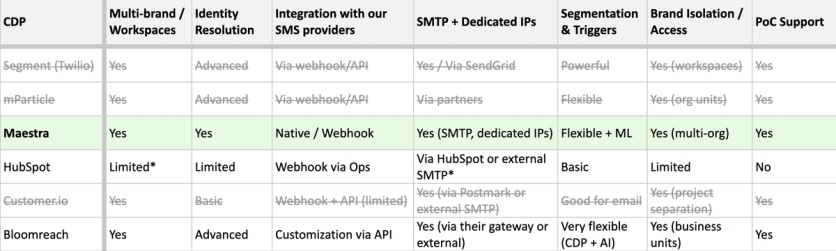
Platform comparison across Crezu's seven evaluation criteria
Real-Time CDP Powers Crezu’s Source-First Strategy
For Crezu, the core value of Maestra is its real-time CDP with flexible segmentation – the foundation that makes Source-First Strategy possible.
| Before Maestra | With Maestra |
|---|---|
| ❌ One customer often existed as multiple leads with no way to unify them into a single profile | ✅ Unified customer profile across brands and touchpoints |
| ❌ No real-time visibility into traffic source | ✅ Traffic source captured in real time at the customer level |
| ❌ All customers received the same communications regardless of where they came from | ✅ Messaging, timing, and channel adapt to each customer’s traffic source |
| ❌ No real-time eligibility checks – wrong customers reached, deliverability damaged | ✅ Eligibility determined instantly |
| ❌ No distinction between active, pre-churn, and churned customers | ✅ Lifecycle segmentation drives different messaging for each stage |
Rebuilt Deliverability Infrastructure Gets Emails to the Inbox
When working with active audiences, inbox placement is the top priority – and Crezu had a problem here. Frequent sends across multiple languages need to be tightly organized, or providers start flagging them as spam. But transactional and promotional emails shared the same sending domains, and authentication was inconsistent across the entire setup.
The fix required a full infrastructure rebuild across 140+ root domains.
Subdomain architecture: Each communication type – promotional, triggered, transactional – was assigned its own subdomain. This separated reputation signals that had previously contaminated each other.
Authentication: DKIM, DMARC, SPF, and DNS records were audited and corrected across all domains. When Google rolled out stricter DMARC enforcement in early 2024, Crezu was already compliant – while competitors scrambled. The Maestra team configured the return path and conducted large-scale testing of authentication records across ~500 sending domains.

An email for Vietnamese audience where open rates climbed from 7–10% to 26% after migrating to Maestra
Save 60+ Hours a Month – and Shift the Team From Execution to Strategy
Before Maestra, Crezu’s marketers manually built segments and sent 3–4 promotional emails per day, per market, per brand – usually just a day or two ahead. Two CRM marketers spent 65–80 hours a month on this alone. Strategy took a back seat to day-to-day operations.
Today, one marketer spends under 10 hours a month on promotional sends – and that time goes toward reviewing launches, refreshing creatives, and testing new hypotheses. The rest is handled by Maestra automatically.
Every day, the system rotates creatives automatically – if a customer has already seen one, they receive a different one next time. With 60+ creatives in rotation for a single brand in Poland, every customer sees fresh content with zero manual involvement. In Mexico, the same creative now reaches the same customer no more than once every 20 days – compared to near-daily repetition before.
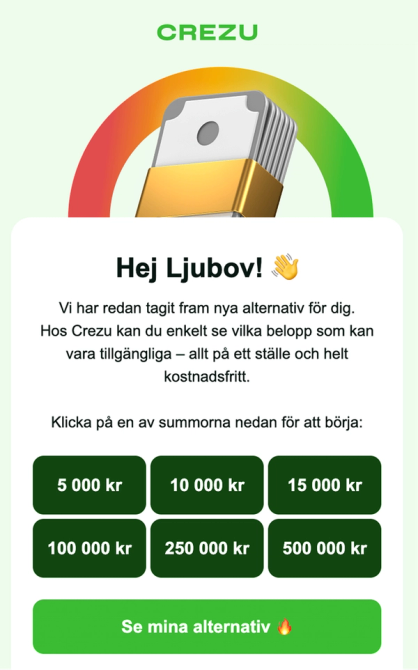
Promotional offer for Swedish audience
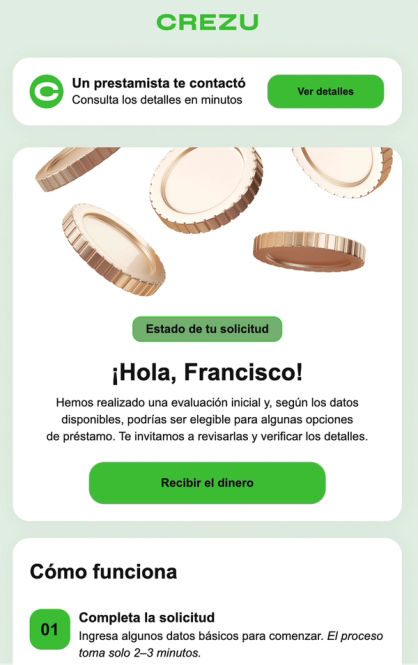
Promotional offer for Mexican audience
Critically, the automation targets active customers only. Pre-churn and churned segments are automatically excluded from promotional sends – reserving their attention for special re-engagement offers.
The result: revenue from promotional sends grew 43% year-over-year, on 32% fewer sends.
A Custom SMS Architecture Brings 15-Country Operations Under Control
Running SMS at Crezu’s scale is operationally complex. Every country has its own provider requirements, link formatting rules, alpha name conventions, and compliance obligations. Standard out-of-the-box SMS couldn’t handle this.
The team designed a smarter architecture: Maestra sends structured SMS payloads to Crezu’s own backend, which handles provider selection, link formatting, and routing across 8 providers. The result is full operational control with Maestra’s attribution and analytics layer on top.
The impact was significant. SMS attribution – previously a persistent problem due to fragmented provider data – is now tracked cleanly. Marketers can see delivery events, clicks, and non-deliveries in real time, and trigger automatic channel redirects if a provider fails. CRM analytics, once unreliable, now produce accurate data that feeds directly into acquisition strategy.
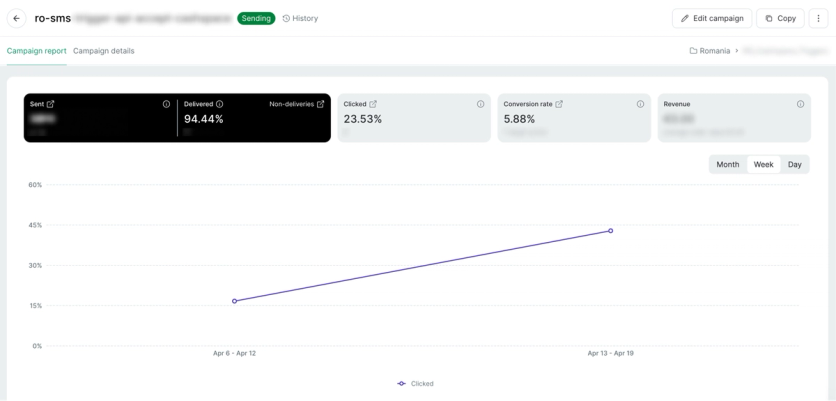
The time savings are just as striking. Creating a single SMS flow used to take 25–30 minutes involving webhook setup, provider routing, and manual verification. Now it takes under 3 minutes.
Web Push Transformed From Bulk Blasting to a Strategic Channel
Before Maestra, web push was a blunt broadcast tool – sent 3–4 times daily, always to the same promotions page, with no connection to email or flows. Now, audience segmentation, flow integration, and centralized tracking have turned it into a meaningful revenue driver.
In Vietnam, adding web push to flows brought its share of CRM revenue to 25%. In South Africa, it drives 15% – after the team replaced welcome emails with web push entirely, protecting sender reputation and keeping email metrics clean.

The South Africa Welcome flow runs on web pushes exclusively

Vietnam’s flows include web pushes