
Ecommerce CDP Benefits: How It Works with Real Examples

Key Benefits of a CDP for Ecommerce, in Short
An ecommerce CDP automatically tailors marketing to each customer – recommending products based on browsing history, triggering messages based on real-time behavior, and making sure every ad dollar reaches the right audience. The result: more revenue, higher LTV, lower costs, and a shopping experience that actually feels personal.
Below, we break down exactly what a customer data platform for ecommerce does – with real examples and metrics from brands like Coolibar, PuffCuff, JOLYN, Enlightened Equipment, and Selkirk Sport.
What Is an Ecommerce CDP – and Why Brands Use It
An ecommerce CDP is the engine behind marketing automation. It collects customer data from your store, email, ads, and every other touchpoint – then uses it to automatically launch personalized communications. That means more sales and lower marketing costs.
The numbers back this up. Enlightened Equipment, an outdoor gear brand, saw a +52.5 % increase in total revenue after activating multiple CDP-driven automations – pop-ups, upsell bars, advanced email and SMS flows, and personalized product recommendations – all running from one platform.
The marketer defines the strategy and sets the CDP’s rules. From there, the platform segments the customer base and launches an omnichannel flow for each segment. Email, push notifications, online ads, in-app banners, and website banners – all channels work as a single system. This lets you build consistent communication and manage everything from one dashboard.
For example, you can create RFM segments in a CDP and launch a separate email flow for each: product announcements for loyal customers, curated product picks for newcomers, and discount codes for dormant customers. On top of campaigns, you can set up automated advertising – say, retargeting customers who didn’t respond to emails.
How a CDP Works for Ecommerce
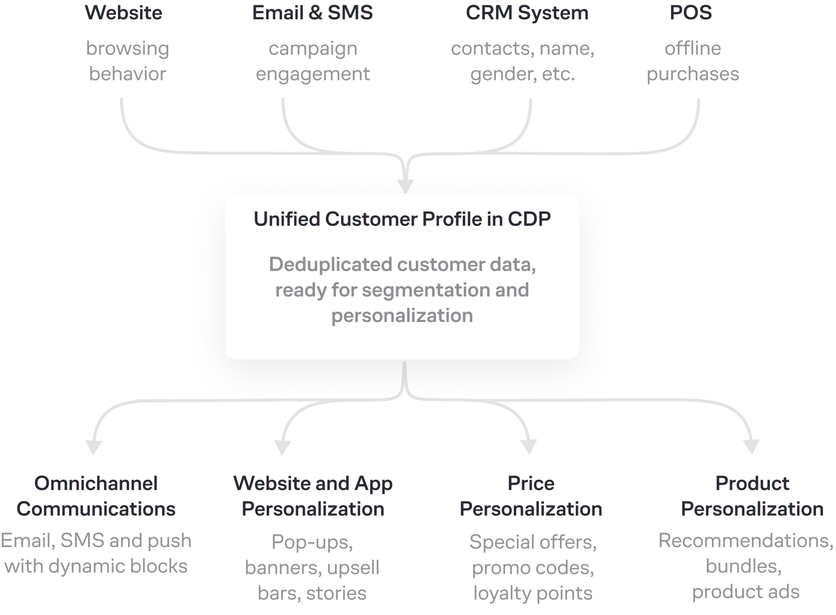
A CDP Builds a Unified Customer Profile for Every Shopper
The platform records the full history of every touchpoint between the customer and your brand across channels: website, email, ads, in-store. The system “recognizes” a user even if they haven’t registered or logged in. Customer data and interaction history live in a unified profile on the platform. It includes:
- Personal customer data – name and contact info
- Available communication channels – for example, whether the app is installed
- Activity log – site visits, purchase history
- Touchpoint log – which campaigns were sent and which ads were shown
A CDP can collect any data your systems generate. For example, performance swimwear brand JOLYN stores contact information, browsing and purchase history, customer size, and a key preference: whether they’re shopping for beach or pool swimwear. These data points feed directly into personalization. A customer browsing beach swimwear and one searching for pool training suits get completely different welcome emails – not to mention different product recommendations on the website. With 4,000 SKUs, that level of detail matters.
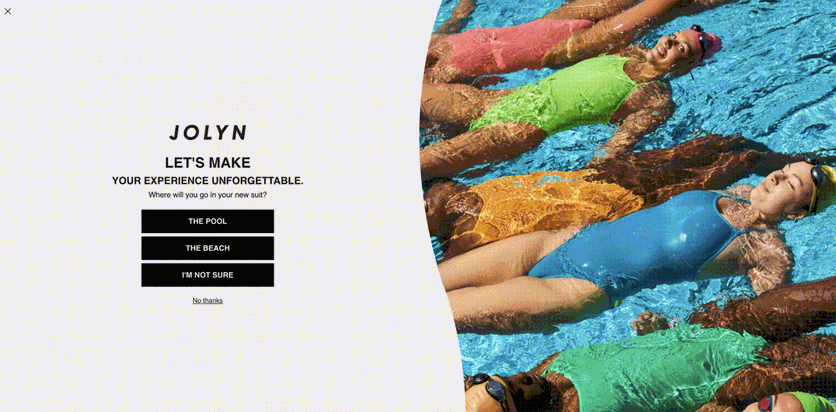
JOLYN collects customer preferences – beach or pool, size, style – to personalize the experience from the very first visit
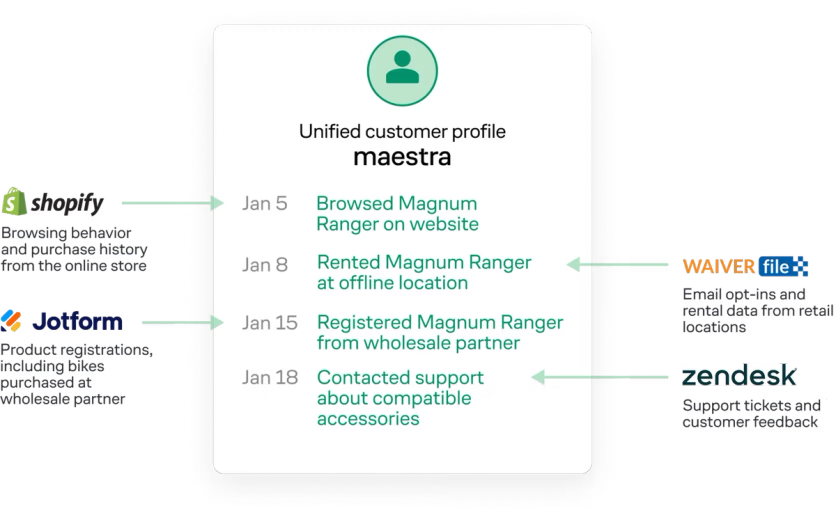
Customer data on the platform is deduplicated: one customer, one profile in the CDP. Events in the activity log are arranged chronologically. Then unified profile data powers database segmentation, message timing, and full customer journey analysis across all channels. For example, Magnum Bikes had customer data scattered across systems – online orders, retail visits, rentals, and product registrations all tracked separately. After switching to Maestra, every touchpoint merged into a single profile, powering product-specific flows and geo-targeted campaigns. The result: +111.7 % in online order volume.
The Platform Automatically Segments Your Customer Base
An ecommerce CDP segments your customer base automatically using any data from the unified profile – purchase history, browsing behavior, location, demographics. These segments drive everything: email campaigns, on-site banners, paid media campaigns, product recommendations.
Segmentation helps you show different customer groups what’s actually relevant to them. For example, recommending products that users in the same segment tend to buy. These selections are generated automatically using ML algorithms.
Enlightened Equipment uses this to show different recommendations depending on whether someone is a new or returning visitor. A first-time visitor sees bestsellers on the homepage. A returning customer sees a personalized selection based on their browsing and purchase history. This approach helped the brand achieve 15 % website conversion growth.
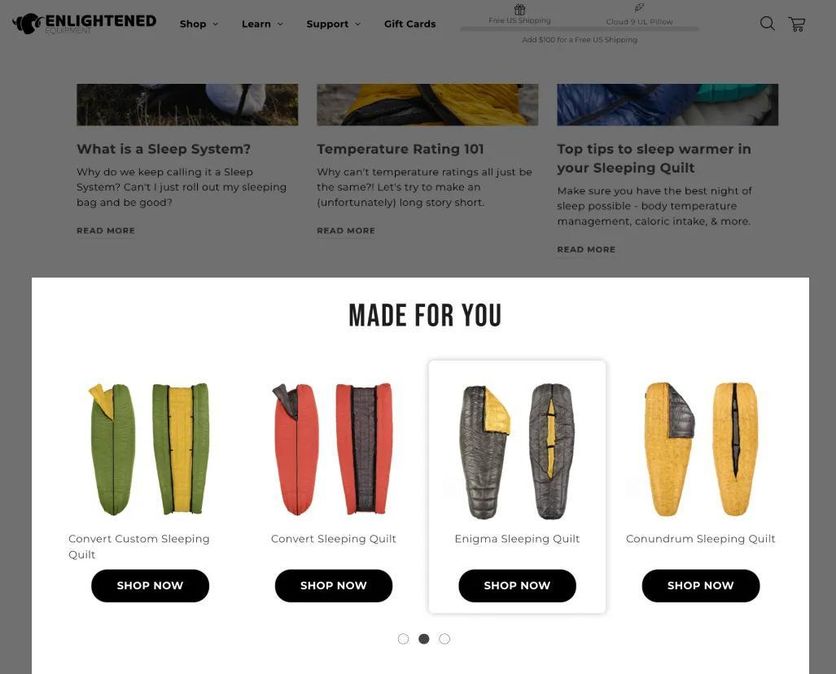
Enlightened Equipment’s homepage shows different product selections to new vs. returning visitors
Processing speed is just as important as what data you collect. The platform has to be fast enough to build segments and send personalized messages before they lose relevance – especially during peak periods like Black Friday and Cyber Monday, when every second counts.
But speed matters outside of peak season too. For instance, Maestra uses in-session segmentation, which means with every click, we learn more about a visitor's behavior and instantly adjust what they see. If someone's browsing sale items, they get a sale banner. If they're looking at new arrivals, we show them that instead. The recommendations get sharper in real time, within the same browsing session.
How an Ecommerce CDP Automates Campaigns to Recover Lost Revenue
Automated campaigns are triggered by user actions. For example, a customer adds products to the cart but doesn’t check out. That event hits the CDP and kicks off a campaign to nudge them toward completing the order.
The abandoned cart flow is typically a few messages synchronized with the sales funnel. For example:
- Remind the customer about the items they left behind and help with the decision
- Offer a discount on those items
- Remind them about the discount
- Offer credit or installment payment
Each message in the chain only sends if the previous one didn’t lead to the target action – the customer didn’t place the order. If they buy, they’re automatically removed from the “abandoned cart” segment in the CDP and the campaign stops.
Similar mechanics work for other “abandonment” scenarios:
- Abandoned search – user searched for something specific but left without clicking through to a product
- Abandoned category – customer visited a product category but didn’t buy
- Abandoned browse – user viewed a product page but didn’t buy
- Abandoned wishlist – user added items to their wishlist or favorites but never purchased
- Abandoned checkout – customer started entering shipping or payment details but didn’t complete the order
Coolibar, a sun-protective apparel brand, switched from Klaviyo to Maestra and tripled revenue from abandoned-item flows. Their dedicated Forward Deployed Marketer rebuilt existing automations and launched new ones – including Price Drop Alerts and Abandoned Collection flows. Total campaign revenue grew by 33.6 %.
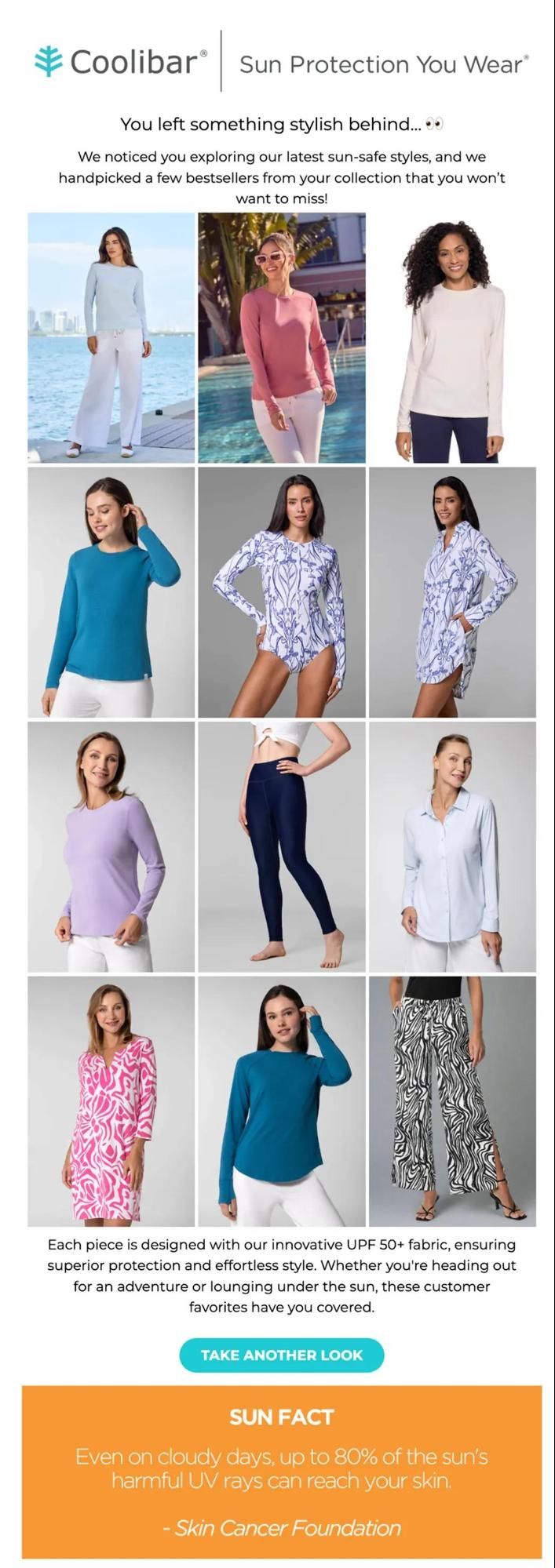
Coolibar’s Abandoned Collection flow re-engages visitors who browsed a category but left without adding products
Low Stock Notifications
Low stock notifications complement abandoned cart and abandoned browse flows. If a shopper didn’t respond to an abandoned cart message, they might still be comparing products and prices – or may have already bought elsewhere. A message that a product is running low can push those who are still on the fence. The timing is calibrated to avoid overwhelming the customer while still reaching them before they buy from a competitor.
For clothing and other seasonal items, the “low stock” reminder is typically sent on the day of the missed purchase or within the next 2–3 days. For furniture or electronics, a week or more may pass before the reminder.
Enlightened Equipment added low stock alerts as part of a broader intent recovery strategy. When inventory on a viewed or carted item drops below a threshold, the CDP triggers an automatic notification. Combined with price drop and back-in-stock alerts, these flows contributed to +52.5 % total revenue growth.
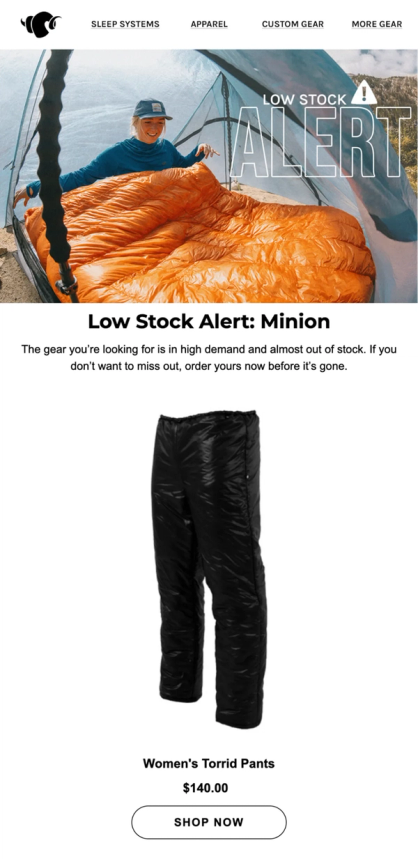
Enlightened Equipment’s low stock alert email triggered automatically when inventory drops below a set threshold
Back in Stock Alerts
The back-in-stock flow complements abandoned cart and abandoned browse campaigns – or works on its own. When a popular item sells out, customers who viewed or carted it can subscribe to restock notifications. Once inventory is replenished, the CDP automatically triggers a message.
Selkirk Sport, a leading pickleball brand, couldn’t run back-in-stock flows at all on their previous platform – broken product data meant customers got restock notifications, only to find the item still out of stock online. After switching to Maestra, accurate real-time inventory data made back-in-stock alerts work properly for the first time. Combined with smarter cart recovery and segmentation, the brand achieved +55 % email revenue and +149 % SMS revenue year-over-year.
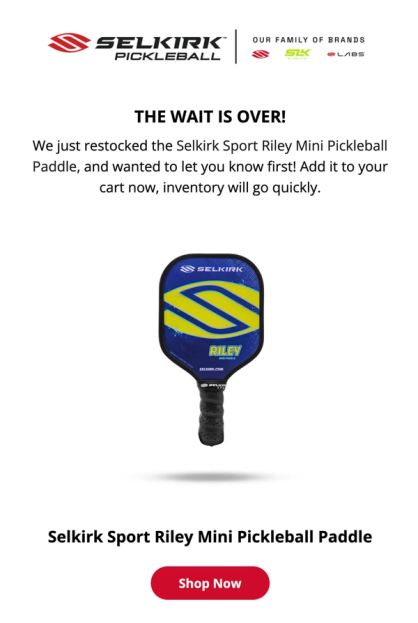
Selkirk Sport’s Back in Stock email – a flow that was impossible on their previous platform due to broken product data
Cascade Campaigns – More Reach, Lower Cost
Cascade campaigns send the same message through different channels in sequence – email and push first, then SMS if those don’t work. The CDP knows which channels each customer has opted into, so the cascade skips unavailable ones automatically. This way, brands maximize reach without overspending on paid channels.
A cascade can be configured in any flow, including abandoned cart. Each campaign message – say, a discount on cart items – can be sent through a chain: email, then push, then SMS. Each channel fires only if the previous one didn’t work. This way, brands don’t overspend on paid channels and still increase reach: if a customer didn’t respond in one channel, they may respond in another.
PuffCuff, a hair care accessories brand with 218,000+ customers, consolidated two separate Klaviyo accounts and an Attentive account into Maestra’s unified platform. They set up cascading workflows – email first, SMS only if the email goes unopened – which eliminated the duplicate messaging that had plagued their previous setup. The team launched 35 automated workflows (56 email +15 SMS) in just two months, cutting marketing automation software costs by 73.6 %.
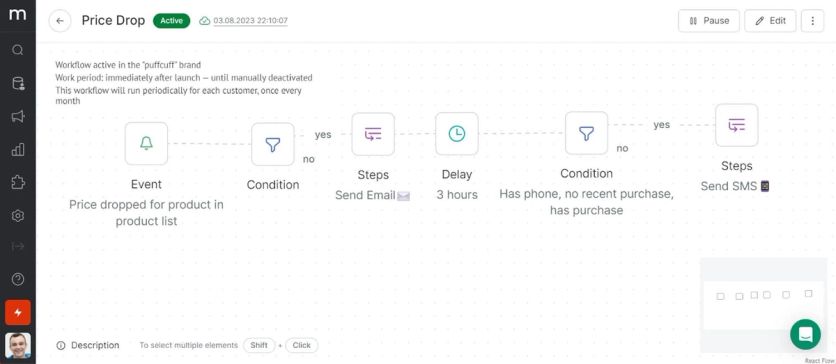
PuffCuff consolidated two Klaviyo accounts and Attentive into Maestra’s unified flow builder
How an Ecommerce CDP Makes Ad Spend More Efficient
An ecommerce CDP lets you fold online advertising into the same automation logic. If a customer doesn't respond to the abandoned cart email chain, the platform automatically syncs that segment to your ad account for retargeting. The same segment data powers lookalike audiences – so you can find new shoppers who resemble your best repeat customers. Layering ads on top of email and SMS helps increase reach, improve ad performance, and reduce costs.
PuffCuff used Maestra’s CDP to automatically create customer segments and export them to Facebook for lookalike audience targeting. By feeding the ad platform better data – segments based on actual purchase behavior, not just pixel events – they reduced cost per order by 43.76 % and saw a 63.9 % decrease in CPM. The result: the same ad budget now reaches more of the right people.
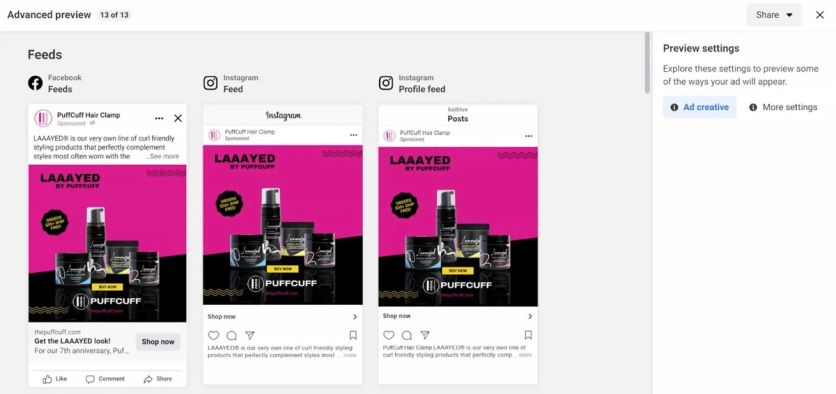
PuffCuff’s automated Facebook audience segments synced directly from Maestra’s CDP
How an Ecommerce CDP Personalizes Communications at Scale
An ecommerce CDP lets you tailor every communication to the customer's interests – making messages more useful and, as a result, more profitable. This boosts marketing effectiveness and helps grow both sales and customer LTV.
Dynamic Content That Updates Itself
A template engine automatically personalizes campaigns. The marketer creates a message template with dynamic blocks that swap content based on data from the unified CDP profile. For example, addressing the recipient by name, showing a different recommendation block depending on gender, or swapping promotional banners based on the current sale.
I Love Linen, an Australian linen brand, used Maestra’s dynamic content blocks to automate promotional updates across all email and SMS flows. Every time a promotion changes, the platform automatically updates banners, subject lines, and SMS text across every active flow – and reverts everything when the promotion ends. This saves the team 5 hours of manual work every week. As their Digital Marketing Manager put it: everything goes live without any manual work.
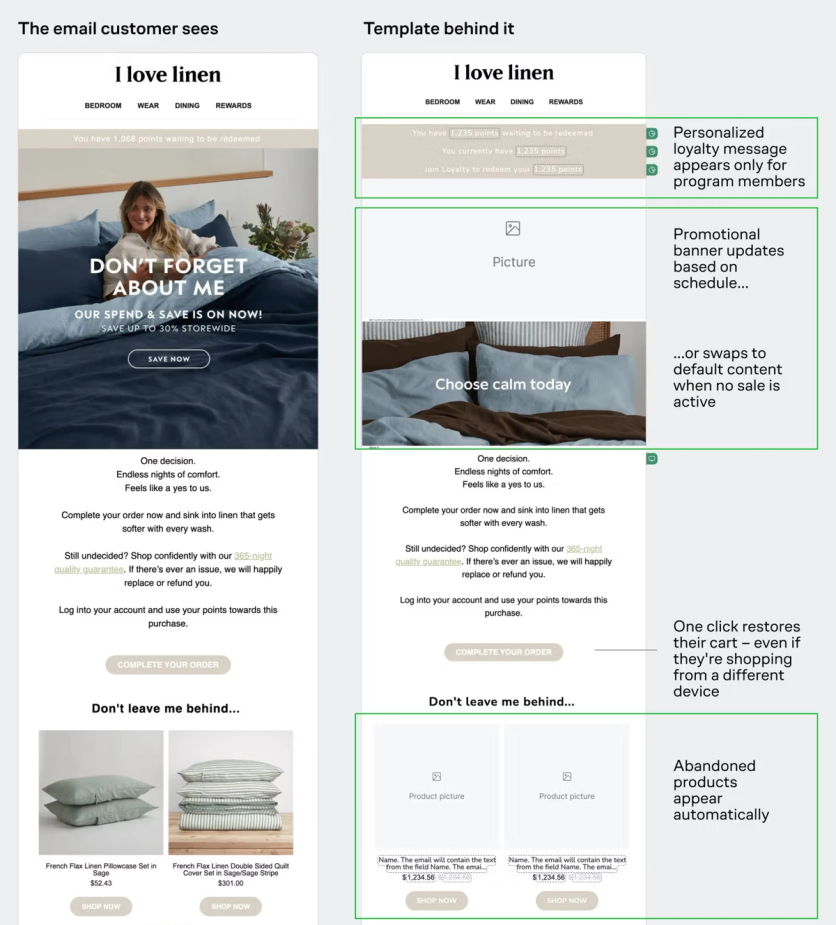
I Love Linen’s promotional content updates automatically across all flows when a new sale launches – and reverts when it ends
Product Recommendations Based on CDP Data
Analyzing customer behavior with platform data lets you create personalized recommendations and figure out the right moment to send a message. Data is analyzed using ML algorithms – machine learning models that spot patterns in browsing and purchase behavior.
The algorithms build selections of complementary and similar products, products from viewed categories, and bestsellers. These selections can be used in email campaigns, on the website, and in the app.
Enlightened Equipment achieved 15 % website conversion growth and an 8.7 % increase in average order value with Maestra’s AI-powered product recommendations. The platform analyzes browsing patterns and purchase history to surface the most relevant products across five touchpoints: the main page, product pages, the shopping cart, 404 error pages, and empty search results. As their Director of Marketing, Will Palumbo, noted: the ML algorithms understand product relationships – something their previous tools couldn’t do.
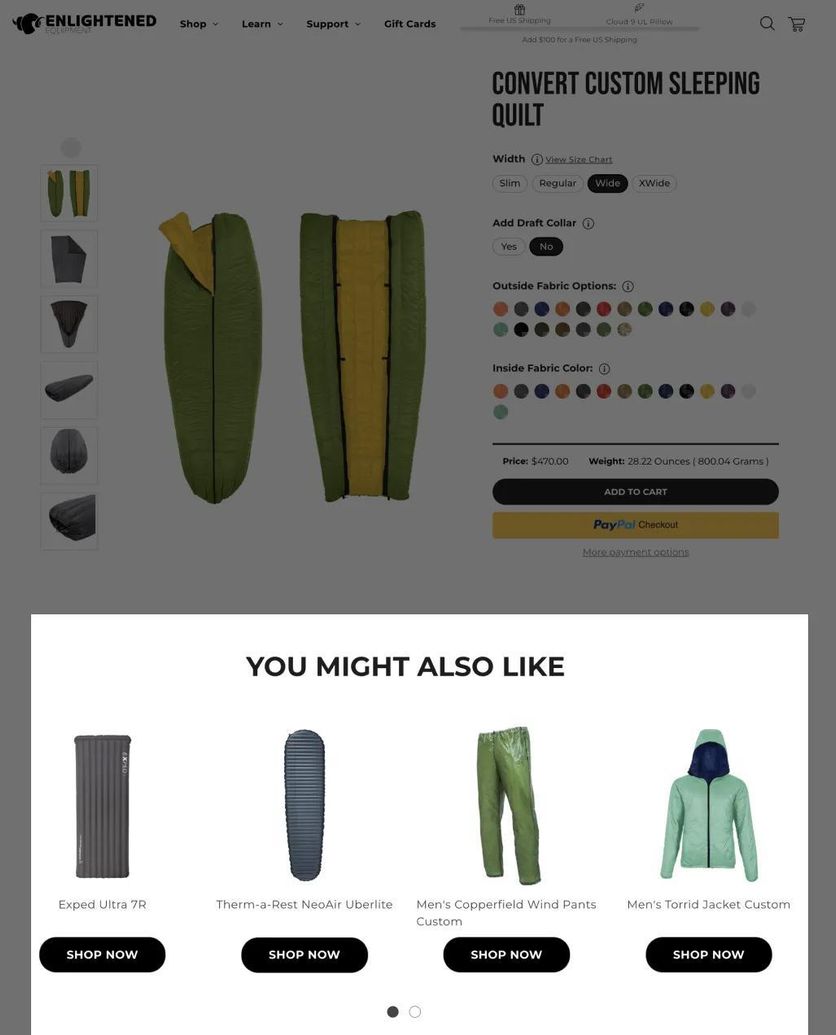
Enlightened Equipment’s product page recommendations – the ML algorithms surface complementary products based on browsing patterns and purchase history
How an Ecommerce CDP Enables Data-Driven Testing and Optimization
An ecommerce CDP lets you collect stats and analyze the customer journey as a whole, by individual channel, or by specific scenario branch. For example, for the omnichannel flow “push, email, SMS,” Maestra can generate a report on sales conversion for the entire flow, and separately for each channel.
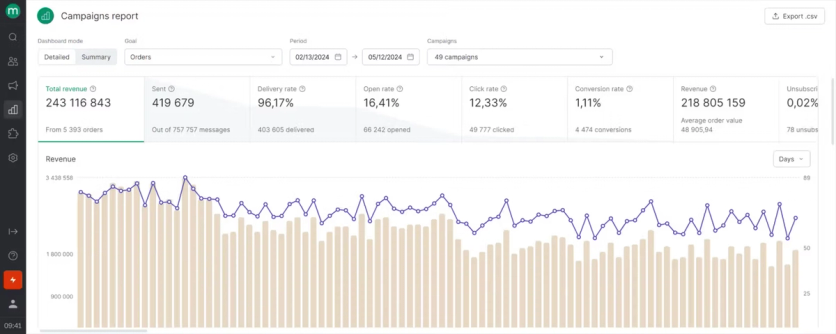
Maestra’s detailed campaigns report
Data analysis in the CDP helps pinpoint problem areas and form hypotheses about their causes. Those hypotheses are then tested with A/B tests. CDP-based automation lets you build A/B tests directly into your communication scenarios. This is used to test campaign variants, communication channels, and mechanics of individual or entire scenario branches.
Maestra also uses AI to analyze your data and suggest hypotheses for A/B testing and optimization – helping you spot opportunities that might not be obvious from dashboards alone.
FAQ
- A CDP (Customer Data Platform) is software that collects customer data from every channel – website, email, ads, in-store POS – and merges it into a single unified profile. Ecommerce brands use CDPs because they enable real personalization at scale: instead of sending the same email to everyone, you can automatically tailor messages, product recommendations, and ads to each customer's behavior and preferences. The result is higher conversion rates, better retention, and more efficient marketing spend.
- The main benefits are: Higher revenue from automation – Brands like Coolibar saw +33.6% email and SMS revenue growth after switching to a CDP with advanced automation. Better product discovery – Enlightened Equipment achieved 15% conversion growth with AI-powered product recommendations driven by CDP data. Lower marketing costs – Urban Armor Gear cut marketing software costs by 64% by consolidating fragmented tools into one CDP. Time savings – Selkirk Sport saved 15 hours per week on manual product curation with automated, AI-driven recommendations. Smarter ad spend – PuffCuff reduced cost per order on Facebook by 43.76% using CDP-powered audience segments.
- The highest-impact CDP use cases for ecommerce: Abandoned cart and browse recovery – multi-step flows triggered by shopper behavior. After moving to Maestra, Blossom Flower Delivery saw a 5x revenue boost from their abandonment journey. Back-in-stock and low stock alerts – notifications triggered by real-time inventory data. Selkirk Sport couldn't run these flows on Bloomreach; after switching to Maestra, the brand saw +55% email revenue and +149% SMS revenue. Personalized product recommendations – on Maestra, JOLYN influences 7% of sales through recommendations across 4,000 SKUs, with attribute-level matching by color, size, and material. Cascade campaigns – sending through email and push first, then SMS only if those don't convert. Level Up Basketball uses Maestra's multi-channel flows to sequence push notifications and emails through the trial-to-subscription journey, contributing to 4.5x revenue growth. Automated ad audiences – CDP segments synced to Meta and Google for retargeting and lookalikes. PuffCuff reduced cost per order on Facebook by 43.76% using Maestra's CDP-powered audience segments. Dynamic promotional content – automatically updating email and SMS templates when promotions change. I Love Linen saves 5 hours per week this way – when a new sale launches, Maestra updates banners, subject lines, and SMS text across every active flow.
- A CDP's core job is data – collecting it, unifying it, and making it actionable. The features that distinguish a real CDP from a marketing automation platform with a CDP label: unified customer profiles that deduplicate records across all channels into one record per customer, identity resolution that recognizes the same shopper across devices and sessions even before they log in, real-time segmentation that updates with every click and purchase, and first-party data ownership that gives you full control of your customer data. Maestra handles all of this natively and adds in-session segmentation – adjusting what a visitor sees during a single browsing session based on their real-time behavior. Crezu operates across 15 countries and 8 languages; Maestra's identity resolution links anonymous visitors to known customers across all markets, powering personalized flows that grew email revenue by 23%.
- For most ecommerce brands, CDP implementation means connecting your data sources (ecommerce platform, ad accounts, CRM), unifying customer profiles across channels and devices, configuring segmentation and automation rules, and validating data accuracy before scaling. Timeline depends on how many systems you are consolidating and how clean your existing data is – brands on Shopify or BigCommerce can be operational in a few weeks. Maestra assigns a dedicated Forward Deployed Marketer who manages the entire process. Sena had two separate Klaviyo accounts running different campaigns for the US and EU markets – Maestra consolidated all contacts, flows, templates, and segments into one unified system in two weeks, giving the team a single customer view across both regions.
- The pattern across published case studies is consistent: brands that unify their data and automate campaigns see measurable revenue growth with the same or smaller team. After activating CDP-driven automations – pop-ups, upsell bars, email and SMS flows, and product recommendations – Enlightened Equipment achieved +52.5% total revenue growth, all from one platform with zero additional ad spend. Magnum Bikes consolidated customer data from two separate Shopify stores into Maestra and saw +56.6% revenue growth with a lean team. The common thread: eliminating data silos and manual work compounds into revenue gains across every channel.