
7 Best All-in-One Marketing Platforms for Shopify Brands [2026]

Open the Apps column of a typical Shopify admin and count: an email app, an SMS app, a loyalty app, a reviews app, a popup builder, a quiz tool. Six subscriptions, six dashboards, and six versions of the same customer who somehow still gets a 20% welcome offer two years after her first order.
Consolidating that stack is harder than it should be, because the vendors themselves keep moving. Yotpo terminated its email and SMS product on December 31, 2025 (Yotpo), and Privy acquired two retention platforms – Emotive, then Sendlane – inside twelve months (PRWeb). Picking an all-in-one platform now means picking a vendor that will still be one company with one roadmap next year.
This guide compares seven platforms that run marketing for Shopify stores, from $16-a-month starters to six-figure enterprise contracts, on five questions: what each one replaces, how it bills, how deep its Shopify sync goes, who does the setup, and how stable the vendor is.
Quick Verdict on the Best All-in-One Marketing Platforms for Shopify
The best all-in-one marketing platforms for Shopify brands in 2026 are Maestra, Klaviyo, Omnisend, Drip, Sendlane, ActiveCampaign, and Bloomreach. For mid-size and enterprise stores, Maestra is the strongest pick: email, SMS, loyalty, and site personalization run on one real-time CDP, and a Forward Deployed Marketer migrates and runs the program.
Best for Shopify brands that want the safe choice: Klaviyo – self-serve email, SMS, and push that most Shopify agencies already know
Best for small stores on a budget: Omnisend – email, web push, and forms with prebuilt automations at entry-level prices
Best for small DTC brands focused on email: Drip – ecommerce email with dynamic segments and onsite popups, plus SMS for US brands
Best for big lists with modest send volume: Sendlane – unlimited contacts with pay-per-send pricing, now owned by Privy
Best for marketing automation with a sales CRM: ActiveCampaign – visual automations and a sales pipeline in one account
Best for enterprises with technical staff: Bloomreach – Loomi AI across 17+ channels plus ecommerce search, sold on annual contracts
Best All-in-One Marketing Platforms for Shopify at a Glance
| Platform | Best For | Key Differentiator | Starting Price |
|---|---|---|---|
| Maestra | Mid-size, enterprise, and rapidly scaling Shopify brands | Email, SMS, loyalty, and site personalization on one real-time CDP, with a dedicated Forward Deployed Marketer | From $2,000/mo (CDP + email; first 100K active profiles) |
| Klaviyo | Shopify brands that want the proven, safe choice | Proven on 117,000+ Shopify stores, with Shopify Markets and Locale Aware Catalogs support | Free plan available (up to 250 profiles); paid from $20/mo |
| Omnisend | Small Shopify stores watching every dollar | Email, web push, and forms in one workflow at entry-level prices | Free plan available (up to 250 contacts); Standard from $16/mo |
| Drip | Small DTC brands that want email done well | Behavior-based segments, onsite popups, and unlimited email up to 30,000 people, with SMS for US brands | From $39/mo (2,500 people) |
| Sendlane | Brands with big lists and modest send volumes | Unlimited contacts – you pay for sends, not stored profiles | From $100/mo (50,000 email sends) |
| ActiveCampaign | Teams that need marketing automation and a sales CRM together | Active Intelligence AI across email, SMS, and WhatsApp plus 1,000+ integrations | From $15/mo (1,000 contacts, annual billing) |
| Bloomreach | Enterprises with technical staff on call | Loomi AI across 17+ channels, with e-commerce search sold as a separate subscription | Custom pricing (email marketing from $22,500/yr) |
How to Choose an All-in-One Marketing Platform for Shopify
Five questions separate these platforms more than any feature grid.
1. What All-in-One Actually Includes
All seven sell consolidation, but the coverage differs. For some it means email plus SMS. For others it stretches to loyalty, popups, reviews, and site personalization. Start with your own stack:
Step 1. List your stack. Write down every channel and app you pay for today, from email and SMS to loyalty, reviews, popups, and quizzes. Add the ones you plan to launch next year.
Step 2. Check coverage. See which platform covers each one out of the box. A partner app that you still pay for and set up separately doesn’t count.
Step 3. Compare tool by tool. Put each specialist tool you’d retire next to the platform’s built-in version and test both on the jobs you run today. You may be surprised how easy the best-in-breed app is to replace.
Urban Armor Gear replaced Klaviyo, Yotpo Loyalty, and Frosmo with Maestra. As Nick Salisbury, the brand’s E-commerce Director, put it, “Each tool we replaced now works better than before.”
2. The Pricing Model Behind the Sticker Price
Per-contact pricing punishes list growth: once active profiles pass the plan limit, Klaviyo moves the plan up a tier automatically, and that upgrade can’t be switched off (Klaviyo Help Center). Omnisend bills on all billable contacts, subscribers or not, which is how a merchant ends up writing in April that Omnisend would “charge $550 a month even when they don’t send any mails.” Sendlane flips the model and charges per send; Maestra bills on profiles but doesn’t charge for storage, so inactive profiles cost nothing. Model your real list a year out before comparing prices.
G-Plans, a nutrition brand, saw the bill shrink after moving off Klaviyo. Jon Powell, its Head of Experimentation and Conversion Rate Optimization, explained why: “Maestra offers more flexible pricing – unlike Klaviyo, which gets expensive with our 7 million customers.”
3. Depth of the Shopify Sync
The gap hides in the details. ActiveCampaign’s abandoned-cart sync only captures shoppers who reach the shipping step of checkout, so earlier cart abandonment never enters the system, and browsing shows up only as page visits of known contacts (ActiveCampaign Help Center). Omnisend’s tracking silently fails if the app embed isn’t enabled in the theme (Omnisend Help Center). Commerce-native platforms sync browsing, cart, checkout, and order data in real time; generalists sync what their connector allows.
JOLYN, a Shopify swimwear brand, couldn’t run Price Drop Alerts or Low Stock Notifications on Klaviyo because the platform didn’t capture enough customer signals. In the words of Jennifer Fenton, its Sr. Director of Marketing, “Maestra captures everything natively – so we can finally run advanced flows that simply were impossible before.”
4. Self-Serve or Managed Service
Klaviyo, Omnisend, and Drip are built for teams that run the platform themselves: migration help and onboarding are scoped or tied to bigger plans, and ongoing build work stays with your team or an agency. Sendlane adds a dedicated success manager from 800,000 emails a month, and Maestra assigns a named marketer who does strategy and setup work on every plan. If you don’t have a dedicated retention marketer on staff, the service model matters more than any feature below.
At Furniture Fair, Maestra’s team completed the Shopify integration, migrated every existing campaign, and launched improved flows within three months. Kyle Cannon, its Digital Marketing Manager, describes the day-to-day: “With two dedicated Maestra marketers who communicate with me daily via Slack, we move at a pace I haven’t seen anywhere else.”
5. Vendor Stability
A platform you commit your customer data to should be core business, funded, and shipping. Yotpo announced its exit mid-quarter and gave merchants until December 31 to move, and Sendlane’s reviews on the Shopify App Store and Trustpilot had stopped months before its acquisition. Check the date of a vendor’s last product release – and of its last happy review.
Svaha USA had to rebuild its email and SMS program mid-Q3, when Yotpo announced it was shutting those products down, right before peak season. By Black Friday, all its communications ran on Maestra. Nikki Brown, its Marketing & Operations Director, remembers the timeline: “Our Maestra marketer helped us migrate under a crazy deadline, and the service hasn’t dropped since.”
1. Maestra – Best for Mid-Size, Enterprise, and Rapidly Scaling Shopify Brands
Starting price: From $2,000/mo (CDP + unlimited email; first 100,000 active profiles)
G2 rating: 4.8
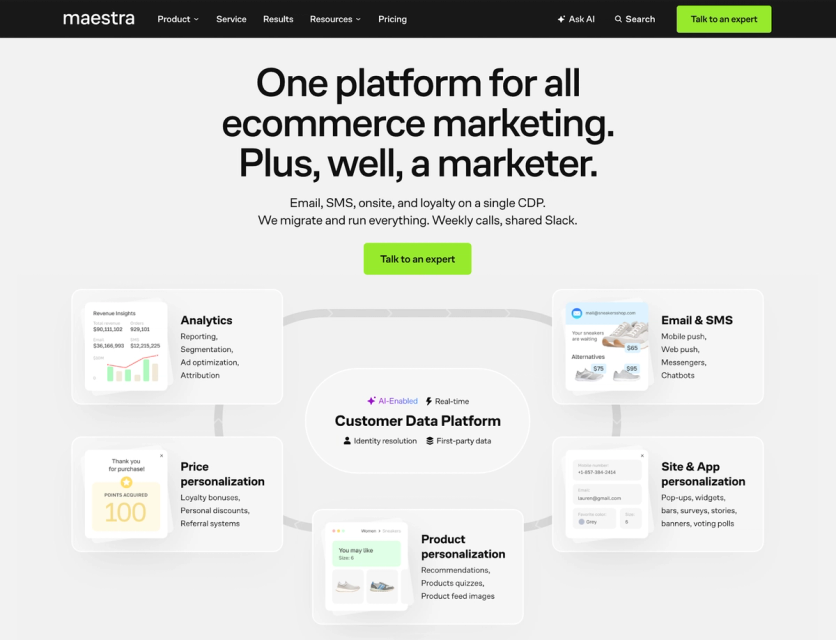
Maestra runs email, SMS, loyalty, promotions, and site personalization on one real-time customer profile fed by Shopify data. Every account also gets a Forward Deployed Marketer who migrates and runs the program.
The one-profile architecture is the point: the loyalty program knows what the last email offered, the popup knows what’s in the cart, and no channel discounts a customer who was about to pay full price.
Key Features
Omnichannel Journey Builder
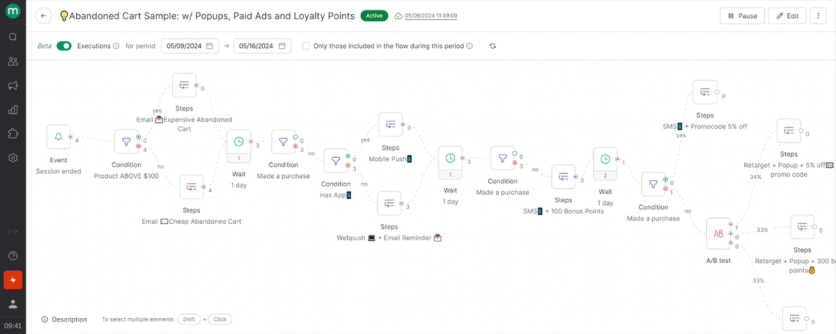
Flows orchestrate email, SMS, push, and messengers alongside loyalty rewards, promotions, and on-site offers, with real-time branching and A/B testing. One journey can send an email, follow with an SMS for non-openers, and stop itself the moment the customer converts on-site.
Real-Time CDP
Maestra’s built-in customer data platform connects to Shopify with ready-to-use integration, auto-cleans and deduplicates records, and tracks the full journey – sessions, searches, categories, carts, and checkouts. Segments update in real time and are instantly usable in every channel.
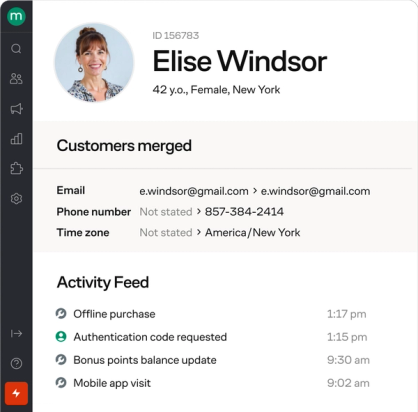
Two records for the same shopper merged into one Maestra profile, filling in the missing phone and time zone, with offline purchases, app visits, and point updates in one feed
Site and App Personalization
Pop-ups, quizzes, surveys, and real-time offers run from the same segments as email and SMS – zero code required. Because on-site tools see the whole profile, a returning VIP and a first-time visitor get different experiences out of the box.
Nat’v Basics moved its pop-ups from Alia to Maestra, and the brand’s Maestra marketer started testing the welcome offer. A flat $15 off converted 24% better than the old 12% discount, and a second test showed $10 off converts just as well for a third less in discount cost.
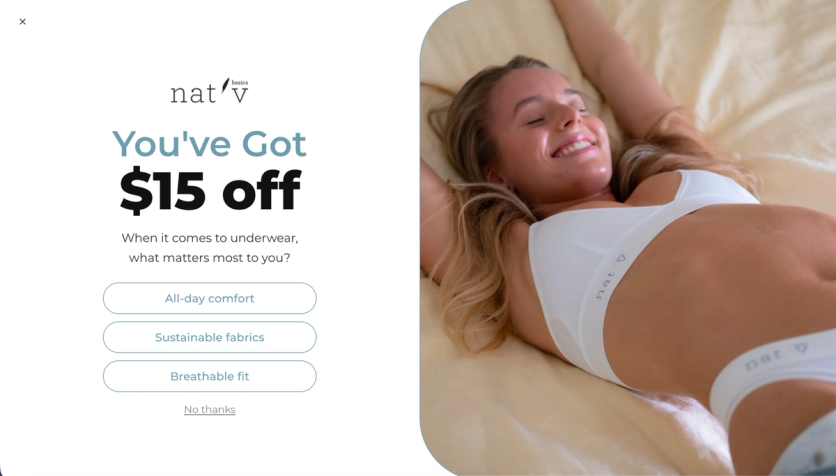
Nat’v Basics’ welcome pop-up with a flat $15 off, the offer that beat a 12% discount by 24% in pop-up conversion
Product Recommendations on 14 AI Algorithms
Fourteen recommendation algorithms personalize the storefront, emails, and messages. Svaha USA used them with color swatches shoppers can flip through right inside the recommendation block.
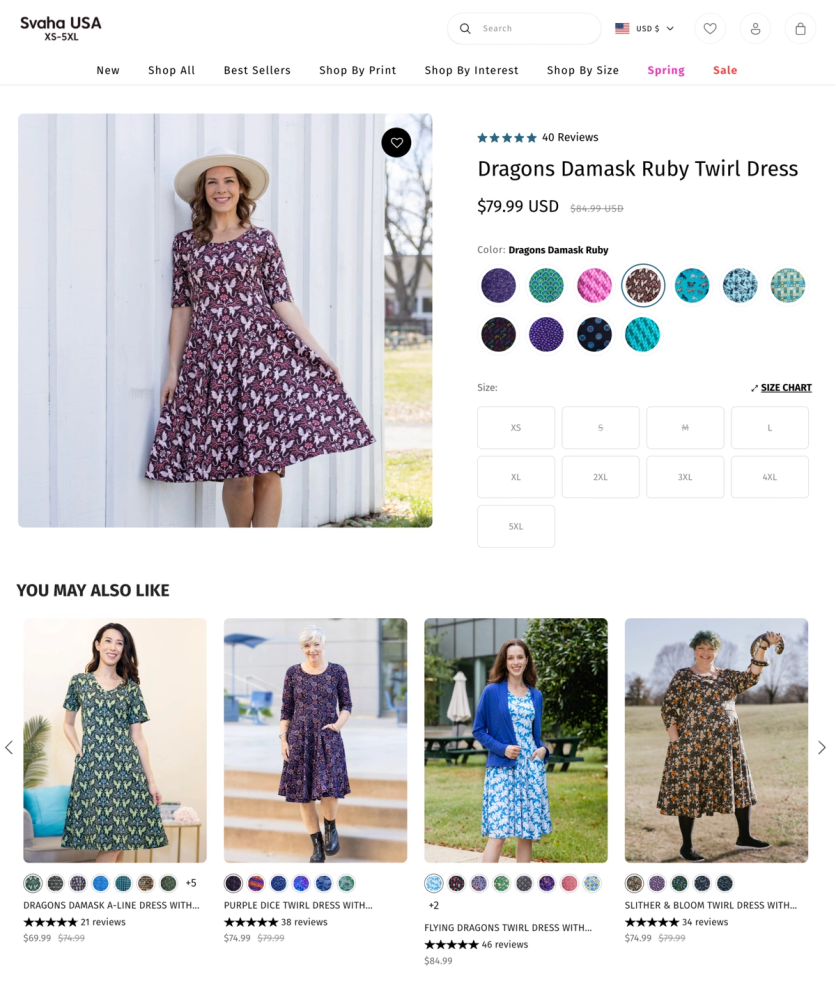
Svaha USA’s recommendation block, with each dress’s color variants grouped into swatches so every slot shows a different product
Built-In Loyalty, Promo, and Referrals
Points, tiers, referral programs, promo codes, and gift cards are part of the platform, not a third-party app. A flow can grant bonus points and an email can show a live point balance without a single integration to maintain.
Svaha USA moved its loyalty program from Yotpo to Maestra, and loyalty tickets dropped out of its customer service queue. Points now land on every review and purchase, shoppers redeem rewards with one tap at checkout, and an adaptive email block shows members their tier and balance while inviting everyone else to join.
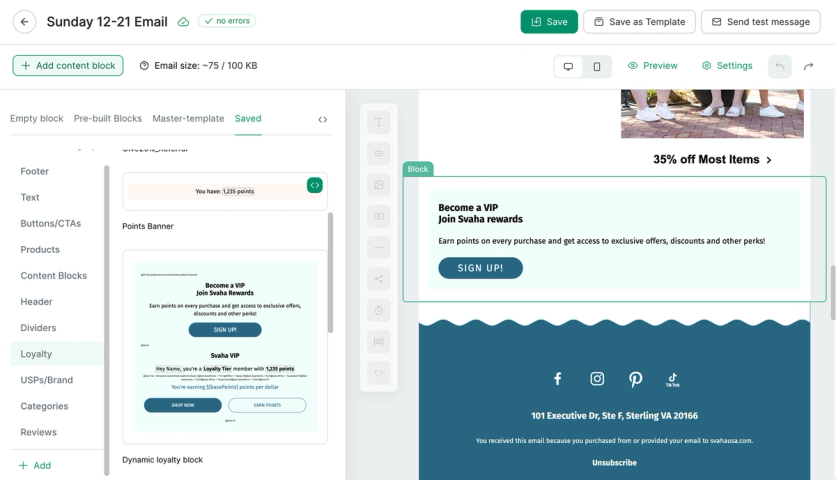
Svaha USA’s saved loyalty blocks in Maestra’s email builder, where members see their tier and points balance and non-members get a sign-up invite
Maestra Support
Every Maestra plan includes a Forward Deployed Marketer, a Maestra marketer who both sets the strategy and does the hands-on work. That person migrates your automations, campaigns, and templates, builds flows, segments, email templates, and on-site experiences, and keeps A/B testing them after launch.
Each marketer handles fewer than 15 accounts. The working rhythm is a weekly call plus a shared Slack channel, and live chat inside the platform typically answers within five minutes. Technical issues go to a separate support team.
No service tier or annual contract is needed to get the marketer. Billing is month-to-month, and migration and implementation come without setup or onboarding fees.
For Coolibar’s CRM Lead, Nikita Zabrodin, the migration from Klaviyo came down to three tasks: “provide access, answer a few questions about the database, and help with domain warming.”
Maestra Pricing
On Maestra’s pricing page, the most common package costs $2,000/month: the customer data platform with unlimited email, covering the first 100,000 active profiles. Each active profile beyond that adds $0.013 a month.
Anonymous and inactive profiles are never billed, and the profile count is a rolling 12-month average, so a Black Friday spike doesn’t set the price for the year. Other channels, such as SMS, onsite personalization, and loyalty, come as monthly modules you add only when you need them.
Where Maestra Wins
Stack consolidation. Svaha USA moved email, SMS, loyalty, and recommendations onto Maestra and grew total sales 26% year-over-year, with average order value up 14%. Urban Armor Gear’s marketing stack costs 64% less, about $100,000 a year, since three tools moved onto one platform.
Multi-store brands. Sena runs its US and EU Shopify stores on one Maestra account and grew campaign-driven revenue 8.6x year-over-year after leaving separate Klaviyo accounts behind.
A marketer on every plan. Strategy and hands-on builds come from a named marketer, so the work gets done without hiring a separate agency.
Where Maestra Falls Short
No free or self-serve plan. Stores under roughly 100,000 profiles will struggle to justify the entry price against $16-a-month tools, unless the subscription visibly retires several apps at once.
No reviews or helpdesk. Maestra doesn’t sell standalone reviews or helpdesk modules, so brands that want those will still keep a reviews app.
When to Switch to Maestra
Four scenarios repeat across published case studies:
- Your Apps column is a budget line. Urban Armor Gear saved about $100,000 a year consolidating three tools into one.
- You’ve outgrown self-serve. JOLYN switched from Klaviyo and grew campaign-driven revenue 26% and SMS revenue 52%, crediting dynamic recommendations and flows it couldn’t run before.
- Your enterprise platform needs a consultant for everything. Selkirk Sport moved off Bloomreach and grew email-attributed revenue 55% and SMS-attributed revenue 149% in its first year.
- You run multiple storefronts. Sena unified two regional Shopify stores and grew total revenue 2.2x year-over-year.
2. Klaviyo – Best for Shopify Brands That Want the Safe Choice
Starting price: Free plan available (up to 250 profiles); paid from $20/mo
G2 rating: 4.6
Klaviyo is the biggest name in Shopify marketing: over 117,000 Shopify stores run on it.
It’s the platform every Shopify agency already knows, and it’s priced like it.
Klaviyo also sells customer service tools alongside marketing.
Key Features
Klaviyo Marketing
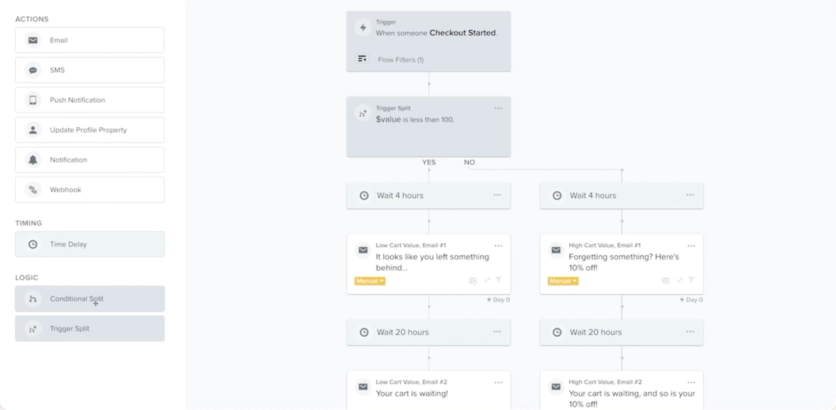
Klaviyo runs campaigns and flows across email, SMS, MMS, WhatsApp, RCS, and mobile push from one account, starting from 60+ prebuilt flows for Shopify stores. A/B tests send the winning version automatically on any paid plan. The catch is the messaging bill: SMS, WhatsApp, and RCS draw on a prepaid monthly dollar plan, and unused dollars don’t roll over (Klaviyo Help Center).
Klaviyo Data Platform
Every account keeps one profile per shopper with real-time segments. Once a store has enough order history, each profile also shows a predicted lifetime value, churn risk, and expected next order date, which is what a win-back or VIP flow needs to target the right people. RFM reports and custom lifetime-value windows come with Advanced KDP or the Marketing Analytics add-on, and warehouse sync needs Advanced KDP, which starts at $500/mo and is billed on total profiles, suppressed ones included (Klaviyo pricing).
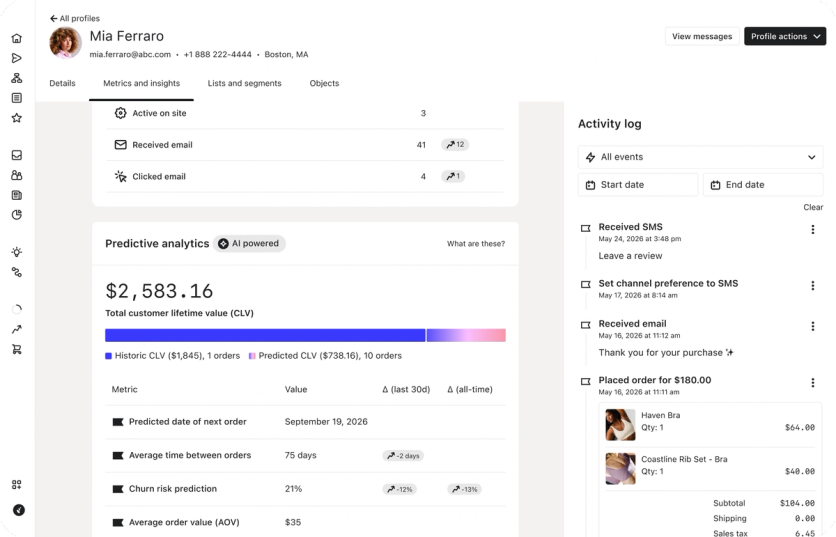
A Klaviyo profile with predicted lifetime value, next order date, and a 21% churn risk, shown once a store has enough order history
Klaviyo AI
Composer, Klaviyo’s AI agent, drafts campaigns, flows, and segments from a plain-language request and audits existing flows and forms, and nothing goes live without approval. It’s still in beta and metered: the free tier covers $5 of work a month, and more costs $20/mo plus $10 per 1,000 extra credits (Klaviyo Help Center). A separate Customer Agent answers shoppers in chat, email, SMS, and WhatsApp and is billed per resolved conversation.
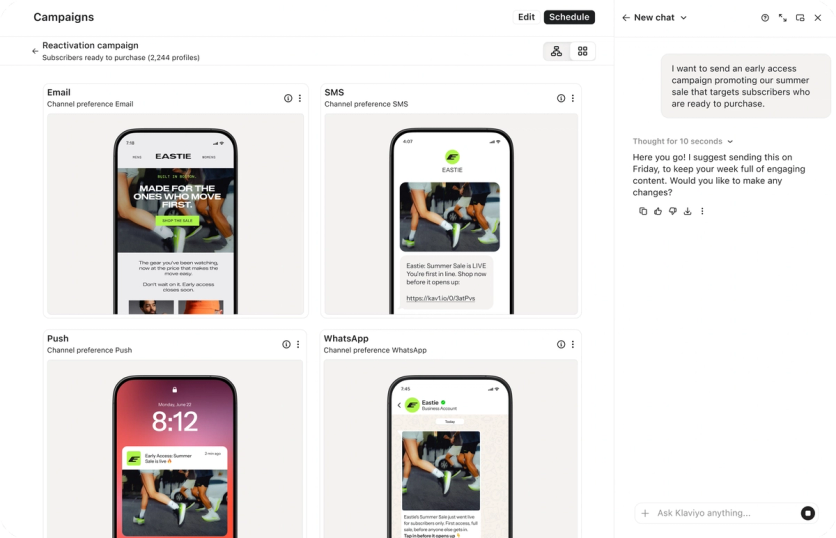
Klaviyo’s Composer building an early-access campaign for email, SMS, push, and WhatsApp from a single chat request
Klaviyo Service
Customer Hub replaces the Shopify account pages with a drawer where shoppers track orders, start returns, reorder, and see their loyalty points and favorites, so routine order questions get answered without a ticket. Helpdesk completes the service side. Both are paid add-ons: Customer Hub starts at $20/mo for up to 10,000 active profiles, and Helpdesk is billed per ticket (Klaviyo pricing).
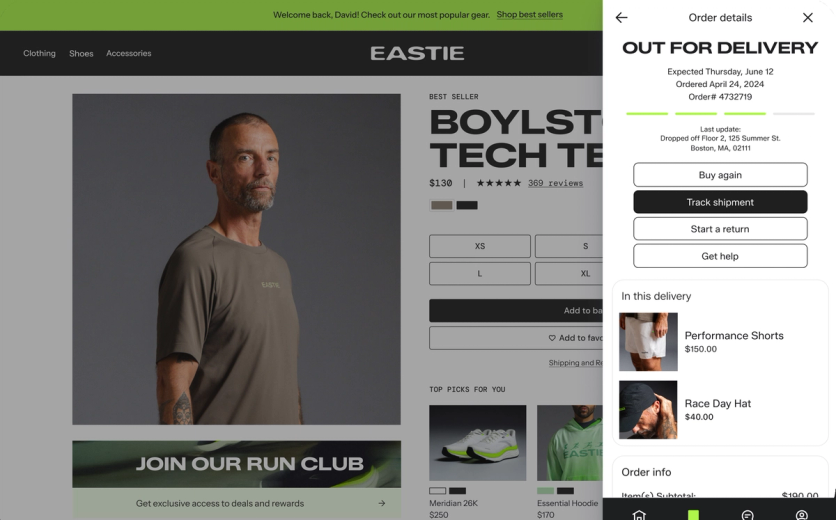
Klaviyo’s Customer Hub, where shoppers track a delivery, start a return, or buy again without contacting support
Shopify Markets Support
The Shopify integration syncs each market’s translated product content, local prices and currency, and market-specific URLs. One email template can then show every shopper their own language and price, and products not sold in a country stay out of its recommendations. It connects to one Klaviyo account per Shopify store, skips B2B and Retail markets, and translating the email copy itself needs a paid plan.
Klaviyo Support
Paid Klaviyo plans include 24/7 email support, with response targets of 4 to 48 hours counted in local business hours, plus weekday live chat that starts with an AI assistant. The free plan gets email support for its first 60 days.
Faster responses and weekend chat cost extra: the Professional support package starts at $500/mo and Enterprise at $1,800/mo (Klaviyo pricing). A named Customer Success Manager is reserved for the highest-tier plans. Migration is self-serve, and hands-on builds go to Klaviyo’s paid professional services or to its 6,000+ agency partners.
Klaviyo Pricing
Free plan available (up to 250 profiles, 500 email sends/mo). Paid email starts at $20/mo for up to 500 profiles and climbs with list size – roughly $100/mo at 5,000 profiles, $720/mo at 50,000, and $1,380/mo at 100,000, with SMS, MMS, WhatsApp, and RCS billed on top through a prepaid monthly plan in dollars. Two billing rules deserve attention: Klaviyo bills on all stored active profiles, including ones you never message, and plan auto-upgrades triggered by list growth can’t be disabled (Klaviyo Help Center).
Where Klaviyo Wins
The safe Shopify choice. Klaviyo’s integration runs on a six-figure install base, and most Shopify agencies already know how to build on it. Out of the box it covers what a typical store needs: two-way sync, onsite tracking, back-in-stock alerts, and Shopify Markets localization. For brands selling across regions, Locale Aware Catalogs show each market its own product titles, prices, and links.
A low-cost way to start. Klaviyo has a free plan, paid email from $20/mo, sign-up forms that work before a brand pays anything, and 60+ prebuilt flows for welcome, abandoned cart, and win-back; on the new Klaviyo Starter app for Shopify, the free plan runs three automations and one sign-up form at a time. A small team can switch those on quickly and see whether retention marketing pays off before building anything bigger.
Where Klaviyo Falls Short
Billing complaints. Klaviyo’s Trustpilot score sits at 1.6. Support draws the most complaints in recent reviews, and billing comes second: one reviewer wrote in April that “they bill based on outdated list sizes so even after you clean your list, you’re forced to overpay.”
Support at scale. Larger accounts complain about support too: “we pay $4k a month and only have access to AI chatbots who take you around in circles,” a customer reported in May. Cancellation and downgrade friction round out the pattern.
Compared to Maestra
Klaviyo is self-serve breadth; Maestra is managed depth. Klaviyo hands a growing brand more products to configure – CRM, Service, AI agents – while the bill climbs with every marketable profile, messaged or not. Maestra bundles the equivalent marketing scope with built-in loyalty and a Forward Deployed Marketer who does the configuring. The published switches are one-directional so far: JOLYN grew SMS revenue 52% after leaving Klaviyo, and Magnum Bikes doubled its online orders after the same move.
3. Omnisend – Best for Small Shopify Stores on a Budget
Starting price: Free plan available (up to 250 contacts); Standard from $16/mo
G2 rating: 4.6
Omnisend is the budget-friendly consolidator: email, web push, forms, and reporting in one app.
It’s a sensible starter kit while your SMS plans and your list stay small.
Key Features
Automations
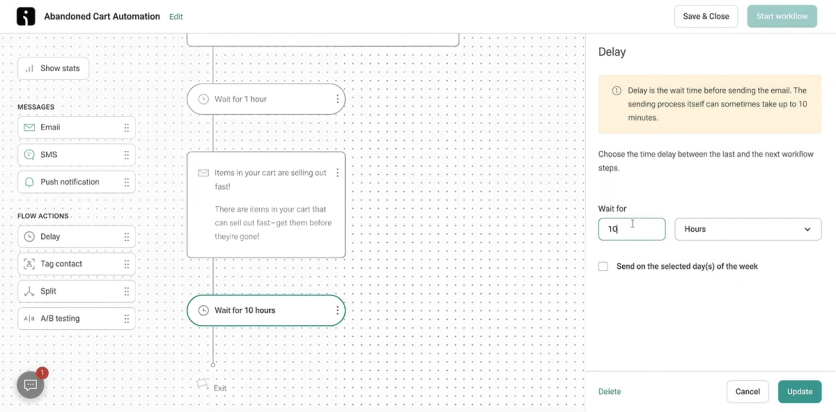
Email and push run in the same workflow on every plan, including Free, and prebuilt e-commerce workflows cover welcome, abandoned cart, and browse abandonment. Adding SMS to a workflow takes the Pro plan plus a separate SMS credits subscription.
Email Campaigns
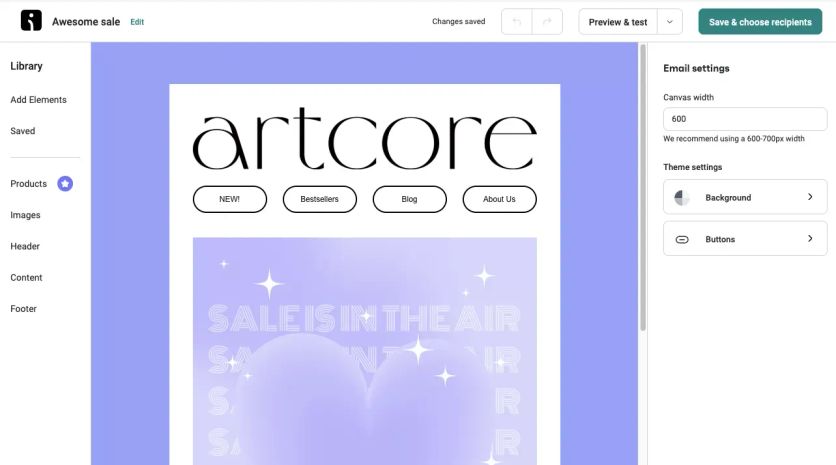
The drag-and-drop editor and AI help with subject lines and copy come on every plan, and brands can upload their own fonts, though Gmail falls back to Arial and Outlook for Windows to Times New Roman. Every plan also gets a basic product recommender for best sellers and new arrivals; personalized recommendations, dynamic content, and personalized send times are Pro features that Standard users can add from $5/mo each (Omnisend pricing).
AI Segment Builder
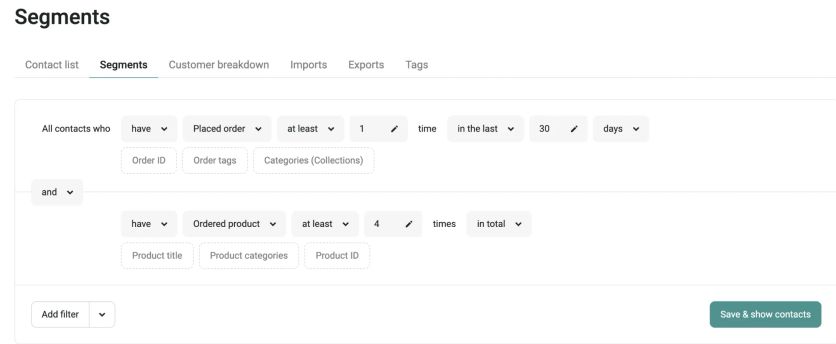
Describe an audience in plain words and the AI writes the segment rules, asking follow-up questions when the request is vague; the rules stay editable. It’s on every plan, Free included, and a separate customer breakdown groups shoppers by recency, frequency, and spend and flags those likely to churn.
Forms AI
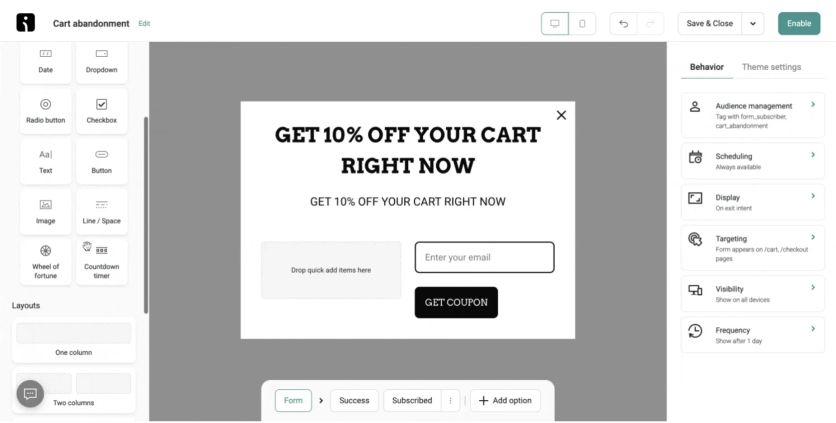
Describe a popup and Forms AI builds the layout, copy, and branding in under two minutes, then offers a few versions to pick from; it also sets targeting and scheduling and builds spin-to-win and back-in-stock forms. Forms themselves, A/B tests included, are on every plan, but the AI builder needs Standard or Pro, and Free forms carry Omnisend branding.
Reports
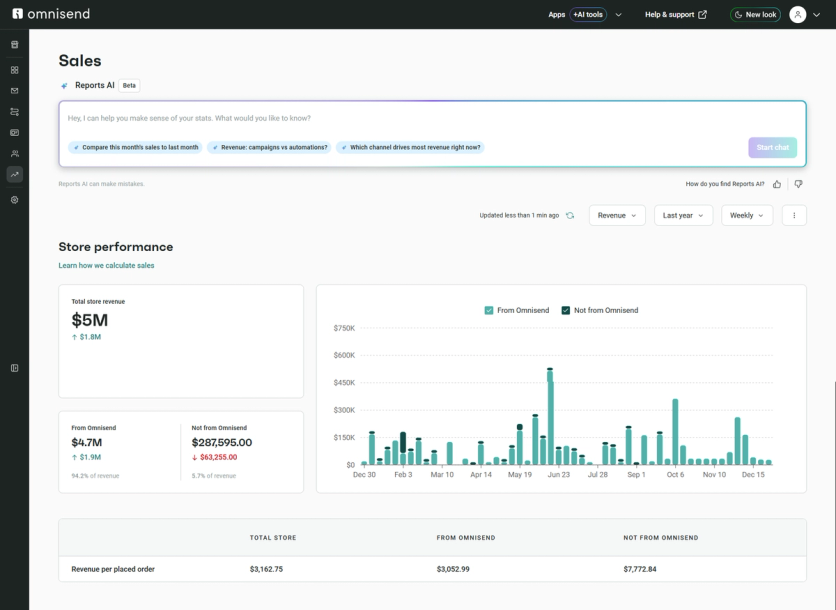
Every plan shows revenue by channel and by campaigns versus automations, plus form, product, and deliverability reports. Reports AI, which answers questions about the numbers in plain language, comes with Standard and Pro, and trend breakdowns and campaign sales by segment are Pro-only.
Omnisend Support
Omnisend offers 24/7 live chat and email on every plan, the free one included. An AI assistant answers first, and a human takes over on request.
Stores with more than 250 contacts get a free migration: brands leaving Klaviyo get every live workflow, their segments, and up to five forms moved over, while other platforms are capped at four workflows, five segments, and three forms. Once a plan costs $400/mo or more, a dedicated Account Expert comes at no extra charge (Omnisend pricing). Anything beyond that is do-it-yourself or paid work through Omnisend’s partner directory.
Omnisend Pricing
Free plan available (up to 250 reachable contacts, 500 emails/mo). Standard from $16/mo at 500 contacts with email credits capped at 12x your contact count; Pro from $59/mo with unlimited emails. The fine print matters: bills auto-adjust on all billable contacts, and SMS comes only with Pro, sold as a separate credits subscription at $0.007–$0.009 per US message, depending on monthly spend (Omnisend Help Center).
Where Omnisend Wins
Entry-level value. $16/mo covers email, push, forms, and automation that competitors gate behind higher tiers, and from 2,500 contacts the Pro plan costs about what Klaviyo’s email plan does while sending unlimited email instead of Klaviyo’s cap of 10 sends per profile.
Where Omnisend Falls Short
Support strain. A merchant reported in April that support “copied and pasted all the info for me to try and figure it out myself.”
Contact-based billing. Bills grow with the list: one store found Omnisend “charging us 10K more contacts then Klaviyo was”, and SMS requires the Pro plan.
Compared to Maestra
They solve different problems. Omnisend keeps a sub-10,000-contact store’s marketing affordable and simple; Maestra replaces the entire stack for brands doing serious volume. There’s no loyalty program, no site personalization, and no real-time CDP in Omnisend – the exact layers where Svaha USA found its 26% total sales growth after consolidating on Maestra. Grow past Omnisend’s sweet spot and the platform you graduate to looks like this comparison’s first entry.
4. Drip – Best for Small DTC Brands Focused on Email
Starting price: From $39/mo (2,500 people)
G2 rating: 4.4
Drip is built around e-commerce email: segments that update from shopping behavior, prebuilt workflows, and onsite popups to grow the list. US brands can also send SMS and MMS.
It suits a small store whose marketing runs mostly through email and doesn’t need loyalty or site personalization.
Key Features
The visual builder works from Drip templates, saved blocks shared across emails, and conditional content. Plans up to 30,000 people send unlimited email, larger plans cap monthly sends at 12 times the list, and the free trial has daily send limits. Fonts are limited to Google Fonts.
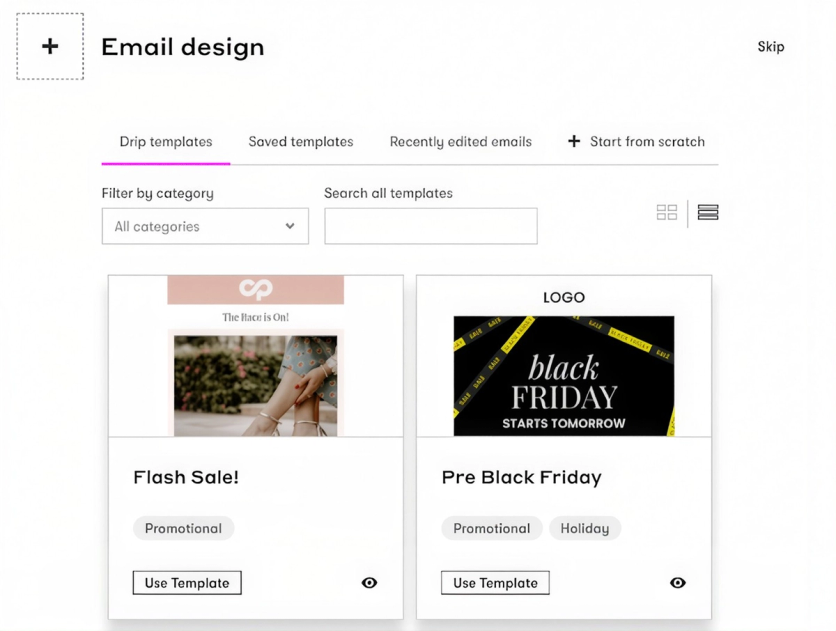
Drip’s template gallery, filterable by category, with ready designs for promotions like a flash sale or a Black Friday teaser
SMS
US brands can send SMS and MMS campaigns from Drip and add texts to workflows, with SMS results in their own report. Switching it on takes a setup form, a compliance review, and carrier registration (Drip Help Center), and SMS is billed on separate monthly tiers by opted-in subscribers and message volume.
Segmentation
Segments update in real time from products viewed, orders, spend, tags, and email engagement, so a shopper who buys a second time drops out of the one-time-buyer segment without anyone touching it.
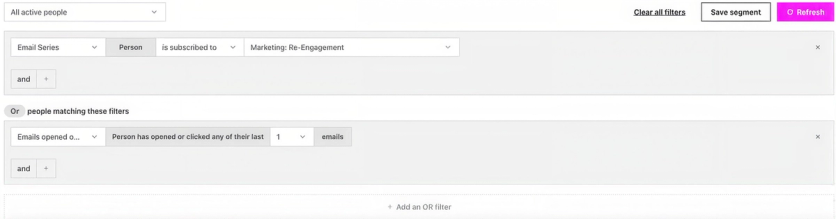
Drip segment rules that combine a list subscription with recent email engagement through AND and OR conditions
Automation
Accounts can run up to 50 active workflows, built from 20+ e-commerce templates for welcome, abandoned cart, post-purchase, and win-back, and a workflow can start on a Shopify event such as an add to cart. Whether 50 is enough depends on how the program is organized: brands that split flows by market, product line, or customer stage can outgrow it.
Onsite
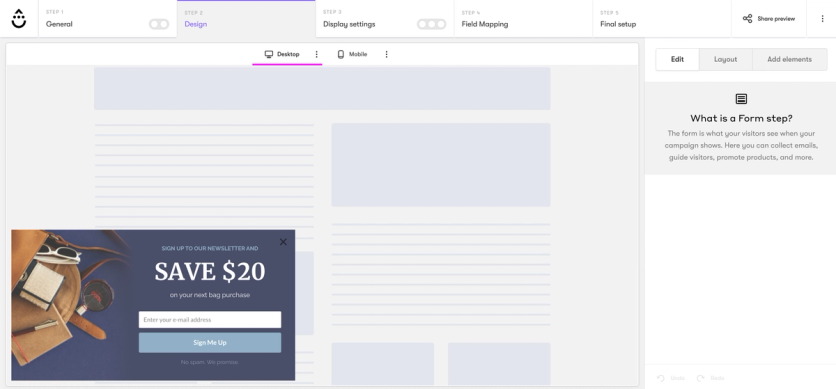
Popups come with a no-code editor on every plan, with no cap on popups or sessions. Embedded forms are plain HTML that picks up the site’s own CSS, while popups rely on the editor plus a custom-code block.
Drip Support
Drip’s paid plans all get email support on weekdays. Live chat starts on plans from $99/mo, which kick in above 5,000 people (Drip pricing).
From about 17,500 people ($249–289/mo), Drip runs a free migration and a 90-day onboarding with four one-hour Success Manager sessions; smaller stores migrate on their own with Drip’s help-center guides.
Drip Pricing
From $39/mo for up to 2,500 people, scaling to $154/mo at 10,000 and $699/mo at 50,000. Email is unlimited up to 30,000 people; the $699 plan includes 600,000 sends a month. Every feature ships on every tier, and there’s a 14-day trial. SMS is billed separately on its own monthly tiers and opens to US brands only after a compliance review.
Where Drip Wins
No feature tiers. Every plan gets every feature, including unlimited popups with no session caps, so a growing store never upgrades just to get segmentation or onsite forms.
Polished email for the price. The segmentation-to-email pipeline is polished for the price, and lists up to 30,000 people send unlimited email.
Where Drip Falls Short
Narrow scope. It’s the least all-in-one platform here: no loyalty, reviews, or push, and SMS only for US brands that pass Drip’s compliance review.
Limited reporting. Reporting is the top product complaint: “the custom reporting options are quite restricted,” a reviewer noted in May. Some basics still route through support: “can’t reactivate customers without going through support,” another wrote the same month.
A small vendor. Drip has about 150 employees and ships new features at a modest pace, a smaller bet than most names on this list.
Compared to Maestra
A small store running email and popups will be well served at $39. A brand that also needs loyalty, site personalization, SMS outside the US, and a team to help run it all is shopping in a different category. If Drip’s feature list covers your roadmap for the next two years, buy Drip; if you’re already juggling apps around it, consolidate once instead of twice.
5. Sendlane – Best for Big Lists with Modest Send Volume
Starting price: From $100/mo (50,000 email sends), unlimited contacts
G2 rating: 4.7
Sendlane bundles email, SMS, reviews, and forms with a pricing model nobody else here offers: unlimited contacts, pay only for sends.
Privy acquired Sendlane in early 2026 – its second retention-marketing acquisition in a year after Emotive (Sendlane press release). The product operates normally, but the roadmap now belongs to Privy.
Key Features
Email Marketing
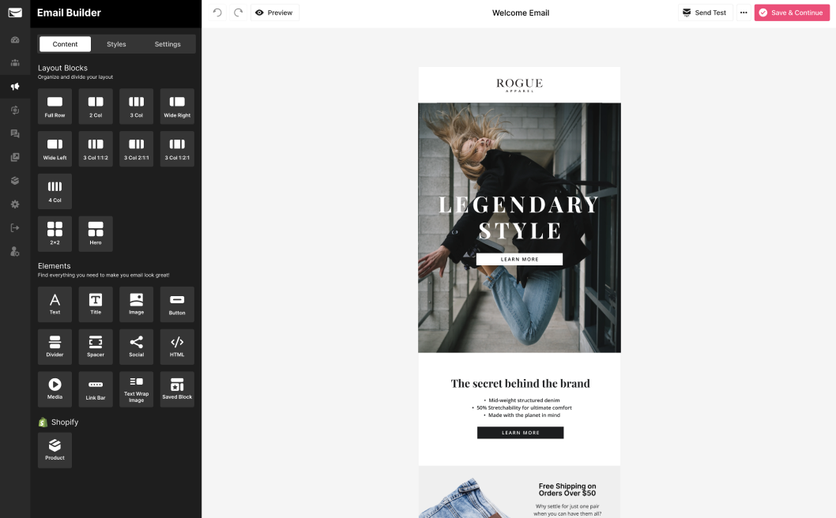
Sendlane’s drag-and-drop builder drops Shopify products straight into an email, picked by hand or filled automatically with best sellers, abandoned-cart items, or recently viewed products. Campaign tests compare up to four versions of the subject line, preheader, or content, and the winner goes out on clicks, opens, or revenue.
SMS Marketing
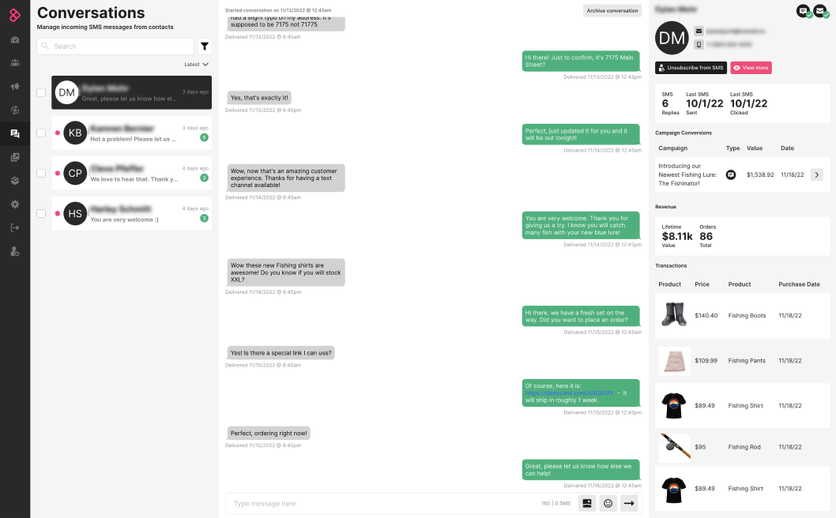
Two-way SMS runs from one inbox, and texts can sit inside automations, including browse and cart reminders that show the product the shopper left behind. The business needs a registered US address, messages reach the US and Canada, and getting a number approved can take up to four weeks.
Deep-Data Integrations
A one-click Shopify connection pulls purchase, category, and spend data into segments built from 100+ real-time data points, including customer lifetime value.
Sendlane Beacon
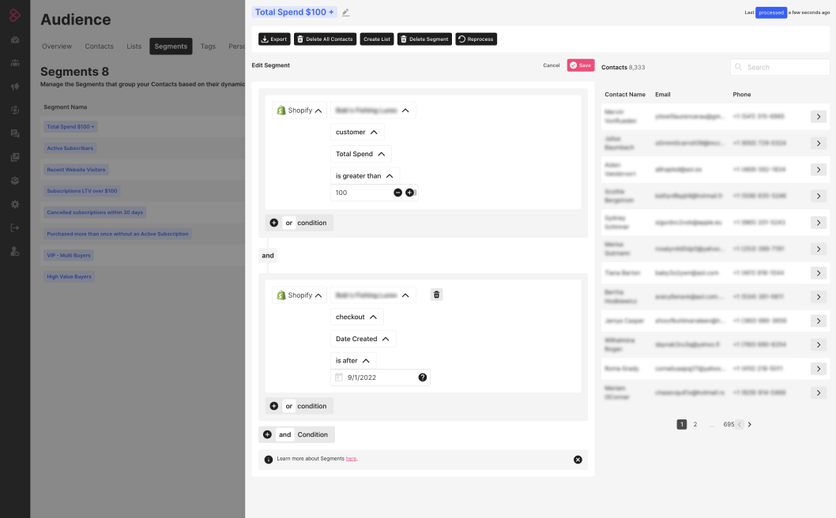
Beacon tracks page views and add-to-cart events and feeds them into segments and automations. It only sees visitors after they sign up through a Sendlane form or click a Sendlane email, and on a standard Shopify theme it’s switched on by hand through the Sendlane Event Tracking app embed.
Sendlane Support
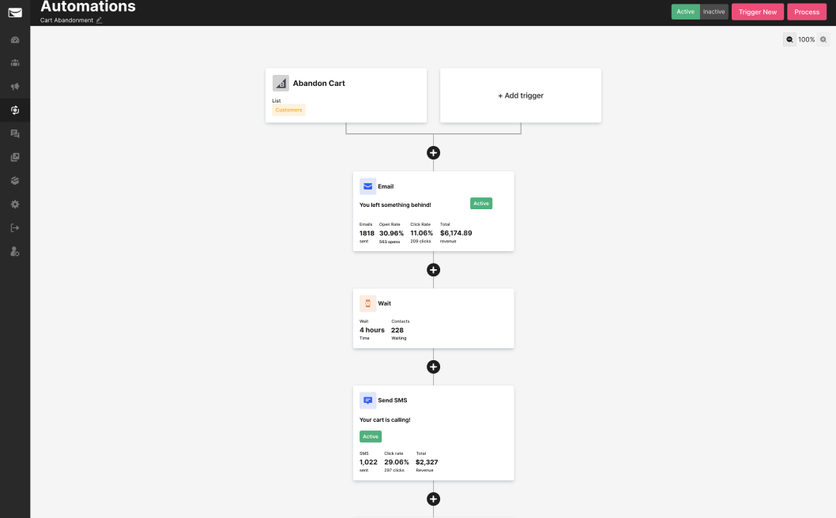
Every Sendlane account, trial users included, gets chat and email support. Live specialists work weekdays during business hours, and an AI chat answers the rest of the time.
Enterprise tiers add dedicated support, a personal Slack channel, and custom onboarding with an implementation partner, and Sendlane reserves them for customers on an annual contract. A dedicated Customer Success Manager and white-glove migration start at 800,000 emails a month, about $900/mo (Sendlane pricing). After the Privy deal, Sendlane told customers to expect the same hands-on support (Sendlane blog).
Sendlane Pricing
From $100/mo for 50,000 email sends with unlimited contacts; SMS runs on credit plans from $0.009 per credit, carrier fees included. Free 60-day trial, capped at 100 contacts and 500 email sends.
Where Sendlane Wins
Pay per send. A 200,000-contact list that sends twice a month costs a fraction of its Klaviyo equivalent, because stored profiles are free. Seasonal businesses and high-AOV brands with rare repeat purchases get the best math here.
Where Sendlane Falls Short
Acquisition uncertainty. Long-term product independence is unknown, and the public footprint had already thinned: fresh reviews have dried up on the Shopify App Store and Trustpilot, leaving G2 as the main source of recent feedback.
Reporting and automation limits. On G2, reviewers call the reporting “somewhat basic”: one marketing manager in March wanted “more customizable dashboards and deeper segmentation on campaign performance”. Reviewers also note that complex multi-branch automations “can get clunky,” with “occasional delays or misfires in highly customized sequences.”
Compared to Maestra
Both sell consolidation; the difference is scope and certainty. Sendlane covers email, SMS, reviews, and forms, and Privy now owns it. Maestra is independent and adds what Sendlane doesn’t offer: a built-in loyalty program and on-site personalization. Its Forward Deployed Marketer also comes with every month-to-month plan, while Sendlane keeps dedicated support for annual contracts.
6. ActiveCampaign – Best for Marketing Automation with a Sales CRM
Starting price: From $15/mo (1,000 contacts, annual billing)
G2 rating: 4.4
ActiveCampaign is the generalist of this list: a marketing automation platform with a sales CRM attached.
It’s built for businesses that sell through conversations and pipelines as much as through campaigns.
Key Features
Active Intelligence
ActiveCampaign’s AI suggests next steps from what it learns about the account, runs scheduled tasks, and keeps memory between sessions. Starter and Plus get a limited version, and the limits aren’t public.
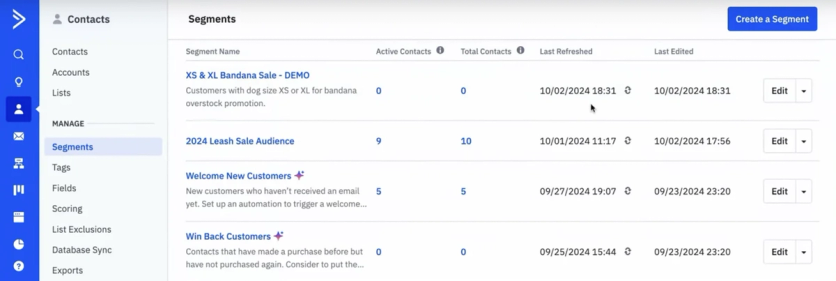
ActiveCampaign suggests ready segments, like win-back customers, and lists them next to the ones a marketer built
AI Agents
Describe a campaign and the AI builds the email, including images and layout, or type a request to generate an automation. AI actions and AI translations are paid add-ons on every plan, with no public prices.
Automation Builder
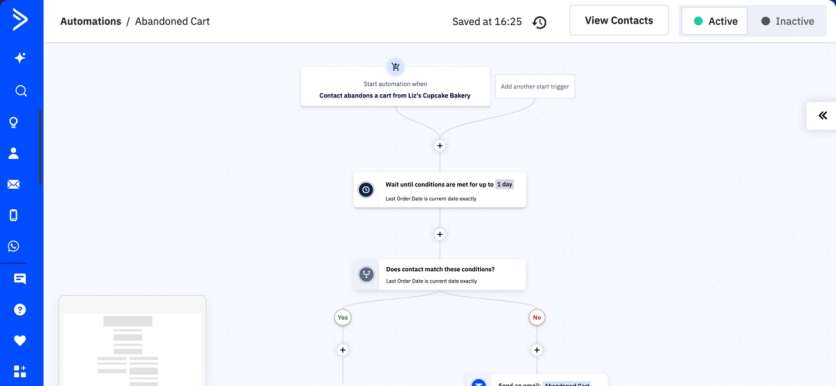
The visual builder handles branches, waits, and jumps between steps across email, SMS, and WhatsApp, and it’s the feature reviewers praise most. Plans set the ceiling: Starter allows five actions per automation and email only, and SMS and WhatsApp steps need add-ons on Plus or higher.
WhatsApp Plans
WhatsApp comes as its own subscription or as an add-on, with a shared inbox and chat flows, and the first 1,000 replies a month inside the 24-hour window after a customer’s message are free per number. Outgoing template messages draw on prepaid monthly credits that expire, and plans start at $99/mo (ActiveCampaign pricing).
1,000+ Integrations
The catalog lists more than 1,000 apps, and a remote MCP server on every plan lets Claude or ChatGPT work with account data. The MCP connection only shows up while ActiveCampaign branding is switched on.
ActiveCampaign Support
All ActiveCampaign plans come with chat and email tickets, community access, and free onboarding. Chat is English-only, opens with an AI assistant, and reaches a person Monday to Friday plus Sunday evenings, US Central time. No plan includes a human phone line.
Pro and Enterprise move you to priority support, and only Enterprise adds a dedicated account team (ActiveCampaign pricing). On qualifying plans, migration is free for the first 10 objects, such as lists, forms, and templates, and the rest you import yourself. Extra expert sessions start at $79.
ActiveCampaign Pricing
Starter from $15/mo, Plus $49, Pro $79, Enterprise from $145 (all at 1,000 contacts, billed annually), scaling with list size to roughly $375/mo for Pro at 10,000 contacts. SMS is an add-on with credits that expire monthly, and historical Shopify order sync requires plans above Starter. Watch the total: extra users, custom reporting, and CRM pipelines can each add their own line.
Where ActiveCampaign Wins
Automation depth for the price. The visual builder handles logic that $15–$79 competitors can’t, and a real CRM is available as a paid add-on from Plus up. One long-term customer summarized the value equation as “$250/mth vs. a HubSpot $2500.”
Integrations and AI. The integration catalog and fast AI shipping cadence add reach that single-channel tools don’t have.
Where ActiveCampaign Falls Short
The cost of the AI pivot. ActiveCampaign’s Trustpilot score sits at 2.7, and recent reviewers tie their complaints to it: “each time they add another AI anything, they take away past functionality,” one wrote in June, while another wrote in August that the company is “replacing actual support reps with useless AI bots.” Price hikes “without warning” are a second recurring theme in this year’s reviews.
A thin Shopify sync. Abandoned carts register only from the checkout shipping step, and there’s no native product recommendation engine.
Compared to Maestra
ActiveCampaign brings CRM pipelines Maestra doesn’t have; Maestra brings the commerce depth ActiveCampaign doesn’t. On Maestra, the CDP tracks the full on-site journey rather than checkout-stage events, and recommendations, loyalty, and personalization are products rather than integration projects. Coolibar grew flow revenue 62% year-over-year after its Maestra Forward Deployed Marketer rebuilt its automations – the kind of hands-on work that on ActiveCampaign stays on your team’s plate.
7. Bloomreach – Best for Enterprises with Technical Staff
Starting price: Custom pricing (email marketing from $22,500/yr)
G2 rating: 4.6
Bloomreach is the enterprise heavyweight: marketing automation across 13+ channels, e-commerce search, and its Loomi AI layer, sold as an annual contract.
It’s built for enterprises that have engineers to spend on setup.
Key Features
Loomi AI
The Loomi platform comes with every marketing package and handles send-time optimization, profile-based personalization, and segment-aware search results. The AI tools on top of it, for audiences, analytics, web, and journeys, are sold as extra modules, and the marketing agent is priced separately again.
Marketing Automation
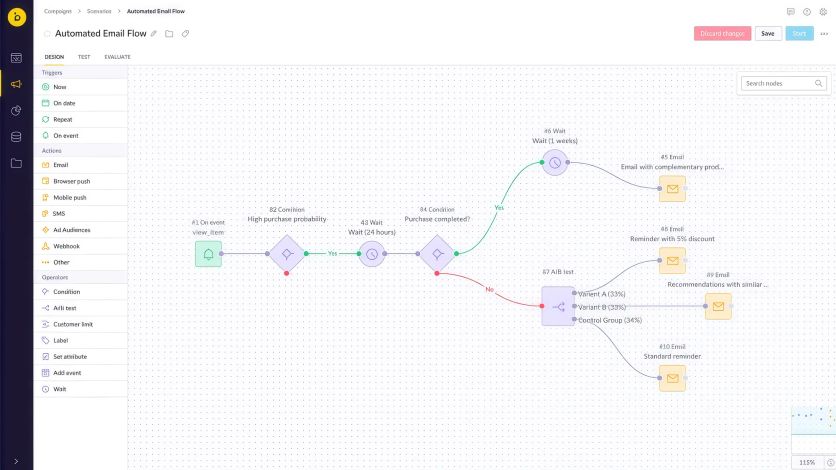
Journeys run across email, SMS, RCS, WhatsApp, web, and the mobile app, with price-drop and back-in-stock triggers built in. Each channel family is a separate package that can be bought on its own, Enterprise Marketing bundles them all, and the messaging packages set a yearly send allowance per customer profile: 60 emails, 6 texts, or 60 pushes.
Ecommerce Search
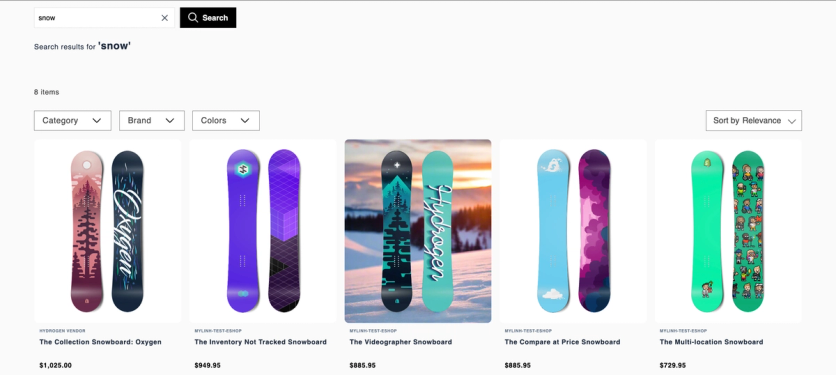
Search replaces Shopify’s default search and collection pages with ranking that learns from shopper behavior, synonyms, typo tolerance, and filters, and merchandisers can boost, bury, or pin products and A/B test the grid. It’s a separate subscription, from $45,000/yr on the Shopify listing, implementation averages six weeks, and Shopify B2B isn’t supported.
Marketing Agent
The agent turns a single prompt into a campaign brief, an audience, and email or SMS messages for a marketer to approve. It’s a paid add-on to the Email or Enterprise package, the segments it builds can’t be reused outside that campaign, and after launch it only tunes send timing for abandoned cart and browse campaigns.
Loomi Shopping Agent
The shopping agent answers product questions and steers shoppers to items in a storefront chat. It needs Bloomreach Search, and setup runs several weeks of project, feed, and tracking work.
Bloomreach Support
A Bloomreach contract includes a named Customer Success Manager and onboarding through go-live (Bloomreach). Standard support runs 9 to 5 on business days in your contracted time zone, in English, with first responses in 2 to 24 hours depending on severity. The phone line is reserved for platform-down emergencies.
Standard support keeps a 24/7 phone line for platform-down emergencies; round-the-clock email and chat come with Premium Support. Building use cases from scratch, creative work, advanced deliverability consulting, and new integrations fall outside standard support and go to paid Client Services.
Bloomreach Pricing
Custom quotes only, billed annually. Each marketing package is a yearly fee tiered by customer profiles and monthly visitors, with send allowances written into the contract. Public prices start at $22,500/yr for email marketing and $45,000/yr for e-commerce search (Shopify App Store). Vendr’s contract data puts the average annual cost near $180,000, from a small sample of six deals (Vendr).
Where Bloomreach Wins
Enterprise depth. It combines a CDP-grade single customer view, behavior-driven flows across every channel, and site search. Gartner included it in the 2026 Magic Quadrant for Multichannel Marketing Hubs, and the company passed $260M ARR in 2025 with positive free cash flow (Bloomreach press release), so vendor stability isn’t a concern.
AI in production. Nearly half its customers use at least one AI agent or next-generation AI tool, per the company.
Where Bloomreach Falls Short
Steep learning curve. “It is not at all user-friendly and the logic is really complicated,” a mid-market reviewer wrote in June; an enterprise retail user the same month cited a “steep learning curve – quite a few quirks and platform jargon to learn.”
Hidden people costs. Reviewers report needing paid third-party consultants for builds, and one Shopify merchant wrote that Bloomreach “pushed us to upgrade six tiers above our initial quote” on event volume after signing. Support, meanwhile, “usually ends with the case being closed and no solution,” per an April review.
Compared to Maestra
Both are omnichannel personalization platforms with real-time data underneath; the split is who does the work and what it costs to start. Bloomreach assumes engineers, consultants, and a six-figure annual contract. Maestra ships the commerce use cases pre-built, prices from $2,000 a month with month-to-month terms, and staffs every account with a Forward Deployed Marketer. The published head-to-head: Selkirk Sport left Bloomreach for Maestra and grew email-attributed revenue 55% and SMS-attributed revenue 149% year-over-year, crediting flexible segmentation and flows its team could finally run itself.
The Right Platform for Each Stage of Growth
Maestra is the strongest choice for mid-size and enterprise Shopify brands because it replaces three to five point tools – email, SMS, loyalty, popups, personalization – with one real-time platform and a Forward Deployed Marketer who runs it with you. The proof is published: 26% total sales growth at Svaha USA, a 64% stack-cost cut at Urban Armor Gear, 149% SMS-attributed revenue growth at Selkirk Sport.
The rest of the field maps to stages. Omnisend and Drip serve small stores well at small prices, Klaviyo owns the self-serve middle, ActiveCampaign adds a CRM, Sendlane rewards big quiet lists, and Bloomreach serves enterprises with engineering muscle.
Wherever you land, apply the same three checks: price your real list a year from now, read reviews from the last 12 months only, and make sure the vendor’s product – and ownership – will still look the same at renewal.
Ready to see your whole stack on one customer profile? Book a Maestra demo.
Frequently Asked Questions
- Maestra, Klaviyo, and Omnisend lead for Shopify specifically. Maestra fits mid-size and enterprise brands consolidating email, SMS, loyalty, and site personalization – Svaha USA grew total sales 26% after moving its stack onto it. Klaviyo fits self-serve brands that want the safe choice; Omnisend fits small stores on a budget.
- Yes, Maestra covers email, SMS, loyalty, and popups natively, plus quizzes, surveys, and product recommendations. That is the core of its consolidation pitch – Urban Armor Gear cut stack costs 64% doing exactly that. Klaviyo covers email, SMS, and push and adds reviews and helpdesk; Omnisend covers email, SMS, push, and forms; Sendlane covers email, SMS, reviews, and forms.
- Klaviyo and Omnisend have free plans, and paid starters run $15–$39/mo (ActiveCampaign, Omnisend Standard, Drip). Bloomreach sits at the top end: custom enterprise contracts that Vendr’s contract data puts around $180,000 a year.
Maestra pricing starts at $2,000/mo for the customer data platform plus unlimited email, with the first 100,000 active profiles included and dormant profiles stored free. Migration and a Forward Deployed Marketer come with every plan, billed month-to-month. Furniture Fair gets a 7,543% ROI from Maestra. Compare the full monthly total: platform fee plus SMS credits plus the apps you still keep. - Maestra has the deepest Shopify integration on this list. Sessions, searches, carts, checkouts, and orders feed one real-time CDP profile that every channel and the loyalty program share. Klaviyo is the safe choice – its integration runs on 117,000+ Shopify stores and supports Shopify Markets localization. Omnisend and Drip sync well for their scope; ActiveCampaign captures carts only from the checkout shipping step. With Maestra capturing those signals, JOLYN runs Price Drop Alerts and Low Stock Notifications it couldn’t build before, and its campaign-driven revenue grew 26%.
- By install base, yes – over 117,000 Shopify stores use Klaviyo. Billing on every marketable profile, messaged or not, with auto-upgrades you can’t switch off, makes it expensive as a list grows, so brands compare it against pay-per-send models like Sendlane or consolidation platforms like Maestra before renewing. G-Plans, with 7 million customers, grew customer lifetime value 2x on Maestra, and its marketing costs went down because Maestra’s pricing is more flexible than Klaviyo’s.