
7 Best Bloomreach Alternatives & Competitors for 2026

You are probably here because Bloomreach stopped working the way your team needs it to. You signed up for a commerce marketing platform and ended up writing code just to personalize an email. The reporting dashboard tends to create more questions than it answers.
Maybe the implementation ate months of IT time, and you still use only half the features. Or the pricing has climbed beyond what your team can justify, especially when campaign performance is buried in an interface only a specialist can navigate.
Bloomreach is a genuinely powerful platform. Its Loomi AI suite delivers real strengths in AI-driven product discovery and ships with a built-in CDP. It still is not the right fit for everyone.
Mid-market e-commerce brands often pay enterprise prices for a platform that demands engineering-level skill for everyday marketing tasks.
Below, we break down the seven best Bloomreach alternatives, what each one does well, where each falls short, and which fits your team, whether you want a friendlier interface, transparent pricing, faster setup, or a platform your marketers can run without touching Jinja code.
What Are the Best Bloomreach Alternatives
The best Bloomreach alternatives are Maestra, Insider One, SAP Engagement Cloud, Klaviyo, Adobe (Marketo Engage and Target), Salesforce Agentforce Marketing, and Braze. Maestra leads for mid-market retailers that want Bloomreach-level personalization, a built-in CDP, loyalty, and on-site experiences in one platform, without Jinja code or enterprise pricing.
Here is how the seven break down by category.
- Maestra: best for omnichannel e-commerce personalization. A unified CDP with email, SMS, loyalty, and on-site personalization, without Bloomreach’s complexity.
- Insider One: best for AI-powered cross-channel personalization. Web, app, and messaging personalization with predictive AI segmentation.
- SAP Engagement Cloud: best for SAP ecosystem retailers. Pre-built retail playbooks with native SAP integration.
- Klaviyo: best for self-serve email and SMS. Quick Shopify setup without Bloomreach-level merchandising overhead.
- Adobe Marketo Engage and Adobe Target: best for enterprise B2B and personalization. Demand gen and on-site testing for Adobe ecosystem teams.
- Salesforce Agentforce Marketing: best for Salesforce-native teams. Cross-channel journeys tied closely to Salesforce CRM.
- Braze: best for mobile-first engagement. Real-time messaging for app-driven brands.
Content:
Common Pain Points with Bloomreach
We read through reviews on G2, Capterra, Gartner Peer Insights, TrustRadius, and Trustpilot to surface the most common frustrations, along with a few fixes worth trying before you switch.
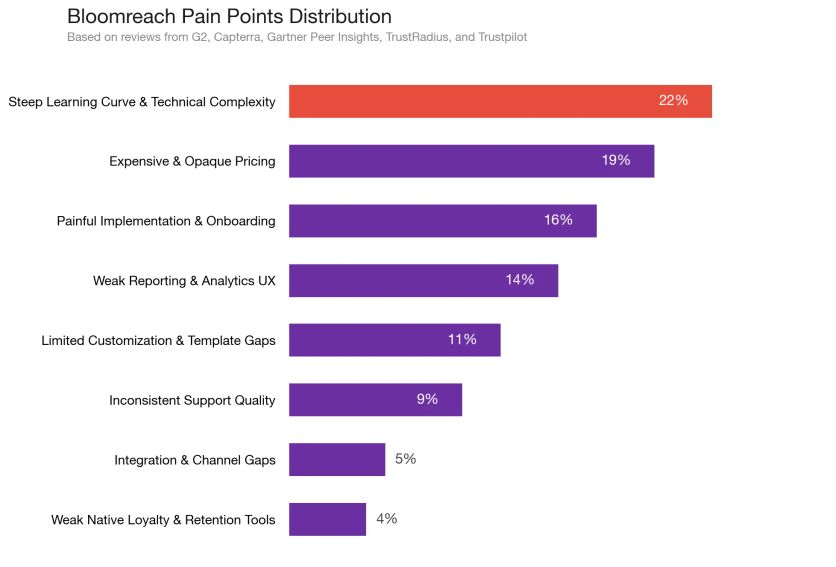
| Pain Point | Description | Possible Solutions |
|---|---|---|
| Steep learning curve and technical complexity | Advanced features expect Jinja coding and data know-how, so non-technical marketers stall without engineering support. | Use pre-built templates and lean on a dedicated Bloomreach specialist. |
| Expensive and opaque pricing | Custom, add-on-based pricing climbs unpredictably, and G2 rates it “$$$$$.” | Audit usage and cut unused add-ons at renewal, and negotiate volume caps. |
| Painful implementation and onboarding | Setup takes months and heavy IT involvement, which overwhelms smaller teams. | • Define a phased rollout – email first, then expand to personalization and recommendations
• Use Bloomreach’s professional services for initial setup • Set realistic timelines (3–6 months minimum for full deployment) |
| Weak reporting and analytics UX | Dashboards are hard to navigate, and there is no built-in alerting. | Build dashboards around a few key KPIs and export to your BI tool. |
| Limited customization and template gaps | Pre-built templates are thin, and brand-specific design hits flexibility limits. | Build your own template library and submit feature requests to your account manager. |
| Inconsistent support quality | Support can be slow, and quality varies by account tier. | Escalate through your customer success manager and negotiate premium support into your contract. |
| Integration and channel gaps | Some channels lack native integrations beyond email and web. | • Use Bloomreach’s API for custom integrations
• Consider a supplementary tool for channels Bloomreach doesn’t cover natively • This is a platform limitation for some channels – consider alternatives below |
| Weak native loyalty and retention tools | There is no built-in loyalty engine, so loyalty and referrals need third-party tools. | • Integrate a third-party loyalty tool (Smile.io, Yotpo Loyalty) alongside Bloomreach
• This is a platform limitation – consider alternatives below if native loyalty is a priority |
Here is the pattern we see most. Brands start shopping once the gap between Bloomreach’s capabilities and their team’s ability to use them grows too wide.
Marketing teams need to launch campaigns in hours, not days. When that happens, the technical barrier Bloomreach creates becomes a bottleneck rather than a feature.
Bloomreach has pushed hard into AI with its Loomi suite, and its agentic tools can turn a prompt into a campaign. The underlying platform still rewards teams that have engineering resources and Jinja know-how.
The Alternatives at a Glance
| Platform | Omnichannel Marketing | Pricing | G2 Rating |
|---|---|---|---|
| Maestra | Email, SMS, web/mobile push, loyalty, on-site personalization, ads sync | From $2,000/mo (CDP + unlimited email); modular – pay only for the channels you use and only for active profiles | 4.8 / 5 |
| Insider One | Email, SMS, push, in-app, web personalization, WhatsApp, RCS, ads retargeting | Custom (quote only) | 4.8 / 5 |
| SAP Engagement Cloud | Email, SMS, mobile apps, social/ads audiences, direct mail, contact centers | Custom (quote only) | 4.2 / 5 |
| Klaviyo | Email & SMS, mobile push, in-app, on-site banners, ad sync | Free up to 250 contacts; from $20/mo | 4.6 / 5 |
| Adobe (Marketo + Target) | Email (Marketo), web/app personalization (Target); limited without full Adobe stack | Custom enterprise (high) | 4.1 / 4.0 |
| Salesforce Agentforce Marketing | Email, SMS, mobile push, ads, social | Custom; editions from ~$1,250/org/mo | 4.0 / 5 |
| Braze | Mobile-centric: push, in-app, email, SMS, web push, WhatsApp, RCS | Custom (MAU-based) | 4.5 / 5 |
Leading Alternatives to Bloomreach
1. Maestra: Best for E-commerce Omnichannel Personalization
Maestra is an all-in-one marketing automation platform for midsize retail brands. It pulls a real-time CDP, omnichannel campaign management, on-site personalization, product recommendations, loyalty, and ad audience sync into one system.
The goal is to provide mid-market e-commerce businesses with enterprise-level personalization and automation at lower cost and complexity. Maestra works in real time, so you can run omnichannel campaigns and personalized promotions from a single tool.
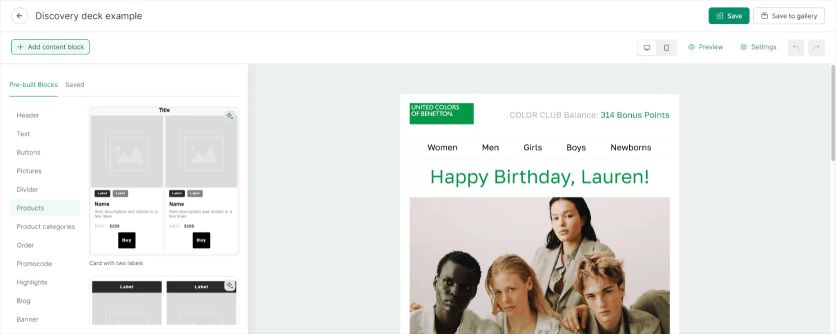
Maestra’s visual email composer
Key Features
- Real-time CDP that unifies browsing, purchase, and profile data
- Email, SMS, web push, and mobile app push in one platform
- Built-in loyalty program with points and tiers
- On-site personalization and AI product recommendations
- Ad audience sync to Facebook and Google Ads
- Native integrations with Shopify, BigCommerce, and WooCommerce
- Campaign, flow, and segment work driven from Claude or ChatGPT over MCP
Personalization and AI
Maestra runs AI-driven personalization across channels. At its core is a real-time CDP that pulls browsing behavior, purchase history, and more into detailed customer profiles, and that data feeds the personalization engine.
On websites, Maestra serves dynamic content and product recommendations based on each visitor’s behavior. Its recommendation and merchandising module automates “people who viewed X also viewed Y” placements and upsell or cross-sell blocks, similar to Bloomreach’s recommendation algorithms.
The result is a personalization set aimed squarely at more revenue per customer.
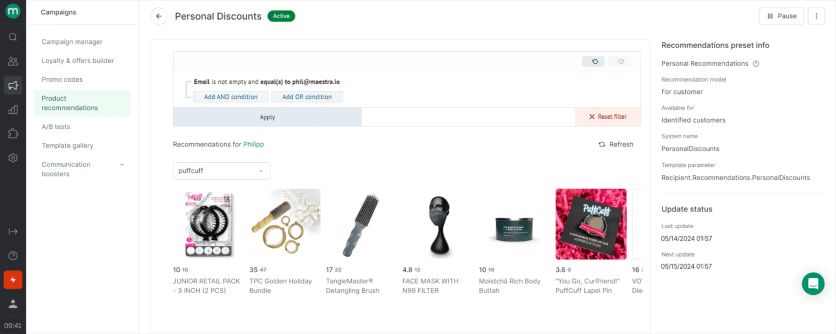
Maestra: сreating a personalized recommendations block
Omnichannel Capabilities
Maestra covers the full customer experience for a retail brand, across both communications and on-site interactions. It supports email, SMS, web push, mobile app push, and on-site personalization.
It also builds in a loyalty module and discount management. You can run a points-based loyalty program, then use those tiers in your targeting, sending VIP customers a special offer, all inside Maestra.
It syncs customer segments to Facebook and Google Ads and can trigger ad campaigns as part of a flow. Few platforms offer that out of the box.
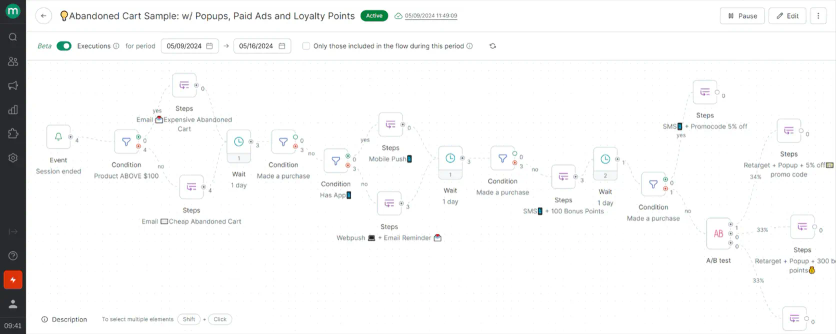
Maestra’s flow example: abandoned card flow with emails, mobile and web pushes, pop-ups, paid ads and loyalty points
Channel coverage runs end to end. You send emails and SMS, update on-site content for personalized greetings or recommendations, fire a push notification, show targeted ads, and manage loyalty rewards, all in unified flows. The architecture is real-time, so customers see updated personalization the moment they interact. That breadth is unusual for a mid-market tool and rivals Bloomreach’s Engagement plus Discovery combination in scope.
Scalability and Flexibility
Maestra was built for mid-market scale and handles databases in the hundreds of thousands of customers with room to grow. Among its clients is Movavi, a global software company with 70 million users.
Modularity is one of its strengths. It offers five modules: the CDP, multichannel communications, loyalty, website personalization, and product recommendations. You do not have to abandon other tools to adopt it. You can use just the CDP and email and skip the loyalty module if you already run one. Maestra focuses on B2C retail, and its flexibility is greatest there.
Integrations
Maestra ships with pre-built integrations for popular e-commerce platforms. It natively connects to Shopify, BigCommerce, WooCommerce, and other storefronts, which makes ingesting products, customers, and orders far easier for mid-market brands already on Shopify. It also connects to Instagram and Google Ads for audience sync and to BI tools like Tableau and Power BI.
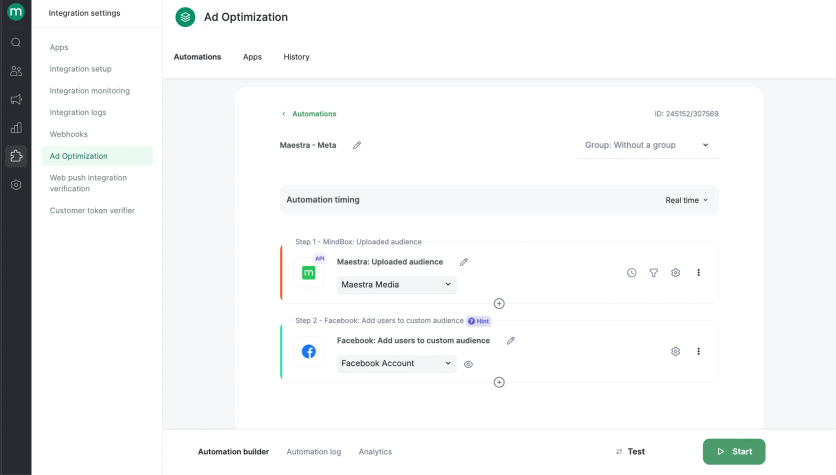
Maestra’s ad optimization tool
Its open API lets you hook in custom data sources or export to a warehouse. Bloomreach has an API too, but users note it lacks some plug-and-play connectors, so Maestra’s ready-made commerce connectors can save real integration time and cost.
Maestra also offers custom integration support through APIs and webhooks, backed by your Forward Deployed Marketer, so even without a ready connector for a unique CMS, the team steps in to help you wire it up.
Pricing
Maestra is transparent and mid-market friendly. Pricing starts at $2,000 per month for the most common starting package – the customer data platform plus unlimited email – and the first 100,000 active profiles are included. You only pay for active profiles, so storing dormant ones is free, unlike the list-size billing most competitors use.
From there you add monthly modules only for the channels you use – SMS, on-site personalization, loyalty, or mobile push. Every plan includes a dedicated Forward Deployed Marketer, free migration, and month-to-month billing with no setup fees. SMS, MMS, and RCS carry per-message fees on top of the module.
For context, Bloomreach is custom-priced and often runs much higher for a similar contact count. Even Klaviyo, cheaper at small scale, climbs into the mid-hundreds per month for tens of thousands of contacts and still leaves out on-site personalization and loyalty.
User Experience
Maestra is built to be marketer-friendly and fast to deploy. Users consistently praise its ease of use and smooth onboarding. The interface is clean and intuitive, and even non-technical users pick up email and automation building quickly. That is a clear split from Bloomreach, which some find hard to learn.
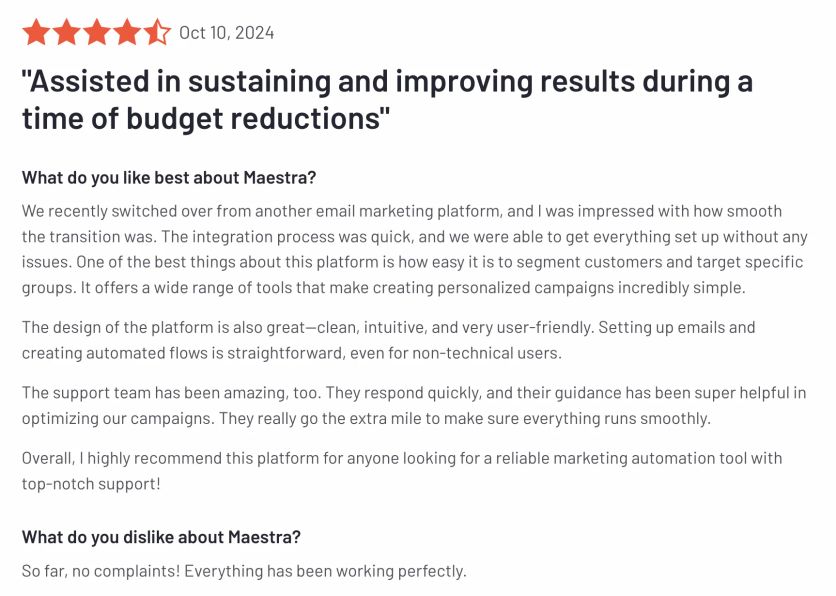
Maestra also provides a dedicated Forward Deployed Marketer and responsive support. That white-glove service means the team helps set up and optimize your first flows, which takes the load off your team. In G2 reviews, support is the top-rated aspect of Maestra, followed by ease of use and ease of integration.
How It Compares
Maestra costs a lot less than Bloomreach, connects more smoothly with popular e-commerce platforms, and builds in loyalty.
Bottom line: Bloomreach can deliver more advanced product discovery and search, but at a higher price and complexity level.
When to Switch to Maestra from Bloomreach
You pay enterprise prices but use a fraction of the features.
Urban Armor Gear, a phone and laptop protection brand, was paying for three platforms: Klaviyo for email, Yotpo for loyalty, and Frosmo for on-site personalization. Their emails stayed generic, complex flows were impossible to build, and the loyalty program was barely visible to customers. After moving everything into Maestra, they cut stack costs by 64%, saving roughly $100K a year.

Your marketers can’t launch campaigns without a developer.
Enlightened Equipment, an outdoor gear brand, leaned on developers to connect and maintain Mailchimp, Klaviyo, and several personalization apps. After switching to Maestra, the marketing team runs everything on its own – dynamic Meta ads, A/B-tested lead-capture pop-ups, AI-powered product recommendations, and automated cart-recovery flows, all no-code. Those compounding improvements across the funnel drove a 52.5% increase in total revenue.
You need native loyalty and Bloomreach doesn’t offer one.
JOLYN, a performance swimwear brand, replaced four tools – Klaviyo, Amped, Rebuy, and Yotpo Rewards – with Maestra. Recommendations factor in real-time inventory and product attributes, winback flows draw on unified purchase data, and loyalty sits inside the same platform that sends the emails. The result was 22% more repeat domestic revenue and 26% more campaign-driven revenue.

With other providers, we often got recommendations to adopt their new features rather than having them truly understand our needs.
Maestra is completely different. I get proactive suggestions like 'Your Browse Abandonment flow could do better with this kind of recommendation. Let’s A/B test it.'
That’s the kind of partnership that drives real results!
2. Insider One: Best for AI-Powered Cross-Channel Personalization
Insider One (formerly Insider) is a cross-channel personalization platform for high-converting customer experiences. It tackles data silos by unifying customer data in a CDP, then layers on AI-driven segmentation and individualized content.
Repositioned as an AI-native platform, it now includes the Sirius AI engine and Agent One autonomous agents. One standout feature is InStory, which lets brands run Instagram-style story content on their own sites.
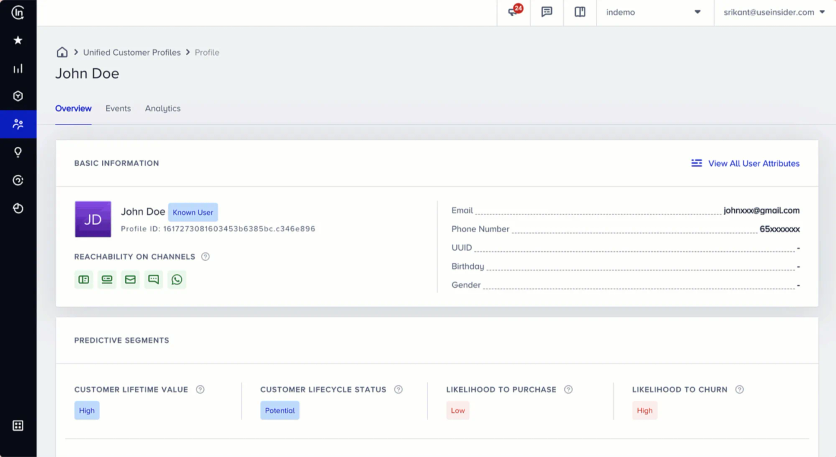
Insider’s customer profile
Key Features
- AI personalization engine with Sirius AI and Agent One agents
- More than 12 channels, including WhatsApp, RCS, and TikTok
- Predictive smart segmentation for purchase and churn likelihood
- Architect journey builder for cross-channel flows
- InStory Instagram-style on-site content
- Integration Hub with connectors for Shopify, VTEX, and more
Personalization and AI
Insider brings a strong AI personalization engine for web and mobile content, product recommendations, and predictive targeting. Its smart segmentation predicts purchase likelihood, churn risk, and more to sharpen relevance.
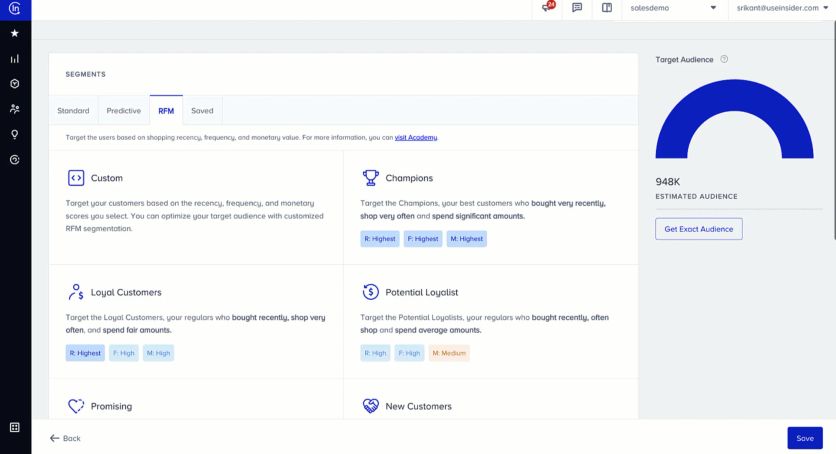
Insider’s segmentation
Omnichannel Capabilities
Insider supports more than 12 channels, including email, SMS, push, in-app messages, web personalization, WhatsApp, RCS, TikTok, and ad retargeting. Marketers coordinate across those touchpoints with the Architect journey builder to create connected customer journeys.
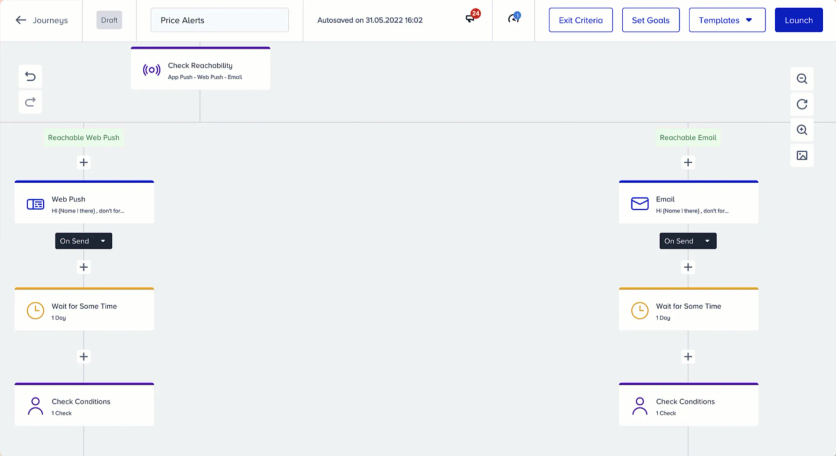
Insider’s flow builder
Scalability and Flexibility
Insider is built for enterprise scale. Many global retail brands use it, and it handles large volumes of customer data in real time. It offers a flexible API and pre-built connectors to systems like Shopify, Magento, and Salesforce.
Integrations
Its Integration Hub provides out-of-the-box connectors for e-commerce platforms such as Shopify and VTEX, plus email providers, analytics tools like Google Analytics and Mixpanel, ad networks, and CRMs. Syncing data and actions between Insider and other tools is straightforward.
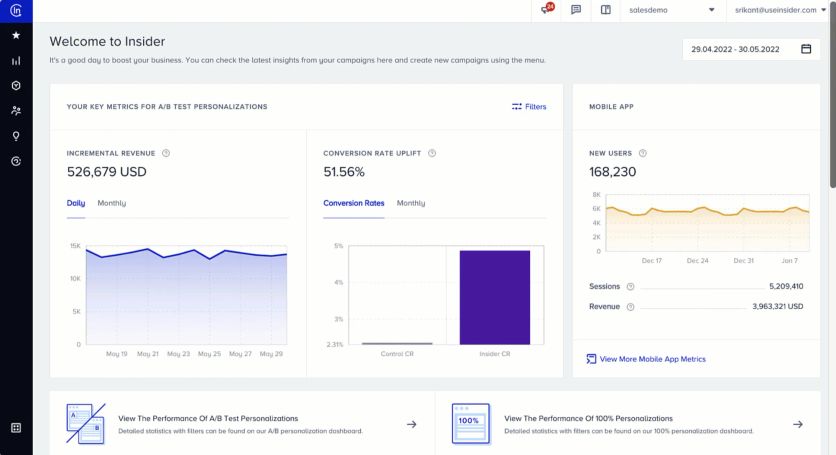
Insider’s reporting
Pricing
You will not find a price on the site. Insider uses custom enterprise pricing with no public tiers, tailored to each business. There is no free plan, and budget-wise it sits in the enterprise and upper mid-market range.
User Experience
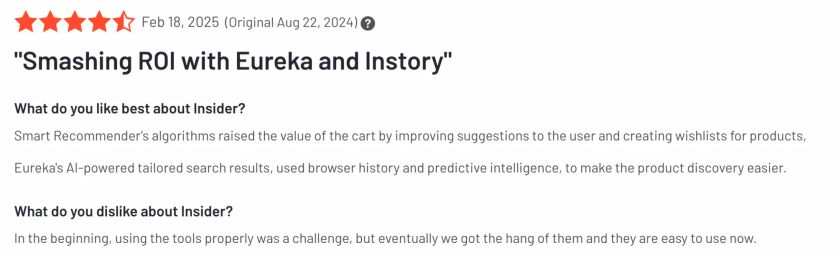
Insider is fairly marketer-friendly for how much it does. The platform ships with templates and a rich library of pre-built journey templates that cut the learning curve, and the success team offers hands-on guidance to speed up ROI.
How It Compares
Against Bloomreach, Insider leans into hyper-personalization across a long channel list, including WhatsApp, Messenger, and push. Bloomreach has an equally strong AI core but asks for more technical overhead and does not natively support some of Insider’s direct-messaging channels.
Against Maestra, Insider stands out for its local partner network and managed services, but it does not include loyalty. Maestra is all-in-one, with loyalty and product recommendations in a single subscription.
3. SAP Engagement Cloud: Best for SAP Ecosystem Retailers
SAP Engagement Cloud (formerly SAP Emarsys, acquired by SAP in 2020 and renamed in 2026) is an omnichannel customer engagement platform built for B2C marketers, especially in retail. It combines a real-time CDP, a personalization engine, and automated campaign workflows in one solution, with a strong focus on retail outcomes like purchase frequency and lifetime value.
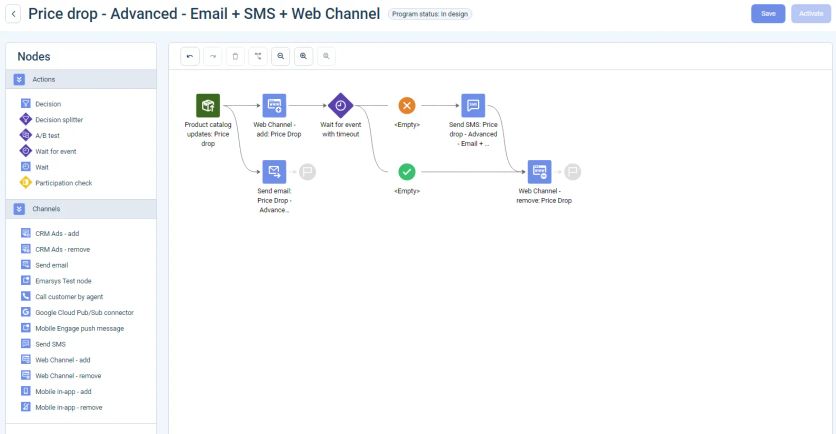
Emarsys’s flow builder
Key Features
- Real-time CDP with a 360-degree customer view
- Omnichannel support, including email, SMS, app messaging, digital ads, direct mail, and call center
- Predictive analytics for churn and send-time optimization
- Pre-built retail automation programs for cart abandonment and post-purchase
- Native SAP Commerce Cloud integration
Personalization and AI
SAP offers built-in predictive analytics and personalization. It generates product recommendations and personalized content based on behavior and lifecycle stage, and it adds retail-specific AI insights such as churn prediction and optimal send times.
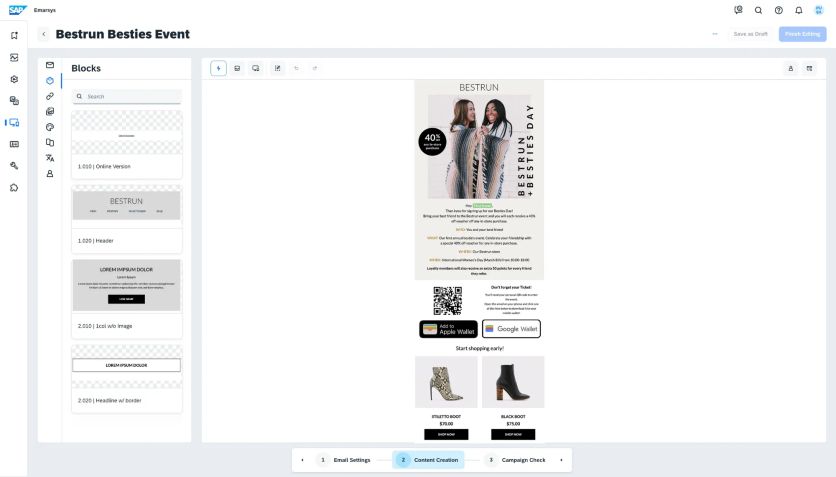
Emarsys’s email editor
Omnichannel Capabilities
Coverage is strong. SAP supports email, SMS, on-site personalization, mobile app messaging, digital ads, and even direct mail and call-center integrations. You can trigger an SMS or a Facebook ad audience, sync off email behavior, and manage every channel from one platform.
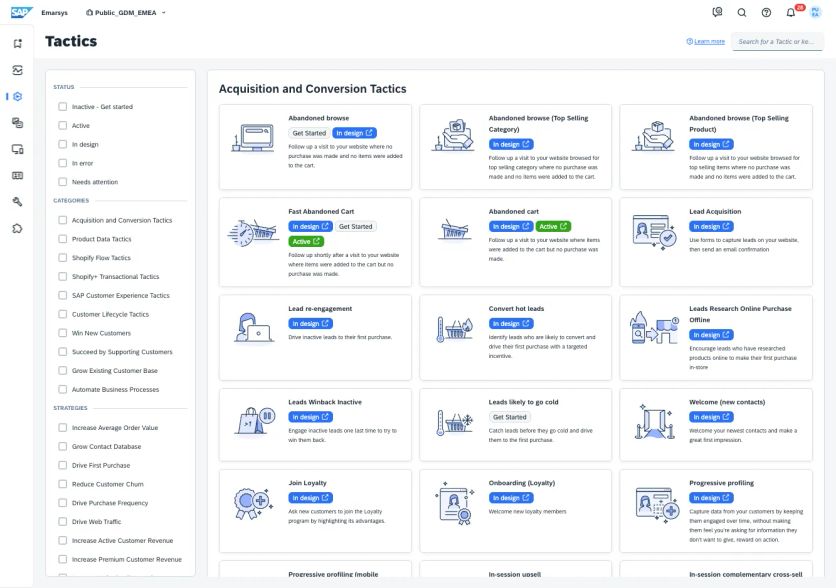
Emarsys’s flow templates
Scalability and Flexibility
As part of SAP’s CX suite, Engagement Cloud is enterprise-grade and scales to large data and message volumes, though mid-market retail brands use it too. Its unified data layer gives a 360-degree customer view and handles complex segmentation and trigger rules.
Integrations
Engagement Cloud connects natively to SAP Commerce Cloud and other SAP systems, and offers APIs plus some pre-built connectors for popular e-commerce platforms. Clients have integrated Magento, Shopify, and custom stores. It is not as plug-and-play as smaller tools, but its integration options are solid for enterprise needs.
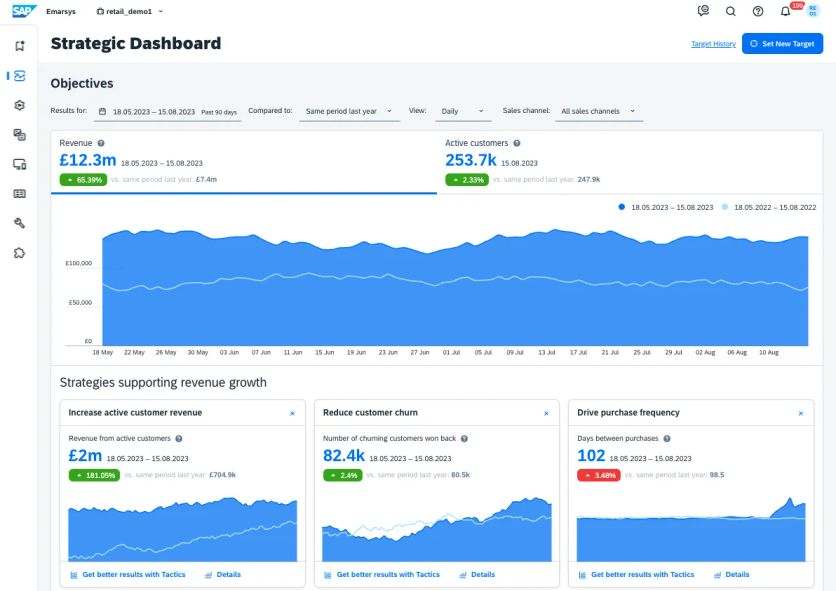
Emarsys’s reporting
Pricing
Engagement Cloud uses custom pricing, generally in the mid-market to enterprise range. It does not publish rates, and cost depends on database size and modules. It usually costs less than Salesforce or Adobe but more than self-service tools.
User Experience
Engagement Cloud is known for a marketer-friendly interface with a drag-and-drop editor and pre-built programs for retail use cases like cart abandonment, post-purchase, and reactivation. Day-to-day work is manageable. Onboarding still takes time, and some reviews point to a complex initial setup and limited reporting transparency.
How It Compares
Against Bloomreach, Engagement Cloud centers on retail predictive analytics, where Bloomreach reaches further for content and search but often costs more to implement.
Against Maestra, Engagement Cloud ships with pre-built retail automation templates, but Maestra tends to cost less and includes loyalty and on-site personalization natively, where Engagement Cloud may need extra modules.
4. Klaviyo: Best for Self-Serve Email and SMS
Klaviyo is a popular marketing automation platform for e-commerce, particularly strong in email and SMS marketing for online stores. It started as an email platform for Shopify merchants and has grown into a broad B2C CRM for mid-market brands. Klaviyo’s sweet spot is direct-to-consumer businesses looking for powerful yet easy-to-use email, SMS, and customer data capabilities without enterprise overhead.
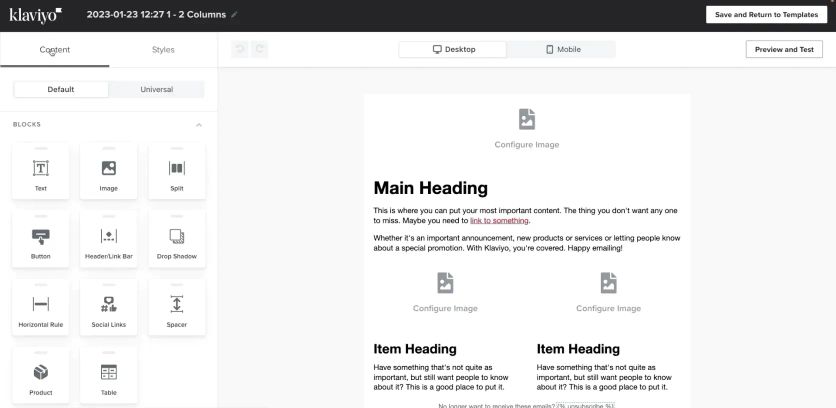
Klaviyo’s email composer
Key Features
- Email and SMS built for e-commerce
- Data-driven segmentation on browsing and purchase behavior
- Predictive analytics for lifetime value and churn risk
- Mobile app push, in-app messaging, and on-site banners
- Plug-and-play integrations with every major storefront
- Free plan up to 250 contacts
Personalization and AI
Klaviyo specializes in data-driven segmentation and personalized messaging built on e-commerce data. It tracks browsing and purchases automatically and lets marketers create segments and triggers like “repeat buyers” or “viewed product X but did not purchase.” It also offers predictive analytics such as expected lifetime value and churn risk, plus product recommendations in email.
Klaviyo’s AI is more basic than Bloomreach or Insider, though, and leans toward send-time and segment predictions rather than deep on-site personalization.
Omnichannel Capabilities
Email and SMS are the core, both fully built in and easy to use. Klaviyo has widened its mix since then. Mobile app push is now generally available, and it syncs with Facebook and Google Ads for retargeting audiences.
Klaviyo has also added on-site personalization through Personalized Onsite Banners and mobile in-app messaging, alongside light ad targeting. The tool still is not as deep an omnichannel hub as Insider One or Maestra, with no native loyalty and lighter cross-channel orchestration, but it now covers far more than outbound messaging alone.
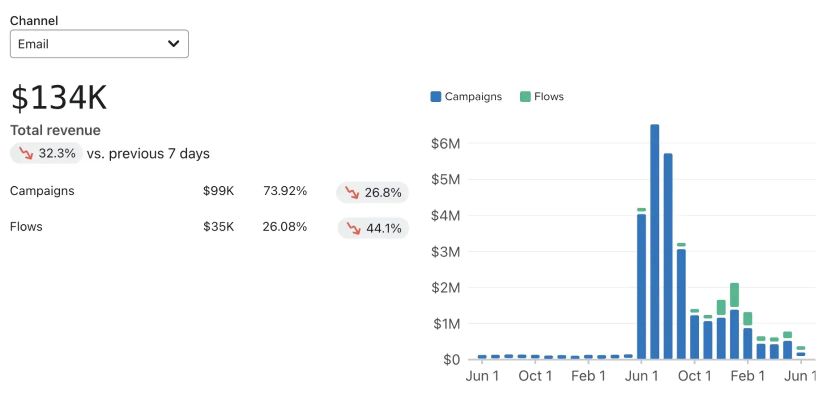
Fragment of Klaviyo’s business review dashboard
Scalability and Flexibility
Klaviyo scales well on contact count, and many brands send millions of emails through it. Its cloud infrastructure grows automatically as your list does. Flexibility is capped by its feature set, though. You cannot run call-center or direct-mail campaigns, and multi-step journeys mainly revolve around email and SMS. For most mid-sized e-commerce businesses, it still covers the core needs, helped by a large library of pre-built flows and templates.
Integrations
This is a strong suit for Klaviyo. The platform offers plug-and-play integrations with every major e-commerce platform, including Shopify, BigCommerce, WooCommerce, Magento, and Wix. You can sync customer and order data in a few clicks, and it connects to payment systems, loyalty apps, and help desks through built-in connectors or its API.
Pricing
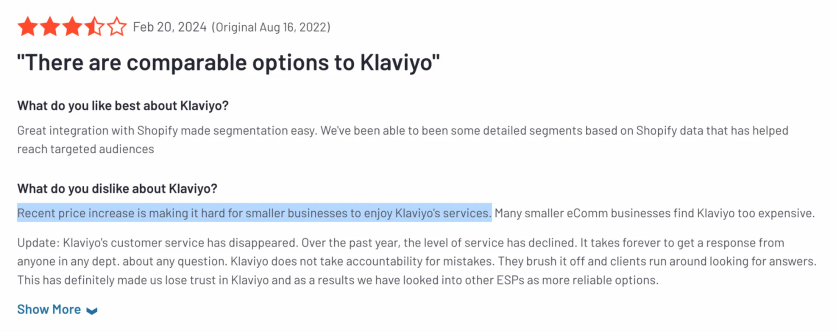
Here is where it gets tricky. Klaviyo is usage-based and affordable for mid-market, with a free plan up to 250 contacts, then tiered pricing that scales with contacts and messages. Around 10,000 contacts runs about $150 per month, and 50,000 contacts costs about $720 per month for email and SMS, with all features included.
That makes it one of the more cost-effective options for mid-market, since you pay more only as your list and volume grow. Smaller businesses can feel the squeeze as they scale, though, because Klaviyo’s active-profiles model counts every contact in the account, not just the ones you email.
User Experience
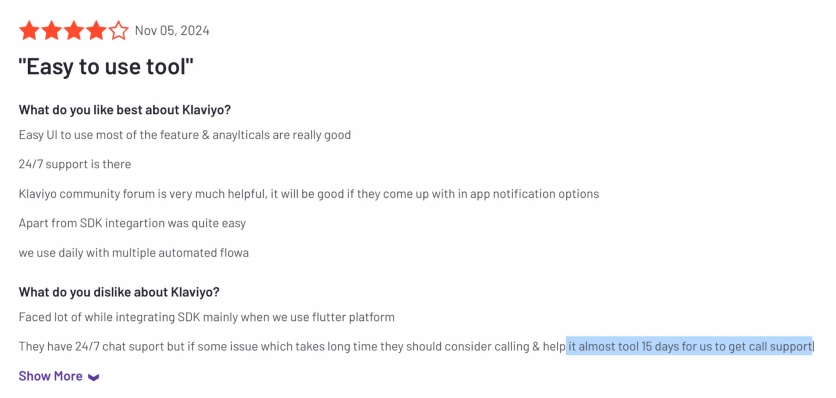
Ease of use is excellent. Klaviyo earns steady praise for a clean interface that marketing teams pick up quickly, and its visual builder makes campaigns and flows simple to create. In user ratings, it scores high on usability and a bit lower on advanced capabilities. Marketers without much technical support can self-serve most tasks, which helps resource-strapped teams. Very sophisticated multi-channel strategies can bump into its simpler approach.
How It Compares
Against Bloomreach, Klaviyo is much simpler for email and SMS but lacks Bloomreach’s deep on-site personalization and search technology.
Against Maestra, Klaviyo stays a favorite for small online stores, mostly for email and SMS, while Maestra covers more channels, adds loyalty, and includes on-site personalization, which makes it a fuller fit for retailers that want one platform.
5. Adobe Marketo Engage and Adobe Target: Best for Enterprise B2B and Personalization
Adobe pairs Marketo Engage, for marketing automation and CRM-driven campaigns, with Adobe Target, for on-site testing and personalization. Together, often alongside Adobe Campaign or Experience Cloud, they can stand in for Bloomreach at large enterprises that need strong email marketing, lead nurturing, and website testing.
Adobe increasingly centers this stack on the Adobe Experience Platform, with Journey Optimizer for cross-channel orchestration and GenStudio plus the AEP AI Assistant adding generative tooling.
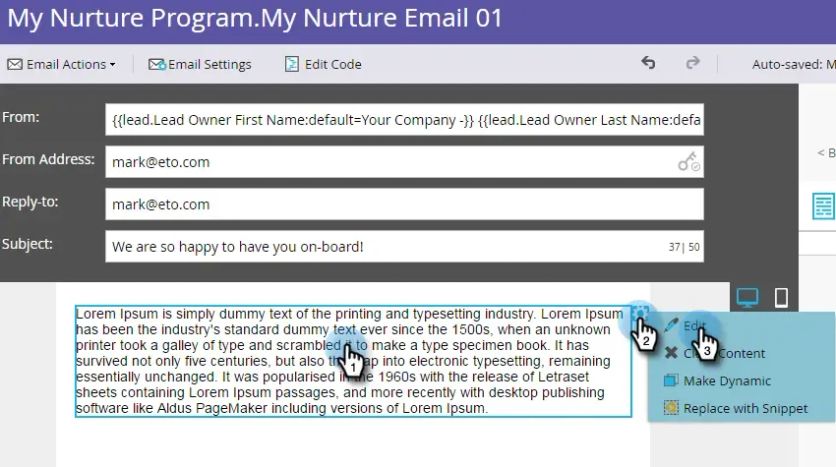
Sending an email via Marketo Engage
Key Features
- Marketo Engage for automation, lead scoring, and nurture streams
- Adobe Target for A/B testing and on-site personalization
- Adobe Sensei AI for Auto-Target and Auto-Personalization
- Deep integration across the Adobe Experience Cloud
- Enterprise scale for millions of contacts
Personalization and AI
Marketo Engage handles advanced automation, including triggered campaigns, lead scoring, and nurture streams, mainly for email and CRM-based marketing. It is not heavily AI-driven out of the box, though it personalizes email with dynamic fields and offers add-ons for predictive content.
Adobe Target is an A/B testing and personalization engine for web and mobile. It uses Adobe Sensei for Auto-Target and Auto-Personalization, serving different content to different segments to lift conversions. Together, Marketo and Target cover personalization in email and on-site, with strong testing, though pairing them takes integration effort.
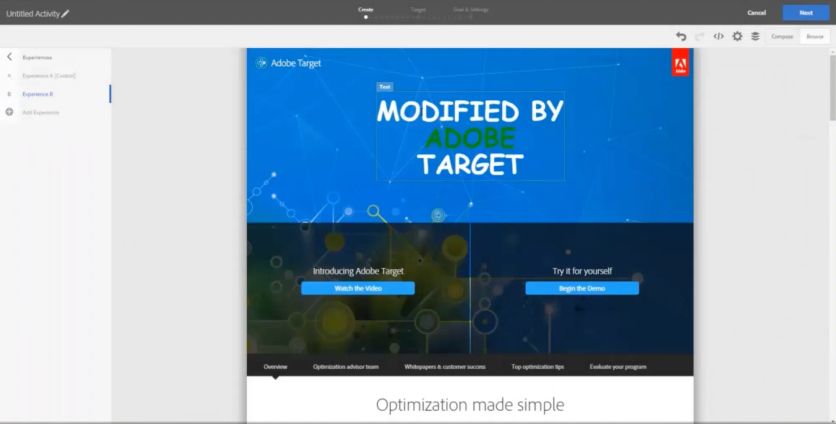
Adobe Target’s Visual Experience Composer
Omnichannel Capabilities
Marketo is strong in email and supports events and webinars in B2B contexts. It can handle SMS and other channels, usually through third-party integrations or LaunchPoint partners. Adobe Target focuses on web and mobile app experiences, like personalized banners, recommendations, and in-app content.
A full Adobe Experience Cloud rollout covers most channels through Adobe Campaign and Journey Optimizer. As a standalone pair, though, Marketo and Target mainly cover email and on-site experience, which is not unified for SMS or push without other Adobe tools.
Scalability and Flexibility
Adobe’s tools scale to enterprise volumes. Marketo runs millions of contacts and complex automations for Fortune 500 companies, and Target serves personalization on high-traffic sites worldwide. They are flexible too, especially Target, which lets you test almost any experience change. The trade-off is that this flexibility asks for more technical and organizational resources, and implementation timelines can run long.
Integrations
Both tools integrate widely. Marketo has the LaunchPoint marketplace and integrates well with CRMs, particularly Salesforce, as well as webinar and analytics tools. It works with Magento (Adobe Commerce) fairly well since both sit under Adobe, and with others via API. Target drops into any site through its script and shares deep data with Adobe Analytics.
If you already run the Adobe ecosystem, these tools fit right in. If you do not, expect custom work to connect your store’s data and events to Marketo and Target.
Pricing
This is the part that rules Adobe out for most teams. It is expensive and enterprise-level, priced custom and often bundled across products. Marketo Engage sells in tiers based on database size and can cost tens or hundreds of thousands of dollars per year for large databases. Target is enterprise-priced too, based on traffic or as part of an Experience Cloud license.
This combo is one of the priciest alternatives, usually justified only for larger enterprises that can use the full capability set. Mid-market companies often find the cost hard to justify without very ambitious requirements and technical support.
User Experience
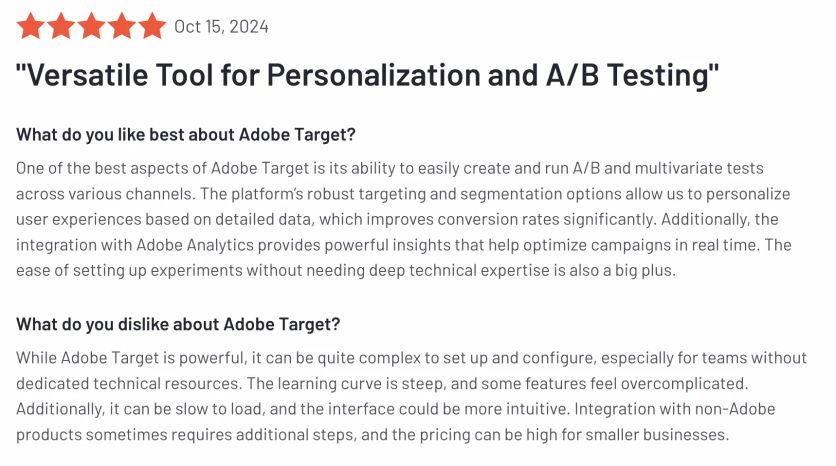
The learning curve is steep. Users report that Marketo is powerful but not the most intuitive for beginners, and Target usually needs developers or technical marketers to set up tests. These tools are not turnkey, and they demand real expertise.
Skilled teams can run very advanced marketing on Adobe, backed by strong documentation and a large community, but plan to invest in enablement. Teams already on multiple Adobe products get a smoother ride, while others can find the stack overwhelming next to more out-of-the-box platforms.
How It Compares
Against Bloomreach, Adobe’s suite matches it in enterprise-grade personalization, especially with Target’s testing, but Bloomreach’s commerce-focused features are more turnkey, whereas Adobe usually requires significant customization.
Against Maestra, Adobe offers deep integrations within its own ecosystem, while Maestra is simpler and cheaper to implement, particularly for mid-market retailers.
6. Salesforce Agentforce Marketing: Best for Salesforce-Native Teams
Salesforce Agentforce Marketing is a data-driven marketing suite that large B2C brands use for cross-channel engagement. It spans Email Studio, Mobile Studio, Advertising, Journey Builder, and more to run campaigns across email, mobile, and social. Paired with Salesforce CRM and Commerce, it can stand in for Bloomreach Engagement at big retailers.
In 2025 Salesforce folded SFMC into its Agentforce Marketing push, renaming the classic suite Marketing Cloud Engagement and adding a Data Cloud rebuild called Marketing Cloud Next.
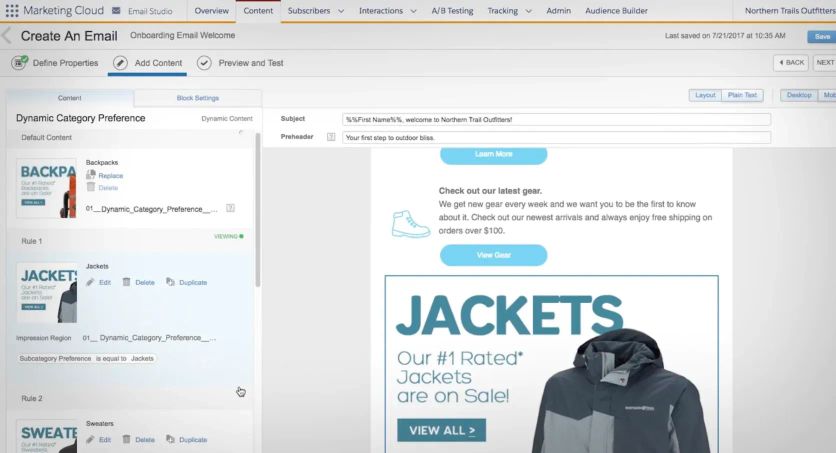
Salesforce Marketing Cloud’s email builder
Key Features
- Email, SMS, MMS, and push across Studios and Builders
- Einstein AI for predictive scoring and send-time optimization
- Journey Builder for cross-channel journeys
- Marketing Cloud Personalization for real-time web personalization
- Tight integration with Salesforce CRM and Commerce
Personalization and AI
Agentforce Marketing uses Salesforce’s Einstein AI for predictive scoring, product recommendations, and automated insights. Einstein predicts who is likely to open or click, recommends per-user send times, and auto-selects the best content variant, now marketed under the Agentforce and Einstein brands.
The platform’s Marketing Cloud Personalization (formerly Interaction Studio, originally Evergage) adds real-time web personalization and recommendations similar to Bloomreach’s on-site work. With these together, Salesforce reaches very advanced personalization, from tailored emails to dynamic web pages, though you often need to add modules and data integration to match Bloomreach’s full breadth.
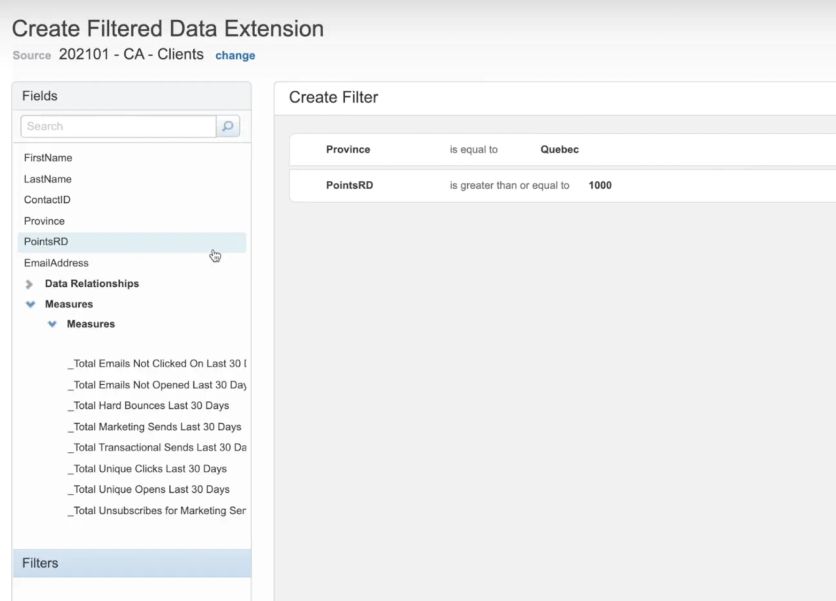
Salesforce Marketing Cloud: user segmentation
Omnichannel Capabilities
Coverage is excellent. Out of the box, Agentforce Marketing handles email, SMS, MMS, and push, and it integrates paid social audiences. Journey Builder can chain an email, an SMS reminder, and a Facebook audience ad if there is no response, and Advertising Studio handles ad and retargeting audiences.
Agentforce Marketing aims to be the single hub for digital communications. One gap is on-site content personalization and A/B testing, which live in separate products like Marketing Cloud Personalization and Salesforce CMS rather than in the core suite.
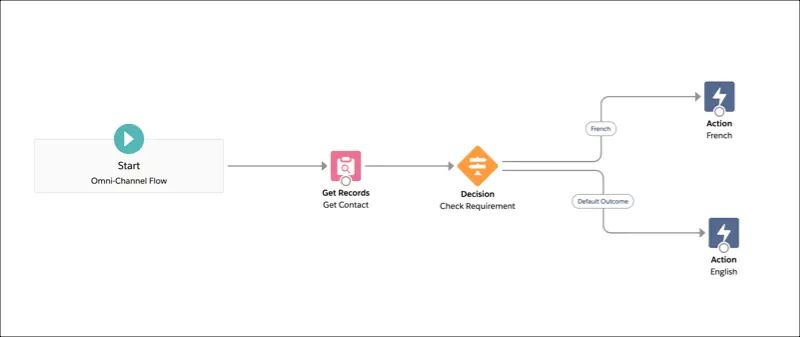
Salesforce Marketing Cloud flow builder
Scalability and Flexibility
Agentforce Marketing scales high. Some of the largest retailers, banks, and travel companies send billions of messages through it, and its infrastructure on Salesforce Hyperforce handles huge data volumes. Flexibility cuts both ways. You can craft very complex solutions across its many studios, but that also means complexity. Most enterprises find it flexible enough, and the real question is whether they have the resources to use that flexibility.
Integrations
Agentforce Marketing integrates best inside the Salesforce family, including Sales Cloud, Service Cloud, and Commerce Cloud, for 360-degree data sharing. A retailer on Salesforce Commerce can feed product and transaction data fairly easily. Connecting third-party platforms like Shopify or Magento is less direct and often needs custom API work or middleware, since Salesforce favors its own commerce platform.
Agentforce Marketing has APIs and some connectors, but integration can become a project, especially for real-time sync, unless you are already on Salesforce.
Pricing
Agentforce Marketing is high-end and modular, known for complex, premium pricing. You buy a tier, such as Pro, Corporate, or Enterprise, with contact and feature limits, then add modules like extra messaging or Studios. Costs can reach six or seven figures a year for large implementations. It is usually one of the most expensive options, fitting when a business is ready to invest heavily in marketing tech.
User Experience
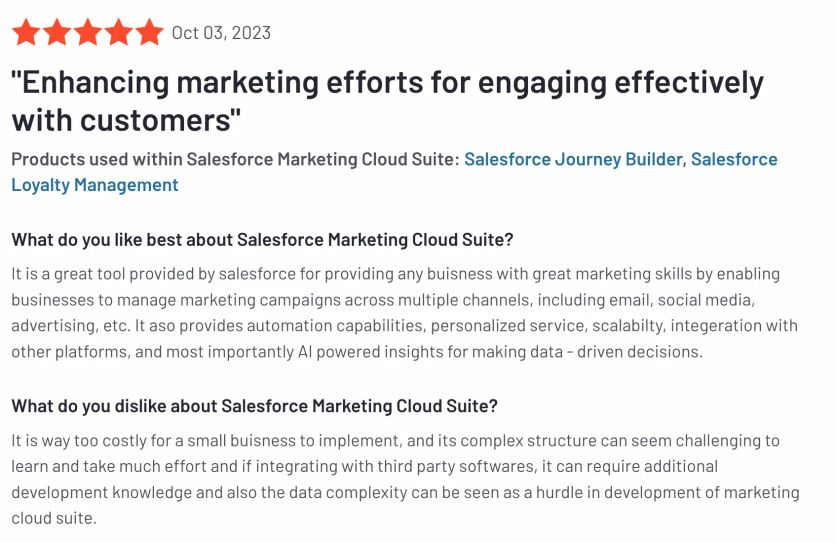
Agentforce Marketing is resource-intensive. Users note that it is powerful but not very intuitive for new marketers, and its separate studios can feel siloed. A sophisticated journey might call for SQL queries, AmpScript coding, and an understanding of data extensions, all of which raise the required skill. Many companies bring in certified Agentforce Marketing consultants to implement and manage it.
Once configured, everyday tasks like building an email or SMS campaign run through wizards and content builders. Salesforce keeps improving usability, and Trailhead training helps, but next to easier tools it needs a dedicated, trained team to reach full value.
How It Compares
Against Bloomreach, Agentforce Marketing can rival it on AI-driven personalization when combined with Marketing Cloud Personalization, while Bloomreach’s edge is its specialized on-site product discovery and merchandising.
Against Maestra, Salesforce is broad and modular and covers most enterprise needs, but it usually costs a lot and demands dedicated expertise, where Maestra delivers a unified suite at a lower price with faster onboarding.
7. Braze: Best for Mobile-First Engagement
Braze is a customer engagement platform known for its strength in real-time mobile and multichannel marketing. It’s used by many consumer brands (including retailers, media, and fintech) to deliver coordinated messages across mobile apps, websites, and email. If your e-commerce business has a significant mobile app audience or you need instantaneous personalization, Braze can be a compelling alternative to Bloomreach’s engagement module.
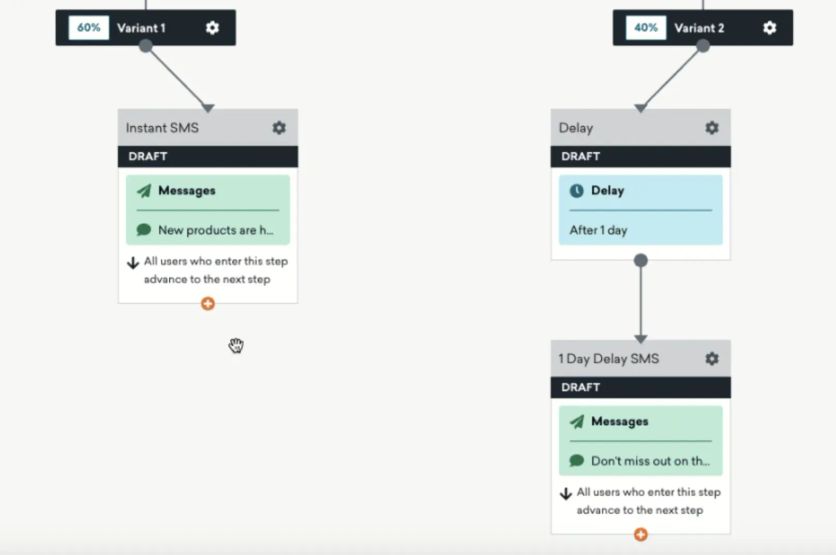
Braze’s Canvas tool
Key Features
- Real-time triggers on app and web events
- Push, in-app messages, and Content Cards, plus email and SMS
- BrazeAI Decisioning Studio for automated message optimization
- Web push, native WhatsApp, and RCS
- SDKs and Currents for real-time data streaming
Personalization and AI
Braze focuses on real-time personalization and reacts to app or web events within seconds to trigger messages. It supports personalized content insertion, and its BrazeAI suite predicts churn and optimal send times. In 2025, Braze acquired OfferFit and folded its reinforcement-learning decisioning into BrazeAI Decisioning Studio, adding one-to-one automated message optimization.
Braze does not ship product catalog recommendations the way Bloomreach does, but it can ingest recommendation data from other systems or personalize messaging through Currents. Its personalization is very strong for messaging and lighter on on-site product discovery.
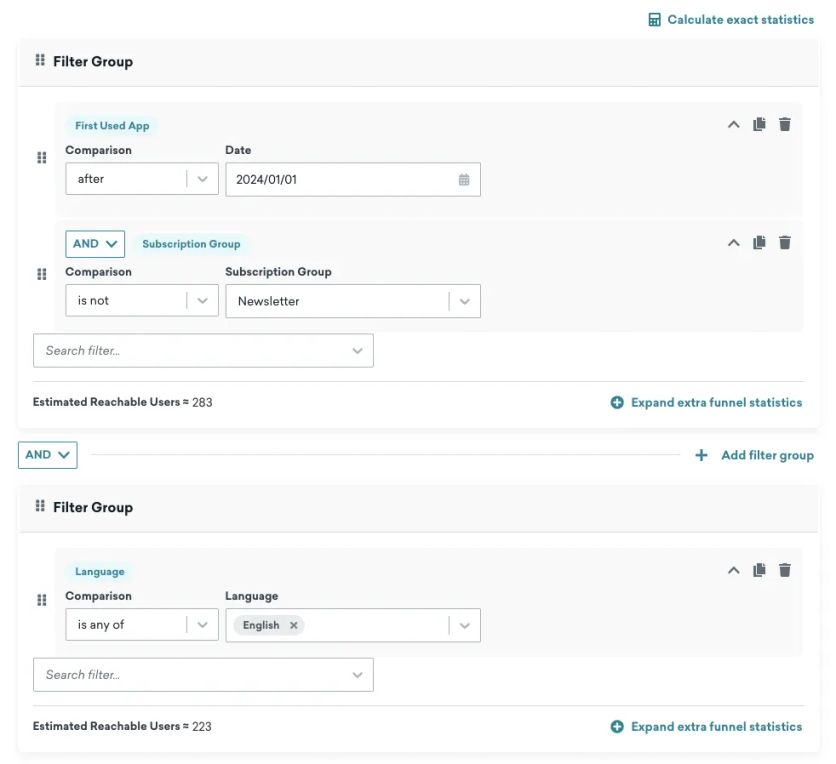
Creating a segment in Braze
Omnichannel Capabilities
Braze covers mobile and web deeply. It started as a mobile-first platform, formerly Appboy, so it excels at push, in-app messages, and Content Cards. It also handles email, SMS, web push, native WhatsApp and RCS, and webhooks. A retailer can push a cart reminder in the app, follow up by email, and show an in-app discount on the next open.
Braze does not change on-site web content the way a personalization engine does, so for that you pair it with a testing tool or use its Content Cards. Its strength is omnichannel with a mobile and messaging emphasis.
Scalability and Flexibility
Braze scales to enterprise needs and handles huge event and message volumes for clients with tens of millions of users. Developers stream data in real time, and marketers then build granular segments and triggers. Its real-time streaming architecture is a plus for speed and flexibility, though using it fully often means having developers set up the SDKs and data flows. For email-only use cases, Braze can be overkill. For multi-channel real-time engagement, it shines.
Integrations
Braze provides mobile and web SDKs to capture events and attributes, plus an API and data export through Currents and partners. Integrating with e-commerce platforms is not one-click like Klaviyo – instead, you instrument your app or site to send events to Braze. Many companies feed e-commerce events like purchases into Braze in real time through their data pipeline or CDP.
It also has pre-built connectors for Segment, mParticle, and other customer data platforms, which helps if you already use them. Integration is developer-driven and well-documented.
Pricing
Braze is premium and custom-quoted, priced on monthly active users and message volume with no public rates. For mid-market, it can run expensive unless your focus is heavily mobile, where its value is highest. Some growing D2C brands still use it as they scale, so it is not only for Fortune 500. Packages can start in the low tens of thousands per year and grow from there. It will not match Klaviyo on price, and for rich mobile push, many teams find the ROI worth it.
User Experience
Braze has a modern UI that marketers like, though initial setup takes technical work. Once the data flows are in place, building campaigns and segments runs smoothly through the drag-and-drop Canvas, and playbooks help teams get started. The learning curve is moderate, easier than heavy enterprise suites and a bit more complex than self-serve email tools. Braze’s documentation and customer success earn frequent praise. You may need a developer to set things up, and your marketing team should run it day-to-day after onboarding.
How It Compares
Against Bloomreach, Braze excels at mobile-first, real-time engagement and push notifications, while Bloomreach excels in integrated site search, content management, and product recommendations.
Against Maestra, Braze offers strong mobile marketing and real-time triggers, but it requires more developer effort, whereas Maestra focuses on holistic retail experiences, with out-of-the-box loyalty and site personalization for non-technical marketers.
Which Bloomreach Alternative Is Right For You
The best choice comes down to your priorities, budget, and team resources. If you need specialized site search and advanced merchandising, Bloomreach remains a strong contender despite the higher price.
If you want to consolidate several marketing tools in one place with strong support, Insider, SAP Engagement Cloud, and Klaviyo each shine in specific areas, especially for mid-market teams.
Brands after enterprise-level capabilities without the overhead can look to Adobe or Salesforce, as long as they are ready for a hefty investment.
And for mobile-first businesses that want to engage users in real time, Braze is the natural choice.
Why Start with Maestra
Maestra balances cost and capability in a way the others do not. It brings advanced personalization, loyalty, real-time behavioral triggers, and native integrations with major e-commerce platforms, all inside an interface small teams can run without a specialist.
If you are a mid-market or fast-growing retailer that wants to improve customer experiences without juggling vendor contracts or draining internal resources, Maestra’s all-in-one approach is a strong place to start. Book a demo today!
FAQ
- Klaviyo offers a free plan supporting up to 250 contacts with email capabilities – the strongest free option for e-commerce marketing. However, if your goal is to replicate Bloomreach’s breadth (CDP, personalization, multi-channel), a free tool won’t cover it. Maestra starts at $2,000/month for the CDP plus unlimited email and replaces Bloomreach’s entire capability set – plus adds native loyalty – without the Jinja coding or months-long implementation. Blossom Flower launched 38 automated campaigns in a single month and saw a 426% ROI on marketing automation.
- For Shopify brands that need omnichannel campaigns, loyalty, and site personalization alongside email and SMS, Maestra provides the full stack with native Shopify, BigCommerce, and WooCommerce integrations. Magnum Bikes doubled their online orders after switching to Maestra’s unified platform.
- Yes, most marketing platforms accept historical data imports. Maestra’s dedicated Forward Deployed Marketer team handles the complete migration – including customer profiles, segment logic, automation flows, and historical data – as part of onboarding. Sena completed their full migration in just 2 weeks, preserving customer histories and segment structures while immediately improving campaign performance.
- For AI product discovery and site search specifically, Bloomreach is difficult to beat. Maestra offers 14 AI product recommendation algorithms, real-time behavioral segmentation, and AI-powered send-time optimization – delivering commerce-specific AI without requiring Jinja coding or technical expertise. Enlightened Equipment increased average order value by 38.7% with Maestra’s Smart Upsell Bar.
- Among the alternatives listed, Maestra is the only platform with a fully built-in loyalty engine – including points, tiers, referrals, and behavior-based promotions. All other alternatives require a third-party loyalty tool. JOLYN uses Maestra’s integrated loyalty program alongside omnichannel campaigns.
- Bloomreach is rated “$$$$$” on G2 with custom pricing that scales unpredictably with add-ons and usage. Among alternatives: Klaviyo is the most affordable (from $20/month), Maestra starts at $2,000/month for the CDP plus unlimited email, with monthly modules for other channels, SAP Engagement Cloud and Insider One use opaque enterprise pricing, and Adobe/SFMC can reach six to seven figures. Maestra’s transparent, modular pricing gives the clearest cost-to-value picture. Furniture Fair cut marketing costs by 27% after consolidating into Maestra.