
Essential Shopify Apps to Grow Your Store Faster: How to Scale in 2026

Running a Shopify store means installing apps for everything – support tickets, popups, reviews, loyalty, upsells. Each one adds another subscription, another dashboard, and another integration to maintain. The real challenge isn’t finding apps; it’s picking the right combination that works together without blowing up your tech stack.
We compared 13 Shopify apps across five categories – support, conversion, AOV, unified marketing, and shipping & fulfillment – so you can build a stack that matches your growth stage.
We also included three all-in-one platforms that pull multiple categories into a single system – worth considering if you’d rather manage one tool with one customer profile as you scale.
For each app – both the category picks and the all-in-one platforms – we cover what it does well, what it costs, how support works, and what to watch for before committing.
Quick Verdict: Best Shopify Apps by Category
Best for self-service returns and exchanges: SelfServe – automated return portal that cuts support tickets
Best for helpdesk and ticket management: Gorgias – centralized support with Shopify order data in every ticket
Best for AI chat and sales assistance: Rep AI – conversational AI that answers product questions and drives purchases
Best for targeted popups and on-site messages: Wisepops – advanced targeting rules with exit-intent and scroll-based triggers
Best for free popup campaigns: Claspo – drag-and-drop popups with a usable free tier
Best for social proof and product reviews: Judge.me – review collection with photo/video and SEO-friendly rich snippets
Best for fee-free subscriptions: Easy Subscriptions – flexible plans with bundling, build-your-own-box, and a self-service customer portal
Best for reviews + loyalty + wishlists in one: Growave – multiple engagement features consolidated into a single app
Best for upsell and cross-sell funnels: Bold Upsell – in-cart and post-purchase offers with conditional logic
Best for omnichannel e-commerce marketing: Maestra – CDP, email, SMS, push, loyalty, and on-site personalization in one platform
Best for loyalty program management: Yuko Loyalty – points, tiers, and referrals with Shopify-native integration
Best for AI-powered product recommendations: Rebuy – personalized upsell widgets powered by machine learning
Best for on-site product discovery: Nosto – visual merchandising and content personalization for Shopify Plus
Best for Google Shopping feed optimization: AdNabu – AI-optimized product feeds with Merchant Center error fixes and real-time sync
Best for cleaner paid-ad conversion data: Wetracked – first-party server-side tracking that forwards enriched conversion data to Meta, Google, TikTok, and more
Best for FedEx shipping and label automation: PH Ship Rate & Track – FedEx-certified app for live rates, bulk label printing, and tracking
Best for Australia Post fulfillment: PluginHive Australia Post Ship – MyPost Business, eParcel, and StarTrack integration with bulk label printing
Content:
Essential Shopify Apps for Ecommerce at a Glance
We split the shortlist into two groups. The first group covers point solutions: each tool does one job well – support, popups, reviews, or upsells. You pick one from each category based on your priorities.
| App | Category | Starting Price | Shopify Rating | Best For |
|---|---|---|---|---|
| SelfServe | Post-purchase operations | Free; from $79/mo | 5.0 | Self-service order editing with built-in post-purchase upsells |
| Gorgias | Customer service helpdesk | From $10/mo (50 tickets) | 4.3 | Centralized ecommerce helpdesk with deep Shopify integration and AI automation |
| Rep AI | AI shopping assistant and support bot | From $99/mo (a 30-day free trial) | 4.7 | Proactive AI sales agent and post-purchase support bot trained on your Shopify catalog |
| Wisepops | Popups and CRO | From $99/mo | 4.9 | AI-driven product recommendations inside popups with behavioral targeting |
| AdNabu | Google Shopping feed optimization | Free to install; $39.99/mo for Grow | 4.9 | AI-optimized product feeds with Merchant Center error fixes and real-time sync |
| Claspo | Popups and lead capture | Free (3K pageviews); from $39/mo | 4.9 | Gamified popups and lead capture with 1,000+ templates |
| Judge.me | Product reviews | Free; $15/mo for Awesome | 5.0 | Affordable review collection with Google rich snippets and SEO impact |
| Easy Subscriptions | Subscriptions & retention | Free to install; from $39/mo | 5.0 | Flexible, fee-free subscription models with bundling and self-service |
| Growave | Loyalty and retention | Free (100 orders); from $49/mo | 4.8 | Bundled loyalty programs, reviews, wishlists, and referrals |
| Bold Upsell | Upsell and cross-sell | Free (up to 50 orders/mo); from $25/mo | 4.3 | Pre-checkout and post-purchase upsell funnels with AI recommendations |
| Wetracked | Ad tracking & conversion data | From $49/mo (14-day free trial) | 4.8 | First-party server-side tracking that forwards enriched conversion data to Meta, Google, TikTok, and more |
| PH Ship Rate & Track for FedEx | Shipping | From $19/mo | 4.9 | FedEx-certified live rates, bulk label printing, and tracking for FedEx-heavy US merchants |
| PluginHive Australia Post Ship | Shipping | From $19/mo | 5.0 | Australia Post fulfillment with MyPost Business, eParcel, and StarTrack |
All-in-one platforms are the second group – unified systems that replace several point solutions with a single tool and one customer profile across channels.
| Platform | Category | Starting Price | Shopify Rating | Best For |
|---|---|---|---|---|
| Maestra | All-in-one personalization | From $2,000/mo (CDP + unlimited email; add modules as you grow) | 5.0 | Full-funnel personalization, omnichannel flows, loyalty, and AI recommendations – all in one platform |
| Yuko | All-in-one retention platform | Free; from $12/mo | 5.0 | Shopify stores looking to combine loyalty, reviews, and referrals to increase conversions |
| Rebuy | AI personalization and upsell | From $25/mo per package (only checkout extensions and post-purchase offers) + $0.10/order | 4.7 | Modular AI-powered product recommendations, smart cart, and post-purchase upsells for Shopify |
| Nosto | AI ecommerce personalization | Custom pricing: revenue-based license + modules | 4.8 | AI-driven product recommendations, search, merchandising, and content personalization |
Part 1: Apps That Reduce Support Load
Most Shopify stores cannot invest in growth because their team is buried in support. Every hour spent answering “Where is my order?” or processing a manual address change is an hour not spent on campaigns, merchandising, or conversion optimization. The first step to scaling is getting that time back. The three tools below take different approaches: letting customers resolve common requests themselves, automating the tickets that still come through, and deflecting routine questions before they reach a human.
SelfServe
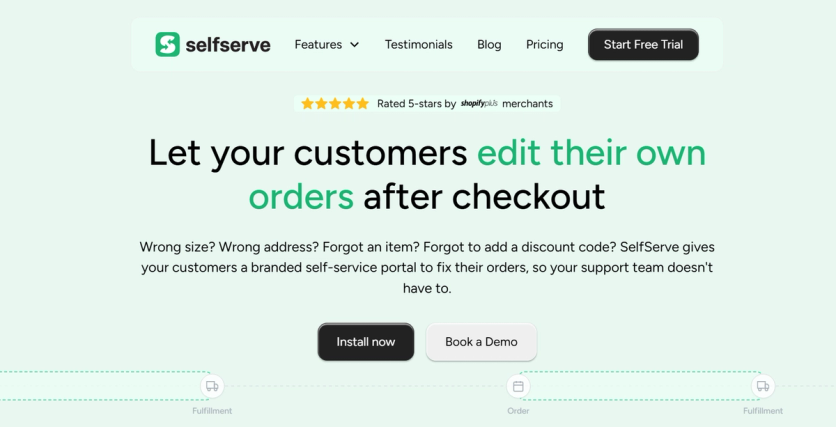
SelfServe’s primary value is letting customers resolve common post-purchase requests – address changes, product swaps, quantity adjustments, cancellations – without ever contacting your support team. The self-service portal is embedded directly in the customer account page, so the experience feels native rather than redirected. SelfServe also helps merchants increase AOV: during the editing flow, SelfServe presents upsell offers with automatic discounts.
Key Features
- Self-service order editing: Customers swap products, change variants, adjust quantities, and update shipping details through a branded portal on the order status page – all without contacting support.
- Configurable edit windows: Set time-based limits or advanced conditional rules controlling what customers can edit and when.
- Google Maps address validation: Prevents failed deliveries by prompting customers to correct invalid addresses before shipment.
- Cancellation queue: Self-service cancellation flow with approval queues and tag-based restrictions to protect high-value orders.
- Shopify Flow automation: Tags orders when changes are made, triggers workflows, updates packing slips, and routes to fulfillment providers.
- Post-purchase upsells: One-click upsell offers appear on the checkout and order status pages during the editing flow.
- Payment handling: Automatically collects price differences or issues refunds. 15-minute auto-revert if a customer does not complete payment for an upgraded order.
Support
Support is available through the app. Users report fast response times – one review mentions a bug fix delivered in 20 minutes.
Pricing
| Plan | Monthly Price | Orders/mo | Edits | Upsells |
|---|---|---|---|---|
| Free | $0 | Up to 2,500 | 5/mo | 5/mo |
| Starter | $79 | Up to 2,500 | Unlimited | Unlimited |
| Professional | $159 | 2,500-5,000 | Unlimited | Unlimited |
| Enterprise | $299 | 5,000+ | Unlimited | Unlimited |
All paid plans include a 5-day free trial.
What to Consider
The free plan is limited: 5 edits and 5 upsells per month. The app is effective for stores with high volumes of “Where is my order?” and “Can I change my order?” tickets, but adoption depends on customer behavior. If your customer base is not accustomed to self-service order management, you may see lower utilization than expected. The upsell functionality is tied to the order editing flow, so its reach is limited to customers who actively modify orders.
Gorgias
Gorgias is purpose-built as a customer service helpdesk for ecommerce. It centralizes conversations from email, live chat, SMS, WhatsApp, Facebook, Instagram, and TikTok into one unified inbox with full Shopify order context. Agents can view order history, issue refunds, edit orders, and manage subscriptions without leaving the ticket – and an AI agent handles routine requests like order tracking and returns 24/7.
Key Features
- Omnichannel inbox: All customer messages from every channel in a single feed with customer context attached. No switching between tabs or platforms.
- Deep Shopify integration: Customer sidebar shows full order history, lifetime value, tracking info, and subscription status. Agents can cancel, refund, duplicate, or create Shopify orders directly inside tickets.
- AI Agent: Handles routine questions autonomously – order tracking, shipping updates, cancellations, returns, FAQs, and product recommendations. Gorgias claims up to 60% of support inquiries resolved without human intervention. Includes automatic handoff to human agents when confidence is low or the customer is angry.
- Macros and automation rules: Canned responses that auto-populate customer data, plus if-then rules for auto-tagging, assignment, routing, and sentiment detection.
- Two AI modes: Support Agent (handles support inquiries) and Shopping Assistant (product recommendations and selling).
Support
Starter and Basic plans include email and chat support. Pro plan adds priority support. Advanced plan includes a dedicated success manager. Support quality gets mixed feedback – some merchants report slow response times during peak seasons.
Pricing
| Plan | Monthly Price | Tickets/mo | Overage |
|---|---|---|---|
| Starter | $10 | 50 | $0.40/ticket |
| Basic | $60 | 300 | $0.40/ticket |
| Pro | $360 | 2,000 | $0.36/ticket |
| Advanced | $900 | 5,000 | $0.36/ticket |
| Enterprise | Custom | Custom | Custom |
The starter plan is limited to 3 user seats; all other plans support up to 500. AI Agent costs $1.00 per automated resolution. Both the helpdesk ticket fee and the AI automation fee apply to the same ticket. Voice and SMS require separate add-ons. 7-day free trial on all plans.
What to Consider
Gorgias’s ticket-based pricing creates cost unpredictability during peak seasons. The AI Agent only works on email, chat, and SMS – Facebook Messenger, Instagram DMs, WhatsApp, and TikTok are excluded. The AI Agent also only works on Shopify – BigCommerce, Magento, and WooCommerce stores cannot use it. Analytics are limited compared to dedicated tools like Zendesk without add-ons.
Rep AI
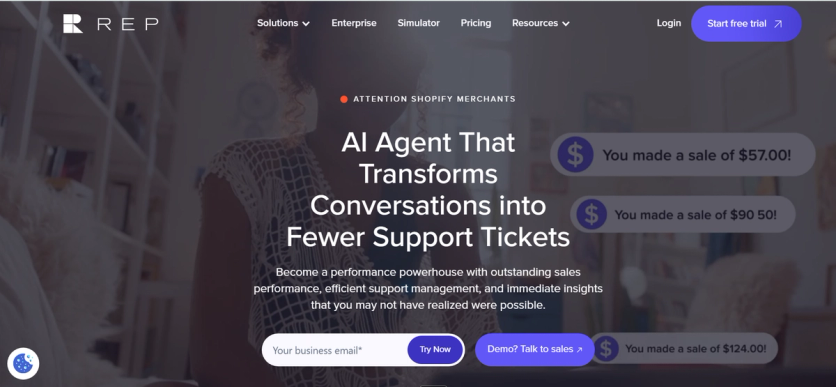
Rep AI is a Shopify-native AI chatbot that combines a sales assistant and a support agent into one widget. The sales side proactively engages browsing visitors with product recommendations, answers product questions, and recovers abandoned carts; the support side handles post-purchase inquiries – order status, returns, exchanges, subscription edits – without escalating to a human. The bot is trained on the merchant’s product catalog, policies, and brand voice, with real-time inventory sync so recommendations never surface out-of-stock items.
Key Features
- Proactive AI sales agent: Detects browsing intent and starts conversations at the right moment with personalized product suggestions, comparisons, and upsell offers. Trained on the full product catalog with attribute-level matching (size, color, material, use case).
- AI support agent: Resolves post-purchase tickets autonomously – order tracking, returns, exchanges, refund status, subscription changes – by connecting to Shopify order data and integrated tools like Gorgias, Zendesk, and Klaviyo.
- Real-time catalog sync: Inventory, pricing, and product attributes stay current so the bot never recommends sold-out items or surfaces stale promo information.
- Custom AI training and personality: Brand-specific tone, escalation rules, and response templates configurable without code. Multi-language support out of the box.
- Seamless human handoff and analytics: Routes complex or low-confidence conversations to human agents with full chat context preserved. Dashboard tracks engagement rate, conversion lift, recovered revenue, and ticket deflection. Live chat available on web and mobile.
Support
Onboarding included on all paid plans, with custom AI training assistance during setup. Standard support via in-app chat and email; higher tiers add priority response and dedicated success managers. Reviews praise the support team’s responsiveness during implementation.
Pricing
| Plan | Details |
|---|---|
| Starter | $99/mo, up to 10K visitors and 1K products |
| Basic | $199/mo, up to 25K visitors and 2K products |
| Standard | $350/mo, up to 50K visitors and 5K products |
30-day free trial on all paid plans. Annual billing is available at a lower monthly rate than month-to-month plans. Additional visitors cost $12 per 1,000. Custom pricing for stores above 50K monthly visitors or 5K SKUs.
What to Consider
Rep AI’s pricing scales by visitor volume, so high-traffic stores can outgrow the published tiers quickly – costs above 50K visitors require a custom quote. Some Shopify reviewers report that the AI delivers confident-sounding answers that miss the actual question, leading to frustrated chat sessions and circular conversation loops; quality depends heavily on how thoroughly the bot is trained during onboarding. The product catalog cap (max 5,000 SKUs on the published plans) is a hard ceiling for larger stores. Rep AI is a chat-and-conversation tool only – it does not centralize multi-channel tickets the way Gorgias or Zendesk do, so it works best as a layer on top of an existing helpdesk rather than a replacement.
Part 2: Apps That Boost Conversions
If your conversion rate stays flat, the only way to grow revenue is to spend more on ads – and acquisition costs keep rising. Even a 0.1% lift in conversion rate multiplies across every future visitor, and unlike ad spend, it keeps paying out after the campaign ends. The tools below help you convert more of the traffic you already have – through social proof that builds trust, and targeted on-site messaging that reaches shoppers at the moment they are most likely to buy.
Wisepops
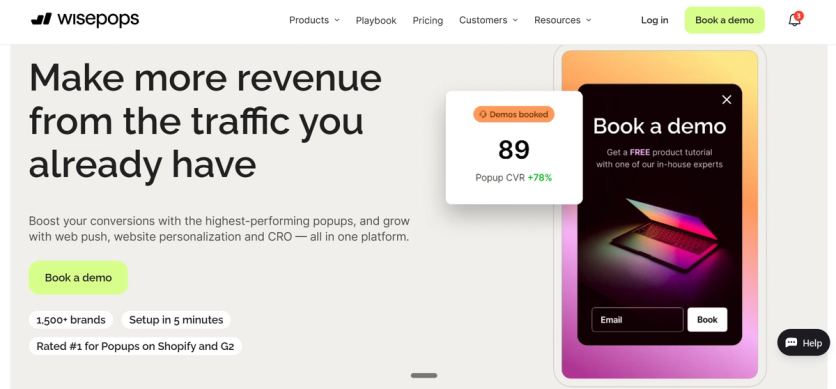
Wisepops combines popups with AI-driven product recommendations and behavioral targeting to convert browsing visitors into buyers. Its standout feature is a notification feed (similar to an on-site notification bell) that lets you reach returning visitors with personalized offers without interrupting their browsing. The platform processes over 25 billion behavioral signals to power its targeting engine.
Key Features
- AI product recommendations inside popups and notification feeds – one-click setup, analyzes purchase intent and upsell opportunities automatically.
- Advanced A/B testing with control groups – measures true revenue-per-visitor impact, not just click rates.
- 20+ ready-made campaign types: Cart recovery, upsell, list building, FOMO, exit-intent, and discount campaigns.
- Notification feed (Wisp): An on-site notification center (bell icon) for persistent, non-intrusive messaging – unique among popup tools.
- Shopify-specific targeting: Rules based on Shopify tags, cart value, products in cart, customer order history, URL, traffic source, and behavioral patterns.
- Revenue attribution tracking which campaigns and popups drive actual purchases.
Support
In-app support and live chat. Managed plans include a dedicated strategist. The team is Paris-based, so response times may be slower for US merchants outside European business hours.
Pricing
| Pageviews/mo | Monthly Price |
|---|---|
| 100k pageviews | $99 |
| 250k pageviews | $179 |
| 500k pageviews | $249 |
14-day free trial on all plans, no credit card required. No free plan available.
What to Consider
Wisepops uses pageview-based pricing, meaning you pay for all traffic regardless of whether a popup is shown. There is no free plan, only a 14-day trial. Users on Capterra and G2 report limited template customization beyond the 200+ included designs. The notification feed is a genuine differentiator, but not every store needs it – and it is bundled into the price either way.
AdNabu
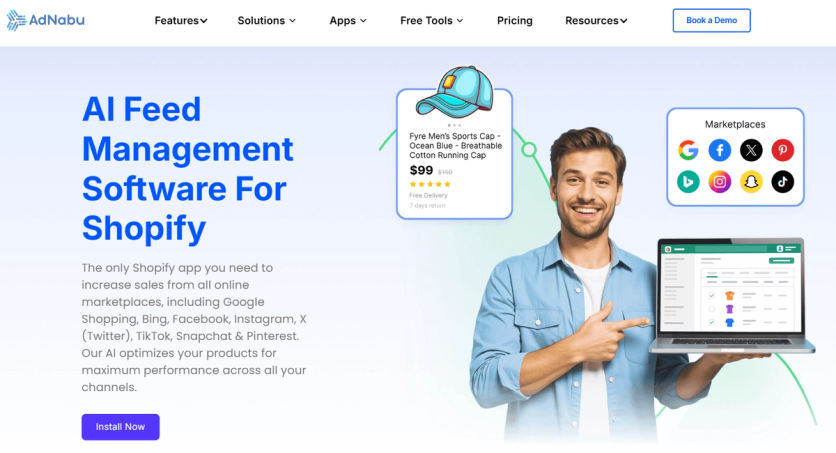
For high-traffic stores, feed quality is a conversion lever in its own right: accurate real-time listings, plus star ratings pulled onto your Shopping results, mean shoppers arrive pre-qualified and more of that traffic converts. Nabu for Google Shopping Feed is a product feed optimization tool that helps Shopify merchants enrich their product data for marketplaces such as Google Shopping, Meta, Pinterest, Snapchat, and Bing. Built by AdNabu, the app uses AI to generate optimized titles and descriptions, fix Google Merchant Center errors, and sync product changes from Shopify to Google in real time. It is “Built for Shopify” certified and supports Shopify Plus stores with headless setups.
Key Features
- AI-powered feed optimization: improves product titles, descriptions, and attributes automatically using ChatGPT, with up to 100K AI credits per month on the Plus plan.
- Google Merchant Center error resolution: automated suggestions, validation scores, and one-click fixes to keep your account in good standing.
- Feed rules, metafields, and blocklists: customize product data, exclude collections or product types, and override specific attributes without touching your Shopify catalog.
- Real-time sync: any change to a product, price, or inventory in Shopify reflects in Google within minutes (instant sync on the Plus plan, hourly on Advanced).
- Product review integration: Judge.me, Yotpo, Loox, Okendo, Smile.io, and more to show star ratings on Google Shopping listings.
- Multi-language and multi-currency support: across 20 languages, with localized feeds for international markets and Shopify Markets compatibility.
- Bulk export and import: via CSV, Shopify Flow automation, Shopify Product Taxonomy mapping, and Google Keyword Suggestions for better targeting.
Support
24/7 priority support with a dedicated account manager on the Plus plan. Lower tiers get email and chat from certified Google Ads experts who liaise with Google directly on disapprovals and account suspensions. Reviewers consistently flag the team as responsive and proactive.
Pricing
| Plan | Price | What You Get |
|---|---|---|
| Explorer | Free to install | Up to 100 products, 1 target country, Merchant Center analytics ($19.99/mo after 10 orders) |
| Grow | $39.99/mo | Unlimited products and countries, AI optimization, bulk edit |
| Advanced | $99.99/mo | 20K AI credits, XML feeds, review integration, hourly sync, headless support |
| Plus | $249.99/mo | 100K AI credits, unlimited XML feeds, instant sync, dedicated account manager |
Annual billing saves 17–20%. 14-day free trial on all paid plans.
What to Consider
The free Explorer plan caps at 100 products and 10 orders per month, which most active stores outgrow quickly. Instant sync is gated to the Plus tier at $249.99/mo, so smaller stores run on hourly sync instead. AI credits are also tied to plan level, so catalog-heavy stores running aggressive optimization may need to size up to avoid hitting monthly limits.
Claspo
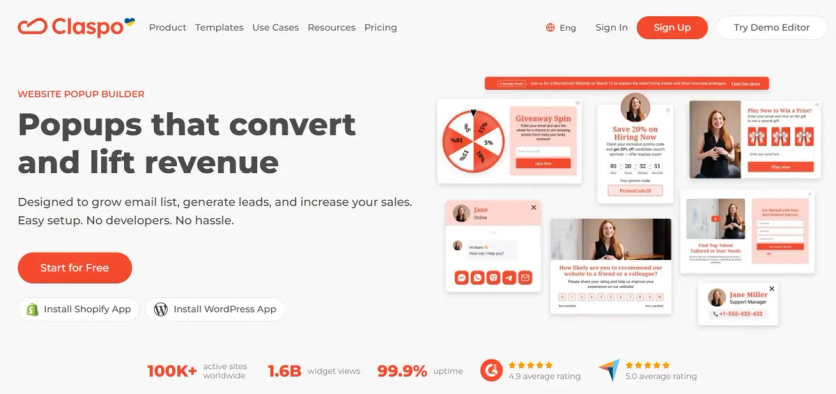
Claspo is a popup and lead capture app built around one of the largest template libraries on Shopify – over 1,000 mobile-responsive designs covering exit-intent, email capture, countdown timers, and gamified signup forms. For stores that need to start collecting emails and converting exit-intent visitors quickly without custom design work, Claspo offers a fast path to deployment.
Key Features
- 1,000+ templates covering 36+ use cases, including spin-to-win wheels, mystery boxes, scratch cards, and memory matching games – all available on every plan including free.
- Smart targeting: Geolocation (country, region, city), new vs. returning visitors, UTM parameters, exit-intent, scroll depth, time on page, and cart value thresholds. Automatic overlap prevention when multiple campaigns share triggers.
- A/B testing with continuous optimization that keeps the highest-converting variant active while testing new variations.
- Multi-step forms with conditional logic and AI-powered content generation.
- Relative countdown timers that start individually per visitor – useful for scaling urgency-based offers without a fixed deadline.
Support
Priority support is available on all paid plans. Claspo provides support via a live chat and email. It also helps teams with onboarding and launching campaigns. Claspo is designed as a do-it-yourself tool, so marketing teams can build and optimize popups without technical support.
Pricing
| Plan | Monthly Price | Pageviews/mo |
|---|---|---|
| Free | $0 | 3,000 |
| PRO 50 | $39 (or $29/mo billed annually) | 50,000 |
| PRO 100 | $69 (or $49/mo billed annually) | 100,000 |
All features are available on every plan – the only difference is pageview volume and number of websites. Free plan includes a “Powered by Claspo” badge. 14-day free trial on all paid plans.
What to Consider
Claspo’s free plan caps at 3,000 pageviews per month, which most active stores will exhaust quickly – and Claspo counts every page load where the script is present, not just popup impressions. The integration library (around 20 integrations) is smaller than some other popup apps.
Judge.me
Judge.me addresses one of the most fundamental conversion barriers in ecommerce: the absence of customer reviews. The platform collects product reviews with photo and video support, populates Google rich snippets for search visibility, and syndicates reviews across Google Shopping, Meta, TikTok, and Instagram. It has earned a 5.0 rating across more than 37,000 Shopify reviews – one of the highest-reviewed apps on the entire App Store – and won the 2025 Shopify Build Award.
Key Features
- Unlimited reviews on the free plan: Automated email requests after fulfillment, in-email review submission (customers do not need to visit your site), photo and video reviews, star rating badges, and Google rich snippets – all at no cost.
- Google Shopping and SEO integration: JSON-LD structured data and metadata optimization for search. Reviews syndicate to Google Shopping, Meta, TikTok Shop, and Instagram.
- AI-powered tools (Awesome plan): AI review replies, AI review summaries, and automatic multi-language translation.
- Review import: Bring existing reviews from Amazon, Etsy, Yotpo, Loox, and other platforms.
- 16 customizable widgets including carousels, Q&A sections, testimonials, and trust badges.
- 100+ integrations (Awesome plan) with Klaviyo, Gorgias, Shopify Flow, and others.
Support
24/7 support via in-app chat and email. The team handles queries in English, Portuguese, French, and Spanish. However, some recent reviews note that initial support responses come from an AI chatbot, which can require extra steps to reach a human agent.
Pricing
| Plan | Price | What You Get |
|---|---|---|
| Forever Free | $0/mo | Unlimited reviews, photo/video, rich snippets, basic widgets, review import |
| Awesome | $15/mo | All features, AI tools, 100+ integrations, SMS requests, Q&A, coupons, full customization, no branding |
Flat pricing with no scaling costs based on order volume. 15-day free trial of the Awesome plan.
What to Consider
If a customer orders multiple products, Judge.me sends a separate review request email for each item – which can feel spammy for large orders. The default widget design is functional but not the most polished; advanced styling requires CSS knowledge. Judge.me is Shopify-only, which limits multi-platform merchants. The free plan includes a Judge.me badge on all widgets.
Part 3: Apps That Increase Order Value and Repeat Revenue
Converting a visitor into a customer is only half the equation. The apps in this section focus on getting each customer to spend more per transaction – through upsells, cross-sells, loyalty incentives, and post-purchase opportunities that add revenue without adding acquisition costs.
Easy Subscriptions
Easy Subscriptions gives Shopify merchants a full subscription toolkit, flexible plan types, product bundling, and a self-service customer portal, with 0% transaction fees on every plan, including free. It’s trusted by 2,000+ Shopify merchants and holds “Built for Shopify” certification. The app is built for brands where the subscription itself is core to the product experience: coffee, meal kits, pet supplies, and other replenishment or curation-based D2C businesses.
What sets it apart is the depth of control it gives both merchant and customer in one app, rather than bolting bundling or loyalty on as separate tools. Brands can run rotating product series, fixed bundles, or build-your-own-box subscriptions side by side, while customers manage pause, skip, and swap actions themselves, reducing the support load that typically comes with recurring orders. Merchants specifically cite the seamless checkout, intuitive interface, and quick setup without transaction fees as reasons they chose it over competitors.
Key Features
- Customizable subscription plans: Weekly, monthly, or fully custom billing cadences to match the product and category.
- Recurring & prepaid subscriptions: Supports both standard recurring billing and prepaid subscription terms in the same app.
- Subscription series: Rotates different products over time within one subscription, useful for coffee, meal, and variety-box brands.
- Fixed bundles & build-your-own-box: Merchant-curated bundle subscriptions or customer-built boxes from a defined product set.
- Quantity-based tiered discounts: Automatic discounting that scales with order size to encourage larger subscriptions.
- Upsell & cross-sell offers: Additional revenue opportunities surfaced directly within the subscription flow.
- Gift products & loyalty incentives: Rewards for long-term subscribers to support retention.
- Customer self-service portal: Pause, skip, swap, or reschedule subscriptions without contacting support.
- Smart dunning & payment retry: Automated retry logic to recover failed payments and reduce involuntary churn.
- Subscription analytics & reporting: Visibility into subscriber behavior, recurring revenue, and churn.
- Bulk subscription management: Tools for handling large subscriber bases efficiently.
- Easy migration: Straightforward switch-over from other subscription apps, including Recharge, Bold, Skio, Appstle, and Seal.
- Integrations: Klaviyo, Omnisend, Mailchimp, and more.
Support
Live support is available 24/7, even on the free plan, a differentiator from apps that gate real-time support behind paid tiers. Reviewers consistently point to support as a standout: one merchant reported the support team explained subscription setup, product plans, and integration thoroughly, and specifically credited them with guidance on building a subscription model to increase recurring revenue and retention. Another reviewer noted the support team resolved every issue quickly at no extra cost. The app currently holds a 5.0-star rating from 206 total reviews on the Shopify App Store.
Pricing
| Plan | Price | What You Get |
|---|---|---|
| Starter | $0/mo | Up to 100 subscription orders/mo, 0% transaction fees, subscription plans & contracts, dunning management, product swapping with fallback, prepaid + manual orders, widget customization, unlimited emails + language translations, quantity breaker, 24/7 live support |
| Growth | $39/mo | All in Starter+, up to 1,000 subscription orders/mo, Build-Your-Own-Box, fixed product bundles, customer retention tools, trial products, gift products, dedicated success manager |
| Scale | $99/mo | All in Growth+, up to 10,000 subscription orders/mo, upsell & cross-sell with discounts, scheduled billing dates, custom email domain, dedicated success manager |
| Enterprise | $399/mo | All in Scale+, unlimited subscription orders, order-based & time-based series subscriptions, auto sequence calendar swaps, post-purchase upsell with discount, dedicated success manager, custom plans available |
What to Consider
Zero transaction fees on every plan, including free, is a genuine differentiator versus subscription apps like Recharge or Skio that charge a percentage on top of the subscription price. The free plan and 24/7 support even at that tier also stand out versus competitors that reserve real-time support for paid users. The limits are volume- and tier-based: the free plan stops at 100 subscription orders a month and Growth at 1,000, build-your-own-box and fixed bundles start at Growth, and order- and time-based series subscriptions plus post-purchase upsell are Enterprise-only. Brands running simple one-SKU recurring orders may not need the bundling and series features that make this app stand out; for those, a lighter, single-purpose app may be enough.
Growave
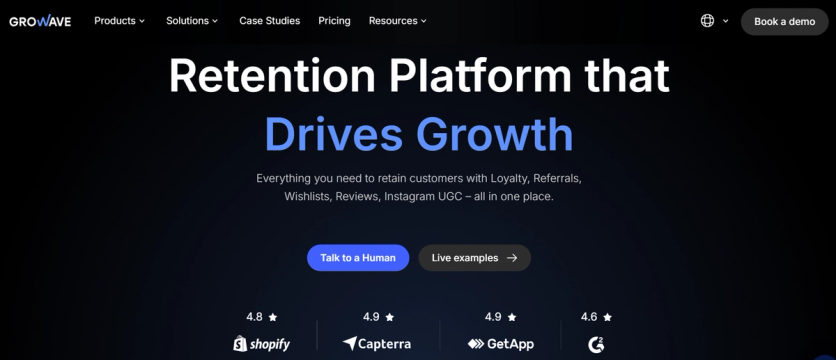
Growave takes the retention route to AOV growth and a broader approach to ecommerce growth by focusing on what happens after the first purchase. Instead of solving a single conversion issue, it brings together loyalty programs, VIP tiers, referrals, reviews, wishlists, and user-generated content into one connected retention system. This creates multiple pathways for customers to return and spend more. The platform is designed for Shopify brands that want to move beyond one-off transactions and build long-term customer relationships through consistent engagement and personalized experiences. Brands like LEGO, Sony, Birkenstock, and Toys“R”Us use Growave to drive repeat purchases through points-based rewards and tiered incentives that motivate higher spending per transaction.
Where competitors operate in silos, Growave combines multiple customer retention drivers into a unified ecosystem. This allows brands to reward behavior, collect social proof, and re-engage customers across different touchpoints without relying heavily on discounts or fragmented tools.
Key Features
- All-in-one retention platform: Loyalty programs, referrals, reviews, wishlists, and Instagram-based social proof are managed in a single dashboard, reducing the need for multiple apps and integrations.
- Loyalty & points program: Flexible points-based rewards for purchases, sign-ups, social actions, and custom events. Brands can tailor earning rules and redemption options to match their customer lifecycle.
- VIP tiers: Tiered loyalty system that rewards high-value customers with exclusive perks like bigger discounts, free shipping, or early access to products. This encourages repeat purchases and long-term engagement because the progression is based on spending or engagement.
- Referral program: Built-in referral system with customizable incentives for both brand advocates and new customers, helping drive acquisition through word of mouth.
- Social reviews & UGC: Collects and displays photo reviews, imports existing reviews, and showcases user-generated content to build trust and increase conversion rates. Google Shopping syndication and search snippet support.
- Wishlist functionality: Allows customers to save products and return later, improving purchase intent tracking and enabling targeted remarketing. Back-in-stock notifications and sale alerts for saved items drive return visits.
- Instagram integration: Pulls Instagram content directly into the storefront to create a more dynamic, social shopping experience and strengthen brand credibility.
- Customization & branding: Flexible design options to match storefront aesthetics, with widgets and features that can be adapted to different brand identities. Launch a fully branded loyalty page that matches your store’s look and feel, with customizable design elements that reflect your brand identity and provide customers with an intuitive space to view, earn, and redeem rewards directly within your Shopify storefront.
- Integration: Best-in-class integration with Klaviyo, Gorgias, Attentive, TikTok, etc. Built specifically for Shopify, with seamless integration into themes, checkout, and existing workflows.
Support
Paid plans include 24/7 support via email and live chat, with onboarding assistance and customization guidance. The team is known for helping merchants set up and optimize retention strategies rather than just troubleshooting technical issues. The free plan offers 48-hour email support.
Pricing
| Plan | Price | What You Get |
|---|---|---|
| Free plan | $0/mo | Loyalty points program, Wishlist, Product Reviews, + |
| Entry | $49/mo | Free plan+, Advanced rewards, Referral program & fraud protection, Nudges, Review request email, Shopify POS & Flow, +1 integration, + |
| Growth | $199/mo | VIP Tiers program, Store Credit, Dedicated loyalty page, Shopify POS Loyalty QR, Points expiration & Gift cards, Account extensions & Review attributes, Google Shopping Reviews, + |
| Plus | $499/mo | Checkout extensions, Headless: API & SDK, Custom reward actions. B2B & Unlimited integrations, Customer success manager, + |
| Unlimited | $999/mo | All-in fixed price, No limits on orders, Custom integrations, Features built for Shopify Plus, Enterprise Success Manager, + |
What to Consider
The free plan caps at 100 orders per month with a 500 total lifetime limit. Growave combines multiple retention features into one platform, so it offers a broader solution compared to single-purpose apps. This is a better approach for merchants focused on long-term retention and customer lifetime value that don’t want to stack multiple tools.
Bold Upsell
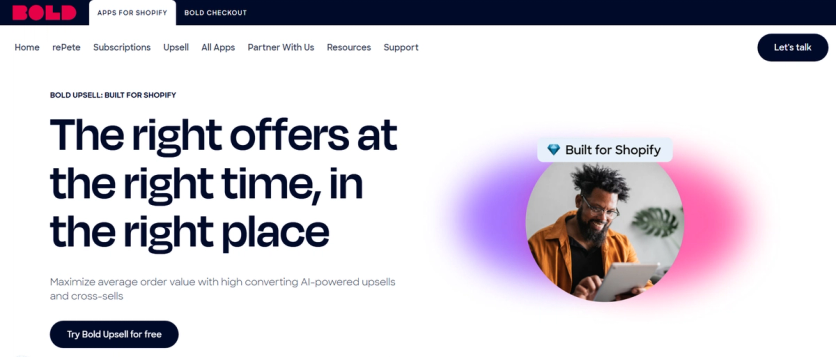
Bold Upsell has been in the Shopify ecosystem since 2012, making it one of the longest-running upsell apps available. The platform uses AI-powered Smart Offers to recommend complementary products at multiple touchpoints throughout the shopping journey – from product pages to post-purchase emails. Bold holds “Built for Shopify” certification.
Key Features
- AI Smart Offers: Automatically curates upsell and cross-sell recommendations based on purchase patterns. Manual override available for specific product pairings.
- Multiple placement points: Product page, add-to-cart popup, cart drawer, in-checkout (Shopify Plus only), post-purchase popup, and post-purchase email.
- Funnel creation: Sequential offer flows combining true upsells, cross-sells, and downsells.
- Performance analytics: Real-time data and weekly summaries tracking conversion rates, revenue attribution, and ROI per offer.
- Bold Subscriptions integration: Convert one-time buyers into recurring customers with subscribe-and-save offers.
Support
Live chat Monday through Friday, 9am to 5pm CST. Email support and phone line available. AI chat assistant available 24/7. Help center with documentation and YouTube tutorials.
Pricing
| Plan | Monthly Price | Details |
|---|---|---|
| Essential (Free) | $0 | Free for stores with fewer than 50 monthly orders; converts to Standard after |
| Standard | $25 | + usage fee based on offer views (500 views = $10, 1,000 = $25, 3,000 = $50) |
| Complete | $50 | All features including funnel creation and in-checkout offers; + same usage fees |
| Enterprise | $500 | Flat fee, no usage fees, unlimited views; billed annually at $6,000 |
Views are counted every time a customer sees an upsell offer (accept or decline). 14-day free trial on paid plans.
What to Consider
Bold’s view-based pricing means you pay based on how many times offers are displayed – regardless of whether customers convert. For high-traffic stores, costs can accumulate quickly without corresponding revenue. G2 and Capterra reviews flag several recurring issues: popup design options are limited (especially on mobile) and some users report stability issues. With a 4.3 Shopify rating – the lowest in this guide – Bold has a more polarized review profile than its competitors. Recent comparison roundups note that newer alternatives like Selleasy and ReConvert offer comparable functionality with better interfaces.
Part 4: Unified Marketing Platforms
The apps above each solve a specific problem – popups, reviews, upsells, support. But the more point solutions you add, the more time you spend connecting them, reconciling data, and managing separate dashboards. The platforms in this section take a different approach: they consolidate multiple marketing functions into a single system with shared data, so every channel and touchpoint works from the same customer profile.
Maestra
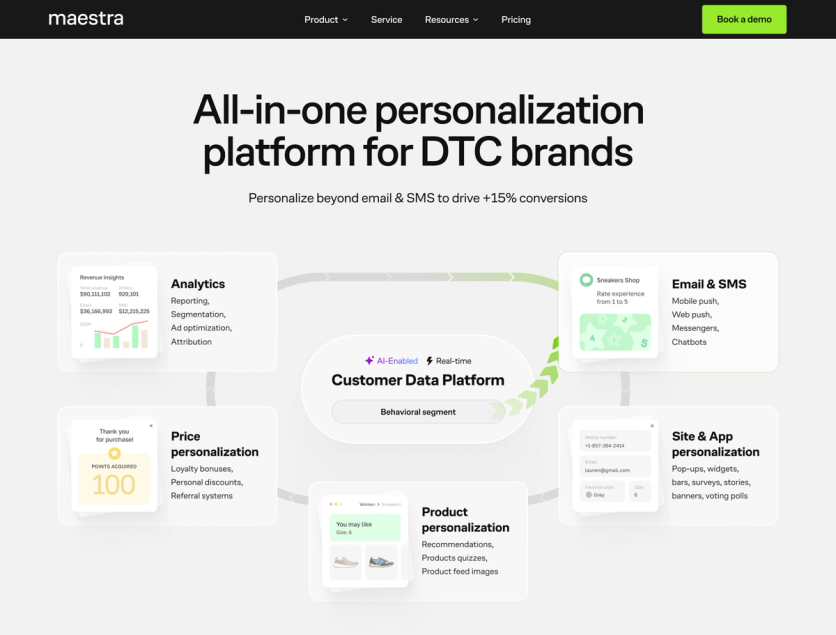
Maestra is an all-in-one personalization platform that covers every growth lever in this guide – conversion, AOV, and support reduction – from a single system. Instead of connecting separate popup, email, upsell, and loyalty tools through integrations, Maestra runs them all from one platform with a shared real-time customer profile. The same profile that triggers an abandoned cart email also powers on-site recommendations, upsell thresholds, loyalty tier logic, and transactional messages – no sync between tools. Native Shopify integration with one-click install.
Key Features
- Real-time CDP: Unified customer profiles across every channel – site, app, email, SMS, MMS, RCS, messengers, offline stores, and more – updated in under 300ms. A customer adds an item to cart on desktop – an hour later, the triggered RCS on their phone shows the exact product with current pricing. After switching to Maestra, Magnum Bikes unified fragmented customer data across their online store, retail locations, and dealer network into one profile – and used it to run geo-targeted campaigns and coordinate promotions across email, SMS, and on-site. Result: 111.7% increase in order volume and 56.6% growth in online revenue after switching to Maestra.
- Omnichannel flow builder: Drag-and-drop visual builder that orchestrates email, SMS, push, popups, and paid media retargeting in one canvas. Flows trigger on any customer action – not a fixed set of templates. Abandoned cart emails show the exact items a shopper left behind plus personalized product recommendations. The same flow can sync audiences to Meta and Google. JOLYN saw a 26% lift in campaign revenue and 52% lift in SMS revenue after switching to Maestra – unlocking flows their previous stack couldn’t support, including price drop alerts, low stock notifications, and multi-step cart recovery.
- On-site personalization: No-code pop-ups, quizzes, surveys, upsell bars, spin-to-win games, scratch cards, stories, countdown timers, banners, social proof notifications, and more – all with behavioral targeting, exit-intent triggers, frequency control, and A/B testing. Enlightened Equipment saw a 38.7% AOV increase – an additional $99.80 per order – after deploying an upsell bar with tiered incentives for free shipping and a free pillow pad. Setup took one hour.
- 14 AI recommendation algorithms: Bestsellers, similar products, often purchased together, personal recommendations, post-purchase cross-sell, and more – deployed on homepage, product pages, cart, checkout, 404 pages, inside emails. Matching by color, size, material, and purchase patterns. JOLYN uses this to recommend matching bikini bottoms when a customer adds a top – same size, color, and material – driving 7% sales influenced by product recommendations.
- Loyalty tiers, referrals, and promotions: Multi-tier structure with points, cashback, exclusive access, early sale previews, and free shipping at higher tiers. Referral programs with dual rewards triggered at optimal moments. Personalized offers based on cart size, product category, channel, and time period. Selkirk Sport used tiered Black Friday cart recovery: paddle buyers saw escalating bonuses as their cart grew, while accessory buyers received urgency messaging about limited stock.
- Accurate transactional emails: Full line-item order data including multi-shipment tracking, partial cancellation status, and correct order details – all from one platform instead of separate systems with conflicting data. Selkirk Sport moved transactional emails to Maestra after Bloomreach showed incorrect order statuses, eliminated back-in-stock notification errors that were generating support tickets.
Support
Every Maestra client gets a dedicated Forward Deployed Marketer (a marketer who works as part of your team) included in their subscription – no additional fees. The Forward Deployed Marketer handles strategy, integration setup, flow design, A/B testing, and deliverability monitoring. Each Forward Deployed Marketer works with at most 15 clients (compared to 60+ at many competitors). Live chat response time averages 5 minutes. Clients get weekly strategy meetings and a dedicated shared Slack channel. In practice, this often means the Forward Deployed Marketer takes over marketing execution, freeing the in-house team to focus on strategy. For example, bedding brand I Love Linen saves 5 hours a week now that promotional content updates itself.
Pricing
Pricing starts at $2,000 per month for the customer data platform plus unlimited email – the most common starting package, with the first 100,000 active profiles included. You pay only for active profiles; dormant ones are stored free. SMS, loyalty, and other channels are added as monthly modules. Billing is month-to-month with no annual contract. Heavy lifting is handled by a dedicated Forward Deployed Marketer at no additional cost. There are no setup or onboarding fees – migration and implementation are included.
What to Consider
Maestra is built for mid-market and enterprise ecommerce brands. The starting price puts it out of reach for early-stage stores or businesses processing fewer than a few hundred orders per month. The platform is deep – clients typically run 30 to 70 automated flows – which means there is a ramp-up period even with a dedicated Forward Deployed Marketer. If you only need a single-channel tool (just popups, or just reviews), a point solution will be simpler and cheaper. But if you are already juggling three or more marketing tools and spending time reconciling data between them, Maestra eliminates that complexity.
Yuko Loyalty
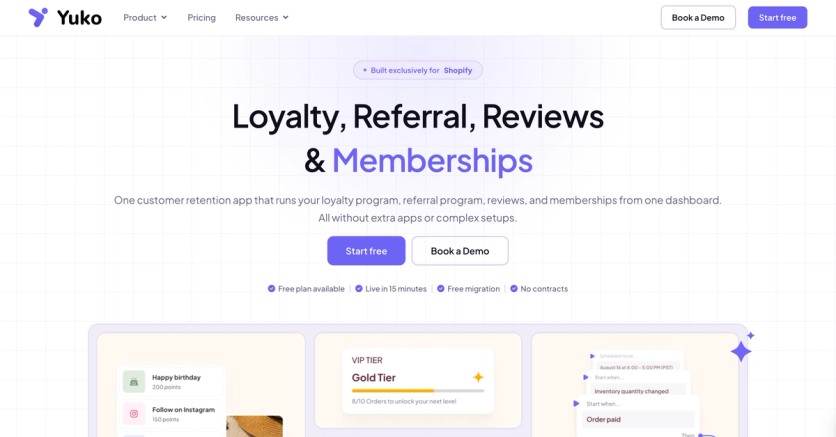
Yuko’s primary value is consolidating loyalty, referrals, reviews, and memberships into a single Shopify app – replacing the four or five separate tools most stores stitch together for retention. Built exclusively for Shopify, Yuko runs all four programs from one dashboard with one customer profile, so points, review requests, referral rewards, and member perks share data instead of fighting over it. Most stores are live in under 15 minutes, and migration from existing review apps is free on every plan.
Key Features
- Loyalty and VIP tiers: Points-based rewards with 12+ earning actions (purchases, reviews, signups, social follows), customizable tiers with exclusive perks, a dedicated loyalty page, customer hub on the account page, and checkout extensions for Shopify Plus stores.
- Referral program: Unique referral link per customer with dual-sided rewards, real-time tracking, customizable reward types, and built-in fraud protection – no manual voucher codes or tracking required.
- Reviews and UGC: Automated review request emails and SMS, photo and video reviews, Google Shopping rich snippets, store reviews, Q&A, and customizable widgets. One-click import from Judge.me, Yotpo, Okendo, Stamped, Loox, and others.
- Memberships: Paid and free membership tiers with exclusive early access, member-only pricing, recurring revenue streams, and native integration with the loyalty engine.
- Workflows: Visual drag-and-drop builder for trigger-based automations across email and SMS – post-purchase review requests, points reminders, referral nudges, VIP tier unlocks with A/B testing and per-flow analytics.
- Native integrations: Klaviyo, Omnisend, Shopify Flow, Instagram, Facebook, TikTok, WhatsApp, plus webhooks and a public API for custom workflows.
- Branding control: Full design customization across all widgets and emails, with no-code setup that matches your storefront aesthetic.
Support
Live chat support is available on every plan, including Free. Higher tiers add email support, priority routing, and free expert onboarding. The Growth plan includes a dedicated account manager. Free migration from any competing review app is included on every plan, regardless of tier.
Pricing
| Plan | Monthly Price | Orders Included |
|---|---|---|
| Free | $0 | 50 orders/mo |
| Basic | $12 | 100 orders/mo |
| Advanced | $30 | 300 orders/mo |
| Growth | $199 | Unlimited |
Free trial available on Basic and Advanced plans, no credit card required. Cancel anytime from the Shopify admin.
What to Consider
Yuko’s loyalty, referrals, VIP tiers, and memberships are Shopify-only – WooCommerce stores get the Reviews product but not the full retention suite, which is a hard limitation for multi-platform merchants. Pricing scales with order volume on Basic and Advanced, so high-traffic stores can outgrow these tiers quickly before hitting the unlimited Growth plan at $199/mo, and there’s a noticeable jump between $30 and $199 with no middle tier. Klaviyo integration, Workflows, and checkout extensions are gated to the Advanced and Growth plans, so smaller stores on Basic miss the deeper automation layer. Yuko is also a relatively newer entrant compared to incumbents like Smile.io or Yotpo – with 100+ brands listed it’s fine for most use cases, but enterprise merchants evaluating long-term vendor stability may want to weigh the smaller install base against the consolidation benefits.
Rebuy
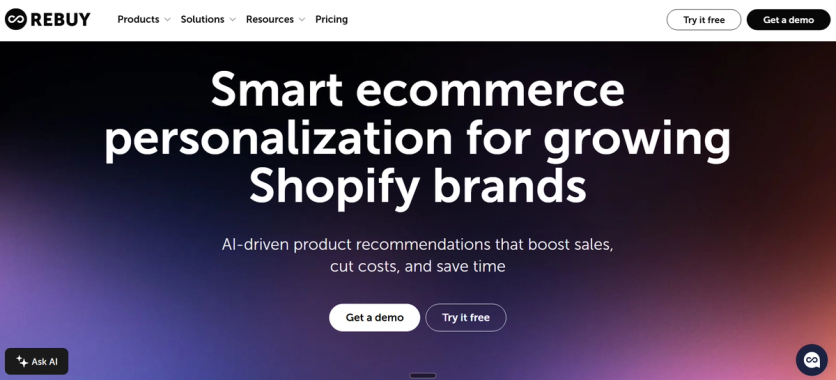
Rebuy is a modular AI-powered personalization platform built exclusively for Shopify. Rather than offering a monolithic tool, Rebuy lets merchants pick and combine individual packages – product recommendations, smart cart, checkout upsells, site search, and post-purchase offers – each powered by AI that analyzes purchase patterns and browsing behavior.
Key Features
- Smart Cart: An advanced slide-out cart with 40+ integrations, AI-powered product recommendations, and dynamic upsells – all inside the cart drawer.
- Merchandising widgets: AI-driven product recommendations deployable on any page – homepage, product, collection, and cart.
- Post-purchase offers: One-click upsells presented after checkout, before the thank-you page.
- Dynamic bundles: AI-generated “frequently bought together” bundles and a manual bundle builder for curated pairings.
- Smart Search: AI-powered site search with intent recognition and product ranking.
- Checkout extensions: In-checkout upsells for Shopify Plus stores.
- A/B testing: Built-in testing for recommendation strategies and offer placements.
- Rebuy Monetize (free): Earn revenue from third-party brand offers on post-purchase and thank-you pages.
Support
Standard support (live online support on weekdays) is included on all paid plans. Premium Support is available as a $499/month add-on with faster response times and priority handling.
Pricing
| Plan | Monthly Price | Details |
|---|---|---|
| Build Your Own | From $25/mo for a minimum package | Pick individual packages; price scales with monthly order volume |
| Platform One | $534/mo | All packages included, Premium Support, dedicated MSM, beta access |
14-day free trial for packages, 30-day free trial for Platform One.
Pricing scales dynamically based on order volume and selected packages – so costs rise automatically during high-traffic periods like Black Friday. Each feature (cart, checkout, search, post-purchase) is a separate paid package: the $25/month starting price covers a single package at minimum volume. Stores needing the full feature set pay $534/month for Platform One. Premium Support adds $499/month.
What to Consider
Rebuy’s order-volume-based pricing scales aggressively: multiple Shopify App Store reviewers describe the pricing as expensive relative to value once order volumes grow. The platform has a steep learning curve – G2 reviewers consistently cite feeling overwhelmed by the extensive feature set, with advanced features taking time to fully understand and optimize. Rebuy is Shopify-only with no support for WooCommerce, Magento, or BigCommerce (it does support Shopify Hydrogen for headless, but nothing outside the Shopify ecosystem). Standard support (chat and email) receives mixed reviews – meaningful strategic support requires the $499/month Premium add-on. Some users on the Shopify App Store report technical issues with specific Shopify themes and API integrations. If that curve or that bill is the sticking point, we rank the Rebuy alternatives side by side.
Nosto
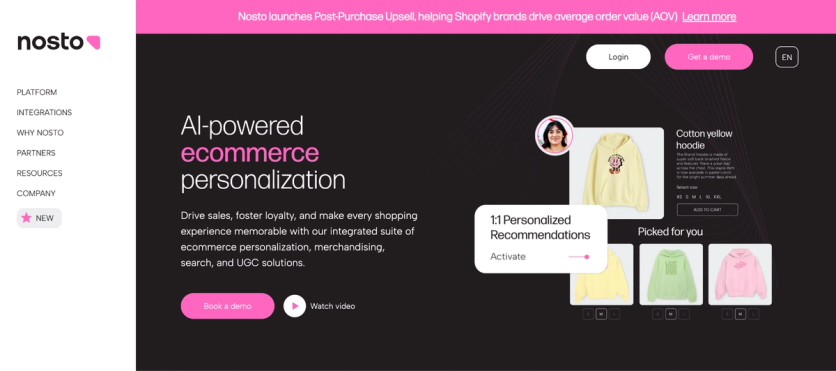
Nosto positions itself as a Commerce Experience Platform – an AI-driven suite covering product recommendations, on-site personalization, search, merchandising, and shoppable UGC. The platform uses four AI modules (Predictive AI, Semantic AI, Visual AI, and Generative AI) to power personalization across the shopping experience. Over 1,500 brands, including Marc Jacobs, Kylie Cosmetics, and Muji, use Nosto across Shopify, Salesforce Commerce Cloud, Adobe Commerce, BigCommerce, and Shopware.
Key Features
- AI product recommendations: Behavioral and predictive algorithms powering personalized product suggestions across all pages.
- Personalized search: AI-driven site search with intent understanding and dynamic product ranking.
- Category merchandising: Automated collection page optimization based on performance metrics, inventory, and business rules.
- Content personalization: Dynamic on-site content that adapts to visitor segments and behavioral signals.
- Behavioral pop-ups: Targeted overlays driven by browsing behavior, cart state, and audience segmentation.
- Shoppable UGC: Curated user-generated content from Instagram and TikTok displayed as shoppable galleries.
- Dynamic bundles and post-purchase upsells: AI-generated product bundles and one-click post-purchase offers.
- A/B testing and optimization: A/B/n, split, and multivariate testing across on-site experiences with commerce KPI measurement (CVR, AOV, click-through rate).
- Multi-platform support: Native integrations with Shopify, Salesforce Commerce Cloud, Adobe Commerce, BigCommerce, Shopware, and 100+ third-party tools.
Support
Live chat and email support in English, French, and German. Dedicated CSM support is included, with regular status calls tailored to client needs. Professional services (custom template development, campaign creation, CRO audits) are available as separately billed engagements.
Pricing
Nosto uses a custom-quoted, modular pricing model. Merchants pay a flat license fee that scales with their revenue, plus charges for each module they activate across Nosto’s Product and Content experience clouds – recommendations, search, content personalization, UGC, A/B testing, and more. Implementation and professional services are billed separately. There is no public pricing. This structure means Nosto tends to get expensive fast for high-GMV merchants, because the license tier is tied to revenue, costs rise as the store grows – a trade-off several Nosto users and competitors have flagged as a reason to look at alternatives.
What to Consider
Nosto’s pricing is opaque – there is no public pricing page beyond the entry-level Incubator plan, and all other tiers require a sales call. The revenue-based pricing model means costs scale as your store grows, which multiple G2 and Capterra reviewers describe as expensive, especially for smaller businesses. The platform has a steep learning curve; G2 reviewers note that understanding Nosto’s full functionality requires significant time and support. Some users on the Shopify App Store report that recommendation quality can be unreliable – popular products automatically appearing as “frequently bought together” despite no actual purchase correlation. Capterra reviewers mention advertised integrations that do not always work as expected. CSM quality can be inconsistent: one G2 reviewer reported their replacement CSM attended fewer than half of scheduled meetings and had not reviewed the account beforehand. Contract and billing disputes appear in Shopify App Store reviews, with merchants reporting difficulty canceling within stated windows.
Part 5: Apps That Maximize Paid Ad Performance
Paid traffic only pays off when the data behind it is clean. These apps work upstream and downstream of your ad campaigns – optimizing the product data you send to ad platforms, and sharpening the conversion signals those platforms use to optimize spend. The result is better-targeted campaigns and more reliable attribution, so every advertising dollar works harder.
Wetracked
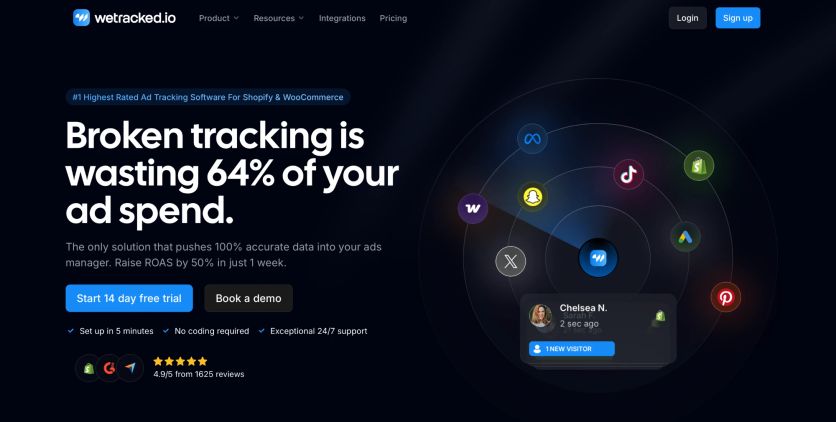
Wetracked is an ad tracking app for Shopify and WooCommerce stores that want cleaner conversion data inside platforms like Meta, Google Ads, TikTok, Snapchat, Pinterest, and X. Instead of acting as another analytics dashboard, it focuses on collecting more complete customer activity data, enriching it, and sending it back to ad platforms so campaigns have better purchase signals to optimize from. It is especially useful for stores affected by iOS tracking limits, cookie loss, ad blockers, and unreliable native pixel data.
Key Features
- First-party ad tracking: tracks visits, sales, and revenue using first-party data, helping stores recover conversions missed by native tracking scripts.
- Data enrichment engine: enriches customer and event data before forwarding it to ad platforms, which can improve attribution quality.
- Direct ad platform forwarding: sends conversion data into Meta, Google Ads, TikTok, Snapchat, Pinterest, and X without requiring merchants to manage another reporting dashboard.
- Multiple pixels per store: lets merchants add multiple ad pixels, useful for brands running several ad accounts or testing different paid media setups.
- No-code setup: Shopify merchants can connect the app, add pixel IDs, and start tracking without custom code or UTM setup.
- Multi-store support: Starter includes up to 3 stores, Business up to 5, Scale up to 10, and Enterprise supports unlimited stores.
Support
Wetracked offers 24/7 live chat support across its plans. The Shopify App Store listing shows a 4.8 rating from 108 reviews, while the company says it is used by more than 9,000 merchants.
Pricing
Plan | Monthly price | Order limit | Stores |
|---|---|---|---|
Starter | $49/mo | Up to 500 orders/mo | Up to 3 stores |
Business | $149/mo | Up to 3,000 orders/mo | Up to 5 stores |
Scale up | $249/mo | Up to 7,500 orders/mo | Up to 10 stores |
Enterprise | Custom | 7,500+ orders/mo | Unlimited stores |
Annual billing gives 20% off published monthly pricing. All plans include a 14-day free trial, unlimited ad pixels per store, unlimited ad spend, unlimited revenue, real-time data forwarding, and a 60-day money-back guarantee.
What to Consider
Wetracked is best viewed as a tracking accuracy layer, not a full ecommerce analytics platform. It pushes cleaner conversion data into ad platforms, but it does not replace tools that offer broader reporting, profit tracking, merchandising analytics, or multi-touch attribution dashboards. Pricing scales by order volume, so fast-growing stores should check their monthly order count before committing. For teams that need fully custom tracking logic or deep ownership over their setup, a custom server-side Google Tag Manager setup may offer more flexibility, though it requires more technical work.
Part 6: Apps That Simplify Shipping & Fulfillment
Shopify’s native shipping covers USPS, UPS, and DHL Express in the US – but not FedEx – and isn’t available in Australia at all. For merchants who run on either of those carriers, third-party apps aren’t a “scale-stage upgrade” – they’re the starting point. The apps below cover that gap. Both are single-carrier specialists rather than multi-carrier aggregators (Shippo, EasyShip), with PH Ship Rate & Track listed as FedEx-certified on the App Store. The right pick when one carrier dominates your shipping mix and you want a deeper, carrier-native integration over broad coverage.
PH Ship Rate & Track for FedEx
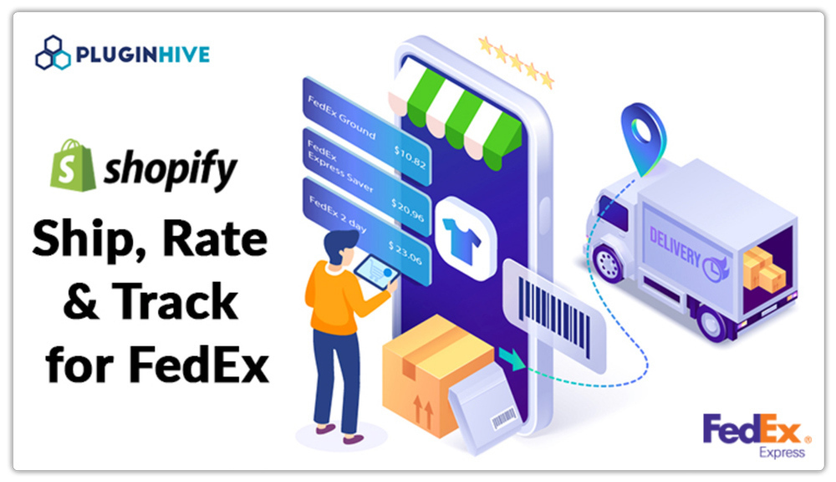
PH Ship Rate & Track for FedEx App is a Shopify shipping automation solution built for merchants that rely on FedEx for domestic and international order fulfillment. The app automates live FedEx shipping rates at checkout, shipping label generation, FedEx order tracking, and shipping documentation directly inside Shopify. It is designed for ecommerce businesses looking to streamline shipping operations, reduce manual fulfillment work, and improve delivery accuracy as order volume grows. The app holds a 4.9-star rating from 588 reviews on the Shopify App Store.
The app supports advanced FedEx services, including FedEx Express, FedEx Ground, FedEx Freight, SmartPost, and FedEx One Rate. Real-time shipping automation and bulk label processing help stores simplify high-volume shipping workflows without needing external shipping software.
Key Features
- Live FedEx Shipping Rates: Automatically display accurate FedEx shipping rates at Shopify checkout based on product weight, dimensions, destination, and shipping services.
- FedEx Shipping Label Printing: Generate and print FedEx shipping labels in bulk directly from Shopify orders to speed up fulfillment operations.
- Automated FedEx Tracking: Send shipment tracking updates and delivery notifications automatically to customers after order fulfillment.
- Advanced FedEx shipping support: Supports FedEx Express, Ground, Freight, SmartPost, One Rate, international shipping, and dimensional weight calculations.
- Shipping automation and pickup requests: Automate shipping workflows, create manifests, and schedule FedEx pickups directly from Shopify.
Support
PluginHive provides onboarding assistance, live chat, and email support for FedEx account integration, shipping configuration, international setup, and advanced automation workflows.
Pricing
| Plan | Monthly Price | Details |
|---|---|---|
| Starter | $19 | Essential FedEx shipping automation features |
| Premium | $49 | Advanced shipping and label automation |
| Enterprise | $99 | High-volume shipping operations |
Free trial available on all plans.
What to Consider
The app is built specifically for stores that ship with FedEx, making it best suited for merchants already using FedEx as their primary carrier. Some advanced services, such as FedEx Freight, international shipping documentation, and pickup scheduling, may require compatible FedEx business accounts or enabled carrier services.
PluginHive Australia Post Ship
PluginHive Australia Post Ship App is a Shopify shipping solution designed for Australian ecommerce businesses looking to automate Australia Post fulfillment directly inside Shopify. The app handles live Australia Post shipping rates, shipping label printing, shipment tracking, manifests, and bulk order processing to simplify ecommerce shipping management.
It supports MyPost Business, Australia Post eParcel, and StarTrack accounts, making it suitable for growing stores managing large domestic and international shipment volumes. The app holds a 5.0-star rating from 140 reviews on the Shopify App Store. By automating repetitive fulfillment tasks, the app helps merchants improve shipping accuracy, speed up order processing, and reduce manual shipping effort.
Key Features
- Live Australia Post Rates: Display accurate Australia Post shipping rates at Shopify checkout based on order details, package dimensions, and delivery locations.
- AuPost Label Printing: Generate and print Australia Post shipping labels in bulk directly from Shopify orders for faster fulfillment.
- Automated Shipment Tracking: Send automated Australia Post tracking updates and delivery notifications to customers after shipping.
- MyPost Business, eParcel, and StarTrack integration: Supports Australia Post MyPost Business, eParcel, and StarTrack accounts for streamlined shipping management.
- Shipping automation and manifests: Automate fulfillment workflows, create shipping manifests, and manage multi-package shipments directly from Shopify.
Support
PluginHive offers onboarding assistance, live chat, and email support to help merchants configure Australia Post accounts, shipping settings, and automation workflows.
Pricing
Standard Plan: $19/month with live Australia Post rates, label printing, tracking, manifests, pickups, and shipping automation features. 15-day free trial available. Additional carrier charges may apply based on Australia Post account usage.
What to Consider
The app is best suited for merchants primarily using Australia Post services. Some advanced shipping automation features may require active MyPost Business or eParcel account configurations for full functionality.
Key Takeaways
Growth on Shopify follows a natural sequence:
Free up your team first. Support tickets eat the hours and budget that should fund growth. Automate what you can, let customers resolve what they can, and reclaim the time.
Then boost conversion. Turn the traffic you already have into paying customers. A 0.1% conversion lift compounds across every future visitor – and it keeps paying out long after the campaign ends.
Then grow average order value. Once your funnel converts reliably, increase what each customer spends per order through upsells, cross-sells, and loyalty incentives.
Each stage has the tools that fit it. Once you’re juggling three or more, consolidating into one platform becomes the practical next step.
- For self-service order editing on the customer account page: choose SelfServe – customers swap products, change variants, adjust quantities, and update shipping without contacting support.
- For a centralized ecommerce helpdesk with a multi-channel inbox and AI ticket automation: choose Gorgias – unified email, SMS, WhatsApp, Facebook, Instagram, and TikTok, with AI resolving up to 60% of routine tickets.
- For a Shopify-native AI chatbot that combines sales and support in one widget: choose Rep AI – trained on your product catalog with real-time inventory sync and conversation-based cart recovery.
- For popups and product recommendations in one tool with an on-site notification feed (bell icon): choose Wisepops – AI product recommendations inside popups, behavioral targeting, and the Wisp notification center that reaches returning visitors without interrupting them.
- For the largest popup template library on Shopify (1,000+) with gamification on a free plan: choose Claspo – spin-to-win wheels, scratch cards, memory games, and mystery boxes on every tier.
- For unlimited product reviews with photo, video, and Google rich snippets at no cost: choose Judge.me – multi-platform review syndication and the highest rating on the Shopify App Store.
- For a retention bundle that combines wishlists, Instagram-based social proof, and loyalty in one dashboard: choose Growave – built specifically for Shopify retention through consistent engagement.
- For sequential upsell → cross-sell → downsell funnels with Shopify Plus in-checkout extensions: choose Bold Upsell – the longest-running upsell app in the Shopify ecosystem, with “Built for Shopify” certification.
- For Shopify-only merchants who want to buy personalization modules à la carte (Smart Cart, checkout upsells, post-purchase offers, search) instead of committing to a full platform: choose Rebuy – especially if you’re running a headless Shopify store with Hydrogen.
- For AI-driven search, category merchandising, shoppable UGC from Instagram/TikTok, and a Visual AI module for image-based matching: choose Nosto – Visual AI analyzes product images to match customers with visually similar items, while shoppable galleries turn UGC into direct purchases.
- Start with Maestra when you’re ready to consolidate support reduction, conversion, and AOV into one platform – real-time CDP, native omnichannel flows, on-site personalization, loyalty, and a dedicated Forward Deployed Marketer included on every plan. Furniture Fair replaced five separate tools with Maestra and documented 7,543% ROI; Urban Armor Gear cut stack costs by 64% after the switch.
The best Shopify app isn’t the one with the most features – it’s the one that removes the most friction from your growth.
Ready to consolidate your Shopify stack? Book a 15-minute demo with Maestra and see how one platform can replace the five you’re juggling right now.
FAQs
- Maestra consolidates email, SMS, popups, product recommendations, loyalty programs, and customer data into one platform. Brands like Sena, Furniture Fair, and Urban Armor Gear have replaced three to five separate tools after switching. Urban Armor Gear achieved a 64% reduction in marketing stack costs.
- Start by asking whether popups are your only need or part of a broader personalization strategy. If you want popups that connect to email, SMS, loyalty, and product recommendations inside one flow builder, Maestra includes a full popup engine as part of its platform – no separate app needed. For a standalone popup tool on a budget, Claspo offers a free plan with 1,000+ templates and gamification. Wisepops is a stronger standalone choice for stores that want AI product recommendations inside popups and behavioral targeting based on browsing history and cart state.
- Start with the highest-leverage tactic for your store. If you want to incentivize larger carts, Maestra’s upsell bar with threshold-based rewards (free shipping, gifts) drove a 38.7% AOV increase for Enlightened Equipment. Selkirk Sport took this approach for Black Friday with tiered cart recovery: paddle buyers saw escalating bonuses – free shipping, then a free hat, then free pickleballs – as their cart grew, while accessory shoppers got urgency-driven messaging about limited stock instead. For long-term AOV growth, loyalty programs from Maestra or Growave encourage repeat purchases at higher spend levels.
- Gorgias claims up to 60% of routine inquiries resolved by its AI Agent, though actual results vary by store. Maestra takes a preventive approach, eliminating the issues that create tickets (pricing discrepancies, missing promo codes, inaccurate order data) rather than automating responses to them.
- All three offer AI-powered product recommendations, but they serve different needs. Nosto covers similar ground with broader platform support (Shopify, Salesforce, Adobe) and adds content personalization and UGC. Maestra goes beyond on-site personalization to include email, SMS, push, loyalty programs, and a real-time CDP – all orchestrated in a single flow builder with a dedicated Forward Deployed Marketer on every plan. If you need only on-site recommendations, Rebuy is the most cost-effective choice. If you need cross-platform support, Nosto fits. If you want personalization connected to your full marketing stack, Maestra covers it all.
- Maestra delivers AI recommendations across every customer touchpoint – site, email, SMS, push – orchestrated in a single flow builder with a real-time CDP tracking every interaction. It integrates natively with Shopify, pulling product catalog, orders, and customer data in real time. Shopify swimwear brand JOLYN saw 7% of total sales influenced by Maestra’s product recommendations, and Defense Mechanisms achieved 8.9% sales influenced by recommendations. For Shopify-specific on-site recommendations, Rebuy offers a modular approach covering smart cart, checkout, and post-purchase. Nosto combines recommendations with search, merchandising, and UGC in a broader commerce experience suite.
- Maestra supports dynamic bundles as part of its personalization engine with native Shopify integration that pulls catalog and behavioral data in real time. Bundle recommendations are powered by the same AI that drives product suggestions across email, site, and SMS, so bundles adapt to each customer’s purchase history and browsing behavior. For a dedicated bundling tool within the Shopify ecosystem, Rebuy offers AI-generated dynamic bundles alongside its smart cart and post-purchase upsells.
- Judge.me is the strongest standalone reviews app on Shopify – unlimited reviews on the free plan, photo and video support, Google rich snippets, and over 37,000 reviews averaging a perfect 5.0. Maestra covers social proof as part of its personalization stack: live visitor counts, recent-purchase notifications (“X people bought this today”), low-stock alerts, bestseller and trending badges, promotional tags like “Hot Buy,” and product ratings – all no-code, fully customizable, and A/B testable inside the same builder. Review request flows are part of the same automation builder that handles cart recovery, loyalty, and post-purchase sequences. And because Maestra auto-generates dynamic product cards with live ratings, prices, and social proof for email, Meta, and Google ads, the same trust signals extend beyond your site into paid media. This means your social proof strategy works inside your customer lifecycle, not alongside it.
- Maestra is built for ecommerce personalization across every channel – not just on-site. The platform combines a real-time CDP, AI product recommendations, dynamic content blocks, popups, email, SMS, and push into one flow builder, so personalization follows the customer from your homepage to their inbox. Enlightened Equipment saw a 15% increase in website conversion rate after deploying Maestra’s on-site personalization. For on-site-only personalization, Nosto offers AI-driven recommendations, search, and merchandising across Shopify, Salesforce, Adobe Commerce, BigCommerce, and Shopware. Claspo and Wisepops cover popup-based personalization with behavioral targeting, but do not extend to email, SMS, or product recommendations beyond the popup itself.
- Every app adds code that can affect page load speed. Audit your current stack before adding new tools – remove apps you are not actively using. Prioritize apps that integrate with your existing tools. Start with one or two apps that address your biggest conversion barrier, measure results over 60 days, then expand based on proven ROI rather than feature lists.