
8 Best Postscript Alternatives for Shopify Brands

Postscript built a loyal following as the SMS platform made for Shopify. And for SMS-first brands selling to US customers, it still does that job well. But reviews from the past year describe a $500 platform fee before a single text goes out, support that reviewers say has slipped since late 2024, and annual contracts that renew unless you dig out the paperwork yourself.
There are also the walls you hit by design. Postscript is SMS only. Email means running a second platform with its own segments and its own attribution math. It’s Shopify-exclusive, and international sending costs $0.25 per SMS, roughly 28 times the domestic Starter rate. Meanwhile the SMS market itself has been churning: Yotpo shut down its Email & SMS product, and Privy acquired both Emotive and Sendlane. Picking a platform now also means picking one that will still exist in its current form next year.
This article compares eight Postscript alternatives – from all-in-one platforms that fold SMS into a unified customer profile to budget mass-texting tools – using current pricing pages, current feature sets, and verified reviews from the last 12 months. Here’s how they stack up:
Quick Guide: Best Postscript Alternatives by Use Case
Eight platforms stand out as Postscript alternatives in 2026: Maestra, TxtCart, Klaviyo, Attentive, Sendlane, Recart, Emotive, and SlickText – each strongest for a different kind of SMS program.
Best for personalization in SMS, email, and beyond: Maestra – recommendations, offers, and content personalized across SMS, email, push, and the storefront from one real-time customer profile
Best for Shopify brands consolidating email and SMS: Klaviyo – a self-serve platform with 350+ integrations and mature segmentation
Best for enterprise SMS at scale: Attentive – managed programs, two-tap sign-up, and large-list deliverability
Best for hands-on support: Sendlane – unified email and SMS with a dedicated team and pay-per-send pricing
Best for Shopify list growth: Recart – OneClick Opt-in pop-ups and a managed strategy team
Best for done-for-you texting: Emotive – human TextPros write and run your SMS campaigns
Best for simple mass texting: SlickText – dependable bulk SMS beyond e-commerce, at the cheapest entry point
Content:
Postscript Alternatives at a Glance
| Platform | Best For | Key Differentiator | Starting Price | G2 Rating |
|---|---|---|---|---|
| Maestra | Mid-size, enterprise, and rapidly scaling e-commerce brands | SMS, email, push, loyalty, and site personalization on one real-time customer profile | From $2,250/mo (CDP + email & SMS) | 4.8 |
| TxtCart | Shopify brands wanting AI-led, two-way conversational cart recovery | AI sales agent that texts like a human rep – 45% reply, 30% conversion on conversations | From $29/mo ($0.009/SMS) | No G2; 4.9 (Shopify App Store) |
| Klaviyo | Shopify brands consolidating email and SMS | 350+ integrations and mature segmentation | Free plan available (up to 250 profiles); email + SMS from $35/mo | 4.6 |
| Attentive | Enterprise DTC brands with large SMS lists | Two-tap sign-up and managed enterprise SMS at scale | Custom pricing (contact sales) | 4.5 |
| Sendlane | Established DTC brands that want hands-on support | Send-based pricing with unlimited contacts | From $100/mo (unlimited contacts, pay per send) | 4.7 |
| Recart | Shopify brands focused on list growth | OneClick Opt-in popups and a managed strategy team | From $299/mo (23,000 SMS included, 12-month commitment) | 4.7 (Shopify App Store) |
| Emotive | Brands that want done-for-you conversational SMS | TextPros™ human SMS experts; dedicated copywriter from the Pro plan | From $100/mo + $0.015/SMS | 4.5 |
| SlickText | Teams that need simple mass texting beyond e-commerce | Cheapest entry point with unlimited contacts | From $29/mo (500 texts) | 4.8 |
Pain Points with Postscript
Postscript holds a 4.8 rating on G2, though recent reviews have slowed to a trickle – only two G2 reviews were posted in all of 2026, and there’s no Trustpilot profile at all. The freshest, most detailed complaints from the last 12 months live on the Shopify App Store, where Postscript holds 4.7 across more than 1,100 reviews. Six themes repeat.
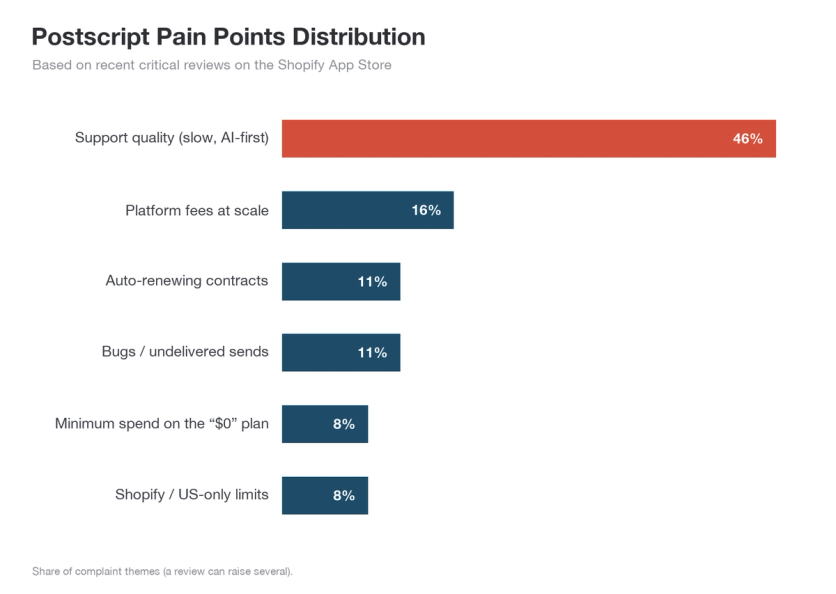
| Pain Point | Description | Possible Solutions |
|---|---|---|
| Minimum spend on the “$0” plan | The Starter plan advertises no platform fee but bills a $49 monthly minimum even with zero sends | Platforms with genuinely free tiers (Klaviyo) or flat plans (SlickText) |
| Platform fees at scale | Professional costs $500/mo before messages, plus per-text rates and pass-through carrier fees | All-in-one platforms where SMS spend replaces a whole stack (Maestra), or send-based pricing (Sendlane) |
| Support quality decline | Reviewers report AI-first support and days-long email waits; live chat is gated to Growth and above | Platforms with dedicated CSMs in every plan (Maestra, Sendlane, Recart) |
| Contracts that renew quietly | Reviewers report annual terms that aren’t visible in platform billing and roll over into another year | Month-to-month platforms (Maestra, SlickText) |
| SMS-only channel gap | No email product – brands run Klaviyo alongside, with duplicate segments and split attribution | Platforms with email and SMS unified (Maestra, Klaviyo, Sendlane) |
| Shopify-only, US/Canada-first | No path for WooCommerce, BigCommerce, or Magento; international SMS costs $0.25 per message | Multi-platform tools (Sendlane, Klaviyo) and platforms with global messaging (Maestra) |
Minimum Spend on the Free Plan
The dominant complaint of 2025–2026 traces back to a billing change: Postscript retired its old $200 credits plan with rollover and moved merchants onto a Starter tier with a $49 monthly minimum. Small stores felt ambushed. “They offer a 'free plan' but charge you $49 even if you didnt send any text messages,” wrote one US merchant on the Shopify App Store in April 2026. Another Canadian store owner put it more bluntly in May 2026: “says free to install, i installed it, barely used it, charged my $67.99 without warning.”
Platform Fees at Scale
At the other end of the ladder, the Professional plan’s $500 monthly platform fee lands before a single message is sent – and per-message rates plus pass-through carrier fees (Postscript’s own page averages them at $0.00418 per SMS and $0.00841 per MMS) stack on top. “I was charged $500 for platform fees. Imagine a platform charging you $500 for nothing,” wrote a small-business founder on G2 in May 2026. A Capterra reviewer was more measured in February 2025: “Pricing can be high for growing businesses.”
Support Quality Decline
Support was historically Postscript’s calling card, which makes the recent turn conspicuous. “Updating my review from a few years ago as customer service has gone downhill or almost nonexistent… I reached out via email in November and it took days to hear back… And replacing it with AI support is a leap backward,” reads a January 2026 Shopify App Store review. A September 2025 reviewer echoed it: “NO ONE is available on chat and no response from your email team either.” Live chat only unlocks on the Growth plan; priority chat requires Professional or Enterprise.
Contracts That Renew Quietly
Merchants on negotiated terms describe a paper chase. “They do not include your contract anywhere in their platform billing, so if you have been with them for three years like I have and decide you want to move on – you basically have to dig through files to ensure you are out of contract (which for me was yearly and rolled into another YEAR LONG term),” a US store wrote in January 2025.
The Email Gap and the Shopify Wall
The last two pains are structural, not bugs. Postscript deliberately does one channel on one platform: SMS (plus MMS and RCS) for Shopify stores selling to US and Canadian customers. That focus is why its Shopify data integration runs deep – and why brands that add email, expand to another storefront, or start selling internationally end up managing a second stack. As one G2 reviewer noted, “Unfortunately they don’t integrate with other E-Commerce stores, other than Shopify.” A consumer-goods reviewer in April 2026 added a broader worry: “For certain parts of our business, it feels like it’s lacking in tech innovation, and we’ve had to create workarounds to get things done.”
Before You Switch
To be fair: many of these pains have in-platform fixes worth trying first. If support is the issue, moving from Starter to Growth unlocks live chat. If you’re on legacy terms, ask your rep to re-paper onto current usage-based pricing – Postscript’s published per-message rates have come down ($0.009 per SMS on Starter, $0.007 on Professional). And if you’re SMS-first, US-only, and happy on Shopify, features like Infinity Testing, the Shopper AI assistant, and CashBack are genuinely differentiated. Switch when the platform’s boundaries – email, storefronts, geography, or economics – are the problem, because those don’t have workarounds.
1. Maestra – Best for All-in-One Retention
Starting price: From $2,250/mo (CDP + email & SMS; first 100K active profiles)
G2 rating: 4.8
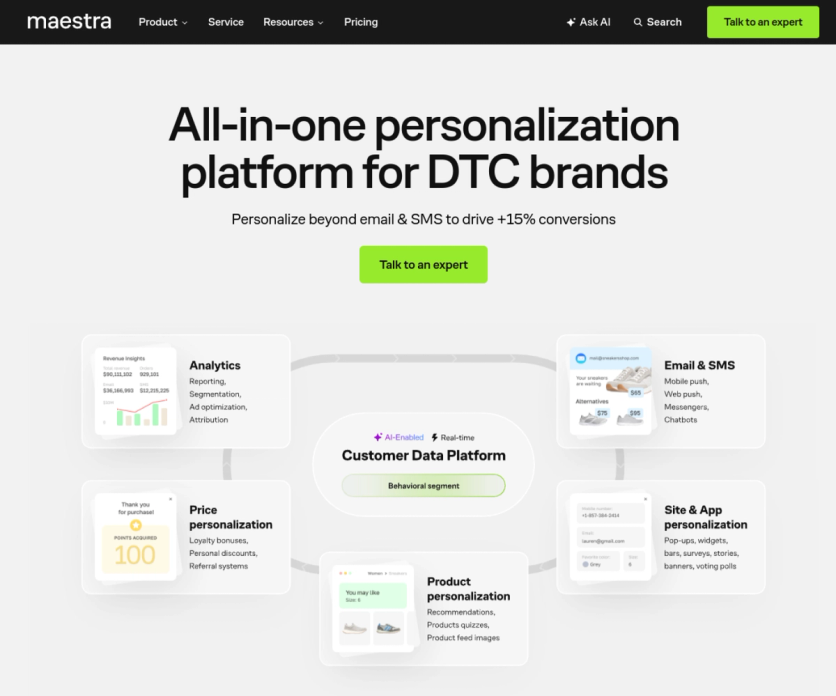
Maestra is an all-in-one marketing personalization platform for mid-size, enterprise, and rapidly scaling e-commerce brands: real-time CDP, email, SMS, web and mobile push, messengers, site personalization, product recommendations, and built-in loyalty in a single system. Where Postscript treats SMS as the product, Maestra treats SMS as one channel inside a unified customer profile – so a text, an email, and an on-site popup all work from the same live data.
That difference sounds abstract until you run a winback flow that starts with an email, follows with an SMS only for people who didn’t open it, and suppresses both for anyone who already bought this morning. On a two-platform stack, that coordination is a sync job. On Maestra, it’s one flow.
Every subscription includes a dedicated team that handles migration, implementation, campaign and journey setup, and ongoing optimization – closer to Postscript’s paid managed tier than to its self-serve default.
Key Features
Omnichannel Flows
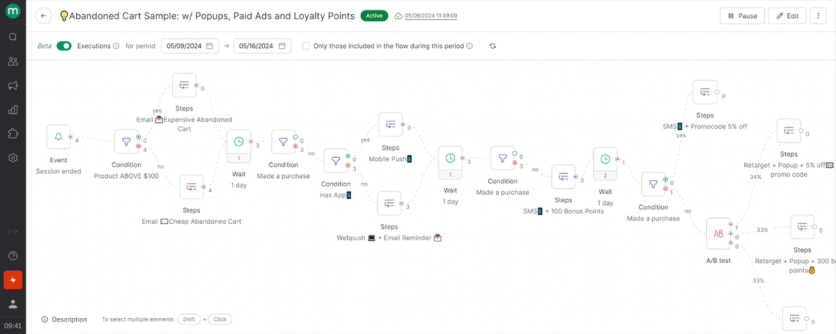
Maestra’s journey builder runs email, SMS, push, messengers, and on-site messages from one canvas, with branching, A/B testing, and channel fallbacks. Coolibar grew revenue from email and SMS campaigns by 33.6% year-over-year after switching from Klaviyo, and grew flow revenue by 62%.
Real-Time CDP
Every customer action updates the profile instantly – Maestra quotes sub-300-millisecond processing – with identity resolution stitching anonymous and known sessions across devices. Segments built on this data are available to every channel at once, so the SMS list and the email list are never out of sync.
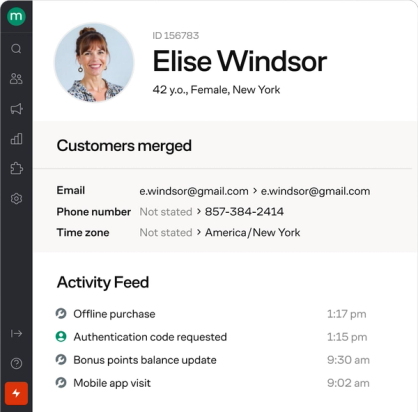
A unified customer profile in Maestra’s real-time CDP
SMS, MMS, and RCS
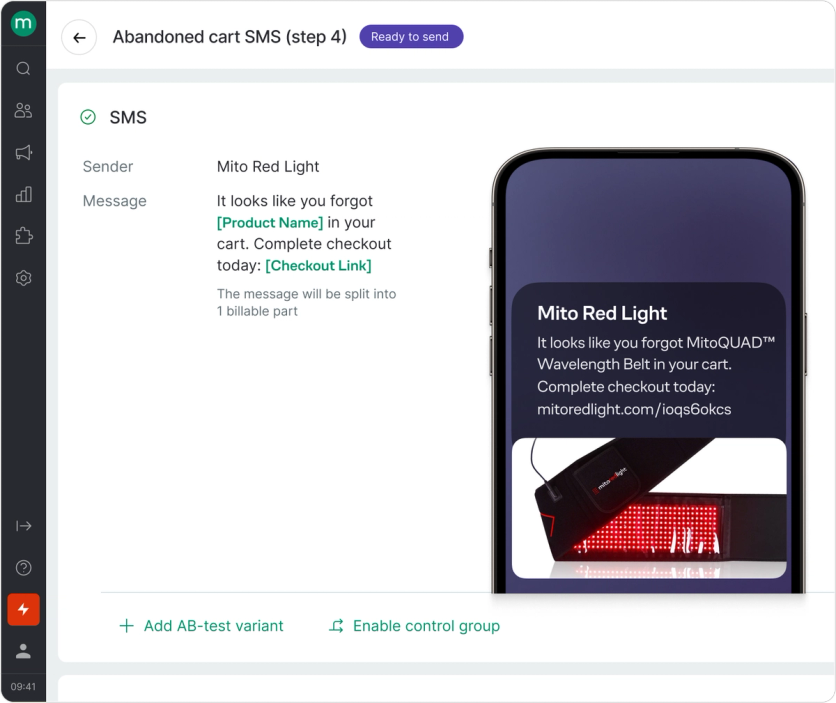
Maestra supports SMS, MMS, and RCS with short codes, 10DLC, and toll-free numbers, plus Tap-to-Text subscriptions. Selkirk grew SMS-attributed revenue by 149% year-over-year alongside 55% email revenue growth after moving its program to Maestra.
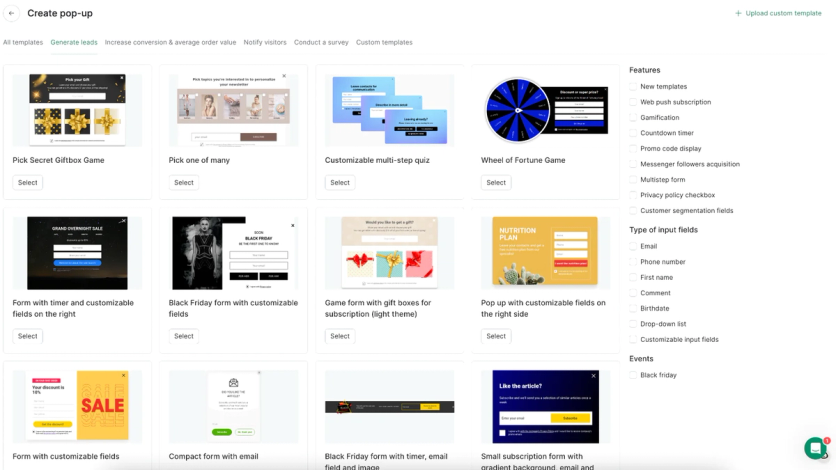
Site Personalization with One-Click SMS Opt-Ins
Pop-ups, quizzes, embedded blocks, and banners run from the same segments as messaging – including pop-up templates with one-click SMS opt-ins, which do the list-growth work Postscript delegates to its Onsite Opt-in widgets while also feeding email and push lists.
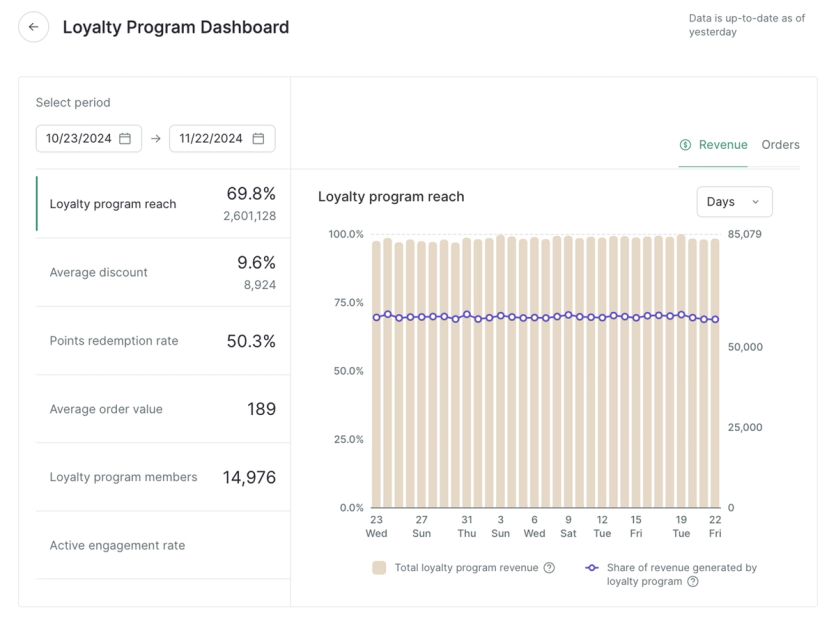
Built-In Loyalty and Promotions
Points, referrals, promo codes, gift cards, and a promotions arbitration tree are part of the platform, not an integration. UAG consolidated Klaviyo, Yotpo Loyalty, and Frosmo into Maestra and cut marketing stack costs by 64% – about $100,000 a year.
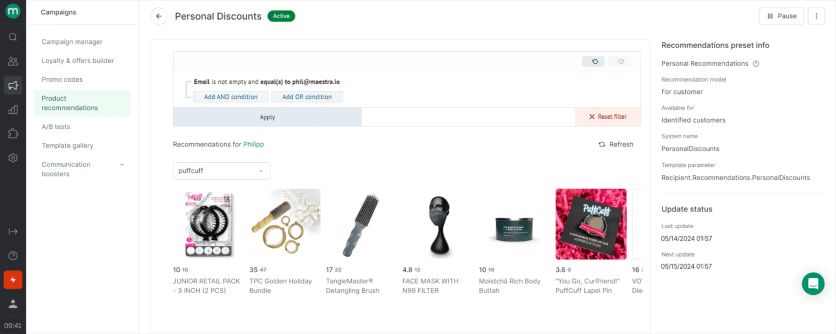
Product Recommendations and Next Best Offer
Fourteen ready-to-use recommendation engines personalize emails, texts, and on-site blocks, and Next Best Offer picks the most relevant product and offer for each customer from their RFM and behavior, then triggers a personalized campaign.
Pricing
Maestra separates the platform fee from message costs. The platform side scales with active profiles – the customers you actually engage – while SMS and MMS bill per message, like any texting tool. Your first 100,000 active profiles are included, and dormant contacts cost nothing to store.
Three builds map to how far past SMS you want to go:
Match Postscript, then some: $2,250/mo gets the CDP + Unlimited Email + SMS, MMS & RCS. That base already carries full-funnel reporting, product recommendations, ad-audience sync, and MCP – plus a Forward Deployed Marketer, a Maestra specialist embedded in your account who builds flows and segments, runs tests, and reviews results with you each week over Slack.
Add the storefront: $3,765/mo layers on Onsite Experience Personalization – pop-ups, embedded forms, quizzes, and recommendation widgets that turn site visits into subscribers.
Add more inboxes: $4,185/mo opens WhatsApp, other messaging apps, and custom channels for conversations that outgrow SMS.
SMS and MMS keep standard per-message pricing throughout – US SMS at $0.0035 plus carrier fees, MMS at $0.0125. Onboarding and migration are done for you at no charge, and nothing bills until you’re live. Plans stay month-to-month with no lock-in – so where a platform fee climbs with your message volume, the Maestra side of the bill grows only when your engaged audience does. See Maestra’s pricing.
Where Maestra Wins
Consolidation economics. A Postscript brand almost always runs Klaviyo (or similar) beside it, often plus a loyalty app and a popup tool. Maestra replaces that stack with one platform and one bill – the mechanism behind UAG’s $100,000 annual savings – and eliminates the segment-syncing and attribution double-counting that come with parallel tools.
Depth of personalization. Because SMS shares a profile with email, site behavior, and loyalty status, texts can carry the same dynamic recommendations and price-drop triggers as email. Enlightened Equipment upgraded from basic abandoned-cart emails to complex flows combining email and SMS on the way to 52.5% total revenue growth.
Service model. The dedicated team in every plan means strategy and build-out don’t depend on plan tier – a direct answer to the support decline Postscript reviewers describe.
Where Maestra Falls Short
Maestra is built for mid-size and larger brands, and the entry price reflects that: there’s no free tier and no $49-a-month path, so an early-stage store that only needs cart-abandonment texts will find Postscript’s Starter or SlickText far cheaper. Some G2 reviewers also note the interface can feel technical during setup – the dedicated team offsets this, but self-serve-minded marketers should expect a learning curve.
Compared to Postscript
Postscript is a specialist: SMS-first, Shopify-only, US/Canada-first, self-serve. Maestra is a consolidator: omnichannel, multi-platform, with service included. Postscript’s AI (Shopper, Infinity Testing) optimizes within the SMS channel; Maestra’s AI (Next Best Offer, recommendation engines, send-time prediction) optimizes across channels. If SMS is your entire program, Postscript is a fine tool. If SMS is one of four channels that should share one brain, that’s Maestra’s home turf.
When to Switch from Postscript to Maestra
You’re running Postscript plus Klaviyo and maintaining everything twice. Two segment builders, two attribution models, two bills. UAG’s stack consolidation cut costs 64% precisely by ending this kind of duplication.
Your SMS revenue plateaued because texts can’t see the rest of the customer. When SMS joins email, site behavior, and purchase history on one profile, flows get smarter – Selkirk’s 149% SMS revenue growth came alongside, not instead of, 55% email growth.
You’re paying platform fees plus minimum spends plus app subscriptions. If the combined stack bill approaches four figures a month, Maestra’s all-in pricing with an included services team usually compares favorably – and it’s month-to-month, unlike the annual terms Postscript reviewers complain about discovering at renewal.
You’re expanding beyond Shopify or beyond the US. Maestra integrates with Shopify, BigCommerce, Magento, and WooCommerce, and supports international messaging without Postscript’s $0.25-per-SMS economics.
2. TxtCart – Best for AI-Powered Conversational Cart Recovery
Starting price: From $29/mo (Starter, $0.009 per SMS)
G2 rating: No current G2 listing; 4.9 on the Shopify App Store (300+ reviews)
TxtCart is a Shopify-exclusive, AI-native SMS platform built around one idea: replace one-way blasts with two-way, human-sounding conversations. Founded in 2019 by Kyle Bigley and grown to serve thousands of Shopify brands without venture funding, TxtCart says its platform has driven over $50 million in attributed revenue, with SMS accounting for roughly 21% of overall sales for brands running it. Where Postscript automates sends and Attentive automates at enterprise scale, TxtCart’s pitch is narrower and sharper: an AI sales agent that texts customers back in real time, the way a human rep would, rather than a bot reciting a script. The company reports average cart recovery rates of 15–25%, against a 3–5% benchmark it attributes to email, and claims brands using the platform see an average 18x ROI.
That conversational layer is also why TxtCart frames itself less as a “marketing tool” and more as an always-on team member – it answers product questions, resolves objections, and closes sales inside the same text thread a shopper started, instead of routing them to a separate support inbox.
Key Features
AI Sales Agent
Trained on the brand’s voice, catalog, and knowledge base, TxtCart’s AI agent replies to inbound texts in real time – recovering abandoned carts, checkouts, and browse sessions without a human on the other end. TxtCart reports 45% reply rates and 30% conversion rates on these conversations, well above the open-and-click math of a typical email flow.
Flows
AI-built and fully customizable SMS flows cover cart, checkout, and browse abandonment along with post-purchase and win-back sequences. TxtCart claims its conversational approach recovers 33% more abandoned checkouts than standard one-way SMS reminders.
Campaigns and Campaign Planner
One-time broadcasts to segments or the full list, with dynamic, unique discount codes generated per customer. A built-in Campaign Planner surfaces AI-recommended send dates around holidays and sales moments so brands don’t miss key windows.
Popups and Checkout Opt-In
Full-screen popups and a checkout-embedded, peer-to-peer opt-in flow (P2P Checkout Opt-In) grow the SMS list without a separate app. TxtCart cites 10–15% opt-in rates from full-screen popups and up to 25% more subscribers from checkout opt-in, contributing to a claimed 3–5x list growth overall.
Analytics and AI Assistant
Real-time subscriber and revenue analytics sit alongside an AI Assistant that suggests campaign copy and surfaces performance insights. TxtCart also reports that brands see roughly 60% fewer support tickets once the AI agent starts handling routine customer questions over text.
Pricing
Four tiers, billed through Shopify with per-message overage and no setup fees: Starter at $29/mo ($0.009/SMS), Growth at $79/mo (adds advanced segmentation, an auto-capture knowledge base, and AI-generated offers), Pro at $399/mo (adds advanced analytics, reporting, and a dedicated Customer Success Manager), and Managed at $999/mo, annual billing only (a fully managed program with done-for-you campaign copy, custom popups with A/B testing, and a dedicated Slack channel). Carrier fees pass through at cost, and every plan includes a 14-day free trial with $1,000 in free credits, no contracts, and no performance fees.
Where TxtCart Wins
Entry price and billing honesty. At $29/mo with transparent, tiered per-message rates, TxtCart undercuts Postscript’s $49 minimum and avoids the $500 platform fee Postscript charges on Professional – while staying purpose-built for Shopify cart recovery rather than generic mass texting.
Conversational depth. The AI agent is the clearest differentiator: reviewers consistently credit two-way, human-sounding replies, rather than automated one-way flows, for converting shoppers that would otherwise have ignored a text. For brands whose products invite questions before purchase, that’s a meaningfully different tool than a broadcast platform.
Where TxtCart Falls Short
It’s Shopify-only, so brands on WooCommerce, BigCommerce, or Magento are locked out – the same structural wall Postscript has. There’s no unified email channel, so brands still need a separate platform (typically Klaviyo) to run email, meaning the segment-syncing and attribution overlap that pushes brands off Postscript in the first place doesn’t fully go away. TxtCart also has no independent G2 presence yet, so due diligence currently rests on Shopify App Store reviews alone rather than a second, harder-to-game source.
Compared to Postscript
Both are Shopify-exclusive SMS specialists with self-serve, month-to-month pricing and no long-term contracts. The difference is emphasis: Postscript leans on breadth built up over years – Shopper AI, Infinity Testing, RCS, CashBack – while TxtCart leans hard into one thing, AI-led two-way conversation, at a lower entry price ($29 vs. Postscript’s $49 monthly minimum) and without Postscript’s $500 Professional platform fee. For a brand whose main complaint is Postscript’s fees or the flatness of one-way blasts, TxtCart is a direct, cheaper swap within the same Shopify-only category, though it doesn’t solve Postscript’s email gap or its US/Canada-first international pricing problem.
Compared to Maestra
The two aren’t really competing for the same brand. TxtCart is a single-channel specialist that goes deep on SMS conversation quality; Maestra is a full retention platform where SMS is one channel sharing a real-time profile with email, push, site personalization, and loyalty. A brand that’s outgrown TxtCart’s single-channel ceiling – running SMS well but still juggling a separate email platform, a separate popup tool, and no unified view of the customer – is the brand for whom Maestra’s consolidation, with a dedicated team included in every plan, starts to make sense.
3. Klaviyo – Best for Shopify Email and SMS
Starting price: Free plan available (up to 250 profiles); email from $20/mo, email + SMS from $35/mo
G2 rating: 4.6
Klaviyo is the default email platform for Shopify – and the most common second platform running beside Postscript. For Shopify brands consolidating email and SMS in one self-serve platform, its pitch as a Postscript alternative is simple: keep the SMS, absorb it into the email suite, and delete one login. Klaviyo now calls itself “the autonomous B2C CRM,” and SMS is one channel in a portfolio that spans email, SMS/MMS, RCS for Business, mobile push, WhatsApp, and social.
Klaviyo’s own comparison page leads with “Go beyond SMS” – a fair summary of the trade: less SMS-specific tooling than Postscript, far more surface area everywhere else.
Key Features
Flows
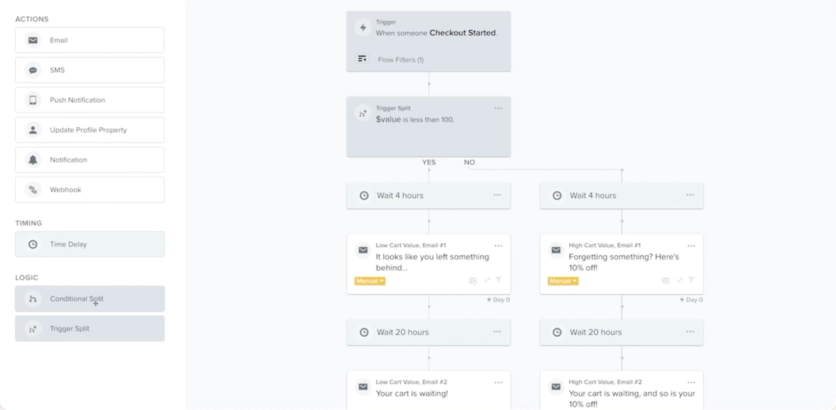
Klaviyo’s automation builder combines email and SMS in one canvas with behavioral triggers, conditional splits, and A/B testing – the coordination Postscript users currently do across two tools.
Klaviyo AI
The K:AI umbrella covers predictive analytics (churn risk, expected next order date, lifetime value), generative content, and the new Composer (Beta), which audits and creates flows and campaigns from a prompt.
Klaviyo Data Platform
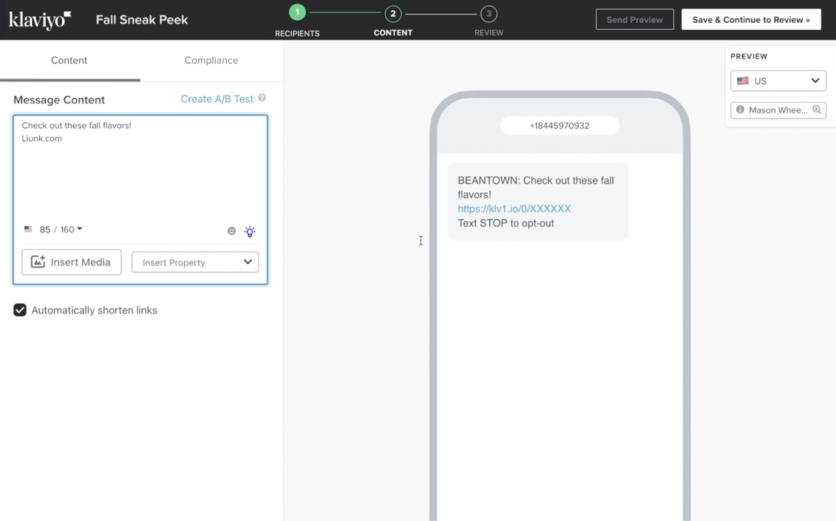
The CDP layer unifies customer data across 350+ integrations, with RFM analysis and predictive analytics built in – CLV forecasts, predicted next order date, and churn risk. An Advanced KDP tier adds data transformation, custom objects, and warehouse sync to Snowflake, BigQuery, and Redshift.
Customer Hub
A signed-in shopper account experience – order tracking and returns, wishlists, loyalty points, subscription management, and personalized recommendations – that sends activity back into Klaviyo to trigger flows and segments. Works with Shopify, WooCommerce, and headless storefronts.
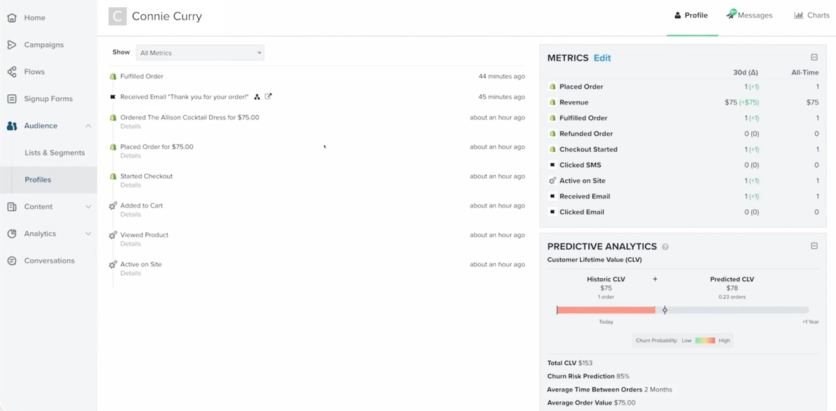
Segmentation
Real-time segments on any combination of profile data, predicted metrics, and behavior. As one G2 reviewer put it: “Klaviyo is the gold standard for ecommerce email and SMS marketing. Its segmentation is especially powerful.”
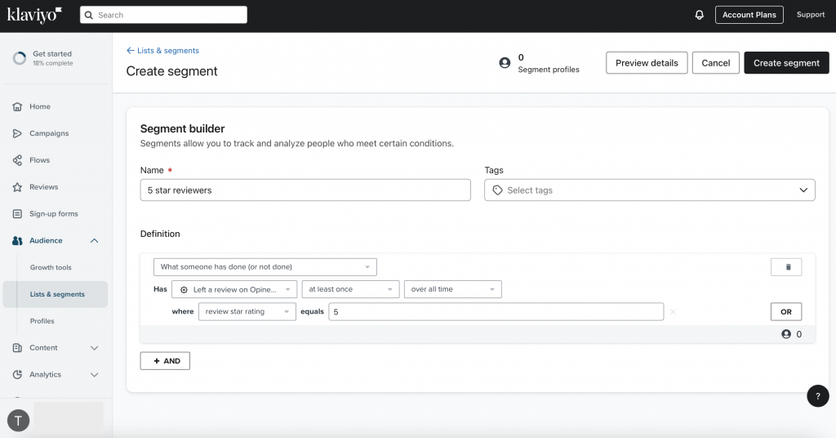
Pricing
Free plan available (up to 250 profiles, 500 email sends and a $5 mobile-messages credit a month). Email from $20/mo (251–500 profiles); adding SMS starts at $15/mo for 1,250 credits, so a combined email + SMS program starts around $35/mo. Pricing scales on active profiles across the whole database – roughly $150/mo at 10,000 profiles and $720/mo at 50,000 per third-party testing (estimates, not official rates).
Where Klaviyo Wins
Breadth on a budget. For a small or mid-size Shopify brand, Klaviyo delivers email, SMS, push, reviews, and predictive analytics for less than Postscript’s Professional platform fee alone. The Shopify integration is the category benchmark – “the integration with our Shopify store makes it easy to build automated flows based on real customer behavior,” in one G2 reviewer’s words – and unlike Postscript, Klaviyo also runs on BigCommerce, WooCommerce, Magento, Wix, and Salesforce Commerce Cloud.
Data depth. Predicted lifetime value, churn risk, and expected order date are available as segment conditions out of the box – Postscript’s 45+ segmentation filters are SMS-behavior-centric by comparison.
Where Klaviyo Falls Short
The active-profile billing model is the loudest complaint of the past year. Because Klaviyo charges for every stored profile – not just people you message – bills jump when lists grow or when the model changes. one Trustpilot reviewer described going from $39/month to over $200/month overnight after a change in business model; another reported a bill going from $625 to $2,765. Klaviyo’s Trustpilot rating sits at 1.8, driven mostly by billing complaints.
Support is the second theme: reviewers describe 24/7 chat that turns out to be a poorly trained AI bot – an ironic echo of the exact complaint pushing people off Postscript.
Compared to Postscript
Postscript prices by SMS usage; Klaviyo prices by stored profiles – so a text-heavy, small-list brand often pays less on Postscript, while a brand consolidating email and SMS usually pays less on Klaviyo than on both. Postscript’s SMS toolkit (Shopper, Infinity Testing, CashBack, RCS branded profiles) is deeper; Klaviyo counters with cross-channel attribution and channel-affinity AI that Postscript can’t see from inside one channel.
Compared to Maestra
Klaviyo and Maestra are both consolidation plays, aimed at different weight classes. Klaviyo is self-serve with a free tier – right for brands below the mid-market line. Maestra bundles a real-time CDP, site personalization, and built-in loyalty that Klaviyo delegates to integrations, and includes a dedicated services team where Klaviyo’s support runs through an AI-first chat queue. Notably, several published Maestra cases are Klaviyo migrations: Magnum Bikes doubled online orders after switching, and Sena grew total revenue 2.2x while consolidating multi-regional marketing.
4. Attentive – Best for Enterprise SMS

Starting price: Custom pricing (contact sales)
G2 rating: 4.5
Attentive is the enterprise heavyweight of SMS – the platform behind text programs for large retail, food and beverage, and travel brands, and the company Yotpo chose to take over its managed Email & SMS customers when it exited the business. The fit: enterprise DTC brands running SMS programs at scale with a managed partner. Where Postscript is self-serve software for Shopify merchants, Attentive is a sales-led program: negotiated contracts, channel bundles, and optional AI add-ons.
Key Features
Attentive AI
The umbrella AI layer, sold as tiered add-ons: AI Journeys for automated lifecycle messaging, AI Pro for identity and personalization (“beyond the browser cookie”), and AI Grow for list growth.
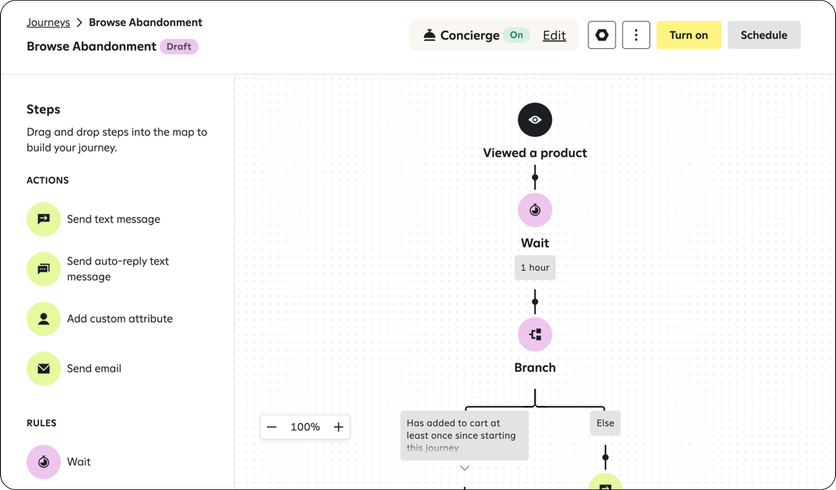
Attentive Concierge
Conversational commerce where “conversational AI and AI-assisted live agents work together to deliver high-quality responses 24/7” – the enterprise counterpart to Postscript’s Shopper.
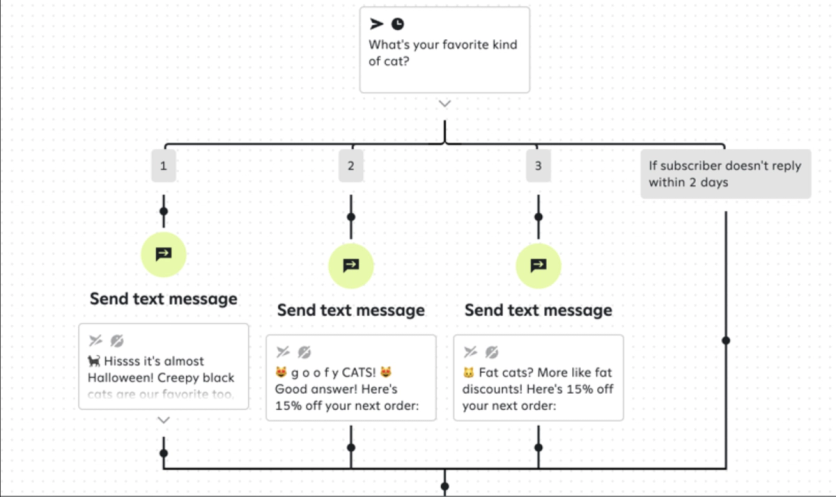
Two-Tap Sign-Up
Attentive’s signature list-growth mechanic: subscribers join from a mobile page in two taps. Its head start with this mechanic is why Attentive lists are famous for growing fast.
RCS Hub
Attentive’s RCS for Business turns texts into verified, branded conversations – rich cards, product carousels, tap-to-reply buttons, and full-resolution media – running across campaigns, journeys, and AI Pro. Like Postscript, Attentive is betting on rich messaging as the next SMS.
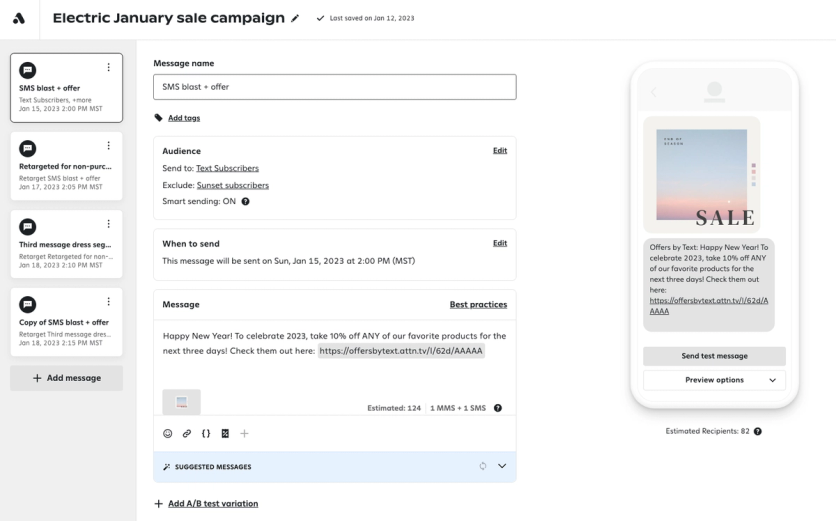
Audience Manager and Signal
Two products that feed each other: Signal, an identity layer that resolves browsing behavior, phone numbers, and emails into one unified subscriber profile using server-side technology, and Audience Manager, which builds dynamic segments on those profiles from behaviors, demographics, and pre-built templates.
Pricing
Custom pricing (contact sales). The pricing page publishes no numbers; plans are built from channel bundles (text only, text & email, or SMS, email, RCS & push) plus AI add-ons. Third-party estimates put typical spend at a $300–$500/mo platform fee with $0.01–$0.025 per SMS segment and 6–12 month contracts (estimates, not official rates).
Where Attentive Wins
Scale and service. For a brand sending millions of texts across regions or multiple brands, Attentive brings deliverability infrastructure, compliance tooling, and a hands-on customer success team that reviewers consistently praise. List growth is the other differentiator – its sign-up units are the most battle-tested in the category.
Channel roadmap. SMS, email, RCS, and push under one contract makes Attentive the most credible single-vendor option for enterprises that want to retire multiple messaging tools at once.
Where Attentive Falls Short
Contracts. The most persistent complaint theme is lock-in: reviewers describe strict SMS exclusivity with long-term contracts, limited flexibility, and significant financial penalties for changing your tech stack. Attentive’s subscription agreement states fees are non-cancellable and non-refundable.
Cost transparency. Reviewers cite carrier fees that can add materially to the monthly bill, and G2’s summary lists cost as the dominant drawback. Budgeting requires a negotiation, not a pricing page.
Compared to Postscript
This is a step up in weight class, not a lateral move. Postscript publishes its rates and lets you downgrade monthly; Attentive negotiates everything and expects a term commitment. In exchange, Attentive removes Postscript’s ceilings: multi-platform (not just Shopify), email included, enterprise deliverability and support. Brands under roughly $10M revenue will likely find Attentive’s minimums hard to justify against Postscript’s usage-based bill.
Compared to Maestra
Both target brands that have outgrown self-serve SMS tools, and both include hands-on service. The difference is scope: Attentive is a messaging platform (SMS, email, RCS, push), while Maestra adds the real-time CDP, site personalization, recommendations, and built-in loyalty on top of messaging – with published pricing and month-to-month billing instead of negotiated annual contracts. A brand choosing between them is really choosing between the best-of-breed messaging contract and a full-stack consolidation. For a deeper look, see Maestra’s Attentive alternatives comparison.
5. Sendlane – Best for Hands-On Email and SMS
Starting price: From $100/mo (unlimited contacts, pay per send); SMS from $0.009 per credit
G2 rating: 4.7
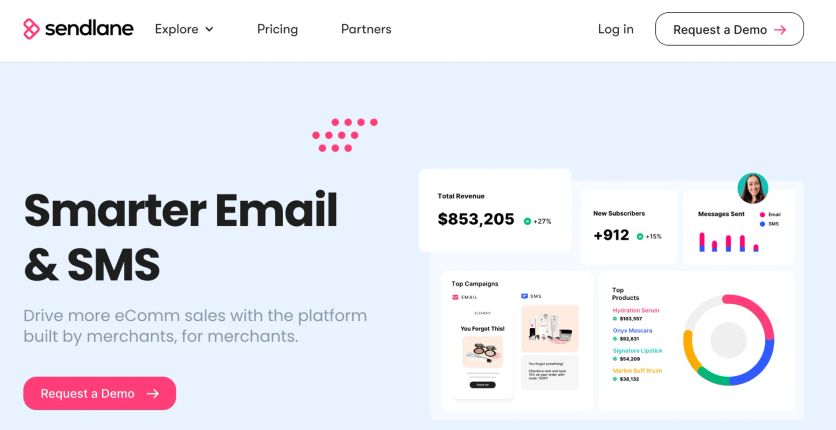
Sendlane sells “unified email, SMS, reviews & forms” with a service-first culture aimed at established DTC brands – dedicated success managers, migration help, and a pricing model that charges for sends rather than stored contacts. In February 2026 it was acquired by Privy (which had bought Emotive seven months earlier), and it continues to operate under its own brand. Its send-based pricing is the cleanest answer on this list to both Postscript’s platform fees and Klaviyo’s profile-based bills.
Key Features
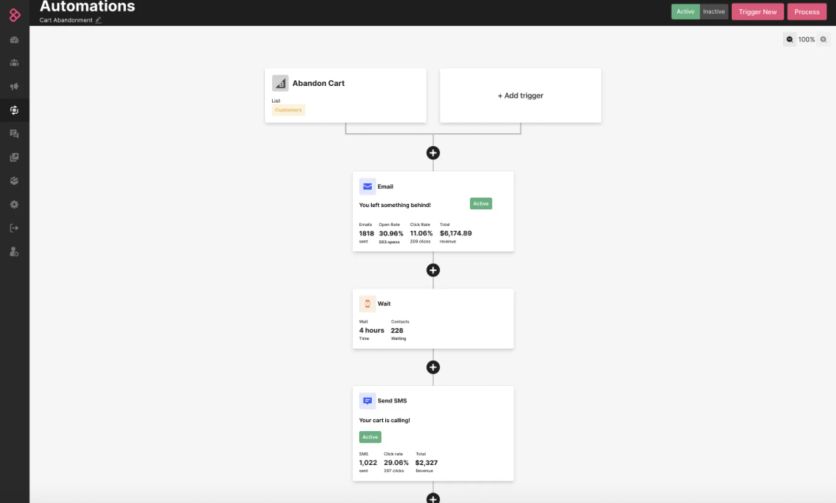
Multi Channel Automations
Email and SMS in one automation builder with deep-data triggers from your store, plus 50+ pre-built funnels covering the standard jobs – welcome series, abandoned carts, and back-in-stock alerts.
Multivariable Segmentation
Dynamic segments that update in real time, built on 100+ data points – purchase behavior, engagement, and on-site activity tracked by Sendlane Beacon. CLTV segments are built in, separating big spenders from shoppers who need an extra nudge.
Multivariate Testing
Experiments that test up to four variables at once – subject lines, CTAs, imagery – and automatically send the winning combination to the rest of your audience.
Deep-Data Integrations
One-click, two-way sync with Shopify, WooCommerce, and BigCommerce that pulls hundreds of customer data points into messaging – the products people view, click, and buy. Multiple stores can connect to a single Sendlane account.
Reviews and Forms
Native review collection with dynamic display in emails (abandoned-cart emails included), plus intelligent pop-ups with advanced targeting rules and multi-step forms – folding two more point tools into the same bill.
Pricing
No free plan; a 60-day trial (100 contacts, 500 email sends) is unusually long. Email from $100/mo with unlimited contacts – you pay for sends, not profiles, with the send volume set by a slider on Sendlane’s page. SMS from $0.009 per credit inclusive of carrier fees, plus a $10/mo activation.
Where Sendlane Wins
The pricing model rewards big lists with disciplined sending: a 100,000-contact brand that emails segments rather than blasts pays for what it sends, with no per-profile meter running. Carrier fees folded into the SMS rate also make budgeting simpler than Postscript’s pass-through model. And the service reputation – “dedicated, personalized support from experts,” as the Privy announcement puts it – is corroborated by reviewers praising hands-on success managers.
Where Sendlane Falls Short
Analytics come up repeatedly: reviewers describe reporting as somewhat basic and ask for more customizable dashboards and deeper campaign-performance segmentation. An older review (2021) flagged unreliable KPIs on non-Shopify storefronts like BigCommerce – verify the current state before weighing it heavily. Newer reviewers also find advanced automations slightly overwhelming for beginners.
Compared to Postscript
Sendlane trades Postscript’s SMS specialization for two-channel unification and predictable economics. There’s no equivalent of Shopper or Infinity Testing, and Sendlane’s SMS is US-focused. But there’s also no $500 platform fee, no separate email bill, and no contact-count anxiety. The $100 entry point prices out hobby stores – this is a move for brands doing real volume, not a budget escape hatch.
Compared to Maestra
Both include hands-on service and both unify email and SMS; Maestra extends the same profile into site personalization, push, messengers, recommendations, and built-in loyalty, where Sendlane stops at messaging plus reviews and forms. Sendlane’s new ownership is also worth watching: Privy now owns three overlapping platforms (Privy, Emotive, Sendlane), and product roadmaps in that situation tend to converge – Maestra’s platform, by contrast, is one product under one roof.
6. Recart – Best for Shopify List Growth
Starting price: From $299/mo (23,000 SMS included, 12-month commitment)
G2 rating: No current rating (stale listing); 4.7 on the Shopify App Store
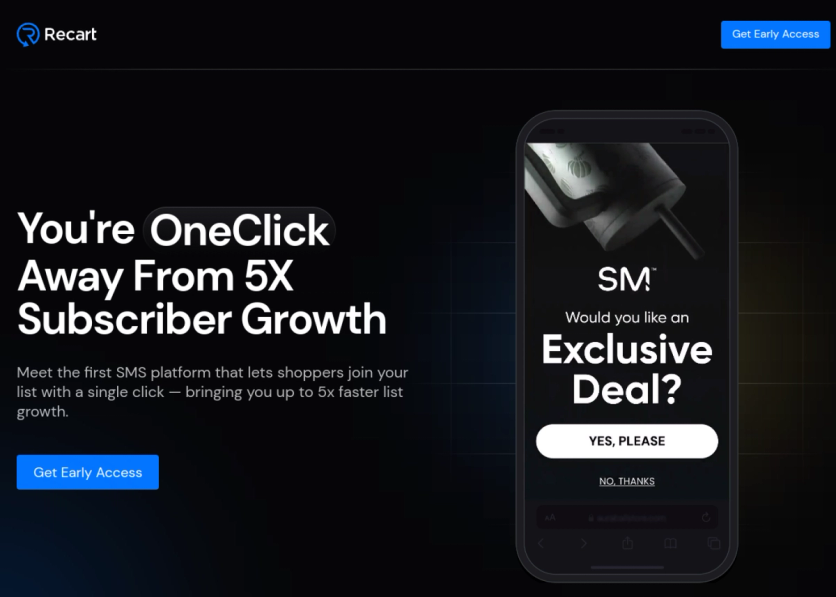
Recart is the closest structural twin to Postscript on this list: Shopify-exclusive, DTC-focused, SMS-first. Its wedge is list growth – its OneClick Opt-in popup technology claims to grow SMS and email lists “2–5x faster” – and a managed model where a client strategy team is included at every tier. It’s built for Shopify brands that treat list growth as the main lever and want a managed program. Recart is so confident in the list-growth wedge that its popups integrate with Postscript itself.
Key Features
OneClick Opt-in
Recart calls it “the world’s first one-click popup tool” – subscribers opt in without typing their phone number, which is where the 2–5x list growth claim comes from.
AI Campaigns
Recart’s AI turns one campaign goal into multiple personalized texts, segmented by lifecycle, product preferences, and purchase behavior, and timed to when each subscriber is most likely to buy. Brand-tone rules govern wording, style, and emoji, and you review and approve every variant before it sends.
Campaign Library
A browsable archive of 200,000+ real SMS and email campaigns from the top 10,000 DTC brands, searchable by brand, industry, or message content – with send-frequency trends and timing heatmaps per brand. Free to browse, no account required.
Client Strategy
The managed layer, included on Scale and Enterprise plans rather than sold as an upgrade: Recart’s team handles migration and compliance, builds and optimizes flows and popups, writes campaigns from your marketing calendar, and runs monthly strategy sessions with weekly reporting.
Automations
Five flow families – welcome, abandonment (browse, cart, and checkout), transactional, post-purchase, and retention – with Shopify-native triggers, A/B testing on flow messages, and setup handled by Recart’s team.
Pricing
From $299/mo (23,000 SMS at $0.010 per text) on a 12-month commitment; Pro at $499/mo brings the per-text rate to about $0.0085, and Scale at $999/mo to $0.007. Carrier fees add $0.003 per message. List-growth-only plans run $200–$800/mo on quarterly commitments. The pricing page advertises no free plan, though the Shopify App Store lists a free plan and a 7-day trial.
Where Recart Wins
Opt-in performance is the story reviewers actually tell: “Their popups delivered 2–2.5x higher opt-in rates right out of the gate,” a candle brand wrote in February 2026, and a jewelry brand praised “the reporting and strategy recommendations their team brings to the table.” For a brand whose SMS revenue is capped by list size rather than message quality, that’s the right tool aimed at the right bottleneck.
Where Recart Falls Short
The commitment structure is the opposite of Postscript’s flexible downgrades: 12-month terms at $299 minimum. Negative reviews are scarce but sharp – one merchant reported “$10,000+ lost in revenue with Recart due to platform bugs” and disputed its attribution numbers against Shopify’s native reporting (December 2024); another described a billing dispute escalating to account suspension. And there’s no meaningful G2 presence – the listing dates from Recart’s Messenger era, so diligence rests on Shopify App Store reviews.
Compared to Postscript
Same market, different centers of gravity. Postscript’s product depth (Shopper, Infinity Testing, RCS, CashBack) versus Recart’s acquisition engine and included strategy team. Postscript lets you start at $49 minimum and leave monthly; Recart starts at $299 on an annual term but hands you a team. Brands confident in their own SMS operators lean Postscript; brands that want the program run for them lean Recart.
Compared to Maestra
Recart optimizes the top of one channel’s funnel; Maestra runs the whole customer lifecycle across channels. They’re not really substitutes – a Recart-sized brand is often earlier-stage than Maestra’s sweet spot – but a brand evaluating Recart’s managed model at $999/mo Scale pricing plus a separate email platform is already at the spend level where Maestra’s all-in consolidation, with popups and one-click SMS opt-ins included, deserves a look.
7. Emotive – Best for Done-for-You SMS
Starting price: From $100/mo + $0.015/SMS
G2 rating: 4.5
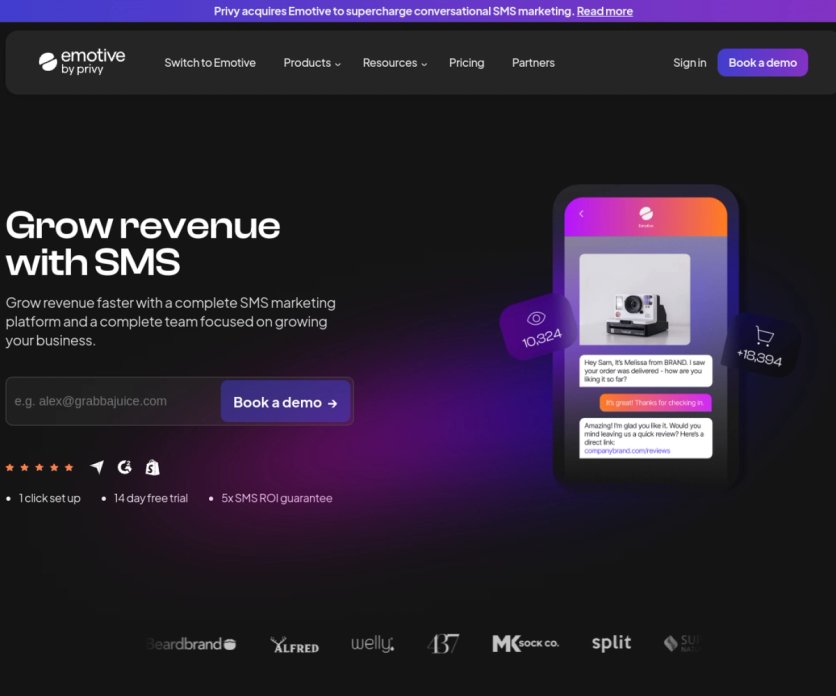
Emotive built its name on human-powered conversational SMS for brands that want texting done for them: real people (TextPros™) texting with customers on the brand’s behalf, backed by a “5x SMS ROI guarantee.” In July 2025 it was acquired by Privy, which is merging it into a unified email and SMS platform – Emotive still sells under its own brand, but its roadmap now belongs to a bigger consolidation story. If Postscript’s Shopper is AI pretending to be a person, Emotive’s TextPros are people assisted by software.
Key Features
TextPros
Dedicated SMS experts – the core team is included, with a dedicated copywriter from the Pro plan up. Emotive pitches it as “a $5,000+ a month service for free.” They handle two-way conversations, campaign writing, and optimization.
CartAI
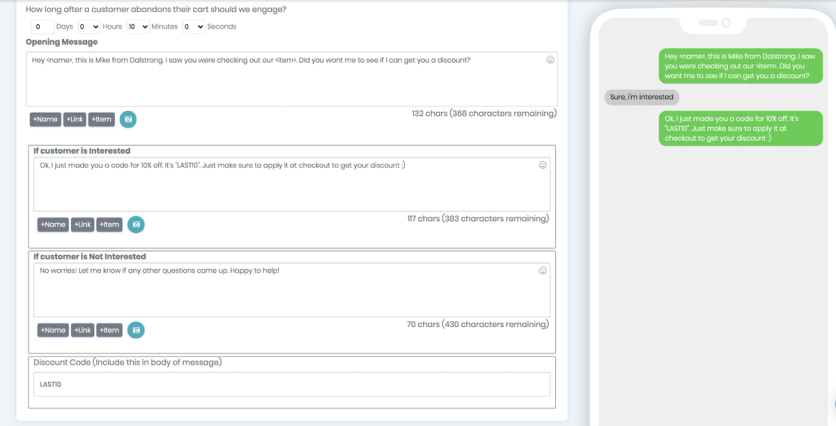
Emotive’s proprietary first-party identification pixel, built to recognize anonymous shoppers that standard tracking misses and feed them into abandonment flows. Emotive claims 300% more captured carts and backs the bundle with a money-back ROAS guarantee.
RealLink
Links in texts come from your own domain instead of a generic shortener – Emotive’s answer to shoppers wary of tapping suspicious links, which it credits with a 20% lift in click-through rates.
Emotive Attribution
Multi-touch attribution across paid ads, lifecycle, and ecommerce channels in one dashboard – model comparisons, conversion journeys, and a first-party pixel for checking platform ROAS against reality. A direct response to the over-attribution skepticism common across SMS platforms.
Flow Builder
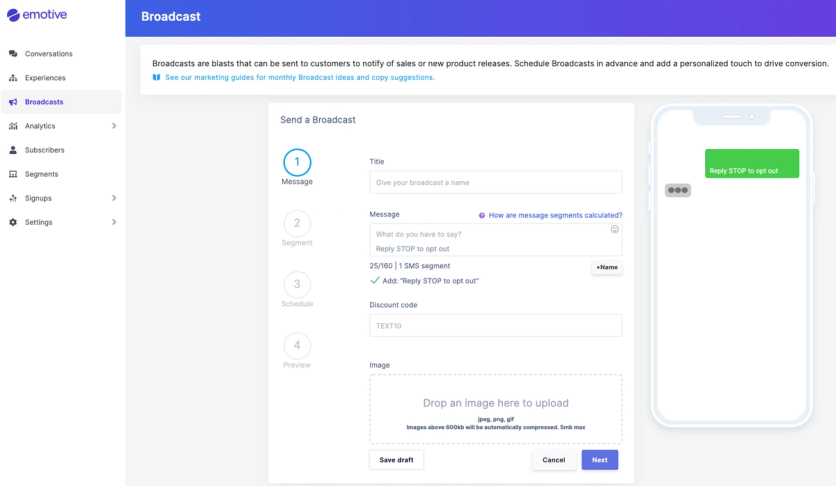
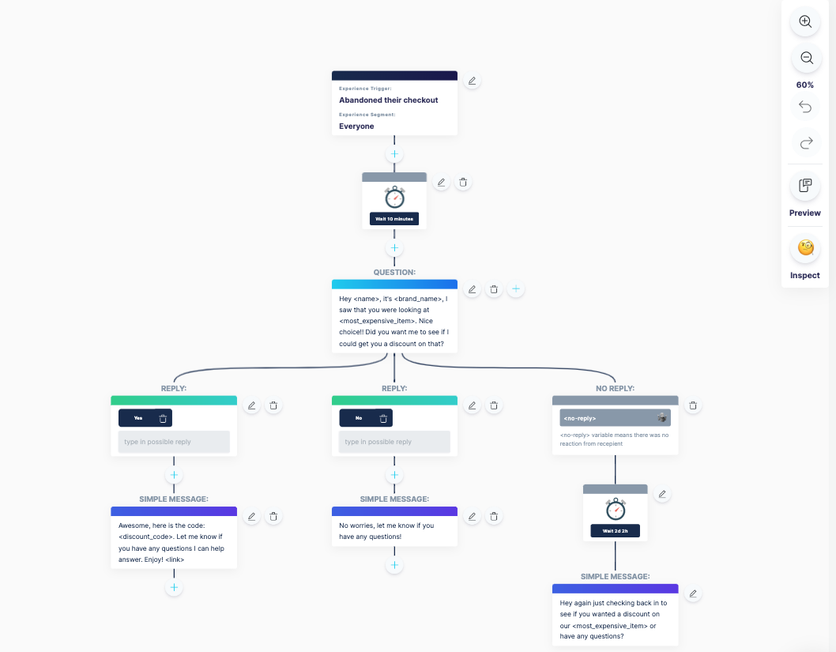
Conversational one-to-one flows built in minutes, with what Emotive calls Endless Triggers – add-to-carts, viewed content, and other behavioral events – plus Smart Reply for routing two-way responses to the right place.
Pricing
From $100/mo + $0.015/SMS (Starter, lists under 2,000); Pro at $200/mo and Advanced at $300/mo lower per-message rates but add minimum spends ($200–$400); Enterprise is custom above 10,000 contacts. 14-day free trial. The 5x ROI guarantee requires at least 10,000 monthly unique site visits to qualify.
Where Emotive Wins
The managed conversational layer is genuinely differentiated: for brands whose products invite questions – supplements, skincare, considered purchases – human-driven two-way SMS converts conversations Postscript’s automation would drop. Reviewers consistently credit the hands-on success team, and the multi-platform support (Shopify, WooCommerce, BigCommerce, Magento) removes Postscript’s storefront wall.
Where Emotive Falls Short
Pricing transparency is the loudest recent complaint: reviewers say carrier fees, taxes, and minimum-spend requirements are confusing and poorly disclosed, and warn that the pricing structure is complicated with automatic yearly renewals worth reading closely. Its Shopify App Store rating sits at 3.6 – notably below every other platform here – and the Privy merger adds roadmap uncertainty that a buyer should ask direct questions about.
Compared to Postscript
Emotive bets on humans where Postscript bets on AI. Postscript’s platform is deeper (testing, RCS, CashBack, analytics) and its self-serve pricing is cleaner; Emotive’s included TextPros replace work Postscript charges for via Postscript Plus. Ironically, both now share a complaint theme: contract terms and renewals that surprise merchants. Read both contracts carefully.
Compared to Maestra
Both include human service, at different altitudes: Emotive’s TextPros execute SMS conversations; Maestra’s dedicated team builds and optimizes the whole omnichannel program – flows, segmentation, site personalization, loyalty. Emotive post-acquisition is becoming part of a bundled email + SMS mid-market suite, while Maestra already operates as a single unified platform a tier up, with the CDP and personalization depth that bundles assembled from acquisitions typically lack.
8. SlickText – Best for Simple Mass Texting
Starting price: From $29/mo (500 texts); 14-day free trial
G2 rating: 4.8
SlickText is the generalist: 24,000+ brands across retail, nonprofits, churches, gyms, and other industries use it for straightforward list-based texting. It’s not an e-commerce retention platform – and that’s the point: it’s for teams that need dependable mass texting without an e-commerce data model. If what you actually need from “SMS marketing” is campaigns, keywords, and a shared inbox at a fair price, SlickText does that with the highest G2 rating on this list.
Key Features
Workflows
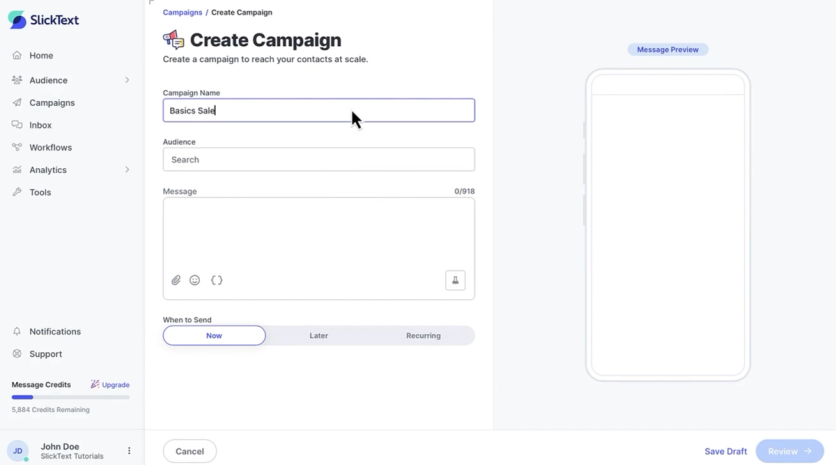
A no-code, drag-and-drop builder for drip sequences and multi-branched journeys, with triggers, conditions, and waits, A/B tests inside workflows, and revenue attribution per flow.
Keywords
Text-to-join keywords (plus QR codes and Tap-to-Join links) – the classic list-building mechanic SlickText is known for. Each keyword carries its own auto-reply with a welcome message or discount code, and keywords double as segments by location, campaign, or interest.
Inbox
Two-way messaging with a shared team inbox: round-robin assignment, internal notes inside conversations, tag and status filters, and auto-close rules for off-hours and inactivity. Incoming messages are free on every plan.
Segments
Dynamic segmentation on subscriber attributes and engagement – links clicked, cart status, order activity, location, opt-in method – updating in real time as customers act.
Web Forms and Popups
Branded landing pages, embeddable forms, and popup templates with page-level targeting and per-device designs, feeding lists directly – with carrier-compliant opt-in language built into every form.
Pricing
From $29/mo (500 credits) up to $939/mo (50,000 credits), with custom plans above. All plans include unlimited contacts, free incoming texts, rollover credits, and live phone, chat, and email support. A 14-day full-featured trial requires no credit card. One credit equals one 160-character SMS; MMS costs three credits.
Where SlickText Wins
Simplicity and support. Reviewers praise the intuitive dashboard and fast human support on every plan – no tier gates, which directly answers two of the top Postscript complaints. The pricing ladder is honest: no platform fees, no minimum-spend fine print, credits roll over, and unlimited contacts means list growth never raises your bill by itself.
Where SlickText Falls Short
It isn’t built for e-commerce retention. Its Shopify integration and ecommerce workflows cover the basics, but revenue attribution and cart-abandonment depth fall short of dedicated DTC platforms, and MMS at three credits gets expensive for image-heavy programs. Reviewers ask for more segmentation flexibility – “the limited number of Textgroups can be hard,” per a February 2025 Capterra review – and deeper analytics; one reviewer noted having to wait until Monday for help with weekend campaign issues.
Compared to Postscript
This is a downgrade in e-commerce intelligence and an upgrade in billing sanity. Postscript knows your Shopify catalog, revenue per flow, and subscriber LTV; SlickText knows your list and your keywords. A DTC brand running revenue-driven SMS shouldn’t make this trade – but a brand that felt overserved and overbilled by Postscript’s platform fees, or that operates outside Shopify entirely, gets a calmer tool at a fraction of the cost.
Compared to Maestra
They barely overlap. SlickText is a single-channel utility; Maestra is an omnichannel personalization platform. The honest guidance: if SlickText covers your needs, you don’t need Maestra yet – and if you’re comparing them seriously, your real question is whether SMS should stay a standalone list or become part of a unified customer profile.
How to Choose the Right Postscript Alternative
Postscript replacements fall into three groups – full retention platforms, unified email-and-SMS suites, and SMS-first specialists. Which fits comes down to six questions:
How is pricing structured? If Postscript’s platform fee plus per-message costs is what’s pushing you out, check whether the alternative charges a platform fee at all. SlickText starts cheapest; Maestra separates the two – its platform fee tracks active profiles, while SMS bills per message like the rest; Attentive and Recart are quote- or commitment-based.
Do you need email too, or just SMS? Postscript is SMS-only, so many brands bolt on Klaviyo. If you’d rather run both from one place, Maestra, Klaviyo, and Sendlane all unify email and SMS; Recart, Emotive, and SlickText stay SMS-first.
What platforms do you sell on? Postscript, Recart, and Attentive lean Shopify- and US-first. Klaviyo, Sendlane, and Maestra work across platforms – the safer bet if you’re on WooCommerce, BigCommerce, or Magento, or selling internationally.
How much do you want to run yourself? Attentive, Recart, and Emotive include managed, done-for-you teams; Klaviyo and SlickText are self-serve; Maestra assigns a Forward Deployed Marketer who builds campaigns alongside your team.
How far beyond SMS do you want to go? If SMS is one channel in a bigger retention program – email, push, WhatsApp, on-site personalization, loyalty – Maestra runs them on one customer profile, while the pure SMS tools (SlickText, Emotive, Recart) don’t.
What support model do you get? Postscript’s recent complaints center on AI-first support and slow email replies. If hands-on help matters, Sendlane, Attentive, Emotive, and Maestra offer dedicated support; the cheaper self-serve tools lean on docs and chat.
Your Next Move After Postscript
Maestra is the alternative to pick when the real problem isn’t Postscript’s SMS – it’s the stack sprawl around it: SMS in one tool, email in another, loyalty in a third, popups in a fourth, and no single view of the customer. Maestra replaces three to five point tools with one platform on one real-time profile, with a dedicated team doing the migration and optimization – the consolidation math behind UAG’s $100,000-a-year savings and Selkirk’s 149% SMS revenue growth.
The rest of the field maps cleanly to specific situations: Klaviyo for self-serve email + SMS consolidation, Attentive for enterprise messaging contracts, Sendlane for send-based pricing with service, Recart for list growth, Emotive for human-run conversations, SlickText for texting without the e-commerce machinery.
If your Postscript bill now funds a platform fee, a second email tool, and workarounds for channels it can’t see – book a Maestra demo and price the consolidated version of your stack instead.
FAQ
- Maestra is the strongest alternative for mid-size and scaling Shopify brands because it folds SMS into an omnichannel platform – email, push, site personalization, and built-in loyalty on one real-time customer profile – with migration and ongoing optimization included. Klaviyo is the strongest self-serve option for smaller brands, and Omnisend is the best budget path off Postscript’s $49 minimum. After consolidating both channels on Maestra, Selkirk grew SMS revenue 149% alongside 55% email growth.
- Maestra, Klaviyo, Omnisend, and Sendlane all run email and SMS from one automation builder. Attentive offers email as part of its negotiated channel bundles. Recart and SlickText remain SMS-first, and Emotive is adding email through its merger with Privy. Of the group, Maestra is the one built to scale past those two channels – push, WhatsApp, on-site personalization, and built-in loyalty run on the same customer profile – so you add channels when you’re ready instead of migrating platforms again.
- Klaviyo has a free plan for up to 250 profiles (including 150 SMS credits a month), and Omnisend’s free plan covers 250 contacts with email, SMS, and web push. SlickText offers a 14-day full-featured trial. Maestra doesn’t offer a free tier – it’s built for brands past that stage – but includes migration and setup in every subscription. That trade pays off at scale: UAG saved about $100,000 a year consolidating its stack on Maestra. See Maestra’s pricing.
- Yotpo shut down its Email & SMS product (formerly SMSBump) on December 31, 2025, to refocus on reviews and loyalty. Managed customers were transitioned to Attentive, and Omnisend became the official migration partner for self-serve brands. Any list that still recommends Yotpo for SMS is out of date. Some Yotpo customers took a third path: Svaha moved to Maestra after its Yotpo product recs kept breaking – recommendations now assist 11.2% of its revenue.
- No. Postscript is Shopify-exclusive by design, which is a hard blocker for WooCommerce, BigCommerce, and Magento stores. Maestra, Klaviyo, Omnisend, Sendlane, and Emotive all support multiple e-commerce platforms; SlickText works independently of any storefront. Atlanta Cutlery runs two BigCommerce stores on Maestra after leaving Mailchimp, Attentive, and Yotpo – automations ARPU grew 3x on one storefront and 10x on the other.
- Four models dominate: usage-based with platform fees (Postscript, Recart, Emotive), per-profile platform pricing with SMS credits (Klaviyo, Omnisend), send-based pricing with unlimited contacts (Sendlane, SlickText), and all-in platform pricing where SMS is one usage-priced channel among many (Maestra, from $0.0035 per US SMS on top of the platform subscription). Model the math on your own list size and send volume – the cheapest headline price is rarely the cheapest total. Maestra’s math favors senders: the platform fee tracks active profiles (with unlimited email included), so message volume raises only the per-SMS line, never the subscription. Compare the full breakdown on Maestra’s pricing page.