
9 Best Nosto Alternatives for E-Commerce Personalization

Nobody searches for "Nosto alternatives" while their personalization engine is humming along. Something's off. Maybe it's the bill that climbs every time your GMV and traffic do. Maybe it's an onboarding that keeps stretching past the promised date. Or the feeling that account management got thinner once Nosto swapped your dedicated manager for a pooled team.
Verified reviews from the last 12 months suggest you’re in good company. Nosto powers personalization for 1,500+ brands and holds a healthy 4.6 on G2, yet those same three complaints keep resurfacing.
This guide compares nine platforms that solve those problems from different angles: full personalization suites, search-and-discovery specialists, and Shopify-focused upsell engines. Here’s how they stack up:
Quick Verdict: Best Nosto Alternatives by Use Case
The best Nosto alternatives in 2026 are Maestra, Rebuy, Athos Commerce, Bloomreach, Dynamic Yield, Insider One, Algolia, Monetate, and Clerk.io.
The strongest choice all-around: Maestra – AI recommendations, site and app personalization, email, SMS, loyalty, and a unified customer profile
Best for Shopify upsells and bundles: Rebuy – Smart Cart, dynamic bundles, and checkout offers for Shopify and Shopify Plus
Best for search-led discovery: Athos Commerce – site search, merchandising, and product feed syndication
Best for discovery plus marketing automation: Bloomreach – enterprise search and campaigns with Loomi AI
Best for experimentation at scale: Dynamic Yield – testing-first personalization for enterprise programs
Best for omnichannel journeys: Insider One – orchestration across web, app, and messaging
Best for developer teams: Algolia – API-first search, browse, and recommendations with a free plan
Best for server-side testing: Monetate – enterprise experimentation, including server-side
Best for budget-conscious stores: Clerk.io – search, recommendations, and email on usage-based pricing
Content:
Pain Points with Nosto
Nosto reviewers on G2 are broadly positive, so the complaints below come from a minority. But they repeat across G2 and Trustpilot reviews from the last 12 months, and they’re worth checking against your own contract before renewal.
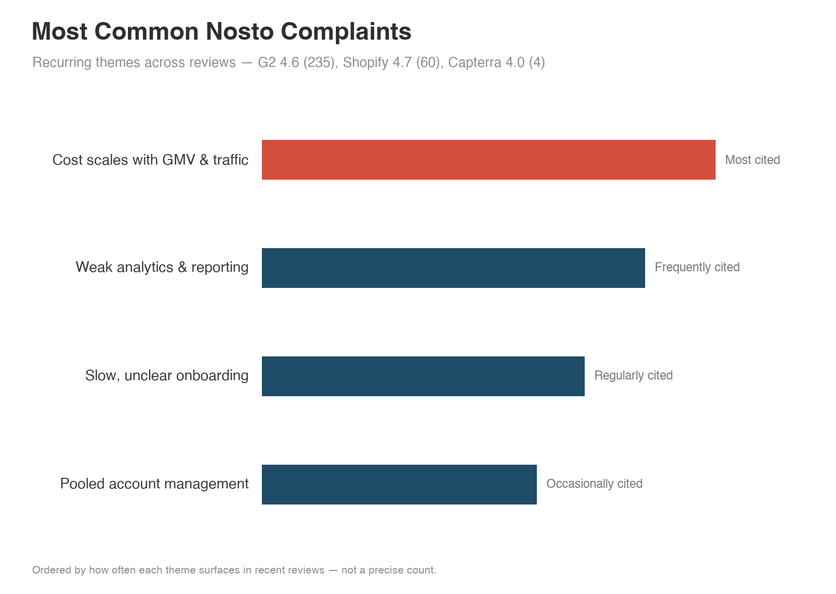
| Pain Point | Description | Possible Solutions |
| Costs scale with GMV and traffic | Pricing is a base platform fee plus a fee calculated on store volume, so the bill climbs as you grow – even if you use the same modules | Platforms priced on active profiles, not GMV (Maestra); order-based pricing (Rebuy) |
| Weak analytics and reporting | Recent reviewers call reporting the platform’s clear weak spot, including missing date-range comparisons | Platforms with full-funnel reporting (Maestra); dedicated experiment analytics (Monetate) |
| Slow, unclear onboarding | Trustpilot reviewers report misdirected integrations that had to be redone on deadline | Platforms with managed migration (Maestra); Shopify-native setup (Rebuy) |
| Pooled account management | Long-term customers report losing their dedicated account manager to a “faceless team” | Platforms with a dedicated CSM on every contract (Maestra, Insider One) |
| Complexity for advanced setups | Advanced customization and non-Shopify implementations often require developer time | No-code personalization tools (Maestra, Clerk.io) |
Costs scale with GMV and traffic. Nosto’s own pricing page describes a base platform fee plus a fixed fee calculated on your store’s volume (GMV turnover and traffic). In practice, that means your fee grows with your revenue. “Pricing can be expensive for small businesses,” one G2 reviewer notes, and a Capterra reviewer puts it more bluntly: “Becomes quite expensive. Fee paid for any sale that has a Nosto element to it, not always fair.”
Weak analytics and reporting. This is the most consistent recent complaint from otherwise happy customers. G2 reviewers who still rate the platform 4 and 5 stars say the analytics dashboard “could be pushed further,” and one asks for something as basic as “a comparison tool for date ranges.”
Slow, unclear onboarding. Two separate Trustpilot reviewers describe integrations that had to be redone. One writes: “We were then mis-directed by their team on how to integrate which has meant we need to redo the whole integration with around ten days to spare.”
Pooled account management. G2 reviewers frequently name and praise individual Nosto account managers – when you get one, the experience is good. The complaints come from long-term customers who lost that: they describe a praised, named account manager being replaced by someone far less engaged, and support turning slow and impersonal once that happened.
Complexity for advanced setups. “The interface can sometimes be a bit complex to handle, even though recent improvements have been made,” one G2 reviewer notes, while another adds that “some advanced customization may require technical expertise.”
Why (or When) to Consider Nosto Alternatives
Nosto still does what it was built for: recommendations and on-site content personalization. If your bill is predictable, reporting covers what you need, and pooled support works for your team, there’s no urgent reason to move.
The case for switching builds when the pain points above start compounding:
- A fee that rises with your revenue and traffic turns growth into a pricing penalty.
- Reporting gaps push your team into spreadsheets to prove the platform’s impact.
- Onboarding or support friction costs you the very weeks the tool was supposed to save.
Before you switch, it’s fair to exhaust the fixes: ask your account team to re-scope your module mix (you may be paying for clouds you don’t use), request a named account manager in writing at renewal, and run Nosto’s own A/B Testing & Optimization module to check each widget still earns its share of the fee.
There’s also the consolidation question. Nosto covers the storefront only, so email, SMS, and loyalty still live in separate tools that don’t share a single customer profile. If one or more of these sound familiar, the nine platforms below each take a different approach.
And beneath them sits a structural issue. Nosto personalizes your storefront, while your email, SMS, loyalty, and customer data live in other tools. Each with its own invoice and its own version of the customer.
Nosto Alternatives at a Glance
| Platform | Best For | Key Differentiator | Starting Price | G2 Rating |
| Maestra | Consolidating onsite personalization with email, SMS, and loyalty | Recommendations and offers sync across site, email, and SMS from one real-time CDP | From $2,815/mo (CDP + onsite personalization; first 100K active profiles included) | 4.8 |
| Rebuy | Shopify brands focused on cart upsells and AOV | Smart Cart – a fully customizable slide-out cart with built-in cross-sells | From $25/mo (single package) | 4.9 |
| Athos Commerce | Search-led product discovery and feed syndication | Klevu + Searchspring + Intelligent Reach merged into one discovery platform | Custom pricing (contact sales) | 4.6 |
| Bloomreach | Enterprise teams pairing discovery with a full ESP | Loomi AI agents span search, merchandising, and 13+ marketing channels | Custom pricing (module fee + usage fee) | 4.6 |
| Dynamic Yield | Experimentation-heavy enterprise personalization | Experience OS with AdaptML deep-learning models and Mastercard data signals | Custom pricing (contact sales) | 4.5 |
| Insider One | Omnichannel journeys across web, app, and messaging | Architect journey builder plus AI agents across web, app, and messaging channels | Custom pricing (contact sales) | 4.8 |
| Algolia | Developer teams building custom search and recommendations | NeuralSearch – hybrid keyword + vector search on every keystroke | Free plan available (10,000 searches/mo) | 4.5 |
| Monetate | Server-side testing and personalization at enterprise scale | Maestro experimentation suite with zero-flicker server-side testing | Custom pricing (contact sales) | 4.1 |
| Clerk.io | Budget-conscious search and recommendations for European stores | Usage-based per-module pricing with cookieless personalization | Custom usage-based pricing (per-module calculator) | 4.8 |
1. Maestra – Best for Consolidating Personalization, Email, SMS, and Loyalty
Starting price: From $2,815/mo (CDP + onsite personalization; first 100K active profiles included)
G2 rating: 4.8
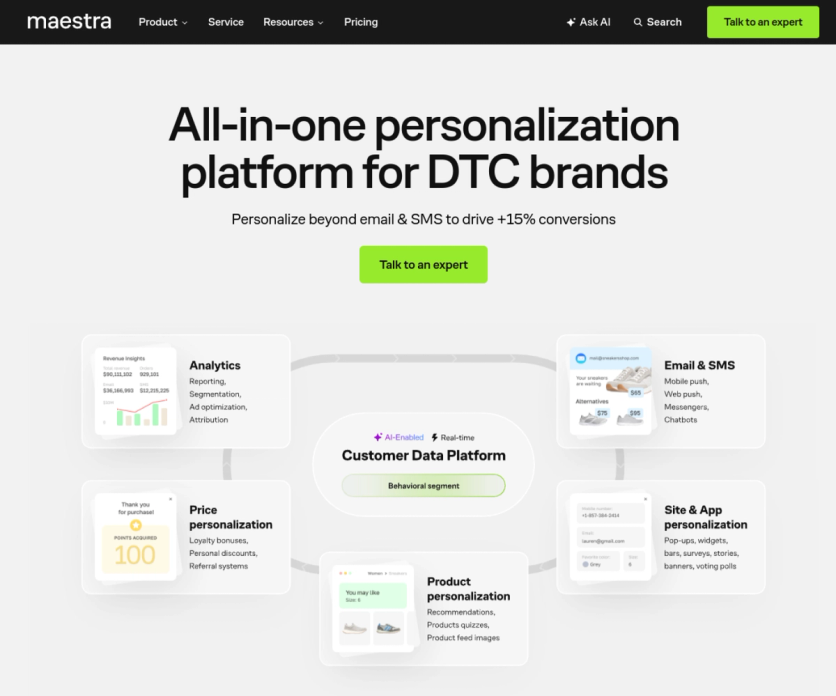
Maestra is an all-in-one marketing personalization platform: product recommendations, site personalization, email, text messages, built-in loyalty, and promotions, all running on one real-time customer data platform.
Where Nosto personalizes your storefront, Maestra personalizes your storefront and every channel connected to it from the same customer profile.
That’s the core difference. Nosto’s recommendations live onsite (plus embeds for your existing ESP). Maestra’s recommendations follow the customer from the product page into their inbox, MMS and RCS, and messaging apps.
Key Features
Product Recommendations Across Channels
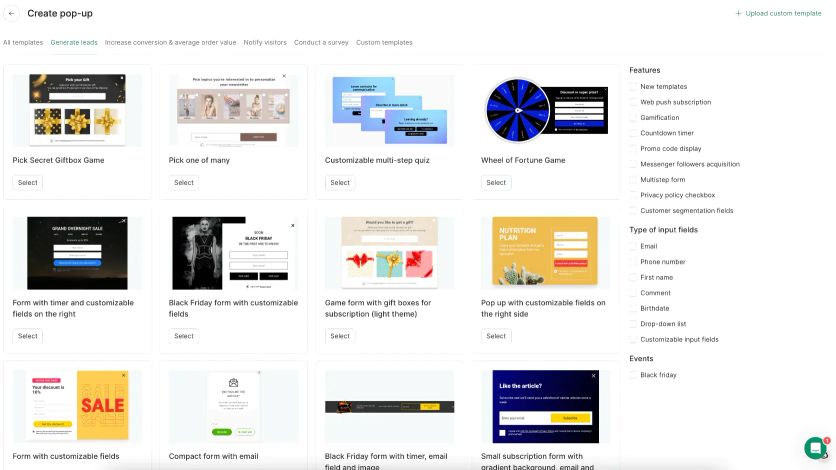
AI-powered recommendations handle cross-sell, upsell, and downsell on site, in email, and in SMS – one algorithm, every channel. Selkirk cut 15 hours of manual work per week with AI-powered recommendations, and Svaha sees recommendations assist 11% of revenue.
Site and App Personalization
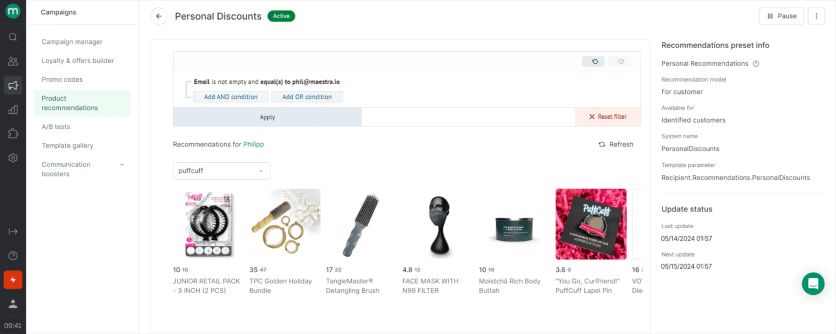
Pop-ups, quizzes, real-time offers, surveys, and widget prioritization with in-session segmentation and frequency control. Blossom Flower generates 9% incremental revenue through website personalization, and its product quiz added 14% to website conversion.
Real-Time CDP
Every widget, segment, and message reads from one live customer profile with identity resolution across touchpoints. Maestra’s AI proposes segment hypotheses for marketers to review – you approve the logic, not a black box.
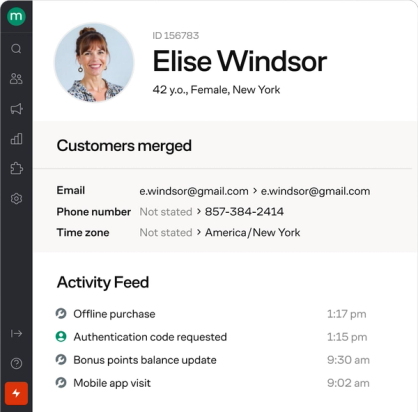
A unified customer profile in Maestra’s real-time CDP
Omnichannel Flows
The flow builder orchestrates email, SMS, push, and messengers with the same segmentation the site widgets use. JOLYN grew repeat domestic revenue 22% after moving its email and SMS flows to Maestra, and its AI-powered email capture lifted the email capture rate by 21%.
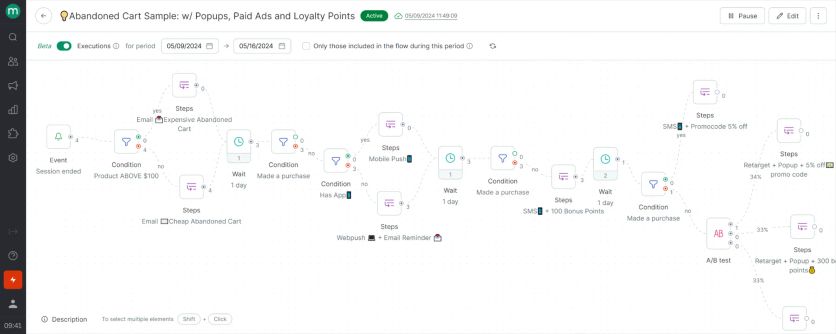
Built-In Loyalty and Promotions
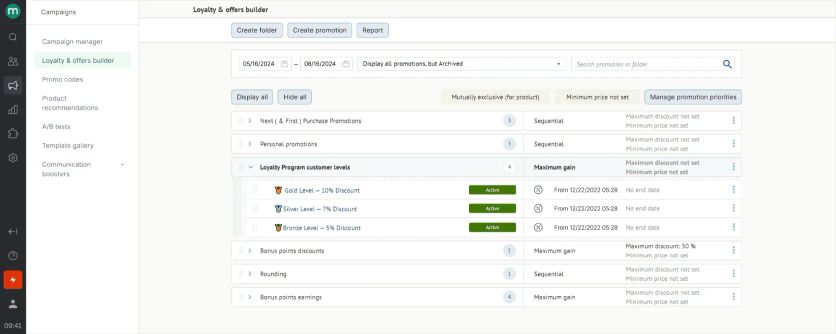
Loyalty tiers, targeted promotions, referrals, and unique promo codes ship with the platform – no separate loyalty vendor. UAG cut marketing stack costs 64% (around $100,000 a year) by consolidating Klaviyo, Yotpo Loyalty, and Frosmo into Maestra.
Full-Funnel Reporting
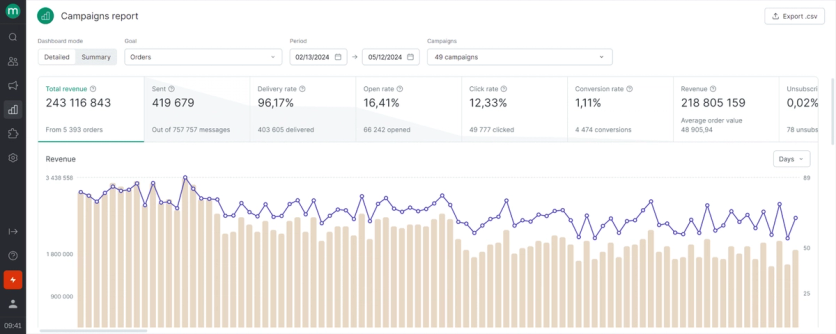
Configurable attribution, revenue reporting per flow and widget, email health monitoring, and A/B testing – a direct answer to Nosto reviewers' analytics complaints.
Pricing
Maestra prices by module on top of a real-time CDP base. The bill is tied to active profiles – not your traffic, GMV, or a percentage of sales. The first 100,000 active profiles are included, and storing inactive ones is free.
Three builds cover the typical Nosto-replacement scenarios:
Like-for-like with Nosto: starts at $2,815/mo for the CDP plus Onsite Experience Personalization. The base already includes product recommendations, ad audience sync, MCP, full-funnel reporting, and a Forward Deployed Marketer.
The Forward Deployed Marketer is a Maestra specialist working inside your account day to day: they build your segments and flows, run A/B tests, and monitor performance, with weekly strategy calls and a shared Slack channel to keep the work moving.
Personalization plus messaging: starts at $3,765/mo for everything above plus Unlimited Email and SMS, MMS and RCS.
Full retention stack: starts at $4,775/mo. Add the loyalty program to the build above and consolidate four vendors into one bill – a CDP, onsite personalization software, an email and SMS tool, and a loyalty app.
Integration and migration are free and handled by Maestra's team. Billing doesn't start until the migration is complete. From there, contracts run month-to-month with no cancellation penalties. And where Nosto's fee is calculated on your GMV and traffic, Maestra's moves only when the number of customers you actively engage does. See Maestra’s pricing.
Where Maestra Wins
Consolidation is the headline. Maestra replaces three to five point tools – onsite personalization, ESP, SMS vendor, loyalty platform, CDP – with one contract and one customer profile. Enlightened Equipment grew revenue 22% in two months with zero extra budget after consolidating from Klaviyo, with AI-powered product recommendations and a smart upsell bar doing much of the work.
The onsite toolkit is competitive on its own. Enlightened Equipment’s Smart Upsell Bar lifted average order value by 38.7%, and shoppers who engage with Blue Q’s recommendations show a 28.7% higher AOV.
And every account gets a dedicated Forward Deployed Marketer who proposes campaigns and builds alongside your team. Given Nosto’s account-management complaints, that’s not a small detail.
Where Maestra Falls Short
Maestra doesn’t offer personalized site search – if replacing Nosto’s Personalized Search is your priority, you’d pair Maestra with a search specialist like Algolia or keep your platform’s native search. There’s no UGC module either, so Nosto’s Shoppable UGC (the former Stackla) has no direct Maestra equivalent.
The platform is also scoped for mid-size and larger brands. Stores wanting a $99 entry point will find Rebuy or Clerk.io a better fit for their stage.
Compared to Nosto
Nosto is deeper in pure product discovery: Personalized Search, Category Merchandising, and Shoppable UGC have no Maestra counterparts. Maestra is deeper everywhere else: owned email and SMS channels, a real-time CDP, built-in loyalty, promotions, and reporting that Nosto reviewers say they’re missing.
Pricing philosophy differs too – Nosto charges on GMV and traffic, Maestra on active profiles, with channel modules added on top.
When to Switch from Nosto to Maestra
You’re consolidating your stack. If Nosto is one of several tools (ESP, loyalty, pop-up builder) each billing separately, Maestra replaces the set. UAG cut stack costs 64% doing exactly that.
You want recommendations beyond the storefront. Nosto’s Personalized Emails embed recommendations into your existing ESP; Maestra owns the channel end to end. Enlightened Equipment grew website conversion 15% with AI-powered product recommendations as part of a full-platform move.
Your bill grew faster than your usage. If Nosto’s GMV-and-traffic fee keeps climbing while your module mix stays the same, Maestra’s active-profile pricing puts growth back on your side.
You miss having a dedicated account manager. Maestra assigns a Forward Deployed Marketer to every account – JOLYN’s 22% repeat-revenue growth came partly from campaigns its Forward Deployed Marketer proactively proposed.
2. Rebuy – Best for Shopify Cart Upsells and Bundles

Starting price: From $25/mo (single package)
G2 rating: 4.9
Rebuy is a Shopify-only personalization engine built around one obsession: getting more into the cart. Its center of gravity is the checkout path – cart, checkout, post-purchase – where Nosto is strongest before the cart.
If Nosto helps shoppers find products, Rebuy helps them buy more of them.
Key Features
Smart Cart
A fully customizable slide-out cart – Rebuy calls it “the most advanced shopping cart on Shopify” – with cross-sells, free-shipping progress bars, and 35+ pre-built integrations.
Smart Search
AI-powered search that personalizes results in real time – spellcheck, keyword redirects, add-to-cart inside search results, and load times under 0.2 seconds. Rebuy's answer to Nosto's Personalized Search, though younger as a product.
Dynamic Bundles and Bundle Builder
Dynamic Bundles assembles complementary products automatically; Bundle Builder lets customers construct their own. Comparable to Nosto’s Dynamic Bundles, with more buying-flow options.
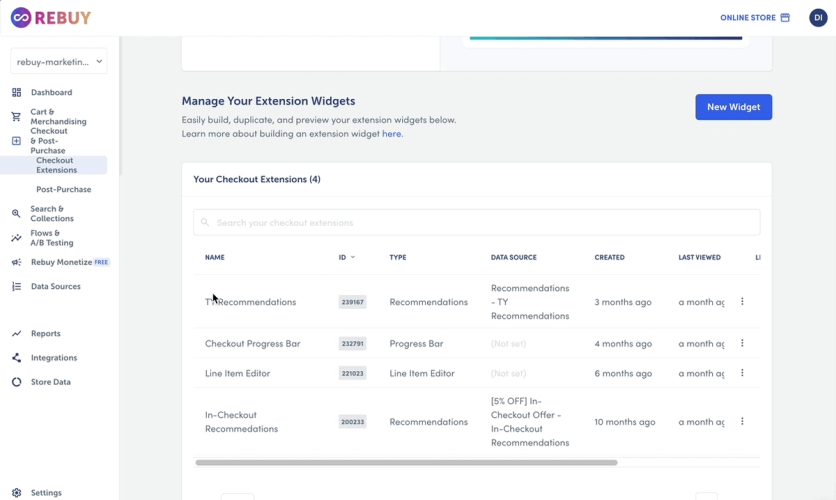
Checkout Extensions and Post-Purchase Offers
Checkout customization and offers between checkout and the thank-you page (Checkout Extensions require Shopify Plus). Nosto only entered this territory with its Shopify-only Post-Purchase Upsell module in 2025.
Smart Flows
A no-code, drag-and-drop editor for on-site journeys – pop-ups, Buy X Get Y offers, and gift-with-purchase campaigns triggered by cart value, customer segment, or behavior, with revenue attribution per flow.
Pricing
From $25/mo for a single à la carte package (Cart & Merchandising, Checkout & Post-Purchase, Search & Collections, or Flows & A/B Testing), scaling with monthly order volume. Platform One – all products plus a dedicated CSM – starts at $534/mo. There’s also Rebuy Monetize, a free tier that pays you per transaction for showing partner-brand offers on post-purchase pages. Free trials run 14–30 days.
Note the pattern, though: pricing scales on orders, so like Nosto, growth raises the bill – just on a different meter.
Where Rebuy Wins
For Shopify merchants who want revenue impact this quarter, Rebuy is about as direct as it gets. Merchants on the Shopify App Store report unit-per-transaction lifts translating into double-digit sales growth, and reviewers from the last 12 months consistently note it needs little to no developer work to launch.
It’s also meaningfully cheaper to start than Nosto’s quote-based contracts – $25/mo versus a sales call.
Where Rebuy Falls Short
Stability complaints are the sore spot in recent Shopify App Store reviews: merchants describe carts that “would work intermittently” and one deployment that briefly broke checkout. Billing disputes show up in the same review stream.
Scope is the other limit. There’s no content personalization, no pop-ups, no UGC, no personalized email – and it only works on Shopify. Reviewers also note a learning curve on complex rules.
Compared to Nosto
Rebuy overlaps with Nosto on recommendations, search, and bundles, then goes deeper in the cart-to-post-purchase zone. Nosto covers far more surface: Content Personalization, Behavioral Pop-Ups, Shoppable UGC, A/B Testing & Optimization, and multi-platform support (BigCommerce, Adobe Commerce, Salesforce Commerce Cloud, Shopware) where Rebuy is Shopify-only.
Compared to Maestra
Rebuy optimizes one moment (the purchase); Maestra optimizes the relationship – CDP, email, SMS, loyalty, and site personalization together. A Shopify brand might run Rebuy’s Smart Cart alongside an ESP and loyalty tool; Maestra replaces that stack with one platform and syncs recommendations across all of it. Rebuy starts cheaper; Maestra consolidates more. Shopify brands weighing a move off it can start with our ranked Rebuy alternatives.
3. Athos Commerce – Best for Search-Led Discovery and Merchandising
Starting price: Custom pricing (contact sales)
G2 rating: 4.6
Athos Commerce is what became of Klevu and Searchspring: the two search-and-merchandising vendors merged in January 2025, folding in feed-management company Intelligent Reach, and now sell one unified discovery platform. If you shortlisted Klevu or Searchspring as a Nosto alternative before, this is the same conversation with a new name.
Athos is a product discovery specialist – strongest exactly where Nosto’s search modules compete, absent everywhere else Nosto plays.
Key Features
Site Search
Hybrid Search combines keyword and semantic matching with Personalized Search Relevancy, Product Noun Detection, autocomplete, spell correction, and support for 31 languages.
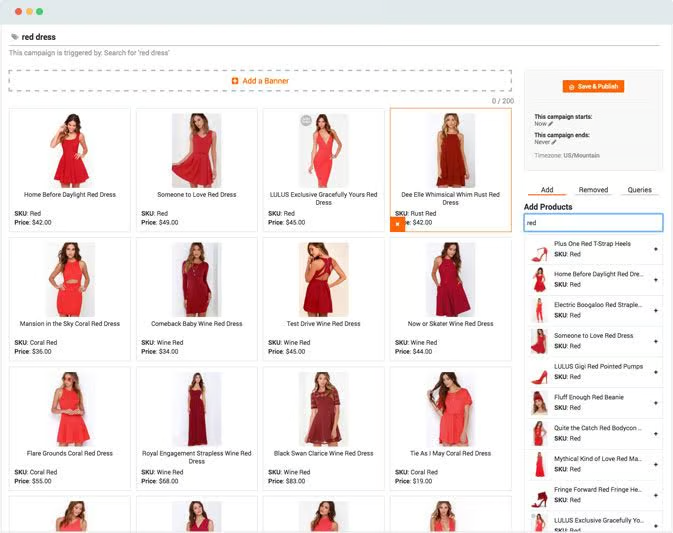
Merchandising the results for a search query in Athos Commerce
Merchandising
Rule-based and AI-driven category merchandising – the Searchspring heritage, with visual category management that reviewers have praised for years as the platform’s standout.
Personalization
Behavior-based recommendations, AI product bundling, and personalized ranking across search, category, and product pages – built on first-party behavioral data, with recommendations extending into email and SMS through Klaviyo, Dotdigital, and Cordial.
Product Feed Management
Feed syndication across 1,400+ marketing, social, and marketplace channels, with generative-AI data enrichment, real-time feed health monitoring, and SKU-level A/B testing – the Intelligent Reach inheritance, and something Nosto doesn't offer at all.
AI and Agents
Conversational Assistant, Channel Assistant, GEO Assistant, and Product Discovery AI – 2026 additions aimed at AI-mediated shopping. GEO Assistant is the notable one: it enriches your catalog and syndicates it to Gemini, ChatGPT, and other AI platforms so products surface in AI answers.
Pricing
Custom pricing (contact sales) across three plans: Onsite Discovery, Offsite Discovery, and Complete Discovery, with AI agents priced separately. Third-party listings estimate entry around $699/mo (G2 and Capterra estimates). Worth knowing: Klevu used to publish plans from roughly $449–499/mo before the merger – pricing transparency went backward, and recent reviewers mention continued price increases.
Where Athos Commerce Wins
If search is why you’re leaving Nosto, Athos is the specialist play. Klevu-side reviewers report strong search conversion uplifts, and Searchspring-side reviewers have praised the merchandising tooling and support for years. The feed-management layer is a genuine differentiator: onsite discovery and offsite syndication from one vendor.
Where Athos Commerce Falls Short
Support speed is the loudest recent complaint – reviewers report multi-week helpdesk turnarounds unless an issue is marked urgent, and one Capterra reviewer summarizes: “Very expensive and continued price increases.” Others say the platform “really needs a dedicated person to manage it.”
The merger adds its own risk: reviewers and analysts describe three integrated-but-distinct products still converging, and buyers question which roadmap they’re buying into mid-migration.
Compared to Nosto
On search and category merchandising, Athos matches or beats Nosto – it’s the closer specialist. But it has no content personalization, no behavioral pop-ups, no UGC, and no A/B testing module, all of which Nosto includes. Swap Nosto for Athos and you’re trading breadth for search depth, plus gaining feed syndication Nosto lacks.
Compared to Maestra
Athos and Maestra barely overlap – which makes them complements more than rivals. Athos handles search and feeds; Maestra handles the customer relationship: CDP, email, SMS, loyalty, site personalization, and recommendations across channels. Brands replacing Nosto sometimes need both halves – a discovery specialist plus a personalization/marketing platform – and this is that pairing.
4. Bloomreach – Best for Enterprise Discovery Plus Marketing Automation
Starting price: Custom pricing (module fee + usage fee)
G2 rating: 4.6
Bloomreach spans two worlds Nosto only touches: e-commerce search and discovery on one side, and a 13+ channel marketing automation platform with a CDP on the other – all now fronted by its Loomi AI layer.
Bloomreach is what Nosto plus your ESP plus your CDP would look like if they were one enterprise platform.
Key Features
Ecommerce Search
AI-native commerce search positioned to “maximize revenue per visitor,” with Ecommerce Categories and Product Recommendations as connected channels – the former Discovery product line.
Marketing Automation
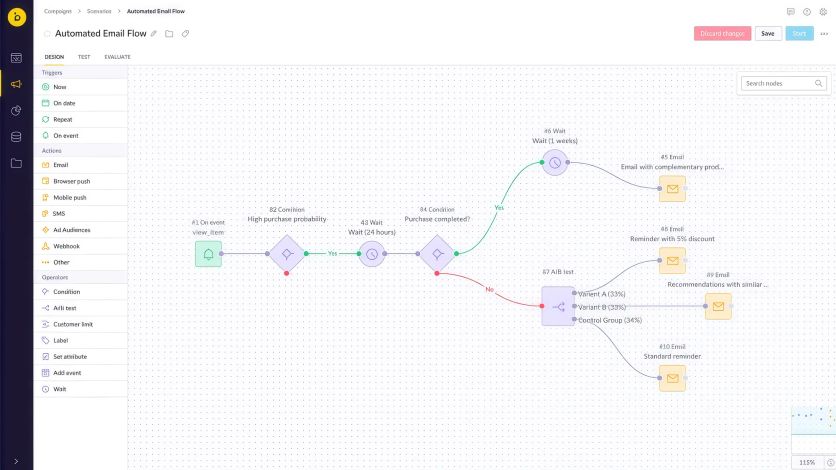
AI-powered personalization across email, SMS, RCS, WhatsApp, web, and mobile app – built on the former Engagement product with its ESP and real-time segmentation.
Loomi AI and Agents
Marketing Agent converts “a single prompt into a fully built workflow”; Shopping Agent 2.0 acts as an autonomous shopping companion; Loomi Connect builds custom agents. Core Loomi is included at no extra cost, with a paid Loomi Premium tier for advanced autonomous features.
Web Personalization and A/B Testing
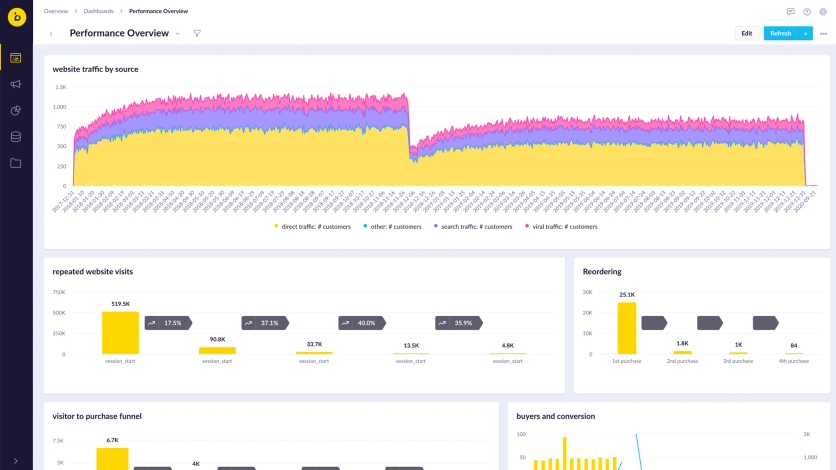
Bloomreach Experiments runs no-code A/B tests with flicker-free rendering and automatic winner distribution, while weblayers – banners, pop-ups – personalize on-site content. Ad audiences sync to Google, Meta, Snapchat, and TikTok within milliseconds of an interaction.
Enterprise CMS
A commerce-focused content platform – the former Content line – built on a create-once-deliver-everywhere model: headful, headless, or hybrid deployment, a drag-and-drop visual editor, and Loomi AI assistance for authoring and tagging across multiple sites, brands, and languages.
Pricing
Custom pricing: a module fee for each product you license plus a usage fee scaling on customer volume, catalog size, and message volume, on annual contracts. Third-party benchmarks put typical deployments around $40,000–$250,000+ per year, with average contracts near $180,000 (Costbench and DXP Scorecard estimates, citing Vendr data). There’s no self-serve enterprise tier, though a Shopify Engagement Starter plan runs around $1,585/mo.
Where Bloomreach Wins
Breadth at enterprise depth. Reviewers consistently praise the omnichannel orchestration – one platform holding customer data, segmentation, and campaign automation across every channel – and Bloomreach’s support scores run high, with reviewers describing “a strong partnership in business operations.”
For a brand outgrowing Nosto and its ESP simultaneously, Bloomreach consolidates both – the same consolidation argument Maestra makes, aimed one segment higher.
Where Bloomreach Falls Short
Cost and complexity gate it firmly to enterprise. Reviewers report that vendors “will underestimate the number of processed events you need,” leading to forced tier upgrades; implementations typically run three to six months with dedicated teams, and “some advanced features required technical knowledge or coding experience.”
Reporting draws recurring criticism too – reviewers call the tools restrictive “when deep, customized analysis is needed.” And there’s no UGC module.
Compared to Nosto
Bloomreach covers Nosto’s entire core – search, categories, recommendations, web personalization, A/B testing – then adds the CDP, ESP, and agent layer Nosto doesn’t have. What it doesn’t match: Nosto’s Shoppable UGC, Nosto’s mid-market pricing, and Nosto’s merchandiser-friendly setup. Moving from Nosto to Bloomreach is a segment change, not a lateral swap.
Compared to Maestra
Both consolidate discovery-adjacent personalization with owned marketing channels and a real-time CDP. The differences: Bloomreach includes site search and a CMS (Maestra doesn’t), while Maestra includes built-in loyalty and promotions (Bloomreach doesn’t). Commercially they’re far apart – Bloomreach’s estimated ~$180K average annual contract and annual commitments versus Maestra’s published $2,815/mo start, month-to-month, with migration included. Mid-market brands get enterprise-grade consolidation from Maestra without enterprise procurement.
5. Dynamic Yield – Best for Experimentation-Heavy Personalization

Starting price: Custom pricing (contact sales)
G2 rating: 4.5
Dynamic Yield, owned by Mastercard, calls its platform Experience OS – a personalization and experimentation layer used by McDonald’s, SKIMS, and L’Oréal. Where Nosto is built for merchandisers, Dynamic Yield is built for optimization teams that treat every pixel as a test.
Dynamic Yield is the choice when personalization is a program with a headcount, not a plugin.
Key Features
Recommendations
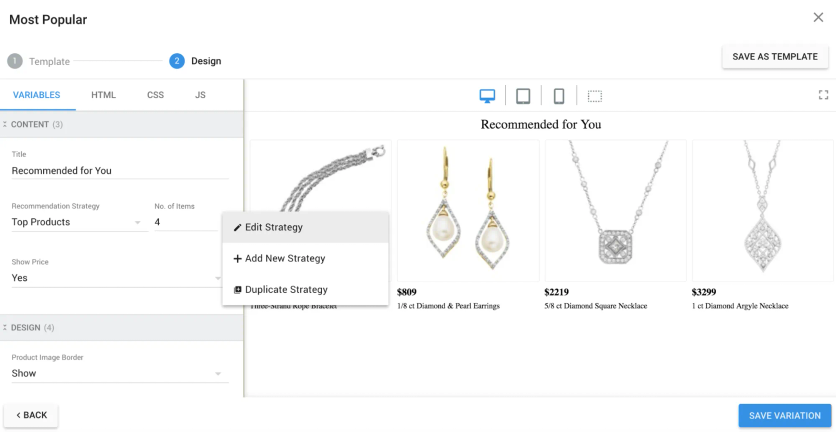
Algorithmic product recommendations tuned in Algorithm Studio, with AdaptML™ deep-learning models – NextML, AffinityML, and VisualML – predicting individual customer interests. Strategies combine in a single widget or run on autopilot, serving web, apps, email, SMS, and push.
Optimization
A/B/n experimentation on any digital property, server- and client-side, with Bayesian and multi-armed bandit engines and Dynamic Traffic Allocation shifting traffic to the winning variation automatically – deeper testing infrastructure than Nosto's A/B Testing & Optimization module.
Segmentation and Targeting
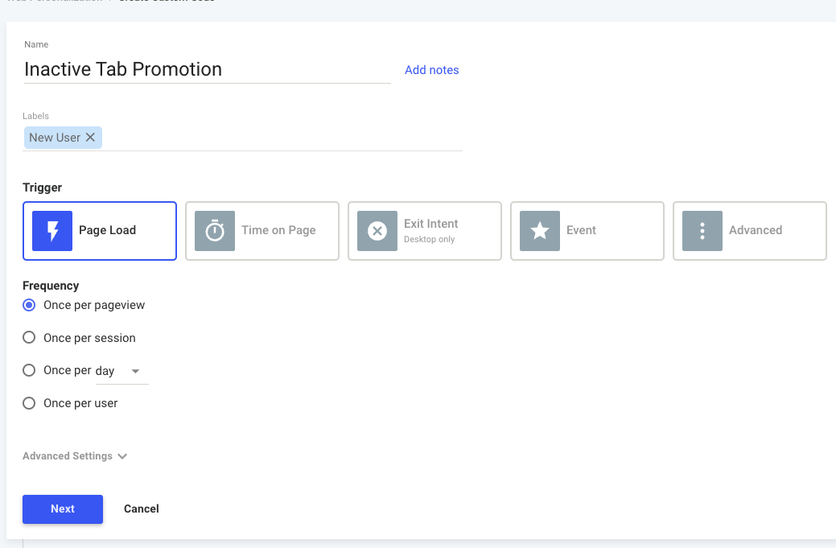
Audience building, analysis, and per-segment offers via Audience Hub, spanning web, email, and app through the Experience Web, Experience Email, and Experience App products.
Site Search and Sorting Optimizer
Experience Search brings semantic and visual search with results personalized on affinity profiles and browsing history; Sorting Optimizer re-sorts category pages using algorithms you build in Algorithm Studio – the counterparts to Nosto's Personalized Search and Category Merchandising.
Shopping Muse and Element
Shopping Muse is a generative-AI shopping assistant that recommends bundles and refines suggestions through conversation; Element is a suite of Mastercard applications – SpendingPulse™, Market Basket Analyzer – bringing anonymized payment-network spend data into personalization.
Pricing
Custom pricing (contact sales) – there’s no published pricing page. Third-party benchmarks estimate entry around $35,000/year, scaling with monthly active users and modules (Personizely estimates). No free plan.
Where Dynamic Yield Wins
Experimentation muscle. Reviewers from the last 12 months describe scaling A/B/n testing and personalization “in a way that a smallish company by themselves wouldn’t be able to achieve,” and the template library lets lean teams ship overlay and countdown campaigns quickly. Customer success draws consistent praise – reviewers describe their CSM as a strategic partner.
The Shopify Plus certification matters here too: unlike most enterprise personalization vendors, Dynamic Yield ships a dedicated Shopify app.
Where Dynamic Yield Falls Short
Developer dependence is the recurring theme in recent reviews: achieving desired personalization “often necessitates substantial development effort, including custom coding and complex CSS.” Built-in analytics also disappoint – reviewers describe fragmented campaign dashboards and lean on BI exports or GA4 for real analysis.
And pricing is prohibitive below enterprise: at an estimated $35K/year entry, most Nosto-sized merchants are priced out.
Compared to Nosto
The overlap is nearly complete – recommendations, search, category sorting, content personalization, overlays, testing – but the operating model differs. Nosto is plug-and-play for merchandisers; Dynamic Yield is API-first and assumes engineering support. Nosto adds Shoppable UGC; Dynamic Yield adds deep-learning models, conversational commerce, and enterprise experimentation.
Compared to Maestra
Dynamic Yield personalizes experiences; Maestra runs the marketing too. There’s no owned ESP in Experience OS – Experience Email personalizes messages sent through your existing provider, while Maestra owns email and SMS outright, plus loyalty and promotions. Maestra also publishes its pricing and includes migration; Dynamic Yield requires a sales cycle and developer bandwidth. For a marketing team without dedicated engineers, that difference decides it. The wider field is in our guide to Dynamic Yield alternatives.
6. Insider One – Best for Omnichannel Journey Orchestration
Starting price: Custom pricing (contact sales)
G2 rating: 4.8
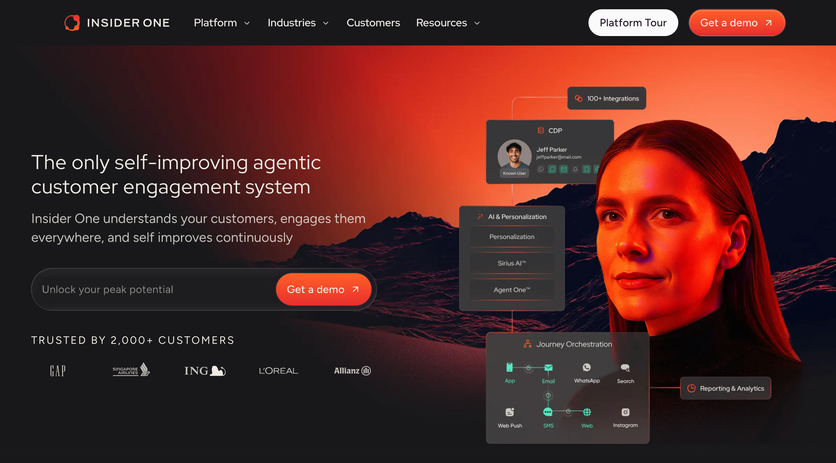
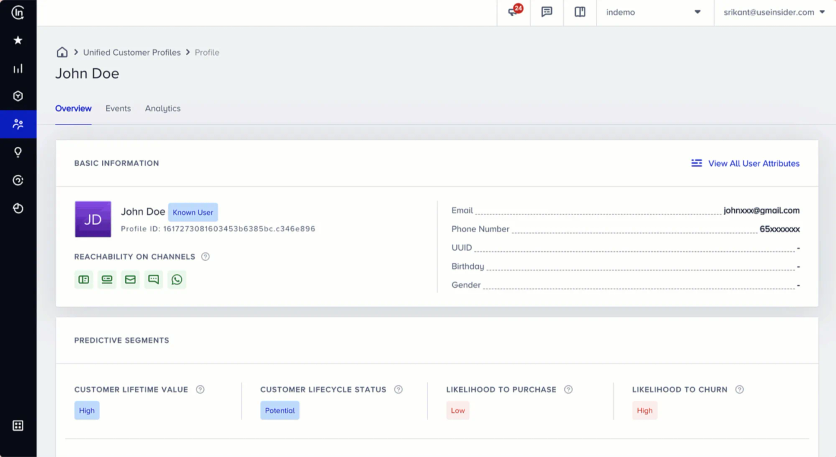
Insider rebranded to Insider One in 2025–2026 and now positions itself as an “Agentic Customer Engagement Platform” – a CDP, journey builder, and AI agent suite spanning web, email, SMS, RCS, WhatsApp, and push. Its generative-AI capabilities now sit under the Insider One AI™ umbrella.
Insider One treats your storefront as one of a dozen channels – Nosto treats it as the whole game.
Key Features
Architect
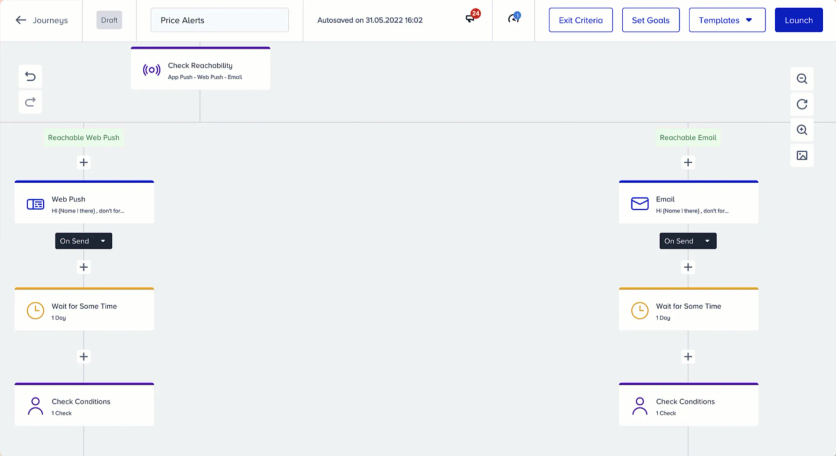
The journey orchestration engine: cross-channel campaigns built on one canvas, with 100+ ready-made templates and AI features – Next Best Channel, Send Time Optimization, and Auto Winners – choosing channel and timing per customer.
Smart Recommender
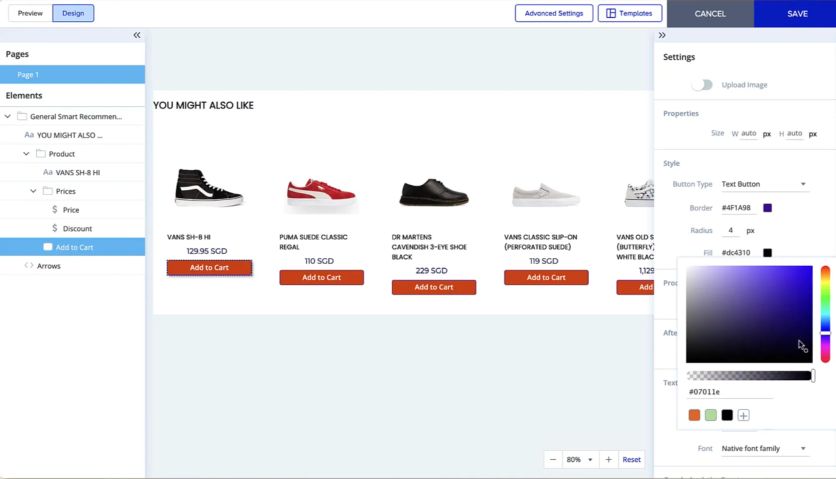
AI product recommendations with 20+ strategies – bought together, user-based, most valuable products – auto-optimized by combining product attributes and user affinity, and served on site, in app, and inside messaging channels.
Eureka Search
Insider's intelligent search and merchandising: NLP relevance, typo tolerance, and synonym matching, plus manual boost, bury, hide, and pin controls – comparable to Nosto's Personalized Search, deployed through a no-code visual editor.
InStory
Stories-format product discovery – Insider's answer to TikTok, Reels, and Instagram Stories – with AI product suggestions inside each story and journey-aware context like resurfacing browsed products. A mobile-first merchandising surface Nosto doesn't have.
Insider One AI and Agent One
Prompt-based segment discovery, auto-generated journeys, and AI-generated content, plus purpose-built agents: a Shopping Agent that turns site search into an answer engine, a Support Agent acting on CDP and CRM data, and an Insights Agent that turns campaign data into answers.
Pricing
Custom pricing (contact sales) – no published pricing or free plan. Third-party estimates put starter packages around $950–$1,300/mo (Spendbase), with typical contracts near $48,000/year (Vendr). Cost drivers are monthly tracked users, channels, and AI depth.
Where Insider One Wins
Channel breadth with genuine personalization depth. Recent Shopify App Store reviewers highlight fast integration and hands-on support, and Capterra reviewers praise “consistent, personalized customer experiences across multiple channels.” For brands whose growth is mobile- and messaging-led – WhatsApp, RCS, push – Insider One covers surfaces Nosto never touches.
Where Insider One Falls Short
The platform’s breadth is its learning curve: recent reviewers say it takes a while “to fully understand how everything works and where to find the right functionality.” Onboarding runs longer than expected and leans on technical teams, and a 2026 Shopify reviewer reports ongoing data integration and API friction.
There’s also no UGC module, and category merchandising isn’t a named product.
Compared to Nosto
Insider One covers Nosto’s recommendations, search, and web personalization, then extends into everything Nosto delegates to other tools: email, SMS, WhatsApp, push, CDP, and AI agents. Nosto counters with Shoppable UGC, dedicated Category Merchandising, and a simpler, storefront-focused scope that’s faster to learn.
Compared to Maestra
These two are the closest philosophical rivals on this list – both consolidate personalization with omnichannel marketing on a real-time profile. The practical differences: Maestra publishes its pricing ($2,815/mo start) while Insider One is quote-only; Maestra includes built-in loyalty and promotions; Insider One brings RCS and WhatsApp depth and InStory. Maestra’s dedicated Forward Deployed Marketer model is designed for lean teams; Insider One’s breadth tends to reward brands with more operators in the seat.
7. Algolia – Best for Developer-Built Search and Recommendations
Starting price: Free plan available (10,000 searches/mo)
G2 rating: 4.5
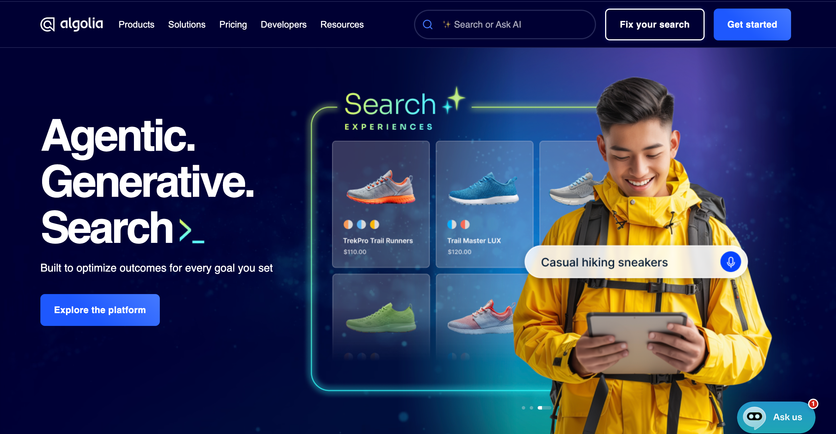
Algolia is a search-and-discovery API suite: Search, Recommendations, Browse, and a no-code Merchandising Studio, with NeuralSearch combining keyword and vector ranking on every keystroke. It’s not a personalization platform – it’s the infrastructure you’d build one on.
Algolia gives you Nosto’s discovery layer as an API – with the flexibility and the build cost that implies.
Key Features
Search and NeuralSearch
AI-driven results with hybrid keyword-plus-vector ranking (NeuralSearch, on the Elevate tier) – consistently reviewed as among the fastest search experiences available.
Recommendations
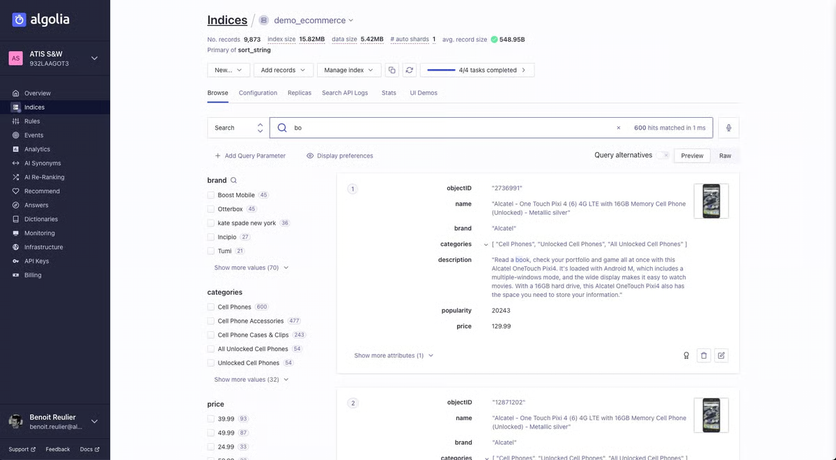
Behavioral recommendation models served via API – Frequently Bought Together, Looking Similar, Related Items, Trending – trained on real-time events and answering in 1–20 milliseconds, at $0.60 per 1,000 requests beyond the included volume.
Browse
Curated, personalized category pages – Algolia's counterpart to Nosto's Category Merchandising – with Dynamic Collections that update on seasonality and trends, engagement-based product ordering, and Dynamic Facets surfacing the most useful filters per query.
Merchandising Studio
The no-code layer where merchandisers run campaigns across AI Search, AI Browse, and AI Recommendations without engineering tickets – Smart Groups, collections pages, redirects, and banners, with real-time analytics and built-in A/B testing.
Agent Studio and Ask AI
2026-era additions: Agent Studio is a retrieval-first framework for building AI agents grounded in live Algolia indices – working with Anthropic, OpenAI, and Gemini models – and Ask AI serves cited, conversational answers straight from the search bar.
Pricing
Free plan available (10,000 search requests and 1M records/mo). Paid usage starts at $0.50 per additional 1,000 requests on Grow, $1.75 on Grow Plus; NeuralSearch and real-time personalization require the annual-contract Elevate tier (custom pricing). Fully published, fully usage-based – the most transparent pricing on this list.
Where Algolia Wins
Speed and control. A May 2026 Shopify reviewer: “Algolia has made search much faster and more relevant on our store. We especially like the control over rankings, synonyms, filters, and merchandising.” The free tier means you can prove value before spending anything – no other platform here offers that.
Where Algolia Falls Short
Costs escalate with scale – recent reviewers warn that pricing can become quite expensive as usage scales, and the dual request-plus-record billing makes bills hard to forecast. Advanced configuration assumes technical expertise, and the Shopify app itself rates just 3.6/5, with a 2026 reviewer calling it “a bit clunky to use at times.”
Most importantly for this comparison: there are no pop-ups, no content personalization, no UGC, no email.
Compared to Nosto
Algolia beats Nosto on raw search quality, developer flexibility, and pricing transparency. Nosto beats Algolia on everything that isn’t discovery: content personalization, behavioral pop-ups, UGC, bundles, and a merchandiser-first (rather than developer-first) operating model. Algolia replaces one Nosto cloud, not the platform.
Compared to Maestra
They don’t compete – they complete. Algolia covers search, which Maestra deliberately doesn’t build; Maestra covers the CDP, email, SMS, loyalty, and cross-channel recommendations Algolia doesn’t attempt. A common post-Nosto architecture is exactly this pair: Algolia for discovery, Maestra for personalization and marketing on one customer profile.
8. Monetate – Best for Enterprise and Server-Side Testing

Starting price: Custom pricing (contact sales)
G2 rating: 4.1
Monetate – spun back out of Kibo in 2022, now independent and grown through its SiteSpect acquisition – brands itself “The Experience Optimization Platform.” Its lineup spans four suites – Symphony (personalization), Maestro (experimentation), Overture (search and discovery), and Concierge (services) – with MONET AI as the decisioning engine.
Monetate is for enterprises that consider experimentation a discipline – including regulated industries Nosto never targets.
Key Features
Product Recommendations
AI-Powered Recommendations “deliver hyper-relevant product suggestions in real time, optimized for each customer’s context,” part of the Symphony suite alongside Dynamic Bundles and Product Finder.
Personalized Search
Site search personalization including category-page product ordering – a direct Nosto Personalized Search counterpart, now packaged under Monetate’s Overture search-and-discovery suite.
Maestro Experimentation
A/B/n and multivariate testing, Dynamic Testing, Feature Experimentation, and Forte secure experimentation for regulated environments – including zero-flicker server-side testing from SiteSpect.
Social Proof
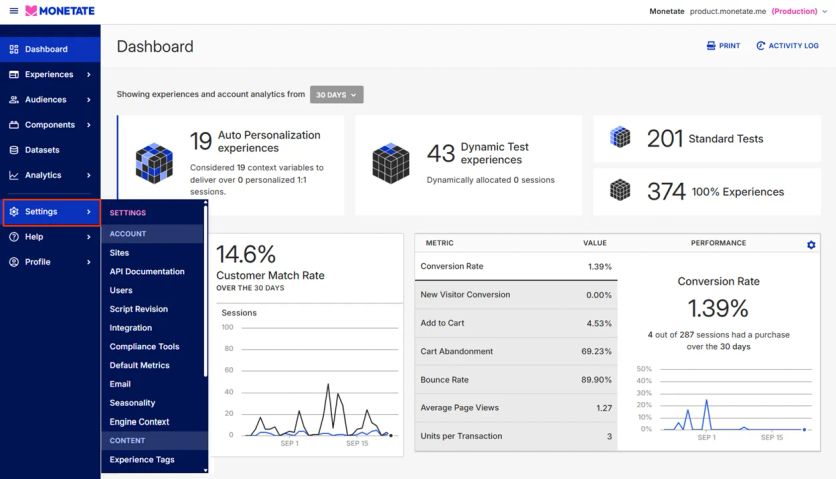
Real-time behavioral signals surfaced at decision moments – popularity messaging, scarcity cues from live inventory and demand, and trending items, tuned to visitor context. Monetate cites a 30% add-to-cart uplift for City Plumbing.
MONET AI
The intelligence layer unifying “real-time decisioning, adaptive automation, and enterprise-grade experimentation,” learning continuously from usage across the platform. A GenAI assistant adds on-demand guidance drawn from thousands of client experiences.
Pricing
Custom pricing (contact sales) – no public numbers and no free plan. Third-party analysts describe it as suited to retailers “generating over $100 million annually” and thousands of dollars a year more expensive than entry-level testing tools (ITQlick estimates).
Where Monetate Wins
Experimentation depth, especially server-side – a capability neither Nosto nor most platforms on this list can match, and the reason financial services and travel brands appear on its customer list. Recent reviewer summaries praise a support team that’s “responsive, knowledgeable, and proactive” and rate its A/B testing tooling highest among its capabilities.
Where Monetate Falls Short
The interface is the recurring complaint: reviewers find it “confusing and outdated, especially for new users,” and report that some builds still require manual JavaScript work “with 0 assurance that it won’t break the site.” Reporting draws criticism as “a bit too basic,” echoing – ironically – the same analytics complaint Nosto gets.
No UGC, no pop-up builder, and mid-market budgets need not apply.
Compared to Nosto
Monetate matches Nosto on recommendations, search personalization, and content targeting, and clearly exceeds it on testing. Nosto wins on merchandiser usability, pop-ups, UGC, and a segment fit that doesn’t assume nine figures of revenue. They increasingly serve different buyers: Nosto sells to e-commerce teams, Monetate to optimization programs.
Compared to Maestra
Monetate optimizes experiences on your site; Maestra connects the site to every owned channel. There’s no ESP, no loyalty, and no SMS in Monetate – it assumes a mature martech stack around it. Maestra assumes the opposite: that you’d rather collapse that stack. A brand leaving Nosto for simplicity should look at Maestra; a brand leaving Nosto for a bigger testing lab should look here.
9. Clerk.io – Best for Budget-Conscious Search and Recommendations
Starting price: Custom usage-based pricing (per-module calculator)
G2 rating: 4.8
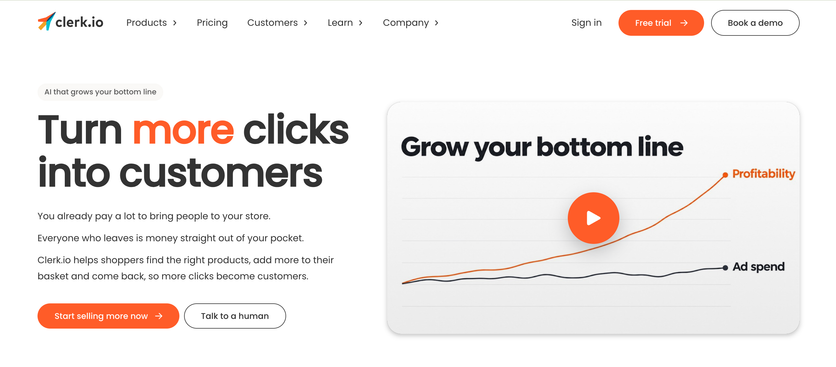
Clerk.io is a Danish platform selling five modules à la carte – Search, Recommendations, Email, Audience, and Chat – with usage-based pricing and cookieless personalization as its calling cards. It’s the pragmatic, budget-friendlier corner of this list.
Clerk.io offers most of Nosto’s discovery features at SMB-friendly economics – with SMB-sized depth.
Key Features
Search
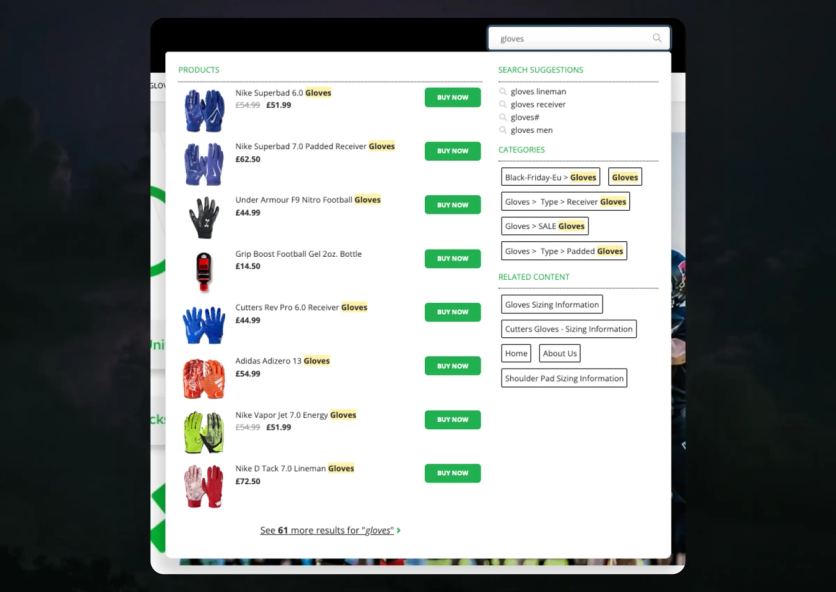
Personalized site search with typo tolerance, synonym detection, and sales-based ranking on real-time transactional data, plus content search across blogs and FAQs. Recent reviewers say it performs “extremely well even with complex product data and large assortments.”
Recommendations
Set-and-forget recommendation placements that adapt to your catalog automatically, driving cross-sell and upsell across home, product, and cart pages – reviewers report meaningful cross-sell lifts after enabling them.
Data-driven personalized email “on auto-pilot” – behavior-triggered sends, per-subscriber product picks, and an AI agent that plans a month of campaigns from a chat prompt. A channel Nosto only reaches through your existing ESP.
Audience
Predictive segments built on what customers will buy next – VIPs, churn risks, cross-sell targets – synced automatically to Google, Meta, Klaviyo, and Mailchimp, including lookalike audiences, all on Clerk's cookieless approach.
Chat
A generative-and-predictive AI chatbot for guided shopping – product-specific answers, order tracking, exit-intent saves, and escalation to human support when a conversation needs one.
Pricing
Custom usage-based pricing via per-module calculators – costs scale on monthly searches, recommendations served, opened emails, subscribers, and chat conversations, with rates dropping as volume grows. Third-party listings estimate modules from around $119/mo each (Software Finder estimate). Contracts run monthly to yearly, with discounts for commitment.
Where Clerk.io Wins
Value for money on the discovery basics, with support that reviewers consistently single out as what sets Clerk.io apart. It’s multi-platform (Shopify, Magento, WooCommerce, PrestaShop, BigCommerce, Shopware and more), so unlike Rebuy it travels with you if you replatform.
Where Clerk.io Falls Short
Billing friction dominates recent Trustpilot complaints: one merchant was charged twice “despite the service never being fully implemented” after hitting Shopify integration issues and a 30-day cancellation notice requirement. Another describes a Magento 2 integration that support couldn’t stabilize for weeks. G2 reviewers also note significant price increases over time.
There’s no content personalization, no pop-ups, no UGC, and no dedicated category merchandising module.
Compared to Nosto
Clerk.io covers Nosto’s search and recommendations at friendlier economics, and adds owned email and chat that Nosto lacks. Nosto counters with Category Merchandising, Content Personalization, Behavioral Pop-Ups, Shoppable UGC, and A/B testing – the full storefront suite. For stores that only use Nosto’s search and recs, Clerk.io is the sensible downshift; for stores using all of Nosto, it’s a feature cut.
Compared to Maestra
Both bundle recommendations with owned email – but at different scales. Clerk.io is built for smaller catalogs and budgets; Maestra is built for mid-size and larger brands that need a real-time CDP, SMS, built-in loyalty, full-funnel reporting, and a dedicated Forward Deployed Marketer behind the personalization. Brands often start with Clerk.io economics and grow into Maestra consolidation.
How to Choose the Right Nosto Alternative
The nine platforms above fall into three camps – full personalization suites, search-and-discovery specialists, and Shopify-focused upsell engines. Which camp is right for you comes down to six questions:
How is pricing structured? If Nosto's GMV-and-traffic fee is what's pushing you out, don't trade it for another usage-based bill. Ask every vendor what happens to your price when traffic doubles.
What are you consolidating? If email, SMS, loyalty, and customer data live in separate tools, a suite like Maestra replaces several bills at once. If your stack works and only discovery is weak, a specialist is a cleaner swap.
Does it fit your platform? Rebuy is Shopify-native by design, while Maestra, Bloomreach, and Algolia work across many platforms – the safer bet if replatforming is anywhere on your roadmap.
How deep does reporting go? Weak analytics is the gripe that surfaces most in recent Nosto reviews, so require full-funnel reporting on a demo.
What support model do you get and keep? If getting moved from a named manager to a shared support pool is what stung, ask directly who owns your account in year two.
How much experimentation do you run? Testing-heavy programs point to Dynamic Yield, Maestra, or Monetate, so if you want testing plus execution in one place, that’s suite territory.
Where to Take Personalization Next
Maestra is the strongest Nosto alternative for mid-size and larger e-commerce brands because it replaces the whole cluster of point tools around your storefront – ESP, SMS vendor, loyalty platform, pop-up builder, CDP – with one platform and one customer profile, where Nosto swaps only the onsite personalization layer. Recommendations follow shoppers from the product page to the inbox, pricing is tied to active profiles instead of your GMV, and every account gets a dedicated Forward Deployed Marketer – the exact thing Nosto’s unhappiest recent reviewers say they lost.
The specialists have their place: Rebuy for Shopify cart economics, Athos Commerce or Algolia for search depth, Dynamic Yield or Monetate for enterprise experimentation, Insider One for messaging-led journeys, Clerk.io for smaller budgets.
If consolidation is the goal, book a Maestra demo and bring your current stack list – the pricing math usually settles the question.
Frequently Asked Questions About Nosto Alternatives
- Maestra, Rebuy, and Insider One all integrate natively with Shopify and Shopify Plus. Maestra consolidates recommendations, site personalization, email, SMS, and built-in loyalty on one platform – Enlightened Equipment grew revenue 22% in two months after consolidating on it. Rebuy is the pick if your focus is narrowly cart upsells and AOV on Shopify.
- Nosto doesn’t publish prices. Its pricing is modular: a base platform fee plus a fixed fee calculated on your store’s GMV turnover and traffic, quoted by sales. Third-party listings put it in the mid-market-and-up range, and reviewers from the last 12 months call the total expensive relative to alternatives. Maestra takes the opposite approach: published pricing tied to active profiles – the customers you actually engage – rather than GMV or traffic. See Maestra’s pricing.
- Maestra, Bloomreach, Insider One, and Clerk.io all pair recommendations with an owned email channel. Maestra syncs the same AI recommendations across site, email, and SMS from one customer profile – Svaha sees recommendations assist 11% of its revenue.
- Yes – that’s the consolidation case. Maestra, Bloomreach, and Insider One each cover onsite personalization plus email and SMS. UAG cut its marketing stack costs 64% by consolidating personalization, loyalty, and messaging into Maestra.
- Athos Commerce, Algolia, Bloomreach, Dynamic Yield, Insider One, and Clerk.io all offer personalized search. Maestra doesn’t include site search – brands that need it typically pair Maestra with a specialist like Algolia and let Maestra handle recommendations, site personalization, and messaging. That layer carries real revenue: at JOLYN, Maestra recommendations influence 7% of sales.
- Algolia has a genuinely free plan (10,000 searches/mo). Rebuy offers 14–30 day trials plus its free Monetize tier. Nosto, Bloomreach, Dynamic Yield, Insider One, Monetate, and Athos Commerce are all quote-based with no self-service trial – Nosto offers a structured proof of concept for qualified merchants instead. Maestra has no free tier but publishes its pricing and includes migration and setup in every subscription – see Maestra’s pricing.