
9 Best Magento Personalization Extensions and Tools
Magento – whose paid edition is now sold as Adobe Commerce – gives you a powerful catalog, checkout, and merchandising engine. What it doesn’t give you out of the box is deep, shopper-level personalization. Live Search and Product Recommendations (both powered by Adobe Sensei) cover the basics, but anything beyond re-ranked product widgets – experience targeting, A/B testing, cross-channel offers – points you toward Adobe Target, a separate Adobe Experience Cloud license, or a third-party tool.
That gap is why “magento personalization extension” is a search in the first place. Merchants want recommendations, pop-ups, quizzes, and personalized email that read from live store data – without waiting on a developer sprint for every rule.
This guide compares nine ways to personalize a Magento or Adobe Commerce store: full personalization platforms, search-and-discovery specialists, and installable marketplace extensions. Here’s how they stack up:
Quick Guide: Best Magento Personalization Tools by Use Case
The best Magento personalization tools are Maestra, Nosto, Dynamic Yield, Algolia, Bloomreach, Insider One, Dotdigital Personalization (formerly Fresh Relevance), Clerk.io, and Amasty. Maestra layers product recommendations, site personalization, email, SMS, a real-time CDP, and built-in loyalty onto a Magento store from one platform, while the others specialize in on-site recommendations, product discovery, or single-purpose extensions.
The strongest choice all-around: Maestra – storefront personalization and the email, SMS, and loyalty that follow it, run from a single customer record
Best for merchandising-led discovery: Nosto – personalized search, category merchandising, and shoppable UGC in one suite
Best for experimentation at scale: Dynamic Yield – Experience OS with AdaptML models and Mastercard data signals
Best for developer teams: Algolia – NeuralSearch hybrid keyword and vector ranking, with a genuine free tier
Best for discovery plus a marketing suite: Bloomreach – Loomi AI across search, merchandising, and 17+ marketing channels
Best for omnichannel journeys: Insider One – Architect journey builder plus AI agents across 12+ channels
Best for web and email personalization: Dotdigital Personalization – Marketplace extensions feeding web, email, and SMS
Best for budget-conscious stores: Clerk.io – usage-based per-module pricing with an official Magento 2 extension
Best for a one-time license: Amasty – rule-based recommendations with no recurring platform fee
Content:

Magento Personalization Tools at a Glance
Platform | Best For | Key Differentiator | Starting Price |
|---|---|---|---|
Maestra | Consolidating on-site personalization with email, SMS, and loyalty on Magento | Recommendations and offers sync across site, email, and SMS from one real-time CDP | From $2,000/mo (100,000 active profiles) |
Nosto | Merchandising-led product discovery on Adobe Commerce | Personalized Search, Category Merchandising, and Shoppable UGC in one suite | Custom pricing (contact sales) |
Dynamic Yield | Experimentation-heavy personalization at enterprise scale | Experience OS with AdaptML models and Mastercard data signals | Custom pricing (contact sales) |
Algolia | Developer teams building fast search and recommendations | NeuralSearch hybrid keyword + vector ranking, with a genuine free tier | Free plan available (10,000 searches/mo) |
Bloomreach | Enterprise teams pairing discovery with a full marketing suite | Loomi AI across search, merchandising, and 17+ marketing channels | Custom pricing (module + usage fee) |
Insider One | Omnichannel journeys across web, app, and messaging | Architect journey builder plus AI agents across 12+ channels | Custom pricing (contact sales) |
Dotdigital Personalization | Web and email personalization tied to a marketing suite | Adobe Commerce Marketplace extensions feeding web, email, and SMS | Custom pricing (contact sales) |
Clerk.io | Budget-conscious search, recommendations, and email | Usage-based per-module pricing with an official Magento 2 extension | Custom usage-based pricing (free trial) |
Amasty | Adding rule-based recommendations without a SaaS contract | One-time license marketplace extension, no recurring platform fee | From $309 (one-time, Open Source edition) |
Pain Points with Native Magento Personalization
Adobe Commerce reviewers rate the platform highly for flexibility and scale. The complaints below aren’t about the storefront – they’re about what personalization costs, in money and developer time, once you push past the defaults. They repeat across G2, Capterra, and Gartner Peer Insights reviews from the last 12 months.
Pain Point | Description | Possible Solutions |
|---|---|---|
Native personalization is thin without add-ons | Live Search and Product Recommendations re-rank widgets well, but experience targeting, testing, and content personalization need Adobe Target (a separate license) or a third-party tool | SaaS personalization platforms (Maestra, Nosto, Dynamic Yield) |
Everything needs a developer | Rules, catalog syncs, and template changes typically require Composer installs and dev time, not marketer self-service | No-code personalization platforms (Maestra, Insider One) |
High total cost of ownership | Adobe Commerce license plus hosting, implementation, and maintenance runs into six figures a year before personalization is added | Flat or usage-based tools that don’t scale on GMV (Maestra, Clerk.io) |
Personalization lives only on-site | Native recommendations don’t follow the shopper into email or SMS – those stay in a separate ESP with a separate customer view | Platforms that own email and SMS (Maestra, Bloomreach, Clerk.io) |
Performance and upgrade risk | Reviewers report slowdowns at peak traffic and customizations that break on version upgrades | Externalized SaaS layers that update independently of the store (Maestra, Nosto, Algolia) |
Native personalization is thin without add-ons. Adobe Commerce’s Sensei-powered recommendations offer types like “Recommended for you,” “Customers who bought this also bought,” and “Trending” – genuinely useful, but limited to product widgets. The moment you want to test two homepage experiences or target a segment with different content, you’re looking at Adobe Target on top. For brands whose Adobe Commerce license already runs into the tens of thousands a year, paying again for testing and targeting is the part that gets questioned.
Everything needs a developer. The recurring theme in recent reviews is technical dependency: “If you do not have a developer at your disposal, working with this platform is probably going to be a bit of a struggle.” Personalization rules that a marketer edits in a day on a SaaS tool become a ticket in a sprint on native Magento.
High total cost of ownership. Adobe Commerce is quote-based, licensed on your GMV and average order value, with third-party estimates putting license fees alone in the $40,000–$250,000+ per year range before implementation (typically two to five times the license). Reviewers who came from cheaper platforms consistently name cost as the trade-off.
Personalization lives only on-site. The native tools personalize the storefront. Your email, SMS, and loyalty still run in other systems, each with its own invoice and its own version of the customer – the same fragmentation a personalization layer is supposed to solve.
Performance and upgrade risk. Reviewers report slowdowns at peak traffic and customizations that break on version upgrades – the bill a heavily extended Magento store pays later. A personalization layer that runs on its own infrastructure, rather than as one more extension in the build, keeps that risk outside your release cycle.
Before you add anything, it’s worth exhausting the native tools: enable Live Search and Product Recommendations if you haven’t, and check whether your Adobe Commerce contract already includes Sensei capabilities you’re not using. If native re-ranking is enough, you’re done. If you need testing, cross-channel offers, or marketer self-service, here are the tools that fill the gap.
1. Maestra – Best for Running Personalization and Messaging on One Profile
Starting price: From $2,000/mo (100,000 active profiles)
G2 rating: 4.7
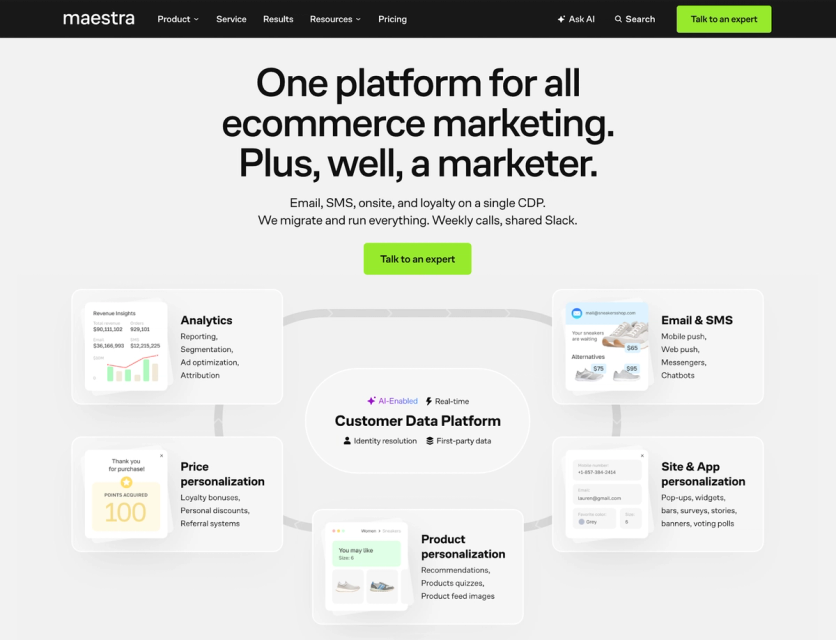
Maestra bundles the pieces Magento merchants usually license separately: a recommendation engine, on-site campaigns, email and SMS delivery, loyalty mechanics, and the customer database underneath all of them. Magento sits alongside Shopify, BigCommerce, WooCommerce, and custom storefronts on its integration list.
Adobe Sensei stops at the storefront. Maestra treats the storefront as one surface among many, and feeds the rest of them from the same record of what the shopper did.
In practice, the recommendation a shopper saw on the product page carries into their inbox, their text messages, and their loyalty offers, because every one of those channels reads from the same profile.
Key Features
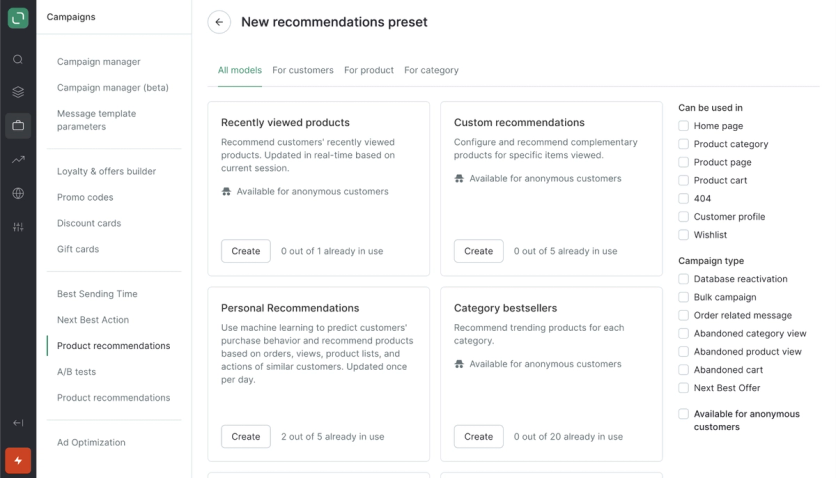
Cross-Channel Product Recommendations
One recommendation engine serves the product page, the cart, the inbox, and outbound texts, so a shopper who ignored a cross-sell on site meets a coherent follow-up later. At Svaha, recommendations assist 11.2% of total revenue; Selkirk handed 15 hours a week of manual product curation over to the engine.
On-Site Campaigns and Pop-Ups
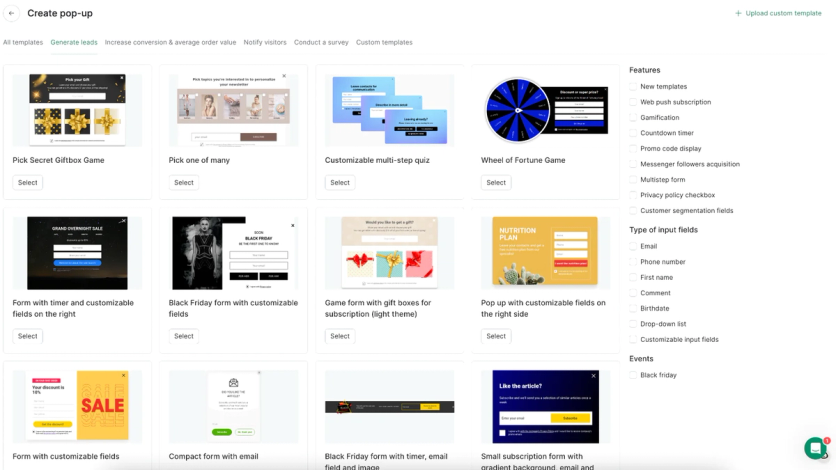
Marketers build pop-ups, quizzes, surveys, and timed offers themselves, with in-session targeting and frequency caps deciding who sees what. Blossom Flower measured 9% incremental revenue against a holdout group, and a product discovery quiz lifted its conversion rate by 14%.
Real-Time Customer Profiles
Identity resolution stitches sessions, orders, and channel history into a single record, and every rule in the platform queries that record rather than its own copy. Segment suggestions arrive as hypotheses a marketer approves or rejects, so the targeting logic stays inspectable.
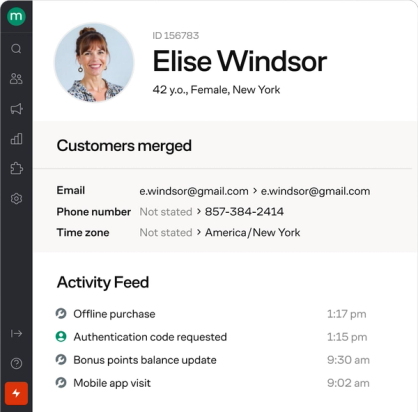
A unified customer profile in Maestra’s real-time CDP
Automated Cross-Channel Flows
Journeys chain email, SMS, push, and messenger steps behind the same conditions that drive on-site widgets, so a shopper never gets two contradictory offers. JOLYN lifted repeat domestic revenue 22% running advanced email and SMS flows next to AI-powered email capture.
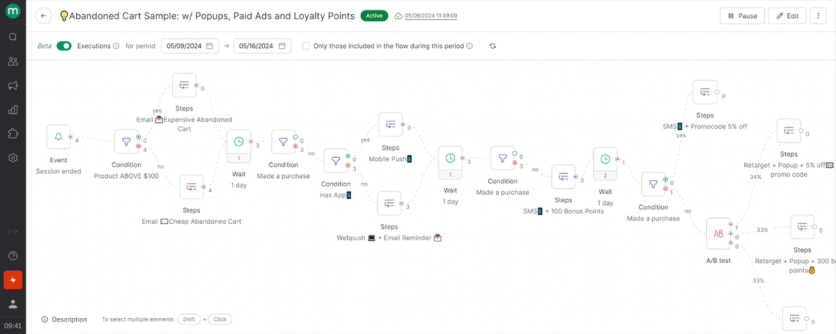
Loyalty, Promo Codes, and Referrals
Tiers, referral mechanics, targeted offers, and single-use promo codes are part of the subscription, which removes the usual third loyalty contract from a Magento stack. UAG folded Klaviyo, Yotpo Loyalty, and Frosmo into Maestra and took 64% off its stack bill – roughly $100,000 a year.
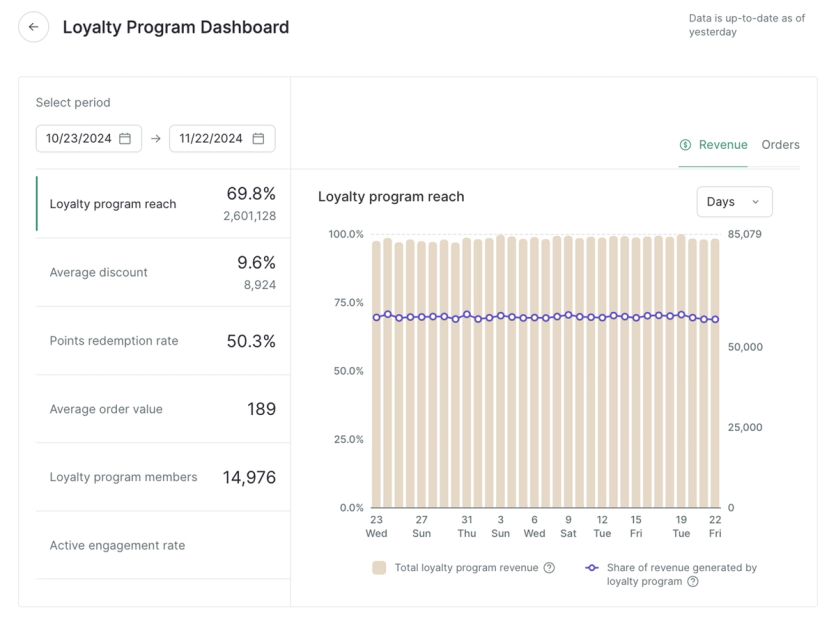
Pricing
From $2,000/mo, which includes 100,000 active profiles, the real-time CDP, and email; modules like product recommendations, site personalization, and loyalty are flat-rate add-ons, while SMS and WhatsApp bill on usage. Migration and implementation are included at no additional cost, billing is month-to-month, and email sends are unlimited. Only profiles active in a given month count – database size doesn’t affect the bill. See Maestra’s pricing.
Compared to Adobe Commerce’s GMV-and-AOV licensing, a strong quarter doesn’t raise your Maestra bill.
Where Maestra Wins
Consolidation is the headline. One contract and one profile stand in for the on-site tool, the ESP, the SMS vendor, the loyalty app, and the customer database – usually three to five line items on a Magento merchant’s invoice. Enlightened Equipment added 22% revenue in two months on no extra budget after making that swap.
The on-site toolkit holds its own. Enlightened Equipment’s Smart Up-sell Bar lifted average order value 38.7%, and its AI-powered product recommendations grew website conversion rate 15%. At Blue Q, shoppers who engage with Maestra-powered recommendation sections show 28.7% higher AOV, and “Often Bought With” bundles account for 40% of recommendation-influenced revenue.
Every account also gets a dedicated forward-deployed marketer who builds flows and segments alongside your team, rather than the developer tickets native Magento personalization tends to require.
Where Maestra Falls Short
Site search is not part of the platform – if personalized search ranking is your priority, keep Adobe Commerce Live Search or pair Maestra with a specialist. Review and UGC collection are missing too, so shoppable social content stays with whatever tool already handles it.
The platform is scoped for mid-size and larger brands. A small Magento Open Source store wanting a sub-$100 one-time extension will find Amasty or Clerk.io a closer fit for its stage.
Compared to Native Magento
Adobe Sensei personalizes product widgets and search results well, and it’s already inside your store. Maestra goes wider: owned email and SMS, a real-time CDP, built-in loyalty, pop-ups, quizzes, and recommendations that follow the shopper off-site. It’s also marketer-operated – rules and campaigns are built in the UI, not shipped via Composer. The trade-off is a monthly platform fee on top of your Magento license.
When to Add Maestra to Your Magento Store
You want personalization your marketers can run. If every recommendation rule or pop-up currently needs a developer, Maestra moves that work into a no-code UI. Blossom Flower’s product quiz – built and iterated by the marketing team – added 14% to conversion rate.
You’re consolidating your stack. If Magento personalization currently means an ESP, a loyalty app, and a pop-up builder held together by integrations, Maestra covers the set – the saving at UAG came to 64% of what it had been paying.
You need recommendations off the storefront. Sensei widgets stop at the page; the same Maestra models render inside email and SMS, which is where Svaha picks up 11.2% of revenue assisted by recommendations.
Your Adobe Commerce bill scales with GMV. Maestra’s active-profile pricing doesn’t move with your revenue, so growth doesn’t automatically raise the personalization line item.
2. Nosto – Best for Merchandising-Led Product Discovery
Starting price: Custom pricing (contact sales)
G2 rating: 4.6
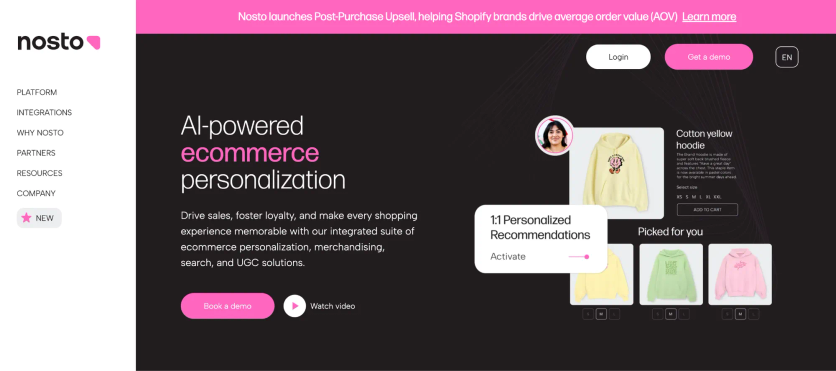
Nosto is a commerce experience platform and an Adobe/Magento Premier Technology Partner with more than ten years on the platform. Its Adobe Commerce extension is Marketplace-listed, actively maintained, and Composer-installed, with confirmed Hyvä theme compatibility.
Nosto is the closest thing to a purpose-built discovery layer for Magento – deep where product discovery matters, quieter everywhere else.
Key Features
Personalized Search
AI-driven site search that adapts results to shopper behavior – the counterpart to Adobe Commerce Live Search, with more merchandiser control.
Category Merchandising
Visual, rule-and-AI category page management – a long-standing Nosto strength that native Magento merchandising doesn’t match for ease of use.
Product Recommendations
Cross-sell, upsell, and behavioral recommendations across the storefront, with reviewers reporting conversion and AOV lifts.
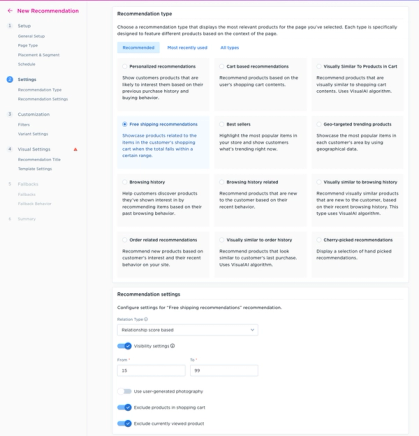
Nosto’s recommendation type picker
Dynamic Bundles and Post-Purchase Upsell
Automatically assembled bundles plus post-purchase offers between checkout and the thank-you page.
Shoppable UGC
User-generated content (the former Stackla) turned into shoppable on-site galleries – a capability most tools on this list don’t have.
Pricing
Custom pricing (contact sales). Nosto doesn’t publish rates; its model is modular and scales on GMV and traffic. Third-party estimates put smaller mid-market contracts around $1,500/mo and up (estimate, not confirmed by Nosto), rising into five figures monthly at enterprise scale.
Where Nosto Wins
For Magento merchants whose priority is discovery, Nosto is the specialist. Its Adobe Commerce integration is mature and Marketplace-listed, and reviewers from the last 12 months praise the time its AI saves and the depth of its segment analytics. Recommendations and merchandising are its center of gravity, and both are strong.
Where Nosto Falls Short
Interface complexity is the recurring complaint – recent reviewers describe setup for recommendations and tests as fiddly and note the platform “require[s] technical knowledge.” The Magento build is genuinely developer-heavy compared to Nosto’s turnkey Shopify experience, with one reviewer noting some integration elements “require back-end work.” Cost and occasional support delays round out the concerns.
Compared to Native Magento
Nosto beats native Magento on merchandiser usability, personalized search, and UGC, and it’s a maintained Marketplace extension rather than a first-party feature you configure yourself. What it shares with native Magento: personalization stays on-site, and setup still needs developer time. It’s a discovery upgrade, not a cross-channel one.
Compared to Maestra
Discovery is where Nosto goes deeper: Personalized Search, Category Merchandising, and Shoppable UGC have no equivalent on the Maestra side. Everything downstream of the storefront tilts the other way – owned email and SMS, the customer database, loyalty, and recommendations that carry across channels. The meters differ too: GMV and traffic for Nosto, active profiles for Maestra. Running both is a legitimate Magento setup – Nosto on discovery, Maestra on the relationship after it.
3. Dynamic Yield – Best for Experiment-Driven Storefront Optimization

Starting price: Custom pricing (contact sales)
G2 rating: 4.5
Mastercard owns Dynamic Yield, and sells it as Experience OS: a layer for targeting and testing that McDonald’s, Sephora, and On run. A partner integration for Magento and Adobe Commerce exists, but the implementation details below matter before you commit.
Pick Dynamic Yield when experimentation has a roadmap and someone whose job it is to run it.
Key Features
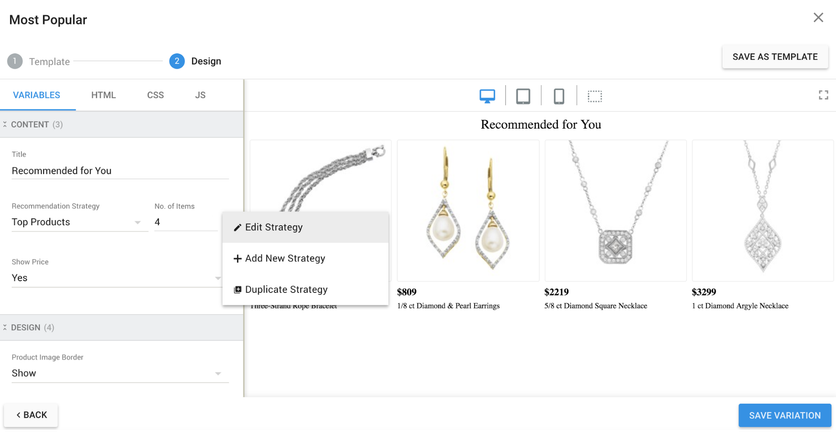
Recommendations
Algorithmic recommendations tuned with AdaptML deep-learning models predicting individual customer interest.
Optimization
A/B/n and multivariate experimentation on any digital property – deeper testing than native Magento or most tools here offer.
Journey Orchestration
Cross-moment targeting spanning web, email, and app through the Experience products.
Shopping Muse and Element
Shopping Muse is a conversational AI shopping assistant; Element pushes hyper-personalization using signals that include Mastercard data assets.
Pricing
Custom pricing (contact sales) – nothing published, no free tier. Personizely puts the entry point near $35,000 a year as a third-party estimate, rising with monthly active users and the modules you license.
Where Dynamic Yield Wins
Experimentation muscle. Reviewers describe scaling A/B/n testing and personalization “in a way that a smallish company by themselves wouldn’t be able to achieve,” and customer success draws consistent praise. Mastercard ownership and a long Gartner Magic Quadrant record give it enterprise credibility native tools can’t claim.
Where Dynamic Yield Falls Short
Developer dependence is the recurring theme: personalization “often necessitates substantial development effort, including custom coding.” Built-in analytics disappoint, pushing teams to GA4 or Adobe Analytics. For Magento specifically, Dynamic Yield’s published Composer module appears frozen at a 2021-era build designed for default templates – its own docs flag issues with heavily customized themes – so current integration is closer to a semi-custom script than a maintained one-click app. Verify the integration path with their team before committing.
Compared to Native Magento
Dynamic Yield far exceeds native Magento on testing and algorithmic depth, but it assumes engineering support and an enterprise budget – the same developer-and-cost burden that pushes brands off native personalization in the first place, only with a bigger testing payoff.
Compared to Maestra
The split is scope. Experience OS optimizes what a shopper sees; it has no sending infrastructure of its own, so Experience Email dresses up messages your existing provider delivers. Maestra sends the email and SMS itself and carries loyalty and promotions in the same subscription. The commercial gap matters as much: a published price and included migration on one side, a procurement cycle plus engineering hours on the other. Magento teams without in-house developers rarely find that a close call.
4. Algolia – Best for Developer Teams Building Fast Search

Starting price: Free plan available (10,000 searches/mo)
G2 rating: 4.5
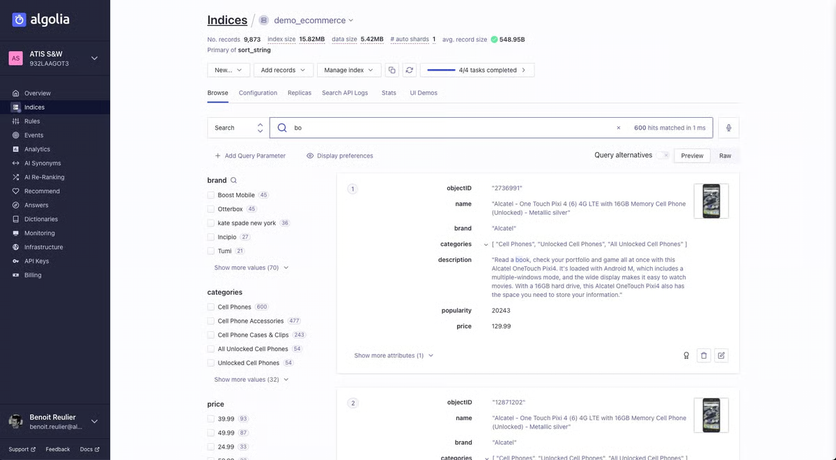
Algolia ships search as infrastructure: APIs for Search, Recommendations, and Browse, a no-code Merchandising Studio on top, and NeuralSearch blending keyword matching with vector similarity as the shopper types. Its Adobe Commerce extension sits on the Marketplace, installs through Composer, and runs on more than 1,600 Adobe Commerce stores.
Algolia gives Magento the discovery layer Adobe Sensei aims at – faster, more configurable, and with a build cost that comes with the flexibility.
Key Features
Search and NeuralSearch
Hybrid keyword-and-vector ranking, with response times reviewers routinely call the fastest they have used. Magento’s default search is swapped for results that appear as the query is typed.
Recommendations
Behavioral recommendation models served via API, priced per thousand requests beyond the included volume.
Browse
Curated, personalized category pages – Algolia’s counterpart to Adobe Commerce category merchandising.
Merchandising Studio
The no-code layer where merchandisers run search and browse campaigns without engineering tickets.
Pricing
Free plan available (10,000 search requests a month and 50,000 records). Beyond that, requests bill at $0.50 per thousand on Grow and $1.75 on Grow Plus, while NeuralSearch and live personalization only unlock on the Elevate tier. Two meters run at once, on requests and on records stored.
Where Algolia Wins
Speed and control, with a free tier that lets a Magento store prove value before spending anything – no other platform here offers that. Recent reviewers single out the control over rankings, synonyms, filters, and merchandising, and the Adobe Commerce extension is actively maintained for current versions.
Where Algolia Falls Short
The bill grows unpredictably: reviewers report pricing that “can become quite expensive as usage scales,” and charging on both requests and records makes forecasting awkward. Setup expects engineers. And for this comparison the decisive gap is what is absent: no pop-ups, no content personalization, no UGC, no email.
Compared to Native Magento
Algolia beats Adobe Commerce Live Search on raw speed, relevance control, and pricing transparency, and its free tier lowers the barrier. It replaces one capability – search and discovery – rather than adding a personalization program. Everything off the search bar stays as native Magento left it.
Compared to Maestra
These two sit side by side rather than against each other. Search is Algolia’s whole product and a deliberate blank in Maestra’s; the customer database, email, SMS, loyalty, and cross-channel recommendations are Maestra’s and outside Algolia’s remit. Plenty of Magento stacks carry both: Algolia on discovery, Maestra on everything the profile drives afterward.
5. Bloomreach – Best for Pairing Commerce Search With Marketing Automation
Starting price: Custom pricing (module + usage fee)
G2 rating: 4.6
Two products live under one brand at Bloomreach: commerce search and merchandising, and a marketing automation suite with a CDP and 17+ channels. Loomi, its AI layer, is now the front door to both.
Imagine Adobe Commerce Live Search, your ESP, and your customer database sold as a single enterprise contract – that is roughly the shape of Bloomreach.
Key Features
Bloomreach Discovery
AI-native commerce search with Ecommerce Categories and Product Recommendations as connected channels.
Bloomreach Engagement
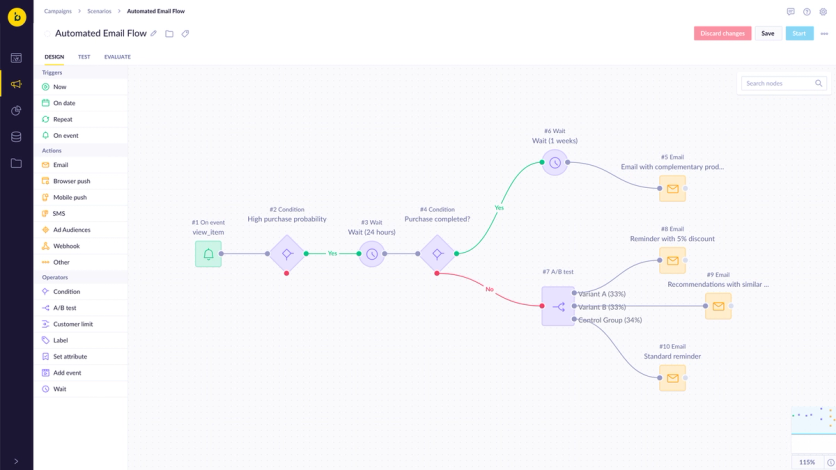
Campaign personalization across email, SMS, web, and the mobile app, all reading from a real-time customer database with its own segmentation engine.
Loomi AI and Agents
Loomi Marketing Agent turns a single prompt into a finished workflow, Loomi Shopping Agent 2.0 acts as an end-to-end shopping companion, and Loomi Connect lets teams assemble agents of their own.
Web Personalization and A/B Testing
Content targeting and experimentation across the same customer data.
Pricing
Custom pricing, billed as a fee per licensed module plus usage that tracks customer volume, catalog size, and messages sent, on annual terms. CostBench estimates put working deployments between $40,000 and $250,000+ a year. Nothing entry-level exists.
Where Bloomreach Wins
Breadth at enterprise depth, with strong recent reviews. One G2 reviewer (January 2026) praises “its smart search, which understands what a customer means when they don’t have the exact word”; another (March 2026) notes “powerful personalization … without loads of dev effort.” For a Magento brand outgrowing its ESP and its native search at once, Bloomreach consolidates both.
Where Bloomreach Falls Short
Cost and complexity gate it to enterprise – implementations run six-plus months, and reviewers call it too heavy for teams “with limited internal resources.” The Magento-specific catch is fresh and important: Bloomreach’s packaged Magento connector is now a legacy plugin, unsupported for new implementations as of January 1, 2026, so new Adobe Commerce merchants integrate through its Tracking API and data imports – a heavier, more technical build.
Compared to Native Magento
Bloomreach covers native Magento’s search and recommendations and then adds the CDP, ESP, and agent layer Magento doesn’t have. It’s a segment change, not a swap – enterprise budget, enterprise timeline – and its dedicated Magento connector is being retired, pushing new stores toward a custom API integration.
Compared to Maestra
Both bring discovery-adjacent personalization together with owned channels on top of a live customer database. Each has something the other lacks: site search and a CMS at Bloomreach, loyalty and promotions at Maestra. The commercial distance is wider than the feature distance – annual enterprise commitments against a published $2,000/mo start with migration included and no lock-in. Magento merchants in the mid-market get the consolidation without the procurement process. If Bloomreach is on your shortlist, compare it against the Bloomreach alternatives we track.
6. Insider One – Best for Messaging-Led Growth Beyond the Storefront
Starting price: Custom pricing (contact sales)
G2 rating: 4.8
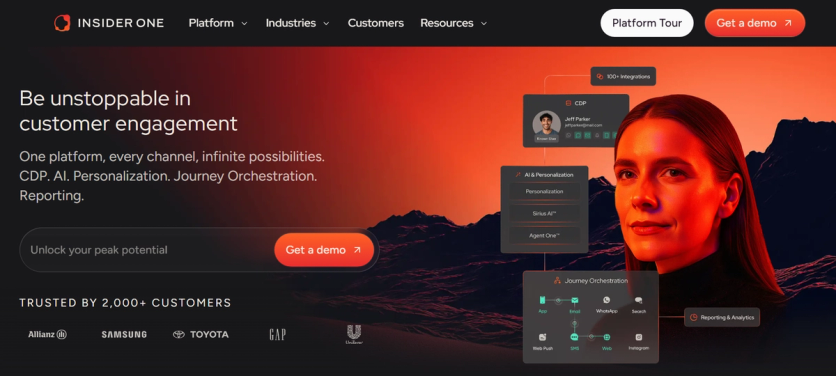
Renamed Insider One in late 2025, the platform now sells itself on agentic engagement: a customer database, a journey canvas, and a set of AI agents working across web, email, SMS, WhatsApp, and push. Adobe Commerce connects through an API-integration extension published on the Adobe Commerce Marketplace.
Native Magento personalization ends at the storefront; for Insider One the storefront is one entry in a list of a dozen channels.
Key Features
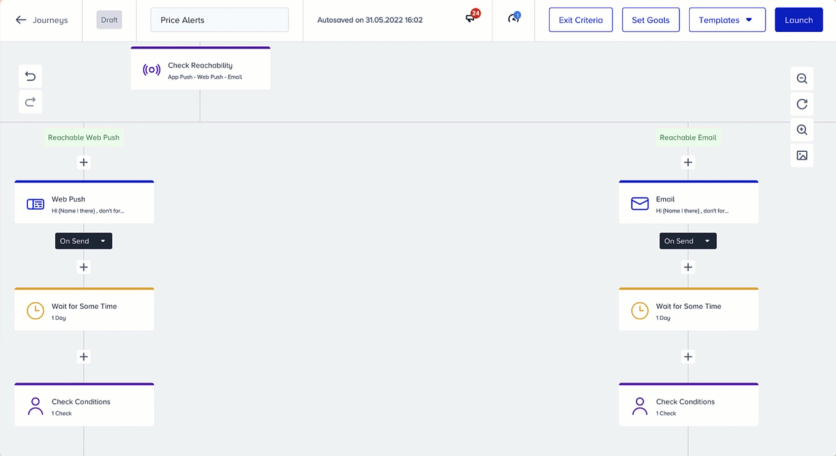
Architect
The journey orchestration engine – cross-channel campaigns drawing on a customer profile updated in milliseconds.
Actionable CDP
The customer data foundation unifying web, app, and messaging behavior into one profile.
Smart Recommender and Eureka Search
AI recommendations plus personalized site search and product discovery, served on site, in app, and inside messaging.
Insider One AI and Agent One
Prompt-based segment discovery, auto-generated journeys, and purpose-built Shopping, Support, and Insights agents.
Pricing
Quote-only, with nothing published and no free tier. Spendbase estimates starter packages at $950–$1,300/mo and typical agreements near $48,000 a year. What moves the number: tracked users per month, how many channels you switch on, and how deep you go on AI.
Where Insider One Wins
Reach across channels without giving up personalization depth. A March 2026 reviewer points to “fast, easy integration,” and a September 2025 one credits Architect with letting the team “trigger contextual journeys based on the actions a user took.” Where growth runs through WhatsApp or push, Insider One lands on surfaces Magento’s own tools never see.
Where Insider One Falls Short
Breadth is also the learning curve. Reviewers report a setup that “did take some time and needed input from our tech team” and a “steep” initial learning curve on Architect. Insider’s own integrations page doesn’t name Magento (the connection is a Marketplace API extension), so confirm the integration path for your version before committing.
Compared to Native Magento
Insider One extends far beyond native Magento – email, SMS, WhatsApp, push, a CDP, and AI agents Magento delegates to other tools. The cost is enterprise pricing and an API-based setup that leans on developers, versus native features already inside the store.
Compared to Maestra
This is the closest matchup on the list – two platforms betting on the same idea, that personalization and omnichannel messaging belong on one live profile. Where they part: pricing is public on one side and quote-only on the other; loyalty and promotions come included with Maestra; mobile app and WhatsApp surfaces sit at the center of Insider One’s pitch. Staffing decides the rest – a lean team leans on the forward-deployed marketer, a bench of operators gets more out of Insider’s breadth. We break the platform down further in our guide to Insider alternatives.
7. Dotdigital Personalization – Best for Web and Email Personalization Tied to a Marketing Suite

Starting price: Custom pricing (contact sales)
G2 rating: 4.8 (listed on G2 as Fresh Relevance)
Dotdigital Personalization is the product formerly sold as Fresh Relevance, acquired by Dotdigital in 2023 and now folded into the Dotdigital brand. It ships two official Adobe Commerce Marketplace extensions (the personalization script and a W3C data layer), both Composer-installed and 2.4-compatible.
Dotdigital Personalization pulls live Magento store data into web, email, and SMS experiences – strongest when paired with Dotdigital’s marketing automation.
Key Features
Web and App Personalization
Content tailored to each shopper segment – new, frequent, or lapsed buyers – across the storefront.
Triggered Email and SMS
Behavior-triggered messages – browse and cart abandonment, back-in-stock – fed by real-time store data.
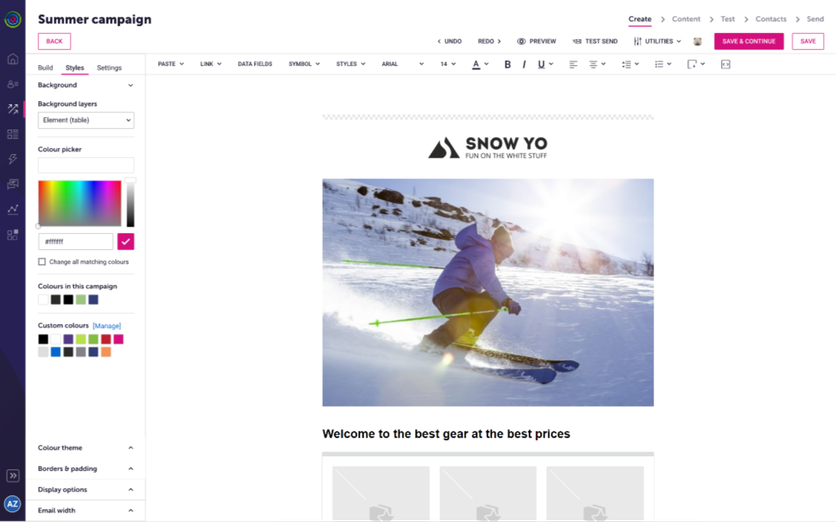
Product Recommendations
Recommendations in email and on the web based on shopper interests and live stock levels.
Social Proof
Ratings, popularity, and scarcity cues surfaced on product pages to nudge conversion.
Pricing
Custom pricing (contact sales), volume-based on monthly page views and selected modules. A third-party estimate lists entry from around $400 per feature per month (aggregator estimate, not vendor-confirmed). No free plan.
Where Dotdigital Personalization Wins
Support is the standout in reviews – one reviewer calls the technical team “second to none … with very quick turn around times.” Reviewers credit browse and basket abandonment with strong revenue impact, and the cross-channel breadth (web plus email plus SMS plus social proof) suits Magento merchants who want one vendor across on-site and messaging.
Where Dotdigital Personalization Falls Short
Setup can be daunting – reviewers describe onboarding as “overwhelming due to the number of available features” and the terminology as “a bit clunky.” On Magento specifically, the integration means installing two separate Composer extensions plus the W3C data layer, so it needs developer resources rather than a one-click install. Note too that the standalone Fresh Relevance brand is being retired into Dotdigital.
Compared to Native Magento
It adds the web-and-email personalization and abandonment messaging native Magento leaves to a separate ESP, feeding on live store data through Marketplace extensions. The setup is still developer-installed, and it’s most compelling if you also use (or are open to) Dotdigital’s email platform.
Compared to Maestra
Both connect on-site personalization to owned email and SMS. The differences: Maestra includes a real-time CDP, built-in loyalty, and promotions, publishes its pricing, and assigns a dedicated forward-deployed marketer; Dotdigital Personalization is quote-only and leans on the wider Dotdigital suite for its full value. For a Magento brand wanting one consolidated platform rather than a personalization add-on to an ESP, Maestra covers more from a single contract.
8. Clerk.io – Best for Small Catalogs on a Tight Budget
Starting price: Custom usage-based pricing (free trial)
G2 rating: 4.8
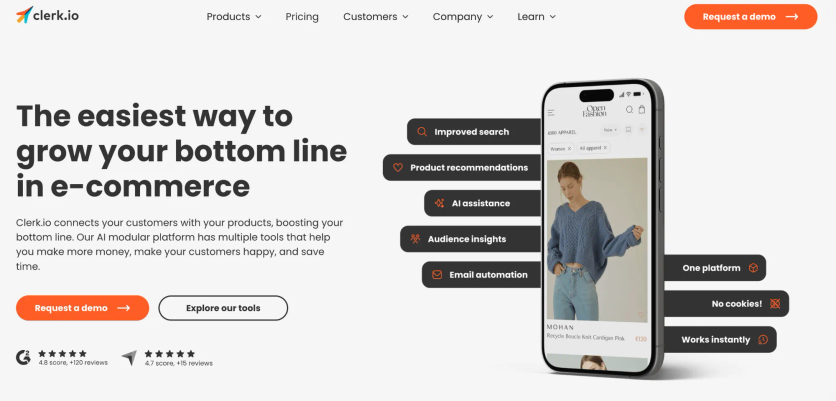
Clerk.io is a Danish vendor selling five modules separately – Search, Recommendations, Email, Audience, and Chat – and charging on usage. Its Magento 2 extension is first-party, installed with Composer rather than through the Adobe Marketplace, and supports Adobe Commerce 2.4.
For a Magento store the discovery essentials are covered at SMB prices, and at SMB depth.
Key Features
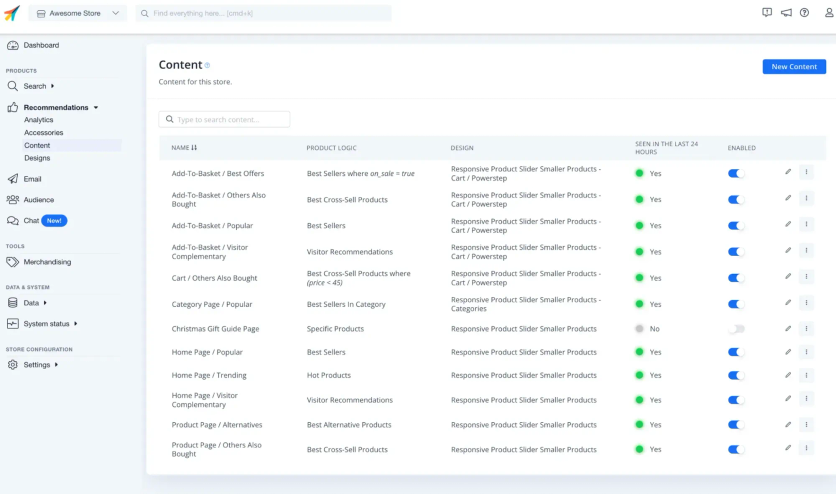
Search
Personalized site search that recent reviewers say performs well even on large, complex catalogs.
Recommendations
Personalized product suggestions across home, product, and cart pages, with reviewers reporting cross-sell lifts.
Data-driven personalized email campaigns – a channel native Magento reaches only through a separate ESP.
Audience and Chat
Segment building synced to ad and email platforms, plus a generative-and-predictive AI shopping chatbot.
Pricing
Custom usage-based pricing via per-module calculators – costs scale on monthly searches, recommendations served, opened emails, subscribers, and chat conversations, with rates dropping as volume grows. There’s a free trial but no permanent free plan.
Where Clerk.io Wins
Value for money on the basics, plus support that reviewers keep bringing up unprompted. One September 2025 reviewer credits Clerk with “increasing conversion rates,” and because the platform is not tied to Magento, it follows you if you replatform.
Where Clerk.io Falls Short
Pricing scales up fast as search and recommendation volume grows – the most consistent complaint across reviews. Its Magento history includes real integration friction: one detailed review described a Magento 2 connection as “horrific,” with weeks of unresolved bugs (that review is older, from 2022, but it’s the standout Magento-specific complaint on record – confirm current stability before committing). A/B testing and messaging depth trail the broader platforms here.
Compared to Native Magento
Clerk.io adds personalized search, recommendations, and owned email at friendlier economics than an enterprise platform, through its own Magento extension. It’s a lighter, cheaper discovery-plus-email layer than native Adobe Commerce personalization plus a separate ESP – best for smaller catalogs and budgets.
Compared to Maestra
Recommendations plus owned email describes both, at very different scales. Smaller catalogs and tighter budgets are Clerk.io’s territory; a live customer database, SMS, loyalty, full reporting, and a named marketer come with Maestra and suit bigger operations. The usual path for a Magento merchant runs from the first to the second.
9. Amasty – Best for Rule-Based Recommendations Without a SaaS Contract
Starting price: From $309 (one-time license, Open Source edition)
G2 rating: Not rated on G2 (Adobe Commerce Marketplace ratings apply)
Amasty is one of the best-known Magento extension vendors, and its Automatic Related Products extension is the go-to answer for “magento personalization extension” when a merchant wants recommendations without a monthly SaaS bill. Aheadworks and Mirasvit sell comparable rule-based related-products extensions.
Amasty is the pragmatic, own-it-outright option – on-site recommendations you install once, with no recurring platform fee.
Key Features
Automatic Related Products
Rule-based related, cross-sell, and upsell blocks driven by product conditions and customer groups, shown across product, cart, and category pages.
Behavior-Based Recommendation Rules
An unlimited number of recommendation rules, with the option to blend rule logic with visitor behavior on-site.
Customer-Group Targeting
Different upsell and cross-sell blocks for different customer groups – segment-level personalization within the store admin.
Pricing
From $309 as a one-time license for the Magento Open Source edition, including 90 days of support and lifetime updates; the Adobe Commerce edition costs more. There’s no recurring platform fee – you own the extension.
Where Amasty Wins
Cost predictability. For a Magento store that just wants smarter related-products blocks, a one-time license beats a SaaS subscription outright, and the extension installs into the store you already run. Amasty’s marketplace catalog is broad and well-documented, so the recommendations extension slots alongside other Amasty tools.
Where Amasty Falls Short
It’s on-site only and rule-based – there’s no real-time CDP, no email or SMS, no cross-channel sync, and the “AI” is closer to smart rules than the deep-learning models the SaaS platforms run. Like all extensions, it needs a developer to install and maintain, and it carries upgrade risk when Magento versions change. It personalizes one surface, not the customer relationship.
Compared to Native Magento
Amasty extends native Magento’s related-products logic with more flexible rules and customer-group targeting, without the separate Adobe Target license. It stays inside the same on-site, developer-maintained model – a targeted upgrade to product blocks, not a new personalization program.
Compared to Maestra
Different categories entirely. Amasty is a one-time on-site recommendations extension; Maestra is a full personalization platform with a CDP, email, SMS, loyalty, and cross-channel recommendations on a monthly subscription. A small store proving the value of recommendations might start with Amasty; a brand that wants personalization across every channel needs a platform like Maestra.
How to Choose the Right Magento Personalization Tool
Maestra is the strongest Magento personalization tool for mid-size and larger brands because it doesn’t add one more on-site widget to a store that already needs a developer for every rule – it replaces the three to five point tools around the storefront (ESP, SMS vendor, loyalty app, pop-up builder, CDP) with one platform and one customer profile. Recommendations follow shoppers from the product page into email and SMS, pricing is tied to active profiles instead of your GMV, and every account gets a dedicated forward-deployed marketer who builds alongside your team.
The rest have their place: Nosto and Algolia for discovery depth, Dynamic Yield or Bloomreach for enterprise experimentation and search, Insider One for messaging-led journeys, Dotdigital Personalization for web-and-email tied to a marketing suite, Clerk.io for smaller budgets, and Amasty when a one-time recommendations extension is all you need.
If the goal is running your whole retention stack on top of Magento, book a Maestra demo with your current subscriptions in hand – the arithmetic tends to answer the question.
Frequently Asked Questions About Magento Personalization
- It depends on scope. If the storefront, the inbox, and the loyalty program all need to act on the same shopper record, Maestra is the strongest pick for Magento – Enlightened Equipment grew revenue 22% in two months after consolidating onto it. Narrow the job to product discovery and Nosto or Algolia lead instead; for on-site recommendations on a one-time license, Amasty is the cheapest way in.
- Yes, but it’s limited. Adobe Commerce includes Live Search and Product Recommendations powered by Adobe Sensei, which re-rank products and power recommendation widgets. Deeper personalization – experience targeting, A/B testing, content personalization – requires Adobe Target (a separate Adobe Experience Cloud license) or a third-party tool. Magento Open Source gets even less out of the box. That gap is why brands layer a platform on top and measure it: on-site personalization run through Maestra generated 9% incremental revenue against a control group for Blossom Flower.
- It’s an installable module for a Magento or Adobe Commerce store that adds personalization features – most commonly product recommendations. The choice splits by scope. A platform like Maestra keeps one customer profile that drives on-site recommendations and the email and SMS that follow – at JOLYN, recommendations built on that profile influence 7% of sales. A pure extension adds rules inside Magento only: Amasty, Aheadworks, and Mirasvit sell rule-based recommendation extensions on a one-time license, while Nosto, Algolia, and Clerk.io distribute Magento extensions but bill as ongoing subscriptions.
- Maestra renders the same recommendation models on the product page, in email, and in SMS, all driven by one customer record – at Svaha that setup assists 11.2% of total revenue. Bloomreach and Insider One also combine on-site personalization with owned messaging, at enterprise contract sizes. Clerk.io bundles an email module with its recommendations for smaller stores, and Dotdigital Personalization feeds a wider Dotdigital marketing suite.
- Yes, if the pieces you are replacing are personalization, messaging, and the customer data underneath them. Maestra covers on-site campaigns, recommendations, email, SMS, and loyalty on one profile, which is how UAG took 64% off its stack bill after folding three vendors into it. Bloomreach and Insider One consolidate a similar range at enterprise pricing. What none of them replaces is Adobe Commerce itself – the catalog, checkout, and merchandising engine stay where they are.
- Algolia is the only tool here with a standing free tier (10,000 search requests a month), and Clerk.io runs free trials; Amasty sidesteps the question with a one-time license. Nosto, Dynamic Yield, Bloomreach, Insider One, and Dotdigital Personalization all quote privately with no self-service entry. Maestra has no free plan either, but its number is public: from $2,000/mo covering the real-time CDP, email, and the first 100,000 active profiles, with migration and implementation included – see Maestra’s pricing.