
8 Best Dynamic Yield Alternatives in 2026 (Compared & Ranked)

Dynamic Yield publishes no pricing at any tier. The license scales with served visitors, and quotes add onboarding and program-support fees, so the first real number arrives only after a sales call. It sits at the top of the personalization market and is priced accordingly.
The engineering bar is just as high. Recent reviewers describe integration that proceeds "page by page" and custom experiences that call for HTML, CSS, and JavaScript – a real cost if your team doesn't include front-end developers.
This guide compares eight Dynamic Yield alternatives on personalization depth, testing rigor, pricing transparency, and how much your marketers can ship without engineering. Here's the quick verdict, then the full breakdown:
Quick Verdict on the Best Dynamic Yield Alternatives
The best Dynamic Yield alternatives are Maestra, Insider One, Bloomreach, Nosto, Monetate, Optimizely, Wingify, and Adobe Target. All eight cover the Dynamic Yield use cases – web personalization, A/B testing, and product recommendations – from very different angles:
- Best for consolidating the whole stack: Maestra – site personalization, recommendations, A/B testing, email, SMS, and built-in loyalty on one real-time customer profile
- Best for experimentation depth: Optimizely – enterprise testing with a dedicated Stats Engine, feature flags, and AI agents
- Best for agent-driven engagement: Insider One – AI agents running campaigns across a dozen-plus channels
- Best for search and merchandising: Bloomreach – AI-native ecommerce search paired with marketing automation
- Best for testing plus behavior analytics: Wingify (formerly VWO and AB Tasty) – A/B testing with heatmaps and session recordings included, plus a 30-day free trial
Content:
Common Dynamic Yield Pain Points (and Quick Fixes)
The themes below come from recent verified G2 and Capterra reviews; each is worth checking against your own renewal terms.
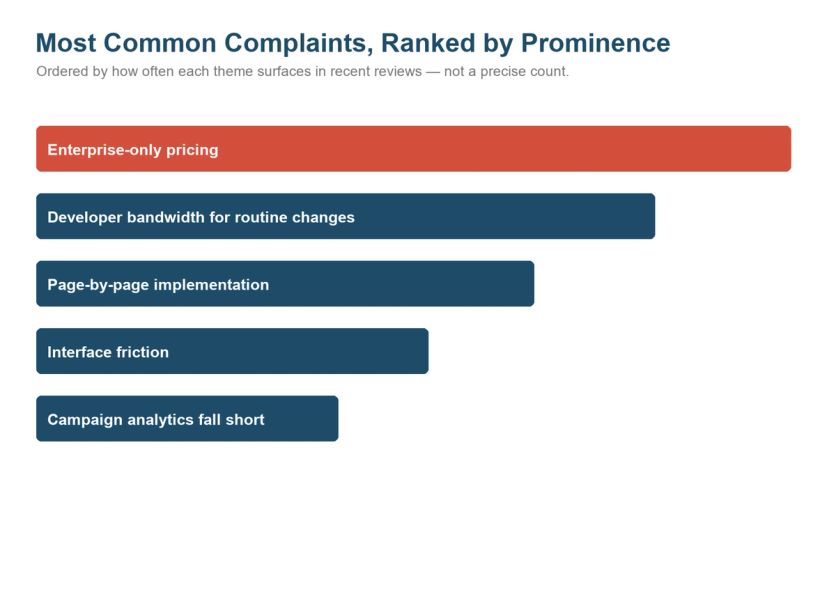
| Pain Point | Description | Possible Solutions |
|---|---|---|
| Enterprise-only pricing | The license runs on served visitors, and quotes stack a one-time onboarding fee, an adoption fee, and an ongoing program-support fee on top (G2); nothing is published at any tier, and third-party buyer data pegs entry near $35K/yr | Request the full fee schedule before renewal; shortlist platforms that publish pricing. Buyers report an average 18% discount off the first quote (G2) |
| Developer bandwidth for routine changes | Deeper customization calls for HTML, CSS, and JavaScript, and even client-side tests can require custom code | Favor no-code editors – or a vendor whose team builds campaigns with you |
| Page-by-page implementation | Reviewers describe wiring up the platform one page at a time rather than dropping in a single snippet | Budget a phased rollout, or pick a tag-based setup the vendor implements |
| Interface friction | The UI reads as clunky for manual work like curating a fixed set of recommended products | Run a proof of concept with your real catalog before committing |
| Campaign analytics stop short | Reviewers ask for more detailed campaign-level reporting than the dashboards provide | Export to your BI stack, or choose a platform with revenue-level reporting built in |
The cost theme is blunt in reviews: "DY is a household name when it comes to personalization. This is reflected in its comparatively high pricing," one mid-market reviewer wrote. The implementation theme matches: "Integration is a time taking concept as we need to integrate page by page."
To be fair, plenty of this is fixable without leaving. Reviewers genuinely praise Dynamic Yield's customer success teams and its out-of-the-box templates "that can help you start your first tests straight away" – so before switching, trim custom builds back to templates, revisit which modules you actually license, and renegotiate the fee schedule at renewal.
Why (or When) to Consider Dynamic Yield Alternatives
Three situations make the search worthwhile. First, when personalization is gated on engineering: if every experience change waits in a dev queue, the license fee is only part of what you're paying.
Second, when Dynamic Yield is one of several tools doing retention work. Experience OS personalizes experiences and sends triggered messages, but most brands still run their core email and SMS programs, loyalty, and customer data stack elsewhere – and those line items add up.
Third, when the roadmap fit drifts. Since Mastercard completed its $325M acquisition in April 2022, Dynamic Yield's 2026 release notes add features for financial institutions and Mastercard rewards ecosystems alongside retail – worth watching if you want an ecommerce-first roadmap. BigCommerce brands should also note that Dynamic Yield lists BigCommerce as a technology partner without a dedicated app.
The Best Dynamic Yield Alternatives at a Glance
| Platform | Best For | Key Differentiator | Starting Price | G2 Rating |
|---|---|---|---|---|
| Maestra | Personalization and retention on one platform | Site personalization, recs, testing, email, SMS, and loyalty on one real-time profile | From $2,815/mo (100K active profiles included) | 4.8/5 |
| Insider One | Agentic AI engagement at enterprise scale | Agent One AI plus 140+ web templates across 12+ channels | Custom (~$48K/yr average contract per Vendr estimates) | 4.8/5 |
| Bloomreach | AI search plus marketing automation | Loomi AI across search, merchandising, and campaigns | Custom (module + usage fees, annual billing) | 4.6/5 |
| Nosto | Merchandising-led personalization | Recommendations, search, and category merchandising with built-in A/B tests | Custom (GMV- and traffic-based) | 4.6/5 |
| Monetate | Enterprise testing without flicker | Network-layer experimentation (Forte, formerly SiteSpect) | Custom pricing (contact sales) | 4.1/5 |
| Optimizely | Mature experimentation programs | Stats Engine, feature flags, and Opal AI agents | Custom (free Rollouts tier for feature flags) | 4.2/5 |
| Wingify | Testing plus behavior analytics | Heatmaps, session recordings, and emotion-based segments beside every test | Custom (MAU-based; 30-day free trial) | 4.4/5 |
| Adobe Target | Personalization inside the Adobe stack | Auto-Target and Automated Personalization tied to Real-Time CDP | Custom (mid-five-figure entry per partner estimates) | 4/5 |
1. Maestra – Best for Personalization With Marketing Channels Built In
Starting price: From $2,815/mo (CDP + onsite personalization; first 100K active profiles included)
G2 rating: 4.8/5
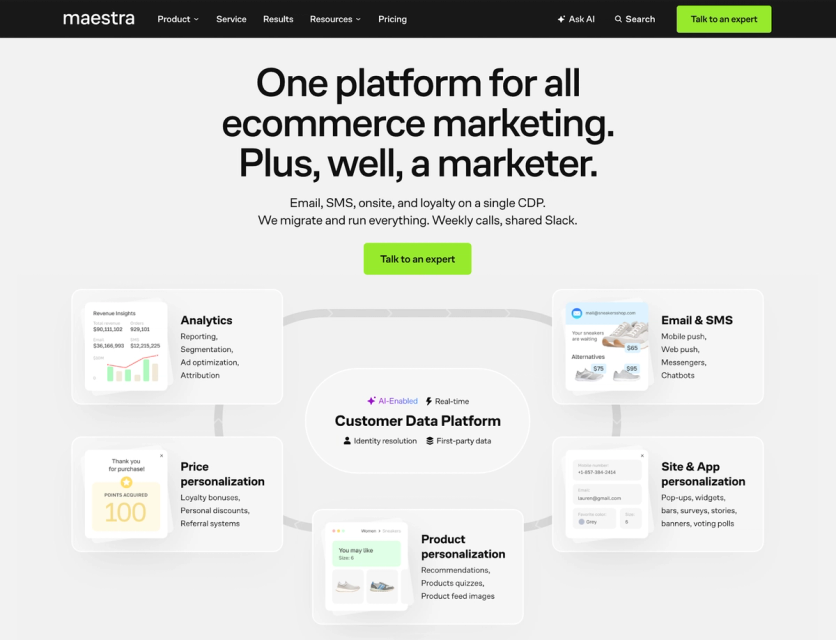
Maestra runs personalization and retention on one platform for mid-size, enterprise, and rapidly scaling ecommerce brands. Dynamic Yield optimizes the experience layer; Maestra runs the experience layer and the marketing behind it – site and app personalization, product recommendations, A/B testing, email, SMS, push, and built-in loyalty, all reading from one real-time customer profile.
Key Features
Web and App Personalization Campaigns
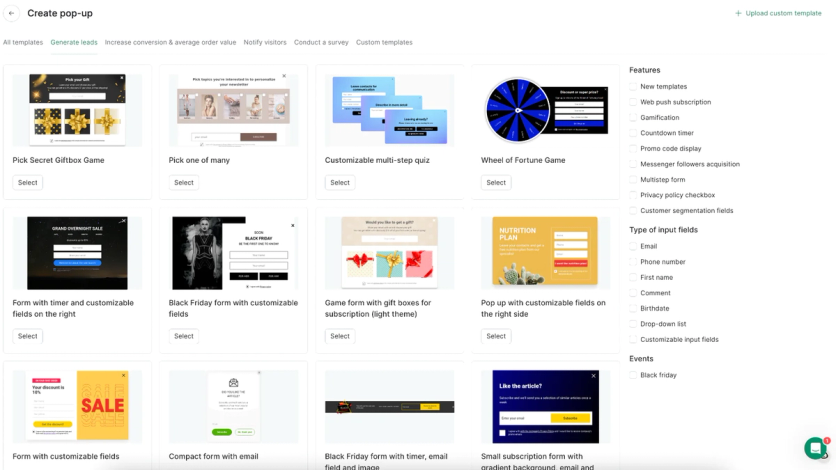
Banners, pop-ups, stories, embedded blocks, surveys, and real-time offers launch from templates with zero code, targeted by in-session behavior and location. Personalization decisions process in under 300 ms, and the asynchronous on-site SDK stays under 100 KB – published Lighthouse benchmarks show roughly 5–7% mobile Time to Interactive on standard-template setups.
A/B Testing With Control Groups
Every on-site campaign can run as an A/B test against a control group, so personalization has to prove itself in revenue, not clicks. Blossom Flower validated its personalized website in Google Optimize across three A/B tests: 9% incremental revenue versus the control group in 15 days. 1Thrive A/B-tested pop-up messaging – exclusive deals against an upfront discount – and lifted its signup rate by 4.26%.
Product Recommendations on 14 Algorithms
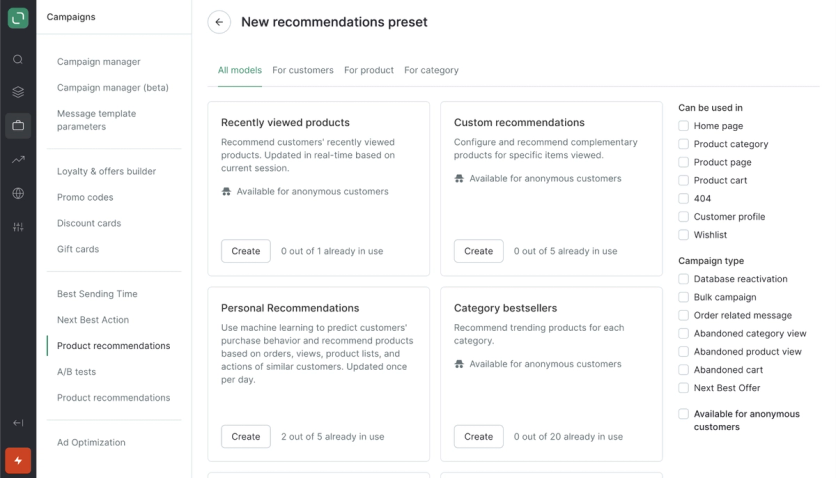
Fourteen ready-to-use recommendation engines – bestsellers, similar products, often-purchased-with, post-purchase cross-sell – deploy across the site, app, email, and even 404 pages, with business rules for price, category, color, and collection. Shoppers only see in-stock, size-matched, region-appropriate items. At Defense Mechanisms, recommendations influence 8.9% of sales through homepage bestsellers, complementary gear on product pages, and personal picks on 404 and empty-search pages. "It feels like a gear expert is guiding each customer – and that's been a big unlock for conversion," says Jessie Gullikson, Brand Director at Defense Mechanisms.
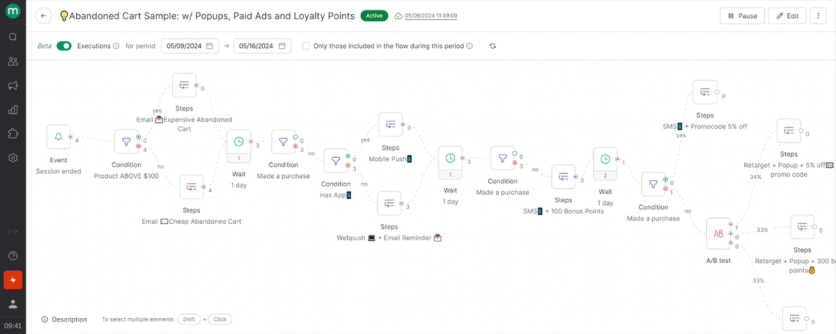
Omnichannel Flows on the Same Profile
The events that trigger an on-site campaign can trigger an email, SMS, or push message in the same flow builder – no sync between a personalization tool and an ESP. Audiogon runs dedicated newsletters and flows for buyers, dealers, and members on one platform and grew active subscribers 75% year over year, with 26% more email-driven sessions. "The real game-changer was having email and on-site in a single system," says Justin Roberson, Director of Digital at Audiogon.
Real-Time CDP and Built-In Loyalty
Every module reads and writes the same profile, updated in real time from web, app, store, and support data – and loyalty tiers and point balances become targeting conditions anywhere. Urban Armor Gear runs email, loyalty, and site personalization on this one profile after consolidating a three-tool stack, cutting marketing-stack costs 64% – about $100,000 a year.
A Forward Deployed Marketer on Every Plan
Every subscription includes a Forward Deployed Marketer who handles migration, integration setup, flow and segment builds, and ongoing optimization. It's the difference between buying software and adding capacity: "We didn't just consolidate platforms with Maestra, we upgraded everything," says Nick Salisbury, E-commerce Director at Urban Armor Gear.
Pricing
From $2,815/mo for the real-time CDP plus onsite personalization, with the first 100,000 active profiles included. Billing follows activity: a profile only counts in a month when you message it or it visits or buys, so anonymous and dormant profiles cost nothing. SMS, MMS, and WhatsApp bill on usage on top of that. Contracts run month-to-month, and migration, implementation, and campaign setup are included – the full module breakdown is on Maestra's pricing page.
Where Maestra Wins
One platform closes the gap between personalizing an experience and monetizing it. Furniture Fair runs email, product recommendations, pop-ups, and dynamic product ads from a single system after consolidating five point tools – including Optimizely, UNBXD Recommendations, and Wisepops – and reports 7,543% ROI with a 27% cut in stack costs.
Speed to impact is the second win. Campaigns launch from templates without code, the Forward Deployed Marketer does the wiring, and results are read against control groups from day one.
And the price is knowable. Maestra publishes its starting price and billing logic; every platform in the enterprise tier of this list quotes custom contracts.
Where Maestra Falls Short
There's no free plan or self-serve trial, and the $2,815/mo floor is real money for an early-stage store. Brands below the mid-market threshold usually get better payback from point tools first.
Experimentation is marketer-grade, on purpose. You get A/B tests and control groups for on-site campaigns, pop-ups, and messages – you don't get a server-side feature-flag suite for product engineering teams the way Optimizely or Wingify offer.
There's also no native reviews or UGC module; brands running shoppable UGC keep a separate tool for it.
Compared to Dynamic Yield
Dynamic Yield's depth is algorithmic: AdaptML models, Mastercard-derived data products like Element and Shopping Muse, and enterprise experimentation. The trade is that it's quoted, not priced; implementation runs page by page; and your email, SMS, loyalty, and CDP still live in other contracts.
Maestra covers the personalization use cases most ecommerce teams buy Dynamic Yield for – on-site campaigns, recommendations, A/B testing – and adds the channels and loyalty those experiences feed. If your bottleneck is experimentation at global-enterprise scale, Dynamic Yield earns its quote. If it's turning one customer profile into revenue across site, email, and SMS, Maestra closes the whole loop.
When to Switch from Dynamic Yield to Maestra
Your personalization tool sits beside a separate ESP, loyalty app, and CDP. Audiogon moved email and on-site into a single system and grew active subscribers 75% year over year – the flows that personalize the site now power the inbox, too.
Every experience change waits on developers. Maestra campaigns are zero-code, and the Forward Deployed Marketer handles integration setups. Blossom Flower launched on a WooCommerce site with a custom CRM: "The integration was easy even with our custom CRM system... we implemented it within days," says CTO Felix.
You need the price to be knowable. From $2,815/mo, published billing on active profiles, month-to-month terms – versus custom quotes with onboarding, adoption, and support fees (G2).
You want personalization proven against control groups without hiring analysts. Blossom Flower showed 9% incremental revenue versus control; Enlightened Equipment's Smart Upsell Bar grew AOV 38.7% in a 38-day A/B test.
2. Insider One – Best for Agentic AI Engagement at Enterprise Scale
Starting price: Custom (contact sales; ~$48K/yr average contract per Vendr estimates)
G2 rating: 4.8/5
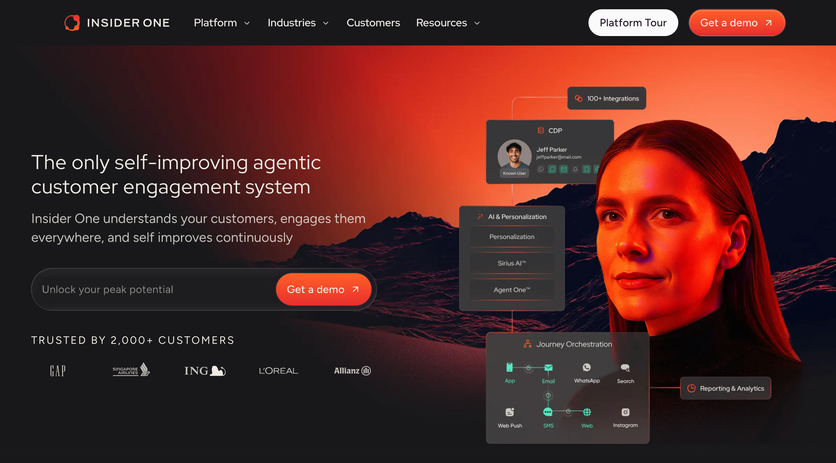
Insider rebranded to Insider One in 2026 and now describes itself as "the leading Agentic Customer Engagement Platform." For ecommerce brands, it bundles web personalization, product recommendations, site search, and cross-channel journeys – with AI agents taking over more of the operating work.
Key Features
Smart Recommender
Insider One's recommendation engine spans web, app, email, SMS, WhatsApp, and push, with algorithm families for generic, contextual, and personalized suggestions plus image-based Visually Similar and Complementary picks – "20+ proven algorithms" on the web channel alone. The new Recommendation Strategist turns a plain-language goal like "Maximize Cart Value" into a working recommendation strategy, validated against your catalog.
Eureka Search
Eureka, Insider One's "AI Search & Merchandise" product, reads query intent with NLP and reorders results around each shopper's preferred brands, sizes, and colors. Typo tolerance, synonym recognition, and intelligent autocomplete come standard.
Web Personalization and Onsite Experiments
The Web channel ships 140+ prebuilt, customizable templates – banners, gamified pop-ups like Spin the Wheel, and InStory, a story-format product discovery layer. Onsite Experiment covers A/B and multivariate testing, and Winner Auto-Selection promotes the leading variation automatically.
Architect Journey Orchestration
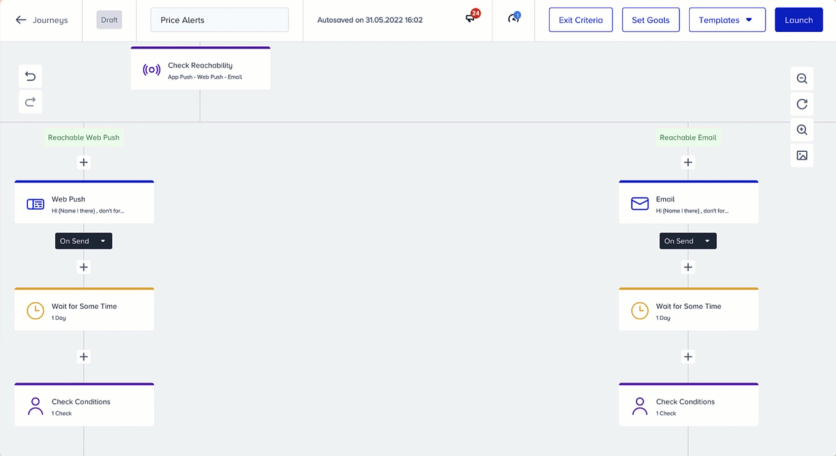
Architect, Insider One's journey builder, combines "all the triggers, conditions, and actions you need in a single canvas" across SMS, email, WhatsApp, web push, web, app, and TikTok. AI features pick the next best channel and send time per customer.
Insider One AI and Agent One
Insider One AI is the umbrella intelligence layer, and Agent One adds autonomous agents – Insights, Design, Shopping, and Support – that analyze, generate, and operate campaigns with approval gates.
Pricing
Custom pricing (contact sales). Fees are based on Monthly Active Users and officially include professional services, onboarding, and support; contracts run on one-year terms, and the "$0 Migration Movement" program covers switching costs, including buying out competitor contracts. Third-party estimates put starter pricing around $950–$1,300/mo (Spendbase) and the average contract near $48,210/yr (Vendr).
Where Insider One Wins
Channel breadth is the headline: one vendor covers on-site personalization, search, and messaging across a dozen channels, so global brands consolidate regional stacks onto it. The 140+ template library keeps launch speed high despite the platform's size.
Reviewers also single out the embedded customer success model – "involved in our processes not as an external consultant, but as a member of the team," as one Capterra reviewer put it. Its 4.8/5 G2 rating across 1,400+ reviews is the strongest in this list.
Where Insider One Falls Short
Onboarding takes longer than buyers expect: "the initial onboarding and technical integration took a bit more time than we anticipated," one 2026 reviewer wrote, echoing an earlier "onboarding requires longer period than ideal."
The breadth cuts both ways – "it can be a bit overwhelming for beginners," and the Architect learning curve is "steep" before teams run journeys independently. Modules are also sold piecemeal: one reviewer asked for a package covering new products "so we dont have to make order form for each product that we start using."
Compared to Dynamic Yield
Both sell to enterprises and lead with AI, but they specialize differently: Dynamic Yield goes deepest on algorithmic experience optimization – AdaptML models, bandit testing, Sorting Optimizer – while Insider One goes widest, attaching messaging channels, search, and an actionable customer data layer to its personalization.
If your gap is experimentation rigor, Dynamic Yield holds the edge; if it's reaching the same customer on site, WhatsApp, and push from one canvas, Insider One does more of that out of the box.
Compared to Maestra
Both platforms unite personalization with marketing channels on unified customer data – the difference is posture and pricing. Insider One is built for global enterprise rollouts, priced on MAUs through custom annual contracts; Maestra publishes its pricing, bills on active profiles month-to-month, and pairs every account with a Forward Deployed Marketer who builds the flows and segments.
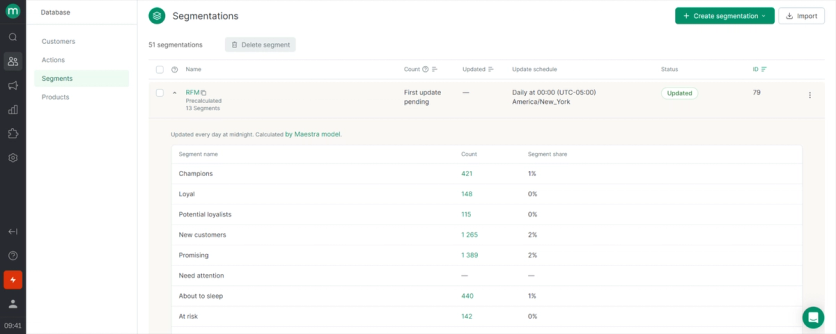
Insider One offers ML-driven Predictive Segments; Maestra keeps segmentation marketer-controlled, with RFM analysis and AI-suggested segment hypotheses for review. For a DTC brand on Shopify or BigCommerce, Maestra's cases run closer to home: Enlightened Equipment grew AOV 38.7% with an A/B-tested Smart Upsell Bar on BigCommerce.
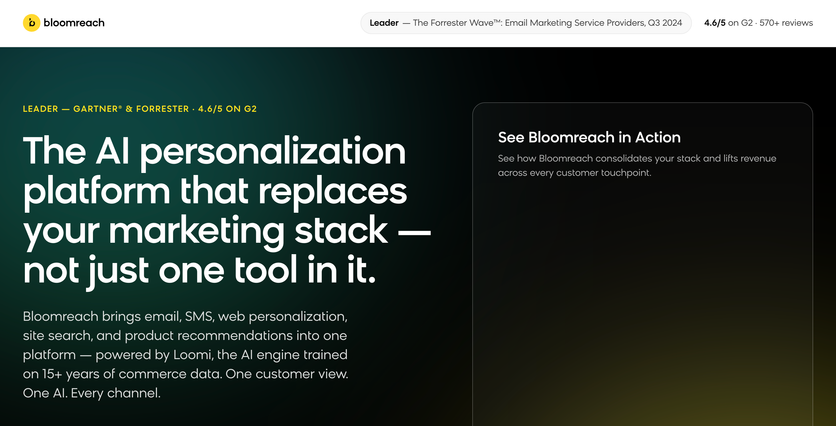
3. Bloomreach – Best for AI Search and Marketing Automation Together
Starting price: Custom (module + usage fees; Bloomreach's own Shopify listing cites $22,500/yr for Email Marketing and $45,000/yr for Ecommerce Search)
G2 rating: 4.6/5
Bloomreach calls itself "The AI Platform for Personalization" and serves 1,400+ brands, including American Eagle and Pandora. Its 2026 lineup renames the familiar products – Engagement is now Marketing Automation, Discovery is now Ecommerce Search – with Loomi AI as the intelligence layer across both.
Key Features
Web Personalization
Weblayers and banners trigger on real-time behavior, and contextual personalization individualizes offers using Bloomreach's native predictive analytics – purchase intent, churn risk, and best channel are modeled in-platform.
Ecommerce Search and Product Recommendations
The former Discovery product is AI-native site search built to maximize revenue per visitor, and its recommendations draw on search history, customer insights, and product data – bestselling, frequently bought together, trending, and rule-based "Build Your Own" strategies. Bloomreach claims a 20% revenue-per-visitor lift for Ecommerce Search.
Ecommerce Categories
Merchandisers "boost, bury, lock, and block" products on category pages, build dynamic categories from attributes like color or price, and control specific grid slots – no reliance on a developer for daily merchandising.
Experiments and A/B Testing
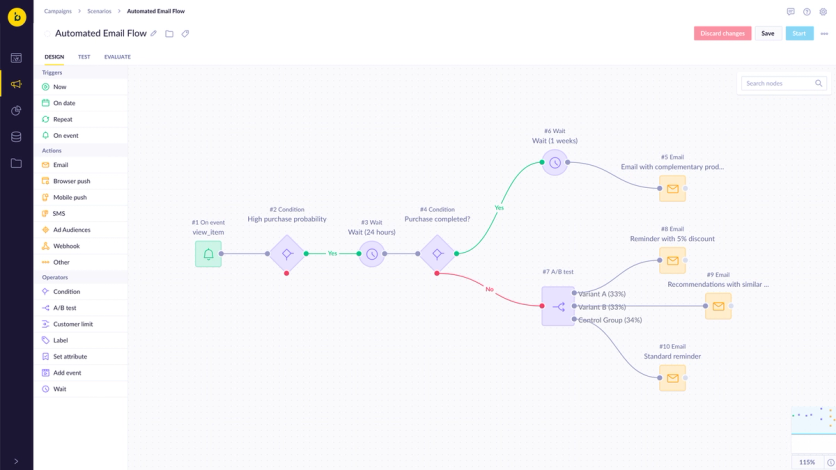
Tests run across email, SMS, in-app, ads, and the web – including server-side – with automatic winner distribution and what Bloomreach calls "patented flicker-free technology." Results report on revenue, AOV, and conversion uplifts directly in the platform.
Loomi AI and Agents
One prompt is enough for Loomi Marketing Agent to assemble a finished workflow; Loomi Shopping Agent 2.0 handles the shopper-facing side end to end. Loomi Connect (new) lets teams build custom agents on the same intelligence.
Pricing
Custom pricing built from two parts – a module fee for each product you license plus a usage fee that scales with customers served, catalog size, and message volume. Billing is annual only. Bloomreach's own Shopify App Store listing cites $22,500/yr for Email Marketing and $45,000/yr for Ecommerce Search; buyer transaction data puts the average contract near $180,000/yr (Vendr).
Where Bloomreach Wins
Search and product discovery pedigree: for brands where search drives revenue, the former Discovery product plus Ecommerce Categories is among the strongest merchandising stacks anywhere. It's a genuine one-vendor answer for search, marketing automation, and personalization at enterprise scale.
Support scores stand out too – a 9.3 Quality of Support score on G2 – and reviewers praise its real-time speed on high data volumes.
Where Bloomreach Falls Short
The usage-fee model draws the sharpest reviews: "During negotiations, they will underestimate the number of processed events you actually need to lure you in with a lower investment. Once you are signed up, they will insist you are far below the processed events you require," one G2 reviewer warned.
It's also technical. Reviewers report needing "a technical consultant from Bloomreach to develop scenarios, which is an extra cost," a significant learning curve during implementation, and out-of-the-box functionality that's "limited or unnecessarily complex."
On Shopify specifically, Bloomreach's own documentation notes the platform can't use a service worker there – which rules out web push notifications and flicker-free experiments on Shopify storefronts.
Compared to Dynamic Yield
Bloomreach is the closest enterprise substitute in this list: search, recommendations, personalization, and testing under one AI brand. It goes further than Dynamic Yield on owned marketing channels – email, SMS, RCS, and WhatsApp are core products rather than triggered add-ons – while Dynamic Yield counters with experimentation depth and Mastercard-scale data products.
Budget-wise they rhyme: both are quoted, both scale with volume, and both reward careful contract review.
Compared to Maestra
Selkirk Sport ran email on Bloomreach before consolidating onto Maestra – and measured against its last Bloomreach year, email-attributed revenue rose 55% and SMS 149%, with the team crediting flexible segmentation and "reporting we can trust." The pricing models differ the same way: Bloomreach bills modules plus usage on annual contracts; Maestra bills active profiles month-to-month, and anonymous or dormant profiles are free.
Bloomreach remains the stronger pick for enterprise-grade site search; Maestra counters with built-in loyalty, published pricing, and a Forward Deployed Marketer instead of a paid consultant bench.
4. Nosto – Best for Merchandising-Led Personalization
Starting price: Custom (GMV- and traffic-based; ~$47.6K average contract per Vendr estimates)
G2 rating: 4.6/5
Nosto's Commerce Experience Platform pitches "AI personalization for ecommerce" – an integrated suite of recommendations, search, merchandising, and content personalization under its experience.AI branding. Its DNA is mid-market retail: fast to launch, merchandiser-friendly, and strongest where storefront discovery is the battleground.
Key Features
Product Recommendations
Nosto recommends "the most relevant products in the right moment" from real-time behavioral and transactional data, with Predictive AI surfacing what a shopper is most likely to buy next.

Personalized Search
Search interprets real-time intent and re-sorts results per shopper, with Semantic AI handling long-tail queries beyond keyword matching.
Category Merchandising
Sorting rules blend product attributes with performance metrics – and business goals like margin or inventory clearance – through a drag-and-drop editor with built-in A/B testing.
Content Personalization
Hero banners, menus, copy, content tiles, and layouts swap per segment in real time through a point-and-click builder, no developers required.
Dynamic Targeting and Business Intelligence
Audience Builder, Campaign Testing, and Adaptive Scheduling handle the targeting layer (down to weather-based rules), while Business Intelligence adds Product Intelligence, Audience Insights, and UGC monitoring across 25+ social networks.
Pricing
Custom pricing (contact sales). Nosto prices on "your business volume: GMV turnover and traffic," the modules you pick, and the support tier – no dollar figures are published, and there's no self-service trial (qualified merchants get a structured proof of concept). Procurement data puts the average contract near $47,591/year (Vendr).
Where Nosto Wins
Time-to-live: the Shopify integration is genuinely one-click, and Nosto claims first-vendor status on Shopify Markets with Hydrogen 2 support. Reviewers echo the speed – "Nosto content also loads fast and does not slow down our pages."
The merchandising automation earns real praise: "It really saves time: the virtual merch is automated thanks to some rules you configurate on Nosto," one 2025 reviewer wrote. Hands-on customer success managers show up by name in review after review.
Where Nosto Falls Short
Cost reads as a stretch for smaller teams: "The cost of the solution also represents a significant investment, which can be a barrier for some companies." And depth demands staffing – "there are many options and levels of details… but this requires a lot of time."
Reviewers also want more from analytics ("the Analytics dashboard could be pushed further") and note merchandising changes that "take time… to reflect on the website." Magento integrations may need back-end work from your team.
Compared to Dynamic Yield
The overlap is wide – recommendations, search, merchandising, on-site personalization – but the centers of gravity differ. Nosto optimizes product discovery for mid-market retail with tools merchandisers run themselves; Dynamic Yield optimizes whole experiences for enterprises with experimentation depth Nosto doesn't attempt.
Both bill on your success metrics (GMV and traffic for Nosto, served visitors for Dynamic Yield), so both bills climb as you grow.
Compared to Maestra
Nosto is a storefront-experience specialist; Maestra attaches the storefront to the rest of retention – the recommendations, pop-ups, and banners share a profile with email, SMS, and built-in loyalty. Billing splits the same way: GMV-based versus active-profile-based with the first 100K included.
Platform coverage matters here too: Nosto lists Shopify, BigCommerce, Adobe Commerce, Shopware, and Salesforce Commerce Cloud – but not WooCommerce, where Maestra runs personalization for Blossom Flower with 9% incremental revenue proven against a control group. For the full segment-by-segment breakdown, see our Nosto alternatives guide.
5. Monetate – Best for Enterprise Testing Without Flicker

Starting price: Custom pricing (contact sales)
G2 rating: 4.1/5
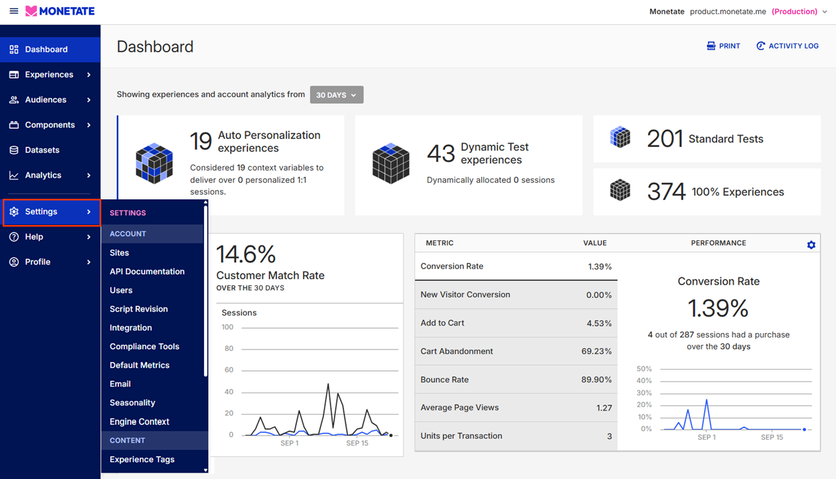
Monetate brands itself "the Experience Optimization Platform," uniting AI, personalization, recommendations, and experimentation for enterprise retailers. After acquiring SiteSpect in mid-2025, it relaunched around named suites: Symphony for personalization, Maestro for experimentation, MONET as the AI engine, and Concierge support bundled into every subscription.
One housekeeping note: despite the similar names, Monetate's Maestro testing suite and Maestra are unrelated products from different companies.
Key Features
Symphony Personalization Suite
Symphony spans "Personalized Discovery & Recommendations," "Audience & Journey Intelligence," and "Adaptive Personalization at Scale" – with Product Recommendations, Social Proof, Dynamic Bundles, and Product Finder as its working parts.
Maestro Experimentation Suite
Maestro pairs client-side agility with server-side control in one suite, reaching web, mobile, native apps, SPAs, and in-store touchpoints – with 150+ out-of-the-box targeting conditions and HIPAA-ready compliance for regulated industries.
Forte Network-Layer Testing
Forte – formerly SiteSpect – runs experiments in the network layer, modifying HTML before it reaches the browser. That architecture "eliminates flicker, layout shift, and script delays by design," which is why finance and healthcare teams favor it.
Dynamic Testing
Instead of waiting for statistical significance, Dynamic Testing lets MONET's adaptive AI reallocate traffic to the best-performing variant, with the model updating every five minutes – a practical answer for lower-traffic pages where classic A/B tests starve.
Product Recommendations and Personalized Search
Recommendations combine MONET's self-learning AI with slot-level merchandising control across PDPs, category pages, email, apps, and kiosks. Personalized Search blends large language models with your merchandising rules – though Monetate's own docs note it "requires custom development resources for full implementation."
Pricing
Custom pricing (contact sales) – "we work with you to build a customized pricing plan specific to you and your business." Every subscription includes Monetate Concierge with dedicated strategists. No credible third-party price benchmarks are published.
Where Monetate Wins
Flicker is the sharpest differentiator: with Forte, tests happen before HTML delivery, so there's nothing to flash. For brands in regulated industries or with strict performance budgets, that architecture is hard to match.
Reviewers consistently praise launching tests and personalization without engineering – "the ability to update my website without the need for IT support" – plus minimal site-speed impact and the option to stack multiple tests. Monetate also claims more of today's top 1,000 retailers than any other provider.
Where Monetate Falls Short
The interface draws recurring criticism: "The UI doesn't look as advanced as the tool is," with a 2026 review titled "Easy Setup and Quick Start, but a Learning Curve in the UI." Flicker complaints persist on tag-based (non-Forte) implementations – "anything above the fold flashes the old version" – including "sensitive areas such as the checkout."
Reviewers also report "data inaccuracy that complicates reporting," and the Action Builder gets blunt feedback: "not reliable at all," with some teams writing JavaScript builds "with 0 assurance that it won't break the site."
Compared to Dynamic Yield
This is the most direct philosophical matchup in the list: two enterprise experience-optimization platforms, both custom-priced, both AI-led. Monetate's edge is delivery architecture – network-layer testing that Dynamic Yield doesn't offer; Dynamic Yield's edge is its model depth (AdaptML) and Mastercard-derived data products.
The G2 gap is worth noting too: Monetate's 4.1 trails Dynamic Yield's 4.5, with UI and reporting the recurring reasons.
Compared to Maestra
Monetate optimizes experiences for top-1,000 retailers; marketing execution stays in your other contracts. Maestra runs the personalization and the channels it feeds – email, SMS, push, loyalty – from the same profile, with published pricing and a Forward Deployed Marketer instead of a strategist you access through a support tier. Furniture Fair reached 7,543% ROI running that whole loop in one platform after consolidating five point tools.
6. Optimizely – Best for Mature Experimentation Programs
Starting price: Custom (free Optimizely Rollouts tier for feature flags; ~$81.4K/yr median contract per Vendr estimates)
G2 rating: 4.2/5 (all Optimizely products)
Optimizely wrote much of the experimentation playbook, and its testing products remain the reference point for mature programs. A June 2026 rebrand reorganized the suite into Agentic CMS, Agentic Experimentation, and Agent Platform under the Optimizely One umbrella – with Web Experimentation now folded into Agentic Experimentation.
Key Features
Web and Server-Side Experimentation
"Run experiments wherever your customers are" – a visual editor covers fast web tests, while server-side control handles deeper product experiments. Multivariate tests and bandits run alongside classic A/B.
Stats Engine
Optimizely's Stats Engine "uses false discovery rate control to reduce your chance of making an incorrect business decision" – the statistical rigor that separates enterprise experimentation from split-testing widgets.
Feature Management
Feature flags with targeted rollouts by user, region, or custom attributes, an instant kill switch ("Features go dark in seconds"), and SDKs that evaluate in under a millisecond.
Personalization
Behavioral targeting swaps images, headlines, and promotions by on-site behavior or journey stage, and intelligent merchandising tailors product sorting, search, and recommendations. It's a real capability – though clearly the experimentation program's companion rather than the company's center of gravity.
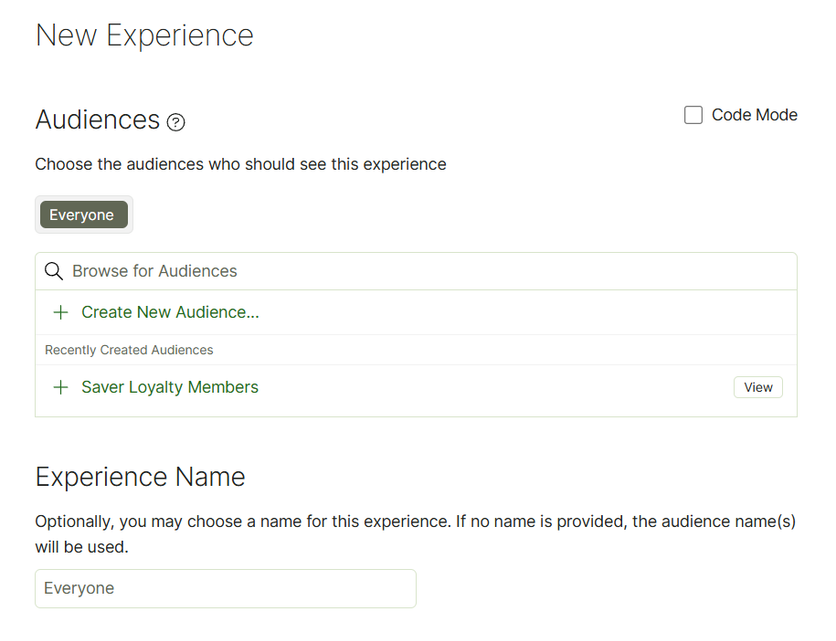
Opal AI Agents
Opal spans ideation to execution: the Variation Development Agent "generates experiment variations without any dependency on developers," and January 2026 added an Experimentation Context so teams manage testing programs from within Opal.
Pricing
Custom – "every Optimizely plan is individually packaged." The free Optimizely Rollouts tier covers unlimited feature flags with one experiment at a time; paid Feature Experimentation bills on monthly active users. Third-party buyer data estimates single-product web testing at roughly $36K–$65K/yr (GoStellar), while logged deals put the median contract at $81,447/yr (Vendr).
Where Optimizely Wins
Experimentation credibility. The Stats Engine methodology, the free feature-flag tier, and a 2026 Gartner Magic Quadrant for Personalization Engines Leader placement (its second consecutive year) give data teams little to argue with.
Reviewers echo the fundamentals: support that answers in "~24 hrs. or less," intuitive test building, and "the ability for non-technical users to execute experiments on our homepage and iterate more quickly."
Where Optimizely Falls Short
Price and complexity travel together: "it's quite a pricey solution," and some teams "rely on our agency for most experiments setup." The learning curve is steep, and recent UI changes "make it difficult to find and access certain features."
Growth costs extra – "you might need to pay extra to get more features / evolve your offering as your needs become more niche." On Shopify, the snippet doesn't load on checkout pages (Shopify hosts checkout on a separate domain), so checkout events need a custom pixel.
Compared to Dynamic Yield
Optimizely is testing-first with personalization attached; Dynamic Yield is personalization-first with strong testing. If your program lives on hypothesis backlogs, feature flags, and statistical guardrails, Optimizely is the deeper tool; if it lives on individualized recommendations and affinity-based content matching, Dynamic Yield's AdaptML stack goes further for retail catalogs.
Compared to Maestra
Two Maestra clients arrived from different corners of Optimizely's broad suite. Audiogon ran its email program on Optimizely through late 2024; a year later, with email and on-site personalization in one system, active subscribers were up 75% and email-driven sessions up 26%. Furniture Fair consolidated a five-tool stack that included Optimizely and cut marketing-stack costs 27% at 7,543% ROI.
The split is clean: Optimizely for experimentation as a discipline, Maestra for personalization as a revenue channel – tested with control groups, then pushed through email, SMS, and loyalty on the same profile.
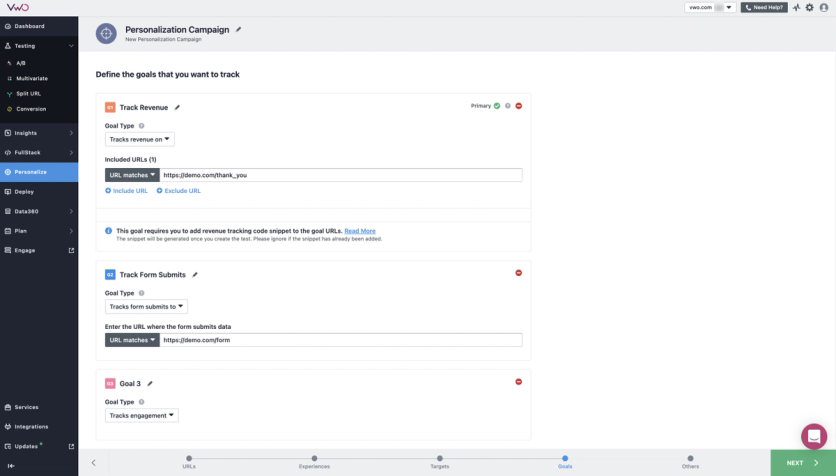
7. Wingify – Best for Testing, Behavior Analytics, and Emotion-Based Targeting
Starting price: Custom (Growth, Pro, and Enterprise tiers priced by monthly active users; 30-day free trial)
G2 rating: 4.4/5 (VWO Testing and AB Tasty listings)
Wingify is the company VWO and AB Tasty became. The two announced their combination in January 2026 and launched the joint brand in September: “Today we’re introducing Wingify, the brand that brings VWO and AB Tasty together as one company.” vwo.com now redirects to wingify.com, and VWO and AB Tasty stay on as product brands while customers move to the shared platform. The suite covers experimentation, personalization, behavior analytics, feature management, and commerce search and recommendations.
Key Features
Experimentation
A/B, split URL, and multivariate tests run through a visual editor on Wingify SmartStats, which “operates on Bayesian and Frequentist methodologies (you choose!)” with built-in error and peeking correction. Wingify says its SmartCode leaves “no flicker or flash of original content.” Feature Rollouts and Feature Experimentation add server-side tests and feature flags, with SDKs across 10+ programming languages and frameworks.
Behavior Analytics
Heatmaps, session recordings, surveys, and funnels sit beside the testing tool, so the “why” behind a losing variation is one click away. Reviewers single this pairing out: “you can get heatmaps on each variation in your test.”
Emotions and Personalization
Wingify Emotions, the former AB Tasty EmotionsAI, “uses in-session behavior to assign each visitor to one of 10 emotional need profiles in about 30 seconds” – Quality, Immediacy, Safety, Comfort, and so on. No other platform in this list segments by emotional need. It’s sold as a paid add-on.
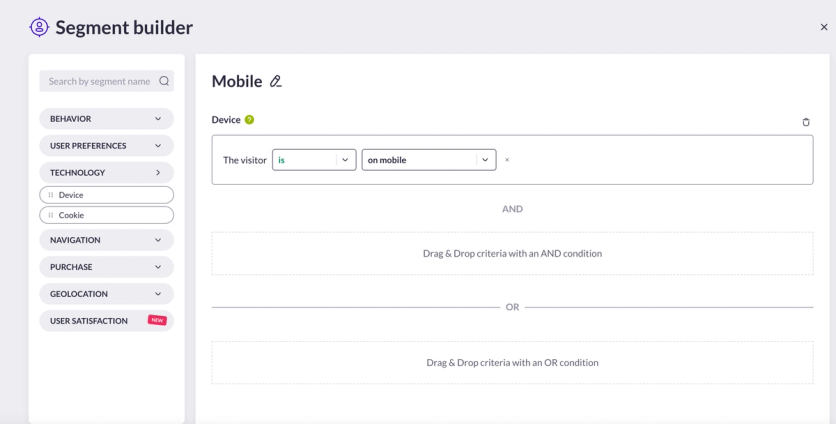
Segments built from in-session behavior, transactional, technographic, and location data feed no-code personalized experiences through the same visual editor.
Search, Recommendations, and Merchandising
The commerce products add semantic search that “understands intent” and a recommendation engine with merchandising rules to “boost, bury, or exclude products” on home, category, product, and cart pages.
Wingz AI
Wingz is “the AI layer woven into Wingify,” built on what AB Tasty offered through its Evi assistant and VWO through Copilot. It generates test ideas, analyzes results, and builds campaigns from prompts. Wingz Core comes free with every paid product; Wingz Advanced is a paid plan.
Pricing
Custom. Wingify’s pricing page says it outright: “No fixed plans. Just a custom proposal built around your goals and scope.” Each product – experimentation, personalization, feature management, analytics, user feedback, search, recommendations, and web push – comes in Growth, Pro, and Enterprise, priced on monthly active users (behavior analytics on monthly tracked users). There’s no free plan, but the 30-day free trial needs no credit card. Before the merger, logged AB Tasty deals had a median contract of $66,500/yr (Vendr).
Where Wingify Wins
Testing, heatmaps and session recordings, emotion-based segmentation, feature flags, and commerce search come from one vendor, and the analytics bundle replaces a separate heatmap tool. Both legacy products earn praise for support – “outstanding customer support, with monthly meetings to answer questions and plan new tests” for VWO, “the team’s support and response time have been a standout” for AB Tasty – and for a visual editor that lets marketers “make UX changes without even having to code.”
Where Wingify Falls Short
The merger is still in motion. Existing customers can keep using VWO or AB Tasty during the platform transition, while accounts opened since June 14, 2026 already run on Wingify’s own tracking code – so ask which platform your contract and script will sit on next year.
Heavy client-side changes strain page speed: “when executing significant changes, the loading time becomes very long,” one AB Tasty reviewer wrote, and a Capterra reviewer of VWO lists “high price relative to its features, occasional bugs in the editor, and code that can significantly slow down website performance.” The visual editor “occasionally struggles with complex or highly dynamic page layouts,” and lower-traffic sites can wait a long time for significance. On Shopify, the Wingify app deploys everywhere except checkout, post-purchase, and order status pages.
Compared to Dynamic Yield
Both cover experimentation, personalization, and recommendations. Dynamic Yield goes deeper on machine-learning recommendations and individual-level targeting; Wingify leads on testing rigor, behavior analytics on the same contract, and emotion-based segments. If testing plus analytics is the need, Wingify covers it; if individualized experiences are the point, it isn’t a like-for-like swap.
Compared to Maestra
Wingify shows you what to fix and lets you test it; Maestra acts on what it knows about each customer – across the site and into email, SMS, and loyalty. The testing discipline overlaps: 1Thrive A/B-tested pop-up messaging in Maestra and lifted signups 4.26%, with the winning variant feeding email flows on the same profile. A Wingify win usually ends as a site change; a Maestra win keeps running as a campaign tied to the profile that triggered it, from one vendor on month-to-month terms.
8. Adobe Target – Best for Personalization Inside the Adobe Stack
Starting price: Custom (annual pricing generally starts in the mid-five-figure range per partner estimates)
G2 rating: 4.0/5
Adobe Target is the testing and personalization arm of Adobe Experience Cloud, "offering comprehensive tools to personalize customer experiences across web, mobile sites, apps, social media, and other digital channels." It ships in two packages: Target Standard, and Target Premium – which adds the machine-learning features and Recommendations.
Key Features
A/B, Multivariate, and Experience Targeting
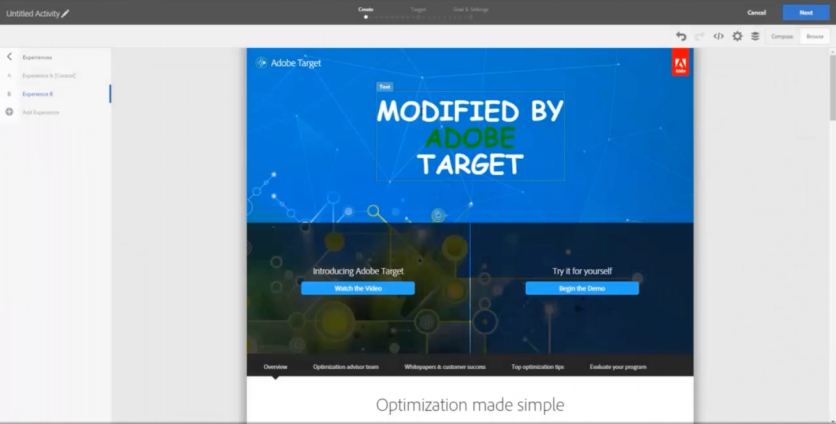
The Visual Experience Composer builds A/B Tests, Multivariate Tests, and rules-based Experience Targeting activities without code, with custom-code insertion for deeper work.
Auto-Allocate
A multi-armed bandit that "identifies a winner among two or more experiences and automatically reallocates more traffic to the winner" – 80% of traffic follows performance while 20% keeps exploring.
Auto-Target and Automated Personalization (Premium)
Both run on Random Forest machine learning: Auto-Target picks the best whole experience per visitor from marketer-defined variants, while Automated Personalization assembles offer combinations per individual profile. Neither is available in Target Standard.
Recommendations (Premium)
Catalog-native criteria – "People Who Bought This, Bought That," "People Who Viewed This, Viewed That," Last Purchased Item, Favorite Category – rendered in configurable designs across web, apps, and email.
Server-Side SDKs and Real-Time CDP Integration
SDKs for Node.js, Java, .NET, and Python plus on-device decisioning for near-zero-latency delivery. Inside Adobe Experience Platform, Target consumes Real-Time CDP audiences with edge segmentation and same-page personalization, and reports through Customer Journey Analytics.
Pricing
Custom pricing (contact sales) – Adobe lists product options, digital-property volume, and omnichannel delivery as the pricing factors. Partner estimates put annual pricing as "generally starts in the mid-five-figure range," with implementation typically extra (third-party estimates run $20K–$50K+ for enterprise deployments).
Where Adobe Target Wins
The Experience Cloud fit: if Adobe Analytics or Real-Time CDP already anchor your stack, Target inherits their audiences and reporting in ways standalone tools can't match – "integration with Adobe Analytics provides powerful insights that help optimize campaigns in real time," as one reviewer put it. Delivery reach is genuinely broad, spanning web, apps, email, IoT, and call centers.
Where Adobe Target Falls Short
Setup is hands-on: "Setting up the targets can be very manual, and a bit of an eyesore," and even trained teams report "there was still a lot we needed to learn." A 2025 reviewer was harsher: "very buggy, especially after the latest UI update," with support "frequently not able to provide adequate support in a timely manner."
Server-side testing "is not simply available without large amount of integration," reviewers note AI rigidity "when you are optimizing for multiple metrics," and even fans concede "the pricing can be high for smaller businesses."
Compared to Dynamic Yield
Both are enterprise AI personalization platforms with custom quotes and consultant-shaped implementations. The decision usually reduces to ecosystem: inside Adobe Experience Cloud, Target's data and reporting integration wins; outside it, Dynamic Yield is the more self-contained retail personalization product, with its AdaptML models and commerce-specific tools like Shopping Muse.
Compared to Maestra
Adobe Target presumes an Adobe ecosystem, an enterprise services budget, and an integration program. Maestra delivers the same working pattern – a real-time profile, ML recommendations, experiences proven against control groups – as one product a mid-size team runs without that scaffolding, with the email, SMS, and loyalty channels already attached and pricing published from $2,815/mo.
How to Choose the Best Dynamic Yield Alternative
Maestra is the strongest Dynamic Yield alternative for ecommerce brands that want personalization and the marketing it powers in one platform – it replaces the personalization tool, the ESP, the loyalty app, and the CDP glue between them. The rest of the field wins on narrower ground: Optimizely for experimentation as a discipline, Insider One and Bloomreach for enterprise omnichannel suites, Nosto for merchandising, Wingify for CRO teams, Monetate and Adobe Target for enterprise programs with specific architecture needs.
Five questions settle most shortlists:
- Who ships the changes? If marketers (or the vendor's own team) must launch campaigns without engineering, weigh no-code depth and included service as heavily as the feature list.
- What does the price track? Served visitors, MTUs, processed events, GMV, or active profiles – each scales differently as you grow. Ask for the number at 2x your current volume.
- Does personalization end at the experience? If the same data should drive email, SMS, and loyalty, one platform saves both licenses and sync work.
- What's your proof standard? Control groups and revenue-level reporting separate personalization that demonstrably pays from personalization that demos well.
- What's your platform? Shopify checkout restrictions, BigCommerce coverage, and WooCommerce support differ sharply across this list – check before you shortlist.
If the answers point toward consolidation, book a Maestra demo and price your current stack against one platform doing all of it.
Frequently Asked Questions About Dynamic Yield Alternatives
- Maestra replaces Dynamic Yield most completely for ecommerce. It covers the same core use cases – site personalization, product recommendations, and A/B testing – and adds email, SMS, push, and built-in loyalty on top of a single real-time customer profile, with pricing published from $2,815/mo. Audiogon grew active subscribers 75% year over year after unifying email and on-site personalization in Maestra. Optimizely fits experimentation-led programs, Insider One fits enterprise omnichannel rollouts, and Nosto fits merchandising-led teams.
- Dynamic Yield doesn't publish pricing for any of its modules. Its license scales with served visitors for web personalization (email opens and MAUs for other modules), and quotes add a one-time onboarding fee, an adoption fee, and an ongoing program-support fee (G2); nothing is published at any tier. Third-party estimates put entry around $35,000/yr, and illustrative ranges place mid-market to large deployments at $5,000–$20,000/mo (ITQlick). By contrast, Maestra – a personalization platform with email, SMS, and loyalty in the same subscription – publishes its pricing: from $2,815/mo for the CDP plus onsite personalization, with the first 100,000 active profiles included and month-to-month billing. Consolidating is where the money shows up: Urban Armor Gear folded a three-tool stack into Maestra and cut marketing-stack costs 64% – roughly $100,000 a year.
- Maestra includes A/B testing with control groups for on-site campaigns, pop-ups, and messages. Nat’v Basics ran two rounds of welcome pop-up tests (12% off against $10 and $15, then $10 against $15) and came out with pop-up conversion up 24% and 74% more new subscribers than in the two weeks before the test. Optimizely, Wingify, Monetate (including network-layer testing via Forte), and Bloomreach all ship experimentation as core products; Nosto builds A/B testing into its merchandising and content modules.
- Yes, Maestra runs site personalization, product recommendations, and the email/SMS/push channels on one real-time profile. Selkirk Sport moved its email stack onto Maestra and finished the year 55% up on email-attributed revenue and 149% up on SMS. Insider One and Bloomreach also combine personalization with owned messaging channels. Dynamic Yield sends triggered messages through Journey Orchestration, but most brands keep a full ESP alongside it.
- Maestra integrates with Shopify, BigCommerce, and WooCommerce. Enlightened Equipment runs on BigCommerce, where its A/B-tested Smart Upsell Bar grew AOV 38.7%. Nosto offers one-click Shopify integration (WooCommerce isn't listed); Bloomreach has a Shopify app but its docs note no web push or flicker-free experiments there; Optimizely's snippet doesn't load on Shopify checkout pages. Dynamic Yield itself has a Shopify Plus app, while BigCommerce is a technology partner without a dedicated app.