
12 Best AI Marketing Tools for Growth-Focused Teams (2026)

The best AI marketing tools don’t just bolt a chatbot onto old software – they change what a small team can actually ship. But the category is noisy, and most “AI marketing” roundups hand you 30 tools that all do the same three things.
This guide is built differently. Twelve tools, each owning a distinct job: tracking your brand’s visibility in AI search, turning that AI-search visibility into on-site conversions, automating workflows with AI agents, running an AI-assisted CRM, optimizing SEO and content, and keeping customer data ready for AI personalization. For each, you’ll get what it does, what it costs, and who it fits – so you can match the right one to your biggest gap.
Here’s where AI actually earns its place:
What the Best AI Marketing Tools Do
The best AI marketing tools each handle one job well. Beamtrace tracks whether AI search engines like ChatGPT recommend your brand. Zapier Agents automate work across your apps. HubSpot runs an AI-assisted CRM that unifies data and lets agents resolve tickets and qualify leads. Semrush turns SEO into a prioritized task list with AI-guided content. And Maestra keeps customer data AI-ready in a real-time CDP, so every personalized message runs on a complete profile. Match the job to your biggest gap, and the right tool picks itself.
Content:
The 12 Best AI Marketing Tools at a Glance
Tool | Built For | Starting Price | Key Capabilities | Ideal For |
|---|---|---|---|---|
Beamtrace | AI visibility tracking | From $20/mo | Visibility Score, brand visibility comparison, prompt tracking, competitor analysis, citation analysis | Agencies, freelancers, startups, and in-house teams tracking AI search presence |
Sintra AI’s Soshie | AI social media management | From $15.60/mo (promo) | Brain AI brand context, content calendars, captions, Facebook/Instagram/LinkedIn scheduling, performance summaries | Freelancers, small businesses, lean marketing teams |
| VEED | AI video creation and editing | Free plan; paid from $12/user/mo | AI video generator, online video editor, auto subtitles, screen recorder, templates, multi-language captions | Marketers, content creators, and social teams that need to produce and publish polished video content without a production team |
| Magic Hour | AI lip sync and video localization | Free (3 lip syncs/day); paid from $12/mo | Lip sync to new audio, talking photos, face swap, AI video generation | Creators and marketing teams adapting existing videos for new dialogue, languages, or audiences |
Stripo | Email design and production | Free plan; paid from $20/mo | Email editor, modules, translations, collaboration, AI tools, testing, 90+ integrations | Marketing teams, agencies, freelancers, startups |
ConversionBox | AI visibility and onsite conversion | From $49/mo | AI Visibility Audit, AEO/GEO grader, citation monitoring, AI site search, shopping assistant | Ecommerce & B2B brands turning AI visibility into sales |
Zapier Agents | AI marketing automation | Free; Pro ~$33/mo (billed annually) | AI agents across 9,000+ apps for leads, content, support, sales, and ops; reasoning beyond linear workflows | Teams using Zapier as the connective layer between SaaS tools; no-code workflows |
HubSpot AI | AI-powered CRM | Starter $20/mo per seat; Pro $890/mo (3 seats) | Breeze Assistant, Breeze Agents (Customer, Prospecting, Data) with outcome-based pricing, Smart CRM, 100+ embedded AI features | Marketing and sales teams that need unified data, inbound-heavy motions, closed-loop attribution |
Semrush | AI SEO and content optimization | Free plan; Semrush One from $199/mo | Semrush Copilot, AI Content Optimization, ContentShake AI, AI Forecasts, Site Audit, Keyword Research, AI Visibility Toolkit | SEO/marketing teams, agencies tracking clients, in-house teams that need prioritized SEO tasks |
SE Ranking | SEO data for AI agents and automation | From $129/mo | Data on keywords, backlinks, rankings, competitors, audits, and more. API and MCP on every plan, 180+ tools, Data Studio / n8n / Make.com connectors, GA4 and GSC integration. | Agencies and in-house teams wiring search data into AI assistants, BI, and client reporting |
Pecan | Predictive AI for lifecycle and retention marketing | Custom; annual plans (Starter, Team, Business) | Churn prediction, LTV modeling, repeat-purchase and upsell propensity, predictive winback, scored audiences delivered to CRM, marketing automation, and data warehouse | Lifecycle, retention, and CRM marketers at DTC, subscription, and ecommerce brands with historical customer data who don’t want to wait on the data science queue |
Maestra | Customer data platform for AI-readiness | From $2,000/mo (CDP + email) | Real-time CDP, AI product recommendations, omnichannel flows, built-in loyalty, advanced segmentation with RFM | Mid-market and enterprise DTC brands running personalization across multiple channels |
Beamtrace – Best AI Visibility Tool
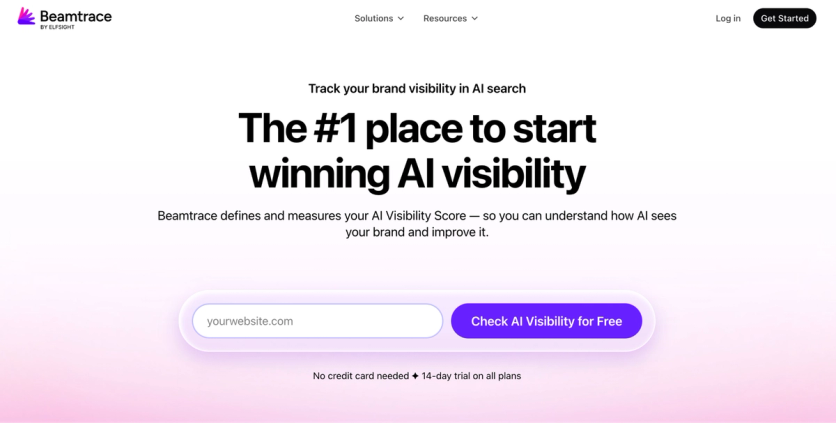
Beamtrace monitors how your brand shows up in AI-generated answers. When a potential customer asks ChatGPT about products in your category, Beamtrace tells you whether AI mentions you, who it mentions instead, and how often. It’s a rank tracker built for AI search, not Google.
What It Actually Does
The Search Visibility Tracker monitors brand presence across AI search platforms and tells you which prompts surface your brand and which don’t. The Brand Visibility Tracker compares your overall presence to direct competitors, flagging prompts where AI recommends them but skips you.
The Search Rank Tracker lets you build a custom list of high-intent prompts and watch your visibility on each over time – the AI-search equivalent of classic keyword rank tracking. Citation Analysis breaks down how AI cites sources, showing which of your pages get pulled into answers and which competitor pages get cited in their place.
Top-line metrics include Visibility Score, mention frequency, average position, and prompt-level visibility grouped by topic.
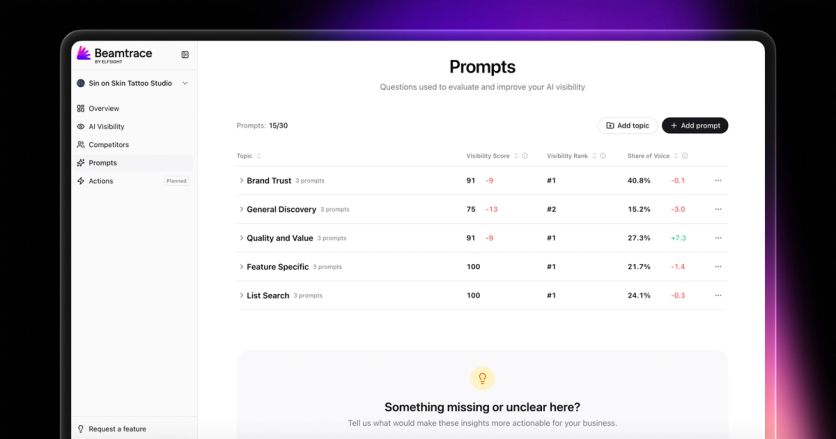
Beamtrace prompt dashboard
Pricing
Plans start at Starter $20/month, Growth $40/month, Premium $100/month (billed annually). Higher tiers unlock more prompts (10 to 60), more competitors tracked (up to 30), trend data, and faster update cycles.
Where It Shines
Beamtrace fits agencies tracking multiple clients across AI search, startups testing how early AI traffic finds them, and in-house marketing teams that want visibility metrics for AI without needing SEO expertise. Setup is no-code: add your brand name and URL, and Beamtrace begins scanning AI search results across relevant queries.
The tool turns AI visibility from a black box into a list of fixable gaps. You see where you appear, where you don’t, and which prompts your competitors are winning. From there, you can prioritize content updates, improve coverage, and strengthen signals that AI models reward.
What to Consider
Teams needing deep historical data should know that Beamtrace focuses on current and forward-looking tracking, not archived AI snapshots. The platform currently tracks ChatGPT only, with Gemini, Claude, Perplexity, DeepSeek, and Grok marked as coming soon – if you need coverage across all AI platforms today, that’s a limitation.
Teams that prefer stable, mature products may want to wait. Beamtrace is an early-adopter tool, so expect rapid iteration. If your priority is classic Google SEO over AI search, dedicated SEO platforms will serve you better – Beamtrace is purpose-built for how AI systems pick brands inside generated answers, not for Google rankings.
Bottom line: a focused, affordable way to find out whether AI search mentions you and what to do about it.
Sintra AI’s Soshie – Best AI Tool for Social Media Marketing
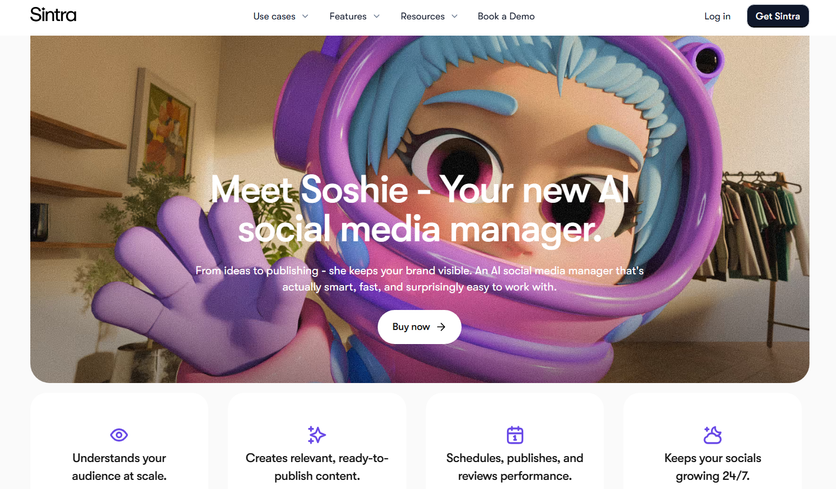
Soshie is Sintra’s AI social media assistant. It is designed for freelancers, small businesses, and lean marketing teams that need to maintain an active social presence without spending each day planning, drafting, and scheduling posts.
What It Actually Does
Soshie starts by learning about the business, including its audience, brand positioning, goals, and preferred tone of voice. This information is stored in Sintra’s Brain AI workspace, allowing Soshie to apply the same context across future content rather than requiring users to repeat their instructions for every post.
Users can develop a social media strategy, create content calendars and campaign roadmaps, generate captions and post variations, research relevant trends, and prepare launch messaging. Content can be adapted for the requirements and conventions of different social networks.
Soshie also connects directly with Facebook, Instagram, and LinkedIn. Users can review and edit its suggested content before approving posts for scheduling, which keeps the business in control of what is published.
Beyond content creation, Soshie can analyze performance trends, highlight the topics and formats gaining traction, and prepare weekly summaries with suggested next steps. It also supports content production in more than 100 languages.
Pricing
Soshie is included with the Sintra team alongside Sintra AI’s other specialized helpers. Current promotional pricing is $48.50 per month on the 1-month plan, $23.60 per month on the 3-month plan, and $15.60 per month on the 12-month plan. Each plan includes all 12 AI helpers, 250 monthly credits, more than 15 integrations, 24/7 support, and a 14-day money-back guarantee.
Where It Shines
Soshie is strongest for small teams that understand the value of social media but struggle to maintain consistent output. It brings planning, writing, scheduling, and basic performance analysis into one workflow, reducing the need to switch among separate strategy documents, content generators, and publishing calendars.
Brain AI is particularly useful for brand consistency. As users provide company information, reference materials, preferences, and feedback, Soshie can carry that context into future posts and campaigns. This makes it easier to maintain a recognizable voice across different channels and over longer periods.
It is also a practical choice for freelancers and founders who handle social media themselves and cannot justify hiring a full-time social media manager.
What to Consider
Soshie is not a full social listening, influencer-management, or paid-ad optimization suite. Businesses that need enterprise-level audience monitoring, detailed attribution, or advanced advertising controls may still require a specialized social media management platform.
Direct social account connections currently focus on Facebook, Instagram, and LinkedIn. Teams centered on other platforms may use Soshie for strategy and content preparation but could need another tool for publishing.
Soshie is also packaged with Sintra AI’s broader team of helpers. That offers strong value for businesses that need assistance beyond social media, but it may be more functionality than teams looking only for a basic caption generator require.
Bottom line: a practical AI social media manager for small businesses and freelancers that need to plan, create, schedule, and improve social content without adding another full-time marketer.
VEED – Best AI Video Generator for Marketing Teams
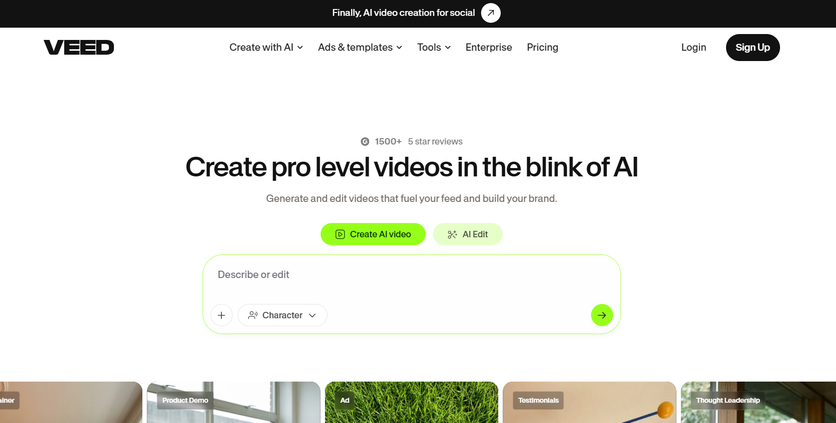
VEED gives marketing teams without a dedicated production team an AI video platform to produce video content themselves. Where Soshie handles social media copy and scheduling, VEED handles the video itself – turning scripts, prompts, or raw footage into polished, publish-ready content.
What It Actually Does
The AI video generator creates videos from text prompts or scripts, removing the need for filming. Teams can generate spokesperson videos, product explainers, social ads, and campaign content directly in the browser. The online video editor handles cuts, transitions, text overlays, and branding without requiring software installation or technical expertise.
Auto-subtitle generation transcribes and captions video automatically, critical for social content watched on mute across Instagram, TikTok, LinkedIn, and YouTube. Templates cover the most common marketing formats: short-form social clips, YouTube intros, ad creatives, and presentation recordings.
The screen and webcam recorder lets teams create product walkthroughs, tutorials, and talking-head videos in one take, with AI cleaning up the output.
Pricing
The free plan covers the core editing tools. Paid plans start at $12 per user per month billed yearly ($147 up front), which removes the watermark and adds unlimited auto-subtitles, 15+ AI tools, and 6,000 credits – roughly 1,500 AI videos. The $22 Pro tier adds multiple brand kits and translation into 50+ languages.
Where It Shines
Teams that publish video on a steady schedule – for social feeds, paid ads, onboarding sequences, or content marketing – get that output from VEED without the cost or timeline of a video production agency. Nothing needs installing, and there’s no handoff between a marketer and a video editor.
It works especially well alongside a social media management tool like Soshie: Soshie plans and schedules the content calendar, VEED produces the video assets that fill it.
What to Consider
VEED is built for speed and accessibility, not Hollywood production quality. Teams needing multi-camera shoots, advanced color grading, or complex motion graphics will outgrow it. It’s also a content creation tool rather than a distribution or analytics platform – you’ll still need your social scheduler and analytics stack alongside it.
Bottom line: the practical pick when video has to go out regularly and there’s no production budget or dedicated video team.
Magic Hour – Best AI Lip Sync Tool for Video Localization
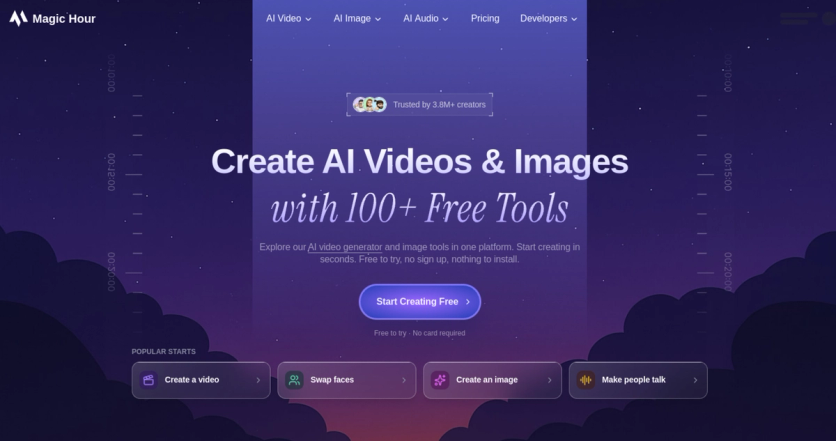
Magic Hour is a browser-based AI video tool that helps creators synchronize mouth movements with spoken audio. Its lip sync AI feature can turn existing footage into talking videos by matching a person’s lip movements to an audio track, without requiring repeated recordings or manual animation.
What It Actually Does
Magic Hour’s lip-sync tool lets users upload a video and audio track to generate synchronized speech movements. This can be useful for creating talking videos, adapting existing footage to new dialogue, and experimenting with AI-generated content.
For content creators and marketing teams, the tool offers a way to produce promotional clips, social media videos, character dialogue, and other talking-head content. It can also complement Magic Hour’s other tools, including AI talking photos, face swapping, and AI video generation.
Because the workflow runs in the browser, users can experiment with lip synchronization without installing specialized animation software. The final results depend on factors such as the source video’s facial visibility, audio clarity, and the movements captured in the original footage.
Pricing
Magic Hour offers a free lip-sync tool with up to 3 generations per day, without requiring sign-up. Free video results include a watermark. For more control and additional generation capacity, users can access paid plans with credit-based generation and different processing modes.
Where It Shines
Magic Hour is useful for creators and marketing teams that need to adapt existing videos for new dialogue, languages, or audiences. For example, a business can reuse a talking-head video with a translated audio track instead of arranging a new recording. It can also help creators produce dialogue for virtual characters and AI-generated videos.
Its browser-based workflow and support for uploaded audio make it practical for quick experiments and content variations.
What to Consider
Magic Hour works best when the face is clearly visible and the source footage has suitable facial movement. Multiple faces, obstructed mouths, and poor-quality audio or video can affect the result. The tool synchronizes mouth movements with supplied audio; it does not automatically translate the spoken content.
Bottom line: Magic Hour provides a browser-based way to synchronize existing video with new audio, making it useful for video dubbing, content localization, and talking-video creation.
Stripo – Best Email Design Platform with AI-Powered Productivity Tools
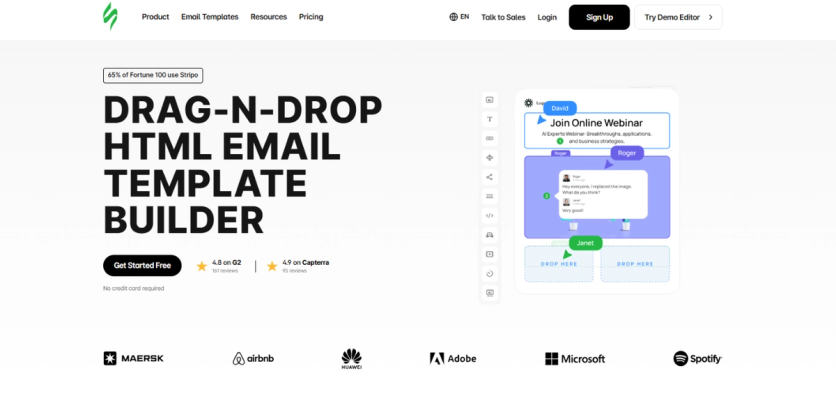
Stripo is an email design platform built for teams that need to create, review, and prepare professional emails at scale. It brings drag-and-drop builder, HTML editing, reusable modules, testing and optimization tools, and AI-powered assistance into one production workflow. Once an email is ready, teams can export it directly to more than 90 ESPs and marketing automation platforms.
What It Actually Does
The AI tools help marketers generate email layouts, subject lines, email copy, images, and alt text directly within the editor. Instead of starting from a blank canvas, teams can quickly generate content, refine it, or rewrite existing copy without switching to external AI tools.
Widgets make it easy to add interactive email elements such as polls, surveys, quizzes, NPS forms, and games without coding. The AI Assistant can help adapt and customize the widget to match the campaign’s goals and content.
The email builder combines drag-and-drop editing with a full HTML editor, allowing both marketers and developers to work on the same templates. Reusable modules, brand libraries, and real-time collaboration help teams maintain consistency while reducing production time.
Built-in quality assurance tools help optimize emails before export. Accessibility and spam checkers identify potential issues, while preview and testing tools help ensure emails render correctly across major email clients.
Pricing
Stripo offers a free plan, while paid plans start at $20/month. AI-powered features are available on the free plan, allowing users to generate email layouts, copy, subject lines, and images without upgrading. The main difference between plans is the monthly AI image generation quota, with higher-tier plans providing significantly more image generations alongside expanded collaboration, storage, and project management features.
Where It Shines
Stripo is best suited for marketing teams that want to use AI throughout the email production process without switching between multiple tools. The AI tools can help generate complete email layouts, subject lines, copy, images, and alt text directly within the platform.
Widgets add another layer of AI-assisted production. Teams can insert interactive elements such as polls, surveys, quizzes, NPS forms, games, and scratch cards, then use the AI Assistant to modify their configuration and adapt them to the needs of a campaign through chat. This reduces the technical effort normally associated with building interactive emails.
Stripo also works well for teams that already use an ESP or marketing automation platform but need more advanced email creation and AI tools. Finished emails can be exported directly to more than 90 platforms, so teams can continue sending campaigns through the tools they already use.
What to Consider
Stripo offers a comprehensive set of email design, collaboration, testing, and AI tools, along with reusable modules, multilingual email management, and export process. While this makes the platform highly capable, new users may need some time to explore all of its features and become comfortable with the workflow.
Stripo is also not an email service provider. However, direct integrations with more than 90 ESPs and marketing automation platforms make it easy to design emails in Stripo and export them to your preferred sending platform in just a few clicks.
Bottom line: Stripo is an email design platform that combines professional editing, collaboration, testing, and AI-powered productivity tools in one workflow. It’s an excellent choice for teams that want to create high-quality emails faster while continuing to use their existing ESP or marketing automation platform.
ConversionBox – Best AI Visibility and Conversion Platform
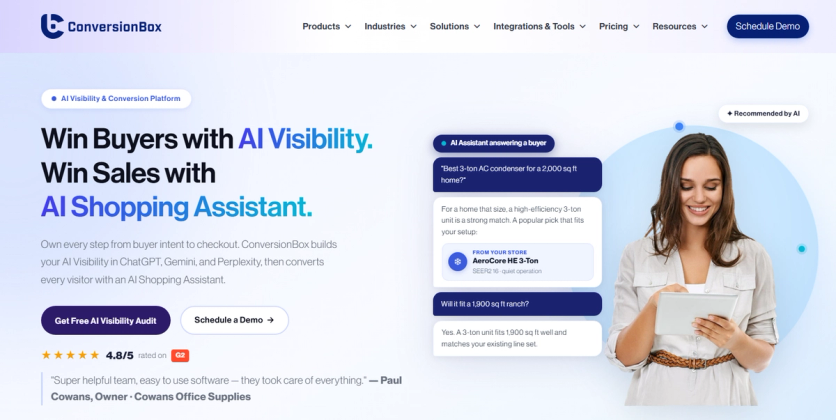
ConversionBox is an AI Visibility and Conversion Platform for ecommerce and B2B brands. It helps brands get found, cited, and recommended in AI-generated answers, then convert those visitors through AI Site Search, guided selling, and product discovery. Its connected model covers four stages: audit visibility, improve weak signals, monitor change, and convert demand.
What It Actually Does
The AI Visibility Audit and AEO/GEO Grader evaluate whether AI engines name, cite, ignore, or replace a brand with a competitor for relevant buyer prompts. The audit examines AEO readiness, GEO visibility, citations, crawler accessibility, schema, content structure, and generated responses. It then produces a prioritized action plan instead of stopping at a visibility score.
The Content Assistant turns those findings into execution. It helps teams create answer-first sections, content briefs, FAQs, structured-data recommendations, stronger entity signals, and authority improvements designed to support AI mentions and citations.
Citation Monitoring tracks what changes after those improvements go live. Teams can follow prompt-level mentions, linked citations, missing placements, sentiment, competitor movement, and visibility trends. This creates a measurable cycle from diagnosis to implementation and reporting.
ConversionBox also supports the on-site buyer journey. AI Site Search and Conversational Search interpret intent, handle complex questions, and surface relevant products faster. Search Analytics helps teams identify failed searches, unmet demand, and catalog gaps.
The AI Shopping Assistant answers pre-purchase questions about product fit, variants, materials, compatibility, shipping, warranties, and returns. Smart Filters, AI Merchandising, Predictive Bundles, and Product Finder extend that experience across search results, category pages, product pages, and the cart.
ConversionBox supports Shopify, BigCommerce, WooCommerce, Magento, and custom implementations through integrations, APIs, or catalog feeds.
Pricing
ConversionBox offers a 28-day trial for up to 100 SKUs. Published commerce plans start at $49 per month on annual billing for up to 1,000 SKUs. The SMB plan starts at $99 per month on annual billing for up to 2,000 SKUs. Enterprise pricing is customized for unlimited SKUs, higher usage, multi-store support, advanced integrations, model tuning, and dedicated success support.
The published pricing covers commerce products such as AI Search, AI Shopping Assistant, merchandising, filters, bundles, and analytics. Teams evaluating the AEO/GEO Grader, Content Assistant, or Citation Monitoring should confirm those commercial terms directly.
Where It Shines
ConversionBox is strongest when a company wants AI visibility to become a commercial growth program rather than another reporting dashboard.
A monitoring-only platform may show that a competitor appears more often. ConversionBox helps teams identify why that competitor is winning, improve the signals contributing to the gap, monitor whether those changes increase visibility, and support the buyer after an AI engine sends them to the website.
This workflow is useful for ecommerce brands with substantial catalogs, B2B companies with technical or compatibility-driven products, and marketing teams responsible for both discovery and conversion. ConversionBox states that it supports more than 100 ecommerce brands across multiple industries and platforms.
The platform also connects two valuable data sources. External AI visibility data shows what buyers ask before visiting the website. Site-search and assistant data show what they ask after arrival. Together, those signals can reveal missing product attributes, weak comparison content, unclear categories, and recurring purchase objections.
What to Consider
ConversionBox delivers the most value when teams are prepared to act across content, SEO, product data, merchandising, and customer experience.
A business that needs only a basic monthly mention report may not require the wider platform. Implementation effort will depend on catalog quality, website architecture, integration requirements, and the number of products being deployed.
During evaluation, teams should validate supported AI engines, prompt volume, monitoring frequency, historical reporting, onboarding scope, catalog requirements, analytics integrations, and how visibility gains will be connected to traffic, pipeline, and revenue.
Bottom line: ConversionBox is best suited to ecommerce and B2B brands that want one connected system for earning visibility in AI answers, improving the signals behind those recommendations, and converting AI-referred buyers once they reach the website.
Zapier Agents – Best AI Tool for Marketing Automation
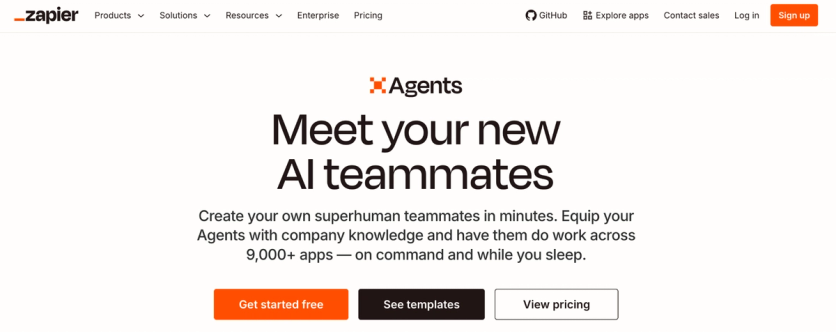
Zapier Agents are AI teammates that automate work across 9,000+ apps. Where classic Zaps run linear triggers and actions, Agents add reasoning: they research, decide, retry different approaches, and handle multi-step tasks that don’t fit a fixed workflow.
What It Actually Does
Zapier Agents work as configurable AI workers that you brief with company knowledge, then deploy across your stack. Common marketing use cases include lead enrichment and qualification (agents pull research and firmographic data into new leads, score and route them to the right rep), content creation (agents research trends, draft video scripts, set up engagement automations), customer support (email and Zendesk-ticket agents draft replies from your knowledge base and escalate complex issues), sales outreach (Sales Email Writer agents pull context from a prospect’s website and write personalized first-touch emails), and operations (Expense Classifier agents categorize spending; Slack Thread Insights agents summarize long threads).
The difference from regular Zaps is reasoning. A Zap follows a fixed path. An Agent will try different approaches until it gets a result, which makes it usable for tasks that aren’t deterministic – research, drafting, qualifying.
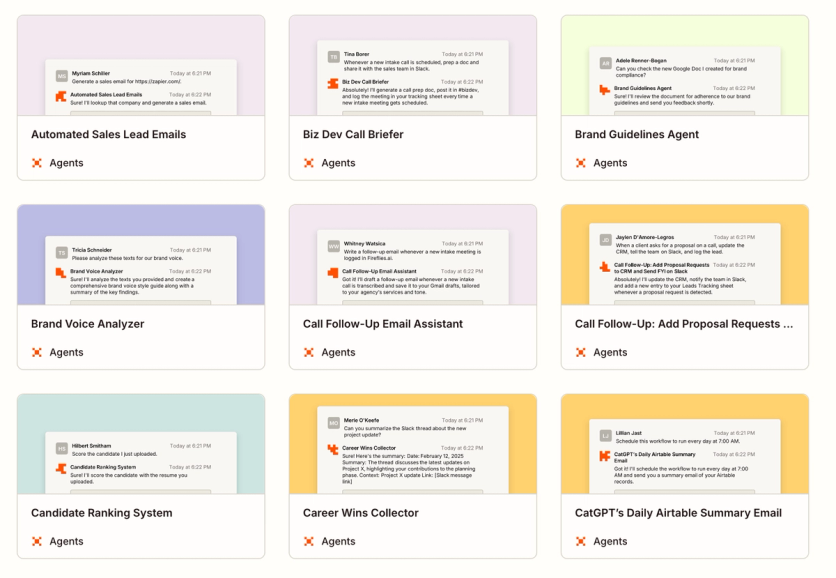
Zapier Agents Library
Pricing
Agents are metered in activities – the actions an agent takes, like running a behavior, browsing the web, or looking something up. The free tier covers 400 activities a month. Agents Pro runs about $33/month billed annually for 1,500 activities a month. Enterprise moves to custom activity volumes with unlimited users, advanced admin controls, and a dedicated technical account manager.
Agents are billed separately from Zapier’s classic Zaps, which are metered by tasks – the two don’t share a pool.
Where It Shines
Zapier Agents work for marketing teams that already use Zapier as the connective tissue between SaaS tools. The agents extend that integration layer with reasoning, which means workflows that previously required human judgment – lead qualification, response drafting, content research – can now run unattended.
Teams without engineering resources benefit most: building these agents requires no code, and the 9,000+ app integrations cover practically every SaaS tool a modern marketing org uses.
What to Consider
Teams that need deterministic, predictable automation – every step the same every time – are better off with classic Zaps or other workflow tools. Agents add reasoning, but reasoning means variability, which isn’t always what you want.
Heavy-volume teams should watch the activity-based pricing math. At enterprise scale, costs climb fast, and dedicated AI agent platforms with outcome-based pricing may work out cheaper. Teams that need agents purpose-built for a single function – sales SDR agents, customer-support agents – often find vertical-specific tools more capable than Zapier’s generalist approach.
Bottom line: the right pick if Zapier is already your connective layer and you want AI to act across the stack, not just inside one app.
HubSpot AI – Best AI-Powered CRM for Marketing Teams
HubSpot’s Smart CRM unifies customer data, conversations, and tools so marketing, sales, and service teams work from the same record. The AI layer – branded as Breeze – embeds across the platform, with 100+ AI features built in and standalone AI agents for higher-leverage work.
What It Actually Does
Breeze Assistant is HubSpot’s in-app AI assistant, free across all plans. You can ask it to generate reports, summarize deals, or draft emails – and it learns your CRM context over time.
Breeze Agents are autonomous AI teammates with outcome-based pricing. Customer Agent resolves inbound questions across email, chat, and forms – 70% of conversations on average, and teams see 77% more tickets closed per month, at $0.50 per resolved conversation. Prospecting Agent finds in-market accounts, builds lists, and drafts outreach, with teams creating 65% more sales leads on average per month, at $1.00 per qualified lead. Data Agent answers natural-language questions about your CRM, documents, and web data, at $0.10 per answer.
Breeze Intelligence scans engagement, web activity, and interaction history to surface high-value leads and recommend next steps.
Smart CRM stores contact and company records, deal pipelines, communication history, custom objects, and behavioral data, with native integrations to Salesforce, Google Workspace, Microsoft 365, Slack, and Shopify – plus 2,000+ apps via the Marketplace. Sensitive data is encrypted at rest and in transit, with field-level access controls.
For marketing teams specifically, HubSpot’s AEO Grader scores how your brand shows up across AI search engines like ChatGPT, Perplexity, and Gemini – measuring sentiment, share of voice, and brand recognition.
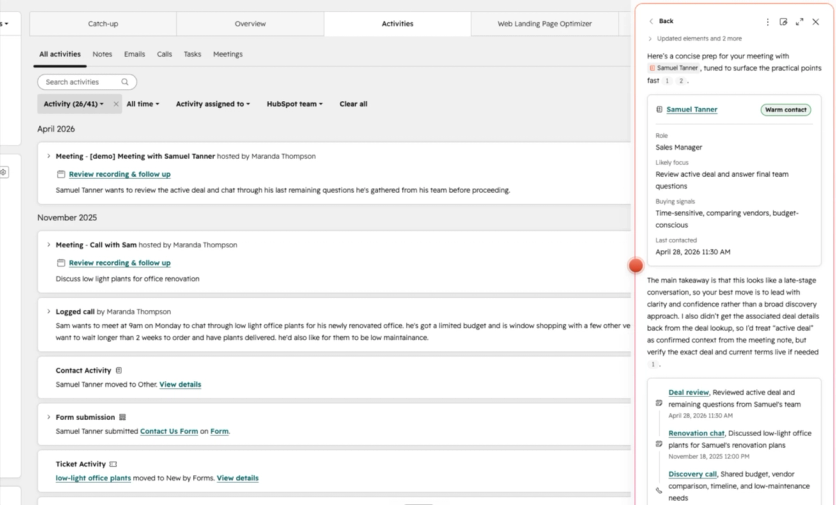
HubSpot Breeze Assistant
Pricing
Marketing Hub: Free with Breeze Assistant + 100+ embedded AI features. Starter from $20/month per seat (adds Prospecting Agent + Data Agent + 500 HubSpot Credits). Professional $890/month with 3 seats included, $3,000 one-time onboarding, 12-month commitment. Enterprise $3,600/month with 5 seats included, 10,000 marketing contacts, $7,000 onboarding.
Smart CRM standalone: $50/month per seat (Professional), $75/month per seat (Enterprise).
Outcome-based pricing on Breeze Agents replaces per-seat fees for AI work – you only pay when the agent delivers a result.
Where It Shines
HubSpot serves 288,000+ customers worldwide. After six months on the platform, customers generate 3x more leads, close 94% more deals, and raise ticket resolution rates by 57%.
The unified data layer is the real product. Marketing-qualified leads flow into sales pipelines with full context on which campaigns they touched, which content they downloaded, and which emails they opened – closed-loop reporting most competitors only achieve through integrations and workarounds. This makes attribution and pipeline analysis directly actionable for budget decisions.
Outcome-based pricing on Breeze Agents is the 2026 differentiator. Instead of paying for an AI seat or a feature flag, you pay only when the agent closes a ticket, qualifies a lead, or returns a documented answer.
HubSpot Academy provides one of the strongest free educational resources in B2B SaaS – useful for ramping new team members on both the platform and broader RevOps concepts.
What to Consider
The pricing structure is steep for growing small businesses. There’s an $870 gap between Starter ($20/seat) and Professional ($890/month minimum), plus $3,000 onboarding and a 12-month commitment. For automation-led growth teams below the Professional threshold, lighter-weight tools cost a lot less.
Meaningful AI capabilities – predictive lead scoring, conversation intelligence, AI agents – live behind Professional or Enterprise tiers. Teams under 10 reps can run on the free CRM, but advanced reporting and segmentation are locked above it.
HubSpot’s AI works inside HubSpot’s own workflows. It can’t listen to live sales calls, extract conversation intelligence, or update the CRM autonomously based on what was discussed. Teams needing deep conversation intelligence will need a separate tool.
Bottom line: the most complete AI CRM – if you can clear the jump to the Professional tier.
Semrush – Best AI Tool for SEO and Content Optimization
Semrush is the SEO platform most marketing teams already know. In 2025–2026, it added an AI layer across every toolkit – an AI advisor, AI-assisted content optimization, AI forecasting, and a separate AI Visibility Toolkit for tracking presence in AI-generated answers. Core positioning hasn’t changed: this is the platform that helps you rank, with AI doing the heavy analysis.
What It Actually Does
Semrush Copilot is an AI advisor included free with all subscriptions. It analyzes data from six core tools – Site Audit, Position Tracking, Backlink Analytics, Organic Research, Keyword Gap, and Backlink Gap – and surfaces prioritized recommendations directly in your dashboard. Copilot flags technical issues, ranking drops, and competitor moves with explanations of why each matters, and you can ask natural-language questions about your data.
AI Content Optimization studies top-ranking pages for a target keyword and generates real-time guidance on structure, headings, subtopics, and terminology – cutting hours spent reverse-engineering what Google rewards.
ContentShake AI is Semrush’s content-generation product (Chrome extension and platform integration), with an AI Writer, Brand Voice controls, and an SEO Article Generator for optimized blog posts.
AI Forecasts estimate traffic and ranking gains based on current performance, useful for budget conversations.
Site Audit with AI-prioritized recommendations checks for indexing issues, page speed problems, broken links, and security warnings – and ranks fixes by likely impact rather than handing you a flat list.
AI Visibility Toolkit tracks brand presence in ChatGPT, Google AI Mode, Perplexity, Gemini, and Claude – useful for teams that also need an AI-search layer alongside their SEO stack.
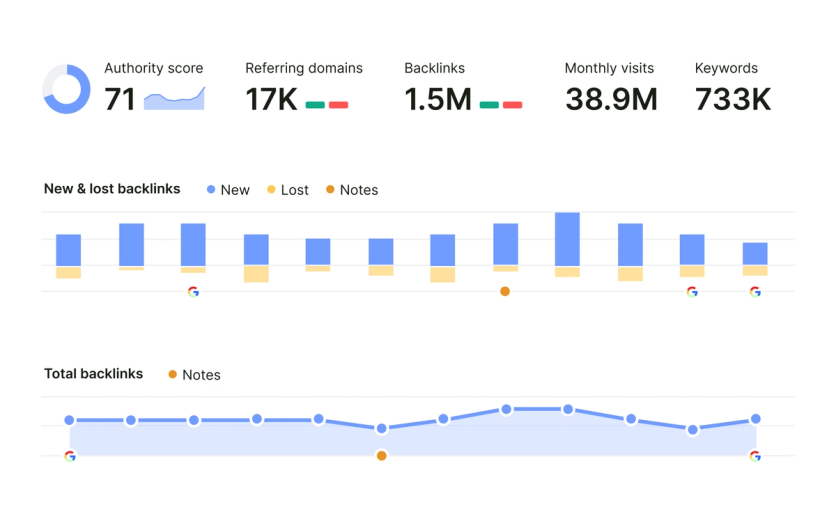
Semrush backlink tracker
Pricing
Semrush One (SEO + AI Visibility combined): Starter $199/month, Pro+ $299/month, Advanced $549/month.
SEO Classic (without AI Visibility): Pro $139.95/month ($117.33 annual), Guru $249.95/month ($208.33 annual), Business $499.95/month ($416.66 annual).
Add-on: AI Visibility Toolkit standalone runs $99/month per domain, with no free trial. Semrush’s general free plan provides 10 daily queries for domain, keyword, and competitor research.
Where It Shines
Hepper, a modern pet furniture company, grew its website to over 3 million monthly organic visitors in nine months using Semrush and increased revenue by 2,964%. BestSelf Co., a motivational stationery retailer, used Site Audit and Backlink Audit to recover from a pandemic-era traffic drop – organic traffic rose 40%, leads from organic grew 17%, average position climbed from 48 to 33, and 74 new keywords broke into the top 10 in 3 months.
The platform suits SEO and marketing teams running competitive analysis across multiple markets, agencies that report client visibility to stakeholders, and in-house teams that need a single source of truth for content priorities. Copilot’s prioritization is the practical day-to-day value – instead of staring at dashboards, you get a ranked task list.
What to Consider
The AI Visibility Toolkit add-on costs $99/month per domain. Agencies tracking 5+ clients would pay $495+ monthly on top of base plans, and the toolkit doesn’t offer a free trial. Bundling into Semrush One is cheaper than buying it standalone if you need both SEO and AI visibility.
All Semrush plans include only one user account by default. Additional seats range from $45 to $100 per month depending on tier, which makes team access expensive at scale.
AI prompt tracking spans ChatGPT, Google AI Mode, Perplexity, Gemini, and Claude, though Meta AI isn’t covered yet. The bigger limitation is keyword data: Semrush covers Google but not other search engines, which creates gaps in local markets where Yandex, Baidu, or Naver hold meaningful share.
Bottom line: the deepest AI layer in SEO, and the safe choice if Google still drives most of your traffic.
SE Ranking – Best SEO Data Source for AI Agents and Automation
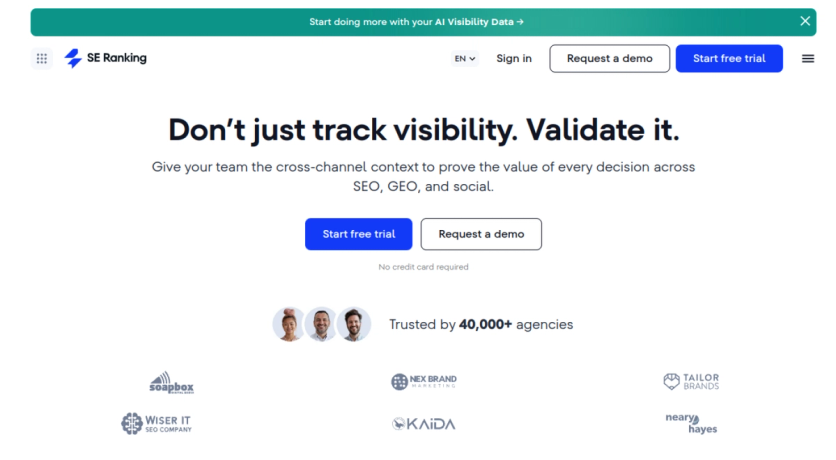
SE Ranking gives AI agents and automation workflows direct access to live SEO data. An analyst no longer has to export reports and paste them into a prompt. Instead, an agent pulls keyword, backlink, audit, ranking, and visibility data from SE Ranking itself, through the API, a remote MCP server, or pre-built n8n and Make connectors.
What It Actually Does
SE Ranking’s API gives agents two types of data. The first is research data from SE Ranking’s databases: keyword metrics and ideas, backlink profiles, domain traffic and keyword gaps, website audits, and AI search visibility for any domain. The second is project data from your own SE Ranking account: rankings, competitors, and Google Search Console metrics for the sites you track. Agents can also act on that project data, such as creating projects, adding keywords, triggering ranking checks, and managing sub-accounts.
The MCP server connects all of this to AI assistants, with 180+ tools. Supported clients include Claude, Claude Code, ChatGPT custom connectors, Codex, Cursor, VS Code, Gemini CLI, and other MCP-compatible tools. The server is remote and uses OAuth, so nothing needs installing. Setup takes about 30 seconds. From there, a marketer can ask in plain language for a content brief, an audit summary, or a competitor gap analysis, and the assistant builds it from live data.
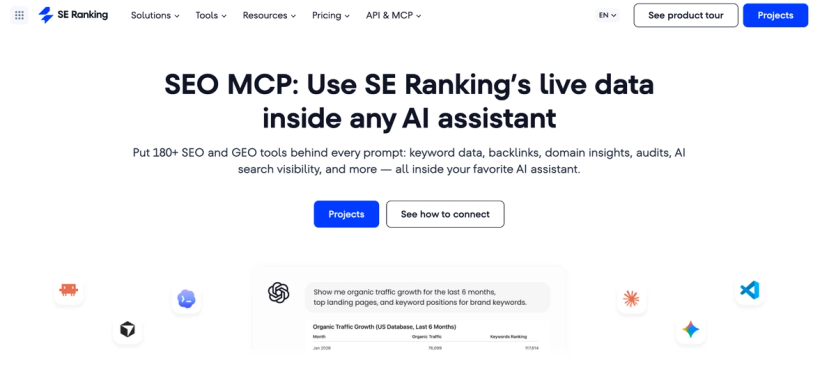
For teams that prefer visual workflows, the n8n and Make connectors together cover keyword research, backlinks, domain analysis, website audits, AI search, and project management. SE Ranking also publishes ready-made Claude Skills built on the MCP, covering content briefs, share of voice, audit change logs, backlink gaps, keyword clusters, etc.
Pricing
API and MCP access are included in every subscription tier. Core is $129/month; Growth is $279/month. Teams that only need the data can buy the standalone Data API from $179/month (annual billing, 12M credits). Alternatively, they can start with pay-as-you-go at $50 for 250,000 credits, which don’t expire. The 14-day trial includes 100,000 credits and full endpoint access.
Where It Shines
This fits agencies and in-house teams that have outgrown screenshots and manual exports: client reporting that refreshes itself in Data Studio, visibility data landing in the same report as organic rankings and GA4 traffic, audits running on a schedule across a whole client base rather than one project at a time.
The MCP server is the part that matters for the AI-stack question. An agent built in a tool like Zapier can act across a stack; what it still needs is a source for ranking drops, new technical issues, or which prompts a competitor is winning, and the MCP server is that source without anyone building an integration first.
What to Consider
There are no first-party SDKs: integration runs on the REST reference and a Postman collection, so moving from another provider means remapping endpoints by hand. Default requests-per-second is lower than some competitors and has to be raised through support. On the MCP side, the server is a transport over the same APIs, so it inherits their rate limits and credit costs. MCP is stateless, so the agent re-fetches context every conversation, and a call returning 100,000 backlinks will overflow most agent context windows.
Bottom line: the pick when the gap is getting search and visibility data into the agents, reports and workflows a team already runs.
Pecan – Best Predictive AI Tool for Lifecycle and Retention Marketing
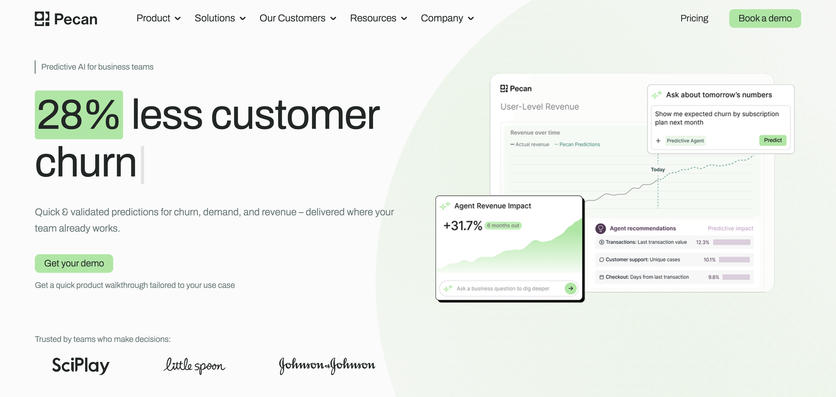
Most lifecycle programs run on rules: no purchase in 90 days, send the winback flow. Pecan replaces the rules with predictions. Its Predictive AI Agent reads your customer history and tells your lifecycle team who is about to churn, who is worth the most over time, who is ready to buy again, and which lapsed customers will actually come back. No code, no waiting on data science.
What It Actually Does
You ask a lifecycle question in plain English, like “which subscribers are likely to cancel in the next 30 days?” Pecan’s Predictive AI Agent prepares the data, builds the model, and validates it automatically. The whole thing takes a fraction of the time a custom build would.
The models map to the stages your lifecycle program already runs. At acquisition, LTV predictions show which new customers are worth a richer welcome flow and which will never pay back the discount. For conversion, repeat-purchase propensity tells you who is ready for a second order and when to send it. Upsell and cross-sell scores flag who is primed for a bigger basket or the next tier. And churn prediction catches customers who are slipping, from behavior, purchase, and engagement signals, while there’s still time to act.
Winback is where the approach shows most clearly. Instead of blasting “we miss you” to every dormant customer, Pecan identifies which lapsed customers have real return potential and how likely each one is to come back on their own, so you can decide who earns an incentive and who just needs a nudge. Your team stops handing 20% off to people who would have come back for free.
Scores flow straight into Salesforce, HubSpot, your marketing automation platform, or your warehouse on a schedule, ready to trigger flows when a customer crosses a threshold. Every model shows the drivers behind each prediction, so you can see why a customer is slipping and write messaging that addresses it.
Pricing
Pecan sells three annual plans: Starter (2 monthly prediction batches, 500M rows of storage), Team (10 batches, 2B rows), and Business (custom batches, 5B rows). Pricing is quote-based. Every plan includes the Predictive AI Agent, with no setup fee.
Where It Shines
Pecan fits lifecycle teams that already have customer data but are still segmenting on recency and gut feel. Whistle Express, a membership-based car wash operator, cut churn by 30% in its most competitive markets, with marketing running targeted retention campaigns off Pecan’s predictions.
Subscription brands get the most out of it. Little Spoon, a subscription baby and kids food brand, uses predictive LTV to decide which acquisition campaigns to scale, a weekly order-likelihood model to catch subscribers about to skip or lapse, and upsell and next-purchase models on top. Adam Smith, Director of Strategic Analytics, says the investment paid off from those early A/B experiments alone. Clearwave Fiber built its first churn model in weeks and cut churn 20x among its highest-risk subscribers.
Pecan also pairs naturally with an execution platform. Pecan decides who to save, who to grow, and who to win back; a CDP and journey builder like Maestra puts those scores to work with the right message on the right channel.
What to Consider
Pecan predicts; it doesn’t send. There’s no email builder, journey canvas, or loyalty module, so you’ll need your ESP or CDP to act on its scores.
The models need historical, event-level customer data to be accurate, so brands without much purchase history won’t get the full value yet. And since pricing isn’t published, expect a sales conversation before you see a number.
Bottom line: the pick when your lifecycle flows run on rules and you want them to run on who is actually about to churn, buy again, or come back.
Maestra – Best Customer Data Platform for AI-Readiness
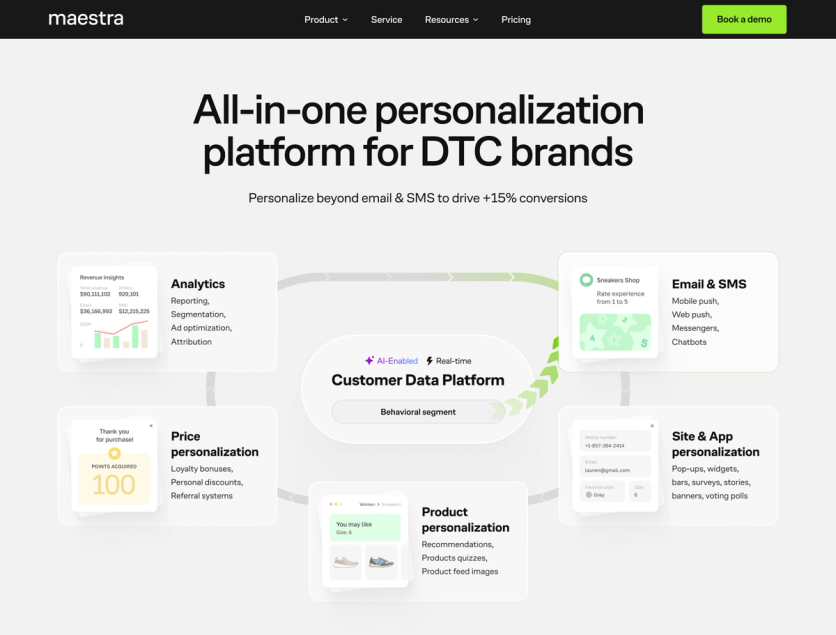
Maestra is a personalization software with a Customer Data Platform in its core, which is essential in the AI era. The logic is simple: point AI at messy data and you get messy output. MarTech’s stack survey found 65.7% of marketers struggling with data integration as a top stack headache, and 20.7% naming siloed data their biggest worry for the road ahead.
That fragmentation cuts deeper in the AI era: when a single shopper is scattered across tools as a dozen mismatched records, every model and agent pointed at that data inherits the contradictions and misfires. Gartner backs the pattern up – even at the most AI-mature companies, 29% still name data availability and quality a leading blocker to AI adoption, rising to 34% at less mature ones. Maestra removes the blocker at the source: it merges, scrubs, and de-duplicates every customer record into one live profile, then drives AI personalization from it – across every channel a DTC brand runs.
What It Actually Does
Real-time CDP. Maestra keeps customer data AI-ready by unifying online and offline events into the single source of truth. The platform resolves identities and removes duplicates automatically, so each profile stays accurate the moment a customer acts. Many CDPs refresh hours or days later, but Maestra updates in milliseconds. This lets a page or message respond inside the same session.
Both first-party and zero-party data feed the profile: first-party behavior is captured automatically, while zero-party preferences come straight from shoppers through on-site quizzes, surveys, polls, and forms. As third-party cookies fade out, this owned, real-time data is what keeps AI personalization accurate instead of running on stale fragments.
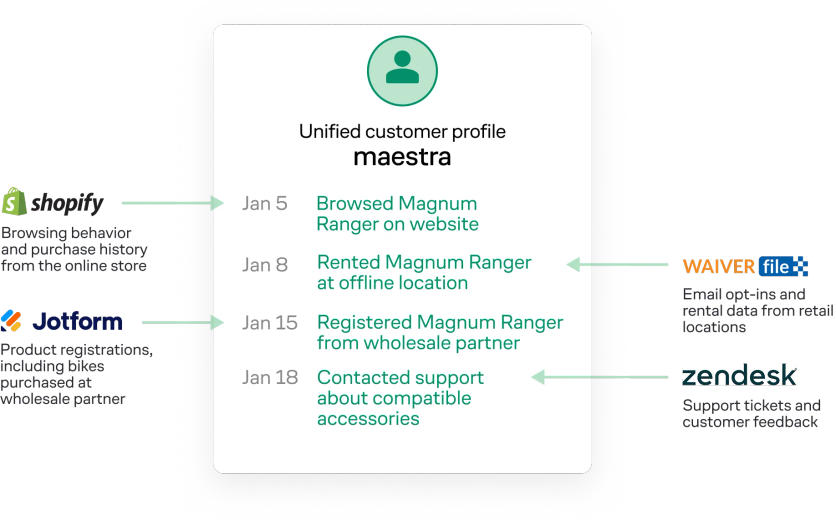
A real unified customer profile in Maestra – Magnum Bikes brings website browsing, offline rentals, registrations, and support tickets onto one real-time timeline
Advanced segmentation. Segments are built on browsing history, purchases, location, engagement, loyalty status, and any custom attributes. Marketers add nested logic, computed fields, and RFM scoring, segmenting by customer, product, brand, or order status – then push those segments into paid media for sharper ad targeting.
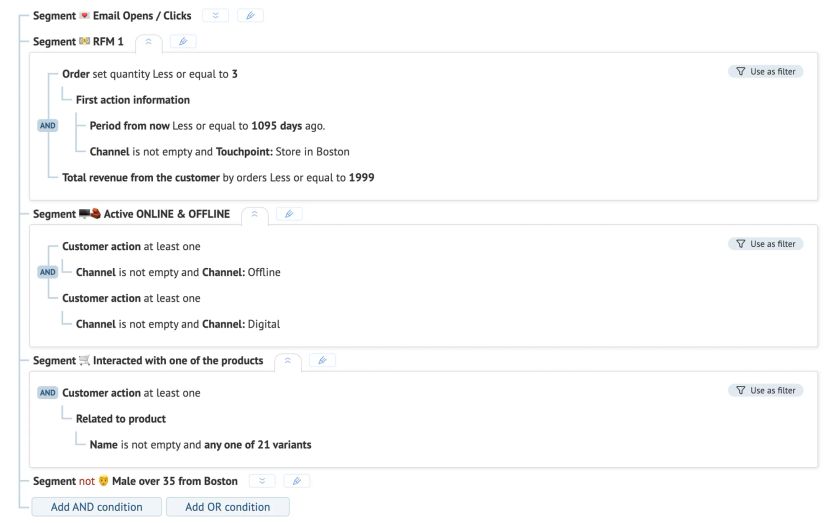
Building a customer segment in Maestra – filter by behavior, purchases, loyalty status, and custom attributes
Omnichannel journey builder. It coordinates personalized experiences across email, SMS, MMS, RCS, mobile and web push, messaging apps, chatbots, on-site, in-app, and paid media – all from a single visual editor. Flows branch on real-time customer activity, not delayed batch updates. A Next Best Action algorithm decides the right moment to send each customer their next personalized offer, rather than emailing on a fixed schedule, and Send-Time Optimization delivers each email at the recipient’s peak open time.
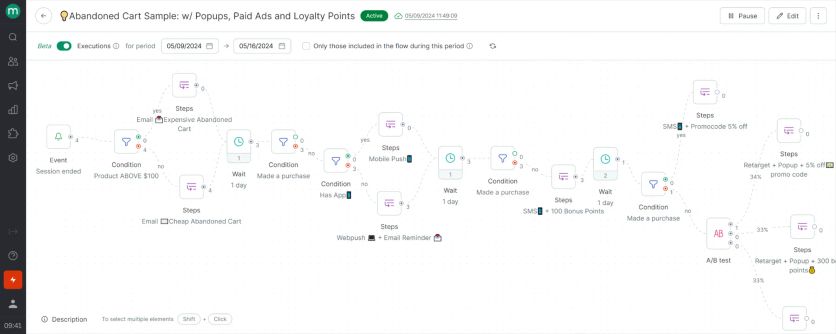
An omnichannel flow in Maestra’s visual builder – branches across email, SMS, and push on real-time behavior
AI across strategy and execution. On the strategy side, an AI Assistant reviews your segments, campaigns, and flows and points to the next move – a flow losing revenue, a segment that slipped, a test worth running. On the execution side, AI drafts email copy and matches the right products to each shopper. Because it runs on the same live profile, the output reflects what each customer is doing now, not a weekly snapshot.
AI-driven product recommendations. The recommendation engine ships with fourteen algorithms you can mix per placement:
- Recently browsed products
- Products similar to recently browsed
- Bestsellers
- Category bestsellers
- Bestsellers from previously viewed categories
- Post-purchase cross-sell
- Custom post-purchase recommendations
- Personal recommendations
- Event-based personal recommendations
- Related products
- Often purchased with items in the list
- Similar products
- Similar products to a product list
- Custom rules of your own
They run on the homepage, product and category pages, the cart, and even 404 and empty-search pages, refresh on every click, and work for anonymous, first-time visitors.
Connects with your AI stack. Maestra ships an MCP server that connects the account to Claude, ChatGPT, or any MCP-compatible tool. Pull campaign, flow, and personalization reporting and ask plain questions like “summarize last week’s campaigns” or “which flow has the worst CTR.” The same connection writes, too: edit campaigns, build segments, or describe an automation and have the assistant build it in Maestra’s flow builder.
Site and app personalization. On-site content adapts in real time to each visitor – pop-ups, quizzes, banners, embedded blocks, and more, all driven by the live profile. JOLYN shows what that unlocks. Working with Monocle’s AI, the brand let its pop-ups decide in real time when to appear and what incentive to offer – a 10% code, 15%, or none at all, depending on the shopper. Monocle’s AI made the call, but it read Maestra’s real-time behavioral data to make it, and Maestra delivered the right pop-up instantly with no lag. Those pop-ups also captured preferences like beach versus poolwear, which fed straight back into the profile for later targeting. Without clean, real-time data underneath, that loop falls apart; with it, JOLYN lifted pop-up submissions 21% and revenue per visitor 26%.
Built-in loyalty and promotions. Loyalty programs, referrals, and promotions run across channels, with support for points, VIP tiers, gift cards, and POS integration. Discounts can adapt dynamically to engage hesitant customers.
Pricing
Maestra runs on month-to-month billing that starts at $2,000/month – the real-time CDP plus unlimited email, with the first 100,000 active customer profiles included. You pay only for active profiles, so dormant ones are free, then add modules for the channels you use – SMS, onsite personalization, loyalty, mobile push. No onboarding fees, no lock-in contracts.
Billing begins only after complete migration, and a Forward Deployed Marketer handles migration, configuration, and ongoing strategy at no additional cost. The same marketer builds the integrations you need, from native connectors to custom API and SDK work – all inside the subscription, so you can wire in as many tools as you want, AI ones included.
The marketer also sets up Maestra’s recommendation algorithms and layers your business rules on top, like gender or purchase history, mapped to your brand’s goals up front.
Where It Shines
Maestra is strongest when personalization runs across many channels on one set of customer data – and the payoff usually shows up in revenue and order volume, not just engagement. A few examples:
Enlightened Equipment grew lead capture from 0.37% to 6.1% and new subscribers 20x in two months, lifted website conversion by 15%, increased AOV by 38.7% with the smart upsell bar, and grew total revenue 52.5% over time. Implemented without developers.
Magnum Bikes, a premium e-bike retailer, switched from Klaviyo and saw +111.7% online order volume and +56.6% online revenue year-over-year using Maestra’s unified profiles, product-specific flows, and on-site personalization.
Urban Armor Gear replaced Klaviyo, Yotpo Loyalty, and Frosmo with Maestra, cutting marketing stack costs by 64% – approximately $100,000 in annual savings.
Support isn’t a separate tier or an upsell – it’s built into every account. A dedicated Forward Deployed Marketer takes the heavy lifting off your team: they run the migration, build the integrations (including most custom work), set up flows and segments, and fine-tune the recommendation algorithms and business rules around your goals. Most of the integration complexity that usually lands on your developers stays with them instead.
The role goes past setup, too. The same marketer is a strategist who watches your performance, spots where retention and engagement are slipping, and proposes the campaigns, flows, and tests to lift them. You reach them in a shared Slack channel with fast replies and weekly strategy calls – all at no extra cost.
What to Consider
Maestra targets mid-market and enterprise DTC brands. Its starting price, from $2,000/month, is structured for companies running active personalization across 50,000+ customers, not early-stage stores. Service businesses or any organization without an ecommerce presence won’t get value from the toolset, which is purpose-built for retail and DTC use cases.
Brands that prefer a single-purpose tool over a unified platform – for example, a standalone email-only ESP or a standalone loyalty tool – should pick those instead. Maestra’s value comes from running multiple modules on shared customer data, which means the math works in favor of consolidation, not narrow point solutions.
Bottom line: the pick when AI personalization is the goal and clean, real-time customer data is the thing you’re missing.
How to Choose the Right AI Marketing Tool
Start with your biggest gap, not the longest feature list. AI visibility, automation, CRM, SEO, and customer data are different jobs – pick the tool that closes the one hurting you most, and add others only when the next need is clear.
Watch how each tool charges. Outcome-based pricing, like HubSpot’s Breeze Agents, ties cost to results; modular pricing, like Maestra’s, charges only for the channels you use and only for active profiles. Choose for predictability or for pay-for-results.
And if AI personalization is the goal, the data foundation matters more than the model. AI run on fragmented data returns fragmented results – so clean, unified, real-time customer data is the place to start.
Ready to put your customer data to work? See how Maestra’s real-time CDP unifies every profile and powers AI personalization across channels. → Book a 30-minute walkthrough
FAQs
- It depends on what you’re optimizing for – there’s no single best tool for every store. If you’re early-stage or mainly need email, a focused, cheaper tool is usually enough. Maestra fits DTC and ecommerce brands running personalization at scale across many channels: it combines a real-time CDP, AI product recommendations, omnichannel flows, and built-in loyalty in one platform, from $2,000/month for the CDP plus unlimited email, with the first 100,000 active profiles included. The value comes from running several channels on shared data – Magnum Bikes switched from Klaviyo and saw +111.7% online order volume year-over-year – so it pays off once you’re at that scale, not before.
- Beamtrace is purpose-built for tracking brand visibility in AI-generated answers. It monitors which prompts surface your brand in ChatGPT, who AI recommends instead, how you stack up against competitors, and how AI cites sources. Plans start at $20/month. Semrush’s AI Visibility Toolkit covers similar ground at $99/month per domain – better for teams that also need full SEO tracking.
- Outcome-based pricing charges only when an AI agent delivers a measurable result – like resolving a customer ticket or qualifying a sales lead – instead of charging a flat seat fee. HubSpot’s Breeze Agents use it: $0.50 per resolved conversation, $1.00 per qualified lead, $0.10 per data answer, so cost tracks results rather than seats. The upside is you don’t pay for AI you don’t end up using; the trade-off is less predictability than a flat fee when volume spikes.
- For ecommerce marketing automation, Maestra runs omnichannel flows across email, SMS, MMS, RCS, push, messengers, on-site, in-app, and paid media – branching on real-time customer behavior in a single visual builder. For cross-app SaaS workflow automation, Zapier Agents extend automation across 9,000+ apps with AI reasoning, handling lead enrichment, content drafting, support replies, and sales outreach. Pricing: Maestra starts at $2,000/month (CDP plus unlimited email); Zapier Agents start free, with Pro around $33/month. Magnum Bikes automated product-specific flows after switching from Klaviyo, growing online order volume by 111.7% year-over-year.
- Semrush has one of the deepest AI layers of any SEO platform. Semrush Copilot analyzes data from six core SEO tools and surfaces prioritized recommendations, ContentShake AI generates SEO content, and AI Content Optimization guides structure in real time. Pricing starts at $199/month for Semrush One Starter, which bundles SEO with AI Visibility tracking. Hepper used Semrush to grow to 3M+ monthly organic visitors in nine months.
- Traditional SEO measures rankings in Google. AI search visibility measures whether ChatGPT, Perplexity, Google AI Mode, and similar tools mention your brand when users ask category questions. The two overlap – AI engines often cite content that already ranks – but optimization paths diverge. AI engines reward structured citations, clear answers to specific prompts, and brand authority across multiple cited sources rather than just backlinks and on-page SEO.
- An AI-ready customer data platform is a CDP architected to feed AI personalization with clean, real-time, unified customer data – instead of fragmented data scattered across separate email, on-site, loyalty, and ad tools. The qualifier matters because AI fails when data is siloed: the same customer appears as different IDs, behavior signals arrive late, and the model works on incomplete profiles. Maestra is built on this premise – every channel runs on the same real-time CDP, so AI personalization works on a complete picture. G-Plans shows what that unlocks: with Klaviyo, most of their customer data – funnel stage, appointments, diet, preferences – never reached the platform, flattening every journey to the basics. On Maestra’s unified data they group customers in real time, personalize across email, mobile, and SMS, adapt the experience to each customer’s history, and doubled customer lifetime value.