
The WhatsApp Marketing Playbook for DTC Brands: Cart Recovery, Win-Back, and Post-Purchase
WhatsApp is one of the highest-engagement marketing channels a DTC brand can run. Business messages on the platform see open rates near 98% and click-through rates of 45–60%, compared with 20–25% open rates for email (Chatarmin).
The three flows that deliver the fastest payback are cart recovery, win-back, and post-purchase. This playbook covers all three with copy templates, timing, diagnostics, and named case studies.
Executive Summary — Three WhatsApp Flows That Pay Back First
- Cart recovery — send the first WhatsApp message 60–180 minutes after abandonment. FILA Hong Kong converted 26% of cart reminders with a 65x ROAS.
- Win-back — fire at two cycles past the average repeat purchase (60–180 days). Lead with relevance, not a discount. Conversational follow-ups cut discount usage by 29%.
- Post-purchase — four touches (confirmation, shipped, delivered, day 30). Proactive shipping notifications cut WISMO tickets 40–50%. The day-30 message drives repeat purchases.
- Start with post-purchase — it is the easiest to ship, the cleanest to measure, and builds the opt-in base for the other two flows.
Why WhatsApp Outperforms Email and SMS for DTC Retention
WhatsApp now carries the conversational expectations of SMS, the visual range of email, and the trust of a one-on-one conversation. Customers open it, read it, and reply to it.
The numbers back this up: 98% open rates and 45–60% click-through rates on business messages, versus 20–25% open rates for email (Chatarmin). Response time matters too — WhatsApp replies come in seconds to minutes, while email takes hours to days.
That gap shows up in three places for DTC. WhatsApp recovers carts that email never opens. Win-back campaigns get a real conversation, not a one-way blast. Post-purchase flows feel like service, not marketing. None of this replaces email or SMS — it layers on top, catching the revenue that other channels leave behind.
The WhatsApp Marketing Stack in Three Layers
A working DTC WhatsApp program needs three layers. Without unified data, messages fire without context. Without orchestration, campaigns collide across channels or overwhelm a single one. Without a conversation layer, customer replies go unanswered for hours — and WhatsApp's value disappears.
Data. Customer profiles, purchase history, segment definitions, and consent live somewhere unified. When customer data is fragmented across tools, messages fire without context — a shopper gets a cart reminder for an item they already bought, or a win-back offer the day after a purchase. Most growth-stage brands run this on a CDP or a retention-focused marketing platform.
Orchestration. Triggers, journeys, segment-based sends, and channel-level pacing run from one place. If you run WhatsApp alongside email, SMS, and push — and most DTC brands do — orchestration keeps channels from competing with each other. A shopper should not get a cart recovery email, an SMS, and a WhatsApp message within the same hour.
Conversation. Messages on WhatsApp need to feel like a person, not a template, and replies need an answer in seconds, not hours. This is where a conversational AI agent sits, plugged into the product catalog and order data.
The pattern is: orchestration triggers the campaign, AI handles the inbound. Brands that try to run WhatsApp without one of the three layers tend to stall on either deliverability, response time, or message relevance.
The First Three WhatsApp Flows to Set Up for DTC Revenue
These are the first three flows to set up. There are others — welcome sequences, restock alerts, loyalty programs — but these three deliver the fastest payback.
| Flow | Trigger | Goal | Primary KPI |
|---|---|---|---|
| Cart recovery | Cart abandoned 60–180 minutes ago | Bring shopper back to checkout | Recovered revenue per send |
| Win-back | No purchase in 60–180 days | Re-engage churned buyer | Reactivation rate |
| Post-purchase | Order placed, then milestones (shipped, delivered, day 7, day 30) | Reduce WISMO, lift LTV | Repeat-purchase rate |
Each has its own structure, copy length, and timing. The next three sections cover each one.
Playbook 1: Cart Recovery on Your WhatsApp Business App
When to Send Messages for the Best Customer Engagement
Cart recovery on WhatsApp works best between 60 and 180 minutes after abandonment. Send too early, and the shopper is still browsing. Send too late, and the intent has cooled.
For higher-AOV products (above $150), a second touch at 24 hours is worth running. For impulse categories (under $50), a single well-timed message captures most of the available recovery.
The opportunity is sizeable. Research puts the average online cart abandonment rate at 70.19% across 49 studies. On Klaviyo, email cart recovery flows convert at an average of 3.33%, with top performers at 7.69% and revenue per recipient around $3.65. WhatsApp usually layers on top of that.
What to Send
A WhatsApp cart recovery message is short. Three to four lines. One product image. One question that invites a reply.
Example:
Hey Sarah, you left the [product name] in your cart at [brand]. Want me to hold it for you? I can also answer any sizing or shipping questions. [link to checkout]
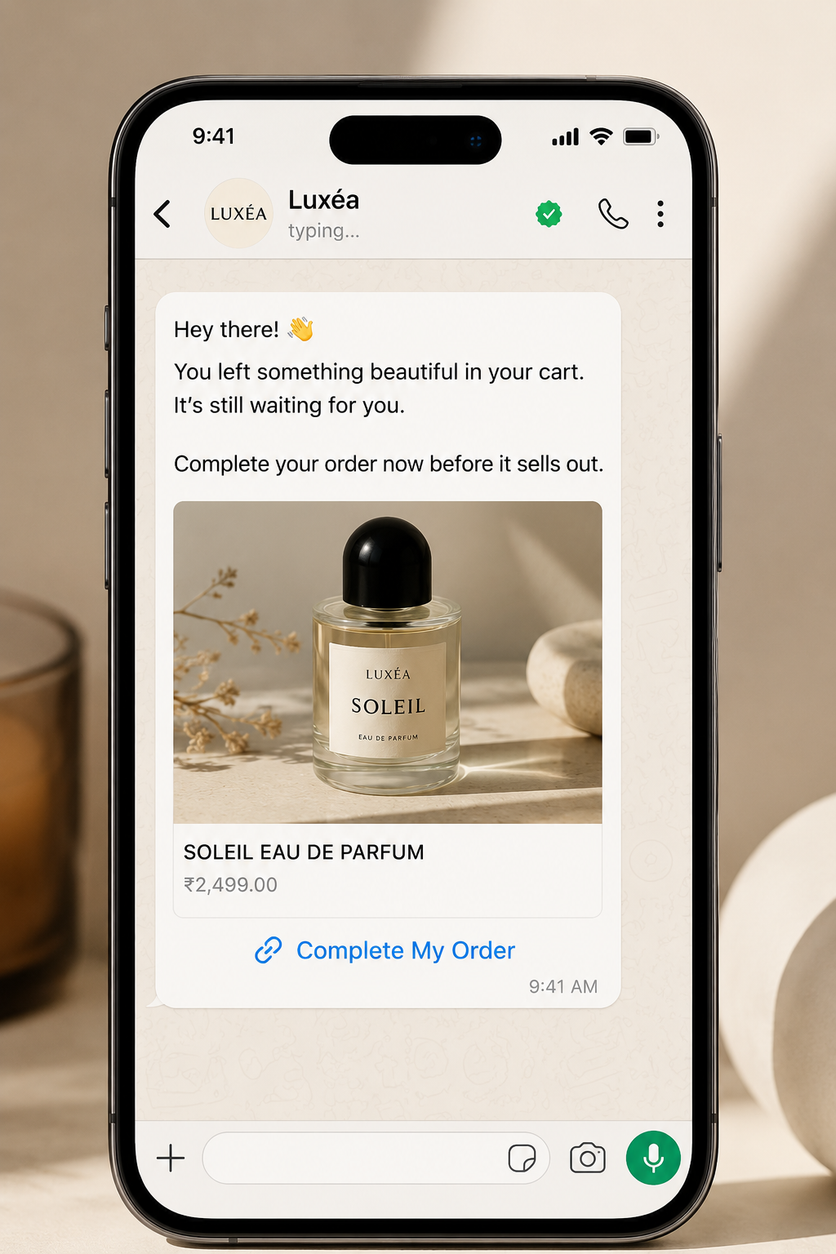
Example of a WhatsApp cart recovery message with product image and a direct checkout link
The reply is the point. WhatsApp earns its read rate because it feels like a message from a person, not a brand. If the customer replies with a question, the AI agent on the inbound side answers using the product catalog and policy data.
Case Study: FILA on WhatsApp
For FILA Hong Kong, the first WhatsApp cart recovery reminder converted at 26% with a 65x ROAS. During the 11.11 campaign window, completed-transaction conversion rose 3.5x in a week (Omnichat case study).
Timberland ran a similar setup in the region and reported a 7x conversion rate uplift after directing online traffic to store associates on WhatsApp (Omnichat case study).
Those are upper-bound numbers from chat-led retail with strong brand pull. Most DTC brands will land between Klaviyo email benchmarks and these case-study highs, with WhatsApp adding incremental recovery rather than replacing email.
Cart Recovery Diagnostic
| Problem | Likely Cause | Fix |
|---|---|---|
| Low read rate | Message looks templated, sent from unverified number | Move to a verified WhatsApp Business account (Meta-verified accounts see 2–3x higher open rates per Messangi) |
| High open, low click | Copy is too long or too transactional | Cut to 3 lines, add a question |
| High click, low conversion | Checkout friction or stock issue | Audit mobile checkout, check inventory by variant |
| Replies go unanswered | No conversational layer on WhatsApp | Route inbound to an AI agent trained on catalog and policy data |
Playbook 2: Win-Back on Your WhatsApp Business Profile
When to Send
Win-back windows depend on the category. Replenishment categories (coffee, supplements, beauty) want a 60–90 day window. Apparel and seasonal goods stretch to 120–180 days.
The right window is two cycles past the average repeat purchase. If a shopper buys every 45 days on average, the win-back fires at day 90.
Most DTC programs leave revenue on the table here. The average DTC retention rate sits at around 31%, while top performers with structured lifecycle programs hit 45–55% (Propel Retention Benchmarks, 2026).
Email win-back flows typically land at 1–2.5% click-through (OwlClaw CRM & Email Benchmarks), which is why WhatsApp is often added as a second channel rather than a replacement.
What to Send
A win-back message on WhatsApp does not lead with a discount. It leads with a reason to come back.
Example:
Hey Marcus, it’s been a while. We dropped the [new product] you might like, since you bought the [past product] in March. Want a quick look? Happy to share a 10% returning-customer code if you do.
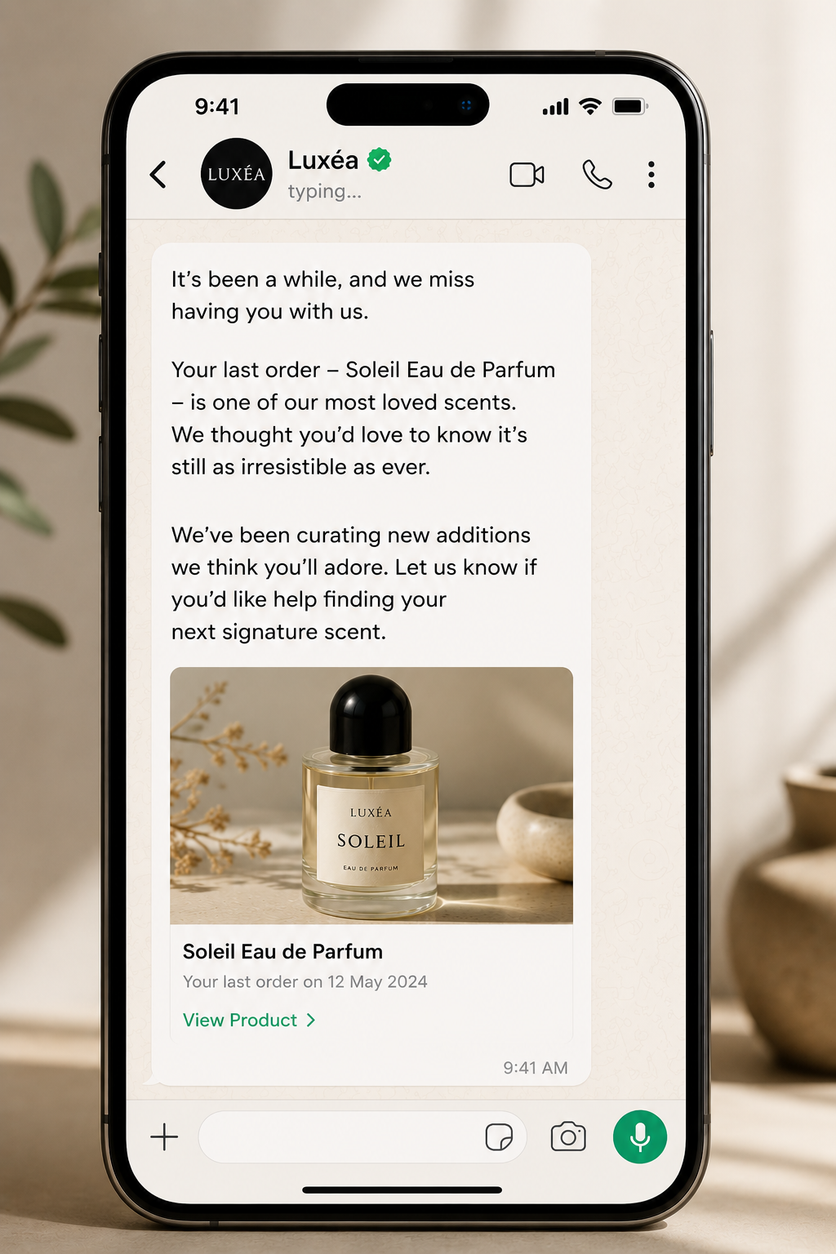
Example of a WhatsApp win-back message that leads with product relevance, not a discount
Lead with relevance (the new drop, the related product), then offer the incentive only if the shopper engages. This protects the margin and trains the audience that WhatsApp messages are about them, not about discounts.
A SayOne case study with a Shopify fashion store showed that discount usage in recovery flows dropped by 29% as conversational follow-ups resolved doubts without immediate price reductions, while the repeat purchase rate climbed 16% from stronger post-purchase engagement (SayOne, 2025).
Case Study: MPD on WhatsApp
MPD, a Dubai real estate brokerage, built a reactivation track that paired timing with relevance. During Ramadan, a top developer launched a standout deal on a premium residential complex — MPD sent it straight to the inactive WhatsApp segment. Contacts who had been silent for months came back as qualified leads requesting property searches. The broader base cleanup pushed deliverability from 53% to over 80% and cut messaging costs by 10% (Maestra case study).

Win-Back Diagnostic
| Problem | Likely Cause | Fix |
|---|---|---|
| Reactivation rate under 3% | Window too late, audience is cold | Tighten to 60–90 days post-purchase |
| Reply rate under 5% | Copy reads like an email blast | Shorten, ask one question, drop the subject-line voice |
| High reply, low purchase | Discount fired too early in the conversation | Hold the code until the shopper asks for one |
| Low LTV lift on reactivated buyers | Win-back recovered low-intent buyers only | Add a second touch 14 days later for higher-intent segments |
Playbook 3: Post-Purchase on WhatsApp
When to Send Shipping Updates on Orders
Post-purchase is a sequence, not a single send. Four moments matter:
- Order confirmed (within 5 minutes of order)
- Order shipped (when tracking is available)
- Order delivered (when carrier confirms)
- Day 30 (replenishment or review prompt)
Each touch has a different goal and a different structure.
What to Send
The order confirmation message replaces the standard email. Short, friendly, with one tracking link and an invitation to ask anything.
The shipped and delivered messages cut WISMO (“where is my order”) tickets. WISMO accounts for 30–40% of inbound support volume in ecommerce and can cost mid-market brands $50K–$200K annually (ShippyPro, 2026). Proactive notifications typically cut those tickets 40–50% in the first 30 days, and 60–70% after timing is optimized.
The day-30 message is the engine for the repeat-purchase rate. For replenishment categories, it is a one-tap reorder. For apparel, it is a review prompt with a follow-up offer.
Example day-30 message for replenishment:
Hey Priya, your [product] should be running low about now. Tap here to reorder in one click. Anything you want to swap or pause? Reply, and I’ll handle it.
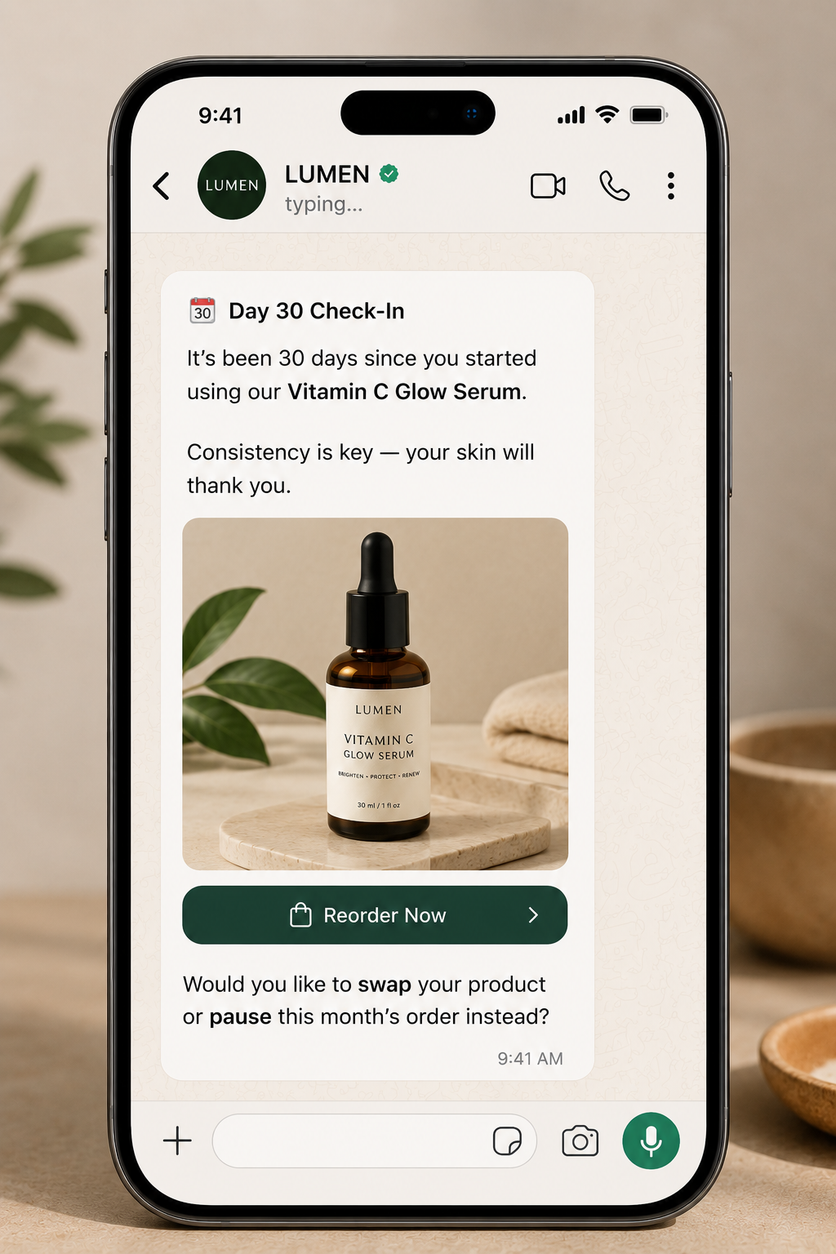
Example of a WhatsApp post-purchase message prompting a day-30 reorder
Post-Purchase Diagnostic
| Problem | Likely Cause | Fix |
|---|---|---|
| WISMO tickets still high | Shipping notifications going to email only | Move tracking notifications to WhatsApp first |
| Day-30 reorder rate flat | Generic reorder prompt with no personalization | Pull last order data from the CDP, name the product |
| Customers churning at the second cycle | No save logic when a subscriber pauses | Trigger a conversational save flow on pause |
| Review submissions low | Asking too late or in the wrong channel | Send the review prompt on WhatsApp at day 7 post-delivery |
What Drives the ROI of WhatsApp Marketing for DTC
WhatsApp marketing moves three numbers: incremental recovered revenue, reactivation rate, and repeat-purchase rate. Looked at together, those three line up with the gap between average DTC retention (31%) and top-performer retention (45–55%) reported by Propel.
Rather than projecting a fixed number, model the lift against your own baselines:
- Recovered carts: compare WhatsApp + email recovery rate to email-only.
- Reactivated customers: compare WhatsApp + email reactivation rate to email-only, then multiply by AOV and post-reactivation purchase frequency.
- Post-purchase reorder lift: track the day-30 reorder rate before and after WhatsApp.
Run a two-month A/B with one flow live (post-purchase is the cleanest start) before extending to the other two. The honest answer is that lift depends on category, AOV, opt-in rate, and the maturity of the existing email program, so any single projected figure will overstate or understate it in most cases.
A Decision Framework: Should Your DTC Brand Run WhatsApp Marketing Now
| If your brand is… | Run WhatsApp now | Wait six months |
|---|---|---|
| DTC under $1M revenue | Skip, focus on email and SMS basics | Start once email contributes 25%+ of revenue |
| DTC $1M–$5M with replenishment SKUs | Yes, post-purchase first | Cart recovery layer second |
| DTC $5M–$20M with international audience | Yes, all three flows | None, you are the prime customer |
| DTC $20M+ with subscription model | Yes, treat WhatsApp as a top-three channel | None |
| Single-purchase categories (luxury furniture, mattresses) | Cart recovery only | Win-back and post-purchase |
Pair WhatsApp execution with a CDP that holds clean opt-in customer data. The platform’s policy requires explicit opt-in for business-initiated messages, and double opt-in remains the GDPR-safe default (Infobip, WhatsApp Opt-In Guide).
When WhatsApp Marketing Strategy Fails
WhatsApp does not save a brand with weak product-market fit, no opt-in capture flow, or thin first-purchase economics. Common conditions where the channel underperforms:
- Opt-in rate below 8% on the website.
- No verified WhatsApp Business account.
- No CDP feeding the campaign.
- No conversational AI handling the inbound.
In those cases, fix the foundational layer first.
Where WhatsApp Marketing Is Heading in 2026 and Beyond
AI agents are taking over WhatsApp conversations at scale. The DTC brands that compound revenue are running fully agentic WhatsApp flows, where the customer does not feel a difference between marketing and service.
CDPs are evolving to treat WhatsApp as a first-class channel, not a bolt-on. Triggers, segments, and reporting on WhatsApp now match what email and SMS have had for years.
The brands stacking a CDP-led data layer with an AI-led conversation layer are positioning WhatsApp marketing as a top-three revenue channel within two to three years.
Conclusion
WhatsApp is no longer a side channel for DTC brands. Cart recovery, win-back, and post-purchase flows on WhatsApp move incremental revenue that email alone does not reach, with strong supporting evidence.
The stack is straightforward: a CDP for data and orchestration, and a conversational AI layer for inbound replies. Start with one flow (post-purchase is the easiest to ship), measure the lift against your own email baseline, and add the next two within a quarter.
FAQ
- Post-purchase is the easiest first flow because the customer has already bought, opt-in is fresh, and there is no acquisition cost. Cart recovery is the highest revenue flow once post-purchase is running. Win-back ships third.
- Yes, when the value exchange is clear. Order tracking and exclusive drops drive strong opt-in rates at checkout, especially when consent language names the business, states message type and frequency, and explains how to opt out (Infobip, WhatsApp Opt-In Guide). Aim for double-digit checkout opt-in as a healthy baseline.
- The 98% figure traces back to Mobilesquared (2025) and is widely cited. It applies to verified business messages, not all WhatsApp traffic. Treat it as an upper bound rather than a guarantee, and compare against your own delivered-to-read ratio once running.
