
Best Multichannel Marketing Platform Solutions for E-Commerce
If your marketing still runs through email and SMS alone, you’re leaving most of your customer touchpoints unmanaged. Shoppers interact with brands across websites, mobile apps, push notifications, WhatsApp, paid social, and in-store – and they expect a consistent experience no matter where they engage.
This is where multichannel marketing platforms come in. They let you orchestrate campaigns across every channel from a single system, with unified customer data driving the targeting. But the category has grown fast – the market was projected to reach $28.6 billion by 2030 (per Market Research Future) – and the range of options is wide. Some platforms focus on B2B lead nurturing. Others are built for e-commerce and DTC. A few try to serve everyone and end up serving no one particularly well.

If you’ve outgrown tools like Klaviyo or Omnisend that primarily handle email and SMS, this guide is for you. The platforms below go beyond two-channel marketing – they support cross-channel journeys across email, SMS, push, WhatsApp, web personalization, in-app messaging, and paid media. We’ve compared their features, pricing, and real-world performance to help you find the platform that matches how your team actually works.
Quick Verdict: Best Multichannel Marketing Platforms by Category
The best multichannel marketing platforms for e-commerce are Maestra, HubSpot, Iterable, ActiveCampaign, Adobe Marketo Engage, Salesforce Marketing Cloud Account Engagement, and Oracle Eloqua. Maestra ranks first for omnichannel e-commerce, pairing a real-time CDP with native email, SMS, push, WhatsApp, on-site personalization, and loyalty in one platform – no extra vendors required.
Best for omnichannel e-commerce: Maestra – real-time CDP with email, SMS, push, WhatsApp, loyalty, and on-site personalization
Best for CRM-first marketing teams: HubSpot – marketing hub tightly integrated with CRM and sales tools
Best for mobile-first cross-channel campaigns: Iterable – flexible data architecture with strong mobile and in-app messaging
Best for SMB automation with CRM: ActiveCampaign – advanced email workflows with built-in CRM at mid-market pricing
Best for B2B demand generation: Adobe Marketo Engage – lead scoring, nurture programs, and ABM for complex sales cycles
Best for Salesforce-native teams: Salesforce MCAE – deep Salesforce CRM integration for B2B marketing
Best for complex B2B campaign orchestration: Oracle Eloqua – granular segmentation and multi-step nurture for large marketing teams
Content:
Common Multichannel Marketing Challenges
We analyzed G2, Capterra, and TrustPilot reviews across all seven platforms in this guide. The same six complaints surface consistently – regardless of price tier or target market.
Pain Point | What Reviewers Say |
|---|---|
Learning Curve & Complex Onboarding | The #1 complaint across the category. Enterprise platforms like Marketo and Pardot require dedicated staff or consultants. Even mid-market tools like ActiveCampaign get flagged: reviewers note “significant time investment to understand features and operations.” |
High or Escalating Pricing | Contact-based pricing looks affordable at 1,000 subscribers. At 50,000, the same platform can cost 10-20x more. Pardot starts at $1,250/mo. Eloqua at $2,000/mo. HubSpot jumps from $20/mo (Starter) to $890/mo (Professional) with a $3,000 onboarding fee in between. |
Missing Features & Inflexibility | Platforms built for one use case (B2B lead nurturing, outbound prospecting, email automation) lack critical capabilities for others. Eloqua reviewers want WhatsApp and SMS. ActiveCampaign users cite limited form builders. HubSpot users need more design flexibility. |
UI/UX Issues & Dated Interfaces | Pardot reviewers call the interface “not intuitive AT ALL.” Eloqua users describe the email editor as “dated.” Marketo’s UI is consistently flagged as requiring modernization. Even newer platforms get dinged for confusing navigation. |
Poor Support & Onboarding Gaps | Pre-sale promises rarely match post-sale support. Pardot users report receiving “random links from sales executives” instead of structured onboarding. Eloqua support “responds based on issue severity.” ActiveCampaign prioritizes higher-tier plans. |
Multichannel Marketing Platforms at a Glance
Platform | Best For | Key Strengths | Pricing |
|---|---|---|---|
Maestra | Mid-size, enterprise, and rapidly scaling e-commerce brands | Real-time CDP, omnichannel flow builder (email, SMS, push, WhatsApp, pop-ups, ads), site personalization, built-in loyalty, dedicated Forward Deployed Marketer | From $2,000/mo (CDP + unlimited email); monthly modules per channel, billed only for active profiles |
HubSpot | SMBs and mid-market brands wanting integrated marketing-sales-service | User-friendly interface, built-in CRM, 2,000+ integrations, content tools | From $15/seat/mo (Starter); $890/mo (Professional) |
Iterable | Growth-stage and enterprise brands needing AI-powered cross-channel engagement | Real-time data processing, Studio journey builder, Catalog for dynamic recommendations, strong API | Custom pricing (~$86K/yr median) |
ActiveCampaign | SMBs wanting advanced automation without enterprise complexity | Visual workflow builder with dozens of triggers, email + SMS + WhatsApp, CRM included | From $15/mo (Starter, annual) |
Adobe Marketo Engage | Enterprise organizations with complex, multi-touch buyer journeys | Advanced lead scoring, account-based marketing, deep Salesforce integration, Smart Campaigns | Custom pricing (~$40K-$200K/yr) |
Salesforce Marketing Cloud Account Engagement | B2B teams already invested in the Salesforce ecosystem | Native Salesforce sync, Engagement Studio, Einstein AI lead scoring, real-time prospect tracking | From $1,250/mo (annual billing) |
Oracle Eloqua | Enterprise organizations needing sophisticated campaign orchestration at scale | 500+ integrations, advanced lead scoring, multi-CRM support, campaign Canvas builder | From $2,000/mo (Basic, 10K contacts) |
G2 Ratings for Multichannel Marketing Platforms
User reviews are the fastest way to sanity-check a vendor’s marketing claims. Maestra holds the highest G2 rating in this guide – 4.8 out of 5 – while the established enterprise platforms cluster between 3.9 and 4.4. Here is how all seven multichannel marketing platforms score on G2 and Capterra, based on verified reviews as of June 2026.
Platform | G2 Rating |
|---|---|
Maestra | 4.8 / 5 |
HubSpot Marketing Hub | 4.4 / 5 |
Iterable | 4.4 / 5 |
ActiveCampaign | 4.4 / 5 |
Adobe Marketo Engage | 4.1 / 5 |
Salesforce Marketing Cloud Account Engagement | 4.0 / 5 |
Oracle Eloqua | 3.9 / 5 |
Maestra is the newest platform in this comparison, so it carries fewer reviews than incumbents like HubSpot or ActiveCampaign – but it also earns the highest G2 score in this guide, reflecting its breadth of native channels and hands-on service model. Review volume favors the legacy suites; satisfaction scores favor the more focused platform.
1. Maestra
Best for mid-size, enterprise, and rapidly scaling e-commerce brands that have outgrown email-and-SMS-only tools and need true omnichannel marketing execution with unified customer data.
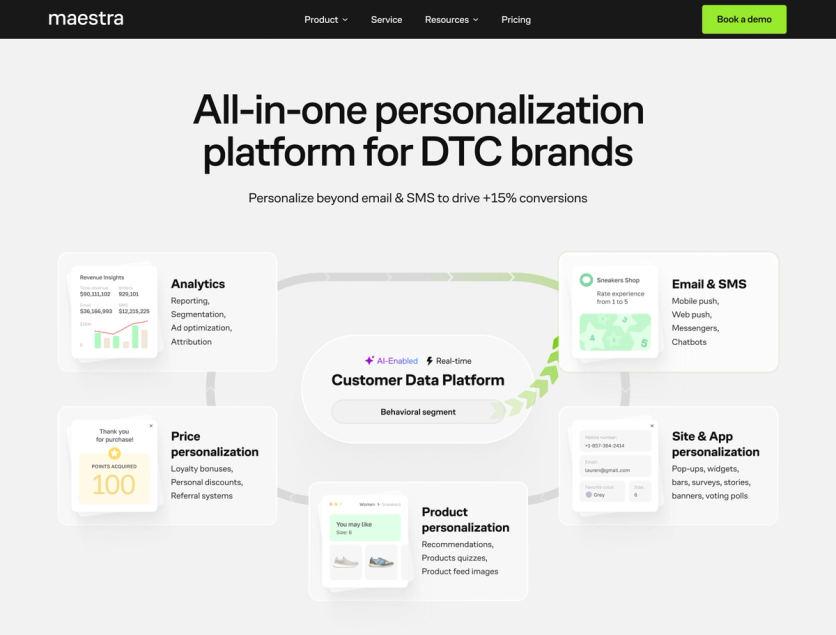
Maestra is an all-in-one marketing platform built specifically for e-commerce. Where most multichannel platforms started with one channel and bolted on others, Maestra was designed from the ground up to orchestrate campaigns across every customer touchpoint from a single system – with a real-time CDP unifying all the data underneath.
The platform consolidates six core products – real-time CDP, site & app personalization, email, SMS, and more, product recommendations, loyalty, promo & referral engine, and reporting & analytics – into a single platform with white-glove service included for every account.
The platform’s customer base includes JOLYN, Coolibar, Urban Armor Gear, Selkirk Sport, Enlightened Equipment, Furniture Fair, and Magnum Bikes.
Key Features
Omnichannel Flow Builder
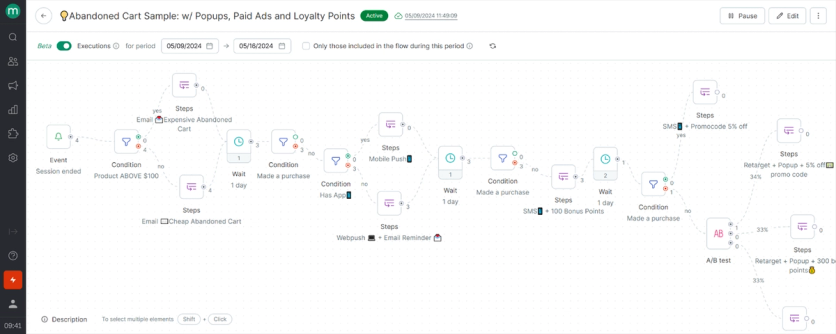
The visual flow builder is the centerpiece for multichannel marketing. It supports 30+ triggers with unlimited conditions and branches, orchestrating campaigns across email, SMS, MMS, RCS, web push, mobile push, WhatsApp, chatbots, on-site pop-ups, and paid media retargeting – all in one canvas. Cascading logic automatically falls back from one channel to the next if a message isn’t delivered: email first, then SMS, then push. Magnum Bikes coordinated email, SMS, and on-site elements (announcement bars, corner banners, pop-ups) for seasonal promotions – a coordinated approach that contributed to +56.6% online revenue and +111.7% online order volume year-over-year.
Real-Time Customer Data Platform
Maestra’s CDP processes customer data in under 300 milliseconds – every website visit, purchase, email click, and loyalty interaction is available for segmentation and personalization immediately. The platform handles databases from 30K to 65M records with 150+ native integrations including Shopify, BigCommerce, WooCommerce, and Magento. RFM segmentation, behavioral segments, and calculated fields let marketers build precise audiences without SQL.
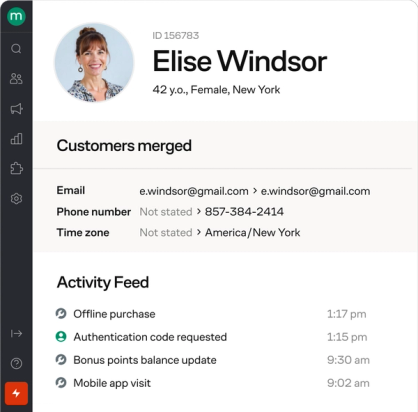
Customer profile in Maestra
Email & SMS Marketing
Drag-and-drop email builder with conditional blocks, AI-generated text, optimal send time prediction, and dedicated IP deliverability support. SMS/MMS/RCS at $0.0035/SMS plus carrier fees. Coolibar grew email and SMS revenue by 33.6% YoY using Maestra’s messaging tools. After switching from Klaviyo, JOLYN saw a 26% increase in campaign-driven revenue.
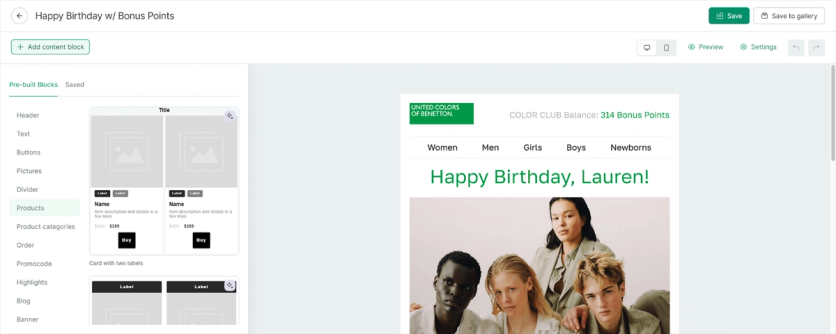
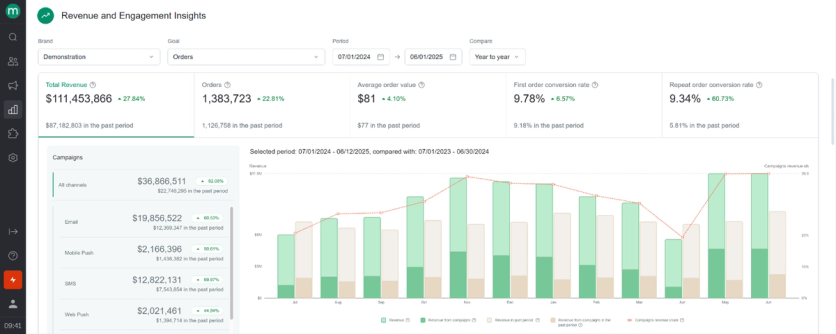
Site Personalization & Product Recommendations
No-code pop-ups, quizzes, surveys, banners, embedded blocks, and product recommendation widgets – all personalized in real time based on visitor behavior and segment membership. 14 AI recommendation algorithms work across website, app, email, and messengers. Maestra client Enlightened Equipment grew lead capture rate from 0.37% to 6.1% using targeted pop-ups with personalized offers, and separately grew subscriber volume by 20x.
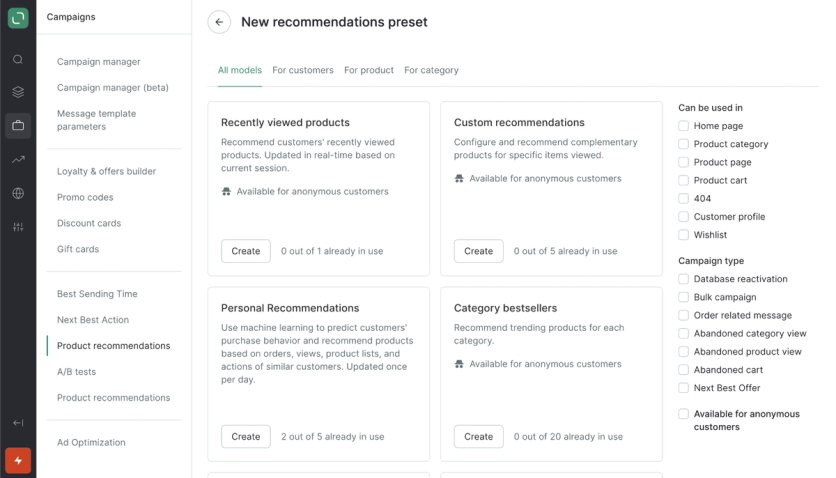
Built-In Loyalty Program
Full loyalty engine – points, tiers, referral programs, personal coupons, gamification – integrated directly into the CDP and flow builder. Loyalty data feeds into segmentation and triggers, so you can automate campaigns based on tier changes, point balances, or lapsing behavior. G-Plans doubled customer LTV within one year using Maestra’s loyalty engine combined with email, SMS, and mobile push flows.
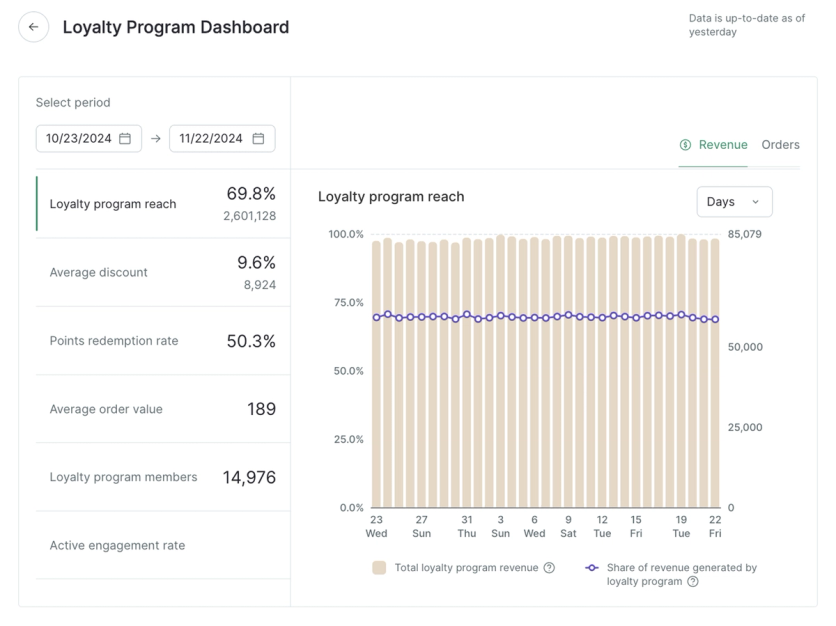
Reporting & Analytics
Full-funnel reporting with configurable attribution (Last Non-Direct Touch by default), A/B testing with statistical significance and incremental revenue impact, email health monitoring, and control group methodology. Revenue, orders, conversion, AOV, and repeat purchase metrics tracked in real-time dashboards without exporting to external BI tools.
Dynamic Product Cards for Ads
Auto-updating product visuals for Meta ads with real-time prices, discounts, ratings, and custom tags. Maestra client Defense Mechanisms doubled their ROAS from 17x to 34x using dynamic product cards combined with audience segmentation from the CDP.

Defense Mechanisms’ product ads before

Defense Mechanisms’ product ads with Maestra
White-Glove Service
Every Maestra client gets a dedicated Forward Deployed Marketer (a marketer who works as part of your team) who handles only 10-15 accounts (industry average: 60-125). Forward Deployed Marketers handle migration, build multichannel flows, design templates, optimize deliverability, and run A/B tests – so marketing teams get expert-built campaigns without needing in-house technical resources. Communication happens through shared Slack or Microsoft Teams channels with a 5-minute SLA. Maestra client JOLYN migrated from Klaviyo with the Forward Deployed Marketer rebuilding all flows, templates, and segments while the team continued running campaigns on the old platform until cutover.

Pricing
From $2,000/mo for the CDP plus unlimited email, first 100,000 active profiles included. You pay only for active profiles – dormant contacts are stored free. SMS, WhatsApp, and loyalty are added as monthly modules; SMS also carries $0.0035/SMS plus carrier fees. Dedicated Forward Deployed Marketer and managed migration included, with month-to-month billing and no annual contracts.
Strengths
- True omnichannel: email, SMS, MMS, RCS, web push, mobile push, WhatsApp, chatbots, pop-ups, and paid ads – all orchestrated from one flow builder
- Real-time data processing under 300ms enables immediate personalization across all channels
- Dedicated Forward Deployed Marketer for every account (10-15 accounts per Forward Deployed Marketer vs. industry standard 60-125) who builds flows and campaigns on your behalf
- Migration fully managed at no additional cost in 2-8 weeks; billing starts only after go-live
- All-in-one consolidation: Maestra client Furniture Fair achieved 7,543% ROI replacing 5 separate tools; Maestra client Urban Armor Gear saved ~$100K/year (64% stack cost reduction) consolidating Klaviyo + Yotpo + Frosmo
Weaknesses
- Starting at $2,000/mo, Maestra is not designed for small businesses or early-stage startups
- Primarily designed for e-commerce and DTC – may not be the ideal fit for B2B or SaaS, though some non-retail brands also use the platform
Pain Point Check
Pain Point | How Maestra Handles It |
|---|---|
Learning Curve | Dedicated Forward Deployed Marketer (10-15 accounts each) builds flows, campaigns, and segments on your behalf. Migration is fully managed – your team doesn’t need to learn the platform before seeing results. |
Escalating Pricing | You pay for active profiles only – dormant contacts are stored free. Channels are monthly modules, so costs track usage, not list size. No onboarding charges, no premium support tiers, no annual lock-in. |
Missing Features | Six core products in one platform: CDP, site personalization, omnichannel flows, product recommendations, loyalty/promo/referrals, and analytics. No bolt-ons needed. |
UI/UX Issues | Visual flow builder and drag-and-drop email composer designed for marketers. Forward Deployed Marketer handles complex configurations, reducing the UI learning burden. |
Poor Support | 5-minute SLA on shared Slack/Teams channels. Forward Deployed Marketer is a strategic partner, not a ticket queue. Weekly strategy calls included. |
Data Quality & Integration | Real-time CDP processes data in under 300ms. 150+ native integrations with Shopify, BigCommerce, WooCommerce, Magento. No batch syncing or middleware required. |
When to Choose Maestra
- You’ve outgrown Klaviyo, Omnisend, or a point-solution stack and need real omnichannel – not just email and SMS
- You want a single platform that replaces your ESP, CDP, loyalty tool, recommendation engine, site personalization tool, and analytics dashboard
- Your team wants white-glove onboarding and a dedicated Forward Deployed Marketer who builds campaigns and flows for you – not just a help desk
- You need a built-in loyalty program tied directly to your customer data and marketing flows
- You want cascading channel logic – if email isn’t delivered, the flow automatically falls back to SMS, then push – so no message gets lost
2. HubSpot
Best for SMBs and mid-market brands wanting an integrated marketing-sales-service platform with a user-friendly interface and built-in CRM.
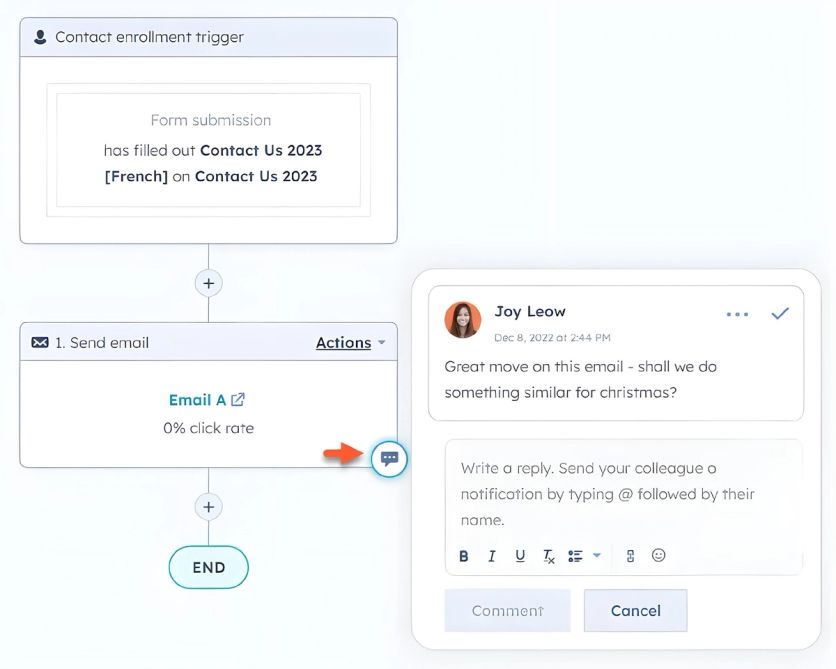
HubSpot operates on a modular structure with multiple Hubs – Smart CRM, Marketing Hub, Sales Hub, Service Hub, Content Hub, Data Hub, and Commerce Hub. This architecture lets teams subscribe only to the products they need. The platform is known for accessibility – marketing teams can launch campaigns without engineering support.
Key Features
Marketing Hub
Drag-and-drop website builder creates web pages, blog posts, landing pages, and email templates without code. SEO suggestions appear during content creation. Social media publishing schedules posts for optimal reach. Content personalization adjusts images, headlines, and CTAs based on location, traffic source, device, and persona.
Sales Hub
Email templates, sequences, and meeting scheduling reduce manual work. Sales teams receive instant notifications when prospects engage with content. Lead rotation and task assignment happen through automated workflows. The built-in CRM tracks deals and contacts without a separate system.
Service Hub
Help desk, team email, knowledge base, live chat with chatbot automation, and customer feedback tools. Issue resolution tracking prevents unresolved cases from falling through the cracks.
Integration Ecosystem
2,000+ integrations in the HubSpot App Marketplace connect to virtually any tool in your stack.
Pricing
Marketing Hub Starter: $15/seat/mo (annual) or $20/seat/mo (monthly), 1K marketing contacts included. Professional: $890/mo (monthly billing) or $800/mo (annual), 2K contacts, $3,000 onboarding fee. Enterprise: $3,600/mo (annual only), 10K contacts, $7,000 onboarding fee. Starter offers true month-to-month billing; Professional and Enterprise require annual commitments.
Strengths
- Excellent tool quality across the entire platform with a consistent, intuitive UI
- Free version of each tool lets businesses test before purchasing
- Built-in CRM eliminates the need for a separate system
- 2,000+ integrations connect to virtually any tool
- Strong content creation tools (blog, landing pages, SEO)
Weaknesses
- Pricing escalates significantly as customer bases grow and higher tiers become necessary
- Marketing automation capabilities may not satisfy teams needing advanced workflow complexity
- Annual billing with substantial onboarding fees ($3,000-$7,000) increases upfront costs
- Limited e-commerce-specific features – no native loyalty, product recommendations, or site personalization widgets
Pain Point Check
Pain Point | How HubSpot Handles It |
|---|---|
Learning Curve | One of the most intuitive interfaces in the category. HubSpot Academy provides free courses. However, advanced automation requires the Professional tier jump. |
Escalating Pricing | Transparent pricing, but the Starter-to-Professional gap ($20 → $890/mo) is steep. Contact overages add up. Onboarding fees ($3K-$7K) increase upfront costs. |
Missing Features | Strong generalist platform, but lacks e-commerce-specific tools: no loyalty engine, no product recommendation algorithms, limited site personalization. |
UI/UX Issues | Consistently praised for clean, accessible interface. Landing page builder gets mixed reviews (“clunky” per some G2 reviewers). |
Poor Support | Free tier relies on community forums. Starter adds email support. Professional and Enterprise get phone support. No dedicated CSM at lower tiers. |
Data Quality & Integration | 2,000+ App Marketplace integrations. Built-in CRM eliminates marketing-sales data silos. No native CDP – relies on integrations for unified customer data. |
Compared to Maestra
HubSpot is a broad marketing-sales-service platform; Maestra is a deep e-commerce multichannel execution engine. HubSpot offers stronger content creation tools (blog, landing pages, SEO) and a wider integration ecosystem (2,000+ vs. 150+). But for e-commerce brands, Maestra provides real-time CDP processing (under 300ms), an omnichannel flow builder with cascading channel logic, built-in loyalty, 14 product recommendation algorithms, and site personalization – none of which HubSpot offers natively. Maestra also includes a dedicated Forward Deployed Marketer and free onboarding with every plan, while HubSpot charges $3,000-$7,000 to get started. HubSpot suits B2B and content-driven businesses; Maestra suits e-commerce brands that need multichannel execution depth.
3. Iterable
Best for growth-stage and enterprise brands needing AI-powered cross-channel engagement with flexible data modeling and strong API capabilities.
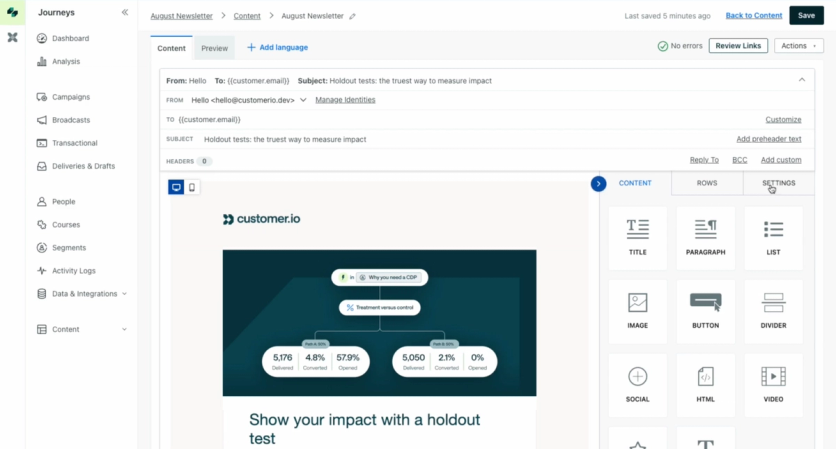
Iterable is an AI-powered customer communication platform specializing in cross-channel engagement across email, SMS, push notifications, in-app messages, WhatsApp, and web push. The platform processes customer data in real time, enabling marketers to orchestrate personalized journeys without coding.
Key Features
Studio Journey Builder
Drag-and-drop journey building with sophisticated branching logic. Workflows span email, SMS, push, and in-app channels with behavioral triggers and conditional paths. Experiments enable A/B testing of campaign elements across channels.
Catalog & Dynamic Recommendations
The Catalog functionality creates dynamic recommendations by matching user data with stored content. Messages are personalized at send time – product recommendations, content suggestions, and offers update dynamically based on the latest customer behavior.
Flexible Data Model
Handlebars templating accesses any user data point for customization. The platform handles complex customer data structures without rigid schema requirements, making it adaptable for diverse business models.
Segmentation & AI
Behavioral segmentation generates audiences based on real-time event data. AI capabilities power send time optimization, Channel Optimization (selecting the best channel per user), and content personalization at scale.
Pricing
Custom pricing. The median annual cost is approximately $83,683 based on industry data, with pricing ranging from ~$27,000 to $400,000+ depending on profile volumes and custom events. Specific pricing requires sales consultation.
Strengths
- Flexible data modeling handles complex customer structures without rigid schemas
- Accessible interface simplifies daily workflows for marketing teams
- Strong Catalog capabilities automate content personalization at scale
- Real-time data processing for immediate campaign triggering
- Strong API and developer documentation
Weaknesses
- Steep learning curve for new users despite accessible interface
- Reporting functionality lacks depth compared to dedicated analytics tools
- Custom pricing creates budget uncertainty – no published price tiers
- Limited native e-commerce integrations compared to platforms built for retail
Pain Point Check
Pain Point | How Iterable Handles It |
|---|---|
Learning Curve | Accessible interface for daily workflows, but G2 reviewers note a steep curve for complex journeys and segmentation (89 mentions). Strong documentation helps. |
Escalating Pricing | Custom pricing with no published tiers creates budget uncertainty. Median annual cost ~$86K per Vendr data. Costs grow with contacts and events. |
Missing Features | Lacks A/B testing in Journey feature and holdout functionality (92 G2 mentions). No native loyalty programs, site personalization, or product recommendation engine. |
UI/UX Issues | Clean interface for standard workflows. Power users managing high volume note that certain refinements are needed (78 mentions). |
Poor Support | Email support and AI chatbot available. Live chat and phone limited to higher tiers. No dedicated CSM model. |
Data Quality & Integration | Flexible data model handles complex structures. Strong API documentation. Real-time data processing for immediate campaign triggering. |
Compared to Maestra
Iterable offers flexible data modeling and strong API capabilities for diverse business models. But for e-commerce specifically, Maestra provides deeper functionality: built-in loyalty programs, 14 product recommendation algorithms, site personalization, and dynamic ad cards – all integrated with the CDP and flow builder. Maestra’s dedicated Forward Deployed Marketer builds campaigns and flows on your behalf, while Iterable relies on self-service with ticket-based support. Iterable’s strength is its data flexibility and cross-channel messaging for non-retail verticals; Maestra’s strength is all-in-one e-commerce execution with white-glove service.
4. ActiveCampaign
Best for SMBs wanting advanced marketing automation with email, SMS, and WhatsApp – without enterprise complexity or pricing.
ActiveCampaign serves a large customer base with powerful automation workflows at accessible price points. The platform combines email marketing, CRM capabilities, and multichannel messaging for teams with varied technical skill levels.
Key Features
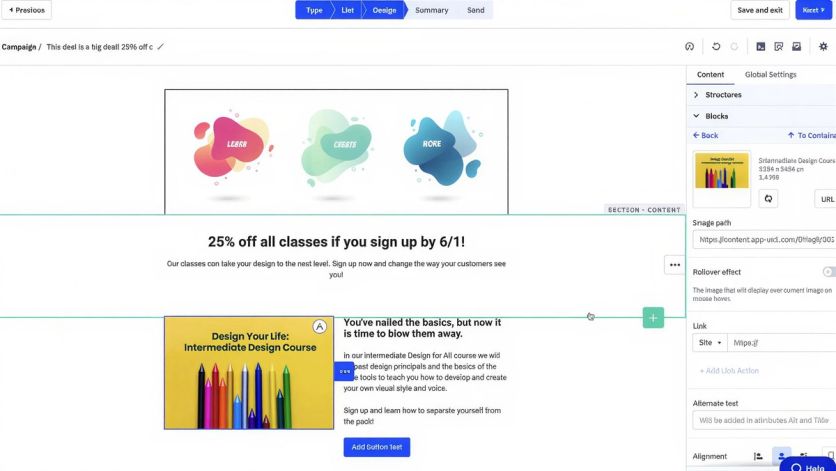
Visual Automation Builder
Dozens of triggers and actions support complex workflows with branches, conditional content, and predictive sending. Unlimited automation actions on most plans. The Active Intelligence AI engine uses data from billions of interactions to optimize campaign performance.
Multichannel Campaigns
Email, SMS, WhatsApp, site messaging, and Facebook Custom Audiences sync for ad retargeting. Email send limits reach 10-15x contact counts depending on tier. Landing pages, forms, and website tracking capture visitor activity.
CRM & Lead Scoring
Built-in CRM tracks deals and pipelines. Lead scoring prioritizes prospects based on behavior and engagement patterns. Sales automation handles lead rotation and follow-up sequences.
Pricing
Starter: from $15/mo (annual billing, 1K contacts). Plus: from $49/mo. Pro: from $79/mo. Enterprise: from $145/mo. Enhanced CRM add-ons cost $68/mo (Pipelines) and $111/mo (Sales Engagement). 14-day free trial with Pro features, no credit card required.
Strengths
- Powerful automation builder handles sophisticated workflows accessible to non-technical users
- High email deliverability through list hygiene and IP warmup features
- Free migration service transfers contacts, forms, and automations from existing platforms
- Accessible pricing for small and mid-size businesses
Weaknesses
- Since November 2025, new accounts are charged for all contacts including unsubscribed and bounced, driving costs higher as lists grow
- Basic CRM lacks functionality for complex sales processes
- Starter plan limits automations to 5 actions and requires upgrade for branching logic
- No native loyalty programs, product recommendations, or site personalization
Pain Point Check
Pain Point | How ActiveCampaign Handles It |
|---|---|
Learning Curve | Visual builder is accessible, but reviewers cite 604 G2 mentions of learning curve challenges. Documentation and free migration from other platforms help offset. |
Escalating Pricing | Affordable entry ($15/mo) but costs scale aggressively with contact growth. Since November 2025, new accounts pay for all contacts including unsubscribed and bounced. |
Missing Features | No native loyalty, product recommendations, site personalization, or real-time CDP. Starter plan limits automations to 5 actions. |
UI/UX Issues | 301 G2 mentions of “not intuitive” interface. Power users find navigation confusing for advanced features despite the visual automation builder being well-regarded. |
Poor Support | Free migration included on all plans. Support prioritized for higher tiers – lower-tier users report slower response times. |
Data Quality & Integration | 900+ integrations. Built-in CRM syncs with Salesforce and Shopify. Website tracking feeds behavioral data into lead scoring. No real-time CDP. |
Compared to Maestra
ActiveCampaign offers strong automation at accessible pricing, making it a good fit for SMBs. But its multichannel reach is narrower: no native push notifications, no loyalty programs, no product recommendations, no site personalization widgets. Maestra orchestrates campaigns across 10+ channels from a single flow builder with cascading logic, includes a real-time CDP, and provides a dedicated Forward Deployed Marketer for every account. For e-commerce brands scaling past basic email/SMS automation, Maestra delivers broader channel coverage and deeper e-commerce functionality. ActiveCampaign suits smaller teams that primarily need email automation with basic SMS and CRM.
5. Adobe Marketo Engage
Best for enterprise B2B organizations with complex, multi-touch buyer journeys that need advanced lead scoring and account-based marketing.
Adobe acquired Marketo in 2018 and positioned it as the core enterprise B2B marketing automation platform within the Adobe Experience Cloud. Marketo Engage specializes in managing sophisticated campaigns through diverse channels for organizations with intricate sales cycles.
Key Features
Advanced Lead Management
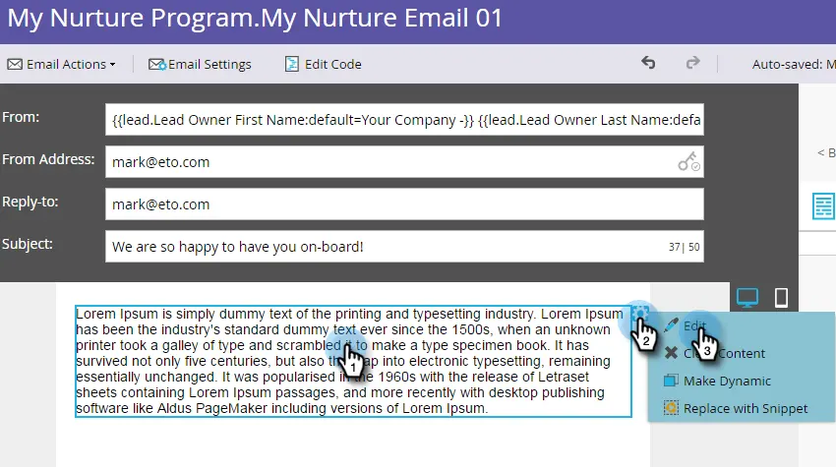
Sophisticated lead scoring, segmentation, and routing allow marketing teams to engage prospects at every buyer journey stage. Account-based marketing (ABM) tools focus resources on high-value target accounts.
Cross-Channel Campaign Orchestration
Smart Campaigns coordinate engagement through email, web, mobile, social, and events from a centralized hub. The automation engine supports complex workflows that respond to customer behavior and data changes in real time.
Predictive Content & AI
AI identifies best-performing content assets and delivers them for personalization at scale. Journey analytics track campaign performance through the full revenue lifecycle.
Salesforce Integration
Marketo’s Salesforce integration is considered superior to Salesforce’s own Marketing Cloud – native CRM connections maintain real-time data alignment between sales and marketing.
Pricing
Four packages: Growth, Select, Prime, and Ultimate. Annual costs range from ~$40,000 to $200,000+ depending on database size. Entry-level implementations start around $1,000/mo. Specific quotes require sales consultation.
Strengths
- Exceptional Salesforce integration surpasses competing platforms
- Handles massive data volumes without performance degradation
- Deep customization enables sophisticated enterprise B2B workflows
- Advanced ABM capabilities for targeting high-value accounts
- Strong ecosystem within Adobe Experience Cloud
Weaknesses
- Dated UI makes simple tasks more time-consuming than necessary
- Steep learning curve requires dedicated staff or external consultants
- Limited native reporting – often requires Adobe Analytics for full visibility
- Enterprise pricing puts it out of reach for SMBs
- Primarily B2B-focused – limited e-commerce-specific capabilities
Pain Point Check
Pain Point | How Marketo Handles It |
|---|---|
Learning Curve | The steepest in this guide. G2 reviewers consistently flag the learning curve as the #1 complaint. Most organizations need dedicated Marketo administrators or external consultants. |
Escalating Pricing | Enterprise pricing (~$40K-$200K/yr) puts it out of reach for SMBs. Advanced features require higher tiers. No public pricing page. |
Missing Features | Strong B2B automation but limited e-commerce capabilities. Poor native email design tools – many customers use third-party tools like Knak. Limited social media capabilities. |
UI/UX Issues | Interface consistently described as “outdated” and “unintuitive” across G2 and TrustRadius. Adobe has been slow to modernize the frontend. |
Poor Support | G2 reviewers mention slow response times and support staff who lack deep product knowledge. Implementation support often requires paid consulting. |
Data Quality & Integration | 500+ integrations. Superior Salesforce integration. Handles massive data volumes. Strong ABM data management for enterprise B2B. |
Compared to Maestra
Marketo is purpose-built for B2B lead nurturing and ABM; Maestra is purpose-built for e-commerce multichannel execution. Marketo excels at complex lead scoring, multi-touch attribution, and Salesforce integration for long sales cycles. Maestra excels at real-time personalization, omnichannel consumer engagement, and consolidated e-commerce functionality (loyalty, recommendations, site personalization). For B2B organizations, Marketo is the stronger choice. For e-commerce brands, Maestra delivers faster time-to-value with its all-in-one platform and dedicated Forward Deployed Marketer support.
6. Salesforce Marketing Cloud Account Engagement
Best for B2B marketing teams already invested in the Salesforce ecosystem that need marketing automation aligned with their CRM.
Formerly known as Pardot, Marketing Cloud Account Engagement operates exclusively within the Salesforce ecosystem. The platform aligns marketing activities with sales objectives, helping teams find, nurture, and convert prospects through personalized communication across the buyer journey.
Key Features
Lead Generation & Scoring
Drag-and-drop builders for landing pages, forms, and offers capture and score prospects on submission. The platform assigns scores based on engagement behavior while grading prospects on profile fit – allowing sales teams to prioritize high-potential leads.
Engagement Studio
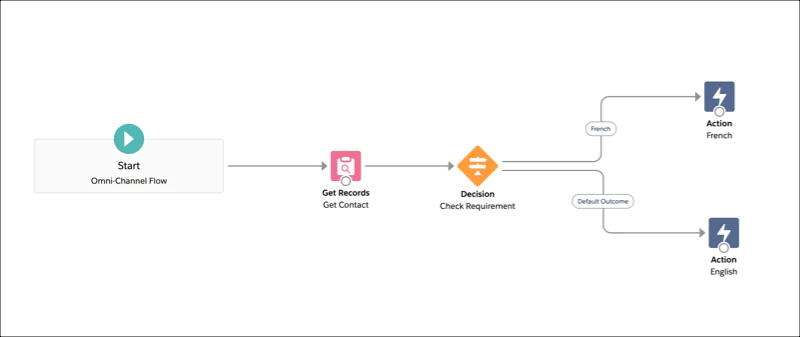
Visual workflow builder creates automated nurture journeys with trigger-based personalization. Dynamic content adjusts email and website elements based on industry, job title, score, or grade.
Real-Time Prospect Tracking
Monitors page views, email clicks, downloads, and website interactions. Every action is logged in a unified engagement history. Sales teams receive alerts about prospect activity, enabling timely follow-up.
Einstein AI & Salesforce Sync
Einstein AI (available on Plus+ tier and above) generates and updates lead scores, predicting how close prospects are to purchasing. Native two-way sync with Salesforce CRM maintains alignment between leads, contacts, campaigns, and opportunities without manual data transfer.
Pricing
Growth+: $1,250/mo. Plus+: $2,750/mo. Advanced+: $4,400/mo. Premium+: $15,000/mo. All plans require annual billing. Additional prospect blocks beyond base limits cost extra per 10,000 contacts.
Strengths
- Native Salesforce synchronization keeps marketing and sales data perfectly aligned
- Automatic lead scoring and grading highlight sales-ready prospects
- Real-time activity alerts enable sales teams to follow up at optimal moments
- Einstein AI-powered predictions improve over time
Weaknesses
- Designed primarily for Salesforce users – delivers limited value outside that ecosystem
- High starting price of $1,250/mo increases as prospect databases expand
- Setup and workflow optimization require technical expertise and significant time investment
- Limited channel coverage compared to true multichannel platforms – primarily email-focused with basic landing pages
Pain Point Check
Pain Point | How Account Engagement Handles It |
|---|---|
Learning Curve | G2 and Capterra reviewers describe the interface as “not intuitive AT ALL.” Without a consultant, most teams struggle through integration and onboarding. |
Escalating Pricing | Starts at $1,250/mo with annual billing only. Prospect blocks beyond base limits add costs. No month-to-month option. |
Missing Features | Primarily email-focused with landing pages. Limited channel coverage for true multichannel – no native push, WhatsApp, or site personalization. Einstein AI only on Plus+ and above. |
UI/UX Issues | One of the most criticized UIs in the category. “Breaks standard functionality conventions” per G2 reviews. Landing page builder particularly frustrating. |
Poor Support | Multiple G2 reviews cite “near to no onboarding” and receiving “random links from sales executives” instead of structured training. Support quality declined after Salesforce acquisition per reviewer accounts. |
Data Quality & Integration | Native Salesforce CRM sync is excellent. Two-way data alignment between marketing and sales. However, duplicate lead creation and email data management are flagged as issues. |
Compared to Maestra
Salesforce Account Engagement is a B2B nurturing tool; Maestra is an omnichannel e-commerce execution platform. Account Engagement excels at lead scoring, Salesforce CRM alignment, and B2B prospect management. Maestra excels at real-time consumer engagement across 10+ channels, with built-in loyalty, product recommendations, and site personalization. For B2B teams in the Salesforce ecosystem, Account Engagement is the natural choice. For e-commerce brands needing true multichannel execution beyond email, Maestra offers broader channel coverage, faster implementation (2-8 weeks vs. months), and month-to-month billing instead of an annual contract.
7. Oracle Eloqua
Best for enterprise organizations with complex campaign orchestration needs, high data volumes, and requirements for multi-CRM integration.
Oracle Eloqua brings over two decades of marketing automation refinement to enterprise organizations. The platform handles massive data volumes while maintaining enterprise-grade performance and security through Oracle Cloud Infrastructure.
Key Features
Campaign Canvas Builder
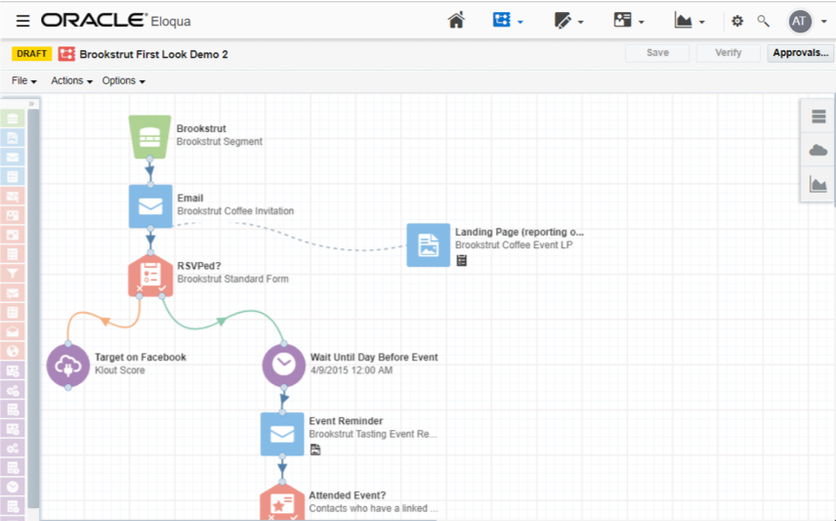
Drag-and-drop campaign builder creates multistep workflows spanning email, native SMS, display, search, web, video, and social channels. AI selects optimal audiences and generates personalized campaign assets. Program Canvas automates repetitive tasks across complex business requirements.
Advanced Lead Scoring
Real-time scoring across multiple campaigns, products, business units, and regions – without IT assistance. Account-level engagement scoring combines individual activities to identify conversation-ready opportunities.
Integration Depth
500+ prebuilt integrations connect naturally with existing tech stacks. Native synchronization with multiple CRM systems works simultaneously – a differentiator for organizations running more than one CRM.
Reporting
70+ prebuilt reports and dashboards with customizable metrics tracking email performance, revenue attribution, and campaign ROI.
Pricing
Basic: $2,000/mo (10,000 contacts, 10 marketing users, 5 sales users). Standard: $4,000/mo (similar contacts, 50 marketing users, 10 sales users, advanced segmentation and real-time scoring). Enterprise: custom pricing through Oracle sales.
Strengths
- Visual campaign builder reduces training time and operational errors
- Precise segmentation capabilities for targeted audience creation
- Custom objects enable feature customization without coding
- 500+ integrations with multi-CRM support
- Enterprise-grade security and performance at scale
Weaknesses
- Steep learning curve complicates initial setup and advanced feature adoption
- Limited template selection with restricted customization unless HTML skills exist
- Implementation requires significant time investment for complex integrations
- Enterprise pricing excludes most mid-market organizations
Pain Point Check
Pain Point | How Eloqua Handles It |
|---|---|
Learning Curve | Steep, but the visual Campaign Canvas reduces complexity for day-to-day workflow building. Advanced features require specialist knowledge. |
Escalating Pricing | Starts at $2,000/mo. 86% of G2 pricing feedback is negative – reviewers say it’s “not cost-effective for the functionality offered.” Enterprise tier requires Oracle sales engagement. |
Missing Features | No native WhatsApp, limited SMS. Reviewers wish for AI configuration built into Eloqua. Email and landing page editors lack modern design flexibility. |
UI/UX Issues | Areas of the platform “feel dated compared with newer tools.” Email editor and reporting interface are the most criticized. |
Poor Support | 75%+ of G2 support feedback is negative. Support “responds based on issue severity” – lower-priority issues can wait. |
Data Quality & Integration | 500+ integrations. Multi-CRM support is a genuine differentiator. However, database architecture and data modeling capabilities are flagged as needing improvement. |
Compared to Maestra
Oracle Eloqua is built for enterprise campaign orchestration across diverse business units; Maestra is built for e-commerce multichannel execution. Eloqua offers stronger multi-CRM support (multiple CRMs simultaneously) and more granular enterprise controls across regions and business units. Maestra offers real-time e-commerce personalization, built-in loyalty programs, product recommendations, and a dedicated Forward Deployed Marketer who builds campaigns on your behalf. For enterprises with complex multi-division marketing needs, Eloqua provides the governance and scale. For e-commerce brands that want omnichannel execution with white-glove service, Maestra delivers faster results.
Pick the Platform That Matches Your Business Model
Maestra stands out for e-commerce brands that want full-stack omnichannel consolidation – a real-time CDP, flow builder with cascading channel logic, built-in loyalty, product recommendations, site personalization, and analytics in one platform with white-glove service. Instead of managing separate tools for each channel and hoping they share data, Maestra provides a single customer view that powers every touchpoint from a single interface.
But the right multichannel platform depends on your business model and priorities. HubSpot delivers the most accessible marketing-sales-service platform for content-driven businesses. ActiveCampaign offers the best automation-to-price ratio for SMBs. Marketo and Salesforce Account Engagement dominate B2B lead nurturing within their respective ecosystems. Oracle Eloqua handles enterprise-scale campaign orchestration across multiple business units. Iterable provides flexible cross-channel engagement for brands with complex data needs.
Which Platform Solves Your Biggest Pain Point?
Your Primary Challenge | Best Performers | Why |
|---|---|---|
“We need multichannel but our team isn’t technical” | Maestra, HubSpot | Maestra’s Forward Deployed Marketer builds everything for you. HubSpot has the most intuitive self-service interface. |
“Our costs keep escalating as we grow” | Maestra, ActiveCampaign | Maestra bills only for active profiles – dormant contacts are free – and its modules are monthly fees, so costs don’t balloon as your list grows. ActiveCampaign offers the best automation-to-price ratio for SMBs. |
“We need e-commerce-specific features (loyalty, recommendations, site personalization)” | Maestra | Only platform in this guide with built-in loyalty, 14 recommendation algorithms, and site personalization integrated with the CDP and flow builder. |
“We’re in the Salesforce ecosystem and need CRM alignment” | Salesforce MCAE, Marketo | Native Salesforce sync. Marketo’s integration is widely considered superior to Salesforce’s own marketing tools. |
“We need enterprise-scale campaign orchestration across business units” | Oracle Eloqua, Marketo | Multi-CRM support, regional governance, and campaign management designed for complex organizational structures. |
The most important question isn’t “which platform has the most channels?” – it’s “which platform lets my team actually use those channels effectively?” A platform with 10 channels is useless if your marketing team needs to file engineering tickets to launch a campaign. And a platform with perfect automation is overkill if all you need is email sequences with basic SMS.
For e-commerce teams ready to move beyond email-and-SMS-only marketing, explore Maestra’s platform or view published case studies to see results from brands that consolidated their stack.
FAQ
- A multichannel marketing platform enables businesses to coordinate campaigns across multiple channels – email, SMS, push notifications, WhatsApp, web personalization, in-app messaging, and paid media – from a single system. Maestra orchestrates all of these channels through one flow builder with cascading logic and a real-time CDP underneath, so every touchpoint uses the same unified customer profile.
- Pricing spans a wide range. Budget-friendly options like ActiveCampaign start at $15/mo. Mid-market platforms like HubSpot Professional cost $890/mo. Enterprise tools like Oracle Eloqua start at $2,000/mo and Marketo ranges from $40K-$200K/year. Maestra starts at $2,000/mo for the customer data platform plus unlimited email, with the first 100,000 active profiles included; channels like SMS or WhatsApp are added as monthly modules, and every plan comes with a dedicated Forward Deployed Marketer.
- The best multichannel platform for e-commerce should combine a real-time CDP with native execution across all customer channels, plus e-commerce-specific tools like product recommendations, loyalty programs, and site personalization. Maestra consolidates all of these into one platform with 150+ native integrations for Shopify, BigCommerce, WooCommerce, and Magento. HubSpot and ActiveCampaign offer broader use cases but lack e-commerce depth. Iterable provides strong cross-channel messaging but doesn’t include loyalty or site personalization natively.
- Most modern platforms offer visual drag-and-drop builders. ActiveCampaign, HubSpot, and Maestra are designed for marketing teams without coding skills. Enterprise platforms like Marketo and Oracle Eloqua have steeper learning curves and benefit from dedicated technical staff. Maestra takes this further with a dedicated Forward Deployed Marketer who builds flows, campaigns, and segments on your behalf – so even complex multichannel strategies don’t require technical expertise on your team.
- Multichannel means using multiple channels. Omnichannel means those channels are connected – customer data flows between them, and the experience is consistent regardless of touchpoint. Many platforms claim multichannel but operate channels in silos. Maestra’s approach is omnichannel: the real-time CDP unifies all customer data, the flow builder orchestrates journeys across every channel, and cascading logic dynamically selects the best channel for each customer based on engagement patterns.
- Timelines vary significantly. ActiveCampaign and HubSpot can be set up in days to weeks for basic use cases. Maestra completes fully managed migration in 2-7 weeks, with the Forward Deployed Marketer handling 99% of the work. Enterprise platforms like Marketo, Salesforce Account Engagement, and Oracle Eloqua typically require 3-6 months due to complex integrations and multi-team coordination.
- Look for a platform that runs WhatsApp, email, and SMS from the same flow builder on shared real-time data, rather than bolting messaging on through third-party connectors. Maestra orchestrates WhatsApp, email, SMS, push, and on-site messaging in a single cascading flow, so a customer who ignores an email can be followed up on WhatsApp automatically – with frequency and timing controlled from one place.
- Yes. Consolidating your email tool, CDP, on-site personalization, and loyalty into one platform removes the integrations and data delays that fragment most stacks. Furniture Fair cut marketing costs 27% after replacing a fragmented stack with Maestra, and many teams find a single multichannel platform contract cheaper than four overlapping subscriptions.
- Real-time sync depends on a built-in customer data platform (CDP) rather than nightly data imports. Maestra and Iterable both process customer events in real time, so segments and triggers react to behavior within seconds. For e-commerce, this is what lets abandoned-cart, back-in-stock, and price-drop messages fire while the intent is still fresh.
- Several do. HubSpot and ActiveCampaign include a traditional sales CRM, which suits teams that manage deals and pipelines. For e-commerce, a real-time CDP often matters more than a sales CRM – Maestra unifies every customer’s web, app, email, and purchase data into one live profile, giving marketers the segmentation depth of a multichannel CRM without manual list management.
- Most platforms price by contact volume, then charge separately for added channels or premium features – so web push, WhatsApp, or SMS can raise the bill as you scale. Maestra charges by active profiles instead – dormant contacts are stored free – starting at $2,000/mo for the CDP plus unlimited email, with additional channels available as monthly modules. That keeps budgeting predictable as your list grows, because you pay for the customers you actually reach and the channels you actually use.