
Best Paid Media Agencies for Ecommerce Brands [2026]: Fees, Fit, and What Happens After the Click

The agency’s monthly deck shows ROAS holding steady. Cash in the bank hasn’t moved in the same months, and no one on the call can say why.
Ad costs keep climbing, and the team has no hours left to test new creative. Maybe the current agency stopped bringing ideas a while ago. Or there is no agency yet, and the founder still checks Meta at night.
This guide covers paid media agencies that work with online stores: what they charge, how to choose one, and which ones to shortlist.
Quick Verdict
The best paid media agencies for ecommerce brands in 2026 are Solutions 8, Vysta, Affect Group, Power Digital, ROI Revolution, LP, Digital Position, Structured, and Inflow. Published fees start at $3,000 a month for a flat plan and reach $6,000–6,500 minimums with a percentage of ad spend on top. Whichever agency runs the ads, first-party segments and Dynamic Product Cards from Maestra raise what they return: Selkirk’s Meta Ads ROAS grew 2.6x against its previous dynamic product ads.
- Solutions 8 – best for Google Shopping and Performance Max · clients include TOCCIN and Aminah Abdul Jillil · rated 4.7 on Clutch.
- Vysta – best for Google and YouTube at five-figure monthly spend · clients include Elavate Superfoods and Hume Health · rated 5.0 on Clutch.
- Affect Group – best for larger budgets that want a capped fee and an AI audit tool · clients include Cheap Airport Parking, Shorty Awards, and Rubik’s WOWCube · rated 4.9 on Clutch.
- Power Digital – best for consumer brands that set budgets by incrementality tests · clients include YoungLA · rated 4.8 on Clutch.
- ROI Revolution – best for $10M+ brands adding retail media and connected TV · clients include a luxury handbag brand · no Clutch reviews yet.
- LP – best for one large vendor across Google, Microsoft, Amazon, and paid social · clients include Azure Standard, WOLFpak, and FoamOrder · rated 4.5 on Clutch.
- Digital Position – best for stores past $1M that need tracking fixed first · clients include PeachSkinSheets, Milk Street, and Mary Square · rated 5.0 on Clutch.
- Structured – best for Meta and TikTok with creative in-house · clients include PackIt, MNML, and Gee Beauty · rated 3.3 on Clutch.
- Inflow – best for a small senior team on search, shopping, and paid social · clients include a military accessories brand · rated 4.9 on Clutch.
Content:
What a Paid Media Agency Does for an Online Store
A paid media agency plans, buys, and optimizes a store’s advertising on platforms such as Meta, Google, and TikTok, and answers for what that spend brings back. Paid media is any placement a brand pays for, as opposed to owned channels such as email and earned ones such as press.
For an online store, the work usually covers:
- Meta. Facebook and Instagram campaigns, including catalog ads built from the product feed.
- Google. Search, Shopping, and Performance Max, plus YouTube and Demand Gen.
- TikTok. In-feed ads and, for some brands, TikTok Shop.
- Amazon and other marketplaces. Sponsored placements for brands that also sell there.
- Creative. Static ads, video, and creator content, with a testing plan for each.
- Feed management. Product titles, images, prices, and availability in Google Merchant Center and Meta’s catalog.
- Measurement. Conversion tracking, server-side events, and reports the brand can check against its own store data.
Few agencies do all of it. ROI Revolution is one that does: its services cover search and Shopping, paid social, Amazon, product feeds, performance creative, and analytics.
How a Paid Media Agency Differs From a PPC, Performance, or Growth Agency
The labels overlap, and agencies pick the one their buyers search for. Behind each label the scope still differs, for example:
- PPC agency. Search and shopping ads on Google and Microsoft, billed per click. It is the narrowest scope of the group.
- Paid social agency. Meta, TikTok, Pinterest, and Snapchat, with creative production at the center.
- Paid media agency. Search and social together, often with marketplaces, YouTube, or connected TV.
- Performance marketing agency. Any channel judged on a measurable result, which can add affiliates and email to the paid channels.
- Growth agency. Paid media plus landing pages, conversion work on the store, and sometimes email and SMS.
Read the service list, not the label. An ecommerce PPC agency and a paid ads agency can offer the same Google Shopping management under two names.
What Paid Media Agencies Charge
Agencies price paid media in four ways. The figures below come from pricing pages the agencies publish themselves, checked in November 2026.
| Pricing model | Published fees | Best for | The catch |
|---|---|---|---|
| Flat monthly retainer | From $3,000 a month at Digital Position; $899–5,999 a month for search retainers at 1Digital | Stable budgets and a fixed scope | The fee stays the same in months when spend is cut |
| Percentage of ad spend | 15% of spend at $5,000–30,000 a month, then 12% plus $250 above that at WebFX | Budgets that move month to month | The fee grows with the budget, whether or not profit does |
| Hybrid of a minimum and a percentage | $6,000 a month or 15% of spend, whichever is greater, at Stackmatix; $6,500 minimum up to $250,000 in monthly spend at Affect Group, then 3%, then 2% capped at $15,000; $6,500 plus a percentage of spend at Structured | Brands that expect to scale spend | Small accounts pay the minimum however little they spend |
| Performance or revenue share | No agency checked for this guide publishes a rate; it is quoted case by case | Stores with known margins and reliable attribution | The fee depends on who counts the attributed revenue |
Several costs sit outside the management fee. The ad spend itself goes to the platforms. Creative is often its own line: Stackmatix sells six static ads for $1,500, and Digital Position’s creative plan starts at $2,000 a month. Setup can be billed once, such as Digital Position’s $3,000 server-side tracking setup.
Contract terms vary as much as fees. Stackmatix bills month to month, Structured asks for 60 days and then goes month to month, and 1Digital sets a six-month initial term.
What Makes an Agency’s Ads Work Harder – First-Party Segments and Product Creative
Agencies build audiences inside the ad platforms and produce creative for their campaigns. Two things are harder for them to reach: the brand’s full order history, which sits outside the ad accounts, and catalog ads, which pull product photos straight from the feed, so a branded version of each product has to be made and kept current.
Maestra supplies both. It is a marketing platform for email, SMS, onsite, and loyalty that comes with, well, a marketer. Two parts of it work directly on acquisition.
Segments in the ad accounts. Customer segments built in Maestra are sent automatically to Google Ads and Facebook. The agency receives audiences built on the store’s order data, for example recent buyers, customers who haven’t ordered in six months, or top spenders. It decides inside the ad platform which ones to target and which to exclude.
Dynamic Product Cards. Maestra generates branded product visuals for Meta catalog ads from the product feed. Each card carries the photo with the price, star rating, offers, and guarantees, laid out to the brand’s guidelines. The visuals go straight to the Meta ad account and update when the product data changes.


Selkirk replaced its previous dynamic product ads with these cards. Meta Ads ROAS grew 2.6x.

The creative quality and template design are significantly better, the team is incredibly responsive and supportive, and most importantly, the performance has exceeded anything we’ve seen before.
Better design. Better support. Better performance. It’s a win-win-win for us.
At Defense Mechanisms, the same switch took Meta Ads ROAS from 17x to 34x. Furniture Fair saw online sales from Facebook ads rise 300% with no extra budget.
Every Maestra account comes with a Forward Deployed Marketer, a marketer on Maestra’s payroll who is assigned to the brand. They set up the segments and the product cards and work alongside the paid media agency. After the click, the same person runs email, SMS, and loyalty for the customers the ads bring in. Each marketer works with around 15 brands.
Maestra starts at $2,000 a month for the customer data platform and unlimited email, and that base includes ad audience sync and the marketer. Dynamic Product Cards come with the Product Feed & Imagery Optimization module at $925 a month. Both are listed on the pricing page.
Maestra does not buy media or manage campaigns. The agency, or an in-house buyer, still does that.
How to Choose a Paid Media Agency
Five checks separate the proposals before any contract is signed.
Ask who works in the account each week. Get the names of the media buyer and the strategist, and how many accounts each one carries. Digital Position, for example, lists its full team by name and role.
Keep the ad accounts and pixels in the brand’s name. The agency should work through partner access to the brand’s Meta Business Manager, Google Ads account, and Merchant Center. Audiences, pixel history, and campaign data then stay when the agency leaves.
See how creative is made and tested. Ask how many new ads ship each month, who produces them, and what is billed separately. Creative is a separate plan at some agencies, as the cost section shows.
Agree on the numbers in the report. Platform ROAS counts every sale the platform can claim. Ask for new-customer CAC and contribution margin next to it. One agency’s own case study notes that a blended Shopify view “would show a lower number” than the 17.35 ROAS it reports.
Read the term and the exit. Published terms run from month to month to a six-month initial commitment. Write down the notice period and what is handed over on exit.
🚩 Red flags in a proposal:
- The agency creates the ad accounts under its own business manager.
- Reports show platform ROAS only, with no store-level numbers.
- A percentage-of-spend fee has no tiers and no cap.
- Creative is billed monthly with no stated number of ads.
- The contract runs 12 months with no performance exit.
The Shortlist – Paid Media Agencies for Ecommerce, by Fit
Each agency below is based or led in the United States and works with online stores. Partner badges were checked in the platforms' own directories in November 2026.
Darkroom, Common Thread Collective, and other agencies that pair paid media with retention work are covered in the DTC guide and are not repeated here.
Google, Shopping, and YouTube Specialists
Solutions 8
📍 Chicago, Illinois, and Scottsdale, Arizona
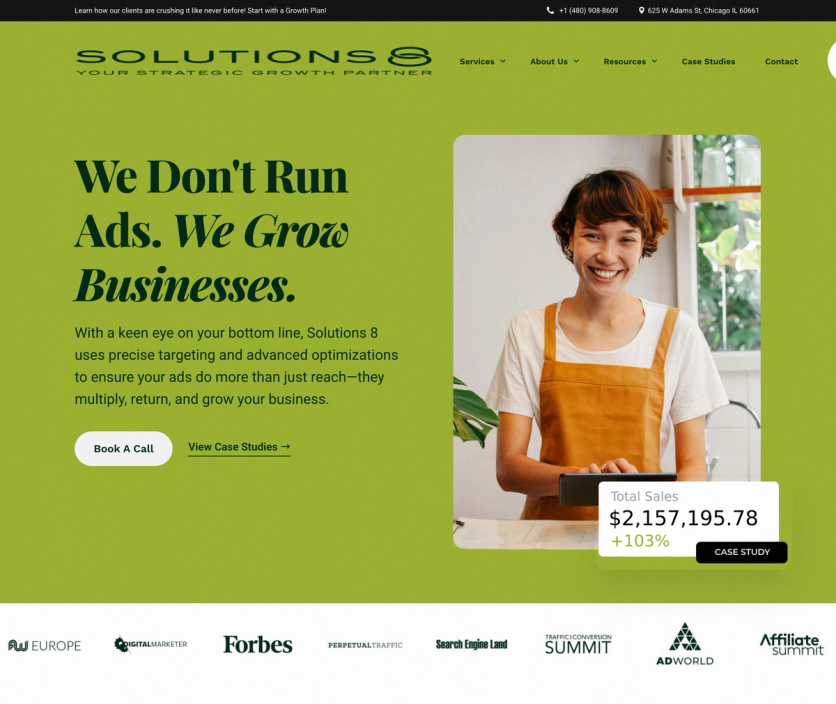
Kasim Aslam started Solutions 8 in 2006 as a one-man web development shop. Today the agency runs Google Ads for ecommerce and lead-generation clients, covering Search, Shopping, and Performance Max, with Meta and Amazon ads alongside.
Pricing: Not published. The pricing page states no hourly billing and no long-term contracts.
Real cases:
- TOCCIN – monthly revenue grew from $31,136 to $100,254 in four months.
- Aminah Abdul Jillil – sales up 22% after the agency took over Meta ads.
Client reviews: The Clutch review from the last 12 months credits a lower cost per acquisition and clear communication, and asks for more transparency.
Vysta
🏅 Google Premier Partner 2026
📍 Evesham, New Jersey
Founder Nate Schneider ran his own ecommerce brands before he started the agency. Today Vysta manages Google Search, Shopping, Performance Max, YouTube, and Demand Gen for eight- and nine-figure brands, and takes on no Meta, TikTok, or Amazon work.
Pricing: The homepage says most ecommerce clients pay £1,500–4,000 a month in management on top of ad budget. It asks for at least £10,000 a month in existing ad spend.
Real cases:
- Elavate Superfoods – cost per acquisition on cold traffic nearly halved, by the client’s account.
- Hume Health – $220,000 a day in revenue from Google and YouTube.
Client reviews: Clutch reviews from September 2026 praise communication and a structured approach. One calls the agency “not the cheapest”.
Multi-Channel Teams for Larger Budgets
Affect Group
🏅 Awards listed on the agency’s site: Effie, Shorty, and Clutch
📍 Sacramento, California
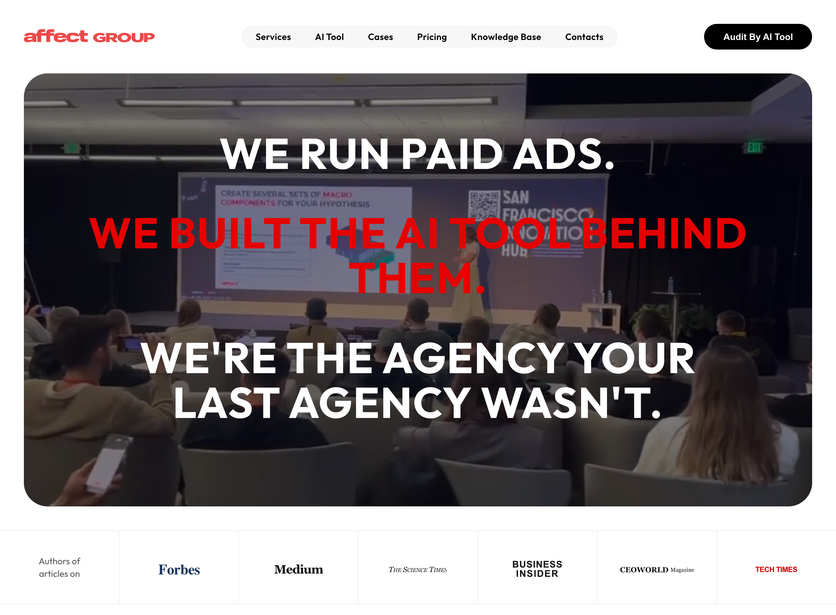
Affect began as an advertising agency in 2003, and its US company now runs the performance marketing arm. Today Affect Group manages Google, Meta, TikTok, and programmatic campaigns with performance creative and analytics. It also builds DataMind, its own AI auditor for Google Ads accounts. Published work spans a travel marketplace, B2B software, and a consumer hardware launch.
Pricing: One of the few public rate cards on this list. The agency fee is a $6,500 minimum up to $250,000 in monthly media spend, 3% from $250,000 to $450,000, and 2% above that, capped at $15,000. DataMind has a free plan and paid plans from $99 a month.
Real cases:
- Cheap Airport Parking – monthly profit up more than 40% against the same month a year earlier.
- Shorty Awards – 450% ROAS from new users.
- Rubik’s WOWCube – more than 6M people reached on Meta during the product launch.
Power Digital
🏅 Google Premier Partner 2026 · Amazon Ads Advanced Partner · Klaviyo Master Elite Partner
📍 San Diego, California
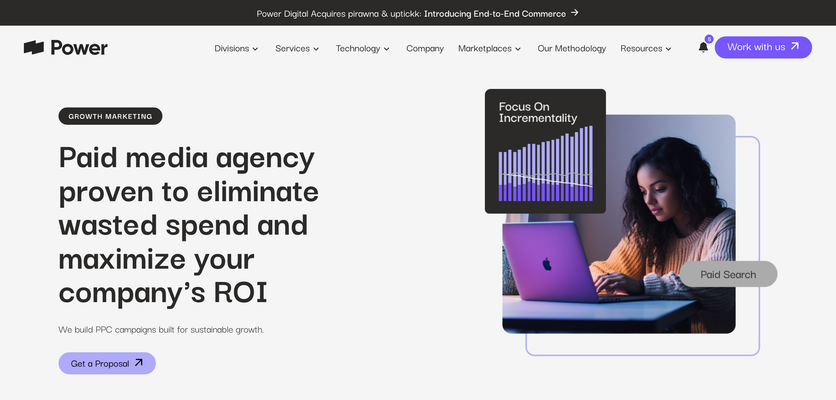
Grayson Lafrenz founded Power Digital in San Diego in 2012. Today it is a growth marketing agency with divisions for consumer goods, fashion, and lifestyle brands next to B2B and healthcare. Its paid media teams run Google, Microsoft, Amazon, paid social, and connected TV with creative in-house. In September 2026 it acquired an Amazon agency and a TikTok Shop agency.
Pricing: Not published. The paid media page says the agency quotes after reviewing the account. Its Clutch profile lists a $5,000 minimum project.
Real cases:
- YoungLA – net sales up 22% year over year.
- A non-toxic makeup brand – 3.65 incremental ROAS from YouTube prospecting, measured in a matched-market test.
- A guitar brand – ecommerce revenue up 22% year over year.
ROI Revolution
🏅 Google Premier Partner 2026 · Shopify Plus Partner · Amazon Ads Verified Partner
📍 Raleigh, North Carolina
Timothy Seward founded ROI Revolution in 2002 and still runs it as CEO. Today the agency covers paid search and Shopping, paid social, programmatic and connected TV, and Amazon and retail media for ecommerce brands, with product feed optimization in-house.
Pricing: Not published.
Real cases:
- A luxury handbag brand – connected TV test returned ROAS above 7:1 against a 6:1 goal, measured in GA4.
LP (Formerly Logical Position)
🏅 Google Premier Partner 2026 · Microsoft Advertising Elite Partner · Amazon Ads Advanced Partner · Shopify Plus Partner
📍 Lake Oswego, Oregon
Michael Weinhouse founded Logical Position in 2010 in Beaverton, Oregon, and the agency became LP in October 2026. Today it is a large digital agency with an ecommerce practice alongside local and enterprise clients. That practice runs paid search, Shopping, Performance Max, paid social, and Amazon ads, with data feed work.
Pricing: Not published.
Real cases:
- Azure Standard – account-wide revenue up 61% in 2025 against 2024.
- WOLFpak – sales up 33% after campaigns launched in 2024.
- FoamOrder – revenue up 41% year over year.
Search and Social for Stores Past $1M
Digital Position
🏅 Google Premier Partner · Microsoft Advertising Partner · Amazon Ads Verified Partner
📍 Simsbury, Connecticut
Roger Parent founded Digital Position and now advises its CEO, Grant McKinstrie. Today a US-based team of 27 runs paid search, shopping, and paid social for ecommerce brands with at least $1M a year in online revenue, with creative and server-side tracking in-house.
Pricing: Performance marketing starts at $3,000 a month and scales with ad spend. Creative starts at $2,000 a month, and tracking setup is $3,000 once. The pricing page states no commitment.
Real cases:
- PeachSkinSheets – $300,000 in additional Google Ads revenue without more spend, attributed.
- Milk Street – $900,000 in Google Ads revenue and 1,100 new customers, attributed.
- Mary Square – ad revenue up more than 60% without more spend, attributed.
Client reviews: Clutch reviews from spring 2026 describe the team as an extension of the client’s own and note that it stays within budget. Reviewers name no recurring issue.
Structured
🏅 TikTok Marketing Partner
📍 Marina del Rey, California
Nick Shackelford and Jake Schmidt founded Structured in 2017. Today the agency runs Meta, TikTok, Google, Pinterest, and Snapchat ads with creator and studio creative, plus email, SMS, and conversion work for the same clients.
Pricing: Paid media starts at $6,500 plus a percentage of spend. The initial term is 60 days, then month to month, for brands with $150,000 or more in monthly revenue.
Real cases:
- PackIt – new-customer CAC on the site down 60% during a 2025 sale.
- MNML – TikTok Shop revenue up 149% in two months.
- Gee Beauty – new-customer ROAS up 33% in three months.
Client reviews: Clutch reviews from the last 12 months praise revenue growth, project management, and fast communication. One asks for more guidance on brand creative and tone.
Inflow
🏅 Google Partner
📍 Tampa, Florida
Michael Belasco founded the company as seOverflow, a search agency. Today Inflow is a remote team of about 25 that manages Google Search and Shopping with feed optimization, Microsoft, YouTube, Amazon, and Meta ads, with conversion work and SEO for the same stores.
Pricing: Not published. The agency says it manages accounts from $3,000 to $2M a month in ad spend.
Real cases:
- A military accessories brand – total site revenue up 59%.
Client reviews: The Clutch review from October 2026 notes consistency, on-time delivery, and responsiveness.
How to Tell If It Is Working
Three checks run on data the brand owns, with no agency report needed.
Track new-customer CAC next to the blended number. Divide ad spend by the number of new customers acquired in the period, using first-time buyers from Shopify’s customer reports. A blended figure that improves while new-customer CAC rises means the ads are reaching people who already buy.
Check contribution margin after ad spend. Contribution margin is sales revenue minus variable costs, and ad spend is one of those costs. Watch it month over month alongside MER, which is total revenue divided by total marketing spend. ROAS can rise while both of these fall.
Run a lift test once a year. Meta’s Conversion Lift holds ads back from a control group and compares conversions between the two groups. It costs nothing extra and needs a campaign with $5,000 or more in spend and at least 500 conversions. Google offers user-based and geography-based lift studies for eligible accounts.
In-House or Agency for Paid Media
The choice comes down to monthly ad spend and how much creative the account needs.
A paid marketing manager in the United States earns $122,493 a year on average, according to Salary.com in November 2026. The Bureau of Labor Statistics puts the median for advertising and promotions managers at $133,660. That is about $10,200 a month in salary before benefits, tools, and creative.
- Agency. At a 15% fee, an agency costs less than that salary until spend passes roughly $68,000 a month. This is an estimate from the two figures above. The fee also covers creative and analytics people a single hire can’t replace.
- In-house. Past that level, a full-time buyer who knows the product can cost less than a percentage fee. Creative production and tracking still need someone, on staff or freelance.
Tiered fees move that line. On Affect Group’s rate card, the fee at $450,000 a month is capped at $15,000, close to the cost of one senior hire.
Final Verdict
Pick the agency by what the account needs most:
- Google Shopping, Performance Max, or YouTube – Solutions 8 or Vysta.
- Many channels at a larger budget – Affect Group, Power Digital, ROI Revolution, or LP.
- Search and social with tracking or creative in-house – Digital Position, Structured, or Inflow.
Then give the agency better inputs. Maestra plugs customer segments and Dynamic Product Cards into the ad accounts the agency already manages. See the modules on the pricing page or book a demo.
Frequently Asked Questions
- A paid media agency for an ecommerce brand costs from about $3,000 a month for a flat plan to a $6,000–6,500 minimum with a percentage of ad spend. Digital Position starts at $3,000 a month, Stackmatix charges $6,000 a month or 15% of spend, whichever is greater, and Affect Group sets a $6,500 minimum with 3% and 2% tiers above it. Ad spend and, at many agencies, creative are billed on top.
- A percentage-of-spend fee is a fair deal when the percentage falls as spend grows or the fee is capped. WebFX drops from 15% to 12% above $30,000 a month, and Affect Group caps its fee at $15,000. A single percentage with no tiers pays the agency more every time the budget rises, whatever happens to profit.
- Meta ROAS rises without more budget when the ads get better audiences and better product creative. Maestra sends customer segments to the ad account and replaces plain catalog photos with Dynamic Product Cards that show price, rating, and offers. Defense Mechanisms took Meta Ads ROAS from 17x to 34x this way. “Maestra made setting up our Meta catalog quick and easy,” says Scott Julian, Marketing Content Specialist at Defense Mechanisms.
- The same agency can run paid media and email, but most are stronger in one of the two, so check the email team as carefully as the media buyers. A less obvious setup keeps the paid media agency and moves email, SMS, and loyalty to Maestra, where a Forward Deployed Marketer runs them. At Furniture Fair, that marketer also fixed the product feed behind the brand’s Facebook ads. “They care about my results, not just contracts,” says Kyle Cannon, the brand’s Digital Marketing Manager.
- The brand should own the ad accounts, the pixel, and the product catalog. An agency then works through partner access that can be removed in a day. Audiences and campaign history then stay with the brand when the contract ends.