
Best Customer Data Platforms for E‑Commerce
Your customer data lives in 10+ tools – and none of them talk to each other. Purchase history in Shopify, email clicks in your ESP, ad spend in Meta, loyalty points somewhere else. At enterprise scale, this isn’t just inconvenient – it’s a revenue leak. Broken personalization, redundant campaigns, segments built on yesterday’s CSV exports. Dedicated customer data platforms solve this with real-time identity resolution and unified profiles you can actually activate.
This guide compares 11 dedicated CDPs – platforms built from the ground up for data unification, not marketing tools with a CDP label bolted on. We evaluated each on identity resolution, activation speed, channel coverage, and real pricing. Whether you’re a high-growth brand hitting the limits of your ESP or an enterprise retailer consolidating a fragmented stack – here’s the honest breakdown.

Looking for CDPs built for ecommerce? This guide covers the broader market. For online stores specifically, see our ranking of the best customer data platform for ecommerce tools.
Quick Verdict: Best Customer Data Platforms by Category
Best for e-commerce activation: Maestra – real-time CDP with built-in marketing channels ($2,000/mo)
Best for data clean rooms: Decentriq – privacy-first collaboration on sensitive data
Best for mobile-heavy brands: Insider One – AI-powered cross-channel journeys
Best for content-driven commerce: Bloomreach – search, merchandising, and CDP combined
Best for Salesforce ecosystem: Salesforce Data 360 (formerly Salesforce CDP) – native CRM data unification
Best for composable architecture: Twilio Segment – developer-friendly data routing (from $120/mo)
Best for enterprise analytics: Adobe Real-Time CDP – deep Adobe Experience Cloud integration
Best for tag management: Tealium – server-side data collection at scale
Best for data engineering teams: Treasure Data – flexible enterprise data infrastructure
Best for Shopify stores: Klaviyo – email/SMS CDP for SMB e-commerce (free tier available)
Best for retail identity resolution: Amperity – AI-powered customer identity matching
Common CDP Challenges
Before evaluating individual platforms, here are the patterns that trip up CDP buyers most often. These aren’t complaints about any single tool – they’re structural issues across the category, sourced from hundreds of G2, Capterra, and TrustPilot reviews.
| Pain Point | Description | What to Look For |
|---|---|---|
| Implementation That Drags On | Enterprise CDPs routinely take 4-6+ months to implement. Complex data models, custom integrations, and multi-team coordination turn “quick wins” into quarter-long projects. Some platforms require dedicated engineering teams just for onboarding. | Ask how long implementation takes for a company your size. Check whether onboarding is included or billed separately. Prioritize platforms where a dedicated team handles migration. |
| Data Collection Without Activation | Many CDPs excel at unifying data but offer limited tools to act on it. You end up with beautiful customer profiles that still need to be exported to separate email, SMS, and ad platforms – adding latency, complexity, and integration points. | Evaluate whether the CDP can activate data natively (email, SMS, push, site personalization) or only feeds other tools. The fewer handoffs, the faster you move. |
| Opaque Pricing & Escalating Costs | Most CDPs don’t publish pricing. Once signed, usage-based fees for profiles, events, API calls, and activations quietly inflate the bill. One G2 reviewer reported spending 40% more than the quoted price within the first year. | Demand a fully loaded cost estimate. Compare per-profile vs. per-event vs. per-org pricing. Ask what happens when you exceed thresholds. |
| Identity Resolution Quality Varies | The whole point of a CDP is unifying customer identities – but resolution accuracy differs wildly. Some platforms rely on basic deterministic matching (email = email). Others use probabilistic models that may create false positives. | Ask how the platform handles cross-device identity stitching. Test with real data during evaluation. Check whether you can audit and override resolution decisions. |
| Engineering Dependency | API-first CDPs sound flexible until your marketing team needs to file engineering tickets for basic segmentation or audience building. G2 reviews for several platforms cite “requires developer for simple tasks” as a recurring frustration. | Test whether marketers can build segments, create audiences, and activate campaigns without writing SQL or code. |
| Vendor Lock-In & Ecosystem Dependency | CDPs tied to a parent ecosystem (Salesforce, Adobe, SAP) work well inside that ecosystem – and painfully outside it. Switching costs compound as data, workflows, and integrations become entangled. | Evaluate data export capabilities and integration breadth beyond the parent ecosystem. Check how easily you can migrate workflows to another platform. |
Customer Data Platforms at a Glance
| Platform | Best For | Key Strengths | Pricing | G2 Rating |
|---|---|---|---|---|
| Maestra | Mid-size, enterprise, and rapidly scaling e-commerce brands | Real-time CDP (<300ms), omnichannel execution, built-in loyalty, site personalization, dedicated Forward Deployed Marketer for every account | $2,000/mo (CDP + email; first 100K active profiles, modules on top) | 4.8 |
| Decentriq | Privacy-first data collaboration between companies | Data clean rooms, confidential computing, partner network, no-code and Python/R workflows | Custom pricing | 4.5 |
| Insider One | Enterprise brands seeking AI-native cross-channel personalization | Sirius AI, 12+ native channels, predictive audiences, 120+ profile attributes | Custom pricing (from ~£1,000/mo) | 4.8 |
| Bloomreach | E-commerce companies wanting CDP + AI-powered marketing execution | Loomi AI included, real-time data processing, modular adoption, 130+ integrations | Custom pricing (module + usage) | 4.6 |
| Salesforce Data 360 | Organizations already invested in the Salesforce ecosystem | Native CRM integration, Einstein AI, account-based profiles, two-way data federation | Consumption credits ($500/100K); Data 360 Starter from $60K/yr | 4.3 |
| Twilio Segment | Data-driven teams needing a CDP foundation for their existing stack | 700+ integrations, composable architecture, strong event collection, identity resolution | Free tier; from $120/mo (Team) | 4.5 |
| Adobe Real-Time CDP | Fortune 500 companies with complex multi-brand digital needs | Real-time profile updates, federated audience composition, Adobe Sensei AI, B2C/B2B/B2P support | Custom enterprise pricing | 4.1 |
| Tealium | Regulated industries needing vendor-neutral data governance | 1,300+ integrations, tag management heritage, consent management, audit trails | Custom pricing (~$50,000+/yr per industry estimates) | 4.3 |
| Treasure Data | Global enterprises needing flexible CDP deployment | Complete + Composable modes, Diamond Record identity resolution, zero-copy warehouse integration | Usage-based (per-profile + events) | 4.5 |
| Klaviyo | B2C and DTC brands wanting embedded CDP with email/SMS execution | 350+ integrations, predictive analytics, lifetime data retention, fast data-to-action | From $500/mo (Advanced KDP, 100K profiles) | 4.6 |
| Amperity | Enterprise retailers with messy, fragmented customer data | AmpID (45 algorithms for identity resolution), schema-free ingestion, 505% Forrester ROI | Custom enterprise pricing (usage-based Amps) | 4.3 |
1. Maestra
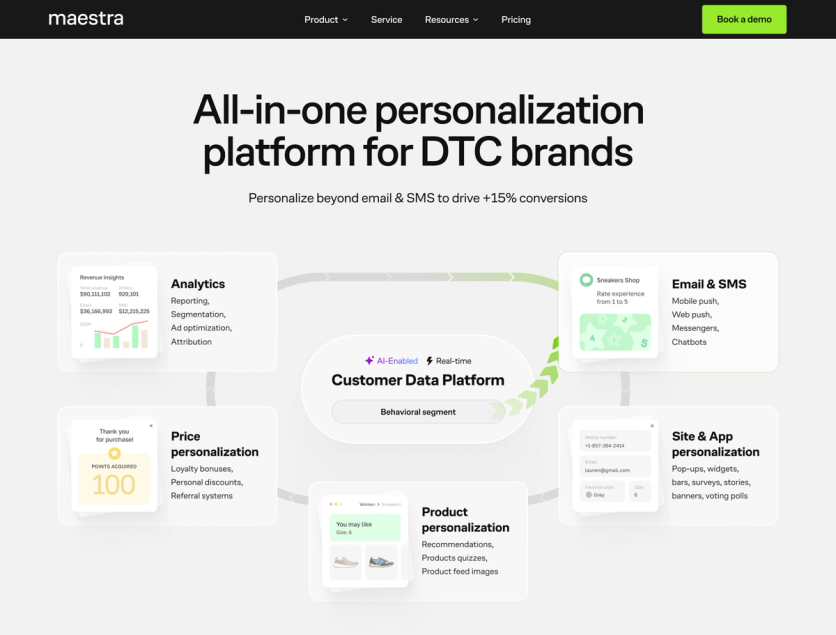
Maestra is a marketing platform built specifically for e-commerce brands. Best for mid-size, enterprise, and rapidly scaling e-commerce brands that want a real-time CDP with full marketing execution – not just data unification.
Where most CDPs stop at collecting and unifying data, Maestra treats the CDP as the foundation for a complete marketing stack. The platform consolidates a customer data platform, email and SMS marketing, omnichannel flow builder, built-in loyalty program, product recommendations, site personalization, and analytics into a single platform with white-glove service included for every account.
The platform’s customer base includes Blue Q, Sena, Enlightened Equipment, Urban Armor Gear, Coolibar, JOLYN, and Selkirk Sport.
Key Features
Real-Time Customer Data Platform
Maestra’s CDP unifies customer data from all channels – e-commerce platform, website, email, SMS, loyalty, support – into a single profile that updates in under 300 milliseconds. Unlike middleware CDPs that sync on a schedule, every interaction is available for segmentation and personalization immediately. The platform handles databases from 30K to 65M records with 150+ native integrations including Shopify, BigCommerce, WooCommerce, and Magento.
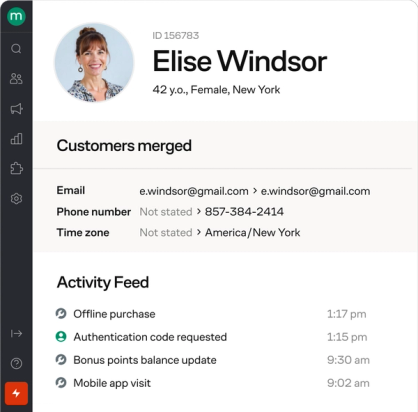
Customer profile in Maestra
RFM Segmentation & Predictive Analytics
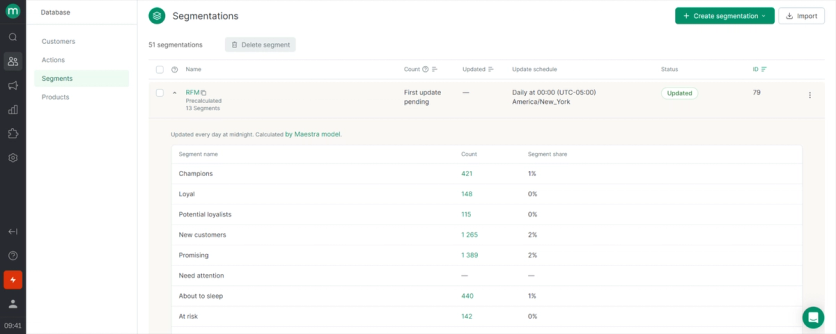
Built-in RFM analysis scores every customer by recency, frequency, and monetary value – automatically grouping your audience into actionable segments like “Champions,” “At Risk,” and “Hibernating.” Combined with behavioral segmentation, product-based segments, and nested segment logic, marketers can build precise audiences without SQL.
Omnichannel Flow Builder
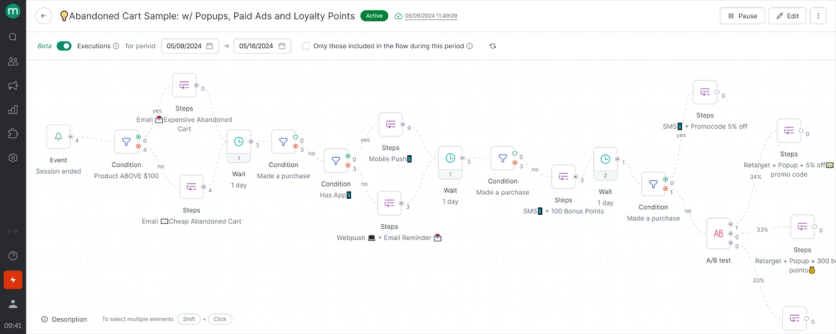
The visual flow builder lets marketers create adaptive journeys across email, SMS, WhatsApp, web and mobile push notifications, on-site pop-ups, and paid media retargeting – all in one canvas. Flows branch based on real-time customer behavior, and channel selection happens dynamically based on engagement patterns. Cascading logic automatically falls back from one channel to the next if a message isn’t delivered.
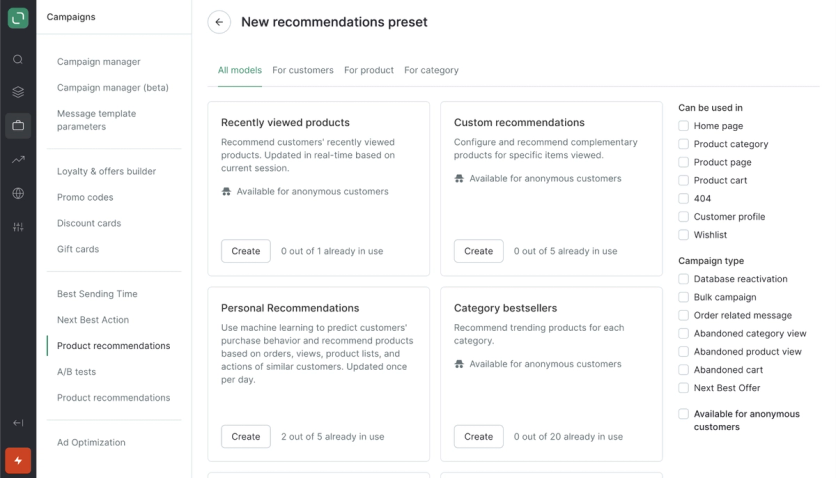
Product Recommendations
14 AI algorithms power personalized product recommendations across email, site, and push notifications. Recommendations are inventory-aware (no out-of-stock suggestions), support attribute-based matching (color, size, material), and allow business rules on top of AI. Maestra client JOLYN generates 7% of total sales from recommendation-driven campaigns. Maestra client Defense Mechanisms drives 8.9% of sales through recommendations.
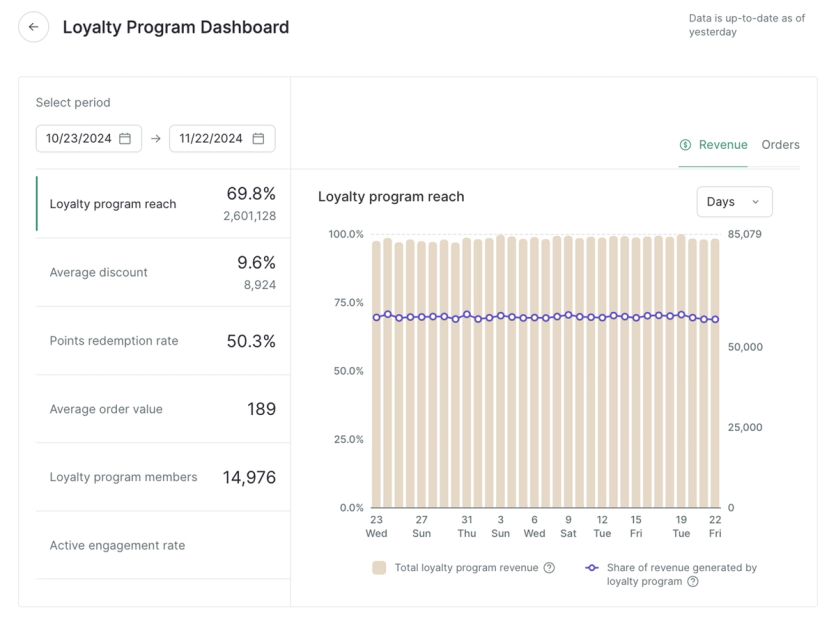
Built-In Loyalty Program
Maestra includes a full loyalty engine – points, tiers, referral programs, personal coupons, gamification – as a core part of the platform, not a bolt-on module. Loyalty data feeds directly into segmentation and flows, so you can trigger targeted campaigns when a customer reaches a new tier or is about to lapse. Maestra client G-Plans doubled customer lifetime value after switching from Klaviyo, gaining full visibility into customer data that Klaviyo couldn’t handle.
Site Personalization
No-code widgets adjust content, banners, product recommendations, and promotions in real time based on visitor behavior and segment membership. Maestra client Enlightened Equipment grew lead capture rate from 0.37% to 6.1% and increased subscriber volume by 20x using Maestra’s pop-ups with product quizzes.
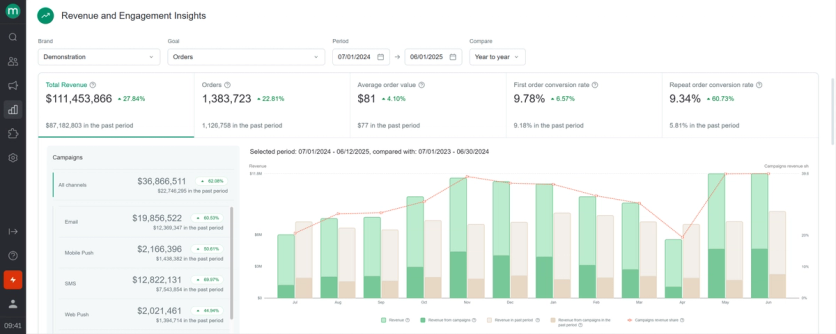
Reporting & Analytics
Real-time dashboards track revenue attribution (last-click and assisted), A/B test performance with statistical significance, and campaign-level ROI. Control group methodology measures true incremental lift. RFM analysis, cohort reporting, and email health monitoring give marketers a clear picture of what’s working without exporting data to external BI tools.
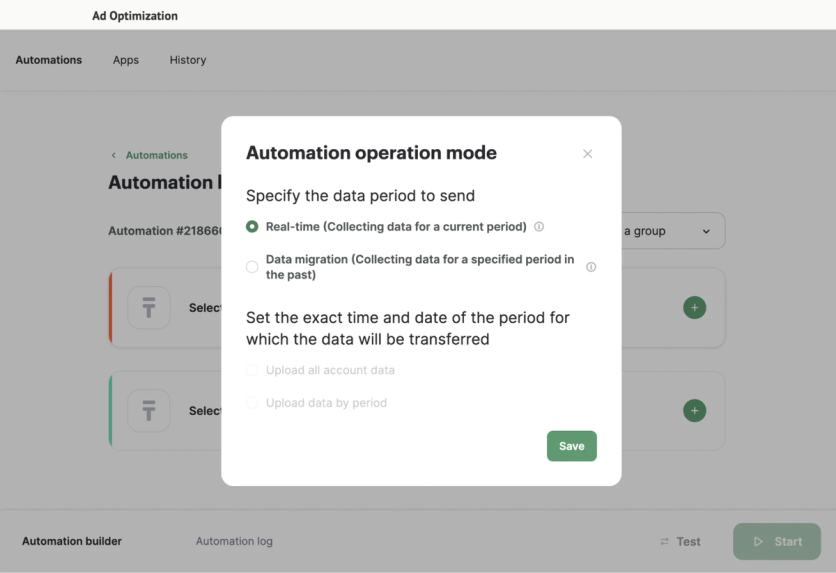
Dynamic Product Cards for Ads
Auto-updating product visuals for Meta (Facebook/Instagram) ads with real-time prices, discounts, ratings, and custom tags like “Hot Buy” or “New Arrival.” Maestra client Defense Mechanisms doubled their ROAS from 17x to 34x using dynamic product cards.
Pricing
From $2,000/mo for the real-time CDP and email, with the first 100,000 active profiles included – you pay only for active profiles, and dormant ones are stored free. SMS, on-site personalization, and loyalty are fixed monthly modules on top. Every plan includes a dedicated Forward Deployed Marketer (a marketer who works as part of your team) and managed migration. Month-to-month billing, and billing starts only after go-live.
Strengths
• One platform replaces 5-7 separate tools (ESP, CDP, loyalty, recommendations, site personalization, SMS, analytics)
• Real-time data processing under 300ms – no batch delays
• Dedicated Forward Deployed Marketer for every account (10-15 accounts per Forward Deployed Marketer vs. industry standard 60-125)
• Migration fully managed at no additional cost in 2-8 weeks; billing starts only after go-live
• 150+ native integrations with major e-commerce platforms
• Proven results: Maestra client Furniture Fair achieved 7,543% ROI replacing 5 tools; Maestra client Sena saw 8.6x campaign revenue growth after switching from Klaviyo; Maestra client Urban Armor Gear saved ~$100K/year (64% stack cost reduction) consolidating Klaviyo + Yotpo + Frosmo into Maestra; Maestra client Enlightened Equipment grew total revenue by 52.5% YoY
Weaknesses
• Starting at $2,000/mo, Maestra is not designed for small businesses or early-stage startups
• The platform is purpose-built for e-commerce and DTC – not a fit for SaaS, media, or non-retail verticals
• Fewer third-party marketplace integrations than developer-focused CDPs like Segment
When to Choose Maestra
• You’re running 3-5+ marketing tools and want to consolidate into one platform with a single customer view
• You need a CDP that doesn’t just collect data but also activates it across email, SMS, push, web, and ads
• Your team wants white-glove onboarding and ongoing optimization from a dedicated Forward Deployed Marketer – not a help desk
• You’re scaling past the limits of Klaviyo, Attentive, or a point-solution stack and need omnichannel personalization
• You want a built-in loyalty program tied directly to your customer data and marketing flows
2. Decentriq
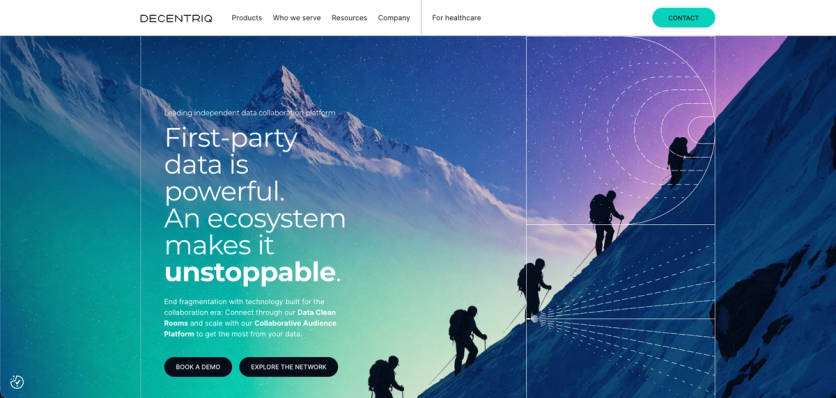
Decentriq is a clean-room-native data collaboration platform built for companies that need to work with partner data without exposing raw datasets. Best for retailers, advertisers, publishers, and agencies that want privacy-preserving audience collaboration, measurement, and activation – especially where first-party data strategy depends on external partners rather than internal customer unification alone.
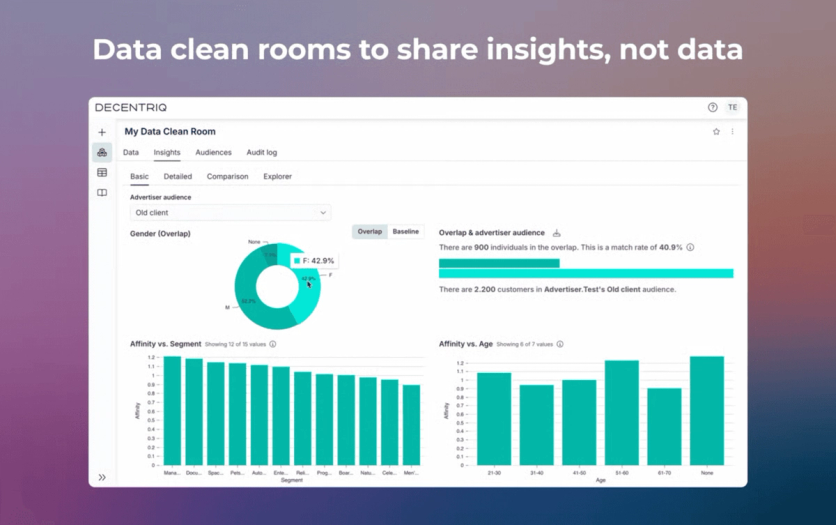
Where many CDPs focus on collecting and centralizing customer data inside one brand’s stack, Decentriq is built around cross-company collaboration. Its Data Clean Room provides a secure environment for joining and analyzing sensitive datasets without sharing raw data. Its Collaborative Audience Platform adds segmentation, identity resolution, activation, and reusable audience products on top of that foundation. For e-commerce and retail media teams, that positions it for partner-led use cases – audience building, enrichment, joint analytics, and activation – more than for in-house lifecycle marketing orchestration.
Key Features
Data Clean Room Foundation
Decentriq’s core product is a data clean room – a secure environment where multiple parties can collaborate on sensitive data without exposing underlying records. The platform uses confidential computing, meaning data is processed inside secure hardware enclaves that keep it encrypted and inaccessible during analysis. That makes it well suited to privacy-preserving collaboration between retailers, brands, publishers, and agencies.
Collaborative Audience Platform
Decentriq’s platform connects through an active partner network of advertisers, publishers, retailers, agencies, and data partners. Many high-value use cases – retail media, second-party audience building, partner measurement, and monetization – depend on coordinated workflows across organizations. That network reduces the friction of starting new collaborations and is a functional part of the platform’s value proposition.
Partner-Network Orientation
Decentriq’s platform connects through an active partner network of advertisers, publishers, retailers, agencies, and data partners. Many high-value use cases – retail media, second-party audience building, partner measurement, and monetization – depend on coordinated workflows across organizations. That network reduces the friction of starting new collaborations and is a functional part of the platform’s value proposition.
No-Code and Technical Workflows
Business users can work through a no-code interface for audience and collaboration workflows. Data scientists can use Python and R for custom analyses and advanced queries. The result is a platform that doesn’t require engineering support for standard use cases while still giving technical users full programmatic control.
Pricing
Custom pricing. Decentriq does not publish standard pricing on its website; buyers need to request a demo or contact sales.
Strengths
• Strong fit for privacy-preserving data collaboration across retailers, advertisers, publishers, and agencies – rather than internal customer-data unification only.
• Clean-room-native architecture with confidential computing reduces governance friction when working with sensitive partner data.
• Collaborative Audience Platform combines data clean room, DMP, and CDP capabilities including segmentation, identity resolution, activation, and reusable audience products.
• Supports both no-code business workflows and custom technical work in Python and R.
Weaknesses
• Not a full e-commerce marketing execution platform – no built-in email, SMS, loyalty, or on-site personalization.
• Less suited to brands whose primary need is internal CDP functionality for lifecycle marketing inside a single owned stack.
• Public messaging is built around collaboration, audience workflows, and privacy-preserving activation rather than retail CRM and campaign execution breadth.
Compared to Maestra
Decentriq is a specialized collaboration tool; Maestra is an execution platform that runs those channels itself. Decentriq doesn’t send emails, run loyalty programs, or personalize websites – it enables secure data collaboration across company boundaries. Maestra handles all of that natively, with a real-time CDP powering every channel. For teams replacing multiple marketing execution tools with one platform, Maestra is the more direct fit. For teams where the core problem is secure, privacy-preserving collaboration with external partners – retailers working with brands, publishers, or agencies on audience activation and measurement – Decentriq is the more differentiated choice.
3. Insider One
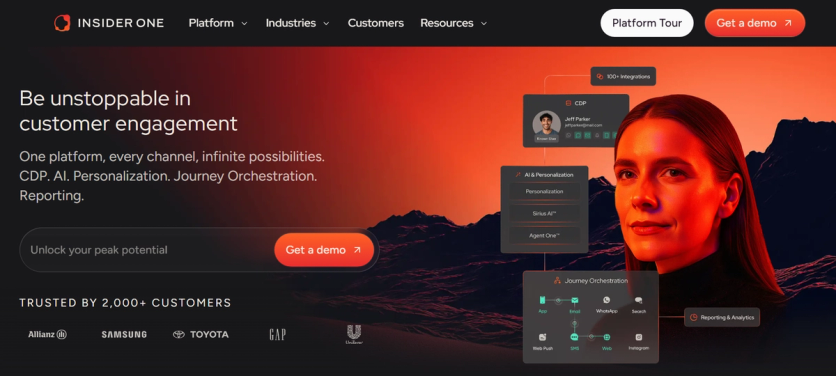
Insider One integrates customer data management with AI-powered cross-channel marketing automation. Best for enterprise brands seeking AI-native personalization across 12+ channels with predictive audience building.
The platform serves over 2,000 customers globally, including Samsung, L’Oréal, Unilever, Allianz, and Toyota. Insider One was recognized as a Gartner Peer Insights Customers' Choice for Personalization Engines (2025) and named a Leader in the IDC MarketScape: Worldwide AI-Enabled Marketing Platforms for Enterprise Companies 2025.
Key Features
Unified Customer Profiles
The platform brings together customer data from any online or offline source – CRMs, POS devices, analytics tools, data warehouses – and creates unified customer profiles with 120+ attributes. Data is stored for five years by default.
Sirius AI & Predictive Audiences
Insider’s AI engine generates predictive audiences based on likelihood to purchase, churn probability, discount affinity, and projected lifetime value. The system combines generative, predictive, and agentic AI capabilities for campaign optimization.
Native Channel Activation
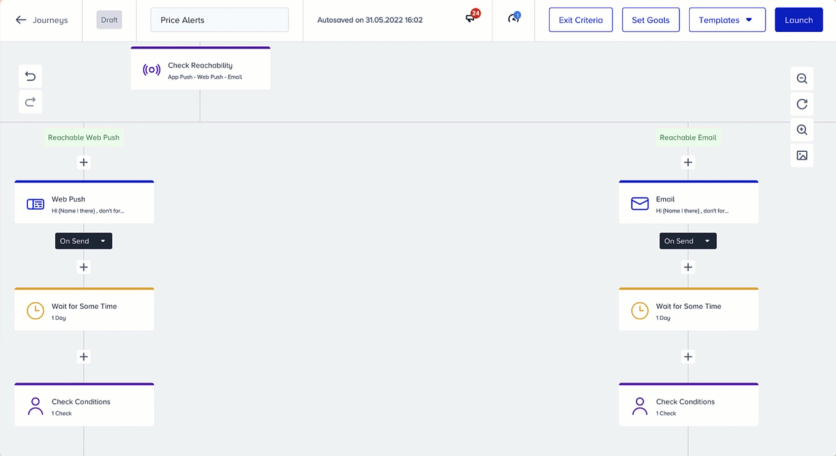
WhatsApp, SMS, email, web, app, and site search are supported natively – eliminating the need for third-party tools for basic channel activation. Smart Recommender delivers AI-powered product recommendations, while Architect enables visual journey design without IT dependency.
Implementation Speed
Insider claims implementation completes within 90 days or less. Support teams can assist with setup at no extra charge and migrate existing customer journeys from other platforms.
Pricing
Custom pricing starting from approximately £1,000/mo. Industry estimates place average annual costs around $48,000, with enterprise pricing reaching $100,000+ depending on requirements.
Strengths
• AI-driven predictions and cross-channel data activation
• Extensive template library for fast campaign launches
• 100+ integration tools
• Unified reporting across channels
• Strong mobile channel support
Weaknesses
• Steep learning curve for teams new to journey orchestration
• Complex multi-channel journey setup requires time and governance
• G2 reviews cite integration issues and concerns about support quality at scale
Compared to Maestra
Insider One covers more channels natively (including app and site search), but Maestra offers deeper e-commerce-specific functionality: built-in loyalty programs, 14 product recommendation algorithms, and site personalization widgets that Insider handles through separate modules. Maestra’s white-glove service model (10-15 accounts per Forward Deployed Marketer) provides more hands-on support than Insider’s self-service-first approach. For e-commerce brands specifically, Maestra’s consolidation often replaces more tools at a lower total cost.
4. Bloomreach
Bloomreach Engagement combines CDP capabilities with marketing automation, analytics, and AI-driven personalization. Best for e-commerce and retail companies that want a modular platform combining data unification with AI-powered campaign execution.
Bloomreach acquired Exponea in 2021, gaining a CDP architecture built from the ground up since 2012. The platform handles massive scale – during Cyber Week 2022, Bloomreach Discovery processed approximately 1.2 billion user events per day while maintaining 100% uptime.
Key Features
Modular CDP Architecture
Bloomreach offers flexibility: businesses can select specific modules rather than committing to an all-or-nothing solution. It can function as a standalone CDP feeding unified data to existing stacks or handle complete marketing operations across channels.
Loomi AI
Loomi AI is built into every product at no extra charge. It powers tailored search results, product recommendations, campaign optimization, optimal send time calculation, customer lifetime value prediction, and purchase forecasting.
Real-Time Campaign Activation
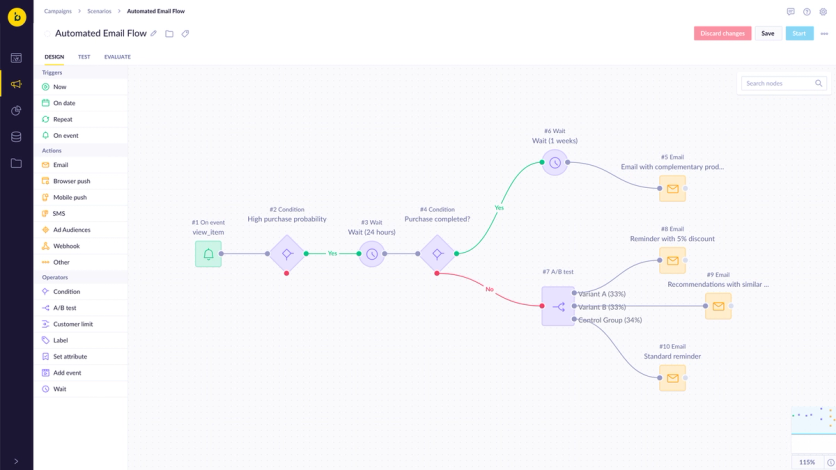
Beyond data unification, Bloomreach provides native campaign building and activation processed within milliseconds. Drag-and-drop scenario creation handles complex automated flows across channels.
Integration & Implementation
130+ native connections with common marketing tools plus a rich API for custom integrations. Implementation typically completes within six weeks, with customers using the platform within three months on average.
Pricing
Module fee plus usage fee. Customers pay only for selected modules. Usage-based pricing decreases per-unit costs as volume grows. Annual subscriptions (Bloomreach reports a 99% renewal rate). All plans include the customer data engine, Loomi AI, support, and documentation.
Strengths
• Complete CDP functionality without complex setup
• Reliable platform performance for high-scale businesses
• Flexible modular approach allowing gradual adoption
• Real-time data processing and campaign activation
• ROI payback in less than six months (per Forrester study, August 2024)
Weaknesses
• Premium pricing tier compared to mid-market alternatives
• Single Customer View card lacks depth in customer value metrics like CLV and purchase probability
• Limited free educational materials; advanced learning requires paid Academy
• Experiments module cannot scale across multiple pages simultaneously
Compared to Maestra
Both platforms combine CDP with marketing execution, but Maestra includes a built-in loyalty engine, 14 product recommendation algorithms, and dedicated Forward Deployed Marketer support (10-15 accounts each) as standard features. Bloomreach requires more technical resources for implementation and ongoing management. For e-commerce brands wanting a fully managed experience with loyalty built in, Maestra consolidates more functionality. Bloomreach’s strength lies in its search and merchandising capabilities, which Maestra doesn’t offer.
5. Salesforce Data 360
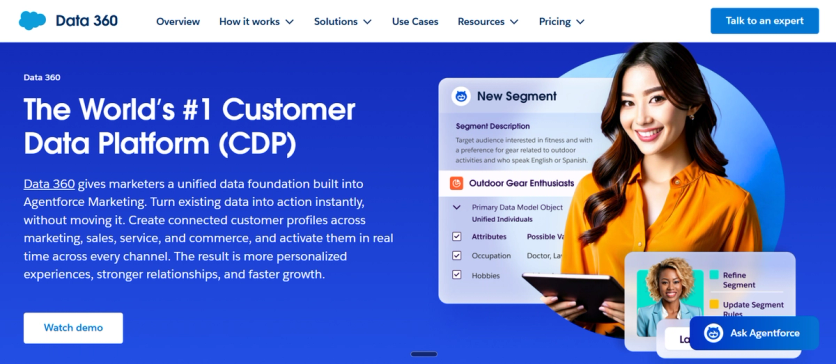
Salesforce Data 360 operates natively within the Salesforce ecosystem. Best for organizations already invested in Salesforce CRM that need unified customer data across sales, service, and marketing.
Gartner named Salesforce a Leader in Customer Data Platforms. The platform functions as a data solution for multiple departments – marketing, sales, service, commerce – and enables workflow automation and AI-powered customer interactions through Einstein AI.
Key Features
Two-Way Data Federation
Data 360 unifies customer data from any source without physically moving it. Two-way data access between Salesforce and partners like Snowflake or Google BigQuery keeps data where it lives while making it queryable.
Identity Resolution
The platform links disconnected records through user-defined rules – determining that different email addresses, phone numbers, and cookie IDs belong to the same individual.
Einstein AI & Calculated Insights
Calculated Insights enable custom metric creation from customer profile data. Einstein AI powers intelligent segmentation. The system supports both individual and account-based profiles, combining insights from ERPs, PLMs, and OMSs.
CRM Integration
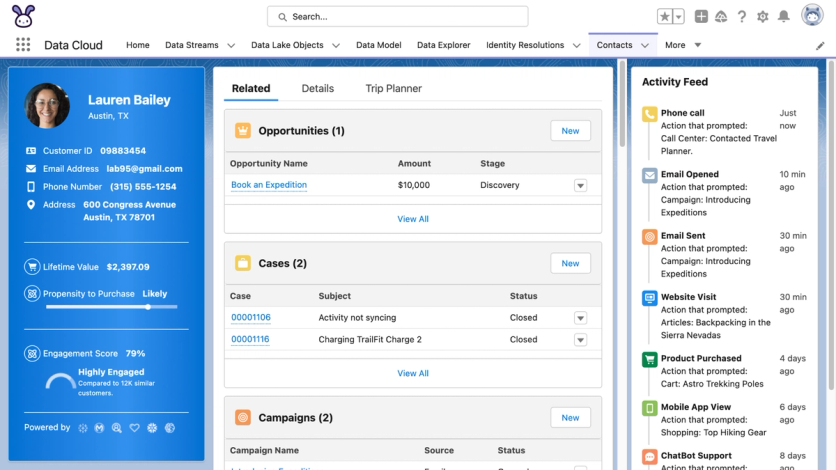
Native connectivity to Salesforce apps means unified profiles appear directly as fields and related lists within the core CRM platform. Prebuilt integrations to cloud storage like Amazon S3 reduce custom integration requirements.
Pricing
Salesforce restructured Data 360 pricing under the Data 360 rebrand. The primary model is consumption credits at $500 per 100,000 credits (use for any Data 360 action). Data 360 Starter begins at $60,000/year. Profile-based SKUs ($240-$420 per 1,000 profiles/year) exist as a secondary option. Annual contracts required.
Strengths
• Deepest CRM integration of any CDP on the market
• Einstein AI capabilities for segmentation and predictions
• Account-based CDP functionality for B2B use cases
• Visual data model interface
• Federated data architecture reduces data movement
Weaknesses
• Expensive: consumption-based pricing adds up quickly at scale (legacy Starter for Marketing was $108,000/org/year)
• Complex segmentation interface with a steep learning curve
• 4-6+ month implementation timeline for most organizations
• Real-time streaming is available but segmentation and activation can still involve batch processing delays depending on configuration
• Requires the Salesforce core platform – not a standalone CDP
Compared to Maestra
Salesforce Data 360 excels within the Salesforce ecosystem but requires significant investment in both licensing and implementation. Maestra offers real-time data processing under 300ms with immediate activation, built-in marketing execution across all channels, and managed implementation in 2-8 weeks vs. 4-6+ months. For e-commerce brands, Maestra’s published price of $2,000/mo delivers more predictable value than Salesforce’s consumption-based credits model – and Maestra includes loyalty, recommendations, and site personalization that Salesforce Data 360 doesn’t offer natively. You can build your own estimate on the Maestra pricing page.
6. Twilio Segment
Twilio Segment is a composable CDP that collects, unifies, and routes customer data to 700+ downstream destinations. Best for data-driven engineering teams that need a flexible CDP foundation to feed their existing marketing and analytics stack.
Forbes Advisor ranks Segment as a top customer data platform. The platform launched in 2012 and was acquired by Twilio in November 2020. Its composable architecture lets businesses collect event data and route it to whatever tools they already use.
Key Features
Event Collection Infrastructure
Segment captures real-time data from every customer touchpoint – mobile apps, websites, servers – and federates it to downstream tools. The Connections product handles event data collection and routing.
Identity Resolution & Profile Unification
Unified profiles are enriched with each new interaction. The system merges behavioral data from multiple sources through deterministic identity resolution and automatic profile merging.
Composable Architecture
Four base products: Connections (event collection), Protocols (data governance), Unify (identity resolution), and Twilio Engage (audience building and activation). Each can be adopted independently.
Integration Depth
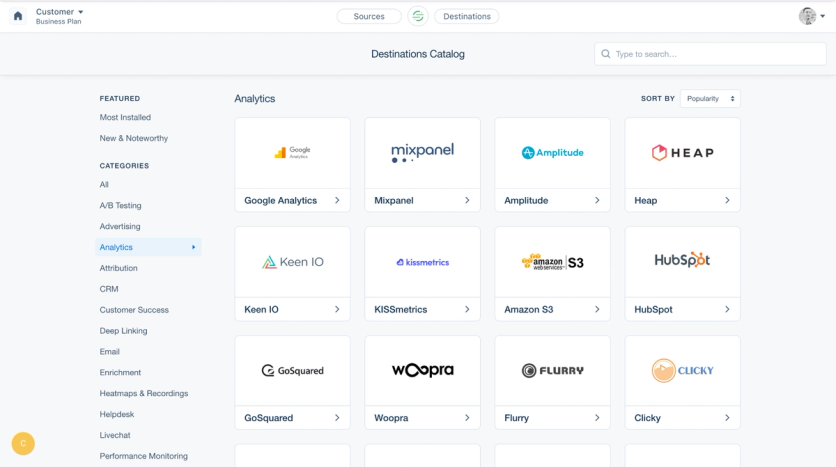
700+ pre-built integrations with analytics tools, marketing platforms, data warehouses, and customer support systems. API-first design makes custom integrations straightforward for engineering teams.
Pricing
Free plan: up to 1,000 monthly tracked users (MTUs) with limited sources and 450+ integrations. Team: from $120/mo for 10,000 MTUs with unlimited sources. Business: custom MTU-based pricing (industry estimates: ~$7,000 list for 100K MTUs, negotiable to $1,820-$3,332 after discounts).
Strengths
• Mature event collection infrastructure trusted by engineering teams
• Extensive integration catalog (700+ destinations)
• Strong product documentation
• Easy scaling and API-first flexibility
• Free tier available for small teams
Weaknesses
• Data model is inflexible – prevents custom objects
• Long implementation timelines for complex setups
• Steep learning curve for non-technical users
• High-traffic businesses find costs escalating quickly
• Does not store customer data natively – relies on downstream tools
Compared to Maestra
Segment is a data infrastructure tool; Maestra is an execution platform. Segment collects and routes data but doesn’t send emails, trigger SMS, personalize websites, or run loyalty programs – you need separate tools for all of that. Maestra includes a real-time CDP plus every activation channel in one platform. For e-commerce teams that want to act on their data immediately without managing 5+ integrations, Maestra provides faster time-to-value. Segment is the better choice for teams with strong engineering resources that want maximum flexibility in their tool selection.
7. Adobe Real-Time CDP
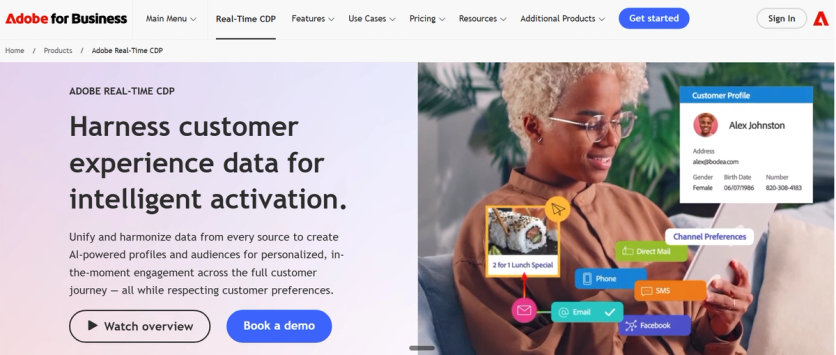
Built on Adobe Experience Platform, Adobe Real-Time CDP unifies known and anonymous data from multiple enterprise sources. Best for Fortune 500 companies with complex, multi-brand digital operations that are already invested in the Adobe ecosystem.
Adobe is the only Visionary in the Gartner Magic Quadrant for Customer Data Platforms. The platform supports B2C, B2B, and B2P (business-to-person) use cases with flexibility for organizations managing diverse customer and account relationships.
Key Features
Real-Time Profile Updates
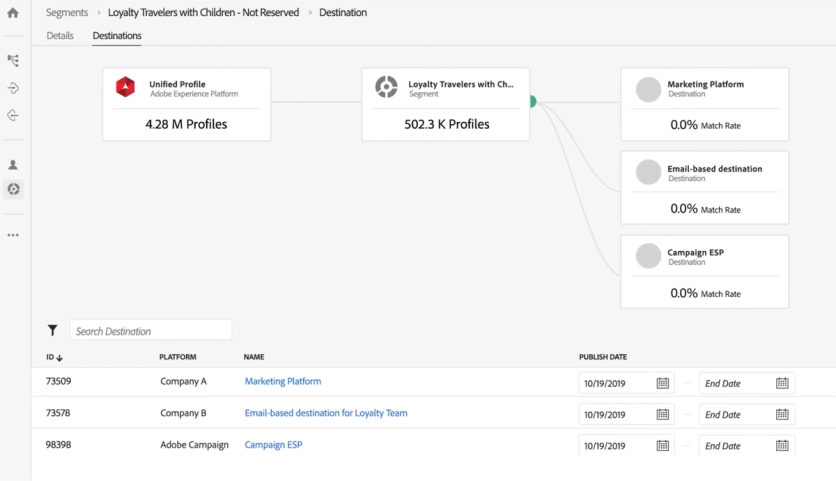
Customer profiles update the moment new data becomes available – product views, email clicks, in-store interactions trigger immediate changes. However, profile update latency of up to 15 minutes has been reported.
Federated Audience Composition
Enterprises can federate datasets from existing data warehouses to create and enrich audiences without moving data. This reduces data duplication and storage costs.
Adobe Sensei AI
AI-powered insights drive intelligent segmentation, propensity scoring, and audience optimization. Integration with Adobe Analytics, Adobe Target, and Adobe Campaign creates a unified intelligence layer.
Sandbox Tooling
Export and import configurations between development environments for improved accuracy. Use Case Playbooks provide pre-built templates to help teams get started faster.
Pricing
Custom enterprise pricing. Three editions: B2C, B2B, and B2P. Licensed per 1,000 profiles with Prime and Ultimate tiers. Pricing is not publicly available – contact Adobe sales.
Strengths
• Real-time profile updates from all touchpoints
• Native integration with Adobe Experience Cloud (Analytics, Target, Campaign)
• AI-powered insights through Adobe Sensei
• Supports B2C, B2B, and hybrid B2P use cases
• Strong data governance controls
Weaknesses
• Enterprise-focused pricing makes it inaccessible for most mid-market brands
• Steep learning curve requiring technical expertise in data architecture and Adobe’s Experience Data Model (XDM)
• Implementation takes several months with significant consulting costs
• Profile update latency of up to 15 minutes limits true real-time capabilities
• Heavily dependent on the Adobe ecosystem for full value
Compared to Maestra
Adobe Real-Time CDP is designed for Fortune 500 organizations with dedicated data architecture teams. Maestra targets mid-market and enterprise e-commerce brands with a fully managed approach. Maestra processes data in under 300ms (vs. Adobe’s up to 15 minutes), includes all marketing channels natively, and implements in 2-8 weeks vs. several months. Adobe’s strength is its broader Experience Cloud ecosystem – but for e-commerce brands that need CDP + execution without a six-figure consulting engagement, Maestra provides a more practical path.
8. Tealium
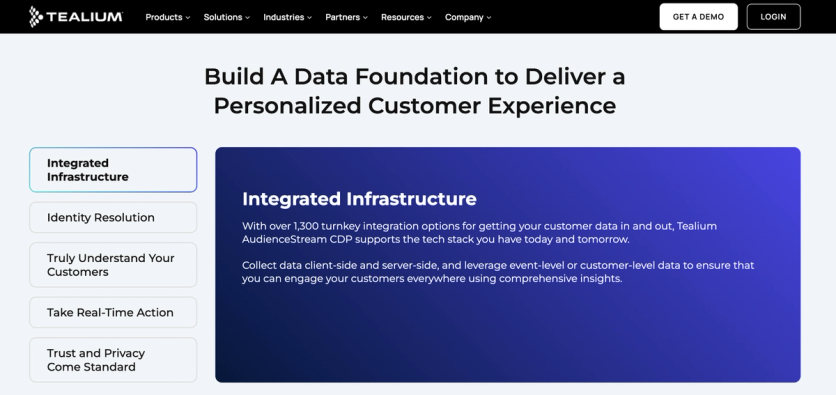
Tealium built its Customer Data Hub from tag management roots, creating a vendor-neutral CDP that prioritizes how data is collected, unified, and governed. Best for regulated industries (finance, healthcare, government) needing a vendor-neutral CDP with strong data governance and consent management.
In the 2026 Gartner Magic Quadrant for CDPs, Tealium is positioned as a Challenger (previously a Leader in 2025). Its tag management heritage gives the platform distinct advantages in data collection infrastructure compared to platforms built primarily for activation.
Key Features
Modular Data Suite
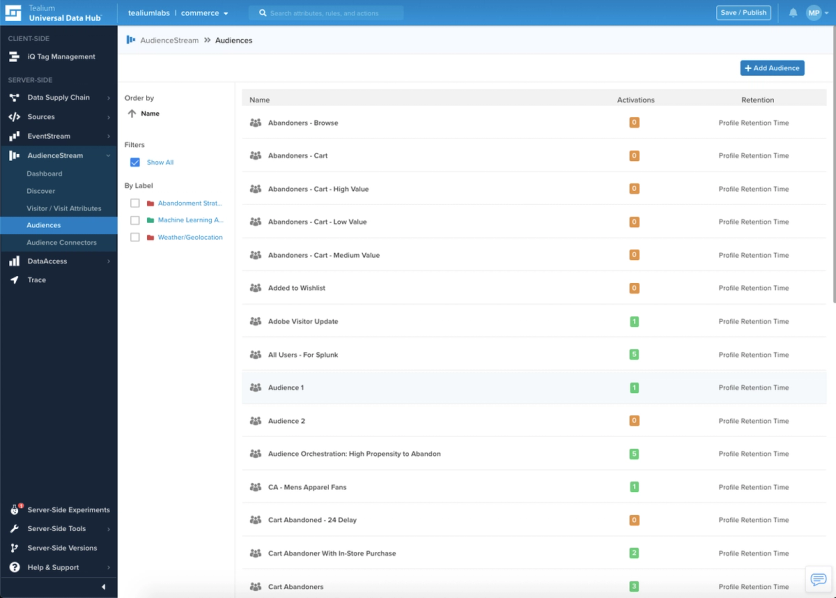
The platform operates through five modules: iQ (tag-based event data management), EventStream (real-time event capture and routing), AudienceStream (cross-channel customer profiles), Predict ML (propensity scoring), and DataAccess (cleansed data for reporting).
Vendor-Neutral Data Ingestion
Accepts data of any type from any source – bridges physical and digital worlds into a single customer view. 1,300+ integration partners reach wherever customer experiences happen without custom engineering.
Privacy & Consent Management
Consent is treated as a data attribute on every profile, governing data flow through all systems. This makes Tealium particularly strong for organizations in regulated industries.
Identity Resolution
Different identifiers from sessions, channels, and touchpoints are tied to a single visitor ID automatically. Transparent resolution with audit trails supports compliance requirements.
Pricing
Custom pricing based on event volume. Industry estimates place entry-level contracts around $50,000/year for mid-volume usage. Tealium commands a premium due to governance strength and integration depth. Contact sales for specific pricing.
Strengths
• Real-time data processing across 1,300+ integrations
• Strong governance controls for regulated industries
• Transparent identity resolution with audit trails
• Mature tag management foundation
• A Forrester study found businesses using Tealium received 363% ROI
Weaknesses
• Steep learning curve – G2 reviews consistently mention complexity
• Complex setup requiring technical expertise
• UI needs improvement (common G2 feedback)
• Resource-intensive implementation
• Premium pricing compared to lighter CDP alternatives
Compared to Maestra
Tealium is a data-first CDP designed for governance and compliance; Maestra is an execution-first platform designed for revenue growth. Tealium excels at collecting and routing data to other tools but doesn’t send emails, run loyalty programs, or personalize websites natively. Maestra includes all of that plus a real-time CDP. For e-commerce brands that need to act on data immediately, Maestra provides faster time-to-revenue. Tealium is the better choice for organizations in regulated industries where data governance, consent management, and audit trails are primary requirements.
9. Treasure Data
Treasure Data pioneered CDP technology before the term existed and is recognized as a Challenger in the Gartner Magic Quadrant. Best for global enterprises that need flexible deployment options – either a fully managed CDP or a composable layer on top of their existing data warehouse.
The platform unifies customer data and AI agents into one system, offering both Complete Mode (all-in-one managed solution) and Composable Mode (builds on existing data warehouse infrastructure).
Key Features
Flexible Deployment Modes
Complete Mode provides an all-in-one managed CDP. Composable Mode enables zero-copy integration with existing data warehouses like Snowflake, eliminating duplicate storage costs. Organizations can choose the approach that fits their data architecture.
Diamond Record Identity Resolution
Treasure Data’s Diamond Record optimizes customer profiles beyond static “Golden Records” by continuously refining identity resolution as new data arrives. The system unifies batch and streaming data at the profile level for millisecond-level personalization.
Integration Hub & Journey Orchestration
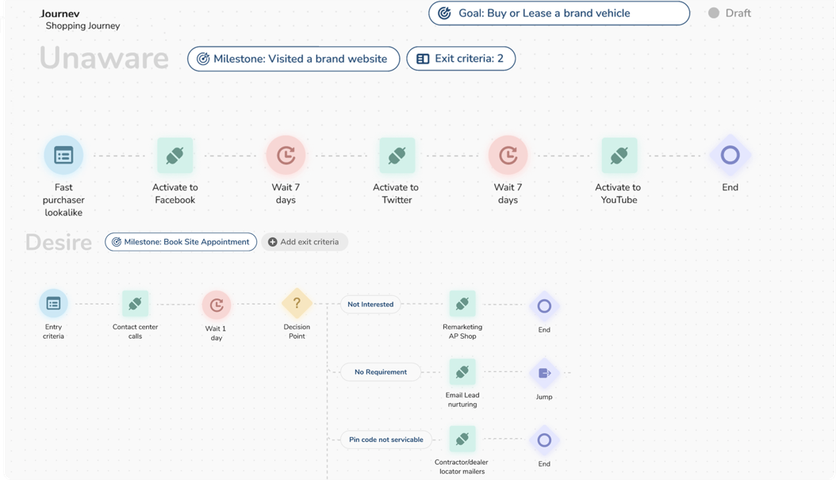
200+ data source connections support live and batch ingestion. Audience Studio builds segments, Journey Orchestration creates omnichannel experiences, and AI Agent Foundry develops custom automation.
Pricing
“No Compute” pricing charges for unified customer profiles stored and behavioral events. Unlimited queries and activations are included. This decouples cost from processing resources. Contact sales for specific pricing.
Strengths
• Flexible Complete and Composable deployment modes
• AI-native architecture for advanced use cases
• Strong Japanese market presence and support
• Zero-copy data warehouse integration reduces storage costs
• “No Compute” pricing model with predictable costs
Weaknesses
• Requires technical expertise for configuration and management
• G2 reviews report concerns about support service quality
• Limited self-service capabilities for non-technical users
• Smaller integration ecosystem compared to Segment or Tealium
Compared to Maestra
Treasure Data offers flexibility in deployment architecture but requires technical teams to manage and activate data. Maestra includes all activation channels natively and provides a dedicated Forward Deployed Marketer to handle implementation, optimization, and ongoing support. For e-commerce brands that want immediate marketing impact – not a data infrastructure project – Maestra delivers faster ROI. Treasure Data suits organizations with data engineering teams that want a flexible CDP foundation for complex, multi-department use cases.
10. Klaviyo
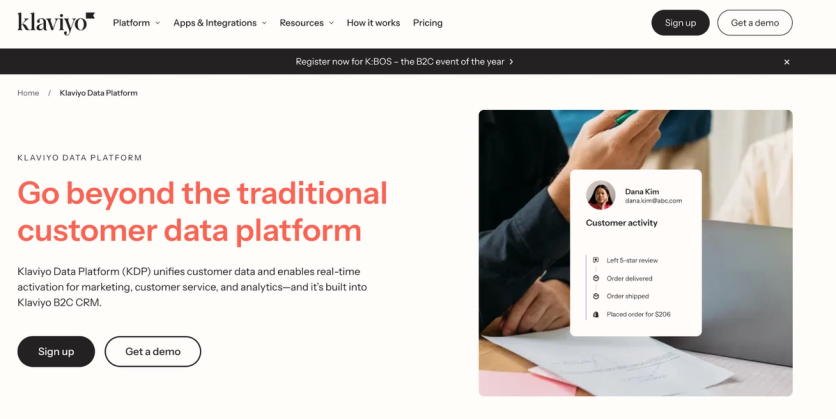
Klaviyo operates as an embedded CDP that serves B2C and direct-to-consumer brands. Best for early-to-mid-stage DTC brands that want unified customer data with email and SMS execution in one platform – without enterprise complexity.
The Klaviyo Data Platform (KDP) stores every data point with lifetime retention, unifying website behavior, purchase history, and marketing engagement into profiles that power segmentation and automation.
Key Features
Embedded CDP with Lifetime Retention
350+ data source connections through pre-built integrations, open APIs, and web tracking. Unified customer profiles update in real time with deterministic identity resolution and automatic profile merging.
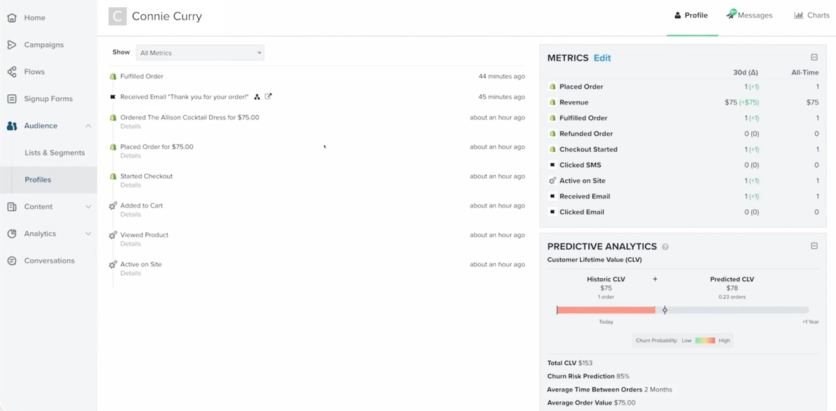
Predictive Analytics
Built-in predictions for customer lifetime value, churn risk, average time between orders, and next purchase date. These predictions feed directly into segmentation and automation triggers.
Advanced KDP Capabilities
No-code data transformations, RFM analysis for behavioral scoring, product catalog insights, funnel analysis, and data warehouse syncing with Amazon Redshift, Snowflake, Google BigQuery, and Microsoft Azure.
Pricing
Advanced KDP starts at $500/mo for 100,000 profiles (billed based on total profiles, not just active). Standard KDP features are included free with any Klaviyo Marketing plan. Email and SMS plans scale separately based on contact count and send volume.
Strengths
• Fast data-to-action activation with minimal setup
• Strong e-commerce platform integrations (Shopify, BigCommerce, WooCommerce)
• Unlimited segmentation conditions with lifetime data storage
• Predictive analytics built in at accessible price points
• Large user community and extensive documentation
Weaknesses
• Costs increase substantially as contact lists grow – high-volume senders find pricing aggressive
• Limited channel coverage: mobile push only via SDK integration (no web push), no loyalty program, no site personalization
• Support response delays reported in G2 reviews, especially for lower-tier plans
• Over-attribution of revenue to email by default
• No built-in product recommendations, dynamic ad cards, or omnichannel flow builder
Compared to Maestra
Klaviyo is a strong starting point for DTC brands, but its scope is limited to email, SMS, and basic CDP functionality. Maestra replaces Klaviyo plus 4-5 additional tools (loyalty, recommendations, site personalization, push, dynamic ads) in a single platform. Maestra client Sena saw 8.6x campaign revenue growth after switching from Klaviyo. Maestra client JOLYN increased total company revenue by 17% after the switch. Klaviyo’s advantage is accessibility – lower starting cost and faster self-service setup for smaller teams.
11. Amperity
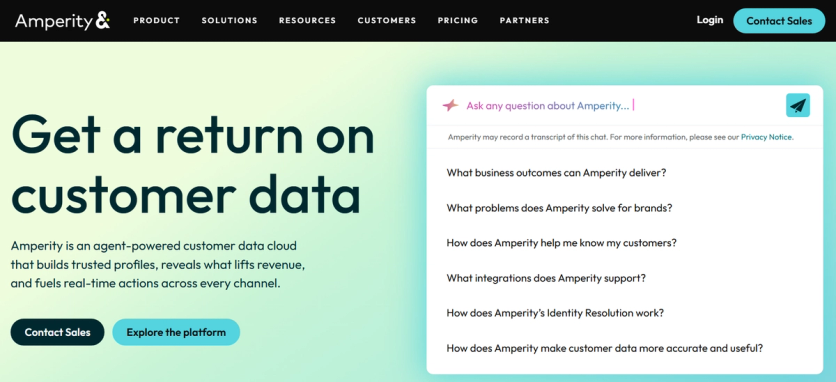
Amperity was founded in 2016 with a specific thesis: enterprise customer data is messy, and identity resolution deserves treatment as a first-class technical problem. Best for enterprise retailers and hospitality brands with massive, fragmented customer databases that need industry-leading identity resolution accuracy.
The Seattle-based company serves large consumer brands, retailers, and hospitality firms managing enormous customer data volumes across fragmented legacy systems.
Key Features
AmpID Identity Resolution
Patented technology combining probabilistic and deterministic matching through 45 different algorithms. It stitches together customer records where the same individual appears across seven systems under five email addresses and three phone numbers. The platform handles 100M to 1.2B+ records daily for global brands.
Schema-Free Data Ingestion
Accepts raw data from any source without heavy ETL. This removes a common bottleneck where data teams spend weeks or months mapping schemas before a CDP can start processing.
Amp360 & AmpIQ
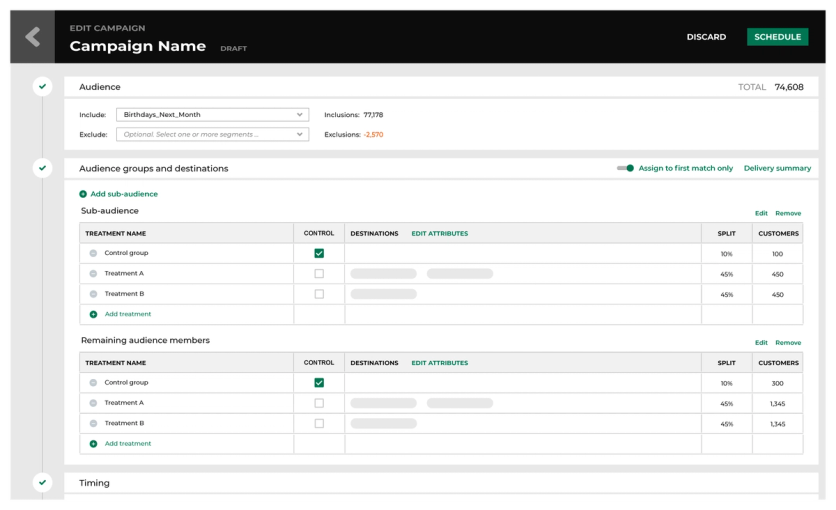
Complete Customer 360 provides prebuilt and predictive attributes with hundreds of audience templates. AmpIQ allows business users to build segments without SQL. Built-in analytics include customer lifetime value modeling, churn prediction, and purchase propensity scores.
Activation Network
200+ destinations for audience activation. A Forrester TEI study found 505% ROI from Amperity deployments.
Pricing
Usage-based “Amps” pricing where one Amp measures platform consumption across processing, queries, and campaigns. All plans include full platform access with no feature gatekeeping. Usage monitoring dashboard and automated alerts are included. Contact sales for specific pricing.
Strengths
• Industry-leading identity resolution accuracy (45 algorithms)
• Transparent data processing with explainable matching decisions
• Reliable database performance at scale
• Strong customer success team
• GDPR and HIPAA compliance
• 505% ROI in Forrester TEI study
Weaknesses
• Premium enterprise pricing – not accessible for mid-market brands
• Steep learning curve for configuration and management
• Implementation timeline spans several months
• Privacy concerns reported by some users in G2 reviews
• Automated alerts and monitoring need improvement
• Limited marketer-friendly features – designed for data teams, not campaign managers
Compared to Maestra
Amperity focuses narrowly on identity resolution and data unification – it doesn’t send emails, run loyalty programs, or personalize websites. Maestra includes a real-time CDP plus all marketing execution channels in one platform. For e-commerce brands that want to act on unified profiles immediately, Maestra provides faster time-to-revenue. Amperity is the right choice for enterprises with extremely fragmented data (hundreds of millions of records across legacy systems) where identity resolution accuracy is the primary challenge. Maestra’s CDP handles databases up to 65M records with real-time processing under 300ms – sufficient for most e-commerce operations.
Which CDP Matches How Your Team Actually Works
Maestra stands out for e-commerce brands that want full-stack consolidation – a real-time CDP, omnichannel execution, loyalty, product recommendations, and site personalization in one platform with white-glove service. Instead of stitching together 5-7 separate tools and hoping they share data correctly, Maestra provides a single customer view that powers every channel from a single interface.
But the right CDP depends on your specific situation. If you’re deeply embedded in Salesforce, Data 360 keeps everything in one ecosystem. If your engineering team wants maximum control over data routing, Twilio Segment’s composable architecture gives them that flexibility. If identity resolution across billions of messy records is your primary challenge, Amperity’s 45-algorithm approach is purpose-built for that problem.
The most important question isn’t “which CDP has the most features?” – it’s “which CDP matches how my team actually works?” A platform with perfect data unification is useless if your marketers can’t activate that data without filing engineering tickets. And a platform with every marketing channel is overkill if all you need is clean data flowing to your existing tools.
For e-commerce teams ready to consolidate their stack and see faster returns, explore Maestra’s platform or view published case studies to see results from brands that made the switch.
FAQs
- A customer data platform unifies customer data from multiple sources into a centralized database that builds persistent, unified customer profiles. Maestra’s real-time CDP processes data in under 300ms and supports databases from 30K to 65M records with 150+ native integrations. Unlike CRMs (which manage existing relationships) or DMPs (which store anonymous third-party data that expires after ~90 days), CDPs unify first-party data across all touchpoints and make it accessible for marketing, sales, and service teams.
- CDP pricing varies significantly by platform and scale. Enterprise CDPs like Salesforce Data 360 use consumption-based pricing that adds up quickly at scale. Mid-market solutions like Twilio Segment start at $120/mo for basic plans. Maestra offers a unified CDP with email, SMS, loyalty, recommendations, and site personalization included – starting at $2,000/mo with managed migration at no additional cost and billing starting only after go-live.
- The best CDP for e-commerce should unify customer data in real time, offer native integrations with platforms like Shopify and BigCommerce, and include built-in marketing execution tools. Maestra combines a real-time CDP with omnichannel marketing automation, product recommendations (14 AI algorithms), and a built-in loyalty engine. Klaviyo offers an embedded CDP with email/SMS at a lower price point. Bloomreach adds AI-powered search and merchandising. The right choice depends on whether you need a data-only CDP or a platform that collects, unifies, and activates data in one place.
- If you need real-time identity resolution and on-site personalization across multiple channels, a full CDP makes sense. If you mainly need unified views for email and ads, a data warehouse with reverse ETL tools may suffice. Maestra bridges this gap – it provides enterprise-grade CDP functionality with real-time processing, while also including all the execution tools (email, SMS, push, pop-ups, loyalty, recommendations) so you don’t need to integrate separate platforms.
- Implementation timelines vary widely. Maestra completes migration in 2-8 weeks with a dedicated Forward Deployed Marketer handling the entire process. Bloomreach typically takes six weeks to three months. Enterprise platforms like Salesforce Data 360 and Adobe Real-Time CDP often need 6+ months due to complex integrations and data architecture requirements.
- A composable CDP (like Twilio Segment or Treasure Data in Composable Mode) feeds clean, unified data to your existing marketing tools – it doesn’t execute campaigns itself. A CDP with built-in execution (like Maestra or Bloomreach) combines data unification with built-in marketing execution: email, SMS, flows, personalization. Composable CDPs offer maximum flexibility but require more integrations. CDPs with built-in execution reduce tool count and complexity but may limit flexibility. For e-commerce brands, Maestra’s all-in-one approach eliminates the integration tax while maintaining 150+ native connections to external tools.