
Best Magento Agencies [2026]: 5 Compared by Their Own Cases, With Pricing

Your store runs on Magento or Adobe Commerce, and the agency that built it now answers tickets slowly or bills $185 an hour for a patch. A version upgrade is due, the Hyvä question keeps coming up, and someone has floated moving to Shopify.
Agency websites do not settle any of it. They show an Adobe badge, a logo wall, and a contact form. They rarely say who will work on your store, how many stores that person carries, or what a support hour costs.
Below you will find what a Magento agency does and what the Adobe tiers mean, what the work costs in 2026, ten questions for a first call, and five agencies compared by their own published cases. The guide also prices what agency roundups usually skip: the marketing stack that runs on the store, including an option where the marketer comes with the platform.
Quick Verdict on Magento Agencies
The best Magento agencies for US ecommerce brands in 2026 are scandiweb, Classy Llama, Rave Digital, Human Element, and 121eCommerce. All five build on Magento or Adobe Commerce and work with US brands. US agencies charge $100–$250 an hour and $2,500–$8,000 a month for a support retainer, and a new Adobe Commerce build runs $50,000–$500,000+ before the license. Whatever you choose for marketing, you keep the development agency. For the marketing half, Maestra pairs one platform for all ecommerce marketing with a Forward Deployed Marketer. The price is $2,000 a month for the real-time customer data platform with the first 100,000 active profiles plus unlimited email, with the marketer included and AI product recommendations and analytics built in.
- scandiweb – best for an enterprise or B2B Adobe Commerce store that wants build, hosting, and support from one team · Adobe Gold Partner, Hyvä Platinum Partner · rated 4.8 on Clutch.
- Classy Llama – best for a mid-market replatform onto Adobe Commerce with B2B portals · Adobe Silver Partner · rated 4.8 on Clutch.
- Rave Digital – best for a long-running Magento retainer with the most client reviews on this list · Adobe Silver Partner · rated 5.0 on Clutch.
- Human Element – best for B2B and B2C Adobe Commerce builds and code audits from a Michigan team · Adobe Silver Partner · no Clutch reviews.
- 121eCommerce – best for a Magento 1 or legacy migration onto Adobe Commerce with a dated result · Adobe Silver Partner · rated 4.3 on Clutch.
- Maestra – one platform for all ecommerce marketing. Plus a Forward Deployed Marketer. From $2,000/month, with the first 100,000 active profiles included.
What a Magento Agency Actually Does
A Magento agency is a development company that builds, migrates, upgrades, and supports stores on Magento Open Source or Adobe Commerce, the paid edition Adobe sells on top of the same code. Marketing is a side service at most Magento agencies, so first decide which you are buying: development or marketing.
The Adobe badge is the first thing most agency sites show, so start with what Adobe requires for each level. On March 1, 2026, Adobe merged its two partner programs into the Adobe Digital Experience Partner Program. It has four levels: Community, Silver, Gold, and Platinum. The level requirements for the solution track put Silver at a $3,000 annual fee, 30 certifications, 10 customer deployments, and one specialization. Gold takes $15,000, 100 certifications, 20 deployments, and five specializations, and Platinum carries a $25,000 fee. The levels are Adobe-wide, across Experience Manager, Analytics, and the rest, so a Gold partner is not necessarily a Commerce specialist. Commerce competence sits in a separate specialization, earned per region with references from three customer projects and renewed every two years. An older program page lists a Bronze level, and some agencies still print it.
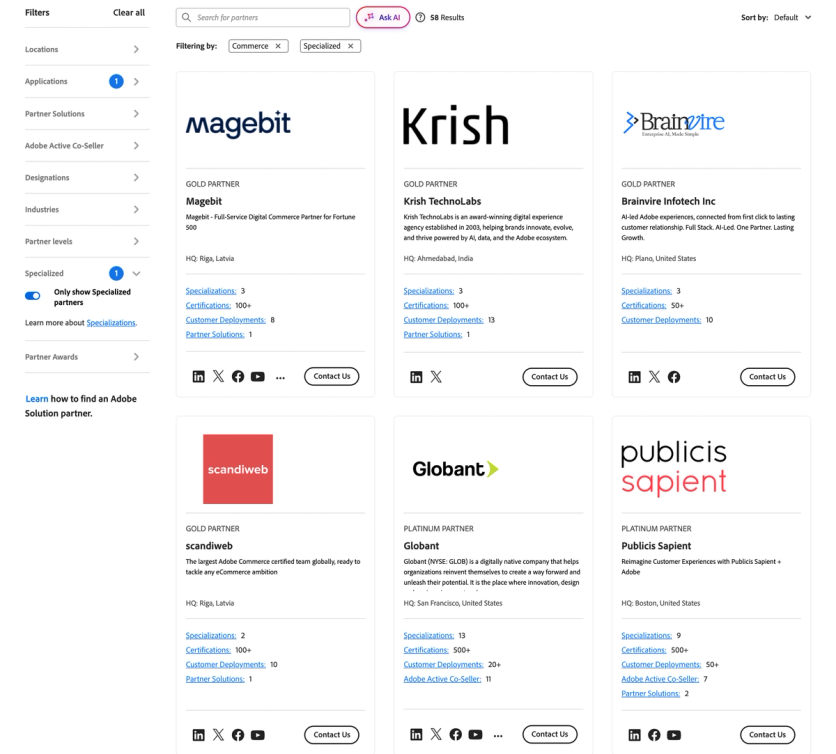
Adobe’s partner directory lists 236 partners under Commerce, and 58 of them hold the Commerce specialization, as of November 25, 2026. Filter by Applications = Commerce, switch on “Only show Specialized partners,” and add your region. Each card shows the level, the headquarters, a certification band, and a customer-deployment band, which is more than most agency sites print.
The second badge to read is Hyvä, the Tailwind-based frontend that replaces Magento’s Luma theme. Hyvä says it is trusted by 7,000+ stores, and the theme itself has been free and open source since November 2025. Its partner program runs Bronze, Silver, Gold, and Platinum on a points system. Silver needs one certified developer, Gold three, and Platinum five, and each tier sets a minimum share of live projects passing Core Web Vitals, from 50% at Bronze to 70% at Platinum. The program is free to join, and at least 45% of a partner’s points must come from Hyvä license sales, so the tier tracks Hyvä projects sold as well as certified people.
Magento work comes in two forms, and mixing them up is how stores overpay: a project stops at the handover, while a retainer bills every month against a ticket queue and an SLA.
A one-time project normally covers:
- a new build on Adobe Commerce or Magento Open Source, B2C or B2B.
- a migration: Magento 1 to 2, Open Source to Adobe Commerce, or a move to or from Shopify.
- a Hyvä frontend or a version upgrade.
- an ERP, PIM, or payment integration.
- a technical audit, usually fixed-price, with a written report.
A support retainer covers the month-to-month work:
- security patches and version upgrades on Adobe’s release schedule.
- hosting, monitoring, and uptime, sometimes on the agency’s own platform.
- a block of development hours for fixes and small features.
- site speed and Core Web Vitals work, since Magento frontends are heavy by default.
Three things changed the work in the last two years. Hyvä moved frontend builds from a Luma rework to a rebuild: scandiweb’s performance page puts it as “A typical Magento frontend loads 200+ files, and the Hyvä frontends scandiweb builds load 2.” Adobe launched Adobe Commerce as a Cloud Service, a multi-tenant SaaS edition where Adobe runs the upgrades, so an agency’s upgrade retainer becomes a smaller line on that edition. And AI agents started doing patch work: scandiweb says its agent Ari ran an Adobe Commerce “2.4.6 to 2.4.9 upgrade with three conflicts in 44 minutes” on its public demo store, with a person approving the release. The routine hours agencies used to bill for patches and upgrades shrink first, and the work worth paying for is the architecture, the integrations, and the judgment about what to touch.
Marketing sits at the edge of these agencies. All five below list marketing services. The email platform and the loyalty tool are still licensed separately from the agency’s hours, which is where the Maestra section below picks up.
What a Magento Agency Costs in 2026
A Magento agency costs $100–$250 an hour in the US, $2,500–$8,000 a month on a support retainer, and $50,000–$500,000+ for an Adobe Commerce build, before the license. Differ (February 2026) puts US agencies at $150–$250 an hour and retainers at $2,500–$8,000. Swell (April 2026) puts an Adobe Commerce implementation at $50,000–$500,000+, and Elogic (November 2026) cites US agency rates from $100. The figures below come from twelve guides and rate cards published between November 2025 and November 2026. None of the five agencies below prints an hourly rate on its own site, and Clutch shows only bands, so use these ranges as a benchmark when a quote arrives.
| Pricing model | Typical range in 2026 | What it usually covers | Watch out for |
|---|---|---|---|
| Hourly | US agencies $100–$250 · Eastern Europe $35–$85 · India $20–$65 · Latin America $30–$75 | Fixes, audits, patch work | A US sales office with offshore delivery billed at the US rate |
| Support retainer | $500–$5,000 a month for limited hours · $2,500–$8,000 at US agencies | Patches, monitoring, a block of hours | Hours that expire monthly, and patch response times left out of the contract |
| Fixed project | Open Source build $20,000–$60,000 · Adobe Commerce build $50,000–$500,000+ · Magento 1 to 2 migration $15,000–$40,000 on Open Source, $75,000–$250,000+ on Adobe Commerce · Hyvä frontend $12,000–$80,000 | A build or migration with a handover | A quote before anyone has read your extension list |
| Dedicated team | $8,000–$30,000+ a month | A named team at a monthly rate | Who owns the code and the repository when the team leaves |
Ecommerce Fastlane, updated in May 2026, puts US agency rates at $120–$200 an hour, Eastern Europe at $50–$80, and India at $30–$60. Abbacus Technologies, an Indian agency writing in 2026, adds Latin America at $30–$75 and a dedicated team at $8,000–$30,000 a month. It calls its own numbers “broad planning bands rather than standardized market rates.” On Clutch, scandiweb counted the hourly bands of 5,479 Magento firms in November 2026: 67% list under $50 an hour and 13% list $100 or more.
Build and migration figures spread by edition. Ecommerce Fastlane prices a basic Magento Open Source site at $20,000–$50,000 and an Adobe Commerce build at $100,000–$500,000+ for the first year. Emerline, updated in January 2026, puts a Magento 1 to 2 migration at $15,000–$40,000 on Open Source and $75,000–$250,000+ on Adobe Commerce Cloud. For a Hyvä frontend, Meetanshi quotes $12,000–$50,000+ as of November 2025. Elogic, updated in November 2026, puts a focused build at $35,000–$80,000 over two to four months.
Support retainers depend on how many hours they include. BSS Commerce, in November 2025, puts retainers at $500–$5,000 a month, and Bemeir works through a 100-hour retainer at $185 an hour, $18,500 a month, for a mid-market store that needs that much.
Budget the license and the hosting on top of the agency. Adobe does not publish a price list, and every guide works from partner estimates: about $22,000 a year for Adobe Commerce on premise under $1 million in revenue and about $40,000 on Adobe’s cloud, rising to roughly $125,000 and $190,000 above $25 million (mgt-commerce, March 2026; Swell gives the same top figures). Magento Open Source has no license fee, so you pay hosting instead: $150–$500 a month for managed hosting at a mid-size store, and $400–$3,000+ a month on dedicated infrastructure.
Budget the marketing stack on top of both. None of the agency figures above includes the email and SMS platform, the loyalty app, or the person who runs them. At 100,000 profiles the Klaviyo email plan alone is about $1,380 a month. A retention retainer runs $3,000–$10,000 on top, per Darkroom’s 2026 pricing guide, updated in November 2026. If email is the whole mandate, the Klaviyo agency guide prices it.
Keep the Development Agency, Replace the Marketing Stack and the Retainer
Maestra is a personalization platform for ecommerce brands. It costs $2,000 a month for the real-time customer data platform with the first 100,000 active profiles plus unlimited email, with AI product recommendations and analytics built in, and a Forward Deployed Marketer included in the price. Add the marketing stack to the agency figures above, and the store pays three parties: the Magento agency, a marketing-software vendor, and whoever runs the marketing.
A Magento store still needs its agency or its in-house team for patches, upgrades, and integrations, and nothing in this section changes that. What changes is the marketing half: the email platform, the pop-ups, the recommendations, and the retention retainer or the hire who runs them come as one line. SMS, MMS, and RCS add a flat monthly module plus per-message fees, and loyalty is a separate module on the same customer profile.
Magento sits among Maestra’s 150+ native integrations, alongside Shopify, BigCommerce, and WooCommerce. On a standard Magento store, Maestra’s team adds the tracking script through your Magento settings or Google Tag Manager and connects the store through the API. Your part is to give access and approve.
Every order, browse, and cart event from the store then lands on one real-time customer profile. So the welcome pop-up, the abandonment email, and the products picked for it react to what a shopper did minutes ago. Segments can combine several conditions, such as customers who bought a sofa this year but no accessories, and the same segment drives email, a pop-up, and an ad audience.
Your Forward Deployed Marketer owns the results and can join your quarterly business review to answer for them. They build on what already brings revenue to the other brands they work with. They do the work themselves, from the migration off your current tools to the flows, segments, templates, and pop-up tests, and your team runs one-off campaigns with their help. When an integration needs your Magento developer, the marketer manages that project and works with your agency directly, so nobody on your team has to coordinate it. They work with your team in a shared Slack channel and on regular calls to review results, agree on next steps, and get your approvals.
A Maestra marketer earns at least 60% of their pay from how their brands’ numbers move, so their income rises and falls with your store’s results, while an agency retainer bills the same amount either way.
At 100,000 profiles, the marketing half prices out like this. The development agency stays in both columns.
| Magento agency plus a marketing stack | Maestra with a Forward Deployed Marketer | |
|---|---|---|
| Store development and support | Your Magento agency, unchanged | Your Magento agency, unchanged |
| Email platform | Klaviyo email plan, | Real-time customer data platform plus unlimited email, |
| Pop-ups, recommendations, analytics | Separate extensions or apps, each on its own contract | Lead-capture pop-ups, AI product recommendations in email and other messages, and reporting in the base price; on-site widgets in the Onsite module, priced separately |
| The person running retention | Retention retainer, $3,000–$10,000/mo | A Forward Deployed Marketer, included |
| Monthly total for the marketing half | $4,380–$11,380, plus the extensions | $2,000 |
That puts the marketing half at $2,000 a month with Maestra, marketer included, against $4,380–$11,380 for a Klaviyo license at 100,000 profiles plus a retention agency.
Switching platforms is the cost. Maestra’s team moves your flows in two to seven weeks while the current tools keep sending, and billing starts only after the migration. Instead of Klaviyo’s integration catalog, you get Maestra’s 150+ integrations, and the team builds anything missing through the API. Maestra suits mid-size and enterprise brands; a store with a few thousand profiles gets more from an entry-level email plan.
Maestra has published no Magento case yet, so the three cases below come from brands on Shopify and on a custom site, and show what the platform and the marketer changed in each brand’s marketing.
German Kabirski, a designer jewelry brand on Shopify with 70% of its audience in the US, moved from Klaviyo in March 2023. Maestra migrated the ten existing flows in three days, and its Forward Deployed Marketer then launched 31 workflows across email and the website within four months, including lead-capture pop-ups and a subscription banner that collects an email address from 48.78% of the people who click it. Over those four months the brand’s return on Maestra was 2,349%, on last-paid-click attribution, and email reached 21.33% of revenue.

G-Plans, a personalized nutrition brand with 7 million customers on a custom website and mobile apps, left Klaviyo because the platform could not handle most of its customer data, from funnel stage to past appointments, and got expensive at that scale. On Maestra, the G-Plans team launched retention, re-engagement, and refill-reminder flows, with segments that update in real time from each customer’s history. The flows run across email, SMS, and mobile push. G-Plans doubled customer lifetime value in a year.

Nat’v Basics, an underwear brand on Shopify with about 60,000 monthly visitors, had run the same 12% welcome offer for months. Maestra’s Forward Deployed Marketer proposed a test of 12% off against $10 and $15 off, ran it for two weeks across about 20,000 visitors, and found that $15 off converted 24% better and brought 22% more pop-up revenue for nearly the same discount cost. New subscribers rose 74% in the two weeks of the test against the two weeks before it.
If the marketing half still goes to an agency, ask it for what the Maestra model includes: a named person, a regular call, and pay that moves with your numbers.
How to Choose a Magento Agency: a 10-Question Vetting Checklist
One first call answers most of what matters if the questions are about your store. Below are ten questions, each followed by the answer a strong agency gives.
- Which edition and version are we on, and what is your upgrade and patch policy? The agency names your edition and version and the date that version loses support. Then it describes a patch cadence with a response time written into the contract. If the agency hasn’t asked which version you run, the quote isn’t based on your store.
- Who will work on my store, and how many certified developers are on the team? Named developers with Adobe certifications you can check in Adobe’s directory, and the person who will own your tickets on a call before you sign.
- How much Hyvä work have you shipped, and can I see a live store? Named stores on Hyvä with PageSpeed or Core Web Vitals figures and a launch date. A Hyvä tier in the partner directory counts for more than the word on a services page.
- Who owns the code, the repository, and the hosting account? You do, with the repository in your name and admin access on the hosting account from day one. Leaving should mean removing the agency’s access rather than requesting an export.
- Extension or custom code, and who decides? A written rule: a maintained extension first, custom code only where no extension fits, and a list of every extension that must be refactored at the next upgrade. The upgrade cost of a store is set by that list.
- How do you price support, and what happens to unused hours? A fixed monthly fee, the hourly rate behind it, the response time by severity, and whether hours roll over. Of the five below, only scandiweb publishes its support terms and none prints an hourly rate, so ask for all four in writing.
- Who does QA, and where? A QA step separate from the developer who wrote the code, on a staging copy of the store, with a regression list for the checkout and the integrations.
- What will you look at before you quote? The extension list, the integration map, the catalog size, and the traffic pattern. An agency that quotes a fixed price before seeing those four has not scoped your store.
- Where does marketing sit in your services, and who runs the email platform? An honest split. Most Magento agencies build; the email platform, the loyalty tool, and the person running retention are usually a separate vendor and a separate hire. With Maestra, that person comes with the platform: a Forward Deployed Marketer who owns your retention numbers and splits their time across around 15 brands.
- How will we work week to week, and what happens when the store goes down? A regular call with an agenda, a shared channel for the days in between, a named owner with a response time in writing, and a clear account of how it handled a client’s last checkout outage. On the marketing side, Maestra’s Forward Deployed Marketer stays in a shared Slack channel with your team between regular calls and takes any platform issue straight to Maestra’s product team.
Red Flags
Each of these can surface in a proposal or on the first call. One on its own may have a good reason behind it; three together are a reason to keep looking.
| What you see | What it means |
|---|---|
| 🚩 A fixed-price quote before anyone has read your extension list | The price will be revised at the first upgrade |
| 🚩 The repository or the hosting account in the agency’s name | Leaving means starting from zero, or paying to get your own store back |
| 🚩 An Adobe badge with no certified developers named | The company holds the badge; the people on your store may not hold the certifications |
| 🚩 No live Hyvä store to show when Hyvä is on the proposal | Your store will be their first |
| 🚩 Support hours that expire monthly with no response time in writing | You pay for availability and get a queue |
| 🚩 Custom code where a maintained extension exists | Every upgrade now carries that code, at your cost |
| 🚩 A migration pitch to another platform in the first meeting | The agency would rather sell a new build than support your current store |
| 🚩 Case studies with percentages and no period | A claim you can’t check against a time frame |
Magento Agencies Worth Shortlisting
Below are five agencies that build on Magento and Adobe Commerce and work with US brands. Four are headquartered in the US; scandiweb is headquartered in Riga, Latvia, with a New York office, and is a Maestra partner. Each was checked in November 2026 on its own site, in Adobe’s partner directory, on hyva.io, and, where a profile exists, on Clutch, a directory where clients rate agencies. The table sums up what each agency’s published cases cover, and each card adds pricing, strengths, gaps, and client reviews. The order is not a ranking; use the list to decide whom to call first.
| Agency | Where the cases cluster | What the work actually is | What sets them apart |
|---|---|---|---|
| scandiweb | Enterprise retail, B2B, food, sportswear | Adobe Commerce builds, Hyvä frontends, hosting, support | Adobe Gold and Hyvä Platinum; its own AI agent and hosting platform |
| Classy Llama | Homeschool retail, industrial parts, chemicals | Replatforms onto Adobe Commerce, B2B portals | Four-platform replatform agency with a dated revenue case |
| Rave Digital | Collectibles, publishing, media | Magento 2 builds, migrations, retainers | 113 Clutch reviews at 5.0, the most on this list |
| Human Element | Truck parts, chemicals, performance parts | B2B and B2C Adobe Commerce builds, code audits | Says it holds 35+ Adobe Commerce certifications; Clutch sizes the team at 10–49 |
| 121eCommerce | Bath fixtures, publishing, lighting | Magento 1 and legacy migrations | A one-year revenue comparison on a Magento migration |
scandiweb
🏅 Adobe Gold Partner, Commerce specialized · Hyvä Platinum Partner · Design Pioneer Award, Meet Magento New York 2025
📍 Riga, Latvia, with a New York office
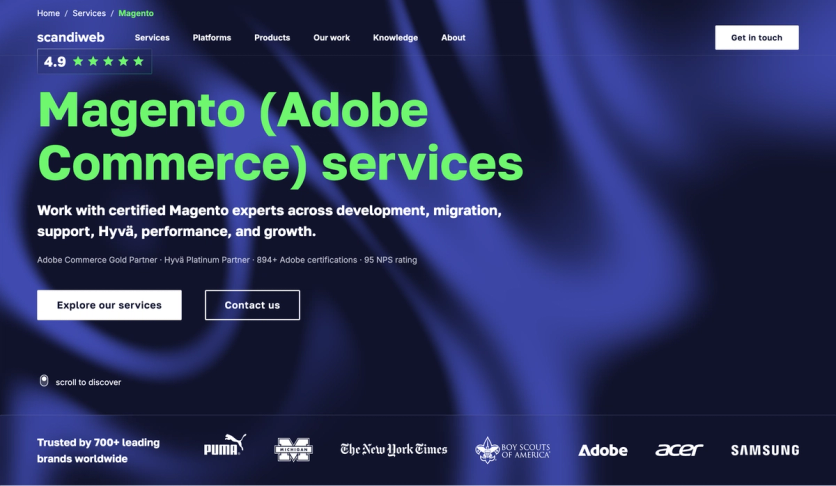
scandiweb was founded in Riga in 2003 by Antons Sapriko and has grown to a team of more than 600 specialists, with 700+ clients and 2,100+ projects behind it. It lists offices in New York, Montreal, London, Stockholm, and Dubai. It says it is the most certified Adobe Commerce agency in the world, with 894+ Adobe certifications. Adobe’s directory lists it in the 100+ certification band with 10 customer deployments and two specializations, and calls it “the largest Adobe Commerce certified team globally.” Its clients include PUMA, The Met, The New York Times, and Lafayette 148 New York. It also builds its own Magento tools. Ari is an AI agent that makes store changes from a chat and ships them only after a person approves. Expedio is a server-side accelerator it says makes a store at least twice as fast on any theme, and ReadyMage is its hosting and CI/CD platform for Adobe Commerce.
Pricing: scope and cost are agreed before development starts, with a ballpark after a 30-minute discovery call. Support is billed pay-as-you-go with no fixed monthly fee and a first response within 24 hours, a technical audit is a fixed price with a written report within two weeks, and version upgrades are free for as long as a client builds with scandiweb. Clutch lists a $25,000 minimum project and $50–$99 an hour.
Strong on: running the whole Adobe Commerce store, from the Hyvä frontend to the hosting, with results on the page. Läderach, a Swiss chocolatier, moved from a split WordPress and Magento 2 setup onto one Adobe Commerce store with a Hyvä frontend. The migration was completed in January 2023, and the case page reports conversions up 47.8% and revenue up 39% after the upgrade, without a comparison period. Macron, a sportswear brand selling in 150+ countries, replaced a legacy B2B system with Adobe Commerce connected to Pimcore and SAP, and conversion from direct traffic rose 132.5% with revenue up 29.8% year over year. For a US example, Scouting America rebuilt an older Magento storefront on Hyvä and reported mobile revenue up 6.2% and average order value up 27.3% year over year in March 2026. It also runs migrations in both directions, from Magento 1 to Adobe Commerce and from Magento to Shopify, so the same team can stay with you whichever way the store goes.
Weaker on: distance for a US brand. Its offices with an address are in Latvia and Georgia, with the rest of the team spread across 30+ countries by its own count, and Clutch reviewers mention the time-zone gap.
Client reviews: rated 4.8 on Clutch from 53 reviews, from February 2022 to June 2026. A February 2025 reviewer noted, “One of our challenges was the time zone differences.”
Classy Llama
🏅 Adobe Silver Partner · Shopify Plus Partner · BigCommerce B2B Specialized Partner
📍 Springfield, Missouri

Classy Llama was founded in 2007, and Kurt Theobald, its CEO, is a co-founder. It now calls itself “the replatform agency for mid-market ecommerce,” building on Adobe Commerce, Magento, Shopify, and BigCommerce from one office in Springfield. Magento and Adobe Commerce are 45% of its ecommerce work on Clutch and Shopify 40%. Its clients include Rainbow Resource Center, R&R Products, Prosoco, and Tombow USA.
Pricing: custom; Clutch lists a $50,000 minimum project and $150–$199 an hour.
Strong on: a replatform measured a year later. Rainbow Resource Center, a homeschool curriculum retailer, grew revenue 24% year over year after its relaunch while holding nearly all of the prior year’s order volume through peak periods. Classy Llama also builds B2B portals with ordering, invoices, and tracking for customers.
Weaker on: focus. Shopify is now nearly as large a share of its work, the Rainbow case page does not name the platform, and its site shows no Hyvä work, although Hyvä lists it as a Silver partner.
Client reviews: rated 4.8 on Clutch from 10 reviews, from July 2025 to October 2026. A July 2026 reviewer asked for “more frequent site reviews, suggesting opportunities to improve site performance and customer experience.”
Rave Digital
🏅 Adobe Silver Partner, Commerce specialized · Hyvä Silver Partner · Clutch Top Magento Developers 2024
📍 Parkland, Florida
Rave Digital has built on Magento since 2008 and leads with “eCommerce Development & Strategy for Magento, Adobe Commerce & Shopify Plus.” It is a Florida corporation with delivery offices in Belarus and India, and a team Clutch sizes at 250–999, with Magento and Shopify splitting its work evenly. Its site names Adobe Bronze; Adobe’s directory lists it as Silver with 50+ certifications and two deployments. Clients include Topps, Highlights for Children, and America’s Test Kitchen.
Pricing: fixed packages for Adobe Commerce as a Cloud Service and Adobe Commerce Optimizer, without dollar figures; Clutch lists a $25,000 minimum project and $100–$149 an hour.
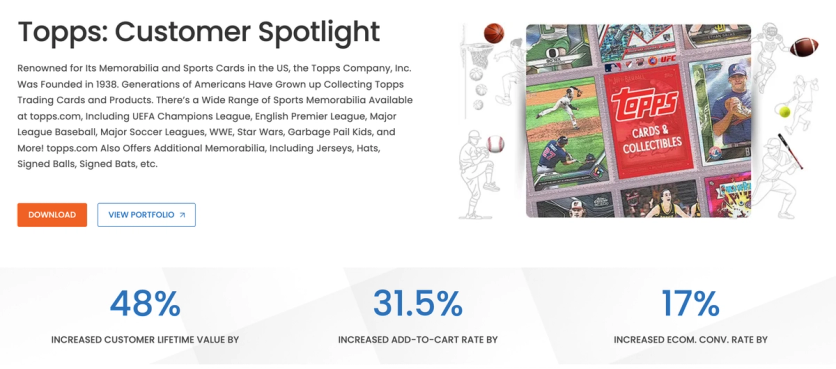
Strong on: long Magento retainers with the deepest review history here. At Topps, on Magento 2, customer lifetime value rose 48%, add-to-cart rate 31.5%, and conversion rate 17%, and Highlights for Children reported product revenue up 52.67% after a Magento 1 to 2 move behind a Drupal front end.
Weaker on: periods and offices. None of its cases states a time frame, and its delivery offices are in Belarus and India. Its site still prints Adobe Bronze while Adobe’s directory lists Silver; Hyvä lists it as a Silver partner.
Client reviews: rated 5.0 on Clutch from 113 reviews, from December 2021 to October 2026. An April 2025 reviewer wanted “more frequent updates or clearer timelines at certain stages.”
Human Element
🏅 Adobe Silver Partner, Commerce specialized, 35+ Adobe Commerce certifications · Shopify Plus Partner
📍 Ann Arbor, Michigan

Human Element was founded in 2004 by Ben Lorenz and Jason Magee and has worked on Magento since 2010. It sells B2B and B2C builds, replatforms, support, custom integrations, and Adobe Commerce code audits, with Magento at 60% of its ecommerce work on Clutch and BigCommerce at 30%. Its clients include Duallane Truck Parts, ChemPoint, and Roush Performance.
Pricing: custom; Clutch lists a $25,000 minimum project and $150–$199 an hour.
Strong on: Adobe Commerce builds and audits. Duallane, a truck-parts brand that opened an online channel next to its stores, launched on Adobe Commerce in September 2023. After its Google Merchant Center listings went live, online revenue grew 264% in Q4 2024 against Q3 2024, and 257% in January 2025 against January 2024. ChemPoint pairs a custom platform with an Adobe Commerce code audit, a useful first purchase that scandiweb and Rave Digital also sell.
Weaker on: a short public record. Duallane is its only Adobe Commerce case with figures; its other published result, Roush Performance, with revenue up 172% between equivalent periods a year apart, comes from a move off Magento 1 to Shopify Plus. Hyvä does not appear on its site.
Client reviews: no Clutch reviews. Adobe’s directory lists the Silver level with 20+ certifications and two customer deployments, which is the next-best public source, and the site lists testimonials from Pentair and Young Trucks.
121eCommerce
🏅 Adobe Silver Partner · Adobe Commerce Emerging Partner of the Year, Americas 2020 · BigCommerce Elite Partner
📍 Cleveland Heights, Ohio
121eCommerce was established in 2014 and is led by Daniel Gross. Magento is 100% of its ecommerce work on Clutch, though its site now sells Shopify, BigCommerce, and Adobe Commerce development side by side. It also sells SEO, paid media, and marketing automation. Its clients include Vintage Tub & Bath, New Leaf Publishing Group, and The Universal Group.
Pricing: custom; Clutch lists a $10,000 minimum project and $100–$149 an hour.
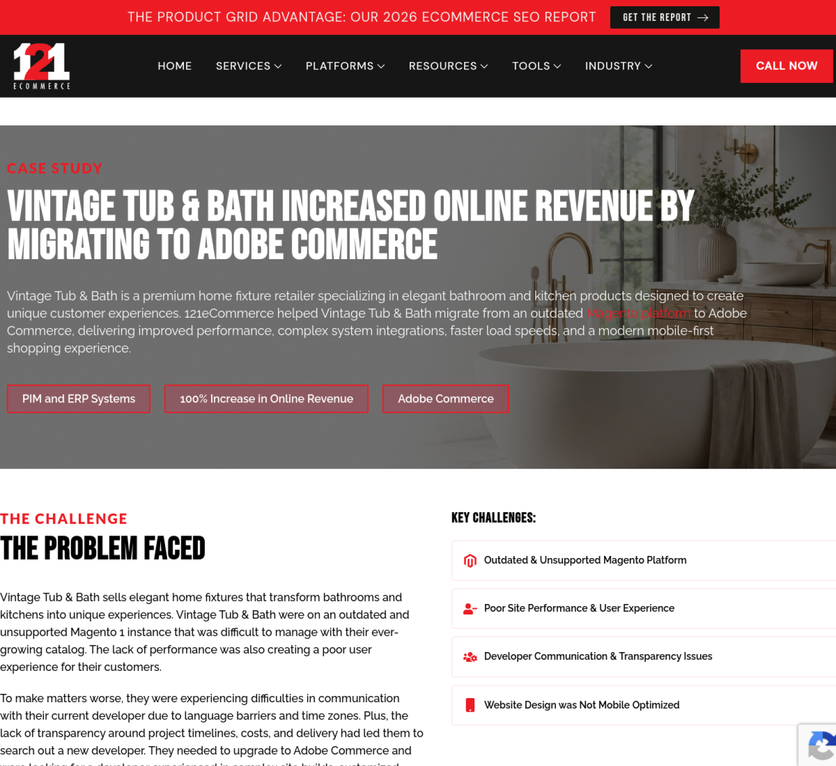
Strong on: migrations with a dated result. Vintage Tub & Bath moved from Magento 1 to Adobe Commerce with P21 and Salsify integrations and, less than a year after launch against the same period a year earlier, reported online revenue up 100%, orders up 63%, and average order value up 23%. New Leaf Publishing Group’s Hyvä rebuild is its one Hyvä case.
Weaker on: recent reviews and consistency. No Clutch review is newer than 2022, the Adobe tier reads Silver in the Adobe Commerce Marketplace and Gold on Clutch, and the Vintage Tub page’s testimonial comes from a different client.
Client reviews: rated 4.3 on Clutch from 18 reviews, from November 2020 to November 2022. A December 2021 reviewer named “the turnaround time for their tasks” as the thing to improve.
Also considered: Wagento (Adobe Silver, but Magento is 25% of its work on Clutch and its site names no headquarters), Forix (Beaverton, Oregon; its site could not be read for this review, the Adobe tier could not be verified, and its newest Clutch review is from February 2024), Blue Acorn iCi (Charleston, now an Infosys unit whose homepage no longer mentions Magento), Creatuity (closed in mid-2026, by its founder’s own account), Corra (acquired by Publicis Sapient in 2023; the brand is gone), Guidance (folded into OneMagnify in 2025), Absolute Web (Miami, Shopify Platinum; its flagship Magento case is a migration off Magento), Magebit (Hyvä Platinum, but headquartered in Riga with a Florida subsidiary), Cadence Labs (Boulder; no readable cases or reviews), Aumcore and 1Digital Agency (full-service digital agencies where Magento is a minority line), Elogic Commerce (Adobe Silver, B2B specialist, headquartered in Tallinn), and Mobecls (Vilnius).
How to Tell If a Magento Agency Is Working
Settle three things before the first invoice: the numbers the agency answers for, the place you read them, and the dates you check them.
Set the Goal First and Measure Against It
A build answers for the launch date and the site’s speed after it. A support retainer answers for uptime, ticket response time against the SLA, and release cadence. Both answer for conversion rate after each release, read in your own analytics rather than the agency’s deck.
Put the target in the agreement with its baseline: the Core Web Vitals scores today, the current uptime, and the current conversion rate. The monthly review then opens with those numbers: which moved, which way, and after which release.
The First 90 Days
Month one should produce an audit of the codebase, the extensions, and the hosting, along with a dated plan. The first patch or fix should be in production within the first two weeks of a support retainer, and the first release of a build project should be on staging by the end of month one.
By day 60 the backlog should be in your ticket system, with severities, and every release should carry a changelog. Day 90 should show shipped work and a speed score you can compare with the baseline. If all you get at day 90 is a roadmap, make that the first item of the quarterly review.
Upgrades and Security Patches on a Calendar
Adobe publishes security patches and version releases on its own schedule, and each Adobe Commerce version loses support on a fixed date. Ask for the agency’s patch log for your store: the date each patch was released, the date it reached your staging environment, and the date it went live. If the gap runs to months, raise it at the next review.
The same log tells you the cost of your extension list. Each upgrade that needs a refactor of a custom module or a conflicting extension is a line item, and an agency that cannot show the list before the upgrade cannot quote it either.
What Clients Complain About After They Sign
Every Clutch review includes a question on what the agency could have done better. For the agencies above, the 2021–2026 answers sort into three groups.
- Timelines slip. A Rave Digital client in April 2025 wanted clearer timelines at certain stages.
- Estimates move. A Rave Digital client in December 2021 wrote that “the estimation of cost and time is not what we initially discussed.”
- The agency waits to be asked. A Classy Llama client in July 2026 wanted more frequent site reviews and improvement suggestions, and proactive suggestions are the part of a retainer agencies often skip unless asked.
One of the five has no Clutch reviews and another has none since 2022, so reference calls do more work here than on a marketing shortlist. Ask for two current support clients and find out what their last upgrade cost.
Magento Agency vs In-House vs Maestra: the Decision Table
A Magento support retainer at a US agency runs $2,500–$8,000 a month, and an in-house Magento developer about $9,500–$11,200 a month with benefits. The marketing half on top runs $4,380–$11,380 a month with an agency plus a Klaviyo license at 100,000 profiles. An in-house email marketing manager costs about $12,500–$14,800 with the license. Maestra costs $2,000 a month at 100,000 active profiles, with AI product recommendations and analytics built in and a Forward Deployed Marketer included.
| Magento agency plus a retention retainer | In-house developer plus an email manager | Magento agency plus Maestra | |
|---|---|---|---|
| Monthly cost at 100,000 profiles | $2,500–$8,000 for support, plus ≈ $4,380–$11,380 for marketing | ≈ $9,500–$11,200 for the developer, plus ≈ $12,500–$14,800 for the email manager with the Klaviyo license | $2,500–$8,000 for support, plus $2,000 for marketing, Forward Deployed Marketer included |
| Who answers for the store | The agency, against its SLA | One developer, accountable to you | The agency, unchanged |
| Who answers for repeat revenue | An account manager, on the agency’s attribution | One person, accountable to you | Your marketer, with at least 60% of pay tied to results |
| Platform expertise | Deep in Magento; the marketing tools vary by account manager | Depends on who you hire | The only platform the marketer works in |
| Cross-industry input | Yes, if the strategist has time for it | Whatever the hires bring | Yes, from the other brands your marketer carries |
| Ramp time | Typically several weeks to the first live flow | A hiring cycle, then onboarding | Two to seven weeks, migration included; billing starts after the migration |
| Adding a channel or loyalty | A new extension and a new scope | Training or another hire | Add a module; the same marketer sets it up and tunes it |
| Getting a marketing-platform issue fixed | Through the agency to the vendor | Through the vendor’s support queue | Your marketer takes it to Maestra’s product team |
| What you keep when you leave | Your code and hosting, if they were in your name | Everything | Your store as it was, plus your data exports |
The developer line takes the Salary.com average of $87,531 and the Glassdoor median of $103,724 for a Magento developer as of November 2026, plus about 30% for benefits. The email-manager line takes the Salary.com average of $123,910 and the Glassdoor median of $102,450 for an email marketing manager. It adds the same 30% and then the $1,380 license. A senior developer or a manager who also owns SMS and loyalty costs more, so read both as floors.
Final Verdict: Agency, In-House, or Maestra
Hire a Magento agency if the store needs a build, a migration, an upgrade, or a patch queue with a response time, which is every Magento store at some point. For enterprise and B2B Adobe Commerce work, start with scandiweb; for a mid-market replatform, Classy Llama or 121eCommerce. Rave Digital suits a long-running Magento retainer, and Human Element an Adobe Commerce build or a code audit first. Hold any of them to the checklist above: named certified developers, the repository in your name, a patch SLA in writing, and a quote that came after your extension list.
Go in-house if the store ships code every week and you want the person who knows its extensions on payroll. One developer costs about $9,500 a month and up. An email manager with the license costs about $12,500 and up.
Choose Maestra for the marketing half if nobody owns repeat revenue today. The five agencies above build and patch the store; a Forward Deployed Marketer answers for the retention numbers and, when an integration needs your developer, manages that project with your agency. At $2,000 a month for 100,000 active profiles, a mid-size or enterprise Magento brand gets the real-time customer data platform with unlimited email and the marketer at no extra cost. AI product recommendations and analytics come built in. Your marketer moves your flows over and brings the next test to each regular call. Start with the pricing page or book a demo.
Frequently Asked Questions About Magento Agencies
- A Magento agency in the US costs $100–$250 an hour in 2026, and senior developers at mid-market agencies bill $175–$250. Agencies in Eastern Europe charge $35–$85, in India $20–$65, and in Latin America $30–$75, and many US-registered agencies deliver from those regions. Support retainers wrap the rate into a monthly block, usually $2,500–$8,000 at US agencies, and a few hours of basic support start around $500. The marketing stack is a separate bill:
- An Adobe partner tier measures the agency’s investment in Adobe’s program, which says little about the work on your store. Silver needs 30 certifications, 10 customer deployments, and a $3,000 annual fee. Gold needs 100 certifications, 20 deployments, and $15,000. The level is Adobe-wide, so check the Commerce specialization and the certification band in Adobe’s directory, then ask which certified developers will be on your store. Maestra’s Forward Deployed Marketer works for Maestra itself, so a question about the marketing platform goes straight to the people who build it, with no partner in the middle. The
- An in-house Magento developer costs about $9,500–$11,200 a month with benefits and suits a store that ships code weekly and runs custom integrations. An agency suits a store that needs a patch queue, periodic upgrades, and a bench wider than one person. An agency costs $2,500–$8,000 a month for support or $100–$250 an hour. Most mid-size stores run both: an agency for upgrades and rescue work, one in-house person for the daily queue. For the marketing half, a Forward Deployed Marketer comes with
- A Magento 1 to Magento 2 migration takes two to five months with an agency, and scandiweb’s own guide says it “usually never exceeds half a year.” The cost runs $15,000–$40,000 on Magento Open Source and $75,000–$250,000+ on Adobe Commerce Cloud. The extension list, the integrations, and the catalog size drive it, rather than the data itself, which moves in days. Ask for a redirect plan and a staging launch date before the quote. Migrating the marketing stack is a separate project. At Maestra, the Forward Deployed Marketer moves flows, templates, and segments in two to seven weeks while the old tools keep sending; at
- The best Magento agency for an ecommerce brand depends on the job. scandiweb has the Gold tier and the enterprise cases, and Classy Llama and 121eCommerce publish a replatform result with a stated time frame. Rave Digital has the longest review history, and Human Element sells the code audit that makes a good first purchase. The email platform and the person running it remain a separate decision. For that half,