
11 Best Enterprise Marketing Platforms and Software for 2026

Enterprise marketing platforms promise everything – omnichannel campaigns, real-time personalization, AI-powered optimization. But if you’ve ever implemented one, you know the pattern: a 6-month onboarding, a separate analytics tool bolted on top, a dedicated engineering team just to launch a campaign. And pricing that triples once you exceed the first tier.
The gap between what these platforms sell and what they deliver is massive. Some excel at mobile but can’t handle e-commerce flows. Others have great analytics but zero support. And nearly all of them require custom integrations for channels they claim to cover out of the box.
We compared 11 enterprise marketing platforms and software solutions on real-world capabilities: channel coverage, marketing automation, implementation time, support quality, and total cost of ownership. Each gets a direct verdict based on G2 reviews, official documentation, and pricing data – not marketing claims.
Quick Verdict: Best Enterprise Marketing Platforms by Category
The best enterprise marketing platforms in 2026 are Maestra, Insider One, Braze, Salesforce Marketing Cloud, Adobe Experience Cloud, HubSpot Marketing Hub, Bloomreach Engagement, Twilio Segment, Improvado, Phonexa, and Reply.io. The right enterprise marketing software depends on your channels, data, and team – Maestra leads for e-commerce brands that need real-time omnichannel personalization and enterprise marketing automation without a six-month rollout.
Best for outbound at scale: Reply.io – AI-powered sales outreach automation
Best for buying and selling leads and calls at scale: Phonexa – pay per lead and pay per call software suite for lead and call tracking, distribution, and analytics
Best for cross-channel analytics and reporting: Improvado – agentic data pipelines that unify spend and performance into one warehouse-first source of truth
Best for composable data: Twilio Segment – developer-friendly CDP and data routing
Best for content-driven commerce: Bloomreach Engagement – search, merchandising, and marketing
Best for mid-market inbound: HubSpot Marketing Hub – CRM, content, and automation in one (from $800/mo)
Best for enterprise content: Adobe Experience Cloud – end-to-end content and analytics suite
Best for CRM-integrated marketing: Salesforce Marketing Cloud – full Salesforce ecosystem
Best for mobile-first messaging: Braze – real-time push, in-app, and email for app-driven brands
Best for AI-powered journeys: Insider One – predictive segmentation and cross-channel orchestration
Best for e-commerce personalization: Maestra – real-time omnichannel with hands-on support (from $2,000/mo)
Content:
Common Enterprise Marketing Platform Challenges
Before diving into individual platforms, it’s worth understanding the patterns that trip up enterprise buyers. These aren’t complaints about any single tool – they’re structural problems across the category, sourced from hundreds of G2, Capterra, and TrustPilot reviews. Measurement cuts across them: every platform reports on the channels it runs, so the question of which paid touchpoints actually move revenue belongs to a dedicated multi-touch attribution tool.
| Pain Point | Description | What to Look For |
|---|---|---|
| Opaque Pricing & Hidden Costs | Most enterprise platforms don’t publish pricing. Once you sign, add-on fees for channels, contacts, support tiers, and integrations quietly inflate the bill. One G2 reviewer noted spending 40% more than the quoted price within the first year. | Ask for a fully loaded cost estimate that includes all channels, overages, and support. Compare per-contact vs. per-MAU vs. per-org pricing models – they look similar but scale very differently. |
| Implementation Complexity | Enterprise marketing platforms routinely take 3–6 months to implement. Complex data models, custom integrations, and multi-team coordination turn “quick wins” into quarter-long projects. | Ask how long implementation takes for a company your size. Check whether onboarding is included or billed separately. Look for platforms where a dedicated team handles migration. |
| Engineering Dependency | Many platforms are built API-first, which sounds great until your marketing team needs to file engineering tickets for basic segmentation changes or template updates. G2 reviews for several platforms cite “requires developer for simple tasks” as a recurring frustration. | Test whether your marketers can build segments, create flows, and edit templates without writing code. No-code isn’t just a buzzword – it determines how fast your team ships campaigns. |
| Vendor Lock-In & Ecosystem Dependency | Platforms deeply tied to a parent ecosystem (Salesforce, Adobe, SAP) work beautifully inside that ecosystem – and painfully outside it. Switching costs compound over time as data, workflows, and integrations become entangled. | Evaluate how easily you can export data and migrate workflows. Check integration breadth beyond the parent ecosystem. |
| Support Quality Gaps | Enterprise buyers consistently report a gap between pre-sale promises and post-sale support reality. Common complaints: first-line reps who can’t troubleshoot technical issues, slow response times outside premium tiers, and account managers juggling over 60 accounts each. | Ask how many accounts each CSM handles. Check if premium support requires an additional fee. Look for guaranteed SLAs in the contract, rather than “priority access.” |
| Channel Fragmentation | Most platforms started with email and bolted on other channels later. The result: SMS, push, WhatsApp, and web personalization often feel like separate products stitched together, each with different UIs, reporting, and data models. | Test cross-channel flows end-to-end. Can you trigger an SMS based on email behavior? Can you personalize web content based on push engagement? The flow builder tells you everything. |
Enterprise Marketing Platforms at a Glance
| Platform | Best For | Key Strengths | Pricing |
|---|---|---|---|
| Maestra | Mid-size and enterprise e-commerce seeking real-time personalization and hands-on support | Real-time CDP, omnichannel flows, built-in loyalty, site personalization, dedicated Forward Deployed Marketer for every account | From $2,000/mo (CDP + unlimited email); modular – pay only for the channels you use and only for active profiles |
| Insider One | Enterprise brands seeking AI-native cross-channel personalization | Sirius AI (generative + predictive + agentic), over 12 channels, real-time hyper-personalization | Custom pricing (contact sales) |
| Braze | Mobile-first brands needing real-time engagement at scale | Sub-second data processing, Canvas journey builder, BrazeAI decisioning, over 140 integrations | Enterprise pricing (custom; ~$60K+/yr per industry estimates) |
| Salesforce Marketing Cloud | Organizations already invested in the Salesforce ecosystem | Deepest CRM integration, Agentforce AI, Journey Builder, multi-org support | From $1,500/org/mo (Growth Edition) |
| Adobe Experience Cloud | Fortune 500 companies with complex, multi-product digital needs | Full creative-to-analytics suite, Adobe Sensei AI, advanced customer journey analytics | Custom enterprise pricing |
| HubSpot Marketing Hub | Brands wanting an integrated marketing-sales-service platform | User-friendly interface, unified CRM, Breeze AI, over 1,800 integrations | From $800/mo (Professional) |
| Bloomreach Engagement | E-commerce and retail companies wanting AI-powered marketing | Loomi AI included, real-time data processing, omnichannel orchestration | Custom pricing (contact sales) |
| Twilio Segment | Data-driven organizations needing a CDP foundation before marketing execution | Over 700 pre-built integrations, identity resolution, zero-copy architecture | Free tier available; from $120/mo |
| Improvado | Enterprise teams consolidating spend and performance data across many channels | 1000+ connectors, agentic data pipelines, warehouse-first delivery, AI querying | Custom (quote-based) |
| Phonexa | Enterprise-grade affiliate networks & advertisers | Lead & call tracking, distribution, analytics, real-time reporting, and omnichannel coverage in one place | Custom & usage-based |
| Reply.io | Sales teams and agencies automating multichannel outreach | AI SDR automation, email sequences, LinkedIn outreach, calls, meeting booking, CRM integrations | From $59/user/mo |
1. Maestra – Best for E-Commerce Personalization
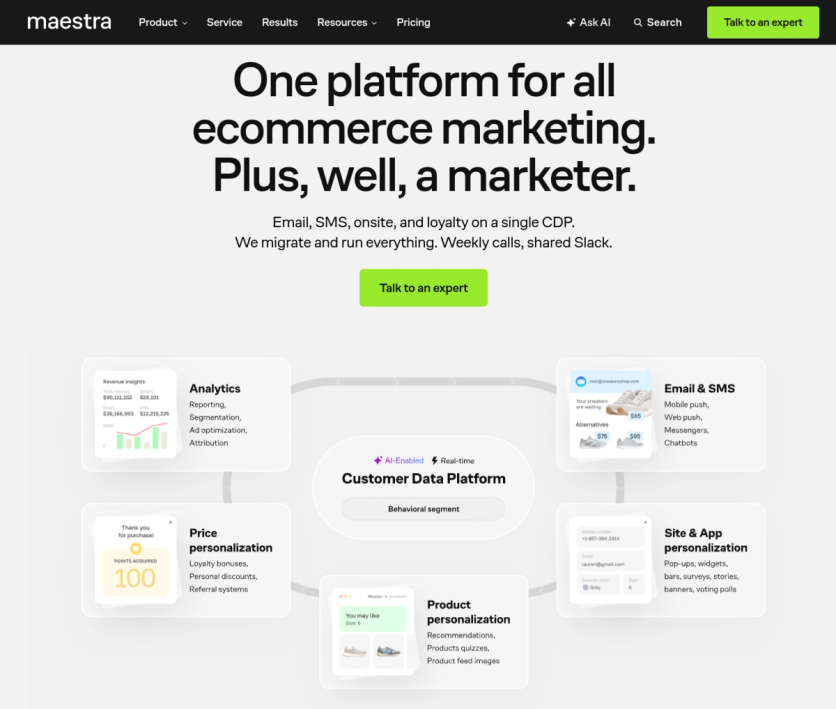
Best enterprise marketing platform for e-commerce teams seeking real-time personalization with hands-on support and fast time-to-value
Maestra runs the whole customer lifecycle on one platform, built specifically for mid-market and enterprise e-commerce brands. Instead of asking you to stitch together a CDP, email tool, SMS provider, loyalty engine, and personalization platform – and then hoping they all talk to each other – Maestra consolidates everything into a single platform with white-glove service included for every account.
The platform is one of the fastest-growing in the space, with a rapidly expanding customer base that includes Selkirk Sport, Blue Q, Enlightened Equipment, Urban Armor Gear, Coolibar, and JOLYN.
Key Features
Real-Time Customer Data Platform
Maestra’s CDP unifies customer data from all channels – e-commerce platform, website, email, SMS, loyalty, support – into a single profile that updates in real time. Unlike middleware CDPs that sync on a schedule, every interaction is available for segmentation and personalization immediately.
The platform supports product-based, brand-based, order-based, and status-based segments, plus nested segmentation with subtraction logic for complex audience targeting. Custom and calculated fields let you build segments your business actually needs, beyond the ones that come out of the box. Built-in identity resolution, auto-deduplication, and error monitoring keep your data clean without manual effort. For multi-brand enterprises, Maestra handles multiple brands and product feeds from a single account, so you’re not managing parallel setups.
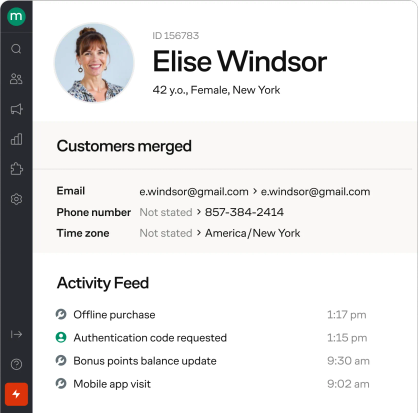
Customer profile in Maestra
Omnichannel Flow Builder
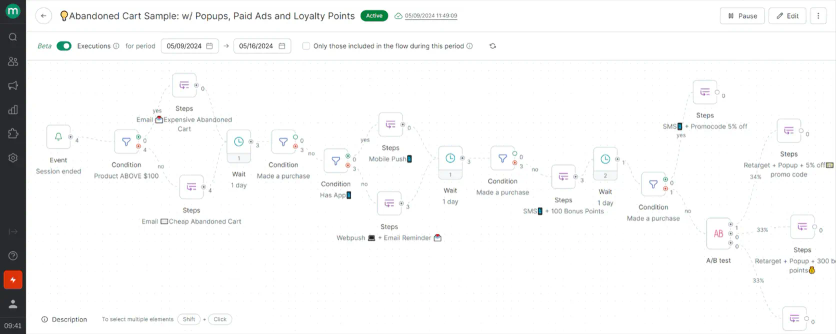
The visual flow builder lets marketers create adaptive journeys across email, SMS, WhatsApp, web and mobile push notifications, on-site pop-ups, and paid media retargeting – all in one canvas. Flows can branch based on real-time customer behavior, and channel selection happens dynamically based on engagement patterns.
What makes this different from other flow builders: loyalty actions, promotions, site personalization, and product recommendations all live inside the same flows – not in a separate tool you have to integrate. You can set up gradually increasing offers (e.g., 10% first, then 15% if no response), rotate channels automatically, and run A/B tests at any branch point. Magnum Bikes used these omnichannel flows to quadruple their assisted revenue within three months of launching.
Built-In Loyalty Program
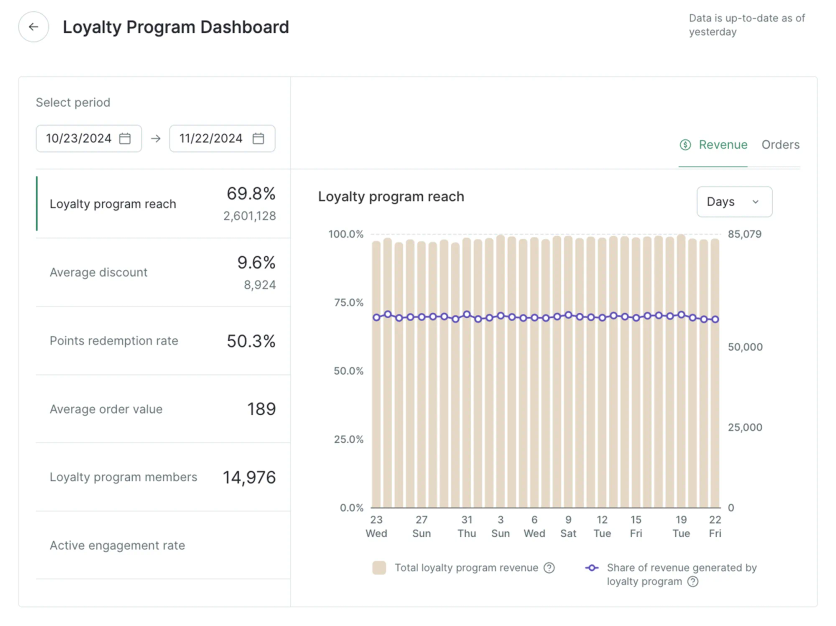
Maestra includes a full loyalty engine – points, tiers, referral programs, personal coupons, gift cards, and promotions arbitration – as a core part of the platform, not as a bolt-on module. Tiers can be based on total spend, earned points, or purchase count, and reward types are flexible: cashback, discounts, free products, bonus points, or third-party perks.
Loyalty data feeds directly into segmentation and flows, so you can trigger a targeted campaign when a customer reaches a new tier, is about to lapse, or has expiring points. The promo code engine generates unique codes with usage limits, expiration dates, and product-level targeting – JOLYN used this with AI-determined timing to achieve 9x winback flow conversion growth. The whole system also works at the POS level for brands with physical stores. This eliminates the need for a separate loyalty vendor entirely.
Site & App Personalization
No-code widgets that adjust content, banners, product recommendations, and promotions in real time based on visitor behavior and segment membership. Elements include pop-ups, quizzes, surveys, games, voting polls, embedded blocks, product recommendations, stories, banners, bars, and countdown timers – all with frequency control and prioritization rules so you’re not annoying visitors with overlapping offers.
What’s worth highlighting for larger operations: in-session segmentation means Maestra reacts to what a visitor does right now, without waiting for yesterday’s profile data. You can target offers based on real-time cart value, browsing behavior, location, and device – and your Forward Deployed Marketer (a marketer who works as part of your team) handles the setup and design, zero code required. Enlightened Equipment saw +15% website conversion growth after launching site personalization, and Blossom Flower saw a 14% boost in conversions after adding a product-picking quiz.
For mobile apps, Maestra offers SDK integration for iOS, Android, Flutter, and React Native – with in-app messaging, push notifications, and pop-ups fully synced with your web and email channels.
Product Recommendations
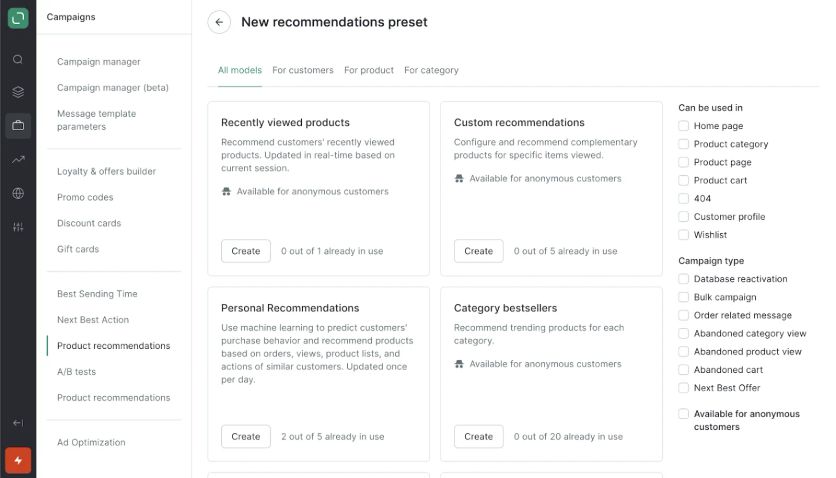
14 AI algorithms power personalized product recommendations across email, site, messages, and push notifications. Options range from basics like Bestsellers and Recently Viewed to advanced engines like Personalized Post-Purchase Picks – and all of them factor in real-time inventory, size availability, and region-specific product feeds, so customers never see out-of-stock items.
You also get manual override through business rules: filter or boost by color, price, category, collection, or any custom attribute. For brands like JOLYN, this means swimwear recommendations match by color, material, and size – something their previous tool couldn’t do. JOLYN now drives 7% of sales from product recommendations alone. Beyond AI picks, Maestra also supports product bundles and quizzes that guide customers to the right product, which Blossom Flower used to increase website conversion by 14%.
Email & SMS Marketing
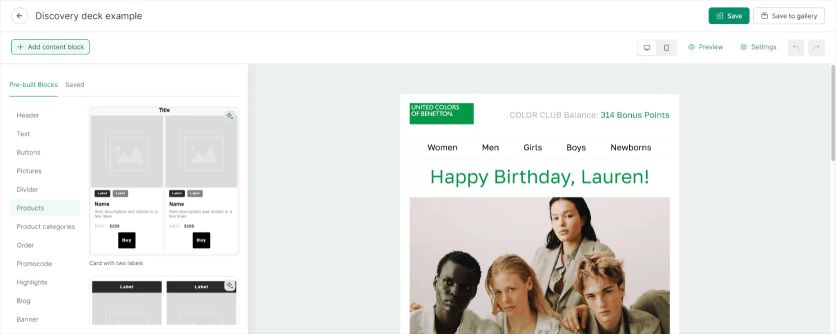
A home-grown drag-and-drop email composer with product recommendations, conditional blocks, optimal send time prediction, and built-in deliverability tools including dedicated IPs, a DMARC analyzer, and white-glove deliverability support from your Forward Deployed Marketer. Emails render upon sending, so dynamic content like prices and inventory levels are always current – Furniture Fair uses this to show real-time pricing in emails, solving a pain point their store managers had struggled with for years.
For SMS, Maestra supports short codes, 10DLC, and toll-free numbers with rates starting at $0.0035/SMS and $0.0125/MMS. RCS (Rich Communication Services) is also available for richer messaging. Features include tap-to-text subscription, cart restoration links, AI-generated content, and optimal send time prediction. Coolibar saw +33.6% campaign-driven revenue growth year-over-year after switching their email and SMS to Maestra from Klaviyo.
Analytics & Reporting
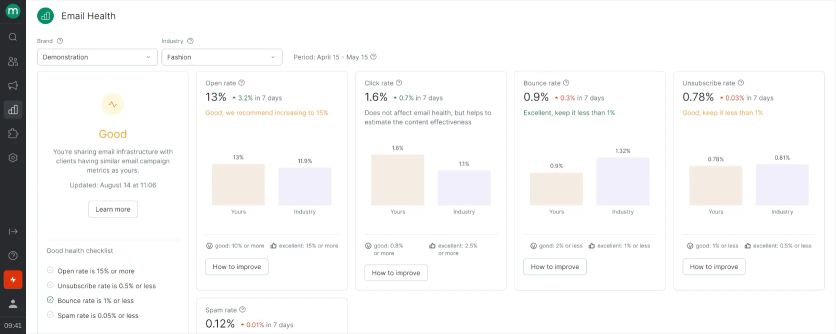
Campaign performance, flow analytics, revenue attribution, RFM segmentation, and email health monitoring – all built into the platform. No need to export to a spreadsheet or connect a separate BI tool to understand what’s working.
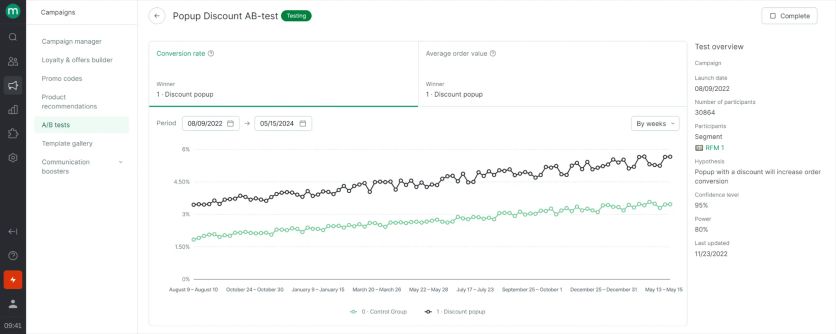
Attribution is configurable and fully transparent: last-non-direct-touch by default, with adjustable attribution windows and the ability to verify every individual order. Email health monitoring compares your metrics against industry benchmarks and tracks reputation by provider. You can A/B test across any channel – email, SMS, pop-ups, recommendations, promotions, even loyalty rewards – and measure incremental lift with control groups. For paid media, Maestra pushes CDP segments directly to Facebook, Instagram, Google, and LinkedIn for retargeting and look-alike audiences. PuffCuff used this to cut Facebook Ads cost per order by 43.7%. And if you need raw data in your own warehouse, you can export or stream it live to your BI at any time.
Pricing
Maestra pricing starts at $2,000 per month for the most common starting package – the CDP base ($1,300/month) plus unlimited email ($700/month). Other channels, like SMS, loyalty, and onsite personalization, are flat monthly modules. The first 100,000 active profiles are included; after that, $0.013 per active profile. A contact counts as active only if they received a message, visited the site or app, or bought that month – dormant profiles are stored free.
- Product recommendations, reporting, and ad audience sync included in the CDP base
- Billing starts only when an account is fully live
- Month-to-month billing, no annual contracts required
- Unlimited email sends – no volume metering or send-based overages
- Full migration, implementation, and onboarding included – no setup fees
- Managing up to three brands at no extra charge (additional brands available for a fee)
- White-glove Forward Deployed Marketer support for each client via a shared Slack channel and weekly calls
- Leading messaging rates: SMS from $0.0035, MMS from $0.0125
Maestra clients typically see ROI exceeding 20x within just a few months, fueled by higher conversion rates, increased AOV, and improved marketing efficiency. For example, the platform generated a 2,349% ROI for jewelry brand German Kabirski in four months. Furniture Fair saw a massive 7,543% ROI, earning $75.43 for every dollar invested.
Strengths
- Single-platform architecture – CDP, email, SMS, push, loyalty, site personalization, product recommendations, and analytics in a single platform. No integrations to maintain, no data silos.
- White-glove support for every account – Every Maestra client gets a dedicated Forward Deployed Marketer who handles only 15 accounts (industry average is 60). Forward Deployed Marketers help with migrations, flow audits, segmentation strategy, and ongoing optimization. Shared Slack or Microsoft Teams channels and weekly Zoom meetings. Live chat with a 5-minute SLA.
- Built for e-commerce – Loyalty programs, product recommendations, RFM segmentation, and Shopify integration aren’t add-ons bolted on later – they share the same data layer and work inside the same flows.
- Transparent pricing – Every module price is published. No setup fees, no annual contract, and billing counts only active profiles; per-message SMS fees apply.
Weaknesses
- Smaller brand ecosystem – Maestra is younger and growing fast, but doesn’t yet have the brand recognition of Salesforce or Adobe among enterprise buyers evaluating platforms by name alone.
- Not built for mobile-app-first companies – If your primary customer touchpoint is a mobile app rather than a website or store, you’ll want a platform like Braze that specializes in in-app messaging, Content Cards, and push SDK optimization.
Client Results
- Urban Armor Gear: 64% reduction in marketing stack costs after consolidating from multiple tools to Maestra
- JOLYN: +22% repeat domestic revenue growth
- Coolibar: +33.6% campaign-driven revenue
- Level Up Basketball: 4.5x revenue increase
When to Choose Maestra
You’re managing 3+ marketing tools and want to consolidate. If your current stack includes a separate CDP, email platform, loyalty tool, and personalization engine – with integrations that keep breaking and a combined bill that’s hard to justify – Maestra replaces all of them with a single platform. Urban Armor Gear cut their marketing stack costs by 64% after making this switch.
Your marketing team needs to move faster without engineering support. If campaign launches are delayed because marketers need to file tickets for segmentation changes or template edits, Maestra’s no-code flow builder, drag-and-drop email composer, and marketer-friendly segmentation tools let your team ship campaigns independently.
You want pricing that scales predictably. Maestra’s modular pricing keeps every cost a known number: a flat monthly fee per module, unlimited email sends, and billing that counts only active profiles. Adding a channel is a fixed line item, and dormant contacts never inflate the invoice.
You need a partner who runs the platform with you. With a Forward Deployed Marketer who handles only 15 accounts, a 5-minute SLA, and weekly strategy calls, Maestra functions more like an extension of your marketing team than a SaaS vendor you email when something breaks.
2. Insider One – Best for AI-Powered Journeys
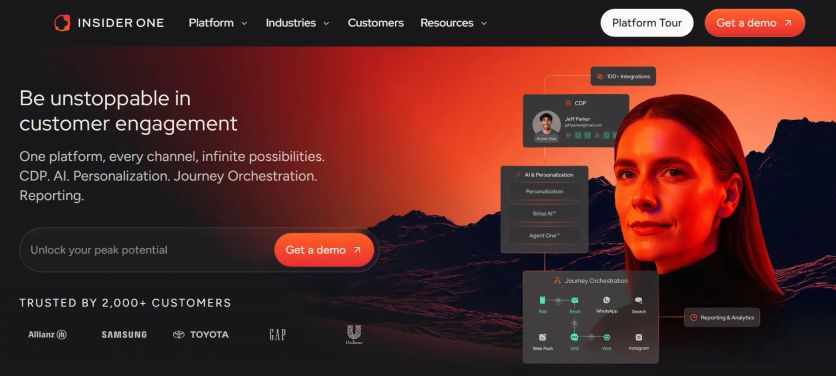
Best for enterprise brands seeking AI-native cross-channel personalization
Insider One (recently rebranded from Insider) is an AI-native marketing platform trusted by over 2,000 customers worldwide including Adidas, Samsung, Philips, and Toyota. The platform combines its proprietary Sirius AI engine – spanning generative, predictive, and agentic AI – with cross-channel orchestration across over 12 channels.
Key Features
Sirius AI & Agent One
Insider One’s headline differentiator is its AI layer. Sirius AI automates segmentation, generates email subject lines and body copy from prompts, predicts customer behavior, and selects optimal send times and channels. Agent One adds purpose-built AI agents that can autonomously manage customer engagement workflows.
Cross-Channel Orchestration
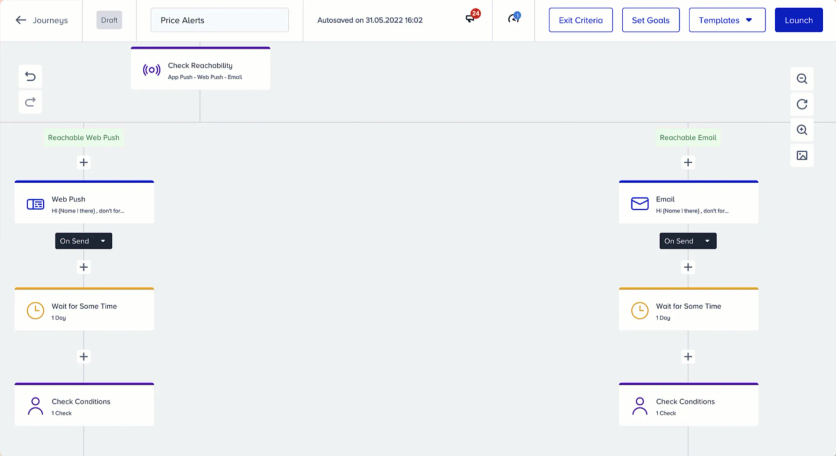
The Architect journey builder orchestrates flows across email, SMS, RCS, WhatsApp, web push, mobile app, in-app messaging, site search, and InStory (mobile stories). The platform’s AI determines the next-best channel for each customer based on engagement patterns.
Advanced CDP
Connects data from over 100 sources to build unified customer profiles that update in real time. Supports predictive segments based on purchase likelihood, churn risk, and customer lifetime value.
Pricing
Custom pricing only – no public pricing page exists. Prospective clients must request a demo. Industry estimates vary widely, and Insider One does not disclose ranges.
Strengths
- Widest native channel support in the category (over 12 channels including WhatsApp, RCS, and in-app stories)
- AI capabilities are genuinely differentiated – Sirius AI and Agent One go beyond basic send-time optimization
- Strong enterprise track record with recognizable global brands
- Gartner Magic Quadrant Leader for Personalization Engines
- G2 rating: 4.8/5
Weaknesses
- Completely opaque pricing requires extensive sales engagement before you get any numbers
- The platform delivers maximum value only when you adopt the full suite – using individual modules in isolation undercuts the value proposition
- Enterprise-heavy customer base means the platform and support may not be calibrated for mid-market needs
- Some G2 reviewers note the admin panel can feel complex for teams without dedicated marketing operations resources
Compared to Maestra
Insider One’s AI capabilities are genuinely ahead of most competitors – Sirius AI automates channel and content selection per customer at a level few platforms match. The trade-off: Insider One has no built-in loyalty engine, pricing is completely opaque (vs. Maestra’s published pricing), and there’s no guaranteed Forward Deployed Marketer-to-account ratio. E-commerce brands get product recommendations and Shopify integration inside Maestra’s CDP base from day one, with loyalty available as a flat-fee module on the same data layer.
3. Braze – Best for Mobile-First Messaging
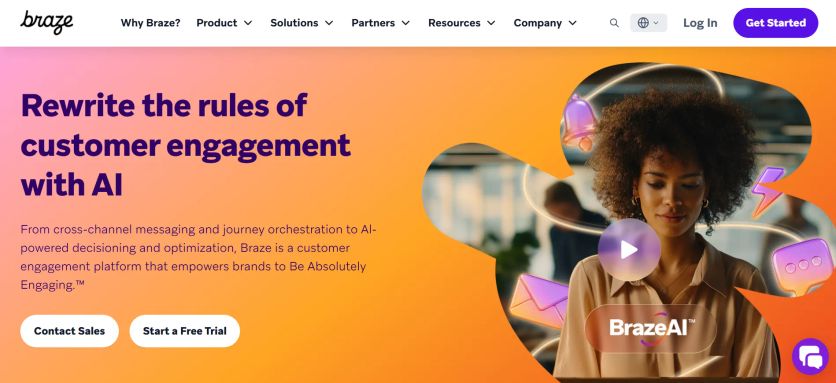
Best for mobile-first brands needing real-time engagement at scale
Braze is an enterprise customer engagement platform powering over 2,000 global brands. The platform processes over 3.9 trillion messages and Canvas actions annually, with sub-second data processing that makes it the go-to choice for brands where speed matters – gaming, fintech, media, and mobile-first e-commerce.
Key Features
Canvas Journey Builder
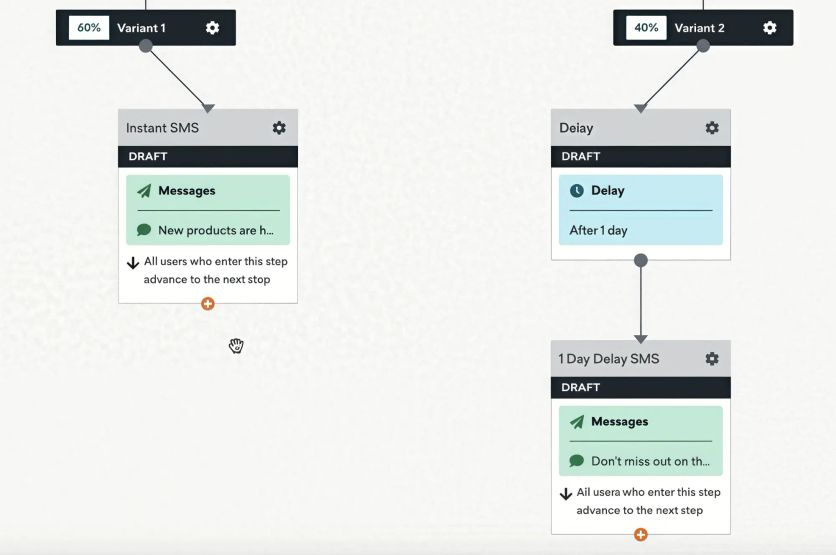
Braze’s visual journey builder (Canvas) lets teams create, test, and optimize cross-channel flows with branching logic, delays, audience syncs, and A/B testing. It’s one of the most flexible journey tools in the market, though it comes with a learning curve.
BrazeAI Decisioning
Following its acquisition of OfferFit, Braze now offers an AI decisioning studio that optimizes 1:1 personalization across channel, timing, and content. BrazeAI also includes AI copywriting and engagement automation agents.
Real-Time Data Processing
Sub-second data activation means messages can personalize based on what a customer did moments ago – not hours ago. For brands in gaming, media, or financial services, this speed is a genuine competitive advantage.
Cross-Channel Messaging
Email, SMS, push notifications, WhatsApp, in-app messages, Content Cards (persistent in-app messaging), and paid media retargeting (Meta, Google, Pinterest, Snapchat, TikTok, Criteo).
Pricing
Braze publishes named editions (Go, Select, Pro, and Enterprise) but no public prices. Pricing is quote-based on monthly active users (MAUs), data points tracked, and a usage-based Action Credits model. Industry estimates put entry enterprise contracts at around $60,000/year and up. Onboarding and premium support are charged separately. Implementation typically takes 3–6 months with professional services.
Strengths
- Industry-leading real-time data processing with sub-second response
- Powerful cross-channel capabilities, especially for mobile (push, in-app, Content Cards)
- Enterprise-grade security: SOC 2 Type 2 and ISO 27001 certified
- Over 140 technology partner integrations through Braze Alloys
- G2 rating: 4.5/5
Weaknesses
- Steep learning curve – G2 reviewers consistently note the interface can feel cluttered and overwhelming for new users
- Costs escalate quickly as contact lists grow and you add data points
- Template customization often requires developer involvement
- Setup complexity demands dedicated technical resources
Compared to Maestra
Braze dominates the mobile-first engagement space – sub-second data processing, Content Cards, and deep in-app messaging make it the default for gaming, fintech, and media companies. Where it falls short for e-commerce: no loyalty engine, no product recommendation algorithms, no site personalization. Maestra covers all three natively. Pricing also differs in structure – Maestra publishes its prices and includes migration, onboarding, and Forward Deployed Marketer support in the base subscription, while Braze charges separately for onboarding, premium support, and advanced features.
4. Salesforce Marketing Cloud – Best for CRM-Integrated Marketing
Best for organizations already invested in the Salesforce ecosystem
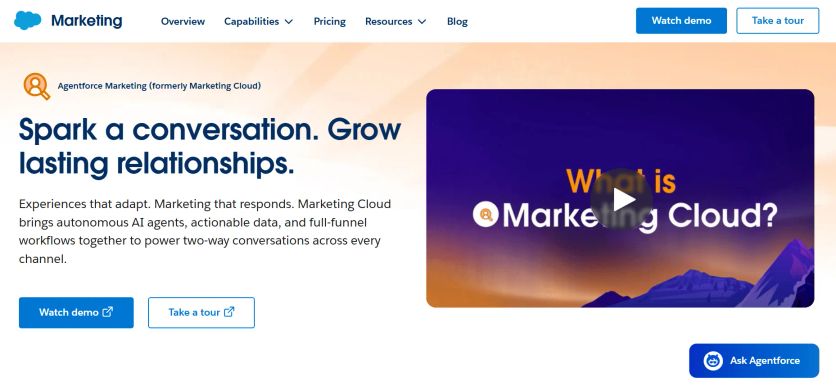
Salesforce Marketing Cloud is one of the most established enterprise marketing platforms, now repositioned around a “Next-Gen” architecture that brings AI-powered Agentforce capabilities across all marketing functions. For organizations already using Salesforce CRM, the integration depth is unmatched.
Key Features
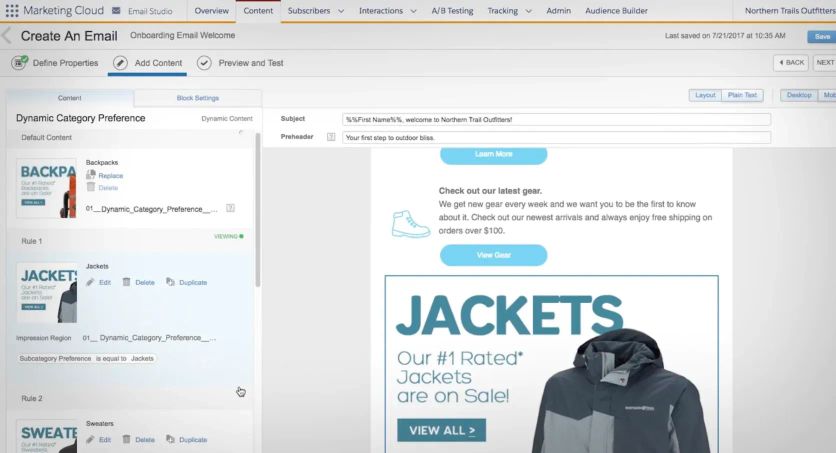
Journey Builder
Maps and automates multi-step campaigns across the entire customer lifecycle. Behavior-based triggers, branching logic, and AI-powered decisioning. Natively connected to Salesforce CRM data.
Agentforce
Salesforce’s AI layer brings autonomous agents that can generate segments, create campaign briefs, write email and SMS content, and optimize targeting – all within the Salesforce platform.
Cross-Channel Messaging
Email, SMS, WhatsApp, web messaging, and what Salesforce calls “two-way conversations” – turning standard do-not-reply messages into interactive customer discussions.
CRM Integration
The deepest CRM integration in the market. Customer data from Sales, Service, and Commerce clouds flows directly into marketing workflows. Multi-org support for enterprises managing multiple brands or regions.
Pricing
Salesforce recently restructured pricing around its Next-Gen Marketing Cloud:
- Growth Edition: $1,500/org/month (billed annually)
- Advanced Edition: $3,250/org/month (billed annually)
- Add-ons: Personalization ($8,000/org/mo), Marketing Intelligence ($10,000/org/mo), Loyalty Management ($20,000/org/mo)
Existing customers on legacy Marketing Cloud Engagement can upgrade via “+” editions without replacing their current setup. The old $400/mo entry point (Basic email) is being phased out in favor of the new platform editions.
Strengths
- Deepest CRM integration available – if you’re on Salesforce, nothing else connects as seamlessly
- Agentforce AI is genuinely capable for campaign creation and optimization
- Massive ecosystem of implementation partners, Trailhead training resources, and community
- Multi-org support for complex enterprise structures
- G2 rating: 4.0/5
Weaknesses
- Costs add up quickly – base platform plus add-ons for personalization, intelligence, and loyalty can reach $30,000/month
- Learning curve requires specialized Salesforce training (many reviewers recommend hiring certified admins)
- Implementation timelines are longer than modern SaaS tools – 3–6 months is typical
- Interface feels dated compared to newer platforms, with navigation between “studios” that can be confusing
- Outside the Salesforce ecosystem, integration options are more limited
Compared to Maestra
If your company runs on Salesforce CRM, Marketing Cloud’s integration depth is genuinely hard to replicate with any other tool. The question is cost: adding Loyalty Management ($20,000/mo), Personalization ($8,000/mo), and Marketing Intelligence ($10,000/mo) as add-ons can push monthly costs above $40,000. A comparable Maestra setup with CDP, unlimited email, loyalty, and onsite personalization runs $4,525/month in flat module fees, and product recommendations and analytics are already in the base. Implementation speed is another factor: Maestra typically goes live in weeks, while Salesforce implementations run 3–6 months.
5. Adobe Experience Cloud – Best for Enterprise Content
Best for Fortune 500 companies with complex, multi-product digital needs
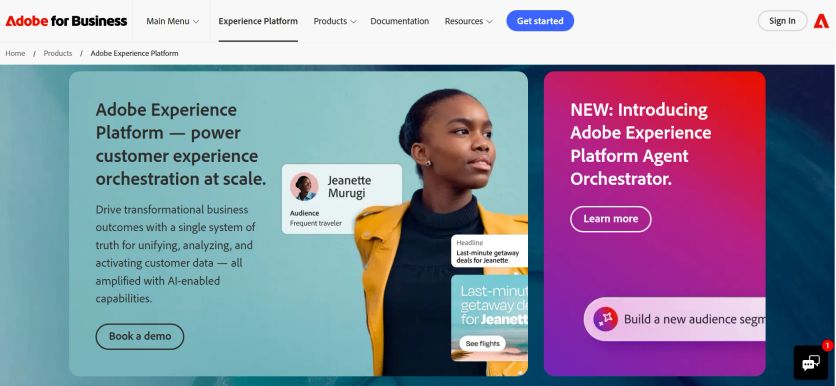
Adobe Experience Cloud isn’t a single product – it’s a suite of enterprise tools spanning analytics, content management, journey orchestration, CDP, and personalization. Used by 74% of Fortune 500 companies, it’s the platform of choice for organizations that need the full spectrum of digital experience management at massive scale.
Key Features
Adobe Experience Manager
An experience management platform for building and managing websites, digital assets, forms, and screens – with minimal IT dependency for content updates.
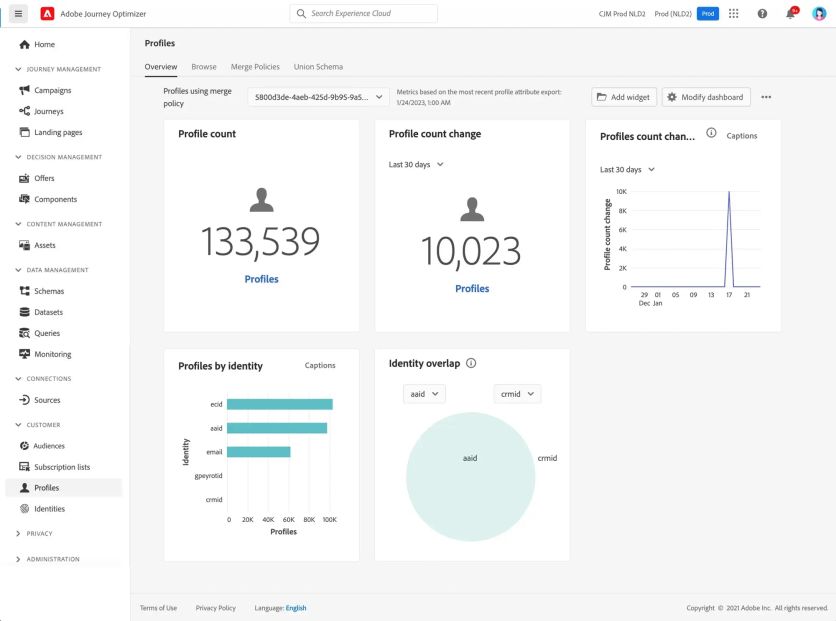
Journey Optimizer
Adobe’s journey orchestration tool for 1:1 customer interactions across email, push, in-app, SMS, and web. Includes AI-powered decisioning via Adobe Sensei.
Real-Time CDP
Unifies customer data from across the Adobe ecosystem and external sources for real-time segment activation and cross-channel personalization.
Marketo Engage
Adobe’s B2B marketing automation tool for lead management, account-based marketing, and multi-touch attribution. Particularly strong for complex sales cycles.
Analytics & Customer Journey Analytics
Advanced web and mobile analytics with cross-channel journey mapping. Customer Journey Analytics connects every digital touchpoint into a single view.
Pricing
Fully custom enterprise pricing – no public pricing page. Each product (Experience Manager, Journey Optimizer, Real-Time CDP, Marketo Engage, Analytics) is licensed separately or as bundles. Expect six-figure annual contracts for meaningful implementations.
Strengths
- The most comprehensive digital experience suite available – from content creation to analytics to personalization
- Adobe Sensei AI spans creative, analytics, and campaign optimization
- Deep integration between content tools (Creative Cloud, Experience Manager) and marketing execution
- Used by 74% of Fortune 500 companies – proven at the largest scale
- G2 rating: 4.2/5 for Adobe Experience Manager
Weaknesses
- Extreme complexity – implementing the full suite requires dedicated teams and significant consulting investment
- Cost is prohibitive for all but the largest enterprises
- Some G2 reviewers note that recent version upgrades have removed features, creating stability concerns
- The product suite can feel fragmented – different tools within Experience Cloud have different interfaces and workflows
- Pricing evaluation requires mapping your specific needs against individual product costs
Compared to Maestra
These platforms serve different markets. Adobe Experience Cloud is a digital experience suite for Fortune 500 companies with large IT and content teams – it spans content management, B2B marketing (Marketo), analytics, and creative tools far beyond what any marketing automation platform covers. Maestra is narrower but deeper for e-commerce: the loyalty engine, product recommendations, and site personalization that would require assembling multiple Adobe products come out of the box. For most e-commerce operations, Maestra delivers faster time-to-value at a fraction of the investment.
6. HubSpot Marketing Hub – Best for Mid-Market Inbound
Best for brands wanting an integrated marketing-sales-service platform
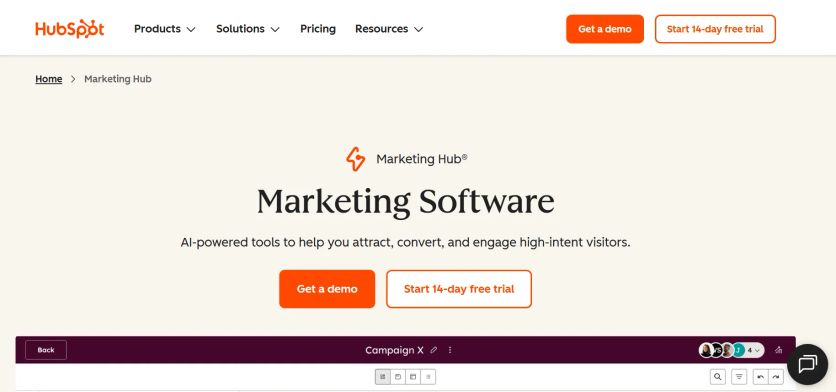
HubSpot has built its reputation on being the platform that marketing teams can actually use without filing engineering tickets. The Marketing Hub brings together email, forms, landing pages, workflows, and CRM into a single interface that prioritizes usability over complexity.
Key Features
Unified CRM Integration
HubSpot’s biggest advantage is that marketing, sales, and service tools share the same database. No sync issues, no data silos between teams. Contact-level visibility across every touchpoint.
Workflow Automation
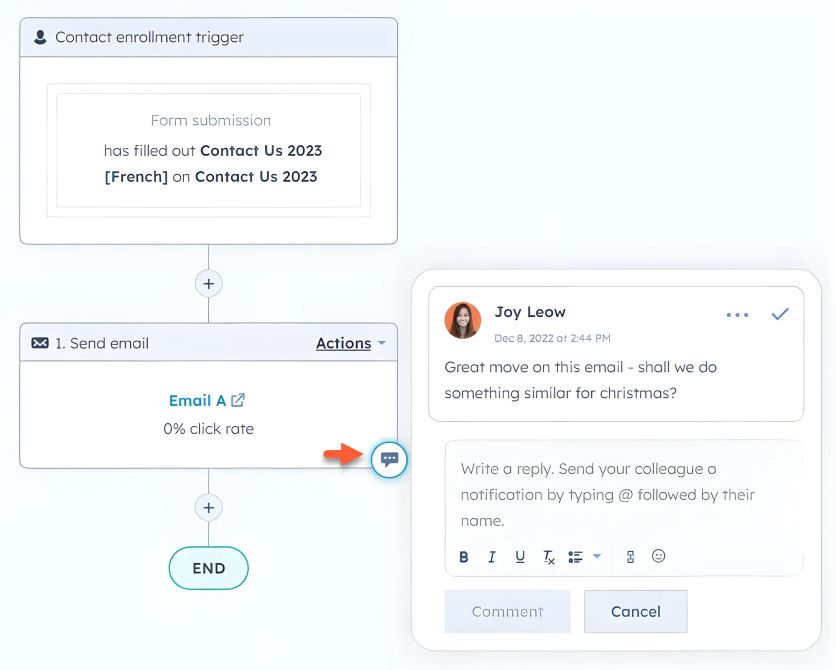
Visual workflow builder for lead nurturing, customer onboarding, internal notifications, and multi-step campaigns. Supports branching, delays, and conditional logic.
Breeze AI
HubSpot’s AI layer includes a Customer Agent, Data Agent, and Buyer Intent tools for lead scoring, content generation, and customer journey analysis.
Content Tools
Landing page builder, blog platform, social media management, ad management, and SEO tools – all built into the marketing hub. For teams that want everything in one place, it eliminates the need for separate content tools.
Pricing
HubSpot publishes transparent pricing:
- Professional: $800/month (annual) with 2,000 marketing contacts and 3 core seats. $3,000 one-time onboarding fee.
- Enterprise: $3,600/month with 10,000 marketing contacts and 5 core seats. $7,000 one-time onboarding fee.
- Additional contacts and seats available at extra cost ($75/month per additional Enterprise seat).
Strengths
- Genuinely user-friendly – marketing teams can self-serve without technical training
- Tight integration between marketing, sales, and service eliminates cross-team data silos
- Over 1,800 integrations in the HubSpot marketplace
- Excellent educational resources through HubSpot Academy
- Transparent, published pricing
- G2 rating: 4.5/5
Weaknesses
- Costs escalate as you add contacts and users – an Enterprise plan with 50,000 contacts costs significantly more than the base price
- Less flexible customization than more complex platforms – advanced use cases can feel constrained
- Advanced reporting features require Professional or Enterprise tiers
- Migration from other platforms takes time and resources, especially for complex data models
- Not built for e-commerce-specific use cases (no loyalty, no product recommendations, limited site personalization)
Compared to Maestra
HubSpot is a generalist CRM platform – it connects marketing, sales, and service teams under one roof, which is its core strength. That generalist approach means e-commerce-specific capabilities are thin: no loyalty engine, no product recommendation algorithms, limited site personalization. Maestra goes deep where HubSpot goes wide. For B2B companies or service businesses that need sales pipeline alignment, HubSpot is the natural fit. For e-commerce brands focused on retention and revenue, Maestra covers the use cases HubSpot can’t.
7. Bloomreach Engagement – Best for Content-Driven Commerce
Best for e-commerce and retail companies wanting AI-powered marketing automation
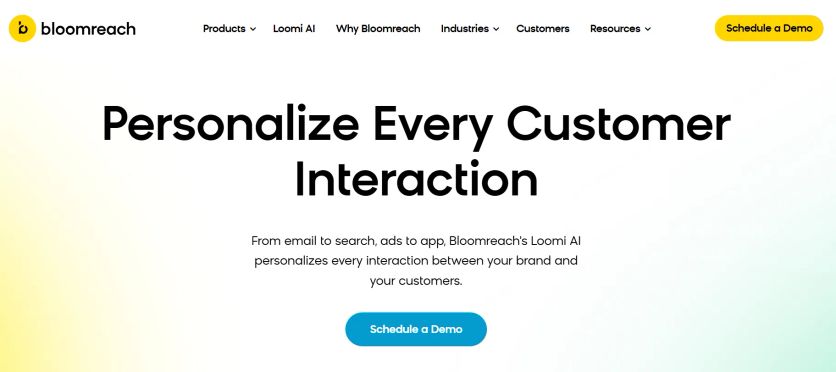
Bloomreach Engagement combines a customer data engine, AI-powered marketing automation, and omnichannel orchestration in a platform designed specifically for e-commerce. Forrester reports a 251% ROI over three years for Bloomreach customers, with ROI payback in under six months.
Key Features
Loomi AI
Bloomreach’s AI engine is included with every package. Loomi determines the next-best action, optimal channel, and perfect timing for every customer interaction. It also powers product recommendations, content generation, predictive churn and purchase scoring, and a new analytics agent for in-platform reporting.
Customer Data Engine
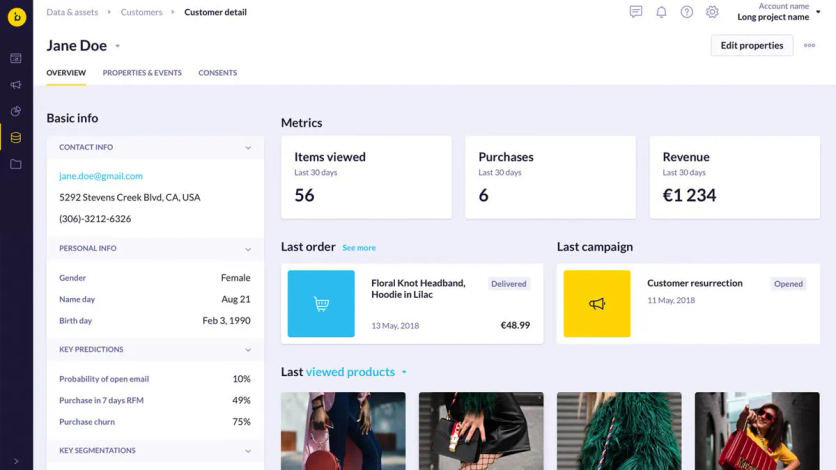
Combines all customer interactions, preferences, and predicted behavior into real-time profiles. Supports both online and offline data sources for a unified customer view.
Omnichannel Orchestration
Drag-and-drop scenario builder for flows across over 13 channels: email, SMS, WhatsApp, web, mobile app, ads, and more. Real-time triggers based on customer signals.
Pricing
Custom pricing only – no public pricing page. Pricing is based on modules selected (email, SMS, etc.) and usage volume, with decreasing per-unit costs at higher volumes. Base Loomi AI is included at no additional cost. Annual billing cycles are standard. Industry estimates suggest average contracts around $180K/year for enterprise implementations.
Strengths
- Base Loomi AI included at no extra cost – unlike platforms that charge for AI features as add-ons
- E-commerce-focused architecture with deep understanding of retail workflows
- Real-time data processing – responds to customer signals in milliseconds
- 130 native integrations including Shopify, Snowflake, and Databricks
- GDPR-certified, SOC 2 Type II, and ISO certified
- G2 rating: 4.6/5
Weaknesses
- Custom pricing makes cost comparison difficult before engaging sales
- Setup process requires dedicated resources and implementation planning
- Some G2 reviewers note the Single Customer View card could display more comprehensive customer value information
- Testing multiple page variants simultaneously in the Experiments module can be challenging
- Enterprise-level pricing may not suit smaller e-commerce operations
Compared to Maestra
Bloomreach and Maestra are the two most e-commerce-focused platforms on this list. Bloomreach’s advantages: data processing speed (millisecond-level), Loomi AI depth, and a strong search/merchandising product for retailers who need both. Maestra’s advantages: built-in loyalty (Bloomreach has no native loyalty engine), transparent published pricing, and a hands-on Forward Deployed Marketer model with 15-account-max ratios. The practical difference often comes down to what you need most – AI-driven decisioning speed (Bloomreach) or a single platform that replaces your loyalty, personalization, and marketing automation tools simultaneously (Maestra).
8. Twilio Segment – Best for Composable Data
Best for data-driven organizations needing a CDP foundation before marketing execution
Twilio Segment is a customer data platform that sits underneath your marketing tools, not alongside them. It collects, cleans, and routes first-party data from websites, mobile apps, and servers to over 700 downstream destinations.
Key Features
Connections
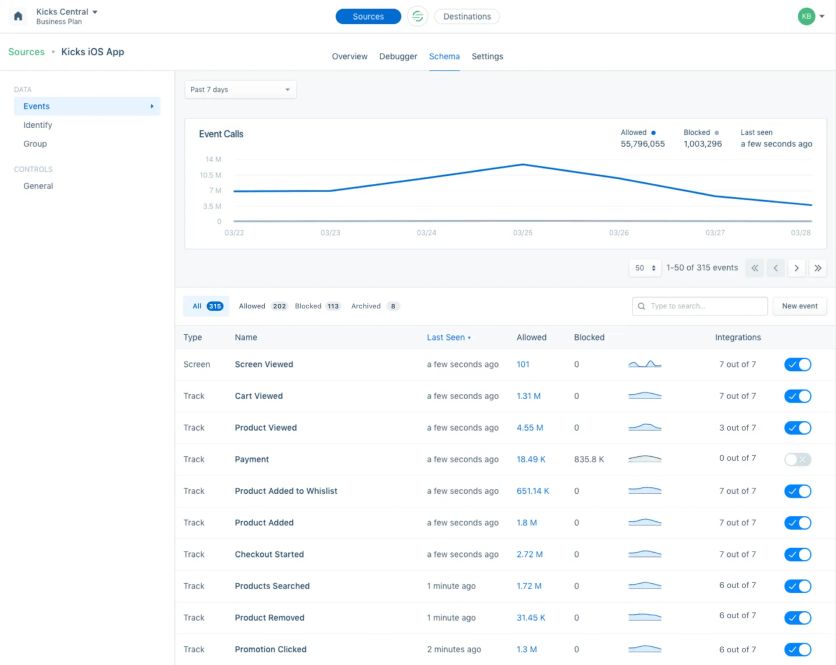
The core data pipeline that collects event data from all customer touchpoints and sends clean, standardized behavioral data to marketing tools, analytics platforms, and data warehouses.
Unify (Identity Resolution)
Creates complete customer profiles by connecting multiple touchpoints – resolving anonymous visitors to known customers across devices and channels.
Protocols
Data governance tools that standardize collection rules, enforce schemas, and maintain data quality across all sources.
Twilio Engage
Audience building and activation layer that lets marketers create segments based on events, attributes, or computed traits and push them to downstream marketing tools.
Pricing
Segment publishes transparent tiered pricing for its Connections product:
- Free: $0/month – 1,000 monthly visitors, 500K Reverse ETL records
- Team: $120/month – 10,000 monthly visitors (from $10–12 per additional 1,000 MTUs, with volume discounts at scale)
- Business: Custom pricing for higher volumes
The full CDP (Connections + Unify + Engage) requires custom pricing through sales.
Strengths
- The largest integration catalog in the CDP space (over 700 destinations)
- Data debugging tools that are genuinely useful for troubleshooting pipeline issues
- Flexible architecture: zero-copy lets you use your data warehouse as the source of truth
- Regional data residency options (EU or US)
- Free tier lets small teams start without commitment
- G2 rating: 4.5/5
Weaknesses
- Segment is a data layer, not a marketing execution platform – you still need separate tools for email, SMS, push, etc.
- Complex setup with a steep learning curve, especially for non-technical teams
- Data model is restrictive – objects are limited to user or account types
- Costs scale quickly at high data volumes
- Support requires completing a questionnaire – no immediate live support available
Compared to Maestra
Segment and Maestra solve fundamentally different problems. Segment is a data infrastructure tool – it collects and routes data but doesn’t send emails, build flows, run loyalty programs, or personalize your website. Maestra includes a built-in CDP alongside all the marketing execution tools. If you need a standalone CDP to feed multiple downstream tools, Segment is the standard. If you want a platform that handles both the data layer and the marketing execution layer, Maestra eliminates the need for Segment entirely.
9. Improvado – Best for Marketing Analytics and Reporting
Best for enterprise teams consolidating spend and performance data across many channels into one source of truth
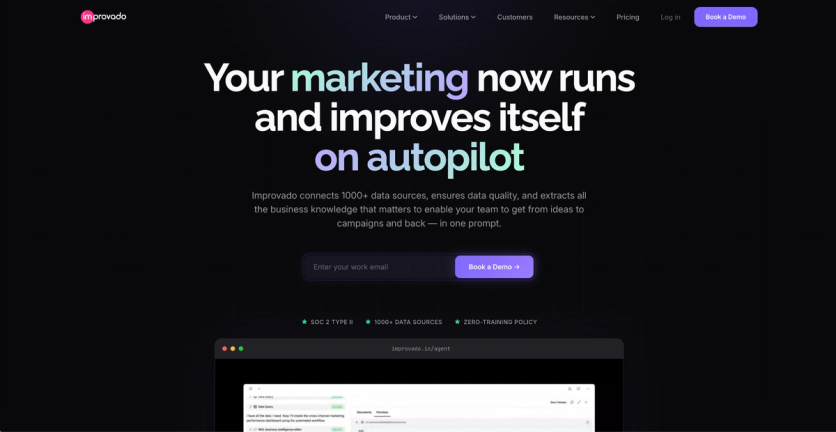
Most enterprise marketing platforms focus on executing campaigns. Improvado focuses on measuring them. It is an agentic marketing analytics platform that sits at the analytics layer of the stack, consolidating spend and performance data from across the enterprise into one governed source of truth. For large teams running an automation platform, a CDP, and a dozen ad accounts, it answers the question those tools rarely can on their own: what is actually working across every channel.
Key Features
Broad Connector Coverage
1000+ connectors across ad platforms, CRMs, and commerce systems.
Agentic Data Pipelines
Pipelines that extract, normalize, and load marketing data into a warehouse or BI tool automatically, with a normalization layer that harmonizes naming, currency, and time zones across channels.
Natural-Language AI Agent
An AI agent for natural-language querying of unified marketing data.
Warehouse-First Architecture and Governance
Warehouse-first architecture, so the organization owns and controls its data, with marketing data governance suited to multi-team, multi-brand enterprises.
Pricing
Custom, quote-based pricing scoped to connectors and data volume, positioned for enterprise budgets.
Strengths
- Purpose-built for the analytics and reporting layer rather than execution
- Consolidates many sources into one trusted model with a low engineering footprint
- Warehouse-first delivery avoids lock-in to a single front-end tool
Weaknesses
- Not a campaign execution, messaging, or CDP product, so it complements an automation platform rather than replacing one
- Value compounds with the number of channels and accounts you need to consolidate, so it is less suited to single-channel teams
Compared to Maestra
Maestra and Improvado sit at different layers of the stack. Maestra is an execution platform – omnichannel campaigns, a real-time CDP, built-in loyalty and site personalization, and reporting on the channels it runs. Improvado doesn’t execute anything; it stays at the analytics layer, consolidating spend and performance data across whatever tools you already use – including an execution platform like Maestra – into one warehouse-first source of truth. The two are complementary rather than competing: run execution and customer data in Maestra, then layer Improvado on top when you need unified reporting across many external ad accounts and tools.
10. Phonexa – Best for Pay Per Call & Pay Per Lead Campaigns
Best for affiliate networks, lead generators, and advertisers that buy and sell leads and calls at scale
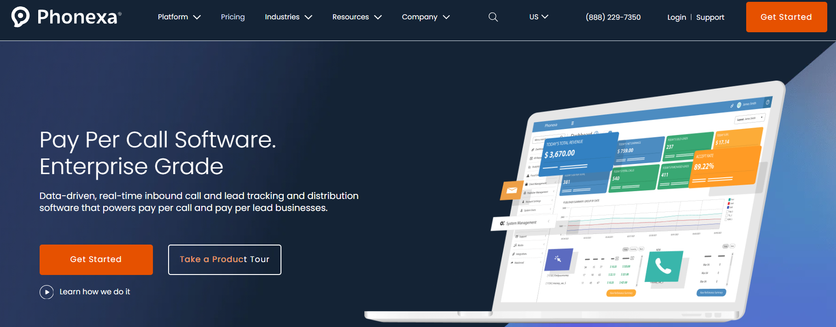
Phonexa is a pay per call & pay per lead software suite for companies that buy, sell, and manage large volumes of leads and phone calls, including affiliate networks, advertisers, lead generators, and large-scale affiliates. With two core solutions for web and call tracking, distribution, and analytics – LMS Sync and Call Logic – and six additional features, Phonexa might provide everything a lead- and call-reliant company needs, all under one roof without having to juggle systems and reports.
Key Features
Lead & Call Tracking, Distribution, and Analytics
Phonexa’s LMS Sync, Call Logic, and other modules work together to help you track the customer journey from top to bottom, doubling down on profitable efforts and eliminating unprofitable campaigns, traffic sources, and marketing assets. You know what works and what doesn’t and can make data-driven decisions on the fly.
Real-Time Reporting
Built-in real-time reporting allows you to track campaigns as they unfold, so you can adjust when something goes wrong or, conversely, increase the budget for your top-performing campaigns. Likewise, you can see which sources generate high-quality leads, which tend to submit duplicates, and more.
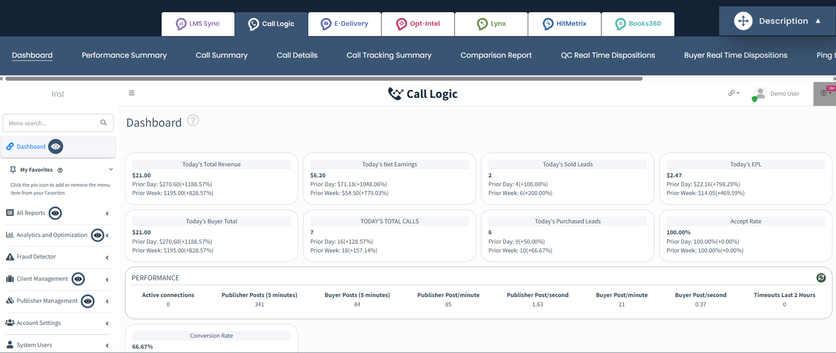
AI Call Agents
One of the recent additions to Phonexa’s tech stack, AI Call Agents can provide humanlike conversational experiences while collecting valuable data on inbound calls and helping qualify them on the fly to a matching internal sales or customer support rep or external business. AI Call Agents can be added as a block within your IVR builder.
Omnichannel Coverage
With LMS Sync, Call Logic, and the other 6 features fully synchronized, you get all the benefits of free data flows between systems. For example, you can automate email follow-ups with E-Delivery, sending personalized emails based on the call’s context and outcome. Likewise, you can automate SMS campaigns, commission payments, and other essential things that would otherwise require stitching several different tools together.
Pricing
Subscription pricing is custom and depends on your scale and usage.
Strengths
- Covers pay per lead and pay per call campaigns from top to bottom
- Includes features for omnichannel marketing, such as email follow-ups
- Offers direct post and ping post lead distribution, including ping tree campaign stacks
- Pulls data from different campaigns into an all-in-one tracking dashboard
- Integrates with CRMs and essential marketing tools
- G2 rating: 4.9/5
Weaknesses
- No free trial
- Steep learning curve
- Doesn’t fit small businesses and individual marketers
Compared to Maestra
Maestra and Phonexa are focused on different business aspects. Maestra is a customer engagement and personalization platform, making it a strong fit for companies that want to sell more to existing customers by analyzing their behavior. On the other hand, Phonexa is a solution for businesses that want to buy or sell leads and live calls, such as affiliate networks, lead generators, and advertisers.
Maestra focuses on customer engagement, while Phonexa focuses on connecting the right customer to the right company to maximize commercial value for those companies and the profits of the market player involved in the deal. Phonexa’s biggest use case is affiliate networks that manage tens or hundreds of thousands, or even millions of leads and want to automate their business while keeping it data-driven, accurate, and protected from fraud at all times.
11. Reply.io – Best for Outbound at Scale
Best for sales teams and agencies automating multichannel outbound outreach
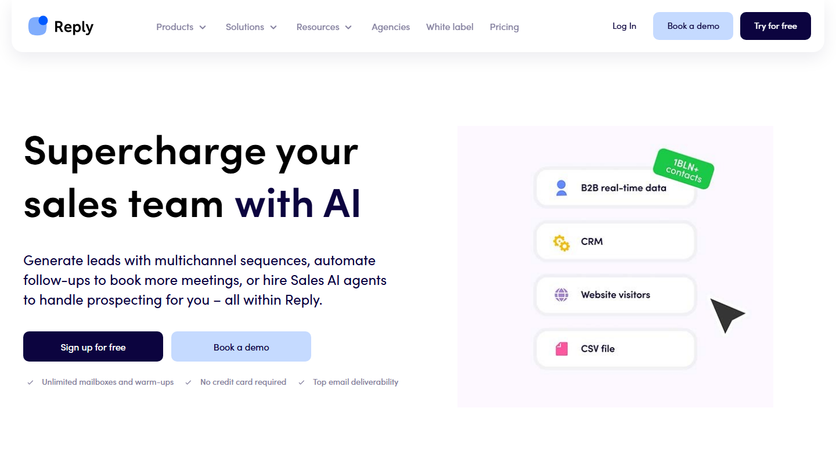
Reply.io is an AI-powered sales engagement platform designed to help teams automate prospecting, outreach, follow-ups, and meeting booking across multiple channels. It combines email automation, LinkedIn outreach, calling, SMS, and AI SDR workflows in one platform, making it popular among B2B sales teams focused on scaling outbound campaigns efficiently.
Key Features
AI SDR & Sequence Automation
Automates prospecting workflows with AI-generated emails, personalized follow-ups, and multichannel sequences across email, LinkedIn, calls, and SMS.
Multichannel Outreach
Allows teams to combine email campaigns with LinkedIn touches, WhatsApp, SMS, cloud calls, and meeting scheduling from a single workflow.
Email Deliverability Tools
Includes email warm-up, mailbox health monitoring, spam testing, and sender rotation to improve inbox placement and campaign performance.
Lead Management & CRM Integrations
Integrates with Salesforce, HubSpot, Pipedrive, Close, and other CRMs to sync contacts, activities, and pipeline data automatically.
AI Personalization
Uses AI to generate personalized email copy, suggest responses, and tailor messaging at scale for outbound campaigns.
Pricing
Reply.io pricing is structured around user seats and feature access:
- Email Volume – From $59/user/month
- Multichannel – From $89/user/month
- Agency Plans – Custom pricing
- AI SDR & advanced automation – Available in higher-tier plans
Strengths
- Strong multichannel automation combining email, LinkedIn, calls, and SMS
- AI SDR tools reduce manual prospecting work
- Built-in deliverability and email warm-up features
- Large integration ecosystem with popular CRMs and sales tools
- Easier onboarding compared to complex enterprise sales platforms
- G2 rating: 4.6/5
Weaknesses
- Primarily focused on outbound sales rather than full customer lifecycle marketing
- Advanced AI automation features require higher-tier plans
- Reporting and analytics are less advanced than enterprise marketing clouds
- Large-scale enterprise workflow customization can feel limited compared to Salesforce or Braze
- Heavy outbound usage still requires careful deliverability management
Compared to Maestra
Reply.io focuses on outbound sales engagement and lead generation, while Maestra is built for omnichannel customer marketing and retention. If your priority is scaling cold outreach, booking meetings, and automating sales prospecting, Reply.io is the stronger fit. However, it lacks Maestra’s customer data platform, loyalty tools, real-time personalization, and lifecycle marketing capabilities designed for e-commerce retention and customer engagement.
Choosing the Right Enterprise Marketing Platform
Maestra stands out as the most complete single-platform solution for e-commerce brands – full-stack e-commerce consolidation that replaces your CDP, marketing automation tool, loyalty vendor, and personalization engine with one platform and one bill. Brands like Urban Armor Gear cut marketing stack costs by 64% after making that switch; JOLYN grew repeat revenue by 22%. The white-glove support model (15 accounts per Forward Deployed Marketer, 5-minute SLA) means you get a strategic partner alongside the software.
That said, the right platform depends on your specific situation. If you’re already deep in the Salesforce ecosystem, Marketing Cloud’s CRM integration is unmatched. If your business is mobile-app-first, Braze’s real-time engagement capabilities are purpose-built for that. Adobe Experience Cloud makes sense for Fortune 500 companies with complex digital experience needs that go beyond marketing. HubSpot is a strong choice for teams that prioritize usability and need marketing-sales alignment without heavy technical investment. If lead and call acquisition and sales are your number one priority, Phonexa is likely the best fit. Bloomreach brings AI-powered e-commerce marketing with impressive processing speed. And Segment is the right foundation if your primary challenge is data infrastructure rather than marketing execution.
The platforms that deliver real ROI are the ones that match your team’s capabilities, your tech stack, and your actual business model – not the ones with the longest feature list.
FAQs
- Maestra and Bloomreach are both built specifically for e-commerce. Maestra offers the most complete single-platform solution – CDP, email, SMS, push, built-in loyalty programs, site personalization, and product recommendations in a single platform. Bloomreach excels at AI-powered decisioning and has strong search and merchandising capabilities. For e-commerce brands already on Shopify, Maestra’s native integration makes it particularly straightforward to implement. E-commerce brands see this in practice: 4ocean switched from Klaviyo and now runs a personal impact report its old stack couldn’t produce, and Coolibar grew campaign revenue 33.6% year over year.
- Maestra offers a full built-in loyalty engine – points, tiers, referral programs, and personal coupons – as a flat-fee module ($1,010/month on top of the CDP base), with loyalty data feeding the same segments and flows as every other channel. Salesforce Marketing Cloud offers Loyalty Management as an add-on ($20,000/org/month). Most other platforms in this list require integration with a third-party loyalty provider. The payoff is measurable – Burger King found that loyalty program participants generate 52% more revenue than non-participants.
- Maestra uses AI for product recommendations (14 algorithms), optimal send time prediction, and segment suggestions. Insider One’s Sirius AI automates segmentation, content generation, and channel selection with generative, predictive, and agentic AI. Braze’s BrazeAI (including the acquired OfferFit technology) focuses on 1:1 decisioning optimization. Salesforce’s Agentforce deploys autonomous AI agents for campaign creation. Adobe uses Sensei AI across creative, analytics, and personalization. Bloomreach’s Loomi AI handles next-best-action and product recommendations. HubSpot’s Breeze AI focuses on lead scoring and content generation. These capabilities translate into revenue: Blue Q shoppers who engage with product recommendations spend 28.7% more per order, and JOLYN drives 7% of its sales through recommendations.
- Maestra consistently receives the highest support ratings. The white-glove model means direct Slack access to your Forward Deployed Marketer, a 5-minute response SLA, and weekly strategy calls – not a shared support inbox. HubSpot offers 24/7 support and dedicated CSMs at the Enterprise tier. Insider One has received Gartner Peer Insights Customers' Choice recognition for support quality. Salesforce provides 24/7 support with extensive Trailhead self-service resources. Clients single out the hands-on support: Coolibar’s CRM lead called it “the smoothest migration I’ve ever seen,” and Sena credits a proactive Forward Deployed Marketer who guides them through every project.
- Maestra offers native Shopify integration as a core feature, designed specifically for e-commerce data flows. HubSpot, Bloomreach, and Segment all offer Shopify connectors. Braze, Salesforce, and Adobe typically require custom integration work or middleware for deep Shopify connectivity. Unidragon connected Maestra to their Shopify store and reached a 195% ROI – setting up campaigns without a developer.
- Maestra typically implements in weeks, not months – with the dedicated Forward Deployed Marketer handling migration and setup. HubSpot is relatively quick (1–3 months) depending on complexity. Braze and Salesforce Marketing Cloud typically require 3–6 months with professional services. Adobe Experience Cloud implementations can take 6–12 months for the full suite. Bloomreach offers phased implementation that delivers value incrementally. Real migrations are fast: Sena moved everything – contacts, flows, and templates – in just two weeks, and German Kabirski launched 31 workflows within four months with a dedicated Forward Deployed Marketer.