
Best Website Conversion Optimization Tools and Services for Ecommerce in 2026

70.22% is the average cart abandonment rate (Baymard Institute). Meanwhile, the average Shopify store converts at roughly 1.4%, with only the top 10% hitting above 4.7% (LittleData).
Conversion rate optimization that actually moves revenue is a stack: personalization that matches the right offer to the right shopper, behavioral analytics that tell you why visitors drop off, experimentation that validates what works at scale, and the strategic expertise to tie all three together.
Below, we cover three CRO tools that solve different parts of the problem, six CRO agencies worth hiring, and how to decide which combination fits your business.
Quick Verdict: Best CRO Tools and Agencies by Category
Best tool for e-commerce personalization: Maestra – real-time segments, on-site personalization, and automated flows that reduce abandonment
Best tool for heatmaps and user behavior analysis: Hotjar – session recordings, heatmaps, and surveys to see where visitors drop off
Best tool for A/B testing and experimentation: VWO – full-stack testing platform with visual editor and server-side experiments
Best agency for data-driven conversion growth: Growth-onomics – analytics-first approach with custom conversion strategies
Best agency for Shopify rebuilds that lift conversion: Medito Digital – theme, speed, and funnel work owned by one team
Best agency for Shopify builds and store performance: WebContrive – Shopify Plus development, migrations, and Core Web Vitals work
Best agency for CRO with hands-on implementation: WebDesk Solution – conversion research, A/B testing, and fixes deployed on Shopify Plus, BigCommerce, Adobe Commerce, and WooCommerce
Best agency for landing page optimization: SplitBase – high-converting landing pages and A/B testing for DTC brands
Best agency for research-backed CRO: Invesp – methodology built on behavioral research and usability testing
Content:
Top CRO Tools and Agencies for Ecommerce at a Glance
Best CRO Tools for Ecommerce
| Tool | Best For | Starting Price |
|---|---|---|
| Maestra | Personalization-driven CRO across site, email, SMS, and more | From $2,815/mo (CDP + onsite personalization) |
| Hotjar | Understanding why users don’t buy (heatmaps, session recordings, surveys) | Paid from $49/mo |
| VWO | A/B testing and experimentation | From $314/mo |
Best CRO Agencies for Ecommerce
| Agency | Best For | Starting Price |
|---|---|---|
| Growth-onomics | Performance marketing and CRO | $5,000 min project size |
| Medito Digital | Shopify theme rebuilds, migrations, and funnel audits | CRO audits from £1,900 |
| WebContrive | Shopify development, migrations, and store performance | Custom, project-based |
| WebDesk Solution | Ecommerce CRO with hands-on development on Shopify Plus, BigCommerce, Adobe Commerce, and WooCommerce | Custom, project-based |
| SplitBase | Brand-aligned CRO, UX and customer research, landing page design | From $8,500/mo |
| Invesp | Methodical, research-heavy optimization (SHIP process) | $5,000 min project size |
Best Website Conversion Optimization Tools for Ecommerce
Which tool you need depends on where your CRO program is today. Teams focused on lifting conversion across site, email, and paid media reach for Maestra. Teams trying to figure out why their funnel leaks start with Hotjar. Teams with enough engineering support choose VWO. Below, a closer look at each – and the kind of brand that gets the most out of them.
Maestra – Best for Personalization-Driven CRO
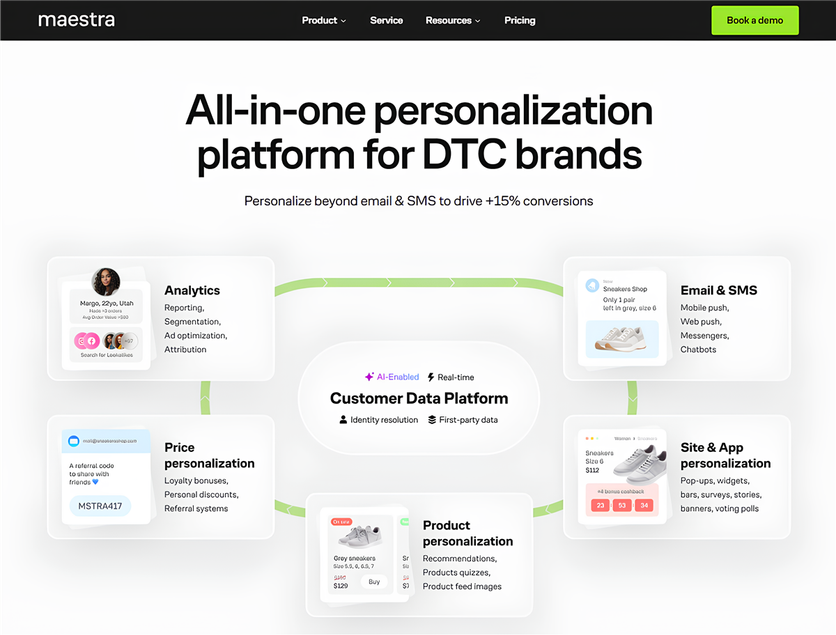
Maestra is an all-in-one personalization platform with a real-time CDP at its core, covering every channel where conversion happens: on-site popups, product recommendations, email, SMS, push, paid media audiences, and loyalty. Unlike pure testing tools, Maestra improves conversion by putting the right offer in front of the right visitor the first time – then lets you A/B test those experiences to iterate.
Key Features
Real-time Customer Data Platform. Maestra unifies customer data from all touchpoints (site, app, email, SMS, POS, and more) into a single profile. For CRO, this means every popup, recommendation, and offer reacts to what the visitor actually did which lifts conversion versus one-size-fits-all experiences. The CDP handles 2M+ requests per minute and supports databases from 30K to 65M records.
On-site personalization engine. No-code builder for popups, quizzes, surveys, upsell bars, spin-to-win games, scratch cards, countdown timers, banners, social proof notifications, and promotional badges. Each widget targets a specific conversion moment – exit-intent popups catch abandoning visitors; countdown timers create urgency on product pages; social proof notifications (“X people bought this today”) close the trust gap; low-stock alerts trigger scarcity. Every widget supports behavioral targeting, frequency control, and A/B testing out of the box.
Smart Upsell Bars. Dynamic progress bar that updates in real time as shoppers add items to cart – “Add $12 more for free shipping,” then “Add $25 more for a free gift.” Threshold messaging nudges shoppers to add one more item before checkout, lifting AOV without any extra acquisition cost. Enlightened Equipment lifted AOV by 38.7% – an additional $99.80 per order – after deploying the upsell bar. Setup took one hour.
14 AI recommendation algorithms. Bestsellers, similar products, frequently bought together, personal recommendations, post-purchase cross-sell, and more – deployed on homepage, product pages, cart, checkout, 404 pages, and inside emails. Smart recommendations cut the “I can’t find what I’m looking for” drop-off and lift both conversion rate and AOV. Matching on color, size, material, and purchase patterns means JOLYN can surface matching bikini bottoms when a customer views a red bikini top – same size, same material – with recommendations assisting 7% of total sales.
Product quizzes for guided discovery. Multi-step quizzes guide shoppers to the right product through a few targeted questions. Large catalogs overwhelm visitors and kill conversion – quizzes eliminate choice paralysis and send each shopper to exactly what they want. Blossom Flower Delivery added a simple quiz and saw a 14% website conversion lift.
Omnichannel flow builder. Drag-and-drop visual canvas that orchestrates email, SMS, push, popups, and paid media retargeting in one workflow. Most visitors don’t convert on the first visit, so cascading flows bring them back: if the abandoned-cart email goes unopened after 2 days, send SMS; if SMS is ignored, show an on-site popup on next visit. Audiences also sync to Meta and Google for retargeting – same visitor, consistent offer, different channels, until they convert.
Built-in A/B testing with revenue attribution. Every widget, flow, popup, and email variant can be split-tested – this is how you prove what actually lifts conversion. Maestra measures lift with control groups, not just click-through or open rates, but real revenue tied to specific variants. RFM analysis and segment-level reporting are native; no separate BI tool required.
Dynamic product cards for paid ads. Auto-generated product visuals with live prices, discounts, and “new arrival” badges pushed directly to Meta and Google ad campaigns. When ad creatives match live on-site inventory and pricing, the click-to-conversion gap narrows – visitors land on pages that match the ad exactly, not a stale promo they came to redeem. Selkirk Sport saw a 2.6x ROAS increase and 17% CPC reduction after switching to Maestra’s dynamic cards.
Dedicated Forward Deployed Marketer (a marketer who works as part of your team). Every plan includes a Forward Deployed Marketer managing at most 10–15 accounts (versus 60+ at many competitors). For CRO specifically, the Forward Deployed Marketer runs your A/B testing program – prioritizing experiments, analyzing results, iterating – not support-ticket duty. Weekly strategy calls and a shared Slack channel are standard. In practice: your team gets an outsourced CRO lead included in the plan, not a tool you operate alone.
How it shows up in CRO results: Enlightened Equipment consolidated email, SMS, product recommendations, popups, and paid media into Maestra – and saw +52.5% total revenue growth from the compounding effect. No single change was revolutionary: AI recommendations lifted website conversion by 15%, the upsell bar grew AOV by 38.7%, lead capture went from 0.37% to 6.1%, and dynamic product cards improved Meta Ads ROAS. But running all of these off the same real-time CDP meant each improvement amplified the others. Blossom Flower Delivery added a product quiz and saw a 14% website conversion lift – and their social proof notifications increased revenue per session by up to 34%.
Best for
Mid-market and enterprise ecommerce brands that want to boost conversions across all marketing channels and need a Forward Deployed Marketer for expertise and execution. Maestra works with Shopify, BigCommerce, WooCommerce, Magento, and custom ecommerce stacks.
What to Consider
Maestra is built for mid-market and enterprise DTC brands. A CRO-focused setup (the CDP base plus the onsite personalization module) starts at $2,815/month, which puts it out of reach for early-stage stores. The platform is deep: clients typically run 30–70 automated flows which means there’s a ramp-up period even with a dedicated Forward Deployed Marketer. If you need only A/B testing, Maestra is overkill. But if your conversion strategy spans multiple channels, consolidating into one platform eliminates the data-sync tax that slows down fragmented stacks. You can build your own estimate on the Maestra pricing page.
Pricing
From $2,815/month for a CRO-focused setup – the CDP base ($1,300/month) plus the Onsite Experience Personalization module ($1,515/month). The first 100,000 active profiles are included, and dormant profiles are stored free. The base already covers product recommendations, reporting, and a dedicated Forward Deployed Marketer. Month-to-month billing, no setup fees; managed migration is included, and billing starts only after go-live.
Hotjar – Best for Understanding User Behavior
Hotjar is the canonical behavioral analytics tool in ecommerce. It doesn’t test or personalize – it diagnoses. Where are visitors clicking? Where do they drop off? What’s confusing them? For teams doing CRO, Hotjar answers the “why” that testing tools and personalization platforms can’t surface on their own.
Key Features
- Heatmaps – visualize where visitors click, scroll, and hover on every page.
- Session recordings – replay anonymized user sessions to see exactly where friction kicks in.
- Surveys and feedback widgets – capture qualitative input from real visitors.
- Funnels – track drop-off at each step of your conversion path.
- User interviews (via Hotjar Engage) – schedule and record 1:1 conversations with your actual users.
How it helps CRO: Before you test, you need a hypothesis. Hotjar is the hypothesis machine. A session recording showing 80% of mobile visitors abandoning at the shipping calculator tells you what to fix – and lets you formulate a testable change instead of guessing.
Best for
Ecommerce teams that need to diagnose why visitors drop off – Hotjar generates hypotheses you then validate with testing and personalization tools.
What to Consider
Hotjar’s free plan is genuinely useful for small stores (35 daily sessions on Observe), but high-traffic merchants outgrow it quickly. The paid plans stack separately across Observe, Ask, and Engage – you pay per product, which adds up. Following Contentsquare’s acquisition in 2025, pricing is migrating to a unified platform with Growth tier at $49/month, but legacy Observe/Ask plans are still available. Hotjar doesn’t test or personalize – you’ll still need a separate tool for that.
Pricing
Paid plan starts at $49/month. Annual billing saves ~20%.
VWO – Best for A/B Testing and Experimentation
VWO is a full-stack experimentation platform covering A/B testing, multivariate tests, server-side feature flagging, personalization, and basic behavioral analytics. Where Hotjar diagnoses and Maestra personalizes, VWO is where you validate whether a change actually lifts conversion.
Key Features
- A/B and multivariate testing with visual and code editors.
- Split URL testing for comparing entirely different page templates.
- Server-side and client-side experimentation for teams with engineering support.
- Personalization engine with audience segmentation.
- Insights module – heatmaps and session recordings (light overlap with Hotjar).
- SmartStats Bayesian statistics for faster decision-making on test results.
How it helps CRO: A proper experimentation program is how you move from anecdote (“I think this CTA would convert better”) to measured revenue lift. VWO’s statistical engine is strong enough for enterprise programs running dozens of concurrent tests.
Best for
Enterprise ecommerce teams running 20+ concurrent A/B tests per quarter with engineering support for server-side testing. Overkill for brands under 50K MTUs.
What to Consider
VWO’s pricing is usage-based and tied to Monthly Tracked Users (MTUs) – unique visitors who interact with an active test or personalization. Costs scale quickly as your traffic grows, and overage pricing isn’t transparently disclosed. The platform has a steep learning curve – setting up robust server-side experiments or segmented personalization often requires engineering support. For most ecommerce brands under 50K MTUs, you won’t need the depth VWO offers – but once you’re running 20+ tests per quarter across a mature funnel, it’s the category leader.
Pricing
Free trial available. Growth plan starts at $314/month (billed annually) for 10,000 MTUs. Pro and Enterprise tiers custom-quoted.
The Best Conversion Rate Optimization Agencies for Ecommerce
Tools solve the execution side of CRO, but the strategic work – research, hypothesis generation, statistical analysis, and prioritization – is where most teams struggle. Hiring a CRO agency makes sense when you lack in-house expertise, need results fast, or want to layer outside strategic thinking onto your existing tool stack. Below are six agencies with distinctive approaches.
Growth-onomics – Best for Performance Marketing and CRO
Growth-onomics is a full-funnel growth agency headquartered in Nicosia, Cyprus, with a second office in Dubai – positioning them as a natural choice for EMEA-focused ecommerce brands. Their specialty is the intersection of paid media and conversion optimization: if your paid traffic is bringing visitors but not converting, they optimize the handoff between ads and landing page.
Growth-onomics also offers an AI visibility service – optimizing brand presence inside LLM-generated answers (ChatGPT, Gemini, Perplexity).
What They Do
- CRO audits and funnel analysis – monthly or one-time deep audits by certified CRO experts, with step-by-step site improvement instructions and backlog management to track implementation.
- Customer journey mapping – streamlining the user journey at every stage of the conversion process.
- Performance marketing – Google Ads, Meta Ads, Taboola, Reddit, Pinterest; the team has managed monthly budgets from €10,000 to €500,000.
- SEO – technical audits, link building, and content strategy; their SEO lead has driven 45% organic traffic increases and 12% CPA reductions for clients.
- Lead generation – ICP development, landing page optimization, and automated outreach sequences across email and LinkedIn.
- AI visibility – optimizing brand citations inside ChatGPT, Gemini, Perplexity, and Copilot; includes a 20-page diagnostic, structured data buildout, and ongoing citation monitoring across LLMs.
- Data analytics and reporting – performance trend analysis to inform strategic growth decisions.
Methodology: A 5-step “Action-Driven Methodology” covering funnel analysis, A/B testing, personalization, omnichannel marketing, and ongoing optimization.
Best for
EMEA ecommerce brands running paid acquisition at scale who want one team managing both traffic and conversion.
Pricing
Growth-onomics doesn’t publish pricing on their website but offers pay-as-you-go subscriptions rather than long-term contracts. According to their Clutch profile, hourly rates run $100–$149/hour with a $5,000+ minimum project size. Most engagements come in under $10,000 per project.
Medito Digital – Best for Conversion-Focused Shopify Rebuilds
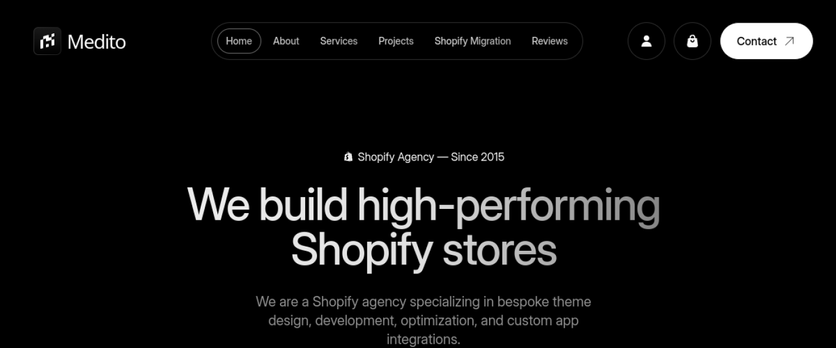
Medito Digital is a UK-based Shopify Partner agency that treats conversion as a build problem: the theme, the speed, and the funnel are owned by the same team that is accountable for the traffic. Alongside the build work it runs SEO and AI visibility, measured with ongoing citation monitoring across ChatGPT, Gemini, Perplexity, and Copilot. A Shopify agency since 2015, with 57 migrations delivered.
What They Do
- CRO audits and funnel analysis – a discovery call and audit producing a prioritized task list against customer journey friction, tracked through to implementation.
- Shopify theme design and customization – bespoke mobile-first themes and targeted customization of existing ones, with speed and Core Web Vitals work built into every build rather than quoted separately.
- Shopify migration – moves from WooCommerce, Magento, BigCommerce, and legacy platforms with products, customers, orders, redirects, and rankings preserved.
- SEO and organic growth – technical audits, keyword mapping, on-page and Shopify-specific fixes, content production, and monthly rank and traffic reporting.
- AI visibility and generative search – structured data buildout, entity and brand clarity, content shaped for citation, and monitoring of brand presence inside AI answers.
- Ongoing support – monthly retainers and post-launch monitoring so gains compound after handover.
Methodology: Two tracks. Theme builds start by assessing the existing store, restructuring content and navigation, redesigning every page and interaction in Figma, layering in features such as wishlist, cart, upsell and cross-sell, then building from scratch so speed is native rather than retrofitted. The SEO and AI visibility track starts from keyword gaps, competitor and backlink profiles, and a baseline of tracked prompts and current citations, feeding a page-level content structure and link building on priority keywords.
Best for
Shopify and Shopify Plus brands that want the theme, the migration, and the conversion work owned by one team, and that also want to be found in AI answers as well as in search results.
Pricing
Indicative starting prices: CRO audits from £1,900 (~$2,400), SEO from £950/month (~$1,200), and Shopify theme development from £15,000 (~$18,900). Reported results include a 40% average conversion lift after a theme rebuild, +36% after a migration, and a 2x improvement in site speed.
WebContrive – Best for Shopify Brands & DTC Growth
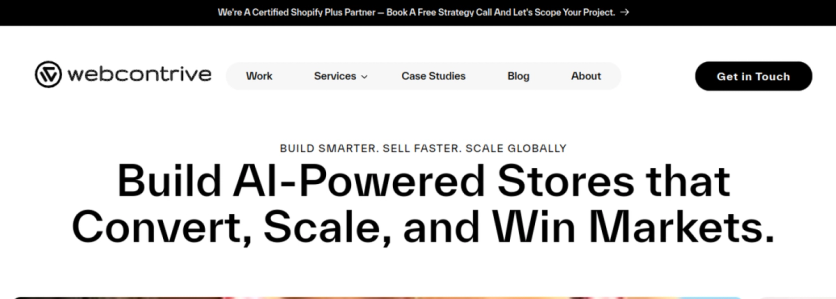
WebContrive is a Shopify development and ecommerce growth agency focused on helping DTC, B2B, and enterprise brands build, optimize, and scale their Shopify stores. As a Certified Shopify Plus Partner, WebContrive combines Shopify development, CRO, performance optimization, and ecommerce strategy under one team.
What They Do
- Shopify store development – Custom Shopify and Shopify Plus development, theme development, custom functionality, integrations, and storefront optimization.
- Shopify Plus solutions – Advanced Shopify Plus development for growing and enterprise brands, including complex commerce requirements and custom integrations.
- CRO and performance optimization – Conversion-focused UX improvements, technical audits, Core Web Vitals optimization, and performance enhancements designed to reduce friction and improve store performance.
- Headless Shopify development – Custom headless storefronts using Shopify’s modern commerce architecture for brands that need greater flexibility and control over their customer experience.
- Shopify migration – Migration from platforms such as WooCommerce, Magento, BigCommerce, and other ecommerce platforms while focusing on SEO, data integrity, redirects, and a smooth transition.
- Ongoing Shopify support and maintenance – Continuous development, troubleshooting, optimization, and technical support for Shopify merchants.
Methodology: WebContrive takes a growth-focused approach that combines Strategy, Development, and Optimization. The team looks beyond simply building a Shopify store, focusing on technical performance, user experience, conversion opportunities, and long-term scalability.
Best for
DTC, B2B, and enterprise brands on Shopify or Shopify Plus that need a reliable development partner for store builds, migrations, custom functionality, performance optimization, or ongoing ecommerce growth.
Pricing
WebContrive offers project-based and ongoing Shopify development services, with pricing depending on the scope, technical complexity, integrations, and level of ongoing support required. Custom Shopify development and Shopify Plus projects are typically scoped based on the brand’s specific requirements rather than a fixed public pricing tier.
WebDesk Solution – Best for Ecommerce CRO and Conversion-Focused Development
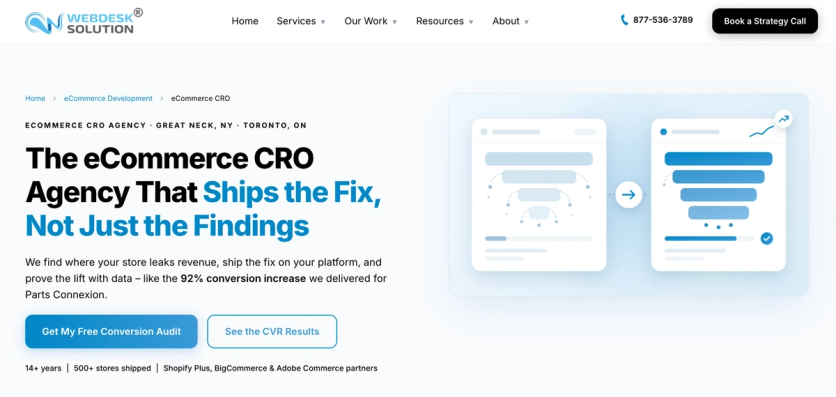
WebDesk Solution is a North American ecommerce digital agency helping growing and enterprise brands improve conversion rates, user experience, and online revenue. The team combines conversion research, experimentation, and hands-on development to identify barriers to purchase, implement improvements, and deploy fixes across Shopify Plus, BigCommerce, Adobe Commerce, and WooCommerce stores.
What They Do
- Conversion research and audits – Analyze analytics, funnels, heatmaps, and user behavior to identify conversion barriers and prioritize improvements.
- Product page optimization – Improve product page layouts, product information, imagery, and buying experiences to help shoppers make confident purchase decisions.
- Cart and checkout optimization – Reduce purchase friction by improving cart functionality, checkout flows, payment options, and other barriers to completing an order.
- Site search and filtering – Improve search relevance, product discovery, and faceted filtering to help customers find the right products faster.
- A/B testing and experimentation – Develop and test conversion hypotheses, measure results, and implement winning variations on live stores.
- Analytics and conversion tracking – Configure and improve GA4 and Google Tag Manager tracking to measure user journeys, conversions, and revenue performance.
Methodology: WebDesk Solution follows a research, prioritize, build, test, and deploy approach. The team uses analytics and behavioral insights to develop measurable hypotheses, prioritizes improvements based on impact and effort, and tests changes where traffic supports reliable experimentation. Winning improvements are implemented on the live store, with results documented to inform future optimization.
Best for
Growing and enterprise ecommerce brands, particularly high-catalogue retailers on Shopify Plus, BigCommerce, Adobe Commerce, and WooCommerce, that need both conversion strategy and the technical expertise to implement improvements.
Pricing
Pricing is customized based on the store’s platform, catalogue size, traffic, and implementation requirements. Engagements include fixed-scope conversion audits, optimization sprints, ongoing CRO programs, and conversion optimization as part of a website build or migration.
SplitBase – Best for DTC Brands on Shopify
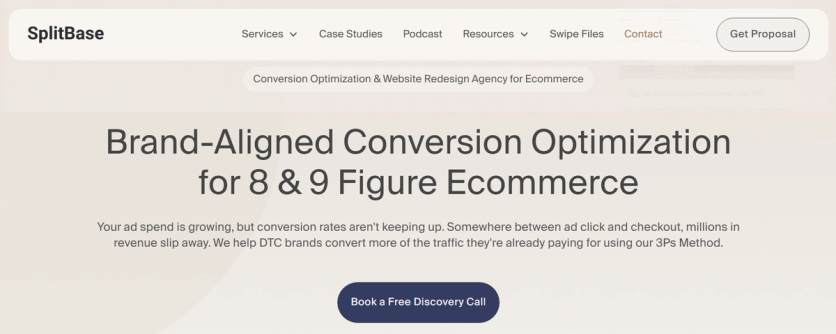
SplitBase is a CRO and landing page agency. They are based in Montreal, Canada – which means North American time zones, native English and French support.SplitBase works exclusively with 8–9 figure DTC brands on Shopify – a sharp specialty that means the playbook is tuned to exactly one platform and one business model.
What They Do
- UX and customer research – analytics deep dives, customer surveys, heatmaps, usability testing, and social media comment monitoring to build an insights database before any test is designed.
- Fully managed A/B testing programs – hypothesis, design, development, QA, and analysis.
- Landing page design and optimization – custom landing pages for paid traffic campaigns, built in Replo or Webflow, with full Figma handoff if your team prefers to code in-theme.
- Brand-aligned CRO with in-house design and copywriting – optimization that preserves brand aesthetics and equity.
Methodology: The 3Ps Method – Patterns (data analysis), Perception (user research), and Proof (experimentation). Every test hypothesis has to be triangulated across all three lenses before launching.
Best for
Shopify-native DTC brands doing $10M+ in revenue who want a dedicated CRO program run by specialists.
Pricing
Full-service landing page and CRO optimization programs start at $8,500/month. Pricing scales with scope – number of testing tracks, research depth, and level of design support. SplitBase doesn’t publish tier breakdown publicly.
Invesp – Best for Data-Driven CRO Strategy
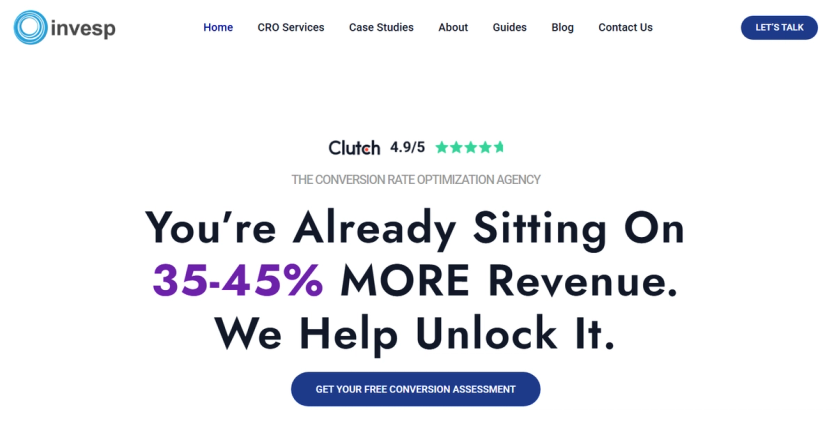
Invesp is one of the longest-running dedicated CRO agencies in the industry – established in Chicago in 2006. Their track record: 38,000+ A/B tests run for 900+ clients.
What They Do
- CRO audits, user research, and competitive analysis – expert heuristic and usability reviews, customer journey mapping, qualitative usability analysis, quantitative analytics assessment, and competitive analysis.
- A/B testing programs – hypothesis creation, solution design, A/B or usability testing, and post-test analysis. Invesp uses FigPii, their proprietary testing platform, for deployment and tracking.
- Conversion research and discovery – a 2-month intensive engagement covering user testing, qualitative and quantitative assessment, delivering a 6–12 month conversion roadmap your team can execute independently.
- Analytics and business intelligence – in-depth analytics audit, tag implementation verification, backend data reconciliation, and custom dashboards for actionable reporting.
- Copywriting and design services tied to test results – in-house design and copy produced as part of each test cycle, not outsourced separately.
Methodology: The SHIP process – Scrutinize (research what’s broken), Hypothesize (form a testable theory), Implement (run the A/B or usability test), Propagate (share findings across channels and verticals). It’s a continuous loop, not a one-time project – and Invesp emphasizes that the Scrutinize and Propagate stages deserve the bulk of your time.
Best for
Ecommerce brands wanting a methodical, research-heavy CRO program – long-term commitment, not one-off audits.
Pricing
Invesp doesn’t publish their pricing. According to their Clutch profile, minimum project size is $5,000+, with monthly investments from client reviews ranging from $7,500 monthly to over $300,000 overall depending on scope.
FAQs
- The global ecommerce average is 1.6–1.9%; for Shopify stores specifically, it’s 1.4%, with the top 10% above 4.7%. Your benchmark depends on your category – high-ticket items like electronics typically convert at 0.8–1.5%, while everyday consumables hit 3–5%. Maestra runs A/B-testable popups, on-site personalization, and AI product recommendations on a real-time CDP, pushing conversion above category averages when the layers work together. Enlightened Equipment saw a 15% increase in website conversion rate after deploying Maestra’s product recommendations alongside email and SMS flows.
- It depends on the job. Maestra covers personalization-driven CRO across on-site, email, SMS, and paid media – with a real-time CDP, AI popups, A/B testing, and one-click Shopify integration. Hotjar is the go-to for behavioral analytics (heatmaps, session recordings, surveys). VWO handles deep A/B testing and experimentation programs. JOLYN replaced its popup tool with Maestra and saw a 22% lift in revenue per user after switching.
- SplitBase’s full-service CRO programs start at $8,500 per month. Growth-onomics and Invesp don’t publish pricing. If your budget is tight, Maestra includes a dedicated Forward Deployed Marketer on every plan at no extra cost: the Forward Deployed Marketer handles migration, flow setup, A/B testing, and ongoing optimization, which covers most of what an agency retainer would deliver. Blossom Flower Delivery launched 38 automated campaigns in one month and achieved 426% ROI over 41 days – with Maestra’s managed setup, no external agency required.
- With tools in place, you can launch your first experiments within 2–8 weeks, depending on implementation complexity. Meaningful lift usually takes 30–90 days – A/B tests need statistical significance, which requires enough traffic and conversions to rule out noise. Maestra’s managed setup shortens this: the dedicated Forward Deployed Marketer handles migration, flow setup, and first experiments. Sena completed its full migration in two weeks and grew total revenue 2.2x. With a pure-agency engagement, expect 30–60 days before the first test goes live, and 3–6 months before material lift.
- Four things matter when evaluating CRO agencies: specialization, methodology, track record, and transparency on tools. Specialization – does the agency have a proven playbook for your vertical (Shopify DTC, B2B SaaS, marketplace)? Generalists rarely outperform specialists. Methodology – ask for their exact process. Invesp’s SHIP framework, SplitBase’s 3Ps Method, and Growth-onomics' Action-Driven Methodology are examples of structured approaches you can evaluate. Track record – specific brand names and measured results, not vague “we lifted conversion for a client.” Transparency on tools – a good CRO agency recommends the right tools for your situation, not the ones they get affiliate revenue from. If you want a tool-plus-service hybrid without hiring an agency separately, Maestra includes a dedicated Forward Deployed Marketer on every plan – migration, flow design, A/B testing, and deliverability monitoring are all handled in-subscription. Magnum Bikes grew online orders by 111.7% with a lean in-house team running sophisticated retention marketing via Maestra’s managed setup – no extra headcount, no external agency.