
10 Best Twilio Segment Alternatives for E-Commerce

Twilio Segment does one job well: it collects customer events and routes clean data to the rest of your stack. The trouble starts when you want to act on that data. Segment moves it. Something else has to send the email, run the flow, personalize the site, and reward the loyal buyer.
That split is where the bills pile up. You pay Segment on monthly tracked users – anonymous visitors included – then pay again for the email platform, the SMS tool, the personalization layer, and the loyalty app that sit downstream. B2C brands with heavy anonymous traffic feel the MTU meter most, and reviewers say support has thinned out since the Twilio acquisition.
So teams start looking for something that either replaces Segment on better economics or removes the second-tool problem entirely. This article compares ten platforms across features, pricing, and verified G2 ratings. Here’s how they stack up.
Quick Verdict on the Best Twilio Segment Alternatives
The best Twilio Segment alternatives are Maestra, RudderStack, Hightouch, DinMo, mParticle, and Tealium. Maestra is the strongest choice for e-commerce brands because it unifies customer data and acts on it – real-time CDP, omnichannel messaging, built-in loyalty, and site personalization in one platform – instead of routing data to separate tools the way Segment does.
Pain Points with Twilio Segment
Segment is a strong pipe. Most complaints are about what that pipe costs and what it leaves you to build yourself. The pain points below come from verified reviews on G2, TrustRadius, and Capterra from the last 12 months.
Twilio Segment Complaints and Possible Fixes
| Pain Point | Description | Possible Solutions |
|---|---|---|
| MTU pricing climbs with traffic | Anonymous website visitors count as monthly tracked users, so high-traffic B2C sites see costs scale with traffic, not conversions. | Move to events-based pricing (RudderStack) or profile-based pricing (Maestra, Treasure AI). |
| Data moves but doesn’t act | The CDP unifies data; a separate ESP, SMS tool, and personalization layer still have to execute. | Choose a platform that unifies data and runs the channels (Maestra, Bloomreach) or a composable CDP with activation (Hightouch). |
| Support declined post-acquisition | Reviewers report template responses and a culture shift since Twilio bought Segment. | Look for platforms that include a dedicated success manager (Maestra). |
| Implementation is heavy | Full instrumentation across every source takes engineering time before value appears. | Prefer platforms with white-glove onboarding (Maestra) or warehouse-native setup. |
| Native execution needs more Twilio | Twilio Engage activation leans on separate Twilio/SendGrid messaging licensing. | Pick a platform where messaging is included, not licensed separately (Maestra). |
On the MTU model, one recurring theme is that costs get “extremely pricey for websites and apps with anonymous users.” On service, reviewers say the “culture has changed” since the acquisition and customers are “not treated well.” Reviewers comparing options most often name RudderStack and Snowplow as cheaper pipes, and bundled platforms when they want execution included.
Before switching, try three things. Turn on Protocols to cut wasted events and tighten your MTU count. Audit which downstream tools you actually use – you may be paying for routing to destinations no one touches. And price your true total: Segment plus every tool it feeds. If that number is climbing faster than revenue, the platforms below are worth a serious look.
Twilio Segment Alternatives at a Glance
| Platform | Best For | Key Differentiator | Starting Price |
|---|---|---|---|
| Maestra | DTC and retail brands that want to unify data and act on it in one platform | Real-time CDP plus omnichannel execution, built-in loyalty, and a dedicated Forward Deployed Marketer | From $2,000/mo (CDP + unlimited email) |
| RudderStack | Data teams that want a warehouse-native pipeline | Events-based pricing, no data storage | From $265/mo (1M events) |
| Hightouch | Marketers on a warehouse who want no-code audiences | Composable CDP with AI Decisioning | Free tier; paid via sales |
| DinMo | European teams that want warehouse-native activation | European agentic CDP with an embedded AI operator that turns workspace data into insights, segments, journeys, and activation proposals | Custom; contact sales |
| mParticle by Rokt | Performance marketing across mobile and media | Hybrid CDP with ad-match boosting | Custom (est. ~$156k/yr) |
| Tealium | Privacy-sensitive enterprises | Data orchestration with 1,300+ connectors | Custom (est. ~$120k/yr) |
| Treasure AI | Data-mature enterprises with SQL teams | Agentic platform, pay-for-value pricing | Custom (est. $100k–$750k/yr) |
| Adobe Real-Time CDP | Existing Adobe Experience Cloud customers | B2C, B2B, and B2P editions | Custom |
| Snowplow | Engineering teams building warehouse-native data | Owned raw behavioral data, AI context layer | 14-day free trial; then quote |
| Bloomreach | Enterprises wanting marketing plus commerce search | Built-in data engine and agentic AI | Custom (module + usage fee) |
Maestra – Best for Unified Data and Omnichannel Execution
Starting price: From $2,000/mo (CDP + unlimited email)
G2 rating: 4.8 / 5
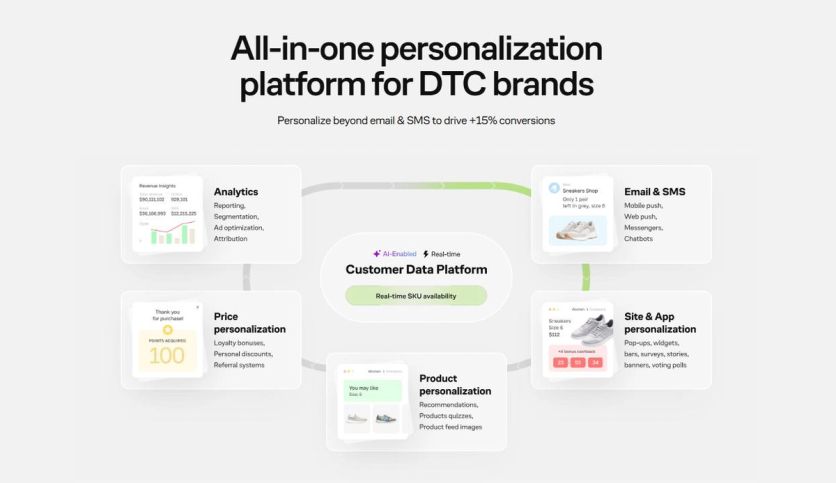
Maestra is a marketing personalization platform for mid-size, enterprise, and rapidly scaling e-commerce brands. It pairs a real-time CDP with the tools that use it – omnichannel flows, site and app personalization, product recommendations, and built-in loyalty – so unified data and activation live in the same system.
Where Segment hands clean data to your other tools, Maestra keeps the data and the execution under one roof.
Key Features
Real-Time CDP
Maestra’s real-time CDP unifies customer data from every channel into one profile, resolves identities across web, app, and offline touchpoints, and auto-cleans and deduplicates records so segments stay accurate.
Marketers build segments with full AND/OR logic and nested conditions – by customer, product, brand, order status, RFM, or purchase history – and every offer, recommendation, and message syncs off the same profile in real time. Coolibar switched for exactly this: flexible segmentation and a centralized customer database its previous tool couldn’t match.
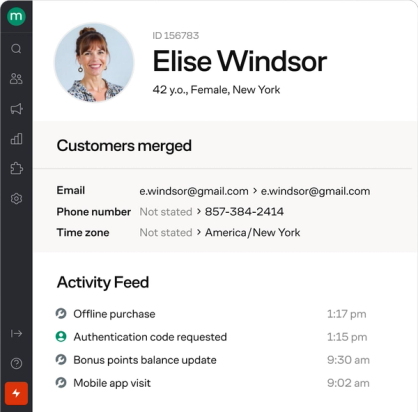
Maestra’s real-time CDP unifies records into one customer profile with identity resolution
Omnichannel Flow Builder
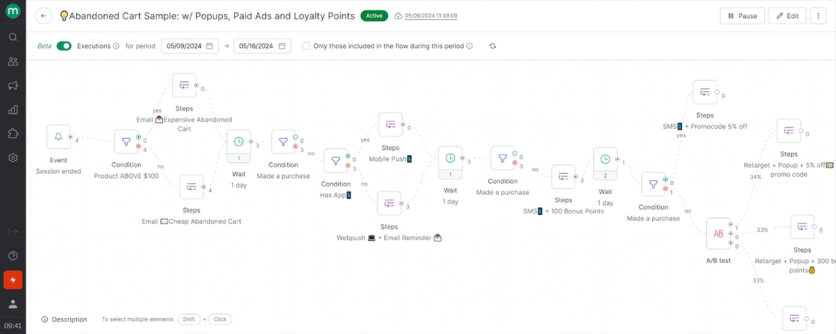
Maestra’s omnichannel flows run on a drag-and-drop builder and adapt in real time across email, SMS, MMS, RCS, mobile and web push, messengers, and chatbots – with no separate messaging vendor to license. Branches react to live behavior, so a cart-abandonment flow can wait, switch channels, or swap content based on what the shopper just did.
JOLYN built abandonment flows with dynamic product recommendations, Price Drop Alerts, and Low Stock Notifications – triggers it couldn’t run in its previous tool – and grew campaign-driven revenue 26% and SMS revenue 52%.
Site and App Personalization
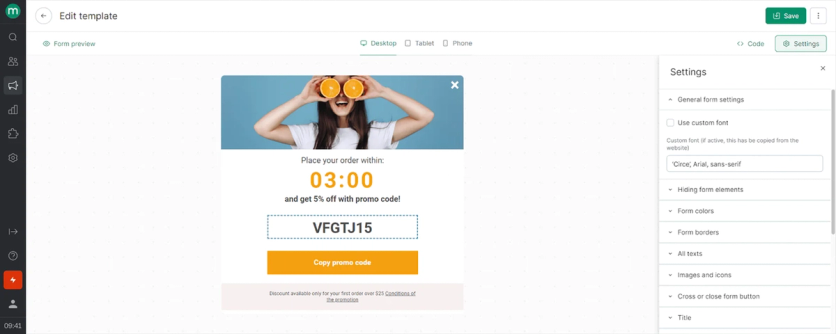
Site and app personalization runs off the same profile data as everything else, so a segment built in the CDP changes what a visitor sees with no export to a separate tool. Maestra re-ranks product recommendations as the shopper browses – powered by 14 AI algorithms – and layers on dynamic content blocks, a smart upsell bar, and gamified pop-ups like spin-to-win wheels, quizzes, countdown timers, and exit-intent forms.
Because personalization reads live CDP data, it can key off RFM segment, cart contents, or the last product viewed in the moment. Enlightened Equipment put AI product recommendations across its site and an upsell bar that updates as items land in the cart, and grew revenue 22% with a 15% lift in website conversion and 8.7% higher AOV – on zero extra ad budget.
Built-In Loyalty and Promotions
Maestra’s built-in loyalty – tiers, earning rules, points, promo codes, and referrals – runs inside the platform and reads live CDP data, so point balances and targeted promotions use the same segments as campaigns and can appear right inside an email or push. Urban Armor Gear folded a separate loyalty app into Maestra and simplified its program to a clear 1 point = $1, part of a consolidation that cut stack costs 64%.
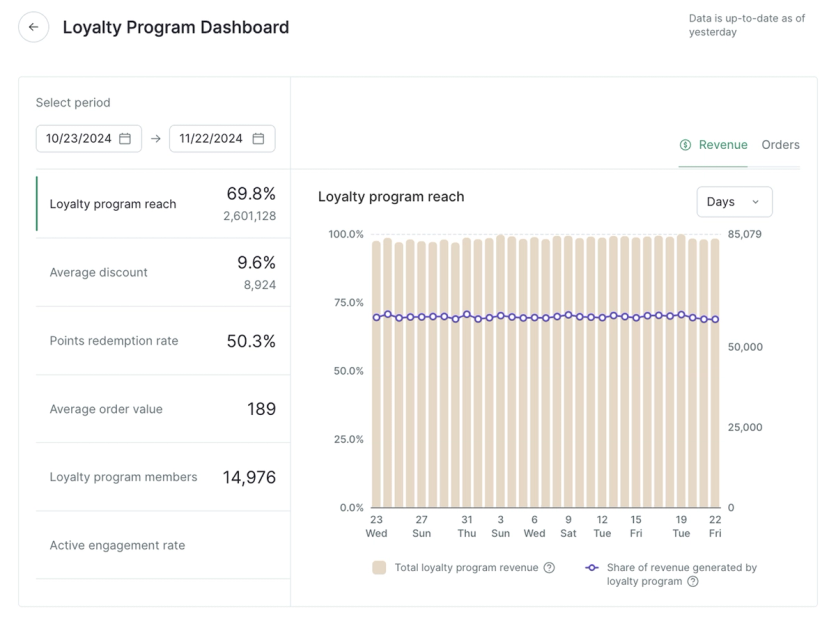
Reporting and Analytics
Maestra’s reporting and analytics sit on the unified data, giving one view of what each segment, flow, and channel returns in revenue – not just opens and clicks.
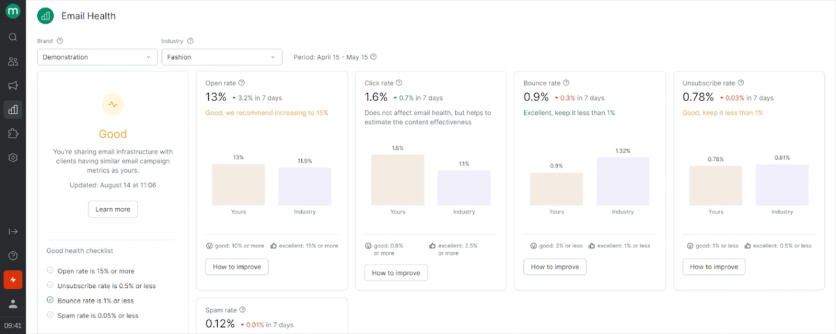
Pricing
Maestra’s pricing is modular and starts at $2,000/mo – the customer data platform base plus unlimited email – with the first 100,000 active profiles included. You pay only for active profiles, so dormant ones are stored free, and you add monthly modules for the channels you use, such as SMS, onsite personalization, loyalty, and mobile push. Email sends are unlimited; SMS, MMS, RCS, and messengers are priced per message. Migration and implementation are included, and every subscription comes with a dedicated Forward Deployed Marketer (a marketer who works as part of your team). See current plans on Maestra’s pricing page.
Where Maestra Wins
Maestra removes the second-tool problem. With Segment, the CDP unifies data and then routes it to whatever sends the message; with Maestra, the segment you build is the segment you activate, in the same click. That collapses a multi-vendor stack – CDP, ESP, SMS, personalization, loyalty – into one line item.
The commercial model favors e-commerce economics too. You pay only for active profiles, not anonymous traffic – dormant profiles are stored free – so a spike in bot or window-shopper visits doesn’t inflate the bill the way MTU counting can. And every plan includes a dedicated success manager who builds and optimizes campaigns for you – a direct answer to the thinned-out support reviewers describe with Segment.
Where Maestra Falls Short
Maestra is built for e-commerce and retail. If your goal is pure data infrastructure – routing events to a warehouse and a data-science stack with no marketing execution attached – a warehouse-native pipe like RudderStack or Snowplow is a more natural fit.
It’s also a unified solution by design. Teams that specifically want to keep their existing ESP and personalization tools and only swap the data layer will get less value from the bundled execution than a brand consolidating its whole stack.
Compared to Twilio Segment
Segment is infrastructure: it collects and routes data, and something else acts on it. Maestra is the CDP and the activation layer together. Segment bills on monthly tracked users including anonymous visitors; Maestra bills only on active profiles. For a DTC brand that wants unified data and the campaigns that use it, Maestra replaces both Segment and the downstream tools it would have fed.
When to Switch from Twilio Segment to Maestra
Switch when the stack around Segment costs more than the pipe itself. Urban Armor Gear consolidated a fragmented stack – replacing Klaviyo, Yotpo Loyalty, and Frosmo with one platform – and cut marketing stack costs by 64%, roughly $100,000 a year, while using advanced segmentation for personalized communications to over a million subscribers.
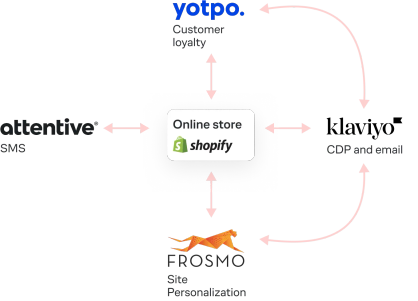
Before – UAG ran Shopify with Klaviyo, Yotpo Loyalty, Attentive, and Frosmo
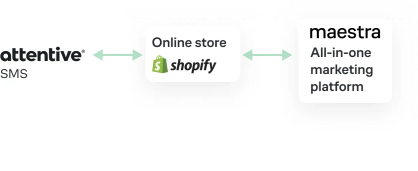
After – consolidated to Maestra plus Attentive for SMS, cutting stack costs 64%
Switch when segmentation is the bottleneck. Coolibar moved off Klaviyo for flexible segmentation and a centralized database, and saw a 33.6% lift in campaign revenue and a 62% lift in flow revenue year over year within two months.
Switch when fragmented data is splitting your audience. Sena unified separate regional accounts into one segmentation hub with automatic routing of customers to the right segment, eliminating duplicate emails and achieving an 8.6x boost in campaign-driven revenue year over year.
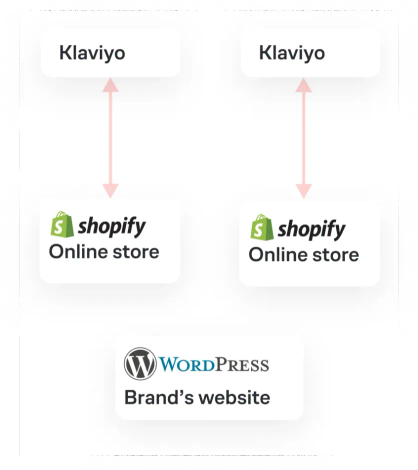
Before – Sena ran two separate regional Klaviyo accounts
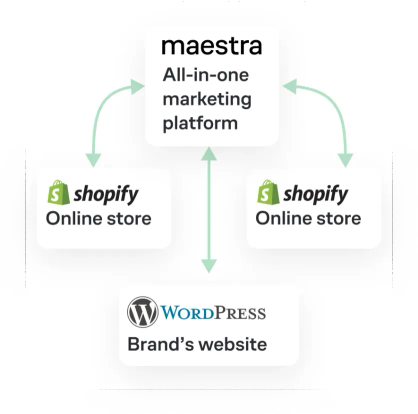
After – one Maestra hub unifying both Shopify stores and the website
RudderStack – Best for Warehouse-Native Data Teams
Starting price: From $265/mo (1M events)
G2 rating: 4.7 / 5
RudderStack is the closest like-for-like Segment alternative for teams that want a data pipe, not a marketing suite. It calls itself “the agentic customer data platform,” but its core argument is unchanged: collect events, unify them in your own warehouse, and activate – without paying a premium to store data in someone else’s black box.
RudderStack is what you pick when you want Segment’s job done on your infrastructure and your economics.
Key Features
Event Stream
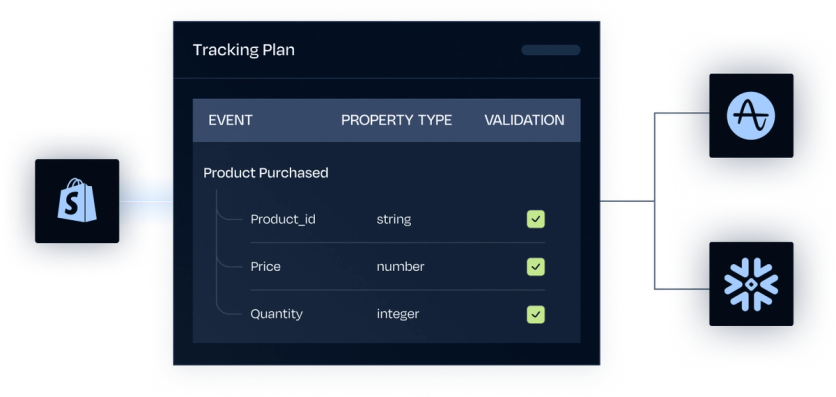
Event Stream captures customer events from 16 SDKs across web, mobile, and server-side, then routes them to 200+ downstream destinations in real time. You define a tracking plan once, and RudderStack validates every incoming event against it so malformed or off-spec data never reaches your warehouse or tools. Because collection can run server-side, it keeps firing even when ad blockers or browser limits break client-side tags.
Profiles
Profiles builds identity resolution and a unified customer 360 directly inside your own warehouse, stitching anonymous and known identifiers into a single record. Marketers and analysts assemble those profiles without writing SQL, while the underlying tables stay in your environment for full governance. It’s the piece that turns raw event streams into the customer view activation depends on – available on the Enterprise tier.
Transformations
Transformations let you reshape data in flight, in JavaScript or Python, before it ever lands in a destination. Common uses are cleaning messy fields, enriching events with extra context, and masking or dropping PII to meet compliance rules. Because the logic runs inside the pipeline rather than after load, every downstream tool receives the same corrected, consistent data.
Reverse ETL
Reverse ETL syncs modeled data from your warehouse back out to the tools that act on it – CRMs, ad platforms, and support desks. You choose a table or query as the source, map its columns to the destination’s fields, and RudderStack keeps the two in sync on a schedule. This is what lets teams activate warehouse-built audiences without exporting CSVs or maintaining custom integrations.
RudderAI and Agentic Audiences
RudderAI is a newer layer that lets teams manage pipelines and build audiences through natural language instead of manual setup. Agentic Audiences can read a plain-English request, assemble the matching segment from warehouse data, and prepare it for activation. It reflects RudderStack’s 2026 shift toward autonomous, agent-driven workflows on top of the same warehouse-native core.
Pricing
Free forever up to 250,000 events/month. Growth starts at $265/mo for 1M events and scales by volume. Enterprise is custom and is the only tier that unlocks Profiles. Pricing is on events, not MTUs.
Where RudderStack Wins
The economics answer Segment’s biggest complaint head-on. Events-based pricing doesn’t punish high-volume, low-conversion B2C traffic the way MTU counting does, and because data lives in your warehouse, you’re not paying to store it twice. Reviewers praise fast setup and a developer-friendly design, and support shows up as the most-mentioned strength.
Where RudderStack Falls Short
It’s a tool for technical teams. Reviewers cite a steep learning curve, inconsistent documentation, and a UI that gets confusing with many sources and destinations. There’s also no self-serve event replay – you contact support to re-run events. Marketers won’t run campaigns here; that still happens downstream.
Compared to Twilio Segment
RudderStack markets itself as “the only end-to-end Segment alternative” and competes directly on price model and data ownership: events versus MTUs, your warehouse versus Segment’s storage, and faster warehouse sync on lower tiers. It concedes Segment has a larger destination catalog.
Compared to Maestra
RudderStack and Maestra solve different halves of the problem. RudderStack is a better pure pipe than Segment for a data team; it still needs a separate execution layer to send anything. Maestra is the pipe and the execution together for a marketing team. Choose RudderStack to re-platform your data infrastructure; choose Maestra to run and unify e-commerce marketing end to end.
Hightouch – Best for No-Code Audiences on a Warehouse
Starting price: Free Reverse ETL tier; paid plans via sales
G2 rating: 4.6 / 5

Hightouch pioneered the “Composable CDP” – a CDP that runs on the warehouse you already own – and has since pivoted hard toward marketers and AI, adding an Agentic Marketing Platform and AI Decisioning. Gartner named it a Leader in the 2026 Magic Quadrant for CDPs.
Hightouch keeps your data in the warehouse and puts a marketer-friendly layer on top of it.
Key Features
Composable CDP
Hightouch’s Composable CDP runs entirely on the warehouse you already own – Snowflake, BigQuery, Databricks, or Redshift – instead of copying data into a separate vendor system. That means no duplicate storage, unlimited history, and the same governance your data team already trusts. Deployment is fast because the customer data never has to be migrated first.
Customer Studio
Customer Studio gives marketers a no-code interface to build and manage audiences directly on warehouse tables. You combine traits, events, and SQL-modeled fields with point-and-click conditions, then sync the result to any channel. It lets non-technical teams self-serve segments without filing a ticket to data engineering.
AI Decisioning
AI Decisioning uses reinforcement learning to choose the best message, offer, and timing for each individual, then improves from the outcomes. Instead of hand-built rules, a marketer sets a goal and the model tests and learns toward it. Reviewers report real lifts – one cited roughly a 30% increase in account activations.
Reverse ETL
Reverse ETL is Hightouch’s original product and still its backbone, syncing modeled warehouse data to 250+ downstream destinations. You define the source query once and Hightouch keeps CRMs, ad platforms, and support tools continuously up to date. It removes the CSV exports and brittle scripts teams otherwise rely on to move data.
Identity Resolution and Match Booster
Identity Resolution stitches fragmented identifiers into unified profiles inside your warehouse, so activation keys off one accurate customer. Match Booster then enriches those profiles to lift match rates when syncing audiences to ad platforms. Together they sharpen targeting and cut wasted ad spend.
Pricing
A free Basic Reverse ETL tier includes up to 2 active syncs with unlimited destinations and seats. Everything beyond that is quote-based. Third-party trackers estimate paid reverse-ETL plans around $350–$1,000/mo and a median contract near $15,000/year (estimates via CostBench and Vendr).
Where Hightouch Wins
Reviewers highlight ease of use for non-technical users and setup measured in hours, not weeks. AI Decisioning draws concrete results in reviews, and the team ships features fast. Data stays in your warehouse, which appeals to teams that want ownership without building pipelines themselves.
Where Hightouch Falls Short
Very large queries can run slowly – reviewers mention long runtimes on hundreds of millions of rows. Pricing is the sharpest complaint: the free tier was cut from 25 syncs to 2, and a long-time user wrote that terms changed to become “unaffordable, all within 2 months.” Lower tiers cap sync scheduling.
Compared to Twilio Segment
Hightouch frames itself as a Composable CDP versus Segment’s traditional CDP: data stays in your warehouse instead of being copied into Segment’s infrastructure, with unlimited lookback and no MTU billing. It concedes Segment has more destinations.
Compared to Maestra
Hightouch still assumes a warehouse and downstream execution tools; it’s the activation-friendly layer over data you already store. Maestra is the store and the channels in one, aimed at e-commerce teams that don’t want to run a warehouse. Pick Hightouch if a warehouse is your source of truth; pick Maestra if you’d rather not maintain one.
DinMo – Best for European Teams That Want a Composable CDP
Starting price: Custom; contact sales
G2 rating: 4.9 / 5
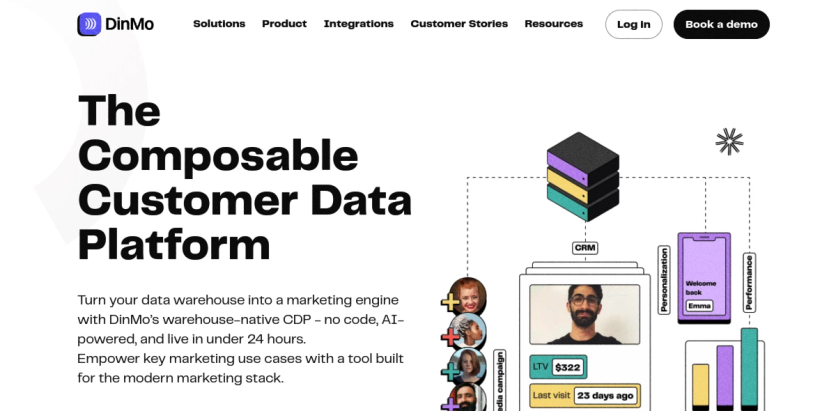
DinMo is a Paris-based composable CDP that runs on the cloud data warehouse you already own and gives marketing teams a no-code layer for segmentation, activation, and customer intelligence. It reads from Snowflake, BigQuery, Databricks, Redshift, and PostgreSQL, then syncs audiences out to ads, CRM, email, personalization, and support tools through reverse ETL. Its differentiator is an embedded AI operator that analyzes the entire workspace, identifies opportunities, and proposes the next actions marketers should take.
DinMo keeps the warehouse as the source of truth and puts a European activation layer on top of it.
Key Features
Agentic AI Operator
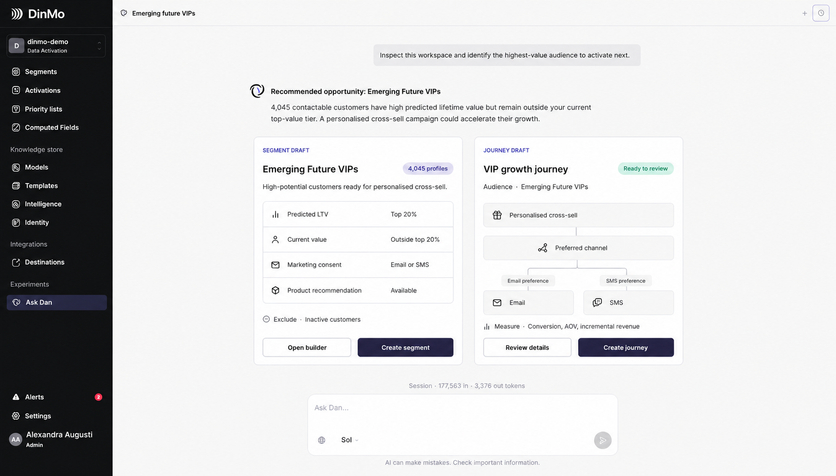
DinMo’s AI Operator acts as an intelligent operating layer across the entire CDP. Grounded in the company’s governed customer data and workspace context, it can analyze what is happening, identify opportunities, recommend next steps, and help users carry out those actions within the platform.
Rather than functioning as a standalone chatbot or focusing only on campaign optimization, the operator assists marketers with segmentation, activation, journeys, customer intelligence, and data management. It can translate a business objective into practical actions while keeping the marketer in control of validation and execution.
Composable CDP
DinMo connects directly to the cloud data warehouse, so customer data stays in the infrastructure you already run instead of being copied into a vendor’s database. Existing governance, security, history, and data models carry over, and the data team keeps control of how everything is modeled while marketers work on top of it. DinMo calls this zero-data copy and frames it around GDPR and the Swiss FADP.
No-Code Segmentation, Activation, and DinMo Journey Module
Marketing teams can explore their data and build advanced segments without SQL. Audiences can combine customer attributes, transactions, behaviors, product data, calculated metrics, and predictive scores using an intuitive interface.
Teams can then activate these audiences in advertising, CRM, customer engagement, personalization, support, and other downstream platforms. With the DinMo Journey Module, they can also create customer journeys that coordinate audiences, triggers, conditions, and activation steps across the tools already in their stack.
Recurring syncs, journeys, and activation rules are managed within DinMo, reducing the need for data engineers to build custom queries, pipelines, or API integrations for every new marketing use case.
DinMo Intelligence
Intelligence adds predictive scores to warehouse data: churn risk, customer lifetime value, product recommendations, best channel per customer, and RFM segmentation. The scores land in the same profiles marketers segment on, so a prediction goes straight into an audience and out to a destination.
Customer Hub
Customer Hub is the measurement side: 360° profiles with full history, custom metrics and dashboards built without technical help, test and control groups for every audience, built-in A/B testing, and a real-time profile API for on-site and in-app use.
Identity
Identity cleans and standardizes incoming data, merges duplicate profiles across sources, and reconciles online signals with offline records – store purchases, CRM data – into one view per customer. Because the unified profiles stay in the warehouse, the identity data stays yours.
Pricing
Custom, quoted on contact volume, destinations, and the capabilities you select. DinMo runs a 30-day free trial.
Where DinMo Wins
The European angle is substantive rather than a label. DinMo is built in Paris, frames compliance around GDPR and the Swiss FADP, and keeps customer data in your own warehouse under what it calls zero-data copy. For teams without a warehouse of their own, DinMo will host a managed one inside Europe, with the option to bring it in-house later. Its customer list reads the same way – TUI, Interflora, Galeries Lafayette, and Huel.
Predictions come with the platform rather than as a separate modeling project. Churn risk, lifetime value, product recommendations, best channel, and RFM scoring are generated on warehouse data and land in the profiles marketers already segment on, so a score can go into an audience and out to a destination without a data scientist in the loop.
Where DinMo Falls Short
DinMo requires a cloud data warehouse and works best when customer data is already centralized and reasonably well modeled. Without that foundation, a traditional CDP that collects and stores the data for you is the shorter path.
It also doesn’t execute. DinMo builds the intelligence, the audiences, the journeys, and the syncs; email, SMS, loyalty, and on-site personalization still happen in the tools downstream. Teams that want to consolidate the stack rather than connect it will be adding DinMo to the bill, not replacing part of it.
Compared to Twilio Segment
Segment collects customer events and routes them into other systems. DinMo starts from the governed data already in your warehouse and adds intelligence, no-code segmentation, and activation on top, so the warehouse stays the source of truth instead of the CDP.
Pick Segment when event collection and routing are the requirement. Pick DinMo when the warehouse is already the source of truth and marketing needs a self-service layer to act on it.
Compared to Maestra
DinMo and Maestra sit on opposite sides of the execution line. DinMo keeps your warehouse and your channel tools and supplies the intelligence and activation layer between them. Maestra holds the CDP, email, SMS, push, site personalization, and loyalty in one platform, so the data and the messages that use it live in the same system.
That changes what you are buying. DinMo is a layer: the warehouse underneath and every tool that sends the message stay separate line items. Maestra starts at $2,000/mo for the CDP with the first 100,000 active profiles and unlimited email, month-to-month, and replaces three to five of those downstream tools.
Choose DinMo to keep the stack you have and give marketers a way to use it. Choose Maestra when the stack itself is the problem.
mParticle by Rokt – Best for Mobile and Paid-Media Performance
Starting price: Custom (third-party estimate ~$156,000/yr)
G2 rating: 4.4 / 5
Since the Rokt merger, mParticle has repositioned from a developer-first CDP toward marketing outcomes – conversion, ROAS, retention. Its flagship idea is a “Hybrid CDP” that combines real-time architecture with warehouse-native options, now wrapped in Rokt’s performance and ad-matching stack.
mParticle is the pick when mobile and paid-media performance is the point of the CDP.
Key Features
Hybrid CDP
mParticle’s Hybrid CDP pairs a real-time streaming architecture with warehouse-native options, so teams can process events in the moment or build audiences directly on their warehouse. That flexibility suits companies that need both instant mobile reactions and deep historical modeling. It’s the foundation the platform’s audiences and activations run on.
IDSync
IDSync is mParticle’s identity engine, matching device IDs, logins, and other identifiers into a single persistent profile across channels. Accurate stitching keeps mobile, web, and offline behavior tied to one customer. It underpins consistent targeting and measurement across every touchpoint.
Real-Time and Composable Audiences
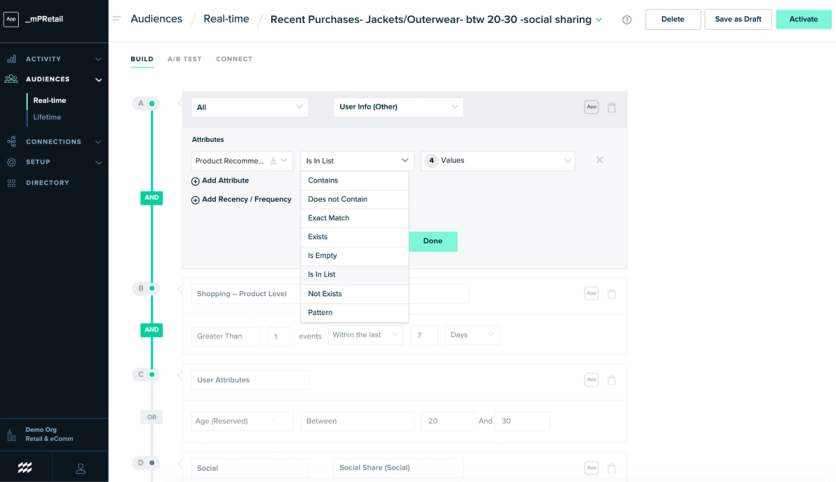
Audiences can be built from live streaming data for instant reactions, or composed directly on the warehouse for richer historical segments. Marketers set attribute and behavior rules, then activate the result to downstream tools. This dual model lets teams choose speed or depth per use case.
Match Boost
Match Boost is the Rokt-era performance product, enriching audiences to raise ad-platform match rates by up to 2x. Higher match rates mean more of your audience is actually reachable in paid media. For performance marketers, that translates straight into reach and efficiency.
Predictive Audiences and Cortex AI
Cortex AI scores each customer’s likelihood to churn, convert, or reach high value, turning raw behavior into forward-looking segments. Marketers can target the about-to-churn or high-propensity groups without building models themselves. Those predictions feed directly into audiences and activations.
Pricing
Custom only, with no published prices; the pricing page is a quote form. Third-party estimates put the average annual cost near $156,000, with entry enterprise plans from roughly $1,000–$1,500/month (estimates via Vendr).
Where mParticle Wins
Reviewers praise fast, thoughtful audience building and hundreds of pre-built integrations that make deploying new tools quick. Support draws strong marks, with reps described as advocating for roadmap items. The Rokt match-boosting is a real edge for paid-media teams.
Where mParticle Falls Short
The learning curve is the top complaint – one reviewer called the layered features and rules “a nightmare for a mid-sized brand.” The interface is described as engineer-facing, leaving marketers dependent on technical teams, and calculated attributes are called basic. Post-Rokt, the standalone Segment comparison page is gone.
Compared to Twilio Segment
mParticle no longer runs a public anti-Segment page; it competes through a Segment migration program that stresses API and event-model parity for a straightforward migration. Functionally it overlaps with Segment on collection and identity, then leans harder into performance activation.
Compared to Maestra
mParticle is enterprise data infrastructure tuned for paid media and mobile, priced accordingly and built for technical teams. Maestra is a unified platform for e-commerce marketing teams, with published pricing and included execution. Choose mParticle for large-scale performance-media use cases; choose Maestra to consolidate an e-commerce stack without an engineering lift.
Tealium – Best for Privacy-Sensitive Enterprises
Starting price: Custom (~$146,000/yr median per Vendr estimates)
G2 rating: 4.3 / 5
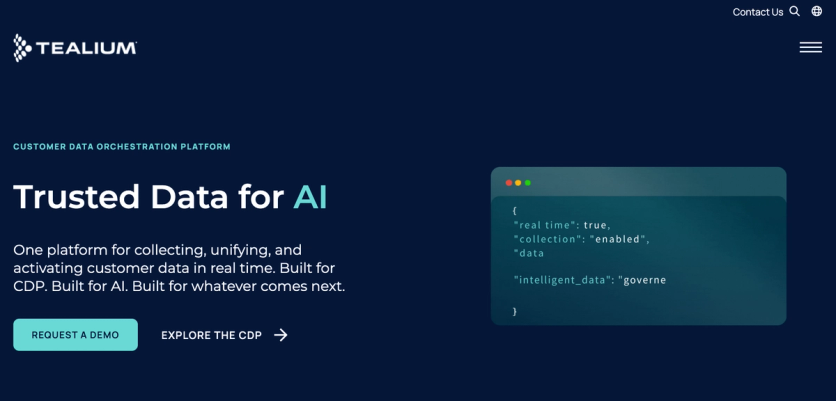
Tealium leads with “Trusted Data for AI” and positions its Customer Data Hub as the orchestration layer feeding downstream tools and, increasingly, AI agents. It’s a mature enterprise platform with deep roots in tag management and a very large connector library.
Tealium is the orchestration hub for enterprises that treat data governance and privacy as first-order requirements.
Key Features
Tealium Customer Data Hub
The Customer Data Hub is Tealium’s umbrella platform, combining tag management, server-side event routing, and a CDP under one roof. Its standout is breadth – 1,300+ pre-built connectors, more than most rivals – so data flows to nearly any tool. It’s built for enterprises orchestrating data across a large, mixed martech stack.
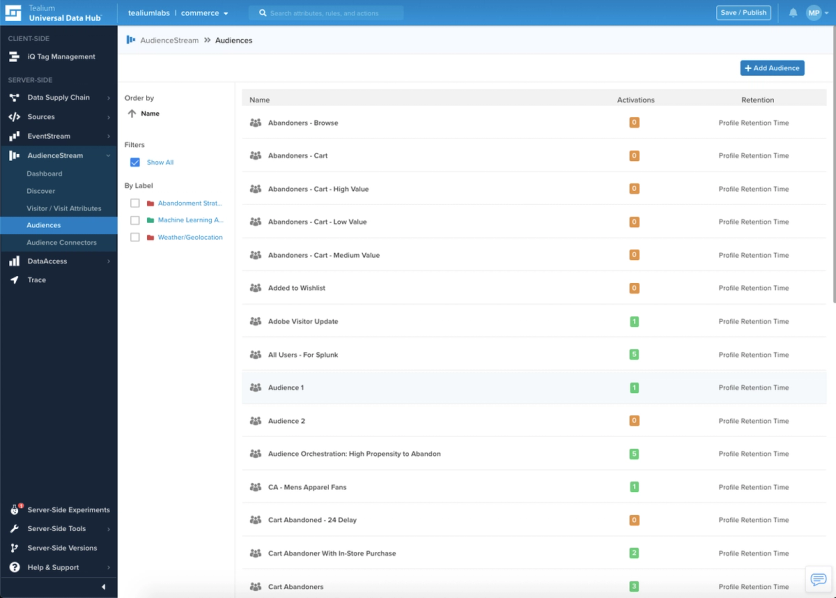
AudienceStream CDP
AudienceStream is the heart of the Hub, assembling real-time visitor profiles and turning them into audiences. Marketers define attributes and triggers, audiences update the instant behavior changes, and they activate through the connector library. Real-time identity stitching keeps each profile accurate as new signals arrive.
EventStream
EventStream handles server-side collection and delivery of event data from one central hub. Moving collection server-side improves data reliability and sidesteps client-side blockers. It feeds clean, consistent events into AudienceStream and downstream systems.
Tealium Moments
Tealium Moments exposes a customer’s real-time signal – identity, traits, predictions, and history – in a single API call at the moment of interaction. Apps, call centers, and external AI agents can query it to personalize in the instant. It’s Tealium’s way of making live context available wherever decisions happen.
Predict ML
Predict ML adds point-and-click machine learning for propensity scores like engagement, purchase probability, and churn risk. Teams build models without data-science resources and feed the scores into audiences. It brings predictive targeting into the same governed platform.
Pricing
Custom, on monthly unique visitors, modules, data volume, and term. Vendr data puts the median buyer near $146,000/year, with a wide range and separate implementation costs (estimates via Vendr).
Where Tealium Wins
The connector library is a standout – reviewers describe it as far larger than rivals'. Real-time identity stitching and privacy-first governance draw praise, especially in regulated industries, and Tealium won a spot in G2’s 2026 awards for data privacy. Support quality is rated well.
Where Tealium Falls Short
There’s a steep learning curve and a real need for dedicated technical staff, particularly at setup. Cost climbs at scale for high-event-volume organizations, and smaller teams find it expensive versus simpler CDPs. Reviewers note workflow friction in the UI.
Compared to Twilio Segment
Tealium and Segment are direct enterprise CDP competitors. Tealium’s edges are its connector breadth, tag-management heritage, and privacy governance; both require technical resources and both leave execution to downstream tools. Neither sends the campaign itself.
Compared to Maestra
Tealium is an enterprise orchestration hub that routes trusted data onward; it does not run your email, loyalty, or on-site personalization. Maestra unifies data and runs those channels in one platform with published pricing and a Forward Deployed Marketer. Choose Tealium for enterprise governance across a large tool ecosystem; choose Maestra to consolidate e-commerce marketing into a single system.
Treasure AI – Best for Data-Mature Enterprises with SQL Teams
Starting price: Custom (third-party estimate $100,000–$750,000/yr)
G2 rating: 4.5 / 5
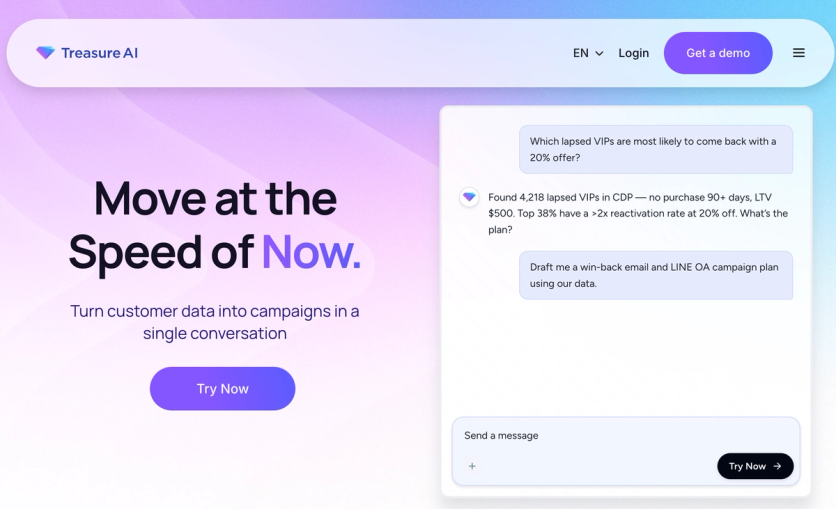
Treasure Data rebranded to Treasure AI in April 2026, repositioning as an “Agentic Experience Platform” built around conversational, AI-driven campaign creation. Underneath the new messaging, the “Intelligent CDP” data layer – ingestion, identity resolution, segmentation, activation – is the enterprise engine buyers know.
Treasure AI wraps a heavyweight enterprise CDP in a conversational, agent-first interface.
Key Features
Agentic Experience Platform
The Agentic Experience Platform is Treasure’s 2026 reframing, coordinating human users, AI agents, and activations in one place. The pitch is that agents handle the heavy lifting of turning data into campaigns. It sits on top of the same enterprise data engine Treasure Data has always run.
Treasure AI Studio
Treasure AI Studio is a conversational workspace where marketers build campaigns by chatting rather than configuring. Access is free, with usage priced per conversation via AI Credits. It’s the front door to the agentic experience, aimed at cutting time-to-launch.
Intelligent CDP
The Intelligent CDP is the data layer underneath – ingestion, identity resolution, segmentation, and activation at enterprise scale. It combines batch and real-time processing for a full view of the customer journey. This is the mature engine data-heavy enterprises actually buy Treasure for.
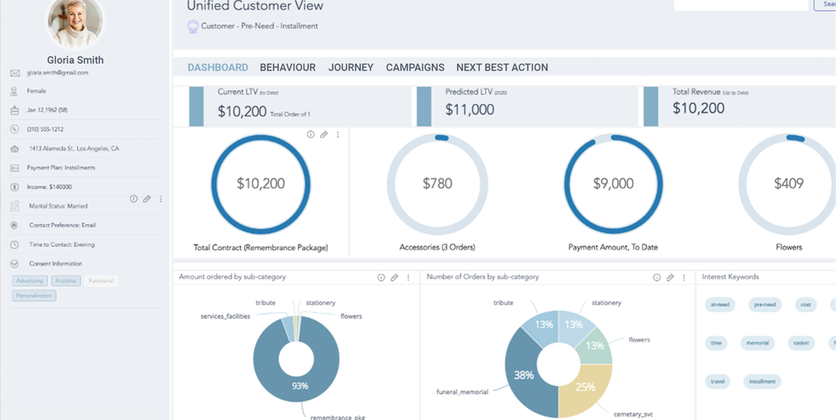
AI Suites
AI Suites package agentic activation for specific functions – engagement, personalization, creative, paid media, and service. Each bundles the agents and connectors for that channel, so teams can adopt piece by piece. They turn the platform’s data into channel-ready action.
Identity Resolution
Identity Resolution unifies customer profiles across both batch and real-time sources into one record. Accurate stitching is what makes segmentation and cross-channel activation trustworthy. It’s a core strength reviewers credit alongside Treasure’s data-volume handling.
Pricing
Custom, with the pricing page promising pay-for-value rather than compute – billed on customer profiles or behavioral events rather than query volume. Third-party estimates put annual cost at $100,000–$750,000 with $30,000+ implementation (estimates via CostBench).
Where Treasure AI Wins
Reviewers praise flexibility, strong handling of large data volumes, and native API connectors and dev tooling. Combining batch and real-time processing gives a fuller view of customer journeys, which suits data-mature enterprises with the skills to use it.
Where Treasure AI Falls Short
SQL knowledge is essential for advanced segmentation and transformations – reviewers call it “not user-friendly without technical expertise.” Licensing surprises come up, where new features add cost, and the vendor leaves hands-on tactical work to partners. The 2026 “10x value in 10 minutes” pitch isn’t yet backed by reviews.
Compared to Twilio Segment
Treasure AI competes as a full enterprise CDP with batch depth and a Trade-Up switching program, versus Segment’s real-time collection focus. Both target large organizations; Treasure AI leans on SQL-capable teams, while its agentic layer is the newer counter to Segment’s newer AI features.
Compared to Maestra
Treasure AI is an enterprise data platform that expects technical resources and six-figure budgets. Maestra targets e-commerce and retail with published pricing, no-SQL segmentation, and included execution and support. Choose Treasure AI for a data-mature enterprise build; choose Maestra to unify and run e-commerce marketing without a data-engineering dependency.
Adobe Real-Time CDP – Best for Adobe Experience Cloud Customers
Starting price: Custom
G2 rating: 4.1 / 5
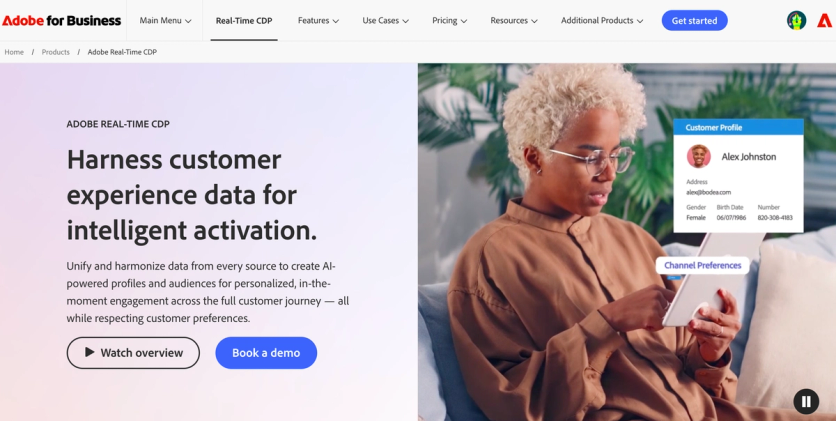
Adobe Real-Time CDP brings known and anonymous data together into real-time profiles and activates them across channels, natively feeding the rest of Adobe’s stack. It comes in B2C, B2B, and B2P editions, each in Prime and Ultimate tiers, and sits inside Adobe’s broader 2026 push into AI agents.
Adobe Real-Time CDP is the natural CDP for enterprises whose experience layer is already Adobe.
Key Features
Three Editions – B2C, B2B, B2P
Adobe Real-Time CDP ships in three editions – B2C, B2B, and B2P – each in Prime and Ultimate tiers. B2B adds account profiles, opportunity data, and buying groups; B2P unifies B2C and B2B targeting of the same individual. The split lets enterprises license the model that matches how they actually sell.
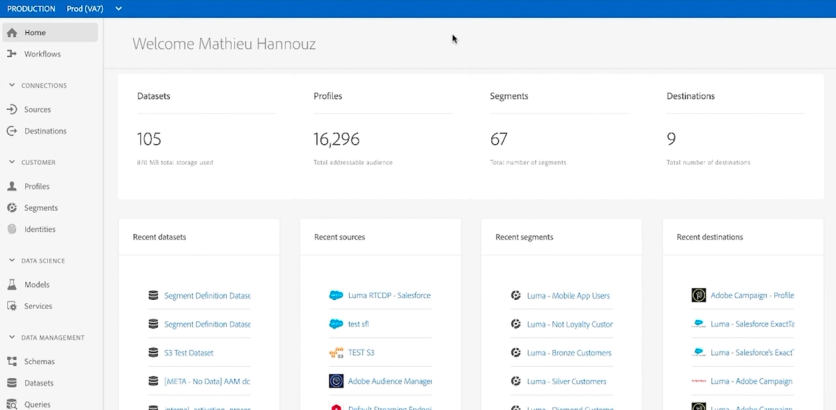
Real-Time Unified Profiles
Known and anonymous data from across the enterprise is stitched into a single profile with identity resolution, updated in real time. The result is one continuously current view of each customer rather than stale nightly snapshots. Those profiles are the basis for every downstream audience and activation.
Streaming Segmentation and Activation
Segments evaluate on streaming data, so audiences form and update the moment behavior changes. Adobe then activates them across email, paid media, on-site experiences, call centers, and connected devices. Native ties into Journey Optimizer and Target make activation seamless for existing Adobe customers.
Real-Time CDP Collaboration
Collaboration is Adobe’s data-clean-room capability for sharing audiences with partners without exposing raw data. Usage is metered in Collaboration Credits, with more included at the Ultimate tier. It targets advertisers running privacy-safe data partnerships at scale.
AI-Driven Insights
AI-driven insights add propensity scoring and lookalike audiences to help find and prioritize customers. Adobe’s 2026 roadmap layers agent-supported tooling on top for more autonomous workflows. As with the rest of the platform, this shines brightest for teams already invested in Adobe.
Pricing
Custom, licensed on addressable profiles, with editions and tiers quoted through sales. No public dollar figures are verifiable.
Where Adobe Real-Time CDP Wins
Real-time unification and identity resolution reduce manual data stitching and support accurate segmentation, according to reviewers. AI-driven insights help identify prospects, and native activation across Journey Optimizer, Target, and Marketo is the decisive advantage for existing Adobe customers.
Where Adobe Real-Time CDP Falls Short
It’s the lowest-rated platform here, and reviewers explain why: it’s “not for a beginner,” needs heavy data-engineering support to stand up and maintain, and is expensive enough that reviewers call it enterprise-only. Setup and identity-rule mapping are complex, and onboarding runs in months.
Compared to Twilio Segment
Both are enterprise real-time CDPs. Adobe’s advantage is native depth inside Experience Cloud; Segment’s is a broader, tool-agnostic destination catalog and a lighter footprint. Adobe rewards all-in Adobe shops; Segment fits mixed stacks better.
Compared to Maestra
Adobe Real-Time CDP is a heavyweight for large enterprises with engineering teams and Adobe budgets, and it still routes to execution tools. Maestra holds the CDP and the channels in one platform for e-commerce, with published pricing, faster onboarding, and included support. Choose Adobe if you live in Experience Cloud; choose Maestra to consolidate an e-commerce stack without the enterprise overhead.
Snowplow – Best for Engineering-Owned Behavioral Data
Starting price: 14-day free trial; managed platform by quote
G2 rating: 4.6 / 5
Snowplow is customer data infrastructure, not a marketer’s CDP. It collects first-party behavioral events into your own warehouse with schema validation and 130+ enrichments, and its 2026 positioning centers on being the real-time context layer that AI models and agents run on.
Snowplow is for teams that want to own their raw behavioral data end to end.
Key Features
Behavioral Data Pipeline
Snowplow’s pipeline – collectors, enrichment, and loaders – captures granular first-party events and delivers them, validated, into your own warehouse or lake. Every event is schema-checked so the data lands clean and analysis-ready. Because you own the pipeline and the data, there’s no black box between collection and use.
Snowplow Signals
Signals is the flagship AI product, pairing a low-latency Profiles Store with an Interventions engine that streams real-time context to apps and agents. It turns raw behavioral data into live user attributes an AI agent can act on in the moment. This is Snowplow’s bet on being the context layer for agentic AI.
130+ Enrichments
More than 130 built-in enrichments clean and augment events as they flow through the pipeline – bot filtering, user-agent parsing, IP anonymization, and custom validation. You can add your own logic to enforce data quality at the source. The result is trustworthy data before it ever reaches analysis.
Event Studio and Data Products
Event Studio lets teams define tracking plans and govern them as reusable Data Products with clear ownership and specs. Treating tracking as a managed product cuts the drift and breakage that plague ad-hoc analytics. It gives data teams a versioned, accountable source of truth for what’s collected.
Snowplow MCP Server
The MCP server lets engineers design tracking with AI coding agents like Claude or Cursor, from concept to instrumentation. Describe the events you need and the agent scaffolds the schema and code. It’s Snowplow’s 2026 move to compress tracking setup from weeks to minutes.
Pricing
A 14-day free trial with full functionality, a self-hosted option for former open-source users, and a fully managed platform by quote. No credible third-party price benchmark is available, so any figure would be unverified.
Where Snowplow Wins
Reviewers value granular, owned raw data and the autonomy to shape the environment to the business – unlike closed SaaS tools. The account and support teams draw praise, and schema-first data quality with easy new-schema releases is a repeated strength.
Where Snowplow Falls Short
The learning curve is steep and it’s hard to self-manage without dedicated engineers. There’s no built-in analytics UI – you get pipelines, not dashboards, and everything downstream is bring-your-own warehouse and BI. Its review base is thin, so verified recent feedback is limited.
Compared to Twilio Segment
Both collect behavioral data, but Snowplow gives you the raw, owned pipeline into your warehouse with no black box, while Segment offers a more packaged, destination-rich experience. Snowplow trades convenience for control and data ownership.
Compared to Maestra
Snowplow is pure infrastructure with no marketing execution – the opposite end of the spectrum from a full lifecycle platform. Maestra unifies data and runs the channels for e-commerce teams. Choose Snowplow if a data-engineering team is building a warehouse-native or AI-context stack; choose Maestra to unify and act on customer data without engineering.
Bloomreach – Best for Marketing Plus Commerce Search
Starting price: Custom (module fee plus usage fee)
G2 rating: 4.6 / 5
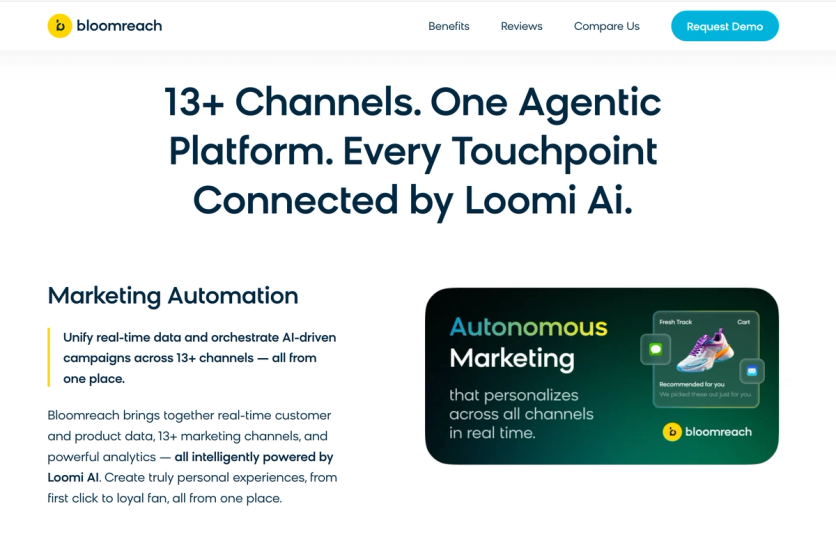
Bloomreach positions itself as “the AI platform for personalization,” pairing marketing automation with commerce search and a built-in data layer. Its marketing product – long known as Bloomreach Engagement – includes a Customer Data Engine, so unlike Segment it both unifies data and acts on it.
Bloomreach argues the CDP should be built into the execution platform, not a separate pipe.
Key Features
Customer Data Engine
The Customer Data Engine is Bloomreach’s built-in real-time data layer, giving marketers a single view of the customer and an audience builder without a separate CDP. It can run standalone or sit on top of Snowflake or Databricks. Because it lives inside the execution platform, the segment you build is immediately ready to act on.
Loomi AI
Loomi AI is Bloomreach’s native intelligence, spanning predictions, content generation, and natural-language reporting, and it’s included at no extra charge. Marketers can forecast behavior, draft content, and ask for reports in plain language. In practice, reviewers say the reporting side is still maturing.
Loomi Marketing Agent
The Loomi Marketing Agent (GA June 2026) turns a single prompt into a fully built campaign workflow. Instead of assembling a scenario step by step, a marketer describes the goal and the agent drafts it. It’s Bloomreach’s headline move toward agentic, prompt-driven campaign creation.
Omnichannel Orchestration
A scenario builder orchestrates journeys across 13+ channels – email, SMS, RCS and WhatsApp, mobile app, ads, and web. Branches react to customer data and behavior to keep messaging coordinated. Reviewers praise its power for complex journeys, while noting a steep learning curve.
Plug and Play Use Cases
Plug & Play offers 70+ prebuilt campaign packages that arrive 70–80% complete, so teams launch faster. Each covers a common use case a marketer can finish and switch on. It’s a practical counter to the platform’s complexity for teams that want a head start.
Pricing
Custom, structured as a module fee plus a usage fee, priced on modules chosen, number of customers, catalog size, and events, billed annually. Third-party estimates range widely from roughly $48,000 to several hundred thousand per year (estimates via WiserReview).
Where Bloomreach Wins
Reviewers value the true all-in-one – data, email, SMS, automation, and analytics in one place – and a flexible scenario builder for sophisticated journeys with a clear overview. Support draws consistent praise, and commerce search plus marketing under one vendor suits retail enterprises.
Where Bloomreach Falls Short
The learning curve is steep and the interface non-intuitive, with reviewers citing platform jargon and thin onboarding. Loomi AI’s reporting underdelivers for some, documentation is called lacking, product development is described as slow, and several teams rely on paid partners to run complex work.
Compared to Twilio Segment
Bloomreach’s own framing is marketing CDP versus infrastructure CDP: Segment collects and routes data to hundreds of downstream tools, while Bloomreach builds unification into the execution platform so activation is immediate. Segment fits engineering-led orgs; Bloomreach fits marketing-led ones.
Compared to Maestra
Bloomreach and Maestra share the same thesis: the data layer belongs inside the platform that acts on it. Bloomreach is a broad enterprise suite with commerce search attached, custom pricing, and a heavier learning curve; Maestra is focused on e-commerce marketing with published pricing, faster onboarding, and a dedicated Forward Deployed Marketer in every plan. Choose Bloomreach if you need commerce search under the same roof; choose Maestra for a leaner, faster path to unified e-commerce marketing.
The contrast is sharpest for teams that actually left Bloomreach. Selkirk Sport spent a year fighting a fragile Bloomreach setup – abandonment flows that wouldn’t run, pop-ups that needed custom JavaScript, and reporting no one could trust – then switched to Maestra and grew email revenue 55% and SMS revenue 149% year over year. Its email marketing manager called the move a day-and-night difference – a simpler solution that does more, and its web developer summed up the Bloomreach year bluntly: we gained nothing during our time with Bloomreach.
Cost is the other wedge. Crezu evaluated six platforms before rolling Maestra out across 15 countries, and its head of CRM recalled that Bloomreach quoted us 8–12x what we were paying for our entire stack at the time, while Maestra offered the flexibility, proven scale, pricing that actually made sense – and support unmatched by the competitors. For a brand weighing Bloomreach’s enterprise suite, that combination of faster time-to-value, honest pricing, and included white-glove support is the reason to choose Maestra.
How to Choose the Right Twilio Segment Alternative
Maestra is the clearest answer for e-commerce brands that want to stop paying for a data pipe and the tools it feeds separately. Where Twilio Segment unifies data and hands it off, Maestra keeps unification and execution – email, SMS, push, site personalization, and built-in loyalty – in one system, replacing three to five point tools with a single platform and a dedicated Forward Deployed Marketer.
The right choice depends on your team. Pick RudderStack, Hightouch, DinMo, or Snowplow if you’re building warehouse-native data infrastructure. Pick Tealium, Adobe, Treasure AI, or mParticle for heavyweight enterprise data needs. But if the real problem is that Segment moves your data and everything else costs extra to act on it, start a Maestra trial and price your whole stack against one line item.
Frequently Asked Questions
- For most e-commerce and retail brands, Maestra is the strongest alternative because it unifies customer data and runs the channels that act on it – email, SMS, push, site personalization, and built-in loyalty – in one platform, rather than routing data to separate tools the way Segment does. RudderStack and Hightouch are better fits for teams that specifically want a warehouse-native data pipe.
- RudderStack is the most transparently priced at $265/mo for 1M events, and its events-based model avoids Segment’s MTU costs on anonymous traffic. But the bigger saving is usually consolidation: Maestra publishes pricing from $2,000/mo – the CDP base plus unlimited email, with the first 100,000 active profiles included – and replaces the CDP plus the separate email, SMS, personalization, and loyalty tools you’d otherwise pay for downstream of Segment – so most brands that switch spend less overall, not more. Maestra client Urban Armor Gear cut marketing stack costs by 64% – about $100,000 a year – by replacing three tools with one platform. Most enterprise CDPs – Tealium, Adobe, Treasure AI, mParticle, Bloomreach – are custom-quote and generally cost more.
- An infrastructure CDP like Twilio Segment collects and routes data to downstream tools but doesn’t run campaigns itself – you still need engineers to instrument it and a separate stack (an ESP, an SMS tool, a personalization layer, a loyalty app) to act on the data. It fits engineering-led organizations building a warehouse-native pipe. A marketing CDP like Maestra or Bloomreach builds unification into the execution platform, so the segment you create is the segment you activate – no second tool and no developer required to send the message. If you’re an e-commerce brand that wants to launch campaigns, personalize the site, and run loyalty without a data-engineering team, a marketing CDP is almost always the more cost-effective choice: one platform instead of five, and marketers who can ship on their own. Reach for an infrastructure CDP only when a data team is deliberately building a custom warehouse-native stack.
- Maestra integrates with Shopify and is built for DTC and retail brands running on it. Most platforms here connect to Shopify through their integration libraries, though warehouse-native tools like RudderStack, Hightouch, and Snowplow typically route Shopify data into your warehouse first rather than acting on it directly.
- Yes. That’s the core reason e-commerce teams consolidate. Maestra replaces the CDP plus the email, SMS, personalization, and loyalty tools that would sit downstream of Segment – Maestra client Urban Armor Gear consolidated its stack this way and cut marketing tool costs by 64%.