Best Ecommerce Personalization Software [2026]: 14 Tools and Platforms by Category
Ecommerce personalization software changes what a shopper sees based on what they do: which products a page recommends, which pop-up fires, which offer lands in the email. The tools below do that job at very different depths. Some only personalize the site. Some run email, SMS, and loyalty from the same customer profile. A few come with a person who sets it all up.
This guide groups 14 ecommerce personalization tools and platforms by what they are built for, with 2026 pricing, the store size each one fits, and the catch in each. It starts with a summary table, so you can skip the demos that were never going to fit.
Quick Verdict: Best Ecommerce Personalization Software by Category
Maestra wins for DTC brands over roughly $5M that want site, email, SMS, and loyalty personalized from one profile, with a Forward Deployed Marketer running it. Bloomreach and Insider One win for enterprise catalogs and in-house teams with six-figure budgets. Klaviyo wins for small Shopify stores that need email and SMS personalization first and site personalization later. Wingify, Adobe Target, and Salesforce Personalization win for teams whose main job is testing. ConversionBox and Experro win for search and product discovery on large catalogs, and Kickflip for stores selling customizable products.
Best for omnichannel DTC personalization with a marketer included: Maestra
Best for large catalogs and product discovery: Bloomreach
Best for enterprise predictive segments across nine channels: Insider One
Best for retail groups that want loyalty inside the suite: Emarsys
Best for search and merchandising on Shopify Plus: Layers
Best for deep-learning recommendations at enterprise scale: Dynamic Yield
Best for AI-assisted product discovery and on-site search: ConversionBox
Best for AI-native product discovery: Experro
Best for real-time previews of personalized products: Kickflip
Best for small Shopify stores starting with email and SMS: Klaviyo
Best for app-first brands that live on push and in-app: MoEngage
Best for experimentation-first teams: Wingify (formerly VWO)
Best for Adobe Experience Cloud customers: Adobe Target
Best for Salesforce CRM customers: Salesforce Personalization
Content:
Most tools here plug into Shopify and the big CDPs out of the box, and several replace two or three point solutions rather than adding one more. The question is which one fits your catalog size, channel mix, and the size of the team that will run it.
What Ecommerce Personalization Software Does
Ecommerce personalization software uses a shopper’s behavior, purchase history, and profile data to change what they see on the site, in email, in SMS, and in push. In practice that means four things: product recommendations that differ per visitor, pop-ups and banners that fire for one segment and not another, offers and discounts tied to a person’s history, and search or category pages reordered by what that shopper tends to buy.
The tools differ mainly in where the data lives and who does the work. A standalone on-site tool reads clicks on the site and personalizes the site; if recommendations are the only piece you need, the best product recommendation tools are a shorter list. A platform with a customer data profile at the center can use the same signal in email, SMS, loyalty, and on the site at once. And a few vendors include a person who builds and runs the campaigns, which matters more than any feature list if your marketing team is two people.
Comparison of Ecommerce Personalization Software
| Platform | Category | 2026 pricing band | Best store size | Built-in loyalty | Marketer included |
|---|---|---|---|---|---|
| Maestra | Omnichannel suite | From $2,000/mo (CDP + unlimited email); on-site personalization module $1,515/mo on top | $5M–$100M DTC | Yes | Yes, a Forward Deployed Marketer |
| Bloomreach | Omnichannel suite | Custom; from about $60K/yr for smaller brands, annual billing | Enterprise, 10K+ SKUs | No | No |
| Insider One | Omnichannel suite | Custom; contracts around $150K–$360K/yr (Vendr) | Enterprise | No | No |
| Emarsys | Omnichannel suite | Custom; 3–36-month contracts | Mid-market and enterprise retail | Yes | No |
| Layers | On-site and product discovery | Custom, usage-based (collection page views and search requests); no overage charges | Shopify Plus stores | No | No |
| Dynamic Yield | Omnichannel suite | Custom; contracts around $60K–$110K/yr (Vendr) | Enterprise | No | No |
| ConversionBox | On-site and product discovery | Custom (quote); free AI Visibility audit | Mid-market, large catalogs | No | No |
| Experro | On-site and product discovery | Custom (quote); monthly, quarterly, or yearly billing | Mid-market and enterprise | No | No |
| Kickflip | On-site and product discovery | $59/mo + 0–1.95% per custom product sold; 14-day trial | Any size selling customizable products | No | No |
| Klaviyo | Email and SMS-led | Free up to 250 profiles; email from $20/mo; SMS per send | Under $5M, Shopify | No | No |
| MoEngage | Email and SMS-led | Custom by monthly tracked users; contracts around $125K–$190K/yr (Vendr) | Mid-market and enterprise, app-first | No | No |
| Wingify (VWO) | Testing-first | Custom by monthly active users; 30-day free trial | Mid-market with a CRO team | No | No |
| Adobe Target | Testing-first | Custom | Enterprise on Adobe Experience Cloud | No | No |
| Salesforce Personalization | Testing-first | $8,000/org/mo; Personalization+ $15,000/org/mo; annual; Data 360 required | Enterprise on Salesforce | No (separate Loyalty Cloud) | No |
Omnichannel Suites for Mid-Market and Enterprise DTC
These platforms keep one customer profile and personalize the site, email, SMS, and push from it; the segmentation engine underneath is compared separately in best customer segmentation tools. They cost the most and replace the most tools.
Maestra – Best for DTC Brands That Want a Marketer Running Personalization

Maestra is a platform for ecommerce marketing that personalizes the site, email, SMS, push, and loyalty from one customer profile. Plus, well, a marketer: every account comes with a Forward Deployed Marketer who migrates the stack, builds the flows and on-site experiences, and runs the A/B tests, on weekly Zoom calls and a shared Slack channel. Each marketer handles around 15 customers.
What you can do with it. Fourteen prebuilt recommendation engines place product picks on the home page, product page, cart, and 404 page, in email, in push, and at the POS, with business rules to fine-tune by price, category, color, or stock. Enlightened Equipment lifted website conversion 15% and AOV 8.7% in two months with those recommendations across key touchpoints, and shoppers who engage with recommendations at Blue Q place orders with 28.7% higher AOV. On-site, you get pop-ups with hundreds of templates, quizzes, countdowns, cashback banners, exit-intent offers, and upsell bars, all targeted by in-session segment with frequency limits. Enlightened Equipment’s smart upsell bar raised AOV 38.7%. JOLYN’s AI-optimized pop-ups raised email capture 21%, and Nat’v Basics raised pop-up conversion 24% without a deeper discount. Svaha USA built a personalized sale page that converts 3x above the site average.
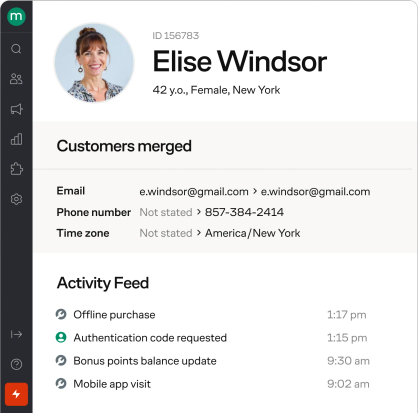
The same profile feeds email, SMS and RCS, mobile and web push, WhatsApp, offline POS, and paid-media audiences, so a promo code a customer gets in an email shows up in a banner when they land on the site. Loyalty and referrals are built in: points, tiers, challenges, and unique promo codes with usage limits.
The catch. Maestra is more platform than a store under a few million dollars needs, and the price only makes sense if it replaces two or three tools rather than sitting next to them.
Pricing. Maestra pricing is modular and starts at $2,000/month for the CDP plus unlimited email, with the first 100,000 active profiles included. Product recommendations, reporting, and ad audience sync are part of the base. The on-site personalization module adds $1,515/month, Shopify loyalty $1,010/month. You pay only for active profiles, dormant ones are stored free, billing is month-to-month, and migration is included.
Maestra Pros and Cons
Pros | Cons |
|---|---|
Forward Deployed Marketer builds and runs campaigns, around 15 customers per marketer | Might be too much for businesses that need simple email marketing |
Live CDP that unifies customer data across channels | Cost only justified if you replace multiple existing tools and use the full platform |
AI-driven product recommendations and dynamic content | |
White-glove support with dedicated Forward Deployed Marketer | |
Clear pricing without hidden fees |
Bloomreach – Best for Large Catalogs and Product Discovery

Bloomreach is built around search and merchandising for big catalogs. Its Discovery product reorders search results and category pages per shopper, and Loomi AI builds segments and personalizes email, SMS, and push from the same data. Content works in 33 languages, which matters for brands selling across Europe.
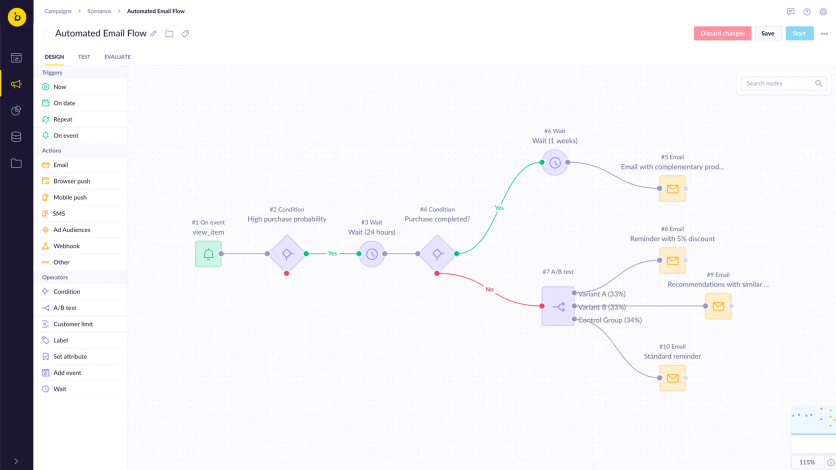
Bloomreach’s flow builder
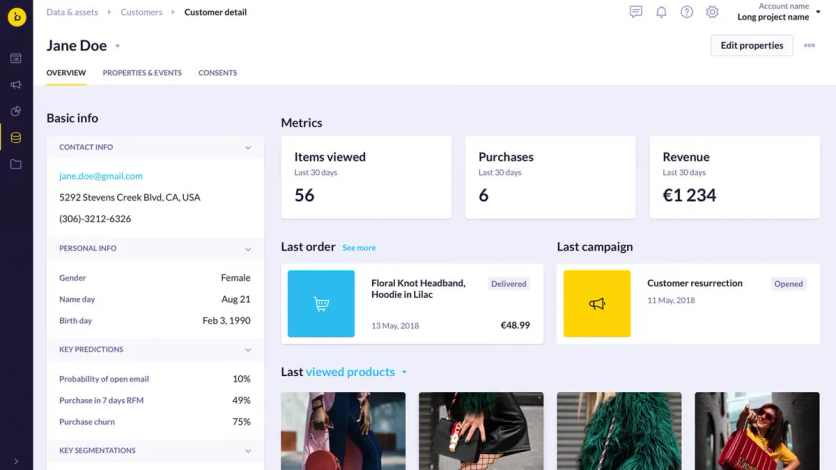
Customer’s profile in Bloomreach
The catch. It is an enterprise purchase. Pricing is custom with a starting point of about $60,000 a year for smaller brands and annual billing only, and most teams need an implementation partner to go live. Trial: none.
Pricing. Bloomreach publishes no rate card. Packages combine a platform fee with usage fees based on customer count, catalog size, and event volume; the published starting point is about $60,000 a year, billed annually. Most companies begin with site search and add modules later.
Support. Teams get quick help with responses arriving in about 2 minutes. Multiple support channels ensure businesses receive guidance when they need it most. Business Consultants and Strategic Experts help companies discover new opportunities as they grow.
Bloomreach Pros and Cons
| Pros | Cons |
|---|---|
| Accessible interface that doesn’t require deep technical knowledge | Higher pricing might not suit smaller businesses |
| Simple performance tracking with useful data insights | Complex integration needs substantial resources |
| AI creates individual-specific experiences instantly | Advanced features take time to master |
| Drag-and-drop tools to build targeted segments |
Insider One – Best for Enterprise Predictive Segments Across Nine Channels

Insider One predicts who is likely to buy, who responds to discounts, and which channel each person prefers, then uses that in Architect, its journey builder, across nine channels including WhatsApp, SMS, email, and web push. The on-site layer handles banners, recommendations, and conversational commerce.
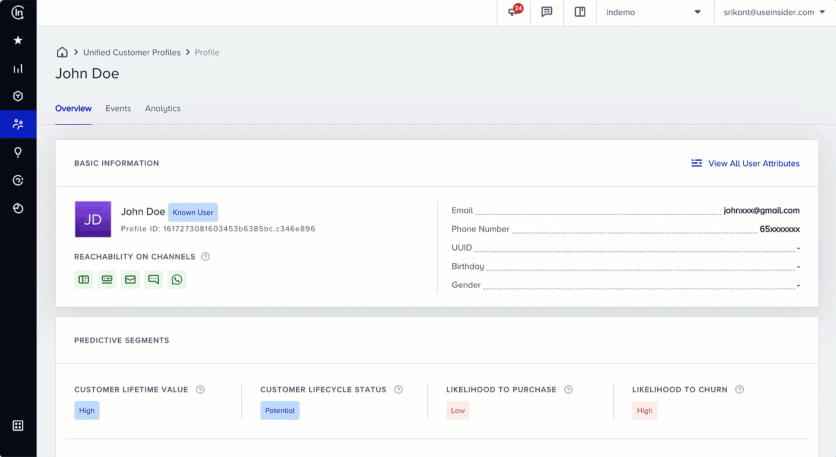
Insider’s customer profile
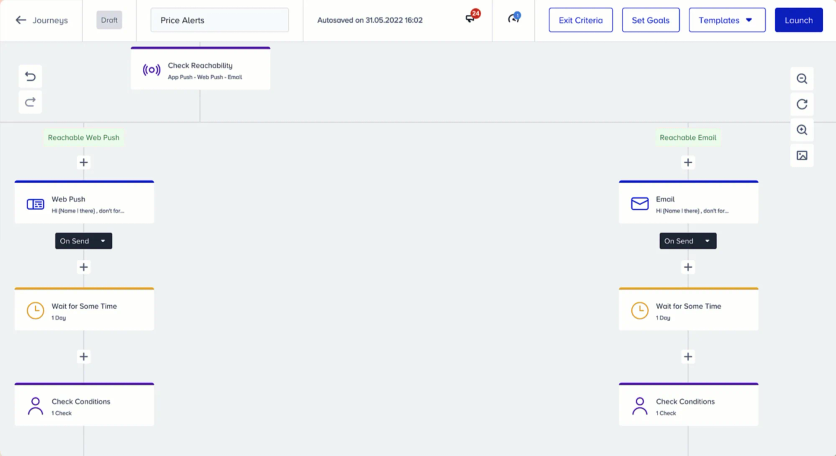
Insider’s flow builder
The catch. Insider One publishes no pricing; contracts tracked by Vendr run from about $150,000 to $360,000 a year, typically on one-to-three-year terms. Setting up integrations takes time and a technical owner.
Pricing. Custom only. The final cost depends on channels, user count, and support options, and the contract is usually annual or longer.
Support. An experienced team helps businesses set up and optimize their Insider One implementation. They provide ebooks, a resource center, email help, FAQs, webinars, and a detailed glossary. The support team makes sure clients use the right data sources and personalization tools that match their needs.
Insider One Pros and Cons
Pros | Cons |
|---|---|
Smart segmentation for targeted customer outreach | Cost is higher than other options, which might not work for small businesses |
Rich analytics for informed decisions | Setting up integrations takes time and resources |
More than 100 integrations with existing systems | |
AI personalization across different channels | |
Ready-to-use templates that speed up campaign launches |
Emarsys – Best for Retail Groups That Want Loyalty Inside the Suite

SAP Emarsys combines demographic, sales, support, and behavioral data into one profile and runs email, web, mobile, and ads from it. Loyalty is part of the suite rather than an integration, and the library of 150+ recommendation strategies and retail playbooks shortens setup for brands with a standard retail calendar.
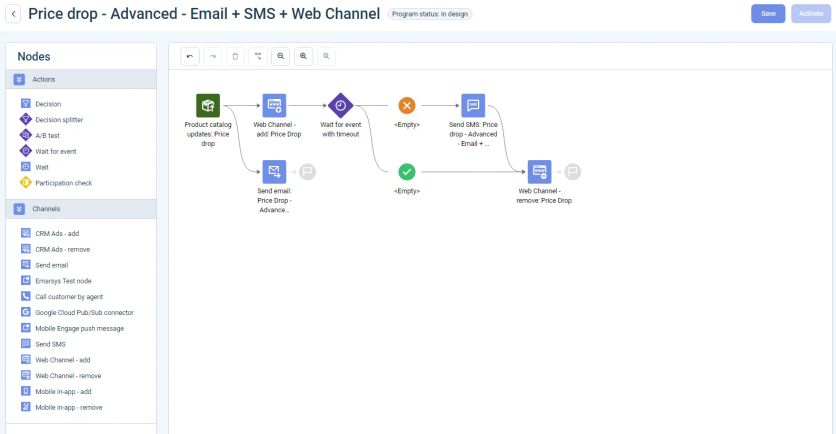
Emarsys’s flow builder
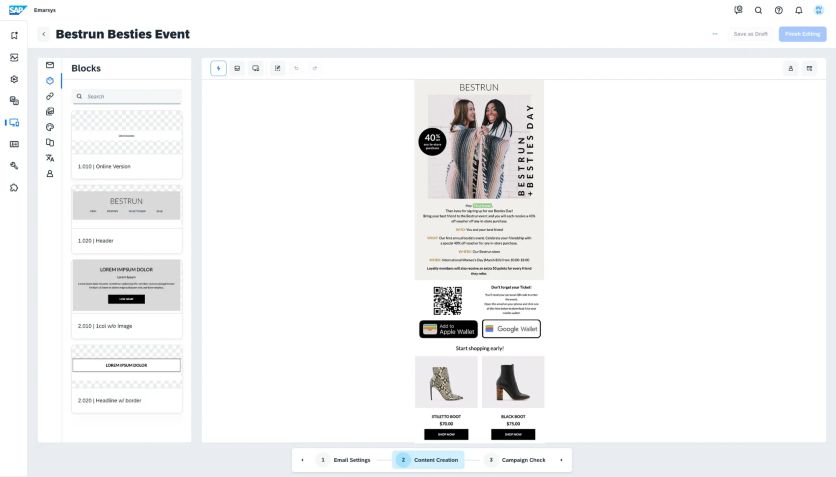
Emarsys’s email editor
The catch. It is sold through SAP, price upon request, on contracts from 3 to 36 months with auto-renewal. There is no trial, and the setup needs technical know-how.
Pricing. The standard package covers the data platform and email; other channels and features are added on top. Prices vary with database size, message volume, and active features, and monthly payment is available on contracts under one year.
Support. Support teams work from 13 locations worldwide in 10 languages, with a 98% customer satisfaction rate. Customers get 24/7 monitoring, live platform updates, and quick responses to urgent issues. Users also have access to training videos, documentation, and the SAP Emarsys Community.
Emarsys Pros and Cons
| Pros | Cons |
|---|---|
| Up-to-the-minute personalization in all shopping channels | No free trial option |
| AI-powered technology that customizes the entire buying journey | Setup needs technical know-how |
| Rich library of +150 recommendation strategies | |
| Deep learning-based visual discovery methods |
Layers – Best for search and merchandising on Shopify Plus
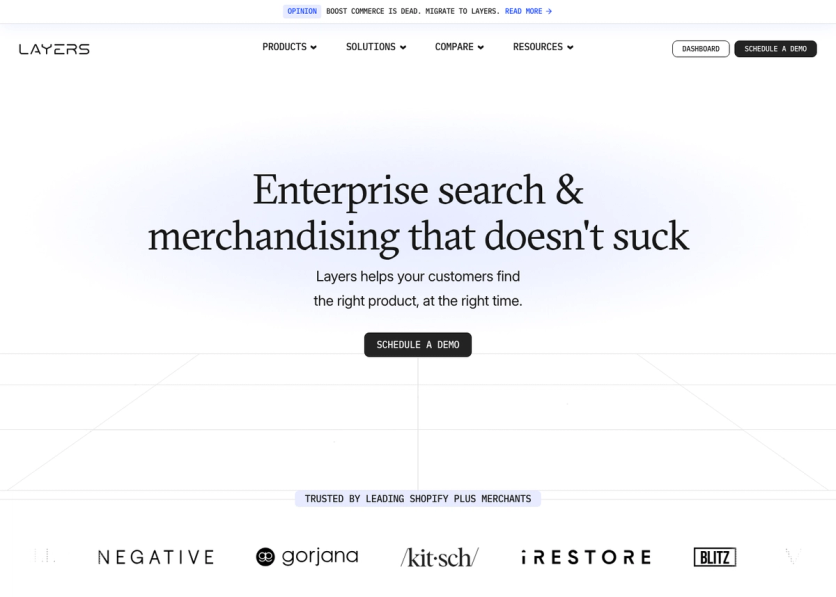
Layers is built for one platform only: Shopify Plus. It combines AI search, merchandising, visual discovery, and product recommendations in one contract.
Most personalization tools start with the inbox or the pop-up. Layers starts with the pages that carry revenue: search results, collection pages, and recommendation rails.
Layers Features
Personalization on search, collection, and product pages:
- Intent-aware AI search. “LBD” becomes “little black dress” and “cheap running shoes” boosts budget options. Search ranking blends five signals: semantic, keyword, engagement, freshness, and inventory.
- Shopper context. Cart contents, purchase history, location, and Shopify Market shape how each query is interpreted, in real time.
- Segmented rankings. One sort order ranks differently by country, marketing channel, and new vs. returning visitors. No duplicate setups.
- Recommendation blocks. Blocks cover the product page, cart, home page, search, and 404s. Interaction strategies rank by lift, and fallback chains keep widgets full.
- Visual search. Shoppers upload a photo and get the exact product or the closest alternative, with shop-the-look included.
- 100+ languages in one index. Multilingual search runs without a separate index per market.
Merchandising control behind it:
- Sort by what sells. Rank collections by 7-day revenue, margin, or sell-through rate with custom metrics.
- Real-time sync. A price change at 2pm shows in search by 2:01, with no 45-minute reindex.
- Sort order A/B tests. Experiments compare conversion, add-to-cart rate, and revenue per session.
- Live team editing. Cursors, field locks, and comments let three people edit one collection without overwrites.
- AI assistant access. Claude and ChatGPT connect through the Layers MCP server, with 48 store-management tools.
The results Layers reports:
- +13% conversion rate and +14% revenue per visitor across top-performing traffic segments, with average order value holding steady.
- +30% conversion rate at Rainbow Shops, a 1,000-store retailer. Its collection pages now reorder daily from 7-day, style-level sales.
- Fewer rage clicks. Erin Di Ienno, Shopify Lead at Venus, reports “a substantially smaller amount of frustration clicks with the search bar.”
David Cost, VP of eCommerce and Digital at Rainbow Shops, put it this way: “We can dynamically change the sort-order on all of our collection pages daily. So those collection pages look different every day.”
Layers Pricing Plans
Layers prices on usage, not seats or modules. The quote comes from the last 12 months of collection page views and search requests.
- All four products are included: AI search, merchandising, visual discovery, and recommendations
- No overage charges, so the rate stays the same if traffic grows
- Price can be locked for up to a year
- No middleware or connector apps to pay for, which is where Layers says its savings of up to 40% against legacy platforms come from
- Layers quotes the exact number on a demo call
Layers Support
Onboarding and training are included. Stores go live in one to two weeks, because the catalog sync reads straight from Shopify.
- Founder-level access. Kenny U, E-commerce Web Manager at iRESTORE: “Jake’s always super helpful whenever we run into an issue. Even as one of the founders, he’s still able to hop into some of these things pretty quickly.”
- A 99.99% monthly uptime SLA on the Search and Browse APIs, with service credits of 5%, 15%, or 100% if Layers misses it
- Docs in AI-friendly formats, including llms.txt and a markdown version of every page
Layers Pros and Cons
Pros | Cons |
|---|---|
Built only for Shopify Plus, so metafields, Shopify Markets, and B2B catalogs work natively | Shopify Plus only, so stores on other platforms can’t use it |
Catalog changes reach search within a minute | No email, SMS, or customer data platform, so it needs a messaging tool alongside |
Merch teams control rankings without engineering tickets | Interaction-based recommendations need order history, so new stores lean on fallbacks at first |
Search, merchandising, visual discovery, and recommendations in one contract | Sort order A/B testing is currently in Beta |
Usage-based pricing with no overage charges | Pricing is quote-based, with no public rate card |
On-Site Personalization and Product Discovery
These tools personalize what a shopper finds on the site, search results, category pages, recommendations, or the product itself, and leave email and SMS to another platform; a longer list of website personalization tools for ecommerce covers the lighter widgets too.
Dynamic Yield – Best for Deep-Learning Recommendations at Enterprise Scale
Dynamic Yield, now part of Mastercard, scores every product by affinity and predicts purchase intent with its AffinityML models. It personalizes the site, email, and app, and its A/B testing runs without developers.
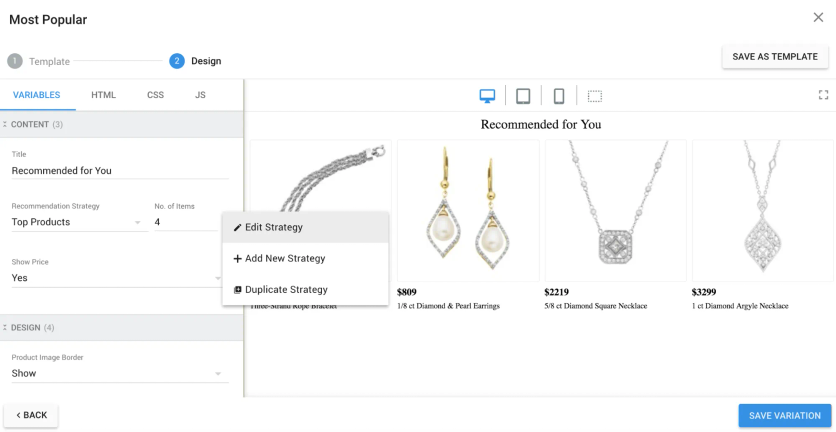
Website recommendations in Dynamic Yield

Campaign creation in Dynamic Yield
The catch. Pricing is custom; contracts tracked by Vendr sit between about $62,000 and $110,000 a year. Some templates still need custom CSS, and reporting focuses on campaign performance rather than customer insight, which is where most Dynamic Yield alternatives compete.
Pricing. Custom proposals only, sized by traffic and the products in scope; no public rates and no free trial.
Support. Dynamic Yield’s customer success team guides users through personalization strategy implementation with detailed assistance through multiple channels. The platform’s documentation and resources help users get the most from their personalization efforts.
Dynamic Yield Pros and Cons
| Pros | Cons |
|---|---|
| Advanced personalization and segmentation capabilities | Some templates need custom CSS knowledge to customize fully |
| User-friendly interface available to non-technical marketers | Setup process takes time |
| Solid A/B testing without developer involvement | Analytics focus on campaign performance instead of deeper customer insights |
| Works well across marketing, merchandising, and product tech departments |
ConversionBox – Best for AI-assisted product discovery and on-site search
ConversionBox is an AI product-discovery and conversion platform for ecommerce and B2B brands that want to help shoppers find the right products faster and buy with more confidence. It powers on-site AI search, guided product discovery, and an AI Shopping Assistant, and it also tracks how a brand appears across AI engines so its catalog stays discoverable.
ConversionBox Features
ConversionBox brings AI Visibility, AI Site Search, AI Shopping Assistant, Product Page Assistant, AI Merchandising, Predictive Bundles, Smart Filters, Product Finder and Quiz, Conversational Search, Gen-AI Answer Engine, Citation Monitoring, Content Assistant, and Search Analytics into one connected platform.
Its AI Visibility tools help brands audit where they appear across AI engines, identify content gaps, and track rankings over time. Inside the website, AI Search understands shopper intent and surfaces relevant products faster. The AI Shopping Assistant answers product, specification, fit, and compatibility questions, helping buyers move from uncertainty to purchase with more confidence.
ConversionBox Pricing Plans
ConversionBox offers Commerce and Enterprise pricing options. Brands can request a demo or start with a free AI Visibility Audit to understand where their products appear across AI-driven search and recommendation surfaces.
ConversionBox Support
ConversionBox works with Shopify, BigCommerce, Drupal, WooCommerce, Magento, WordPress, and custom platforms. It can layer on top of an existing site experience or replace the current search setup.
ConversionBox Pros and Cons
Pros | Cons |
|---|---|
Combines AI visibility, search, and shopping assistance | Strong results depend on clean product and content data |
Helps brands compete across AI-driven discovery channels | Advanced use cases may need setup support |
Useful for ecommerce and B2B catalogs | Pricing details require inquiry |
Supports major ecommerce platforms and custom sites | Best value comes when multiple features are used together |
Experro – Best for AI-native product discovery

Experro is a Gen AI-native product discovery and personalization platform that connects your catalog, content, and customer behavior into one intelligent engine. Unlike tools that still rely on manual rules, keyword search, and static segments, Experro uses LLMs, vector search, and real-time clickstream data to deliver individualized experiences at every touchpoint and AI agents that continuously optimize them without human intervention.
Experro Features
Experro’s Gen AI engine, Eywa, personalizes search, browse, recommendations, and content for every shopper in real time, thus boosting engagement and conversions from the very first click.
By learning each shopper’s preferences, interests, and affinities from first-party clickstream data, Experro drives higher-margin baskets, thus getting smarter and more profitable with every single session.

Delivering a seamless, consistent personalized experience across desktop, mobile, and app, so no matter where your shopper is, the relevance follows them.

Experro Pricing Plans
Experro offers flexible, customized pricing based on the products you need: the Discovery suite, including personalization, content, or conversational agents, and your actual usage. You only pay for the features you use, with the freedom to upgrade or downgrade anytime. Monthly, quarterly, and yearly billing options are available. Pricing is requested directly, and the team promises honest guidance, no hard selling. Experro also commits to delivering positive ROI within a year.
Experro Support
Experro treats support as a partnership, not a helpdesk. Every client gets award-winning, fast, and expert assistance from onboarding through everyday use. What sets them apart is their “Success-as-a-Service” model, which aligns with your business goals, tracks outcomes, and proactively shares performance suggestions and best practices before issues arise. With a 4.8 rating on G2 and recognition as a G2 High Performer and Capterra Quality Choice, the support quality is backed by real client feedback.
Experro Pros and Cons
| Pros | Cons |
|---|---|
| Gen AI-native platform: search, browse, recommendations, personalization, and content in one unified engine | You might never want to go back to your old tool |
| Success-as-a-Service model, the team actively works toward your business goals | Full value unlocked when multiple modules (Discovery + Content) are used together. |
| Goes live in under 6 weeks, fast for an enterprise-grade platform | |
| Trusted by B2C, B2B, and DTC brands globally; 100M+ requests served daily |
Kickflip – Best for real-time previews of personalized products
Kickflip is a no-code product configurator for ecommerce brands that sell made-to-order or customizable goods. Rather than personalizing what’s shown to a shopper, it lets the shopper personalize what they actually buy, picking colors, adding text or a logo, or building out multi-part products, right on the product page, with the price updating live as they go.
It’s built to plug into an existing store (Shopify, WooCommerce, Wix) so merchants add a configurator to products they’re already selling instead of standing up a separate design tool.
Kickflip Features
- Visual, no-code product configurator: shoppers customize a product (color, text, logo upload, engraving, and more) directly on the product page, with the price updating in real time as they choose
- Configurators are built from simple blocks that you simply drag-and-drop so merchants don’t need to write custom code for the customization logic
- Generates print-ready production files for made-to-order manufacturing
- Unlimited variants and options.
- Bulk ordering and quote options (CPQ) available.
- Native integrations for Shopify, WooCommerce, and Wix, and a custom iframe integration for any other website
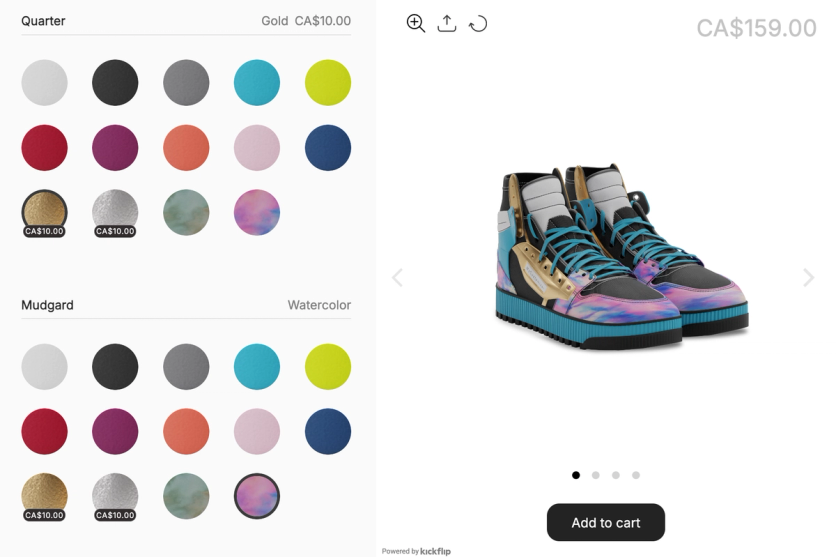
Kickflip’s configurator
Kickflip Pricing Plans
Standard plan starts at $59/month plus a per-order transaction fee (1.95% down to 0%, scaling with volume), with unlimited products, page views, and storage included. Optional add-ons cover white-labeling (+$49/month, removes “Powered by Kickflip”) and customer price-quote requests (+$99/month). A custom Enterprise plan is available for brands with high volume or non-standard needs. 14-day free trial, no credit card required.
Kickflip Support
Kickflip backs the product with a self-serve Help Center, a customer support team, a partner-finder directory for brands that want hands-on implementation help, and a weekly live demo. Kickflip’s support team is available to answer any question and provide step-by-step troubleshooting via chat and email.
Kickflip Pros and Cons
| Pros | Cons |
|---|---|
| Personalizes the actual product itself, a different lever than recommendation/CDP tools | Specifically for merchants selling customizable products who need a visualisation tool for different colors, logos, style, parts, etc. |
| No-code builder for merchants; real-time pricing as customers customize | Transaction fees scale with volume on top of the flat monthly fee. |
| Works across a wide range of product categories (apparel, sporting goods, furniture, and more) | No 3D visualization options yet. |
| Offering options to personalize the product improves conversion rate and time on page, and reduces returns. |
Email and SMS-Led Personalization
These platforms personalize messages first. Site personalization exists, but it is thinner than in the suites above.
Klaviyo – Best for Small Shopify Stores Starting With Email and SMS
Klaviyo pulls data from 350+ integrations into one profile and personalizes email and SMS flows from it: predicted next order date, churn risk, and product recommendations inside messages. The Customer Hub adds an on-site account page with order tracking and tailored picks, and you can start free and grow into it.
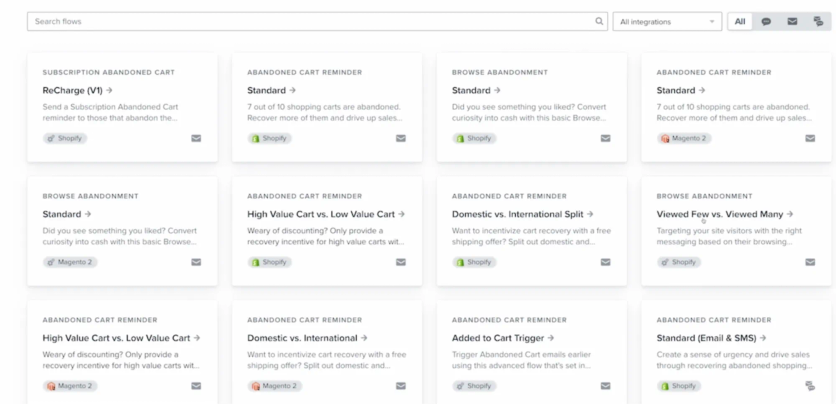
Flow templates in Klaviyo
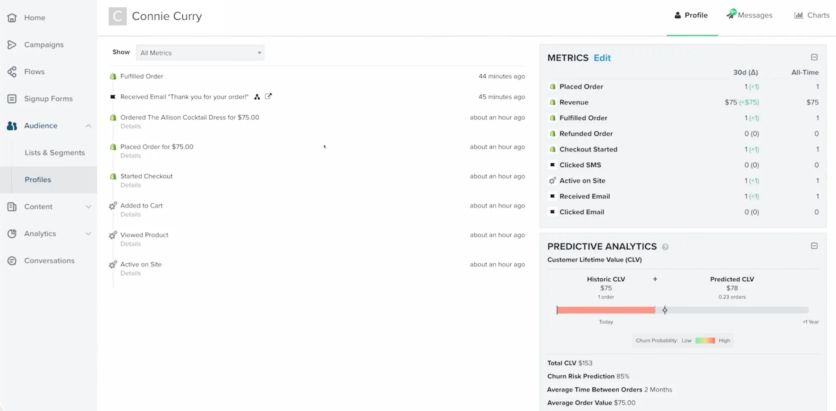
Customer profile in Klaviyo
The catch. Billing is by profile count, and reviewers from the last year describe the pain: “They bill you based on outdated subscriber list sizes, so even after you clean house, you’re stuck overpaying for profiles that don’t exist anymore,” wrote a lifecycle marketer in August 2026. Another store owner found that “despite having auto-upgrade switched off, Klaviyo increased my plan anyway” (August 2026). Email and chat support sit behind paid tiers, and free-plan support ends after 60 days.
Pricing. Klaviyo’s free plan covers 250 active profiles and 500 emails a month. Email starts at $20/month for 500 profiles and 5,000 sends. SMS is billed per send on top, about $0.01 per US toll-free message plus carrier fees. Customer Hub and the Composer are $20/month each. Billing is monthly, no annual contract.
Support. The platform provides email and live chat help along with a complete help center. Free plan users should know they’ll get support for only 60 days. Users say they get helpful answers, but sometimes responses take several hours.
Klaviyo Pros and Cons
| Pros | Cons |
|---|---|
Free plan and a $20 entry point | Billed by list size, including inactive profiles |
350+ integrations and the deepest Shopify data sync | Site personalization limited to Customer Hub and forms |
Predictive analytics on every plan | Email and chat support only on paid tiers |
MoEngage – Best for App-First Brands That Live on Push and In-App

MoEngage personalizes push, in-app, email, SMS, and WhatsApp from one behavioral profile, and its no-code editor changes web page elements or inserts recommendation grids and banners without a developer. Brands with a mobile app get the most from it.
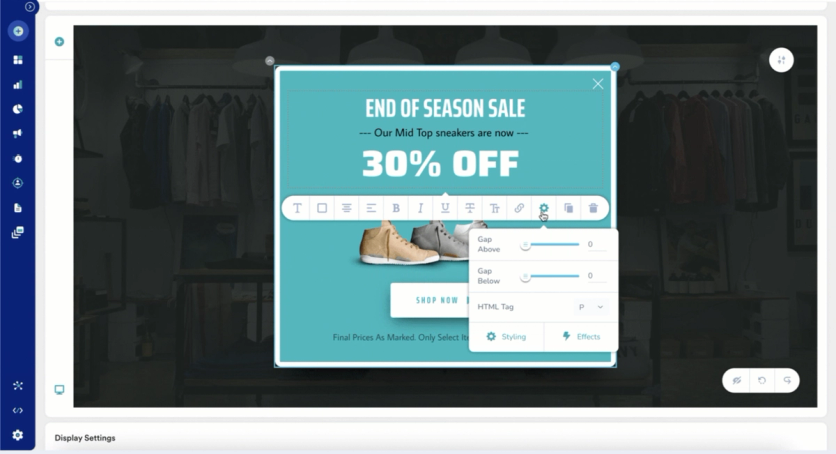
Popup editing in MoEngage
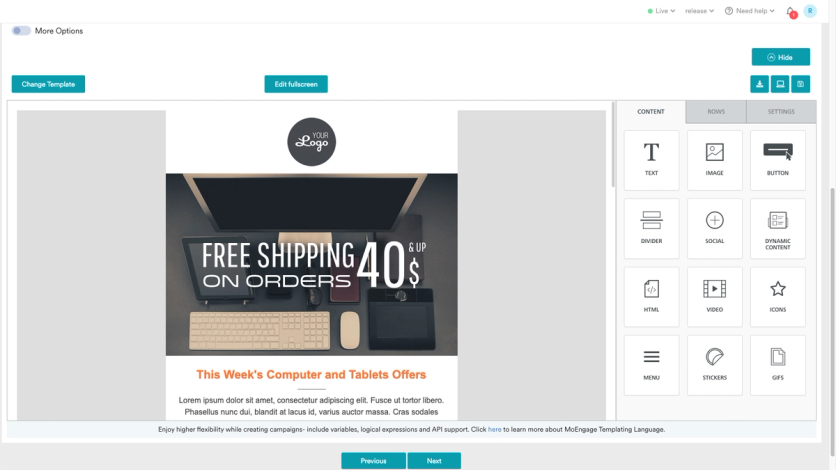
MoEngage’s email editor
The catch. Plans are priced by monthly tracked users and contracts average around $125,000–$190,000 a year, with no free plan on the current price list. Email templates are thinner than the mobile tooling, and event data is kept for 180 days.
Pricing. Growth and Enterprise plans, both custom, priced by monthly tracked users and event volume; many features are add-ons.
Support. Users can access technical support through email, phone, live chat, forum, and knowledgebase. The platform provides video tutorials and social media help.
MoEngage Pros and Cons
| Pros | Cons |
|---|---|
| Customer trips across multiple channels | Email campaigns have limited customization options |
| AI-led optimization for engagement removes manual guesswork | Templates and static content elements need improvement |
| Customer behavior drives segmentation capabilities | Data storage lasts only 180 days |
| Detailed dashboards provide in-depth analytics | Campaign reach suffers from low delivery rates |
Testing-First Personalization
These tools start from experiments. Personalization is a segment-level rule layered on top of A/B tests, and they assume a CRO team that runs them.
Wingify (Formerly VWO) – Best for Experimentation-First Teams

Wingify’s Web Personalization product, the former VWO Personalize, builds visitor profiles from browser properties, on-site activity, and third-party sources, then serves rule-based experiences by persona or event such as scroll depth or time on page. Wingz, the AI layer, suggests segments and reads results. Teams use it to test personalization before committing to a suite.

Personalized campaign creation in Wingify
The catch. It leans on IT more than the demo suggests. One customer in June 2026 found it “far more IT-dependent and complex than originally communicated” and added that Wingify would not “let us out of an agreement that we do not use whatsoever” (Trustpilot). Full data access needs the top plan.
Pricing. Wingify publishes no prices for Web Personalization. Growth, Pro, and Enterprise are custom proposals billed on monthly active users. There is a 30-day free trial with no card, and no free plan.
Support. The team responds within 45 minutes through phone, email, and live chat. Their 99% CSAT score shows this is a big deal as it means that they exceed industry standards. Customers work with dedicated account managers and get 1:1 onboarding and training sessions.
Wingify (Formerly VWO) Pros and Cons
| Pros | Cons |
|---|---|
| User-friendly interface with visual and code editors | Web experiences are the main focus with limited omnichannel options |
| Reliable A/B testing capabilities built into personalization | Some users report inflexible contracts |
| AI-powered features for audience segmentation | Advanced configurations take time to master |
| Advanced configurations take time to master |
Adobe Target – Best for Adobe Experience Cloud Customers

Adobe Target runs A/B, multivariate, and AI-driven tests and personalizes web, mobile, and in-app experiences from an open profile with hundreds of data points, linking customers across devices. If your content and analytics already live in Adobe Experience Cloud, it is the natural testing layer.
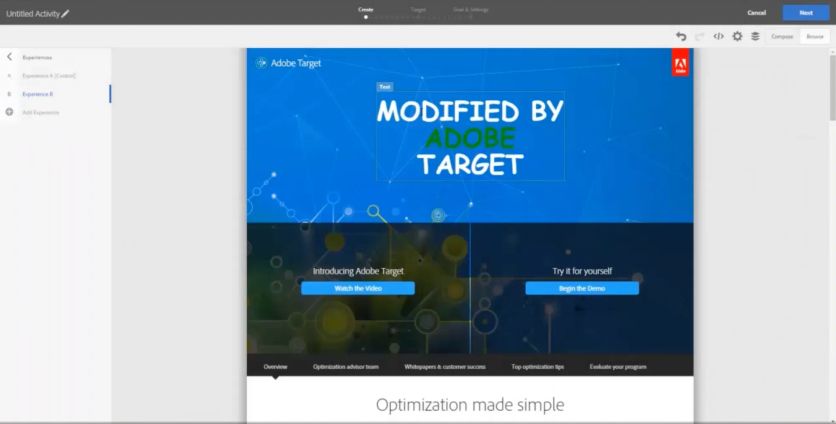
Adobe Target’s Visual Experience Composer
The catch. It is sold only with custom pricing, no trial and no public rates, and the learning curve is steep for segment building. Outside Adobe’s stack, the integration work outweighs the benefit.
Pricing. Custom quotes sized by product options, the number of digital properties, and omnichannel delivery. Standard and Premium editions exist, neither with a published price.
Support. The platform’s Community Forum lets users learn about features, talk to other users, and work with Adobe experts. Users can also get help through Target Basics Webinar Series and Customer Care Office Hours.
Adobe’s telephone support has dedicated Target team members ready to help with technical problems. The support team provides documentation, webinars, and step-by-step guides to solve content delivery issues.
Adobe Target Pros and Cons
| Pros | Cons |
|---|---|
| AI tools that predict customer behaviors and generate content | Steep learning curve, especially when creating segments |
| Infinite integrations with ecommerce platforms | No dedicated landing page builder |
| Targeted email marketing with dynamic product feeds | Lack of free migration assistance |
| Built-in CRM capabilities | |
| Integrated SMS marketing for omnichannel strategies |
Salesforce Personalization – Best for Salesforce CRM Customers

Salesforce Personalization decides in real time which offer, content, or product to show on the site, in email, and through Agentforce agents, using the data already in Salesforce CRM. Governance controls show marketers why the AI chose what it chose.
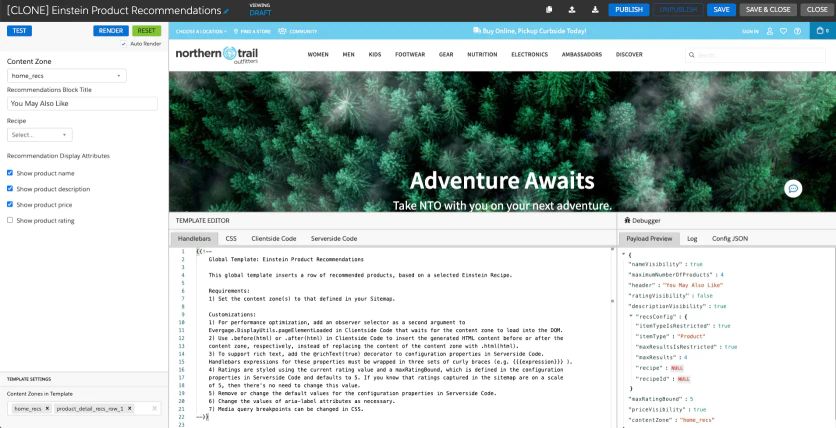
Salesforce Marketing Cloud’s Einstein product recommendations setup
The catch. It is two products with two prices: Salesforce Personalization at $8,000 per org per month and Marketing Cloud Personalization+ at $15,000, both billed annually, and both require Data 360 to be provisioned on top. Non-Salesforce teams face a long learning curve.
Pricing. $8,000 per org per month for Salesforce Personalization and $15,000 for Personalization+, which bundles Marketing Cloud Personalization (the former Interaction Studio). Both are billed annually, and Data 360 is a prerequisite with its own cost.
Support. Teams get control and insight to show their effect through support resources. The platform blends with other Salesforce products like Service Cloud, Sales Cloud, and Loyalty Cloud. This gives users unified support across the ecosystem.
Salesforce Personalization Pros and Cons
| Pros | Cons |
|---|---|
| Easy integration with Salesforce ecosystem | Requires Data Cloud provisioning (additional cost) |
| Up-to-the-minute personalization across multiple touchpoints | Complex pricing structure |
| AI and Agentforce for autonomous personalization | Higher learning curve for non-Salesforce users |
| Secure data handling through Einstein Trust Layer |
A Safer First Step into Personalization
Some e-commerce teams aren’t yet ready for sophisticated personalization platforms due to budget constraints or the need for low-risk tests. In this case, Elfsight can be a smart, low-friction option to consider.
Elfsight is a lightweight, specialized tool for improving specific on-site elements. It’s a versatile 'plug-and-play' library of no-code widgets designed to enhance visitor engagement.
For e-commerce brands, Elfsight works particularly well as a complement to their current marketing stack. For example, while your main platform handles emails, Elfsight adds the interactive front-end components that capture attention and drive immediate action.
Elfsight offers a free plan with limited features and Elfsight branding. Paid plans start at $6 per month and include support and advanced features.
How to Choose Ecommerce Personalization Software
Start from who will run it. A two-person marketing team gets more from a platform with a marketer included than from a bigger feature list; Maestra’s Forward Deployed Marketer builds the flows and on-site experiences, while Bloomreach, Insider One, and Emarsys assume an in-house team or an agency.
Then match the tool to the problem. If shoppers cannot find products in a 10,000-SKU catalog, search and discovery tools like Bloomreach, ConversionBox, or Experro fix that faster than a messaging suite. If the problem is email and SMS, Klaviyo covers a small Shopify store and MoEngage an app-first brand. If the site already converts and you want to test offers, Wingify, Adobe Target, or Salesforce Personalization are testing tools first.
Check the bill against the store size. Klaviyo and Kickflip start under $100 a month; Maestra starts at $2,000 a month with a marketer included; Bloomreach, Insider One, Dynamic Yield, and MoEngage run from about $60,000 to $360,000 a year on annual contracts. A tool that costs more than the revenue it is likely to add in year one is the wrong tool, whatever the demo shows.
FAQs
- Maestra, if you want site, email, SMS, and loyalty personalized from one profile and a Forward Deployed Marketer building it; it starts at $2,000/month and the first 100,000 active profiles are included. Bloomreach fits if the main problem is product discovery in a very large catalog and you have a six-figure budget. Klaviyo stays the right answer only if email and SMS are the whole program and site personalization can wait.
- Yes, if it is cheap or includes the labor. Below 50,000 visitors, recommendations and pop-ups still move AOV and email capture, but an enterprise suite’s annual contract will not pay back. Start with Klaviyo’s free plan or Elfsight’s widgets for the site, or with Maestra if you would rather have a marketer run the program than hire for it.
- For on-site personalization, usually yes. Klaviyo personalizes email and SMS well, but on-site it offers the Customer Hub and forms, not recommendation blocks, quizzes, or exit-intent offers across the site. Brands that want both without two tools move to Maestra, which runs email, SMS, and site personalization from one profile, or add an on-site tool such as ConversionBox or Experro next to Klaviyo.
- Maestra is the one on this list that includes a marketer: a Forward Deployed Marketer migrates the stack, builds flows and on-site experiences, and runs tests, on weekly calls and a shared Slack channel, with around 15 customers per marketer. Bloomreach, Insider One, and Emarsys offer customer success managers and consultants who advise, but the building stays with your team or an agency.