Explore the latest customer data platform (CDP) statistics for 2026. Market size, growth rates, key trends, user pain points, and a comparison of leading CDP platforms for e-commerce brands.
Customer Data Platform Statistics and Market Analysis 2026

E-commerce brands need better customer data in 2026. With third-party cookies going away, companies must collect and manage their own customer information.
But here’s the challenge: Customers now interact with brands across many channels — websites, apps, email, social media, and physical stores. Each channel captures different pieces of information, but those data don’t automatically connect. One customer can look like five different people across your systems.
That’s what customer data platforms (CDPs) are built to solve. They unify all those scattered touchpoints into one complete customer profile, so you can see the full picture and deliver personalized experiences across all your channels.
This guide helps you choose the right CDP for your e-commerce brand. First, we break down the latest market trends and emerging requirements so you know what capabilities you need to build a future-proof tech stack. Then, we analyze the most common pain points marketers face with CDPs today. Finally, we review the leading CDP platforms and show you how each one addresses these challenges.
Content:
How is the CDP Market Evolving
By 2026 the global CDP market has grown rapidly, reaching $4.58 billion. Retail and e-commerce lead CDP adoption, accounting for the largest share 35.67%. This reflects strong demand for unified customer data to enable hyper-personalization across channels. Growth is expected to remain strong going forward. Mordor Intelligence projects a 23.5% CAGR from 2026 to 2031.
North America remains the largest regional market for CDPs. In 2025, North America accounted for 47.32% of global revenue, while Asia Pacific is forecast to grow at a 24.41% CAGR through 2031.
What to Consider Before Choosing a CDP: Key Trends and Drivers
The CDP landscape is being reshaped by technological innovation, regulatory changes, and shifting customer behavior. Here’s how those changes should influence what marketers prioritize when evaluating platforms.
Real-time personalization is no longer optional
Customers expect brands to respond instantly to their behavior. Browse a product? They want relevant recommendations right away. Abandon a cart? They expect a timely reminder. McKinsey research shows that 71% of consumers expect personalized interactions, and 76% get frustrated when they don’t find them.
The problem: many CDPs update customer profiles in batches — hours or even days after an action occurs. By then, the moment has passed. Modern e-commerce requires CDPs that can capture customer actions, update profiles, and trigger personalized responses in real time across all channels.
Disjoint tools → centralization era
As brands add more channels to their marketing mix — email, SMS, MMS, messaging apps, chatbots, push notifications — the fragmented approach breaks down. Each new channel means another tool to integrate, another data source to sync, and another place where customer information gets siloed. What used to work with 2-3 channels becomes unmanageable with 7 or more.
The quality of interactions is also evolving: RCS messaging is expanding, and U.S. e-commerce brands are increasingly asking about WhatsApp because these channels support rich content, such as buttons, images, and detailed product information. Managing all of this across separate tools is increasingly complex.

In the long run, centralized platforms win over fragmented setups. The winners will be brands that centralize early. This isn’t just more efficient, it’s the only way to deliver seamless experiences across dozens of channels.
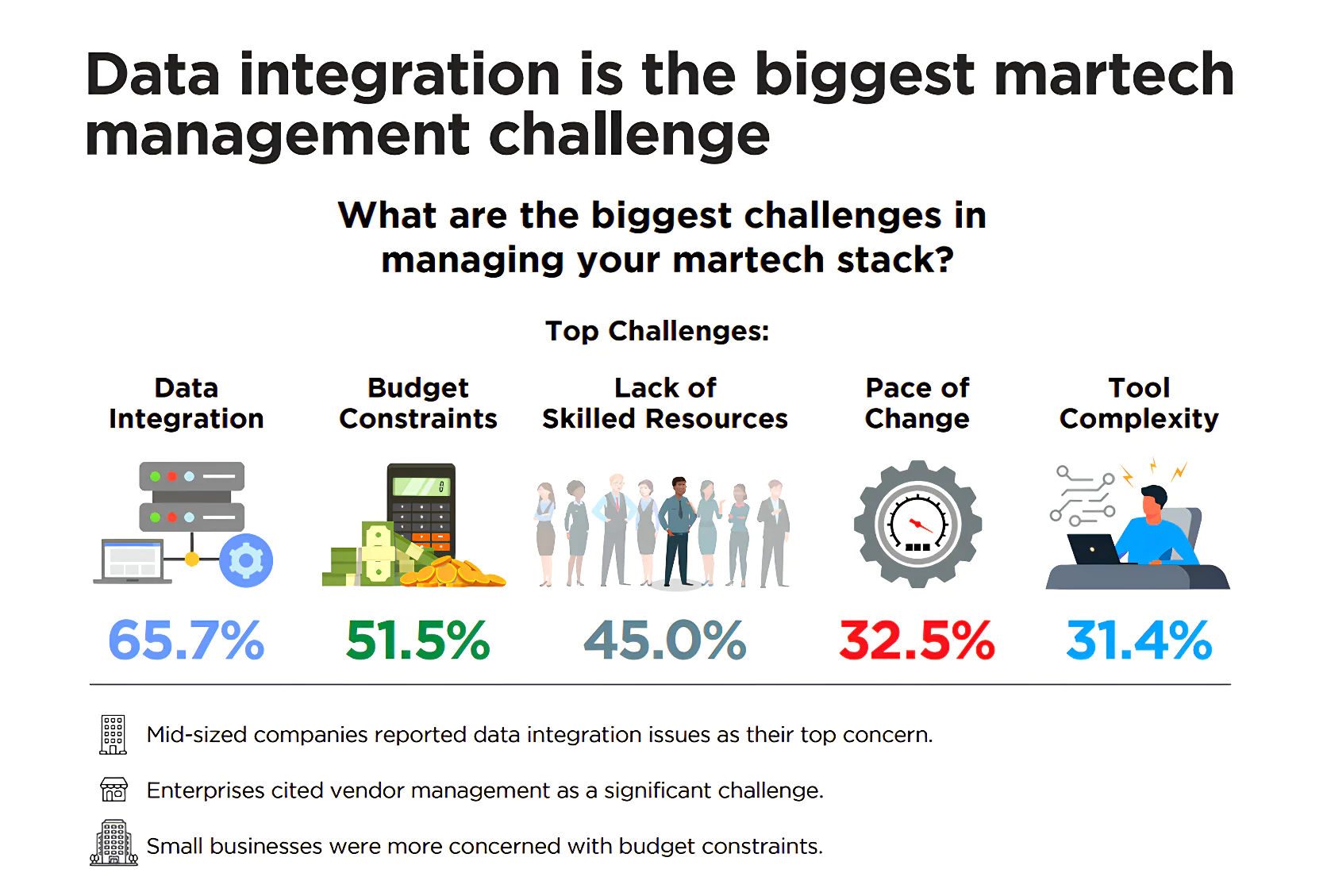
In MarTech’s survey, 65.7% said data integration is one of their biggest martech stack management challenges, and 20.7% reported that data silos are their top concern for the future of the stack. The fragmented approach is collapsing under its own weight. If your current platform requires endless integrations for each new channel, it may be time to look elsewhere.
The AI wave demands better data
The widespread adoption of AI and machine learning has made high-quality data a must-have. According to a Gartner survey, approximately 31% of leaders cite data availability and quality as their top barriers to AI adoption. Brands need a CDP that cleans, unifies, and deduplicates multi-channel signals — because AI is only as smart as the data you feed it.
What Features Are Leading CDPs Building for 2026
Now that you understand the key market shifts, the question becomes: How are CDPs adapting? Here’s what leading platforms are building to address these requirements — and what you need to look for in your evaluation.
Real-Time Is Everywhere
Platforms are racing to reduce latency between data collection or a customer event and action:
- Klaviyo released Automated SMS Conversations, which let brands answer questions, recommend products, and guide purchases in real time. It also supports real-time push content updates.
- Twilio Segment launched Event-Triggered Journeys and Real-Time Signals, enabling immediate responses to customer actions across SMS, MMS, and WhatsApp.
- Tealium introduced AIStream for instant customer recognition and in-the-moment activation.
- Adobe’s Journey Optimizer now uses events to trigger journeys for individual users, delivering real-time messages as each person enters a journey.
- Maestra syncs all data in real time — leads, orders, product updates, customer events — and pushes instant updates to promotions, loyalty, on-site personalization, and all channels.
Real-time capabilities are becoming standard, but implementation varies. When evaluating platforms, ask specifically how fast data flows from event to activation — seconds or minutes can make the difference between capturing a customer’s attention and missing the moment. Also check whether real-time works across all your channels or just email and SMS.
Strategic Moves Toward Unification
The era of fragmented data scattered across disconnected systems is over, and unification is becoming non-negotiable.
CDPs that aren’t part of an all-in-one platform are expanding integrations with other tools and adding new channels. Some have made big business moves to offer a more centralized approach.
- Adobe Experience Platform is integrating with GenStudio for performance marketing.
- Twilio now allows users to manage Salesforce Marketing Cloud Data Extensions directly in Segment.
- Klaviyo is expanding from an email service into a broader B2C CRM with marketing features and analytics.
As platforms are racing to expand channels, it makes sense to look at those who started to streamline journeys across all touchpoints first — all-in-one platforms. Maestra is one of them, integrating data, cross-channel communications, and a personalization engine into a single platform. This makes it more efficient for growth — scaling brands can plug in new touchpoints without endless rounds of integrations.
Centralization is more scalable. Adding new channels doesn’t mean extra costs or new vendors. You can start with tailored emails and on-site widgets, then plug in a loyalty program, in-app messaging, and RCS — all from one platform.
Unified platforms support a complete view of a customer and let marketers build the entire journey, not just isolated touchpoints. So customers get a seamless experience: they click in WhatsApp, land on your site, and see relevant post-purchase recommendations and cart preloaded with a personal pro-code.
Unified platforms support a complete view of a customer and let marketers build the entire journey, not just isolated touchpoints. So customers get a seamless experience: they click in WhatsApp, land on your site, and see relevant post-purchase recommendations and cart preloaded with a personal pro-code.
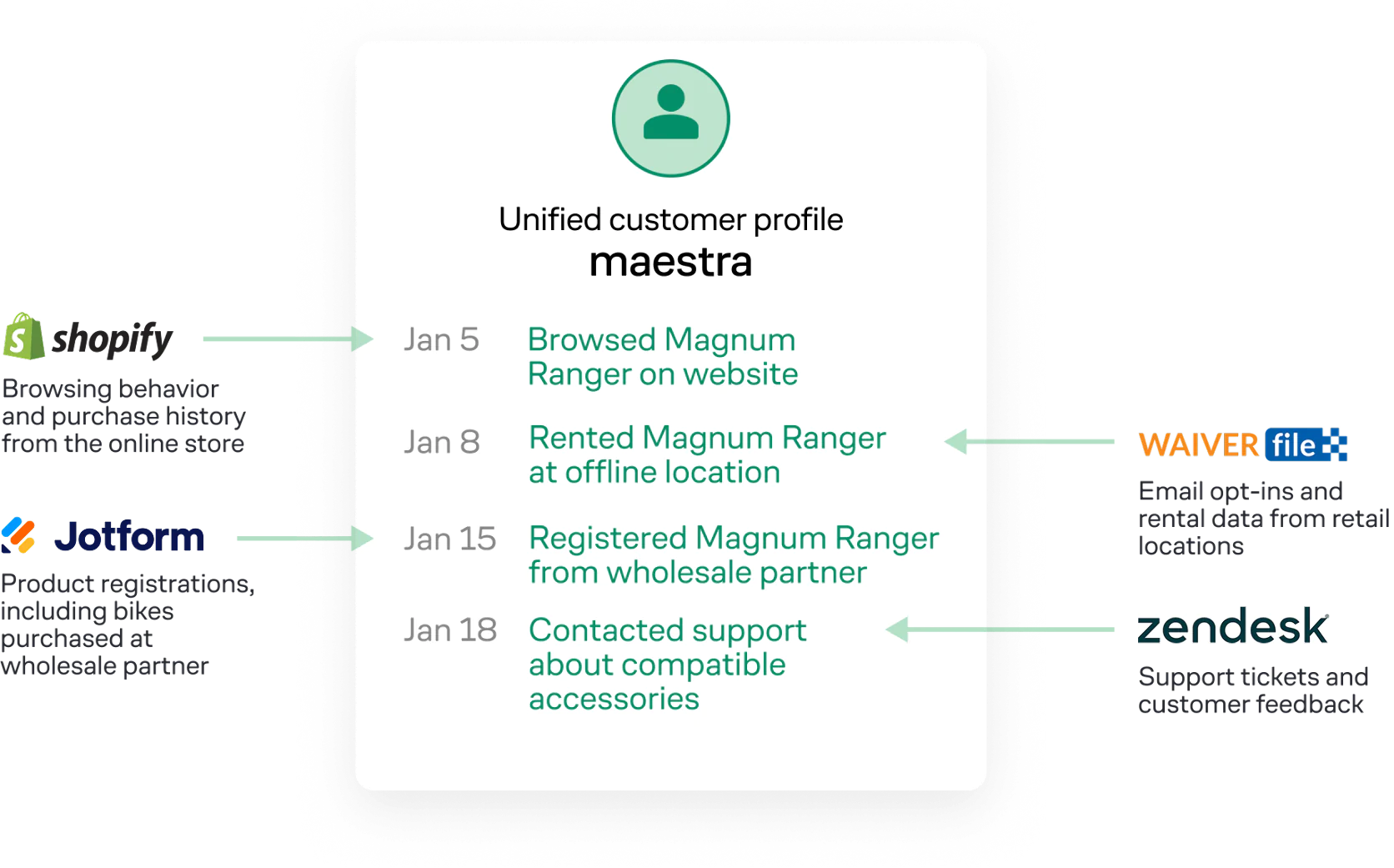
For instance, Magnum Bikes leveraged Maestrato consolidate all touchpoints into a unified customer profile. This provides a comprehensive 360-degree view of the buyer journey — from online purchases and rentals to bike registrations.
Unified platforms are also more cost-effective because they don’t burn your budget on coordination across separate tools. For example, Urban Armor Gear reduced their martech cost by 64% when their marketing team consolidated their stack with Maestra instead of using three separate tools. Furniture Fair replaced even more — five isolated tools — with Maestra and started saving 27% on marketing stack costs.
AI Assistants, Agents, and Predictions
CDP vendors are putting front and center.
- Twilio Segment rolled out new AI features: Predictions, Recommendations, Generative Audiences, and Functions Co‑Pilot.
- Tealium announced an AI feature set, including the Behavioral Insights Agent, Attribute Search, AI Documentation, and Global AI Settings.
- Adobe added new AI Agent capabilities and an AI Assistant to its Experience Cloud.
- Klaviyo launched AI Marketing and Customer Agents.
- Maestra integrated an AI Assistant that audits business metrics across segments, campaigns, and flows. The AI deconstructs revenue trends and generates actionable hypotheses to supercharge marketing strategies and growth.
As we can see, everyone is adding AI, but not all AI delivers value. The best implementations focus on speed to revenue — helping teams understand why revenue shifts happen and what to do about that. For example, Maestra’s AI assistant instantly answers questions like "Which segment is currently underperforming compared to last quarter, and why?" or "What could help reduce our cart abandonment rate?" This turns hours of analysis into seconds of insight.
One more thing: AI should enhance your team, not replace expert support. Look for CDPs that offer both AI tools and access to experienced experts who can guide strategy and troubleshoot complex scenarios.
What Are the Most Common CDP Pain Points
Beyond adapting to new demands, platforms must also address existing user frustrations. Based on our analysis of reviews on G2, Capterra, and Trustpilot, here’s how we categorized the most common pain points:
- Complex onboarding: Steep learning curve — your CDP is so complex you need a PhD to leverage it.
- High or rising costs: The CDP is expensive from the start, or costs increase sharply as the business scales.
- Poor support and setup hurdles: Integration and migration — you do it all yourself. The support team responds in 5 days or even ghosts you.
- Missing features: Key capabilities are discovered to be unavailable months after implementation.
- UI issues: Lack of flexibility and a buried or clunky interface.
- Vendor lock-in: Contracts are difficult to cancel.
- Data quality issues: yous CDP is meant to unify data but instead creates new silos, causing AI agents and models to fail.
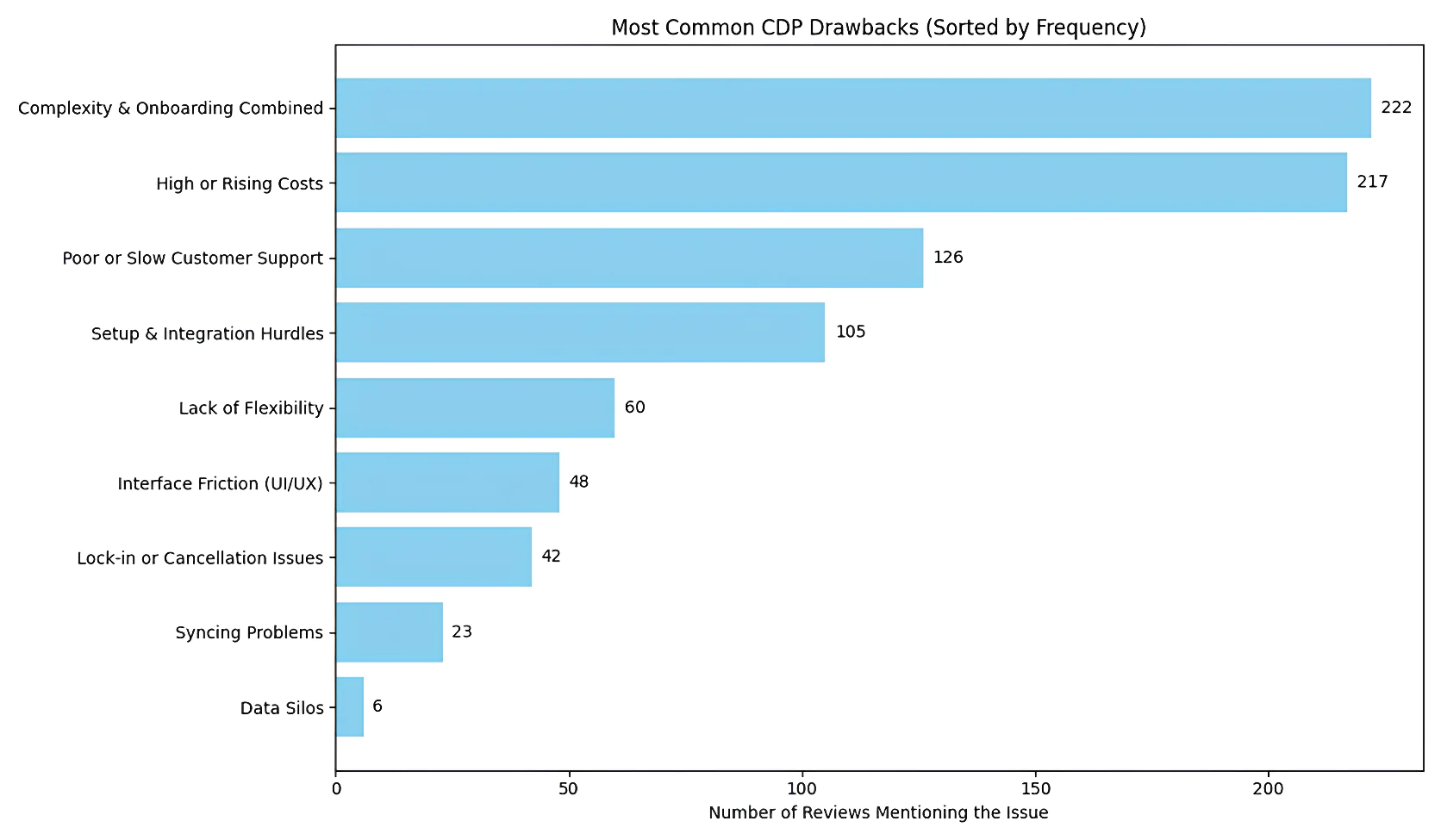
The takeaway: Platforms face a dual challenge — chasing market trends while fixing legacy issues. Ironically, users are often frustrated not by core functionality but by the experience: pricing, support, and contract terms.
Which CDP Is Right for Your Business
If you’ve decided to explore the CDP market or you’re choosing CDP software, let’s evaluate five platforms — what they offer, how they handle common user pains, and whether they’re powerful enough for mid-market brands and enterprises.
Customer Data Platform Comparison Table
Platform
Key Features
Price
Support Options
Maestra
• Real-time CDP with instant profile updates
• Advanced segmentation (RFM, custom, nested segments, computed fields)
• Real-time omnichannel orchestration and messaging
• In-session segmentation and millisecond site and app personalization
• AI-powered product recommendations
• Built-in loyalty and referral programs
• Flexible A/B testing
• Full-funnel analytics with configurable attribution
• Over 150 native integrations
• White-glove service, hands-on support
• High scalability and and enterprise-grade performance:
• Paid media optimization
• Advanced segmentation (RFM, custom, nested segments, computed fields)
• Real-time omnichannel orchestration and messaging
• In-session segmentation and millisecond site and app personalization
• AI-powered product recommendations
• Built-in loyalty and referral programs
• Flexible A/B testing
• Full-funnel analytics with configurable attribution
• Over 150 native integrations
• White-glove service, hands-on support
• High scalability and and enterprise-grade performance:
• Paid media optimization
Starts at $2,990/month for 150K profiles
• No setup or onboarding fees
• Month-to-month billing, no cancellation penalties
• Unlimited emails, API calls, and users
• All features included
• No setup or onboarding fees
• Month-to-month billing, no cancellation penalties
• Unlimited emails, API calls, and users
• All features included
Dedicated CSM for each client:
• Integration and migration support
• Segment and flow setup
• Performance monitoring
• A/B testing
Support Channels:
• Weekly Zoom strategy sessions
• Shared Slack/Teams channel
• Live chat (responses within 5–10 minutes)
• Integration and migration support
• Segment and flow setup
• Performance monitoring
• A/B testing
Support Channels:
• Weekly Zoom strategy sessions
• Shared Slack/Teams channel
• Live chat (responses within 5–10 minutes)
Segment (Twilio)
• Composable architecture with flexible API data collection from web, mobile, and server
• Zero-copy system
• Identity resolution
• Unified customer profiles
• Data governance and consent management
• Over 700 pre-built integrations
• AI Capabilities
• Zero-copy system
• Identity resolution
• Unified customer profiles
• Data governance and consent management
• Over 700 pre-built integrations
• AI Capabilities
Free: 1,000 MTUs
Team: Starts at $120/month for 10K MTUs
Business: Custom pricing
Team: Starts at $120/month for 10K MTUs
Business: Custom pricing
• Email support
• Web support
• Training videos
• Documentation
• 24/7 help for paid plans
• Web support
• Training videos
• Documentation
• 24/7 help for paid plans
Adobe Marketing Cloud
• Real-time CDP with millisecond activation
• Unified B2B and B2C profiles
• AI-powered insights
• Privacy governance (GDPR compliant)
• Streaming APIs and prebuilt connectors
• Unified B2B and B2C profiles
• AI-powered insights
• Privacy governance (GDPR compliant)
• Streaming APIs and prebuilt connectors
Custom pricing only
Estimated starting price over $50,000/year
Estimated starting price over $50,000/year
• Chat and email
• Knowledge base and FAQs
• Forum access
• Multi-language support (9 languages)
• Knowledge base and FAQs
• Forum access
• Multi-language support (9 languages)
Klaviyo
• Real-time segmentation
• No-code data transformation
• Predictive analytics powered by Klaviyo AI
• Drag-and-drop email builder with over 160 templates
• SMS and push notifications
• Over 350 integrations and APIs
• Reviews collection (add-on)
• No-code data transformation
• Predictive analytics powered by Klaviyo AI
• Drag-and-drop email builder with over 160 templates
• SMS and push notifications
• Over 350 integrations and APIs
• Reviews collection (add-on)
CDP (add-on): $500/month
Basic plans:
• Free: 250 profiles, 500 emails/month
• Email: Starts at $20/month
• Email + SMS: Starts at $35/month
Add-ons:
• Reviews: $25/month
• Analytics: $100/month
Basic plans:
• Free: 250 profiles, 500 emails/month
• Email: Starts at $20/month
• Email + SMS: Starts at $35/month
Add-ons:
• Reviews: $25/month
• Analytics: $100/month
• 24/7 email support for paid plans
• 24/5 live chat for paid plans
• Klaviyo Academy resources
• Free users: email support for 60 days only
• 24/5 live chat for paid plans
• Klaviyo Academy resources
• Free users: email support for 60 days only
Tealium
• Real-time data collection and identity stitching
• Over 1,300 turnkey integrations
• Privacy-first governance (HIPAA, GDPR, ISO 27001)
• Flexible implementation options
• Over 1,300 turnkey integrations
• Privacy-first governance (HIPAA, GDPR, ISO 27001)
• Flexible implementation options
No public pricing
Described as expensive for SMBs
Described as expensive for SMBs
• Documentation and community forums
• Online ticketing system
• Zoom meetings for Enhanced plan
• Dedicated Technical Account Manager for premium users
• Online ticketing system
• Zoom meetings for Enhanced plan
• Dedicated Technical Account Manager for premium users
Twilio Segment stands out for its developer-friendly approach. Its composable CDP captures data from customer interactions to create unified user profiles. Since acquiring Segment in November 2020, Twilio has positioned the platform to help companies unify and activate customer data across multiple channels.
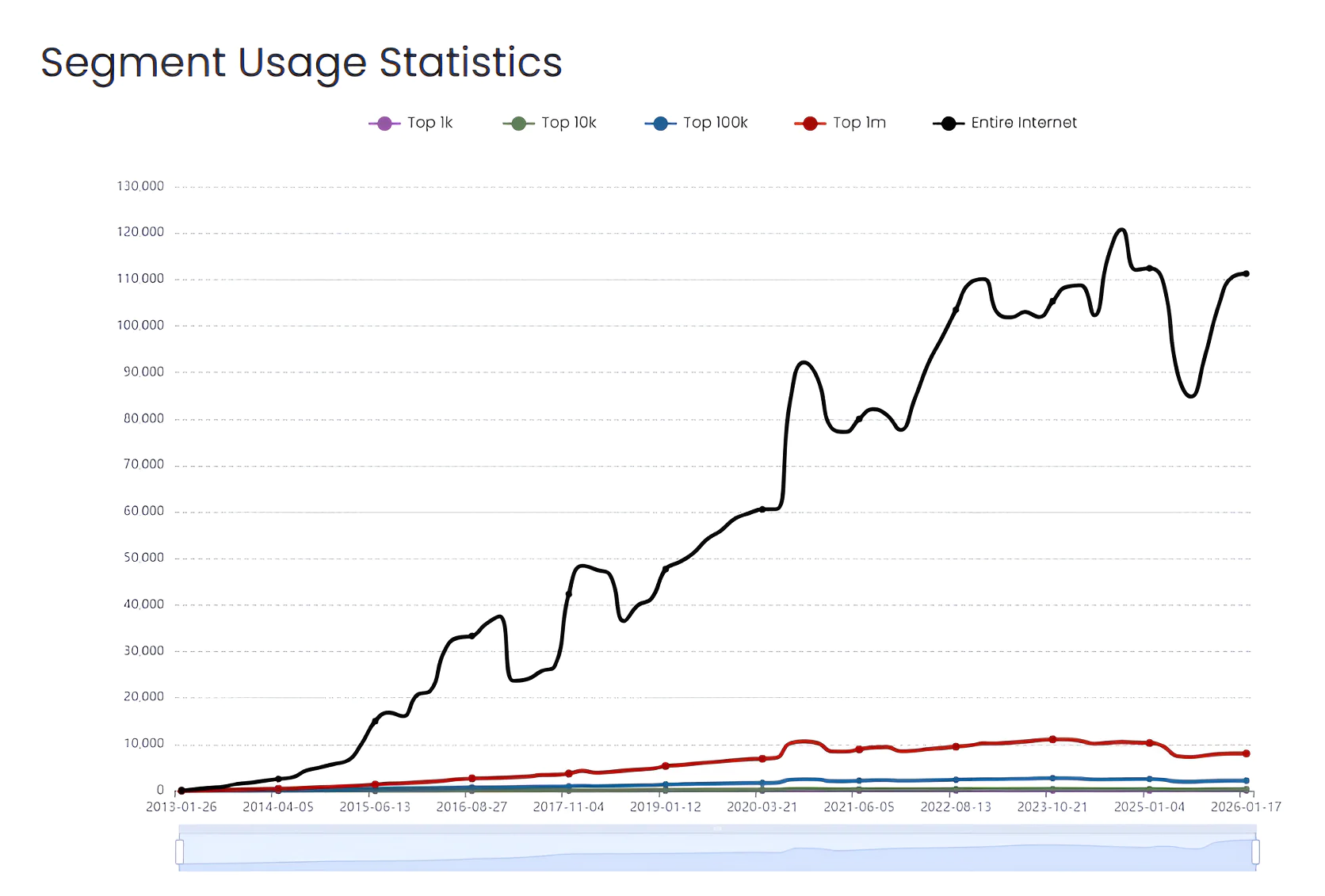
Segment is used by over 111K websites, including approximately 85K in the U.S., with particularly strong adoption among high-traffic sites. Segment’s adoption trend has been strongly upward for several years. The platform has grown its user base steadily since its introduction in the mid-2010s.
Segment Features
Twilio Segment provides a single, unified view of each customer by collecting data from customer touchpoints, including the data warehouse. These profiles update automatically with each interaction, enabling teams to predict and deliver relevant customer experiences in real time.
The platform’s composable architecture lets businesses customize their customer data setup based on their specific needs. Organizations can build and expand more flexibly using APIs, developer tools, and a broad integration ecosystem. Companies can keep their data where it is through a zero-copy architecture that treats the warehouse as the source of truth.
Segment makes AI capabilities available by embedding intelligence directly into customer data workflows. Marketers can use AI to make more informed decisions and improve customer experiences through predictive insights and automated personalization without a data science team.
Segment gives teams control over data collection, flow, and usage through a centralized customer data infrastructure. Data validation, observability, and consent management help businesses stay compliant and maintain data quality as they grow.
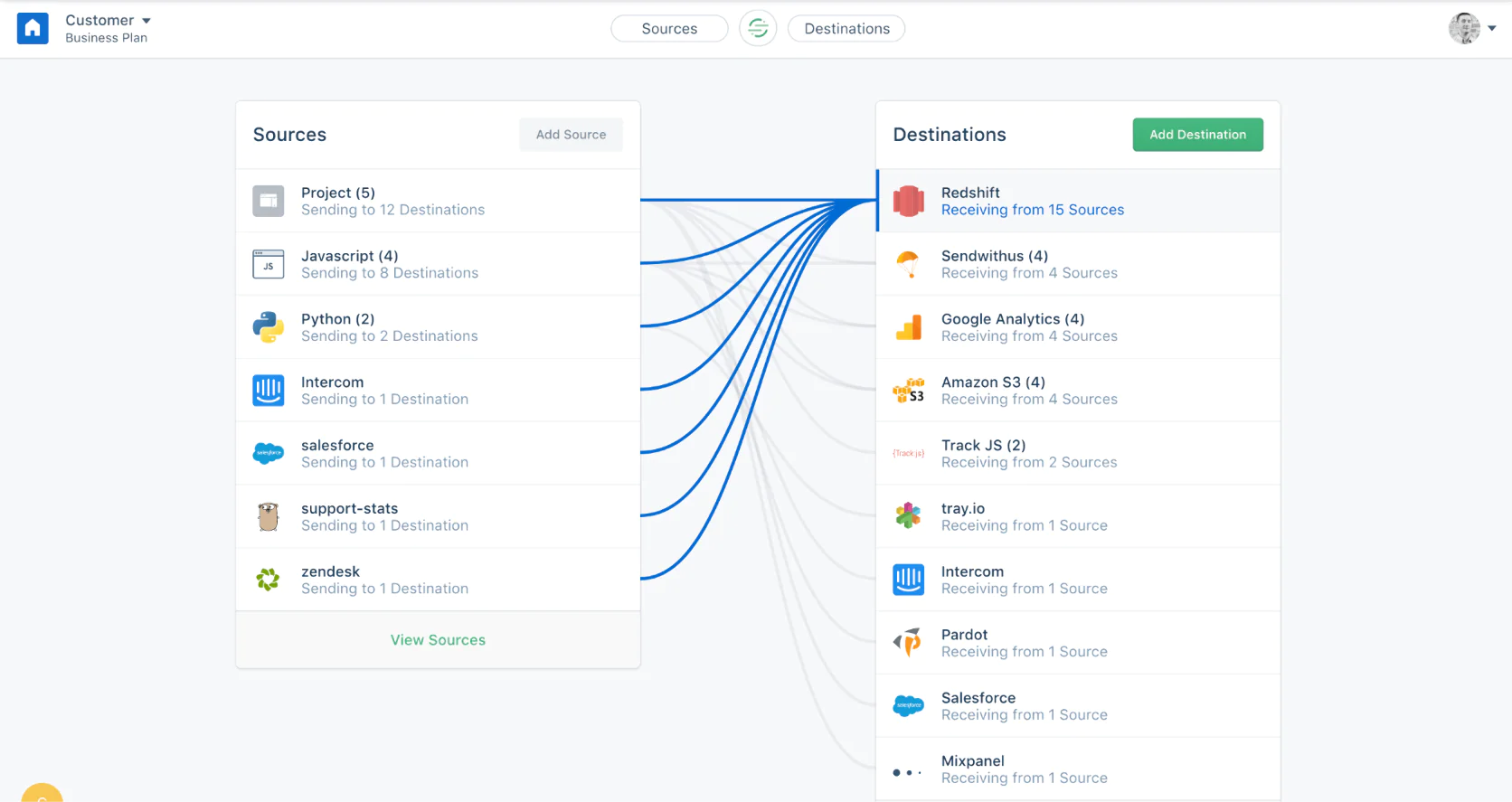
Data paths overview in Segment
Twilio Segment works best for developer-heavy, digital-first teams that focus on event tracking and routing. Teams that can manage identity resolution and data modeling internally will find it most valuable. The platform helps centralize customer data from multiple sources and route it immediately to various tools, which makes it valuable in today’s first-party, data-driven world.
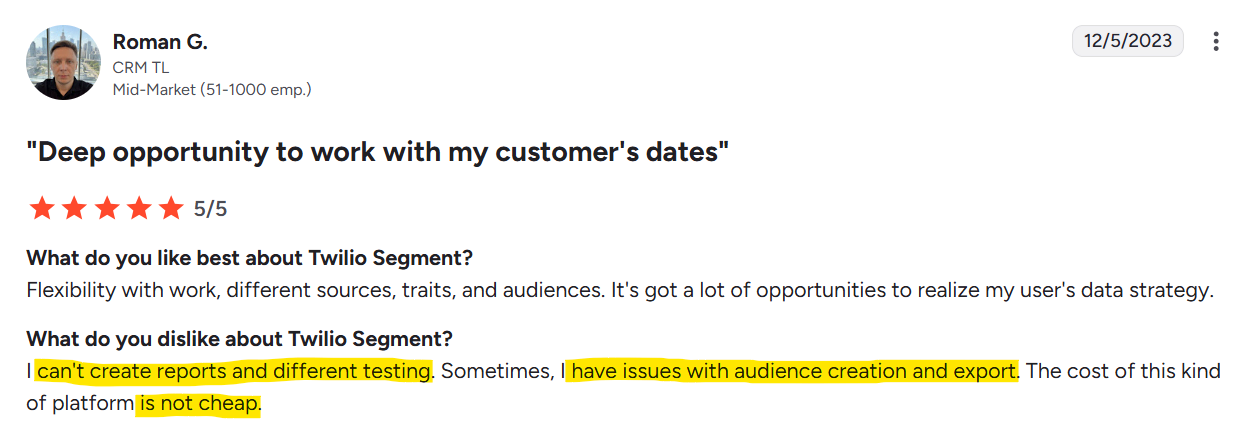
A small number of users point out feature limitations, particularly around reporting and audience export capabilities. While these issues aren’t mentioned by most users, they highlight areas where Segment’s flexibility and feature set didn’t meet certain clients’ expectations.
What users are saying about Segment on G2
Segment Support
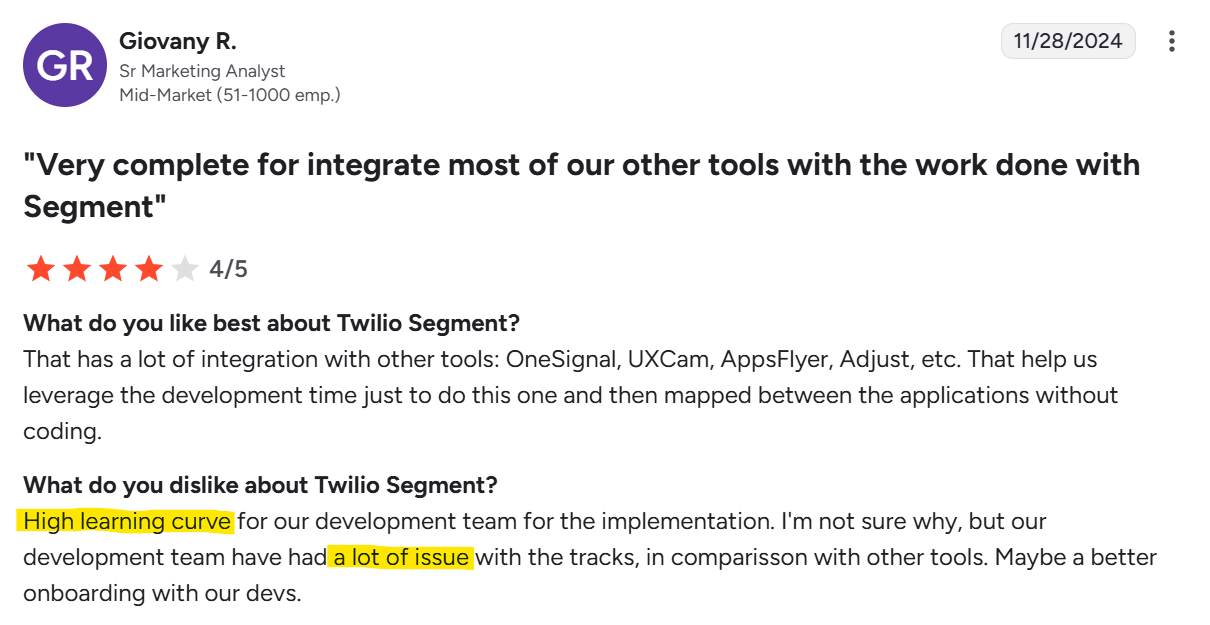
Email and web support are available. Training videos and developer documentation are on-demand. Segment’s support receives generally positive ratings, but a few users report that assistance wasn’t timely and sufficient during integration and onboarding.
Paid plans come with faster response times and 24/7 support. Critical issues receive immediate attention, with response times based on priority level.
What users are saying about Segment on G2
Segment Pricing Plans
Twilio Segment bases its pricing on monthly tracked users (MTUs):
- Free plan: 1,000 MTUs and 2 sources.
- Team plan: Starts at $120 per month for 10,000 MTUs and unlimited sources.
- Business plan: Custom pricing and volumes for enterprise needs.
Businesses can collect and unify real-time events with customer data in the warehouse, send customer data to more than 700 apps, and govern data for quality and compliance. Other features, Reverse ETL, and Identity Resolution may affect pricing. Some reviews mention that cost is a pain point, especially as usage scales.
Segment Pros and Cons
Pros
Cons
Real-time event processing
Limited identity resolution with deterministic matching, which some find restrictive
Over 700 pre-built integrations
New users might struggle with advanced features
Developer-friendly architecture, offering control and flexibility
Requires engineering resources to structure data, build pipelines, and manage identity merges
Strong SDKs and APIs for mobile/web/app event tracking
MTU-based pricing can get expensive for brands with high traffic
Easy setup and integration with other tools
Segment Pain Point Check
Pain Point
How Segment Handles It
Complex Onboarding
Several reviews note a steep learning curve and a challenging initial implementation; some users find Segment complex to use and maintain without technical expertise
High or Rising Cost
MTU-based pricing model can escalate quickly as a business grows
Poor Support and Setup Hurdles
Generally good ratings, but some users report slow responses during critical integration phases
Missing Features
Some users want stronger reporting and audience export capabilities
UI Issues
Interface may be complex, especially for new users
Lock-In
Data portability is possible but requires effort
Data quality
Strong data governance tools help maintain data quality
Adobe Marketing Cloud is part of Adobe Experience Cloud. It delivers enterprise-level solutions to manage cross-channel customer data and enables businesses to build cohesive customer profiles for both B2B and B2C applications. Adobe Real-Time CDP forms the backbone of the Marketing Cloud suite.
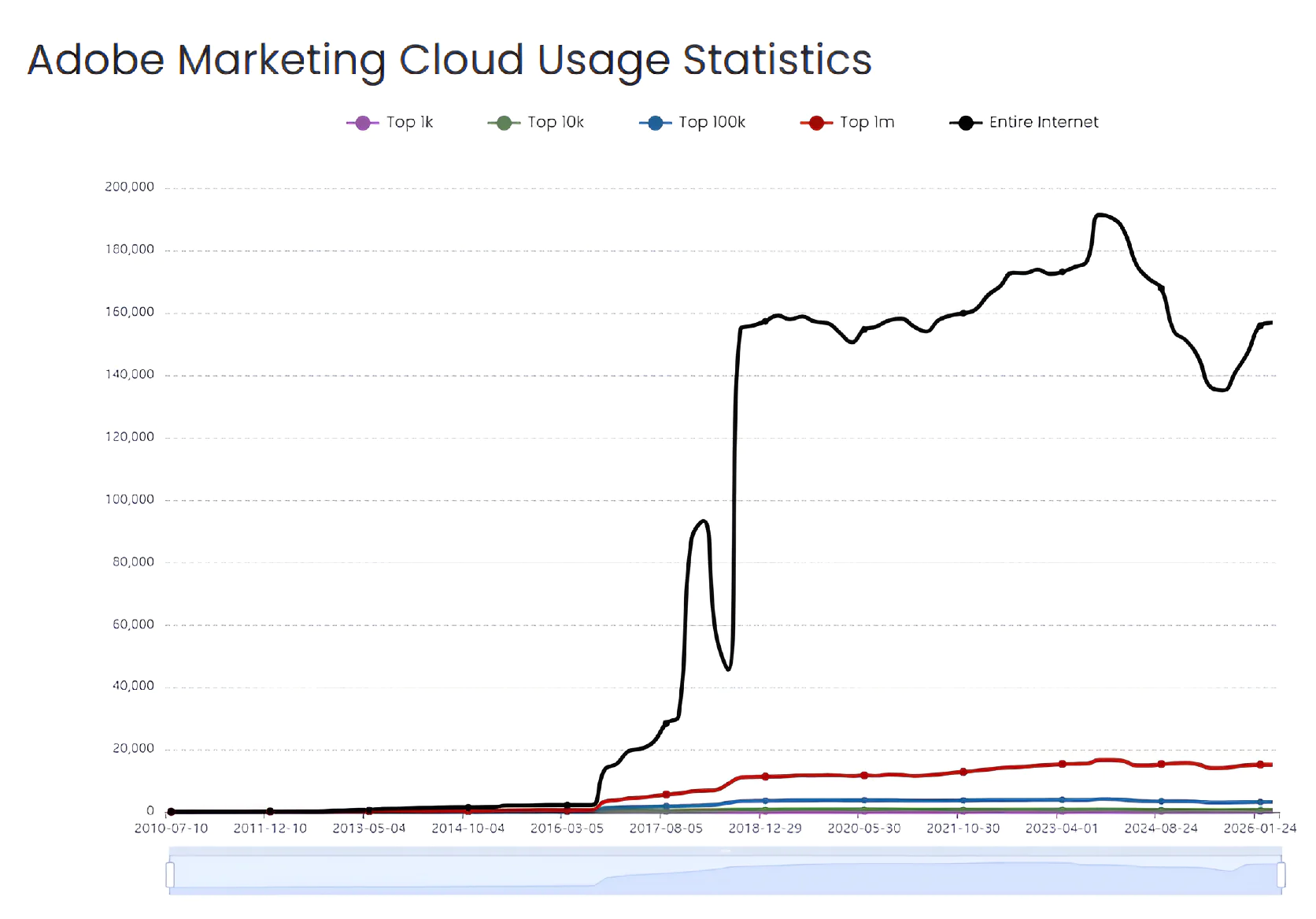
Adobe Marketing Cloud is used by over 156K websites, including approximately 94K in the U.S. However, it faces a flat-to-declining long-term adoption trend. Adobe focuses on higher-traffic sites and enterprise customers. Many smaller sites have either moved away or never adopted it, as evidenced by the fact that over 436K sites once used Adobe’s marketing suite but have since dropped it.
Adobe Marketing Cloud Features
Adobe Real-Time CDP collects and activates customer data from websites, email, social media, call centers, and in-store interactions. It transforms scattered data into unified profiles ready for omnichannel activation.
Adobe’s Real-Time Customer Profile builds dynamic person and account profiles by combining known and unknown data from various sources. Robust privacy, governance, security, and identity controls help protect customer data. These profiles provide an up-to-date view of customers through real-time data streaming via prebuilt connectors.
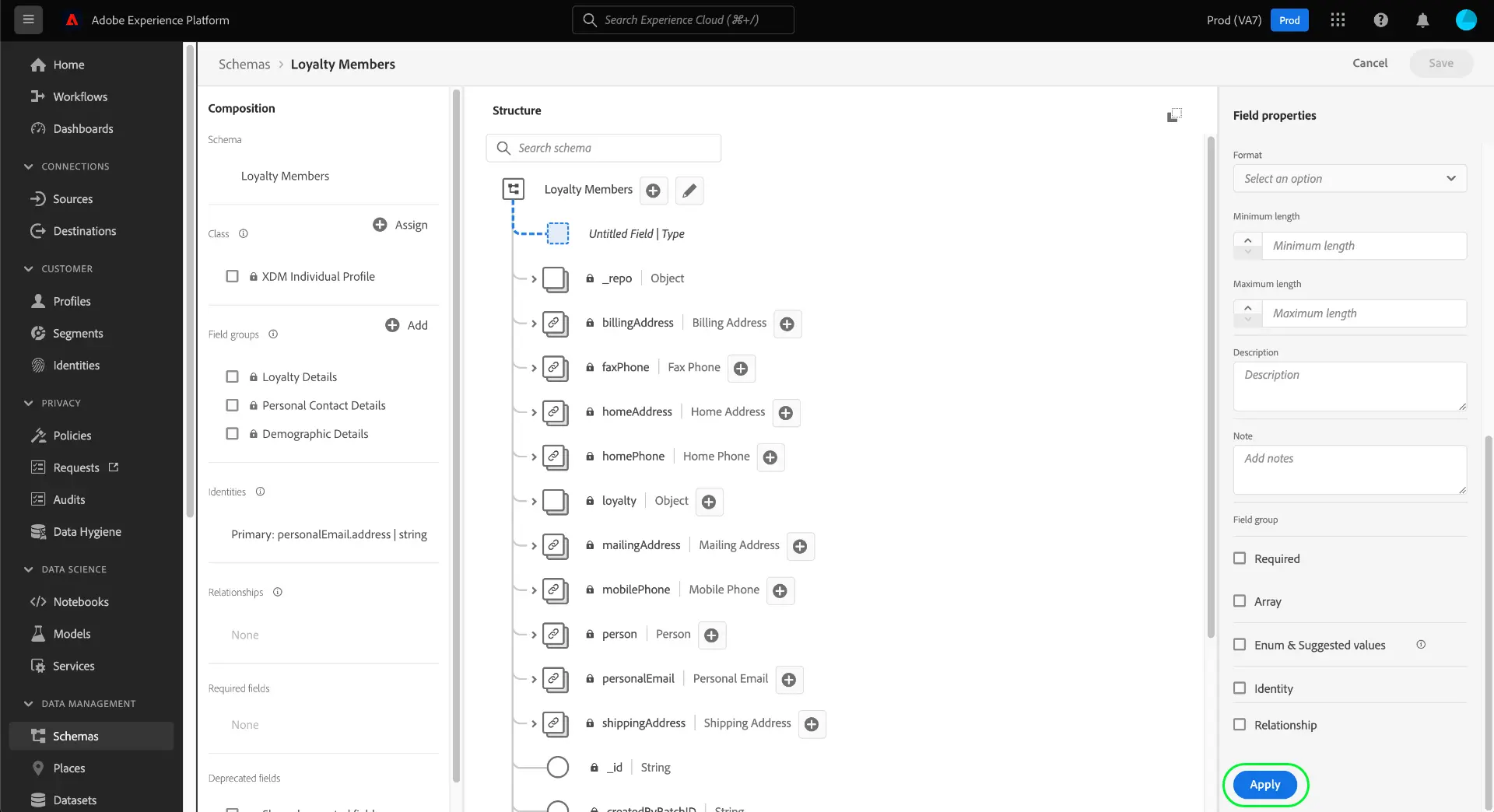
Data management in Adobe Experience Platform
The platform includes extensive activation capabilities through prebuilt B2B and B2C connections, as well as streaming APIs and SDKs for custom integrations. Businesses can respond to customer behaviors quickly, with low-latency collection-to-activation workflows that can run in milliseconds. Adobe supports both B2B and B2C use cases in one system, unlike some CDP platforms that focus primarily on retail.
The system’s AI-driven insights work at the profile level. Companies can improve segmentation, personalization, and opportunity identification through predictive propensity scores and contextual insights.
Adobe Marketing Cloud Support
Adobe users can get help via chat, knowledge base resources, FAQs, and email or help desk services. Global enterprises benefit from Adobe Real-Time CDP’s multilingual support. The platform supports Chinese, English, French, German, Italian, Japanese, Korean, Portuguese, and Spanish. So teams worldwide can implement and adopt the platform more easily.
Adobe support appears to be a mixed experience, skewing negative in many reviews. Many customers praise Adobe’s support, but others cite a lack of readily available training materials and slow ticket resolution via chat support.
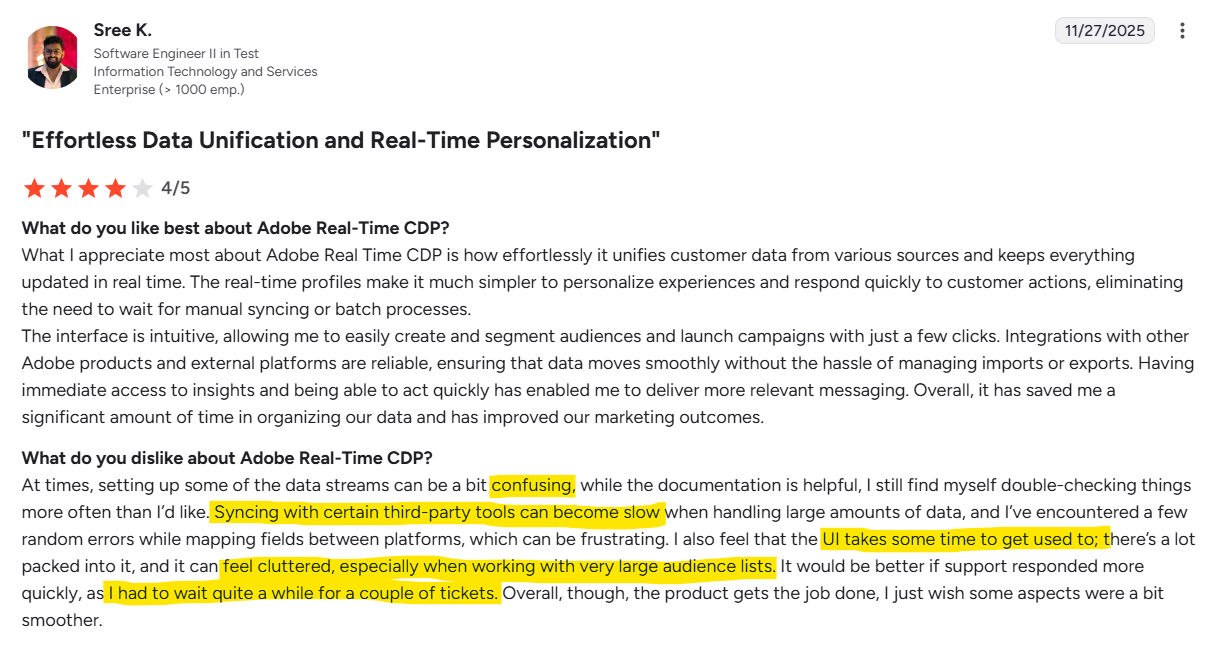
What users are saying about Adobe on G2
New or non-developer users may struggle with the complexity of Adobe’s tools. Initial setup and configuration can require significant time and expertise, and onboarding is difficult without skilled technical resources. Given the steep learning curve, inadequate support and limited training resources have left some customers frustrated.
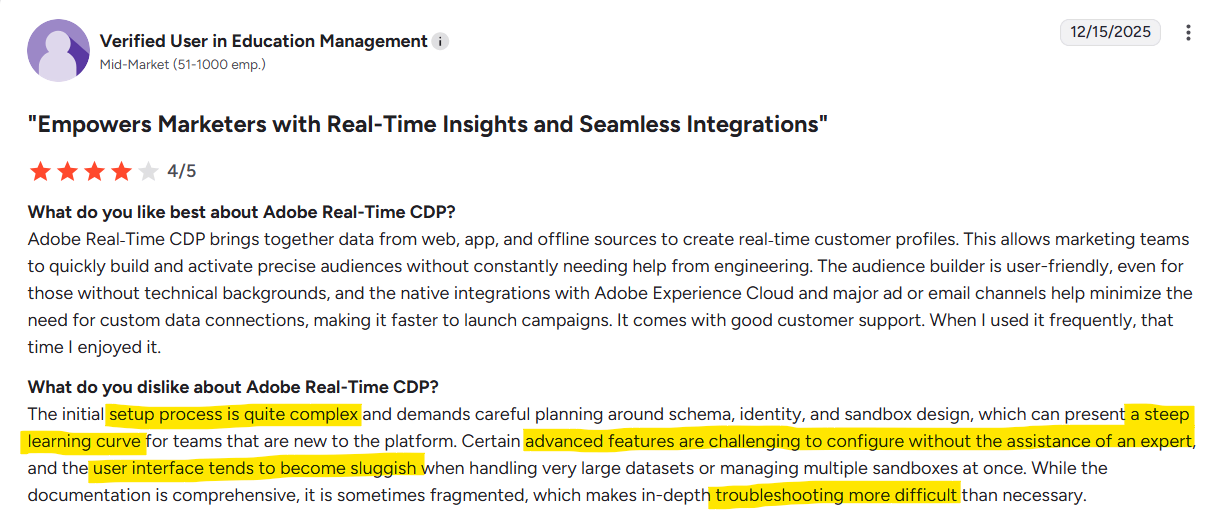
What users are saying about Adobe on G2
Adobe Marketing Cloud Pricing Plans
Adobe Marketing Cloud uses a “request a quote” pricing model. Like other parts of Adobe Experience Cloud, it does not have public, fixed pricing. Adobe pricing is highly customized based on volume, technical requirements, and other business needs.
Sources such as Gartner and TrustRadius suggest pricing starts around $50,000–$100,000 per year. On review sites such as G2 and Capterra, high pricing and licensing costs are repeatedly cited as drawbacks across Adobe’s marketing tools.
Adobe requires a long-term commitment. A few reviewers noted that once invested in Adobe’s ecosystem, switching becomes difficult — largely due to the significant implementation effort already spent.
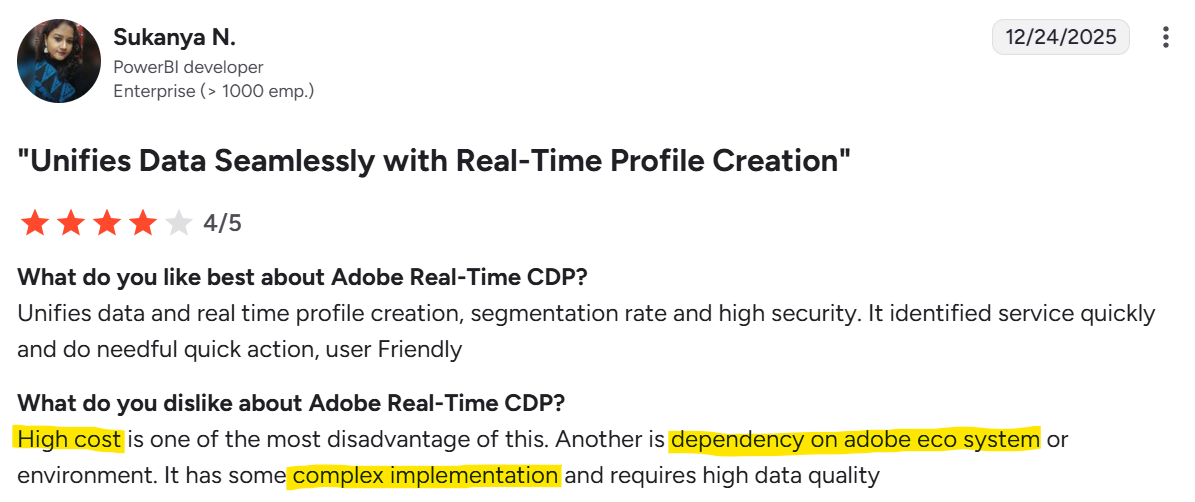
What users are saying about Adobe on G2
Adobe Marketing Cloud Pros and Cons
Pros
Cons
Complete unification of known and pseudonymous customer data from all channels
Complex setup takes longer and needs significant technical resources
Advanced real-time profile management with instant data activation
Expensive, no open pricing
Strong data governance ensures secure, real-time data access and control
Steep learning curve
Reliable partner ecosystem with prebuilt connectors to major third-party platforms
Best value comes when implement other Adobe products
B2C and B2B data models work together without multiple CDP instances
Сluttered interfaces make it hard to find features or troubleshoot issues
AI-powered insights boost segmentation and personalization
Integration with external systems may require significant effort and technical support
Adobe Marketing Cloud Pain Points Check
Pain Point
How Adobe Handles It
Complex Onboarding
Users’ reviews highlight a steep learning curve
High or Rising Cost
Cost is a top complaint — many reviewers describe it as “too expensive”
Poor Support and Setup Hurdles
High ratings indicate strong customer satisfaction with the platform’s services, but some users find Adobe support slow/unhelpful or report integration hurdles
Missing Features
Powerful, but some users say it is not easy to customize and want more adaptability
UI Issues
Reviews describe the UI as not very intuitive and cluttered
Lock-In
Significant switching costs once invested
Data quality
Strong governance tools, but complexity can create implementation challenges
While Klaviyo was once seen primarily as an email tool, it has launched a dedicated data platform that brings customer information together and helps ecommerce brands deliver more personalized marketing across email, SMS, and other channels.
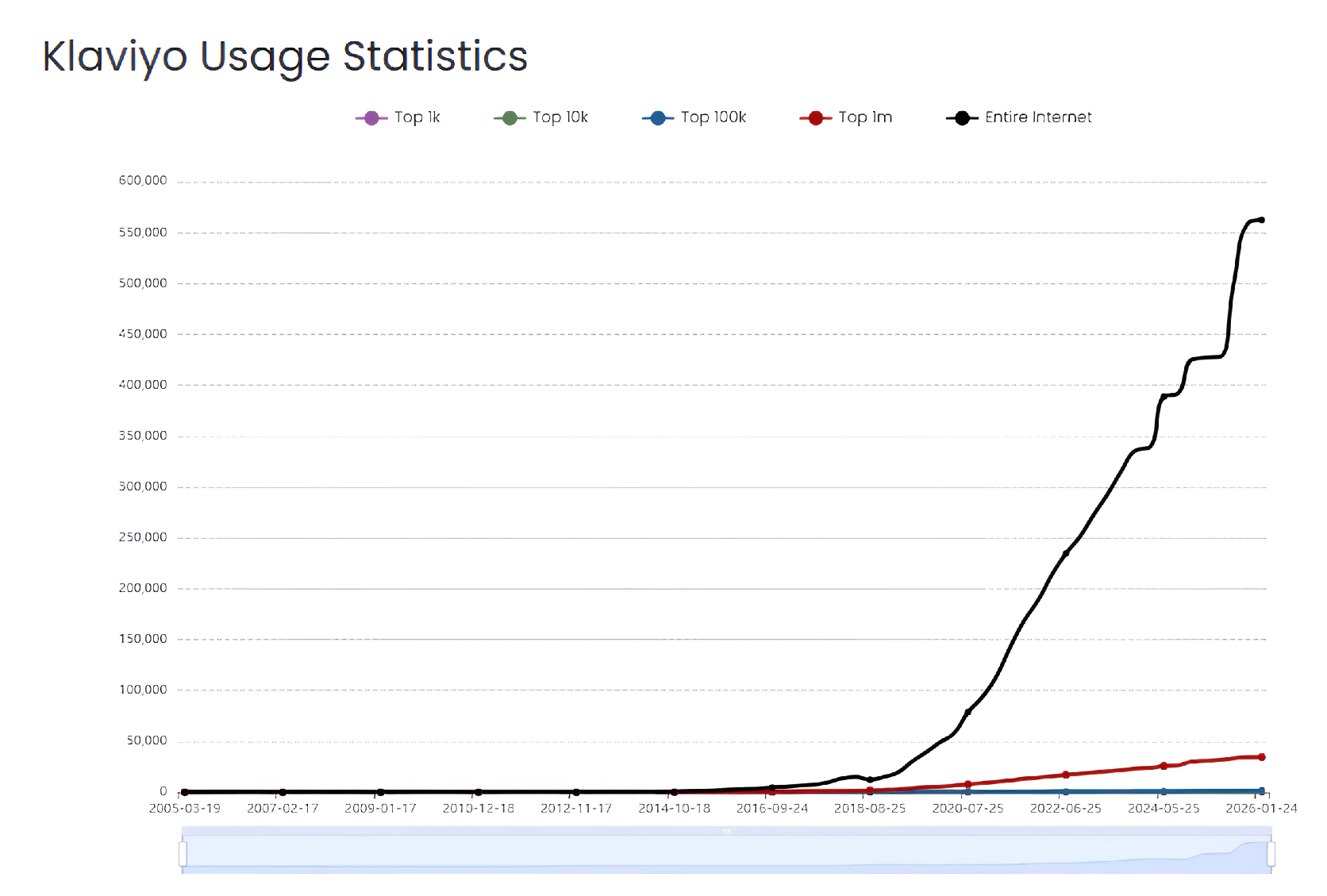
Klaviyo powers over over 562K websites, including approximately 300K in the U.S. Its adoption has trended steadily upward, especially over the past 3–5 years. Klaviyo is now one of the leading marketing automation tools globally. It is most popular among small-to-mid-traffic sites — only about 5% of Klaviyo’s users are in the top 100K.
Klaviyo Features
The Klaviyo Data Platform serves as the system’s foundation, with comprehensive data management tools. Customer profiles are built from millions of data points across marketing channels. These profiles combine three types of data: event data that tracks customer actions, profile data that shows identity attributes, and catalog data that contains product information.
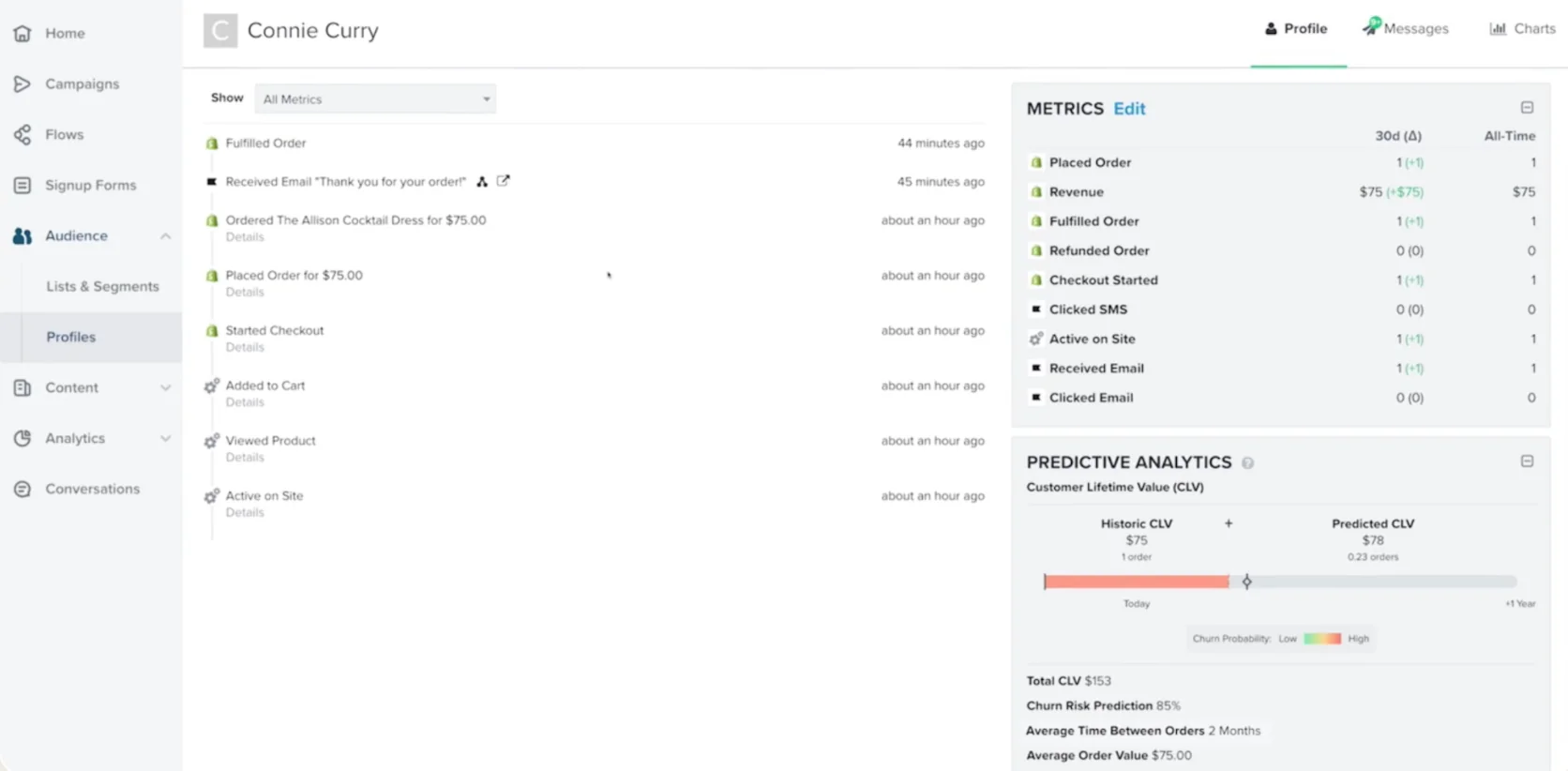
Customer profile in Klaviyo
Data Platform capabilities include:
- Unified, lifetime customer profiles
- Real-time customer segmentation
- Over 350 integrations and APIs
- Predictive analytics powered by AI
- No-code data transformation capabilities
The data management tools let users transform data without coding skills and connect to popular data warehouses such as Amazon Redshift, Google BigQuery, Microsoft Azure, and Snowflake.
However, mid-market and enterprise users need to rely on additional tools alongside Klaviyo for on-site personalization or omnichannel messaging, which they’d prefer to have in a single platform.
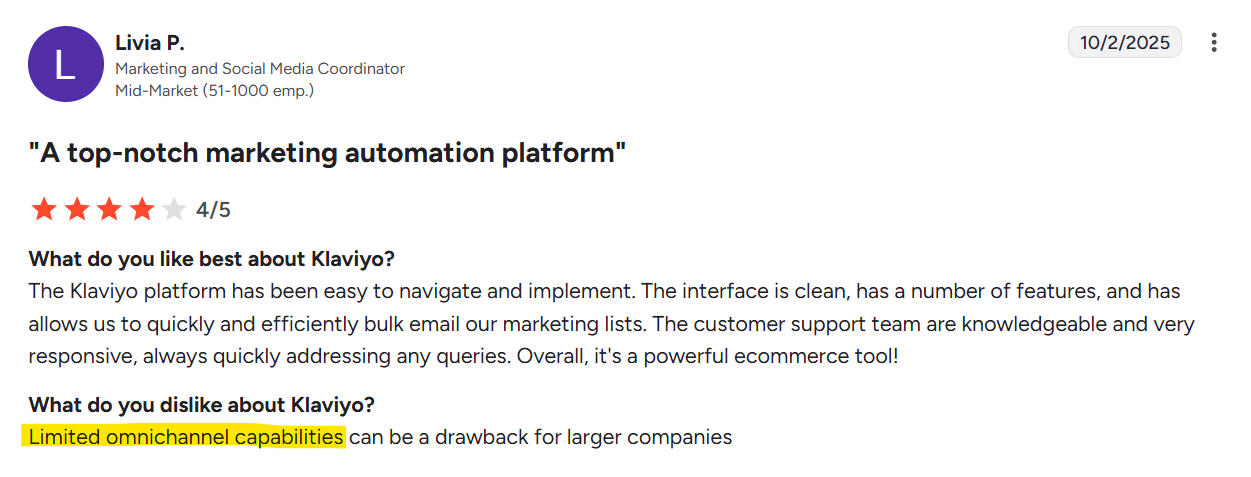
What users are saying about Klaviyo on G2
Klaviyo Support
Support options depend on your plan level. The platform provides a comprehensive help center with articles, tutorials, and a training hub at no cost. Paid plans include live chat support and 24/7 email support.
Klaviyo’s customer support is a commonly mentioned drawback. Users describe support as slow or subpar. Some users report waiting several days for support tickets get a response, which is frustrating when urgent issues like deliverability or account problems arise.
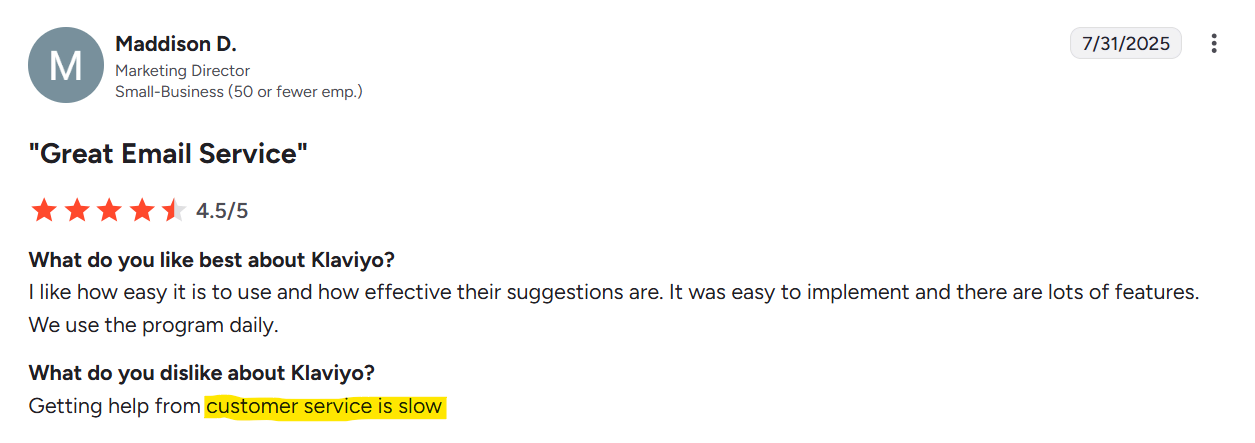
What users are saying about Klaviyo on G2
Klaviyo Pricing Plans
Klaviyo’s pricing structure is tiered and doesn’t include the Klaviyo Data Platform:
- Free plan: 250 contacts and 500 emails per month
- Email plan: Starts at $20 per month for up to 500 contacts and 5,000 emails
- Email + SMS plan: Starts at $35 per month and includes 5,000 emails and 1,250 SMS messages
You can buy Klaviyo Data Platform as an add-on. Its pricing starts at $500 per month for up to 100,000 active profiles.
Extra features:
- Reviews: Starts at $25 per month for up to 250 orders
- Analytics: Starts at $100 per month for up to 13,500 active profiles
Klaviyo’s pricing is a major sticking point. It’s expensive and scales upward as you add more profiles or increase your email and SMS volume. Email Vendor Selection suggests composable alternatives that are more cost-effective. For instance, Maestra holds the second spot on their list of best Klaviyo alternatives. The first one belongs to Omnisend, which is great for teams seeking a simple email tool and don’t need a full CDP.
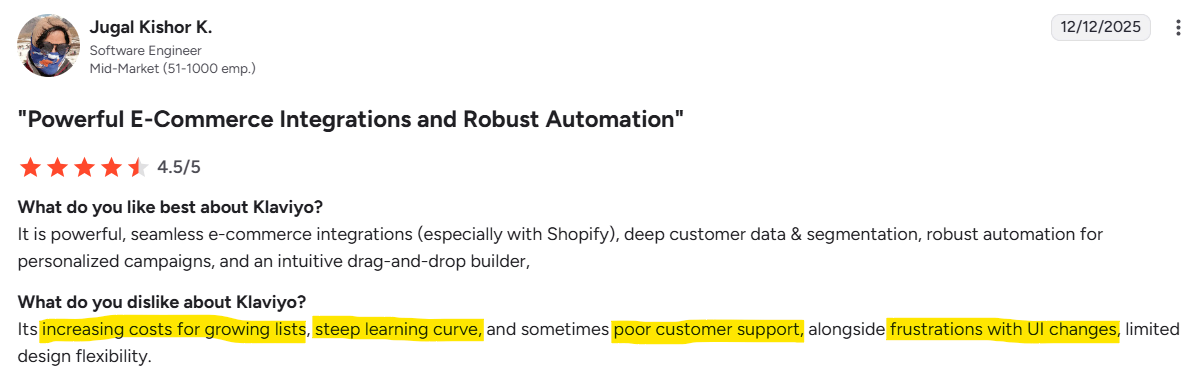
What users are saying about Klaviyo on G2
Klaviyo Pros and Cons
Pros
Cons
Powerful segmentation for targeted email and SMS campaigns
Prices increase significantly as contact lists grow.
User-friendly interface
Data Platform is a pricey add-on, not included in the basic tiers
No-code data transformation
Limited geotargeting
Over 350 integrations
Poor support is the main drawback
Over 60 automations
Detailed documentation + Klaviyo Academy
Klaviyo Pain Points Check
Pain Point
How Klaviyo Handles It
Complex Onboarding
Generally easy to use, but some users report that more advanced flows or segmentation can be complex at first
High or Rising Cost
Prices go up wildly as contact lists grow
Poor Support and Setup Hurdles
Slow response times, subpar support, and limited access for free users (60 days)
Missing Features
Omnichannel messaging, site and app personalization, loyalty and referral systems
UI Issues
Intuitive for basics
Lock-In
Migration is possible
Data quality
Unified profiles work well, though some users report contact overwriting issues
Tealium Customer Data Hub is a data management platform that helps businesses collect, unify, and activate customer data from a wide range of digital sources. It takes a data-first approach, prioritizing data collection, unification, and access through various tools.
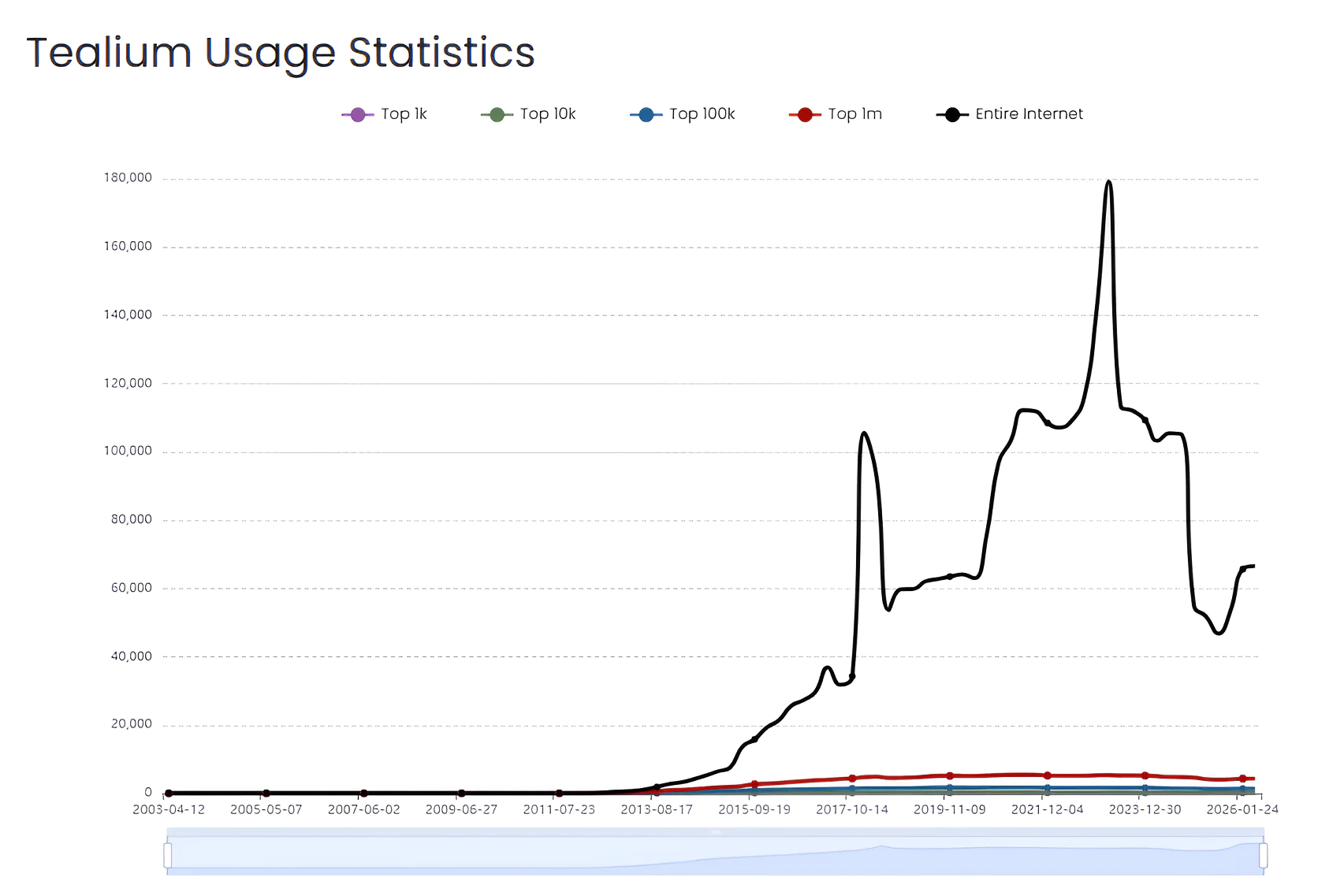
Tealium is used by over 66K, including approximately 48K in the U.S. Its footprint is now significantly smaller than that of some competitors. Tealium was once widely used, but much of its historical install base has since declined. Data shows that approximately 593K sites used Tealium historically, but only about 66K remain active today. Most current Tealium users are either enterprise sites or smaller sites still using legacy installations. Overall, the trend is complex — long-term adoption is downward, though there have been recent signs of a modest uptick in new adoption.
Tealium Features
Tealium CDP is the life-blood of the Customer Data Hub. It functions as a flexible, real-time data management solution. The platform makes customer data more accessible, improves data quality, and drives action across departments and technology stacks.
Tealium helps collect data from multiple sources. Universal data collection supports identity resolution across channels. The platform tracks users from their first interaction onward and builds profiles that connect behavior across devices and sessions into a unified view.
The system processes data in real-time and lets businesses trigger campaign changes automatically and respond right away to behavior changes.
Tealium’s features and interface generally get positive feedback for flexibility, but a few minor drawbacks appear in reviews. For example, some users wish for a more modern UI and more out-of-the-box components to reduce custom coding.
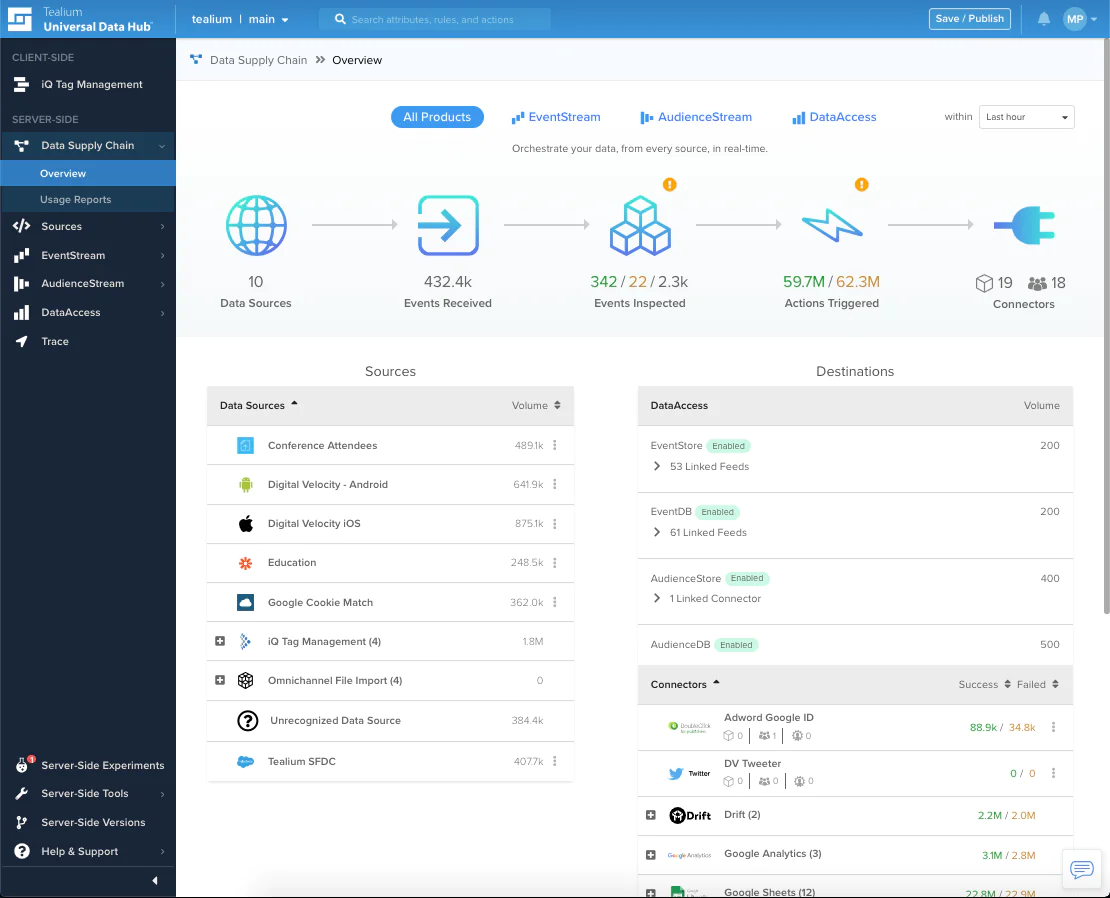
Data sources overview in Tealium
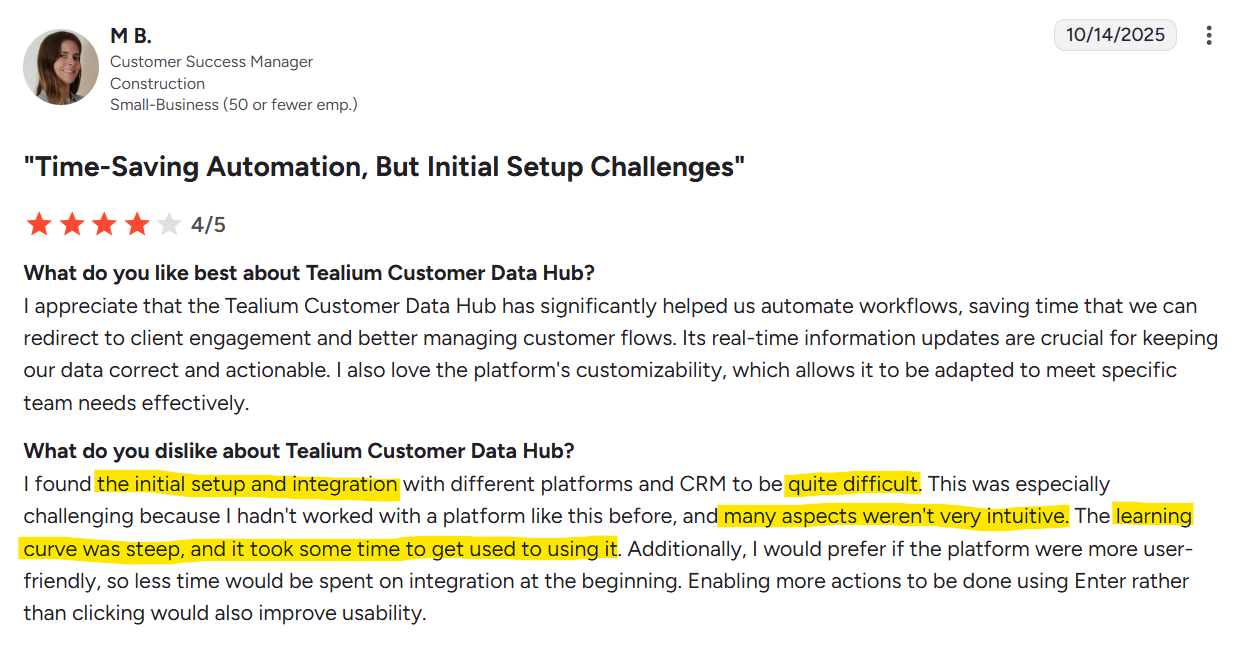
The most frequently cited issue with Tealium is its complexity for new users. Implementing Tealium and learning its many features often demands technical expertise. Beyond the initial setup, day-to-day usage can remain complex. Users report that Tealium requires ongoing learning to use advanced features such as audience segmentation, real-time triggers, and data layer enrichment. Companiesmay need to invest significant time in training or hire specialists to fully leverage the platform
Integrating Tealium with various data sources and destinations can be complex. Several users note that they needed significant technical support or developer assistance to get Tealium up and running and properly integrated into their stack. This suggests that while Tealium is powerful, the setup phase has a high barrier — especially for companies without prior CDP experience or a dedicated implementation team.
What users are saying about Tealium on G2
Tealium Support
Tealium provides three support tiers that meet different business needs:
The Basic support package is included for all customers. Users get access to the knowledge base, community forums, and an online ticketing system.
The Enhanced support package provides more comprehensive assistance. It adds scheduled Zoom meetings and additional ticket submission options for configuration troubleshooting and how-to guidance.
The Premium support package provides enterprises with a dedicated Technical Account Manager who understands their specific implementation details and business goals.
While some users found Tealium’s support excellent, others reported negative experiences. A few reviews mention poor support, particularly during integrations.
Tealium Pricing Plans
The platform offers custom pricing based on usage patterns, with annual or multi-year contract options. Premium features or extended support services may cost extra beyond standard packages.
You have to contact Tealium directly to obtain a custom pricing quote based on their needs and projected data volume.
Cost is a commonly noted drawback, particularly for small-to-midsize businesses.
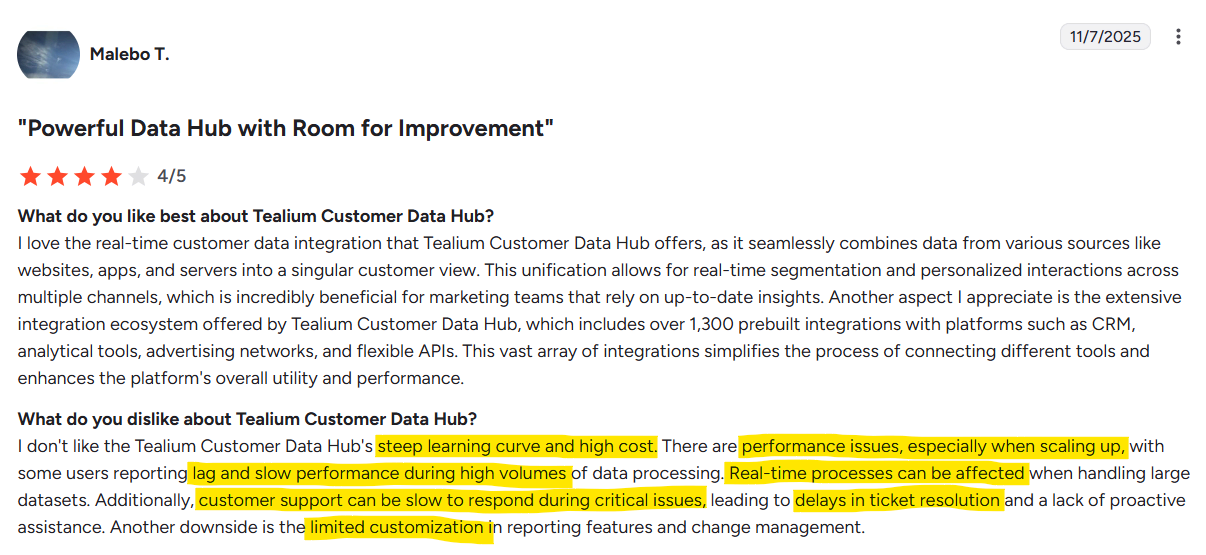
What users are saying about Tealium on G2
Tealium Pros and Cons
Pros
Cons
Real-time data processing enables immediate action on customer behavior
Challenging implementation process requires technical expertise
Configurable identity resolution adapts to each business’s unique needs
Higher cost structure, no open pricing
Patented visitor stitching technology creates complete customer profiles across devices and touchpoints
Occasional data flow delays during high-traffic periods, despite the real-time architecture
Robust privacy and consent management tools maintain regulatory compliance
Over 1,300 integrations
Tealium Pain Points Check
Pain Point
How Tealium Handles It
Complex Onboarding
A significant number of reviews emphasize a steep learning curve: less-experienced teams migh struggle without a dedicated developer
High or Rising Cost
No public pricing, described as expensive and a barrier for smaller businesses
Poor Support and Setup Hurdles
Some report slow/mediocre responses
Missing Features
Powerful but hard for non-technical users; limited built-in reporting
UI Issues
Occasional glitches, slow processing, workflows might feel burdensome
Lock-In
Complex implementation creates significant switching costs
Data quality
Real-time identity stitching helps unify data and reduce silos
Maestra
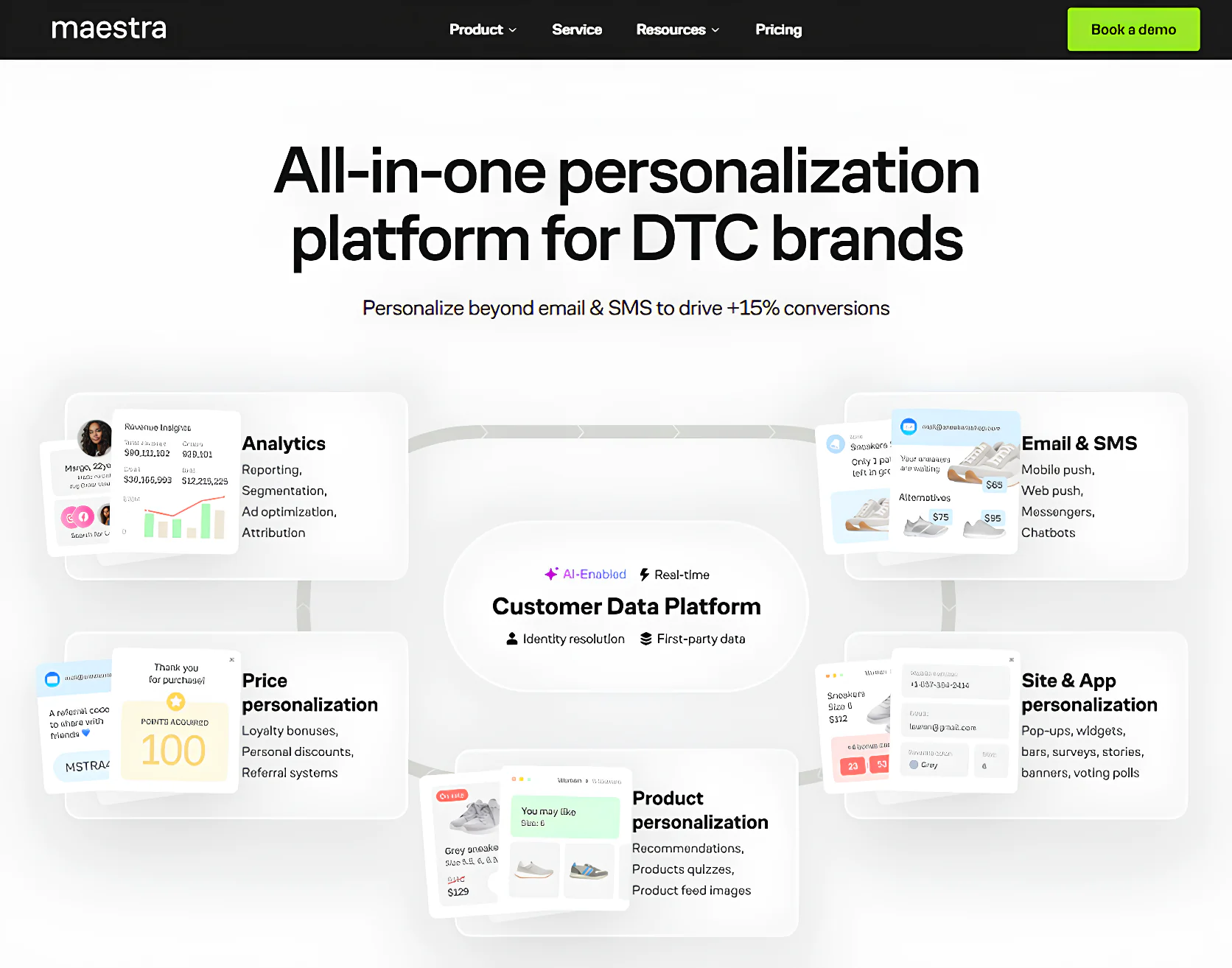
Maestra is a next-level marketing personalization platform powered by a real-time CDP. It helps e-commerce brands scale faster by unifying customer data across multiple channels to create detailed customer profiles and segments.
Maestra Features
Maestra is an all-in-one platform designed to deliver journey-wide personalization.
Real-time CDP: All customer data is unified in real time from online and offline sources into adaptive customer profiles.Maestra cleans and deduplicates data and provides identity resolution. These unified, data-rich customer profiles power AI and enable hyper-personalized experiences even across complex multi-brand setups. The platform supports all marketing channels and smoothly personalizes the full journey. It also tracks performance and sends error alerts when needed.
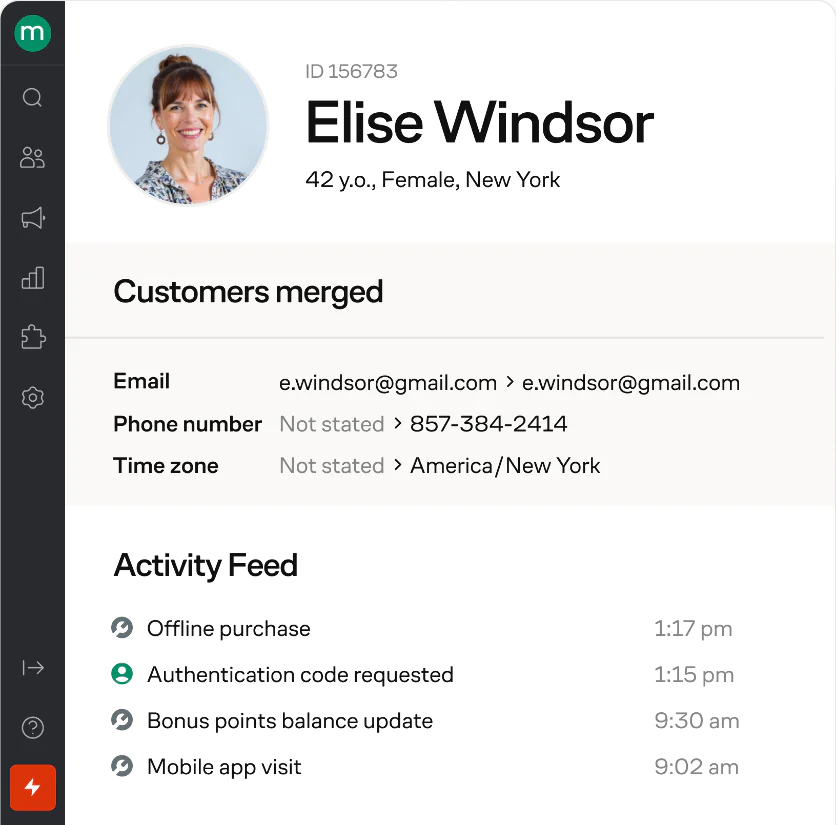
A unified customer profile in Maestra
Advanced segmentation: Brands can target customers based on browsing history, purchases, location, engagement, loyalty status, and behavior. Maestra supports nested logic, scheduled batch segments, RFM (Recency, Frequency, Monetary) scoring, computed and custom fields, static lists, and immediate segments. Marketers can segment by customer, product, brand, order status, or RFM categories like "Champions", “Hibernating”, and "Loyal". Marketers can also optimize ad performance levereging real-time, CDP-backed segmentation by activating behavior-driven segments for paid media targeting.
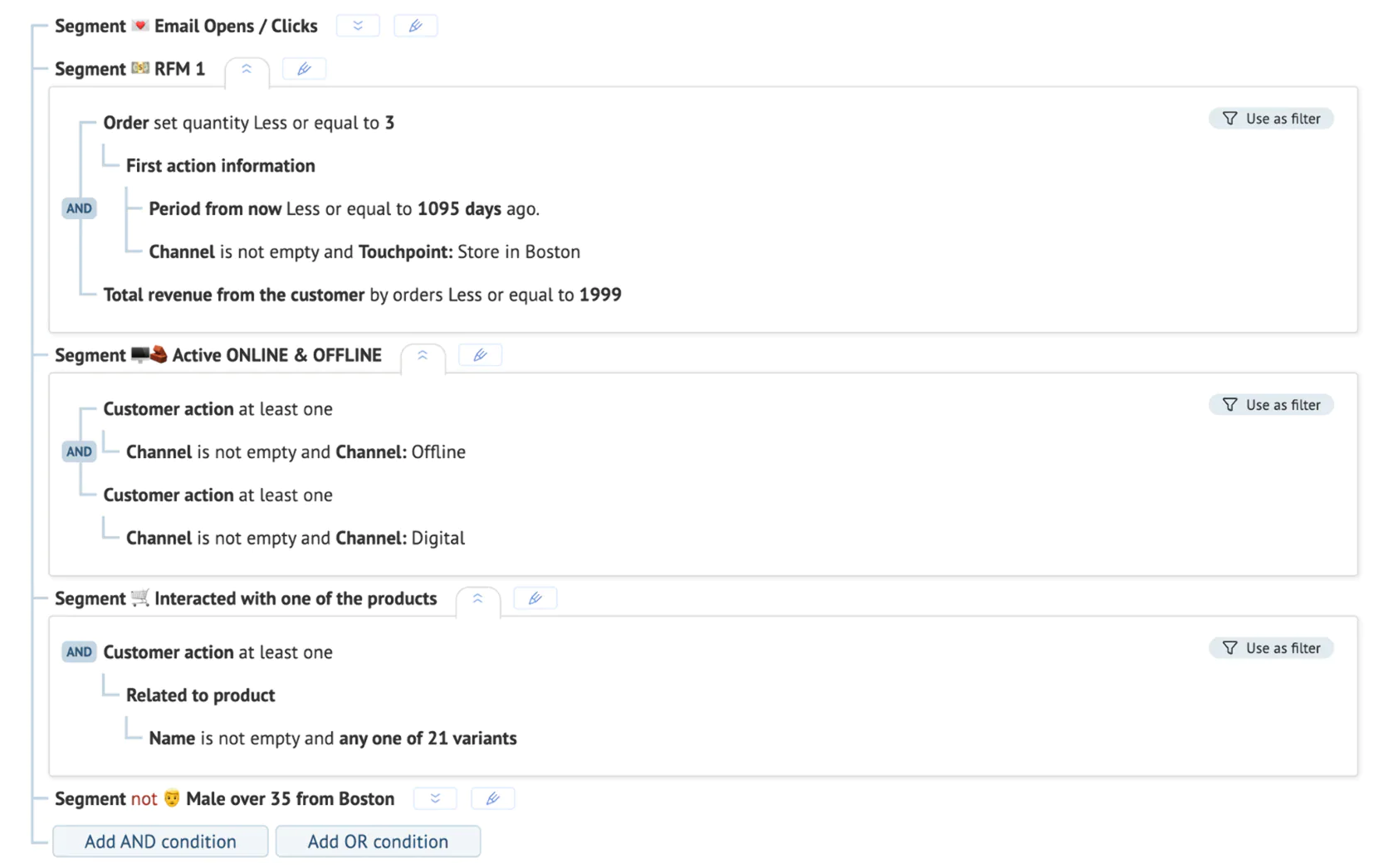
Building a segment in Maestra
Omnichannel journey builder: Maestra’s flexible composer allows marketers to configure and orchestrate seamless personalized journeys across your site, app, email, SMS, MMS, RCS, messaging apps (WhatsApp, Telegram), push notifications, chatbots, paid media, and offline stores. Flows instantly branch based on real-time customer activity.
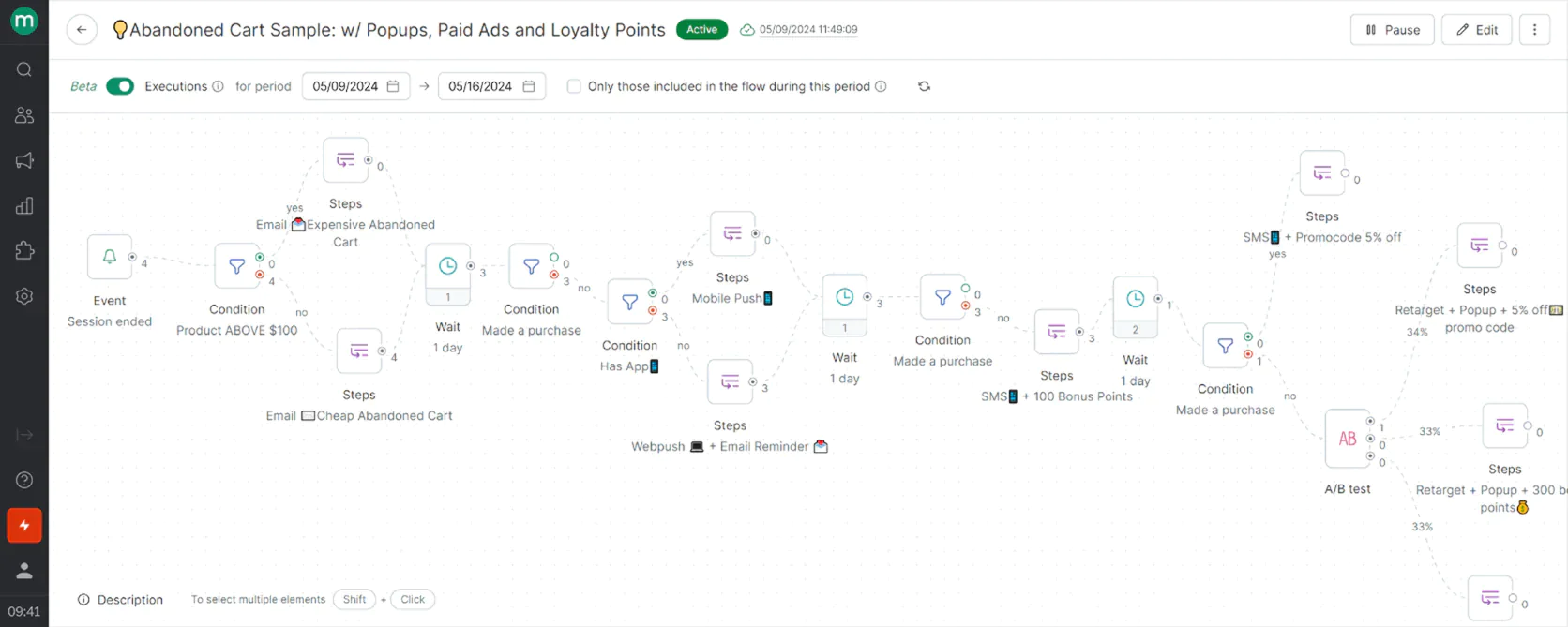
Maestra’s flow example: abandoned card flow with emails, mobile and web pushes, pop-ups, paid ads and loyalty points
Real-time site and app personalization: Maestra’s CDP powers in-session segmentation. In-page content adapts in real time based on customer behavior, including clicks, purchase history, geolocation, and personalized promotions, etc. Marketers can use pre-made templates or customize on-site elements: pop-ups, product-picking quizzes, surveys and polls, games, widgets, banners and bars, embedded blocks, stories, and more. AI-driven frequency and priority controls help keep on-site elements relevant and non-intrusive.
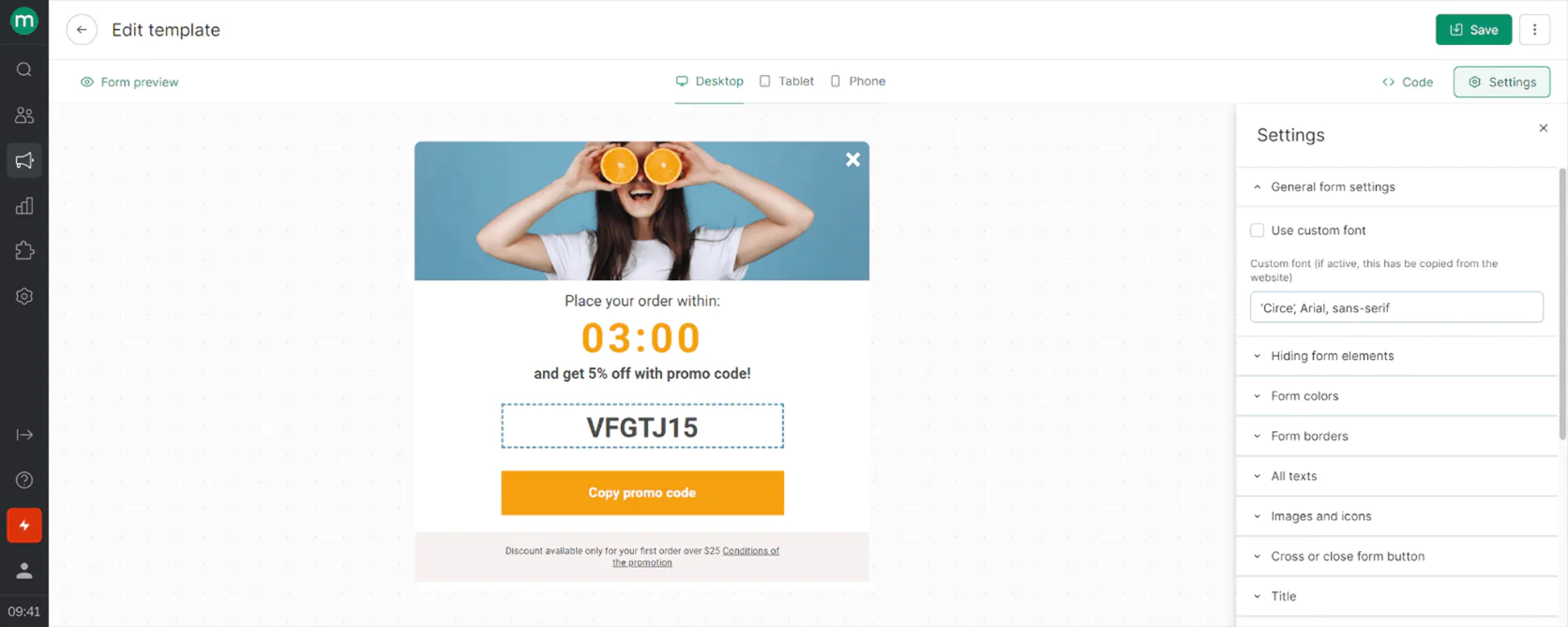
Maestra’s pop-up template editing
Product recommendations: Maestra’s recommendation engine embeds AI-powered product offers across all channels to increase conversion rates and average order value (AOV). AI algorithms drive upsells, cross-sells, and downsells across messaging, apps, and websites — the homepage, categories, and listing pages, product pages, the shopping cart, 404 pages, and empty search results. Product suggestions update in real time based on every visitor action, even for anonymous shoppers.
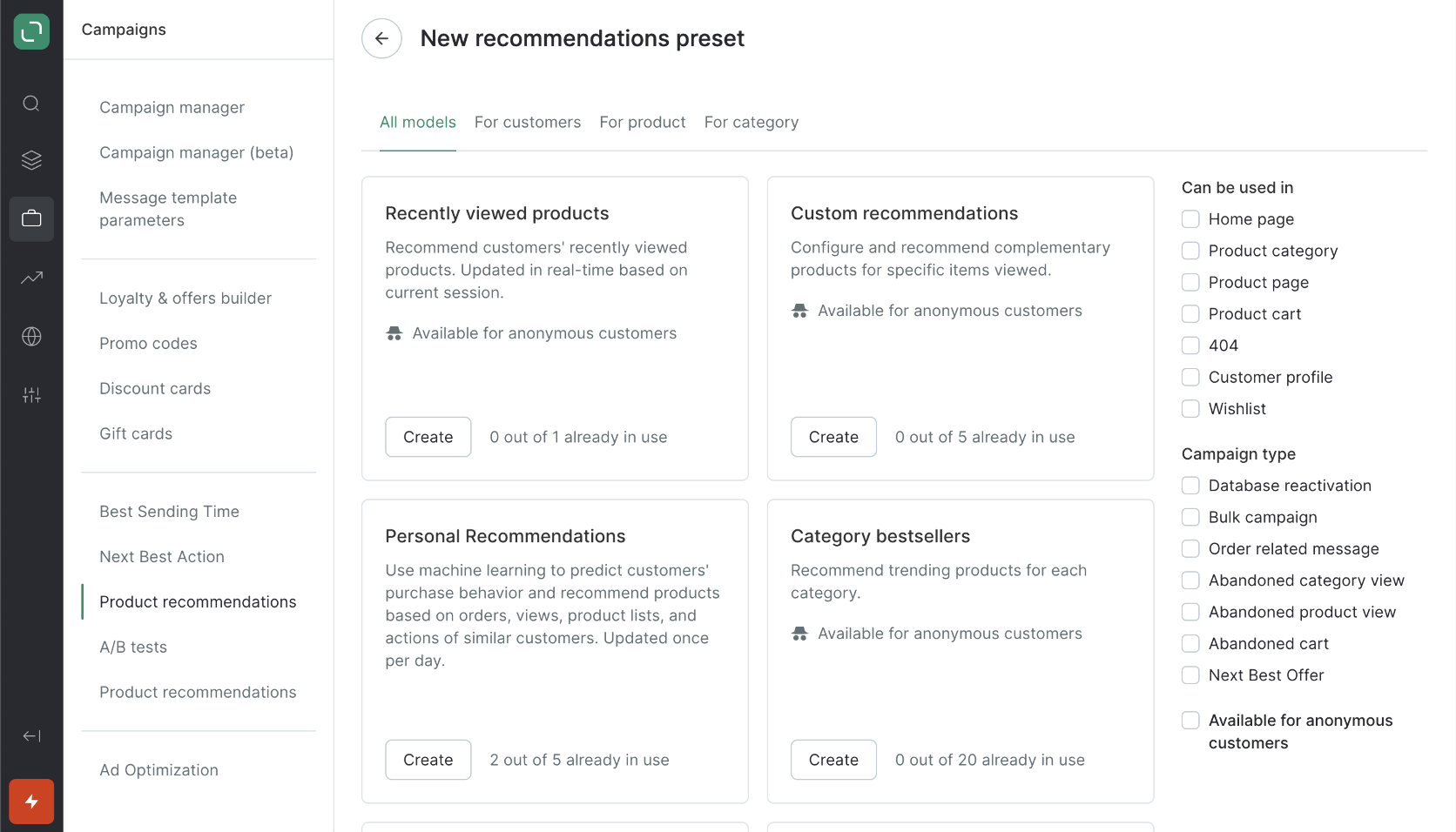
Maestra’s product recommendation presets
Email Vendor Selection tested Maestra’s personalization engine and unified CDP. Check out their review to see why they recommend Maestra as a well-rounded ecommerce marketing tool:

The million-dollar question from my Maestra review is this. Is it good value-for-money? For me, it’s a resounding yes. Maestra is a marketing platform powerhouse for DTC ecommerce brands. Above all else, with its own CDP baked in, it makes customer data talk.
Loyalty programs, referrals, and promotions: Built-in modules are ready to use in every channel to improve customer lifetime value (LTV). Maestra supports points, VIP tiers, referral programs, individual promotions, and other rewards. Discounts and incentives can increase gradually in real time to engage hesitant customers. The platform also offers gift card management and point-of-sale (POS) processing.
Comprehensive analytics: Performance tracking in Maestra uses configurable attribution and detailed full-funnel reporting to understand what drives results and unlock actionable insights. Maestra also supports loyalty and campaign dashboards, list growth reporting, business goal tracking, and A/B testing with incremental revenue impact.
White-glove service: Maestra goes beyond basic support. Each client has a dedicated Customer Success Manager (CSM) who migrates all data, sets up integrations with existing tools, builds flows and segments, and helps streamline marketing strategy. Maestra offers hands-on support through a shared Slack or Teams channel and weekly Zoom calls.
Maestra Support
Maestra’s support stands out because the team actively monitors your performance and proactively suggests optimization improvements. This strategic partnership comes standard with every account, regardless of size, unlike other CDPs that typically limit this level of support to enterprise clients.
What’s included out of the box:
- Dedicated CSM guiding everything from the start
- Shared Slack/Teams channel
- Strategy sessions every week
- Live chat support responds within 5 minutes
- Full data and flow transfer
- Tech stack integrations (including custom ones via API and SDK)
- Flow and segment setup
- A/B testing execution
- Performance tracking and reporting
Users cite Maestra’s support as a major differentiator. They praise its exceptional service, where dedicated CSMs take the lead on the heavy lifting — from data migration to campaign optimization — ensuring white-glove onboarding, setup, and maintenance.
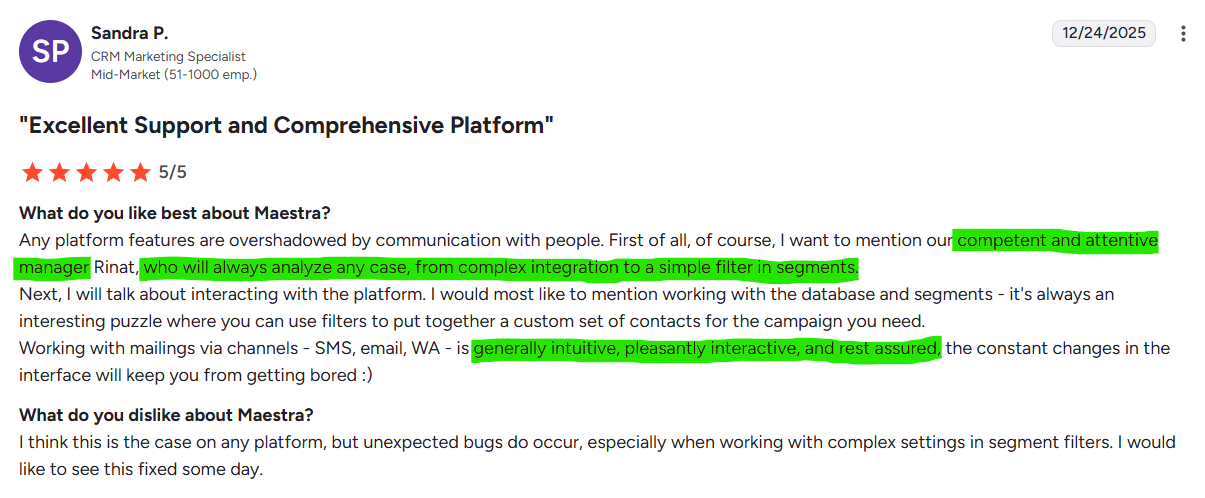
What users are saying about Maestra on G2
Maestra Pricing Plans
Maestra offers a monthly subscription model with all-in pricing. There are no onboarding fees, add-ons, extra costs, or lock-in contracts.
Pricing starts at $2,990 per month for up to 150,000 active customer profiles, with unlimited emails and messages, plus dedicated CSM support.
Billing begins only after the entire migration is complete. Standard migrations take 2–4 weeks, while more complex migrations typically take 4–6 weeks. A full implementation, including IP warming, may take 6–8 weeks.
Maestra Pros and Cons
Pros
Cons
Real-time CDP unifies customer data across all touchpoints and delivers identity resolution
No free trial or plan
All-in-one platform combines email, SMS, push notifications, loyalty programs, referrals, and site personalization in a single tool
Overkill for simple needs
Dedicated CSM does all the heavy lifting for you
Advanced personalization with AI-driven product recommendations and dynamic content
Seamless flows across all channels
Native loyalty and referral programs
Maestra Pain Points Check
Pain Point
How Maestra Handles It
Complex Onboarding
CSM handles the entire migration and onboarding at no extra cost; billing starts only after your migration is complete; users report "smoothest migration ever"
High or Rising Cost
Transparent open pricing, no hidden fees, all features included
Poor Support and Setup Hurdles
Exceptional support (26 positive G2 mentions), shared Slack channel, live chat (5–10 min response), weekly strategy calls
Missing Features
Some users want more email templates and landing page builder; actively updated based on feedback
UI Issues
User-friendly interface
Lock-In
No long-term commitment and cancellation penalties
Data quality
Real-time CDP auto-cleans/deduplicates data, resolves identities
Key Takeaways
- The CDP market is booming — and e-commerce is leading the charge. The global CDP market reached $4.58 billion in 2026, with retail and e-commerce holding the largest share at 35.67%. Mordor Intelligence projects a 23.5% CAGR through 2031, signaling that CDP adoption is accelerating, not plateauing.
- With third-party cookies phasing out, CDPs like Maestra are the essential heartbeat for first-party data strategy as they excel at identity resolution and unified customer profiles
- Three forces are reshaping what marketers should demand from a CDP. First, real-time personalization — 71% of consumers expect it, and batch-updated profiles can’t deliver. Second, stack centralization — 65.7% of marketers say data integration is a top challenge, and managing 5 or more disconnected tools is unsustainable. Third, AI-readiness — 31% of leaders cite data quality as the top barrier to AI adoption, making clean, unified data non-negotiable. If a business wants to stay at the forefront, it needs a centralized platform like Maestra, which is powered by a real-time CDP and transforms fragmented customer data into cohesive profiles ready for AI-driven use.
- Every major CDP is racing toward real-time and unification, but approaches differ. Klaviyo added automated SMS conversations, Twilio Segment launched event-triggered journeys, Tealium introduced AIStream, and Adobe’s Journey Optimizer now fires individual real-time triggers. Maestra syncs all data in real time natively and connects it to promotions, loyalty, site personalization, and messaging from a single platform — no assembly required.
- AI features are everywhere, but not all deliver actionable value. All five platforms reviewed now offer AI capabilities — from Segment’s Predictions and Generative Audiences to Klaviyo’s AI Agents to Adobe’s AI Assistant. The differentiator is whether AI helps you understand why revenue shifted and what to do next, not just surface dashboards.
- The biggest user frustrations aren’t about features — they’re about experience. Our analysis of G2, Capterra, and Trustpilot reviews found the top three pain points are complex onboarding (222 mentions), high or rising costs (217 mentions), and poor support (192 mentions). These operational issues outweigh complaints about missing functionality.
- Legacy CDPs demand significant technical resources and budget. Adobe’s estimated minimum entry point of $50,000–$100,000/year entry point and has a steep learning curve. Tealium’s 1,300 integrations are powerful but require technical expertise to implement. Segment is developer-friendly but MTU-based pricing escalates quickly at scale.
- All-in-one platforms eliminate coordination overhead and hidden costs. Brands like Urban Armor Gear cut martech costs by 64% by consolidating three tools into Maestra. Furniture Fair replaced five isolated tools and saves 27% on stack costs. Centralization isn’t just more efficient — it removes the data silos that break personalization and starve AI models.
- Support quality varies dramatically and can make or break your CDP investment. Some platforms limit human support to enterprise tiers or paid add-ons, while others offer only documentation and chatbots at lower levels. Maestra includes a dedicated CSM, shared Slack channel, weekly strategy calls, and sub-10-minute live chat response for every client — earning 26 positive G2 mentions for support alone.
- When evaluating CDPs, match the platform to your team’s reality. If you have a large engineering team and need maximum flexibility, Segment or Tealium may fit. If you’re already deep in the Adobe ecosystem, their CDP integrates natively. If you need a full marketing stack with hands-on support and predictable pricing — and you’d rather your CSM build flows for you than hire a developer — Maestra is purpose-built for that.
FAQs
Q1. What is a customer data platform (CDP) and why is it important?
A customer data platform is software that collects and unifies customer data from multiple sources to create a comprehensive view of each customer. It’s important because it enables businesses to deliver personalized experiences, improve customer engagement, and make data-driven decisions. As AI adoption accelerates and marketing touchpoints multiply, CDPs have become even more critical. Poor data quality is a significant barrier to AI adoption — and a CDP solves this by cleaning, unifying, and deduplicating data from all channels. Maestra goes further by combining its real-time CDP with built-in execution tools: omnichannel messaging, site personalization, AI-driven recommendations, loyalty and referral engine, and analytics — all within one platform. This means you don’t just collect data, you can act on it instantly across every touchpoint.
Q2. How does a CDP differ from a CRM system?
While both handle customer data, a CRM primarily manages direct customer interactions and sales processes. A CDP focuses on collecting and unifying data from multiple sources in real-time, creating a single customer view. For instance, Maestra’s CDP powers AI-driven decisions and personalizes customer experiences even across complex multi-feed setups. CDPs are designed for broader data integration and activation across various channels, while CRMs are more focused on sales and service management.
Q3. What features should I look for in a CDP?
Key features to consider include data collection and unification capabilities, real-time processing, advanced segmentation, identity resolution, integration options with your existing tech stack, privacy and consent management, GDPR and CCPA compliance, and activation capabilities across multiple channels. Maestra delivers on all these fronts. Its real-time CDP unifies customer data into a single source of truth and provides instant profile updates with every customer action, enabling in-session segmentation and up-to-the-minute personalization. Identity resolution is a core strength. The platform auto-cleans and deduplicates data to keep profiles accurate and scale effortlessly. Maestra offers more than 150 native integrations and supports regulatory compliance.
Q4. Can a CDP help with privacy compliance and data governance?
Yes, many CDPs offer built-in features for data governance, consent management, and privacy compliance. Maestra supports them as well. It can automate consent and data-subject rights for your business. Maestra helps manage customer data in accordance with regulations and standards such as GDPR, CCPA, HIPAA, and ISO 27001 by controlling data collection, storage, and usage.
Q5. How does pricing typically work for CDP software?
CDP pricing models vary, but often include factors like the number of customer profiles or events processed, data volume, and features used. Some platforms offer tiered pricing based on contact limits, while others use custom pricing for enterprise-level solutions. It’s important to consider both upfront costs and potential scaling expenses. However, Maestra takes a different approach with transparent, all-inclusive pricing which is absolutely predictable as you scale. Every subscription includes the full feature set and white-glove support.
Q6. How to choose the right CDP for my business?
Three trends should guide your platform evaluation: real-time personalization for tailored coherent experiences, stack centralization to remove coordination overhead and data silos, and quality data as a fuel for AI and ML.
If your platform can’t process data instantly or activate segments in real time, you’re already behind. Actions must happen immediately after a customer event. Managing five or more disconnected tools prevents your teams from doing big things. If you’re juggling separate tools for CDP, email, SMS, loyalty, and personalization, consolidation in a unified platforms will unlock better execution. Your CDP must clean, deduplicate, and unify signals — not just store them.
Consider the total cost of ownership, not just software license costs. While tools like Klaviyo start at $20/month for emails + $500/month for CDP, costs escalate rapidly as you grow. Maestra offers better long-term value for an all-inclusive price that is still affordable.
When evaluating platforms, also look beyond feature lists and ask: “How does onboarding work?” and “Do I need a developer to use the platform?” or “Will I get real human support, or just a chatbot and documentation?”
Maestra stands out for ecommerce brands seeking a unified marketing solution with hands-on support. Unlike legacy CDPs requiring technical teams and expensive add-ons, Maestra combines real-time CDP, omnichannel messaging, site personalization, loyalty, and analytics in one platform with white-glove CSM service included.