
Best Iterable Alternatives for 2026

If you’re reading this, Iterable probably isn’t cutting it anymore. Maybe every segmentation task needs an engineer, the invoices keep growing with fees you didn’t expect, or your team exports everything to a spreadsheet just to get a straight answer.
You’re not alone. Iterable is a flexible, API-first platform – but for mid-market e-commerce brands, it often means paying enterprise prices and needing enterprise engineering to match.
There are platforms built for exactly this: transparent pricing, native e-commerce features, and a marketing team that can move without filing a Jira ticket.
Below, we break down the 10 best Iterable alternatives for 2026, ranked by where each one wins. Let’s dive in:
Quick Verdict: Best Iterable Alternatives by Category
The strongest Iterable alternatives are Maestra for all-in-one omnichannel e-commerce, Braze for mobile-first engagement, Klaviyo for Shopify email and SMS, Bloomreach for commerce experience, and Customer.io for developer-friendly messaging. Each one closes a specific Iterable gap – opaque pricing, weak reporting, or workflows that need an engineer.
Best for omnichannel e-commerce: Maestra – goes beyond messaging with CDP, loyalty, and on-site personalization
Best for mobile-first engagement: Braze – real-time push, in-app, and messaging with advanced personalization
Best for e-commerce email & SMS: Klaviyo – pre-built Shopify flows without Iterable’s engineering requirements
Best for e-commerce search + engagement: Bloomreach – product discovery and marketing in one platform
Best for developer-friendly event-driven messaging: Customer.io – lightweight workflows with flexible API and webhooks
Best for SAP ecosystem retailers: SAP Emarsys – pre-built retail playbooks with native SAP integration
Best for Salesforce-native teams: Salesforce Marketing Cloud – journey orchestration integrated with Salesforce CRM
Best for insights-led mobile campaigns: MoEngage – AI analytics and engagement for app-first brands
Best for developer-friendly push: OneSignal – lightweight push notifications with a generous free tier
Best for budget-friendly Shopify marketing: Omnisend – email, SMS, and push at accessible pricing
Common Iterable Pain Points (and Quick Fixes)
We analyzed reviews across G2, Capterra, TrustRadius, Gartner Peer Insights, and Software Advice to surface the most common frustrations with Iterable:
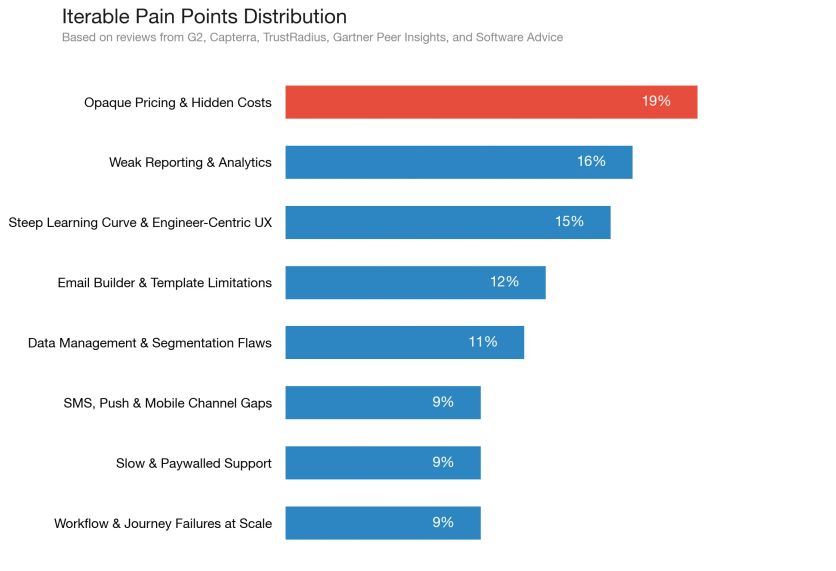
Switching platforms is a big move. Here’s what you can do right now to ease the biggest pain points.
| Pain Point | Description | Possible Solutions |
|---|---|---|
| Opaque Pricing & Hidden Costs | Non-transparent pricing forces custom quotes; hidden fees for sender addresses, SMS minimums, and billing for undeliverable contacts erode trust | • Audit your contract for add-on clauses before renewal
• Scrub undeliverable contacts monthly to reduce profile count • Negotiate SMS minimums down or bundle with email tier |
| Weak Reporting & Analytics | Built-in reporting is the weakest area; inconsistent numbers, and forced Excel exports frustrate data-driven teams | • Connect a BI tool (Looker, Tableau) via data warehouse export
• Use Iterable’s Insights beta for improved dashboards • Build custom UTM frameworks for cross-campaign attribution |
| Steep Learning Curve & Engineer-Centric UX | Interface designed for engineers alienates marketers; excessive clicks for basic tasks, overwhelming navigation, and month-long onboarding minimum | • Invest in Iterable Academy certifications for your team
• Create internal playbooks for common workflows • Request a dedicated onboarding specialist during implementation |
| Email Builder & Template Limitations | Limited custom layouts; template updates don’t propagate to campaigns; no native landing page builder; fragile Handlebars personalization | • Use MJML or custom-coded templates uploaded via API
• Establish a template governance process to track copies • Integrate Unbounce or Instapage for landing pages |
| Data Management & Segmentation Flaws | Email-centric user model creates data issues; batch processing delays, and unresolved segmentation flaws limit real-time activation | • Implement a middleware layer (Segment, mParticle) to normalize data
• Use Iterable’s catalog feature for product data management • Build custom event pipelines to supplement batch processing |
| SMS, Push & Mobile Channel Gaps | Weaker mobile messaging than competitors; basic in-app messaging, push notification SDK bugs, and SMS blocking incidents | • Pin SDK versions to stable releases to avoid notification bugs
• Use a dedicated SMS provider (Twilio) alongside Iterable |
| Slow & Paywalled Support | Non-enterprise customers wait long for critical issue resolution; premium support behind paywall | • Document common issues internally to reduce support dependency
• Leverage Iterable’s community forum for peer support • Negotiate support tier inclusion during contract renewal |
| Workflow & Journey Failures at Scale | Journeys fail with large contact lists or complex filters; limited daily send controls, throttling only at send stage | • Break large journeys into smaller sub-journeys with manageable list sizes
• Use pre-send checklists and QA workflows to reduce recall need • This is a platform limitation for enterprise scale – consider alternatives below |
That said, we often see brands start looking at other platforms once they really outgrow what Iterable can do – especially when reporting limitations start costing real money, or when the marketing team needs to move faster than the engineering queue allows. As your marketing becomes more advanced – more channels, more personalization, more automation – you may eventually need features Iterable doesn’t offer natively: a built-in CDP, loyalty programs, site personalization, or real-time data processing without middleware.
Iterable Alternatives at a Glance
| Platform | Best For | Key Features | Price Range |
|---|---|---|---|
| Maestra | Full-funnel omnichannel marketing for mid-size, enterprise, and rapidly scaling e-commerce brands | • Real-time CDP with unified profiles • Omnichannel flows (email, SMS, WhatsApp, push, in-app, paid media) • Built-in loyalty with points, tiers, referrals • Site personalization with no-code widgets • 14 AI recommendation algorithms • Dedicated Forward Deployed Marketer for every account • One-click Shopify setup | From $2,000/mo (CDP + unlimited email) Modular – pay only for the channels you use and for active profiles |
| Braze | Mobile-first enterprise engagement across diverse industries | • Content Cards for persistent in-app messaging • Liquid personalization for advanced templating • Canvas Flow journey builder • Currents real-time data streaming • AI Copywriting assistant | Custom enterprise pricing ~$60K/yr and up |
| Klaviyo | Shopify-native email and SMS for growing e-commerce brands | • Native Shopify integration with 1-click install • Predictive analytics (CLV, churn risk) • Over 350 pre-built integrations • Smart send time optimization • Revenue attribution per flow and campaign | Free up to 250 contacts; from $20/mo |
| Bloomreach | Commerce experience with search, merchandising, and marketing unified | • Loomi AI for content generation and decisioning • Built-in CDP with real-time unification • Site search & merchandising engine • Omnichannel orchestration • Product recommendations | Custom enterprise pricing ~$180K/yr avg |
| Customer.io | Developer-friendly messaging with visual workflow flexibility | • Visual workflow builder with branching logic • Flexible data model (no schema restrictions) • Multi-channel (email, SMS, push, in-app) • Ad audience sync • Webhooks and API actions in flows | From $100/mo |
| SAP Emarsys | Enterprise retailers in the SAP ecosystem needing turnkey AI | • Pre-built retail playbooks (cart abandonment, replenishment, etc.) • AI product recommendations • Native SAP Commerce integration • Loyalty management module • Web channel personalization | Custom enterprise pricing ~$100K+/yr per industry estimates |
| Salesforce Marketing Cloud | Enterprises standardized on the Salesforce ecosystem | • Journey Builder with AI decisioning • Einstein AI predictive scoring • Deepest CRM integration in the market • Data Cloud CDP • Multi-org support for complex enterprises | From $1,500/org/mo |
| MoEngage | Mobile-first brands wanting predictive AI included natively | • Merlin AI for predictions, send-time, and content optimization • MTU-based pricing (pay only for active users) • Smart Triggers with real-time behavioral activation • Push Amplification for Android reach | Custom pricing From ~$999/mo per third-party estimates |
| OneSignal | Push notification-heavy use cases on a budget | • Unlimited free mobile push subscribers • Journeys workflow builder • In-app messaging with templates • A/B and holdout testing • Real-time analytics dashboard | Free tier available From $19/mo |
| Omnisend | Shopify-based e-commerce brands in SMB to mid-market | • 27 pre-built e-commerce automations • Product picker for email builder • Segmentation based on shopping behavior • SMS + email in same workflow • 1-click Shopify setup | Free tier available From $16/mo |
1. Maestra
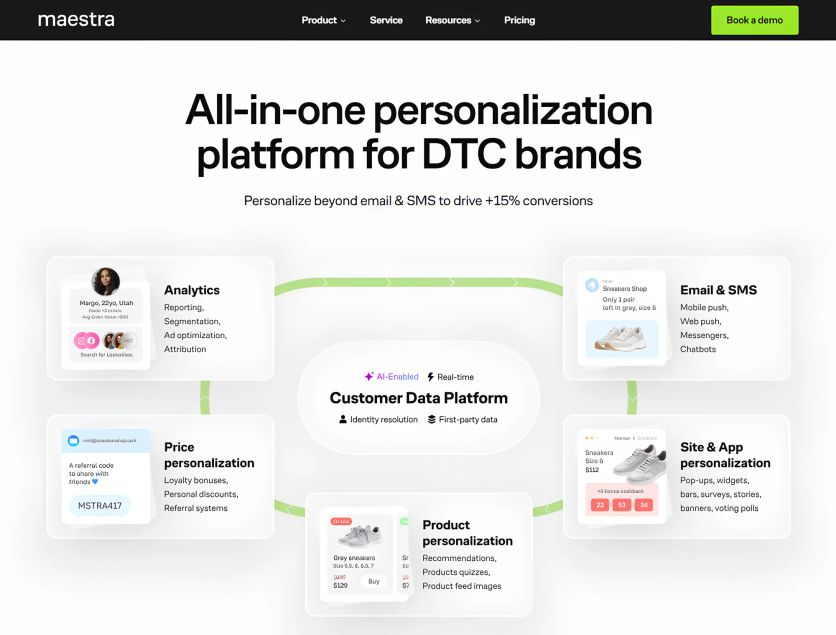
Best Iterable alternative for e-commerce brands that want one platform to replace their entire marketing stack
Maestra is an all-in-one marketing platform built specifically for mid-market and enterprise e-commerce brands. Where Iterable positions itself as an API-first messaging layer that integrates into a broader tech stack, Maestra takes the opposite approach – consolidating a real-time CDP, email, SMS, WhatsApp, push notifications, loyalty programs, site personalization, and product recommendations into a single platform with white-glove service included for every account.
Maestra is one of the fastest-growing platforms in the space, with a rapidly expanding customer base. Notable customers include Selkirk Sport, JOLYN, Enlightened Equipment, Urban Armor Gear, Sena, and Coolibar.
Key Features
• Real-Time CDP: Unified customer profiles from online and offline sources with sub-300ms processing and identity resolution across devices and channels. Unlike Iterable’s batch processing, Maestra processes data in real time.
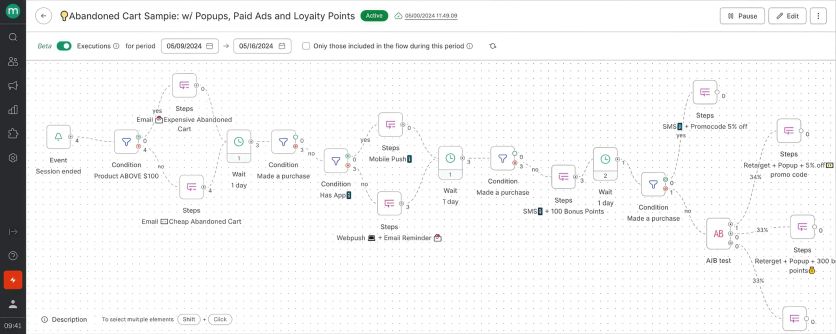
• Omnichannel Flow Builder: Omnichannel flow canvas spanning email, SMS, MMS, RCS, WhatsApp, push, in-app, chatbots, paid media (Meta/Google dynamic product cards), and offline channels from a single drag-and-drop builder.
• Built-In Loyalty & Referrals: Full loyalty suite with points, tiers, referrals, and behavior-based promotions integrates directly with your messaging flows and CDP data, so loyalty actions trigger personalized communications automatically. Native Shopify loyalty app with checkout and post-checkout widgets. Iterable has no native loyalty capability at all.
• Site Personalization: No-code lead forms with gamification, FOMO bars, product quizzes, sticky banners, embedded promo blocks, and A/B testing – an entire category Iterable doesn’t compete in.
• 14 AI Product Recommendation Algorithms: Personal recommendations, post-purchase cross-sell, category bestsellers, related products, recently browsed, event-based picks, and more – deployed across all channels: website, email, SMS, WhatsApp, push, MMS, RCS, and mobile app. Business rules let marketers fine-tune by color, price, category, and inventory. Iterable’s catalog feature is more generalized and less e-commerce-specific.
• AI-Powered Automation: AI assistant that proposes hypotheses and suggests segments and flows, Next Best Offer optimization, send-time optimization, and auto-generated email and SMS content.
• Reporting & Analytics: Full-funnel dashboards with last-non-direct-touch attribution, configurable attribution windows, email health monitoring with industry benchmarks, RFM-based segment analysis, A/B testing across every channel, and raw data export to BI tools.
• Dedicated Forward Deployed Marketer: Every Maestra client gets a dedicated Forward Deployed Marketer (a marketer who works as part of your team) with weekly strategy calls and a shared Slack channel – included in every plan, not gated behind premium tiers.
Strengths
Maestra’s biggest strength is that it genuinely replaces multiple tools. Urban Armor Gear consolidated three separate platforms into Maestra alone – saving approximately $100,000 annually while gaining capabilities none of those tools offered individually.
Maestra’s driving both cost savings and revenue growth. Enlightened Equipment migrated to the platform and saw +22% revenue growth with zero additional budget within 2 months.
Magnum Bikes, a premium e-bike brand with two Shopify stores, consolidated their marketing into Maestra and unified customer data across their online store, retail locations, and dealer network into a single profile. The team launched product-specific flows with distinct journeys for premium bikes, pre-owned inventory, and accessories, deployed geo-targeted campaigns for local store events, and coordinated four major promotions across email, SMS, and on-site elements – all without expanding the team. The result: +111.7% online order volume and +56.6% online revenue growth in the first year on Maestra.
Equally important is the level of service. Each Maestra client gets a dedicated Forward Deployed Marketer who actively builds flows, configures segments, and recommends strategies. Multiple clients describe the Maestra team as feeling like an extension of their own marketing department.
Weaknesses
On the weaknesses side, Maestra isn’t designed for very early-stage startups with small customer bases – a typical setup starts at $2,000/month (the CDP plus unlimited email), and those brands may not yet have the volume or complexity to get full value from the platform. Maestra is also purpose-built for e-commerce, so brands outside of DTC and retail won’t find the same depth of specialized features.
Pricing
Maestra starts at $2,000/month for the CDP plus unlimited email, with monthly modules for extra channels. Full pricing is published openly with an interactive calculator – you pay only for active profiles, and the first 100,000 are included. Billing is month-to-month with no setup or onboarding fees and no long-term lock-in.
Compared to Iterable
Maestra was ranked the #1 Iterable alternative by Email Vendor Selection, an independent analyst and review resource for marketing software. Their analysis described Maestra as “a specialist ecommerce marketing platform with white-glove service.”
Maestra is built for e-commerce consolidation first; Iterable is built for API-first messaging flexibility first. Iterable’s strength lies in its developer-friendly infrastructure and industry-agnostic approach – if your engineering team loves building custom integrations and your use case spans multiple verticals (fintech, media, gaming), Iterable gives them the tools to do so. Maestra’s strength is that it eliminates the need for all of that custom work by including CDP, loyalty, personalization, and recommendations natively – specifically for e-commerce.
If your marketing team needs to move independently of engineering, and you’re tired of stitching together 4–5 separate tools, Maestra is the stronger choice. Its Forward Deployed Marketer team handles much of the implementation and ongoing optimization work, so you can focus on strategy rather than platform operations. This is a stark contrast to Iterable, where premium support is paywalled and hands-on strategic guidance is reserved for the highest-paying enterprise accounts. If you have a large engineering team that thrives on API-first flexibility and your business extends well beyond retail, Iterable may still make sense.
When to Switch to Maestra from Iterable
Your marketing team can’t self-serve without engineering
Maestra’s hands-on support lets your marketing team act on any idea without waiting on engineering. JOLYN, a women’s athletic swimwear brand, hit +26% campaign-driven revenue, +52% SMS revenue, and 9x winback flow conversion growth – all driven by their marketing team without engineering involvement. With Maestra, abandoned cart emails show everything the customer browsed (not just the last item), and new flows like price drop alerts and AI-powered winback sequences launched without a single developer ticket.
You’re paying for 4+ separate tools and still have gaps
Iterable doesn’t offer on-site personalization and has no loyalty capability. Maestra doesn’t require third-party integrations for this. Urban Armor Gear consolidated Klaviyo (email), Yotpo Loyalty (loyalty), and Frosmo (personalization) into Maestra alone – reduced marketing stack costs by 64% while getting white-glove service none of those tools delivered.

Your reporting frustrations have become a business problem
Maestra’s built-in analytics suite ties every channel, flow, and campaign back to revenue so your team can see what’s working and adjust in real time.
You need real-time data processing for time-sensitive e-commerce triggers
Enlightened Equipment, an outdoor gear brand with 2 million yearly website visitors, switched to Maestra and optimized every step of the customer journey using real-time data processing. Dynamic Meta ad visuals automatically update with current prices, ratings, and inventory – showing only in-stock products. AI-powered recommendations adapt to each visitor: new shoppers see bestsellers, returning customers get personalized picks based on browsing behavior – capabilities that batch-processing platforms struggle to match. Advanced cart recovery flows combine email and SMS with intent-based triggers – price drop, low stock, and back-in-stock alerts – that fire when product data changes. The result: +52.5% total revenue growth YoY.
You need multi-region, multi-language operations in a single account
Sena, a motorcycle helmet brand, replaced two separate Klaviyo accounts for US and EU with a single Maestra account. Implementation took just 2 weeks. They saw 2.2x total revenue growth and 8.6x campaign-driven revenue growth YoY, while saving one week of work time per month through automatic language routing across 5 languages.
You want transparent, predictable pricing
Maestra publishes its pricing on the website with an interactive calculator – you can adjust your contact count and see exactly what you’ll pay as your business grows. No custom quotes, no hidden fees, no surprise invoices. Month-to-month billing means no long-term lock-in, and you only start paying once your account is fully live.
You need site personalization without a separate tool
Iterable doesn’t offer on-site personalization at all. With Maestra, no-code lead forms, product quizzes, FOMO bars, sticky banners, embedded promo blocks, and A/B testing are all built in – no need to integrate a separate personalization platform.
You want native loyalty without bolting on another vendor
Iterable has no loyalty capability whatsoever. Maestra’s built-in loyalty suite – points, tiers, referrals, and behavior-based promotions – integrates directly with your messaging flows and CDP data, so loyalty actions trigger personalized communications automatically. No third-party integration required.
2. Braze
Best Iterable alternative for mobile-first enterprise engagement at scale
Braze is Iterable’s closest competitor and the most common platform brands evaluate alongside it. As a publicly traded company (NASDAQ: BRZE), Braze is purpose-built for enterprise-scale customer engagement with particular strength in mobile channels – push notifications, in-app messaging, and Content Cards. If Iterable’s weakness is mobile, Braze’s strength is exactly that.
Key Features
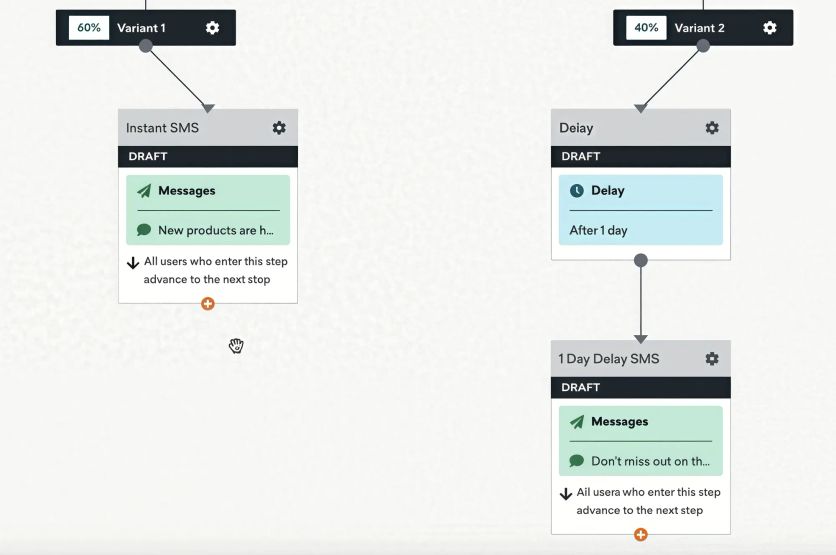
• Canvas Flow: Visual journey builder with experiment paths, audience sync, and real-time branching logic that handles complex multi-channel orchestrations at enterprise scale.
• Content Cards: Persistent, targetable content within native mobile apps.
• Liquid Personalization: More powerful than Iterable’s Handlebars – supports loops, assignments, and complex conditional logic for advanced dynamic content.
• Currents: Real-time data streaming to data warehouses, BI tools, and partner systems – addressing one of Iterable’s biggest data export limitations.
• Braze Sage AI: Copywriting assistant, predictive churn and purchase scoring, intelligent channel and send time selection, and personalized variant generation.
• WhatsApp & RCS Support: Native support for WhatsApp Business and RCS.
Strengths
Braze’s biggest strength is mobile engagement. It scores 9/10 on G2 for mobile push capabilities versus Iterable’s 8.3, and its Content Cards, in-app messaging, and push notification infrastructure are considered industry-leading.
Weaknesses
However, Braze comes with significant challenges. Implementation averages 4 months (some enterprise customers report 6–12 months), the learning curve is equally steep, and pricing starts around $60K/year with enterprise costs frequently reaching $200K–$500K. Braze’s reporting, while improving, is still criticized as less flexible than dedicated BI tools. And unlike Iterable’s generally praised customer support, Braze’s support quality varies more widely based on account size.
Pricing
Braze uses custom enterprise pricing, typically starting around $60,000/year and climbing to $200,000–$500,000 for larger deployments. There is no public pricing or free tier, so every quote requires a sales conversation.
Compared to Iterable
Braze and Iterable compete head-to-head on most capabilities, but the differences matter. Braze wins on mobile channels (Content Cards, WhatsApp, RCS, push optimization), personalization depth (Liquid vs. Handlebars), and real-time data streaming. Iterable wins on ease of use (G2 consistently rates it higher for usability), customer support responsiveness, email-specific features, and generally lower pricing.
If your brand is mobile-first and needs WhatsApp, advanced in-app messaging, or Content Cards, Braze is the clear choice. If you’re primarily email-centric and value faster implementation with stronger support, Iterable may still serve you better.
Compared to Maestra
Braze excels at mobile-first enterprise engagement across any industry, while Maestra offers a more complete e-commerce-specific stack with built-in loyalty, site personalization, and CDP. If your brand spans multiple verticals and mobile is your primary channel, Braze may be the better fit. If you’re an e-commerce brand that wants to consolidate tools and get hands-on strategic support from day one, Maestra wins – with faster implementation (2 weeks vs. 4+ months), transparent month-to-month pricing, and native loyalty/personalization that Braze requires third-party integrations for.
3. Klaviyo
Best Iterable alternative for Shopify-native email and SMS at a transparent price
Klaviyo is the dominant email and SMS platform in the Shopify ecosystem, with over 167,000 customers. Where Iterable targets engineering-led teams with API-first flexibility, Klaviyo targets marketers directly with a platform that non-technical users can operate independently from day one.
Key Features
• Native Shopify Integration: The deepest Shopify integration available – real-time sync of orders, products, browsing behavior, and customer data with a single click.
• Predictive Analytics: Built-in CLV prediction, churn risk scoring, and expected date of next order – without requiring a separate data science team or CDP.
• +350 Pre-Built Integrations: The broadest integration ecosystem among e-commerce marketing platforms.
• Smart Send Time: AI-optimized send time that adapts per-recipient, improving open and click rates without manual testing.
• Revenue Attribution: Direct revenue attribution for every flow, campaign, and individual message – addressing one of Iterable’s biggest reporting gaps.
• Pre-Built E-Commerce Flows: Ready-to-use abandoned cart, browse abandonment, post-purchase, and winback flows that work out of the box.
Strengths
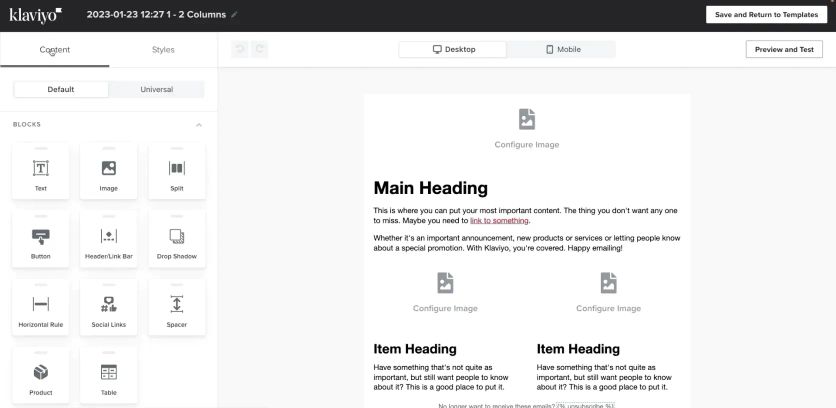
Klaviyo’s biggest strength is accessibility. A marketing manager can sign up, connect Shopify, and have automated flows running the same day – no developer required. The platform’s transparent pricing (published on their website, starting free) is a stark contrast to Iterable’s opaque, quote-only model. And Klaviyo’s revenue attribution gives marketers clear ROI visibility that Iterable’s reporting struggles to match.
Weaknesses
On the weaknesses side, Klaviyo is primarily an email and SMS platform. It lacks native push notifications, in-app messaging, WhatsApp, and advanced journey orchestration. Costs escalate significantly at scale – after a February 2025 pricing change to active-profile billing, brands with large databases saw meaningful increases. And for non-Shopify brands, the platform loses much of its competitive advantage.
Pricing
Klaviyo is free for up to 250 contacts, with paid plans from $20/month. Pricing is published openly and scales with your active-profile count, so costs can rise sharply for large databases under its active-profile billing model.
Compared to Iterable
Klaviyo is built for e-commerce marketers first; Iterable is built for cross-channel engineering teams first. Klaviyo wins decisively on ease of use, Shopify integration depth, transparent pricing, and revenue attribution. Iterable wins on multi-channel breadth (push, in-app, direct mail), API flexibility, and support for non-e-commerce use cases.
If you’re a Shopify brand primarily using email and SMS, and your marketing team wants to operate independently, Klaviyo delivers more value at a lower cost. If you need push notifications, in-app messaging, or a platform that works across multiple verticals, Iterable offers broader capabilities.
Compared to Maestra
Klaviyo excels at accessible, transparent email and SMS for Shopify brands, while Maestra provides a more complete omnichannel stack with built-in loyalty, CDP, site personalization, and dedicated Forward Deployed Marketer support. If you’re an SMB Shopify brand focused on email and SMS alone, Klaviyo’s lower starting price makes it the sensible choice. If you’ve outgrown email-only and need loyalty programs, site personalization, and strategic guidance without hiring additional tools or staff, Maestra delivers more per dollar – as demonstrated by multiple brands that switched from Klaviyo to Maestra and saw significant revenue lifts.
4. Bloomreach
Best Iterable alternative for unifying commerce experience with search, merchandising, and marketing
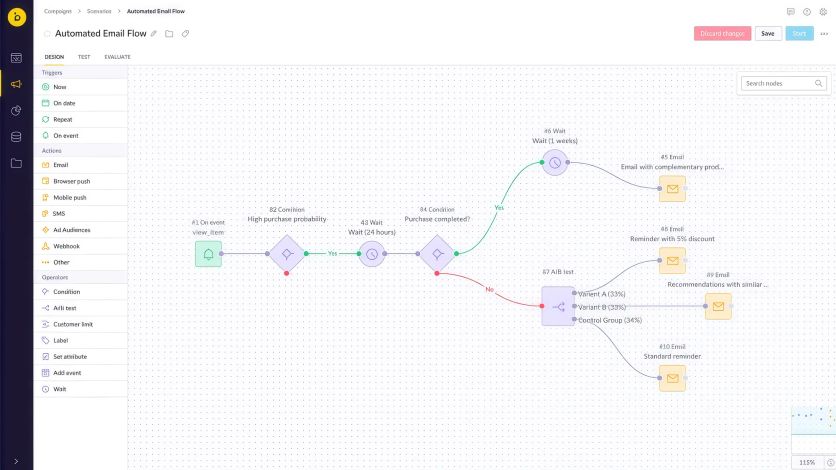
Bloomreach occupies a unique position in the market as a commerce experience platform that combines a CDP, marketing automation, AI-powered site search, and product merchandising in a single suite. Where Iterable focuses narrowly on messaging, Bloomreach extends into the full commerce experience – making it compelling for brands that want to optimize discovery, recommendations, and engagement together.
Key Features
• Loomi AI: Purpose-built commerce AI for content generation, product recommendations, search ranking, and customer journey decisioning – more commerce-specific than Iterable’s AI capabilities.
• Built-In CDP: Real-time customer data unification without requiring a third-party CDP or reverse ETL – solving one of Iterable’s fundamental gaps.
• Site Search & Merchandising: AI-powered search and product discovery engine – an entirely different category that Iterable doesn’t compete in.
• Omnichannel Orchestration: Email, SMS, push, in-app, web personalization, and ad audience sync from a unified platform.
• Product Recommendations: AI-driven, personalized recommendations across website, email, and app – with a commerce-specific understanding of inventory, margin, and seasonality.
Strengths
Bloomreach’s biggest strength is platform breadth. No other alternative on this list combines marketing automation with site search and merchandising in a single platform. For brands where product discovery is a key revenue driver, this integration creates compounding value – what customers search for informs what they’re marketed, and vice versa.
Weaknesses
On the weaknesses side, Bloomreach’s complexity rivals or exceeds Iterable’s. Implementation timelines are long, the platform has a significant cold-start problem for recommendations (requiring historical data before AI becomes effective), and average annual costs around $180K (up to $430K for enterprise) make it one of the most expensive options available. Third-party integrations are also less mature than competitors.
Pricing
Bloomreach uses custom enterprise pricing, with average annual costs around $180,000 and large deployments reaching $430,000. There is no public pricing or free tier, and contracts are typically annual.
Compared to Iterable
Bloomreach is built for unified commerce experience first; Iterable is built for cross-channel messaging first. Bloomreach wins on platform breadth (CDP + search + merchandising + marketing), product recommendation depth, and e-commerce specialization. Iterable wins on marketing automation maturity, ease of use for messaging-specific workflows, and a more extensive messaging channel set.
If your brand’s growth bottleneck is product discovery and you want search, merchandising, and marketing intelligence in one system, Bloomreach is the stronger platform. If you primarily need a messaging engine with strong API flexibility, Iterable remains more focused.
Compared to Maestra
Bloomreach offers broader commerce technology (search + merchandising), while Maestra provides stronger marketing-specific capabilities (loyalty, site personalization widgets, dedicated Forward Deployed Marketer). Both include native CDPs. If your primary challenge is product discovery and search optimization alongside marketing, Bloomreach’s breadth is compelling. If your primary challenge is marketing stack consolidation with hands-on strategic support, Maestra delivers faster time-to-value at a more accessible price point.
5. Customer.io
Best Iterable alternative for developer-friendly messaging with a visual workflow builder
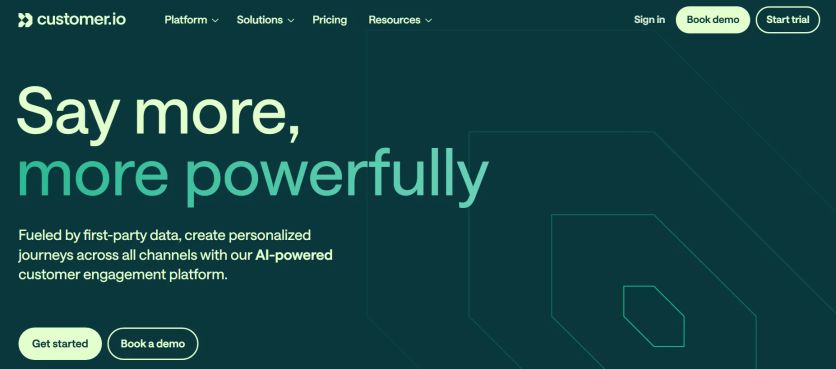
Customer.io is the platform most similar to Iterable in philosophy – API-first, developer-friendly, and designed for teams that want granular control over data and messaging. The key difference: Customer.io delivers this at a fraction of Iterable’s price, with a more intuitive visual workflow builder that also works well for non-developers.
Key Features
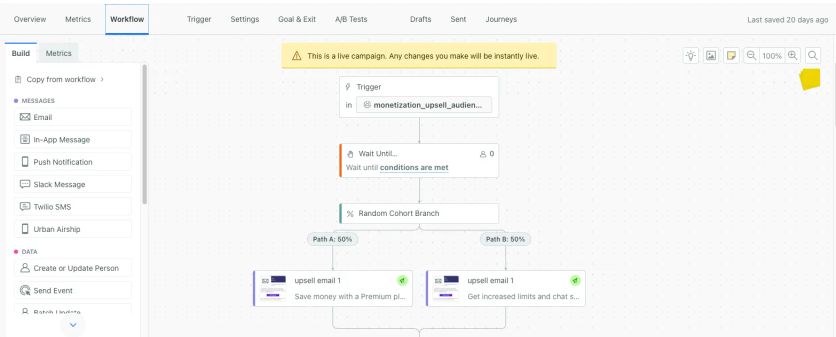
• Visual Workflow Builder: Drag-and-drop journeys with branching logic, delays, A/B testing, and webhook actions – more intuitive than Iterable’s workflow editor while maintaining comparable flexibility.
• Flexible Data Model: No rigid schema – send any data and use it immediately in segmentation and personalization without pre-defining fields. Addresses Iterable’s data structure limitations.
• Multi-Channel Messaging: Email, SMS, push notifications, and in-app messaging from a single platform.
• Ad Audience Sync: Native audience sync to Facebook, Google, and other ad platforms directly from workflows.
• Webhook Actions: Trigger external API calls directly within journeys – giving engineering teams the flexibility they expect from Iterable.
• Data Pipelines: Built-in reverse ETL to sync data from warehouses into Customer.io for activation.
Strengths
Customer.io’s biggest strength is the balance between developer flexibility and marketer usability. It offers the API-first approach that engineering teams love about Iterable, but wraps it in a more accessible visual interface that marketing teams can learn faster. At $100/month starting price versus Iterable’s opaque enterprise pricing, the cost difference is dramatic.
Weaknesses
On the weaknesses side, Customer.io is a smaller platform with fewer pre-built integrations than Iterable. Its mobile capabilities (push, in-app) are less mature, and it lacks the advanced AI features that Iterable and Braze offer. For very large enterprises with complex multi-brand requirements, Customer.io’s infrastructure may feel constraining.
Pricing
Customer.io starts at $100/month for its Essentials plan, with Premium at $1,000/month and custom pricing above that. Pricing is published openly and billed by the number of profiles in your account.
Compared to Iterable
Customer.io offers a similar API-first philosophy at a significantly lower price, with a more intuitive UI. Iterable wins on channel breadth, AI capabilities, and enterprise scale. Customer.io wins on pricing transparency, learning curve, and flexibility of its data model.
If you’re a mid-market brand that loves Iterable’s developer-friendly approach but not its pricing or complexity, Customer.io delivers 80% of the capability at a fraction of the cost.
Compared to Maestra
Customer.io excels at developer-friendly messaging with granular workflow control, while Maestra offers a complete e-commerce stack with loyalty, site personalization, and dedicated strategic support. If your team is engineering-led and you primarily need messaging automation with API flexibility, Customer.io is the leaner choice. If you’re an e-commerce brand that needs loyalty programs, product recommendations, and a Forward Deployed Marketer who builds flows for you, Maestra provides more value.
6. SAP Emarsys
Best Iterable alternative for enterprise retailers in the SAP ecosystem
SAP Emarsys (recently rebranded as SAP Engagement Cloud) is an omnichannel marketing automation platform designed for enterprise retailers – particularly those already running SAP Commerce Cloud, SAP S/4HANA, or other SAP systems. Where Iterable is industry-agnostic, Emarsys is purpose-built for retail with pre-built industry playbooks that eliminate months of custom development.
Key Features
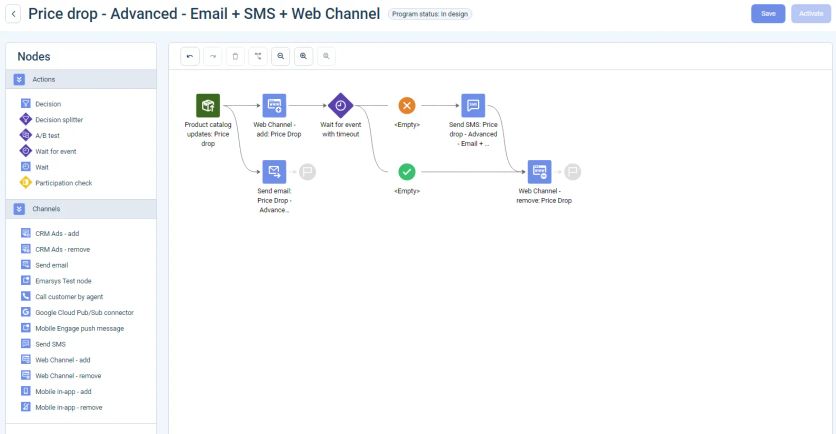
• Pre-Built Retail Playbooks: Ready-to-deploy automation strategies for cart abandonment, replenishment cycles, post-purchase nurturing, and loyalty re-engagement – no custom engineering required.
• AI Product Recommendations: Built-in recommendation engine trained on retail purchase patterns – more e-commerce-specific than Iterable’s catalog feature.
• Native SAP Commerce Integration: Seamless data flow between marketing, commerce, and ERP systems for brands already in the SAP ecosystem.
• Loyalty Management Module: Native loyalty program management – a capability Iterable lacks entirely.
• Web Channel Personalization: On-site content personalization based on customer segments and behavior.
• Customer Lifecycle Management: Visual customer lifecycle framework that maps customers to stages and triggers automated engagement accordingly.
Strengths
Emarsys’s biggest strength is time-to-value for retailers. The pre-built playbooks mean marketing teams can launch sophisticated automation sequences in days rather than the weeks or months Iterable typically requires. For SAP ecosystem brands, the native integration eliminates the data pipeline complexity that Iterable demands.
Weaknesses
On the weaknesses side, Emarsys’s pricing is enterprise-only and opaque – similar to Iterable’s approach. The platform’s UI feels dated compared to newer tools, customization beyond the pre-built playbooks can be limiting, and brands outside the SAP ecosystem lose much of the integration advantage. API flexibility is notably less than Iterable’s.
Pricing
SAP Emarsys uses custom, enterprise-only pricing – industry estimates put it around $100,000+/year depending on volume and modules. There is no public pricing or free tier, so costs require a direct quote.
Compared to Iterable
Emarsys is built for retail execution first; Iterable is built for cross-channel flexibility first. Emarsys wins on e-commerce-specific features (loyalty, recommendations, playbooks) and SAP integration. Iterable wins on API flexibility, developer experience, and multi-industry versatility.
If you’re a large retailer in the SAP ecosystem, Emarsys delivers more out-of-the-box value with less engineering effort. If you’re outside SAP and need API-first flexibility, Iterable remains more adaptable.
Compared to Maestra
Emarsys and Maestra both offer e-commerce-specific capabilities (loyalty, recommendations, personalization), but serve different segments. Emarsys targets very large enterprises in the SAP ecosystem with pre-built playbooks. Maestra targets mid-market and enterprise e-commerce brands and hands-on strategic support and transparent pricing. If you’re a large SAP retailer, Emarsys’s native integration is hard to beat. If you’re a mid-market brand that wants similar capabilities without enterprise-level complexity or SAP dependency, Maestra is the more accessible path.
7. Salesforce Marketing Cloud
Best Iterable alternative for enterprises standardized on the Salesforce ecosystem
Salesforce Marketing Cloud (SFMC) is the largest and most comprehensive marketing automation suite in the market. For enterprises already running Salesforce CRM and Commerce Cloud, SFMC offers the deepest integration and the broadest feature set available – at a premium price that matches its enterprise positioning.
Key Features
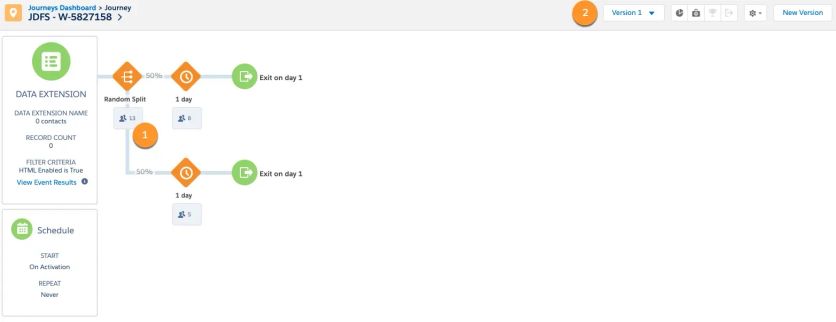
• Journey Builder: AI-powered journey orchestration with Einstein decisioning, branching logic, and multi-channel coordination across email, SMS, push, ads, and more.
• Einstein AI: Predictive engagement scoring, send time optimization, content selection, and next-best-action recommendations – deeper AI than Iterable currently offers.
• CRM Integration: The deepest CRM integration available – real-time sync between marketing, sales, service, and commerce data across the Salesforce ecosystem.
• Data Cloud (CDP): Built-in data unification for creating cross-channel segments.
• Multi-Org Support: Enterprise-grade multi-brand, multi-region, and multi-business-unit management – stronger than Iterable’s project-based approach.
• AppExchange Ecosystem: Thousands of third-party apps and integrations through the Salesforce marketplace.
Strengths
SFMC’s biggest strength is ecosystem integration. No other platform connects marketing, sales, service, and commerce data as deeply as Salesforce – and for enterprises already invested in the ecosystem, the switching costs make SFMC the path of least resistance.
Weaknesses
On the weaknesses side, SFMC is notoriously expensive (starting at $1,500/org/month with typical enterprise costs far exceeding six figures annually), implementation timelines stretch 6–12 months, and the platform’s complexity makes Iterable look simple by comparison. Einstein AI capabilities require premium-tier licensing, and the platform’s reputation for slow innovation in marketing-specific features frustrates teams used to more agile tools.
Pricing
Salesforce Marketing Cloud starts at $1,500/org/month for its entry edition, with typical enterprise costs running well into six figures annually. Advanced features such as Einstein AI require higher-tier licensing.
Compared to Iterable
SFMC is built for the Salesforce ecosystem first; Iterable is built for messaging agility first. SFMC wins on CRM depth, AI maturity (Einstein), and multi-org enterprise management. Iterable wins on implementation speed, ease of use, API flexibility, and cost – often by a significant margin.
If your organization lives in Salesforce and needs marketing to integrate deeply with sales and service, SFMC is the natural choice. If you want faster iteration, simpler implementation, and better engineering tools, Iterable is the leaner option.
Compared to Maestra
SFMC offers the deepest enterprise ecosystem, while Maestra provides a more focused e-commerce stack with faster implementation and transparent pricing. If you’re a large enterprise running Salesforce CRM and need marketing to integrate across your entire org, SFMC’s ecosystem integration is unmatched. If you’re an e-commerce brand that wants results in weeks (not months) with dedicated strategic support, Maestra delivers faster time-to-value – Sena, for example, migrated to Maestra in 2 weeks and saw 2.2x revenue growth YoY.
8. MoEngage
Best Iterable alternative for mobile-first brands wanting predictive AI without premium add-ons
MoEngage is an insights-led customer engagement platform with particular strength in mobile-first markets and predictive AI. Where Iterable charges extra for premium AI features and support tiers, MoEngage includes its Merlin AI suite – predictive analytics, send-time optimization, and content optimization – in its core platform.
Key Features
• Merlin AI Suite: Predictive churn scoring, optimal send time, content optimization, and next-best-channel recommendation – all included without premium add-on pricing.
• MTU-Based Pricing: Pay only for monthly active users, not total contacts in your database – a fundamentally different (and often cheaper) model than Iterable’s reachable-user billing that charges for undeliverable contacts.
• Smart Triggers: Real-time behavioral triggers that activate instantly – contrasting with Iterable’s batch-delayed processing.
• Push Amplification: Proprietary technology that boosts Android push delivery rates by 20–40% – addressing mobile notification reliability issues.
• Intelligent Path Optimizer: AI that automatically routes customers through the highest-performing journey path based on real-time behavior.
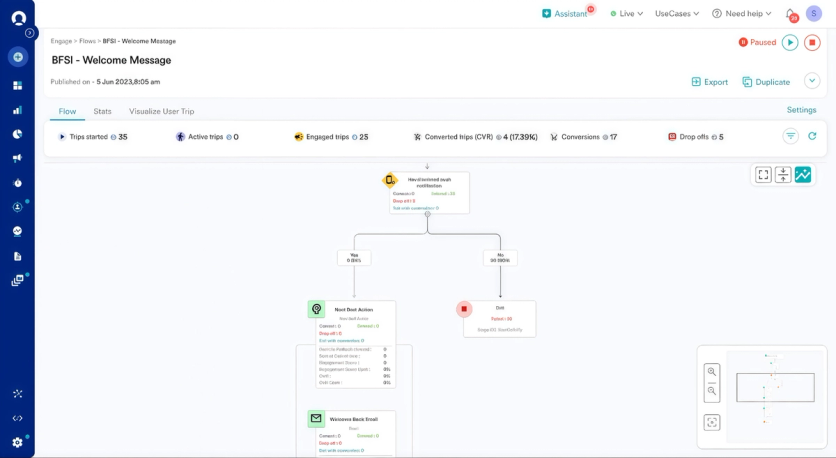
MoEngage flow builder
Strengths
MoEngage’s biggest strength is the AI-included-by-default model. Brands get predictive analytics, smart triggers, and content optimization without paying for premium tiers – capabilities that both Iterable and Braze gate behind enterprise pricing. The MTU-based pricing also means you never pay for dormant contacts.
Weaknesses
On the weaknesses side, MoEngage has a smaller North American presence (stronger in APAC and Middle East), fewer pre-built integrations than Iterable, and less mature email capabilities. For email-heavy brands, MoEngage’s email builder and deliverability infrastructure feel less polished than Iterable’s.
Pricing
MoEngage uses custom pricing, with third-party estimates starting around $999/month. Its MTU-based model charges only for monthly active users rather than your full contact database, which often works out cheaper at scale.
Compared to Iterable
MoEngage is built for insights-first mobile engagement; Iterable is built for API-first messaging flexibility. MoEngage wins on included AI capabilities, pricing fairness (MTU vs. reachable users), and push notification delivery (Push Amplification). Iterable wins on email maturity, API documentation, and North American market presence.
If your brand is mobile-first and you want AI-driven engagement without premium add-ons, MoEngage is the more cost-effective choice. If email is your primary channel and you need the deepest API toolkit, Iterable is more established.
Compared to Maestra
MoEngage excels at mobile-first AI engagement across diverse industries, while Maestra provides a more complete e-commerce-specific stack with loyalty, site personalization, and hands-on strategic support. If your brand is mobile-first and operates outside e-commerce, MoEngage’s AI suite and Push Amplification deliver strong value. If you’re an e-commerce brand that needs loyalty programs, product recommendations, and a dedicated Forward Deployed Marketer, Maestra’s purpose-built platform is the better fit.
9. OneSignal
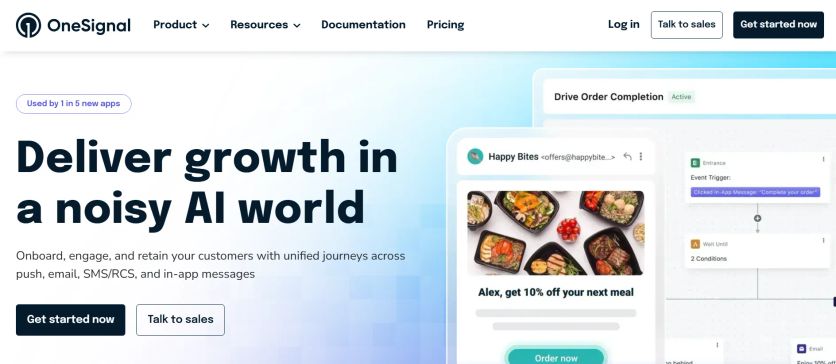
Best Iterable alternative for push notification-heavy use cases on a budget
OneSignal is a customer messaging platform that started as (and remains strongest as) a push notification specialist. With a generous free tier that includes unlimited mobile push subscribers, it’s the most accessible entry point for brands that primarily need push, in-app, and basic email – without Iterable’s enterprise pricing or complexity.
Key Features
• Unlimited Free Mobile Push: No subscriber limits on the free tier for mobile push notifications – a category where Iterable charges from dollar one.
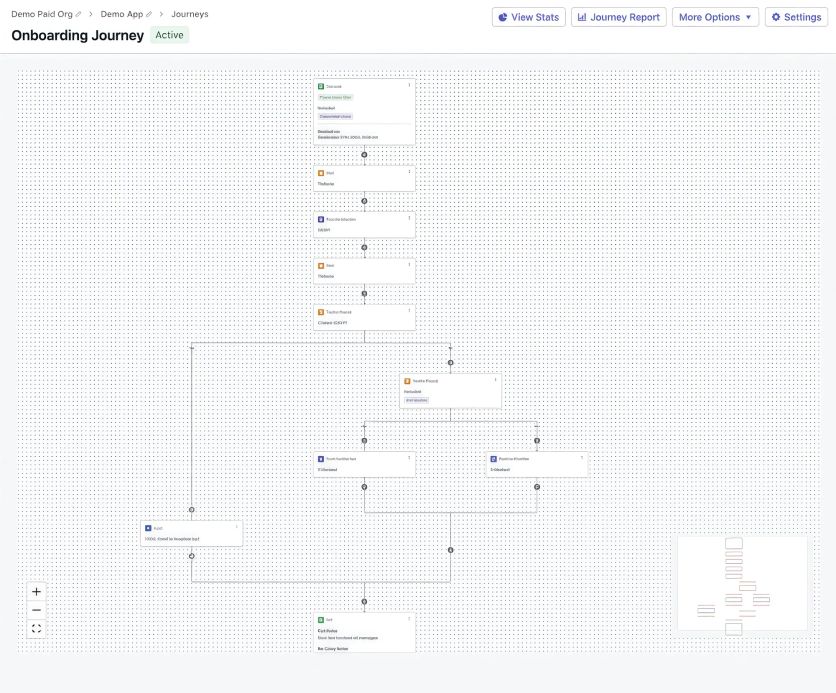
• Journeys Workflow Builder: Visual automation builder with branching, delays, and A/B testing – simpler than Iterable’s but sufficient for most push-centric use cases.
• In-App Messaging: Customizable in-app messages with targeting rules and templates – more straightforward than Iterable’s limited in-app options.
• A/B and Holdout Testing: Native experimentation capabilities for optimizing push, email, and in-app content.
• Real-Time Analytics: Live dashboard showing delivery rates, open rates, and conversion tracking without needing external BI tools.
• Web Push Support: Browser-based push notifications – a channel Iterable supports but OneSignal makes easier to implement.
Strengths
OneSignal’s biggest strength is accessibility. The free tier provides genuine value – unlimited mobile push subscribers with analytics – making it the lowest-risk way to start with push notifications. The paid plans (from $19/month) add email, SMS, and advanced segmentation at a fraction of Iterable’s cost.
Weaknesses
On the weaknesses side, OneSignal is not a full marketing automation replacement. Its email capabilities are basic, SMS is limited, there’s no native CDP, loyalty, or site personalization, and enterprise-scale journey orchestration isn’t its strength. Brands that need a comprehensive cross-channel platform will outgrow OneSignal.
Pricing
OneSignal offers a genuinely free tier with unlimited mobile push subscribers. Paid plans start at $19/month and add email, SMS, and advanced segmentation, with real-world costs scaling by channel as usage grows.
Compared to Iterable
OneSignal is built for push notification excellence at any budget; Iterable is built for enterprise cross-channel messaging. OneSignal wins on push notification infrastructure, pricing accessibility, and ease of implementation. Iterable wins on email sophistication, journey complexity, and multi-channel breadth.
If push notifications are your primary channel and you want the most cost-effective specialist, OneSignal delivers. If you need enterprise-grade email, SMS, and complex journey orchestration alongside push, Iterable offers more – at a significantly higher price.
Compared to Maestra
OneSignal is a push notification specialist; Maestra is a full-stack e-commerce marketing platform. These serve fundamentally different needs. If push is your only requirement and budget is tight, OneSignal’s free tier is unbeatable. If you need push as part of a broader omnichannel strategy with loyalty, personalization, CDP, and strategic support, Maestra is the comprehensive choice – brands like Coolibar saw +33.6% campaign revenue and +62% flow revenue growth within 2 months of switching.
10. Omnisend
Best Iterable alternative for Shopify-based e-commerce brands that want simplicity
Omnisend is an e-commerce-focused email and SMS platform built for brands that want sophisticated automation without complexity. With 27 pre-built e-commerce workflows, a product picker that pulls inventory directly from Shopify, and operational setup in as little as 1–2 hours, Omnisend is the fastest path from “we need a marketing platform” to “we’re sending revenue-generating campaigns.”
Key Features
• 27 Pre-Built E-Commerce Automations: Ready-to-use workflows for abandoned cart, browse abandonment, welcome series, post-purchase, replenishment, and more – each optimized for e-commerce conversion.
• Product Picker: Drag products directly from your store into emails – no manual image uploads or URL copying.
• Shopping Behavior Segmentation: Segment by purchase history, browsing behavior, cart value, and lifecycle stage with pre-built segments that work out of the box.
• Unified Email + SMS Workflows: Send email and SMS from the same automation canvas – a capability that requires more configuration in Iterable.
• 1-Click Shopify Setup: Install, connect, and start sending in under 2 hours.
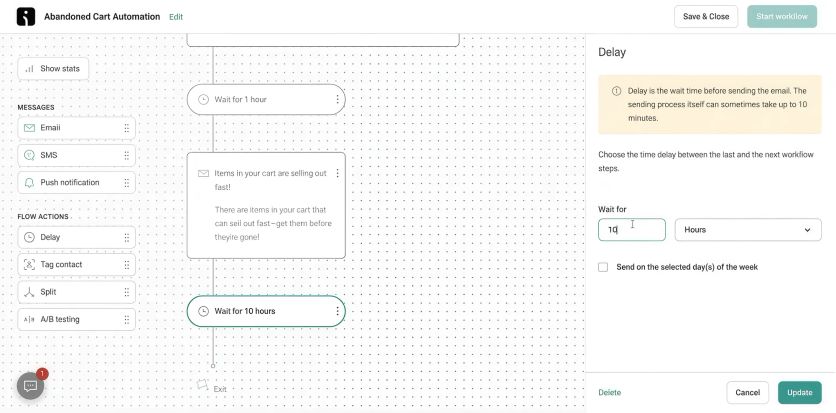
• Campaign Booster: Automatically resends campaigns to non-openers with a modified subject line.
Strengths
Omnisend’s biggest strength is time-to-value. A brand can install Omnisend, connect their Shopify store, activate pre-built workflows, and start generating automated revenue the same day – a timeline that would take weeks with Iterable. The transparent pricing (free tier available, paid plans from $16/month) makes budgeting simple.
Weaknesses
On the weaknesses side, Omnisend is not built for enterprise complexity. It lacks push notifications, in-app messaging, advanced journey orchestration, CDP capabilities, and the API flexibility that Iterable offers. Brands with multi-brand operations, non-Shopify platforms, or complex technical requirements will quickly find Omnisend constraining.
Pricing
Omnisend has a free tier for up to 250 contacts, with paid plans from $16/month. Pricing is published openly and scales with your billable contact count, making it easy to budget for smaller lists.
Compared to Iterable
Omnisend is built for Shopify e-commerce simplicity; Iterable is built for cross-channel enterprise flexibility. Omnisend wins decisively on ease of use, pricing accessibility, time-to-value, and e-commerce-specific features (product picker, pre-built workflows). Iterable wins on channel breadth, API flexibility, journey sophistication, and enterprise scalability.
If you’re a growing Shopify brand that needs email and SMS working today, Omnisend is the more practical choice. If you’ve outgrown email-only and need push, in-app, direct mail, or complex multi-channel journeys, Iterable offers capabilities Omnisend doesn’t.
Compared to Maestra
Omnisend serves the SMB-to-mid-market Shopify segment with accessible pricing and quick setup, while Maestra serves the mid-market-to-enterprise segment with a complete marketing stack. If you need only email + SMS, Omnisend’s price-to-value ratio is hard to beat. If you’re growing beyond email and need loyalty, CDP, site personalization, product recommendations, and strategic support, Maestra is the platform you grow into – and brands like Enlightened Equipment saw +22% revenue growth within 2 months of making that transition.
How to Choose Your Iterable Alternative
Choosing the right alternative to Iterable comes down to where it’s failing you most – opaque pricing, weak reporting, or workflows that need an engineer. If you want the most complete replacement in a single platform, start with Maestra.
Why Start with Maestra
Maestra replaces the entire stack – CDP, email, SMS, WhatsApp, push, loyalty, site personalization, and product recommendations – in a single platform with dedicated strategic support for every account. Where Iterable requires you to bolt on 3–5 additional tools and hire engineers to maintain them, Maestra includes everything natively. The results speak for themselves: brands like Magnum Bikes saw +111.7% online order volume growth, JOLYN saw +52% SMS revenue growth, and Enlightened Equipment achieved 2,440% email/SMS ROI – all within months of switching.
The tools you choose shape the results you get. In a market where marketing complexity grows every quarter, the platform that consolidates rather than fragments your stack isn’t just a software decision – it’s a growth strategy.
Start with Maestra – book a demo and see how one platform can replace your entire marketing stack while delivering the revenue growth and hands-on support your team deserves.
FAQ
- For push notifications, OneSignal offers unlimited free mobile push subscribers – a genuine free tier that delivers real value. For email and SMS, Omnisend and Klaviyo both offer free plans suitable for smaller lists. If you’re looking for a platform that will scale with your business, Maestra starts at $2,000/month for the CDP plus unlimited email, and every plan includes a dedicated Forward Deployed Marketer. Loyalty and site personalization are added as monthly modules, and you pay only for active profiles. Brands like Enlightened Equipment saw 2,440% email/SMS ROI within 2 months, making the investment pay for itself quickly.
- For pure mobile engagement, Braze leads with Content Cards, WhatsApp, RCS, and advanced push. MoEngage’s Push Amplification boosts Android delivery by 20–40%. For e-commerce brands specifically, Maestra offers SMS, MMS, RCS, WhatsApp, push, and in-app messaging all coordinated within a single flow builder alongside loyalty and site personalization – JOLYN saw +52% SMS revenue growth after switching to Maestra’s unified approach.
- Yes – Maestra is one of the only marketing platforms with a fully native loyalty suite: points, tiers, referrals, and behavior-based promotions. This is a significant advantage over Iterable (which has no loyalty capability) and even Braze and Klaviyo (which require third-party integrations like Zinrelo or Talon.One). Urban Armor Gear consolidated their separate loyalty tool into Maestra and saved approximately $100,000 annually while gaining deeper loyalty-to-messaging integration.
- Migration complexity depends on data volume and integration depth. Platforms like Customer.io and Klaviyo offer migration guides and support. Maestra handles the entire migration for you as part of onboarding – with no setup fees and no onboarding fees. Sena completed their full migration to Maestra in just 2 weeks, including multi-region data unification across US and EU operations, with Maestra’s team doing the heavy lifting.
- Maestra supports multiple brands ($500/month per additional brand after the first 3) with automatic language routing and multi-store unification – Sena unified US and EU operations into a single account, reducing email flow versions from 6 to 1. For very large enterprises, Salesforce Marketing Cloud offers the most mature multi-org governance. SAP Emarsys integrates deeply with SAP’s commerce infrastructure for global retailers.
- Iterable’s support is generally well-rated but paywalled – premium support, live chat, and phone access require higher-tier plans. Customer.io and Klaviyo offer more accessible support at lower price points. Maestra takes a fundamentally different approach: every client gets a dedicated Forward Deployed Marketer, weekly strategy calls, a shared Slack channel, and 5-minute response times – regardless of plan tier. As multiple case studies confirm, clients describe the Maestra team as feeling like an extension of their own team.
- Yes – several alternatives excel outside e-commerce. Braze serves fintech, media, and gaming. Customer.io works well for SaaS and digital products. Salesforce Marketing Cloud spans every industry. MoEngage is strong in banking and media across APAC. For e-commerce specifically, Maestra provides the deepest purpose-built features – but if your business extends beyond retail, platforms like Braze or Customer.io offer more versatile foundations.
- Maestra (one-click Shopify integration), Omnisend (1–2 hours for Shopify), Klaviyo (same day for Shopify), and OneSignal (hours for push) offer the fastest starts. Among comprehensive platforms, Maestra stands out – Sena completed a full migration including multi-region data unification in just 2 weeks. By contrast, Braze averages 4 months and SFMC can take 6–12 months.